
Skip to content

Hotel SEO strategy

Regulated marketing

The strategy is direct booking economics, not rankings

Written by Eugene SuslovLast reviewed 29 August 2026No affiliate links
Sector
Lifestyle and leisure
Model
Local service, Marketplace
Competition
Brutal
Time to results
6 to 15 months
Typical monthly
$3,000 to $15,000

Key takeaways

  1. 1The travel agencies are your competitor and your top of funnel at once. Most of your brand searches exist because somebody saw you on an OTA, so the job is converting demand you did not create.
  2. 2Rank is the wrong target. Direct share of bookings is the number, because a reservation that arrives through an OTA and one that arrives through your site are worth very different amounts to the same hotel.
  3. 3Since 12 May 2025 a displayed rate has to be the total price including mandatory fees, more prominently than anything else on the screen. That reaches your metasearch feed and your markup, not just the booking page.
  4. 4The accessible-room page is a legal requirement and a searched query at the same time, and almost no independent hotel has written it properly.
  5. 5Event demand is the one cluster you can write a year early. Recurring events produce dated, high-rate searches that nobody is competing for in the eleven months before they happen.

SEO for hotels is unusual because the biggest competitor is also the largest source of demand. Online travel agencies rank for the queries that discover a hotel, take a commission on the booking, and in the process teach a large number of travellers your name.

Those travellers then search that name. The pattern is old enough to have its own term in the industry, the billboard effect, and it changes what a search programme is actually for.

A hotel SEO strategy is therefore mostly about conversion rather than discovery. Somebody arriving on a brand query has already chosen the property, and everything from that point is whether they book with you or go back to the tab that sent them.

The economics are what make it worth the effort. A direct booking and an intermediated one produce very different net rates on the same room, so a modest shift in channel mix is worth more than a large gain in a term the agencies will win anyway.

What you may do about it is constrained in a way that is rare in this directory. Rate parity clauses remain a standard condition of participation in the United States, so the lever is usually what you can add rather than what you can subtract.

And two federal rules now sit on the pages themselves. One decides how a rate may be shown, the other decides what a reservation page has to say about accessible rooms, and both are content problems before they are legal ones.

Who already ranks in hotels

Search a destination query, then your own property name, and note where the ten blue links actually begin. Most hotel SEO audits find the same thing: Google's own hotel module takes the first screen on the destination query, the agencies take the next four positions, and the property's own site appears somewhere below a listing of itself.

What is on the results page

  • Google's hotel module and map above the organic results on destination queries
  • Free booking links inside that module, which most independents have never claimed
  • Online travel agencies occupying most of the first organic page
  • Review platforms with ranked best-of lists per city and per category
  • Brand queries where an agency listing of your hotel outranks parts of your own site
  • People Also Ask on parking, check-in time, pets, resort fees and cancellation
  • Image and map results doing more work than usual, because the decision is visual
  • Booking.com and the major agencies

    booking.comClaim it

    Competitor, distributor and demand generator at the same time, which is why a plan to remove them usually fails. Treat the listing as advertising you pay for on conversion, keep the content and photography there as good as your own, and judge the channel on net rate after commission rather than on volume.

  • Google's hotel module and free booking links

    google.comClaim it

    The module sits above organic entirely, so a hotel can rank first in the blue links and still be below the fold. Free booking links let a property show its own rate inside it, and a surprising number of independents have never connected their booking engine to do so. That is the single highest-value technical task on this page.

  • Tripadvisor

    tripadvisor.comClaim it

    Still dominant on best-of and category queries in most destinations, and it ranks for phrasings a hotel cannot target directly. The listing is the asset, not the traffic. Keep the amenity data accurate, because those fields feed the filters travellers actually use to narrow a shortlist.

  • Metasearch comparison sites

    kayak.comClaim it

    They aggregate rates rather than sell rooms, and your own rate appears there only if you feed it. Because they display a price, they are also inside the total-price rules, so the feed is a compliance surface and not only a marketing one.

  • Brand and chain websites

    marriott.com

    If you are flagged, the brand site outranks you for your own name and usually owns the only property page a search engine trusts. Find out precisely what your agreement permits before you invest in a separate site, because the answer decides whether you build one at all.

  • Destination marketing organisations

    discoverlosangeles.comClaim it

    Convention and visitor bureaux rank well for destination and event queries and list member properties for free or for a modest fee. Genuinely useful links, a genuine referral source, and most hotels have an incomplete listing sitting there.

  • Airbnb and the short-term rental platforms

    airbnb.com

    Not a directory and increasingly a competitor for the same searches, particularly on group and longer-stay queries. The useful response is to compete on the things a rental cannot offer, front desk, daily housekeeping, cancellation flexibility, and to say so on the page rather than to ignore the comparison.

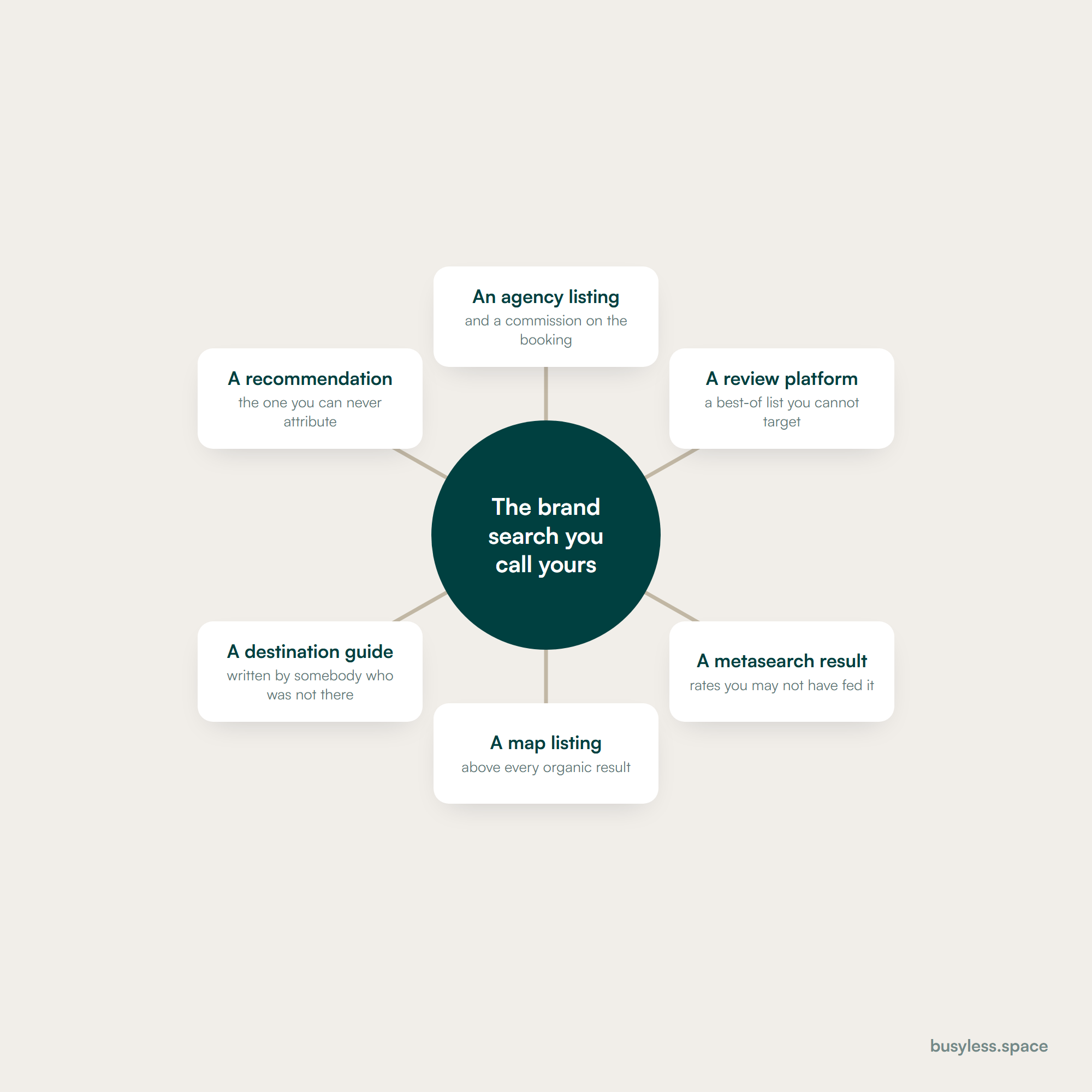
Six spokes around one hub. The hub is the brand search a hotel treats as its own; the spokes are an agency listing, a review platform, a metasearch result, a map listing, a destination guide and a personal recommendation.
Five of the six leave a trace you can measure. The sixth is the one that most often decides it.

What people actually search

Travel search runs from a destination nobody has chosen yet to a property somebody has already chosen, and the value rises sharply along the way. The cluster in the middle, dated event demand, is the one almost nobody writes for.

Destination inspiration

Informational

things to do in [city] in [month]

The page that wins it: Genuinely local guides written by people who live there

The agencies are weaker here than anywhere else, because their content is written at scale from a desk. It converts slowly and it is the only place a small hotel can out-write a large platform.

Proximity to a place

Commercial investigation

hotels near [venue or airport]

The page that wins it: A page per landmark with real walking times and transport detail

High intent and answerable with facts nobody else has bothered to check. Walking minutes, which exit, where the taxi rank is, whether the last train helps. Write it from having walked it.

Dated event demand

Transactional

hotels for [event] [year]

The page that wins it: A page per recurring event, published a year ahead

The cluster unique to this industry. The date is known in advance, the rate is high, the demand is concentrated, and for eleven months of the year nobody is competing for it.

Brand and book direct

Navigational

[hotel name]

The page that wins it: A home page and rate page that answer the comparison immediately

The most valuable traffic you get and mostly created by somebody else's listing. The visitor is deciding between your site and the tab they came from, so the page has to win that comparison in a few seconds.

Policy and logistics

Navigational

[hotel name] parking

The page that wins it: A properties-and-policies page covering every practical question

Enormous combined volume, low glamour, and usually answered by an agency listing rather than by the hotel. Parking, check-in, pets, cots, luggage storage, late arrival, breakfast times.

Accessibility

Commercial investigation

wheelchair accessible hotel [city]

The page that wins it: A detailed accessible-features page per room type

A legal requirement and a commercial opportunity in the same page. The traveller needs specifics to decide independently, and vague reassurance is both unhelpful and non-compliant.

Amenity and policy filters

Commercial investigation

pet friendly hotel [city]

The page that wins it: A page per genuine differentiator, with the actual terms

These behave as hard requirements rather than preferences, so intent is very high. State the fee, the size limit and the rules, because the traveller is trying to eliminate options rather than be persuaded.

Groups, weddings and meetings

Commercial investigation

wedding venue [city]

The page that wins it: A dedicated section with capacities, layouts and real pricing

A different buyer, a much larger transaction and a longer decision. It rarely shares a page with leisure content well, and the agencies are almost absent from it.

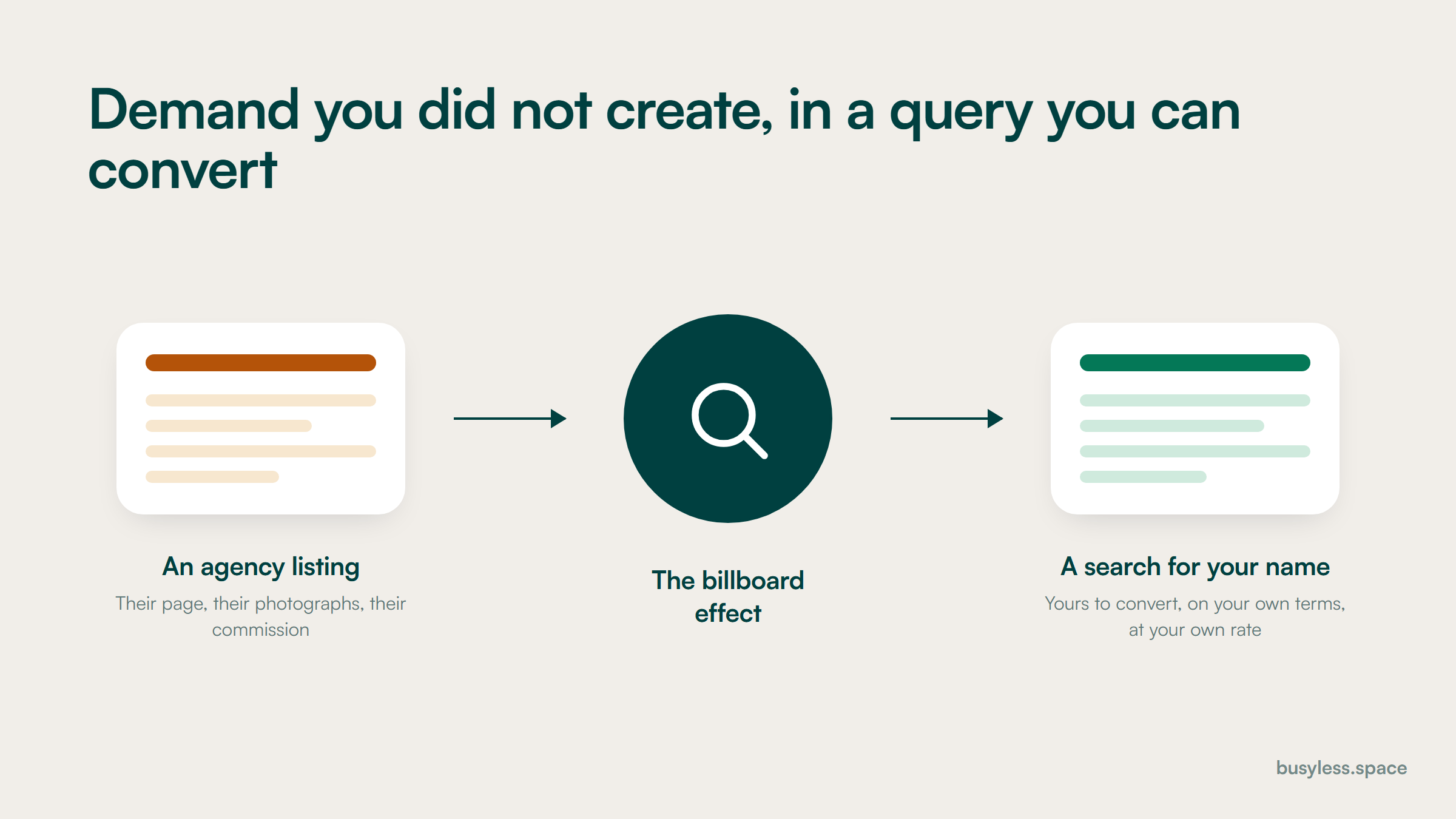
A linear flow of three stops: an agency listing, then the billboard effect, then a search for the hotel's own name.
It runs one way only, which is why removing the first box does not leave the third one standing.

What the rules change

Two federal rules land directly on the pages this playbook builds, one state law got there first, and a third constraint is not law at all but a contract you signed. Check your own jurisdiction and your own counsel; none of this is legal advice.

1

A displayed rate has to be the total price

FTC Rule on Unfair or Deceptive Fees, 16 CFR Part 464, in force 12 May 2025, covering short-term lodging and live-event tickets

What it means

It is an unfair and deceptive practice to offer, display or advertise a price for short-term lodging without clearly, conspicuously and prominently disclosing the total price, which means every mandatory fee and charge except government charges and genuinely optional extras. The total has to be shown more prominently than any other pricing information, and the nature and purpose of a fee may not be misrepresented.

So do this

Audit every surface where a rate appears: the booking engine, the rate table, the metasearch feed, the structured data and the meta description. Resort and destination fees belong inside the headline number. A feed showing a lower rate than the site is now a compliance problem as well as a conversion one.

2

Several states got there before the federal rule, and theirs still apply

California Assembly Bill 537, effective 1 July 2024, which applies specifically to short-term lodging and carries a stated penalty per violation, alongside the state's wider hidden-fees statute

What it means

California requires hotels, motels and short-term rentals to disclose the total price of a stay in the advertised rate, including cleaning and similar mandatory charges, with taxes and government charges excepted. It reached lodging almost a year before the federal rule and it did not go away when the federal rule arrived.

So do this

If you operate in or advertise into a state with its own lodging pricing law, comply with the stricter of the two. Practically that means one all-in display standard everywhere rather than a different rate presentation per market, which is also simpler to maintain.

3

The reservation page has to describe accessible features in real detail

Americans with Disabilities Act Title III regulations, 28 CFR 36.302(e), in effect since 15 March 2012

What it means

A place of lodging must identify and describe accessible features in the hotel and in guest rooms offered through its reservations service in enough detail to let a person with a disability assess independently whether the room meets their needs. It must also hold accessible rooms until all of them are booked and guarantee the specific accessible room reserved. This is a content obligation, not a website code obligation.

So do this

Write a real accessible-features page and put the specifics on each room type: door widths, roll-in shower or transfer bench, bed height, grab bar positions, the route from the parking space, and what the lift and lobby are actually like. Then check the booking engine can hold and guarantee the specific room.

4

Rate parity is a contract, not a law, and it still constrains you

Standard distribution agreements with the major online travel agencies; there is no national ban in the United States, unlike the position in Europe

What it means

Parity clauses restrict what rate a hotel may publish on its own site relative to the agency channel, and in the wider form across other channels too. European regulators have largely dismantled them; in the United States they remain a normal condition of participation and courts have generally upheld them. That makes them the only constraint in this directory imposed by a counterparty rather than a regulator.

So do this

Read your own agreement and find out which form you signed, because operators frequently do not know. Then build the direct case out of things parity does not reach: inclusions, room selection, flexible cancellation, loyalty benefits, early check-in, and a members rate where your agreement allows one.

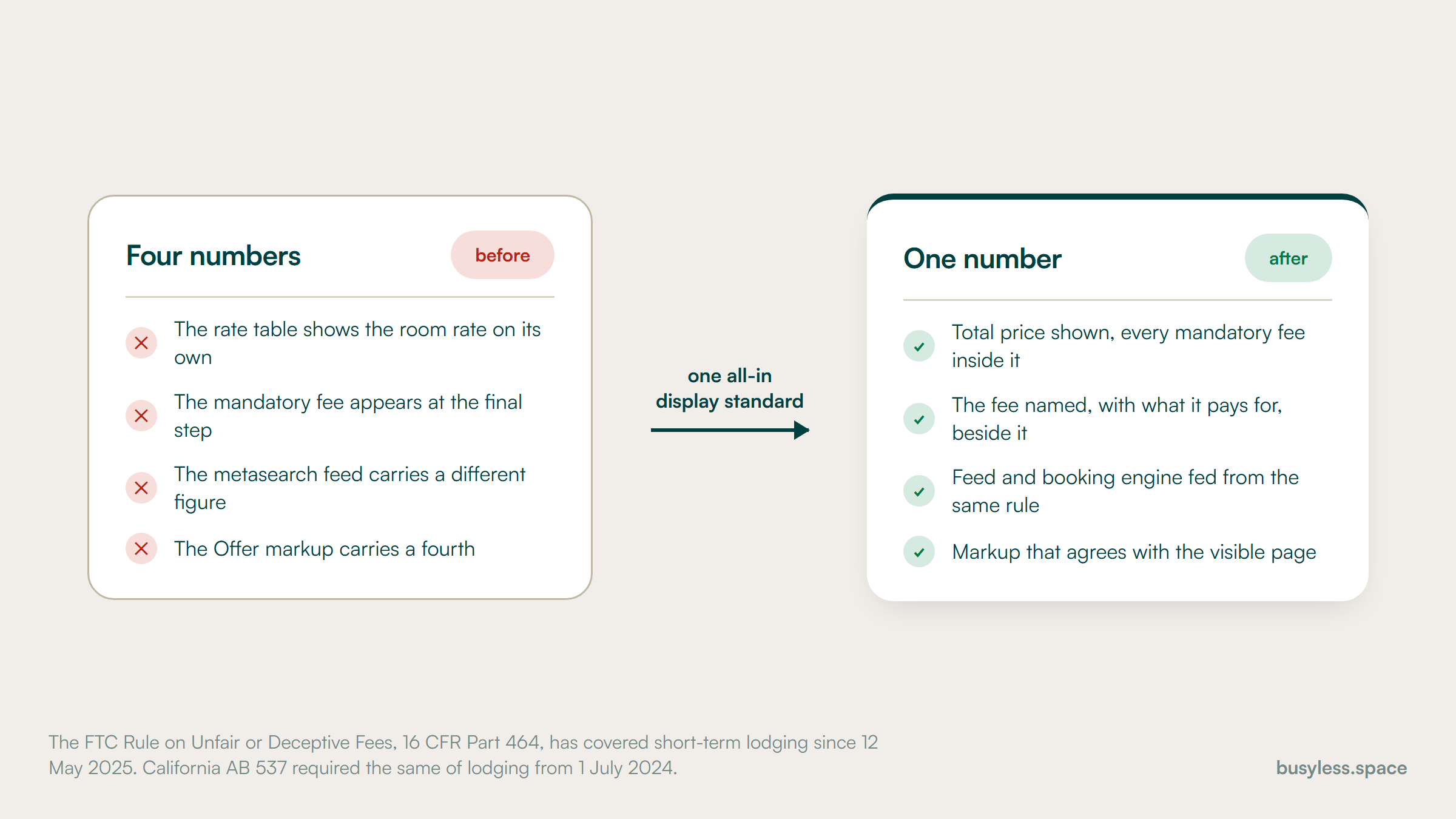
Two panels. Before: the rate table shows the room rate alone, the mandatory fee appears at the final step, the metasearch feed carries a third figure and the Offer markup a fourth. After: one total price, consistent across all four surfaces.
Nothing about the rate itself changes here. What changes is the rule deciding how it may be displayed.

Proving expertise

A traveller is buying somewhere to sleep in a place they do not know, sight unseen, usually paid in advance. What settles it is specific, checkable detail about the property, which is exactly what marketing copy tends to sand off.

  • Photographs of every room type, current, unstaged and named to match the booking engine
  • Real walking times to the places guests actually go, measured rather than estimated
  • Every policy stated in full: check-in, parking, pets, cots, luggage, late arrival, cancellation
  • Accessible features described in measurements rather than in reassurances
  • The total price shown as the total price, with every mandatory fee inside it
  • Named staff, and a real phone number answered by somebody at the property
  • Honest description of the neighbourhood, including what is noisy and what is far
  • Reviews answered specifically, including the negative ones about the things you know are true

How to build a hotel SEO strategy

Nine months, ordered by contribution to net rate rather than by traffic. A hotel SEO strategy that begins with destination content spends six months producing readers; one that begins with the brand and policy pages starts shifting channel mix in the first quarter.

  1. 1

    Weeks 1 to 4

    Fix the money pages and the rate display

    • Audit every surface where a rate appears against the total-price rule
    • Connect the booking engine to free booking links inside the hotel module
    • Rebuild the rate page so the direct case is visible without scrolling
    • Write the full policies page covering every practical question
    • Publish a page per room type with its own photographs and its own name
    • Read the distribution agreement and establish which parity form applies

    You end up with
    A brand query that converts, and a rate displayed the same way everywhere

  2. 2

    Weeks 4 to 10

    Take proximity and accessibility

    • Build a page per landmark, venue and transport hub with measured walking times
    • Write the accessible-features page and add specifics to every room type
    • Confirm the booking engine can hold and guarantee a specific accessible room
    • Add hotel, room and offer structured data carrying the total price
    • Complete the destination marketing organisation listing
    • Fix the image weight so the pages load on a phone in a hotel lobby

    You end up with
    The high-intent proximity queries covered and a legal requirement satisfied

  3. 3

    Weeks 8 to 20

    Write next year's demand this year

    • List every recurring event within reach of the property, with dates
    • Publish a page per event a year ahead of it
    • Build genuinely local destination guides written by people who live there
    • Build the groups, weddings and meetings section with capacities and real prices
    • Link every guide to a room type rather than to the home page
    • Set a calendar to refresh event pages the week the next dates are announced

    You end up with
    Dated demand captured before anybody else has written the page

  4. 4

    Weeks 16 to 36

    Measure channel mix, not rankings

    • Report direct share of room nights every month
    • Report net rate by channel after commission and after acquisition cost
    • Track brand query volume as the demand the agencies are creating for you
    • Track assisted paths from destination content to booking
    • Compare cancellation and length of stay by channel
    • Review the agency mix annually against net contribution, not volume

    You end up with
    A report about the profitability of a room night rather than the position of a keyword

Technical fixes with the best payoff

Hotel websites fail in a distinctive way. They are built as brochures for a property that is also being sold, better, on four other domains, and the pages that would differentiate them are the ones nobody has written.

  • The room descriptions came from the brand and are already on four sites

    A day per property

    Chain and representation companies supply standard room copy, and the same paragraphs appear on the brand site, two agencies and a metasearch listing. The hotel's own page is therefore the least authoritative copy of text it did not write, competing with domains far stronger than its own.

    Rewrite every room type from the room itself. Which floors it is on, what the view actually is, bed dimensions, bathroom layout, noise, what is different about the corner ones. It is a day of work per property and it is the only version of that page that exists anywhere.

  • Nobody has claimed free booking links

    A conversation and a configuration

    Google's hotel module sits above the organic results, and a property can show its own rate inside it without paying for placement. It requires the booking engine or a connectivity partner to feed rates and availability, which nobody has been asked to do, so the module shows agency rates only.

    Ask your booking engine provider to enable it, or use a connectivity partner. It puts your own rate beside the agency rates in the place travellers actually look, above everything this playbook can otherwise reach.

  • The rate on the site, the feed and the markup disagree

    A sprint, then quarterly

    Rates are pushed to metasearch by one system, rendered on the site by another and marked up by a third, and mandatory fees are handled differently in each. Since May 2025 that is not only a conversion problem: a displayed price that excludes a mandatory fee is the thing the rule prohibits.

    Establish one all-in display standard and apply it to the booking engine, the rate table, every feed and the structured data. Then test the same room and date across all four surfaces every quarter, because a system update will break it silently.

  • There is no accessible-features page

    A day of measuring, a day of writing

    The reservation rules require accessible features to be described in enough detail for independent assessment, and the typical hotel site offers a tick box labelled accessible room. It also happens to be a searched query with almost no competition, so the gap is legal and commercial at once.

    Measure and publish: door widths, turning space, roll-in shower or transfer bench, grab bar positions, bed height, the route from the accessible parking bay, lift dimensions. Add it to each room type as well as a summary page, and photograph it.

  • The hero video is the largest page element on a phone

    A sprint

    Hospitality sites are sold on imagery, so the home page opens with an autoplaying video and a full-bleed gallery. A large share of these visits happen on mobile data, often while travelling, and the page that will not load is the page that loses the direct booking to the app the visitor already has.

    Serve modern formats at sensible dimensions, defer everything below the fold, and make the first meaningful paint the rate and the book button rather than the pool. Test on a throttled connection rather than on office wifi.

  • Destination content sits on a blog with no route to a booking

    An afternoon per guide

    Hotels do produce local guides, and they usually live under a blog with a link to the home page at the end. The visitor who wanted a neighbourhood is sent to a generic entry page and has to start the decision over.

    Link every guide to the room type or offer it implies, and put a booking module with dates inside the article rather than after it. Internal links from destination content to rate pages are the whole mechanism by which upper-funnel content pays.

  • International guests get a machine translation or nothing

    A sprint per language

    A meaningful share of demand for many properties is from other countries, and the usual response is a browser translation widget that produces pages search engines will not index as separate documents. The alternative failure is a language folder with no hreflang and no localised rates.

    Pick the two or three source markets that actually book, translate the money pages properly, and implement hreflang correctly with currency and payment expectations localised. Do not translate the blog. Translate the room types, the policies and the rate page.

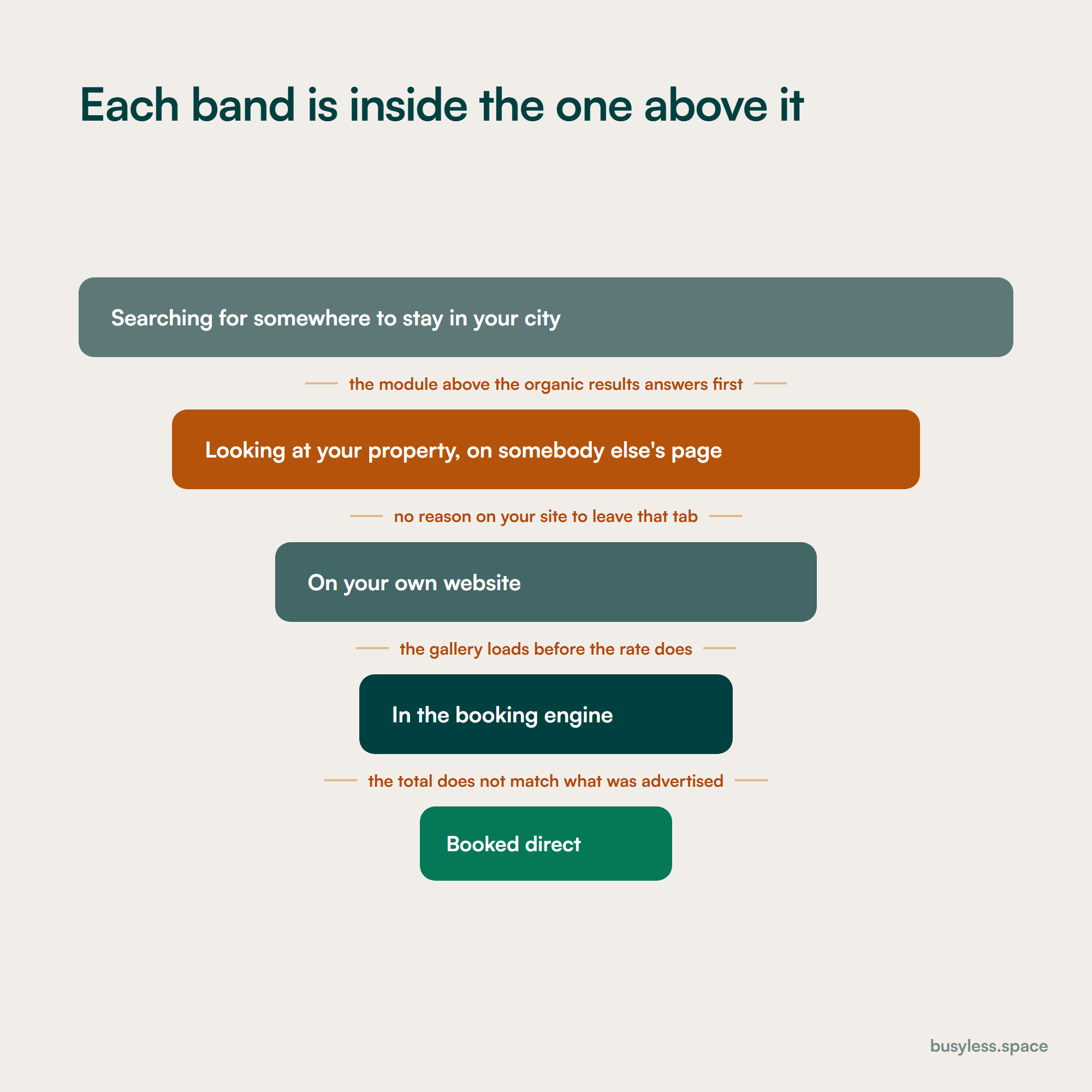
Five nested bands narrowing from everybody searching for a room in the city down to a direct booking, with the technical defect that removes each band written in the gap beneath it.
No counts on the bands. Each is contained by the one above it, so the taper is a fact about the sets rather than a measurement.

Structured data that applies here

The types below fit this industry specifically. Most of them earn no rich result on their own, which is worth knowing before anyone sells the work on that basis. What they do is describe the entity precisely, which matters for how search engines and answer engines resolve who you are.

  • Hotel

    The home page and every property page

    Hotel sits under LodgingBusiness in the vocabulary. The fields worth filling are the ones a traveller filters on, and the accessibility features here should mirror the visible page rather than replace it.

    Hotel.jsonld
    {
      "@context": "https://schema.org",
      "@type": "Hotel",
      "@id": "https://[YOUR-DOMAIN]/#hotel",
      "name": "[HOTEL NAME]",
      "url": "https://[YOUR-DOMAIN]/",
      "telephone": "[+1-555-000-0000]",
      "priceRange": "[$$$]",
      "image": "https://[YOUR-DOMAIN]/exterior.jpg",
      "starRating": { "@type": "Rating", "ratingValue": "[4]" },
      "checkinTime": "[15:00]",
      "checkoutTime": "[11:00]",
      "petsAllowed": "[true or a sentence stating the fee and size limit]",
      "numberOfRooms": "[00]",
      "address": {
        "@type": "PostalAddress",
        "streetAddress": "[123 Example St]",
        "addressLocality": "[CITY]",
        "addressRegion": "[ST]",
        "postalCode": "[00000]",
        "addressCountry": "US"
      },
      "geo": {
        "@type": "GeoCoordinates",
        "latitude": "[00.000000]",
        "longitude": "[-00.000000]"
      },
      "amenityFeature": [
        { "@type": "LocationFeatureSpecification", "name": "Free parking", "value": true },
        { "@type": "LocationFeatureSpecification", "name": "Step-free entrance", "value": true },
        { "@type": "LocationFeatureSpecification", "name": "Roll-in shower available", "value": true },
        { "@type": "LocationFeatureSpecification", "name": "Airport shuttle", "value": false }
      ],
      "containsPlace": { "@id": "https://[YOUR-DOMAIN]/rooms/[SLUG]#room" }
    }
  • HotelRoom

    One per room type, referenced from the hotel node

    The node that makes room types real entities rather than slides in a carousel. Use the same room names the booking engine uses, or a traveller comparing the two will assume they are different products.

    HotelRoom.jsonld
    {
      "@context": "https://schema.org",
      "@type": "HotelRoom",
      "@id": "https://[YOUR-DOMAIN]/rooms/[SLUG]#room",
      "name": "[ROOM TYPE, exactly as the booking engine names it]",
      "url": "https://[YOUR-DOMAIN]/rooms/[SLUG]",
      "description": "[Which floors, what the view is, bathroom layout, noise, what is different about this one.]",
      "bed": {
        "@type": "BedDetails",
        "typeOfBed": "[King]",
        "numberOfBeds": "[1]"
      },
      "occupancy": {
        "@type": "QuantitativeValue",
        "maxValue": "[2]",
        "unitCode": "C62"
      },
      "floorSize": {
        "@type": "QuantitativeValue",
        "value": "[000]",
        "unitCode": "FTK"
      },
      "amenityFeature": [
        { "@type": "LocationFeatureSpecification", "name": "Roll-in shower", "value": false },
        { "@type": "LocationFeatureSpecification", "name": "Bath", "value": true },
        { "@type": "LocationFeatureSpecification", "name": "Air conditioning", "value": true }
      ],
      "containedInPlace": { "@id": "https://[YOUR-DOMAIN]/#hotel" }
    }
  • Offer carrying the total price

    Rate and room pages, referenced from the room node

    The one node in this directory with a rule pointing straight at it. Since May 2025 the displayed price for lodging has to include mandatory fees, so an Offer that omits a resort fee contradicts the page it sits on. Use priceSpecification and be explicit about what is inside the number.

    Offer carrying the total price.jsonld
    {
      "@context": "https://schema.org",
      "@type": "Offer",
      "name": "[RATE PLAN NAME]",
      "url": "https://[YOUR-DOMAIN]/rooms/[SLUG]",
      "itemOffered": { "@id": "https://[YOUR-DOMAIN]/rooms/[SLUG]#room" },
      "offeredBy": { "@id": "https://[YOUR-DOMAIN]/#hotel" },
      "availability": "https://schema.org/InStock",
      "priceSpecification": {
        "@type": "UnitPriceSpecification",
        "price": "[TOTAL PER NIGHT INCLUDING EVERY MANDATORY FEE]",
        "priceCurrency": "USD",
        "unitCode": "DAY",
        "valueAddedTaxIncluded": false,
        "description": "[Includes the mandatory [resort/destination] fee of $[00]. Government taxes are additional.]"
      },
      "eligibleQuantity": {
        "@type": "QuantitativeValue",
        "minValue": "[1]",
        "unitText": "night"
      }
    }
  • Event for a recurring local event

    The page you publish a year ahead of the event

    The markup for the cluster no other industry here has. Mark up the event you are writing about rather than pretending to host it, and use the location of the real venue. It is what lets a dated page be understood as being about a specific occurrence.

    Event for a recurring local event.jsonld
    {
      "@context": "https://schema.org",
      "@type": "Event",
      "name": "[EVENT NAME] [YEAR]",
      "startDate": "[YYYY-MM-DD]",
      "endDate": "[YYYY-MM-DD]",
      "eventStatus": "https://schema.org/EventScheduled",
      "eventAttendanceMode": "https://schema.org/OfflineEventAttendanceMode",
      "location": {
        "@type": "Place",
        "name": "[VENUE NAME]",
        "address": {
          "@type": "PostalAddress",
          "streetAddress": "[VENUE ADDRESS]",
          "addressLocality": "[CITY]",
          "addressRegion": "[ST]",
          "addressCountry": "US"
        }
      },
      "description": "[What the event is, and how far it is from the hotel on foot and by transport.]",
      "url": "https://[OFFICIAL-EVENT-SITE]"
    }
  • FAQPage

    The policies page and each room type

    Parking, check-in and cancellation are the three that carry the volume, and they are usually answered by an agency listing rather than by the hotel. Match the visible text exactly, and keep any fee wording consistent with the total-price standard.

    FAQPage.jsonld
    {
      "@context": "https://schema.org",
      "@type": "FAQPage",
      "mainEntity": [
        {
          "@type": "Question",
          "name": "[Question exactly as it appears on the page]",
          "acceptedAnswer": {
            "@type": "Answer",
            "text": "[Answer exactly as it appears. Give the real fee, the real time and the real cancellation deadline.]"
          }
        }
      ]
    }
  • BreadcrumbList

    Room, event and neighbourhood pages

    Worth adding once rooms, guides and events are a real hierarchy rather than a gallery and a blog. Building it is also the fastest way to notice that the destination content has no parent and no route to a booking.

    BreadcrumbList.jsonld
    {
      "@context": "https://schema.org",
      "@type": "BreadcrumbList",
      "itemListElement": [
        { "@type": "ListItem", "position": 1, "name": "Home",
          "item": "https://[YOUR-DOMAIN]/" },
        { "@type": "ListItem", "position": 2, "name": "[Rooms]",
          "item": "https://[YOUR-DOMAIN]/rooms" },
        { "@type": "ListItem", "position": 3, "name": "[ROOM TYPE]",
          "item": "https://[YOUR-DOMAIN]/rooms/[SLUG]" }
      ]
    }

What it costs

Editorial estimates rather than quotes, and at the higher end of this directory because the content is photographic, often multilingual and has to keep pace with a rate system. Judge any of it against commission saved rather than against traffic gained.

Lean

$1,000 to $3,000
  • Free booking links connected inside the hotel module
  • Rate display standardised to a total price everywhere
  • A page per room type, rewritten from the actual room
  • The full policies page and the accessible-features page
  • Destination marketing organisation listing completed

Who it suits

An independent property with one site and an owner who will write

Where it stops

It fixes the conversion of demand you already have. It will not build the destination or event content that creates demand you do not.

Funded

$3,000 to $8,000
  • Landmark and proximity pages with measured walking times
  • A page per recurring event, published a year ahead
  • Local guides written by people who actually live there
  • The groups and events section with capacities and real prices
  • Reporting on direct share and net rate by channel

Who it suits

An independent or small group competing in a destination with real search volume

Where it stops

It will not move a brand-flagged property whose agreement gives the corporate site the property page. Check what you are allowed to build first.

Enterprise

$8,000 to $15,000
  • Properly localised money pages for the markets that actually book
  • A page set per property in a group, with shared infrastructure
  • Continuous event and destination programming across the calendar
  • Channel mix modelling across agencies, metasearch and direct
  • Quarterly rate-display audits across every surface and feed

Who it suits

Groups, resorts, and properties where a point of channel shift is worth six figures

Where it stops

Above this the constraint is usually rate strategy and inventory rather than search. If the property is running at high occupancy, more demand is a revenue management question and not a marketing one.

How to do it with no budget

The two highest-value items on this list cost nothing and neither is content. One is a phone call to your booking engine provider and the other is a tape measure.

  1. 1

    Turn on free booking links

    A conversation

    Your booking engine or connectivity partner

    It puts your own rate inside the module that sits above every organic result, at no placement cost. A surprising number of independents have simply never asked, and it is the single highest-return item on this page.

  2. 2

    Check the same room and date across all four surfaces

    1 hour

    A browser and a spreadsheet

    Site, booking engine, metasearch feed, structured data. If the numbers disagree, or any of them excludes a mandatory fee, you have a conversion problem and a compliance problem in the same place.

  3. 3

    Measure and write the accessible features

    A day

    A tape measure and a camera

    Door widths, turning space, shower type, grab bar positions, bed height, the route from the accessible bay. Required detail under the reservation rules, and a searched query almost nobody has answered properly.

  4. 4

    Walk to the landmarks and time it

    An afternoon

    Your own feet and a phone

    Real walking times, the actual route, which exit of the station, where the taxis wait. It is the detail an agency page cannot have and it wins the proximity queries outright.

  5. 5

    Write every policy out in full

    2 hours

    Your website editor

    Parking, check-in, late arrival, pets, cots, luggage storage, breakfast times, cancellation. Combined, these are among the highest-volume brand queries you have, and an agency listing is currently answering them for you.

  6. 6

    List every recurring event within reach, with dates

    2 hours

    The venue calendars and the visitor bureau

    Conferences, festivals, sporting fixtures, graduations. Write the page a year ahead of each. For eleven months nobody else is competing for a query with a known date attached.

  7. 7

    Read your distribution agreement

    2 hours

    The contract in your own filing cabinet

    Find out which form of parity you signed, because it decides whether a member rate is possible and what the direct offer can actually be. Operators frequently plan a direct campaign the contract does not permit.

The tool stack

Jobs first, tools second. The most important system on this list is the one that already holds your reservations, because the argument this playbook makes is settled with net rate rather than with rankings.

  • Track destination, proximity and event queries

    Advanced Web RankingSEO APIRead the review

    Record the position of the hotel module as well as the organic position, because ranking first below it is a different result from ranking first on the page.

    Free routeManual checks, noting where the organic results actually start

  • See where competing properties actually get demand

    SimilarwebSEO APIRead the review

    The useful output is channel shape rather than traffic volume: which competitors are winning direct, which are wholly intermediated, and what that implies about the rate you have to beat.

    Free routeRead the results pages and count the agency listings

  • Model what a shift in channel mix is worth

    Marketing Funnel CalculatorFree toolOpen the tool

    Run it on net rate after commission rather than on room nights. A few points of direct share usually outweighs anything a ranking improvement on a destination term would produce.

    Free routeFree

  • Keep the page loading on hotel wifi and mobile data

    PageSpeed InsightsSEO APIRead the review

    Test throttled rather than on the office connection. These visits happen while travelling, and the direct booking is lost to an app the visitor already has installed if the gallery takes eight seconds.

    Free routeFree

  • Publish rooms, events, guides and policies as related content

    StoryblokHeadless CMSRead the review

    Rooms, rate plans, events, neighbourhoods and policies are related entities, and every guide should be able to reference a room type. That relationship is what makes upper-funnel content pay for itself.

    Free routeFree tier for a single property

  • Generate the hotel, room and offer markup

    Schema Markup GeneratorFree toolOpen the tool

    Get the Offer right first. It is the node the total-price rule reaches, and an Offer that omits a mandatory fee contradicts the page it is embedded in.

    Free routeFree

  • Report net rate by channel

    Your property management system

    The system that settles the argument. Room nights by channel, commission, acquisition cost, cancellation rate and length of stay, side by side, is the report this entire playbook exists to produce.

    Free routeAlready paid for, and rarely read this way

  • Know what your contract permits before you plan a campaign

    Your distribution agreements

    Not a tool and the first thing to check. A direct-booking plan built on a rate the agreement forbids is worse than no plan, because it will be halfway built before anybody reads the clause.

    Free routeFree, and routinely skipped

Take it from here

Everything below is yours to take. Fill the [BRACKETS] and it is ready to use. Start with the rate display audit: it takes an hour, it now has a rule attached, and it is where the direct booking is usually lost.

Checklist

One room, one date, four surfaces. Since May 2025 a displayed lodging rate has to be the total price including mandatory fees, which makes this a compliance check as well as a conversion one.

RATE DISPLAY AUDIT - [HOTEL] - [DATE]
Run every quarter, and after ANY booking engine update.

THE RULE
The FTC Rule on Unfair or Deceptive Fees, 16 CFR Part 464, in
force 12 May 2025, covers short-term lodging. Offering,
displaying or advertising a price without clearly, conspicuously
and prominently disclosing the TOTAL price is an unfair and
deceptive practice. The total must include every mandatory fee
and charge except government charges and genuinely optional
extras, and it must be shown MORE prominently than any other
pricing information. California AB 537 has required the same for
lodging in that state since 1 July 2024.

1. PICK ONE ROOM AND ONE DATE
   Room type: [_______________]  Date: [__________]
   Nights: [__]   Occupancy: [__]

2. CHECK EVERY SURFACE
   | Surface                    | Rate shown | Fees inside? |
   |----------------------------|------------|--------------|
   | Website rate table         | $[_______] | [ Y / N ]    |
   | Booking engine step 1      | $[_______] | [ Y / N ]    |
   | Booking engine final step  | $[_______] | [ Y / N ]    |
   | Metasearch feed            | $[_______] | [ Y / N ]    |
   | Free booking link          | $[_______] | [ Y / N ]    |
   | Offer structured data      | $[_______] | [ Y / N ]    |
   | Meta description           | $[_______] | [ Y / N ]    |
   | Each OTA listing           | $[_______] | [ Y / N ]    |

   Do they all match?  [ Y / N ]
   If no, which is wrong: [______________________]

3. LIST EVERY MANDATORY CHARGE
   | Charge                   | Amount   | Mandatory? |
   |--------------------------|----------|------------|
   | Resort / destination fee | $[_____] | [ Y / N ]  |
   | Cleaning                 | $[_____] | [ Y / N ]  |
   | Service charge           | $[_____] | [ Y / N ]  |
   | Parking                  | $[_____] | [ Y / N ]  |
   | Wifi                     | $[_____] | [ Y / N ]  |
   | [______________________] | $[_____] | [ Y / N ]  |

   Anything mandatory belongs INSIDE the headline number.
   A fee a guest can genuinely decline does not.

4. THE PROMINENCE TEST
   [ ] Total price is the largest price on the screen
   [ ] No smaller "from" rate displayed more prominently
   [ ] Fee purpose described accurately, not as a "tax"
   [ ] Nothing described as government-imposed that is not

5. THE ONE-STANDARD RULE
   Write down the display standard once and apply it
   everywhere, rather than per market:
   [_____________________________________________________]
   Owner: [________]   Next audit: [________]

What to publish

The best content a hotel can publish is the detail its own staff take for granted. Everything a traveller needs to choose between you and the listing they came from is knowable from inside the building.

  • A page per room type, written from the room

    Once per room type, refreshed after any refurbishment

    The supplied description is already on four other domains. The version written by somebody who has stood in it is the only one that exists anywhere.

  • The full policies page

    Once, reviewed whenever a policy changes

    Parking, check-in, pets and cancellation carry a large share of brand-query volume, and an agency listing is currently answering them on your behalf.

  • Accessible features, measured

    Once, properly, re-measured after building work

    A reservation obligation and a commercial opportunity in the same page. Specifics let a traveller decide independently, which is exactly what the rule asks for.

  • Landmark and proximity pages

    One per landmark within a reasonable walk

    Measured walking times and real transport detail are facts an agency page cannot have, on queries with clear intent.

  • Event pages published a year ahead

    One per recurring event, refreshed when the dates are announced

    Known dates, concentrated demand, high rates and almost no competition for eleven months of the year.

  • Local guides written by local people

    Monthly, and always linked to a room type

    The one place the platforms are genuinely weaker, because their version is written at scale by somebody who has not been there.

And what not to

  • Room descriptions supplied by the brand and published unchanged
  • Any displayed rate that excludes a mandatory resort or destination fee
  • An accessibility statement that says accessible rooms available and nothing else
  • Generic destination listicles that could describe any city
  • A blog with no internal route from a guide to a bookable room
  • Machine-translated pages standing in for a localised site
  • A hero video that is the largest element on a phone
  • Special offer pages that a parity clause does not actually permit

The expensive mistakes

Treating the agencies purely as the enemy

Costs you A plan to remove the channel that produces most of the brand searches the direct site converts

Judge each agency on net rate after commission, and build the site to convert the demand they create

Reporting rankings instead of channel mix

Costs you A programme that looks successful while the same room nights arrive through a more expensive channel

Report direct share and net rate by channel, every month, beside the leading indicators

Leaving free booking links unclaimed

Costs you The module above every organic result showing agency rates and not yours, for want of a configuration

Ask the booking engine provider to enable it, and check your rate appears there

Displaying a rate that excludes the resort fee

Costs you A conversion problem, an angry guest at checkout, and since May 2025 a prohibited practice

One all-in display standard applied to the site, the engine, every feed and the markup

Answering accessibility with a tick box

Costs you A traveller who cannot assess the room independently, which is the thing the reservation rule requires

Measurements, photographs and room-by-room detail, plus a booking engine that can guarantee the room

Writing destination content with no route to a booking

Costs you Readers, rising traffic, and no measurable contribution to anything the general manager cares about

Link every guide to the room type it implies and put a date picker inside the article

What to measure

The reporting problem here is that the obvious metric is actively misleading. Room nights can rise while profitability falls, because the same demand simply arrived through a channel that takes a larger share of it.

Leading indicators

Move first. They predict, they do not prove.

  • Position on destination, proximity and event queries

    Rank tracking, recording the hotel module separately

    Record where the organic results actually begin. Being first in the blue links below a full-width module is not the same result as being first on the page.

  • Brand query volume

    Search Console, filtered to the property name

    The clearest measure of the demand the agencies are generating for you. It usually moves with distribution activity rather than with anything the site did, which is worth stating in the report.

  • Impressions on policy and accessibility clusters

    Search Console, filtered by cluster

    Parking, check-in, pets, cancellation and accessible rooms. Unglamorous, high volume, and currently answered by somebody else's listing of your hotel.

  • Free booking link impressions and clicks

    Hotel Center reporting

    Only exists once the booking engine is connected. It measures visibility in the place that sits above everything else on the page.

Business indicators

The ones a manager acts on.

  • Direct share of room nights

    Property management system

    The headline number for this playbook. Report it monthly against the same month last year, because seasonality in this industry makes any other comparison meaningless.

  • Net rate by channel

    Property management system set against commission and acquisition cost

    The number that decides whether any of this was worth doing. The same room sold through three channels produces three different amounts of money, and only this line shows it.

  • Cancellation rate and length of stay by channel

    Property management system

    Frequently the deciding detail. A channel with a good headline rate and a poor cancellation rate can be worth less than a cheaper one, and the booking count will never reveal that.

  • Occupancy at the dates you are marketing into

    Revenue management and the forward book

    An operations number that belongs in the marketing report. Driving demand into an already full weekend is a rate decision rather than a marketing one, and the recommendation should say so.

The verdict

Hotels are the clearest case in this directory of a search programme that should be judged on margin rather than on traffic. The agencies will keep winning the discovery queries, and that is survivable, because the demand they create comes back to you as a brand search you can convert.

Everything that converts that search is knowable from inside the building. What the room is actually like, how long the walk really takes, where to park, what the fee covers, whether the accessible room has a roll-in shower. Nobody else can write it and almost nobody does.

So the useful test of hotel SEO services is not a keyword list. Ask what direct share is today, what it would be in twelve months, and how net rate by channel will be reported, and see whether the answer survives contact with your property management system.

If the proposal talks about positions on destination terms and never mentions commission, it is measuring the wrong thing. Read your distribution agreement before you buy anything, because the parity clause in it decides what half of the direct offer may be, whoever is selling SEO services for hotels.

FAQ

Hotels SEO questions

  • Should we try to stop using the travel agencies?
    Almost never entirely, because they generate a large share of the brand searches your direct site converts. The industry calls it the billboard effect, and it means the channel that takes your commission is also the one introducing you to travellers. Judge each agency on net rate after commission, keep the ones that still earn their place, and build the site to convert the demand they create.
  • What is the single fastest improvement available?
    Connecting your booking engine to free booking links, so your own rate appears inside Google's hotel module. That module sits above the organic results entirely, which means a property can rank first in the blue links and still be below the fold. It costs no placement fee, it usually needs one conversation with your booking engine provider, and a lot of independents have simply never asked.
  • Do we have to include the resort fee in the rate we advertise?
    Yes. Since 12 May 2025 the FTC rule on unfair or deceptive fees has covered short-term lodging, and it requires the total price, including every mandatory fee, to be disclosed clearly and more prominently than any other pricing information. California AB 537 has required the same for lodging in that state since 1 July 2024. Apply one all-in standard to the site, the engine, every feed and the markup.
  • Can we offer a cheaper rate on our own website?
    Read your distribution agreement before you plan anything around it. Rate parity clauses remain a normal condition of participation in the United States and courts have generally upheld them, unlike in Europe. Many operators do not know which form they signed. Where a discount is not available, build the direct case on inclusions, room choice, flexible cancellation and loyalty benefits instead.
  • What do we actually need to say about accessible rooms?
    Enough detail for a traveller to decide independently, which is what 28 CFR 36.302(e) has required since 2012. That means measurements rather than reassurance: door widths, turning space, whether the shower is roll-in or has a transfer bench, grab bar positions, bed height and the route from the accessible parking bay. Your booking engine also has to be able to hold and guarantee that specific room.
  • Is destination content worth writing?
    Yes, and only if it connects to a bookable room. The platforms are weaker at local writing because their version is produced at scale by somebody who has not been there. What usually fails is the plumbing rather than the content: guides sit under a blog and link to the home page, so the reader starts again. Link each guide to a room type instead.
  • How should we report on this to the owner?
    On direct share of room nights and net rate by channel, compared with the same month last year. Room nights can rise while the property earns less, because identical demand simply arrived through a costlier channel, and a rankings report will never show that. Put the forward book beside it, because marketing into an already full weekend is a rate decision rather than a demand one.
  • What does hotel SEO cost?
    The tiers above are editorial estimates rather than quotes, and they sit at the higher end of this directory because the content is photographic, often multilingual and has to track a live rate system. A property running a real programme is realistically at $3,000 to $15,000 a month. Judge it against commission saved rather than traffic gained, since one point of direct share is usually the whole business case.

Run it yourself, or have someone own it

Everything above is written to be run without us, and the free path is genuinely most of the value for a single-location business. Where these plans stall is almost never the plan. It is that nobody owns it after the first month. That is the job we do, with search as one distribution layer inside a wider system rather than the whole engagement.