
Similarweb API review
Best modelled traffic at scale
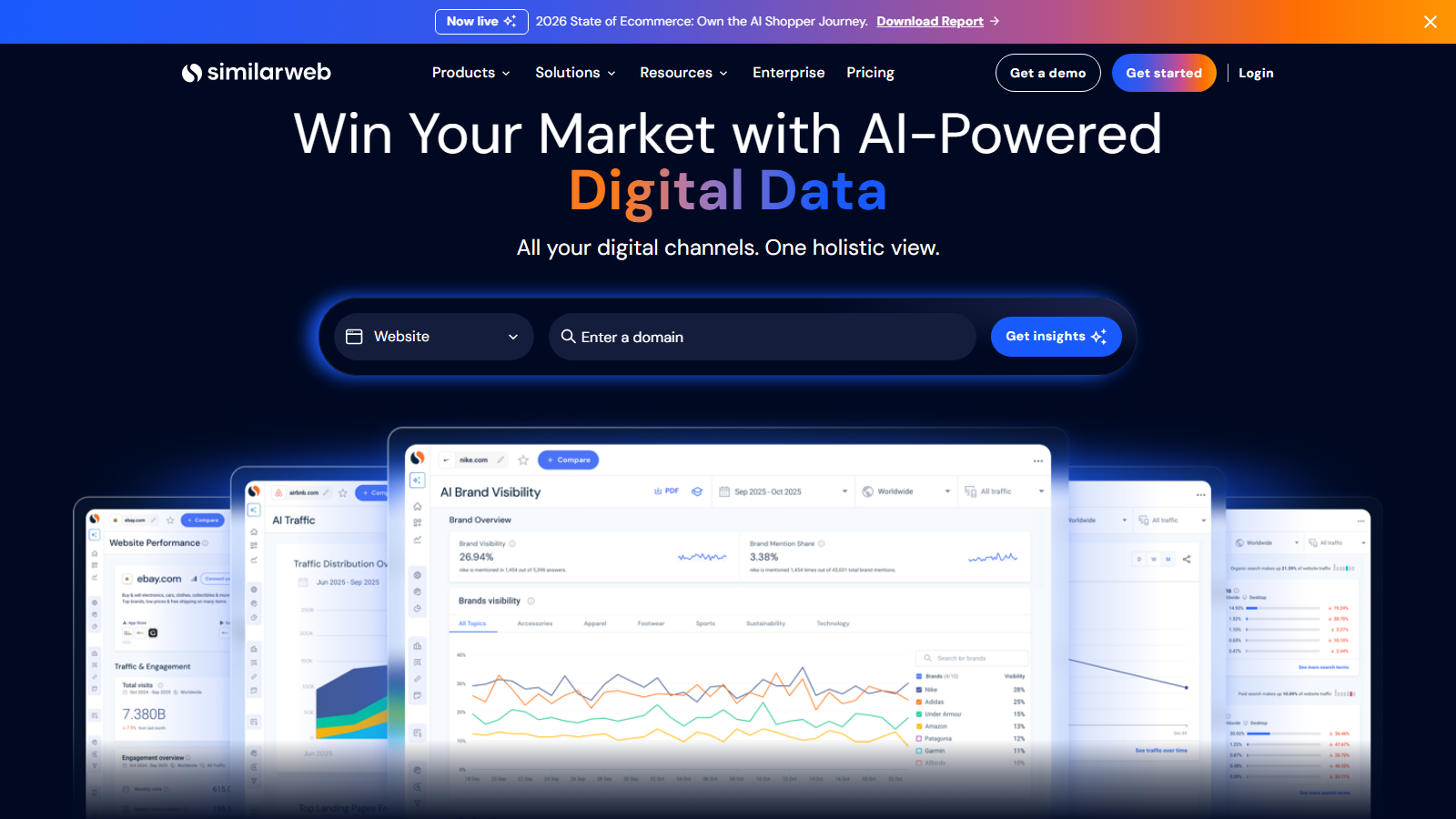
Similarweb models how much traffic a website gets, where it comes from and who visits, and its API carries that model into your own warehouse, dashboard or agent. It is not an SEO data API in the SERP and backlinks sense. It returns estimated visits, engagement, channels, referrals, audiences, keywords, app usage and AI chatbot referrals, over REST for a few domains or Batch for up to a million.
What it costs is the one number Similarweb never prints. Every endpoint carries a documented credit rate, down to 0.13 of a credit per keyword returned, and the docs give a formula for multiplying domains, countries, periods and rows. There is no price for a credit, for the API-only package, or for the Business and Enterprise plans that include the API. The self-serve plans on the pricing page exclude it entirely.
So the planning unit is your query, not your invoice. Three metrics over three months in one country cost nine credits, and the same question at daily granularity costs roughly thirty times as much. Credits are charged only when data comes back, Batch estimates a report's credits before it runs, and unused credits expire with the billing cycle. Size the job first, then take that number to sales.
Our scorecard
Our editorial read across six dimensions, scored 1 to 5. This is our own assessment, not an aggregate of user reviews, and it is deliberately kept out of the page's structured data.
- Data coverage4/5
Traffic, channels, audiences, apps, keywords, companies and AI referrals for domains you do not own. No live SERP or backlink endpoints.
- Pricing1/5
No public price for the API, a credit or any plan that includes it. Unused credits expire.
- Documentation3/5
A credit rate on every endpoint and an OpenAPI reference. The V4 and V5 sites disagree on history, error codes and keyword rates.
- Ease of integration4/5
One api-key header, JSON, several metrics per call on V5. Keys need an admin and an activation toggle.
- Reliability4/5
Ten requests a second, no charge for errors or empty responses, and failed Batch reports kept off the quota.
- Support3/5
Account-managed by design: more credits, premium endpoints and higher limits all go through your account manager.
An editorial read, not an aggregate of user reviews, and deliberately kept out of this page's structured data.
Similarweb API in their own words
From Similarweb API's own YouTube channel. Vendor marketing rather than an independent review, included because it is the quickest way to see the product before you sign up.
What you can pull
Traffic and Engagement (V5)
1 credit per metric per result, up to 8
Visits, bounce rate, visit duration, pages per visit, page views, unique visitors, and new against returning users, by day, week or month
Marketing channels and referrals
7 credits per result for the desktop channel split, 3 per unit for referrals (V4 rates)
Visits split across direct, display, email, organic search, paid search, referrals and social, plus the incoming and outgoing sites behind them
Search intelligence
0.13 credits per keyword, 17 per keyword overview (V4 rates)
Keywords driving clicks to a domain with position, intent, CPC and SERP features, keyword overviews, and the sites taking a keyword's clicks
Audience and demographics
1 to 6 credits per row by endpoint (V4 rates)
Age and gender split, audience interests, overlap between two and five sites, and deduplicated desktop against mobile web audiences
Gen AI intelligence (V5)
Prompt tracking: rows x metrics, needs an active Gen AI campaign
Estimated AI chatbot referral visits and share per LLM source, and daily responses to tracked prompts with brands mentioned, citations and sentiment
App intelligence
1 credit per result for downloads and active users, 18 for retention
iOS and Android downloads, active users, sessions, retention, store ranks and demographics
Batch API
Credits per data point; request-validate estimates the cost first
Asynchronous CSV reports across up to 1,000,000 domains, delivered by download link or straight into S3, Snowflake or Google Cloud Storage
Capabilities and describe
Free
Remaining credits, the countries and date ranges your plan covers, and the metrics each endpoint accepts on your subscription
Who Similarweb API is for
Market research, investment and competitive-intelligence teams that need modelled traffic for domains they do not own, at a volume nobody would type into an interface. The Batch API is the real product for that buyer: up to a million domains in one report, delivered into Snowflake or S3, with its credit cost estimated before it runs. Software companies licensing the data into their own product are a second fit, on OEM terms.
It is the wrong purchase for SEO reporting. The API reference has no live SERP or backlink endpoints, the keyword endpoints return modelled click estimates, and live rank data only covers campaigns you have set up in the platform. It is also wrong for anyone who needs a price before a sales call, or whose competitors are small, because practitioners report accuracy falling away well before a site reaches niche size.
Strengths and limits
What it does well
- Traffic, channel, audience and app estimates for domains you do not control, which most of this directory, built on SERPs and link indexes, cannot return at all.
- A documented credit rate on every endpoint and a published formula for combining them, so the cost of a query is calculable before anyone quotes you.
- Batch reports of up to 1,000,000 domains, delivered to S3, Snowflake or Google Cloud Storage, with a validate call that estimates credits first.
- No charge for errors, rate-limit rejections or responses where no data exists, stated in plain terms in the V5 FAQ.
- V5 returns several metrics in one call and uses one key across REST and Batch, where V4 needed a separate key for each.
- An official MCP server at mcp.similarweb.com, with setup guides for Claude, Cursor, ChatGPT, Microsoft Copilot and Perplexity.
- For sites under 5,000 estimated visits the API still returns a number where the platform shows none, so small domains can be aggregated instead of dropped.
Where it falls short
- No published price for the API, for a credit, or for any plan that includes it. The first real number arrives on a sales call.
- The self-serve plans on the pricing page exclude the API, and the V5 FAQ says an active subscription with API access is needed to test it.
- Every figure is an estimate rather than a measurement, and practitioners consistently report accuracy degrading as a site's traffic falls.
- Unused credits lapse when the billing cycle closes, so an oversized allowance is money lost and an undersized one stops the pipeline.
- Similarweb's own pages disagree on Batch history depth (five or seven years), on the error returned when credits run out (403 or 429) and on the keyword credit rate.
- Only account admins can generate keys, and a new key returns an invalid key error until its activation toggle is switched on.
- The undocumented data.similarweb.com JSON endpoint that circulates in scraping tutorials appears in neither documentation site, and it returned 403 to our scripted request on 13 September 2026.
Similarweb API pricing
Similarweb sells API access three ways and prices none of them publicly. It is included in Business and Enterprise plans, and it can be bought as a standalone API-only package with no platform subscription. The self-serve Web Intelligence plans, $125, $333 and $542 a month billed annually or $199, $399 and $649 monthly, carry no API access. Every route to the data goes through sales.
What the documentation does publish is the exchange rate. Credits are charged for data returned, not calls made: domains multiplied by the endpoint rate, granularity, countries, periods and rows. Traffic and engagement costs one credit per metric per result. The V4 reference lists 0.13 credits per keyword on Website Keywords, 17 per keyword overview and a fixed 350 for API Lite.
That makes granularity the biggest cost lever you control. Three metrics for one domain over three monthly periods is nine credits, and daily granularity is roughly thirty times that. Country filters multiply the same way. On Batch, the request-validate endpoint returns estimated credits before a report runs, which is the nearest thing to a quote the API gives you itself.
Allowances are monthly and use-it-or-lose-it. The V5 guide says unused credits lapse when each billing cycle closes, and the V4 guide says allowances refresh on the first of the month at 00:00 UTC with a prorated first month. Admins can split credits per user and per API, which is worth doing before one analyst's notebook drains the account.
Self-serve plans
From $125 / mo
Billed annually, $199 on monthly billing
- Three tiers, up to $542 / mo annual or $649 monthly
- None of them lists API access or data integrations
- One user seat, three or six months of history
- The free trial covers the interface, not the API
API-only package
Quote only
Standalone, no platform subscription
- Sold through sales, with no figure published anywhere
- Batch API included alongside REST
- Qualifies for the official MCP server
- Monthly credit allowance, and unused credits expire
Business and Enterprise
Quote only
Custom contract, platform plus data
- Lists data integrations and APIs as included
- Real-time and bulk APIs, BI connectors and data feeds
- History expandable to 37 months on the platform
- Admins can cap credits per user and per API
Request example
A minimal call against the live endpoint, with credentials read from the environment rather than pasted inline.
curl -s -G "https://api.similarweb.com/v5/website-analysis/websites/traffic-and-engagement" \
  -H "api-key: $SIMILARWEB_API_KEY" \
  --data-urlencode "domain=example.com" \
  --data-urlencode "metrics=visits,bounce_rate,pages_per_visit" \
  --data-urlencode "granularity=monthly" \
  --data-urlencode "start_date=2026-05" \
  --data-urlencode "end_date=2026-07" \
  --data-urlencode "country=gb" \
  --data-urlencode "web_source=total"

# 1 credit per metric per result: 3 metrics x 3 months x 1 country
# = 9 credits. Set granularity=daily and the same question returns
# roughly 30 results a month, so it costs about 30 times as much.
#
# Errors and empty responses are not charged. REST allows 10
# requests a second and answers 429 above that.
Rate limits and quotas
- REST: 10 requests per second per account, HTTP 429 above that.
- Batch: no rate limit on submission, but a maximum of 20 pending requests per user.
- Batch reports take up to 1,000,000 domains, and a report that fails with an internal error does not count against quota.
- Credits are charged for data returned. Error responses and responses with no data are free.
- Unused credits expire with the billing cycle. The V4 guide says allowances refresh on the 1st at 00:00 UTC, with a prorated first month.
- Each user can hold up to 3 active API keys. Keys have no expiry date and only admins can create them.
- Admins can set credit limits per user, separately for REST and Batch.
- REST history runs up to 37 months. Batch history is stated as five years on some pages and seven on others.
- Monthly data is released by the 10th of the following month; daily data within 72 hours on most endpoints.
- For sites under 5,000 estimated visits the API returns a value the platform does not display.
Third-party reviews
Scores read from each source on 2026-09-13. We report them as-is and publish no rating of our own.
This score rates the Similarweb platform as a whole, not the API specifically. No review site scores the API on its own, and G2 could not be read.
What practitioners say on Reddit
Practitioners treat Similarweb as the most complete traffic estimator available and still decline to call its numbers accurate, often in the same comment. The steady view is that large domains are estimated well at domain level, that the channel split is wrong in a consistent way that still permits comparison, and that accuracy drops quickly once traffic falls.
Checks against people's own analytics cut both ways. One r/SEO commenter found Similarweb showing four times their real visits while Semrush came close; the r/bigseo comparison quoted on our Semrush page had all three tools off, with Similarweb furthest from the Search Console figure. Most threads end on the same instruction: triangulate between tools and label your confidence, rather than trusting any one estimator.
Very little discussion concerns the API itself, and what exists is old: people asking how to pull estimates in bulk, and a 2019 reply from Similarweb's communications team offering API pricing through a representative. We read a 2025 r/AskMarketing thread and did not quote it, because its uniformly glowing, feature-list replies read as promotional.
“For large websites (100k+ visitors per day), the data is very good on domain level. The marketing channel split is wrong. But it is wrong the same way for everyone. So you can still use it to compare websites.”
r/bigseo on Reddit“In my experience, it does a pretty good job estimating traffic to the whole site and high volume pages. Less than one standard deviation. Its accuracy falls pretty quickly after that.”
r/bigseo on Reddit“Just out of curiosity compared my website GoogleAnalytics with SimilarWeb and Semrush: SimilarWeb - completely off. Shows 4x more visits, 3x higher bounce rate, and 12x lower visit duration. Semrush - better. Visits are very close, duration is close (0.7x), but the bounce rate is still 3x higher than reality.”
r/SEO on Reddit“You won't get true accuracy from any third-party traffic tool. Best option is to triangulate: Similarweb for rough total traffic, Ahrefs/Semrush for organic direction, then mark each domain with confidence (high/medium/low) in your sheet. That usually gives a usable estimate without paying for enterprise plans.”
r/SEO on Reddit
Verdict
The API to buy when the question is how much traffic somebody else's site gets, across many domains, and the answer feeds a model, a warehouse or a product. No other provider here returns channel splits, audiences and app usage at that breadth, and the Batch API's million-domain reports are built for exactly that job.
Arrive at the sales call with the query already written. Similarweb will tell you, endpoint by endpoint, how many credits a question costs and nothing about what a credit costs, so the useful preparation is an estimate built from the formula and a validate call. Choose monthly granularity unless daily is the point, because that one setting moves the bill by roughly thirty times.
Treat every figure as a model, never a count. Practitioners agree that big domains are estimated well and small ones are not, and the vendor's own pages disagree with each other on history depth and error codes. For SEO work specifically, a keyword or backlink provider will serve you better; Semrush's Trends API is the other traffic-estimate source here, and it too is bought separately from its plans.
Similarweb API FAQ
How much does Similarweb charge for its API?
Similarweb publishes no price for it. The API comes inside Business and Enterprise plans or as a standalone API-only package, and all of them are quoted by sales. The self-serve plans that do show prices, from $125 a month billed annually, do not include API access. What is published is the credit cost of each endpoint, so you can size a query before that conversation.How do I get a Similarweb API key?
An account admin creates it. In the platform, open Settings, then Account, then the Data Tools section, choose REST API or Batch API and generate a new key. It only works once its activation toggle is on; until then it returns an invalid key error. Each user can hold three active keys, and keys carry no expiry date.Where is the documentation, and is V4 or V5 current?
V5 is current and lives at docs.similarweb.com/api-v5, which labels itself the latest version. The V4 site at developers.similarweb.com is still online and still worth opening, because its reference pages print a credit rate for each endpoint. V5 adds multi-metric requests, one key for REST and Batch, standardised responses and MCP support, and says existing pricing is unchanged.Which endpoints does the API offer?
Website traffic and engagement, marketing channels, referrals, demographics and audience overlap, folders and popular pages, keywords and SERP players, app downloads and usage, company data and lead enrichment, and AI chatbot traffic with prompt tracking. The Batch API reaches the same datasets for up to a million domains per report, and free describe calls show what your plan can query.What is the rate limit?
Ten requests a second per account on REST, with HTTP 429 above that. The Batch API puts no limit on submission but allows 20 pending requests per user. Rejected requests cost nothing, and Similarweb's own advice for large jobs is to move them to Batch rather than push against the REST ceiling. Enterprise customers can ask for more.How are data credits calculated?
By data returned: domains, multiplied by the endpoint rate, granularity, countries, periods and rows. Traffic and engagement is one credit per metric per result, so three metrics over three monthly periods is nine. Errors and empty responses are free, unused credits expire with the billing cycle, and the Batch request-validate endpoint estimates a report's cost before it runs.Are the traffic estimates accurate enough to rely on?
For large domains, broadly, and as comparisons rather than counts. The figures are modelled, and practitioners report good domain-level estimates for big sites with accuracy falling away quickly below that. The API goes one step past the interface here: for sites under 5,000 estimated visits it still returns a number, which Similarweb says is there to aggregate rather than to read alone.Does Similarweb have an MCP server?
It does, at mcp.similarweb.com, with setup guides for Claude, Cursor, ChatGPT, Microsoft Copilot and Perplexity. It needs a subscription with API access, meaning API-only, Business or Enterprise, plus an active key. It is not a free side door: MCP calls draw on the same data credits as the REST API, and a broad prompt that touches several datasets consumes accordingly.
Other providers worth a look
This is an independent review. We have no affiliate relationship with Similarweb API, earn nothing if you sign up, and no provider pays for placement in the directory. Prices were read from the vendor's own pages in September 2026 and change without notice.