Won on the profile and the reviews, not on the website
Written by Eugene Suslov·Last reviewed 29 August 2026·No affiliate links
Sector
Lifestyle and leisure
Model
Local service, Multi-location
Competition
High
Time to results
2 to 6 months
Typical monthly
$500 to $3,000
Key takeaways
1Your menu is the most searched thing about your restaurant, and on most sites it is a PDF, an image or a widget. Publishing it as real text is the highest-return hour available in this industry.
2A delivery platform probably has a menu page for you that outranks your own. Google now requires those providers to offer a removal route, and almost no operator has used it.
3The profile does more than the website ever will. Hours, photographs, ordering links and review responses decide the local pack, and the pack decides most of the traffic.
4Review velocity matters more than review average. A steady flow reads as a working restaurant; a sudden cluster reads as a campaign to everybody, including the platform.
5If you add a mandatory service charge, it belongs on the menu itself. California exempted restaurants from all-in pricing in 2024 precisely on that condition.
SEO for restaurants is mostly not about the website, which is an uncomfortable thing to read on a page about websites. The profile, the reviews and the ordering link carry this business, and a beautiful site changes very little on its own.
What the site does carry is the menu, and the menu is the single most searched thing about any restaurant. It is also, on most sites, a PDF from the designer, a photograph of a printed card, or a widget loading from somewhere else.
So a restaurant SEO strategy is a short list of things done properly rather than a long programme. Get the menu into readable text, get the profile complete and accurate, own the ordering link, and collect reviews at a steady pace.
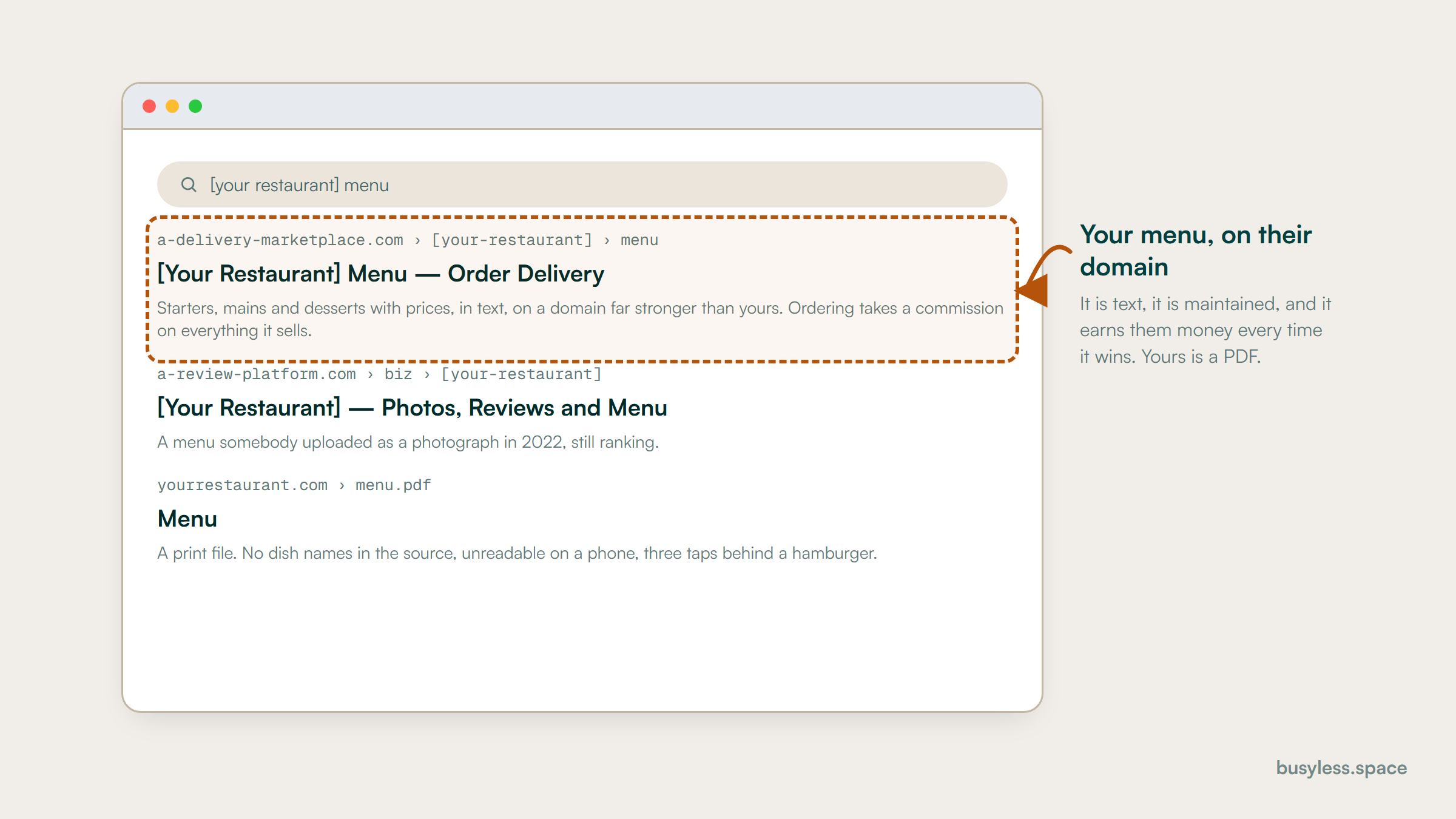
Meanwhile a delivery marketplace has almost certainly built a page for your restaurant, with your dishes and your prices on it, and it very often outranks you for your own name plus the word menu.
That page earns money on every order it takes. Yours does not have to, which is the whole argument for making sure a guest searching your name lands somewhere you control.
None of this takes long. It is unusual in this directory for being a playbook a busy owner can finish, and the reason most restaurants have not is that nobody told them the menu was the asset.
Who already ranks in restaurants
Search your restaurant's name with the word menu after it, then search your cuisine with your neighbourhood, and write down what you see. A restaurant SEO audit rarely needs more than that: the first search usually returns a delivery platform's copy of your menu, and the second returns a reservation platform's list of the best places nearby.
What is on the results page
Local pack and map filling the first screen on cuisine and near-me queries
Reservation platforms with best-of lists per cuisine and per neighbourhood
Review platforms ranking for the same best-of phrasings
Delivery marketplace menu pages on brand plus menu queries
Image results doing unusual work, because the decision is partly visual
People Also Ask on hours, parking, dietary options and reservations
Local news and food media on new opening and best-of queries
Google Business Profile
google.comClaim it
By a wide margin the most valuable thing you own, and the place where hours, photographs, the menu link, the ordering link and reviews all meet. Most restaurants set it up once and never look at the ordering links again, which is where a third party quietly inserts itself between you and the order.
Delivery marketplaces
doordash.comClaim it
They publish a menu page for your restaurant that frequently outranks your own for your own name. It also earns them a commission on every order. Claim the listings you have chosen to have, check the prices match, and use the removal route for any provider you never agreed to.
Reservation platforms
opentable.comClaim it
They own the best-of and cuisine-plus-city queries in most cities, which are phrasings you cannot realistically target from your own domain. Keep the listing accurate and treat it as a distribution channel with a per-cover cost rather than as free marketing.
Review platforms
yelp.comClaim it
Still ranks strongly for restaurant queries in many metros and feeds Apple Maps. Claim it, keep the menu and hours current, and answer criticism specifically. The response is read by far more people than the review, and it is the only part of that page you control.
Tripadvisor
tripadvisor.comClaim it
Matters most where visitors matter: tourist areas, hotel districts, near stations and venues. If a meaningful share of your covers are people who do not live nearby, this listing is doing real work and is usually neglected.
Local food media and city guides
eater.com
The nearest thing this industry has to a link that moves anything. City guides and local critics rank for exactly the queries a restaurant wants, and inclusion comes from being worth writing about rather than from outreach. Make it easy: a press page with high-resolution photographs and a factual description.
Social platforms as a discovery layer
instagram.comClaim it
Not search, and unusually important here because a large share of diners look at photographs before deciding. Treat it as evidence rather than as a channel, and keep the menu and hours there consistent with everywhere else, because inconsistency is what generates the phone call you did not want.
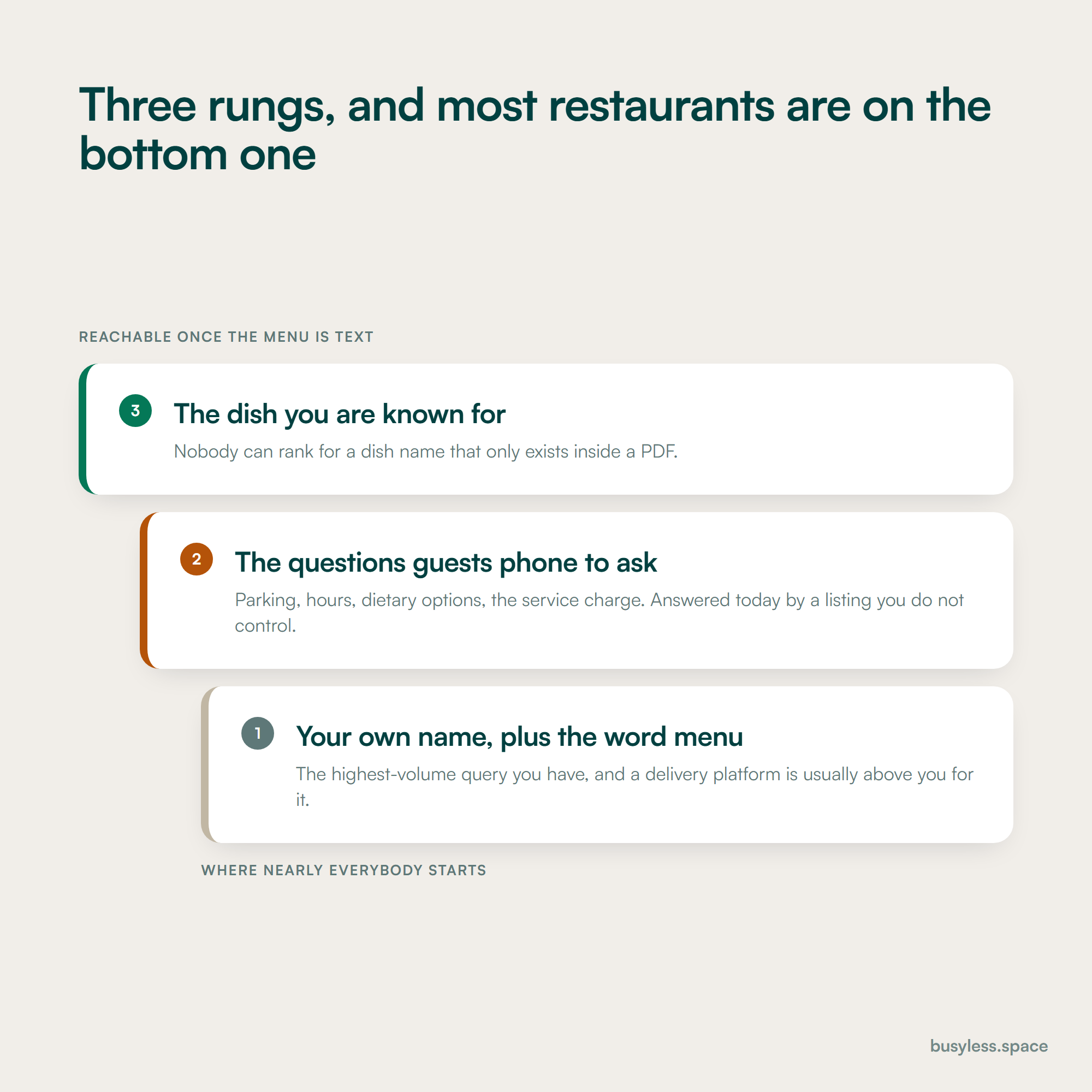
Every rung above the first depends on the same afternoon of work at the bottom.
What people actually search
Restaurant demand divides into a discovery query the platforms already own, a brand query that is yours to lose, and a set of practical questions with enormous combined volume that somebody else is currently answering for you. The seo keywords for restaurants worth answering are those practical ones.
Cuisine plus place
Local commercial
> italian restaurant [neighbourhood]
The page that wins it:A complete profile and one page that names the cuisine and the area plainly
Decided in the pack on proximity, photographs and reviews. The reservation and review platforms own the organic results below it, and that is not usually winnable from a single restaurant's domain.
Brand plus menu
Navigational
> [restaurant name] menu
The page that wins it:The menu as readable text on your own domain
The highest-volume query any restaurant has, and the one most often lost to a delivery platform's copy. Everything else on this page matters less than fixing it.
Dish and speciality
Local commercial
> best [dish] near me
The page that wins it:A menu with real dish names in text, plus a page for anything you are known for
Only reachable if the dish names are indexable. A restaurant famous for one thing and hiding it inside a PDF is invisible for the query it should own outright.
Dietary requirement
Local commercial, high intent
> gluten free restaurants [city]
The page that wins it:A page per requirement you genuinely cater for, with the real caveats
The person searching has a hard constraint and is choosing between a very small number of options. State honestly what you can and cannot guarantee about a shared kitchen; that is more useful than a symbol on a menu.
Practical questions
Navigational
> [restaurant name] parking
The page that wins it:A visit-planning page covering everything a guest asks by phone
Hours, parking, dress code, children, dogs, accessibility, whether you take walk-ins. Large combined volume, trivial to answer, and currently answered by a listing somebody else controls.
Occasion and group
Commercial investigation
> private dining [city]
The page that wins it:A dedicated page with capacities, minimum spends and real menus
A different buyer with a much larger transaction, planning weeks ahead. It converts far better than covers content and almost every independent handles it with an email address.
Time-bound
Local transactional
> restaurants open now near me
The page that wins it:Accurate hours everywhere, including holiday hours
Not content at all, which is why it gets ignored. Wrong hours across the profile, the site and three platforms is the most common and most expensive error in this industry.
Ordering and delivery
Transactional
> [restaurant name] delivery
The page that wins it:Your own ordering page, set as the preferred link on the profile
Every order through a marketplace carries a commission. The query is asked in your name, so the landing page should be one where you keep the margin.
What the rules change
Lighter than the health verticals here, and pointed at exactly the asset this playbook cares about: the menu is both the SEO deliverable and the regulated document. Check your own state and your own counsel; none of this is legal advice.
1
Chains of twenty or more have to declare calories, including online
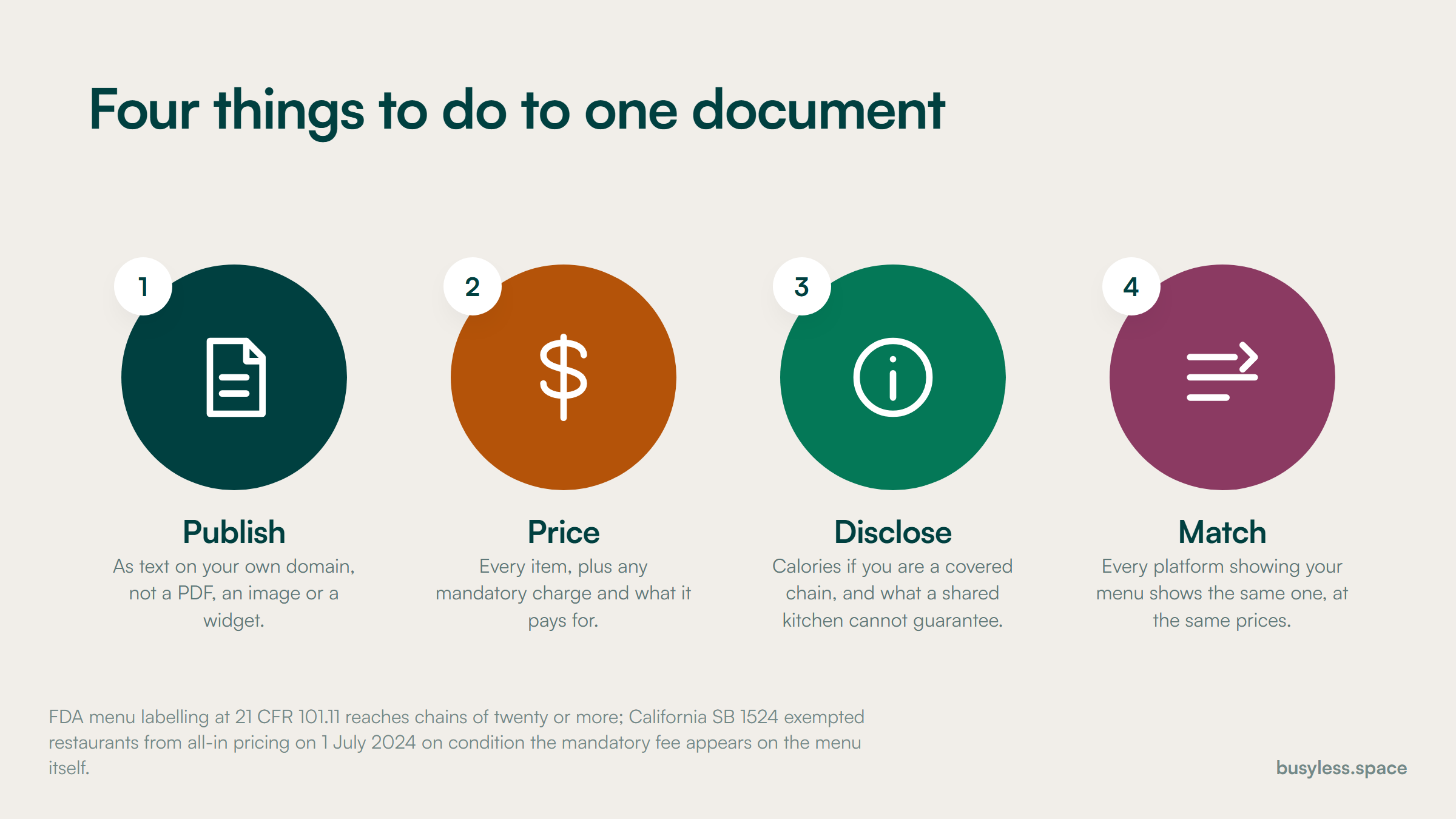
FDA menu labelling requirements, 21 CFR 101.11, whose compliance date was 7 May 2018
What it means
The rule reaches restaurants and similar retail food establishments that are part of a chain of twenty or more locations doing business under the same name and offering substantially the same menu items. Covered establishments must declare calories for standard menu items on menus and menu boards, provide the additional written nutrition information on request, and carry the required succinct statement. A menu used to order from is a menu wherever it lives.
So do this
If you are covered, treat the online menu as a menu rather than as marketing. Calories beside each standard item, the statement present, and the fuller nutrition information reachable. A QR code cannot stand in for the calorie declaration itself, so do not let a designer solve the layout problem that way.
2
A platform may not list you for delivery without an agreement
California Assembly Bill 2149, the Fair Food Delivery Act, in force since 1 January 2021; other states have considered comparable bills and only the California position is verified here
What it means
The California statute prohibits a food delivery platform from arranging delivery from a restaurant without an express agreement authorising it. Before it, platforms routinely listed restaurants they had no relationship with, scraped or reconstructed the menu, and took orders the kitchen had never agreed to serve. Those listings still rank, and stale ones still exist.
So do this
Search your restaurant name on every major platform and write down what you find. For anything you never agreed to, use the platform's removal process and the profile controls below. Then check the prices and the menu on the listings you did agree to, because an out-of-date price on somebody else's page is your problem at the door.
3
Restaurants were exempted from all-in pricing, on one condition
California Senate Bill 1524, signed 29 June 2024 and effective 1 July 2024, which created a restaurant exception to the state's hidden-fees statute
What it means
Where hotels were required to fold mandatory fees into the advertised rate, restaurants were allowed to keep displaying a service charge separately. The exemption is conditional: a mandatory fee or charge has to be clearly and conspicuously displayed, with an explanation of its purpose, on any advertisement, menu or other display carrying the price. It cannot appear for the first time on the bill.
So do this
If you levy a service charge, health mandate or kitchen appreciation fee, put it on the online menu with a sentence saying what it pays for. That is what the exemption asks for, and it is also the version that stops a one-star review about a surprise on the check.
4
How you collect reviews is now regulated
FTC Rule on the Use of Consumer Reviews and Testimonials, 16 CFR Part 465, effective 21 October 2024
What it means
The rule bans creating, buying or disseminating reviews that misrepresent the reviewer's experience or existence, including ones written by staff or generated by a model. It also reaches conduct around suppression, which is the part restaurants most often get wrong: asking only the guests you expect to be happy, or offering something in exchange for a positive review specifically.
So do this
Ask everybody, the same way, at the same point in the meal. Never condition an incentive on the review being positive. Respond to bad reviews rather than trying to remove them, because the response is read by more people than the review and it is the only part of the page you control.
Three of the four also answer a regulator, which is unusual for something that started as a marketing task.
Proving expertise
Trust here is settled by things a restaurant already knows and rarely publishes. A guest wants to be sure the place is open, that the menu is current, that the food matches the photographs, and that somebody will handle a problem.
A current menu, in text, with prices that match what the guest will be charged
Every mandatory charge stated on the menu, with what it pays for
Photographs of the actual food and the actual room, taken this year
Hours that agree across the profile, the site, the review platforms and the door
Named chef and owner, with a real account of where the food comes from
Honest dietary information, including what a shared kitchen cannot guarantee
Review responses that address the specific complaint rather than thanking the reviewer
Accessibility, parking, dress code and family policy answered before anybody has to call
How to build a restaurant SEO strategy
Twelve weeks, and unusually for this directory that is the whole thing rather than a first phase. A restaurant SEO strategy has a short list of high-value tasks and a long tail of things that are not worth doing, and knowing which is which is most of the value.
1
Weeks 1 to 2
Publish the menu and fix the profile
Put the full menu on your own domain as readable text, not a PDF or an image
Add prices, and every mandatory charge with an explanation of what it pays for
Complete the profile: hours, holiday hours, attributes, service options
Audit the ordering links on the profile and remove providers you never agreed to
Set your own ordering page as the preferred link
Photograph the food and the room properly and upload to the profile
You end up with The most searched thing about your restaurant, on a page you own
2
Weeks 2 to 5
Answer the questions people phone to ask
Build the visit-planning page: parking, accessibility, dress, children, dogs, walk-ins
Build a page per dietary requirement you genuinely cater for
Build the private dining and group page with capacities and real minimums
Add restaurant and menu structured data
Check the menu and prices on every delivery and reservation listing
Fix hours everywhere they appear, including the ones you forgot about
You end up with Fewer phone calls, and the practical queries answered on your own pages
3
Weeks 5 to 9
Make the reviews a routine rather than a campaign
Agree one review request, asked of every table the same way
Assign a named person to respond to every review within two days
Write the responses to the recurring criticisms you know are coming
Publish a press page with high-resolution photographs and factual copy
Introduce yourself to the local food writers who cover your area
Set up a monthly check of hours, menu and prices across every platform
You end up with Steady review velocity and a reason for somebody local to write about you
4
Weeks 9 to 12
Measure covers and margin, not traffic
Track profile actions and where they lead
Track direct online orders against marketplace orders
Calculate the real cost of a marketplace order after commission
Track private dining and group enquiries separately
Compare covers by day part against the same period last year
Decide which platforms still earn their commission and which do not
You end up with A short report about covers and margin that an owner will actually read
Technical fixes with the best payoff
One defect dominates this industry and it is embarrassingly simple. The menu is the most searched thing about a restaurant and it is almost never text on a page that the restaurant owns.
The menu is a PDF, an image, or a widget
An afternoon
Menus come from a designer as a print file, so the website links to a PDF or shows a photograph of the printed card. Dish names, prices and dietary information are then invisible, unreadable on a phone, and impossible to keep current, which is why the delivery platform's version outranks it.
Publish the menu as HTML on your own domain, one page or one per service, with dish names as text and prices beside them. Keep the PDF as a download if you want it. Add menu structured data at the same time, because you are already entering the data.
A delivery provider you never agreed to is attached to your profile
An hour
Third-party ordering providers have historically been able to attach themselves to a Google Business Profile, sending orders through a channel the restaurant never chose and taking a commission on them. Google now requires those providers to publish an opt-out route in the profile dashboard and to remove links on request, but only an operator who knows to look will find it.
Open the profile's ordering options, look at every provider listed, and use the removal link on anything you did not sign up for. Then set your own ordering page as the preferred link, so it takes the marked position rather than sitting below a marketplace.
Hours disagree in five places
An hour, then monthly
Hours live on the profile, the website, two review platforms, a reservation platform and a delivery platform, and they change for holidays, private events and staff shortages. Open now is one of the highest-intent queries in the category, and a wrong answer costs a cover and earns a review about it.
Pick one place as the source of truth, usually the profile, and set a monthly check of every other surface. Enter holiday hours in advance rather than on the day. It is the least interesting item on this list and among the most expensive to get wrong.
The site cannot be used one-handed on a phone
A sprint
A large share of restaurant visits happen on a phone, often outside, often while walking. The typical restaurant site opens with a full-screen video, an animated intro and a menu three taps away behind a hamburger, which is a design decision made on a desktop.
Put the menu, the phone number, the address and the booking link in reach on the first screen. Kill the intro animation. Test it standing on a pavement in daylight rather than at a desk, because that is where it is used.
The reservation widget is the whole page
An afternoon
Booking platforms provide an embed, and many restaurants make it the entire contact route. It loads from another domain, often slowly, and the platform's own listing of your restaurant may outrank the page you put it on.
Keep the widget for the transaction and make sure the page around it works without it: hours, phone number, walk-in policy and what to do for a large group. A guest who cannot load the widget should still be able to get through to you.
Multi-site restaurants share one page
A sprint
Each location has different hours, a different room, a different manager and often a slightly different menu, and one page for all of them cannot rank for any neighbourhood. The profile, the website and the reservation platform then disagree about which location a guest is looking at.
A page per location with its own hours, own photographs, own menu variations, own parking advice and its own profile link. Name the neighbourhood in the copy the way locals name it rather than the way the postal service does.
The food photographs are from the opening
An afternoon, yearly
Restaurants photograph everything when they launch and then never again, so the site shows dishes that left the menu two seasons ago and a room that has since been refurbished. It is the most common source of the gap between expectation and arrival, which is what negative reviews are made of.
Reshoot the current menu, the current room and the current staff at least yearly, and upload to the profile as well as the site. A phone in good light is sufficient. Retire photographs of anything you no longer serve.
The ranking order is not the interesting part. The commission attached to the first result is.
Structured data that applies here
The types below fit this industry specifically. Most of them earn no rich result on their own, which is worth knowing before anyone sells the work on that basis. What they do is describe the entity precisely, which matters for how search engines and answer engines resolve who you are.
Restaurant
Home page and every location page
Restaurant sits under FoodEstablishment in the vocabulary and carries fields no other local business type has. Fill servesCuisine, acceptsReservations and the menu reference, and keep the hours identical to the profile rather than approximately similar.
These types exist in the vocabulary for this industry and essentially no other, and building them forces the menu out of the PDF. Fill it from the same source the kitchen prints from, so the markup cannot drift away from what is actually served.
Menu with MenuSection and MenuItem.jsonld
{
  "@context": "https://schema.org",
  "@type": "Menu",
  "@id": "https://[YOUR-DOMAIN]/menu#menu",
  "name": "[MENU NAME, e.g. Dinner]",
  "url": "https://[YOUR-DOMAIN]/menu",
  "inLanguage": "en-US",
  "hasMenuSection": [
    {
      "@type": "MenuSection",
      "name": "[SECTION, e.g. Starters]",
      "hasMenuItem": [
        {
          "@type": "MenuItem",
          "name": "[DISH NAME]",
          "description": "[What is actually in it, in the words a guest would use.]",
          "offers": {
            "@type": "Offer",
            "price": "[00.00]",
            "priceCurrency": "USD"
          },
          "suitableForDiet": ["https://schema.org/VegetarianDiet"]
        }
      ]
    }
  ]
}
MenuItem with nutrition information
Standard menu items, required if you are a covered chain
The node that carries the menu labelling obligation into the markup. It does not satisfy the rule on its own, because the declaration has to be on the menu the guest orders from, but keeping both from one source is what stops them disagreeing.
Worth adding wherever a date and a price exist together: a tasting menu, a holiday sitting, a supper club, a wine dinner. These have real dated demand and they are usually announced only on social media, where they cannot be found again.
Event for a ticketed dinner or a holiday service.jsonld
Parking and dietary requirements are the two that carry the volume, and both are usually answered by a listing you do not control. Match the visible text exactly, and be honest about what a shared kitchen cannot guarantee.
FAQPage.jsonld
{
  "@context": "https://schema.org",
  "@type": "FAQPage",
  "mainEntity": [
    {
      "@type": "Question",
      "name": "[Question exactly as it appears on the page]",
      "acceptedAnswer": {
        "@type": "Answer",
        "text": "[Answer exactly as it appears. Give the real parking situation, the real policy and the real caveat.]"
      }
    }
  ]
}
BreadcrumbList
Menu, location and event pages
Worth adding once there is a genuine hierarchy of menus, locations and events. On a single-site restaurant with four pages it adds nothing, and saying so is more useful than adding it anyway.
Editorial estimates rather than quotes, and at the bottom end of this directory, because the work is short and most of it is free. A restaurant being sold a large monthly retainer for content should ask what it is for before signing anything.
A visit-planning page answering the phone questions
A review request asked of every table the same way
Who it suits
Almost every independent restaurant, and honestly most of them should stop here
Where it stops
It reaches nearly all the available value. What it will not do is build the private dining section or keep five platforms in sync every month without somebody remembering.
Lean
$500 to $1,500
Menu, restaurant and event structured data maintained
Dietary and occasion pages built properly
A monthly check of hours, menu and prices across every platform
Review responses written by somebody who can write
A press page and relationships with local food writers
Who it suits
A restaurant in a competitive area, or one with a real private dining business
Where it stops
It cannot outrank the reservation platforms on best-of queries, and no budget can. Those phrasings belong to the platforms and to the local press.
Funded
$1,500 to $3,000
A page per location with its own menu, hours and neighbourhood copy
Direct ordering promoted properly against the marketplaces
Group, event and catering content produced continuously
Reporting on covers and margin by channel rather than on traffic
Photography refreshed with the menu each season
Who it suits
Multi-site groups, or a single site with catering and events as a real revenue line
Where it stops
Above this the constraint is seats. A full Friday cannot be improved by more demand, and the honest recommendation becomes a pricing or a day-part question.
How to do it with no budget
Almost the entire playbook is free here, which is rare. The first item alone is usually worth more than everything a small restaurant has previously been sold, and it takes an afternoon.
1
Put the menu on your website as text
An afternoon
Your website editor
Dish names, descriptions and prices as readable text on your own domain. It is the most searched thing about your restaurant and it currently lives in a PDF, a photograph or somebody else's app.
2
Audit the ordering links on your profile
1 hour
Google Business Profile
Look at every provider attached to your listing. Providers are now required to offer a removal route, so use it on anything you did not agree to, and set your own ordering page as the preferred link.
3
Fix the hours everywhere
1 hour, then monthly
A list of every platform you appear on
Profile, website, review platforms, reservation platform, delivery platforms. Add holiday hours in advance. Open now is a high-intent query and a wrong answer costs a cover and earns a review about it.
4
Photograph the current food and room
An afternoon
A phone in good light
Most restaurant photography is from the opening and shows dishes that left the menu. The gap between the photograph and the plate is what negative reviews are made of.
5
Write the visit-planning page
2 hours
Your website editor
Parking, accessibility, dress, children, dogs, walk-ins, large groups, where to be dropped off. Every question your staff answer by phone, answered once.
6
Search your own name on every delivery platform
30 minutes
A browser
You may find listings you never agreed to, with prices from two years ago. Under California's Fair Food Delivery Act a platform needs an agreement to arrange delivery from you, and a stale listing is your problem at the door either way.
7
Agree one review request and use it every time
A briefing
Your team
Asked of every table the same way, with no incentive tied to being positive. Velocity matters more than average, and selective asking is exactly what the 2024 rule is aimed at.
The tool stack
The shortest stack in this directory, because most of the work is writing a menu properly and keeping five listings in agreement. Half of these are systems you already have.
Track from the streets your guests walk rather than from the office. Proximity dominates this category, so a rank measured at the restaurant's own address tells you nothing about the next block.
Free routeCheck manually from a phone standing in the neighbourhood
The single most useful check in this industry. If a delivery platform is above you for your own name plus menu, the fix is on this page and it takes an afternoon.
Free routeSearch your name plus menu and read the results
Control which ordering providers are attached to you
Google Business Profile
Providers are required to offer a removal route. Remove the ones you never agreed to, then set your own ordering page as the preferred link so it takes the marked position.
Free routeFree, and the highest-value hour here
Publish the menu as structured content rather than a document
Model dishes, sections, prices and dietary flags as content, and the website, the markup and the printed menu can come from one source. That is what stops the online menu drifting from the kitchen's.
Free routeFree tier is enough for a single restaurant
Work out what a delivery order actually earns you
Your point of sale set against the platform statements
Commission, marked-up menu prices, packaging and the covers you did not take because the kitchen was busy. The number is usually worse than operators expect and it decides how hard to push direct ordering.
Free routeAlready paid for, and rarely read this way
Understand what a returning guest is worth
SEO Revenue Growth Calculator
Use average visits per year rather than average spend. A guest who returns monthly and a one-off from a discount platform are not the same acquisition, and averaging them hides the whole argument.
Free routeFree
Check the menu is genuinely readable
Your browser's view-source
Load the menu page and search the source for a dish name. If it is not there, neither a search engine nor an assistant can read your menu, whatever it looks like on screen.
Free routeFree
Keep review responses on a rhythm
Your review platform dashboards
One named person, two days, every review. The response is read by more people than the review, and it is the only part of a platform's page about you that you control.
Free routeFree
Take it from here
Everything below is yours to take. Fill the [BRACKETS] and it is ready to use. Start with the menu publishing checklist, because it is one afternoon and it is worth more than the rest of this page put together.
Checklist
The single highest-return afternoon in this industry. The menu is the most searched thing about your restaurant and it is almost certainly a document rather than a page.
MENU PUBLISHING - [RESTAURANT] - [DATE]

WHY THIS IS FIRST
"[restaurant name] menu" is the highest-volume query any
restaurant has. On most sites the menu is a PDF from the
designer, a photograph of the printed card, or a widget loading
from a third party. None of those can be read, none work well on
a phone, and none of them stop a delivery platform's copy of
your menu from ranking above your own.

1. CONFIRM THE PROBLEM
   [ ] Open your menu page
   [ ] Right-click, view source (or select all and copy)
   [ ] Search for one dish name
   Found in the source?  [ Y / N ]
   If no, your menu is invisible.

   [ ] Search "[restaurant name] menu" in a private window
   What ranks first?  [_____________________________]
   Where are you?     [__]

2. THE STRUCTURE
   One page per service, or one page with clear sections:
   [ ] Dinner        [ ] Lunch         [ ] Brunch
   [ ] Bar / drinks  [ ] Wine          [ ] Set / tasting
   [ ] Kids          [ ] Catering      [ ] [___________]

3. EVERY ITEM NEEDS
   [ ] Dish name as TEXT, spelled as guests would search it
   [ ] A description in the words a guest would use
   [ ] The price, as text, beside it
   [ ] Dietary markers, with a key that explains them
   [ ] Anything with a supplement, stated

4. THE THINGS RESTAURANTS LEAVE OFF
   [ ] Mandatory service charge, with what it pays for
   [ ] Corkage, and the amount
   [ ] Minimum spend, where one applies
   [ ] Whether prices include tax
   [ ] Set menu rules for larger parties
   [ ] Calories, IF you are part of a chain of 20 or more

5. KEEP THE PDF, DO NOT RELY ON IT
   [ ] HTML menu is the page that ranks
   [ ] PDF offered as a download beneath it
   [ ] The two say the same thing

6. MARKUP WHILE YOU ARE HERE
   [ ] Menu, MenuSection and MenuItem structured data
   [ ] Prices in the markup match the visible prices
   [ ] The Restaurant node references the menu

7. KEEP IT CURRENT
   Who updates it: [____________]
   When: [ same day the kitchen changes it ]
   [ ] Delivery and reservation platform menus updated too
   [ ] Old dishes removed, not left greyed out

8. AFTER TWO WEEKS
   [ ] Re-run the "[name] menu" search
   [ ] Note the change: [____________________]
What to publish
Publish what somebody deciding where to eat tonight needs to know. Recipes and food writing compete with the entire internet, take real time, and reach almost nobody who will sit down in your dining room.
The menu, as text, kept current
Updated whenever the kitchen changes it, not seasonally
The most searched thing about any restaurant and the one asset that is genuinely yours. Everything else on this list matters less.
The visit-planning page
Once, reviewed when a policy changes
Parking, accessibility, dress, children, dogs and walk-ins carry large combined volume and are currently answered by somebody else's listing.
Dietary requirement pages
One per requirement you genuinely cater for
A hard constraint means a very small consideration set and a fast decision. Honest caveats about a shared kitchen are more useful than a symbol.
The private dining and group page
Once, with real minimums and real menus
A larger transaction, a longer decision and a buyer planning weeks ahead. Most independents handle it with an email address and lose it to a venue that published capacities.
Dated events and special services
One page per event, published as soon as the date exists
Tasting menus, holiday sittings and supper clubs have real dated demand, and they are usually announced only on social where they cannot be found again.
A press page
Once, refreshed with the photography
Local food media rank for exactly the queries you cannot target, and inclusion comes from being easy to write about. High-resolution photographs and factual copy remove the friction.
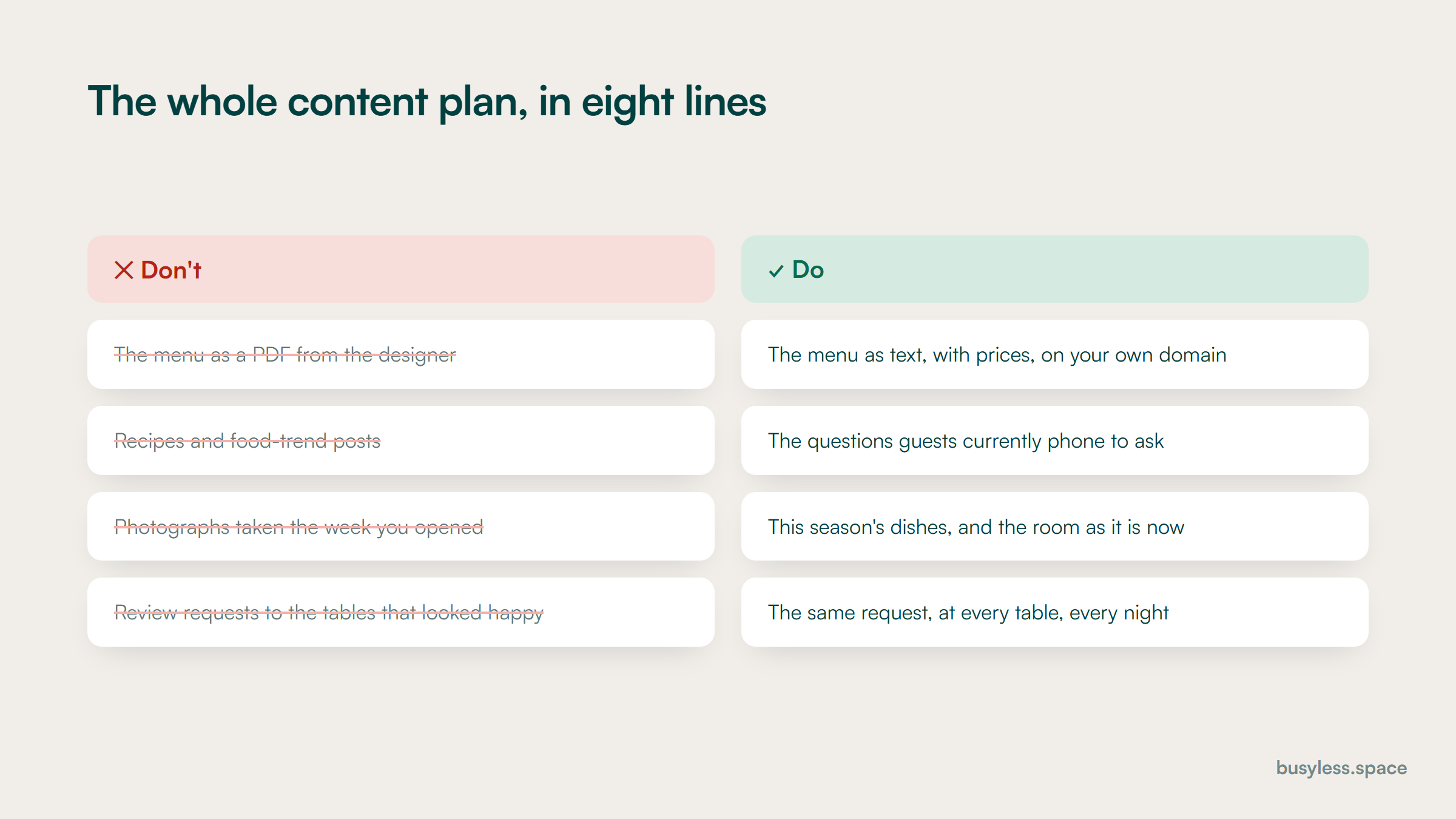
And what not to
A menu published as a PDF, an image or a third-party widget
Recipe and food-culture blogging, which competes with the entire internet
Photographs of dishes that left the menu two seasons ago
A mandatory service charge that appears for the first time on the bill
Review requests sent only to guests you expect to be happy
Any review written by staff, by a friend, or by a model
Calorie information hidden behind a QR code if you are a covered chain
Delivery listings you never agreed to, left in place because nobody looked
All four replacements take less time to produce than the habits they replace.
The expensive mistakes
Leaving the menu in a PDF
Costs you The highest-volume query about your restaurant answered by a delivery platform that takes a commission on the order
Publish it as text on your own domain with prices, and add menu markup while the data is in front of you
Never looking at the ordering links on your profile
Costs you Orders routed through a provider you did not choose, at a commission you did not agree, in your own name
Audit the providers, remove the ones you never signed up for, and set your own page as preferred
Treating reviews as a campaign
Costs you A visible cluster of reviews that reads as manufactured, and conduct the 2024 rule is aimed squarely at
One request, asked of every table the same way, and a named person answering within two days
Letting hours drift across five platforms
Costs you Guests arriving at a closed door, a review about it, and invisibility on the open now query
One source of truth, holiday hours entered in advance, and a monthly check of every surface
Hiding the service charge until the bill
Costs you A one-star review about a surprise, and in California the loss of the exemption the charge depends on
State it on the online menu with an explanation of what it pays for
Buying a content retainer
Costs you Monthly blog posts about food trends, produced for a business whose entire opportunity fits in an afternoon
Do the short list on this page, then spend the money on photography and on the room
What to measure
Traffic is close to meaningless here. The useful questions are whether the profile is producing actions, whether orders are arriving through a channel that keeps the margin, and whether the room is full at the times you need it to be.
Leading indicators
Move first. They predict, they do not prove.
Profile actions: calls, direction requests, website clicks
Google Business Profile insights
Direction requests are the most useful of the three in this category, because somebody asking for directions has decided to come. Watch them by day of week rather than in total.
Position on cuisine and neighbourhood queries
Rank tracking from within the catchment
Measured from the streets guests walk. Position at the restaurant's own address is not the question; position three blocks away is where the decision happens.
Who ranks for your name plus menu
A manual search, monthly
A one-line check with more diagnostic value than any dashboard. If a marketplace is above you, the afternoon's work on this page has not been done or has regressed.
Review velocity and response rate
Review platform dashboards
Report new reviews per month and the share responded to, not the average score. Steady flow reads as a working restaurant, and a sudden cluster reads as a campaign to everyone looking at it.
Business indicators
The ones a manager acts on.
Direct orders against marketplace orders
Point of sale
The channel mix number for this industry. It should move once your own ordering page is the preferred link on the profile, and if it does not, that is the thing to investigate.
Margin per order by channel
Point of sale set against platform statements
Commission, marked-up menu prices and packaging together usually make a marketplace order worth far less than it looks. This is the line that decides how hard to push direct.
Covers by day part, year on year
Reservation and point of sale systems
Compared with the same period last year, because this business is too seasonal and too weather-dependent for a month-on-month comparison to mean anything.
Group and private dining enquiries
Email and your booking system
Small in number and large in value, so it deserves its own line rather than being buried in general enquiries. It is also the clearest evidence that the occasion pages are working.
The verdict
Restaurants are the one industry in this directory where the honest advice is that the website barely matters, and the exception is the menu. Get that into text on your own domain and you have done most of the available work. That is the whole seo strategy for restaurants.
After that it is maintenance rather than marketing. Accurate hours in six places, ordering links you actually chose, photographs of food you actually serve, and a review request asked the same way every night.
Which is why restaurant SEO services are worth approaching carefully. The genuine opportunity here is small enough to finish, and a monthly retainer producing food-trend articles is being paid to avoid noticing that.
So ask a prospective supplier what they would do in the first fortnight. If the answer is the menu, the profile and the ordering links, they understand the business. If it is a content calendar, they are selling something built for a different industry under the heading of SEO services for restaurants.
FAQ
Restaurants SEO questions
Does our website really matter that little?+
The website matters for one thing above all, and that is the menu. The profile, the reviews and the ordering link carry most of this business, and a redesign that leaves the menu in a PDF has improved nothing. Publish the menu as readable text with prices, keep the practical questions answered, and the site is doing its job.
Why does a delivery app outrank us for our own menu?+
Because their version is text on a strong domain and yours is usually a PDF, a photograph or a widget on a weak one. They also have a commercial reason to keep that page working. Publish your menu as HTML with dish names and prices in the markup, add menu structured data, and check the search again in a fortnight.
We are listed on a delivery platform we never signed up to. What now?+
Two routes. California's Fair Food Delivery Act has prohibited a platform from arranging delivery without an express agreement since 1 January 2021, so check whether your state has followed. Separately, third-party ordering providers attached to a Google Business Profile must now offer a removal route in the dashboard, so open your ordering options and use it.
Do we need calorie information on our online menu?+
Only if you are part of a chain of twenty or more locations operating under the same name with substantially the same menu items, which is what 21 CFR 101.11 covers. If you are, treat the online menu as a menu: calories beside standard items, the required statement present and the fuller nutrition information available. A QR code cannot replace the calorie declaration itself.
How should we handle a mandatory service charge?+
Put it on the menu, with a sentence saying what it pays for. California exempted restaurants from its all-in pricing law in 2024 precisely on that condition, which tells you what regulators consider reasonable. It is also the version that prevents the one-star review about a surprise on the check, so the commercial and the legal answer point the same way.
What is the right way to ask for reviews?+
Ask everybody, the same way, at the same moment, with no incentive tied to the review being positive. Since October 2024 the FTC rule on consumer reviews has covered fake and staff-written reviews and conduct around suppression, and selective asking is exactly the habit it targets. Report velocity rather than average, and answer the bad ones rather than trying to bury them.
Should we blog?+
Almost certainly not. Recipes and food-trend writing compete with the entire internet, take real kitchen time and reach almost nobody who will book a table. The exceptions are dated things you actually sell, like a tasting menu or a holiday sitting, which deserve a page rather than a social post that cannot be found again.
What does restaurant SEO cost?+
The tiers above are editorial estimates rather than quotes, and they sit at the bottom end of this directory because most of the work is free and finishes. Many independents genuinely belong in the do-it-yourself band. If you are being sold a large monthly retainer, ask what happens in the first fortnight, and be sceptical if the answer is a content calendar rather than the menu.
Does a restaurant need to pay anyone for this?+
Almost never on a retainer. Local seo for restaurants is the profile, the menu in text and the review habit, and all three belong to whoever is already on site. Seo consultants for restaurants are worth one engagement to fix the menu and the ordering links, and seo marketing for restaurants billed monthly afterwards is usually paying for reports.
The strategy is direct booking economics, not rankings
Online travel agencies own the discovery queries, take a commission on the booking and generate the brand searches you convert, so the whole strategy is the economics of winning the direct booking instead.
Where it comes from
Destination content, brand queries and direct-booking pages
January decides the year and the catchment is a ten-minute drive
Radically seasonal demand around January, membership economics that reward retention over acquisition, and a catchment measured in minutes of travel rather than miles. The membership itself is a regulated contract in many states.
Where it comes from
Local pack, class and modality pages, amenity queries
The portfolio that sells is what makes the site slow
The portfolio is the product, the platforms own discovery, and the booking window is a year long and dated. The central technical problem is that your best work is also what makes the page too slow to rank.
Where it comes from
Venue and genre pages, image search, preferred-vendor lists
Everything above is written to be run without us, and the free path is genuinely most of the value for a single-location business. Where these plans stall is almost never the plan. It is that nobody owns it after the first month. That is the job we do, with search as one distribution layer inside a wider system rather than the whole engagement.