
Storyblok review
Best visual editing
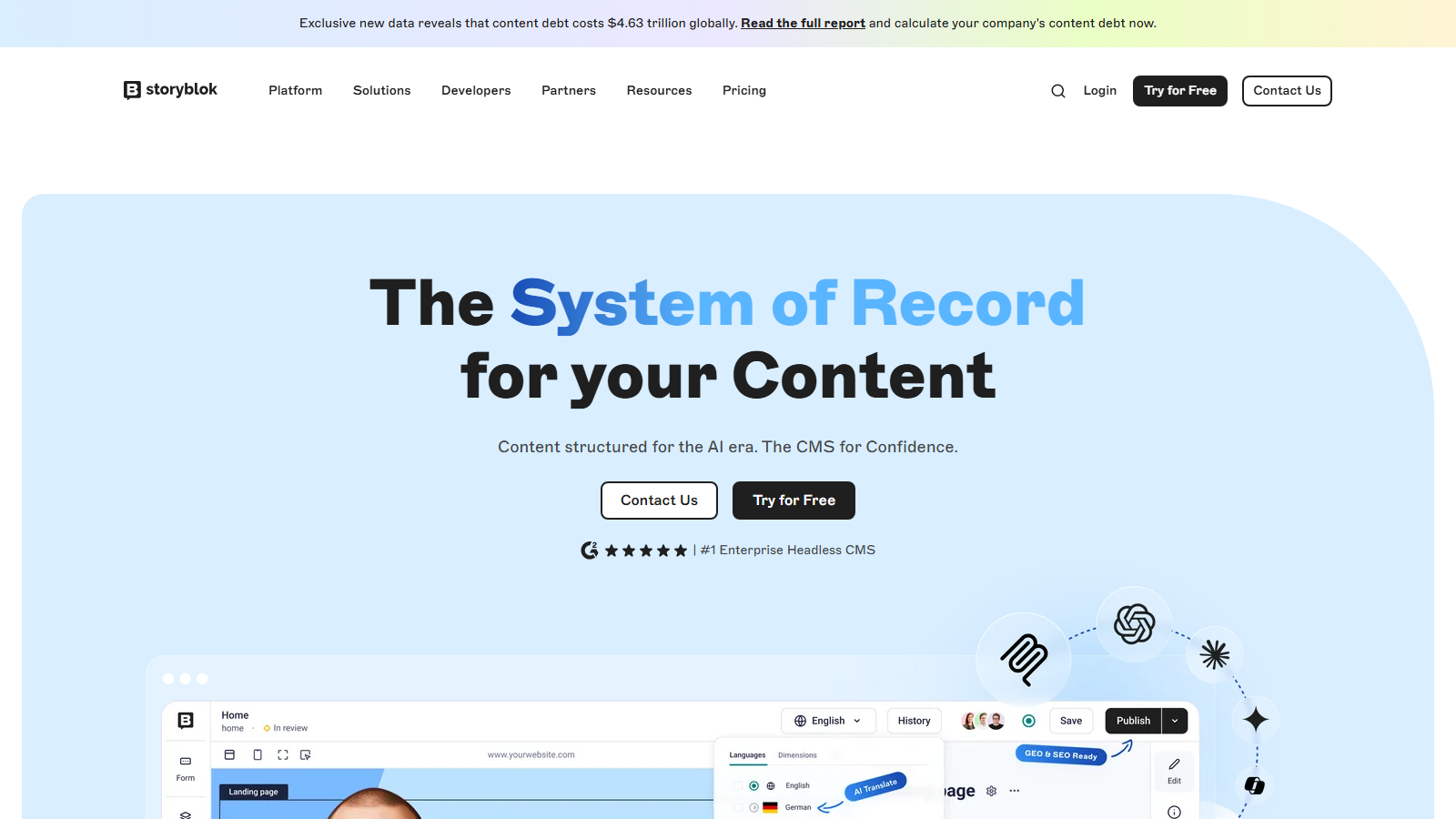
Storyblok's argument is the visual editor, and unlike most claims in this category it is a real one. Editors work on a live rendering of the actual site, clicking a component to edit it in place, and the content model underneath stays properly structured rather than degrading into a page builder. If your buyer is a marketing team that has been burned by a headless migration, this is the platform that wins the demo.
The APIs are conventional and well documented: a Content Delivery API, a Management API covering assets, folders, tags and traffic statistics, a GraphQL API on the Premium and Elite plans, an Image Service for on-the-fly transformation, and a vendor MCP server. Nothing exotic, which is the right answer for a platform whose differentiator lives in the editing experience.
The pricing meters more dimensions than most: seats, traffic, API requests, locales and AI credits each have an included allowance, and on Growth a published overage rate. That makes it forecastable, and a growing site expensive in several directions at once. Note also that the uptime figure on the self-serve paid tiers is 97%, which permits considerably more downtime than it suggests at a glance.
Our scorecard
Our editorial read across six dimensions, scored 1 to 5. This is our own assessment, not an aggregate of user reviews, and it is deliberately kept out of the page's structured data.
- Content modelling4/5
Component-based and genuinely structured, so the visual editor does not cost you a clean model.
- Developer experience4/5
Clean REST (GraphQL on the top tiers), a real Image Service, published rate limits and an MCP server.
- Editor experience5/5
Among the strongest visual editors reviewed here. Editing a live page in place is the reason teams choose it and stay.
- Pricing3/5
Forecastable and metered in five directions at once. The free tier has no overage, so it stops rather than bills.
- Governance3/5
Workflows, locales and versioning are all there, most of them behind the higher tiers.
- Ecosystem4/5
Broad framework support and good integrations, though smaller than Contentful's.
An editorial read, not an aggregate of user reviews, and deliberately kept out of this page's structured data.
Storyblok in their own words
From Storyblok's own YouTube channel. Vendor marketing rather than an independent review, included because it is the quickest way to see the product before you sign up.
What you can query
Content Delivery API
1,000 req/s cached, 50 uncached
Published stories as JSON, served from CloudFront. The read path, and the one the rate limits are written for.
GraphQL API
Premium and Elite plans only
The same content through a generated schema, for teams that would rather shape the response than filter it client-side.
Management API
Also exposes API traffic statistics
Read-write access to stories, components, assets, asset folders, tags, users and spaces. Migrations and imports run here.
Image Service
Billed against your traffic allowance
Resizing, cropping, format conversion and focal points through URL parameters, including protected images.
Visual Editor bridge
Front-end integration, not a data API
The JavaScript bridge that lets the editor address components inside your live front end. The differentiator, and it needs wiring into your app.
MCP server
Plus Universal, Delivery and Management API clients
A vendor-hosted MCP server that lets an assistant such as Claude read and write stories with no connector code.
Who Storyblok is for
Marketing teams that will actually use the CMS every day, and the developers who have to keep them happy. If editors have previously rejected a headless setup because they could not see what they were changing, Storyblok is the strongest answer in this directory, and the content model underneath stays clean enough that engineering does not pay for it.
It is a weaker fit for a pure developer tool, a content model that is mostly structured data rather than pages, or any team that needs to control where the content lives.
Strengths and limits
What it does well
- The visual editor is the real thing: editors work on a live rendering of your own front end, and the model underneath stays component-based rather than collapsing into free-form HTML.
- Rate limits are published in unusual detail, including how they change with page size, which lets you plan caching from documented figures.
- Cached CDN reads get 1,000 requests a second against 50 uncached, which rewards getting your caching right rather than buying a bigger plan.
- On Growth, every metered dimension has a published overage price, so growth is forecastable rather than a renegotiation.
- A vendor-run MCP server plus three official API clients, which is further than several larger competitors have gone.
- The Image Service handles transformation, format negotiation and protected images through URL parameters, so no separate media pipeline is needed.
- A 45-day trial of Growth Plus, which is long enough to actually migrate something and find out.
Where it falls short
- ACCEPTABLE USE CAN CHANGE UNDER YOU. One customer documented in detail being told mid-build that their vertical was now Enterprise-only, after receiving written confirmation months earlier that it was fine. See the Reddit section.
- The uptime figure on both self-serve paid tiers is 97%, roughly a day of downtime a month, and the self-service terms attach no credit to it.
- Five separately metered dimensions means five ways to exceed a plan, and the seat price applies from the first extra user.
- The free tier cannot buy overages at all, so it stops rather than degrades. That is safe, and it makes it useless as a soft launch.
- Every self-serve plan includes exactly one space, so a second project is a second subscription, and references cannot cross between spaces.
- Rate limits drop steeply with page size: asking for 100 entries a page cuts you to 6 requests a second, which makes naive bulk exports slow.
- No self-hosting at any tier, so the data lives with the vendor and the commercial terms are the only protection you have.
Storyblok pricing
Starter is free with hard caps: 1 space, 1 seat, 100GB traffic, 100k API requests, 2 locales and 25k AI credits, and crucially no overages are available to buy. At the cap requests simply stop, with no invoice, which is fine for evaluation and unsuitable for anything with real traffic.
Growth is $99 a month, or $90.75 billed annually, for 5 seats, 400GB of traffic, 1 million API requests, 2 locales and 100k AI credits. Growth Plus is $349 a month, or $319.91 annually, for 15 seats, 1TB, 4 million requests, 10 locales and 200k AI credits, and is the tier Storyblok marks Most Popular.
On Growth every dimension has a published overage: $15 per extra seat, $75 per additional 250GB, $10 per additional million API requests, $20 per additional locale and $20 per 200k AI credits. That transparency is genuinely useful, and it means a site that grows in traffic, languages and headcount at the same time is paying more in three places at once. Growth Plus sells no overage, so its allowances are ceilings.
Premium and Elite are quote-only, and one thing to know before you build: the customer account in the Reddit section below describes an Enterprise quote of 1,980 euros a month on a three-year commitment, arrived at not through usage growth but through a change in which verticals Storyblok would serve on self-serve plans.
Starter
Free
Hard caps, no overages available
- 1 space, 1 seat (a second at $15/mo)
- 100GB traffic and 100k API requests a month
- 2 locales and 25k AI credits
- No additional traffic or requests can be bought at all
Growth
$99 / mo
$90.75/mo billed annually
- 5 seats included, up to 10 at $15/mo each
- 400GB traffic and 1M API requests, both extendable
- Overages: $75 per 250GB, $10 per 1M requests, $20 per locale
- 97% uptime published, with no credit attached
Growth Plus
$349 / mo
$319.91/mo annually, marked Most Popular
- 15 seats, 1TB traffic, 4M API requests, 10 locales
- 200k AI credits a month, and no overage on any meter
- Still one space, and the same 97% uptime figure
- Premium and Elite above this are quote-only
Query example
A minimal fetch against the live API, with credentials read from the environment rather than pasted inline.
curl -s -G "https://api.storyblok.com/v2/cdn/stories/home" \
  --data-urlencode "token=$STORYBLOK_PREVIEW_TOKEN" \
  --data-urlencode "version=published" \
  --data-urlencode "resolve_relations=article.author"

# Rate limits fall as your page size grows, which is the
# non-obvious part: 50 req/s for a listing of 25 or fewer,
# but 6 req/s once you ask for 100 per page. Cached CDN
# reads get 1,000 req/s, so cache aggressively rather than
# paginating harder.
Limits and quotas
- Content Delivery API: 1,000 requests a second when served from the CDN cache.
- Uncached single entries and listings of 25 or fewer: 50 requests a second.
- Listings of 25 to 50 entries: 15 a second. 50 to 75: 10 a second. 75 to 100: 6 a second.
- Exceeding a limit returns HTTP 429.
- Starter: 100GB traffic, 100k API requests, 2 locales, 25k AI credits, no overages purchasable.
- Growth: 5 seats (max 10), 400GB traffic (max 1TB), 1M API requests (max 5M), 2 locales (more at $20 each), 100k AI credits (max 500k).
- Growth Plus: 15 seats, 1TB traffic, 4M API requests, 10 locales, 200k AI credits, with no overage on any of them.
- One space on every self-serve plan, including Growth Plus.
- 97% uptime figure on Growth and Growth Plus, described in the self-service terms as best possible availability.
Third-party reviews
Scores read from each source on 3 September 2026. We report them as-is and publish no rating of our own.
A small sample. Fourteen reviews is thin enough that individual opinions move the average, so weigh it accordingly.
What developers say on Reddit
Developers like the product and the editors love it, which matches every other source. The thread worth reading before you commit is about something else entirely.
In October 2025 an r/nextjs user running a cannabis EDUCATION site described asking Storyblok directly, before building, whether their content was permitted, and being told it was fine.
Months into development they noticed competitors leaving the platform, asked again, and were told legal had made adjustments: cannabis, crypto, adult and anything comparable was now Enterprise-only. Their roughly 350 euro a month plan became a 1,980 euro a month quote on a three-year commitment, and the extra money bought one million more API calls.
We cannot verify the account beyond the post itself, and it is one customer. It is included because the risk it describes is not a pricing complaint but an acceptable-use one, it is specific and dated, and it is the kind of thing that is invisible until it happens to you. If you operate in a vertical anyone might call sensitive, get the answer in your contract rather than in an email.
“Earlier this year, we reached out to Storyblok directly to confirm if cannabis content was allowed. The answer was clear: absolutely fine. [...] Turns out, Storyblok's legal team 'made some adjustments.' Translation: cannabis, crypto, adult, or anything slightly edgy is now Enterprise only.”
r/nextjs on Reddit“Our original plan was around 350 euros a month. Suddenly it's 1,980 euros a month with a three year commitment. The upgrade? Instead of 4 million API calls, we now get... drumroll... 5 million!”
r/nextjs on Reddit“Sounds like Storyblok's risk appetite and KYB (know your business) policies changed. Any business that could pose a risk (and Storyblok defines what risk is), will be subject to specific rules.”
r/nextjs on Reddit“so it's all good ... as long as you pay up? I would love to hear an explanation on that. Are they required to do some auditing on content related to those activities?”
r/nextjs on Reddit“We're migrating to Payload since it's open source and gives us full control over our data. [...] We looked at Sanity too, great product, but your data lives on their platform, so you're still at their mercy when it comes to pricing or policy changes.”
r/nextjs on Reddit
Verdict
Choose Storyblok when editors are the constraint. The visual editor is among the strongest in this directory, it does not cost you a structured content model, and marketing teams who have rejected headless before will accept this one. For a content-heavy marketing site with a real editorial team, that is often the whole decision.
Go in understanding the meter. Five separately priced dimensions and one space per self-serve plan means growth arrives as several simultaneous line items, and the 97% uptime figure is worth reading twice if uptime is contractual for you.
The acceptable-use question is the one nobody thinks to ask. If your content touches anything a legal team might reclassify later, get the permission written into the contract rather than into a support reply, because at least one customer has watched that reply stop being binding halfway through a build.
Storyblok FAQ
How much does Storyblok cost?
Starter is free with hard caps. Growth is $99 a month, or $90.75 billed annually, for 5 seats and 1 million API requests. Growth Plus is $349, or $319.91 annually, for 15 seats and 4 million requests. Premium and Elite are quote-only. These are the US prices; Storyblok shows other visitors the same numerals in their own currency.What counts against a Storyblok plan?
Five things, each metered separately: seats, traffic, API requests, locales and AI credits. On Growth each has a published overage rate, so extra seats are $15 a month, extra traffic $75 per 250GB, extra requests $10 per million, extra locales $20 and extra AI credits $20 per 200,000. Growth Plus sells no overage.What are Storyblok's API rate limits?
1,000 requests a second for cached CDN reads, and 50 a second for uncached single entries or listings of 25 or fewer. The limit falls as page size grows: 15 a second for 25 to 50 entries, 10 for 50 to 75, and 6 for 75 to 100. Cache aggressively rather than requesting bigger pages.What uptime does Storyblok guarantee?
Storyblok publishes 97% for Growth and Growth Plus, roughly 22 hours of downtime a month. Its self-service terms describe that as best possible availability, and only Premium and Elite carry a credit-backed commitment, 99.9% and 99.99%. If uptime is contractual for your business, that belongs in the evaluation rather than the small print.Can Storyblok change what content it allows?
One customer says yes, and documented it. An r/nextjs post describes written confirmation that cannabis education content was permitted, followed months later by that vertical becoming Enterprise-only and a quote roughly six times higher on a three-year term. We cannot verify it beyond the post, and it is a good reason to get vertical approval into a contract.How many spaces do you get?
One per subscription, on every self-serve plan including Growth Plus at $349 a month. A second project is a second subscription, and Storyblok does not support references between spaces, which catches out agencies who expect sister sites to share content.Does Storyblok have an MCP server?
Yes, a vendor-run one, alongside Universal, Content Delivery and Management API clients. That puts it ahead of several larger competitors on AI-client support, and it means an assistant can read and write content without anyone building a bespoke integration first.Storyblok or Contentful?
Storyblok if editors are the constraint and the visual editor is what wins the room. Contentful if the buying process turns on procurement paperwork, governance, EU hosting and a contractual SLA. Contentful's free-to-$300 cliff is steeper, but its uptime commitments and enterprise paperwork are considerably stronger.
Other platforms worth a look
This is an independent review. We have no affiliate relationship with Storyblok, earn nothing if you sign up, and no vendor pays for placement in the directory. Prices were read from the vendor's own pages in September 2026 and change without notice.