


Skip to content

Gym SEO strategy

Regulated marketing

January decides the year and the catchment is a ten-minute drive

Written by Eugene SuslovLast reviewed 28 August 2026No affiliate links
Sector
Lifestyle and leisure
Model
Local service, Multi-location
Competition
High
Time to results
3 to 7 months
Typical monthly
$800 to $4,000

Key takeaways

  1. 1January decides a large share of the year, which means the content has to be live and indexed in November. A campaign that starts on the second of January has missed.
  2. 2Your catchment is a drive time, not a radius. You are competing with the gym eight minutes away, not the one three miles away as the crow flies.
  3. 3Amenity queries are the easiest win in this industry. Childcare, twenty-four hour access, a pool, a sauna, parking. Extremely high intent and almost nobody has the page.
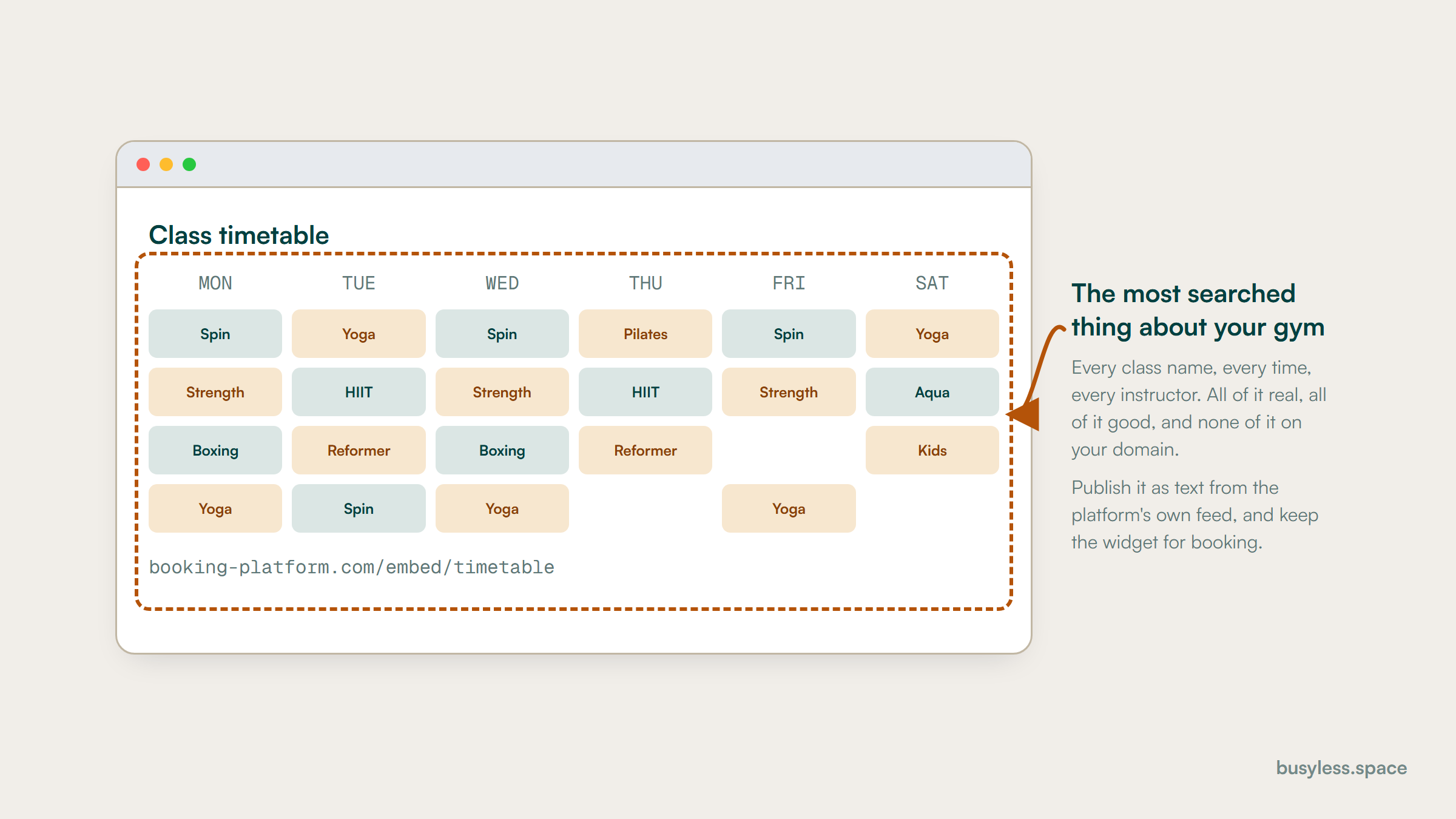
  4. 4Your class schedule is the most searched thing about your gym and on most sites it lives inside a booking platform iframe, where search engines cannot see it.
  5. 5Membership agreements are regulated contracts in many states, with cancellation rights and term limits written into statute. Advertising one is advertising a regulated product.

SEO for gyms is shaped by two facts that have nothing to do with search. A single month carries a disproportionate share of annual sign-ups, and the catchment is a drive time rather than a distance.

The seasonality is the harder of the two to work with. Demand for anything fitness-related climbs through late December and peaks in the first weeks of January, and content published on the second of January has already missed, because indexing is not instant and the decision is already being made.

A gym SEO strategy is therefore written in the autumn for a January that has not happened yet, which is an unusual planning rhythm and the one most operators get wrong.

The catchment fact is more useful than it sounds. People join the gym they will actually go to, and that is a function of minutes rather than miles: on the way home, near the school run, close enough that the decision is not renegotiated every evening.

That means the competitive set is small and specific. You are competing with three or four places, not with everyone in the city, and you can name them.

Underneath both is the economic point that decides whether any of this is worth doing. Membership businesses live on retention, January joiners churn hardest, and a programme that fills the gym with people who leave in March has produced activity rather than value.

Who already ranks in fitness and gyms

Run a near-me query from inside your catchment rather than from the office, then run a class query. Most gym SEO audits turn up the same picture: the map pack takes the whole first screen on the generic query, and on the class and amenity queries there is barely anybody competing at all.

What is on the results page

  • Local pack taking most of the first screen on gym and near-me queries
  • Booking and class marketplaces on modality and class queries
  • Franchise brand sites outranking individual locations on brand terms
  • People Also Ask, dense on price, contract and beginner questions
  • Image results on facility and equipment queries
  • Very little competition on amenity queries, which is the opportunity
  • Sharp seasonal volatility in all of it, concentrated around the new year
  • Google Business Profile

    google.comClaim it

    The dominant channel by a wide margin, because the decision is proximity-led and the pack answers proximity. Categories, attributes, photographs, hours and reviews do most of the available work. The attributes matter more here than in most industries, since amenity filtering happens directly in the pack.

  • Class booking marketplaces

    classpass.comClaim it

    A genuine gatekeeper for boutique studios and a genuine competitor at the same time. They rank for modality and class queries, they fill quiet classes, and they also train customers to buy access rather than membership. Price it on whether marketplace visitors convert to direct members, not on class attendance.

  • Booking and management platforms

    mindbody.ioClaim it

    Both the software you run on and a consumer-facing marketplace. Their listing pages rank, sometimes above your own site, and your schedule usually lives inside their iframe. Claim and complete the consumer profile, and separately get your schedule onto your own domain as real content.

  • Franchise brand sites

    franchise.org

    If you are a franchisee, the corporate site outranks your location for the brand term and often hosts the only location page. Find out exactly what your agreement permits, because the answer determines whether you build a site at all or concentrate everything on the profile and the corporate location page.

  • Yelp and Apple Maps

    yelp.comClaim it

    Yelp still ranks in many metros for fitness and it feeds Apple Maps, which matters more here than in most categories because people navigate to gyms on their phones. Claim both, keep hours and amenities accurate, and note that hours accuracy is unusually important in a category where early morning and late evening access is the product.

  • Certification body directories

    nasm.orgClaim it

    Trainer certification bodies publish searchable directories, which matter for personal training and coaching rather than for membership. Modest traffic and a genuine credential, and the listing is usually incomplete.

  • Community and social platforms

    instagram.comClaim it

    Not search and heavily used in this category for evaluation rather than discovery: somebody finds you in the pack and then looks at your social to see what the place is actually like. Treat it as the visual proof layer and keep it consistent with the website, particularly on class times and pricing.

What people actually search

Fitness search divides into a contested generic query, a set of modality queries that behave like product searches, and an amenity cluster that is almost entirely unserved. The third is where the easy work is.

Generic local

Local commercial

gyms near me

The page that wins it: A complete profile and a location page that loads fast

Decided in the pack on proximity, reviews and photographs. The website barely participates, and profile completeness does more than any page you could write.

Amenity

Local commercial, high intent

gym with childcare near me

The page that wins it: A page per amenity you genuinely offer

The easiest win in this industry. Somebody searching this has a hard requirement, will travel slightly further for it, and almost nobody has built the page.

Modality and class

Local commercial

reformer pilates [city]

The page that wins it: A page per modality with the schedule, the coach and the price

How boutique fitness is actually searched. It behaves like a product query rather than a location one, and the marketplaces are currently answering it.

Price and contract

Commercial investigation

how much is a gym membership

The page that wins it: A pricing page with real numbers and the contract terms

The most searched question in the category, and most gyms answer it with a form. That is not discretion, it is the reason the visitor goes back to the results page.

Beginner and anxiety

Informational

what to expect first time at the gym

The page that wins it: An honest guide to your gym specifically

Reaches the person who has been thinking about it for months, which in January is a large share of the market. Almost nobody writes it and it converts unusually well.

Comparison

Commercial investigation

[competitor] vs [competitor] [city]

The page that wins it: An honest comparison including where the competitor is better

Uncomfortable and effective. Your catchment has three or four real competitors and the reader is choosing between exactly those.

Cancellation

Informational

how to cancel a [brand] membership

The page that wins it: Nothing, usually, and it is worth understanding why the volume exists

Very high volume and mostly about competitors. Writing it about somebody else is opportunistic and cheap; making your own cancellation process genuinely easy is the better answer.

Corporate and community

Commercial investigation

corporate gym membership [city]

The page that wins it: A page for the HR or office manager buyer

Low volume, high value, counter-seasonal, and a route to members who are far more likely to stay because somebody else is paying.

A Venn diagram of a three-mile radius against a ten-minute drive at six o'clock. The radius includes households across a river or behind a rail line. The drive time includes households down a main road with somewhere to park. The overlap is the people who will actually join.
Your competitor is the gym eight minutes away, not the one three miles away. Only one of these two circles knows the difference.

What the rules change

More regulated than operators expect, in two directions. Membership agreements are governed by state statutes written specifically for this industry, and a gym is a place of public accommodation, which brings its own exposure. Check your own state and your own counsel; none of this is legal advice.

1

A gym membership is a regulated contract in many states

State health club, health spa and physical fitness services statutes, which exist in a large number of states and set specific requirements for membership agreements

What it means

Many states have legislation written specifically for this industry. Common provisions include a cooling-off period during which a member may cancel, limits on contract length, requirements about prepayment, rights to cancel on relocation or medical grounds, and in some states registration or bonding requirements for facilities selling long-term memberships. The rules differ substantially state to state.

So do this

Publish the actual terms: length, cancellation rights, notice period, what happens if you move or are injured, and any fee. Then check them against your own state's statute rather than against what the previous owner used. A pricing page that states the cancellation rights plainly converts better than one that hides them, and it is the version the statute expects anyway.

2

Automatic renewal has its own rules, and the federal picture changed

State automatic renewal laws, several of which impose specific disclosure, consent and cancellation requirements; the Federal Trade Commission's revised negative option rule was vacated by the Eighth Circuit in July 2025, leaving state law and the FTC Act as the operative framework

What it means

Recurring memberships are negative option offers. A federal rule that would have imposed uniform requirements was struck down in July 2025, but state automatic renewal statutes were unaffected and several are strict, particularly on making cancellation as easy as sign-up. General consumer protection law continues to apply regardless.

So do this

Make cancellation available by the same route as joining. If somebody can sign up online, they should be able to cancel online. State the renewal terms on the pricing page rather than in a linked agreement, and check your own state's automatic renewal law, because it did not go away when the federal rule did.

3

Your website is part of a place of public accommodation

Americans with Disabilities Act Title III, which applies to places of public accommodation including gyms and health clubs

What it means

Fitness facilities are places of public accommodation, and website accessibility claims against them are common. There is no single technical standard mandated for private websites, and the widely referenced benchmark in practice is the Web Content Accessibility Guidelines. The overlap with SEO is substantial: heading structure, alt text, contrast, keyboard navigation and form labelling are the same work.

So do this

Audit against the current accessibility guidelines and fix the structural issues rather than installing an overlay widget, which is not a substitute and has itself attracted claims. Then keep the schedule, the pricing and the sign-up flow accessible specifically, because those are the pages a claim would name.

4

Results claims and transformation photographs are advertising claims

Federal Trade Commission Act section 5 on deceptive practices, and the FTC Endorsement Guides on testimonials and typical results

What it means

Weight loss and body composition claims are among the most closely watched advertising claims there are, and testimonials describing results carry expectations about typicality. Transformation photographs, timeframes and specific numbers all make claims, whether or not anybody intended them to.

So do this

Publish what a member can actually expect and avoid specific outcome promises. If you use transformations, be accurate about the timeframe and the circumstances, and do not present an exceptional result as representative. Trainer certifications and the coaching approach are more persuasive to the audience you want anyway, because that audience has seen a thousand transformation photographs.

Proving expertise

The proof that matters here is mostly operational rather than credential-based. Somebody choosing a gym wants to know what it is actually like at the time they would go, who runs the classes, and what it costs, and almost none of that appears on a typical gym website.

  • Real photographs of the actual facility, taken at the time of day people would attend
  • Trainers and coaches named with their certifications and the awarding body
  • Class schedule published as text on your own domain, kept current
  • Membership terms published in full, including cancellation rights and notice periods
  • How busy the gym is at different times, stated honestly
  • Equipment listed specifically, because serious members care and general members are reassured
  • Cleaning, maintenance and equipment replacement described, since it is the most common complaint
  • Accessibility and facilities described in detail, including changing rooms, parking and step-free access

How to build a gym SEO strategy

A realistic first six months, and the start date matters more here than anywhere else in this directory. A gym SEO strategy beginning in September is aimed at the coming January; one beginning in February has eleven months to prepare and should use them rather than chasing a peak that has passed.

  1. 1

    Weeks 1 to 3

    Fix the profile and publish the numbers

    • Complete the Google Business Profile, with every amenity attribute set correctly
    • Publish real membership pricing, including the contract terms
    • Check the membership agreement against your state's health club statute
    • Make cancellation available by the same route as sign-up
    • Claim Yelp, Apple Maps and the booking platform consumer profile
    • Photograph the facility at the times people actually attend

    You end up with
    A profile that answers proximity and a pricing page that answers the top query

  2. 2

    Weeks 3 to 8

    Take the amenity and class queries

    • Write a page per amenity you genuinely offer
    • Get the class schedule onto your own domain as real text
    • Write a page per modality with the coach, the schedule and the price
    • Name the trainers with their certifications
    • Add ExerciseGym and class Event structured data
    • Run an accessibility audit and fix the structural issues

    You end up with
    The high-intent queries covered, and the schedule finally visible to search engines

  3. 3

    Weeks 6 to 16

    Prepare for January in the autumn

    • Write the beginner and first-visit guides, honestly
    • Write the honest comparison against your three real local competitors
    • Build the corporate membership page for the HR buyer
    • Prepare the January content and offers, live by mid-November
    • Build a retention content path: what to do in weeks one to six
    • Collect reviews steadily rather than in a push

    You end up with
    Content indexed and ranking before the demand peak arrives, not during it

  4. 4

    Weeks 12 to 26

    Measure retained members, not sign-ups

    • Track sign-ups by source and by channel, with a consistent question
    • Track ninety-day retention by acquisition source, which is the real measure
    • Report member lifetime value rather than joining volume
    • Track the seasonal curve against the same period last year
    • Review contract terms and pricing pages annually
    • Compare marketplace visitors on conversion to direct membership

    You end up with
    A report that distinguishes members who stayed from members who joined

A rising staircase of what waiting costs. Published in November gives up nothing. December gives up some ground. The second of January gives up the season. February gives up the whole year.
Not a measurement. A page published later has less time to be crawled, indexed and linked before the demand arrives.

Technical fixes with the best payoff

One structural problem defines this industry technically: the most searched thing about your gym lives inside somebody else's software. Everything else on this list is smaller and easier.

  • The class schedule is an iframe

    A sprint

    Booking and management platforms embed the schedule from their own domain, so the single most searched thing about a gym is not on the gym's website in any form a search engine can read. It also usually performs badly on a phone, which is where it is read.

    Publish the schedule as real text on your own domain, generated from the platform's data if it offers a feed, and keep the booking widget for the transaction. Add class markup so individual sessions can be understood as events.

  • There is no page per amenity

    An hour per amenity

    Childcare, twenty-four hour access, a pool, a sauna, parking and step-free access are all searched with high intent by people who have a hard requirement. There is usually a bullet on the home page and no page at all.

    One page per amenity you genuinely offer: what it is, the hours, the cost if any, the booking process, photographs, and the practical details. Set the matching attribute on the business profile at the same time, because that is where the filtering happens.

  • Pricing is behind a form

    An afternoon

    The most searched question in the category is what it costs, and the standard answer is a lead capture offering a free pass. The visitor who wanted a number goes back to the results page and finds a competitor who gave one.

    Publish the prices and the terms. Keep the free pass as an offer beside the numbers rather than in place of them. The enquiries you lose were price-shopping and would have left anyway; the ones you gain arrive already comfortable.

  • Photographs are empty and were taken at 2pm

    An afternoon

    Every gym photographs its facility when it is empty and bright, and every prospective member wants to know what it is like at 6pm on a Tuesday. The gap between the two is the most common complaint after joining.

    Photograph at the times people actually attend, including a busy period. Be honest about it. It sets a real expectation, it looks alive, and it stops the disappointment that drives early cancellation.

  • Accessibility has never been checked

    A sprint

    A gym is a place of public accommodation and this sector attracts website accessibility claims. It is also substantially the same work as good technical SEO: headings, alt text, contrast, keyboard navigation and form labels.

    Audit against the current guidelines and fix the structure. Do not install an accessibility overlay widget as a substitute; it does not fix the underlying issues and has attracted claims of its own. Prioritise the schedule, pricing and sign-up flow.

  • Multi-location gyms share one page

    A sprint

    Fitness decisions are made on drive time, so each location needs to rank in its own catchment. A single locations page gives each site nothing, and a shared phone number breaks the profile-to-site consistency the pack relies on.

    A page per location with its own hours, own team, own schedule, own amenities, own photographs and its own profile link. Amenities in particular differ between sites and are frequently listed as though they do not.

  • Franchisees have no idea what they are allowed to do

    An afternoon reading, then a decision

    The corporate site usually outranks a franchisee for the brand term and may own the only location page. Some agreements restrict independent websites and paid search entirely, and operators frequently do not know their own terms.

    Read the agreement and find out. If an independent site is permitted, build it around the catchment, the amenities and the team rather than the brand. If it is not, put everything into the profile and into whatever the corporate location page allows.

A mock class timetable page with a full week of classes outlined, and the source shown as an embedded booking platform domain. The annotation says every class name, time and instructor is real, good, and none of it is on your domain.
The single most searched thing about a gym, published on somebody else's domain. Publish it as text and keep the widget for booking.

Structured data that applies here

The types below fit this industry specifically. Most of them earn no rich result on their own, which is worth knowing before anyone sells the work on that basis. What they do is describe the entity precisely, which matters for how search engines and answer engines resolve who you are.

  • ExerciseGym

    Home page and every location page

    ExerciseGym sits under SportsActivityLocation in the vocabulary. Amenity fields matter more here than in most categories, because amenity filtering is exactly how high-intent searchers narrow the list.

    ExerciseGym.jsonld
    {
      "@context": "https://schema.org",
      "@type": "ExerciseGym",
      "@id": "https://[YOUR-DOMAIN]/locations/[SLUG]#gym",
      "name": "[GYM NAME, this location]",
      "url": "https://[YOUR-DOMAIN]/locations/[SLUG]",
      "telephone": "[+1-555-000-0000]",
      "priceRange": "[$$]",
      "image": "https://[YOUR-DOMAIN]/gym-floor.jpg",
      "address": {
        "@type": "PostalAddress",
        "streetAddress": "[123 Example St]",
        "addressLocality": "[CITY]",
        "addressRegion": "[ST]",
        "postalCode": "[00000]",
        "addressCountry": "US"
      },
      "geo": {
        "@type": "GeoCoordinates",
        "latitude": "[00.000000]",
        "longitude": "[-00.000000]"
      },
      "openingHoursSpecification": [{
        "@type": "OpeningHoursSpecification",
        "dayOfWeek": ["Monday","Tuesday","Wednesday","Thursday","Friday"],
        "opens": "[05:00]",
        "closes": "[22:00]"
      }],
      "amenityFeature": [
        { "@type": "LocationFeatureSpecification", "name": "Childcare", "value": true },
        { "@type": "LocationFeatureSpecification", "name": "24 hour access", "value": true },
        { "@type": "LocationFeatureSpecification", "name": "Pool", "value": false },
        { "@type": "LocationFeatureSpecification", "name": "Free parking", "value": true }
      ],
      "isAccessibleForFree": false
    }
  • EventSeries for a recurring class

    Each class or modality page

    The answer to the iframe problem. A class genuinely is a recurring event with a schedule, a location and an instructor, and marking it up puts the most searched thing about your gym back on your own domain in a form that can be understood.

    EventSeries for a recurring class.jsonld
    {
      "@context": "https://schema.org",
      "@type": "EventSeries",
      "name": "[CLASS NAME]",
      "url": "https://[YOUR-DOMAIN]/classes/[SLUG]",
      "description": "[What the class is, who it suits, what to bring, how hard it is.]",
      "location": { "@id": "https://[YOUR-DOMAIN]/locations/[SLUG]#gym" },
      "organizer": { "@id": "https://[YOUR-DOMAIN]/locations/[SLUG]#gym" },
      "eventAttendanceMode": "https://schema.org/OfflineEventAttendanceMode",
      "subEvent": [
        {
          "@type": "Event",
          "name": "[CLASS NAME]",
          "startDate": "[YYYY-MM-DDT06:00]",
          "endDate": "[YYYY-MM-DDT06:45]",
          "location": { "@id": "https://[YOUR-DOMAIN]/locations/[SLUG]#gym" },
          "performer": { "@id": "https://[YOUR-DOMAIN]/team/[SLUG]#person" },
          "offers": {
            "@type": "Offer",
            "price": "[00]",
            "priceCurrency": "USD",
            "url": "https://[YOUR-DOMAIN]/classes/[SLUG]",
            "availability": "https://schema.org/InStock"
          }
        }
      ]
    }
  • Membership offer with real terms

    The pricing page

    Because a membership is a regulated contract in many states, the useful version of this node carries the term and the billing period rather than a headline number alone. Publish the same terms in the visible copy.

    Membership offer with real terms.jsonld
    {
      "@context": "https://schema.org",
      "@type": "Offer",
      "name": "[MEMBERSHIP NAME]",
      "url": "https://[YOUR-DOMAIN]/membership",
      "seller": { "@id": "https://[YOUR-DOMAIN]/locations/[SLUG]#gym" },
      "category": "Gym membership",
      "priceSpecification": {
        "@type": "UnitPriceSpecification",
        "price": "[00]",
        "priceCurrency": "USD",
        "billingDuration": 1,
        "billingIncrement": 1,
        "unitCode": "MON"
      },
      "eligibleDuration": {
        "@type": "QuantitativeValue",
        "value": "[12]",
        "unitCode": "MON"
      },
      "description": "[Joining fee, minimum term, notice period, cancellation rights and what happens if you move or are injured.]",
      "areaServed": { "@type": "City", "name": "[CITY]" }
    }
  • Person for trainers and coaches

    Team pages, referenced from the classes they teach

    Members choose classes by instructor far more than operators expect. Certifications are checkable against the awarding body's own register, so only claim what is current.

    Person for trainers and coaches.jsonld
    {
      "@context": "https://schema.org",
      "@type": "Person",
      "@id": "https://[YOUR-DOMAIN]/team/[SLUG]#person",
      "name": "[FIRST LAST]",
      "jobTitle": "[Coach / personal trainer]",
      "url": "https://[YOUR-DOMAIN]/team/[SLUG]",
      "image": "https://[YOUR-DOMAIN]/team/[SLUG].jpg",
      "worksFor": { "@id": "https://[YOUR-DOMAIN]/locations/[SLUG]#gym" },
      "hasCredential": [{
        "@type": "EducationalOccupationalCredential",
        "credentialCategory": "[CERTIFICATION]",
        "recognizedBy": { "@type": "Organization", "name": "[AWARDING BODY]" },
        "identifier": "[NUMBER IF PUBLISHED]"
      }],
      "knowsAbout": ["[MODALITY]", "[POPULATION, e.g. postnatal training]"]
    }
  • FAQPage

    Pricing, membership and beginner pages

    Contract and cancellation are the pair to cover, because they are what people search and what gyms most often bury. Match the visible text exactly, and keep it accurate to your state's rules.

    FAQPage.jsonld
    {
      "@context": "https://schema.org",
      "@type": "FAQPage",
      "mainEntity": [
        {
          "@type": "Question",
          "name": "[Question exactly as it appears on the page]",
          "acceptedAnswer": {
            "@type": "Answer",
            "text": "[Answer exactly as it appears. Give the real price, the real notice period and the real cancellation route.]"
          }
        }
      ]
    }
  • BreadcrumbList

    Class, amenity and location pages

    Worth it once classes, amenities and locations are a real hierarchy rather than one page with a booking widget on it. It also shows how little of the site exists as pages at all.

    BreadcrumbList.jsonld
    {
      "@context": "https://schema.org",
      "@type": "BreadcrumbList",
      "itemListElement": [
        { "@type": "ListItem", "position": 1, "name": "Home",
          "item": "https://[YOUR-DOMAIN]/" },
        { "@type": "ListItem", "position": 2, "name": "[Classes]",
          "item": "https://[YOUR-DOMAIN]/classes" },
        { "@type": "ListItem", "position": 3, "name": "[CLASS]",
          "item": "https://[YOUR-DOMAIN]/classes/[SLUG]" }
      ]
    }

What it costs

Editorial estimates rather than quotes, and low compared with most of this directory because the winnable ground is small and specific. The bigger risk here is spending on acquisition when the business needs retention, which no SEO budget can fix.

Do it yourself

$0 to $300
  • Business profile completed with every amenity attribute set
  • Membership pricing and terms published
  • A page per amenity, written by the owner
  • Photographs taken at realistic times of day
  • Reviews collected steadily rather than in bursts

Who it suits

A single independent gym with an owner willing to spend two hours a week

Where it stops

It gets most of the local value, and it will not solve the schedule iframe problem or produce a January content programme, both of which need real time.

Lean

$800 to $2,000
  • The schedule published on your own domain with class markup
  • Amenity and modality pages built properly
  • Beginner and comparison content written
  • Accessibility issues fixed structurally
  • January content prepared in the autumn rather than in January

Who it suits

An independent gym or studio in a market with several credible competitors

Where it stops

It cannot outrank the pack for somebody two miles further away, and it does nothing about retention, which is where the money actually is.

Funded

$2,000 to $4,000
  • A page per location with its own schedule, team and amenities
  • A corporate membership programme with its own content
  • Retention content built into the member journey
  • Per-location reporting and retention by acquisition source
  • Class and modality content produced continuously rather than once

Who it suits

Multi-site operators, or studios with several modalities to fill

Where it stops

Above this the constraint is usually capacity at peak times and retention, not demand. A report that recommends more acquisition into a full 6pm class is the wrong report.

How to do it with no budget

Almost everything valuable here costs time, and the highest-value item is a profile setting rather than a page. Work down the list, and finish before November.

  1. 1

    Set every amenity attribute on the business profile

    1 hour

    Google Business Profile

    Amenity filtering happens directly in the pack, so an unset attribute means you do not appear for somebody who needs childcare or step-free access. Highest return per minute on this page.

  2. 2

    Publish your prices and your terms

    2 hours

    Your website editor

    Price, joining fee, minimum term, notice period, cancellation route. It answers the most searched question in the category and it stops the visitor going back to the results page.

  3. 3

    Write a page per amenity

    1 hour each

    Your website editor

    Childcare, twenty-four hour access, pool, sauna, parking, step-free access. Hard requirements, high intent, and almost nobody has the page.

  4. 4

    Photograph the gym at 6pm

    1 hour

    A phone

    Every gym photographs an empty room in daylight. Show what it is like when people would actually be there. It sets a real expectation and reduces early cancellations.

  5. 5

    Check the membership agreement against your state's statute

    2 hours

    Your state's health club or fitness services legislation

    Cancellation rights, term limits and notice periods are written into statute in many states. Publish the real terms afterwards; the honest version converts better than the hidden one.

  6. 6

    Make cancellation as easy as joining

    An operational decision

    Your membership system

    If somebody can join online they should be able to cancel online. It is what several state laws expect, it removes a very large source of complaints, and it is the reason your brand plus the word cancel has search volume.

  7. 7

    Write the beginner guide

    2 hours

    Your website editor

    What actually happens on a first visit here: where to park, what to bring, what the induction involves, whether anybody will talk to you. It reaches the person who has been putting it off, which in January is most of the market.

The tool stack

Jobs first, tools second, and this is a short list. The most valuable input in this industry is not a marketing tool at all, it is the retention data already sitting in your membership system.

  • Understand your real catchment

    Your own member addresses

    Plot where members actually live and work, and measure it in drive time rather than distance. That map defines the competitive set, and it is usually much smaller than operators assume.

    Free routeFree, and more useful than any keyword tool here

  • Track local pack position within the catchment

    DataForSEOSEO APIRead the review

    Track from the residential areas your members come from, not from the gym itself. Ranking well at your own front door tells you nothing about the neighbourhood eight minutes away.

    Free routeManual checks from a few points in the catchment

  • Find the amenity and modality queries you are missing

    Google Search Console plus your own sales conversations

    Note what every prospective member asks about on a tour. Those questions are the amenity pages, and they are usually more specific than any keyword tool will surface.

    Free routeBoth free, and the sales conversations are better

  • Work out what a member is actually worth

    SEO Revenue Growth CalculatorFree toolOpen the tool

    Use average retained months rather than monthly fee. A January joiner who leaves in March and a referral who stays three years are not the same acquisition, and blending them hides the whole argument for retention.

    Free routeFree

  • Set a budget against retained members

    SEO Budget CalculatorFree toolOpen the tool

    Set the target as members retained past ninety days, not sign-ups. It usually reduces the budget and improves the outcome, which is the right shape of answer for this industry.

    Free routeFree

  • Generate the gym, class and membership markup

    Schema Markup GeneratorFree toolOpen the tool

    The class event markup is the part worth getting right, because it is the answer to the schedule sitting in somebody else's iframe.

    Free routeFree

  • Publish the schedule on your own domain

    PayloadHeadless CMSRead the review

    Classes, coaches, locations and amenities are related entities, and the schedule should be content you own with the booking platform handling the transaction. This is the single structural fix in this industry.

    Free routeFree and self-hosted

  • Measure retention by acquisition source

    Your membership management system

    Not a marketing tool and the most important item here. Ninety-day retention split by how the member arrived tells you which channels are worth anything, and almost nobody runs the report.

    Free routeAlready paid for, and usually not used this way

Take it from here

Everything below is yours to take. Fill the [BRACKETS] and it is ready to use. Start with the amenity audit: it is the fastest work on this page and it sits on the highest-intent, least contested queries in the industry.

Checklist

The easiest win in this industry. Somebody searching for a gym with childcare has a hard requirement, will travel further for it, and almost nobody has built the page.

AMENITY AUDIT - [GYM] - [DATE]

WHY THIS IS FIRST
"Gym with childcare near me" is a hard requirement, not a
preference. The searcher will drive further, will pay more, and
is comparing a very small number of options. Almost no gym has a
page for it, and many have not even set the profile attribute.

1. WHAT YOU ACTUALLY HAVE
   | Amenity              | Have it | Profile attribute set | Page |
   |----------------------|---------|-----------------------|------|
   | Childcare            | [ Y/N ] | [ Y / N ]             | [__] |
   | 24 hour access       | [ Y/N ] | [ Y / N ]             | [__] |
   | Pool                 | [ Y/N ] | [ Y / N ]             | [__] |
   | Sauna / steam        | [ Y/N ] | [ Y / N ]             | [__] |
   | Free parking         | [ Y/N ] | [ Y / N ]             | [__] |
   | Step-free access     | [ Y/N ] | [ Y / N ]             | [__] |
   | Women's only area    | [ Y/N ] | [ Y / N ]             | [__] |
   | Showers / lockers    | [ Y/N ] | [ Y / N ]             | [__] |
   | Olympic lifting area | [ Y/N ] | [ Y / N ]             | [__] |
   | Turf / sled track    | [ Y/N ] | [ Y / N ]             | [__] |
   | Recovery / cryo      | [ Y/N ] | [ Y / N ]             | [__] |
   | Towel service        | [ Y/N ] | [ Y / N ]             | [__] |
   | [_________________]  | [ Y/N ] | [ Y / N ]             | [__] |

2. SET THE PROFILE ATTRIBUTES FIRST
   Amenity filtering happens in the map pack. An unset attribute
   means you do not appear for somebody who needs it, no matter
   what your website says. This takes twenty minutes.

3. WHAT EACH AMENITY PAGE NEEDS
   [ ] What it is, precisely (not "childcare" but "supervised
       creche for ages [__] to [__]")
   [ ] The hours it is available, which are often narrower than
       the gym's
   [ ] Whether it costs extra, and how much
   [ ] Whether it needs booking, and how
   [ ] Capacity or limits
   [ ] Photographs of the actual space
   [ ] Who supervises it and their qualifications, where relevant
   [ ] The rules, honestly (age limits, time limits, what to bring)
   [ ] A link to membership and a link to book a visit

4. THE PAGES PEOPLE MOST OFTEN NEED
   Rank by what prospects ask on tours:
   1. [_________________________]
   2. [_________________________]
   3. [_________________________]

5. MULTI-SITE WARNING
   Amenities differ between locations and are almost always
   listed as though they do not. Check each site separately and
   never let a location page claim an amenity another branch has.

6. HONESTY CHECK
   [ ] No amenity listed that is currently out of service
   [ ] Anything closed for maintenance flagged with a date
   [ ] Anything seasonal (outdoor pool) stated as seasonal

What to publish

Whatever answers a decision somebody is making this week comes first. Publishing fitness advice means competing with the entire internet. What fills a gym is writing about this gym.

  • Amenity pages

    One per amenity you genuinely offer, then leave them

    The easiest win in the industry. Hard requirements, high intent, low competition, and an hour each to write.

  • The pricing and terms page

    Once, reviewed annually and whenever terms change

    The most searched question in the category, usually answered with a form. Publishing the numbers and the contract terms converts the visitor who was about to leave.

  • The class schedule as real content

    Published once, kept current automatically

    The most searched thing about any gym, and on most sites it lives inside somebody else's iframe where nothing can read it.

  • Modality and class pages

    One per modality, reviewed when the timetable changes

    How boutique fitness is actually searched, and it behaves like a product query. Include the coach, the schedule, the difficulty and the price.

  • The beginner and first-visit guide

    Once, properly, refreshed each autumn

    Reaches the person who has been thinking about joining for months, which in January is most of the market, and it converts unusually well because it removes the actual barrier.

  • An honest local comparison

    Once, reviewed yearly

    Your catchment has three or four real competitors and the reader is choosing between exactly those. The version that concedes where a competitor is better is the one people believe.

And what not to

  • General fitness advice, which competes with the entire internet and fills the gym with nobody
  • Pricing hidden behind a lead capture form
  • Specific weight loss or transformation promises, which are advertising claims
  • Testimonials presenting exceptional results as typical
  • Empty facility photographs taken in daylight when the gym is quiet
  • Membership terms that contradict your state's health club statute
  • An accessibility overlay widget installed in place of fixing the site
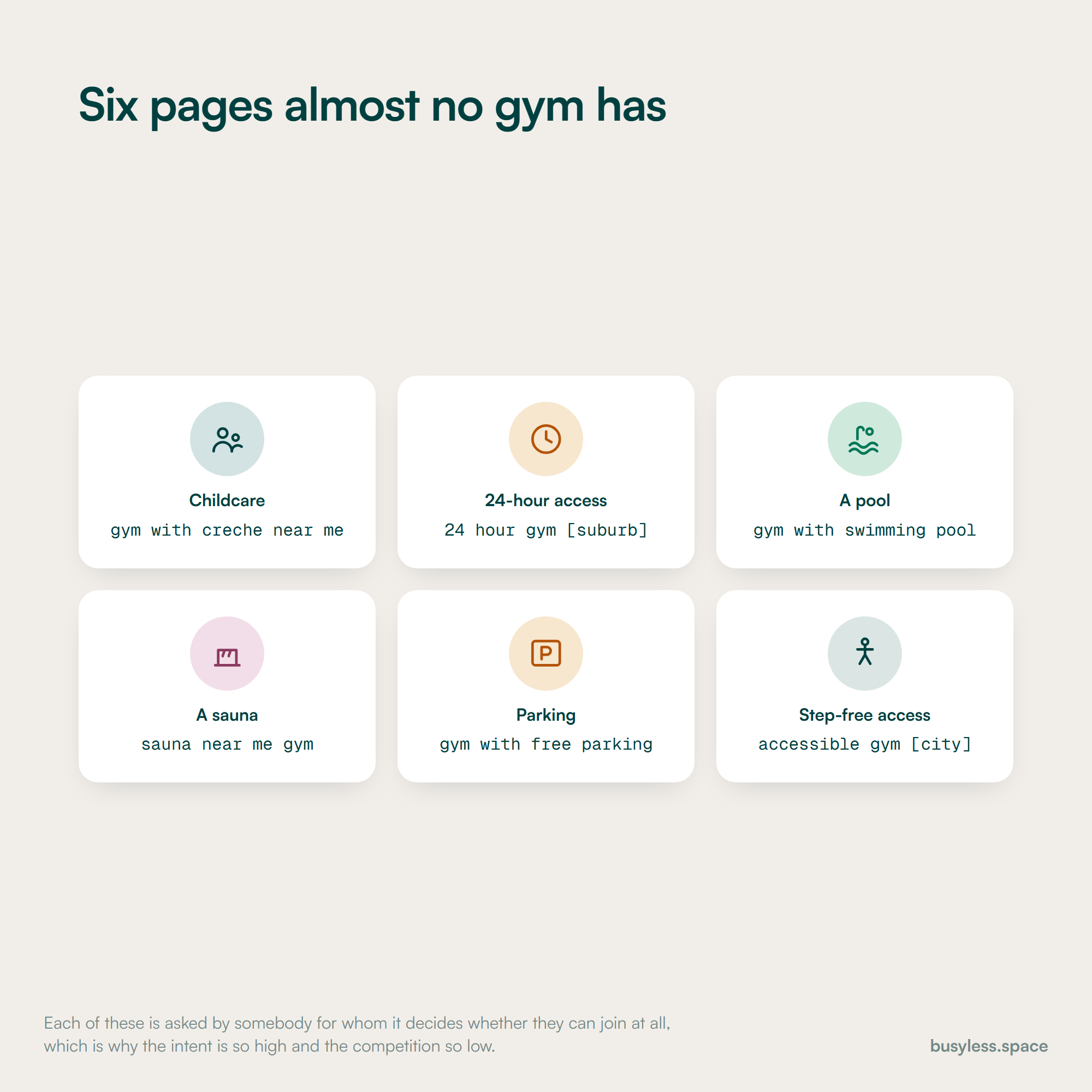
Six amenity queries shown as a set: childcare, twenty-four hour access, a pool, a sauna, parking and step-free access, each with the search it is asked with.
Each of these decides whether somebody can join at all, which is why the intent is so high and the competition so low.

The expensive mistakes

Starting the January campaign in January

Costs you The month that carries the year, missed, because indexing is not instant and the decision was already made

Have the January content live and indexed by mid-November, prepared during the quiet autumn

Hiding the price

Costs you The most searched question in the category answered with a form, and the visitor returning to the results page

Publish the price and the contract terms, and keep the free pass beside the numbers rather than instead of them

Leaving the schedule in the booking iframe

Costs you The most searched thing about your gym invisible to search engines, permanently

Publish it as text on your own domain with class event markup, and keep the widget for the transaction

Ignoring amenity queries

Costs you The highest-intent, lowest-competition searches in the industry, conceded to whoever wrote a paragraph

A page per amenity plus the matching profile attribute, which takes an hour each

Optimising for sign-ups

Costs you A January full of members who leave in March, at a cost per acquisition the retained value never covers

Report ninety-day retention by acquisition source and judge channels on retained members

Making cancellation hard

Costs you Complaints, potential exposure under state automatic renewal laws, and a permanent search volume around your brand plus the word cancel

Cancellation by the same route as joining, stated plainly on the pricing page

What to measure

Two things make measurement here distinctive. The seasonal curve is extreme enough that month-on-month comparison is meaningless, and sign-ups are a poor proxy for value because the members acquired in the peak are the ones most likely to leave.

Leading indicators

Move first. They predict, they do not prove.

  • Local pack position from within the catchment

    Geo-specific rank tracking

    Measured from the residential areas your members actually come from. Position at your own address is not the question; position eight minutes away is.

  • Profile actions: calls, direction requests, website clicks

    Google Business Profile insights

    The fastest indicator and heavily seasonal. Direction requests are the most useful of the three here, because they indicate somebody deciding to visit.

  • Impressions on amenity and modality queries

    Search Console, filtered by cluster

    The ground this playbook is built on. It should grow steadily through the quiet months, which is when you can actually tell whether the content is working.

  • Reviews and review velocity

    Business profile and review platforms

    Report velocity rather than average. Steady collection across the year is worth more than a January push, and a sudden cluster reads as a campaign to everybody looking at it.

Business indicators

The ones a manager acts on.

  • Sign-ups by source

    Membership system, with a consistent question at joining

    The obvious number and the least meaningful one on this list. It is reported because it is the input to the metric below, not because it is the outcome.

  • Ninety-day retention by acquisition source

    Membership system

    The most important number in this industry and the one almost nobody reports. It tells you which channels produce members and which produce sign-ups, and those are frequently different channels.

  • Member lifetime value by source

    Membership system

    Average retained months multiplied by fee, by channel. This is what turns the retention number into a budget decision, and it usually reorders the channels completely.

  • Capacity at peak times

    Class bookings and door data

    An operations number that belongs in the marketing report. If the 6pm classes are full, more acquisition makes the experience worse and increases churn, and the recommendation should say so.

The verdict

Gyms have the sharpest calendar in this directory and the smallest winnable catchment, and both are good news once you accept them. The competitive set is three or four places you can name, and the work is being the obvious answer within a few minutes' drive.

The easy wins are genuinely easy. Set the amenity attributes, publish the price and the terms, get the schedule out of the iframe, and write a page for each amenity you actually have. That is a few days of work against queries almost nobody is contesting.

The shortest assessment of gym SEO services I know is three questions long. Will they publish your prices? Will they get the class schedule onto your own domain? Will they report ninety-day retention by source rather than sign-ups?

Sign-ups make a better report than retained members do, so expect the third to be answered badly. In a membership business that distinction is the whole difference between a channel that works and one that costs money, and it is the first thing I would put to anybody selling SEO services for gyms.

FAQ

Fitness and gyms SEO questions

  • When should we start work for January?
    September, and everything should be live by mid-November. Demand climbs through late December and peaks in the first weeks of January, indexing is not instant, and the decision is made quickly. Content published on the second of January has missed the peak it was written for. Use the autumn to write and publish, use December to prepare the floor and the onboarding, and use January to run it rather than to build.
  • Should we publish our prices?
    Yes, along with the contract terms. What it costs is the most searched question in the category, and answering it with a lead capture form sends the visitor back to the results page to find a competitor who gave a number. Publishing the terms also happens to be closer to what several state health club statutes expect than hiding them in a linked agreement.
  • What is the easiest win available to us?
    Amenity pages, and the profile attributes that go with them. Somebody searching for a gym with childcare, twenty-four hour access, a pool or step-free access has a hard requirement, will travel further to meet it, and is comparing a very small number of options. Almost nobody builds the page and many gyms have not even set the attribute, which means they do not appear in the filtered pack results at all.
  • Our class schedule is in a booking widget. Does that matter?
    It is the single biggest structural problem in this industry. The schedule is the most searched thing about any gym, and inside an iframe from the platform's domain it is invisible to search engines and usually poor on a phone. Publish the schedule as real text on your own domain, generated from the platform's data, with a permanent page per class type, and keep the widget for the booking transaction itself.
  • Are gym memberships specially regulated?
    In many states, yes. There are statutes written specifically for health clubs and fitness services that set cancellation rights, cap contract lengths, govern prepayment and in some cases require registration or bonding. State automatic renewal laws apply on top of that, and they were unaffected when the federal negative option rule was struck down in July 2025. Check your own state, publish the real terms, and make cancellation as easy as joining.
  • Does website accessibility matter for a gym specifically?
    More than in most categories, because a gym is a place of public accommodation and this sector attracts website accessibility claims. It also overlaps almost entirely with good technical work: heading structure, alt text, contrast, keyboard navigation and form labelling. Audit against the current guidelines and fix the structure. Do not install an accessibility overlay widget as a substitute, since it does not resolve the underlying issues and has attracted claims of its own.
  • What does gym SEO cost?
    The tiers above are editorial estimates rather than quotes, and they are on the lower side of this directory because the winnable ground is small and specific. A gym running a real programme is realistically at $800 to $4,000 a month. Before spending, check whether your peak classes are already full, because acquisition into a full 6pm session makes the experience worse and increases churn.
  • Should we measure sign-ups?
    Measure them, and do not treat them as the outcome. Membership businesses live on retention, and January joiners churn hardest, so a channel that produces sign-ups who leave in March is costing you money. Report ninety-day retention split by acquisition source and member lifetime value by channel. That report usually reorders the channels completely, and it is the one almost nobody runs.

Run it yourself, or have someone own it

Everything above is written to be run without us, and the free path is genuinely most of the value for a single-location business. Where these plans stall is almost never the plan. It is that nobody owns it after the first month. That is the job we do, with search as one distribution layer inside a wider system rather than the whole engagement.