
Content marketing for therapists
YMYL and regulatedYour only publishable story is your own, and telling it is clinical
- Sector
- Health and medical
- Channels
- Video, Search, Events and talks
- Buying cycle
- Long cycle
- Time to compound
- 6 to 12 months
- Typical monthly
- $600 to $4,000
Key takeaways
- 1Every other business in this directory markets on client outcomes. You have none available, so the material has to come from somewhere else, and the obvious somewhere else is you.
- 2That is the trap. What you publish about yourself is read by people you see every week, and it becomes part of the work with them. Self-disclosure is a clinical decision that happens to have a marketing consequence, not the reverse.
- 3So publish about the work rather than about yourself or your clients. What a first session is actually like, what the modality does, why people wait years. It is genuinely useful, it is safe, and almost nobody does it.
- 4The most valuable thing you know is what stops people coming. You hear it in first sessions constantly and it never appears on a therapist's website, where the reasons somebody hesitates are treated as objections to overcome rather than as the subject.
- 5Your sign-off is not compliance, it is supervision. The person who should read a post before it goes out is the person who already helps you think about boundaries, and that is a genuinely unusual editorial arrangement.
Content marketing for therapists starts from an absence. The engine that drives almost every other content programme is the client outcome: the case study, the before and after, the quote from somebody whose life improved. None of that is available here, and the reasons are on the search playbook rather than this one.
What is left is the practitioner. Every marketing instinct points there, and so does the market: the profession's most visible people are visible because they talk about themselves. It looks like the obvious answer to a problem with no other answers.
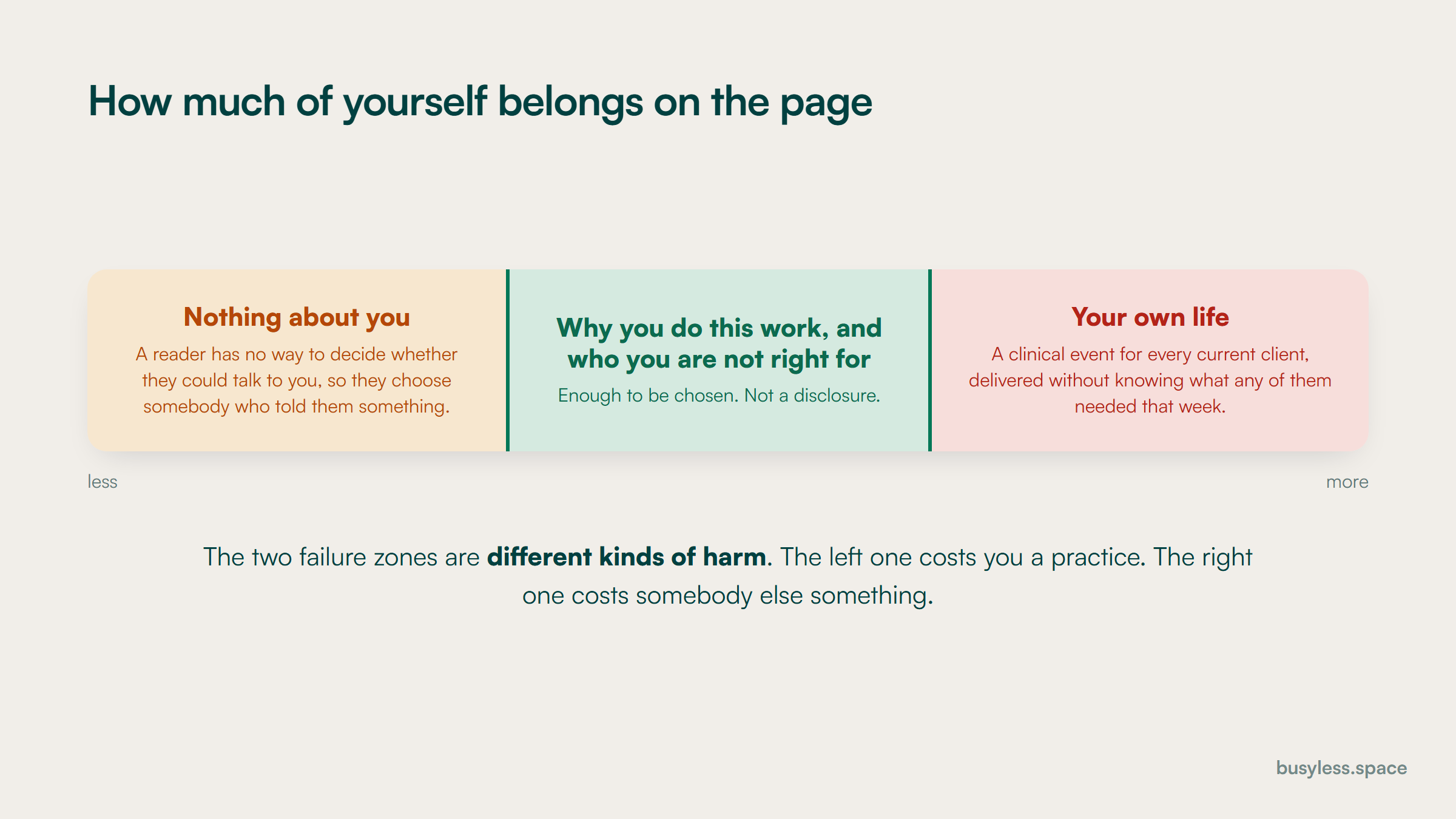
It is also the one thing you cannot spend freely. What you publish about your own life is read by people who sit in your room every week, and it enters the work. A post about your divorce is a disclosure to forty current clients, made without knowing what any of them needed that week.
A therapy content marketing strategy has to solve that rather than ignore it. The way through is to publish about the work: what happens in a first session, what the modality actually does, what stops people coming. It is useful, it is publishable, and the field has largely left it alone.
Looking for the search half
This page decides which channels to run. The one next door goes deep on just one of them.
Which channels to run, and which to skip
Two things decide every verdict below: whether the channel lets somebody assess you without requiring you to disclose, and whether it lets them do that without being seen. Both halves matter, because the decision is unusually intimate and it is made privately.
Run these
Video
RunChoosing a therapist is deciding whether you could talk to this particular person, which is not a decision text can support. A short, plain introduction video answers it in ninety seconds and it is the single highest-return asset in this industry. It also discloses nothing beyond how you speak.
First moveRecord a two-minute introduction with no script. Say who you work with, what a first session is like, and what you are not the right person for.
Search
RunPeople research this privately, at length and for a long time, which is exactly what search serves. The directories own the find-a-therapist query and that landscape is the sibling playbook's subject; the enormous space of questions people ask before they get anywhere near a directory is largely unanswered by anyone who does this work.
First moveAnswer the three questions people email you before booking, properly and at length. You have already written those answers dozens of times.
Events and talks
RunTalks to workplaces, schools, community organisations and staff teams fill practices quietly and reliably, and they suit this constraint unusually well. You are speaking about the work to a room, not disclosing to an audience, and the people who approach you afterwards have already decided you are approachable.
First moveOffer one talk to one organisation you have a connection with. Not a pitch, an hour on something their people actually deal with.
Worth a test, with a kill date
Newsletter
TestUnusual here, because subscribing is itself a small disclosure and people are careful about what arrives in their inbox with a therapist's name on it. It works for a practice with a teaching or workshop side and it works badly as a marketing list. The distinction is worth testing rather than assuming.
First moveAsk people what name they would like it to arrive under, and offer a plain one. It changes the sign-up rate more than the content does.
Founder-led social
TestThis is where the whole difficulty of the page lives. The format rewards personal disclosure, the profession's ethics require separating professional and personal presences, and current clients are in the audience whether or not they interact. Testable with a rule about what you will not post, and unmanageable without one.
First moveWrite down, before posting anything, the three subjects you will never cover. That list is the strategy, more than the calendar is.
Trade press
TestProfessional visibility reaches colleagues, doctors and organisations who refer, which is a real route into a practice. Worth a test where you have something to say to peers, and worth keeping in proportion, because the reader who matters most in this industry is still the person deciding whether to send an email.
First moveWrite one piece for a professional publication about the thing colleagues ask you. It reaches referrers and it costs one evening.
Skip these
Community
SkipThe online spaces where people discuss their own mental health are full of people in distress, and a practitioner marketing there is unwelcome and arguably exploitative regardless of intent. Professional communities are colleagues rather than clients. Neither room is a channel, and the first one should not be treated as one.
Original research
SkipA private practice does not have the capacity, and anything drawn from your own caseload moves immediately into territory governed by consent, ethics review and confidentiality rather than by editorial judgement. Cite other people's research generously instead, which is more useful to a reader anyway.
Three to run, and all three let somebody assess you without either party having to expose anything. The two skips are the only genuine ethical skips in this directory: one room is people in distress and the other requires a consent framework that no marketing plan should be improvising.
What you already own that nobody can copy
The material is unusually close at hand and unusually easy to get wrong, because almost all of it sits next to something confidential. Four of the five below are about the work rather than about any person, which is what makes them safe as well as useful.
What stops people coming
Held by You, from every first session
The cost, the fear of being judged, not feeling bad enough to deserve it, worrying what it would mean about them, a previous therapist who was wrong for them. You hear these constantly and no directory, publisher or health service writes about them, because it requires having sat with somebody saying it.
How to capture it
Note the reason somebody nearly did not come, in their words, after each first session. Never the person, never the detail, only the reason.
What a first session is actually like
Held by You
The single most searched and least answered question in this field. Nobody knows whether they will have to cry, what they are expected to say, whether it is a diagnosis, how long it takes. Answering it plainly removes a genuine barrier and it describes your practice, not a client.
How to capture it
Write down what actually happens in your first fifty minutes, in order, including the boring administrative parts. Half an hour of work.
What your modality actually does, without the jargon
Held by You and your training
Most practice websites list modalities as acronyms, which tells a prospective client nothing and quietly asks them to research it. A plain explanation of what the work involves week to week is rare, and it is the thing that makes somebody feel they could do it.
How to capture it
Explain it as you would to a friend at a dinner table. Record yourself doing that rather than writing, because the written version will drift back into the training language.
The questions people ask before booking
Held by Your inbox
You have already answered these dozens of times, individually, to people who were nervous enough to ask. The phrasing is theirs and the anxiety underneath it is the real subject. It is the closest thing to free research this profession has.
How to capture it
Go through six months of enquiry emails and list the questions. Do not keep anything identifying; the question alone is what you need.
Your own reason for doing this work, bounded
Held by You
The one genuinely personal asset, and the one with a limit on it. Why this work and this population is usually publishable and usually enough. Anything further is a disclosure to every current client, and how far is far enough is a clinical question rather than a marketing one.
How to capture it
Draft it, then take it to supervision before it goes anywhere. That sentence is the entire discipline of this page.
Who actually makes it
Most of this is one person, which is ordinary in a small practice. What is not ordinary is who signs the work off. In every other industry in this directory the reviewer is a compliance function or an editor. Here the right reader is the person who already helps you think about boundaries.
You
All of it, and the decision about what to disclose
Your hours are fifty minutes long and finite, so the plan has to fit into the gaps between them. Recording rather than writing is what makes that possible, and it also produces better material.
3 to 4 hours
Your supervisor or consultation group
Whether a disclosure is a good idea
The most important role on this page and the cheapest. Bring anything personal here before publishing it, framed as what it might do to the work rather than as whether it is allowed.
20 minutes, inside a session you already have
Whoever handles admin or reception
The enquiry questions and the practical answers
In a group practice this person hears every hesitation before it reaches a clinician, which makes them the best source of material in the building and the one nobody asks.
1 hour
An editor, or a careful friend
Reading it as a current client would
A specific job, not general editing: read every draft as somebody who sits in your room on Tuesdays. That reader is the one who decides whether a piece is publishable.
2 hours
Somebody who can edit video
The introduction and the short pieces
Worth paying for once and then reusing, because the introduction video is the highest-return asset here and a badly cut one undermines exactly the quality it is meant to convey.
3 hours, occasionally
The honest cadenceOne recorded explanation a month, one written answer a fortnight, and one talk a quarter. That is three or four hours of your time, which is the honest ceiling for a full caseload, and the plan is built to survive a month where none of it happens.
One project, 8 surfaces
The unit is a single recorded explanation of something you already say out loud several times a week. Recording is deliberate: the written version drifts into training language and the spoken one does not.
- 1
The plain explainer page
2 hoursFrom: The recording, written up
The durable asset and the one people read at eleven at night. Keep your own phrasing, including the hesitations, because a page that sounds like a person is doing the same job the video does.
- 2
A short video
1 hourFrom: The same explanation, on camera
Answers the question the page cannot, which is whether somebody could sit with you. Two minutes is enough and a script makes it worse.
- 3
The pre-session email
30 minutesFrom: The practical half
Sent before a first appointment, describing what will happen. It reduces cancellations and it is the same content doing clinical work rather than marketing work.
- 4
The talk section
45 minutesFrom: Whatever a room always asks about
Accumulates into an hour you can offer to any workplace or school. A talk built from questions you have really been asked lands differently from one built from a topic.
- 5
The answer to an enquiry
0 minutesFrom: The written explainer, sent as a link
The output nobody counts and the one that saves the most time. Somebody nervous enough to email gets a fuller answer than you could type, and they get it immediately.
- 6
A guided exercise
90 minutesFrom: Something you talk people through anyway
Audio suits this better than text or video, and it is genuinely useful to somebody who is not ready to contact anybody. Keep it clearly separate from clinical work in the wording.
- 7
The waiting-list note
30 minutesFrom: The explainer, adapted
Most practices go quiet when they are full, which wastes the moment somebody was ready. Something honest about waiting, and what else to do meanwhile, is the most generous page on a therapist's site.
- 8
A referral note for colleagues
30 minutesFrom: Who you actually work well with
Written for other clinicians rather than for clients, and it is how referrals get made accurately. Being clear about who you are not right for is what makes it useful.
The buying cycle, and what content does at each stage
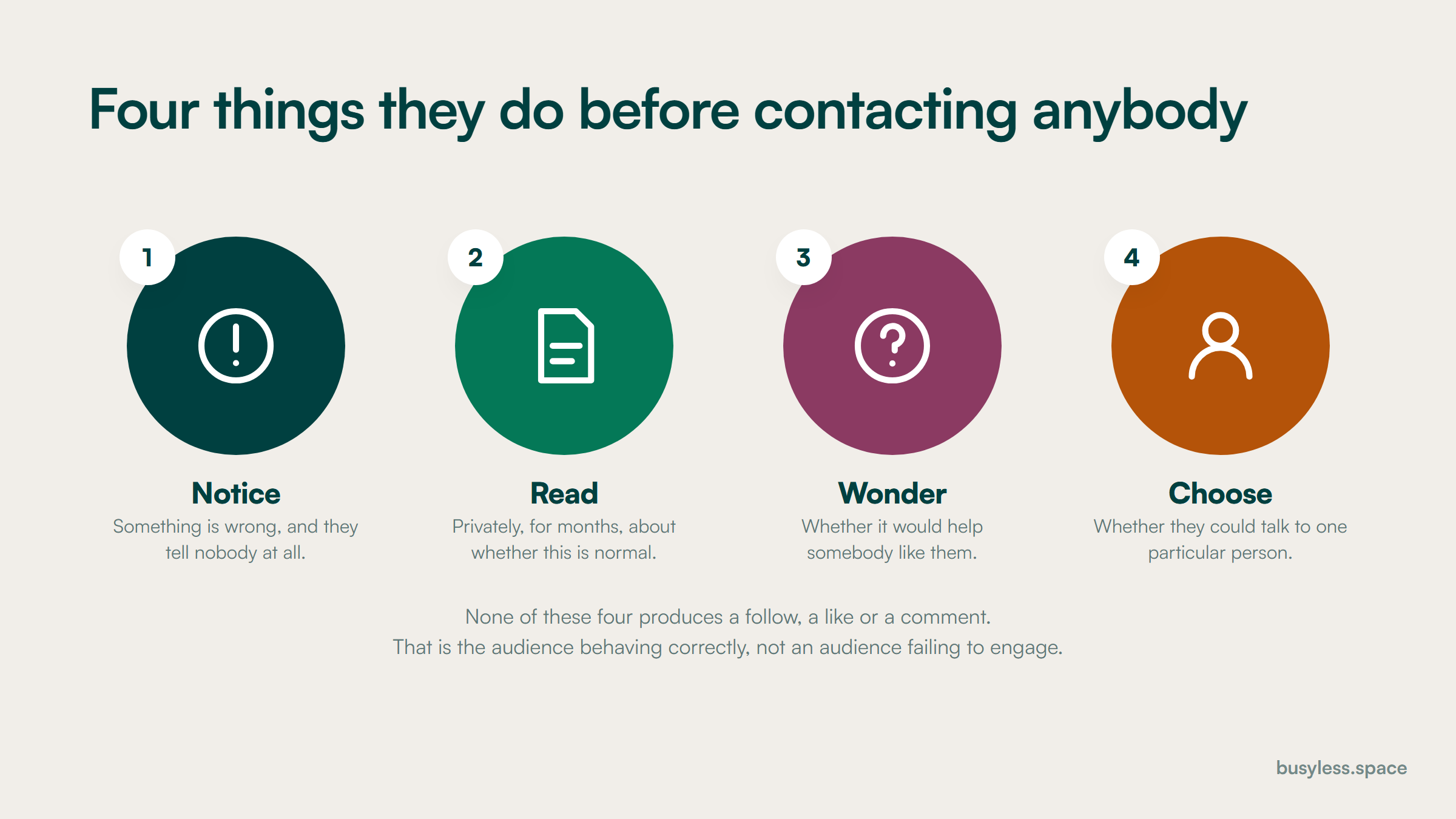
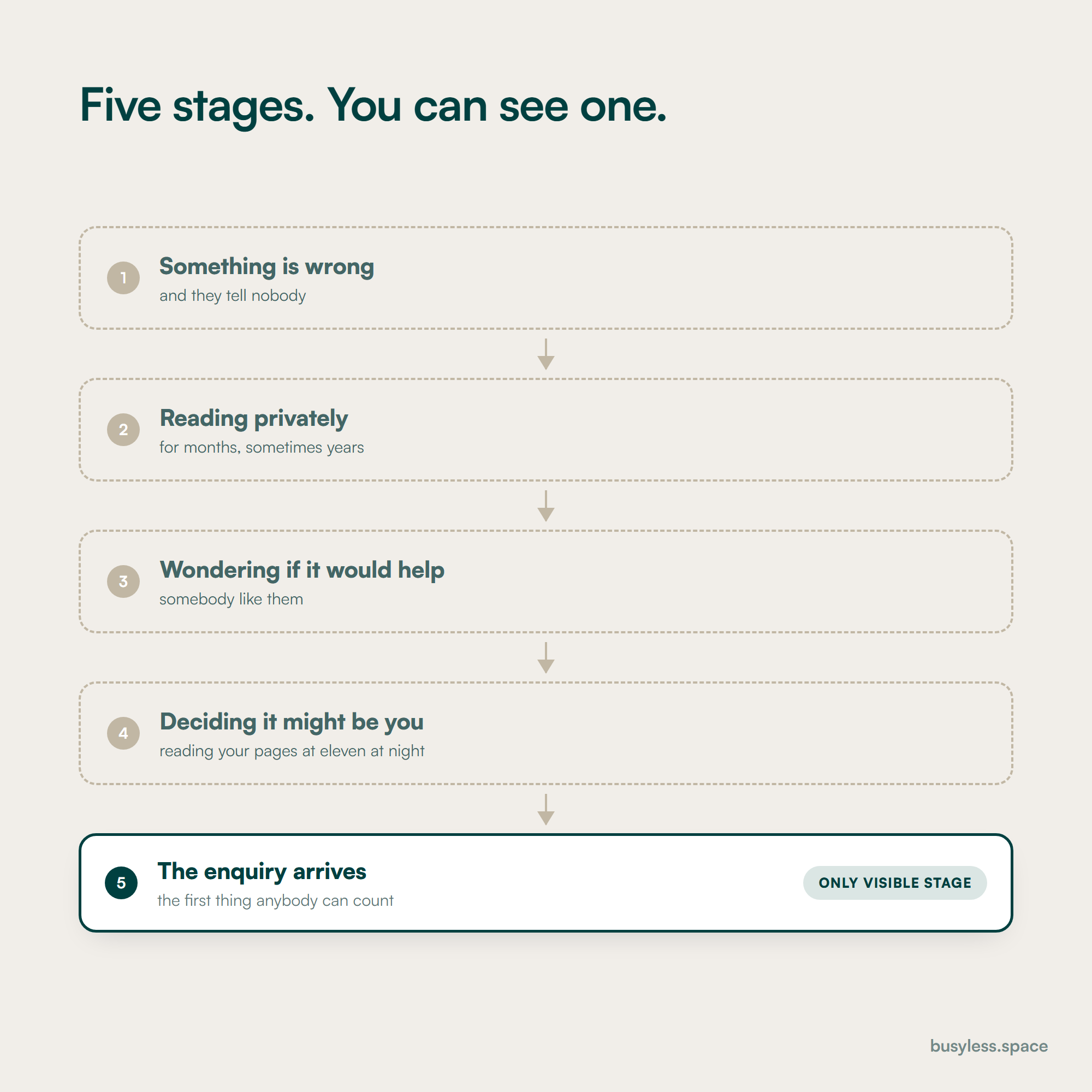
The cycle is long for a reason that is specific to this work: people wait. Somebody may read you for a year before sending an email, and every stage before that email is completely unobservable, which is a genuine measurement problem rather than an excuse.
Something is wrong
Months to years"Is this normal, or is it a problem?"
- What moves them
- Plain writing about the experience, not about therapy
- How you know
- Nothing observable at all, which is the honest answer
Wondering about therapy
Weeks to months"Would this even help someone like me?"
- What moves them
- What the work actually involves, and what stops people
- How you know
- Repeat visits from the same region, with no interaction
Working out who
Days to weeks"Could I talk to this particular person?"
- What moves them
- The introduction video, and how you write
- How you know
- Time on your own pages, and directory profile views
Nearly contacting you
Days"What happens if I send this, and what will it cost?"
- What moves them
- Fees, availability, and what a first session is like
- How you know
- Repeated visits to the contact and fees pages
The first session, and after
Weeks to years"Was this what I thought it would be?"
- What moves them
- The pre-session email, and everything you said you were
- How you know
- Attendance after a first session, and referrals from clients you cannot ask about
What you are allowed to publish
Four rules about what you may publish and where, from professional ethics codes, state boards and, since 2025, three state legislatures. The sibling playbook covers licensure and where you may offer services, tracking and analytics, substance use records and the duty attached to crisis material, so none of those appear here. None of this is legal advice and your own code and board govern.
Your professional and personal presences have to be separate
American Counseling Association Code of Ethics 2014, section H.6.a on virtual professional presence, read 2026-08-30
The code requires counsellors to maintain a professional presence that is separate from any personal one, and to explain to clients the benefits and limitations of using social media in the therapeutic relationship. Related provisions address respecting client privacy on social media and not searching for information about clients there. Other bodies address the same ground differently, and psychologists and social workers should read their own code rather than this one.
So do thisRun one professional presence and keep it professional, rather than a personal account with occasional practice posts. Decide and write down what a current client seeing this account would learn about you, before there is anything on it.
Clinical material is not yours to publish, even disguised
American Psychological Association Ethical Principles of Psychologists and Code of Conduct, standard 4.07 on use of confidential information for didactic or other purposes, read 2026-08-30
Confidential information obtained in the course of the work may generally not be used in writing, teaching or public media unless the person is disguised so they would not be identifiable, or has consented in writing. Disguise is a higher bar than most people assume, because a composite that keeps the vivid detail keeps the identifying detail, and the client is certain to recognise it.
So do thisWrite about patterns rather than about people, and treat anything drawn from a real session as requiring written consent. Where you use a composite, remove the detail that made you want to tell it, which is normally the identifying one.
What you may call yourself is set by your board
State counselling, psychology and social work board rules on advertising, titles and specialty designations, reviewed 2026-08-30
Protected titles, licence status, supervision status and specialty claims are governed by the board that licenses you, and the rules differ by state and by profession. Describing yourself as specialising in something, as a trauma expert, or as certified in a modality is a claim about credentials that a board can act on, and words like expert and specialist carry more weight than practitioners generally assume.
So do thisState your licence, your title and your training exactly as your board words them, and describe experience rather than claiming a specialism you cannot evidence. Our healthcare playbook covers the same question where the boards are medical and dental ones.
Several states now legislate about AI in mental health
Illinois Wellness and Oversight for Psychological Resources Act 2025, Nevada AB 406 2025 and Utah HB 452 2025, read 2026-08-30
A group of states passed statutes during 2025 restricting the use of artificial intelligence to provide therapy or make therapeutic decisions, and regulating mental health chatbots, with requirements that vary considerably between them. The scope of each is different and none of them was written with marketing in mind, which is exactly why an automated reply in a direct message or a chat widget on a practice website is worth thinking about carefully.
So do thisDo not put an automated conversational tool anywhere a distressed person might mistake it for clinical contact, and check your own state rather than generalising from another. The automation section below draws the same line for editorial reasons.
None of this is legal advice. Rules vary by state and by contract, and the dates above are when each source was read. Check your own before you rely on any of it.
How to build content marketing for therapists
Six months, and it opens with two things that need no writing at all: a list of what you will never publish, and a conversation with your supervisor about the personal material you might.
Decide the boundary before the calendar
- Write the three subjects you will never publish about
- Take the personal paragraph you are considering to supervision
- Separate any personal account from the professional one
- Check your title, licence and any specialty wording against your board
Output A written boundary, one supervised decision and accurate credentials
Answer what people actually ask
- List the questions from six months of enquiry emails
- Write what happens in a first session, in order, including the dull parts
- Explain your modality in plain words, recorded rather than written
- Record the two-minute introduction video without a script
Output Three pages and one video that remove real barriers
Publish what stops people
- Note the near-miss reason after each first session for eight weeks
- Write the piece about why people wait, from those notes
- Write the waiting-list page, honestly, including what else to do
- Have somebody read all of it as a current client would
Output The material nobody else in this field publishes
Speak in a room
- Offer one talk to one organisation you already have a connection with
- Build the hour from the questions rooms actually ask
- Write the referral note for colleagues about who you suit
- Record one guided exercise as audio
Output A talk you can give again, and a route in through colleagues
Structured data for what you publish
Your practice, your licences and the therapies you offer are marked up on the sibling playbook, which is where the entity belongs. These six describe what you publish, and two of them are types this profession effectively never uses.
VideoObject for the introduction
The page carrying your two-minute introduction, not only a platformThe highest-return asset in this industry and worth marking up properly, because somebody is deciding whether they could talk to you. Include a transcript, since a proportion of the people watching are doing so with the sound off in a room with other people in it.
{
  "@context": "https://schema.org",
  "@type": "VideoObject",
  "name": "[A short introduction to working with [PRACTITIONER NAME]]",
  "description": "[WHO YOU WORK WITH, WHAT A FIRST SESSION IS LIKE, AND WHO YOU ARE NOT RIGHT FOR]",
  "thumbnailUrl": "https://[YOUR-DOMAIN]/images/[FILE].jpg",
  "uploadDate": "[YYYY-MM-DD]",
  "duration": "PT[M]M[S]S",
  "contentUrl": "https://[YOUR-DOMAIN]/video/[FILE].mp4",
  "embedUrl": "https://[YOUR-DOMAIN]/about",
  "transcript": "[FULL TEXT, BECAUSE MANY PEOPLE WATCH THIS WITH THE SOUND OFF]",
  "inLanguage": "[LANGUAGE CODE]",
  "isFamilyFriendly": true
}
AudioObject for a guided exercise
A page carrying something somebody can use without contacting anybodyThe right type for the one asset that helps a person who is not ready to make contact, and it is used almost nowhere in this field. Say in the description what it is not, because the difference between a recorded exercise and clinical contact should never rest on the listener's assumption.
{
  "@context": "https://schema.org",
  "@type": "AudioObject",
  "name": "[WHAT THE EXERCISE IS, PLAINLY]",
  "description": "[WHAT IT IS FOR, HOW LONG IT TAKES, AND THAT IT IS NOT THERAPY OR CRISIS SUPPORT]",
  "contentUrl": "https://[YOUR-DOMAIN]/audio/[FILE].mp3",
  "encodingFormat": "audio/mpeg",
  "duration": "PT[M]M[S]S",
  "uploadDate": "[YYYY-MM-DD]",
  "transcript": "[FULL TEXT]",
  "isAccessibleForFree": true,
  "creator": {
    "@type": "Organization",
    "name": "[PRACTICE NAME]",
    "url": "https://[YOUR-DOMAIN]"
  }
}
HealthTopicContent for a plain explainer
The page explaining an experience or a modality in ordinary wordsA type built for consumer health explanation and almost unused by private practices, which default to a generic page. The useful field is the aspect: saying that a page is about what to expect, rather than about symptoms or treatment, is exactly the distinction this playbook argues for.
{
  "@context": "https://schema.org",
  "@type": "HealthTopicContent",
  "name": "[WHAT THIS EXPLAINS, IN THE READER'S WORDS]",
  "description": "[WHAT SOMEBODY WILL UNDERSTAND AFTERWARDS]",
  "url": "https://[YOUR-DOMAIN]/about-therapy/[SLUG]",
  "hasHealthAspect": "https://schema.org/BenefitsHealthAspect",
  "dateModified": "[YYYY-MM-DD]",
  "inLanguage": "[LANGUAGE CODE]",
  "audience": {
    "@type": "Audience",
    "audienceType": "[WHO THIS IS WRITTEN FOR]"
  },
  "citation": "[WHERE THE CLAIMS COME FROM, IF ANY ARE MADE]"
}
ImageGallery for the actual room
A page showing the room and the building, as they really areOne of very few honest visual assets available here, and it matters because somebody is deciding whether a place feels safe. Photograph the real room. A stock image of a different room is a small untruth about the one thing a person can check on arrival.
{
  "@context": "https://schema.org",
  "@type": "ImageGallery",
  "name": "The room, and how to find it",
  "url": "https://[YOUR-DOMAIN]/the-room",
  "description": "[WHAT SOMEBODY WILL SEE, INCLUDING THE ENTRANCE AND THE WAITING AREA]",
  "image": [
    {
      "@type": "ImageObject",
      "contentUrl": "https://[YOUR-DOMAIN]/images/[FILE].jpg",
      "caption": "[WHAT THIS SHOWS AND WHY IT IS HERE]",
      "creditText": "[PHOTOGRAPHER]",
      "dateCreated": "[YYYY-MM-DD]"
    }
  ]
}
Event for a talk you give
The page for a talk to a workplace, school or community organisationThe channel that fills practices most quietly, and the markup is worth having because somebody who could not attend may still find the page. Describe what the hour covers rather than naming it after a condition, which sets the wrong expectation about what kind of event it is.
{
  "@context": "https://schema.org",
  "@type": "Event",
  "name": "[WHAT THE HOUR IS ABOUT, PHRASED AS A QUESTION PEOPLE ASK]",
  "description": "[WHAT IT COVERS, WHO IT IS FOR, AND WHAT IT IS NOT]",
  "url": "https://[YOUR-DOMAIN]/talks/[SLUG]",
  "startDate": "[YYYY-MM-DDTHH:MM:SS-05:00]",
  "endDate": "[YYYY-MM-DDTHH:MM:SS-05:00]",
  "eventAttendanceMode": "https://schema.org/OfflineEventAttendanceMode",
  "eventStatus": "https://schema.org/EventScheduled",
  "location": {
    "@type": "Place",
    "name": "[VENUE OR ORGANISATION]",
    "address": "[FULL ADDRESS]"
  },
  "isAccessibleForFree": true,
  "organizer": {
    "@type": "Organization",
    "name": "[PRACTICE NAME]",
    "url": "https://[YOUR-DOMAIN]"
  }
}
Article for your own writing
A piece written in your own voice about the workUse it for writing about the work and not for writing about yourself, which is the whole distinction this page turns on. The author field naming you is appropriate; a piece whose subject is you is the thing supervision should have seen first.
{
  "@context": "https://schema.org",
  "@type": "Article",
  "headline": "[WHAT THIS IS ABOUT, WHICH IS THE WORK]",
  "description": "[THE ONE THING A READER TAKES AWAY]",
  "url": "https://[YOUR-DOMAIN]/writing/[SLUG]",
  "datePublished": "[YYYY-MM-DD]",
  "dateModified": "[YYYY-MM-DD]",
  "author": {
    "@type": "Organization",
    "name": "[PRACTICE NAME]",
    "url": "https://[YOUR-DOMAIN]"
  },
  "about": "[THE SUBJECT, NEVER A CLIENT AND NEVER A CASE]",
  "isAccessibleForFree": true,
  "inLanguage": "[LANGUAGE CODE]"
}
What to automate, and where the line is
The line here is sharper than anywhere else in this directory, and it is not only an editorial one. Several states legislated during 2025 about artificial intelligence and therapy, and a distressed person cannot be expected to work out what they are talking to.
- automate
Transcribing your recorded explanations
The whole production model here depends on recording rather than writing, because the written version drifts into training language. Transcription removes the step that would otherwise not happen in a full week.
- automate
Grouping enquiry questions into themes
Six months of enquiry emails is a manageable pile and the pattern in it is the publishing plan. Strip anything identifying before it goes anywhere, and group the questions rather than the people.
- automate
Producing captions and transcripts for video
A large share of the people watching an introduction video have the sound off, in a house with other people in it. Captions are an accessibility requirement and, here, a privacy feature.
- assist
Drafting the explainer from your transcript
Useful for structure and it will replace your phrasing with the field's, which is the failure this page is about. Put your own words back, including the hesitations, because those are what make the page sound like a person.
- assist
Suggesting what a room might ask in a talk
Reasonable at producing the obvious questions and unable to produce the ones you have actually been asked. Use it to check for gaps after you have written your own list, never before.
- assist
Checking a draft for anything identifying
A useful second reader for names, places and unusual details, and not a substitute for your own judgement about disguise. The identifying element is often the vivid detail that made you want to write the piece.
- never
Replying automatically to somebody in distress
An automated reply in a direct message or a chat widget can be mistaken for contact with a clinician by exactly the person least able to tell. Several states legislated on this ground during 2025 and the ethical answer preceded them.
- never
Writing anything in your voice about your own life
A self-disclosure is a clinical act and it has to be yours, considered, and preferably supervised. A generated personal paragraph is a disclosure you did not make, delivered to people who will treat it as one you did.
What it costs
Treat these as bands to sanity-check a proposal against, and note that a solo practice can do almost everything that matters on this page for nothing but hours. The number moves mainly with whether video is produced properly and whether there is more than one clinician.
Do it yourself
$0 to $300- The first-session page, written properly
- The questions from your inbox, answered at length
- A two-minute introduction video recorded on a phone
- The waiting-list page, honestly written
- Suits
- A solo practitioner with a full or nearly full caseload
- Ceiling
- It stops when the caseload is heavy, which is exactly when it feels least necessary. What is already published keeps working, which is the argument for writing the first-session page before you need it.
Lean
$600 to $2,000- Video produced properly rather than opportunistically
- A monthly recorded explanation, transcribed and written up
- Somebody reading every draft as a current client would
- A talk built and offered to two organisations
- Suits
- A solo practitioner building a practice, or a small group
- Ceiling
- One practitioner's voice reaches as far as one practitioner's time allows. Growing past it means other clinicians publishing, and their disclosure decisions are theirs rather than the practice's.
Funded
$2,000 to $4,000- Several clinicians with introduction videos and their own pages
- A talks programme rather than occasional invitations
- The plain-language library covering everything the practice offers
- Audio exercises produced to a standard worth publishing
- Suits
- A group practice, or a practice with a teaching or workshop side
- Ceiling
- Coordination becomes the constraint. Every clinician has a different boundary about disclosure and a practice cannot set one for them, so a house voice will always be thinner than any individual's.
Above this
$4,000 and up- A multi-clinician practice publishing across several specialisms
- Workshops and courses as a real second income line
- Material in the languages your area actually needs
- Somebody whose job is the editorial and ethical standard
- Suits
- Larger practices where the publishing is part of the service rather than an advertisement for it
- Ceiling
- The risk stops being obscurity and becomes reach. A practice with an audience acquires readers in distress it has no relationship with, and that needs a considered position rather than a bigger inbox.
How to do it with no budget
The first three of these seven cost an evening between them and they are the three that matter. Almost every practice website in the country is missing all three.
- 1
Write down the three things you will never publish about
A piece of paper · 30 minutes
Before any calendar exists. This list is the strategy, and having it means every later decision takes seconds rather than an evening of uncertainty.
- 2
Write what actually happens in a first session
Your own memory of the last fifty · 1 hour
In order, including the administrative parts. It is the most searched and least answered question in this field and it describes your practice rather than any client.
- 3
List the questions from your enquiry emails
Six months of your inbox · 90 minutes
The question only, nothing identifying. You have already answered each of these individually to somebody nervous enough to ask, which is as close to free research as this profession gets.
- 4
Record a two-minute introduction
A phone, a window and no script · 1 hour including retakes
Say who you work with, what a first session is like, and who you are not right for. The third one builds more trust than the first two combined.
- 5
Note the near-miss reason after each first session
One line in your own notes · Eight weeks of noticing
Why they nearly did not come. Never the person and never the detail, only the reason. It becomes the most useful piece you will publish.
- 6
Check your titles and specialty wording against your board
Your board's advertising rules · 1 hour
Words like specialist, expert and certified are claims your board can act on. Describing experience instead is both safer and more persuasive to a reader.
- 7
Offer one talk to one organisation
An email to somebody you already know · 1 hour
Offer an hour on something their people genuinely deal with, and sell nothing. This is how practices fill quietly, and it costs nothing but the hour.
The tool stack
Almost nothing is needed, and the two most valuable items on this list are a supervisor and a person who will read your drafts as a client would. The rows linking into our other directories go to the researched review rather than to a vendor page.
Decide whether a disclosure is a good idea
Twenty minutes of an existing supervision session is the whole editorial function here. Bring it as a question about the work rather than as a question about permission.
Free option: Already paid for, inside a session you have anyway
Record explanations rather than writing them
Speaking keeps your own language. Every therapist who writes first ends up with the training vocabulary, which is precisely what a nervous reader cannot parse.
Free option: The transcription built into most meeting tools
Publish pages that are not a modality list
A first-session page, a plain explainer and a waiting-list note are three shapes, and most therapist website templates are built to hold a fourth thing, which is a list of acronyms.
Free option: Any simple site builder, honestly
See what people search before they look for a therapist
Read it against the inbox rather than instead of it. How the directories dominate the find-a-therapist query is the sibling playbook's subject.
Free option: Your own enquiry emails, which have the real phrasing
Understand what filling a caseload is actually worth
Model it on retained clients over a year rather than on enquiries, because in this work the difference between an enquiry and a course of sessions is most of the value.
Free option: Free
Cost the programme against your own hours
Your hour has a real price, which is a session. Costing this in unpriced evenings is how a plan gets built that a full caseload will kill in month three.
Free option: Free
Read every draft as a current client would
A specific job rather than general editing. They are reading for what somebody who sits in your room on Tuesdays would learn about you, which you cannot see yourself.
Free option: Free
Check what assistants tell people about finding a therapist
An increasing share of the wondering stage happens here, privately, which suits the constraint. The answers lean heavily on directories and large health publishers.
Free option: Ask each assistant how to find a therapist in your area, monthly
Take it from here
Everything below is meant to be copied and filled in. Bodies are plain text, so what you see is exactly what lands on your clipboard.
Written before any calendar exists. This list is the strategy, and having it turns every later decision into a two-minute one.
DISCLOSURE BOUNDARY
Practitioner: [NAME]
Written: [YYYY-MM-DD]
Reviewed in supervision: [YYYY-MM-DD]
Review again: [YYYY-MM-DD]

     [WORKING TOOL, NOT LEGAL OR ETHICAL ADVICE. YOUR
      OWN CODE AND BOARD GOVERN, AND YOUR SUPERVISOR IS
      THE RIGHT SECOND READER.]

WHY THIS EXISTS
Anything published about your life is read by people
who sit in your room every week.

     [A SELF-DISCLOSURE IS A CLINICAL ACT. THIS PAGE IS
      DECIDING, ONCE AND CALMLY, WHAT YOU ARE WILLING
      FOR IT TO BE.]

THE THREE I WILL NEVER PUBLISH ABOUT
 1. [ ]
 2. [ ]
 3. [ ]
     [BE CONCRETE. "MY FAMILY" IS USABLE. "PERSONAL
      THINGS" IS NOT.]

WHAT I AM WILLING TO SAY
Why I do this work:
   [ ]
Who I work with and why:
   [ ]
What I am not the right person for:
   [ ]
     [THE THIRD ONE BUILDS MORE TRUST THAN THE OTHER TWO
      COMBINED AND ALMOST NOBODY WRITES IT.]

THE CURRENT-CLIENT TEST
For anything personal, ask:
  If a client I see on Tuesday read this, what would
  they now know about me?
   [ ]
  Would that change what they bring next session?
   [ ]
  Am I willing for it to?
   [ ]
     [A YES TO THE LAST QUESTION IS A LEGITIMATE ANSWER.
      NOT HAVING ASKED IT IS NOT.]

WHAT GOES TO SUPERVISION BEFORE PUBLISHING
[ ] Anything about my own history
[ ] Anything about my own current circumstances
[ ] Anything about why I left a previous role
[ ] Anything about my health
[ ] Anything I feel strongly about while writing
     [THE LAST ONE CATCHES MOST OF IT.]

ACCOUNTS
Professional presence:    [ ]
Personal presence:        [ ]
Are they separate?        [Y/N]
Does anything link them?  [ ]

SIGNED
Me: [ ]                     Date: [ ]
Discussed with supervisor: [YYYY-MM-DD]The expensive mistakes
Building the marketing on personal disclosure
What it costs: A clinical decision made for a commercial reason, in public, permanently
Publish about the work. Your reason for doing it is usually enough personal material, and anything past that belongs in supervision first.
Listing modalities as acronyms
What it costs: A website that asks a nervous person to go and research what you do
Explain what the work involves week to week, in the words you would use at a dinner table. Record it rather than writing it.
Never describing a first session
What it costs: The most common reason people delay, left entirely unanswered
Write what actually happens, in order, including the dull administrative parts. It takes an hour and it removes a real barrier.
Going quiet when the caseload is full
What it costs: Losing the person who was finally ready, and telling them nothing
Write an honest waiting-list page with what else to do meanwhile. It is the most generous page on a therapist's site and almost nobody has one.
Marketing inside spaces where people discuss their own distress
What it costs: A practitioner soliciting from people who are unwell, whatever the intent
Publish where somebody can find you privately and decide in their own time. Those rooms are not a channel and should not be treated as one.
Using a stock photograph of a room that is not yours
What it costs: The one thing a person can check on arrival, and it was not true
Photograph the actual room, the entrance and the waiting area. Somebody deciding whether a place feels safe is doing something reasonable.
What to measure
Measuring therapy content marketing is genuinely harder than anywhere else in this directory, because the stages that matter are invisible by design: nobody follows, nobody comments, and somebody may read for a year before sending an email. What follows accepts that rather than working around it.
Leading indicators
Enquiries that mention something you published
Ask in the first reply, and write it down
Self-reported, imperfect, and by a wide margin the best attribution available here. People frequently say they read something months earlier, which is the only visibility you will get into the waiting.
Reading on the first-session and fees pages
Analytics, within the constraints the sibling playbook sets
The two pages somebody reads immediately before deciding whether to send an email. Repeat visits to them from the same person are the closest thing to a signal this cycle produces.
Watch-through on the introduction video
Your own player, not only the platform
Somebody who watches two minutes has made most of the decision. Completion matters far more than views, because the question being answered is whether they could sit with you.
Talks given, and to which organisations
A calendar with a mark on it
The channel that fills practices most reliably and the one most likely to quietly stop happening. Counting it is what keeps it in the plan when the caseload is heavy.
Business indicators
Enquiries that convert to a first session
Your practice management system
A rising share usually means the material is doing its work before contact, since somebody who already knows what happens and what it costs arrives with fewer reasons to withdraw.
Attendance after a first session
Your practice management system
The honest test of whether what you published matched what you are. A high enquiry rate with poor continuation usually means the writing promised a different practitioner.
Enquiries arriving from a colleague or an organisation
The question, asked on every enquiry
The trade-press and talks channels show up here rather than in any analytics report, and referrals from other clinicians are among the most durable sources a practice has.
Where you are on your own waiting list
Your own record
The measure that actually matters to a private practice and the one nobody puts in a marketing report. A full caseload is the outcome, and the point of the rest of this page is to reach it with people you are right for.
The verdict
Content marketing for therapists is constrained in a way that looks fatal and is not. You cannot publish a client outcome, so the field's instinct is to publish the practitioner instead, and that instinct is the one thing here with a genuine clinical cost attached.
The way out is unglamorous and it works. Write about the work: what a first session involves, what the modality actually does week to week, and above all what stops people coming. It is the most useful material in this field and it is almost entirely unwritten.
Be wary of therapy content marketing services built around personal brand, or that treat somebody's hesitation as an objection to be handled. The first is a disclosure decision being made by somebody who will not sit with the consequences; the second misreads the subject entirely.
In short, content marketing services for therapists are worth buying when the boundary is written down and the introduction video exists. Without those two, you have hired somebody to fill a website with the acronyms that were already on it.
FAQ
Therapy content marketing questions
Everyone says I need a personal brand. Is that wrong here?
It is the one recommendation on this page with a clinical cost. What you publish about your life is read by people you see weekly and it enters the work with them. Your reason for doing this work is usually enough, and anything beyond it belongs in supervision before it belongs online.What should I write about if I cannot use client stories?
The work itself. What a first session actually involves, what your modality does week to week, why people wait years before coming, what it costs and what happens if it is not right. Every one of those is useful, safe and largely unwritten in this field.Why is a video worth more than a well-written page?
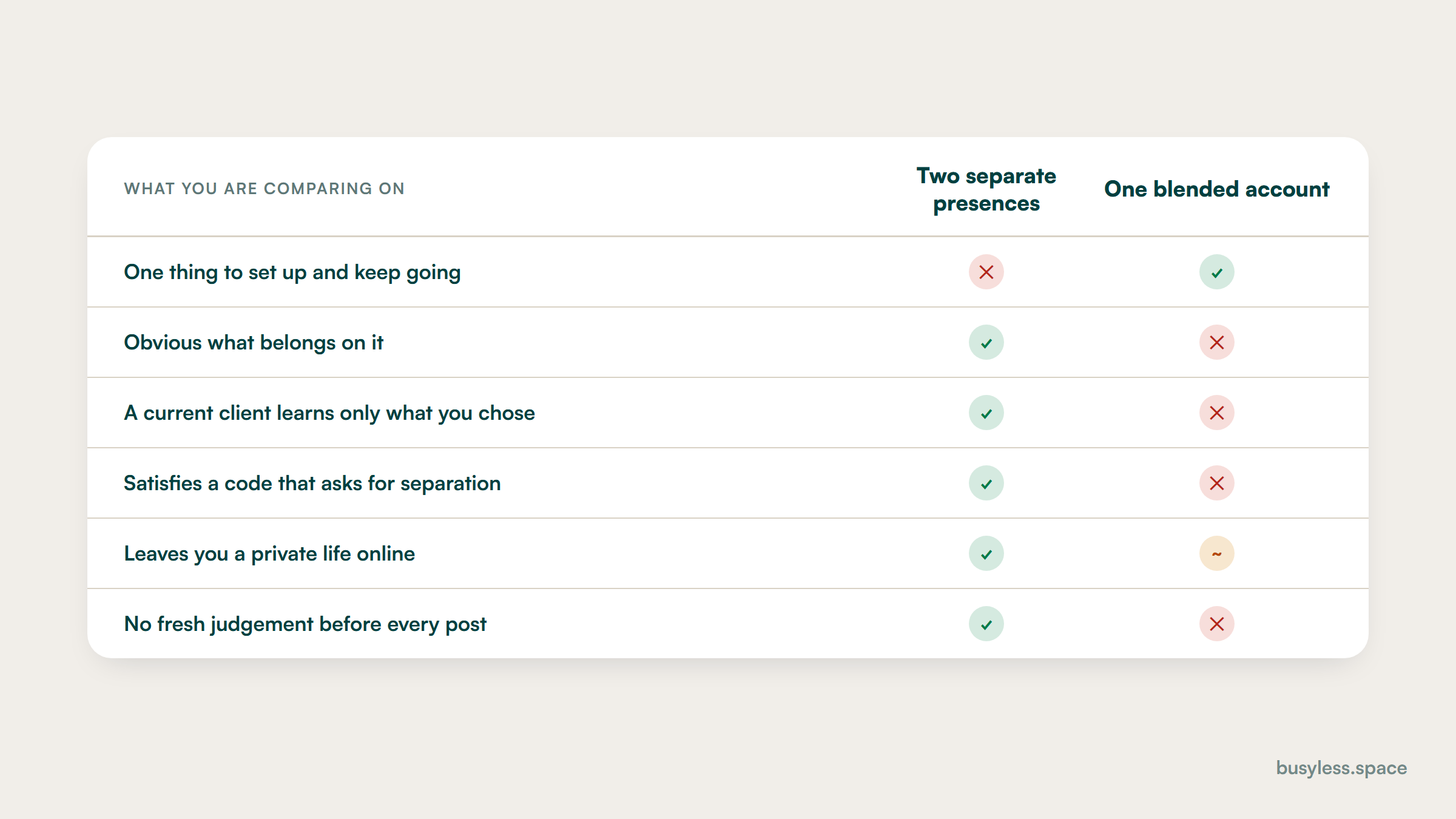
Because the decision somebody is making is whether they could talk to this particular person, and text cannot answer that. Two minutes of you speaking plainly does it, discloses nothing beyond how you speak, and takes an hour to record.Should I have separate personal and professional accounts?
Yes, and for counsellors the ethics code requires a professional presence separate from any personal one. Practically it also removes a daily judgement call, because a professional account has an obvious answer to what belongs on it and a blended one never does.Can I write about a client if I change the details?
Treat it as needing written consent. Disguise is a higher bar than people assume, because the detail that made the story worth telling is usually the identifying one, and the client is the person most certain to recognise themselves in it.Is it worth publishing when my caseload is full?
Yes, and it is when most practices go silent. Somebody finally ready to make contact deserves an honest waiting-list page saying how long, whether to wait, and what else they could do. It is the most generous page on a therapist's site.Can I use an automated reply on my contact form?
Be very careful. A distressed person may not distinguish it from contact with a clinician, and several states legislated during 2025 on artificial intelligence in mental health. A plain acknowledgement with a realistic response time and crisis information is better than anything conversational.What should a practice expect to spend?
The first-session page, the enquiry answers and the introduction video cost hours rather than money, and a solo practitioner can do everything that matters here for nothing. Where a budget exists, the realistic range for running it properly is $600 to $4,000 a month.
Run it yourself, or have someone own it
Everything above is written to be run without us, and the free path is genuinely most of the value for a small practice. Where these plans stall is almost never the plan. It is that the person holding the material has a day job and nobody owns the programme after the first month. That is the job we do.