
Content marketing for healthcare
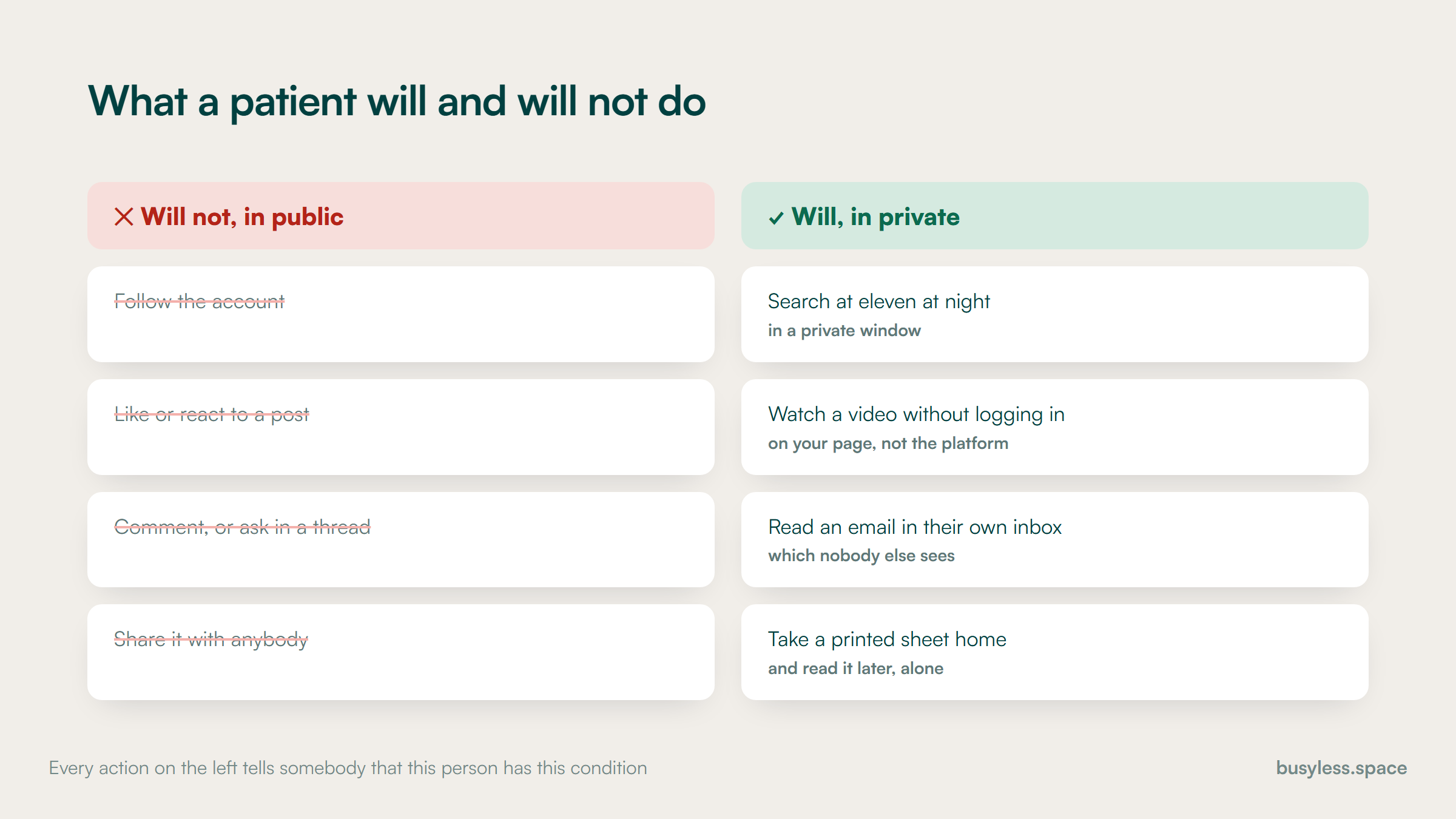
YMYL and regulatedNo patient will be seen following, liking or commenting
- Sector
- Health and medical
- Channels
- Search, Video, Newsletter
- Buying cycle
- Short cycle
- Time to compound
- 9 to 18 months
- Typical monthly
- $4,000 to $20,000
Key takeaways
- 1Your audience will not engage in public. A patient will read, watch and search, and will not follow, like, comment or share, because doing any of those in a place their employer or their family can see discloses something about their health.
- 2That removes the entire measurement layer everyone else uses. Engagement rate, follower growth and share counts are not low here, they are structurally unavailable, and a programme reported on them will look like a failure while it is working.
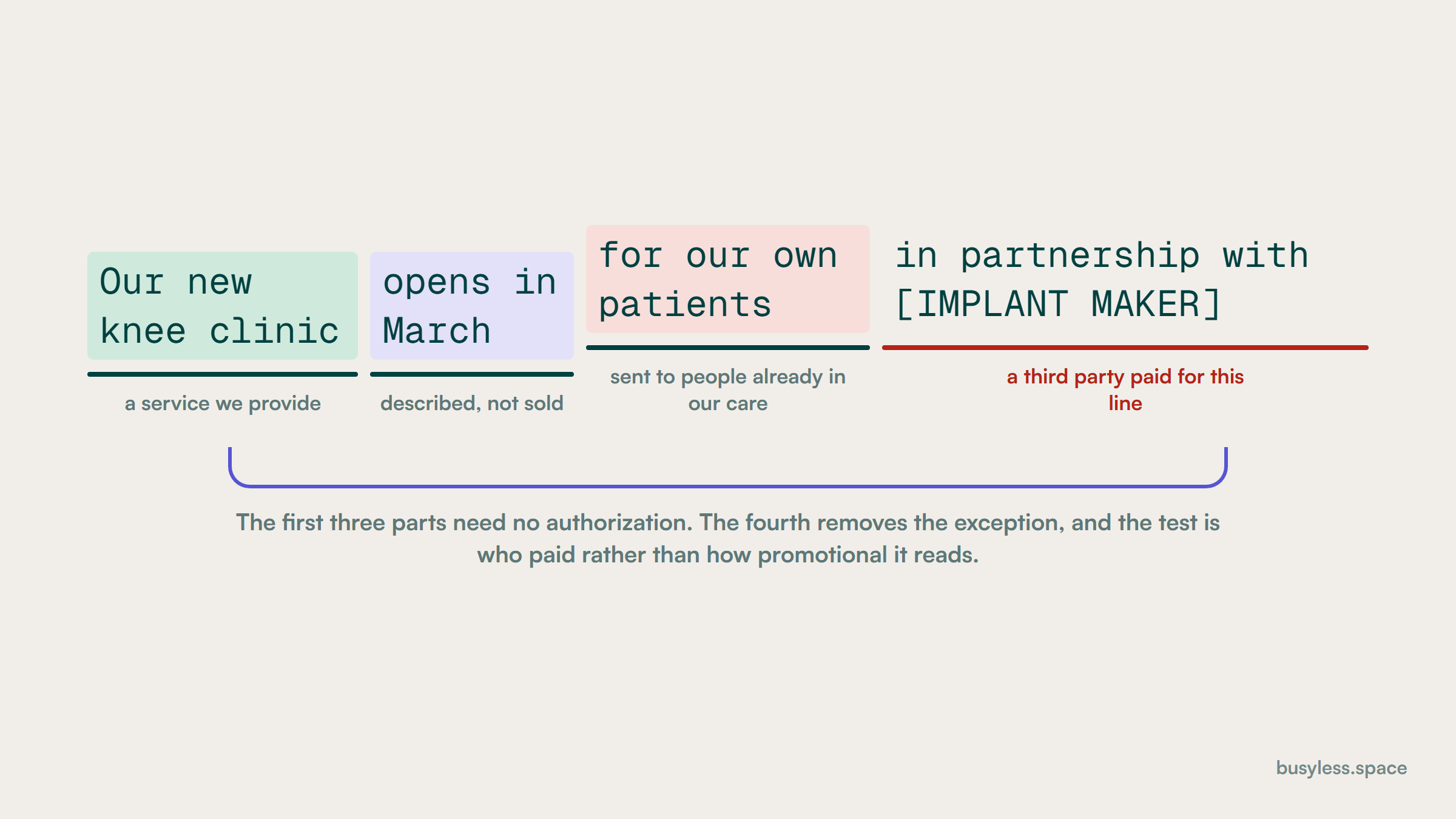
- 3Describing your own services to your own patients is not marketing under HIPAA. The authorization requirement attaches when a third party pays for the message, which means the practice newsletter is fine and the sponsored piece is not.
- 4The best content brief in this industry is a list of questions asked out loud in a consulting room. Nobody outside the practice has it, no keyword tool contains it, and collecting it costs five minutes a day.
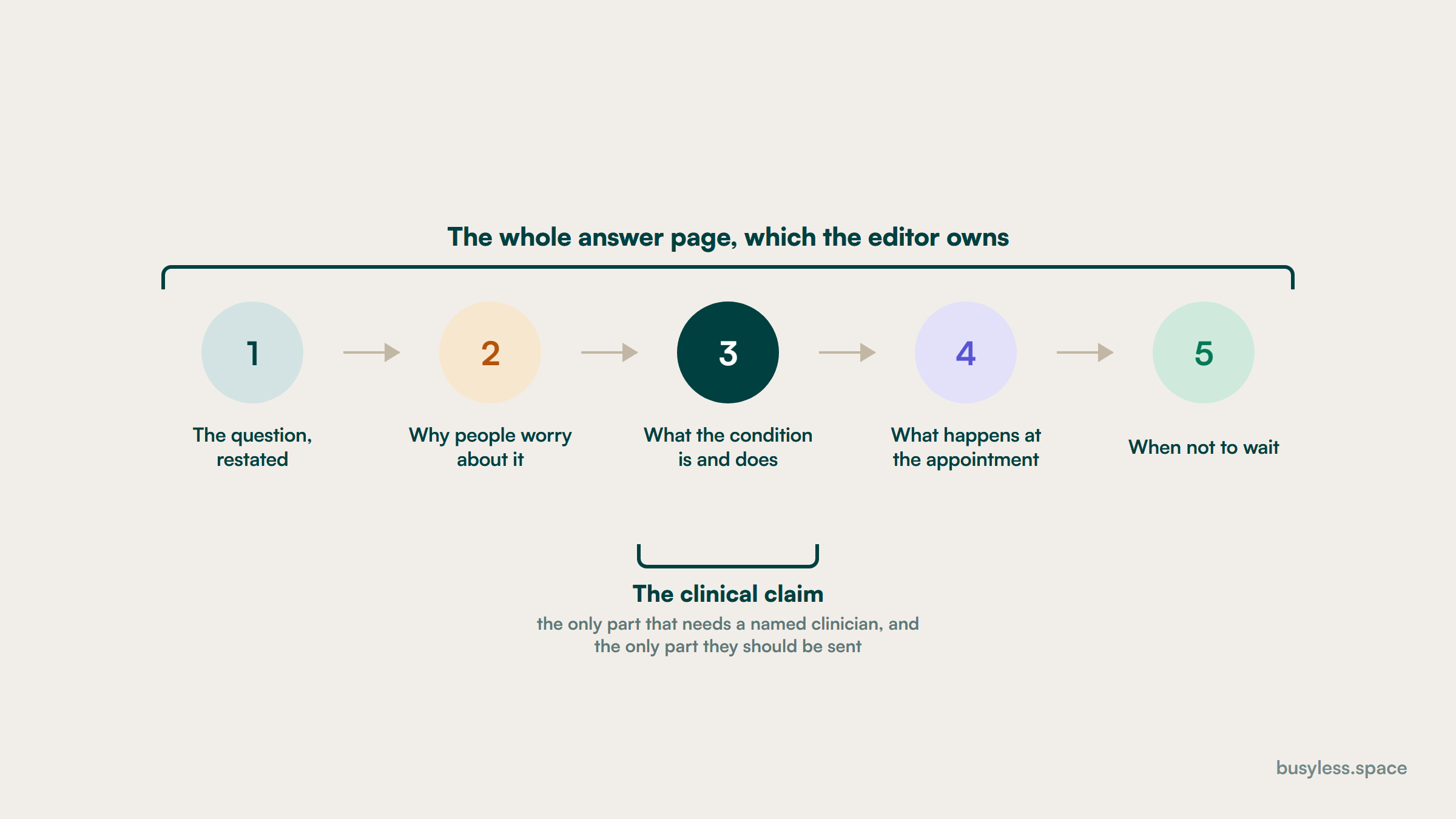
- 5Bound the clinical sign-off to the clinical claim. A clinician reviewing an entire article will not do it twice; a clinician reviewing the four sentences that carry a claim will do it every month for years.
Content marketing for healthcare is usually planned as though patients behave like every other audience, and they do not. The difference is not that they are harder to reach. It is that they will not do anything in public which reveals that they are interested.
Think about what a follow costs a patient. Following a fertility clinic, an oncology practice or an addiction service on a public account tells a colleague, a parent or an insurer something the person may not have told anyone. So they do not follow. They read, they watch, they search, and they leave no trace you can count.
Everything follows from that. The channels worth staffing are the ones that work without an audience member being seen using them, which is search, video that plays without a login, and a private inbox. The channels that fail are the ones that need a public act to function, which is most of social and all of community.
It also breaks the reporting. A healthcare content marketing strategy measured on engagement will read as a failure in month six while it is quietly working, because the signal it produces is volume and arrival rather than interaction. Getting the measurement right at the start is worth more here than getting the calendar right.
Looking for the search half
This page decides which channels to run. The one next door goes deep on just one of them.
Which channels to run, and which to skip
Judged on one question, which is whether the channel works for somebody who will not be seen using it. That single test moves four of the eight channels and it is why this page's mix looks nothing like the one two pages over.
Run these
Search
RunThe channel a worried person actually uses, at eleven at night, in a private window. It asks nothing public of them and it reaches people at the exact moment the question forms. It is also where almost all the competition already is, so the win comes from answering the specific question rather than the broad one.
First moveWrite down the twenty questions your clinicians answer most often out loud, and answer each one properly on its own page. The technical half of this is on the sibling playbook.
Video
RunThe most undervalued channel in this field, because watching is anonymous. Nobody has to subscribe, and a two-minute explanation of what a procedure actually involves does more to reduce the fear that stops people booking than three thousand words will. It also carries tone, which matters when the subject is frightening.
First moveFilm one clinician answering one common question to camera, unscripted, in under three minutes. Publish it on your own page as well as the platform.
Newsletter
RunThe one owned channel a patient will accept, because an inbox is private. It is also the channel where the HIPAA line matters most: describing your own services to your own patients is not marketing, so this is easier than most practices believe until somebody else pays to be in it.
First moveSend something genuinely useful monthly, on one condition or service line, and never mix a sponsored message into it.
Worth a test, with a kill date
Trade press
TestReaches referring clinicians rather than patients, which is a different and often larger source of volume. A named consultant writing in a professional publication is read by the people who send patients on, and none of the anonymity problem applies, because a referrer is not a patient.
First moveHave one clinician write one piece for a publication their referrers read, and measure it in referrals rather than clicks.
Events and talks
TestA community talk or a clinician-to-clinician session is a rare context where people will attend openly, because attending a talk about a condition is not the same admission as following an account about it. Small numbers, high intent, and it doubles as video you can publish afterwards.
First moveRun one evening session on the condition your practice sees most, film it with the audience out of shot, and publish the recording.
Original research
TestA practice holds outcome and waiting-time data nobody publishes, and aggregated properly it is the kind of thing the trade and local press will cover. The constraint is that it has to be genuinely aggregated, and outcome claims are governed on the sibling playbook, so it needs the same care as a clinical statement.
First moveCount one thing you already record across enough cases that no individual is identifiable, and have a clinician sign the interpretation.
Skip these
Founder-led social
SkipNot because reach is poor, but because the actions social runs on cost the audience something. Followers, likes, comments and shares are all public disclosures of interest in a condition, so the funnel never fills, and a practice measuring itself here will conclude content does not work. The exception is a recruitment audience, which is a different job.
Community
SkipPatients do gather, and they gather in places you should stay out of. A clinician answering a specific question in a public group is giving individual advice in public, without a record, without a chart, and outside the relationship. The forums are worth reading for what people are asking and are not a channel to publish in.
Three channels that ask nothing public of the reader, and two skips that most healthcare marketing budgets are currently funding. If a channel needs the audience to raise their hand where others can see it, it does not work here regardless of how well it works elsewhere.
What you already own that nobody can copy
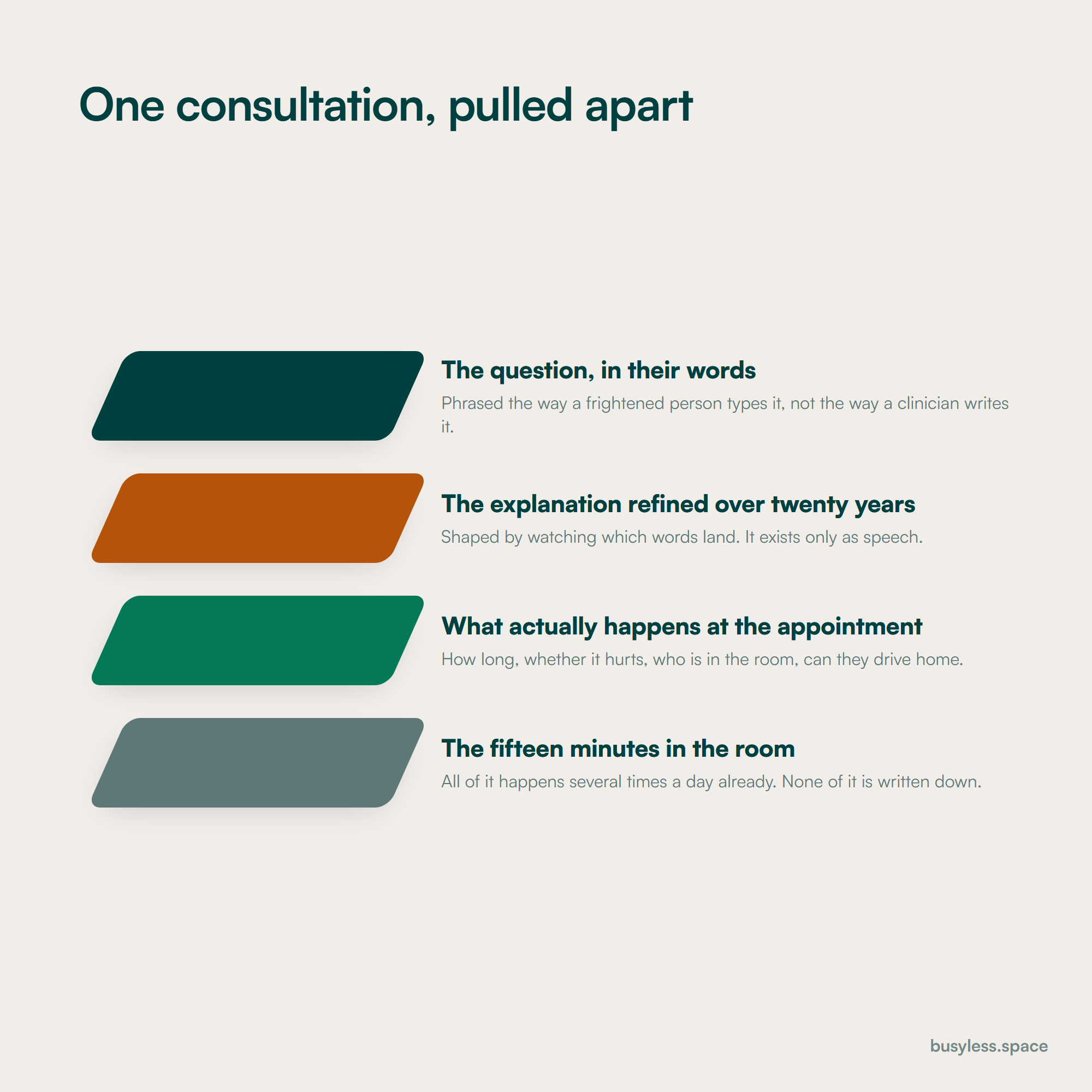
The raw material here is unusually good and almost entirely unrecorded. Everything below is already happening several times a day inside the practice, and none of it is written down anywhere.
The questions asked out loud in the room
Held by Every clinician, and the reception desk
These are the questions people are too embarrassed or too frightened to type, so no keyword tool contains them and no competitor can guess them. They are also phrased in the patient's words rather than the clinical ones, which is exactly the language the page needs.
How to capture it
Ask every clinician to write down the question, verbatim, once a day for a month. That is a year of content, and the whole exercise costs five minutes a day.
What the appointment is actually like
Held by The clinical and nursing team
The thing that stops people booking is rarely a lack of information about the condition. It is not knowing what will happen to them: how long, how much it hurts, whether they can drive home, who will be in the room. Nobody publishes this because to the practice it is too obvious to say.
How to capture it
Walk one appointment type end to end with the nurse who runs it and write down every step. Publish it as the step-by-step it is.
The explanation the clinician has given a thousand times
Held by The senior clinician in each service line
A explanation refined over twenty years of watching which words land is a genuinely rare object. It is better than anything a writer produces from the literature, and it exists only as speech.
How to capture it
Record it. Three minutes to camera, unscripted, no slides. The polish that a script adds is worth less than the fluency it removes.
The pattern across your own caseload
Held by The practice, in its own records
How long people wait, what proportion arrive at which stage, what the local picture looks like against the national one. Aggregated so no individual is identifiable it is genuinely new information, and the local press will use it.
How to capture it
Export a field you already record, aggregate it first and decide what is publishable second, and have a clinician sign the interpretation.
The thing patients consistently get wrong
Held by Whoever handles the follow-up calls
A misunderstanding that recurs across hundreds of patients is a content brief with proven demand attached. It is also the piece most likely to reduce avoidable appointments, which is the version of return a clinical director actually cares about.
How to capture it
Ask the follow-up team what they explain twice a week. They will have an answer immediately and nobody has ever asked them.
Who actually makes it
The bottleneck here is not writing and it is not compliance. It is that a clinician's name goes on a clinical claim, and a clinician asked to review an entire article will do it once and never again. Everything below exists to keep their part small enough to survive.
Clinician as source and signatory
The clinical claim, and only the clinical claim
Recorded and consulted, never asked to draft. Bound their review to the sentences that carry a claim rather than the whole piece, or you get one month of cooperation.
90 minutes
Editor
Turning a recording into something a frightened person can read
Needs to be able to write plainly about a hard subject without either patronising the reader or hedging every sentence into uselessness. Rarer than it sounds.
20 to 30 hours
Practice or marketing lead
The calendar, the list and the questions log
Also the person who keeps the questions log alive. It dies in week three without someone chasing it, and it is the most valuable artefact here.
10 to 15 hours
Privacy reviewer
Whether a communication is marketing, and whether anything identifies a patient
Usually the practice manager or a compliance lead. The question is narrow and answerable, which is why it takes an hour rather than blocking the whole programme.
1 hour
The honest cadenceOne properly answered question a fortnight, one short video a month, and one newsletter. That is roughly twenty-six substantial pieces a year, which is more than most practices have published in total, and it is achievable on ninety minutes of clinician time a month.
One project, 8 surfaces
One recorded explanation of one common question becomes eight things, and the reason it is worth the trouble is that every surface here has to work for somebody who will not identify themselves.
- 1
The answer page
3 hoursFrom: The transcript, rewritten as plain prose
The primary asset. Written for the person searching at midnight, in their words rather than the clinical ones, with the clinician named as the source.
- 2
The short video
45 minutesFrom: The recording itself, trimmed
Publish it on your own page as well as the platform, because the page view is anonymous and the platform view is only anonymous if they are not logged in.
- 3
Chapters within the video
20 minutesFrom: The natural breaks in the answer
Lets somebody jump straight to their question without watching the part about someone else's. Marked up as Clip, which is the schema section below.
- 4
The what-happens-next page
90 minutesFrom: The practical half of the answer
The step-by-step of the appointment. Consistently the highest-converting page type here and consistently the last one anybody writes.
- 5
A newsletter issue
30 minutesFrom: The same answer with a covering line
Describing your own service to your own patients, which is not marketing under HIPAA. Keep it that way by keeping other people's money out of it.
- 6
The waiting room and the discharge sheet
30 minutesFrom: The printed version
The most undervalued surface in this industry. A patient will take a sheet home and read it privately, which is exactly the behaviour this whole page is built around.
- 7
A referrer-facing note
1 hourFrom: The clinical reasoning, at professional register
Different audience, different rules, and none of the anonymity problem. A referring GP is not a patient and will read at depth.
- 8
The answer given at reception
20 minutesFrom: The same answer, as a script
Internal, and it is often what finally makes clinicians willing to be recorded, because it visibly reduces the calls they get asked to return.
The buying cycle, and what content does at each stage
Two things are true at once and they pull against each other. People research for months and then need to be seen this week, so the same programme has to serve a long anonymous read and a short urgent decision without treating them as one journey.
Something is wrong and they are not ready to name it
Weeks to years"Is this serious, or am I overreacting?"
- What moves them
- A plain answer that neither alarms nor dismisses
- How you know
- Long time on page from unbranded search, and nothing else
They accept it needs dealing with
Days to weeks"What actually happens if I do something about this?"
- What moves them
- The step-by-step of the appointment, and a clinician on video
- How you know
- Movement from the answer page to the service and booking pages
They are choosing where to go
Hours to days"Are these the right people, and will they take my insurance?"
- What moves them
- A clinician page that reads like a person, and clear practical detail
- How you know
- Branded search, and enquiries that already name a clinician
They arrive
Minutes"Can I actually get an appointment this week?"
- What moves them
- Booking that works, and honest availability
- How you know
- Booked appointments, which is the only number that matters here
Afterwards
Months to years"Was that right, and what do I do now?"
- What moves them
- Aftercare content and the newsletter
- How you know
- Returning visits, fewer avoidable calls, and referrals by name
What you are allowed to publish
Everything below governs the message and its recipient rather than the measurement. The analytics and tracking rules are the sibling playbook's territory and none of them appear here, which includes the tracking bulletin, call recording, review responses and testimonials.
Describing your own services is not marketing, until somebody pays for it
45 CFR 164.501 and 164.508(a)(3), verified 2026-08-30
HIPAA defines marketing as a communication encouraging the recipient to buy or use a product or service, and requires a signed authorization for it. The exceptions are wide: communications for treatment, for case management or care coordination, and describing a health-related product or service the covered entity itself provides. The exception falls away where the covered entity receives financial remuneration from a third party whose product is described.
So do thisSend your own patients your own service information without an authorization, and treat any sponsored or co-branded message as a different category needing one. The dividing line is who paid, not how promotional it sounds. Our life-sciences playbook is written from the other side of that transaction, for the company doing the paying.
A patient photograph needs an authorization, and a release is a different document
45 CFR 164.508 and standard model release practice, reviewed 2026-08-30
Using a patient's image or story in marketing is a use of protected health information and requires a HIPAA authorization naming the purpose. A photographer's model release covers the subject's likeness rights and does not satisfy the privacy rule. Practices routinely obtain one of the two and believe they have both.
So do thisKeep two documents and get both signed before the shoot, not after. Record where the image may appear and for how long, because an authorization can be revoked and a website is not a magazine you cannot recall.
Before-and-after images carry their own rules
State medical and dental board advertising rules, reviewed 2026-08-30
Many boards require that before-and-after images be of the practice's own patients, be unretouched and taken under comparable conditions, and carry a statement that results vary. Some restrict them entirely for particular procedures. This varies by state and by profession, which is exactly why it is so often got wrong.
So do thisCheck your own board's rule before the first image goes up, write the standard down once, and apply it to every image including the ones on social. This is guidance rather than legal advice.
A credential in a bio is a claim about a body that did not grant it
State board advertising rules on specialty designations, reviewed 2026-08-30
Describing a clinician as board certified, a specialist or an expert is regulated in most states, and typically restricted to certifications from recognised boards. The exposure is not the deliberate misstatement, it is the marketing team compressing a real but non-recognised qualification into a shorter word that happens to be a protected one.
So do thisWrite bios from the certificate rather than from the CV, name the awarding body in full, and have each clinician confirm their own line once a year.
None of this is legal advice. Rules vary by state and by contract, and the dates above are when each source was read. Check your own before you rely on any of it.
How to build content marketing for healthcare
Ordered across six months so the measurement argument is settled in week two rather than in month six. The first phase produces no published content, which is deliberate: a practice that starts publishing before it has agreed what success looks like will cancel the programme on the wrong evidence.
Agree what counts as working
- Write down that engagement metrics are unavailable here, and get the clinical director to agree it before anything is published
- Pick the two numbers the practice actually cares about, which are usually booked appointments and avoidable calls
- Start the questions log: every clinician, one question a day, verbatim
- Settle the marketing question once: which communications involve third-party money and which do not
Output An agreed measurement basis and a questions log that has run for a month
Answer the first questions properly
- Record three clinicians answering their most common question, three minutes each
- Publish the first four answer pages, written in the patient's words
- Write the what-happens-next page for your highest-volume appointment type
- Send the first newsletter, describing your own services only
Output Four answer pages, three videos and a list that has heard from you
Make it repeatable and bounded
- Move clinical review to the claim rather than the article, and write the rule down
- Add chapters to the videos so a reader can reach their own question
- Put the printed versions into the waiting room and the discharge pack
- Have one clinician write one piece for a publication their referrers read
Output A review step a clinician will still do in month twelve
Find out what it moved
- Ask at booking what they had read or watched, and write the answer down
- Compare avoidable call volume on the topics you covered against the ones you did not
- Aggregate one thing from your own caseload and publish it with a clinician's name on it
- Cut whatever produced nothing and say so plainly in the report
Output The two numbers agreed in week two, reported for the first time
Structured data for what you publish
The entity markup belongs on the sibling playbook, which carries the clinic, the clinicians and the conditions. These six describe the things you publish, and three of them exist because the reader here needs to reach their own question without watching or reading anything about anybody else.
VideoObject for a clinician answering a question
The page the video is embedded on, not the platformThe single most useful block on this page, because video is the channel that works for an audience that will not subscribe. Host the video on your own page as well, so a person who is not logged in anywhere can still watch it.
{
  "@context": "https://schema.org",
  "@type": "VideoObject",
  "name": "[THE QUESTION, IN THE PATIENT'S WORDS]",
  "description": "[ONE OR TWO SENTENCES, PLAIN LANGUAGE]",
  "thumbnailUrl": "https://[YOUR-DOMAIN]/images/[FILE].jpg",
  "uploadDate": "[YYYY-MM-DD]",
  "duration": "PT[M]M[S]S",
  "contentUrl": "https://[YOUR-DOMAIN]/video/[FILE].mp4",
  "embedUrl": "https://[YOUR-DOMAIN]/[PAGE-SLUG]",
  "publisher": {
    "@type": "Organization",
    "name": "[PRACTICE NAME]",
    "url": "https://[YOUR-DOMAIN]"
  }
}
Clip for a chapter inside a longer video
Alongside the VideoObject, one per chapterLets somebody watching a twelve-minute explanation jump to the ninety seconds about their own situation. It matters more here than almost anywhere, because a patient will not sit through the parts about other people's conditions to reach theirs.
{
  "@context": "https://schema.org",
  "@type": "Clip",
  "name": "[WHAT THIS CHAPTER COVERS]",
  "startOffset": "[SECONDS]",
  "endOffset": "[SECONDS]",
  "url": "https://[YOUR-DOMAIN]/[PAGE-SLUG]?t=[SECONDS]",
  "partOfSeries": {
    "@type": "VideoObject",
    "name": "[PARENT VIDEO NAME]",
    "url": "https://[YOUR-DOMAIN]/[PAGE-SLUG]"
  }
}
PodcastEpisode
A single episode of a practice or service-line podcastAudio is the other anonymous format, and it suits the long explanations that do not need a picture. Mark up only episodes you publish; an appearance on somebody else's show is theirs to describe.
{
  "@context": "https://schema.org",
  "@type": "PodcastEpisode",
  "name": "[EPISODE TITLE]",
  "description": "[ONE OR TWO SENTENCES]",
  "url": "https://[YOUR-DOMAIN]/podcast/[SLUG]",
  "datePublished": "[YYYY-MM-DD]",
  "duration": "PT[M]M[S]S",
  "partOfSeries": {
    "@type": "PodcastSeries",
    "name": "[SERIES NAME]",
    "url": "https://[YOUR-DOMAIN]/podcast"
  },
  "associatedMedia": {
    "@type": "MediaObject",
    "contentUrl": "https://[YOUR-DOMAIN]/audio/[FILE].mp3"
  }
}
Event for a community or clinician session
Any page announcing a talk, open evening or professional sessionWorth emitting because attending a talk is one of the few public acts this audience will perform. Say plainly whether it is for patients or for clinicians, since the two audiences want opposite registers and will both find the page.
{
  "@context": "https://schema.org",
  "@type": "Event",
  "name": "[SESSION TITLE]",
  "description": "[WHAT SOMEBODY LEARNS BY ATTENDING]",
  "startDate": "[YYYY-MM-DDTHH:MM+00:00]",
  "endDate": "[YYYY-MM-DDTHH:MM+00:00]",
  "eventAttendanceMode": "https://schema.org/[Offline|Online|Mixed]EventAttendanceMode",
  "eventStatus": "https://schema.org/EventScheduled",
  "location": {
    "@type": "Place",
    "name": "[VENUE]",
    "address": "[FULL ADDRESS]"
  },
  "organizer": {
    "@type": "Organization",
    "name": "[PRACTICE NAME]",
    "url": "https://[YOUR-DOMAIN]"
  },
  "audience": {
    "@type": "Audience",
    "audienceType": "[PATIENTS AND FAMILIES | REFERRING CLINICIANS]"
  },
  "isAccessibleForFree": true
}
ImageObject with rights and consent metadata
Any photograph containing a patient, and every clinical imageThe field that earns its place here is not the credit, it is having a single record tying an image to the authorization that permits it. An authorization can be revoked, so you need to be able to find every image covered by one.
{
  "@context": "https://schema.org",
  "@type": "ImageObject",
  "contentUrl": "https://[YOUR-DOMAIN]/images/[FILE].jpg",
  "name": "[WHAT THE IMAGE SHOWS]",
  "creditText": "[PHOTOGRAPHER OR PRACTICE]",
  "copyrightNotice": "(c) [YEAR] [RIGHTS HOLDER]",
  "creator": {
    "@type": "Person",
    "name": "[PHOTOGRAPHER NAME]"
  },
  "license": "[URL OF YOUR IMAGE TERMS PAGE]",
  "acquireLicensePage": "https://[YOUR-DOMAIN]/image-use"
}
NewsArticle for a practice announcement
A news page: a new service line, a new clinician, a published findingUse it for things that are genuinely news and dated, not for evergreen answers, which should not carry a type that implies they expire. A new service line is the announcement most worth marking up because referrers search for exactly that.
{
  "@context": "https://schema.org",
  "@type": "NewsArticle",
  "headline": "[HEADLINE]",
  "url": "https://[YOUR-DOMAIN]/news/[SLUG]",
  "datePublished": "[YYYY-MM-DD]",
  "dateModified": "[YYYY-MM-DD]",
  "author": {
    "@type": "Organization",
    "name": "[PRACTICE NAME]"
  },
  "publisher": {
    "@type": "Organization",
    "name": "[PRACTICE NAME]",
    "url": "https://[YOUR-DOMAIN]"
  }
}
What to automate, and where the line is
A fortnightly cadence is only affordable because the machinery behind it is automated, and the source material still has to come out of ninety minutes of clinician time. It is backstage, and the line here is drawn in a specific place: an agent may handle anything that is not a clinical claim and nothing that is.
- automate
Transcribing the clinician recording
Unattended, every time. The recording is the scarce asset and the transcript is what lets anybody other than the clinician work on it.
- automate
Cutting chapters and captions from a video
Mechanical, and captions matter more here than elsewhere because a patient watching in a waiting room or an office will have the sound off.
- automate
Clustering the questions log into topics
Two hundred verbatim questions collapse into about thirty real topics, and doing that by hand is the step that kills the log.
- assist
Drafting the what-happens-next page
It is a procedural description rather than a clinical claim, so a draft from a walked-through interview is fast and safe. It still needs the nurse who runs the appointment to correct it, because the details are the whole value.
- assist
Turning the transcript into a first draft
Strong on structure, and it strips the repetition speech contains. Reliably wrong about which reassurance was the one that mattered, which is the sentence the page exists for.
- assist
Rewriting clinical language into plain language
Genuinely useful and genuinely dangerous. The failure mode is a simplification that changes the meaning, so every output goes back to the clinician for the claim rather than the prose.
- never
Making or amending a clinical claim
A named clinician is professionally responsible for it. There is no version of this where a generated sentence carries somebody's registration.
- never
Answering a patient's message in any channel
It is individual clinical advice given outside the record and outside the relationship. Not a content task, and not a place to save time.
What it costs
Bands rather than quotes, and each one assumes the practice supplies the clinician time the engine section describes. What moves the number most is the number of service lines running at once, because each one needs its own clinician, its own questions log and its own sign-off.
Do it yourself
$0 to $500- A questions log kept by the clinical team
- One answer page a fortnight, written in-house
- Phone-recorded video, published on your own pages
- A monthly newsletter describing your own services
- Suits
- A single-site practice with one person who can write plainly and reliably
- Ceiling
- Plain writing about a frightening subject is a real skill, and the version produced by whoever has spare time usually either alarms people or says nothing. That is the limit here rather than the hours.
Lean
$4,000 to $8,000- An external editor turning recordings into publishable answers
- Proper video for one service line, with chapters
- The what-happens-next pages for your highest-volume appointments
- A cadence that survives a busy quarter
- Suits
- A practice of five to twenty clinicians, or one service line inside a larger group
- Ceiling
- A second service line roughly doubles the source-capture and sign-off load rather than adding a little, because none of the clinical review transfers between them.
Funded
$8,000 to $20,000- Everything above across three or four service lines
- A regular video programme rather than occasional filming
- One aggregated finding a year from your own caseload
- Referrer-facing content run as its own stream
- Suits
- A multi-site group, or a specialist practice competing outside its own area
- Ceiling
- Clinician availability, not money. Commission more than clinicians can review and you get pages nobody will put their name to, which is worse than publishing less.
Enterprise
$20,000 and up- Several service lines coordinated against one editorial and clinical standard
- In-house video capability rather than booked shoots
- Capture built into clinic routine rather than run as a project
- Referrer and patient programmes staffed separately
- Suits
- Hospital groups and networks where service lines compete for the same internal budget
- Ceiling
- The standard becomes the cost. The failure mode is a house voice so uniform that every clinician sounds identical, which removes the one thing that made the pages worth reading.
How to do it with no budget
Nothing here needs a budget, and all of it uses material the practice already generates several times a day. The first two are worth more than the other five combined and neither of them involves publishing anything.
- 1
Agree that engagement metrics do not apply here
One conversation, written down · 45 minutes
Do this before publishing. It is the difference between a programme that gets a fair hearing in month six and one that does not.
- 2
Start the questions log
A shared note or a card by each desk · 5 minutes a day
Verbatim, in the patient's words. This is the most valuable artefact on the page and it costs nothing.
- 3
Settle the marketing question once
The HIPAA definition and a one-page note · 1 hour
Which of your communications involve third-party money. Almost none will, and knowing that unblocks the newsletter permanently.
- 4
Record one clinician answering one question
A phone, held still, in a quiet room · 15 minutes
Three minutes, unscripted, no slides. Fluency beats polish and a script removes it.
- 5
Write the what-happens-next page
A walk-through with the nurse who runs the appointment · 2 hours
Consistently the page that turns reading into a booking, and the one most practices have never made.
- 6
Print it and put it in the waiting room
Your office printer · 30 minutes
A sheet somebody takes home is read privately, which is exactly the behaviour this page is built around.
- 7
Ask at booking what they had read
One extra field on the booking form · 20 minutes to set up
For a decision this private, one question at intake outperforms every analytics tool available.
The tool stack
Most of these a practice already pays for, under a different department's budget. Rows that link into our other directories go to the researched review rather than to the vendor.
Hold and send the patient newsletter
The procurement question here is not features, it is where the list is stored and who processes it. Settle that before choosing on price.
Free option: Free at the size most practice lists start at
Host video you own rather than only embedding it
A logged-in platform view is not anonymous. A page on your own site is, which is the whole reason video works here.
Free option: Publish to the platform, and also embed a self-hosted copy
Publish and version answer pages without a developer
Worth the setup here specifically because clinical review means pages get revised often, and a revision history is part of the audit trail.
Free option: Open source and self-hosted, which also answers the data-residency question
See what people actually searched before arriving
The query list here is the closest thing to a public version of your questions log, and comparing the two is the fastest content brief you will get.
Free option: Free, and nothing else reports what was actually shown
Check whether an assistant names your practice
Increasingly the first place a worried person asks, and the answers still lean heavily on national publishers rather than local providers.
Free option: Put one condition question to each assistant monthly and keep the answers
Model what one additional booked appointment is worth
Run it on booked appointments rather than enquiries, because the gap between the two is larger here than in most industries.
Free option: Free
Test the budget against the ninety minutes you actually have
The binding input is the ninety minutes a month, not the money. Run it against that and the affordable cadence falls out.
Free option: Free
Track which clinician signed which claim
One row per piece: who was recorded, which clinician signed the claim, what was changed. It is also the answer if anybody ever asks.
Free option: Free, and genuinely better than software for this
Take it from here
Everything below is meant to be copied and filled in. Bodies are plain text, so what you see is exactly what lands on your clipboard.
The five-minutes-a-day habit that produces a year of content nobody else can write.
QUESTIONS LOG
Practice: [PRACTICE NAME]
Service line: [LINE]
Started: [YYYY-MM-DD]     Owner: [NAME]

THE RULE, GIVEN TO EVERY CLINICIAN AND EVERY RECEPTIONIST
"Once a day, write down one question a patient asked you out
 loud, in THEIR words. Do not tidy it. Do not add the answer.
 Do not write down who asked."

WHY VERBATIM MATTERS
The clinical phrasing is already on every competitor's website.
The patient's phrasing is what they type at eleven at night,
and no keyword tool contains it.

THE LOG
Date | Asked of | The question, verbatim | Service line
[YYYY-MM-DD] | [ROLE] | "[EXACT WORDS]" | [LINE]
[YYYY-MM-DD] | [ROLE] | "[EXACT WORDS]" | [LINE]
[YYYY-MM-DD] | [ROLE] | "[EXACT WORDS]" | [LINE]

NEVER RECORD
- Any patient name, initials or identifier
- Any detail that would let a colleague work out who asked
- The clinical answer (that comes later, on camera)

MONTHLY REVIEW  [FIRST WORKING DAY]
[ ] Group the month's questions into topics
[ ] Count how many times each topic appeared
[ ] Cross-check against Search Console queries
[ ] Pick the two topics for next month's recordings
[ ] Circulate the count back to the clinicians who logged them

     Topics this month: [N]
     Most frequent: [TOPIC], asked [N] times
     Already covered on the site: [Y/N]

THE TEST OF WHETHER THIS IS WORKING
After 30 days you should have 20 or more questions and at
least [3] you did not expect. If every question is one you
already have a page for, the log is being tidied rather than
kept.The expensive mistakes
Reporting the programme on engagement
What it costs: A working programme cancelled in month six on evidence that was never going to appear
Agree in week two that likes, follows and comments are structurally unavailable here, and report on volume, arrival and booked appointments instead.
Sending a whole article to a clinician for review
What it costs: One month of cooperation, then a permanently stalled queue
Send the four sentences carrying a clinical claim. Bounded review is the difference between a programme that runs for years and one that runs until March.
Writing about the condition and not about the appointment
What it costs: Pages that inform people and never move them, and a conclusion that content does not convert
Write the step-by-step of what actually happens. What stops most people booking is not ignorance of the condition, it is not knowing what will be done to them.
Building a community or a support group on a public platform
What it costs: Nobody joins, and the few who do have disclosed something to their whole network
Publish where reading is anonymous and let the support happen in the places patients have already chosen, which you can read and should not run.
Treating the sponsored piece as ordinary content
What it costs: A communication that needed an authorization and did not have one
Route anything involving third-party money through a separate process. The question is who paid, and it has a clear answer every time.
Using stock photography of models in a clinical setting
What it costs: Pages that read as untrustworthy to exactly the audience least willing to take a risk
Photograph your own rooms and your own staff, with the authorizations in place. Empty rooms and real corridors beat smiling models here.
What to measure
Measuring healthcare content marketing is a different job from measuring it anywhere else, because the audience refuses to produce the signals the discipline was built on. What follows separates what you can genuinely see from what the practice actually cares about, and says where the join between them is not clean, which for a decision made privately over several months is most of the time.
Leading indicators
Impressions and clicks on unbranded question queries
Search Console, unbranded question queries
The clearest available proxy for people at the first stage. It moves months before anything else does, which is why it is worth watching on its own.
Video watch time on your own pages
Your own player, not only the platform
Platform views are logged-in views. The anonymous audience this page is about will be on your own page, so measure there or you will miss them.
Movement from an answer page to a service or booking page
Your analytics, within the constraints the sibling playbook sets
The single most useful on-site number here, because it is the moment reading turns into intent.
Questions logged, and topics covered against them
The questions log
A leading indicator for the leading indicators. A log that has stopped growing is a programme about to run out of material.
Business indicators
Booked appointments, by service line
Your practice management system
The number that matters. Split it by service line or the one that is working will be hidden inside the one that is not.
New patients who name a clinician on arrival
Your intake record
Strong evidence that somebody read or watched before choosing, since nothing else puts a clinician's name in their head.
Avoidable calls and repeat explanations
Reception and the follow-up team, counted for one week a quarter
The return a clinical director cares about and the one nobody reports. It also makes the case for the next year's budget better than traffic does.
What they say they read, asked at booking
One field on the booking form
For a private decision made over months, one honest question at intake outperforms the entire analytics stack, and it is the only thing that reaches the anonymous half of the audience.
The verdict
Content marketing for healthcare works, and it does not look like it is working for longer than most practices are prepared to wait. The audience reads for months without touching anything you can count, so the programme has to be defended on the right evidence from the start or it will be cancelled on the wrong evidence in month six.
The constraints are unusually narrow and the raw material is unusually good. Twenty questions asked out loud in a consulting room is a year of content that nobody else can write, and it costs five minutes a day to collect. The benefits of content marketing for doctors accrue to the practice rather than to a follower count.
Be sceptical of healthcare content marketing services that open with a social strategy, or whose reporting template carries an engagement column. Both are signs that the person selling has not noticed what this audience will and will not do in public.
Stated plainly: content marketing services for healthcare are worth buying when they are built around ninety minutes of clinician time a month and a bounded sign-off, and are worth nothing when they are built around a publishing calendar. The clinician is the constraint, and every decision here follows from protecting their attention.
FAQ
Healthcare content marketing questions
Why do our social accounts get so little engagement?
Because following, liking and commenting are public acts that disclose an interest in a health condition, and most people will not do that where a colleague or a relative can see. It is not a content problem. Reach can be fine while engagement stays near zero, which is why this page rates social as a skip for patient audiences.Does HIPAA stop us sending a newsletter to our patients?
Generally no. Describing your own health-related services to your own patients falls within the exceptions to the HIPAA definition of marketing, so no authorization is needed. It becomes marketing, and needs a signed authorization, when a third party pays for the message being sent. The dividing line is who paid rather than how promotional it reads.How much clinician time does this actually take?
About ninety minutes a month, spent being recorded and reviewing claims rather than writing. Any plan needing more will stop by the second quarter. The step that protects it is bounding clinical review to the sentences carrying a claim instead of sending the whole article.Can we use patient stories and photographs?
With a HIPAA authorization, which is a different document from a photographer's model release. Practices commonly obtain one and assume it covers both. Get both signed before the shoot, record where the image may appear, and keep a list, because an authorization can be revoked and you will need to find every use.What should we measure if engagement is unavailable?
Impressions on unbranded question queries, watch time on video hosted on your own pages, movement from answer pages to booking, and then the two numbers the practice cares about, which are booked appointments and avoidable calls. Agree this list before publishing rather than after the first disappointing report.Is video really worth it for a medical practice?
Yes, and for one specific reason: watching is anonymous and subscribing is not. A three-minute clinician answering a common question reduces the fear that stops people booking better than a long article does, and it carries tone, which matters when the subject frightens people.What should a practice expect to spend on this?
There is no standard package. An engagement starts with a Discovery and then a monthly retainer sized to the number of service lines, because each one needs its own clinician and its own sign-off. The budget section on this page gives honest bands for running it in-house or with help, and the realistic range for doing it properly is $4,000 to $20,000 a month.Should we be answering questions in patient forums?
No. A clinician answering a specific question in a public group is giving individual advice outside the record and outside a clinical relationship. Read those forums closely, because they are an excellent source of real questions, and publish the answers on your own pages instead.Who should actually be writing this?
The clinician, in five-minute pieces. Content marketing for medical practices fails when it is handed to a marketing team with no clinical access, because the only material worth having is what gets said in the room. Content marketing for doctors is an extraction problem rather than a writing one.
Run it yourself, or have someone own it
Everything above is written to be run without us, and the free path is genuinely most of the value for a small practice. Where these plans stall is almost never the plan. It is that the person holding the material has a day job and nobody owns the programme after the first month. That is the job we do.