

Skip to content

Small business SEO strategy

Regulated marketing

The person who must write it is the one doing the work

Written by Eugene SuslovLast reviewed 29 August 2026No affiliate links
Sector
Business services
Model
Local service, National service
Competition
High
Time to results
4 to 9 months
Typical monthly
$0 to $2,000

Key takeaways

  1. 1Your constraint is not budget and it is not competition. It is that the only person who can answer the questions worth answering is the person who has to do the work today.
  2. 2Almost everything in a standard plan is designed for a team. Applied to one owner with two hours a week it produces guilt and a half-finished blog, which is worse than doing three things properly.
  3. 3The pages that will work for you are the answers you already give on the phone, transcribed. You are not short of expertise. You are short of the forty minutes it takes to write any of it down.
  4. 4Publishing a price is the single highest-leverage thing most small businesses refuse to do, and in California and a growing number of states the price you publish has to include every mandatory fee.
  5. 5There is no federal web accessibility rule for a private business, and that absence is the problem rather than the reprieve, because the standard arrives through demand letters instead.

SEO for small businesses is usually explained as a smaller version of what a company with a marketing team does. It is not. It is a different problem, and the difference is not budget.

In a business of one to ten people, the person who knows why a customer should choose you is the person who is on a job at eleven on a Tuesday. That person is billable, tired, and the only possible author of anything worth reading.

So a small business SEO strategy has to be built around attention rather than around money. Two hours a week is a real budget, it is the one most owners actually have, and almost nothing written for this audience is designed to fit inside it.

That changes the advice quite sharply. Publishing weekly is not a plan, it is a way of producing forty thin pages and a sense of failure. Three good pages and a correct profile will outperform it, and can be finished.

It also changes what to refuse, which is most of the value here. A great deal of standard practice exists to occupy a team, and an owner-operator who copies it will spend a year on work that would have needed a department to matter.

One clarification, because the two get conflated constantly. This page is about capacity. If your problem is that a competitor two miles closer wins the same search whatever you write, that is a different constraint and there is a page for it.

Who already ranks in small businesses

Search the thing you actually sell and look at who answers it, then ask which of those results could have been produced by one person in an afternoon. Most small business SEO advice ignores that second question, and it is the only one that decides what you should do on Thursday.

What is on the results page

  • A local pack on anything with a place attached or implied
  • Directories and best-of listings above every independent operator
  • Franchise and national brand pages on the generic service terms
  • People Also Ask, mostly asking what it costs and how long it takes
  • Publisher and how-to content on the informational half
  • A paid block on anything with commercial intent
  • Reddit and forum threads on brand and comparison queries
  • Almost nothing on the specific, awkward questions you get asked every week
  • Google Business Profile

    google.comClaim it

    Free, the highest-return hour available to almost any small business, and usually half filled in. Services listed explicitly rather than left to the category, real photographs, correct hours including holidays, and the questions section answered by you before somebody else answers it wrongly.

  • The lead marketplaces

    thumbtack.comClaim it

    They rank on terms you will not outrank quickly and they will send work, at the price of a lead sold to several competitors. Useful as a bridge that funds the period before your own pages rank, and dangerous as a permanent model. Measure them on cost per won job rather than per lead, and set a date to review.

  • Best-of listicles and local directories

    expertise.comClaim it

    Pages titled best something in a city, produced at scale, sometimes with a fee attached to the badge. Claim what is free, pay for nothing, and read them as a competitor list: whoever appears on all of them is who your customers are comparing you against.

  • Facebook and the neighbourhood groups

    facebook.comClaim it

    Not search, and for a great many small businesses it produces more work than search does. Recommendation threads convert well and occasionally rank. Worth an honest hour a week if that is where your customers actually are, and worth nothing if it is not.

  • Your trade or professional body

    the association's directoryClaim it

    Membership directories rank on qualified searches, carry a credential a customer can verify, and are usually free with the subscription you already pay. Most members fill in the name and stop, leaving the specialisms and the description blank.

  • Yelp and the review platforms

    yelp.comClaim it

    Still ranks in many categories and feeds map results elsewhere. Claim it, keep the details current, and answer complaints properly rather than defensively. What you must not do is choose which customers get asked, which is now explicitly prohibited.

  • Franchises and national brands

    the sector's national player

    They hold the generic service terms with authority you will not match and marketing budgets you cannot see. They also cannot be specific about your town, your speciality or your awkward jobs, which is the entire opening.

  • Answer engines

    the assistants your customers already use

    Increasingly the first place a specific question gets asked, and they assemble their answers from directories, reviews and whatever text they can read. That makes the profile, the reviews and a plainly written services page more valuable than they were, and a chat widget less.

Two circles that barely overlap. The left holds the queries a budget wins, the right holds the queries an owner's own knowledge wins, and the narrow intersection holds the few that both can reach.
The overlap is small on purpose. Most published advice is written about the left circle.

What people actually search

Four of the eight clusters below are worth an owner's own hours. The other four are worth knowing about so you can decide, deliberately, not to chase them, which is the more useful half of this section.

The thing you sell, plus a place

Local commercial

[service] in [town]

The page that wins it: One real service page and a complete profile

The obvious cluster and mostly a profile job rather than a content one. One page written properly beats five written to cover variations of the same phrase.

Price

Commercial investigation

how much does [service] cost

The page that wins it: A page with real bands and the variables named

Enormous, almost universally answered with a contact form, and the single highest-leverage page most small businesses refuse to build. It also filters out the enquiries you were going to lose anyway.

The awkward question

Commercial, specific

can you [unusual variation of what you do]

The page that wins it: A short page per question you actually get asked

The cluster only you can serve. It is low volume, it converts extraordinarily well, and it is sitting in your call history rather than in a keyword tool.

Comparison and alternatives

Commercial investigation

[option A] or [option B] for [problem]

The page that wins it: An honest comparison, including where you are the wrong answer

Somebody is answering this whether you do or not. Saying plainly when a customer should not buy from you is the fastest trust you can build in this position.

Your own name

Navigational, with doubt

[business name] reviews

The page that wins it: A complete profile and reviews you did not curate

Cheap to win, easy to lose to a directory page or a forum thread. The work is mostly making sure the correct information exists rather than writing anything.

Hiring

Navigational and transactional

[role] jobs in [town]

The page that wins it: A real job page rather than an email address

Not marketing, and frequently the constraint that actually caps the business. If you cannot take on more work, this cluster is worth more than any of the ones above it.

Broad informational

Informational

how to [thing your customers could do themselves]

The page that wins it: Nothing, in most cases

The cluster that consumes small business content budgets. It competes with the entire internet, it attracts people who will not buy, and at its worst it teaches your prospect to do the job without you.

Industry news and trends

Informational

[industry] trends 2026

The page that wins it: Nothing

Listed here to be refused. It is written for other people in your industry rather than for anybody who might pay you, and it is the commonest thing an agency will propose because it is easy to produce.

What the rules change

Lighter than the licensed professions in this directory and broader than most owners expect, because two of the three rules below apply to almost any business with a website. Check your own position; none of this is legal advice.

1

The price you advertise has to include everything that is compulsory

State pricing statutes, of which California's SB 478, the Honest Pricing Law, is the broadest, in force since 1 July 2024

What it means

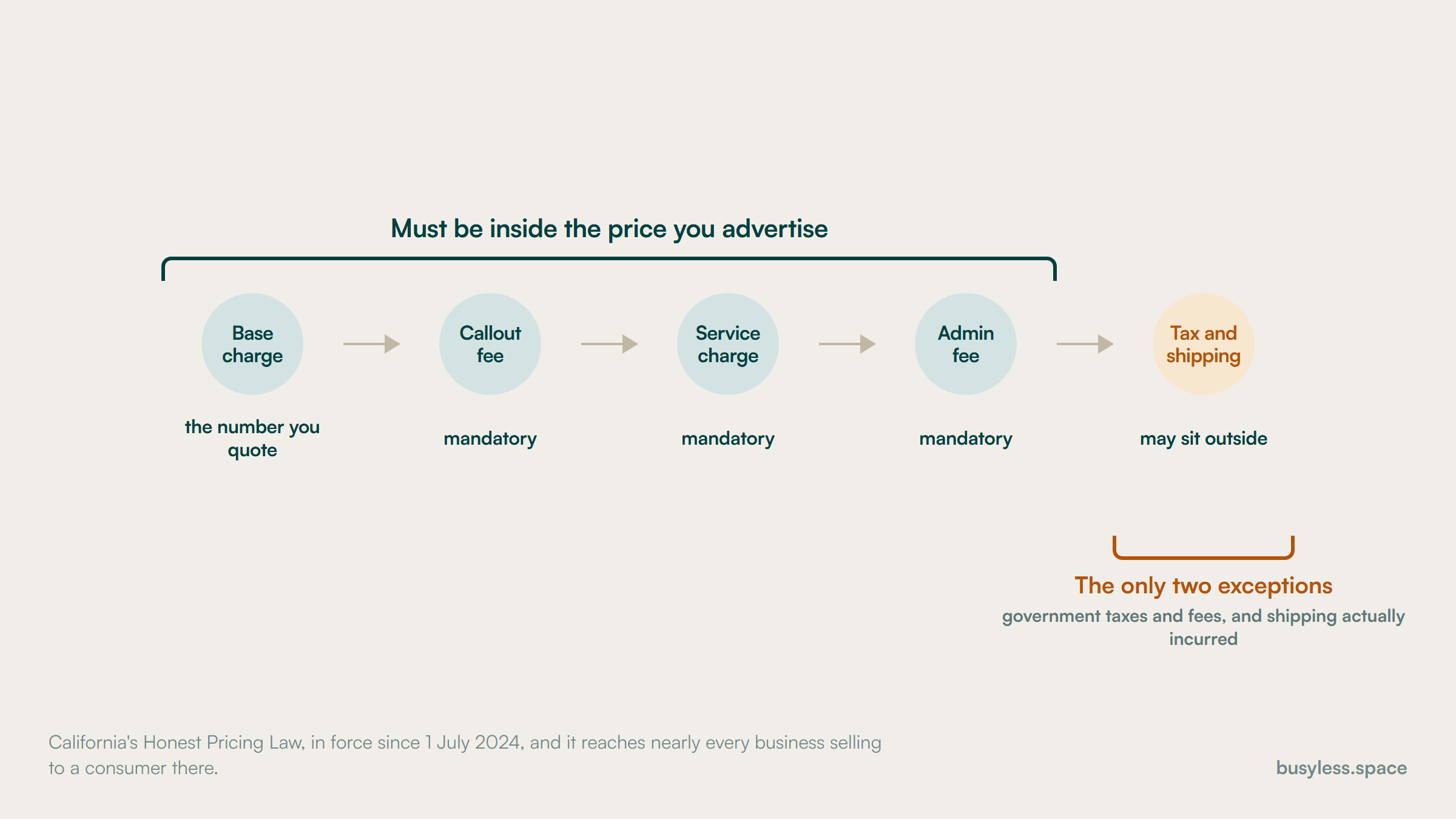
It bans advertising a price that leaves out mandatory fees, and it reaches nearly every business selling goods or services to a consumer in that state. Only two things may sit outside the advertised figure: government taxes and fees, and shipping actually incurred. Booking fees, service charges and admin fees are not exceptions.

So do this

Work out which of your charges a customer cannot avoid and put every one of them inside the number you publish. This is easier than it sounds and it makes the pricing page better: a single all-in band with the variables named reads as more honest than a lower figure with a footnote.

2

The newsletter rules almost everybody breaks by accident

The CAN-SPAM Act, 15 U.S.C. 7701, and the FTC rule at 16 CFR part 316

What it means

Every commercial email needs a valid physical postal address, a clear and working way to opt out, honoured within ten business days, and a subject line and header that are not misleading. Liability does not transfer to the agency or platform that sent it, and each non-compliant message is a separate violation.

So do this

Put your postal address in the footer of the template rather than trusting the platform's default, test the unsubscribe link on a real message rather than assuming it works, and stop importing addresses from anywhere other than people who gave them to you.

3

There is no accessibility rule for you, and that is the problem

The Department of Justice adopted WCAG 2.1 Level AA for state and local government under Title II on 24 April 2024, with compliance dates extended in April 2026; no Title III regulation for private businesses has been issued

What it means

A private business is covered by the statute but not by a technical regulation, so the standard reaches you through private litigation rather than through a rule you can read and comply with. Courts and demand letters use the same WCAG benchmark the government chose for somebody else.

So do this

Do the handful of things that remove most of the risk and improve the site anyway: real text rather than text in images, alt attributes that describe the image, labels on every form field, sufficient colour contrast, and a page that works with a keyboard. Avoid overlay widgets that promise compliance in one line of script.

4

You may not choose which customers get asked for a review

The FTC rule on the use of consumer reviews and testimonials, 16 CFR part 465, effective 21 October 2024

What it means

Review gating, where a happy customer is sent to the public platform and an unhappy one to a private form, is prohibited, as is offering anything conditional on a review expressing a particular sentiment. So is a review written by an employee or a relative without disclosing the relationship.

So do this

Ask everybody, the same way, at the same point in the job. Answer the bad ones properly and publicly. The response to a complaint is read more carefully than the complaint, and a business with only perfect reviews is now less believable rather than more.

A bracket over an advertised price, covering the base charge and every mandatory fee, with a narrower bracket beside it marking the only two things allowed to sit outside: government taxes and shipping actually incurred.
The wide bracket is the number you publish. Everything under it has to be in the figure, not in a footnote.

Proving expertise

In a business this size the expertise is a person rather than an institution, and every proof signal that works says so. All of them are free and most of them take an afternoon.

  • The owner's name, face and actual experience, on a page of its own
  • How long you have been doing this, and what you did before
  • Qualifications, licences and memberships, with numbers where they exist
  • Insurance, stated as a policy type and an amount rather than as the word insured
  • Real photographs of real work, not stock images of somebody else's
  • Prices, or bands, with the variables named
  • What you do not do, and who you refer that work to
  • Reviews you did not choose, with your answers to the difficult ones
  • A physical address or a genuine service area, and a phone number a person answers

How to build a small business SEO strategy

Six months at two hours a week, which is about fifty hours in total. A small business SEO strategy that needs more than that is not wrong, it is for somebody else, and the honest thing is to know which of the two you are reading.

  1. 1

    Weeks 1 to 3

    Spend six hours on the things that are free

    • Complete the profile properly: services listed, real photographs, exact hours
    • Answer the profile's own questions section before a stranger does
    • Claim the two directories that actually rank in your category
    • Fix the contact details so they are identical everywhere
    • Put the owner's name and face on an about page
    • Ask the last twenty customers for a review, all of them, the same way

    You end up with
    The highest-return six hours available, and none of it cost anything

  2. 2

    Weeks 3 to 10

    Write the three pages only you can write

    • Write the pricing page with real bands and the variables named
    • Write one proper service page for the thing you most want more of
    • Write the awkward-question page from your own call history
    • Put every mandatory charge inside the published price
    • Add the four structured data blocks that are worth the time
    • Say plainly what you do not do, and who you would send it to

    You end up with
    Three pages that a competitor cannot copy, because they are about you

  3. 3

    Weeks 8 to 18

    Turn the phone into a content plan

    • Keep a note of every question you are asked for a month
    • Write the six that came up most, one short page each
    • Record the answers on your phone and have them transcribed if writing is the blocker
    • Publish real photographs of jobs you have finished, as pages
    • Write the honest comparison, including where you are the wrong choice
    • Fix the accessibility basics: alt text, form labels, contrast, keyboard use

    You end up with
    A site made of answers you were already giving, for free, one at a time

  4. 4

    Weeks 16 to 26

    Measure enquiries, and be honest about capacity

    • Ask every enquiry one question about how they found you, the same way
    • Track enquiries that became work, not enquiries
    • Track the value of the work, because volume is the wrong target
    • Review the marketplace spend on cost per won job
    • Report how booked you are beside how many enquiries came in
    • Decide what to stop doing before adding anything new

    You end up with
    A page of numbers that fits on a page, and a decision about capacity

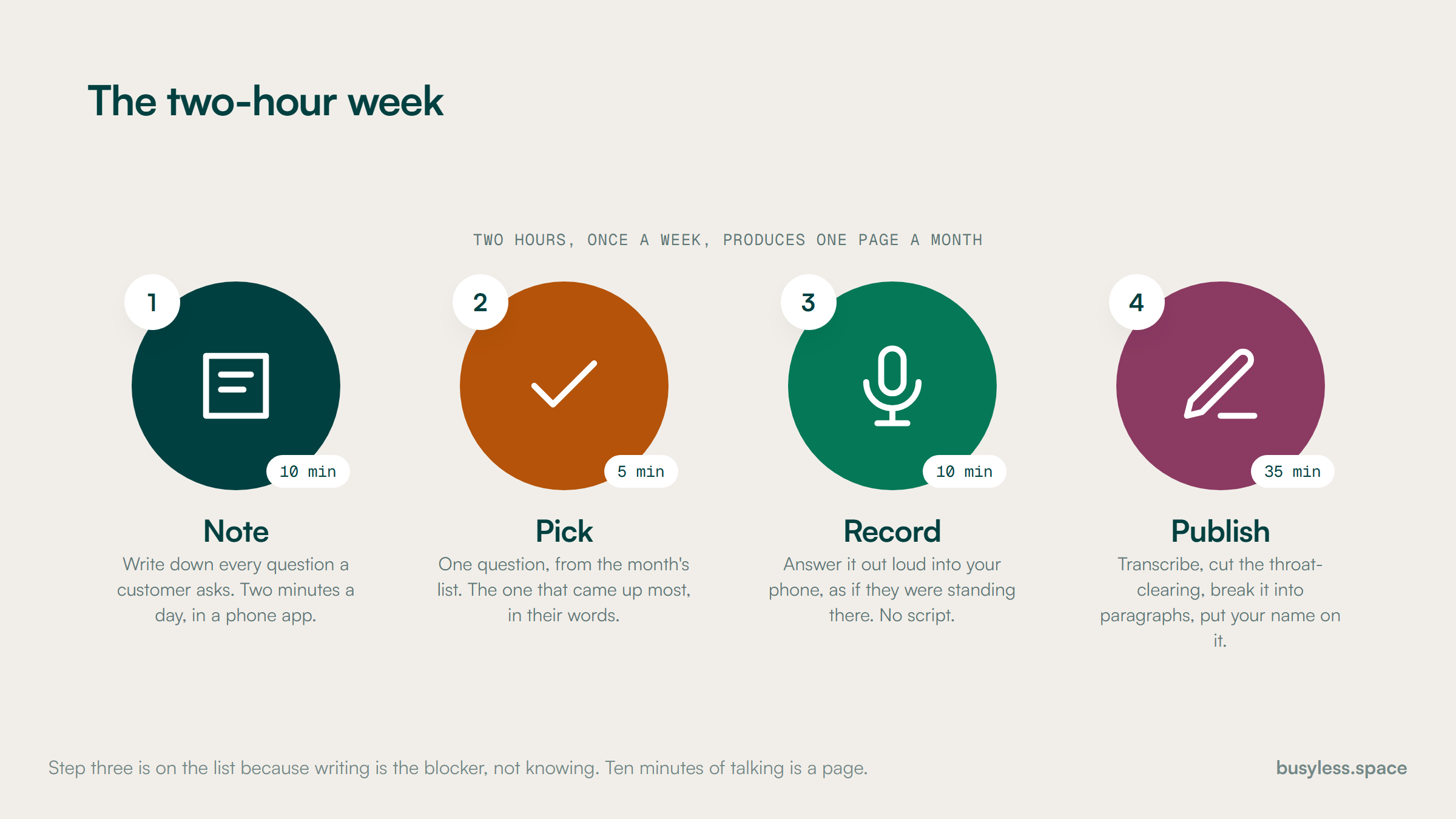
Four numbered steps making up a repeatable two-hour week: note the questions you were asked, pick one, record yourself answering it, publish the tidied transcript.
The recording step is there because writing is the blocker, not knowing. Ten minutes of talking is a page.

Technical fixes with the best payoff

The technical problems here are not the ones a vendor causes. They are the ones that come from building it yourself at half past nine at night, and every fix below is an hour rather than a project.

  • The site is one page

    A day

    Website builders encourage a single scrolling page with sections, which looks tidy and gives you one URL for a business that does four different things. Nothing can rank for anything specific, because there is nothing specific to rank.

    One page per thing you want to be found for, with its own heading and its own address. Four real pages beats one long one, and the sections you already wrote are most of the content for them.

  • Your phone number and address disagree with themselves

    Two hours

    The profile says one thing, the website footer another, an old directory a third, and a rebrand three years ago left two versions of the business name in circulation. Every inconsistency makes it slightly harder to be recognised as one business.

    Write the correct version down once: exact business name, address, phone, hours. Then fix it everywhere in one sitting, starting with the profile and the site and working through whatever the directories are showing.

  • The important text is inside an image

    An hour

    A designed banner with your services in it, a price list as a photograph, opening hours in a graphic. All of it is invisible to search, unreadable by an assistant and unreadable by a customer using a screen reader, which is also the accessibility problem.

    Type it out as text. Keep the image if you like it, put the words underneath it, and write an alt attribute that says what the image shows. This one fix addresses two of the three problems on this page at once.

  • The whole site is slow because of one thing

    An hour

    In a small business site it is nearly always a single cause: a full-screen video, a slideshow plugin, six tracking scripts, or photographs straight off a phone at several megabytes each. It is rarely a deep technical problem.

    Run a speed test, look at what is largest, and remove or resize that one thing. Photographs are usually the answer and resizing them takes twenty minutes. Do not buy a caching plugin before you have looked.

  • The only way to contact you is a form

    An hour

    A form suits the business rather than the customer, and in a small business the customer frequently wants to talk to somebody now. A phone number that is not a link on a phone, or an email address hidden behind three clicks, loses enquiries silently.

    Phone number in the header as a tap-to-call link, an email address written out, and a form for people who prefer one. Then say when you answer, because an unanswered phone costs more than a missing form.

  • You are hiding your prices and a directory is not

    An afternoon

    The cost cluster is one of the largest in almost every category. When you decline to answer it, the answer is supplied by a marketplace, a directory or a competitor, and the customer forms an expectation somewhere other than your site.

    Publish bands rather than a single figure, with what moves them named. You lose enquiries you would have lost anyway, later and more expensively, and you shorten every conversation that remains.

  • The blog stopped in 2023

    An afternoon

    Almost every small business site has a blog with four posts and a two-year gap. It signals abandonment more clearly than having no blog at all, and it usually contains the least useful pages on the domain.

    Either delete it and move the two useful posts into the main site as proper pages, or commit to something small enough to keep, which is usually one page a month from a question you were asked. Do not restart it weekly.

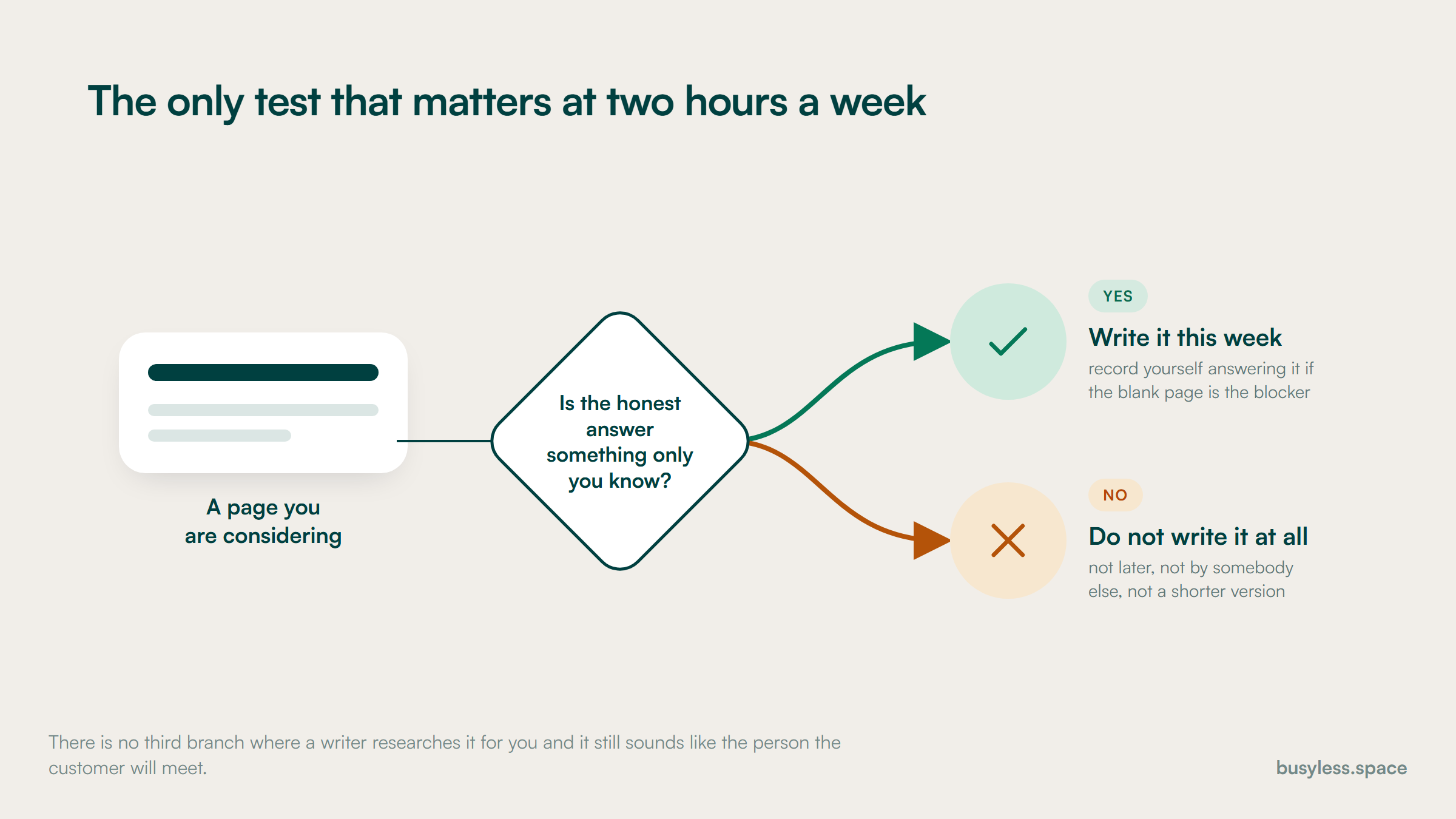
A fork with one question at the top: is the honest answer to this something only you know? On one branch, write it yourself this week. On the other, do not write it at all.
There is no third branch where somebody researches it for you and it still sounds like you.

Structured data that applies here

The types below fit this industry specifically. Most of them earn no rich result on their own, which is worth knowing before anyone sells the work on that basis. What they do is describe the entity precisely, which matters for how search engines and answer engines resolve who you are.

  • LocalBusiness, the honest minimum

    Home page, referenced sitewide

    Worth an hour and no more. The value is in getting the name, address, phone and hours identical to the profile rather than in filling every available property, and half the fields most generators offer are not worth your Thursday.

    LocalBusiness, the honest minimum.jsonld
    {
      "@context": "https://schema.org",
      "@type": "LocalBusiness",
      "@id": "https://[YOUR-DOMAIN]/#business",
      "name": "[EXACT NAME, MATCHING YOUR PROFILE]",
      "url": "https://[YOUR-DOMAIN]/",
      "telephone": "[+1-555-000-0000]",
      "email": "[EMAIL]",
      "priceRange": "[$$]",
      "image": "https://[YOUR-DOMAIN]/[A REAL PHOTOGRAPH].jpg",
      "address": {
        "@type": "PostalAddress",
        "streetAddress": "[STREET, or omit if you visit customers]",
        "addressLocality": "[TOWN]",
        "addressRegion": "[ST]",
        "postalCode": "[00000]",
        "addressCountry": "US"
      },
      "openingHoursSpecification": [{
        "@type": "OpeningHoursSpecification",
        "dayOfWeek": ["Monday","Tuesday","Wednesday","Thursday","Friday"],
        "opens": "[08:00]",
        "closes": "[17:00]"
      }],
      "founder": { "@id": "https://[YOUR-DOMAIN]/about#owner" },
      "sameAs": [
        "[YOUR PROFILE URL]",
        "[ONE SOCIAL PROFILE YOU ACTUALLY USE]"
      ]
    }
  • Person, because the expertise is a person

    The about page

    The block that matters most in a business this size, and the one nobody adds. In a company of three the credibility is a named individual with a history, not an organisation, and this is where that gets stated in a form a machine can read.

    Person, because the expertise is a person.jsonld
    {
      "@context": "https://schema.org",
      "@type": "Person",
      "@id": "https://[YOUR-DOMAIN]/about#owner",
      "name": "[YOUR NAME]",
      "jobTitle": "[Owner / Founder / whatever you actually are]",
      "worksFor": { "@id": "https://[YOUR-DOMAIN]/#business" },
      "image": "https://[YOUR-DOMAIN]/[A PHOTOGRAPH OF YOU].jpg",
      "description": "[How long you have done this, what you did before, what you are known for.]",
      "knowsAbout": [
        "[The specific thing people call you about]",
        "[The unusual thing you are good at]"
      ],
      "hasCredential": {
        "@type": "EducationalOccupationalCredential",
        "credentialCategory": "[QUALIFICATION OR LICENCE]",
        "recognizedBy": { "@type": "Organization", "name": "[ISSUING BODY]" },
        "identifier": "[NUMBER, if there is one]"
      },
      "memberOf": { "@type": "Organization", "name": "[TRADE BODY]" }
    }
  • Service with a real band

    Each service page, once it has a price on it

    Only add this once the same band is visible in the copy, and remember it has to include every mandatory charge. Building it is a useful test of whether the service page actually says what the service is and what it costs.

    Service with a real band.jsonld
    {
      "@context": "https://schema.org",
      "@type": "Service",
      "@id": "https://[YOUR-DOMAIN]/[SLUG]#service",
      "name": "[WHAT YOU CALL IT, IN THE CUSTOMER'S WORDS]",
      "serviceType": "[Plain description of the job]",
      "provider": { "@id": "https://[YOUR-DOMAIN]/#business" },
      "areaServed": { "@type": "City", "name": "[TOWN]" },
      "offers": {
        "@type": "Offer",
        "priceSpecification": {
          "@type": "PriceSpecification",
          "minPrice": "[000]",
          "maxPrice": "[000]",
          "priceCurrency": "USD",
          "valueAddedTaxIncluded": true
        }
      },
      "description": "[What is included, what is not, and what moves the price.]"
    }
  • FAQPage

    The pricing page and the awkward-question pages

    The one block with a visible payoff at this size, because the questions you are answering are the ones people are typing. Match the visible wording exactly and answer in the way you would on the phone rather than in the way a website usually answers.

    FAQPage.jsonld
    {
      "@context": "https://schema.org",
      "@type": "FAQPage",
      "mainEntity": [
        {
          "@type": "Question",
          "name": "[The question exactly as you get asked it]",
          "acceptedAnswer": {
            "@type": "Answer",
            "text": "[Your real answer, including the price band and the honest caveat.]"
          }
        }
      ]
    }
  • BreadcrumbList

    Service and question pages, once there are several

    Not worth doing on a five-page site and worth doing once you have a structure. It is on this list mainly so you know where in the order it belongs, which is after everything above it.

    BreadcrumbList.jsonld
    {
      "@context": "https://schema.org",
      "@type": "BreadcrumbList",
      "itemListElement": [
        { "@type": "ListItem", "position": 1, "name": "Home",
          "item": "https://[YOUR-DOMAIN]/" },
        { "@type": "ListItem", "position": 2, "name": "[Services]",
          "item": "https://[YOUR-DOMAIN]/services" },
        { "@type": "ListItem", "position": 3, "name": "[SERVICE]",
          "item": "https://[YOUR-DOMAIN]/services/[SLUG]" }
      ]
    }
  • WebSite, so the entity is named once

    The home page

    The smallest block here and the one that ties the rest together, by saying which organisation publishes this site. Add it last. If your two hours this week could go to a pricing page instead, they should.

    WebSite, so the entity is named once.jsonld
    {
      "@context": "https://schema.org",
      "@type": "WebSite",
      "@id": "https://[YOUR-DOMAIN]/#website",
      "url": "https://[YOUR-DOMAIN]/",
      "name": "[EXACT BUSINESS NAME]",
      "publisher": { "@id": "https://[YOUR-DOMAIN]/#business" },
      "inLanguage": "en-US"
    }

What it costs

Editorial estimates rather than quotes, and the point of this section is the first tier rather than the last. A great many businesses this size should be at the bottom of this range for a year, and the honest version of that advice does not get given often.

Do it yourself

$0 to $400
  • The profile completed properly and kept current
  • Consistent name, address and phone everywhere
  • The pricing page, with mandatory charges inside the number
  • One proper service page and one awkward-question page
  • Reviews asked for consistently and answered

Who it suits

Most businesses under about ten people, for the first year

Where it stops

It does the things that work and stops there. It will not produce a page a week, and if that is what you have been sold, this tier is the argument against it.

Lean

$500 to $1,200
  • Somebody to write down the answers you give on the phone
  • A page a month from your own call history
  • The technical basics fixed once: text out of images, speed, forms
  • Structured data added properly
  • A monthly report that fits on one page

Who it suits

An owner whose real blocker is writing rather than knowing

Where it stops

It will not win a contested generic term against a franchise. It is designed to take the specific work that franchise cannot describe.

Funded

$1,200 to $2,000
  • A real page set across every service you want more of
  • Comparison and buying-decision content
  • Photography of your own work, published as pages
  • Recruitment pages if hiring is the real constraint
  • Reporting on won work and job value rather than enquiries

Who it suits

A business with several staff and a growth target it has written down

Where it stops

Above this you are no longer a small business in the sense this page means, and the constraint moves from your attention to your delivery capacity.

How to do it with no budget

Almost this entire playbook is free, which is unusual and is the honest position. The first six hours below outperform most paid work available at this size, and none of it requires anybody's permission.

  1. 1

    Finish the profile

    2 hours

    Google Business Profile

    Every service listed explicitly, real photographs, exact hours including holidays, and the questions section answered by you. Most profiles are half done and this is the highest-return two hours available.

  2. 2

    Make your details identical everywhere

    2 hours

    A notepad and an afternoon

    Exact name, address, phone, hours, written down once and then fixed on the site, the profile and the directories. Unglamorous and genuinely worth doing before anything else.

  3. 3

    Publish price bands

    2 hours

    Your website editor

    With the variables named, and with every mandatory charge inside the figure. You will lose enquiries you were going to lose anyway, sooner and more cheaply.

  4. 4

    Write down the questions for a month

    2 minutes a day

    A notes app on your phone

    Every question a customer asks. At the end of the month you have a content plan built from real demand, produced at a cost of about an hour in total.

  5. 5

    Ask everybody for a review

    1 hour to set up

    A text message template

    Everybody, the same way, at the same point in the job. Choosing who to ask is now explicitly prohibited, and a mix of ratings is more believable than a wall of perfect ones anyway.

  6. 6

    Take the text out of your images

    1 hour

    Your website editor

    Services, prices and hours typed as text rather than baked into a graphic. This fixes a search problem, an answer-engine problem and an accessibility problem in the same hour.

  7. 7

    Record yourself answering one question

    10 minutes

    Your phone's voice recorder

    If writing is the blocker, and for most owners it is, talk instead. Ten minutes of you explaining something properly transcribes into a better page than an hour of staring at a blank screen.

The tool stack

Deliberately short, and three of the five entries are free. At this size a tool you have to learn is a cost rather than a saving, and the most useful data source is a notes app.

  • See what people actually type, without paying for a platform

    Keywords EverywhereSEO APIRead the review

    A browser add-on that puts volumes next to searches you were doing anyway is the right shape of tool at this size. A full platform is a subscription you will use twice and a login you will forget.

    Free routeThe suggestions under the search box, and your own call log

  • Work out whether a paid channel is worth it

    AI Marketing CalculatorFree toolOpen the tool

    Useful mainly as a reality check before buying anything. Put the cost of a lead marketplace next to your close rate and your average job value, and the answer is usually clear in five minutes.

    Free routeFree

  • Keep the site simple enough to edit yourself

    Headless WordPressHeadless CMSRead the review

    Listed with a caveat: for most businesses this size, the platform you already have and can edit yourself beats a better one you cannot. Change it only if editing your own site is currently stopping you from publishing.

    Free routeOpen source

  • Collect the questions you get asked

    The notes app on your phone

    The most valuable research tool available to a small business, and the least used. A month of it produces a better content plan than any keyword report, because it is made of demand that already reached you.

    Free routeFree

  • Write when you cannot write

    Your phone's voice recorder, plus any transcription

    The blocker at this size is almost never knowledge and almost always the blank page. Talking for ten minutes and tidying the transcript produces a better answer than writing does, because it sounds like you.

    Free routeFree

  • Find out what your customers actually saw

    One question, asked at every enquiry

    How did you come across us, asked the same way every time and written down. Six months of that beats any analytics setup you would realistically maintain.

    Free routeFree

  • Check the site works for everybody

    Your browser's built-in accessibility check, and a keyboard

    Tab through your own site without touching the mouse. If you cannot reach the phone number and the form that way, neither can a screen reader user, and that is most of the risk in one test.

    Free routeFree

  • Know how booked you are

    Your diary

    Not a marketing tool, and the number that should decide whether to spend anything at all. If you are booked four weeks out, more enquiries make the service worse rather than the business bigger.

    Free routeFree

Take it from here

Everything below is yours to take. Fill the [BRACKETS] and it is ready to use. Start with the six free hours, because they outperform most paid work available at this size and none of them needs anybody's permission.

Checklist

The whole of the first phase as a single afternoon and a bit. Nothing on it costs money and nothing on it requires anybody else.

THE SIX FREE HOURS - [BUSINESS] - [DATE]

WHY THIS FIRST
Everything here is free, none of it needs a developer, and
between them these six hours outperform most paid work available
to a business this size. Do them in this order.

HOUR 1 AND 2: THE PROFILE
[ ] Business name is EXACTLY the name on your sign, with no
    keywords added
[ ] Primary category correct
    Chosen: [_______________]
[ ] Additional categories added: [____]
[ ] Every service listed explicitly, not left to the category
    Services listed: [____]
[ ] Address shown, OR hidden with real service areas set
[ ] Hours exact, including lunch closures
[ ] Holiday hours set for the next 12 months
[ ] At least 10 real photographs (not stock, not the logo)
[ ] The questions section: read it, answer everything yourself
    Unanswered questions found: [____]
[ ] Description written by you, not the builder's default

HOUR 3 AND 4: MAKE EVERYTHING AGREE
Write the correct version down once:
   Business name:   [_______________]
   Address:         [_______________]
   Phone:           [_______________]
   Hours:           [_______________]
Then fix it on:
[ ] The website footer
[ ] The website contact page
[ ] The profile
[ ] Facebook
[ ] Your trade body listing
[ ] Any directory that appears when you search your own name
    Inconsistencies found: [____]

HOUR 5: ASK FOR REVIEWS
[ ] A text or email template written, one version only
[ ] Sent to the last 20 customers, ALL of them
[ ] Nobody screened, nobody skipped
[ ] A note in your diary to send it after every job from now on
[ ] Existing reviews: every one answered, especially the bad ones
    Unanswered reviews: [____]

HOUR 6: PUT YOUR FACE ON IT
[ ] An about page with your name on it
[ ] A photograph of you, taken this decade
[ ] How long you have done this: [____] years
[ ] What you did before: [_______________]
[ ] Qualifications and their numbers: [_______________]
[ ] What you do NOT do, and who you send it to

DONE ON: [__________]
NEXT: the pricing page (separate template)

What to publish

Write the answers you already give. Everything below either exists in your call history or in your head, and none of it requires research, which is the only way it gets written at all.

  • The pricing page

    Once, reviewed when your rates change

    One of the largest clusters in almost every category, answered nearly everywhere by a contact form. Bands with named variables, and every mandatory charge inside the number.

  • One real page per service you want more of

    Three or four in total, not thirty

    Not one per phrase variation. One properly written page about the work you actually want, with what is included, what it costs and what goes wrong.

  • The awkward questions

    One a month, from the month's notes

    The cluster only you can serve, sitting in your call history. Low volume, extremely high intent, and no competitor can research their way to it.

  • Finished work, as pages

    One a month, from work you did anyway

    You already photograph it. What it was, what was difficult, what it cost as a band, how long it took. It answers the question a nervous customer is actually asking.

  • The honest comparison

    Once, revisited yearly

    Including when somebody should not use you. It is the fastest trust available in this position and almost nobody at this size is willing to publish it.

  • The about page, written like a person

    Once, properly

    At this size the credibility is you. How long, what you did before, why you do it this way, and a photograph that is actually of you.

And what not to

  • A blog post a week, which is the fastest way to abandon this after two months
  • Industry trends and news, written for other people in your industry
  • How-to content teaching a customer to do the job without you
  • A page for every variation of the same phrase with the town swapped
  • Anything you would need to research, because you will not finish it
  • Prices with a mandatory fee added at the end
  • A review link sent only to the customers you expect to be happy
  • An accessibility overlay script sold as one-line compliance

The expensive mistakes

Copying a plan written for a marketing team

Costs you A schedule nobody can keep, forty thin pages, and a year of guilt about a blog

Three pages that could only have been written by you, finished

Refusing to publish a price

Costs you The biggest question in your category answered by a directory, a marketplace or a competitor instead

Bands with the variables named, and a shorter, better-qualified set of enquiries

Writing for other people in your industry

Costs you Traffic from peers and competitors, no enquiries, and a strong feeling of having done marketing

Write to the person who was about to call you and did not know one thing

Building the whole site as one scrolling page

Costs you A single URL for a business that does four different things, which can rank for none of them specifically

A page each, using the sections you have already written

Choosing which customers to ask for a review

Costs you Conduct the FTC rule explicitly prohibits, and a wall of perfect ratings that reads as bought

Ask everybody the same way, and answer the difficult ones in public

Spending on acquisition while the diary is full

Costs you A longer wait, worse service for the customers you have, and churn among the people who already chose you

Put how booked you are in the same report as the enquiry count, and let it decide

What to measure

A report at this size should fit on one page and take ten minutes a month. Two things belong on it that usually do not: whether an enquiry became work, and how booked you already are.

Leading indicators

Move first. They predict, they do not prove.

  • Profile calls and direction requests

    Google Business Profile insights

    Free, already collected, and the fastest indicator available at this size. Calls matter more than website visits here, because most enquiries at this scale still arrive by phone.

  • Impressions on the pricing and question pages

    Search Console

    These are the pages this playbook is built on. They move within about two months of existing, well before anything else does, because so little competes with them.

  • Reviews received, and answered

    Your profile dashboards

    Track both numbers. The second is the one businesses skip, and an unanswered complaint sitting at the top of a profile costs more than the complaint did.

  • Enquiries, by how they found you

    One question, asked the same way at every enquiry

    Deliberately a leading indicator rather than an outcome. On its own it flatters whichever channel produces the most unqualified calls, which is usually the paid one.

Business indicators

The ones a manager acts on.

  • Enquiries that became work

    Your diary or invoicing

    The conversion that matters and the one nobody records. Marketplace leads and organic enquiries frequently arrive at similar rates and convert at completely different ones.

  • Value of the work won, by source

    Your invoices

    Job counts hide the difference between a small repair and a full installation. Value is the version that should decide where the next two hours go.

  • Cost per won job on any paid channel

    The marketplace statements against your invoices

    Not cost per lead, which is the number the platform shows you. This is the calculation that ends most marketplace subscriptions, and it takes about twenty minutes.

  • How booked you are

    Your diary

    An operations number in a marketing report, deliberately. Past a few weeks out, more enquiries lengthen the wait and the correct recommendation is to raise prices or hire rather than to market.

The verdict

The advice that fails small businesses is not wrong. It is written for somebody with a marketing team, and applied by one owner with two hours a week it produces a half-finished blog and a sense of having failed at something.

What actually works is short, and most of it is free. A complete profile, consistent details, a published price, and three or four pages made of the answers you already give on the phone.

The reason those pages work is that nobody else can write them. A franchise with a real budget cannot describe your awkward jobs, your speciality or the thing you would talk a customer out of.

So the test for anybody selling small business SEO services is what they plan to refuse. A proposal that includes a weekly blog has not understood the constraint, and anyone offering SEO services for small businesses should be able to tell you which pages they would not build.

FAQ

Small businesses SEO questions

  • How often should we publish?
    Far less often than you have been told, and consistently rather than frequently. One page a month, written from a question a customer actually asked, will outperform a weekly blog you abandon in March. The failure mode at this size is not publishing too little, it is committing to a cadence built for a marketing team and then stopping altogether.
  • Is it really worth putting a price on the website?
    Yes, as bands with the variables named, and it is the single highest-leverage thing most small businesses refuse to do. The cost question is one of the largest in almost every category and it is currently being answered by a directory or a competitor. Note that in California and a growing number of states the advertised figure has to include every mandatory fee.
  • We know the answers but cannot write. What do we do?
    Talk instead. Ten minutes of you answering the question into a phone, transcribed and tidied, produces a better page than an hour spent staring at a blank screen, because it sounds like the person the customer is going to meet. Almost every owner-operator in this position has an expertise problem they think they have, and a blank-page problem they actually have.
  • Is this page or the local businesses page the right one for us?
    This one if your constraint is that the only person who can write it is the person doing the work. The local businesses playbook if your constraint is that a competitor two miles closer wins the same search whatever you publish. Many businesses have both, in which case start here, because capacity decides what you can act on at all.
  • Are lead marketplaces worth paying for?
    Sometimes, as a bridge, and the only way to know is to calculate cost per won job rather than cost per lead. They rank for terms you will not outrank quickly and they will send work, at the price of a lead sold to several competitors. Set a review date when you start, because the channel tends to become the whole model by default rather than by decision.
  • Do we need to worry about website accessibility?
    You are in an odd position: covered by the statute, but with no regulation to comply with, because the Department of Justice adopted a technical standard for state and local government in April 2024 and none for private businesses. The practical answer is to do the basics, which take an afternoon, and to avoid overlay widgets that promise compliance in one line of script.
  • Can we ask only our happy customers for reviews?
    No. Review gating, where satisfied customers are sent to the public platform and unhappy ones to a private form, is explicitly prohibited by the FTC rule that took effect in October 2024, as is anything offered on condition of a particular sentiment. Ask everybody the same way and answer the difficult ones publicly, which is read more carefully than the complaint.
  • What does small business SEO cost?
    The tiers above are editorial estimates rather than quotes, and the range is $0 to $2,000 a month. The bottom of it is not a joke: a complete profile, consistent details, a published price and three pages you wrote yourself is a genuine programme, and a great many businesses this size should stay there for a year.

Run it yourself, or have someone own it

Everything above is written to be run without us, and the free path is genuinely most of the value for a single-location business. Where these plans stall is almost never the plan. It is that nobody owns it after the first month. That is the job we do, with search as one distribution layer inside a wider system rather than the whole engagement.