
Content marketing for small business
Regulated marketingYou have no audience, so you borrow someone else's
- Sector
- Business services
- Channels
- Search, Community, Founder-led social
- Buying cycle
- Short cycle
- Time to compound
- 4 to 9 months
- Typical monthly
- $500 to $3,000
Key takeaways
- 1You do not have an audience, and building one from zero is the slowest possible route. Every channel worth running here is one where somebody else already gathered the people you need.
- 2Two hours a week is the real budget. Not the aspiration, the budget. A plan that needs more will stop in month three and take your confidence in the whole idea with it.
- 3The music on your Reels is probably not licensed for you. Instagram's deals with the labels cover personal and creator accounts, not business ones, which is why your competitor can use a trending track and you cannot.
- 4One channel done every week beats four done occasionally, and it is not close. Nothing else available at this size compounds, so the streak is the strategy.
- 5Your customers are the only content advantage you have. Their questions, their photos and their before-and-afters cannot be replicated by a national competitor with a bigger budget.
Content marketing for small business is usually explained as a smaller version of what a large company does. Publish consistently, build an audience, nurture it, convert it. The arithmetic does not work. A large company starts with a list, a following and a decade of domain history, and the advice assumes all three.
Starting from zero, building your own audience is the slowest and most expensive route to a customer available to you. It is not impossible and it is not where you should start, because there is a faster path that almost nobody frames as a strategy.
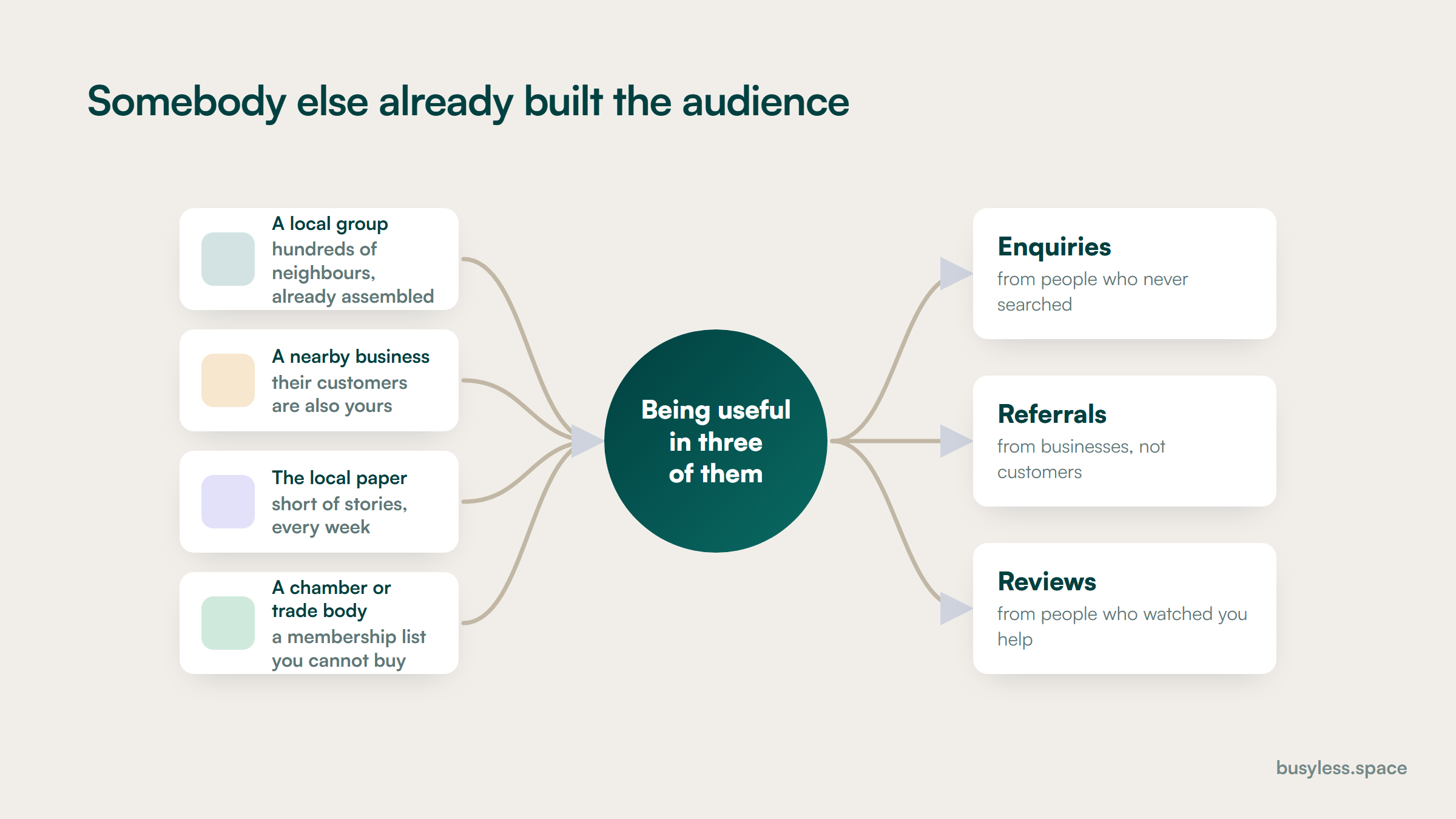
The faster path is borrowing. Somebody else has already spent years assembling the people you need: a local Facebook group, a chamber, a supplier's newsletter, a complementary business's customer list, the local paper, a directory. Being useful inside those is a channel, and it is the channel that fits your actual constraints.
So a small business content marketing strategy that survives is mostly a list of other people's audiences and a realistic weekly commitment. Everything else, the brand voice document and the content pillars and the quarterly campaign, is a large company's process being sold to somebody who cannot staff it.
Looking for the search half
This page decides which channels to run. The one next door goes deep on just one of them.
Which channels to run, and which to skip
Eight channels, judged against two hours a week and no existing audience. Three to run, three worth a test, and two that consume most small business marketing time and return almost nothing.
Run these
Search
RunThe one channel where a small business genuinely competes with a large one, because proximity and specificity beat budget. Somebody searching for what you do near where you are has high intent and low competition from national players. It is also the only channel here that keeps working while you are busy doing the actual job.
First moveClaim and complete every profile, then write the five pages that answer what it costs, how long it takes, what happens first, what goes wrong and who you are not right for. The full search playbook is on the sibling page.
Community
RunThe borrowing channel, and the one this whole page is built around. Local groups, trade associations, chambers, neighbourhood forums and complementary businesses all have the audience you are trying to build. Being genuinely useful in three of them reaches more of the right people in a month than a year of posting to forty followers. The B2B SaaS playbook also runs community, but for the opposite reason: there the audience exists and is comparing tools, and the job is to be present while it happens.
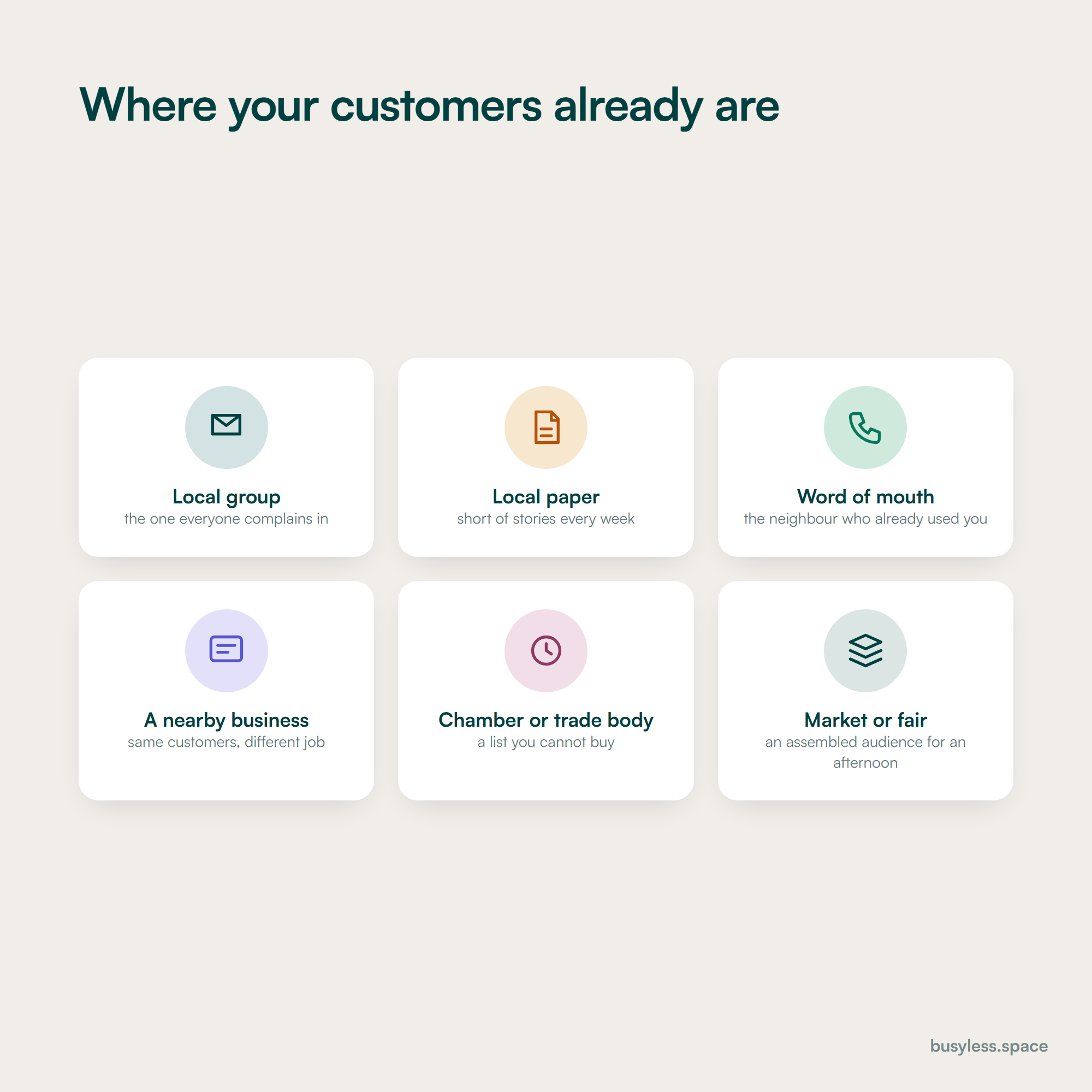
First moveList every place your customers already gather, online and off, and pick three. Answer questions in them for a month without mentioning that you sell anything.
Founder-led social
RunWorth running narrowly and for one reason: it is where proof lives. Before-and-afters, finished work and the actual person doing it are things a national competitor cannot fake, and people check a profile before they call. It fails when it becomes a broadcast channel to an audience of twelve, and it works as a portfolio somebody checks after hearing about you.
First movePost the work, not the thoughts. One finished job a week with a sentence about what made it tricky, and stop measuring followers.
Worth a test, with a kill date
Newsletter
TestReal but slow at this size, and it only makes sense once you have enough past customers to be worth mailing. Where it works is repeat purchase and referral rather than acquisition: a hundred past customers reminded at the right moment is a better return than most paid channels.
First moveCollect email addresses from every customer from today. Send something useful four times a year. Do not start until you have a hundred.
Trade press
TestThe local paper and the trade title are somebody else's audience, which fits this page's constraint exactly, and both are usually short of stories. It is a test rather than a commitment because it is unpredictable, and a placement is worth having rather than something to plan around.
First moveTell the local paper you will comment on anything in your trade within a day, and mean it. Being reachable is the whole qualification.
Events and talks
TestA talk to a local group, a demonstration at a market or a stand at a community event puts you in front of an assembled audience for an afternoon. It is a borrowing channel in physical form, and for trades and consumer services it converts unusually well because people meet the person.
First moveOffer one free practical session to one local group. Measure conversations, not attendance.
Skip these
Video
SkipAs a channel with its own production and schedule, no. The time cost is the highest of anything here and two hours a week does not stretch to it. Filming what you are already doing, on a phone, to post as proof is part of the social channel and costs nothing, which is a different thing from a video strategy.
Original research
SkipOriginal research needs a sample, and a small business does not have one. Publishing a survey of forty responses as though it were a finding is the kind of thing that gets picked apart, and the effort is enormous relative to anything it returns at this size. Leave it to the trade associations, and cite theirs.
Search to be found, community to borrow an audience, social to be checked. None of the three requires you to have a following before you start, which is the test every channel on this page had to pass.
What you already own that nobody can copy
The advantage a small business has is proximity to the customer. Everything below comes from that and none of it can be bought by a competitor with a bigger budget.
The questions customers actually ask
Held by Whoever answers the phone, which is usually you
The real wording, including the questions people are slightly embarrassed to ask. A national competitor writes from keyword research and gets the phrasing wrong, which is why their pages read as though nobody has ever spoken to a customer.
How to capture it
Keep a note on your phone. Every time somebody asks something, write it down in their words. Twenty questions is a year of content.
The work itself, photographed
Held by You, on site, every day
Before-and-afters, finished jobs and work in progress are the most persuasive proof available in most small business categories, and they cost nothing but the discipline to take the photo before you start.
How to capture it
Two photos per job: one before you touch it, one when it is done. Same angle. It takes ten seconds and it is the single highest-return habit on this page.
What goes wrong, and what it costs
Held by You, from experience
The failure modes you have seen a hundred times and a customer has seen once. Writing them down honestly, including where the answer is that they do not need you, is the most trust-building content a small business can publish.
How to capture it
Answer one question: what do people call me about too late, and what would have prevented it.
The price, stated
Held by You, in your quotes
Almost nobody in a local market publishes a real range, and the business that does gets the enquiries that are already qualified. It is not a differentiator anybody can copy quickly, because it takes nerve rather than budget.
How to capture it
Look at your last twenty jobs. Publish the range, what moves it up and down, and the date. Never a single figure.
Who else you know
Held by You, informally
The plumber, the accountant, the supplier and the neighbouring business each have an audience overlapping yours. That network is a distribution channel and a content source, and it exists only because you are local.
How to capture it
Write down every complementary business whose customers are also yours. That list is the borrowing plan.
Who actually makes it
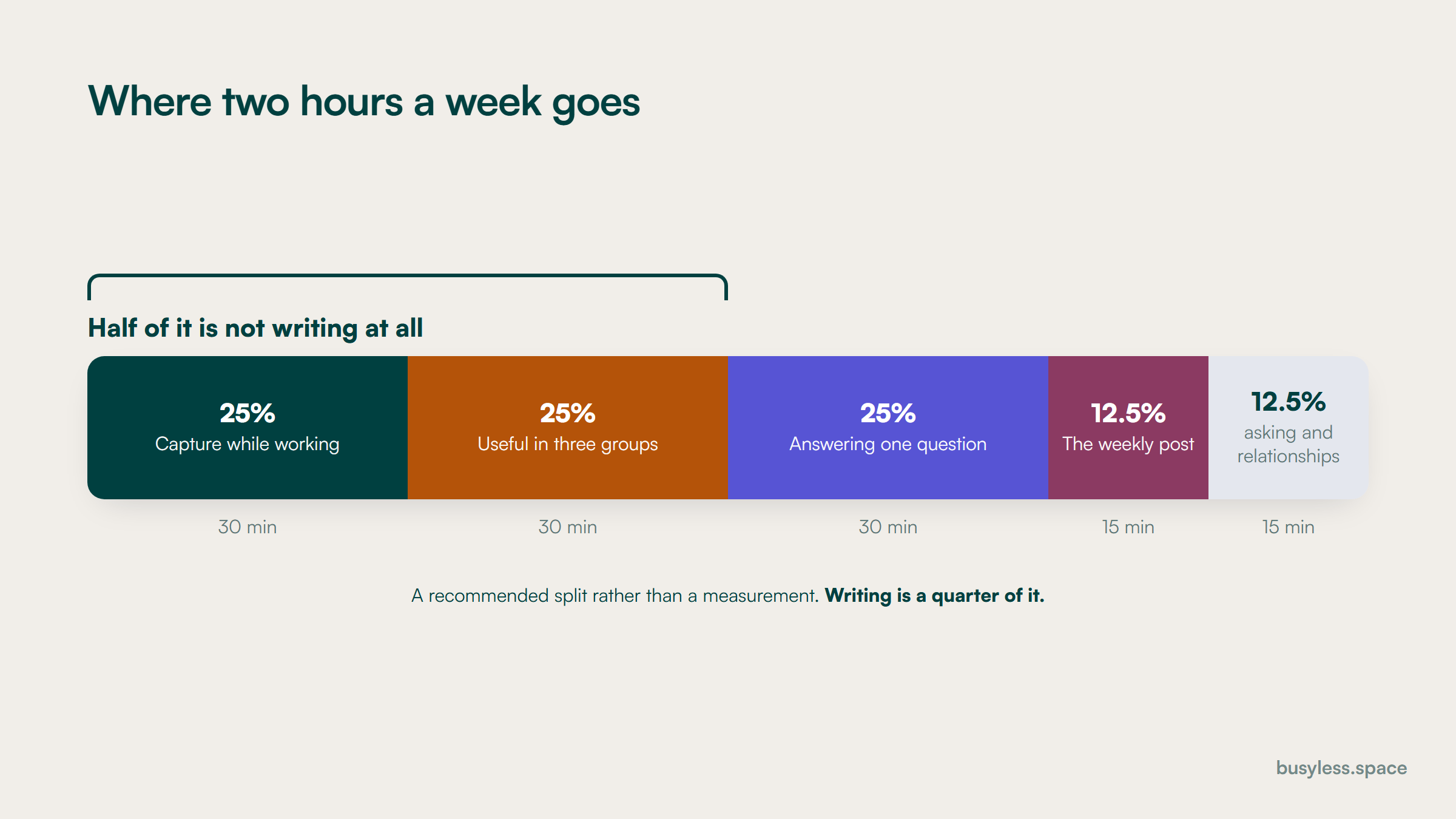
Everything here is sized to two hours a week, because that is what actually exists. A plan built on more will fail in month three, and the failure will be attributed to content marketing rather than to the plan.
The owner
The answers, the photos and the relationships
Two hours a week, and most of it is capture rather than writing: taking the photo, noting the question, sending the email to a complementary business.
8 hours
Whoever else answers the phone
The question log
Costs almost nothing and produces the content brief. If one person takes the calls, this is the same person as above.
20 minutes
A writer, occasionally
Turning notes into pages
The first thing worth paying for, and it is worth paying for in batches. Six pages written properly once beats a retainer producing one a month.
4 to 10 hours, if bought
Nobody else
Nothing
Named deliberately. Most small business content plans quietly assume a person who does not exist, and the plan fails at exactly the point that person was needed.
0
The honest cadenceOne thing a week, the same thing, for a year. A post, a photo, an answer in a group. The specific channel matters less than that it happens every week, because consistency is the only compounding asset available at this size.
One project, 7 surfaces
One completed job produces seven things in about forty minutes, and the reason it works is that the capture already happened while you were working. That is what makes the content marketing ideas for small business below cheap.
- 1
Before-and-after post
5 minutesFrom: The two photos
The highest-performing format available to most small businesses, and the one that needs the least writing.
- 2
The answer to the question that came up
20 minutesFrom: What the customer asked on site
Written in their words, not yours. This is the page that eventually ranks and the answer you stop having to repeat.
- 3
A reply in a local group
5 minutesFrom: The same answer, without the link
The borrowing channel in practice. Useful first, findable second, and never a link on the first reply.
- 4
A line for the price page
5 minutesFrom: What this job actually cost and why
Accumulates into the published range, which is the page that qualifies enquiries before they reach the phone.
- 5
A photo for the profile
2 minutesFrom: The same image, cropped
Search profiles with recent photos perform better and almost nobody keeps them current.
- 6
A note to a complementary business
5 minutesFrom: Anything from the job worth telling them
Maintains the referral relationship that is doing more for you than any channel here.
- 7
A review request
2 minutesFrom: The moment the customer is happiest
Ask everybody, not only the pleased ones. Choosing who gets asked is the practice the sibling page's review rule is about.
The buying cycle, and what content does at each stage
Days, not months, which inverts what content is for compared with the long-cycle playbooks in this directory. Somebody has a problem now and will choose within a week, so the job is to be findable and immediately reassuring rather than to nurture.
The problem appears
Same day"Is this urgent, and can I fix it myself?"
- What moves them
- An honest answer that sometimes says do nothing
- How you know
- Enquiries that arrive already knowing what they need
Asking around
Hours to days"Does anyone know someone good?"
- What moves them
- Nothing you control, except being known locally
- How you know
- Enquiries that say a name when asked how they found you
Searching and checking
Minutes"Who does this near me, and are they real?"
- What moves them
- Complete profiles, recent photos, visible reviews
- How you know
- Profile views and calls from search
The price question
Minutes to days"Can I afford this, and am I about to be ripped off?"
- What moves them
- A published range with what moves it
- How you know
- Fewer enquiries that vanish at the quote
Choosing
Hours"Which of these two do I trust?"
- What moves them
- The work, photographed, and a real person visible
- How you know
- Winning without being the cheapest
What you are allowed to publish
None of these come from a sector regulator and all of them constrain what a small business may publish. The music rule in particular is broken constantly and in good faith, because the platform makes the wrong thing easy. Note that the sibling page covers the offer-side rules instead: advertised pricing, newsletter consent, accessibility and review gating all sit there.
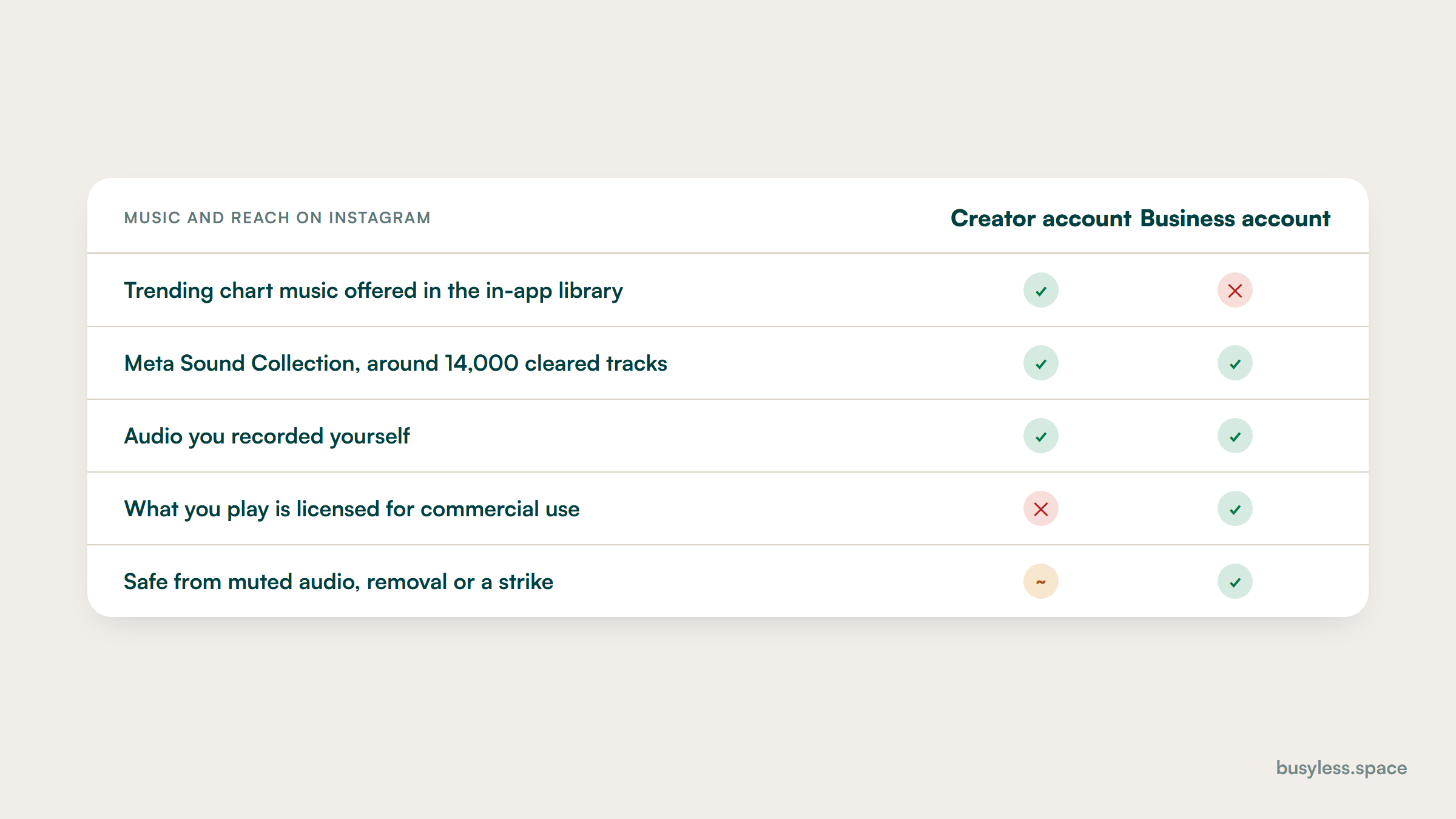
The trending music is not licensed for your business account
Meta and Instagram music licensing terms, read 2026-08-30
Instagram's licensing deals with the record labels cover personal and creator use, not business use. Business accounts are limited to the Meta Sound Collection, roughly 14,000 tracks cleared for commercial use. A track appearing in the in-app library does not mean it is cleared for your account. There is no ten-second or thirty-second exemption, and every recording carries two copyrights, the composition and the recording.
So do thisUse the Meta Sound Collection, or record your own audio, which also stops your video sounding like everybody else's. If your account is set to Creator to reach the larger library while you are plainly a business, understand you are relying on a classification rather than a licence.
A customer's photo is theirs, and so is their face
Copyright and image rights principles, reviewed 2026-08-30
A photo a customer took belongs to the customer, so reposting it needs permission. A photo you took of their home, their child or their event may still need consent to publish, and consent to be photographed is not consent to be used in advertising. Tagging you is not a licence.
So do thisAsk in writing, once, at the point you want to use it, and keep the reply. For work on a private home, ask before you photograph rather than afterwards, and agree whether the location can be identifiable.
Reviews from staff, family and friends are prohibited
FTC Rule on the Use of Consumer Reviews and Testimonials, 16 CFR Part 465, effective 21 October 2024
The rule prohibits reviews and testimonials by company insiders that fail to clearly and conspicuously disclose the material connection, and prohibits a business from disseminating such a testimonial where it knew or should have known the reviewer was an officer, manager, employee or agent. Civil penalties run to $51,744 per violation.
So do thisNever ask staff, family or friends to leave a review, and take down any that exist. If an employee genuinely wants to comment, the connection has to be disclosed in the review itself, clearly enough that a reader sees it without looking for it. The same rule's provisions on suppressing reviews and moving them between products are covered on our DTC ecommerce playbook.
Stock images and fonts carry licences people do not read
Standard stock and font licensing terms, reviewed 2026-08-30
A free-for-personal-use image or font is not free for a business, and a stock licence often excludes use in a logo, on merchandise or in paid advertising. Image-matching services are used routinely to find unlicensed use, and the demand letters that follow are a real and common cost for small businesses.
So do thisKeep a one-line record of where every image and font came from and what the licence permits. Your own photographs solve this problem entirely and perform better, which is why the source section rates them highest.
None of this is legal advice. Rules vary by state and by contract, and the dates above are when each source was read. Check your own before you rely on any of it.
How to build content marketing for small business
Six months at two hours a week. The first month produces almost nothing public, because it is spent on the two habits that make everything afterwards nearly free.
Start capturing, and fix what exists
- Take two photos on every job, before and after, same angle
- Write down every question a customer asks, in their words
- Claim and complete every profile that already exists
- List every place your customers gather and every complementary business
Output A question list, a photo library and a list of audiences to borrow
Answer the five questions and show up
- Write the five pages: cost, timescale, what happens first, what goes wrong, who you are not for
- Publish the price range from your last twenty jobs, with the date
- Be useful in three groups for a month without mentioning that you sell anything
- Post one finished job a week
Output Five pages that answer real questions and a weekly habit
Borrow properly
- Approach three complementary businesses about a genuine swap: a mention, a leaflet, a joint offer
- Offer one practical session to one local group
- Tell the local paper you will comment on your trade within a day
- Ask every customer for a review, not only the pleased ones
Output Two or three borrowed audiences and a first placement
Keep the one that worked
- Ask every enquiry how they found you and write it down verbatim
- Count which of the three channels produced actual work
- Stop the one that produced nothing, and say so out loud
- Start the customer list if you now have a hundred addresses
Output One channel you know works and permission to ignore the rest
Structured data for what you publish
Six blocks for the things you actually put online, none of which describe the business itself. Opening hours, the service pages and the business entity all belong to the search playbook. What follows is about the photographs, because at this size photographs are the asset.
ImageObject with rights metadata
Every photograph of your own workThe most useful block on this page, because your photographs are the one asset a national competitor cannot fake and the one they will lift. contentLocation names the town without publishing a customer's address, which is the balance to get right.
{
  "@context": "https://schema.org",
  "@type": "ImageObject",
  "contentUrl": "https://[YOUR-DOMAIN]/work/[FILE].jpg",
  "name": "[WHAT THE PHOTO SHOWS, e.g. Kitchen rewire, Victorian terrace]",
  "description": "[WHAT WAS DONE, ONE SENTENCE]",
  "creditText": "[YOUR BUSINESS NAME]",
  "copyrightNotice": "(c) [YEAR] [YOUR BUSINESS NAME]",
  "creator": {
    "@type": "Organization",
    "name": "[YOUR BUSINESS NAME]"
  },
  "contentLocation": {
    "@type": "Place",
    "name": "[TOWN OR AREA, NOT THE FULL ADDRESS]"
  },
  "license": "https://[YOUR-DOMAIN]/image-use",
  "acquireLicensePage": "https://[YOUR-DOMAIN]/contact"
}
ImageGallery for a completed job
A page showing one project from start to finishA before-and-after set is genuinely a gallery, and giving it its own URL turns a social post into something that can rank and be linked to. This is how a photograph stops being disposable.
{
  "@context": "https://schema.org",
  "@type": "ImageGallery",
  "name": "[JOB TITLE, e.g. Bathroom refit in Kingsdown]",
  "url": "https://[YOUR-DOMAIN]/work/[SLUG]",
  "description": "[WHAT THE JOB INVOLVED AND WHAT MADE IT TRICKY]",
  "datePublished": "[YYYY-MM-DD]",
  "hasPart": [
    {
      "@type": "ImageObject",
      "contentUrl": "https://[YOUR-DOMAIN]/work/[SLUG]/before.jpg",
      "name": "Before",
      "creditText": "[YOUR BUSINESS NAME]"
    },
    {
      "@type": "ImageObject",
      "contentUrl": "https://[YOUR-DOMAIN]/work/[SLUG]/after.jpg",
      "name": "After",
      "creditText": "[YOUR BUSINESS NAME]"
    }
  ]
}
VideoObject for a short clip
A page hosting a phone video of the workOnly for video on your own page, and check the music rule above before publishing anything with a soundtrack. A clip that lives only on a social platform is marked up by that platform, not by you.
{
  "@context": "https://schema.org",
  "@type": "VideoObject",
  "name": "[WHAT THE VIDEO SHOWS]",
  "description": "[ONE SENTENCE]",
  "thumbnailUrl": "https://[YOUR-DOMAIN]/work/[SLUG]/thumb.jpg",
  "uploadDate": "[YYYY-MM-DD]",
  "duration": "PT[M]M[S]S",
  "contentUrl": "https://[YOUR-DOMAIN]/video/[FILE].mp4",
  "publisher": {
    "@type": "Organization",
    "name": "[YOUR BUSINESS NAME]"
  }
}
Event for a local session or market stall
A page for something you are doing on a specific dateWorth emitting even for a talk to twenty people at a community group, because local event markup is thinly contested and almost nobody near you is bothering with it.
{
  "@context": "https://schema.org",
  "@type": "Event",
  "name": "[WHAT IT IS]",
  "description": "[WHAT SOMEBODY GETS OUT OF COMING]",
  "startDate": "[YYYY-MM-DDTHH:MM+00:00]",
  "endDate": "[YYYY-MM-DDTHH:MM+00:00]",
  "eventAttendanceMode": "https://schema.org/OfflineEventAttendanceMode",
  "eventStatus": "https://schema.org/EventScheduled",
  "location": {
    "@type": "Place",
    "name": "[VENUE]",
    "address": "[FULL ADDRESS]"
  },
  "organizer": {
    "@type": "Organization",
    "name": "[YOUR BUSINESS NAME]"
  },
  "isAccessibleForFree": true
}
NewsArticle for local coverage you received
A page on your site about a mention in the local pressMarks up YOUR page about the coverage, never the newspaper's article. Small businesses commonly copy the whole article onto their own site, which is both a copyright problem and a duplicate-content one; cite it instead.
{
  "@context": "https://schema.org",
  "@type": "NewsArticle",
  "headline": "[YOUR HEADLINE ABOUT THE COVERAGE]",
  "url": "https://[YOUR-DOMAIN]/news/[SLUG]",
  "datePublished": "[YYYY-MM-DD]",
  "author": {
    "@type": "Organization",
    "name": "[YOUR BUSINESS NAME]"
  },
  "citation": {
    "@type": "CreativeWork",
    "name": "[PUBLICATION NAME]",
    "url": "[URL OF THE ORIGINAL ARTICLE]",
    "datePublished": "[YYYY-MM-DD]"
  }
}
Course for a practical workshop
A repeatable class or workshop you actually runOnly where it is genuinely repeatable and somebody learns to do something. A one-off demonstration is an Event. Marking a sales presentation as a Course is the kind of overreach that gets a small site's markup discounted entirely.
{
  "@context": "https://schema.org",
  "@type": "Course",
  "name": "[WORKSHOP TITLE]",
  "description": "[WHAT SOMEBODY CAN DO AFTERWARDS]",
  "provider": {
    "@type": "Organization",
    "name": "[YOUR BUSINESS NAME]",
    "url": "https://[YOUR-DOMAIN]"
  },
  "teaches": "[THE SPECIFIC SKILL]",
  "hasCourseInstance": {
    "@type": "CourseInstance",
    "courseMode": "Onsite",
    "courseWorkload": "PT[N]H",
    "location": {
      "@type": "Place",
      "name": "[VENUE]"
    }
  }
}
What to automate, and where the line is
Automation earns its place here because the constraint is two hours a week rather than money. The line is that an agent may remove admin and may not be the person customers think they are talking to.
- automate
Turning a voice note into a draft answer
You have the answer and no time to type it. Talk for two minutes while driving between jobs and let the transcription and first draft happen unattended.
- automate
Resizing and cropping photos for every profile
Pure admin at fixed ratios, and it removes the most common reason the photo never gets posted.
- automate
Reminding you to ask for a review
A scheduling job. Asking everybody rather than only the pleased ones is what the sibling page's review rule requires, and a reminder is how that actually happens.
- assist
Writing the five core pages from your notes
Structure and completeness come fast from a voice note. Whether the price range is right and whether the caveat is honest needs you, because you are the one who will be held to both.
- assist
Drafting a reply in a local group
Fine as a starting point when you know the answer. It has to be rewritten in your own words before it goes anywhere, because a local group notices a stranger's voice immediately.
- assist
Suggesting which question to answer next
Useful for ranking the question log by how often something comes up. The judgement about which one costs you money to keep answering by phone is yours.
- never
Posting or replying as you in a community
The entire value of the borrowing channel is that a real local person is present. Being caught ends the channel and the reputation together, and in a small market that is not recoverable.
- never
Generating reviews or testimonials
Prohibited outright under the FTC rule effective 21 October 2024, with penalties up to $51,744 per violation. This is not a grey area and it is not worth a moment's consideration.
What it costs
Bands rather than prices, and this is the cheapest playbook in the directory to run. It is also the one where doing it yourself is genuinely most of the available value rather than a compromise.
Do it yourself
$0 to $100- Two photos a job and a question log on your phone
- Every profile claimed and completed
- One post a week and useful presence in three groups
- The five pages, written slowly over a couple of months
- Suits
- Almost every small business, and genuinely most of the available value
- Ceiling
- The writing is what suffers. Five pages take a long time when you are also doing the job, and they tend to stay unfinished at page three.
Lean
$500 to $1,500- A writer turning your voice notes into pages, in batches
- The five core pages written properly once
- Someone keeping the profiles and photos current
- A weekly posting habit that survives a busy month
- Suits
- A business with a few staff and more work than time
- Ceiling
- Nobody is doing the borrowing for you. Relationships with local groups and complementary businesses cannot be outsourced, because the point is that you are the one who is present.
Funded
$1,500 to $3,000- Everything above, sustained rather than sporadic
- Proper local search work across multiple locations or services
- Photography that is not phone photography, occasionally
- A customer list started and maintained
- Suits
- A multi-van, multi-site or multi-service business
- Ceiling
- Above this you are buying a small company's programme at a small business's scale, and the returns flatten. The next real step is usually a second location rather than more content.
Enterprise
Not applicable- Nothing this page recommends
- Suits
- Nobody at this size, and the tier is here to say so plainly
- Ceiling
- A small business being sold an enterprise content programme is the most common way this budget gets wasted. If somebody is proposing content pillars and a brand voice document for a six-person firm, that is the signal to leave.
How to do it with no budget
Seven steps, none of which need money and most of which need a habit rather than an hour. The first two are the ones that make everything afterwards nearly free.
- 1
Take two photos on every job
Your phone · 10 seconds
Before you touch it, and when it is done, from the same angle. The highest-return habit on this page by a distance.
- 2
Write down every question a customer asks
A note on your phone · Seconds each
In their words, not yours. Twenty questions is a year of content and a better brief than any keyword tool.
- 3
Claim and complete every profile that exists
The platforms themselves · 3 hours, once
Search profiles with recent photos and complete information outperform, and most local competitors have abandoned theirs.
- 4
Publish your price range
Your existing website · 2 hours
From your last twenty jobs, with what moves it and the date. Never a single figure. It qualifies enquiries before they reach your phone.
- 5
Be useful in three groups for a month
Wherever your customers already gather · 10 minutes a day
Answer things without mentioning that you sell anything. This is the borrowing channel and there is no faster version.
- 6
Approach three complementary businesses
A conversation · 1 hour
Whose customers are also yours. A genuine swap beats any advertising you could buy at this budget.
- 7
Ask every customer how they found you
The question, asked out loud · Seconds
Write the answer down verbatim. After thirty answers you will know which channel to keep and which to stop.
The tool stack
Weighted heavily towards free, because that is the realistic budget at this size. Where a row points into one of our other directories it goes to the researched review rather than to the vendor. The best content marketing tools for small business are the ones already on your phone.
See which searches actually reach you
Read it for the questions people type rather than for rankings. It will tell you which of your five pages was worth writing.
Free option: Free, and no paid tool holds this data
Keep the photos organised so they are findable later
The reason photos never get used is that nobody can find the before shot six weeks later.
Free option: Costs nothing, and no app has ever improved on it
Use music on video without a licence problem
Roughly 14,000 tracks. Recording your own audio also works and stops your video sounding like everybody else's.
Free option: Free and cleared for commercial use, unlike the trending track
Work out whether a marketing spend is worth it
Worth running before buying anything, because at this size one wrong retainer is a meaningful proportion of the year's marketing budget.
Free option: Free
Check what a realistic content budget looks like
Run it against two hours a week rather than against a proposal, and be suspicious of anything that assumes more.
Free option: Free
Send to past customers once you have a hundred
Do not start before a hundred addresses. Below that a phone call is genuinely a better use of the time.
Free option: Free well beyond the size this list will reach
Publish pages without paying a developer every time
Whatever you already have is almost certainly fine. Rebuilding the site is the most common way this budget disappears before any content is written.
Free option: Free software, cheap hosting
Keep the record of where images and fonts came from
One line per asset: where it came from and what the licence allows. Unlicensed stock use is a real and common cost at this size.
Free option: Free
Take it from here
Everything below is meant to be copied and filled in. Bodies are plain text, so what you see is exactly what lands on your clipboard.
The whole programme, sized to the time that actually exists. Print it and put it somewhere you will see it.
THE TWO-HOUR WEEK
Business: [NAME]
Started: [YYYY-MM-DD]

THE HONEST BUDGET
Two hours. Not four. Not "as much as I can". If a week goes
badly, do the 10-minute version and keep the streak.

ON EVERY JOB (10 seconds, no exceptions)
[ ] Photo BEFORE you touch anything
[ ] Photo AFTER, same angle, same distance
[ ] Any question the customer asked -> note on phone, their words

MONDAY - 15 minutes
[ ] Pick this week's photo
[ ] Post it with one sentence: what made this job tricky
[ ] That is the whole post. No hashtag research.

WEDNESDAY - 30 minutes
[ ] Open the question log
[ ] Pick the question you have answered most times by phone
[ ] Talk the answer into a voice note for 3 minutes
[ ] Either write it up, or bank it for the writer

FRIDAY - 30 minutes
[ ] Go into your three groups
[ ] Answer two things, helpfully, mentioning nothing you sell
[ ] Do not post a link

ANY DAY - 15 minutes
[ ] Ask one complementary business how they are doing
[ ] Ask the customer you finished with how they found you
[ ] Write the answer down VERBATIM

MONTHLY - 30 minutes
[ ] Check the search profile is still complete
[ ] Add this month's best photo to it
[ ] Read back the "how did you find us" answers

WEEKS IN A ROW: [ ]
^ The only number on this page that predicts whether it works.

IF YOU MISS A WEEK
Do not do double next week. Just do Monday. The streak matters
more than the volume.
The expensive mistakes
Trying to build an audience from zero
What it costs: A year of posting to forty followers, and the conclusion that content does not work for small businesses
Borrow. Three groups where your customers already are will reach more of the right people in a month than a year of building your own following.
Using the trending sound on a business account
What it costs: Muted audio at best, removed content or account restriction at worst, and a licence problem you did not know you had
Meta Sound Collection or your own audio. Your competitor is probably on a Creator account, which is why they can and you cannot.
Asking staff and family for reviews
What it costs: A prohibited practice under a federal rule carrying penalties up to $51,744 per violation
Ask every real customer, including the ones you think will be lukewarm. Choosing who gets asked is its own problem.
Committing to daily posting
What it costs: Three good weeks, then nothing, then the belief that you tried it and it failed
One thing a week for a year. Daily is not sustainable alongside the actual job, and a programme that stops in week four has produced nothing.
Refusing to publish a price
What it costs: Unqualified enquiries that consume your evenings and vanish at the quote
A real range from your last twenty jobs, with what moves it and the date on it. It is nerve rather than budget, and almost nobody local does it.
Buying an enterprise content programme
What it costs: A retainer producing brand pillars and a voice document for a business with two hours a week
Buy writing in batches, keep the relationships yourself, and treat any proposal that assumes a marketing team as a signal to leave.
What to measure
At this size most analytics are noise, and the sample is too small for anything to be statistically anything. The measurement that works here is asking, out loud, and writing the answer down. What follows keeps the things that move early apart from the two numbers a small business actually cares about, which are enquiries worth having and jobs won.
Leading indicators
Weeks in a row you published something
A calendar with a mark on it
The single best predictor of whether any of this works, and the only one entirely within your control.
Profile views and calls from search profiles
The platform's own dashboard
Free, immediate and the fastest thing on this list to move once the profiles are complete.
Questions answered in groups
Your own count
The borrowing channel takes weeks to show anything, so counting the input keeps you doing it long enough to find out.
Reviews received, from everybody asked
The platforms
Count how many you asked as well as how many arrived. The ratio tells you whether the asking habit is real.
Business indicators
How they found you, asked and written down
The question, asked on every enquiry
The most valuable number here and the cheapest. After thirty answers you will know which channel to stop.
Enquiry quality, judged on arrival
Your own judgement, written down
Do they know what they want, is the budget realistic, is it work you want. Volume is the metric most likely to mislead at this size.
Quotes converting to jobs
Your own records
Content that is doing its job raises this before it raises enquiry volume, because people arrive already reassured.
Jobs won without being cheapest
Your own records
The number that proves the work is doing something. Being chosen on trust rather than price is what published proof buys.
The verdict
Content marketing for small business is mostly sold as a smaller version of a large company's programme, and that is why it usually fails. The advice assumes a list, a following and a domain history, and you have none of the three. A content marketing strategy for small business has to start from that.
The version that works starts from what you actually have: proximity, photographs, and other people's audiences. Two photos a job, the questions customers really ask, and being genuinely useful in three places where your customers already gather. A content marketing strategy for coaches is the same three moves.
The honest budget for small business content marketing is two hours a week, and every plan should be built against that number rather than against an aspiration. One thing a week for a year beats four things a week for a month, and it is not close.
I would walk away from small business content marketing services that open with brand pillars, a voice document or a posting schedule. At this size the right thing to buy is writing in batches, and the relationships that actually produce work cannot be outsourced because the point is that you are the one present.
FAQ
Small business content marketing questions
How much time does this actually take?
Two hours a week, and most of it is capture rather than writing: two photos on each job, noting the questions customers ask, ten minutes in a local group. Any plan that needs more will stop by month three. Build against the real number rather than the one you hope to find.Why can competitors use trending music on Reels and we cannot?
Because Instagram's licensing deals with the labels cover personal and creator accounts, not business ones. Business accounts are limited to the Meta Sound Collection, around 14,000 tracks cleared for commercial use. A track being in the in-app library does not mean it is licensed for you, and there is no ten-second exemption.Should we be blogging?
Only five pages, and then rarely. Answer what it costs, how long it takes, what happens first, what goes wrong and who you are not right for. Those five earn their keep for years. A weekly blog at this size is a large company's habit applied to a business that cannot staff it.How do we get an audience when we are starting from nothing?
You borrow one. Local groups, trade associations, complementary businesses, the local paper and community events all have the people you need and took years to assemble them. Being genuinely useful inside three of those reaches more of the right people in a month than a year of building your own following.Should we pay someone, or do this ourselves?
At this size the honest answer is usually yourselves, at least to begin with, because the free path on this page is most of the available value. The realistic range for paying somebody is $500 to $3,000 a month, and the lower half of that buys writing in batches rather than a retainer. Most content marketing services for small business are priced against a marketing team that does not exist here.Can we ask staff or family to leave reviews?
No. The FTC rule effective 21 October 2024 prohibits insider reviews that do not clearly disclose the connection, and prohibits a business from spreading them where it should have known the source. Penalties reach $51,744 per violation. Ask real customers instead, including the lukewarm ones.Should we put a price range on the site?
A range, yes, from your last twenty jobs with what moves it up or down and the date attached. Almost nobody local does it, and the business that does gets enquiries that are already qualified. Never publish a single figure, because that becomes a promise rather than a guide.How do we know if it is working?
Ask every enquiry how they found you and write the answer down in their words. At this size the sample is too small for analytics to tell you anything reliable, and thirty verbatim answers will tell you exactly which channel to keep and which to stop.Is an agency worth it for a business this size?
Almost never for the writing. A content marketing agency for small business will produce work that reads like anybody's, because the thing making yours worth reading is that you did the job. Content marketing for coaches has the same problem more acutely, since the practitioner is the product.
Run it yourself, or have someone own it
Everything above is written to be run without us, and the free path is genuinely most of the value for a small practice. Where these plans stall is almost never the plan. It is that the person holding the material has a day job and nobody owns the programme after the first month. That is the job we do.