
Content marketing for law firms
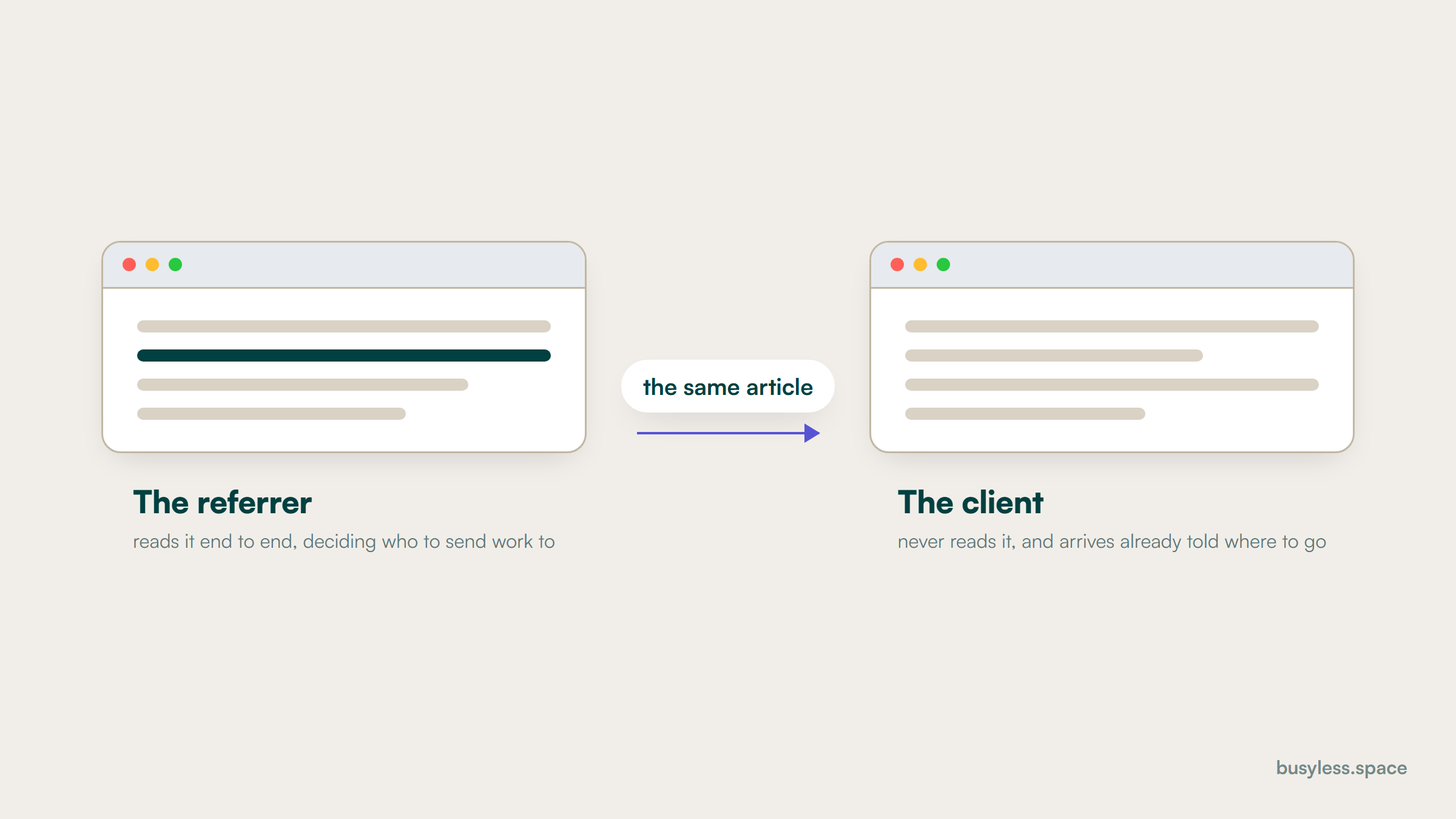
YMYL and regulatedThe referrer reads your content, the client never does
- Sector
- Legal and financial
- Channels
- Newsletter, Events and talks, Search
- Buying cycle
- Medium cycle
- Time to compound
- 6 to 12 months
- Typical monthly
- $3,000 to $15,000
Key takeaways
- 1Write for the referrer, not the client. In most practice areas the person who reads a substantive piece is another lawyer, an accountant or an in-house counsel deciding who to send work to. The client arrives already told where to go.
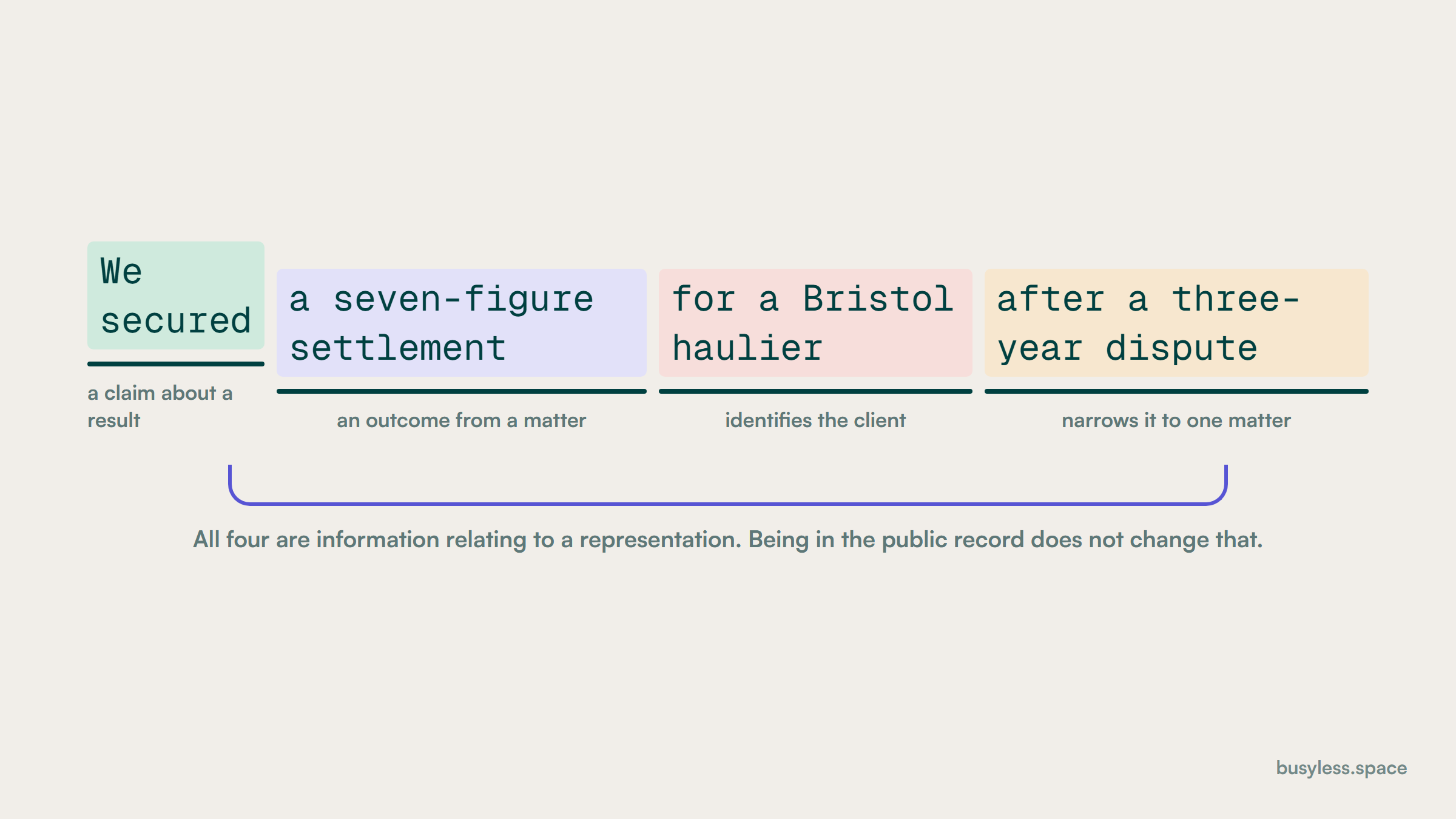
- 2The won case is not yours to write about. ABA Formal Opinion 480 holds that information relating to a representation stays confidential even when it sits in the public record, which removes the case study every other industry builds on.
- 3You may not answer a bad review with facts. Opinion 496 says a negative review alone does not open the self-defence exception, so the response every instinct demands is the one thing you cannot write.
- 4A conflicts check belongs before the draft, not after it. It is the only approval step in this directory that can kill a piece for reasons which have nothing to do with the piece, because the conflict lives in a client relationship elsewhere in the firm. A programme that discovers this in month three stops in month four.
- 5Reach creates exposure here rather than only opportunity. A widely read answer can imply a relationship, or practice in a state where nobody at the firm is admitted, which is a reason to be specific about jurisdiction rather than a reason to publish less.
Content marketing for law firms is aimed at the wrong reader almost everywhere you look. Firms publish explainers written for a frightened person with a problem, and then win most of their work through referral. The two facts sit side by side in the same marketing plan without anybody noticing they contradict each other.
In most practice areas the person who reads a substantive piece all the way through is another professional. An accountant with a client who needs restructuring advice. In-house counsel building a panel. A solicitor at a firm that does not do what you do. They are reading to decide who to send work to, and they read differently from a client: they want the reasoning, not the reassurance.
That changes what good looks like. The piece that wins a referral is the one that shows how you think about a hard question. The piece that reassures a client is the one that answers a simple question plainly. Both are worth publishing, but they are different assets for different channels, and most firms write a blend that serves neither.
Our real estate playbook describes a superficially similar arrangement that is genuinely different. There the client is the reader and passes your name to a friend, which makes them a distributor. Here the client mostly never reaches the content at all, because a professional has already told them where to go.
The second thing that shapes a law firm content marketing strategy is that the best material is the material you are least able to use. The case you just won is confidential even where it is public, the client who is delighted may not be quotable, and the review that is unfair may not be answered. Working within that is most of the craft.
Looking for the search half
This page decides which channels to run. The one next door goes deep on just one of them.
Which channels to run, and which to skip
Judged for a profession where the reader and the buyer are usually different people. Three to staff, three worth a real test, and two that reliably waste money here. The skips are where most legal marketing budget already goes.
Run these
Newsletter
RunThe single highest-value channel in this field, and the one most firms treat as an afterthought. A list of accountants, bankers, insurers, in-house counsel and non-competing firms is a referral network with an address. Two hundred of those people is worth more than any amount of traffic, and unlike every other channel here you own it outright.
First moveBuild the list from your own matter history: every professional who has referred you work, been on the other side, or sat across a table. Send one substantive piece a month, written for them rather than for a client.
Events and talks
RunSpeaking is how referral relationships actually start in law, and an accredited session is the version that gets you in front of the right room. A CLE or CPD slot to an audience of accountants or in-house counsel is a warm introduction to thirty potential referrers, which no post achieves. It is slow and it works.
First moveTurn the question you get asked most by other professionals into a 45-minute accredited session, and offer it to one accountancy firm and one in-house team.
Search
RunThe channel for everybody who arrives without a referrer, which is most consumer-facing work and nearly all urgent work. It is close to irrelevant for panel appointments, so it serves one half of the practice properly and the other half barely at all. Fund it accordingly rather than evenly.
First moveAnswer the questions a frightened person actually types, plainly and without a disclaimer in every second sentence. The full search playbook is on the sibling page.
Worth a test, with a kill date
Founder-led social
TestLinkedIn reaches referrers and reaches almost nobody else that matters here. A named partner posting a considered view on a change in the law is credible; a firm account posting an article link is not. The test is whether a real person at the firm will post in their own voice, because the alternative does not work.
First movePick one partner who already has opinions and post one of them a week for a quarter. Judge it on inbound messages from other professionals, not on impressions.
Trade press
TestThe legal and sector press will take commentary from a named lawyer on a live development, and being the person quoted is a durable positioning asset. It is a real channel and a slow one, and it rewards being reachable and fast far more than being polished.
First moveTell three journalists who cover your sector that you will comment on 24 hours' notice, then actually do it the first time one asks.
Original research
TestA firm sees patterns nobody publishes: how long a tribunal is taking, how often a clause is being contested, what a regulator is actually enforcing. Any of it, aggregated so no matter is identifiable, is the kind of thing the trade press covers and referrers keep. The constraint is Opinion 480, so the aggregation has to be genuine rather than cosmetic.
First moveCount something you already record across at least fifty matters. If the count cannot be published without a reader identifying a matter, it is not publishable, and no amount of rewording fixes that.
Skip these
Video
SkipThe talking-head explainer is the single most common wasted spend in legal marketing. It costs what a proper research piece costs, it dates the moment the law moves, and a referrer will read eight hundred words faster than they will watch four minutes. The exception is a recorded session you were delivering anyway.
Community
SkipThe active legal communities are other lawyers talking about practice, which is useful for recruitment and useless for work. The forums where clients gather are the ones you most need to stay out of: answering a specific question in public is how an inadvertent relationship gets created, and it is the fastest route to the exposure this page's rules section describes.
Two owned channels aimed at referrers and one aimed at clients. The order matters less here than the split does, because a firm that writes everything for the client is invisible to the people who actually send work.
What you already own that nobody can copy
The raw material is unusually good and unusually constrained. Everything below exists inside the firm already; the work is deciding which parts can leave the building, and Opinion 480 makes that a real question rather than a formality.
The argument you had to invent
Held by The partner or senior associate who ran the matter
The route through a hard question, stripped of the facts. Another firm can read the same statute and reach the same answer; they cannot reconstruct the reasoning you built when the answer was not obvious yet. This is the asset that wins referrals, because it is the only one that shows judgement rather than knowledge.
How to capture it
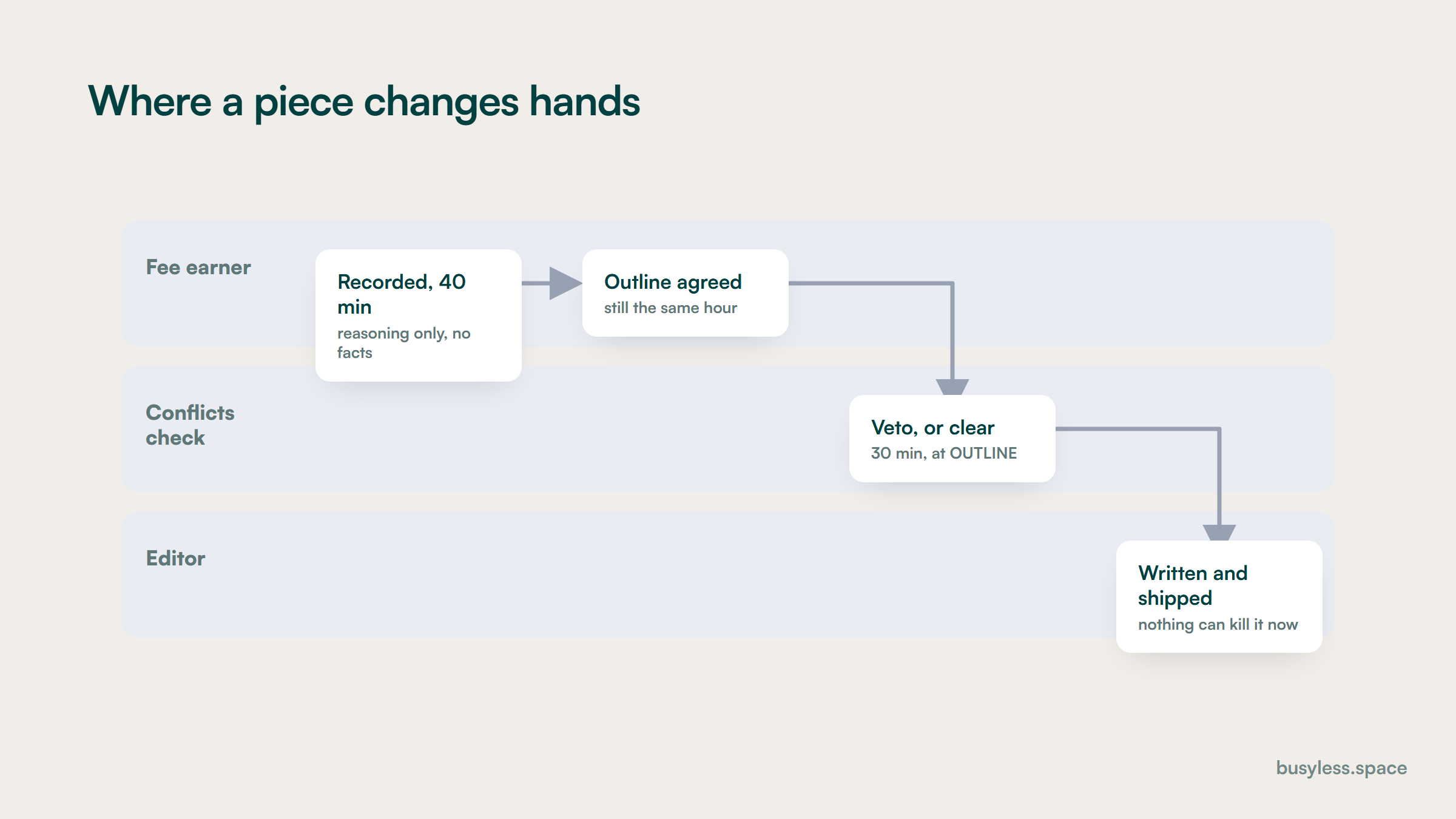
A 40-minute recorded conversation about the reasoning, with an explicit instruction to describe no facts at all. If the argument cannot be explained without the matter, it is not publishable and you have learned that in 40 minutes rather than after a draft.
The pattern across many matters
Held by The practice group, in a matter management system
Nobody outside the firm can see how often a clause is contested, how long a regulator is taking, or which argument is currently working. Aggregated across enough matters it stops being confidential and starts being the most useful thing you could publish.
How to capture it
Export the field you already record, across at least fifty matters. Aggregate first, then decide what is publishable, never the other way round.
The question other professionals keep asking
Held by Whoever takes the referral calls
It is a live signal from your actual referral network about what they do not understand and are therefore reluctant to refer. Nobody else has it, and it is a better content brief than any keyword tool will produce for this audience.
How to capture it
Ask everyone who fields referral enquiries to write down the question, verbatim, for one month. Twenty questions is a year of newsletters.
The change nobody has read properly yet
Held by Whoever monitors the area
Speed is the asset here, not depth. Being first with a plain reading of a new judgment or a consultation is what gets you quoted and forwarded, and it decays within about a fortnight.
How to capture it
Pick three sources you will genuinely watch and commit to 400 words within 48 hours of anything landing. A standing slot beats a perfect piece.
The matter that went wrong
Held by Everybody, and nobody will say so
The generalised lesson from something that did not work is the most trusted thing a firm can publish and the rarest. Written as a principle rather than a story it is publishable, and it does more for credibility with other professionals than any win.
How to capture it
Ask the question in the abstract: what do clients get wrong about this, and what does it cost them. The answer is usually a specific matter, generalised on the way out of somebody's mouth.
Who actually makes it
Legal content programmes fail on approval, not on writing. Several pages in this directory have an approver who can remove a claim; this is the one where an unrelated client relationship can remove the whole topic, which is why the check has to sit at the front rather than the end.
Fee earner as source
The reasoning, and the judgement about what may leave the building
Interviewed, not writing. A partner asked to draft will bill instead, every time, and the programme will be blamed for it.
2 to 3 hours
Conflicts and confidentiality check
The veto
Runs at OUTLINE stage, not on the finished draft. Discovering a piece cannot run after it is written is how firms conclude that content does not work here.
30 minutes
Editor
Turning the recording into something a referrer will finish
External almost always, and it needs someone who can tell a reasoning piece from an explainer, because the firm will keep asking for the second when it needs the first.
20 to 35 hours
Marketing or BD lead
The list, the calendar and the speaking pipeline
The referral list is an asset that decays without maintenance. This is the role that keeps it current and books the sessions, and it is the one most often left vacant.
8 to 12 hours
The honest cadenceOne substantive piece a month for referrers, one fast reaction whenever the law moves, and one speaking slot a quarter. A firm promising weekly output will produce explainers nobody reads, because that is the only thing that can be written at that rate without a fee earner.
One project, 8 surfaces
One recorded conversation about one hard question becomes eight things, and the constraint on all of them is the same: none may contain facts from the matter that prompted it. Every one of these content marketing ideas for law firms is bounded by that rule.
- 1
The reasoning piece
4 hoursFrom: The recording, edited into an argument
Written for another professional. This is the asset the whole programme exists to produce, and it should read as though a partner wrote it because in substance they did.
- 2
Newsletter issue
45 minutesFrom: The same argument, with a covering paragraph
Goes to the referral list. The covering paragraph is where you say who this is relevant to, which is the part that generates the reply.
- 3
A named partner's LinkedIn post
20 minutesFrom: The one line in the recording that was an opinion
Posted by the person, in their voice, and read by them first. Anything else reads as a firm account and performs like one.
- 4
A client-facing explainer
2 hoursFrom: The same topic, rewritten for the person with the problem
A genuinely different piece, not a simplified version. It answers the question plainly and it is what search sends people to.
- 5
Speaking session
5 hours, reusable for a yearFrom: The argument, plus two more like it
Three related pieces make a CLE or CPD slot. Built once, delivered to several audiences, and the only channel here that puts you in a room.
- 6
Press comment
30 minutes when askedFrom: The position, held ready
Having already thought it through is what lets you answer a journalist inside their deadline, which is the entire skill.
- 7
Panel and pitch material
IncludedFrom: The published piece, cited
The most undercounted return in legal content. Published thinking in a panel submission is evidence rather than assertion, and BD teams rarely tell marketing it was used.
- 8
Internal know-how note
Nothing extraFrom: The unedited recording
The version that keeps the facts. It never leaves the firm, and it is often the thing that finally makes fee earners willing to be recorded.
The buying cycle, and what content does at each stage
Two cycles run in parallel and never meet. The referrer's takes months or years and ends in a name being passed on; the client's takes days and ends in a call. The same firm needs content for both and should not try to write one piece that does both jobs.
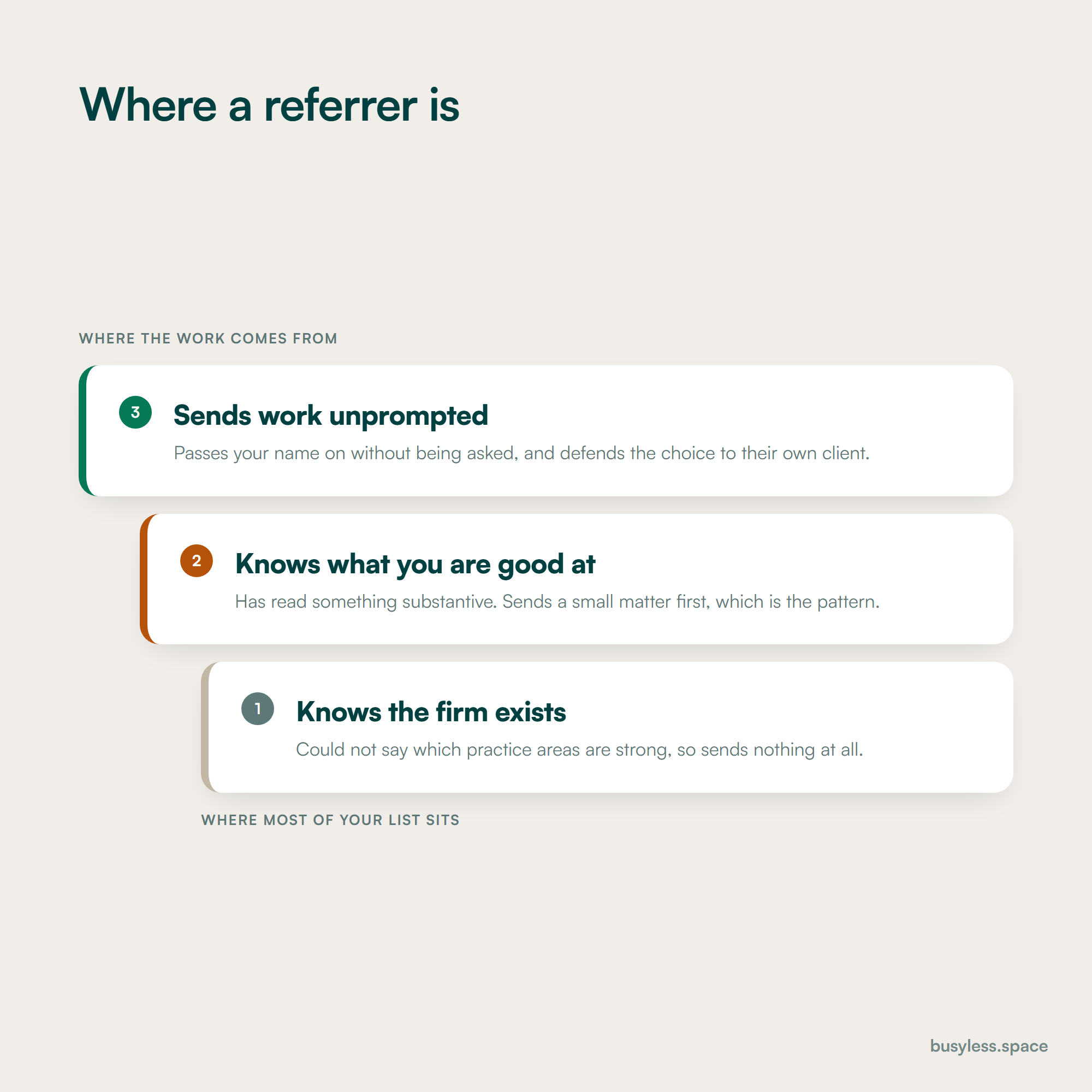
The referrer notices you exist
3 to 18 months"Who actually knows about this properly?"
- What moves them
- Reasoning pieces, a session they attended, a quote they read
- How you know
- Being asked a question by someone who is not a client
The referrer tests you
1 to 6 months"Will this firm look after someone I send them?"
- What moves them
- A useful, fast answer to a question with no fee attached
- How you know
- A small referral before a large one, which is the pattern
The client has a problem
Hours to weeks"How bad is this, and who do I call?"
- What moves them
- A plain explainer, and being findable at all
- How you know
- Enquiries that arrive knowing what they are asking for
The client checks the name they were given
Minutes"Are these people real and do they do this?"
- What moves them
- A page that confirms it in one screen
- How you know
- Referred enquiries that convert without a beauty parade
Panel or repeat instruction
3 to 12 months"Can I justify choosing them to my board?"
- What moves them
- Published thinking a buyer can attach to a submission
- How you know
- Being longlisted without a prior relationship
What you are allowed to publish
Everything below constrains what you may publish, and none of it is on the search playbook, which covers the advertising rules instead: disclaimers, specialist claims, filing requirements and fee sharing all sit there. These five are about confidentiality and reach. They are also why the two assets most other playbooks here lean on, the case study and the review response, are both unavailable.
Even the public record is still confidential
ABA Formal Opinion 480, issued 6 March 2018
A lawyer who blogs or engages in public commentary may not reveal information relating to a representation, INCLUDING information contained in a public record, without informed consent. The opinion covers blogs, articles, website posts, microblogs, videos, webinars and podcasts. A breach can occur without naming anyone, where a third party could reasonably identify the client or the matter.
So do thisWrite from the reasoning rather than from the facts, and test every draft by asking whether a person who was in the room would recognise it. Where a matter is genuinely the point, get informed consent in writing before drafting rather than after.
A negative review does not open the self-defence exception
ABA Formal Opinion 496, January 2021
A negative online review alone does not meet the self-defence exception in Model Rule 1.6(b)(5), and even if it did, a public response would exceed what the rule permits. The opinion's own best-practice suggestion is not to respond at all, because responding draws attention and invites more.
So do thisAgree the response in advance so nobody improvises: request removal from the host where the review breaches its terms, invite the person to contact the firm directly, and say nothing about the matter. Put the wording in a document before you need it.
Reach can be practice in a state you are not admitted in
State unauthorised-practice rules, reviewed 2026-08-30
A widely read piece that answers a specific question can look like legal advice given to a reader wherever they are. The exposure is not theoretical for firms publishing on national topics, and it rises with the specificity of the answer rather than with the size of the audience.
So do thisName the jurisdiction in the piece rather than in a footer, keep public answers general and route specific ones to a conversation. A clear scope statement is better content as well as better protection.
A helpful answer can create a relationship nobody intended
Model Rules 1.18 and 1.2, reviewed 2026-08-30
Replying to a comment, answering a question in a forum, or shipping a downloadable template that applies to a reader's specific circumstances can support a claim that a relationship formed and a duty attached. This is a content risk rather than a website risk, and it lands on the person who replied.
So do thisDecide once who may reply in public and what they may say, and put a real scope line on every downloadable rather than a paragraph of boilerplate nobody reads. Templates should state what they do not cover.
The associate's personal post is still the firm speaking
Model Rule 5.1 and state advertising rules, reviewed 2026-08-30
A post on an individual's own account about a matter, a win or a client is subject to the same confidentiality and advertising obligations as anything on the firm's site, and supervisory duties reach it. The account being personal changes nothing about the duty.
So do thisWrite down what people may post about their own work, with two or three examples of acceptable and unacceptable versions. A rule with examples is followed; a policy document is not.
None of this is legal advice. Rules vary by state and by contract, and the dates above are when each source was read. Check your own before you rely on any of it.
How to build content marketing for law firms
Six months, built so the approval question is answered in week two rather than discovered in month three. The first four weeks produce no public output at all, which is deliberate and is the part firms most want to skip.
Decide who you are writing for
- Split the audience explicitly: which practice areas are referral-led and which are client-led
- Build the referral list from matter history, not from a marketing database
- Agree the conflicts and confidentiality check, and put it at OUTLINE stage
- Write the review-response wording now, before you need it
Output A referral list, an approval path, and a one-page audience split
Capture the reasoning
- Record three 40-minute conversations about hard questions, facts excluded
- Collect a month of verbatim questions from whoever takes referral calls
- Draft the first reasoning piece and run it through the check
- Send the first newsletter to the referral list
Output Three recordings, one published piece, and a list that has heard from you
Get into a room
- Build one accredited session from three related pieces
- Offer it to one accountancy firm and one in-house team
- Start the fast-reaction habit: 400 words within 48 hours when the law moves
- Have one named partner post weekly in their own voice
Output A booked session and a reaction habit that has survived one real test
Find out what referrers do
- Aggregate something you already record across fifty matters and publish it
- Ask every new referrer what they had read or seen, and write the answer down
- Review the split: is the referral half producing enquiries the client half is not
- Cut whichever channel produced nothing, and say so plainly
Output A first honest read on which half of the programme is working
Structured data for what you publish
The sessions you deliver, the recordings you publish and the coverage you receive each have a type, and the firm itself has one on the search playbook. Entity markup, lawyer profiles and service pages all sit there. These six describe what you put out rather than who you are.
Event for a CLE or CPD session
The listing page for a CLE or CPD slotThe channel this page rates highest and the one almost no firm marks up. A session for thirty accountants is a real event even though nobody sold a ticket, and isAccessibleForFree is the field that says so rather than leaving a reader to guess.
{
  "@context": "https://schema.org",
  "@type": "Event",
  "name": "[SESSION TITLE]",
  "description": "[WHAT THE AUDIENCE LEARNS, ONE SENTENCE]",
  "startDate": "[YYYY-MM-DDTHH:MM+00:00]",
  "endDate": "[YYYY-MM-DDTHH:MM+00:00]",
  "eventAttendanceMode": "https://schema.org/[Offline|Online|Mixed]EventAttendanceMode",
  "eventStatus": "https://schema.org/EventScheduled",
  "location": {
    "@type": "Place",
    "name": "[VENUE OR HOST FIRM]",
    "address": "[FULL ADDRESS]"
  },
  "organizer": {
    "@type": "Organization",
    "name": "[FIRM NAME]",
    "url": "https://[YOUR-DOMAIN]"
  },
  "performer": {
    "@type": "Person",
    "name": "[WHO IS DELIVERING IT]",
    "jobTitle": "[TITLE]"
  },
  "isAccessibleForFree": true
}
Course for an accredited programme
A page for a session an accrediting body has approvedA CLE credit is awarded by a bar or an accrediting body, never by you, so this type only applies once somebody else has approved it. Claiming a credential you have not been granted is a worse problem in this profession than in any other, because credentials here are routinely checked.
{
  "@context": "https://schema.org",
  "@type": "Course",
  "name": "[COURSE TITLE]",
  "description": "[WHAT IT COVERS]",
  "provider": {
    "@type": "Organization",
    "name": "[FIRM NAME]",
    "url": "https://[YOUR-DOMAIN]"
  },
  "educationalCredentialAwarded": "[e.g. 1 CLE hour, general credit]",
  "teaches": "[THE SPECIFIC CAPABILITY]",
  "hasCourseInstance": {
    "@type": "CourseInstance",
    "courseMode": "[Onsite|Online]",
    "courseWorkload": "PT1H"
  }
}
PodcastEpisode
An episode page for a firm podcast or a guest appearance you hostOpinion 480 explicitly names podcasts as public commentary, so the confidentiality rule applies to the recording exactly as it applies to a blog. Mark up only episodes you host and publish; a guest appearance on somebody else's show is theirs to mark up.
{
  "@context": "https://schema.org",
  "@type": "PodcastEpisode",
  "name": "[EPISODE TITLE]",
  "description": "[ONE OR TWO SENTENCES]",
  "url": "https://[YOUR-DOMAIN]/podcast/[SLUG]",
  "datePublished": "[YYYY-MM-DD]",
  "duration": "PT[M]M[S]S",
  "partOfSeries": {
    "@type": "PodcastSeries",
    "name": "[SERIES NAME]",
    "url": "https://[YOUR-DOMAIN]/podcast"
  },
  "associatedMedia": {
    "@type": "MediaObject",
    "contentUrl": "https://[YOUR-DOMAIN]/audio/[FILE].mp3"
  }
}
NewsArticle for your own press page
A page about coverage the firm received or commentary it gaveA firm's press page is usually an unstructured list of links. Marked up, it becomes a record of commentary given, which is exactly the evidence a panel submission needs. Cite the publication rather than reproducing its article.
{
  "@context": "https://schema.org",
  "@type": "NewsArticle",
  "headline": "[YOUR HEADLINE ABOUT THE COVERAGE]",
  "url": "https://[YOUR-DOMAIN]/news/[SLUG]",
  "datePublished": "[YYYY-MM-DD]",
  "author": {
    "@type": "Organization",
    "name": "[FIRM NAME]"
  },
  "citation": {
    "@type": "CreativeWork",
    "name": "[PUBLICATION NAME]",
    "url": "[URL OF THE ORIGINAL ARTICLE]",
    "datePublished": "[YYYY-MM-DD]"
  }
}
CollectionPage for a resource hub
An index page gathering guides, templates or briefingsWorth emitting where a firm has built a genuine library rather than a blog archive. It describes the collection as a thing in its own right, which is what a referrer is actually bookmarking when they save your resources page.
{
  "@context": "https://schema.org",
  "@type": "CollectionPage",
  "name": "[HUB TITLE, e.g. Employment law briefings]",
  "url": "https://[YOUR-DOMAIN]/[HUB-SLUG]",
  "description": "[WHO IT IS FOR AND WHAT IT COVERS]",
  "isPartOf": {
    "@type": "WebSite",
    "url": "https://[YOUR-DOMAIN]"
  },
  "about": "[THE PRACTICE AREA]",
  "audience": {
    "@type": "Audience",
    "audienceType": "[e.g. In-house counsel and finance directors]"
  }
}
ImageObject with rights metadata
Photography on people pages, event pages and press coverageFirms license headshots and event photography and routinely reuse both outside the licence. The field that matters here is license: a headshot permission usually expires with the photographer's term and nobody ever diarises it.
{
  "@context": "https://schema.org",
  "@type": "ImageObject",
  "contentUrl": "https://[YOUR-DOMAIN]/images/[FILE].jpg",
  "name": "[WHAT THE IMAGE SHOWS]",
  "creditText": "[PHOTOGRAPHER NAME]",
  "copyrightNotice": "(c) [YEAR] [PHOTOGRAPHER NAME]",
  "creator": {
    "@type": "Person",
    "name": "[PHOTOGRAPHER NAME]"
  },
  "license": "[URL OF YOUR LICENCE TERMS PAGE]",
  "acquireLicensePage": "https://[YOUR-DOMAIN]/image-licensing"
}
What to automate, and where the line is
Automation is what makes a monthly cadence affordable when the source material has to come out of a fee earner's head. It is backstage, and in this field the line is unusually clear: an agent may move material between formats and may not form a view about the law.
- automate
Transcribing the fee earner recording
Unattended, every time. The recording is the bottleneck asset and the transcript is what lets anybody other than the partner work on it.
- automate
Monitoring sources for a development worth reacting to
A watching job across judgments, consultations and regulator pages. It buys back the hours that make a 48-hour reaction possible at all.
- automate
Maintaining the referral list and flagging decay
Mechanical, and the thing nobody does by hand past month four. A list that has not been updated in a year is the most common reason this channel underperforms.
- assist
Drafting the client-facing explainer
The plain-language version of a settled topic is fast to generate and easy to check. It still needs a fee earner to confirm it is right, because a wrong explainer is worse than no explainer in a regulated field.
- assist
Turning the transcript into a first draft
Good at structure and at removing repetition. Consistently wrong about which part of the reasoning was the interesting one, which is the sentence the whole piece exists for.
- assist
Aggregating matter data for a research piece
The counting is mechanical. Whether the aggregate is genuinely non-identifying is a confidentiality judgement under Opinion 480, and that is a human sign-off with a name against it.
- never
Answering a comment or a message in public
A public reply can support a claim that a relationship formed, and it carries a duty. This is the exposure the rules section describes, and it is not a content task.
- never
Deciding what may leave the building
The confidentiality call under Opinion 480 turns on whether a third party could identify a matter, which needs someone who knows the matter. No agent should be near it, and no agent has the information to be right.
What it costs
These are judgements rather than quotes, and every band assumes the firm supplies the fee earner hours the engine section describes. What moves the number most is how many practice areas run at once, because each one needs its own source and its own approver.
Do it yourself
$0 to $600- A referral list built from matter history and emailed monthly
- One reasoning piece a month from a recorded conversation
- One partner posting weekly in their own voice
- The fast-reaction habit when the law moves
- Suits
- A firm of two to eight fee earners with one person who genuinely writes
- Ceiling
- The reaction habit is what breaks first. Being fast requires somebody with cleared time, and in a small firm that time is billable when it matters most.
Lean
$3,000 to $6,000- An external editor turning recordings into publishable pieces
- A managed newsletter and referral list
- One accredited session built and offered
- A monthly cadence that survives a busy quarter
- Suits
- A firm of eight to thirty fee earners, or one practice group inside a larger firm
- Ceiling
- Original research sits outside this, and so does covering more than one practice area properly. A second area roughly doubles the source-capture load rather than adding a little.
Funded
$6,000 to $15,000- Everything above across two or three practice areas
- One original research piece a year with a real sample
- An active press-comment programme with prepared positions
- Search treated properly for the client-led half of the firm
- Suits
- A firm of thirty or more, or one deliberately building a new practice area
- Ceiling
- The ceiling is fee earner availability, not money. Commission more than partners can read and you get material the firm quietly declines to stand behind, which costs more than publishing nothing at all.
Enterprise
$15,000 and up- Multi-office coordination against one editorial standard
- Sector programmes running in parallel with their own sources
- Research as a repeatable annual publication
- Capture built into matter close-out across the firm
- Suits
- Firms where several offices or groups compete for the same panel appointments
- Ceiling
- Coordination becomes the real cost, and the failure mode is a house voice so uniform that the individual partners readers actually follow disappear inside it.
How to do it with no budget
Seven steps using material the firm already holds, none of which need a budget. The first two protect you and the rest produce the year's content. The content marketing tips for lawyers below need no budget.
- 1
Write the review-response wording before you need it
A document everybody can find · 1 hour
Opinion 496 is easiest to comply with when nobody has to improvise while angry.
- 2
Move the conflicts check to outline stage
Your existing intake process · 30 minutes to agree
Costs nothing and prevents the failure that convinces firms content does not work here.
- 3
Build the referral list from matter history
Your matter management system and a spreadsheet · 3 hours
Every professional who referred you work, sat on the other side, or shared a table. This is the highest-value hour on the list.
- 4
Collect a month of verbatim referral questions
A shared note · 5 minutes a day
Twenty questions from real referrers is a year of newsletters and a better brief than any keyword tool.
- 5
Record one 40-minute conversation about a hard question
A phone voice memo · 40 minutes
Instruct the fee earner to describe no facts at all. If the argument needs the matter, you have learned that cheaply.
- 6
Send one substantive piece to the list
Any free newsletter tool · 1 hour
Write it for the referrer. The covering line saying who it is relevant to is what generates the reply.
- 7
Offer one session to one accountancy firm
An email · 30 minutes
The single highest-return thirty minutes in legal marketing, and the one almost nobody spends.
The tool stack
The tool for each job below, and most of them a firm already pays for. Rows linking into our other directories go to the researched review rather than to the vendor.
Hold the referral list and send to it reliably
Deliverability matters more than features. Every address is a person you know, so a message in spam is a relationship not maintained.
Free option: Free at the size this list will be, which is small and valuable
Watch sources for something worth reacting to in 48 hours
Narrow beats broad. Three sources you actually read outperform thirty you skim.
Free option: Free, and better than most paid monitoring for a narrow area
See which queries reach the client-facing half
The queries here are the client half of the practice talking. Referrers do not search for you, so nothing in this report describes them.
Free option: Free, and nothing else reports what Google actually showed
Track whether the firm is named in AI answers
Increasingly where a first-time client asks who handles this, and the answer usually names directories rather than firms.
Free option: Ask the four main assistants the same question monthly and log it
Publish and version the resource hub without a developer
The hub is what a referrer bookmarks, so it needs to be maintainable by the marketing lead rather than by IT.
Free option: A well-organised page on the existing site, which works to about thirty pieces
Model what one additional referral is worth
Worth running here because matter values are large and lumpy, so a single referral can justify a year of the programme.
Free option: Free
Sanity-check the budget against the hours
Run it against the engine section's fee earner hours rather than against a wish list, since those hours are the real constraint.
Free option: Free
Keep the record of what was approved and by whom
One row per piece: who sourced it, who checked it, what was removed. It is also the evidence if a question is ever asked.
Free option: Free, and a spreadsheet genuinely beats software here
Take it from here
Everything below is meant to be copied and filled in. Bodies are plain text, so what you see is exactly what lands on your clipboard.
The outline-stage check that stops a finished piece being killed. Run it before drafting, never after.
PUBLICATION CONFIDENTIALITY CHECK
Working title: [TITLE]
Proposed by: [NAME]        Date: [YYYY-MM-DD]
Checked by: [NAME]         Stage: OUTLINE (not draft)

THE OPINION 480 TEST
[ ] Does this piece rely on any matter the firm has acted on?
    If NO, skip to CONFLICTS below.
    If YES, continue.

[ ] Is any fact drawn from a specific representation?
    Including facts that are in the public record. Opinion 480
    is explicit that public availability does not remove the duty.

[ ] Could a person who was involved recognise the matter?
[ ] Could a person who was NOT involved identify the client
    by combining this with anything else we have published?
[ ] Does the piece name a jurisdiction, sector, date range and
    outcome together? That combination identifies more matters
    than people expect.

IF ANY BOX ABOVE IS TICKED, ONE OF:
[ ] Rewrite from the reasoning, with all facts removed
[ ] Obtain INFORMED CONSENT in writing before drafting
    Consent obtained from: [NAME]   Date: [YYYY-MM-DD]
    Scope of consent: [EXACTLY WHAT MAY BE SAID]
[ ] Do not publish

CONFLICTS
[ ] Run against the current conflicts system
[ ] Does the position taken cut against a current client's interest?
[ ] Does it cut against a position the firm has argued elsewhere?
[ ] Any current matter where this piece could be used against us?

JURISDICTION AND SCOPE
[ ] Jurisdiction named IN the piece, not only in the footer
[ ] Level of specificity: general principle, not applied advice
[ ] Scope line present on any downloadable

APPROVED / REWRITE / DECLINED  (circle one)
Approver: [NAME]                 Date: [YYYY-MM-DD]
Notes: [WHAT WAS REMOVED AND WHY]The expensive mistakes
Writing everything for the client
What it costs: Invisibility to the people who actually send work, while the traffic report looks healthy
Split the programme explicitly. One stream of reasoning for referrers, one stream of plain answers for clients, and never one piece attempting both.
Publishing the case study
What it costs: A confidentiality breach under Opinion 480, which is a regulatory problem rather than a marketing one
Publish the reasoning with the facts removed, or get informed consent in writing before you draft rather than after.
Answering the bad review
What it costs: A second breach on top of the first, and more attention on the review than it had
Use the wording you wrote in advance. Request removal where terms are breached, invite a direct conversation, disclose nothing.
Running the conflicts check on the finished draft
What it costs: A killed piece, a wasted fee earner hour, and a partner who now believes content does not work here
Check at outline. Thirty minutes at the front saves the draft and, more importantly, saves the relationship with the source.
Asking partners to write
What it costs: Four months of nothing, then a cancelled programme blamed on the agency
Record them for forty minutes and let somebody else write. Their scarce contribution is judgement, not prose.
Measuring the referral half on traffic
What it costs: Cutting the channel that produces the work, because it produces the fewest sessions
Ask every new referrer what they had read or attended, and write the answer down. That log outperforms any analytics tool for this half of the practice.
What to measure
Two audiences, two cycles, and no single channel to credit. The referral half is the harder one to measure and the more valuable, so most legal reporting quietly measures the client half and calls it the programme. What follows keeps them apart and says where the join is not clean, which for a referral that took eighteen months is most of the time.
Leading indicators
Referral list size and reply rate
Your list tool
Replies, not opens. On a list of professionals a reply is a relationship moving, and the open rate is noise.
Sessions delivered and rooms entered
Your own record
Count the audience by type, not by headcount. Thirty accountants is a different result from thirty law students.
Press comments given
Your press log
Also a good proxy for whether the fast-reaction habit survived contact with a busy quarter.
Questions asked by non-clients
Whoever fields enquiries, logging them
The clearest early sign that referrers have started treating you as the person who knows about this.
Business indicators
Referral sources sending work for the first time
Your matter intake
The number this whole programme exists to move, and the one most firms do not record.
Enquiry quality, scored on arrival
Your intake log, scored by whoever triages
Practice-area fit, jurisdiction and whether they already know what they are asking for. Cheap to record and the fastest thing here to move.
Matters won without a competitive process
Your pipeline
The number that proves positioning rather than volume. Being chosen rather than compared is what published thinking buys.
What the referrer says they saw
Ask at intake, and write the answer down
One question at the start of a matter outperforms every analytics tool available for a purchase of this shape and this length.
The verdict
Content marketing for law firms is worth doing and is almost always aimed at the wrong person. The traffic comes from clients and the work comes from referrers, and a programme that does not separate the two will keep reporting growth that never reaches the matter intake. A marketing content strategy for law firms has to separate them explicitly.
The constraints are real and they are also the opportunity. Opinion 480 removes the case study, which means the firms that learn to publish reasoning rather than results have a genuine advantage over the ones still trying to find a compliant way to boast. The best content marketing strategies for lawyers start there.
What makes law firm content marketing unusual is that the approval step can destroy a finished asset. Move the conflicts check to the outline and most of the difficulty disappears; leave it at the end and the programme will stop within a year, and everyone will blame the writing. Content marketing strategies for law firms fail on that more often than on writing.
I would be wary of buying law firm content marketing services from anybody who leads with volume, or whose first suggestion is a case study. The binding constraint here is two or three hours a month of a fee earner's attention and a confidentiality rule that most agencies have never read.
FAQ
Law firm content marketing questions
Can we write about a case we won if it is public record?
Generally no. ABA Formal Opinion 480 holds that information relating to a representation stays confidential even when it appears in a public record, and a breach can occur without naming anyone if a third party could identify the matter. Write from the reasoning with the facts removed, or get informed consent in writing before you draft.How should we respond to a bad online review?
Not with facts. Opinion 496 holds that a negative review alone does not open the self-defence exception, and that a public response would exceed what the rule allows anyway. Request removal where the review breaches the host's terms, invite the person to contact the firm directly, and say nothing about the matter.Who is the content actually for?
In most practice areas, other professionals. Accountants, in-house counsel, bankers and non-competing firms read substantive pieces to decide who to send work to. Clients in urgent or consumer-facing matters read plain explainers and find them through search. Both are worth publishing and they are different assets.How much partner time does this need?
Two to three hours a month, spent being recorded and reviewing rather than writing. Any plan needing more will stop by month four. The step that matters more than the hours is moving the conflicts check to outline stage, which costs thirty minutes and saves whole drafts.How are content marketing services for law firms usually priced?
There is no fixed package for this. An engagement starts with a Discovery and then a monthly retainer sized to the firm, and the budget section on this page gives honest bands for running it yourself or with help. The realistic range for a firm doing this properly is $3,000 to $15,000 a month.Is video worth it for a law firm?
Rarely, as its own channel. A talking-head explainer costs what a research piece costs, dates when the law moves, and loses to eight hundred readable words for the referrer audience. The exception is recording a session you were delivering anyway, which is repurposing rather than a channel.Can our associates post about their work on LinkedIn?
Yes, within rules you write down first. A personal account carries the same confidentiality and advertising obligations as the firm's site, and supervisory duties reach it. A short rule with two or three worked examples of acceptable and unacceptable posts gets followed; a policy document does not.How do we know whether any of this worked?
Ask every new referrer and every new client what they had read, seen or attended, and write the answer down at intake. For a purchase this long and this relationship-led, that log outperforms analytics, and the measurement section on this page separates the leading signals from the numbers the firm actually cares about.Should a firm hire an agency for this?
For production, yes; for judgement, no. A content marketing agency for law firms can turn a partner's twenty minutes into six assets, which is the actual constraint. Content marketing for lawyers fails when the agency is also asked to decide what is safe to say.Consultant or agency?
It depends which is missing. A content marketing consultant for law firms is worth it when nobody has decided who the content is for, which is the commonest failure here. A content marketing agency for lawyers is worth it once that is settled and the bottleneck is production.How should we scope the work?
Around partner time. Content marketing services for lawyers priced per article will always want more articles, and the scarce input is a fee earner's attention. Marketing content for lawyers should be scoped in interview hours instead, because the best content marketing for lawyers comes from twenty minutes recorded rather than two hours written.
Run it yourself, or have someone own it
Everything above is written to be run without us, and the free path is genuinely most of the value for a small practice. Where these plans stall is almost never the plan. It is that the person holding the material has a day job and nobody owns the programme after the first month. That is the job we do.