
Skip to content

Mental health SEO strategy

YMYL and regulated

One directory owns the front door and telehealth removed geography

Written by Eugene SuslovLast reviewed 28 August 2026No affiliate links
Sector
Health and medical
Model
Local service, National service
Competition
High
Time to results
5 to 10 months
Typical monthly
$1,000 to $5,000

Key takeaways

  1. 1You are not allowed to solicit testimonials from current therapy clients. That removes the single strongest local ranking signal every other playbook is built on, and it changes the whole strategy.
  2. 2One paid directory is the front door for most of this profession. Treat it as a channel with a cost per new client, and build the thing it cannot give you: a page that explains how you actually work.
  3. 3Telehealth did not remove geography, it replaced it with licensure. You may only offer services where you are licensed or covered by a compact, and your website is an offer.
  4. 4People search by modality. Nobody looks for a dentist who uses a particular filling material, but they absolutely look for an EMDR therapist, and almost no practice has a page for one.
  5. 5A tracking pixel on a page about a specific condition is a live risk. Washington's My Health My Data Act gives consumers a private right of action, and it reaches businesses that are not HIPAA covered entities.

SEO for therapists starts from a position no other local business is in. The profession's ethics rules forbid soliciting testimonials from current clients, and reviews are the strongest local ranking signal there is.

The usual advice does not apply here. You cannot build a review programme, you cannot ask a client to leave five stars at the end of a session, and the strategies that work for a dentist or a plumber start with exactly that.

What replaces it is specificity. A mental health SEO strategy has to win on being the obvious answer to a narrow question, because it cannot win on social proof.

The second structural fact is the directory. For a large part of this profession one paid listing is the effective front door, it ranks for almost every query a client would type, and it frequently outranks the practice for the therapist's own name.

That is not a reason to leave. It is a reason to be clear about what you are buying, and to build the thing a directory profile cannot contain: how you actually work, what a session with you is like, and who you are not the right fit for.

The third fact is recent. Teletherapy removed distance as a constraint and replaced it with licensure, and the interstate compacts have been changing the answer state by state. Your service area is now a legal question, and your website is an offer of service.

Who already ranks in mental health

A modality query and a presenting-problem query return nearly the same first screen, and one directory owns most of it. That is what mental health SEO runs into immediately: the payer platforms occupy much of the rest, and the practices themselves appear a long way down or not at all.

What is on the results page

  • A single dominant directory on almost every therapist and modality query
  • Payer-network platforms on insurance and telehealth queries
  • Local pack on therapist-plus-city queries, with fewer reviews than any other health vertical
  • Crisis resources surfaced directly on self-harm and suicide-related queries
  • People Also Ask, dense on cost, modality and what-to-expect questions
  • AI Overviews on symptom and modality questions, drawn from national health publishers
  • National publishers occupying the condition and symptom head terms entirely
  • Psychology Today

    psychologytoday.comClaim it

    The front door for a large share of this profession. It ranks for almost every therapist and modality query in almost every market, and it usually outranks the practice for the therapist's own name. It is a paid subscription, so treat it as a channel with a cost per new client rather than as a listing. Fill the profile out completely, because the filter fields, not the prose, decide whether you appear.

  • Payer-network platforms

    headway.coClaim it

    A newer class of gatekeeper that owns credentialing and discovery at once. Headway, Alma, Grow Therapy and similar handle insurance panels and route clients, which makes them a distribution channel and a billing intermediary simultaneously. Understand what you are giving up on rate and on client relationship before treating them as free acquisition.

  • Insurance carrier directories

    aetna.comClaim it

    Underused, exactly as in dental. If you are paneled, the carrier's find-a-therapist tool ranks for plan-name queries and a great many clients start there. The listings are frequently wrong about accepting-new-clients status, which sends people straight to somebody else.

  • Specialist and values-based directories

    therapyden.comClaim it

    TherapyDen, Inclusive Therapists, Open Path and the modality-specific registries reach clients who are filtering on fit rather than proximity. Lower volume than the main directory and often better matched, which matters when a poor fit costs both parties a wasted intake.

  • Modality certification registries

    emdria.orgClaim it

    If you hold a modality credential, the certifying body usually publishes a searchable practitioner list, and it ranks for the credential query. It is free, it is authoritative, and it is the one directory where the listing itself is a credential rather than a subscription.

  • Google Business Profile

    google.comClaim it

    Still worth completing properly, with the important caveat that the review engine behind local ranking is one you are not allowed to feed. Categories, services, telehealth attributes and hours do most of the available work here, and they are all within your control.

  • National health publishers

    nimh.nih.gov

    Own the condition and symptom head terms outright and are not worth contesting. They are also the right answer for those queries, which is worth saying: a solo practice should not be trying to outrank a national institute on what depression is.

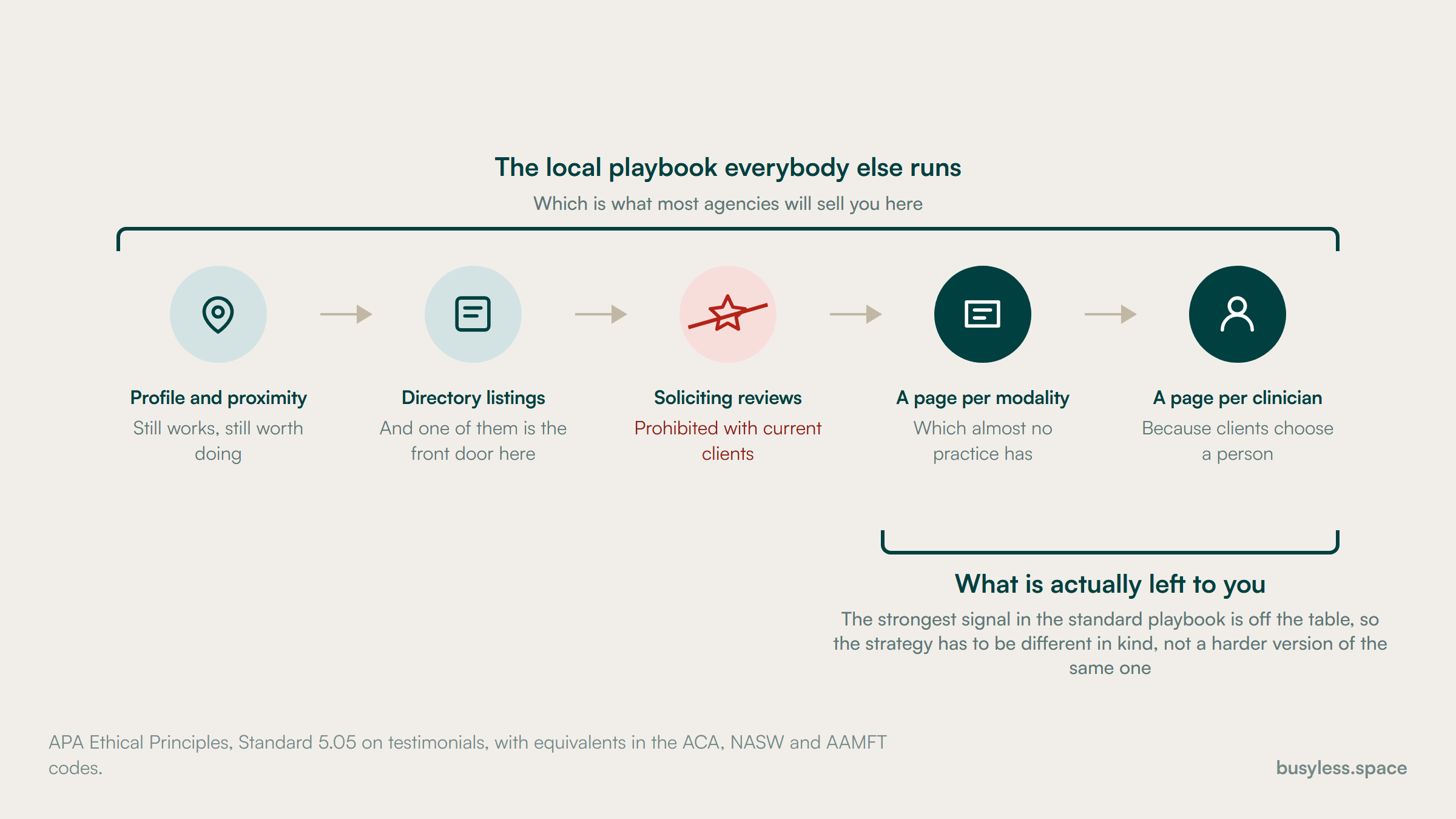
Five stages of the standard local playbook under one bracket. The third, soliciting reviews, is struck through as prohibited with current clients. A narrower bracket covers only the last two, a page per modality and a page per clinician, labelled as what is actually left.
The strongest signal in the standard local playbook is off the table here, which is why the strategy has to be different in kind rather than just harder.

What people actually search

Mental health search has a cluster no other health vertical has: people search by method. That is unusual, it is highly qualified, and it is almost entirely unserved by practice websites, which describe the therapist rather than the work.

Modality

Local commercial

emdr therapist near me

The page that wins it: A page per modality you actually practise, with your training in it

The defining cluster here. Clients arrive already knowing what they want, which makes them the most qualified traffic on the site, and hardly any practice has a page for it.

Presenting problem

Informational to local

therapy for postpartum anxiety

The page that wins it: A page about that specific experience and how you work with it

Not the same as a condition page. National publishers own "what is anxiety"; nobody owns "therapy for anxiety after a birth injury, in [city]".

Insurance and payment

Local commercial

therapist that takes [carrier]

The page that wins it: A payment page with carriers, out-of-network answers and real fees

The highest commercial intent in the vertical and the thing most practice sites either omit or hide. Publishing the fee filters out the enquiries that were never going to book.

Telehealth and state

Local commercial

online therapist licensed in [state]

The page that wins it: A page naming every state you are licensed or compact-authorised in

Created by teletherapy and by the compacts. It is both a ranking opportunity and the answer to a compliance question you have to answer anyway.

Identity and fit

Local commercial

lgbtq affirming therapist [city]

The page that wins it: A page that describes your actual approach and training, not a badge

Clients filter hard on fit, and a claim without substance behind it is transparent. Say what training you have and how it shows up in the room.

Cost and access

Commercial investigation

how much does therapy cost without insurance

The page that wins it: A plain fee page including sliding scale and superbills

Searched constantly and answered almost nowhere by practices. The clients who need this answer are also the ones most likely to give up if they cannot find it.

What to expect

Informational

what happens in the first therapy session

The page that wins it: A specific description of YOUR first session

A national article answers this generically. A page describing your intake, your room, your paperwork and how you end a first session converts people who are frightened of the process.

Symptom and self-assessment

Informational

am i depressed

The page that wins it: Usually nothing, and that is a legitimate answer

High volume, dominated by national publishers, and it carries a crisis duty. If you write here, crisis resources are not optional and the page has to be clinically supervised.

What the rules change

This is the most constrained industry in this directory after healthcare itself, and the constraints hit the marketing directly rather than sitting to one side of it. The first item is the one that rewrites the strategy. None of this is legal or ethical advice; your licensing board, your professional body and your own counsel decide.

1

You may not solicit testimonials from current clients

American Psychological Association Ethical Principles of Psychologists and Code of Conduct, Standard 5.05 on testimonials; equivalent provisions in the ACA, NASW and AAMFT codes, and in many state board rules

What it means

The APA code prohibits soliciting testimonials from current therapy clients or from others who are vulnerable to undue influence because of their particular circumstances. Other professional codes and several state boards take similar or stricter positions, some reaching former clients as well. Reviews are the strongest local ranking signal in existence, and this profession is largely excluded from generating them.

So do this

Do not build a review request into your process. Do not use a reputation tool that sends automated requests, which is a real risk if you are using a general small-business marketing package. Accept unsolicited reviews, respond to none of them in a way that confirms a treatment relationship, and put the effort into specificity instead: modality pages, fit pages and a genuinely described first session.

2

Licensure decides where you may offer services, and your website is an offer

State licensing boards; the Psychology Interjurisdictional Compact (PSYPACT) and the Counseling Compact, both of which have been going live state by state

What it means

Teletherapy removed distance and replaced it with jurisdiction. In general you must be licensed where the client is located at the time of the session, and the interstate compacts create a route to practise across member states for participating professions. Membership and operational status differ by profession and by state and have been changing, so this is a fact with a date on it rather than a permanent answer.

So do this

State on the site exactly which states you can see clients in, and under what authority: licence number by state, or compact authorisation. Check your own board and the compact commission for current status rather than relying on an article, and put a review date on the page. It is a compliance answer and it is also a page that ranks.

3

Tracking on a therapy website is a live legal risk, including outside HIPAA

Washington State My Health My Data Act, effective for most obligations in March 2024, which includes a private right of action; Nevada SB 370; and state consumer health data laws following them

What it means

These laws regulate consumer health data broadly, including inferences about mental health, and they reach entities that are not HIPAA covered entities. Washington's includes a private right of action, which changes the risk calculus substantially compared with regulator-only enforcement. A remarketing pixel on a page about eating disorders or trauma is the case these statutes were written about.

So do this

Remove third-party advertising and analytics trackers from any page about a condition, a modality or an intake form. If you need measurement, use a server-side or privacy-preserving setup that does not send page context to an advertising network, and document what you did. This is worth doing even if your state has no such law yet, because the direction of travel is clear.

4

Substance use records carry stricter rules than HIPAA

42 CFR Part 2, confidentiality of substance use disorder patient records

What it means

If your practice provides substance use disorder treatment as defined by the rule, the confidentiality requirements are stricter than HIPAA's, including on disclosures. That has practical effects on intake forms, on any communication workflow, and on how you handle anything that identifies somebody as having sought treatment.

So do this

If Part 2 applies to you, treat every web form, every automated email and every tracking script as a disclosure question rather than a marketing one. Get the intake flow reviewed by somebody who knows the rule, and keep the marketing stack out of it entirely.

5

Content about crisis carries a duty

Professional ethics codes and platform policies on self-harm and suicide content

What it means

Pages about suicidal ideation, self-harm or acute crisis are read by people in crisis. Search engines surface crisis resources on these queries for a reason, and a practice page that appears in that context without them is a clinical failure before it is an SEO one.

So do this

Put crisis resources, including the 988 Suicide and Crisis Lifeline, at the top of any page touching these topics, not in a footer. Have a clinician review the page. If you cannot supervise it properly, do not publish it; there is no ranking worth the alternative.

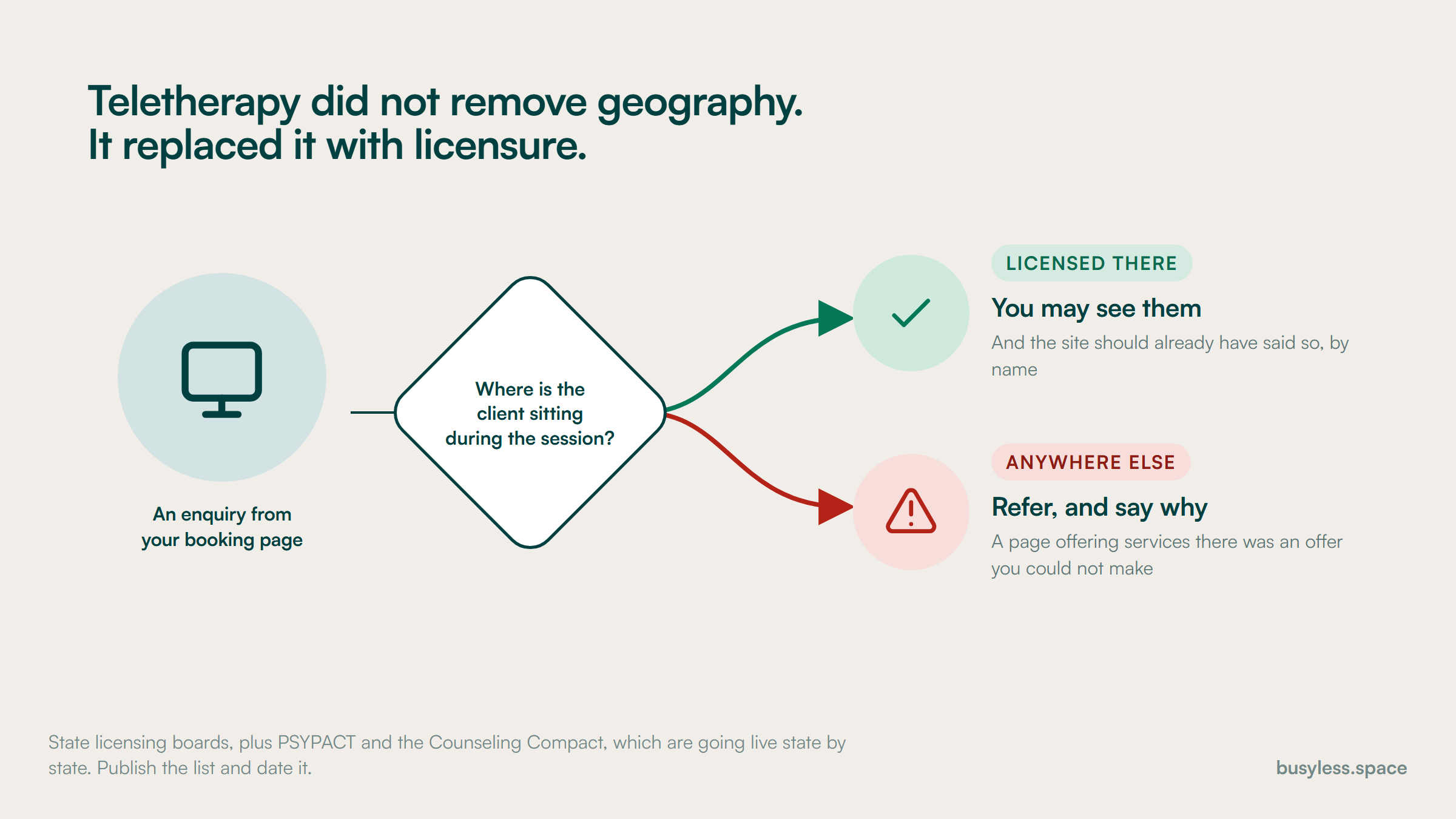
A decision gate asking where the client is sitting during the session. If it is a state you are licensed in or a compact covers, you may see them. Anywhere else, refer and say why.
The gate is about the client's location, not the clinician's. That is the thing teletherapy marketing copy gets wrong.

Proving expertise

This is a your-money-or-your-life category where the practitioner is the product and the usual proof is unavailable to you. Without reviews, everything rests on being specific and verifiable about training, licensure and approach.

  • Licence type and number for every state you practise in, with the issuing board named
  • Modality training stated precisely: which training, which body, completed when, at what level
  • Supervision and consultation arrangements described, which practitioners understand and clients find reassuring
  • Populations and presentations you actually work with, and the ones you refer out
  • A named clinical reviewer and a review date on any content about a condition
  • Crisis resources present and prominent wherever they are relevant
  • Fees published, including sliding scale availability and how superbills work
  • A photograph of the actual room, which does more for an anxious client than a stock image ever will

How to build a mental health SEO strategy

A realistic first six months for a solo or small group practice. This sequence assumes limited time rather than limited money, because that is the real constraint: a mental health SEO strategy competes with a full caseload for the same evenings.

  1. 1

    Weeks 1 to 3

    Close the risks and claim what is free

    • Remove advertising and analytics trackers from condition, modality and intake pages
    • Check no automated review request exists anywhere in your practice software
    • Publish the states you are licensed or compact-authorised in, with numbers
    • Complete the Google Business Profile, including telehealth attributes
    • Claim the modality certification registries you qualify for
    • Check your insurance carrier directory listings, especially accepting-new-clients status

    You end up with
    No live privacy or ethics exposure, and every free authoritative listing claimed

  2. 2

    Weeks 3 to 8

    Answer the questions that decide the enquiry

    • Write the fees and insurance page, with real numbers and the out-of-network answer
    • Write a page per modality you genuinely practise, with your training in it
    • Write the what-to-expect page describing your actual first session
    • Rewrite the about page as a fit page: who you work well with and who you refer on
    • Add MedicalBusiness and MedicalTherapy structured data
    • Photograph the actual room and use it

    You end up with
    A site that answers what a client needs before booking, which the directory profile cannot

  3. 3

    Weeks 6 to 16

    Build the specific pages nobody else has

    • Write presenting-problem pages for the experiences you genuinely specialise in
    • Write the fit and identity pages with real substance behind them
    • Build a page per state for telehealth, where you practise in several
    • For group practices, give every clinician a full page of their own
    • Add crisis resources anywhere they are relevant, at the top
    • Set a clinical review cadence with a named reviewer

    You end up with
    Coverage of the narrow, highly qualified queries the national publishers do not serve

  4. 4

    Weeks 12 to 26

    Measure consultations, not sessions

    • Track initial consultations booked by source, with a consistent question at intake
    • Compare cost per new client from the directory against everything else honestly
    • Report leading and business indicators separately with the attribution gap stated
    • Track caseload fill rather than traffic, because a full caseload changes the goal
    • Review the licensure page whenever compact status or your own licences change
    • Re-check that no marketing tool has quietly reintroduced a review request

    You end up with
    An honest comparison of the directory against your own site, and a caseload number

Technical fixes with the best payoff

The technical problems here are unusually small, because most of these sites are small. The important ones are about what is missing rather than what is broken, and two of them are risks rather than inefficiencies.

  • Trackers on condition and intake pages

    An afternoon

    A page about trauma, an eating disorder or substance use tells an advertising network something extremely sensitive about the visitor. State consumer health privacy laws now reach this directly, and Washington's provides a private right of action, which means a plaintiff rather than a regulator.

    Remove third-party advertising pixels and third-party analytics from those pages entirely. If you need measurement, use a setup that does not send page context to an ad network. Then write down what you did and when, because that record is the defence.

  • The website is a business card behind a directory profile

    A sprint

    If the directory ranks for your name and your specialisms, and your site has three pages, then the directory is your practice's public face and you are renting it. That is a strategic exposure as well as a ranking one.

    Build the pages a profile cannot contain: modality pages with your training, a real fee page, a described first session, and who you refer out. The directory stays as a channel; it stops being the whole shopfront.

  • There is no page per modality

    A day per modality

    Modality is how a large part of this market searches, and practice sites list modalities as a comma-separated line on an about page. There is nothing for the query to land on and nothing to demonstrate the training.

    One page per modality you actually practise: what it is, what a session looks like, what it helps with, what your training in it is, and who it is not suitable for. Do not create pages for modalities you have read about.

  • The states you can practise in are nowhere on the site

    An afternoon

    It is the first question a teletherapy client has and the answer to a compliance question you have to be able to give anyway. Its absence sends qualified clients away and leaves the offer of service ambiguous.

    A page listing every state, the licence number or compact authorisation for each, and a review date. It is genuinely useful and it ranks for state-plus-telehealth queries almost nobody targets.

  • A group practice has one page listing every clinician

    A sprint

    Clients choose a person, not a practice, and they search modality and fit. A single team page means twelve clinicians share one URL and none of them can rank for the thing that makes them findable.

    A full page per clinician: their licences and states, their modalities with training, who they work with, their fees, their availability and their own photograph. Link each to the modality pages they practise.

  • Booking is an iframe from the practice management system

    An afternoon

    The highest-intent step happens on somebody else's domain, frequently on a client portal that looks nothing like the site, and often badly on a phone. Anxious clients abandon at exactly that transition.

    Keep the tool and put real content around it: what happens after you submit, how quickly you reply, what the first appointment involves, what it costs. The page should be useful with the widget removed.

  • Crisis resources are missing or in the footer

    An hour

    Content about self-harm and suicide is read by people in crisis. Burying the crisis line in a footer on a page about suicidal thoughts is a clinical failure, and it is also the exact context in which a search engine will not surface the page.

    Crisis resources at the top of any page where they are relevant, including 988. Have a clinician review those pages. If they cannot be supervised properly, take them down.

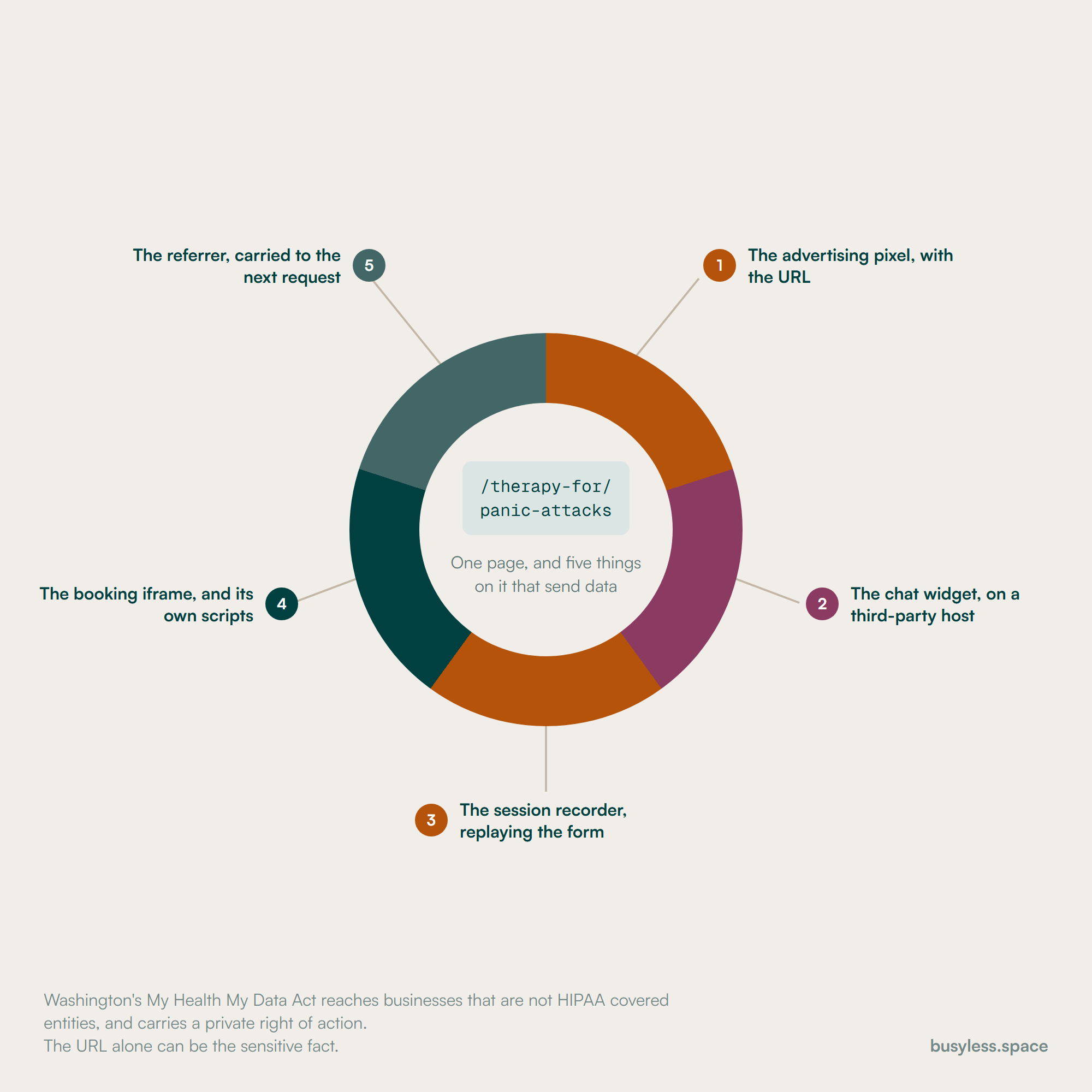
A condition page URL at the centre of a ring, with five callouts: the advertising pixel carrying the URL, a chat widget on a third-party host, a session recorder replaying the form, the booking iframe and its own scripts, and the referrer carried to the next request.
Five things on one page that send data somewhere, and none of them looks like a tracker. The URL alone can be the sensitive fact.

Structured data that applies here

The types below fit this industry specifically. Most of them earn no rich result on their own, which is worth knowing before anyone sells the work on that basis. What they do is describe the entity precisely, which matters for how search engines and answer engines resolve who you are.

  • MedicalBusiness with a psychiatric specialty

    Home page and any location pages

    Use the specialty field rather than reaching for a type that does not exist. One node per physical location, and be careful with areaServed: it should reflect where you may lawfully practise, not where you would like clients from.

    MedicalBusiness with a psychiatric specialty.jsonld
    {
      "@context": "https://schema.org",
      "@type": "MedicalBusiness",
      "@id": "https://[YOUR-DOMAIN]/#practice",
      "name": "[PRACTICE NAME]",
      "url": "https://[YOUR-DOMAIN]",
      "telephone": "[+1-555-000-0000]",
      "medicalSpecialty": "Psychiatric",
      "image": "https://[YOUR-DOMAIN]/room.jpg",
      "address": {
        "@type": "PostalAddress",
        "streetAddress": "[123 Example St, Suite 200]",
        "addressLocality": "[CITY]",
        "addressRegion": "[ST]",
        "postalCode": "[00000]",
        "addressCountry": "US"
      },
      "areaServed": [
        { "@type": "State", "name": "[STATE YOU ARE LICENSED IN]" },
        { "@type": "State", "name": "[COMPACT-AUTHORISED STATE]" }
      ],
      "availableService": [
        { "@type": "MedicalTherapy", "name": "[MODALITY]" }
      ],
      "isAcceptingNewPatients": true
    }
  • MedicalTherapy

    Each modality page

    A real schema.org type that genuinely fits here, unlike in most verticals. Only mark up modalities you are actually trained in, since the page should be stating that training anyway.

    MedicalTherapy.jsonld
    {
      "@context": "https://schema.org",
      "@type": "MedicalTherapy",
      "name": "[MODALITY, e.g. Eye Movement Desensitization and Reprocessing]",
      "alternateName": "[COMMON ABBREVIATION]",
      "url": "https://[YOUR-DOMAIN]/approaches/[SLUG]",
      "description": "[What it is and what happens in a session, in plain language.]",
      "indication": {
        "@type": "MedicalIndication",
        "name": "[What it is used for]"
      },
      "adverseOutcome": {
        "@type": "MedicalEntity",
        "name": "[Honest note on who it is not suitable for]"
      },
      "provider": { "@id": "https://[YOUR-DOMAIN]/#practice" }
    }
  • Person with per-state licences

    Each clinician's page

    The most important node on the site, because clients choose a person. List a credential per state, since that is the fact that decides whether you can see somebody at all.

    Person with per-state licences.jsonld
    {
      "@context": "https://schema.org",
      "@type": "Person",
      "@id": "https://[YOUR-DOMAIN]/team/[SLUG]#person",
      "name": "[FIRST LAST], [LPC / LCSW / PhD / PsyD]",
      "jobTitle": "[Licensed professional counselor]",
      "url": "https://[YOUR-DOMAIN]/team/[SLUG]",
      "image": "https://[YOUR-DOMAIN]/team/[SLUG].jpg",
      "worksFor": { "@id": "https://[YOUR-DOMAIN]/#practice" },
      "hasCredential": [
        {
          "@type": "EducationalOccupationalCredential",
          "credentialCategory": "[LICENCE TYPE]",
          "identifier": "[NUMBER]",
          "recognizedBy": { "@type": "GovernmentOrganization", "name": "[STATE BOARD]" }
        },
        {
          "@type": "EducationalOccupationalCredential",
          "credentialCategory": "[MODALITY CERTIFICATION]",
          "recognizedBy": { "@type": "Organization", "name": "[CERTIFYING BODY]" }
        }
      ],
      "knowsAbout": ["[MODALITY]", "[PRESENTATION]", "[POPULATION]"],
      "knowsLanguage": ["[LANGUAGE]"]
    }
  • Service with licensed area

    The telehealth and states page

    The node that states where you may lawfully see clients. Keep it identical to the list on the page, and put both under the same review date so they cannot drift apart.

    Service with licensed area.jsonld
    {
      "@context": "https://schema.org",
      "@type": "Service",
      "name": "[Online therapy]",
      "serviceType": "Teletherapy",
      "provider": { "@id": "https://[YOUR-DOMAIN]/#practice" },
      "areaServed": [
        { "@type": "State", "name": "[STATE]" },
        { "@type": "State", "name": "[STATE]" }
      ],
      "availableChannel": {
        "@type": "ServiceChannel",
        "serviceUrl": "https://[YOUR-DOMAIN]/book",
        "availableLanguage": ["English", "[OTHER]"]
      },
      "description": "[Which states, under which licence or compact authorisation, checked on [DATE].]"
    }
  • FAQPage

    Fees, telehealth and what-to-expect pages

    Fees and insurance first. They are what clients search and what practices most often leave unanswered. Match the visible text exactly.

    FAQPage.jsonld
    {
      "@context": "https://schema.org",
      "@type": "FAQPage",
      "mainEntity": [
        {
          "@type": "Question",
          "name": "[Question exactly as it appears on the page]",
          "acceptedAnswer": {
            "@type": "Answer",
            "text": "[Answer exactly as it appears. Give the actual fee where you can.]"
          }
        }
      ]
    }
  • BreadcrumbList

    Modality, presentation and clinician pages

    Do it once the site has real sections rather than a flat set of pages. It tends to show that the modality pages and the clinician pages never link to each other, which is worth fixing first.

    BreadcrumbList.jsonld
    {
      "@context": "https://schema.org",
      "@type": "BreadcrumbList",
      "itemListElement": [
        { "@type": "ListItem", "position": 1, "name": "Home",
          "item": "https://[YOUR-DOMAIN]/" },
        { "@type": "ListItem", "position": 2, "name": "[Approaches]",
          "item": "https://[YOUR-DOMAIN]/approaches" },
        { "@type": "ListItem", "position": 3, "name": "[MODALITY]",
          "item": "https://[YOUR-DOMAIN]/approaches/[SLUG]" }
      ]
    }

What it costs

Editorial estimates rather than quotes, and the honest framing is different here. For a solo practitioner the goal is usually a full caseload, not unlimited growth, so the right budget is often the smallest one that fills the diary and then stops.

Do it yourself

$0 to $200
  • Directory profile completed properly, with every filter field used
  • Google Business Profile completed, including telehealth attributes
  • Trackers removed from sensitive pages
  • The fee page, the states page and the first-session page written by you
  • Modality certification registry listings claimed

Who it suits

A solo practitioner with a partly full caseload and a few evenings

Where it stops

It will fill a caseload in an average market and it will not compete in a saturated one. Writing is the constraint, and there is no way around that at this tier.

Lean

$800 to $2,000
  • Modality and presenting-problem pages written properly, with your training in them
  • A fit page that says who you work well with and who you refer on
  • Structured data and the technical fixes
  • State pages where you practise in several
  • Quarterly reporting on consultations rather than sessions

Who it suits

A solo practitioner in a competitive market, or a small group building past referral

Where it stops

It cannot outrank a national publisher on condition terms and should not try. It also cannot generate the review signal, which is a permanent structural limit.

Funded

$2,500 to $5,000
  • A full page per clinician in a group practice, each genuinely individual
  • A modality library covering everything the practice actually offers
  • Multi-state telehealth pages with licensure tracked properly
  • A clinical review workflow with a named reviewer and real dates
  • Attribution reconciled against intake, and a caseload fill report

Who it suits

Group practices, or practices adding clinicians faster than referrals can fill them

Where it stops

Growth is bounded by clinician capacity, not by demand. At some point the right answer is to stop marketing and start hiring, and the report should say so.

How to do it with no budget

Almost everything valuable here costs time rather than money, and two of the items are risk removal rather than growth. Start with the two that remove risk.

  1. 1

    Remove trackers from sensitive pages

    1 hour

    Your website's script settings

    Advertising pixels and third-party analytics off any page about a condition, a modality or an intake. First, because it is the only item here where doing nothing carries a legal risk rather than an opportunity cost.

  2. 2

    Check nothing is asking clients for reviews

    30 minutes

    Your practice management software and any marketing tool

    General small-business marketing packages have review requests switched on by default. In this profession that is an ethics problem, and it is usually running without anybody having decided to.

  3. 3

    Publish the states you can practise in

    1 hour

    Your website editor

    Licence number per state or compact authorisation, with a checked-on date. It answers the first teletherapy question, it ranks, and it settles a compliance question at the same time.

  4. 4

    Write the fee page

    2 hours

    Your website editor

    Session fee, sliding scale availability, insurance you take, what out-of-network means in practice, how superbills work. It filters the enquiries that were never going to book and it is searched constantly.

  5. 5

    Complete the directory profile properly

    3 hours

    Your directory subscription

    The filter fields decide whether you appear at all, and most profiles have half of them blank. This is where the profile prose matters least and the checkboxes matter most.

  6. 6

    Write a page for each modality you actually practise

    2 hours each

    Your website editor

    What it is, what a session looks like, what your training is, who it is not for. Two or three of these outperform twenty generic blog posts about anxiety.

  7. 7

    Describe your actual first session

    2 hours

    Your website editor

    The paperwork, the room, the questions, how long, how it ends, what happens next. It converts the anxious reader who has been putting off booking for months.

The tool stack

Jobs first, tools second, and this is the industry where the shortest tool list is the right answer. Every additional script on a therapy website is a privacy decision as well as a technical one.

  • Understand what clients actually search in your market

    Google Search Console plus your own enquiry emails

    Read fifty enquiries and write down the words people use to describe why they are getting in touch. That phrasing is the content plan and no keyword tool will produce it.

    Free routeBoth free, and the enquiry emails are the better source

  • Check modality and presentation demand across states

    DataForSEOSEO APIRead the review

    Only worth it for multi-state teletherapy practices, where the question is which states have demand for your modality rather than whether a term is searched at all.

    Free routeManual checks are adequate for a single-state solo practice

  • Work out what a new client is actually worth

    SEO Revenue Growth CalculatorFree toolOpen the tool

    Use average episode length rather than session fee. The difference between a six-session and a two-year client is the entire economics, and it decides whether the directory subscription is good value.

    Free routeFree

  • Sanity check the budget against a full caseload

    SEO Budget CalculatorFree toolOpen the tool

    Set the target as caseload fill rather than growth. Most solo practices need a finite number of clients and should stop spending when they have them.

    Free routeFree

  • Generate the MedicalTherapy and Person markup

    Schema Markup GeneratorFree toolOpen the tool

    Generate the pattern, then keep the licence list in one place so the markup and the states page cannot disagree.

    Free routeFree

  • Run a group practice site without a developer per clinician

    PayloadHeadless CMSRead the review

    Clinicians, modalities, presentations and states intersect constantly, and a clinician joining should generate their page and appear on the right modality pages automatically. It is also easier to keep a self-hosted site free of third-party scripts.

    Free routeFree and self-hosted

  • Measure without sending page context to an advertising network

    A privacy-preserving or server-side analytics setup

    Not optional given the state consumer health privacy laws. Whatever you choose, the test is whether a third party learns that a specific visitor read a page about a specific condition. If it does, it does not belong on this site.

  • See what AI assistants recommend when somebody describes a problem

    LLM visibility trackerOur toolSee the tool

    People increasingly describe how they are feeling to an assistant before searching for help. Those answers draw on national publishers, which is a reason to compete on modality and fit rather than on condition explainers.

Take it from here

Everything below is yours to take. Fill the [BRACKETS] and it is ready to use. Start with the privacy and ethics audit: two of its items are live risks rather than missed opportunities, and both are usually running by default.

Checklist

Two things are usually switched on by default on a therapy website and should not be: advertising trackers on sensitive pages, and automated review requests to clients.

PRIVACY AND ETHICS AUDIT - [PRACTICE] - [DATE]

WHY THIS IS FIRST
Both items below are usually running because a tool had them on by
default, not because anybody decided. One is a legal exposure, the
other is a professional ethics one. PART 1: TRACKING ON SENSITIVE PAGES

The risk
State consumer health data laws reach inferences about mental
health and apply beyond HIPAA covered entities. Washington's My
Health My Data Act includes a private right of action, which
means a plaintiff rather than a regulator.

1. LIST EVERY SCRIPT ON THE SITE
   Open the page source, or use your browser's network tab.
   | Script / pixel      | Purpose | Third party? | Keep? |
   |---------------------|---------|--------------|-------|
   | [_________________] | [_____] | [ Y / N ]    | [ Y/N]|
   | [_________________] | [_____] | [ Y / N ]    | [ Y/N]|
   | [_________________] | [_____] | [ Y / N ]    | [ Y/N]|

2. THE PAGES THAT MUST BE CLEAN
   [ ] Any page naming a condition or presentation
   [ ] Any modality page
   [ ] The intake or contact form
   [ ] The booking page and any portal handoff
   [ ] Any page about substance use
   [ ] Any page about self-harm or suicide

3. THE TEST
   For each page above: does any third party learn that this
   visitor read this specific page?
   If yes, that script comes off this page.

4. RECORD IT
   Removed on [DATE] by [NAME]. Scripts removed: [__________]
   Measurement replaced with: [____________________________]
   Keep this record. It is the documentation of the decision.

PART 2: REVIEW REQUESTS

The rule
Professional ethics codes prohibit soliciting testimonials from
current therapy clients, and several state boards go further.
Reviews are the strongest local ranking signal, and this
profession is largely excluded from generating them.

5. CHECK EVERY SYSTEM THAT CAN EMAIL A CLIENT
   [ ] Practice management software: review request feature
       [ OFF / ON ]  ->  turn OFF
   [ ] Any marketing or reputation tool     [ OFF / ON ]
   [ ] Appointment reminder templates       [ checked ]
   [ ] Discharge or session-end templates   [ checked ]
   [ ] Email signature                      [ checked ]
   [ ] Any printed material in the room     [ checked ]

6. WHAT YOU MAY STILL DO
   [ ] Accept unsolicited reviews
   [ ] Respond, without ever confirming a treatment relationship
   [ ] Ask professional colleagues for referral relationships
   [ ] Publish your own credentials and training, in full

7. SIGN OFF
   Reviewed by [NAME] on [DATE]. Re-check every [6] months and
   whenever a new tool is added.

What to publish

The ranking is how directly a page answers the question that decides an enquiry. Most practice sites write about conditions, which the national institutes already own, and rightly so.

  • Modality pages

    One per modality you actually practise, and no more

    The defining search behaviour in this vertical, the most qualified traffic on the site, and almost nobody has one.

  • A real fee and insurance page

    Once, reviewed when fees or panels change

    Searched constantly, answered almost nowhere, and it filters enquiries that were never going to book. It also reduces the emotional cost of asking.

  • The states and telehealth page

    Once, reviewed whenever a licence or compact status changes

    Answers the first teletherapy question, ranks for a query almost nobody targets, and settles a compliance point you have to settle anyway.

  • Presenting-problem pages

    One a month, from what clients actually bring

    Not condition explainers. Pages about a specific experience and how you work with it, which is the gap between what the national publishers cover and what a client needs.

  • A described first session

    Once, properly

    Converts the reader who has been putting off booking for months, which is a large proportion of the people reading a therapy website.

  • A fit page that says who you refer out

    Once, reviewed yearly

    The single most trust-building thing a therapist can publish, and the one that saves both parties a wasted intake.

And what not to

  • Any review request, automated or otherwise, to a current client
  • Testimonials from clients, which several professional codes prohibit outright
  • Advertising pixels or third-party analytics on condition, modality or intake pages
  • Generic condition explainers competing with national health institutes
  • Modality pages for approaches you have read about rather than trained in
  • Self-assessment quizzes without clinical supervision and crisis resources
  • Any implication of a guaranteed outcome, which is both a clinical and a regulatory problem
  • Claiming to serve a state you are not licensed or compact-authorised in
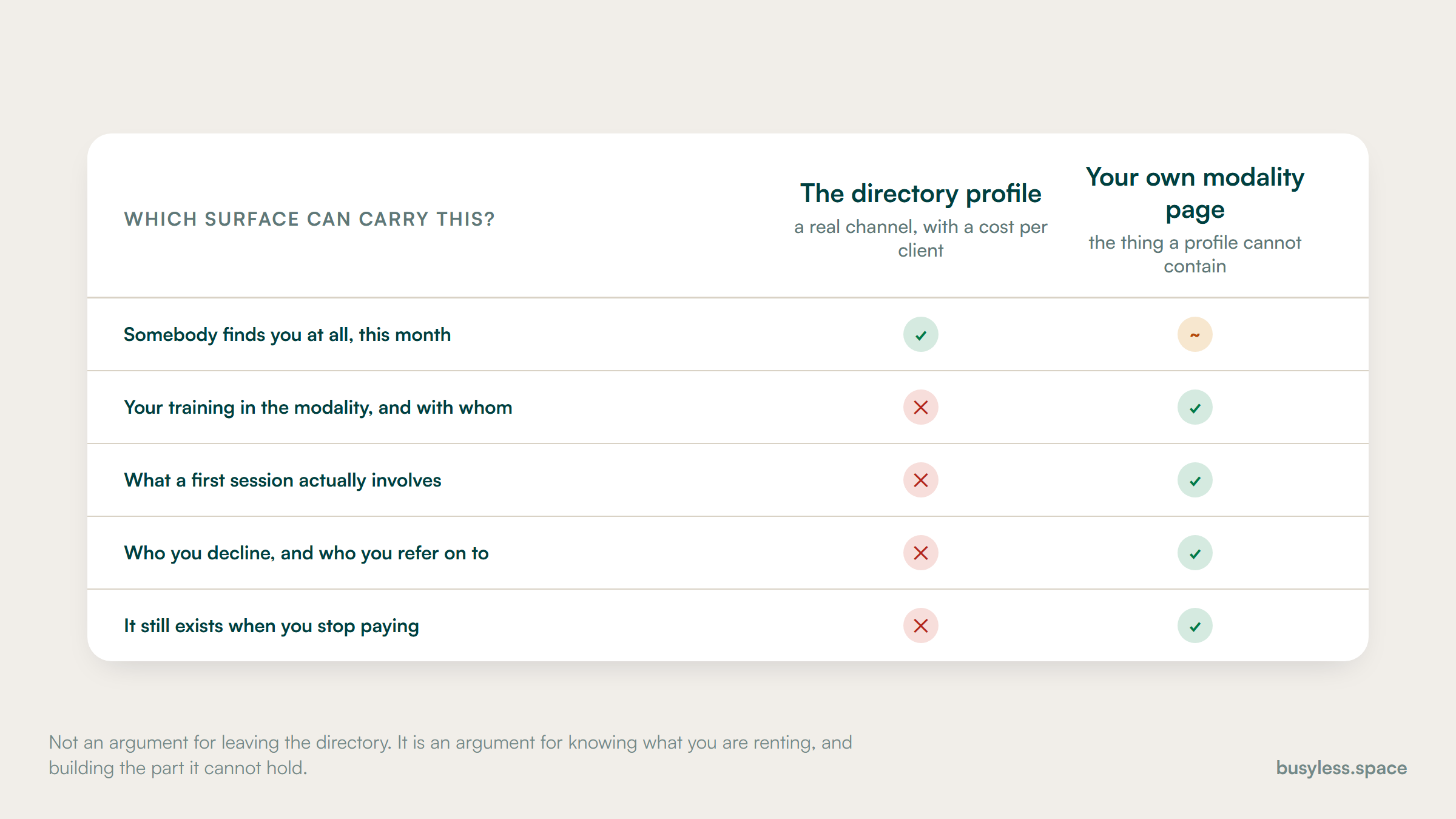
A five-row table comparing a paid directory profile against the practice's own modality page. The profile wins on being found this month. The page carries the training, the first session, who you decline, and it survives you cancelling the subscription.
Not an argument for leaving the directory. It is an argument for knowing what you are renting, and building the part it cannot hold.

The expensive mistakes

Running a general small-business marketing package

Costs you Automated review requests to therapy clients, and advertising pixels on condition pages, both switched on by default

Audit every tool for review requests and trackers before it touches the site, and document what you turned off

Letting the directory be the whole shopfront

Costs you Renting your entire public presence, in a channel that also lists every competitor beside you

Keep the subscription as a channel, and build the modality, fee and fit pages it cannot contain

Listing modalities as a comma-separated line

Costs you The most qualified search behaviour in the vertical, with nowhere to land

A page per modality you actually practise, with the training named and the unsuitable cases stated

Not saying which states you can work in

Costs you Qualified teletherapy clients leaving, and an ambiguous offer of service in states where you may not practise

A states page with licence numbers or compact authorisation and a checked-on date

One team page for a group practice

Costs you Twelve clinicians sharing one URL in a market where clients choose a person and search a modality

A full page each, linked to the modality pages they practise

Reporting traffic to a practice owner

Costs you Effort spent on a number that has no relationship to a full diary, which is the actual goal

Consultations booked and caseload fill, with the attribution gap stated

What to measure

Attribution here is deliberately limited, and that is a feature rather than a failure. The measurement you would normally reach for is exactly the measurement the privacy statutes are concerned about, so the honest approach is fewer numbers, gathered at intake, and a clear statement of what is not being tracked.

Leading indicators

Move first. They predict, they do not prove.

  • Impressions on modality and presentation queries

    Search Console, filtered by cluster

    The right leading indicator here, because it measures the specific ground you can win rather than condition terms you cannot.

  • Profile actions on the business profile

    Google Business Profile insights

    Useful and limited, since the review signal that normally drives local ranking is one you cannot generate. Completeness and category work are what move this.

  • Fee and states page engagement

    First-party analytics only

    Two pages worth watching individually, because reaching either one is a strong signal of a serious enquiry. Measure them without sending anything to an advertising network.

  • Directory profile views and enquiries

    Your directory dashboard

    Track it to price the subscription, not to celebrate it. A view is not an enquiry and the dashboard will encourage you to treat it as one.

Business indicators

The ones a manager acts on.

  • Initial consultations booked, by source

    One question at intake, asked the same way every time

    The most reliable data available in this vertical, precisely because the tracking alternative is one you should not be running. Make it a required field.

  • Consultation to client conversion

    Your practice records

    Worth watching by source. A channel producing consultations that do not convert is producing poor fit, and the fix is usually a clearer fit page rather than more traffic.

  • Caseload fill

    Your diary

    The real goal for most practices in this field, and the number that should end the programme rather than grow it. A full caseload means stop spending, which is a report almost nobody writes.

  • Cost per new client, by channel

    Intake data plus channel spend

    The comparison that decides whether the directory subscription and the payer platforms still earn their place. Include the rate difference on platform clients, because that is a real cost.

The verdict

Mental health is the one industry in this directory where the standard local playbook is not merely wrong but prohibited. You cannot build the review engine, so the strategy has to win on specificity instead, and specificity is genuinely available here in a way it is not elsewhere.

The directory is a channel, not a competitor and not a strategy. Keep it, price it honestly against everything else, and build the pages it structurally cannot contain: what a session with you is like, what your training in a modality actually is, what it costs, and who you would refer somewhere else.

There is a fast way to test anybody selling mental health SEO services, and it is three questions long. Will they remove tracking from your condition pages? Do they know that review requests are an ethics problem here? Will they write modality pages rather than generic condition explainers?

Everybody has an answer to the first and the third. The second is the one to press on, because review generation is a standard part of every local package and almost nobody selling SEO services for therapists thinks to ask whether this profession is permitted to use it.

FAQ

Mental health SEO questions

  • Can we ask clients for Google reviews?
    No, and this is the most important thing on the page. The APA Ethics Code prohibits soliciting testimonials from current therapy clients, and several state boards go further. Since reviews are the strongest local ranking signal there is, this profession is largely excluded from the tactic every other local playbook starts with. Check that your practice management software is not sending review requests automatically, because many have the feature switched on by default.
  • Should we keep paying for the directory?
    Probably, and you should price it properly rather than treat it as a given. Work out your cost per new client from the directory against your cost per new client from everything else, using average episode value rather than session fee. Then build the pages the profile structurally cannot contain: what a session with you is like, your actual training in a modality, your fees, and who you would refer elsewhere.
  • Which states can we advertise teletherapy in?
    The ones you are licensed in, plus any where you are authorised under an interstate compact. Generally you must be licensed where the client is located at the time of the session. Membership and operational status differ by profession and by state and have been changing, so check with your own board and the relevant compact commission rather than relying on an article, and put the checked-on date on your website.
  • Is Google Analytics a problem on a therapy website?
    On pages about conditions, modalities and intake, treat any third-party tracking as a problem until you have checked. State consumer health data laws, including Washington's My Health My Data Act, reach inferences about mental health and apply beyond HIPAA covered entities, and Washington's carries a private right of action. The practical test is simple: does a third party learn that this visitor read this specific page? If yes, that script does not belong there.
  • What should we write about, if not conditions?
    Modalities, presentations and practicalities. National health institutes own the condition head terms and are the right answer for them. What nobody owns is a page about the specific modality you trained in, with your training named and an honest note on who it is not suitable for. Nor does anybody own your fees, the states you can practise in, or a real description of your first session.
  • We are a group practice. Do clinicians need their own pages?
    Yes, full pages rather than a card on a team page. Clients choose a person and they search by modality and fit, so twelve clinicians sharing one URL means none of them can be found for the thing that would make them findable. Each page needs the licences and states, the modalities with training named, who they work with, fees, availability and their own photograph, linked to the modality pages they practise.
  • What does mental health SEO cost?
    The tiers above are editorial estimates rather than quotes. A solo practitioner can do most of the highest-value work themselves at close to no cost, because the constraint is writing time rather than money. A practice paying for help is realistically at $800 to $5,000 a month. For a solo practice the right target is usually a full caseload, at which point the honest recommendation is to stop.
  • Can AI write our content?
    For structure and editing, cautiously. For anything clinical, no. This is a your-money-or-your-life category read by people in distress, and a model will produce a plausible statement about what a modality treats that is subtly wrong. Use it to organise your own words, keep every clinical claim written or corrected by the clinician, and never let it near a page about crisis or self-harm without a supervising clinician reading every line.

Run it yourself, or have someone own it

Everything above is written to be run without us, and the free path is genuinely most of the value for a single-location business. Where these plans stall is almost never the plan. It is that nobody owns it after the first month. That is the job we do, with search as one distribution layer inside a wider system rather than the whole engagement.