
Content marketing for startups
Regulated marketingThe founder is the channel until they are not
- Sector
- Software and tech
- Channels
- Founder-led social, Community, Newsletter
- Buying cycle
- Medium cycle
- Time to compound
- 3 to 9 months
- Typical monthly
- $1,000 to $6,000
Key takeaways
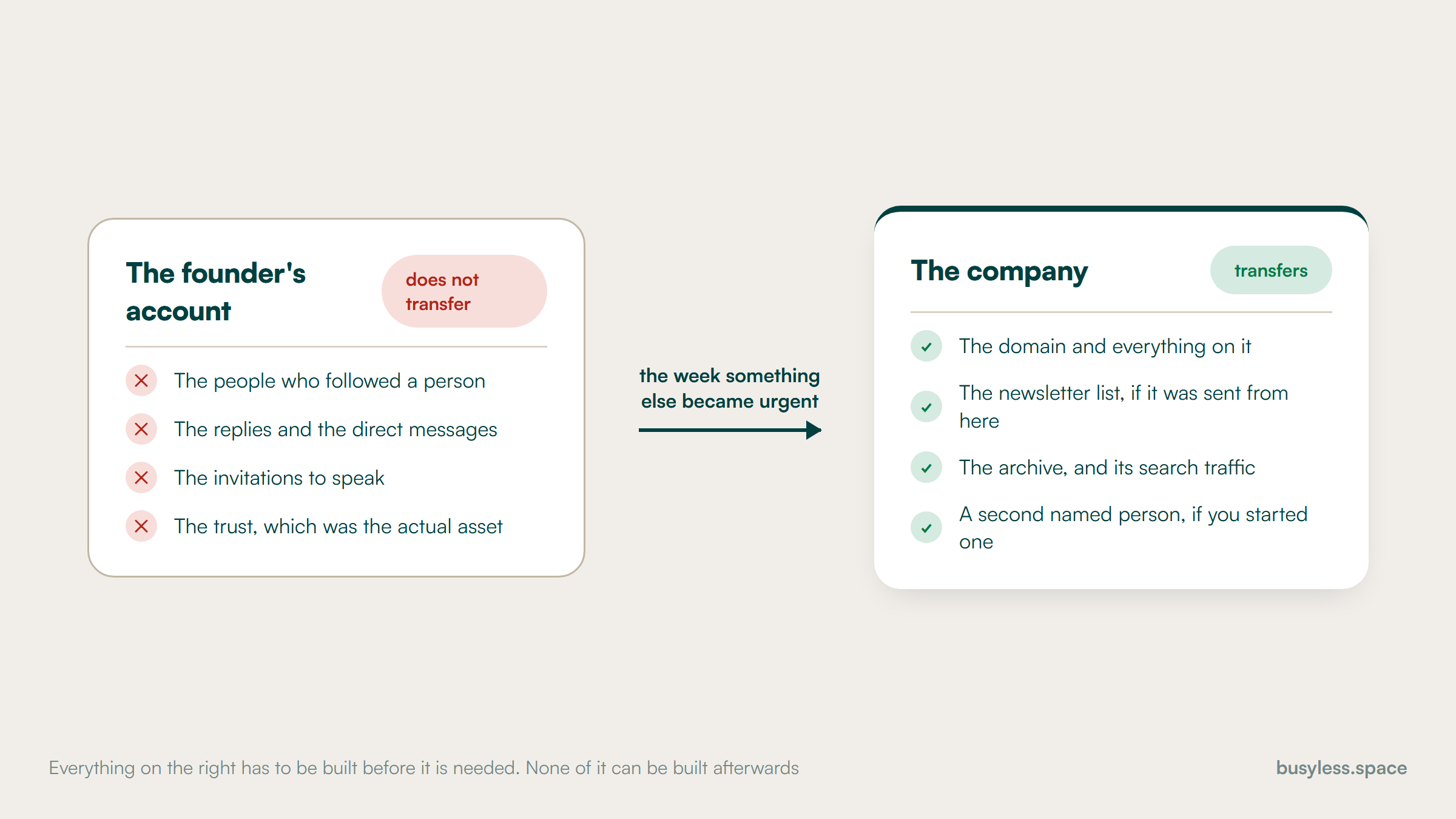
- 1People followed a person, and a company cannot inherit them. The audience, the replies and the invitations are attached to a name and a face, and the archive and the search traffic are the only parts that transfer.
- 2Plan the handover from the start, or discover it during a fundraise. The usual sequence is that the founder stops posting because something else became urgent, and the programme is declared not to have worked six months later.
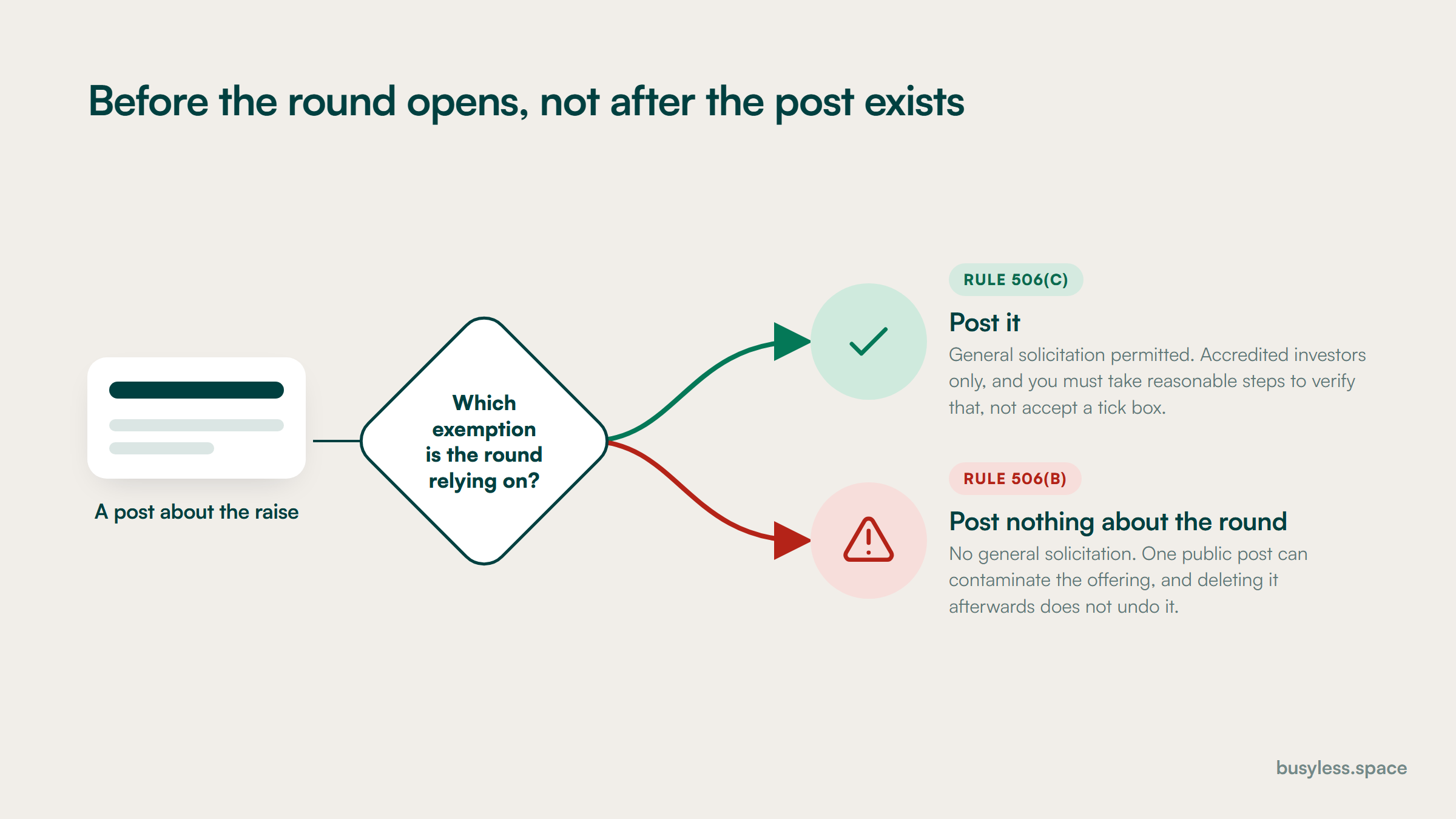
- 3If you are raising under Rule 506(b) you may not post about it. General solicitation is prohibited, and a single public post describing the offering can contaminate it, which lands on precisely the channel this page rates first.
- 4Your only unrepeatable material is the decisions and what you rejected. A better-funded competitor can buy every other kind of content you can make, and cannot buy the reasoning behind a choice they did not have to make.
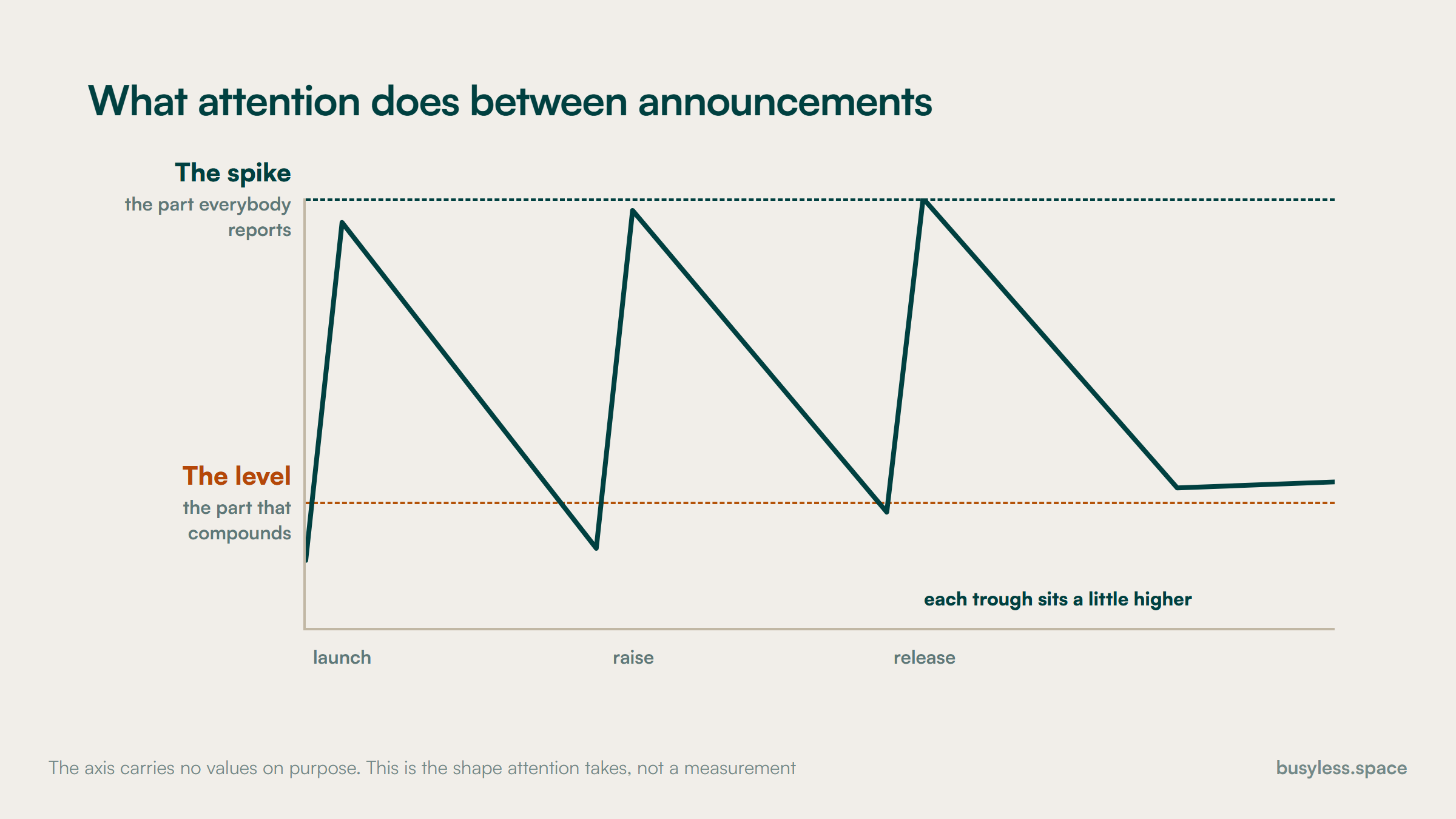
- 5Attention arrives in spikes and the interesting number is what it decays to. A launch, a raise and a release all spike, and the level between spikes is the only thing that compounds.
Content marketing for startups almost always begins with the founder, and that is the right instinct. A named person with an opinion outperforms a company account with a blog, reliably and by a wide margin, at the stage where the company is unknown and the person is at least a person.
The problem is what that quietly builds. Everybody who followed, replied, subscribed or turned up did so because of one human being. The audience is attached to a name, a face and a way of thinking, and none of that sits on a balance sheet or transfers when the founder's attention moves to a fundraise, a hire or a customer crisis.
So the founder-led programme has a failure mode that no other channel arrangement has. It does not decline gradually. It stops, in the week something else became more urgent, and the company discovers it had a distribution channel with a single point of failure and no succession plan.
A startup content marketing strategy worth the name therefore has two jobs running at once: use the founder while they are the best asset available, and build the things that keep working when they stop. Almost every plan does the first and almost none does the second.
Looking for the search half
This page decides which channels to run. The one next door goes deep on just one of them.
Which channels to run, and which to skip
Judged for a company nobody has heard of, whose most credible asset is a person rather than a brand. The test applied throughout is what happens to the channel when that person is unavailable for two months, which is a question most channel advice never asks.
Run these
Founder-led social
RunThe fastest distribution available to a company with no audience and no domain history, and the only one where being small is an advantage rather than a handicap. A founder with a real opinion gets read; a company account posting the same words does not, and the gap between them is the entire reason this channel works here.
First movePick the one person who genuinely has opinions and have them post twice a week for a quarter, in their own account and their own voice, about decisions rather than features.
Community
RunThe places your first hundred customers already gather, which you join rather than build. It reaches people at the moment they have the problem, and it is the only channel here where being useful without a product is a legitimate move. Building your own community before you have customers is the common and expensive mistake.
First moveFind the three places your users already talk and answer questions there for a month without mentioning what you are building.
Newsletter
RunThe one thing on this list you own, which matters more than usual because everything else here is attached either to a person or to a platform. It is also the asset most likely to survive the handover, provided it is sent from the company rather than from a personal address.
First moveStart it now at whatever size, send it from a company address with the founder's name on it, and write about what you decided rather than what you shipped.
Worth a test, with a kill date
Search
TestIt compounds, which nothing else here does, and it takes longer than most startups exist. Worth starting early on the problem people already search for rather than on the category you are inventing, and worth being honest that it will contribute nothing for two or three quarters. The full argument is on the sibling playbook.
First moveWrite the five pages answering the problem people search for today, not the category name you would like them to search for.
Original research
TestA survey or a dataset is the cheapest way for an unknown company to be cited by known ones, and it produces something a founder can post that is not an opinion. The constraint is that your own product data usually cannot be published, so the honest version is normally a survey of your market rather than an export from your database.
First moveAsk one question nobody has asked your market, get two hundred answers, and publish the whole method including the sample size.
Video
TestA short demo does something no writing does, which is prove the thing exists and works. It is also the format most tied to a specific person on camera, so it inherits the handover problem in a sharper form. Test it as product proof rather than as a channel.
First moveRecord one two-minute demo of the thing actually working, on real data you are allowed to show, and put it where the product is described.
Skip these
Events and talks
SkipExpensive, slow, and it consumes the scarcest thing in the company at the stage when it is scarcest. A conference stand for a company with no customers buys a list nobody follows up. Speaking is different and belongs under the founder's own channel rather than as an events programme.
Trade press
SkipCoverage of a funding round is not distribution, and it converts almost nothing. It has real uses in recruitment and in credibility for enterprise buyers, and both are jobs for a communications function later. Chasing it early consumes founder hours that the first three channels use better.
Two channels that work because of one person and one that survives them. The order is deliberate: run the person-dependent channels hard while the person is available, and never let the third one be the thing that gets postponed.
What you already own that nobody can copy
A startup has very little that a larger competitor cannot buy, and the exceptions are all decisions. Everything below is a record of choosing under uncertainty, which nobody with more money and more customers can manufacture.
The decision, and the options you rejected
Held by The founder and the first two or three hires
A competitor can copy what you built. They cannot reconstruct why you chose it over the three alternatives, because they were not choosing under your constraints. This is the single most readable thing a startup can publish and the thing founders most often think is too obvious to say.
How to capture it
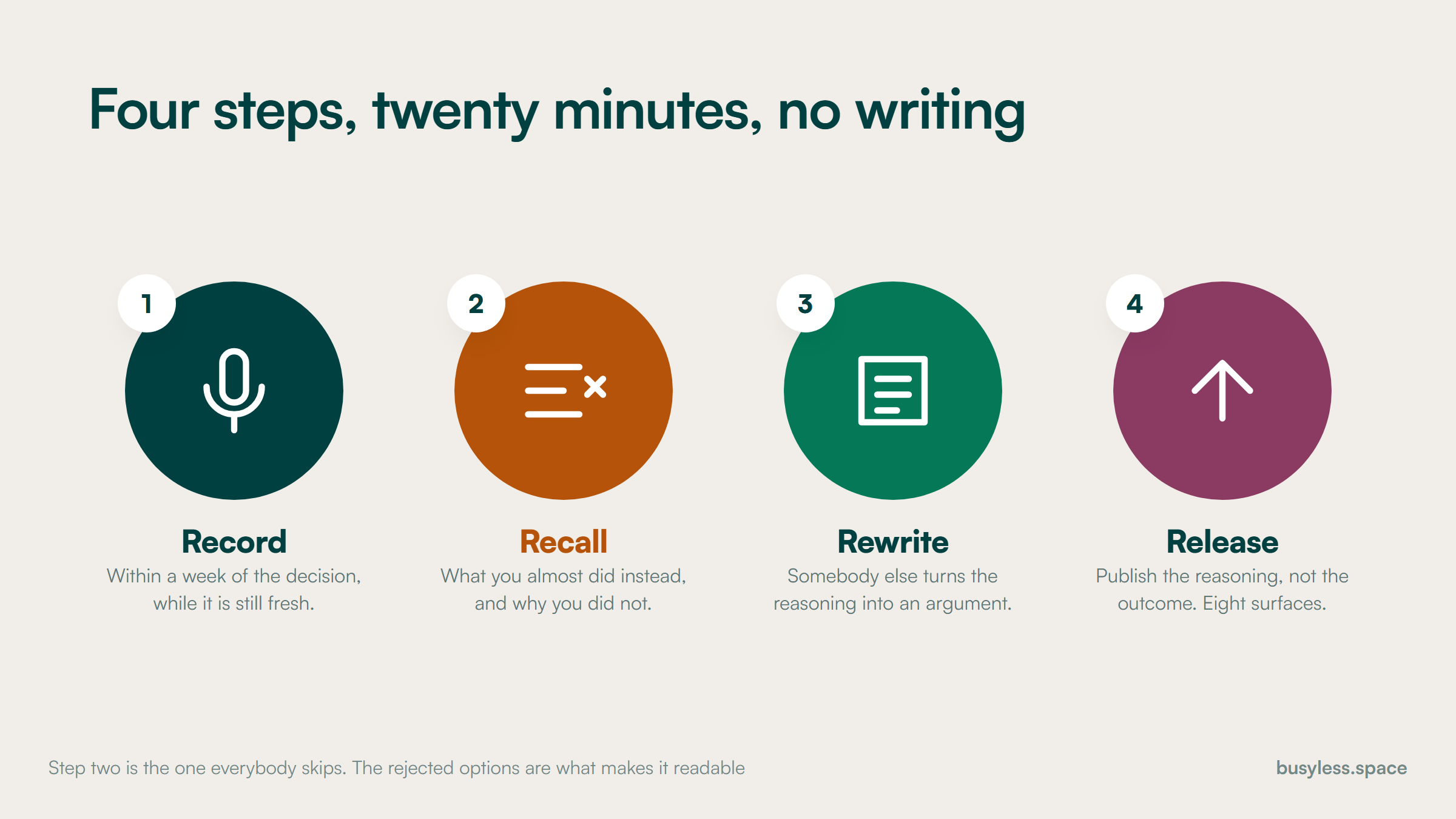
After any real decision, spend twenty minutes recording what you almost did instead and why you did not. Do it while it is fresh, because the alternatives disappear from memory within a month.
The customer calls you are already on
Held by Whoever is doing sales, which early is the founder
Verbatim language from people with the problem, at a stage when you are talking to them personally and nobody has yet abstracted them into a persona. Later this becomes a research project. Now it is a recording you were making anyway.
How to capture it
Record the calls, with consent, and keep a running list of the exact words people use for the problem. Those words are the copy.
What you tried that did not work
Held by Everyone, and nobody wants to publish it
The most trusted thing a startup can write and the rarest, because it costs something to say. Established companies cannot publish it at all, which makes it one of the few genuine advantages of being small.
How to capture it
Write it while it is still slightly painful. A post-mortem written six months later becomes a lesson, and the useful version is the specifics.
The thing you know because you are inside it
Held by The technical founder or the domain expert
Building something means learning how a market actually works at a level analysts do not reach. It is knowledge with no incentive to publish it, which is exactly why publishing it is a positioning move.
How to capture it
Ask what surprised you about this market that outsiders still get wrong. The answer is usually a piece, sometimes a series.
A number from your own market that nobody has counted
Held by Nobody yet, which is the point
Original data is how an unknown company gets cited by known ones. It has to be a survey of the market rather than an export from your product, because your customers' data is almost never yours to publish.
How to capture it
Run one small survey properly and publish the method with it. Two hundred honest answers beat a thousand you cannot explain.
Who actually makes it
Everything here runs through a person with four other jobs, so the engine is judged on a single question: what still happens when they disappear for six weeks. If the answer is nothing, you do not have a content system, you have a founder posting.
Founder as source and voice
The opinion, and the account it is published from
Scheduled rather than spontaneous, because spontaneous is what stops. Two of those hours are being recorded and two are posting in their own words.
4 hours
Editor or content lead
Turning recordings into everything else
The first content hire, and the mistake is hiring a writer rather than someone who can extract. Extraction is the scarce skill here.
20 to 40 hours
The second voice
Being credible without the founder
An engineer, a designer or the first customer-facing hire. Deliberately started in month three rather than in month twelve, which is the whole succession plan.
2 hours
Whoever owns the list
The newsletter, sent from the company
The only asset that survives everything else, and the first thing to lapse. Give it a name against it that is not the founder's.
3 hours
The honest cadenceTwo founder posts a week, one substantial piece a fortnight, one newsletter a month. It is a schedule designed to survive a bad month rather than to maximise a good one, which is the right trade at this stage.
One project, 8 surfaces
One twenty-minute recording about one decision becomes eight things, and the reason it matters more here than elsewhere is that the founder's time is bought once and spent eight times.
- 1
The founder's own post
20 minutesFrom: The sharpest thing said in the recording
Posted by the person, in their voice, and read by them before it goes. Edited into house style it stops working, which is a lesson most companies learn twice.
- 2
The written piece
3 hoursFrom: The whole reasoning, structured
The durable version, on your own domain, where it can be linked to and found later. This is the half that survives the handover.
- 3
A newsletter issue
30 minutesFrom: The same argument with a covering line
Sent from the company with the founder's name on it. That distinction is the succession plan in miniature and costs nothing to get right.
- 4
An answer in a community
15 minutesFrom: The part that answers a question people ask
Posted where the question was asked, as an answer rather than a link. A link with no answer attached reads as extraction and is treated as such.
- 5
A short demo clip
1 hourFrom: The moment the decision shows up in the product
Only where the decision is visible in the interface. Check what data is on screen before this goes anywhere, which is the fourth rule below.
- 6
The second voice's version
45 minutesFrom: The same decision from the engineer's angle
The deliberate duplication that builds a second credible account. It reads differently because they cared about different parts, which is the point.
- 7
Sales and investor material
IncludedFrom: The published reasoning, cited
The most undercounted return here. Published thinking in a deck is evidence rather than assertion, and nobody tells the content owner it was used.
- 8
The internal decision record
Nothing extraFrom: The raw recording, nothing removed
Genuinely useful at the point you hire people who were not there. It is also often what persuades a founder that twenty minutes is worth spending.
The buying cycle, and what content does at each stage
Attention here does not accumulate smoothly, it arrives in spikes tied to events and falls away between them. The launch, the raise and the release all produce one, and the number that matters is not the height of the spike but the level it settles to afterwards.
Nobody knows you exist
Months 0 to 6"Who is this and why should I read them?"
- What moves them
- A named person with an opinion, in places people already are
- How you know
- Replies from strangers, which is the first real signal available
A spike
Days, a few times a year"What is this thing everyone is talking about?"
- What moves them
- Something worth the attention: a launch, a number, a strong opinion
- How you know
- The size of the spike, which is the least useful number here
The decay
The 4 to 10 weeks after each spike"Nothing. They have moved on."
- What moves them
- Whatever you publish in a week when nothing is happening
- How you know
- The level it settles to, which is the number that actually matters
Someone has the problem
Unpredictable, months after first contact"Was there not a company doing exactly this?"
- What moves them
- Being findable by the problem rather than by the category
- How you know
- Branded search from people you never saw arrive
The evaluation
Weeks"Are these people going to still be here in two years?"
- What moves them
- A body of published thinking with dates on it
- How you know
- Enquiries that reference something specific you wrote
What you are allowed to publish
Two of the four below land on a founder's own account rather than on the company site, which is unusual and is exactly why they matter here. The sibling playbook already covers superlative claims, AI claims, investor reviews and the waitlist as a database, so none of those appear here.
If you are raising under 506(b), you may not post about the raise
SEC Regulation D, Rules 506(b) and 506(c), verified 2026-08-30
An offering relying on Rule 506(b) may not involve general solicitation or general advertising, and the issuer needs a pre-existing substantive relationship with an investor before the offering is discussed. A single public post describing the offering can contaminate it and disqualify the exemption. Rule 506(c) permits general solicitation, admits only accredited investors, and requires reasonable steps to verify accreditation rather than a self-certification.
So do thisDecide which exemption you are using before the raise starts, tell everyone who posts under the company's name or their own which one it is, and hold announcements until the round has closed. This is a starting point rather than advice; your counsel decides.
Your team posting about the product are endorsers
FTC Endorsement Guides, 16 CFR Part 255, revised June 2023
An employee who posts about their employer's product has a material connection to it, and where the audience would not otherwise know, that connection has to be disclosed clearly and conspicuously. Launch-day amplification, where everyone shares the same post, is the exact scenario the guides describe, and the obligation reaches the company rather than only the individual.
So do thisWrite one line into the launch checklist saying what people should say about working here, give them the wording, and make it normal rather than a compliance exercise. It also reads better than an undisclosed chorus does. Our higher-education and hotels playbooks apply the same guides to paid ambassadors and to hosted stays.
Naming a competitor turns an opinion into a claim
Lanham Act section 43(a) false advertising principles, reviewed 2026-08-30
Comparative marketing is permitted and it moves what you say into territory where a competitor has standing. Statements of fact about a named competitor's product, including performance comparisons and pricing claims, need to be substantiated and kept current, and a comparison page that was accurate at launch quietly stops being accurate as they ship.
So do thisKeep a dated record of the evidence behind every comparative claim, re-check comparison pages quarterly, and separate opinion from fact in the writing rather than blending them for impact.
Your demo is showing somebody's real data
Customer data-processing terms and confidentiality obligations, reviewed 2026-08-30
Screen recordings, product screenshots and launch videos are almost always captured from a working environment, and the working environment contains real accounts, real names and real numbers. This is the most common accidental disclosure a startup makes, and it happens on the highest-traffic asset the company has.
So do thisKeep a seeded demo account with invented data and record everything from it. Where that is impractical, have a second person review every frame before it is published rather than the person who recorded it.
None of this is legal advice. Rules vary by state and by contract, and the dates above are when each source was read. Check your own before you rely on any of it.
How to build content marketing for startups
Six months, and the second voice starts in month three rather than in month twelve. That is the only structural difference between this plan and the one every startup already runs, and it is the one that decides whether the programme survives its first bad quarter.
Start the person, and own the list
- Pick the one person who genuinely has opinions and get them posting twice a week
- Start the newsletter now, from a company address, at whatever size
- Find the three communities your users already use and start answering there
- Set up the seeded demo account before anybody records anything
Output A person posting, a list that exists, and a safe environment to film in
Turn twenty minutes into eight things
- Record one decision a fortnight, twenty minutes, including what was rejected
- Publish the first four written pieces on your own domain
- Start the verbatim list of how customers describe the problem
- Write the five pages answering the problem people search for today
Output Four durable pieces, and a repeatable route from a recording to a post
Start the second voice
- Pick the engineer or designer who will be the second credible account
- Publish their version of a decision the founder already covered
- Move the newsletter's named owner off the founder
- Agree the fundraising posting rule before you need it
Output Two people publishing, and a list that does not depend on one of them
Find out what the level is
- Measure the level between spikes rather than the height of them
- Ask every inbound enquiry what they had read, and write it down
- Publish one original number from a survey of your market
- Cut whichever channel produced nothing and say so plainly
Output An honest read on the baseline, which is the only number that compounds
Structured data for what you publish
The company, the product and the founder are marked up on the sibling playbook, which is where the entity belongs. These six describe what you publish, and one of them exists specifically because this page's first channel is a person posting in a public thread.
DiscussionForumPosting for a founder thread you host
A community or discussion page on your own domainUse it only for genuine discussion you host, which for most startups means a changelog thread, a public roadmap or a question page. A blog post dressed as a forum thread is exactly the abuse this type attracts, and it is easy to spot.
{
  "@context": "https://schema.org",
  "@type": "DiscussionForumPosting",
  "headline": "[THE QUESTION OR THE OPENING POST]",
  "url": "https://[YOUR-DOMAIN]/discuss/[SLUG]",
  "datePublished": "[YYYY-MM-DDTHH:MM+00:00]",
  "author": {
    "@type": "Person",
    "name": "[WHO POSTED IT]",
    "url": "https://[YOUR-DOMAIN]/team/[SLUG]"
  },
  "interactionStatistic": {
    "@type": "InteractionCounter",
    "interactionType": "https://schema.org/CommentAction",
    "userInteractionCount": "[NUMBER OF REPLIES]"
  },
  "isPartOf": {
    "@type": "WebSite",
    "url": "https://[YOUR-DOMAIN]"
  }
}
VideoObject for a product demo
The page the demo sits on, usually the product pageThe one asset that proves the thing exists. Before publishing, check the rule above about what is on screen, because a demo is the highest-traffic place a startup accidentally discloses a customer's data.
{
  "@context": "https://schema.org",
  "@type": "VideoObject",
  "name": "[WHAT THE DEMO SHOWS]",
  "description": "[WHAT SOMEBODY UNDERSTANDS AFTERWARDS]",
  "thumbnailUrl": "https://[YOUR-DOMAIN]/images/[FILE].jpg",
  "uploadDate": "[YYYY-MM-DD]",
  "duration": "PT[M]M[S]S",
  "contentUrl": "https://[YOUR-DOMAIN]/video/[FILE].mp4",
  "embedUrl": "https://[YOUR-DOMAIN]/[PAGE-SLUG]",
  "publisher": {
    "@type": "Organization",
    "name": "[COMPANY NAME]",
    "url": "https://[YOUR-DOMAIN]"
  }
}
Dataset for original research
The page publishing a survey or a dataset you producedThe type that makes original research citable, which is the entire reason an unknown company runs a survey. State the sample size and the method in the description, because the citation you want comes from people who checked.
{
  "@context": "https://schema.org",
  "@type": "Dataset",
  "name": "[STUDY OR DATASET TITLE]",
  "description": "[WHAT WAS MEASURED, SAMPLE SIZE, METHOD]",
  "url": "https://[YOUR-DOMAIN]/research/[SLUG]",
  "datePublished": "[YYYY-MM-DD]",
  "creator": {
    "@type": "Organization",
    "name": "[COMPANY NAME]",
    "url": "https://[YOUR-DOMAIN]"
  },
  "license": "[URL OF YOUR LICENCE, e.g. CC BY 4.0]",
  "distribution": {
    "@type": "DataDownload",
    "encodingFormat": "text/csv",
    "contentUrl": "https://[YOUR-DOMAIN]/research/[SLUG].csv"
  },
  "temporalCoverage": "[YYYY-MM/YYYY-MM]"
}
NewsArticle for a launch or a milestone
Your own news or changelog pageFor genuinely dated announcements only. Note the fundraising rule above before publishing anything about a round: the schema is not the problem, the announcement might be, and it needs to wait until the round has closed.
{
  "@context": "https://schema.org",
  "@type": "NewsArticle",
  "headline": "[HEADLINE]",
  "url": "https://[YOUR-DOMAIN]/news/[SLUG]",
  "datePublished": "[YYYY-MM-DD]",
  "dateModified": "[YYYY-MM-DD]",
  "author": {
    "@type": "Person",
    "name": "[WHO WROTE IT]"
  },
  "publisher": {
    "@type": "Organization",
    "name": "[COMPANY NAME]",
    "url": "https://[YOUR-DOMAIN]"
  }
}
Event for a webinar or a live session
The listing page for anything you run liveWorth emitting for a live session with a founder, which is one of the few formats where the person-dependent channel produces something with a URL. Say whether it will be recorded, because most of the value arrives after the event.
{
  "@context": "https://schema.org",
  "@type": "Event",
  "name": "[SESSION TITLE]",
  "description": "[WHAT SOMEBODY GETS BY ATTENDING]",
  "startDate": "[YYYY-MM-DDTHH:MM+00:00]",
  "endDate": "[YYYY-MM-DDTHH:MM+00:00]",
  "eventAttendanceMode": "https://schema.org/OnlineEventAttendanceMode",
  "eventStatus": "https://schema.org/EventScheduled",
  "location": {
    "@type": "VirtualLocation",
    "url": "https://[YOUR-DOMAIN]/live/[SLUG]"
  },
  "organizer": {
    "@type": "Organization",
    "name": "[COMPANY NAME]",
    "url": "https://[YOUR-DOMAIN]"
  },
  "performer": {
    "@type": "Person",
    "name": "[WHO IS SPEAKING]"
  },
  "isAccessibleForFree": true
}
ImageObject for product and team imagery
Screenshots, diagrams and team photographyScreenshots travel further than any other asset a startup makes, ending up in other people's decks and articles. Stating the licence once is what turns that into a benefit rather than a series of emails asking permission.
{
  "@context": "https://schema.org",
  "@type": "ImageObject",
  "contentUrl": "https://[YOUR-DOMAIN]/images/[FILE].png",
  "name": "[WHAT THE IMAGE SHOWS]",
  "caption": "[CONTEXT SOMEBODY REUSING IT WOULD NEED]",
  "creditText": "[COMPANY NAME]",
  "copyrightNotice": "(c) [YEAR] [COMPANY NAME]",
  "license": "[URL OF YOUR PRESS OR BRAND TERMS]",
  "acquireLicensePage": "https://[YOUR-DOMAIN]/press"
}
What to automate, and where the line is
Automation matters here more than on most pages, because the whole engine runs on one person's four hours a month. Everything that can be moved off those four hours should be. The line sits at the voice: an agent may prepare and repurpose, and may not be the person.
- automate
Transcribing decision recordings and customer calls
Pure throughput, and it is what turns twenty minutes of founder time into material several people can work from.
- automate
Pulling verbatim problem language out of call transcripts
Mechanical and genuinely useful. The words customers actually use are the copy, and finding them by hand across fifty calls is why nobody does it.
- automate
Monitoring the communities for questions you should answer
A watching job that returns hours. Answering is a person's job; noticing does not have to be.
- assist
Drafting the written piece from a recording
Good at structure and at removing repetition. Consistently wrong about which rejected option was the interesting one, and that is usually the piece.
- assist
Turning one piece into the other seven surfaces
This is where the leverage is. It produces a usable first version of each, and each still needs a person to make it sound like it belongs where it is going.
- assist
Keeping comparison pages current against competitor releases
Flagging that a competitor shipped something your page contradicts is mechanical and valuable. Changing a comparative claim is a substantiation decision with a name against it.
- never
Posting in the founder's voice
The channel works because a real person has an opinion. A generated version of that has no opinion, and the audience for founder-led content is unusually good at telling.
- never
Answering in a community on the company's behalf
Communities you did not build are joined on their terms, and an automated answer is the fastest way to be removed from one permanently.
What it costs
Low by the standards of this directory, and judgements rather than quotes, because the scarce input here is four hours of one person's attention rather than money. What moves the number most is whether the extraction is done in-house or bought.
Do it yourself
$0 to $300- A founder posting twice a week in their own account
- A newsletter sent from the company at whatever size it is
- Answering in three communities you did not build
- One recorded decision a fortnight, written up by whoever has time
- Suits
- Pre-revenue and pre-seed, where the founder is genuinely the whole company
- Ceiling
- The write-up is what stops. Recordings accumulate, nobody turns them into anything, and after two months the company concludes content does not work rather than that extraction was never staffed.
Lean
$1,000 to $3,000- Someone whose job is turning recordings into everything else
- One durable written piece a fortnight on your own domain
- The second voice started properly rather than hoped for
- The five search pages answering today's problem
- Suits
- Seed stage with early customers and a founder still doing sales
- Ceiling
- Original research and video sit outside it, and so does covering more than one audience, because a second audience needs its own community presence rather than a share of the first.
Funded
$3,000 to $6,000- A content lead rather than a freelancer
- One original survey a year, published with its method
- Video treated as product proof rather than as an experiment
- Search worked properly on the problem rather than the category
- Suits
- Series A, where the founder's time is about to become genuinely unavailable
- Ceiling
- Founder availability rather than money, and this is the tier where that stops being a joke. The handover either happened in month three or it is now an emergency.
Enterprise
$6,000 and up- Several named voices publishing rather than one
- Research as a repeatable programme with a calendar
- A community you are resourced to actually run
- Content that supports sales rather than only awareness
- Suits
- Post Series A, where the category is real and competitors have noticed
- Ceiling
- At this point the constraints stop being startup constraints, and the right page is the b2b-saas or b2b playbook rather than this one.
How to do it with no budget
Seven steps that need no budget and roughly four hours of founder time a month. The third is the one that separates a programme that survives from one that does not.
- 1
Pick the person and give them two slots a week
A calendar · 30 minutes to decide
Scheduled beats spontaneous, because spontaneous is exactly what stops when something urgent happens.
- 2
Start the newsletter today, from a company address
Any free newsletter tool · 1 hour
At eleven subscribers if that is what you have. It is the only asset here that survives everything else.
- 3
Name the second voice now
One decision · 20 minutes
In month three, not month twelve. This single choice is the difference between a channel and a dependency.
- 4
Record one decision, including what you rejected
A phone voice memo · 20 minutes
The rejected options are the content. They also disappear from memory within about a month.
- 5
Set up a seeded demo account
Your own product · 2 hours
Invented data, invented names. Do it before anybody records anything rather than after the first accidental disclosure.
- 6
Answer in three communities for a month without pitching
The communities your users already use · 20 minutes a day
You are earning the right to be there. A month of useful answers buys more than any launch post.
- 7
Ask every inbound enquiry what they had read
One question in the first reply · Nothing
At this stage the sample is small enough that you can genuinely read all of it, which will not be true later.
The tool stack
Chosen throughout for a company that cannot afford to run two of anything. Rows linking into our other directories go to the researched review rather than to the vendor.
Own the list from day one
The decision that matters is sending from a company address rather than a personal one. It costs nothing now and is the whole succession plan later.
Free option: Free well past the size most startups reach in year one
Publish on your own domain rather than only on a platform
The durable half of this page's argument needs a domain you control. A platform post is distribution; a page you own is the asset that survives the handover.
Free option: Open source, self-hosted, and free at this scale
See what people search for before your category has a name
Point it at the problem language from your customer calls rather than at the category name, which is the mistake the sibling playbook is largely about.
Free option: Search Console, once you rank for anything at all
Check whether assistants mention you at all yet
Early on the honest answer is usually no, and knowing when that changes is a better signal of category traction than most things you can buy.
Free option: Run the same category question past each assistant monthly and log it
Watch the communities without living in them
Noticing can be automated and answering cannot. The value is in not having to read everything to find the one thread worth a reply.
Free option: Saved searches and email alerts on the three places that matter
Keep the verbatim problem language somewhere findable
One line per phrase, with which customer said it. This becomes your copy, your page titles and eventually your positioning.
Free option: Free, and a document genuinely beats software here
Model what the programme needs to return
Worth running against the lean tier rather than an aspirational one, because the honest question is how few customers make this worth continuing.
Free option: Free
Sanity-check the budget against founder hours
The binding input is the four hours a month, not the money. Run it against that and the affordable cadence falls out.
Free option: Free
Take it from here
Everything below is meant to be copied and filled in. Bodies are plain text, so what you see is exactly what lands on your clipboard.
Written in month one, used in month eighteen. The document this whole page exists to produce.
FOUNDER CHANNEL HANDOVER PLAN
Company: [COMPANY NAME]
Written: [YYYY-MM-DD]     Owner: [NAME, NOT THE FOUNDER]
Review: every [6] months

WHY THIS EXISTS
Our distribution currently depends on one person's personal
account. That is the right choice today and it has a single
point of failure. This document is what we do about it, and
it is written now because it cannot be written later.

WHAT IS ATTACHED TO THE PERSON (DOES NOT TRANSFER)
[ ] The followers on [PLATFORM]:        [N]
[ ] The reply and DM relationships
[ ] Speaking and podcast invitations
[ ] The trust, which is the actual asset

WHAT IS OWNED BY THE COMPANY (TRANSFERS)
[ ] The domain and everything published on it
[ ] The newsletter list:                [N] subscribers
    Sent from: [COMPANY ADDRESS - CHECK THIS TODAY]
    Named owner: [NOT THE FOUNDER]
[ ] The archive of written pieces:      [N]
[ ] The community reputation, partially

THE SECOND VOICE
Name: [ ]           Role: [ ]
Started publishing: [YYYY-MM-DD]
Pieces published:   [N]
Target: [1] piece a month by [YYYY-MM-DD]

  [IF THIS SECTION IS EMPTY AFTER MONTH THREE, THAT IS THE
   FINDING. NOTHING ELSE IN THIS DOCUMENT MATTERS AS MUCH.]

TRIGGERS THAT START THE HANDOVER
[ ] A fundraise opens
[ ] The founder moves to full-time sales or hiring
[ ] Founder output drops below [1] post a week for [3] weeks
[ ] Any of us reads this and cannot remember the last post

WHAT HAPPENS WHEN A TRIGGER FIRES
1. The second voice goes to [2] pieces a month
2. The newsletter continues on schedule, unchanged, under
   [NAMED OWNER]
3. Written pieces continue on the domain
4. The founder's account goes quiet rather than being
   handed to somebody else to write in
   [DO NOT GHOSTWRITE THE PERSONAL ACCOUNT. THE AUDIENCE
    NOTICES AND IT COSTS MORE THAN SILENCE DOES.]

WHAT WE WILL NOT DO
- Ask followers to move to the company account
- Republish the founder's archive under a company byline
- Pretend the reach is the same and report it as such

SIGNED
Founder: [ ]              Date: [YYYY-MM-DD]
Owner: [ ] Date: [YYYY-MM-DD]The expensive mistakes
Building the whole channel on one person with no succession
What it costs: The programme stops in the week that person gets busy, and is blamed six months later
Name the second voice in month three and publish them alongside the founder. It costs two hours a month and it is the difference between a channel and a dependency.
Moving the audience to a company account
What it costs: A fraction of the reach, almost none of the replies, and a conclusion that the audience was fake
Accept that the audience does not transfer, and build the things that do: the domain, the list, the archive and a second named person.
Posting about the raise while it is open
What it costs: A potential problem with the exemption, on the channel this page rates first
Agree the rule before the round opens, tell everyone who posts, and hold the announcement until it has closed.
Recording the demo from the live environment
What it costs: A customer's real data on your highest-traffic asset
Keep a seeded demo account with invented data, and have somebody other than the recorder check every frame.
Building a community before you have customers
What it costs: An empty space that signals the opposite of traction, and months of maintaining it
Join the three communities that already exist and be useful in them. Build your own only when people are already talking to each other about you.
Measuring the spike instead of the level
What it costs: A launch that looks like success, followed by a quarter that looks like failure
Track where attention settles between events. That baseline is the only number here that compounds and the only one worth reporting to a board.
What to measure
Measuring startup content marketing is mostly a matter of not being fooled by your own launches. Attention arrives in spikes, every spike looks like progress, and the number that predicts anything is the level between them. What follows separates the two, and is honest that at this stage the sample is small enough that judgement does real work.
Leading indicators
Baseline reach between spikes
Your platform analytics, averaged over the quiet weeks
The single most useful number on this page. Deliberately excludes launch weeks, because including them makes every quarter with an event look better than it was.
Replies and messages from strangers
The founder's own account
The first real signal a founder-led channel produces, and it arrives long before anything else. Count conversations rather than impressions.
Newsletter subscribers, and where they came from
Your list tool
The asset that survives the handover, so its growth rate matters more than its size. A list growing only during launches is not compounding.
Pieces published by somebody other than the founder
Your own record
An operational metric that predicts survival. Zero here after six months means the programme has one point of failure and everybody has agreed not to mention it.
Business indicators
Inbound enquiries referencing something specific
Ask in the first reply, and write it down
At this stage you can read every one of these, which will not be true later. Take the advantage while it exists.
Branded search volume
Search Console, branded queries only
People looking for you by name are people who encountered you somewhere and did not act at the time. It is the closest thing here to a memory metric.
Pipeline where the first touch was content
Your CRM, filled in honestly rather than automatically
Worth recording even though it is unreliable, because at this volume the qualitative pattern is visible and useful long before the data would be significant.
Inbound hires and inbound partnerships
Whoever handles both
Consistently undercounted, and at this stage a strong hire attributable to a founder's writing can be worth more than several customers.
The verdict
Content marketing for startups works better than it does for almost anybody else, for one narrow window, and the window closes without warning. A named person with an opinion beats a company with a blog, until the day that person has something more urgent to do, which is a certainty rather than a risk.
So the interesting question is not which channel to start with. It is what you are building that does not have the founder's name on it, and the honest answer for most startups at month six is nothing at all.
I would be wary of buying startup content marketing services from anybody whose proposal does not mention the handover, or who wants to move the founder's audience onto a company account. Both are signs they have not watched this fail before.
The honest summary is that content marketing services for startups are worth buying when what they mainly supply is extraction, turning four hours of a founder's month into eight things. They are worth very little when what they supply is writing, because writing was never the part you were short of.
FAQ
Startup content marketing questions
Should we post from the founder's account or the company's?
The founder's, while they are available, because it works far better and there is no honest argument otherwise. The mistake is not choosing it, it is failing to build anything else alongside. Own the domain, own the list, and name a second person in month three rather than month twelve.Can we post about our funding round?
Not while an offering under Rule 506(b) is open, because general solicitation is prohibited and a single public post can contaminate the exemption. Rule 506(c) permits it but admits only accredited investors and requires you to verify accreditation. Decide which applies before the round opens and tell everyone who posts.How much founder time does this really take?
About four hours a month: two being recorded, two posting in their own words. Anything more will be the first thing cut in a difficult quarter. What that time buys depends entirely on whether somebody else is doing the extraction, which is the part to spend money on.Should we build our own community?
Not before you have customers who already talk to each other. An empty community signals the opposite of what you want, and maintaining it costs the attention the first three channels need. Join the three places your users already gather and be useful there for a month first.Is search worth starting this early?
Worth starting, not worth expecting anything from for two or three quarters. Write the five pages answering the problem people search for today rather than the category name you would like them to search for. It is the only channel here that compounds, which is why it is worth beginning before it pays.What do we do when the founder stops posting?
Whatever you set up beforehand, because there is very little to do afterwards. The audience does not transfer to a company account. What carries forward is the domain, the archive, the newsletter list and any second voice you had already established, which is the argument for starting all four early.What does this cost at pre-seed and seed?
There is no standard package, and the useful question is what you are buying rather than what it costs. An engagement starts with a Discovery and then a monthly retainer. The budget section gives honest bands for running it in-house or with help, and $1,000 to $6,000 a month is the realistic range at this stage.What tells us early on whether this is working?
Watch the level between launches rather than the launches. Replies from strangers, newsletter growth in quiet weeks, and enquiries that reference something specific you wrote are the three signals that arrive first. The sample is small enough that you can read all of it, which is an advantage worth using.Should a startup hire an agency for this?
Not for the founder's half. A content marketing agency for startups can produce and distribute, but the credibility comes from a named person who was in the room when the decision was made. Buy the production and keep the byline.How do we make this survive a pivot?
By keeping the writing about the problem rather than the product. Content marketing strategies for startups that publish the category name accumulate nothing when the category changes. A content marketing strategy for startups should be portable, and the content marketing tips for startups worth following all cost attention rather than money.
Run it yourself, or have someone own it
Everything above is written to be run without us, and the free path is genuinely most of the value for a small practice. Where these plans stall is almost never the plan. It is that the person holding the material has a day job and nobody owns the programme after the first month. That is the job we do.