
Content marketing for SaaS
Regulated marketingThe buyer is not the user, and only one is reachable
- Sector
- Software and tech
- Channels
- Search, Community, Founder-led social
- Buying cycle
- Medium cycle
- Time to compound
- 6 to 12 months
- Typical monthly
- $5,000 to $25,000
Key takeaways
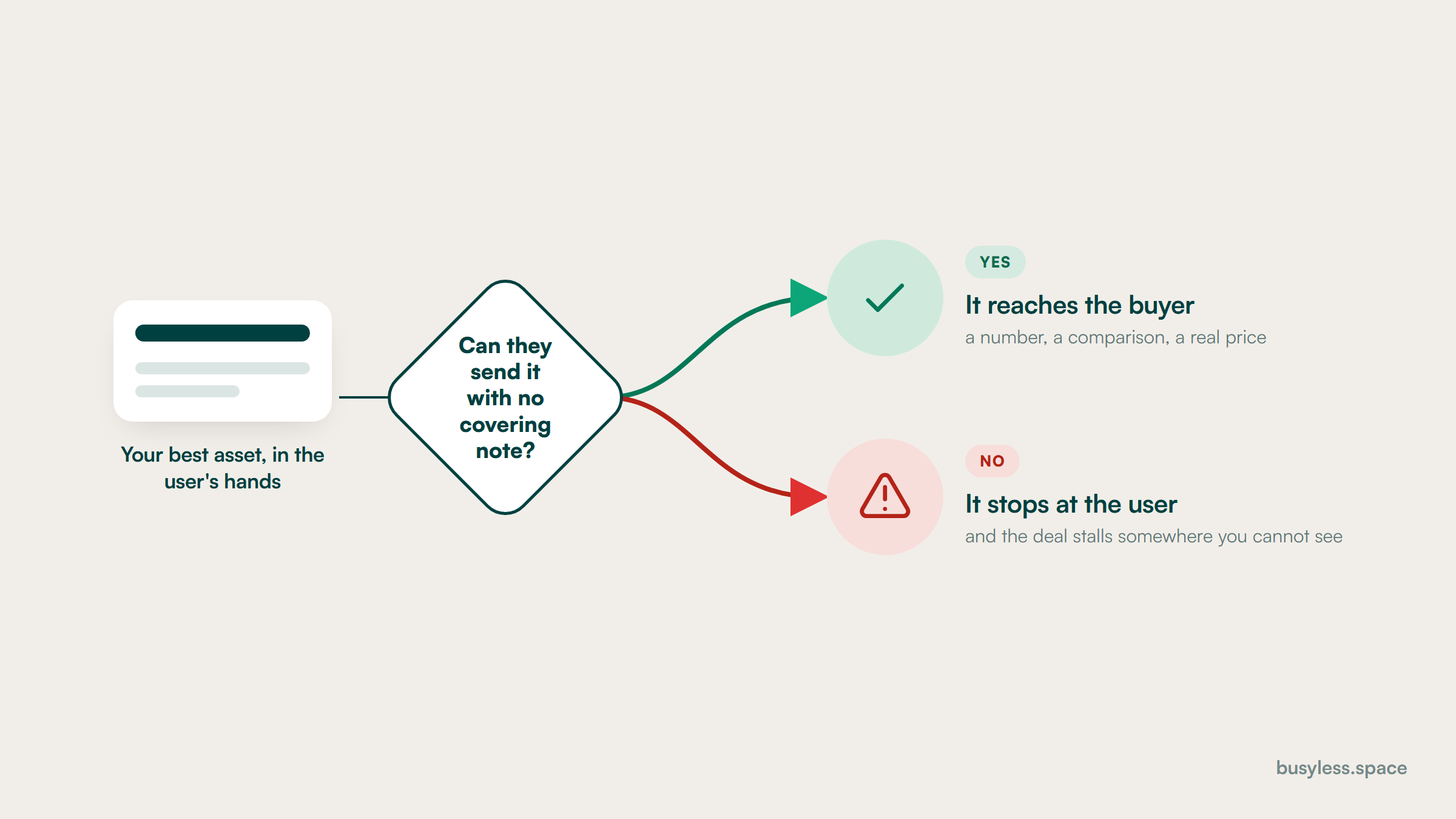
- 1Write for the user, arm them for the buyer. The person you can reach is rarely the person who signs, so the most valuable asset is usually the one an internal champion can forward without editing.
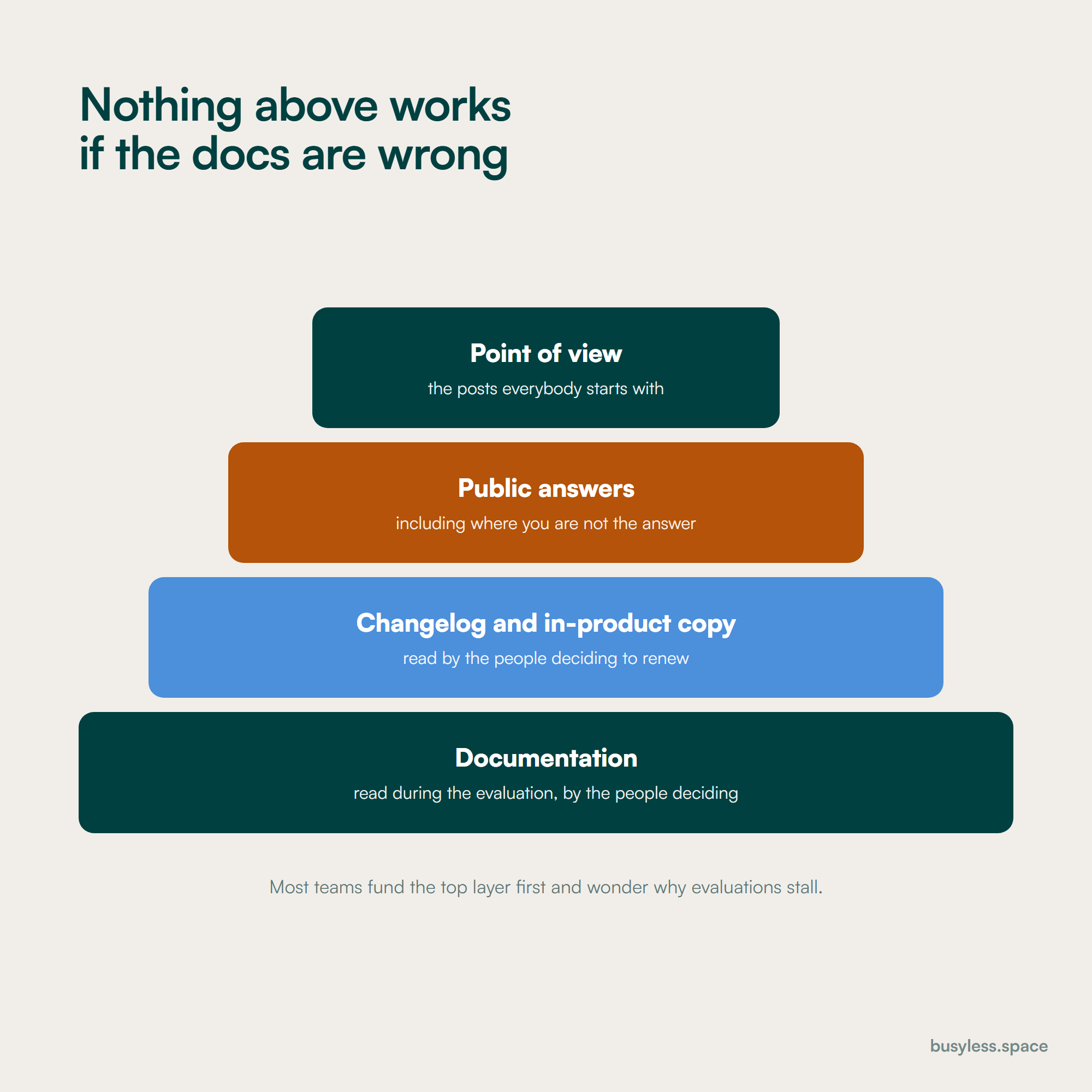
- 2Your docs are content, and they are probably your best content. Documentation, changelog and in-product copy get read more carefully than anything on your blog, by exactly the people who decide whether to renew.
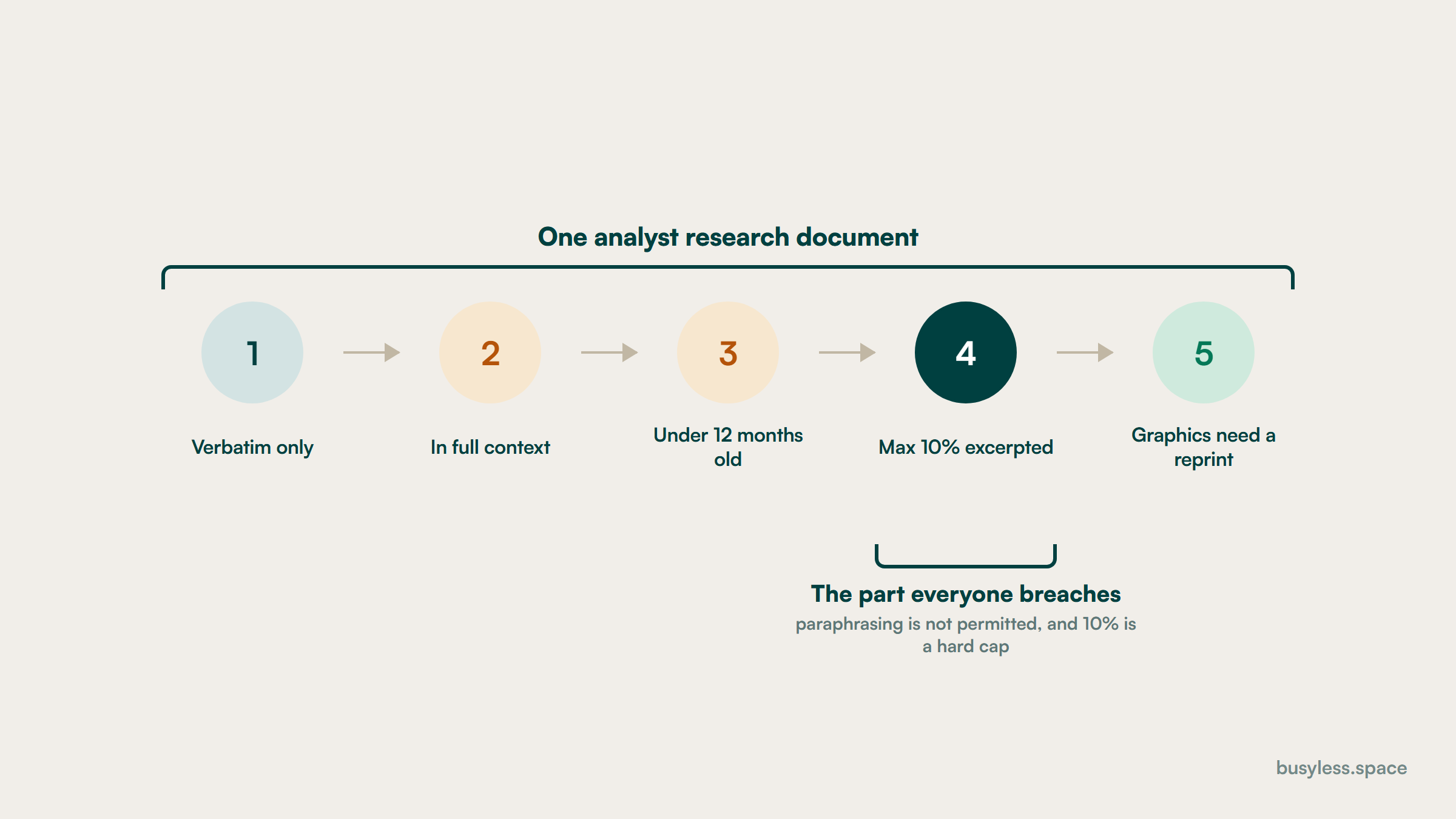
- 3Analyst citation is a contract, not a compliment. Gartner's policy requires verbatim quotes, research under twelve months old, no more than 10% of a document, and a purchased reprint for any Magic Quadrant graphic.
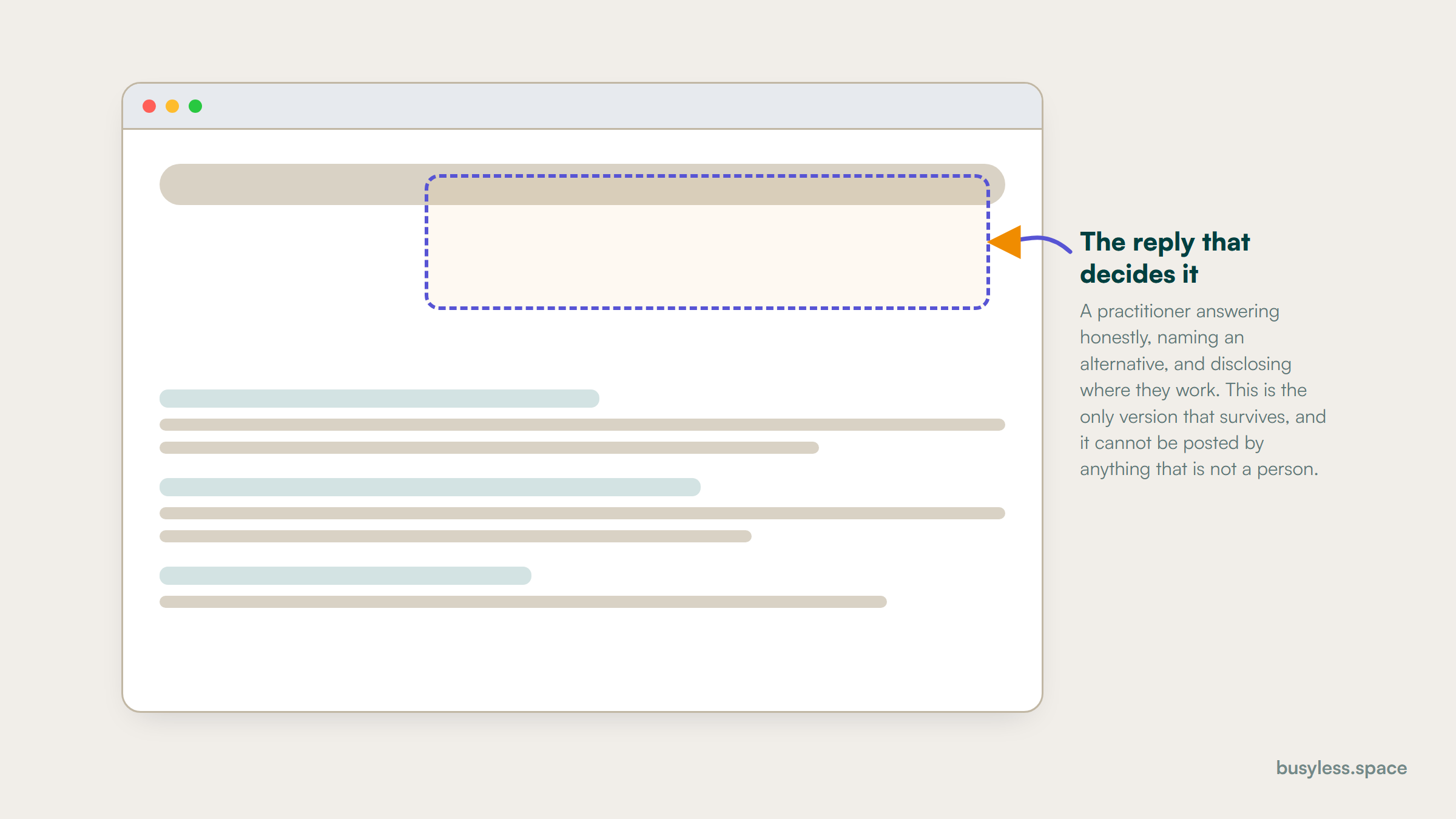
- 4Community is where your category is evaluated out loud. Practitioners discuss tools candidly in places you cannot control, and the cost of entry is being useful without pitching for about six months.
- 5The measurement problem is structural, not a tooling gap. Self-serve signups, sales-led deals and product-led expansion credit content completely differently, and a single attribution model will flatter one and starve the other.
Content marketing for SaaS has an audience problem that most other industries do not. The person who feels the pain, searches for a fix and reads what you publish is usually not the person who signs the contract. They are an analyst, an engineer, an ops lead. The signature belongs to a director or a VP who will read almost nothing you write.
So the reachable audience and the deciding audience are different people, and only one of them is addressable through a channel you control. That is not a funnel problem to be solved with more middle-of-funnel content. It is a structural fact that decides what every asset is for.
It is worth separating this from the other two-audience problem in this directory. Our recruitment playbook has two audiences who are both reachable, in the same feed, and who want opposite things. Here the difficulty is the opposite one: the two want the same outcome and only one of them will ever read you.
The useful reframe is that you are not trying to persuade the buyer. You are trying to arm the user to persuade the buyer, in a meeting you will not attend, using material they can forward without having to explain or apologise for it. That is a different brief from anything a keyword tool will give you.
A SaaS content marketing strategy therefore has two jobs running in parallel. Be genuinely useful to practitioners, in the places practitioners actually are. And produce a small number of assets that survive being forwarded upward, which usually means numbers, comparisons and something that looks like it came from outside the marketing department.
Looking for the search half
This page decides which channels to run. The one next door goes deep on just one of them.
Which channels to run, and which to skip
Judged for a market where your reader and your buyer are different people. Three to staff, three worth a real test, and two that look obvious in software and reliably disappoint.
Run these
Search
RunStill the first channel here, because practitioners genuinely search for the problem your product solves and because the intent is unusually legible. The trap is that the head terms in most SaaS categories are owned by review platforms and by competitors with a decade of domain history, so the winnable ground is the specific problem rather than the category name.
First moveTake the ten questions your support queue answers most and publish the real answer to each, including the parts where your product is not the answer. The full search playbook is on the sibling page.
Community
RunA first-tier channel here, and for a different reason than on the small-business playbook, which also runs it. There the job is borrowing a local audience you do not have. Here the audience exists and is already comparing tools candidly in a Slack, a subreddit or a professional forum. Being a known useful presence in two of those is worth more than a year of blog posts, and it is the only place you hear objections in the wild.
First movePick the two places your users actually are. Show up as a named person, answer questions that have nothing to do with your product, and do not mention it for the first two months.
Founder-led social
RunLinkedIn and X reach practitioners and, unusually, sometimes reach the buyer too, because software buyers are online in a way that hotel owners and architects are not. It works when a named person with a real job posts a real opinion, and it fails as a company account posting product news. Treat it as a distribution channel for opinions, not for links.
First moveHave one person who actually builds or supports the product post one specific thing they learned each week, in their own account and their own words.
Worth a test, with a kill date
Original research
TestThe asset most likely to survive being forwarded to the buyer, because a number from a study reads differently from a claim in a brochure. You are also unusually well placed to produce it, since you can query your own product for patterns nobody else can see. The test is whether your sample is large enough and whether you can publish it without exposing individual customers.
First moveFind one aggregate in your own telemetry that would be genuinely interesting to somebody who is not a customer, and check whether it can be published without any account being identifiable.
Newsletter
TestWorth testing here for a specific reason: it is the only channel that reaches somebody after they have churned or after a deal died. In a category with long evaluation cycles and frequent re-evaluations, a list of people who once looked at you is a real asset. It fails when it becomes a product-update digest.
First moveSend one genuinely useful thing a month to everybody who ever started a trial, including the ones who left, and measure replies rather than clicks.
Video
TestNarrowly, and not as a brand channel. A three-minute recording of the product doing the specific thing somebody asked about converts better than any written page, and a recorded conference talk has a long tail. A produced brand film has neither of those properties and costs more than both.
First moveRecord the demo you already give, once, in segments of under four minutes each, and attach the right segment to the right page.
Skip these
Trade press
SkipThe technology trade press covers funding, acquisitions and outages. It does not meaningfully cover what your product does, and the coverage that is available is usually paid placement wearing an editorial jacket. Analyst relations is the thing people mean when they say press here, and that is a different discipline with its own contract, described in the rules section below.
Events and talks
SkipSponsoring a category conference is the most reliable way to spend a quarter of the budget on branded lanyards. The exception is speaking, which belongs to the social and community channels rather than to an events line, because what makes it work is the named person rather than the venue. If a conference talk is genuinely the goal, fund the person, not the booth.
Search and community reach the user, social reaches both if a real person is doing it, and research is the thing the user forwards upward. Nothing on this list reaches the buyer directly, which is the point rather than a gap in the plan.
What you already own that nobody can copy
A software company sits on a great deal of usable raw material and publishes the least interesting parts of it. Everything below already exists inside the product or the support queue.
Aggregate product telemetry
Held by Whoever can query the production database
Nobody outside the company can see how long a task actually takes, how often a workflow is abandoned, or what the median customer configuration looks like. Aggregated properly it is original research nobody can replicate, and it is the asset most likely to be forwarded to a buyer because it reads as fact rather than as marketing.
How to capture it
One query a quarter against a question you would want answered if you did not work here. Aggregate first, check that no single account is identifiable, then decide whether it is interesting.
The support queue
Held by The support team, in a ticketing system
A live record of exactly what your users cannot do and cannot find, in their own words. It is a better content brief than any keyword tool, because it contains the questions people are too embarrassed to search for and the ones that have no search volume because nobody has named the problem yet.
How to capture it
Export the top fifty ticket subjects each quarter and tag them: fixable in docs, fixable in product, or genuinely a piece of writing. Most of them are the first two, and that is useful too.
The lost deal reasons
Held by Sales, in a CRM field nobody reads
The objections that actually kill deals, as opposed to the ones marketing imagines. This is the material that tells you what the buyer needs and the user cannot supply, which is the exact gap this playbook exists to close.
How to capture it
Read the last forty closed-lost records and write down the reason in the words the prospect used. Do not let it be summarised into a picklist value.
The engineering decision
Held by Whoever made it
Why the product works the way it does, including the tradeoff that was accepted. Practitioners find this genuinely interesting, it is the most credible thing an engineering-led company can publish, and no competitor can write it because they did not make the decision.
How to capture it
A 30-minute conversation after any significant architectural choice. One question: what did we give up to get this.
The migration story
Held by Onboarding and implementation
What actually happens when somebody moves off the incumbent, including how long it really took and what went wrong. This is the single most-wanted piece of information in an evaluation and almost nobody publishes it honestly.
How to capture it
Ask the implementation lead for the last five migrations: what surprised us, what took longer than we said, and what we would tell somebody starting next week.
Who actually makes it
The bottleneck here is not writing capacity, it is access to people who know how the product works. Engineering and support hold the material and neither reports to marketing, which makes this an organisational problem before it is a content one.
A named practitioner voice
Opinions, and the social account that carries them
Usually a founder, a solutions engineer or a head of support. It has to be somebody who genuinely knows the work, because the audience is other practitioners and they can tell within two sentences.
4 hours
Support or engineering source
Technical accuracy and the answer to what actually happens
Interviewed and consulted, not writing. Their scarce contribution is knowing which of three plausible answers is the true one.
3 hours
Writer or content lead
Everything that ships, and the calendar
This is the one industry in the directory where an in-house writer usually beats an agency, because the material is technical and the feedback loop with engineering has to be short.
Full time, or a serious contractor
Data access
The telemetry query, and the check that nothing identifies an account
Often the reason research never happens. Somebody with database access has to care, and that is a staffing decision rather than a content one.
3 hours per research piece
The honest cadenceOne SUBSTANTIVE piece a week, which most industries cannot sustain because they run out of things to say. Here the support queue refills overnight. One research piece a quarter is the harder commitment and the more valuable one.
One project, 9 surfaces
One support pattern becomes nine things, and three of the surfaces below are ones only a software company has. Docs and changelog are content, and treating them as engineering output rather than as publishing is the most common structural mistake here.
- 1
Documentation page
1 hourFrom: The support answer, made permanent
FIRST, before anything public-facing. If the answer belongs in docs and you wrote a blog post instead, you have created a second place for the truth to go stale.
- 2
The public answer
2 hoursFrom: The same question, answered for somebody who is not a customer yet
Deliberately a different piece from the docs page. It includes the part where your product is not the answer, which is what makes it credible.
- 3
Changelog entry
20 minutesFrom: The fix, if the answer was a product change
Read far more carefully than the blog by exactly the people deciding whether to renew. Write it for a human, not as a commit message.
- 4
In-product help text
30 minutesFrom: The same answer, at the moment of confusion
The highest-leverage words a SaaS company writes and almost never a marketing responsibility, which is why they are usually terrible.
- 5
Community reply
15 minutesFrom: The answer, without the product
Answering the question where it was asked, publicly, without pitching. This is what buys the right to be present at all.
- 6
A practitioner's social post
20 minutesFrom: The surprising part of the answer
Posted by the person who knows it, in their own account. The company account version of this post does not work and never has.
- 7
Demo segment
30 minutesFrom: The product doing the thing, recorded once
Under four minutes, attached to the page where the question gets asked. Repurposing, not a video channel.
- 8
Sales enablement note
30 minutesFrom: The objection underneath the question
The bridge to the buyer. If a question comes up in support fifty times, it is coming up in deals too, and sales is answering it inconsistently.
- 9
Quarterly research input
AccumulatesFrom: The pattern, once it has happened enough times
The support queue is where research questions come from. A thing you answer weekly is a thing worth counting.
The buying cycle, and what content does at each stage
Weeks to months, running on two tracks that meet only at the end. The user's track is exploratory and mostly invisible to you; the buyer's track is short, late and decided in meetings you are not in.
The practitioner has a problem
Ongoing"How do other people handle this?"
- What moves them
- The honest answer, including when the answer is not a product
- How you know
- Support-shaped questions arriving from non-customers
Quiet evaluation
2 weeks to 6 months"Would this actually work for our setup?"
- What moves them
- Docs, pricing that is legible, and a real migration account
- How you know
- Documentation traffic from companies with no account
Building the internal case
2 to 8 weeks"How do I justify this to someone who has not felt the pain?"
- What moves them
- Research, numbers and a comparison they can forward unedited
- How you know
- Requests for a one-pager, a deck, or something for my manager
The buyer looks, briefly
Days"Is this a real company and is this a defensible choice?"
- What moves them
- Analyst mentions, customer names, security and status pages
- How you know
- Procurement and security questionnaires arriving early
Expansion or churn
Continuous after signature"Are we getting more out of this than we were?"
- What moves them
- Changelog, docs and in-product copy
- How you know
- Feature adoption moving without a campaign behind it
What you are allowed to publish
Two of the four rules below come from a contract rather than a regulator, and the analyst one is the most consequential publishing constraint most SaaS companies operate under without reading it. Note that the sibling page covers the advertising and comparison rules: paid reviews, competitor comparison claims, trademark use and security statements as product claims all sit there.
Quoting an analyst is governed by a contract with a penalty
Gartner research usage policy, gartner.com, read 2026-08-30
Quotes must be verbatim, in full context, and attributed to research published on gartner.com or presented at a Gartner event. Paraphrasing is not permitted, the research must be under twelve months old or labelled Gartner Foundational, and no more than 10% of a document may be excerpted.
So do thisAny graphic listing organisations, a Magic Quadrant included, needs a purchased reprint, and all creative referencing it must be cleared. The stated penalty is an immediate quote ban and a reprint blackout of up to three months. Keep one record of every quote in use, with its source, date, clearance and a twelve-month expiry.
A customer's logo and a customer's words are two separate permissions
Standard customer-reference and logo-usage clauses, reviewed 2026-08-30
Publishing what a customer said is a question about endorsement; displaying their trademark is a question about trade mark licence. They are decided under different law and most master agreements settle them separately, often with an approval right that marketing has never read.
So do thisAsk for both at signature as two separate permissions, and keep a rights record per customer. Where a customer will not be named, publish at the highest attribution level they will approve rather than dropping the proof entirely.
Aggregate product data can still identify a customer
Customer data-processing terms and privacy law generally, reviewed 2026-08-30
Publishing usage statistics drawn from your own product is normally permitted by your terms, and it stops being permitted the moment a reader can work out which account a number belongs to. In a category with a small number of large customers, a single outlier in a chart can do that on its own.
So do thisSet a minimum cohort size before you query, not after you see the result, and have somebody other than the author check whether the largest customers are identifiable from any figure or chart.
Your users notice generated content, and they mind
Category community norms, reviewed 2026-08-30
This is not a legal rule and it is enforced faster than most legal ones. Practitioner communities identify and publicly call out generated technical content, and the reputational cost falls on the company rather than on the writer. In a category where your buyers read those communities, it is a commercial risk.
So do thisNever publish technical content nobody at the company has verified, and never post in a community under a name that is not a real person who reads the replies.
None of this is legal advice. Rules vary by state and by contract, and the dates above are when each source was read. Check your own before you rely on any of it.
How to build content marketing for SaaS
Six months, front-loaded onto the support queue because that is the fastest route to material that is genuinely useful. The community work starts early precisely because it takes the longest to pay.
Mine what you already answer
- Export the top fifty support ticket subjects and tag each: docs, product, or writing
- Read the last forty closed-lost records and write the reasons verbatim
- Identify the two communities your users are actually in
- Audit every analyst quote currently in use for date, source and clearance
Output A ranked question list, a real objection list and a clean analyst record
Answer things properly
- Fix the ten answers that belong in docs before writing anything public
- Publish the first five public answers, including where the product is not the answer
- Start showing up in both communities as a named person, without pitching
- Have one practitioner post weekly in their own account
Output Docs that are correct and a weekly cadence with a real name on it
Build the forwardable asset
- Run the first telemetry query with a minimum cohort size set in advance
- Publish one research piece with its method and sample stated
- Write the migration account honestly, including what took longer than promised
- Record demo segments under four minutes and attach them to the right pages
Output One asset a champion can forward upward without editing it
Close the loop with sales
- Turn the top five recurring objections into sales enablement notes
- Ask every closed-won contact what they sent to their manager, and log it
- Review which channel produced the pipeline that closed, not the pipeline that opened
- Cut whichever channel produced nothing and say so plainly
Output A first honest read on which content reached the buyer
Structured data for what you publish
Six blocks describing what you ship rather than what you sell. Application markup, pricing and comparison pages all sit on the search playbook. One deliberate absence: the sibling already carries VideoObject, so it is not repeated here even though video matters on this page.
TechArticle for documentation
Documentation and technical guide pagesDocs are the most-read content a SaaS company publishes and the least likely to be marked up, because they are usually owned by engineering. TechArticle carries proficiencyLevel and dependencies, which is exactly what a practitioner filters on.
{
  "@context": "https://schema.org",
  "@type": "TechArticle",
  "headline": "[PAGE TITLE]",
  "url": "https://[YOUR-DOMAIN]/docs/[SLUG]",
  "description": "[WHAT THE READER WILL BE ABLE TO DO]",
  "datePublished": "[YYYY-MM-DD]",
  "dateModified": "[YYYY-MM-DD]",
  "proficiencyLevel": "[Beginner|Intermediate|Expert]",
  "dependencies": "[WHAT THEY NEED FIRST, e.g. an API key and admin access]",
  "author": {
    "@type": "Organization",
    "name": "[COMPANY NAME]"
  },
  "about": "[THE FEATURE OR CONCEPT]"
}
Dataset for original research
A research or benchmark page where you publish real figuresThe asset most likely to be forwarded to a buyer, and the one type that makes the method machine-readable. Emitting it commits you to stating your sample and your date, which is a useful discipline as well as correct markup.
{
  "@context": "https://schema.org",
  "@type": "Dataset",
  "name": "[STUDY NAME]",
  "description": "[WHAT WAS MEASURED, OVER WHAT PERIOD, ACROSS WHAT SAMPLE]",
  "url": "https://[YOUR-DOMAIN]/research/[SLUG]",
  "datePublished": "[YYYY-MM-DD]",
  "creator": {
    "@type": "Organization",
    "name": "[COMPANY NAME]",
    "url": "https://[YOUR-DOMAIN]"
  },
  "temporalCoverage": "[YYYY-MM-DD/YYYY-MM-DD]",
  "variableMeasured": "[THE THING COUNTED]",
  "measurementTechnique": "[HOW, IN ONE SENTENCE]",
  "license": "https://creativecommons.org/licenses/by/4.0/",
  "isAccessibleForFree": true
}
Event for a webinar or conference talk
A webinar or conference talk with its own pageThe one place this advice lives: take the block down once the date passes rather than leaving a stale event live, on every page in this directory. A recording afterwards is a different page and a different node, and conflating the two is the usual error.
{
  "@context": "https://schema.org",
  "@type": "Event",
  "name": "[SESSION TITLE]",
  "description": "[WHAT THE ATTENDEE LEARNS]",
  "startDate": "[YYYY-MM-DDTHH:MM+00:00]",
  "endDate": "[YYYY-MM-DDTHH:MM+00:00]",
  "eventAttendanceMode": "https://schema.org/OnlineEventAttendanceMode",
  "eventStatus": "https://schema.org/EventScheduled",
  "location": {
    "@type": "VirtualLocation",
    "url": "https://[YOUR-DOMAIN]/webinar/[SLUG]"
  },
  "organizer": {
    "@type": "Organization",
    "name": "[COMPANY NAME]"
  },
  "performer": {
    "@type": "Person",
    "name": "[SPEAKER]",
    "jobTitle": "[ROLE]"
  },
  "isAccessibleForFree": true
}
PodcastEpisode
An episode page for a show you hostMark up only episodes you host and publish. A guest appearance on somebody else's show belongs to them, and claiming it is the most common error with this type.
{
  "@context": "https://schema.org",
  "@type": "PodcastEpisode",
  "name": "[EPISODE TITLE]",
  "description": "[ONE OR TWO SENTENCES]",
  "url": "https://[YOUR-DOMAIN]/podcast/[SLUG]",
  "datePublished": "[YYYY-MM-DD]",
  "duration": "PT[M]M[S]S",
  "partOfSeries": {
    "@type": "PodcastSeries",
    "name": "[SERIES NAME]",
    "url": "https://[YOUR-DOMAIN]/podcast"
  },
  "associatedMedia": {
    "@type": "MediaObject",
    "contentUrl": "https://[YOUR-DOMAIN]/audio/[FILE].mp3"
  }
}
Course for a certification or academy
A structured learning path you actually maintainOnly where the programme is real and repeatable. A series of blog posts labelled an academy is not a Course, and marking it as one is the kind of overreach that gets structured data discounted rather than rewarded.
{
  "@context": "https://schema.org",
  "@type": "Course",
  "name": "[COURSE TITLE]",
  "description": "[WHAT SOMEBODY CAN DO AFTERWARDS]",
  "provider": {
    "@type": "Organization",
    "name": "[COMPANY NAME]",
    "url": "https://[YOUR-DOMAIN]"
  },
  "teaches": "[THE SPECIFIC CAPABILITY]",
  "educationalCredentialAwarded": "[CERTIFICATE NAME, IF REAL]",
  "hasCourseInstance": {
    "@type": "CourseInstance",
    "courseMode": "Online",
    "courseWorkload": "PT[N]H"
  },
  "isAccessibleForFree": true
}
ImageObject for a research chart
Any chart or diagram you want citedCharts from research get lifted into decks and articles constantly, which is the goal. Making the credit and the licence machine-readable is what turns that from uncredited reuse into a citation that reaches a buyer with your name attached.
{
  "@context": "https://schema.org",
  "@type": "ImageObject",
  "contentUrl": "https://[YOUR-DOMAIN]/research/[SLUG]/[CHART].png",
  "name": "[WHAT THE CHART SHOWS]",
  "description": "[THE FINDING, IN ONE SENTENCE, WITH THE SAMPLE SIZE]",
  "creditText": "[COMPANY NAME]",
  "copyrightNotice": "(c) [YEAR] [COMPANY NAME]",
  "creator": {
    "@type": "Organization",
    "name": "[COMPANY NAME]"
  },
  "license": "https://creativecommons.org/licenses/by/4.0/",
  "acquireLicensePage": "https://[YOUR-DOMAIN]/research/usage"
}
What to automate, and where the line is
This is the one industry in the directory where the audience will spot generated content and say so in public. That does not make automation useless here, it moves the line: an agent may work on things nobody reads as a human voice, and may not appear anywhere a practitioner expects a person.
- automate
Clustering support tickets into recurring themes
Unattended. It is a classification job over text you already have, and it produces the content brief that everything else on this page runs from.
- automate
Flagging documentation that contradicts the current product
Comparing docs against release notes is mechanical and nobody does it by hand. Stale docs cost more here than a missing blog post ever will.
- automate
Tracking analyst quote expiry and clearance status
A date-watching job with a contractual penalty behind it. The twelve-month rule is exactly the kind of thing a human forgets and a script does not.
- assist
Drafting the first version of a documentation page
Structure and completeness are fast to generate from a ticket and a release note. Whether the answer is actually correct needs somebody who has run the thing, because a confidently wrong doc is worse than none.
- assist
Turning a research dataset into a written piece
Good at describing what the numbers say. Consistently wrong about which finding matters and about the caveat that keeps the piece honest, which is the part a practitioner will check first.
- assist
Writing changelog entries from commits
The raw material is structured and the transformation is obvious. It still needs a human to say why a change matters, because a changelog written for machines is read by nobody.
- never
Posting in a practitioner community
The community is the one channel here that is built entirely on there being a real person behind the name. Getting caught costs the channel permanently, and in this market the people who catch you are your buyers.
- never
Publishing a technical claim nobody has verified
Your readers will test it. In a category where the audience can reproduce what you wrote, an unverified claim is not a content risk, it is a product credibility risk.
What it costs
Judgements rather than quotes, and this is an expensive playbook to run properly for a structural reason rather than an ambitious one: technical material cannot be written cheaply, and research needs somebody with production database access who is not a marketer.
Do it yourself
$0 to $1,500- Docs fixed from the support queue
- One practitioner posting weekly in their own account
- Presence in two communities, unpitched
- Public answers to the ten most common questions
- Suits
- A pre-seed or seed company where a founder is genuinely the practitioner voice
- Ceiling
- Research is out of reach, and so is consistency. The founder voice works until the founder gets busy, which is the point at which most of these programmes stop.
Lean
$5,000 to $10,000- A dedicated writer who can hold a technical conversation
- A weekly cadence that survives a busy quarter
- Docs treated as a publishing surface with an owner
- Demo segments recorded and attached to the right pages
- Suits
- A company with a product-led motion and no dedicated content hire yet
- Ceiling
- Original research sits outside this, and it is the asset that reaches the buyer. So does a genuine community presence, which needs a person rather than a budget line.
Funded
$10,000 to $25,000- Everything above, plus one research piece a quarter with real data access
- A named community presence with time protected for it
- Sales enablement built from real objections rather than from positioning
- Search treated properly for the winnable specific-problem ground
- Suits
- Series A and B companies with both a self-serve and a sales-led motion
- Ceiling
- What runs out first is engineering and support attention. Technical writing nobody at the company has verified becomes a product credibility problem rather than a marketing one, and this audience checks.
Enterprise
$25,000 and up- Multiple audience tracks with their own writers and their own sources
- Research as a repeatable annual publication with a real methodology
- A cleared and maintained analyst relations programme
- Docs, changelog and in-product copy under one editorial standard
- Suits
- Companies selling to several personas or several segments at once
- Ceiling
- Coordination becomes the cost, and the failure mode is a house voice so consistent that the individual practitioners the audience actually follows disappear inside it.
How to do it with no budget
Seven steps using material the company already holds. The first three cost nothing and are worth more than most paid programmes, because they fix things that are actively losing you evaluations.
- 1
Export the top fifty support ticket subjects
Your ticketing system · 1 hour
Tag each one: fixable in docs, fixable in product, or genuinely a piece of writing. Most are the first two.
- 2
Fix the ten docs pages that are wrong or missing
Your existing docs · 1 day
Higher return than any blog post, because these are read during evaluations by people deciding whether to keep going.
- 3
Audit every analyst quote currently on the site
A spreadsheet · 2 hours
Source document, publication date, clearance. The twelve-month rule and the reprint requirement are contractual, and non-compliance carries a quote ban.
- 4
Read the last forty closed-lost records
Your CRM · 2 hours
Write the reason in the prospect's words, not the picklist value. This is what the buyer needs and the user cannot supply.
- 5
Show up in two communities as a named person
The Slack or forum your users are already in · 20 minutes a day
Answer things that have nothing to do with your product for the first two months. There is no shortcut and attempting one costs the channel.
- 6
Record the demo you already give, in short segments
Any screen recorder · 2 hours
Under four minutes each, attached to the page where the question actually gets asked.
- 7
Ask five closed-won contacts what they sent their manager
An email · 1 hour
The single best guide to which asset survives being forwarded upward, and almost nobody asks.
The tool stack
Tooling for each job, and a software company already owns most of it, which is part of the argument. Rows pointing into our other directories go to the researched review rather than to the vendor.
See which queries reach the practitioner audience
The specific-problem queries are the winnable ground. Category head terms belong to the review platforms, which the search playbook explains at length.
Free option: Free, first-party, and unlike everything else here it cannot be bought
Track rankings for the winnable specific-problem ground
Worth the API rather than a seat here, because the interesting keyword set is long and changes with the product.
Free option: Search Console position data, which lags but is free
Check whether AI assistants recommend you in your category
Increasingly the first shortlist a practitioner sees, and in most software categories the answer still names review platforms rather than products.
Free option: Ask the four main assistants the same question monthly and log it
Run docs and marketing site from one content model
The failure mode is docs and marketing telling different stories about the same feature, which evaluators notice immediately.
Free option: A docs generator plus a separate marketing site, which works until they disagree
Model what a shift in trial-to-paid is worth
Useful for sizing the content programme against the thing it is supposed to move rather than against a traffic target.
Free option: Free
Understand what retention is worth before funding acquisition content
Docs and changelog are retention assets, and this is the calculation that justifies staffing them properly.
Free option: Free
Monitor the communities without living in them
Monitoring is automatable. Replying is not, and the rules section explains why that line is commercial rather than ethical here.
Free option: Saved searches and a daily fifteen minutes
Keep the analyst and customer rights record
One row per quote and per customer: source, date, what was approved, expiry. Nothing else on this list prevents a quote ban.
Free option: Costs nothing, and nothing sold as a product does it better
Take it from here
Everything below is meant to be copied and filled in. Bodies are plain text, so what you see is exactly what lands on your clipboard.
Turns the ticket system into a ranked content brief, and finds the things that should be fixed rather than written about.
SUPPORT QUEUE CONTENT AUDIT
Company: [COMPANY]      Quarter: [Q# YYYY]
Run by: [NAME]          Date: [YYYY-MM-DD]

EXPORT
[ ] Top 50 ticket subjects by volume, last 90 days
[ ] Include tickets that were resolved by linking to docs
    (those are docs that exist but cannot be found)

FOR EACH, TAG ONE:
  D = fixable in DOCS         (the answer exists, badly)
  P = fixable in PRODUCT      (the question should not arise)
  W = genuinely needs WRITING (a real explainer or guide)
  N = one-off, no action

  Subject | Volume | Tag | Owner | Notes

THE RATIO TELLS YOU SOMETHING
  Mostly D  -> your docs are the problem, not your blog
  Mostly P  -> stop writing and talk to product
  Mostly W  -> you have a real content backlog, use it

FOR EVERY "W", CAPTURE:
  The question in the user's own words: [ ]
  What they had already tried: [ ]
  Whether the honest answer is "not with our product": [ ]
    ^ INCLUDE THESE. They are the credible ones.

CROSS-CHECK
[ ] Which of these also appear in closed-lost reasons?
    Those are the highest priority: they are costing deals.
[ ] Which have no search volume at all?
    Publish anyway. No volume often means nobody has named
    the problem yet, which is the best position to be in.

OUTPUT
Docs to fix this quarter:        [N]
Product issues raised:           [N]
Pieces to write, ranked: [N]The expensive mistakes
Writing for the buyer you cannot reach
What it costs: Executive-shaped content that no executive reads and no practitioner respects
Write for the user and build a small number of assets they can forward. The buyer reads what your champion hands them, not what you publish.
Treating docs as engineering output
What it costs: The most-read content you own goes stale during exactly the evaluations you are trying to win
Give docs an owner and a review cadence. Fix them before writing a single blog post, because that is where the evaluation actually happens.
Paraphrasing an analyst quote to make it flow
What it costs: A contractual breach carrying a quote ban and a reprint blackout of up to three months
Verbatim, in context, under twelve months old, and never a Magic Quadrant graphic without a purchased reprint.
Entering a community to promote
What it costs: The channel, permanently, and a public record of it your buyers can read
Two months of answering questions that have nothing to do with your product. There is no faster version of this that works.
Publishing a chart where one customer is obviously the outlier
What it costs: A confidentiality problem with your largest account, discovered by that account
Set the minimum cohort size before you run the query, and have somebody else check identifiability before it ships.
One attribution model across self-serve and sales-led
What it costs: Defunding whichever motion the model happens to under-credit, usually the slower and larger one
Report the two motions separately and say plainly where the join is not clean. The measurement section on this page is built for that.
What to measure
Two motions, two audiences and a buyer who is reached through somebody else, so attribution here is worse than usual rather than better. Self-serve signups look attributable and are not, because the evaluation happened in docs and a community thread months earlier. Sales-led deals credit the last touch to a demo request that a forwarded research piece actually caused. What follows keeps the leading signals apart from the numbers the company cares about, and says where the join breaks.
Leading indicators
Documentation traffic from non-customers
Analytics, segmented by logged-in state
The clearest evaluation signal a SaaS company has, and almost nobody reports it. People read docs before they buy, not after.
Support-shaped questions from non-customers
Support inbox and community mentions
Means the public answers are reaching people before they are customers, which is the whole intent of that stream.
Community mentions you did not prompt
Monitoring across the two communities you chose
Unprompted recommendation is the highest-quality leading indicator in this market and the hardest to fake.
Research citations and chart reuse
Backlink and mention monitoring
A chart appearing in somebody else's deck is the asset doing exactly what it was built for.
Business indicators
Trial or signup quality, scored on arrival
Your product analytics
Fit, company size and whether they reached the activation moment. Volume of signups is the metric most likely to mislead here.
Deals where a champion asked for material
Sales notes, recorded deliberately
The most direct evidence that the forwardable asset exists and is being used. If nobody ever asks, you have not built one.
Win rate on deals with an internal champion
CRM, segmented
The number this playbook is actually trying to move. Arming the user is only worth doing if armed users win more often.
What the buyer was sent, asked at close
Ask at kickoff and write the answer down
One question outperforms every attribution tool for the part of the journey that happened in a meeting you were not in.
The verdict
Content marketing for SaaS is mostly an audience problem wearing a channel problem's clothes. The reachable person and the deciding person are different, and a programme that does not name which one each asset is for will produce a great deal of work that reaches neither. Any content marketing strategy for saas has to answer it before it books a writer.
The two highest-return moves cost almost nothing. Fix the documentation, because it is read during evaluations by the people deciding whether to continue. And read forty closed-lost records, because they tell you what the buyer needed and your champion could not supply. That is what separates a content marketing strategy for tech companies from a publishing schedule.
What makes SaaS content marketing different is that the raw material regenerates without anybody commissioning it. The support queue is a live brief written by your users, which is why the constraint here is verification capacity rather than ideas. Most content marketing strategies for saas are sized against ideas instead.
I would be careful buying SaaS content marketing services from anybody who does not ask to see your support tickets in the first week, or who proposes a volume of posts before asking who signs the contract. The binding constraints here are engineering attention and an analyst contract, and neither appears on a content calendar.
FAQ
SaaS content marketing questions
Should we write for the user or the buyer?
For the user, and build a small number of assets they can forward to the buyer unedited. The buyer will read almost nothing you publish directly; they read what an internal champion hands them. Research, honest comparisons and clear numbers survive that journey, and thought-leadership posts do not.Are our docs really content marketing?
They are probably your best content. Documentation is read carefully during evaluations by exactly the people deciding whether to proceed, and again after signature by the people deciding whether to renew. Fixing the ten worst pages returns more than a quarter of blog posts, and it is on the free path on this page.Can we quote a Gartner or analyst report in our marketing?
Only within the licence. Gartner's policy requires quotes to be verbatim and in full context, drawn from research under twelve months old or labelled Foundational, capped at 10% of a document, with a purchased reprint for any Magic Quadrant graphic and clearance for the creative. The stated penalty is an immediate quote ban and a reprint blackout of up to three months.How do we get into a practitioner community without being thrown out?
Show up as a named person and be useful for about two months before mentioning the product at all. Answer questions that have nothing to do with what you sell. There is no faster version of this, and attempting one costs the channel permanently in a market where your buyers read those threads.How much do content marketing services for SaaS cost?
Not as a fixed package. An engagement starts with a Discovery and then a monthly retainer sized to the company, and the budget section here gives honest bands for running it yourself or with help. The realistic range for a company doing this properly is $5,000 to $25,000 a month.Is video worth it in SaaS?
Narrowly. A recorded demo segment under four minutes, attached to the page where that question actually gets asked, converts well. A produced brand film does not, and it costs several times more. Record the demo you already give rather than commissioning something new.Can we publish statistics from our own product data?
Usually yes, and it is the asset most likely to reach a buyer. The constraint is identifiability: set a minimum cohort size before you run the query rather than after seeing the result, and have somebody other than the author check whether your largest customers can be picked out of any chart.Why is attribution so difficult here?
Because the decisive events happen where you cannot see them: a docs page read months before a trial, a community thread, a PDF forwarded into a meeting. Self-serve and sales-led motions also credit content completely differently. Report them separately, and ask at close what the buyer was actually sent.Should we hire an agency for this?
Not before you can name your two readers. Content marketing for tech companies fails on audience far more often than on output, and an agency cannot settle that for you. Once it is settled, content marketing services for tech companies are worth buying for the verification work, which is slow and nobody internal wants it.How do we shortlist agencies?
Ignore the lists. Most rankings of the top content marketing agencies for tech companies are paid placements. Ask instead for a piece an engineer signed off, and the name of the engineer. The best companies for tech content marketing will have one; the rest will send you a traffic chart.How big does the team need to be?
Smaller than you think, if the strategy is right. A content marketing strategy for saas companies with one writer and reliable engineering review will beat three writers and none. Content marketing strategies for tech companies fail on verification capacity far more often than on headcount.
Run it yourself, or have someone own it
Everything above is written to be run without us, and the free path is genuinely most of the value for a small practice. Where these plans stall is almost never the plan. It is that the person holding the material has a day job and nobody owns the programme after the first month. That is the job we do.