
Skip to content

SaaS SEO strategy

Review platforms own the commercial terms you most want

Written by Eugene SuslovLast reviewed 28 August 2026No affiliate links
Sector
Software and tech
Model
B2B SaaS, National service
Competition
Brutal
Time to results
9 to 18 months, and the first gains are defensive
Typical monthly
$5,000 to $30,000

Key takeaways

  1. 1The category head terms belong to the review platforms and they are not coming back. Chasing "best [category] software" with a product page is a multi-year loss, and the qualified version of the same query is available now.
  2. 2Your competitors are publishing comparison pages about you today, and theirs say they win everything. The comparison genre is defensive before it is offensive, and a page that concedes something is the only kind anybody forwards.
  3. 3The bottom of the funnel is finite. There might be two hundred queries in your category worth having, forty companies are chasing them, and no amount of budget creates more of them.
  4. 4Programmatic pages are legitimate here and are also where the category most often breaks the rules. An integration page for an integration that exists is an asset. Four hundred for ones on the roadmap is scaled content abuse.
  5. 5The gift card for a review is the specific practice the FTC's reviews rule of October 2024 addresses, and it is close to standard operating procedure in this category.

SEO for SaaS is shaped by one structural fact that nobody in the category can change. The queries with the clearest commercial intent, the ones naming a category and asking who is best at it, are answered by review platforms. G2, Capterra and their neighbours sit above every vendor in the category, including the largest one.

Nothing a vendor does changes that, because it is the correct result for the query. Somebody typing "best [category] software" wants a list of options from a source that is not one of the options, and a vendor page is by definition the wrong answer.

So the useful part of a SaaS SEO strategy starts one layer down, at the qualified version of that query and at everything after it. Who is best for a company of my size, in my industry, migrating from the thing I already have.

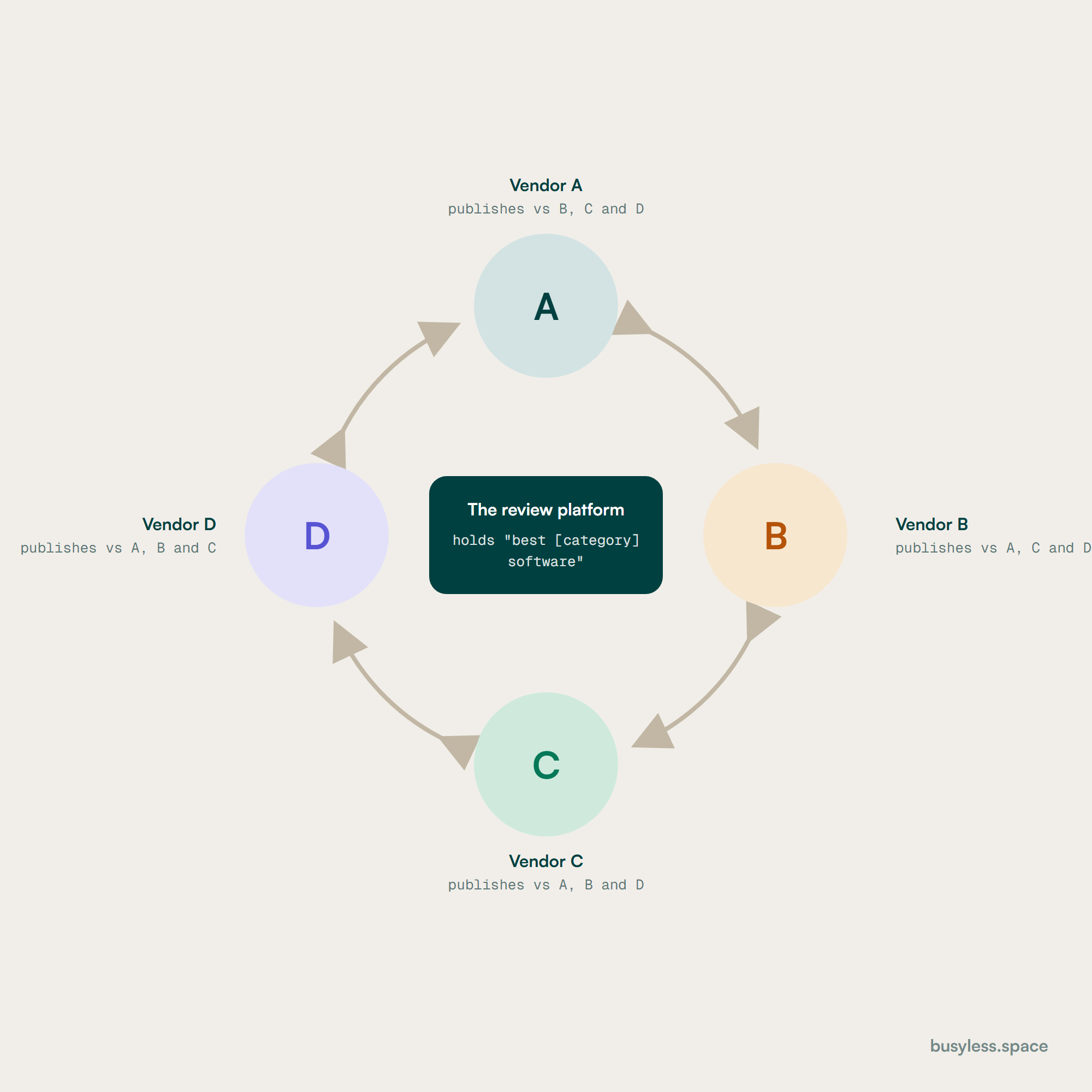
The second structural fact is stranger. In this category the competitors are each other's publishers. Every company writes alternatives and versus pages about every other company, at scale, continuously. That genre exists nowhere else in this directory and it makes a comparison page defensive before it is ever offensive.

The third is that the commercial ground is finite. A category might contain two hundred queries genuinely worth ranking for, and forty vendors are working on them. Budget does not create more of them, which is why so much SaaS content spend ends up somewhere it cannot possibly pay back.

Two neighbours to name. A company still inventing its category has no demand to capture and belongs on the startups page. A company selling to developers has an audience that reads documentation and blocks analytics, which is its own entry here.

Who already ranks in b2b saas

Look at a category results page before planning any SaaS SEO work and the shape is consistent. Two or three review platforms, one or two listicles from a large publisher, a Reddit thread, and then vendors, in an order that has more to do with review counts than with anything on their websites.

What is on the results page

  • Review platform category pages, usually more than one, occupying the positions a vendor most wants for the category term.
  • Listicles from large publishers and from other software companies' content teams, which frequently outrank every vendor named in them.
  • Reddit threads on "what are you actually using for" queries, where practitioners give the blunt answer no vendor page contains.
  • Competitor comparison pages ranking for your own brand plus a competitor's, written before anybody at your company noticed.
  • AI-generated answers assembling a shortlist from the review platforms and the forum threads, and rarely from a vendor site.
  • Documentation and error-message results, which is often where the qualified traffic actually is and which marketing usually does not own.
  • G2

    g2.comClaim it

    The dominant one. Category placement is driven by review volume, recency and a satisfaction score, so it responds to a steady trickle of reviews rather than a burst. The profile is claimable and the category taxonomy is worth reading carefully, because being in the wrong category is a common and expensive mistake.

  • Capterra, GetApp and Software Advice

    capterra.comClaim it

    Three properties under Gartner Digital Markets, all ranking on category and comparison queries. Position on their lists is partly a paid placement, which is worth knowing before concluding that a competitor has out-marketed you organically.

  • TrustRadius

    trustradius.comClaim it

    Smaller traffic, disproportionately enterprise readership, and reviews long enough to be quoted in an internal evaluation document. Worth the effort specifically when your deals involve a formal committee rather than a credit card.

  • Your competitors

    varies

    The gatekeeper unique to this industry. Every serious competitor already has a page about your product, it ranks for your brand plus theirs, and it was written by their marketing team. Read all of them. Correcting the record on your own domain is faster than complaining about theirs.

  • Large-publisher listicles

    varies

    Forbes Advisor, Zapier, HubSpot and their equivalents publish category round-ups with authority no vendor can match. Some accept submissions, some are affiliate-driven, and knowing which is which changes whether it is worth pursuing at all.

  • Reddit

    reddit.com

    Where buyers say what they actually think, and where an answer engine increasingly takes its summary from. Not optimisable. Reading the thread about your category monthly is a free and unusually accurate list of the objections you have not answered.

  • Product Hunt

    producthunt.comClaim it

    Durable authority for a product name and a real launch surface, though the traffic spike does not repeat. It matters more for a newer entrant than for an established vendor, and the page keeps ranking long after the launch.

  • The AI assistants

    varies

    Increasingly the first shortlist a buyer sees, and they assemble it from review platforms, listicles and forums rather than from vendor sites. That makes presence on those surfaces a search question rather than a public relations one.

Four vendors arranged in a ring, each with an arrow to the next, showing that every company in the category publishes comparison pages about the others. The review platforms sit outside the ring, holding the category query none of the four reaches.
The vendors are each other's publishers. Whatever sits outside that ring is holding the one query all four of them want.

What people actually search

The clusters below run from the ones that are lost to the ones that are winnable, which is the opposite of how most SaaS keyword plans are ordered. Volume falls as you go down the list and value rises sharply.

The bare category term

Commercial investigation

best [category] software

The page that wins it: Nothing you publish. Work on the review platform profile instead

Included precisely so it can be conceded in writing. A vendor page is the wrong answer to this query and the platforms answer it correctly. The effort that would go here belongs in review volume and category placement.

The qualified category term

Commercial investigation

best [category] for [industry or company size]

The page that wins it: A segment page with a real answer about fit, including who you are not for

Where the winnable commercial demand actually lives. The qualifier is what a vendor can answer better than a review platform, because the platform knows the category and you know the segment.

Alternatives to a named competitor

Commercial investigation

[competitor] alternatives

The page that wins it: A genuinely useful alternatives page that names options other than yours

High intent, real volume, and already contested by every other vendor in the category. The differentiator is honesty: a page recommending three options gets linked and quoted, a page recommending only yourself gets skipped.

Head to head

Commercial investigation

[you] vs [competitor]

The page that wins it: A comparison page conceding two real things

Defensive first. Your competitor's version of this page is already ranking and already says they win. Publishing yours is not an opportunity so much as a correction, and it is the page a champion forwards to a sceptic.

Migration and switching

Transactional

how to migrate from [competitor] to [category]

The page that wins it: A real migration guide with what exports, what does not, and how long it takes

The most under-served high-intent cluster in the industry. Somebody searching it has already decided to leave. Vendors write a landing page where a practical guide is wanted, and the practical guide is what gets bookmarked.

Integrations

Commercial investigation

[your product] [other tool] integration

The page that wins it: One page per integration that genuinely exists and works

The legitimate programmatic set, and the one most often abused. Each page needs a real answer: what syncs, in which direction, how often, what it cannot do. Generated pages for roadmap integrations are the category's most common policy risk.

The job, done without your product

Informational

how to [job] in [spreadsheet or general tool]

The page that wins it: A free tool or template that does the job, published ungated

Product-led content, and the place SaaS genuinely outperforms other industries. The tool is the asset, it earns links no article will, and it reaches somebody at the moment they feel the problem rather than after.

Errors, limits and how it works

Informational

[product] [specific error or limit]

The page that wins it: Public documentation, indexed, on the main domain

Frequently the highest-quality traffic on a SaaS domain and almost never owned by marketing. It reaches evaluators checking whether the product does a specific thing, and it is usually sitting on a documentation subdomain earning nothing for the brand.

What the rules change

No regulator supervises software vendors as such, and this industry still carries two genuine legal exposures that other pages here do not: a rule that lands on how the whole category collects reviews, and a competitor who can sue without involving an agency at all.

1

Paying for reviews is the practice the rule names

Federal Trade Commission Rule on the Use of Consumer Reviews and Testimonials, 16 CFR Part 465, effective 21 October 2024

What it means

The rule prohibits providing compensation conditioned on a review expressing a particular sentiment, and prohibits undisclosed reviews written by insiders. Gift cards for a review, incentives paid only when a rating clears a threshold, and employees reviewing their own employer without disclosure all sit inside that description.

So do this

Incentivise the act of reviewing rather than the content of it, make that wording explicit in the request, and never condition the reward on a rating. Then check what employees and investors have already posted, because that is usually where the undisclosed connection is.

2

A competitor can sue you over a comparison page

Lanham Act section 43(a), 15 U.S.C. 1125(a), which gives a private right of action for false advertising

What it means

A false or misleading statement of fact about a competitor's product in commercial advertising is actionable by that competitor directly. No regulator has to be involved and no consumer has to complain. Comparison tables are the usual venue, particularly empty cells implying an absent feature that is not actually absent.

So do this

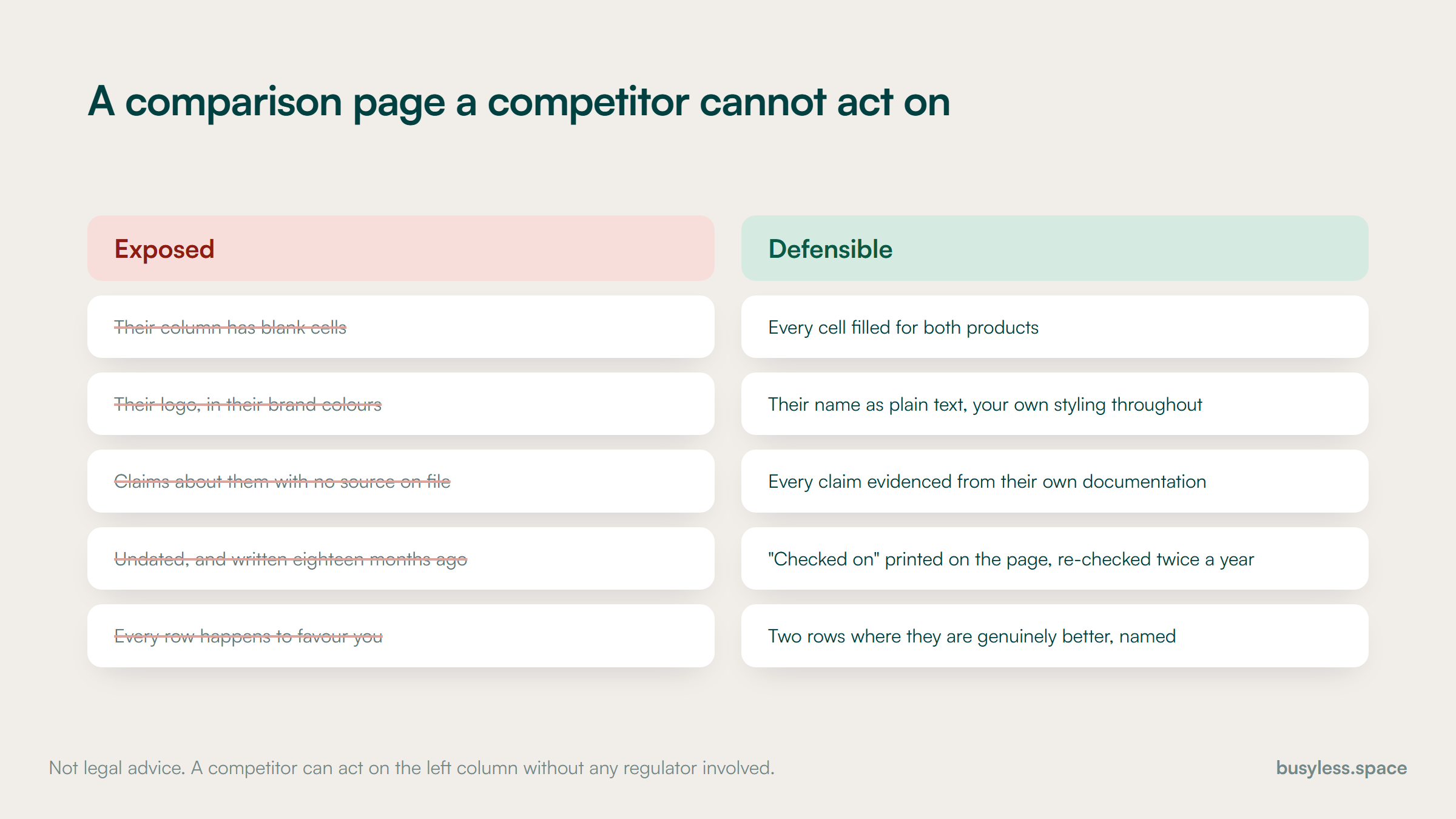
Evidence every claim about a competitor in writing before publishing, date the page, and re-check it twice a year. Fill every cell in their column: an empty cell reads as a factual assertion and is the hardest kind to defend.

3

Using a competitor's name has limits

The Lanham Act on trademark infringement, and the nominative fair use doctrine developed in the case law

What it means

Referring to a competitor by name to compare products is generally permissible where you use no more of the mark than necessary, do not use their logo or styling, and do not suggest sponsorship or endorsement. Reproducing their brand assets, or building a page that mimics their design, moves outside that.

So do this

Use the name as text, never the logo, and keep your own visual identity throughout. Apply the same rule to paid search copy and to landing page headlines, which is where this most often goes wrong.

4

Security and privacy statements are product claims

Section 5 of the FTC Act, under which the Commission has brought actions over overstated security and privacy representations

What it means

"Bank-level encryption", "fully compliant", and implying a certification you hold in progress rather than in fact are all claims about the product. The Commission has treated inaccurate security representations as deceptive practices, independently of whether a breach occurred.

So do this

State exactly which standards you hold, with dates, and say plainly which you do not. Route every security sentence on the marketing site past the person who actually owns the control, not past the person who wrote the last one.

Two facing columns for a comparison page. One lists defensible practice: their name as text, every cell filled, claims evidenced and dated. The other lists the exposed version: their logo reproduced, blank cells, undated claims, styling that mimics their brand.
The right-hand column is not a matter of taste. Each item on it is a statement a competitor could take to court without any regulator involved.

Proving expertise

Evaluators in this category are unusually good at detecting marketing language, because they read twenty vendor sites in a fortnight. What separates a credible site from the rest is the presence of checkable specifics rather than the tone of the writing.

  • Public documentation outside the login, which is the strongest evidence a stranger has that the product does what the homepage claims.
  • A changelog with dates, showing the product is being built rather than positioned.
  • Real pricing, or a genuine explanation of the variables where a list price does not exist.
  • Named customers at companies a stranger can verify, with the outcome method stated rather than a number alone.
  • A security page carrying the certifications with dates, the sub-processor list and a named contact.
  • Comparison pages that concede something specific, which is rare enough in this category to function as a signal on its own.
  • Authors with operational experience in the buyer's job rather than a marketing byline on a technical subject.

How to build a SaaS SEO strategy

The sequence below front-loads the defensive work, because in this category somebody else is already publishing about you. A SaaS SEO strategy that opens with a blog calendar leaves your competitors' account of your product standing for another two quarters.

  1. 1

    Weeks 1 to 3

    Find out what is already being said about you

    • Read every competitor comparison page that mentions your product and note what each gets wrong
    • Check your category placement on each review platform and whether you are even in the right category
    • Search your own brand plus alternatives, plus vs, plus pricing, and record who ranks
    • Ask an AI assistant to recommend tools in your category and save the answer with the date
    • Audit how reviews are currently solicited, including anything offering a reward tied to a rating

    You end up with
    A written account of what the market currently reads about you, and one compliance finding you did not expect

  2. 2

    Weeks 2 to 10

    Publish the defensive set

    • Write comparison pages for your three most-encountered competitors, conceding two real things in each
    • Write the alternatives page for the incumbent most of your customers switch from
    • Publish or fix the pricing page, and the security page with certifications and dates
    • Write the migration guide for the product people leave to come to you
    • Open the documentation and serve it from the main domain

    You end up with
    Your own account of the comparison, on your domain, and a set of pages that shorten cycles already running

  3. 3

    Weeks 8 to 24

    Take the qualified ground and build the legitimate programmatic set

    • Build segment pages for the two or three segments where you genuinely win, each saying who it is not for
    • Add integration pages one at a time, only where the integration exists and has a real answer
    • Ship the free tool that does the job people currently do manually, ungated
    • Start a review programme that solicits the act rather than the sentiment, with the wording checked
    • Prune the content debt: measure every post, keep what earns, redirect the rest

    You end up with
    Coverage of the winnable commercial cluster, a programmatic set that is defensible, and a smaller site than you started with

  4. 4

    Weeks 20 to 40

    Report the finite ground honestly

    • Track the bottom-funnel set as a fixed list, reporting share of it rather than a rank average
    • Monitor whether the assistants have started naming you, and which sources they cite when they do
    • Report review platform position and volume beside search, because in this category they are one system
    • Compare pipeline from comparison and migration pages against everything else, and act on the difference

    You end up with
    A report that treats the commercial cluster as the finite thing it is, rather than as a keyword universe with room in it

Technical fixes with the best payoff

SaaS domains accumulate a characteristic kind of mess, because they grow fast, buy content in bulk and add surfaces faster than anybody removes them. Most of the wins below are subtractions.

  • Four hundred posts, and forty of them do anything

    A sprint, and a difficult conversation

    An agency was briefed on volume and delivered it. The result is hundreds of thin, near-duplicate articles competing with each other, diluting the domain and burning crawl budget on pages no customer has ever read.

    Measure every post on impressions, clicks and assisted signups. Keep what earns, merge the near-duplicates into one better page, and redirect the rest to the closest useful thing. Expect to remove more than half.

  • Integration pages for integrations that do not exist

    A day of deleting

    The directory was generated from a wish list, so hundreds of pages describe connections that are on a roadmap or were never built. It is fast to produce, it looks like coverage, and it is the clearest example of scaled content in the category.

    Publish a page only when the integration works and there is a real answer about what syncs and in which direction. Remove the rest now rather than waiting to be told.

  • Documentation sits on its own subdomain

    A sprint, plus a nervous quarter

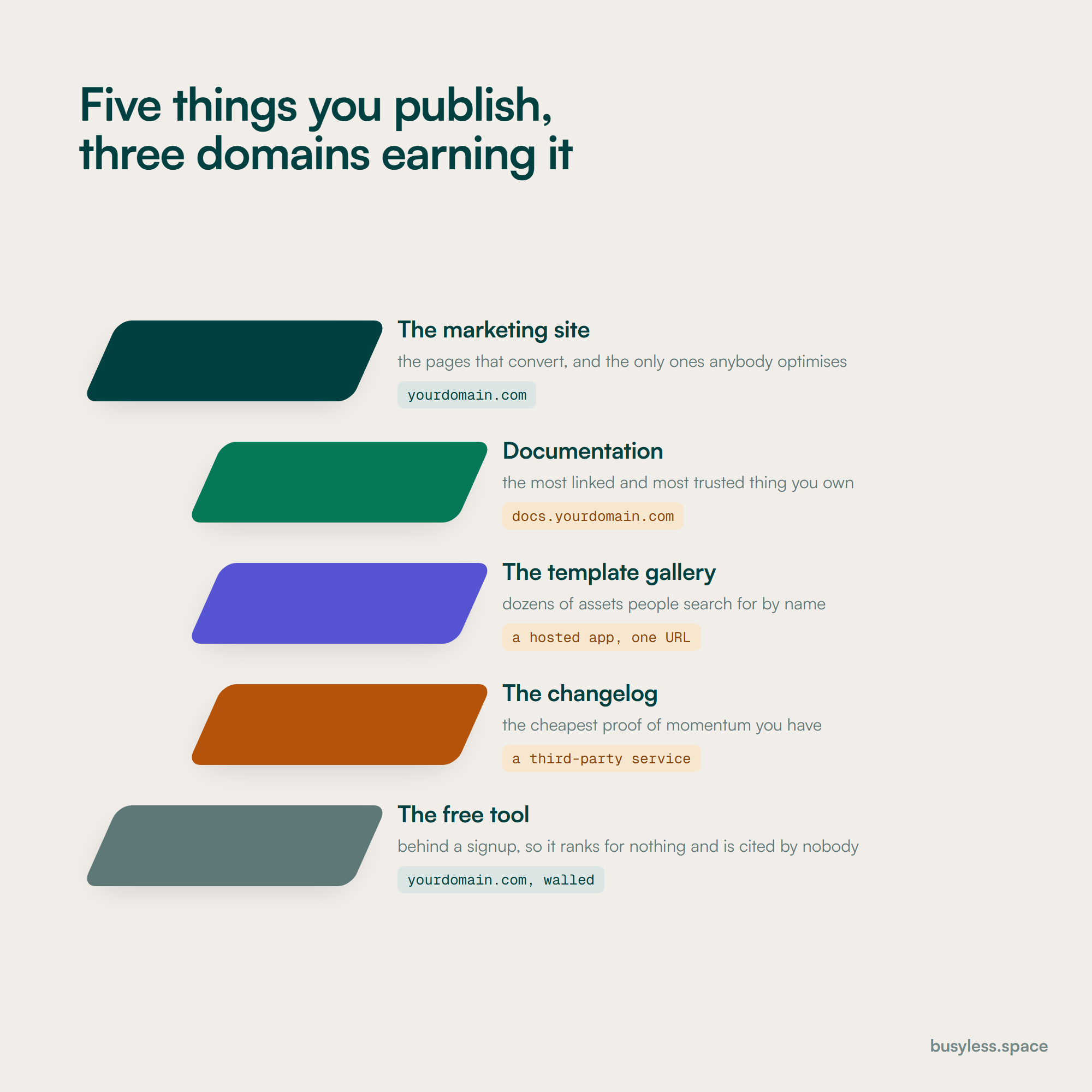
    Documentation platforms default to a separate host. The docs are the most specific, most linked and most trusted content the company owns, and every bit of that reputation accrues somewhere the marketing site cannot use.

    Serve the docs from a subdirectory on the main domain and redirect the old host. This is a genuinely difficult migration once there are thousands of pages, which is the argument for doing it now.

  • The free tool requires a signup

    A sprint, and an argument

    The tool that would earn links and reach people at the moment of need is behind an account wall, so it ranks for nothing and gets cited by nobody. The wall usually exists because somebody needed the lead numbers to look right.

    Make the tool work with no account, and offer the account for saving results. Measure links, referring domains and assisted pipeline before and after rather than only counting form fills.

  • The template gallery has one URL

    A sprint

    Dozens or hundreds of genuinely useful templates rendered inside a filterable app with no addressable page per item. Each one is a real asset somebody searches for by name, and none of them exists as far as a search engine is concerned.

    Give every template a real page with its own title, description, preview and use case. This is one of the few programmatic sets in SaaS that is legitimate by default, because each item is genuinely different.

  • Nobody indexed the changelog

    An afternoon

    It sits in the app, or on a third-party service, or is noindexed by a template default. It is the most convincing proof of momentum the company has and evaluators actively look for it.

    Publish it on the main domain, one page for the feed and an anchor per release, and link it from the pricing and product pages where the evaluator is standing.

  • The comparison table has empty cells

    A day, twice a year

    A blank in a competitor's column reads as a factual claim that the feature does not exist. Frequently it means nobody checked. That is both the weakest kind of persuasion and the most exposed sentence on the site.

    Fill every cell for every competitor, put the date the table was checked on the page, and re-check twice a year. Where a competitor has since shipped it, say so.

  • Machine-translated locale folders

    A day of deleting, then real translation

    A dozen language subfolders generated in bulk to open new markets. The translations are poor, nobody in those markets was consulted, and the pages compete with the English originals while representing the brand badly.

    Keep the two or three languages where you actually sell and have somebody who can read them, translated properly. Remove the rest, redirecting to the English page.

An exploded stack of the surfaces a software company publishes: marketing site, documentation, template gallery, free tool and changelog. Three of the five sit on hosts other than the main domain, shown separated from the stack.
The separated layers are usually the most linked and most trusted things the company publishes. None of that reaches the domain doing the selling.

Structured data that applies here

The types below fit this industry specifically. Most of them earn no rich result on their own, which is worth knowing before anyone sells the work on that basis. What they do is describe the entity precisely, which matters for how search engines and answer engines resolve who you are.

  • SoftwareApplication

    The product page and the pricing page

    Describe the product rather than the company. The offers block is the useful part when pricing is public: it lets an engine state a starting price without inventing one. Leave aggregateRating out unless real ratings exist on your own pages, which for most vendors they do not.

    SoftwareApplication.jsonld
    {
      "@context": "https://schema.org",
      "@type": "SoftwareApplication",
      "name": "[PRODUCT NAME]",
      "url": "https://[YOUR-DOMAIN]/product",
      "applicationCategory": "BusinessApplication",
      "applicationSubCategory": "[CATEGORY IN BUYERS' WORDS]",
      "operatingSystem": "Web, iOS, Android",
      "description": "[WHAT IT DOES, NOT WHAT IT ENABLES]",
      "publisher": { "@id": "https://[YOUR-DOMAIN]/#organization" },
      "featureList": [
        "[CAPABILITY]",
        "[CAPABILITY]",
        "[CAPABILITY]"
      ],
      "softwareVersion": "[VERSION, IF MEANINGFUL]",
      "releaseNotes": "https://[YOUR-DOMAIN]/changelog",
      "offers": [
        {
          "@type": "Offer",
          "name": "[PLAN NAME]",
          "price": "[PRICE]",
          "priceCurrency": "USD",
          "priceSpecification": {
            "@type": "UnitPriceSpecification",
            "price": "[PRICE]",
            "priceCurrency": "USD",
            "referenceQuantity": {
              "@type": "QuantitativeValue",
              "value": 1,
              "unitText": "[SEAT / MONTH / WHATEVER IS TRUE]"
            }
          }
        }
      ]
    }
  • ItemList

    Alternatives and round-up pages

    The type that fits the alternatives page properly, and almost nobody uses it. It describes the page as a list of named options rather than as an article about your product, which is what the page genuinely is when it is written honestly.

    ItemList.jsonld
    {
      "@context": "https://schema.org",
      "@type": "ItemList",
      "name": "[INCUMBENT] alternatives",
      "url": "https://[YOUR-DOMAIN]/alternatives/[SLUG]",
      "numberOfItems": "[COUNT]",
      "itemListOrder": "https://schema.org/ItemListUnordered",
      "itemListElement": [
        {
          "@type": "ListItem",
          "position": 1,
          "item": {
            "@type": "SoftwareApplication",
            "name": "[OPTION NAME]",
            "url": "[THEIR SITE]",
            "applicationCategory": "BusinessApplication",
            "description": "[WHO IT SUITS AND WHAT IT TRADES OFF]"
          }
        },
        {
          "@type": "ListItem",
          "position": 2,
          "item": {
            "@type": "SoftwareApplication",
            "name": "[OPTION NAME]",
            "url": "[THEIR SITE]",
            "applicationCategory": "BusinessApplication",
            "description": "[WHO IT SUITS AND WHAT IT TRADES OFF]"
          }
        }
      ]
    }
  • WebApplication

    The free tool, calculator or generator

    Use it only where the tool genuinely works without an account. Marking a signup-walled tool as free is inaccurate rather than clever, and the free tool is the asset most likely to earn links, so it is worth getting this one right.

    WebApplication.jsonld
    {
      "@context": "https://schema.org",
      "@type": "WebApplication",
      "name": "[TOOL NAME]",
      "url": "https://[YOUR-DOMAIN]/tools/[TOOL-SLUG]",
      "description": "[WHAT IT PRODUCES, IN ONE SENTENCE]",
      "applicationCategory": "BusinessApplication",
      "operatingSystem": "Web",
      "browserRequirements": "Requires JavaScript",
      "isAccessibleForFree": true,
      "offers": {
        "@type": "Offer",
        "price": "0",
        "priceCurrency": "USD"
      },
      "publisher": { "@id": "https://[YOUR-DOMAIN]/#organization" }
    }
  • VideoObject

    Product demos and walkthroughs

    Demo videos are usually embedded from a hosting service with no markup at all, which leaves the engine with an iframe and nothing else. Marking them up makes them eligible as video results on exactly the queries where somebody wants to see the product before booking a call.

    VideoObject.jsonld
    {
      "@context": "https://schema.org",
      "@type": "VideoObject",
      "name": "[PRODUCT NAME] product demo",
      "description": "[WHAT THE VIEWER SEES, IN ONE SENTENCE]",
      "thumbnailUrl": "https://[YOUR-DOMAIN]/[THUMBNAIL.JPG]",
      "uploadDate": "[YYYY-MM-DD]",
      "duration": "PT[M]M[S]S",
      "embedUrl": "[HOSTED EMBED URL]",
      "contentUrl": "[DIRECT FILE URL, IF AVAILABLE]",
      "publisher": { "@id": "https://[YOUR-DOMAIN]/#organization" },
      "hasPart": {
        "@type": "Clip",
        "name": "[CHAPTER NAME]",
        "startOffset": "[SECONDS]",
        "endOffset": "[SECONDS]",
        "url": "https://[YOUR-DOMAIN]/demo#t=[SECONDS]"
      }
    }
  • FAQPage

    The pricing page, the security page and the migration guide

    One node per page, and only for questions genuinely on it. These three pages carry short, specific, repeatedly asked questions, which is what this type is for. The homepage FAQ block somebody added for marketing reasons is not.

    FAQPage.jsonld
    {
      "@context": "https://schema.org",
      "@type": "FAQPage",
      "mainEntity": [
        {
          "@type": "Question",
          "name": "How is [PRODUCT] priced?",
          "acceptedAnswer": {
            "@type": "Answer",
            "text": "[THE MODEL, AND WHAT DRIVES THE NUMBER UP]"
          }
        },
        {
          "@type": "Question",
          "name": "Can we import our data from [COMPETITOR]?",
          "acceptedAnswer": {
            "@type": "Answer",
            "text": "[WHAT COMES ACROSS, WHAT DOES NOT, AND HOW LONG IT TAKES]"
          }
        },
        {
          "@type": "Question",
          "name": "Where is our data stored?",
          "acceptedAnswer": {
            "@type": "Answer",
            "text": "[REGIONS, AND WHETHER THE CUSTOMER CHOOSES]"
          }
        }
      ]
    }
  • BreadcrumbList

    Integration, template, comparison and documentation pages

    It earns its place here because the programmatic sets get deep quickly and the hierarchy stops being obvious from the URL. It also makes the parent set visible in the result, which helps a searcher understand that an integration page belongs to a real directory.

    BreadcrumbList.jsonld
    {
      "@context": "https://schema.org",
      "@type": "BreadcrumbList",
      "itemListElement": [
        {
          "@type": "ListItem",
          "position": 1,
          "name": "Home",
          "item": "https://[YOUR-DOMAIN]/"
        },
        {
          "@type": "ListItem",
          "position": 2,
          "name": "Integrations",
          "item": "https://[YOUR-DOMAIN]/integrations"
        },
        {
          "@type": "ListItem",
          "position": 3,
          "name": "[INTEGRATION NAME]",
          "item": "https://[YOUR-DOMAIN]/integrations/[SLUG]"
        }
      ]
    }

What it costs

These bands are editorial estimates rather than quotes. What moves a company between them is not headcount, it is how many competitors publish about you and how large the existing content estate is, because pruning costs money too.

Focused

$3,000 to $7,000
  • The defensive set: three comparison pages, one alternatives page, pricing and security
  • The migration guide for the product people leave to reach you
  • Documentation opened and moved onto the main domain
  • A review programme run properly, with the solicitation wording checked

Who it suits

A company under a few million in recurring revenue with a small, clean site

Where it stops

It cannot prune a large content estate. If four hundred agency posts already exist, cleaning them up is its own project before anything new is worth publishing.

Funded

$7,000 to $18,000
  • Segment pages where you genuinely win, each honest about who it excludes
  • The integration and template sets built properly, one page at a time
  • A free tool that does the job and is not behind a signup
  • Content debt measured and pruned rather than added to

Who it suits

A company with a defined category, several competitors publishing about it and an existing estate

Where it stops

It does not buy category placement on a review platform. That is driven by review volume and satisfaction, which is a customer-success problem wearing a marketing hat.

Enterprise

$18,000 to $30,000 and above
  • Multi-product and multi-segment coverage, maintained as the portfolio changes
  • Proper localisation in the markets you actually sell in, rather than machine translation
  • Documentation treated as a first-class content surface with its own owner
  • Answer-engine monitoring and the source work that follows from it

Who it suits

A multi-product vendor with several categories and an enterprise motion

Where it stops

None of it takes the bare category term from the review platforms. That result is correct for the query and no budget changes what the query wants.

How to do it with no budget

The free work in this category is unusually valuable because so much of it is defensive. Reading what your competitors publish about you costs an afternoon and frequently changes the plan more than a keyword export does.

  1. 1

    Read every competitor page that mentions your product

    An afternoon

    A search for your brand plus vs, plus alternatives

    Usually inaccurate, usually ranking, and always instructive about how the market describes you.

  2. 2

    Check you are in the right review platform category

    An hour

    The platforms themselves

    Being in an adjacent category is common and quietly expensive, because it removes you from the comparison a buyer is actually making.

  3. 3

    Ask the assistants to recommend tools in your category

    An hour a month

    The assistants your buyers use

    Save the answers with dates. What matters most is which sources the assistant cites, because that is where to exist next.

  4. 4

    Audit how your team currently asks for reviews

    2 hours

    Ask sales and customer success to forward the actual template

    If any reward is tied to a rating rather than to the act of reviewing, that is a same-week fix rather than a quarterly one.

  5. 5

    Fill every empty cell in your comparison tables

    A day

    The competitors' own documentation

    An empty cell is a factual claim you did not intend to make, and it is the least defensible thing on the site.

  6. 6

    Publish the changelog on your own domain

    An afternoon

    Whatever the site already runs on

    The cheapest available proof of momentum, and evaluators genuinely look for it before booking a call.

  7. 7

    Measure every blog post you have ever published

    A day

    Search Console, exported

    The distribution is always more extreme than anybody expects. Having it in a spreadsheet is what makes the pruning conversation possible.

The tool stack

Two things drive the tooling here and neither is keyword research. The commercial ground is a finite list that needs watching precisely, and the content estate is usually large enough that finding the dead weight needs a crawler rather than a spreadsheet.

  • Track a finite commercial keyword set precisely, with the whole results page

    NozzleSEO APIRead the review

    What you want here is not an average position but who else is on the page: which review platform, which listicle, which competitor. Pixel-level results-page data answers a question a rank number cannot.

    Free routeSearch Console position data, averaged and lagged, plus manual checks on the twenty that matter

  • Find every page on the web that mentions your brand next to a competitor

    MajesticSEO APIRead the review

    The comparison genre is the defining feature of this market, so knowing who publishes about you is a standing requirement rather than a one-off audit. Read the pages, do not just count them.

    Free routeSearching your brand plus vs, which finds the ones that rank and misses the rest

  • Find the content debt in an estate too large to read

    OnCrawlSEO APIRead the review

    The useful output is the join between crawl data and log or performance data: pages that exist, are crawled, and have never earned anything. That list is the pruning plan.

    Free routeA Search Console export joined to a sitemap in a spreadsheet, which works up to a few hundred pages

  • Serve marketing, docs and the template gallery from one domain

    StrapiHeadless CMSRead the review

    The requirement is one domain, real URLs for every template and integration, and a content model an engineer can generate pages from. The failure mode is three surfaces on three hosts, each earning reputation the others cannot use.

    Free routeThe self-hosted edition, which most teams run anyway

  • Watch whether the assistants name you, and what they cite

    Peec AISEO APIRead the review

    In this category the assistants are assembling shortlists from review platforms and forums. The citation list matters more than the mention, because it tells you which surfaces to work on next.

    Free routeRunning the same prompts by hand monthly and saving the answers

  • Tie the content programme to recurring revenue rather than to sessions

    ARR CalculatorFree toolOpen the tool

    Useful mainly to force the assumption into the open before a budget is agreed. Put your own conversion and retention numbers in it rather than a benchmark from somebody else's category.

    Free routeIt is free

Take it from here

Everything below is yours to take. Fill the [BRACKETS] and it is ready to use. Start with the competitor mention audit, because in this category somebody else has already written the page you are about to plan.

Checklist

The pass over every page a competitor has published about your product, which is the fastest way to find out how the market describes you.

COMPETITOR MENTION AUDIT
Company: [COMPANY NAME]     Product: [PRODUCT]
Run by: [NAME]     Date: [YYYY-MM-DD]     Next run: [YYYY-MM-DD]

WHY THIS COMES FIRST
In this category your competitors are your publishers. There are pages
about your product, ranking for your own brand, written by people whose
job is to beat you. Most companies have never read them.

THE SEARCHES TO RUN
  [ ] "[YOUR BRAND] vs"
  [ ] "[YOUR BRAND] alternatives"
  [ ] "alternatives to [YOUR BRAND]"
  [ ] "[YOUR BRAND] review"
  [ ] "[YOUR BRAND] pricing"
  [ ] "[YOUR BRAND] competitors"
  [ ] "best [CATEGORY] software"
  [ ] "[YOUR BRAND] [COMPETITOR]"  for each competitor

FOR EACH PAGE FOUND

  URL: [LINK]
  Published by: [COMPANY]
  Ranks at: [POSITION] for "[QUERY]"
  Last updated: [DATE ON THE PAGE, OR "undated"]

  What it gets factually wrong:
    [CLAIM] - actually: [TRUTH]
    [CLAIM] - actually: [TRUTH]

  What it gets right that we do not like:
    [WHAT. Be honest. This is the useful half.]

  Does our own page exist for this query? [Y / N / URL]
  Does ours rank above theirs? [Y / N / position]

  Action: [WRITE OURS / IMPROVE OURS / REQUEST CORRECTION / IGNORE]

THE FACTUAL ERRORS, GATHERED
  Errors worth a correction request:
    [COMPANY] claims [CLAIM] at [URL]
    Evidence it is wrong: [WHAT]
    Contacted: [DATE, OR "not yet"]     Response: [WHAT]

  Note: a polite correction request naming the specific factual error
  works more often than people expect. A complaint about tone does not.

WHAT THE MARKET THINKS WE ARE
  Read all the pages together and write two sentences on how the market
  describes your product when you are not in the room:
    [TWO SENTENCES]

  Does that match your positioning? [Y / N]
  If no, that is a positioning finding, not a content one: [NOTE]

OUR GAPS
  Competitors with a page about us where we have none about them:
    [LIST]  <- priority order for the comparison programme

What to publish

The test for everything here is whether it survives an evaluator who is reading twenty vendor sites this fortnight. That reader is fast, sceptical and looking for a reason to stop reading, and generic writing gives them one immediately.

  • The comparison page, conceding two real things

    One per serious competitor, re-checked twice a year

    Defensive first, because your competitor already published theirs. The concession is what makes it credible, and credibility is the only reason a champion forwards it to a sceptic.

  • The alternatives page that names options other than yours

    One per incumbent your customers switch from

    High intent and already contested, so honesty is the only available differentiator. A page recommending three genuinely different options gets cited by people who do not work for you.

  • The migration guide

    One per product people leave to reach you

    The most under-served high-intent cluster in the industry. Somebody searching it has already decided to leave, and vendors keep publishing a landing page where a practical guide is wanted.

  • The free tool, ungated

    One built properly beats four built quickly

    Product-led content is where SaaS genuinely beats other industries. A tool earns links that no article will and reaches somebody at the moment they feel the problem.

  • Integration pages, one at a time

    One per integration, published when it works

    Real commercial intent and a legitimate programmatic set, provided each page answers what syncs, in which direction and what it cannot do. That answer is what stops it being filler.

  • Public documentation

    Continuous, as part of shipping

    The most trusted content the company owns and usually the least owned by marketing. It ranks for questions the product pages cannot answer and it proves the product is real.

  • Segment pages that say who you are not for

    Two or three, only where you genuinely win

    The qualified category query is winnable precisely because the review platform knows the category and you know the segment. Excluding people is what makes the inclusion believable.

And what not to

  • High-volume top-of-funnel articles about the category in general. It is the standard agency deliverable, it is what produced the four hundred posts, and almost none of it reaches a buyer.
  • Comparison tables where every row happens to favour you. Evaluators read twenty of these a fortnight and discount them entirely.
  • Integration or location pages generated in bulk before the underlying thing exists.
  • "The ultimate guide to [category]" as a link asset. Every competitor has one, none of them gets linked, and the effort is enormous.
  • Machine-translated locale folders opened in markets where nobody at the company speaks the language.
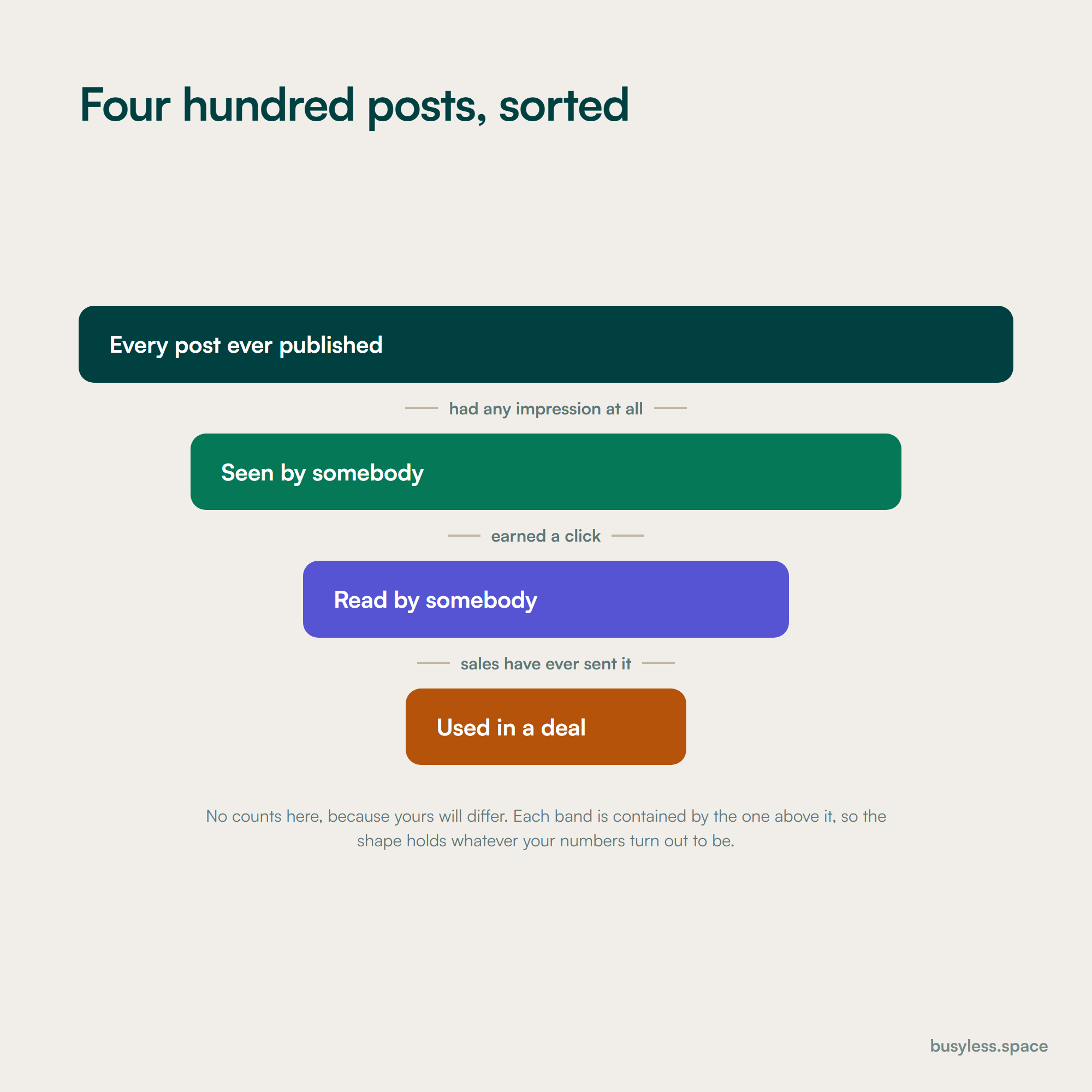
A funnel with four unlabelled stages, each a strict subset of the one above: every post published, posts with any impressions, posts with clicks, posts a customer has read. No counts appear on any stage.
No numbers here because yours will differ. The shape holds regardless, and the gap between the first and last stage is the pruning plan.

The expensive mistakes

Chasing the bare category term with a product page

Costs you Years of effort against a result the query does not want

Concede it in writing, take the qualified version, and put the effort into review volume and category placement.

Publishing a comparison page where you win every row

Costs you A page nobody forwards and nobody believes

Concede two specific things, fill every cell in their column, and date the table.

Generating the integration directory from the roadmap

Costs you Hundreds of pages describing things that do not work, which is the shape engines act against

One page per working integration, published when it ships, each with a real answer about what syncs.

Buying content by the article

Costs you An estate that has to be pruned before anything new can rank

Commission against a specific query and a specific buyer objection, and measure each piece six months later.

Putting the free tool behind a signup

Costs you The links, the citations and the reach, in exchange for a lead number

Open the tool and gate the saving of results. Measure referring domains and assisted pipeline, not just form fills.

Offering a gift card for a five-star review

Costs you The exact practice the reviews rule addresses, in a category where it is close to standard

Incentivise the act of reviewing, say so explicitly in the request, and never tie the reward to a rating.

Leaving competitor cells blank in a comparison table

Costs you An unintended factual claim, actionable by the competitor directly

Fill every cell, evidence every claim in writing, and re-check the table twice a year.

What to measure

The reporting mistake specific to this category is treating the commercial keyword set as an open universe. It is a closed list. Reporting share of a fixed set tells you something; reporting average position across thousands of terms tells you almost nothing.

Leading indicators

Move first. They predict, they do not prove.

  • Share of the fixed commercial set

    A rank tracker pointed at a named list of the queries that matter

    Define the list once, with sales, and hold it steady. The number that matters is how many of those results pages you appear on, not where you sit on average across everything.

  • Presence on competitor comparison queries

    Rank tracking on your brand plus each competitor

    Track your own page against theirs for the same query. Losing your own versus page to a competitor is the most fixable bad result in this industry.

  • Review platform category position and review velocity

    The platforms' own reporting

    Belongs in the same report as search, because they are one system from the buyer's point of view. Velocity matters more than total, since recency drives placement.

  • Assistant mentions, and the sources cited

    A fixed prompt set run monthly

    Record which sources the answer draws on rather than only whether you appear. The source list is the actionable half and it changes faster than the mention does.

  • Pages removed, and traffic retained

    Your own pruning log, checked against Search Console

    The metric that makes a subtraction defensible. Report both together or the removal looks like a loss for the two months before it stops being one.

Business indicators

The ones a manager acts on.

  • Signups and pipeline from comparison and migration pages

    Analytics joined to the CRM at account level

    These pages convert differently from everything else, so averaging them into a blended figure hides the finding that should be driving the budget.

  • Win rate against each named competitor

    The CRM, where the competitor is recorded on the opportunity

    The specific thing the comparison pages are meant to move. It requires sales to record the competitor, which is the part that fails rather than the analysis.

  • Recurring revenue from accounts with an organic first touch

    Billing joined to first-touch attribution

    Report the untracked share beside it. In a market where buyers arrive through review platforms and assistants, a meaningful share of first touches were never yours to record.

The verdict

The structural facts here are unusually fixed. Review platforms hold the head terms, competitors publish about each other continuously, and the commercial ground is a closed list. None of that responds to effort.

What does respond is everything one layer down. The qualified segment query, the honest comparison, the migration guide nobody writes, the integration page that tells the truth about what syncs. That is a real programme and it is mostly unoccupied.

The quickest way to assess SaaS SEO services is to ask what they would remove. A category with four hundred existing posts usually needs a smaller site before it needs a bigger one, and very few proposals are willing to say so.

Ask a provider of SEO services for SaaS what they would concede, too. Anybody promising the bare category term against three review platforms has either not looked at the results page or is hoping you will not.

FAQ

B2B SaaS SEO questions

  • Can we ever outrank G2 for our category?
    Realistically no, and it is the correct result anyway. Somebody asking who is best wants a source that is not one of the options. Take the qualified version of the query and put the effort into your category placement instead.
  • Do we have to write comparison pages about competitors?
    They are already writing them about you, and theirs rank. Publishing your own is a correction rather than an attack. Concede two real things, fill every cell in their column and date the table.
  • Are programmatic integration pages safe?
    Where the integration exists and the page has a real answer about what syncs and in which direction, yes. Generated from a roadmap, no. That distinction is the whole of the risk in this category.
  • What do we do with four hundred old blog posts?
    Measure every one on impressions, clicks and assisted signups, then keep what earns, merge the near-duplicates and redirect the rest. Expect to remove more than half, and report retained traffic alongside pages removed.
  • Should the free tool require an email?
    Usually not. The wall costs you the links and the citations, which are what the tool was for. Open the tool and ask for an account to save results, then compare referring domains before and after.
  • Is it a problem to offer a gift card for a review?
    It is if the reward depends on the rating or the sentiment. Incentivising the act of leaving a review is a different thing from paying for a good one, and the wording in your request is what distinguishes them.
  • Are the budget figures on this page quotes?
    No. They are editorial estimates. What moves a company between the bands is usually the size of the existing content estate rather than headcount, because pruning is work too.
  • What is the one thing to do first?
    Read every competitor page that mentions your product. It takes an afternoon, it is usually inaccurate, it is usually ranking, and it will change your plan more than a keyword export would.

Run it yourself, or have someone own it

Everything above is written to be run without us, and the free path is genuinely most of the value for a single-location business. Where these plans stall is almost never the plan. It is that nobody owns it after the first month. That is the job we do, with search as one distribution layer inside a wider system rather than the whole engagement.