
Content marketing for B2B
Buying happens in private channels you will never measure
- Sector
- Business services
- Channels
- Original research, Newsletter, Search
- Buying cycle
- Long cycle
- Time to compound
- 9 to 18 months
- Typical monthly
- $4,000 to $20,000
Key takeaways
- 1The decisive conversation is private and you will never see it. Peer Slacks, private communities and forwarded PDFs decide most B2B purchases, and no analytics product will ever report them.
- 2Build for the forward, not for the click. The asset that matters is the one somebody sends to a colleague with no covering note, which rules out most gated content and almost all thought leadership.
- 3Original research is the highest-leverage asset in B2B and the most under-produced. It travels between companies, gets cited without a link, and is the one thing a stranger will repeat on your behalf.
- 4A webinar can be a regulated disclosure. For public and pre-IPO companies, Regulation FD makes any channel where material non-public information is shared a disclosure channel, and a slide is enough.
- 5Report the honest version or you will defund the thing that works. Last-touch reporting in a market this dark will credit the demo request and starve the research piece that caused it.
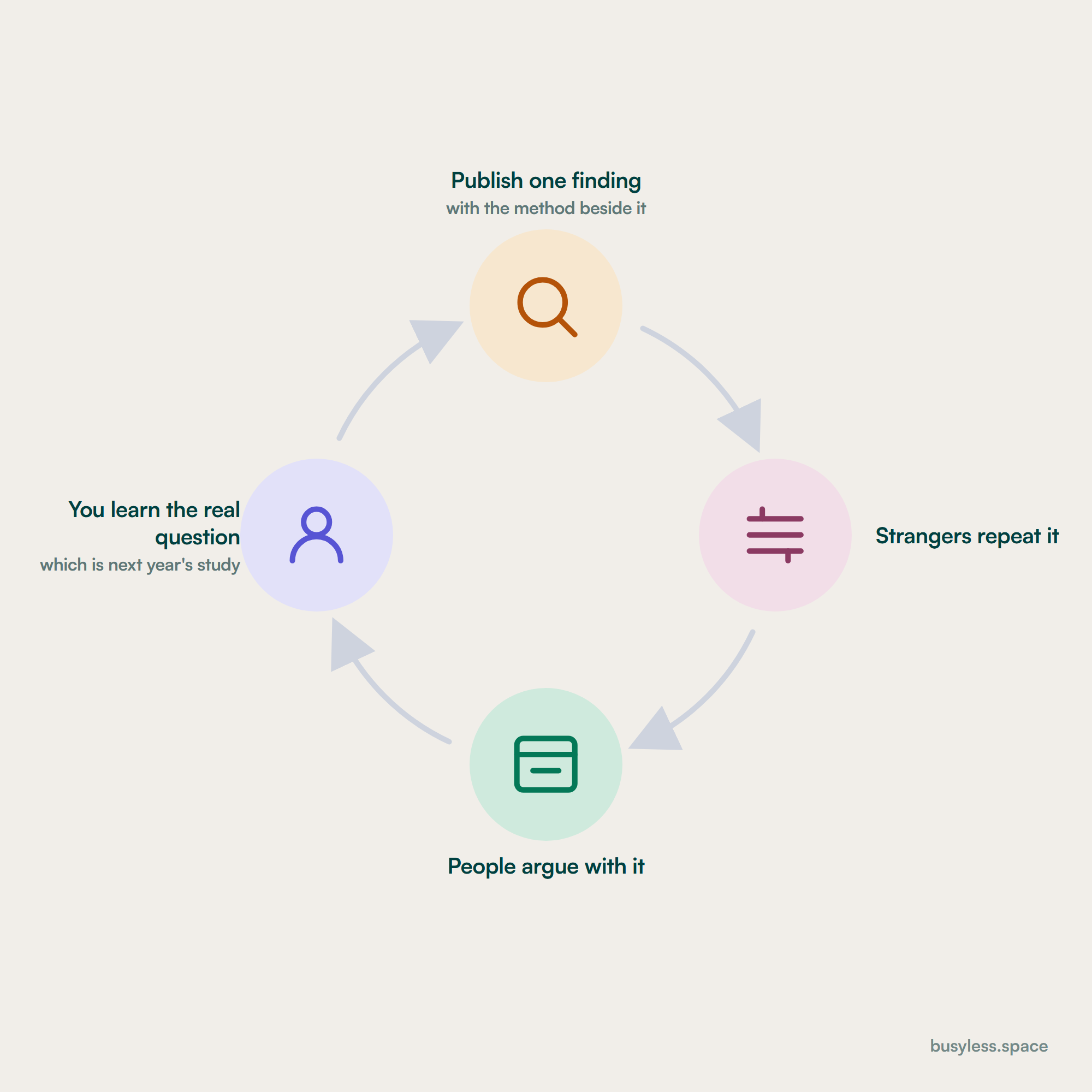
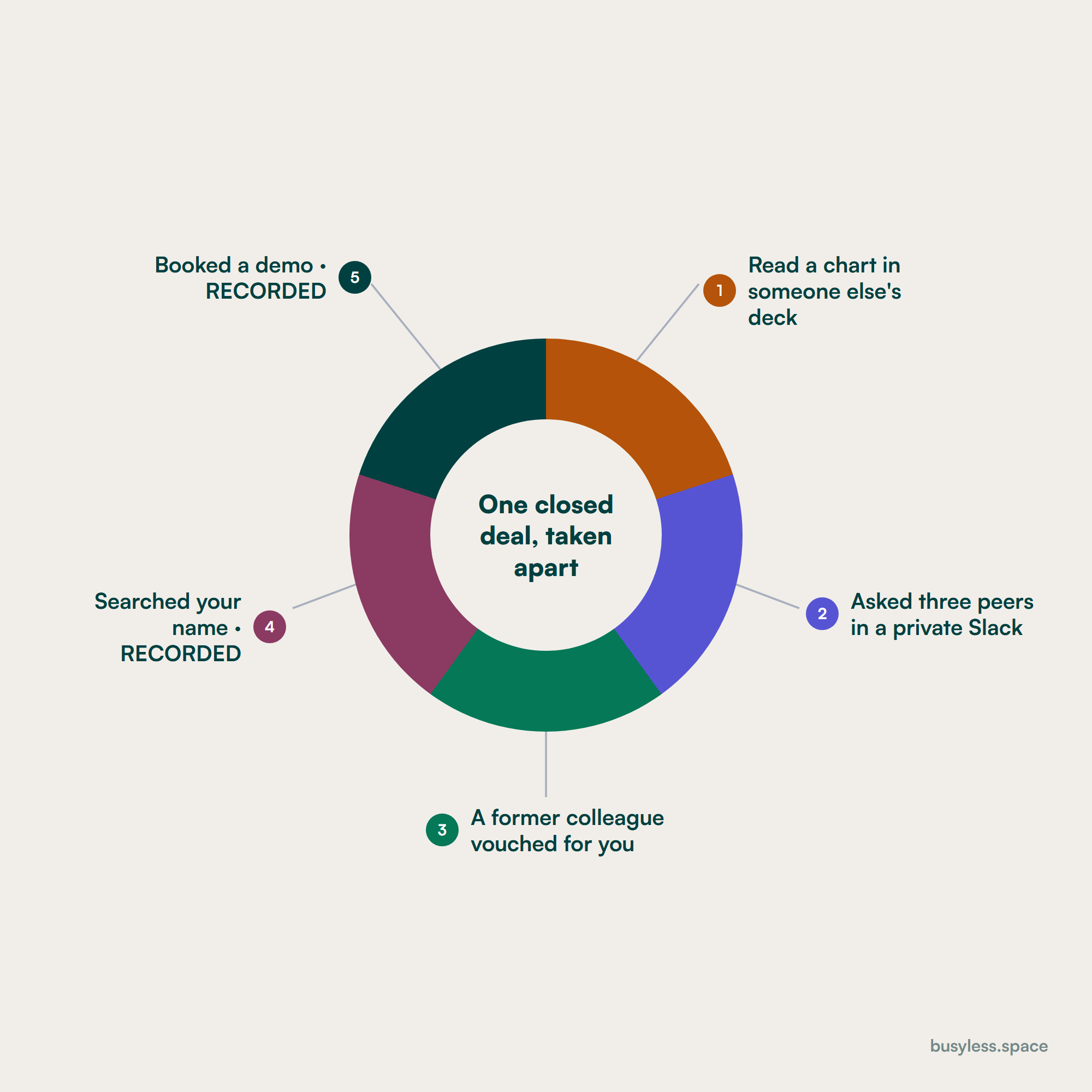
Content marketing for B2B is measured almost entirely on the parts that do not matter. The tracked path shows a search, a page, a form and a demo request, and the untracked path shows somebody asking three peers in a private channel who they use, getting an answer, and searching for that name a fortnight later. The second path decided the deal. The first one got the credit.
This is not an attribution tooling problem waiting for a better product. It is structural. Those conversations happen in places nobody instruments and nobody will ever instrument, and the further upmarket you sell the more of the decision happens there.
The strategic consequence is specific rather than philosophical. If the decisive event is somebody repeating your name to a peer, then the job of content is to give people something worth repeating and something worth forwarding, which is a different brief from ranking for a term or capturing an email.
So a B2B content marketing strategy that works tends to be narrower than the plan it replaces. Fewer assets, built to travel without you, aimed at being the thing somebody quotes in a channel you cannot read. Most of what fills a B2B calendar is produced for a funnel diagram rather than for a person.
Looking for the search half
This page decides which channels to run. The one next door goes deep on just one of them.
Which channels to run, and which to skip
Judged for a market where the decisive conversation happens out of sight. Three to staff, three worth a real test, and two that consume most B2B budgets and return the least.
Run these
Original research
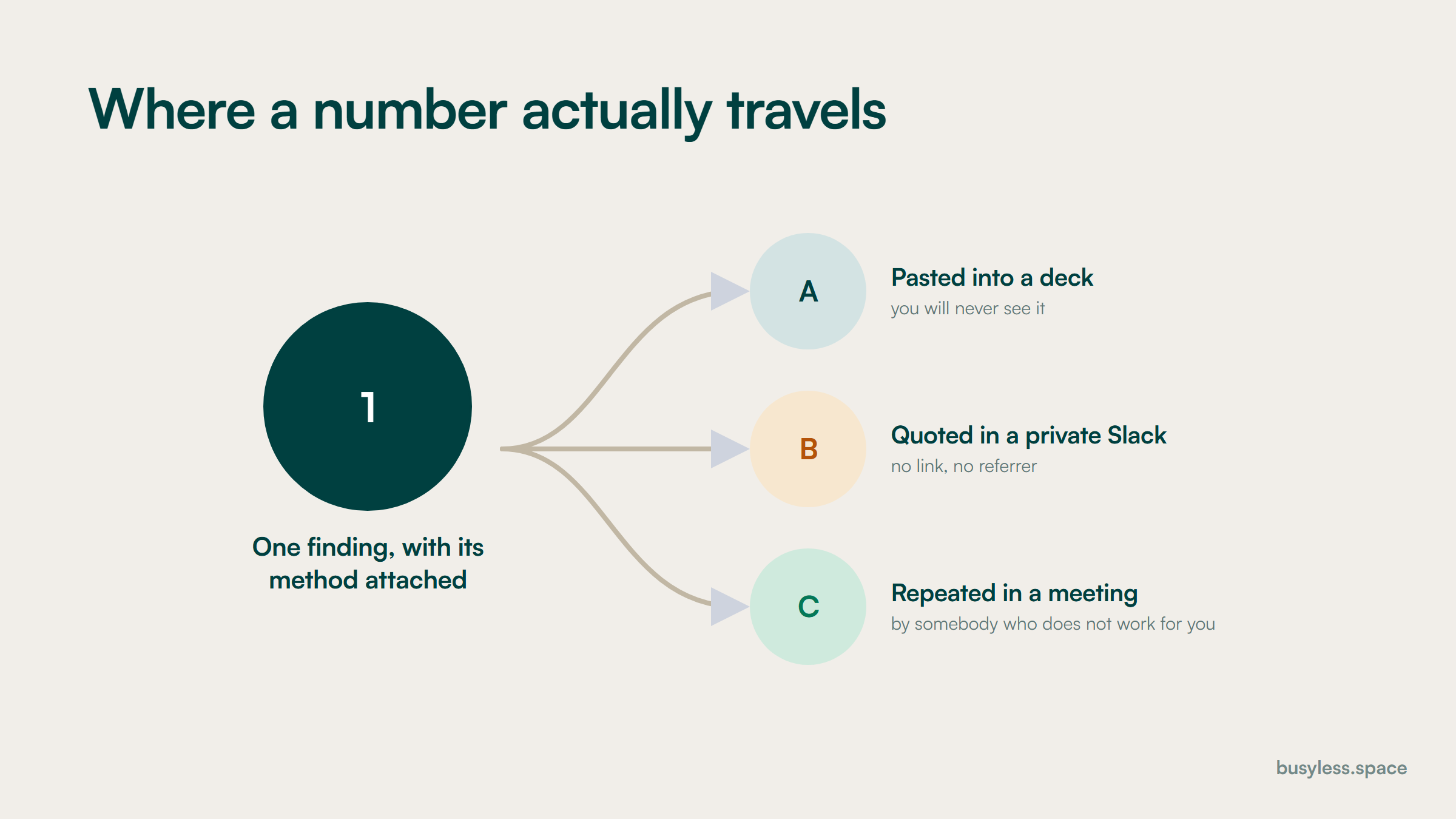
RunThe highest-leverage asset available in B2B and the most under-produced, because it is the only thing a stranger will repeat on your behalf. A number with a real method attached travels between companies, gets cited in decks you never see, and answers the question a champion is actually facing: how do I justify this to somebody who has not felt the problem. Nothing else you publish does that job.
First moveFind one question your market argues about with no data behind it, survey or measure it properly, and publish the method alongside the finding.
Newsletter
RunThe only channel here you own outright, and in a market with an eighteen-month cycle that matters more than reach. Most of your future buyers are not in market now, and a list is the one mechanism that keeps you present until they are. It works when it carries a point of view and fails the moment it becomes a content digest.
First moveSend one genuinely useful thing a fortnight to everybody who has ever spoken to you, including lost deals, and measure replies rather than opens.
Search
RunNarrower than most B2B plans assume, and dependable inside that narrow job. It rarely creates demand for a considered purchase; it catches the person who was handed your name and wants to check you are real, plus the specific problem queries that come before anybody searches a category. It confirms rather than creates, and a plan that funds it as the demand engine will be disappointed on schedule.
First moveMake sure somebody who has been given your name can confirm in one screen what you do, who you do it for and roughly what it costs. The full search playbook is on the sibling page.
Worth a test, with a kill date
Community
TestThe channel where the decisive conversation actually happens, and the hardest to participate in honestly. You cannot join a peer Slack as a vendor and be useful, but you can sponsor, host or simply be the company whose research keeps getting posted there. The test is whether presence is possible without being resented.
First moveFind the three private or semi-private places your buyers talk, and ask a customer to tell you honestly whether a vendor presence would be welcome. Believe the answer.
Founder-led social
TestLinkedIn reaches a real slice of B2B buyers, and reaches them as individuals rather than as a company. That is the uncomfortable part: the asset belongs to a person who could leave, and the company page that cannot leave is the one nobody reads. The test is whether anybody senior will post rather than approve, because approving is what usually happens.
First moveFind whoever at your company already argues about this market in private, and ask them to do it in public once a week for a quarter.
Events and talks
TestSpeaking and hosting work; sponsoring rarely does. A small hosted roundtable with twelve of the right people creates more pipeline than a booth at a conference with four thousand, and it produces the peer conversations this page is about rather than interrupting them.
First moveHost one dinner or roundtable for twelve people with no pitch and a real agenda, and measure conversations rather than leads.
Skip these
Video
SkipProduced video is where B2B budgets go to be invisible. A brand film costs what a research study costs and cannot be forwarded with a covering note that makes sense to a CFO. The exception is recording something that was happening anyway, which is repurposing rather than a channel and is covered below.
Trade press
SkipIn most B2B categories the trade press is thin, pay-to-play, or read only by competitors. There are genuine exceptions in regulated and industrial sectors, which is why manufacturing gets a different verdict, but for the general B2B case the effort buys less than the same hours spent on research that the press would cover anyway.
Research to be repeated, a list to stay present, and search to be confirmable. All three are built for a buyer who will make the actual decision somewhere you cannot follow them.
What you already own that nobody can copy
The material worth publishing in B2B is almost never in marketing. It sits with the people who lose deals and the people who onboard customers, and both keep it in systems marketing does not read.
The lost-deal record
Held by Sales, in a CRM field summarised into uselessness
The real objections, in the prospect's own words, from the moment they decided against you. It is the most honest description of your market available anywhere, and it is what tells you which arguments your champion could not make on your behalf.
How to capture it
Read the last forty closed-lost records and write the reason down verbatim. Refuse to accept a picklist value like price or timing; both are usually a summary of something specific.
The question that stops a deal
Held by Whoever runs the deal desk or handles procurement questions
Security reviews, legal redlines and procurement questionnaires contain the questions that quietly kill deals late. Nobody publishes the answers, and the buyer who cannot find them assumes the worst.
How to capture it
Collect every question asked in the last twenty procurement processes. The ones that recur are pages, and publishing them shortens cycles measurably.
Data only you can see
Held by Whoever runs operations or delivery
How long the work actually takes, what the median engagement looks like, how often a thing people worry about actually happens. Aggregated across enough clients it becomes the research asset that travels, and no competitor can replicate it because they do not have your book of business.
How to capture it
Pick one number you already track internally, aggregate it across at least thirty engagements, and check it is interesting to somebody who is not a customer before writing a word.
The argument you have in every sales call
Held by Whoever sells
The point where the buyer's assumption is wrong and somebody has to change their mind. It is the highest-value piece of content in the company and it is currently being delivered forty times a quarter to an audience of one.
How to capture it
Sit in on three calls and write down the moment the conversation turns. That moment is the piece; everything else is context.
What the champion needed and could not get
Held by Won customers, if you ask within a fortnight
A direct account of what happened in the meeting you were not in. It tells you exactly which asset was missing at the moment it was needed, which no analytics product can.
How to capture it
At kickoff, ask two questions: what did you send to your boss, and what did you have to explain yourself. Write the answers down verbatim.
Who actually makes it
The constraint here is access rather than writing capacity. Everything worth publishing sits with sales, delivery or the deal desk, none of whom report to marketing and all of whom are busy.
A subject expert who sells
The argument, and whether a claim will survive a sales call
Usually a founder, a head of sales or a principal consultant. Interviewed rather than writing. Their scarce contribution is knowing which version of an argument actually changes a mind.
4 hours
Data or operations owner
The numbers behind any research
The reason research does not happen in most B2B companies. Somebody with access has to care enough to run the query, and that is a staffing decision rather than a content one.
4 hours per research piece
Editor or content lead
Everything that ships, and the standard
Needs enough seniority to refuse work. In B2B the failure mode is a calendar full of assets nobody asked for, and the editor is the only person positioned to say no.
30 to 60 hours
Sales liaison
Getting the lost-deal reasons and the champion questions out of the CRM
Often the same person as the editor, but it needs naming separately because it is the step that quietly stops happening in month three.
4 hours
The honest cadenceOne research piece a quarter, a fortnightly newsletter, and one substantive argument a month. A B2B company publishing weekly is almost always producing filler, because the source material does not regenerate that fast at this altitude.
One project, 8 surfaces
One research study becomes eight things, and the reason it works is that a number can be quoted without a link. Everything below is built so a stranger can repeat it accurately in a channel you cannot see.
- 1
The research report
20 hours, onceFrom: The dataset, the method and the finding
The source asset. Publish the method and the sample alongside the number, because that is what lets somebody defend it in a meeting you are not in.
- 2
A single chart, cleanly credited
1 hourFrom: One finding
The unit that actually travels. Most people will never read the report and many will paste this into a deck, so it has to carry the source on its face.
- 3
The forwardable one-pager
3 hoursFrom: The finding plus what it costs to ignore
Built to be sent with no covering note. This is the asset a champion uses, and most B2B companies have never made one.
- 4
Newsletter issue
1 hourFrom: The finding, with the argument around it
Goes to everybody who ever spoke to you, including lost deals. A lost deal reading your research is a re-entry point.
- 5
A named person's post
30 minutesFrom: The most contested finding
Pick the number people will argue with. Agreement gets no engagement and no forwarding.
- 6
Conference or roundtable talk
6 hours, reusableFrom: The whole study, as an argument
Research is what gets a speaking slot accepted. A vendor pitch is what gets one declined.
- 7
Sales enablement note
1 hourFrom: The finding, mapped to the objection it answers
Closes the loop back to the lost-deal record the study came from, which is the point at which sales starts supplying material voluntarily.
- 8
A benchmark somebody can measure themselves against
8 hoursFrom: The dataset, made interactive or downloadable
Turns a report into something people return to, and it is the version that gets bookmarked and passed on internally.
The buying cycle, and what content does at each stage
Twelve to twenty-four months, and you are absent for most of it. Four of the five stages below happen without any contact, which is the single most useful thing to internalise about this market.
Not in market
Most of the time"Nothing. They have other problems."
- What moves them
- A newsletter and a person worth following
- How you know
- List growth and replies from people who will not buy this year
A problem becomes named
1 to 3 months"Is this a thing other people deal with?"
- What moves them
- Research that names and sizes the problem
- How you know
- Research citations and unprompted mentions
Asking peers, privately
2 weeks to 3 months"Who do you use, and would you use them again?"
- What moves them
- Nothing you control. Only what customers say.
- How you know
- Direct and branded search rising with no campaign behind it
Building the internal case
1 to 4 months"How do I justify this to people who have not felt it?"
- What moves them
- The forwardable one-pager and the benchmark
- How you know
- Champions asking for something to send upward
Formal evaluation
1 to 3 months"Can procurement and security approve this?"
- What moves them
- Published answers to the questionnaire questions
- How you know
- Shorter security review cycles, fewer late surprises
What you are allowed to publish
Two of the three rules below apply to a minority of B2B companies and matter enormously to that minority, which is why they are here rather than in a general note. The sibling page covers the data-protection and email rules instead: CCPA on business contact data, GDPR, the FTC testimonials rule and CAN-SPAM all sit there.
A webinar can be a regulated disclosure
SEC Regulation FD, 17 CFR 243, reviewed 2026-08-30
For a public company, disclosing material non-public information to a selected audience triggers an obligation to make it public simultaneously, or promptly where the disclosure was unintentional. A webinar, a conference slide or a customer briefing is a disclosure channel like any other, and marketing frequently owns those without anybody telling them the rule exists. Pre-IPO companies operate under related constraints during a quiet period.
So do thisAgree with legal or finance which numbers may appear in any external material, and route anything about revenue, growth, customer counts or forward-looking performance through a single approver. Put the rule in the content brief rather than in a policy nobody reads.
Recording an event is a consent question, not a production one
US state two-party consent statutes and UK and EU data protection law, reviewed 2026-08-30
Recording a webinar or roundtable captures attendees' voices, faces, names and employers. Several US states require all-party consent for recordings, and in the UK and EU an attendee's image and identity are personal data with a lawful basis required. Publishing the recording is a further processing step beyond making it.
So do thisAnnounce the recording before it starts and again at the start of any Q&A, give a real way to participate off the record, and decide in advance whether attendee questions will be edited out of the published version.
In co-marketing, each party warrants its own claims
Standard co-marketing and partner agreements, reviewed 2026-08-30
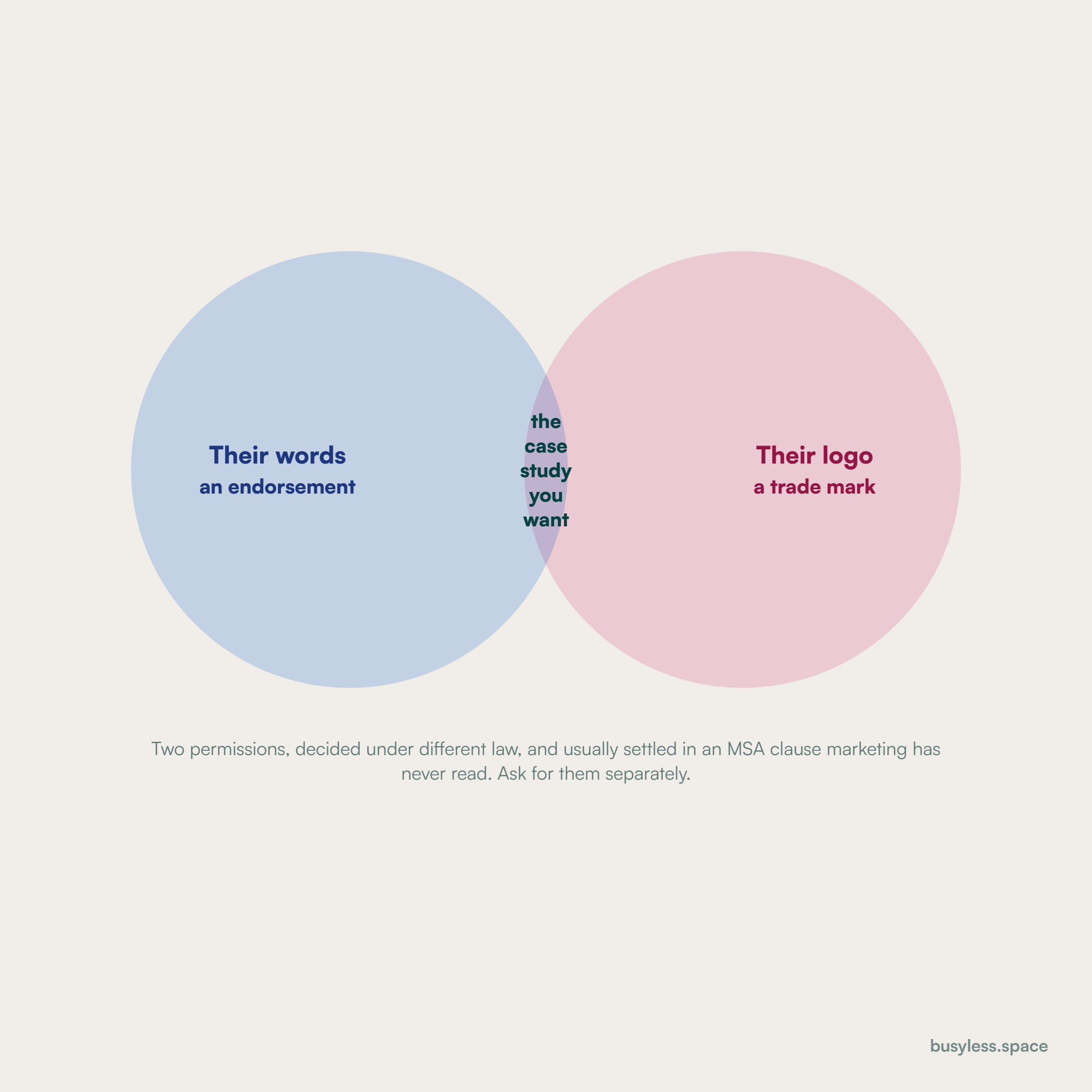
Joint reports, co-hosted webinars and partner one-pagers put your name on somebody else's claims and theirs on yours. Most partner agreements make each party responsible for the accuracy of its own contribution and for having the rights to what it supplies, including logos and customer references. The exposure is that you cannot see the evidence behind their half.
So do thisAgree in writing who approves the finished asset, who owns it afterwards, and what happens if either party wants it taken down. Ask for the substantiation behind any statistic a partner supplies before it goes out under your logo.
None of this is legal advice. Rules vary by state and by contract, and the dates above are when each source was read. Check your own before you rely on any of it.
How to build content marketing for B2B
Six months, and the first six weeks produce no public output at all. That is the part every B2B plan wants to skip and the part that determines whether the research is worth publishing.
Find out what actually loses deals
- Read the last forty closed-lost records and write the reasons verbatim
- Collect every question from the last twenty procurement processes
- Sit in on three sales calls and note the moment the conversation turns
- Ask five recent won customers what they sent to their boss
Output A real objection list and a first idea of what the champion was missing
Build the thing that travels
- Pick one question your market argues about with no data behind it
- Agree the method and the sample before running anything
- Publish the research with its method, sample and limitations stated
- Cut one chart that can be pasted into a deck and still make sense
Output One research asset and one chart built to be repeated
Arm the champion
- Build the forwardable one-pager from the finding and the top objection
- Publish the answers to the recurring procurement questions
- Start the fortnightly newsletter, including to lost deals
- Have one named person post the most contested finding weekly
Output An asset a champion can send with no covering note
Find out what you cannot see
- Ask every new opportunity how they first heard of you, and log it verbatim
- Host one roundtable of twelve with no pitch
- Compare self-reported origin against what analytics claims, and write down the gap
- Cut whichever channel produced nothing and say so plainly
Output A documented gap between reported and actual origin, which is the real finding
Structured data for what you publish
Markup for the research, the sessions and the recordings. Organisation, service and article nodes belong to the search playbook and are not repeated here. The first block below is the only type on this page that makes a method machine-readable, which is why it leads.
Dataset for original research
A research or benchmark page where you publish real figuresThe most important block on this page. Emitting it commits you to stating a sample, a period and a method, which is exactly what lets somebody defend your number in a meeting you are not in. A statistic without those is not research and should not carry this type.
{
  "@context": "https://schema.org",
  "@type": "Dataset",
  "name": "[STUDY NAME]",
  "description": "[WHAT WAS MEASURED, OVER WHAT PERIOD, ACROSS WHAT SAMPLE]",
  "url": "https://[YOUR-DOMAIN]/research/[SLUG]",
  "datePublished": "[YYYY-MM-DD]",
  "creator": {
    "@type": "Organization",
    "name": "[COMPANY NAME]",
    "url": "https://[YOUR-DOMAIN]"
  },
  "temporalCoverage": "[YYYY-MM-DD/YYYY-MM-DD]",
  "variableMeasured": "[THE THING COUNTED]",
  "measurementTechnique": "[SURVEY / OBSERVED DATA / INTERVIEWS, IN ONE LINE]",
  "license": "https://creativecommons.org/licenses/by/4.0/",
  "isAccessibleForFree": true,
  "citation": "[ANY PRIOR WORK YOU BUILT ON]"
}
Event for a webinar or roundtable
A webinar or roundtable you are hosting yourselfRead the Regulation FD point in the rules section before publishing an event page for anything where numbers will be discussed. The listing is itself an announcement, and the description field is where a forward-looking claim usually slips out.
{
  "@context": "https://schema.org",
  "@type": "Event",
  "name": "[SESSION TITLE]",
  "description": "[WHAT THE ATTENDEE LEARNS]",
  "startDate": "[YYYY-MM-DDTHH:MM+00:00]",
  "endDate": "[YYYY-MM-DDTHH:MM+00:00]",
  "eventAttendanceMode": "https://schema.org/OnlineEventAttendanceMode",
  "eventStatus": "https://schema.org/EventScheduled",
  "location": {
    "@type": "VirtualLocation",
    "url": "https://[YOUR-DOMAIN]/events/[SLUG]"
  },
  "organizer": {
    "@type": "Organization",
    "name": "[COMPANY NAME]",
    "url": "https://[YOUR-DOMAIN]"
  },
  "performer": {
    "@type": "Person",
    "name": "[SPEAKER]",
    "jobTitle": "[ROLE]"
  },
  "maximumAttendeeCapacity": "[N, IF IT IS GENUINELY LIMITED]",
  "isAccessibleForFree": true
}
VideoObject for a published recording
The page hosting a webinar or talk recordingOnly for recordings you host on your own page. Confirm the consent position in the rules section first: publishing a recording is a further step beyond making one, and attendee questions are the part most often forgotten.
{
  "@context": "https://schema.org",
  "@type": "VideoObject",
  "name": "[TITLE]",
  "description": "[WHAT IT COVERS]",
  "thumbnailUrl": "https://[YOUR-DOMAIN]/video/[SLUG]/thumb.jpg",
  "uploadDate": "[YYYY-MM-DD]",
  "duration": "PT[M]M[S]S",
  "contentUrl": "https://[YOUR-DOMAIN]/video/[FILE].mp4",
  "embedUrl": "[EMBED URL IF USING A PLAYER]",
  "publisher": {
    "@type": "Organization",
    "name": "[COMPANY NAME]"
  },
  "isFamilyFriendly": true
}
PodcastEpisode
An episode page for a show you hostMark up only episodes you host and publish. In B2B the common error is marking up a guest appearance on somebody else's show, which is theirs to describe and theirs to rank for.
{
  "@context": "https://schema.org",
  "@type": "PodcastEpisode",
  "name": "[EPISODE TITLE]",
  "description": "[ONE OR TWO SENTENCES]",
  "url": "https://[YOUR-DOMAIN]/podcast/[SLUG]",
  "datePublished": "[YYYY-MM-DD]",
  "duration": "PT[M]M[S]S",
  "partOfSeries": {
    "@type": "PodcastSeries",
    "name": "[SERIES NAME]",
    "url": "https://[YOUR-DOMAIN]/podcast"
  },
  "associatedMedia": {
    "@type": "MediaObject",
    "contentUrl": "https://[YOUR-DOMAIN]/audio/[FILE].mp3"
  }
}
NewsArticle for a research announcement
A press or newsroom page announcing a studyMarks up YOUR announcement, never a publication's coverage of it. Cite the outlet rather than absorbing its article, which is the mistake that turns a legitimate node into a false claim of authorship.
{
  "@context": "https://schema.org",
  "@type": "NewsArticle",
  "headline": "[ANNOUNCEMENT HEADLINE]",
  "url": "https://[YOUR-DOMAIN]/news/[SLUG]",
  "datePublished": "[YYYY-MM-DD]",
  "author": {
    "@type": "Organization",
    "name": "[COMPANY NAME]"
  },
  "about": {
    "@type": "Dataset",
    "name": "[STUDY NAME]",
    "url": "https://[YOUR-DOMAIN]/research/[SLUG]"
  },
  "citation": {
    "@type": "CreativeWork",
    "name": "[PUBLICATION THAT COVERED IT]",
    "url": "[URL]"
  }
}
Course for a structured programme
A genuine multi-part programme with an outcomeOnly where the programme is real, sequenced and maintained. A drip campaign of five emails is not a Course, and labelling it one is the sort of overreach that gets a site's structured data discounted across the board.
{
  "@context": "https://schema.org",
  "@type": "Course",
  "name": "[PROGRAMME TITLE]",
  "description": "[WHAT SOMEBODY CAN DO AFTERWARDS]",
  "provider": {
    "@type": "Organization",
    "name": "[COMPANY NAME]",
    "url": "https://[YOUR-DOMAIN]"
  },
  "teaches": "[THE SPECIFIC CAPABILITY]",
  "hasCourseInstance": {
    "@type": "CourseInstance",
    "courseMode": "Online",
    "courseWorkload": "PT[N]H"
  },
  "isAccessibleForFree": true
}
What to automate, and where the line is
Automation earns its place here on the research and the listening, which are the two most time-expensive parts. The line is that an agent may count things and may not decide what a number means.
- automate
Clustering lost-deal reasons into themes
A classification job over free text you already have. It also survives the moment sales stops filling in the field properly, because it works on the notes rather than the picklist.
- automate
Collating procurement and security questionnaire questions
Mechanical extraction from documents nobody reads twice. The recurring questions are pages, and finding them by hand is why nobody does it.
- automate
Monitoring where your research gets cited
The one measurable trace of an otherwise invisible channel. A citation without a link is exactly the signal this page cares about, and it is a watching job.
- assist
Cleaning and aggregating a research dataset
The arithmetic is mechanical. Whether a cut is honest, and whether the sample supports the claim, is a judgement that has to have a person's name against it.
- assist
Drafting the research write-up
Good at describing what the data shows. Reliably wrong about which finding is interesting and about the limitation that keeps the piece defensible, which is the paragraph a sceptical reader checks first.
- assist
Turning a finding into the one-pager
Structure and length are easy to generate. The sentence about what this does not prove is the one that makes it survive a hostile read, and that needs the person who ran the study.
- never
Publishing a number nobody has checked
A research asset works because a stranger will repeat it. A number that does not hold up destroys the only channel where you have no ability to correct the record.
- never
Deciding what may be said about company performance
For a public or pre-IPO company this is a disclosure question under Regulation FD with legal consequences, and it belongs to a named approver in finance or legal rather than to anything in a content workflow.
What it costs
Ranges rather than quotes. What separates one band from the next is research, which is genuinely expensive and is also the asset this page rates highest, so the tiers are shaped around whether you can fund it.
Do it yourself
$0 to $1,000- The lost-deal read and the procurement question list
- Published answers to the questions that stall deals
- A fortnightly newsletter to everybody who ever spoke to you
- One named person posting weekly
- Suits
- A company under about twenty people where a founder still sells
- Ceiling
- No research, which is the asset that travels. Everything at this tier depends on the founder's time, and it stops when a big deal lands.
Lean
$4,000 to $8,000- An editor with enough seniority to refuse work
- One substantive argument a month, sourced from real sales calls
- A maintained newsletter with a point of view
- The forwardable one-pager, properly built
- Suits
- A company with a repeatable sale and no dedicated content hire
- Ceiling
- Original research still sits outside this. So does a genuine events programme, which needs somebody to own relationships rather than a line in a budget.
Funded
$8,000 to $20,000- One original research piece a quarter with a real method
- Everything above, sustained through a busy quarter
- Hosted roundtables rather than sponsored booths
- Search treated properly for the confirm-and-qualify job
- Suits
- Companies selling a considered purchase into a defined market
- Ceiling
- Money stops being the limit here and access takes over. An expert who cannot spare an hour a fortnight leaves you with a calendar that reads as though marketing wrote it unaided, because marketing did.
Enterprise
$20,000 and up- Research as a repeatable annual publication with a defensible method
- Several audience tracks with their own sources and their own editors
- A hosted event programme with a real guest list
- One editorial standard across regions and business units
- Suits
- Companies where several units sell to overlapping buying committees
- Ceiling
- Coordination becomes the cost, and the failure mode is a research programme that publishes on a schedule rather than when it has something to say.
How to do it with no budget
Seven steps using material the company already holds. The first four cost nothing but attention and will tell you more about your market than any agency's discovery phase.
- 1
Read the last forty closed-lost records
Your CRM · 2 hours
Write the reason in the prospect's words. Refuse the picklist value; price and timing are almost always a summary of something specific.
- 2
Collect every procurement and security question from twenty deals
Email and your document store · 3 hours
The recurring ones are pages, and publishing them measurably shortens cycles.
- 3
Sit in on three sales calls and note where the conversation turns
Your calendar · 3 hours
That moment is the piece. It is currently being delivered to an audience of one, forty times a quarter.
- 4
Ask five won customers what they sent to their boss
An email at kickoff · 1 hour
The only direct account you will get of the meeting you were not in.
- 5
Build one list of everybody who ever spoke to you
Your CRM and any free newsletter tool · 2 hours
Including lost deals. In a market with an eighteen-month cycle a lost deal is a future opportunity, not a dead record.
- 6
Publish the answer to the question that stalls deals most
Your existing site · 4 hours
Usually security, pricing structure or implementation time. The buyer who cannot find it assumes the worst version.
- 7
Ask every new opportunity how they first heard of you
One field, filled in verbatim · Ongoing, seconds each
The gap between these answers and what analytics claims is the most useful thing you will learn this year.
The tool stack
What to use for each job. Where a row points into one of our other directories it goes to the researched review rather than to the vendor, because the review is what helps you choose.
Track where your research is cited, including without a link
The only measurable trace of the invisible channel. Search for your exact finding rather than your brand name.
Free option: A saved search on a distinctive phrase from the study, checked fortnightly
See which queries reach you at the confirm-and-qualify stage
Branded and near-branded queries rise before pipeline does in this market, which makes this the closest thing to a dark-social indicator you will get for free.
Free option: Free, and there is nowhere else this data exists
Check whether AI assistants name you in your category
Increasingly the first shortlist a buyer sees, and it behaves like a peer recommendation rather than like a search result.
Free option: Ask the four main assistants the same question monthly and log it
Publish research so it is citable and does not rot
Research gets cited for years. A stable URL and a visible publication date matter more than any feature.
Free option: A well-structured page with a stable URL, which is most of the value
Model what a shorter sales cycle is worth
Useful for arguing the case for publishing procurement answers, which shortens cycles rather than adding leads.
Free option: Free
Sanity-check the programme cost against the hours
Run it against the engine section's expert hours, since access to sales and delivery is the real constraint.
Free option: Free
Run the newsletter to a list that includes lost deals
Segment lost deals rather than excluding them. They are the warmest cold audience you have.
Free option: Free at the size this list will be
Keep the record of self-reported origin
Verbatim, never a picklist. The whole argument of this page is that the interesting answers are ones a dropdown cannot contain.
Free option: Costs nothing, and outperforms every attribution product sold
Take it from here
Everything below is meant to be copied and filled in. Bodies are plain text, so what you see is exactly what lands on your clipboard.
Turns forty closed-lost records into the objection list your content should answer. Refuses picklist values on purpose.
LOST-DEAL REASON EXTRACTION
Company: [COMPANY]      Period: [LAST 40 CLOSED-LOST]
Run by: [NAME]          Date: [YYYY-MM-DD]

THE RULE
Do not accept "price", "timing", "no budget" or "went with a
competitor". Those are summaries. Go to the notes, the emails
and the rep, and write what the buyer actually said.

FOR EACH DEAL

  Deal: [ID]     Closed: [YYYY-MM-DD]    Value: [ ]
  Stage lost at: [ ]
  Picklist reason: [WHAT THE CRM SAYS]

  THE REAL REASON, VERBATIM:
  "[WHAT THEY ACTUALLY SAID]"

  WHO KILLED IT:
  [ ] Our champion could not get it approved
  [ ] Someone we never spoke to objected
  [ ] Procurement or security
  [ ] Genuine product or capability gap
  [ ] Timing, genuinely
  [ ] Never found out

  IF OUR CHAMPION COULD NOT GET IT APPROVED:
  What could they not answer? [ ]
  ^ THIS IS THE CONTENT BRIEF. It is the whole point of this
    exercise, and it is where the forwardable one-pager
    comes from.

AFTER FORTY

  Recurring themes, ranked by count and by deal value:
  1. [THEME]  Count: [N]  Value lost: [ ]
  2. [THEME]  Count: [N]  Value lost: [ ]
  3. [THEME]  Count: [N]  Value lost: [ ]

  For each theme, one of:
  [ ] A page that answers it publicly
  [ ] A number in the next research study
  [ ] A product conversation, not a content one
  [ ] Nothing, we accept losing these

CROSS-CHECK
[ ] Do any of these also appear in procurement questionnaires?
Those are the highest priority.The expensive mistakes
Optimising for the tracked path
What it costs: Defunding the research and the newsletter, which caused the pipeline the demo form got credit for
Report self-reported origin alongside analytics and treat the gap as data rather than as noise. The measurement section on this page is built for exactly that.
Gating the research
What it costs: The asset stops travelling, which was the entire point of making it
Publish it openly and gate the benchmark tool or the raw dataset instead. A number that cannot be quoted will not be quoted.
Publishing a statistic with no method
What it costs: Nobody can defend it in a meeting, so nobody repeats it
State the sample, the period, the method and what it does not show. Those four lines are what make a number usable by a stranger.
Sponsoring the conference
What it costs: A quarter of the budget for a list of badge scans who did not want to talk to you
Host twelve of the right people for dinner. It costs a fraction and it produces the peer conversations this whole page is about.
Letting marketing publish company numbers unchecked
What it costs: For a public or pre-IPO company, a disclosure problem rather than a marketing one
One named approver in finance or legal for anything about revenue, growth, customer counts or forward-looking performance.
Writing for the buying committee as an abstraction
What it costs: Content aimed at nobody in particular, which is most of what fills a B2B calendar
Write for the champion, and build one asset they can forward without editing. The committee reads what your champion hands them.
What to measure
This is the page where the attribution caveat is the argument rather than a footnote. The decisive conversation happens in a channel with no analytics, so any model that assigns full credit to a visible touch is not approximating the truth, it is describing a different event. What follows separates what you can genuinely observe from what you can only ask about, and the second list is the more reliable one.
Leading indicators
Research citations, with and without a link
Mention monitoring on a distinctive phrase from the study
The closest thing to a measurement of the invisible channel. An uncredited quote still means somebody repeated you.
Branded and near-branded search volume
Google Search Console
Rises when people are being told your name somewhere you cannot see. It is a lagging indicator of a private conversation and a leading indicator of pipeline.
Newsletter replies from people not in market
Your list tool
In a cycle this long, staying present with people who will not buy this year is the job. Replies show it is working; opens show nothing.
Champions asking for material to send upward
Sales notes, recorded deliberately
The most direct evidence that the forwardable asset exists and is being used. If nobody asks, you have not built one.
Business indicators
Self-reported origin, verbatim
One CRM field, filled in by whoever takes the call
The single most valuable number on this page. Never a picklist, because the interesting answers are the ones a dropdown cannot hold.
The gap between self-reported and tracked origin
Both of the above, compared quarterly
Not a data quality problem to be fixed. The size of that gap is a measurement of how much of your market runs on private conversation.
Sales cycle length
Your CRM
Publishing procurement and security answers shortens cycles, and that shows up here rather than in lead volume. It is the most under-claimed content result in B2B.
Win rate where a champion was identified
CRM, segmented
The number this playbook is trying to move. Arming the champion is only worth funding if armed champions win more often.
The verdict
Content marketing for B2B is judged almost entirely on the part of the journey that can be seen, and decided almost entirely on the part that cannot. Reconciling those two facts honestly is most of the work, and refusing to is why so many B2B content programmes are cut while working. A content marketing strategy for b2b has to be argued that way.
Two things follow. Build fewer assets and build them to travel: a number with a method attached, and a page a champion can forward with no covering note. And ask people how they heard of you, verbatim, because that answer is more accurate than your analytics and costs nothing.
What makes B2B content marketing distinctive is not the length of the cycle, which plenty of industries share. It is that the decisive conversation happens between two people who do not work for you, in a channel you will never be invited into. Most content marketing strategies for b2b are measured in the wrong room.
I would be sceptical of B2B content marketing services sold against a lead target, or of any attribution model presented as solving this. The honest version reports what it can observe, asks about the rest, and treats the gap between them as the most interesting number in the report.
FAQ
B2B content marketing questions
How do we measure something that happens in a private Slack?
You cannot measure it directly, and no product will let you. What works is asking every new opportunity how they first heard of you and recording the answer verbatim, then comparing that against what analytics claims. The gap between the two is a real measurement of how much of your market runs on private recommendation.Should we gate our research?
Generally no. The value of a research asset is that strangers repeat it in rooms you are not in, and a gate stops that immediately. Publish the findings openly and gate the interactive benchmark or the raw dataset instead, so the number travels while the deeper engagement still identifies people.Is original research really worth the cost?
It is the highest-leverage asset in B2B and the most under-produced, precisely because it is expensive. A number with a stated method answers the question a champion actually faces, which is how to justify a purchase to people who have not felt the problem. Nothing else you publish does that job.Why does a webinar need legal review?
For public and pre-IPO companies it can be a disclosure channel. Regulation FD requires that material non-public information disclosed to a selected audience be made public simultaneously, and a slide about revenue or growth in a customer webinar is a disclosure. Route anything about performance through a single named approver.Is there a typical budget for content marketing services for B2B?
Nothing here is productised into a package. An engagement starts with a Discovery and then a monthly retainer sized to the company, and the budget section here gives honest bands for running it yourself or with help. The realistic range for a company doing this properly is $4,000 to $20,000 a month.Should we sponsor our industry conference?
Rarely. Sponsorship buys badge scans from people who did not want to talk to you. Hosting a roundtable or dinner for twelve of the right people costs a fraction and produces the peer conversations that actually decide purchases in this market. If a conference matters, fund a speaker rather than a booth.Do we need to tell attendees we are recording a webinar?
Yes, and it is more than a courtesy. Several US states require all-party consent for recordings, and in the UK and EU an attendee's voice, image and employer are personal data. Announce it before the session and again before any Q&A, and decide in advance whether attendee questions appear in the published version.How long before this shows up in pipeline?
Nine to eighteen months for a considered purchase, and the early signals are not pipeline. Watch research citations, branded search and champions asking for material to forward. Sales cycle length usually moves before lead volume does, which is the result most B2B teams forget to claim.How do we brief writers when the buying happens in private?
Give them the transcripts rather than the personas. Content for b2b marketing works when it is written from what a buyer actually said on a call, because the private conversation you cannot measure is the one being repeated back to you.
Run it yourself, or have someone own it
Everything above is written to be run without us, and the free path is genuinely most of the value for a small practice. Where these plans stall is almost never the plan. It is that the person holding the material has a day job and nobody owns the programme after the first month. That is the job we do.