
Content marketing for recruiters
Regulated marketingYour best content makes candidates leave the clients paying you
- Sector
- Business services
- Channels
- Founder-led social, Newsletter, Events and talks
- Buying cycle
- Medium cycle
- Time to compound
- 6 to 12 months
- Typical monthly
- $2,000 to $10,000
Key takeaways
- 1The best candidate content is career advice, and career advice tells people how to get paid more and when to leave. Your clients read it. That is not a tone problem to be edited away, it is the structure of the business.
- 2You cannot solve it by choosing a side. Serve only employers and you have no candidates, which is the thing you actually sell. Serve only candidates and you are publishing a case for leaving the companies that pay your invoices.
- 3It is solved by channel, not by copy. A segmented list and separate rooms let you say different true things to two audiences; one shared feed does not, so the feed carries only what is true and useful to both.
- 4You are the only party in the market who hears both sides of a declined offer. Nobody else knows why the candidate really said no, and no job board, salary survey or consultancy can obtain it.
- 5A salary guide assembled from what your client companies pay is not obviously just marketing. Compensation information moving between competitors through an intermediary is a live antitrust question, and it is the rule on this page most firms have never considered.
Content marketing for recruiters has a problem that no amount of skilled writing removes. Your product is access to people, so your content has to attract people. The content that attracts people is career advice: what you are worth, how to negotiate, how to tell when a job has stopped going anywhere.
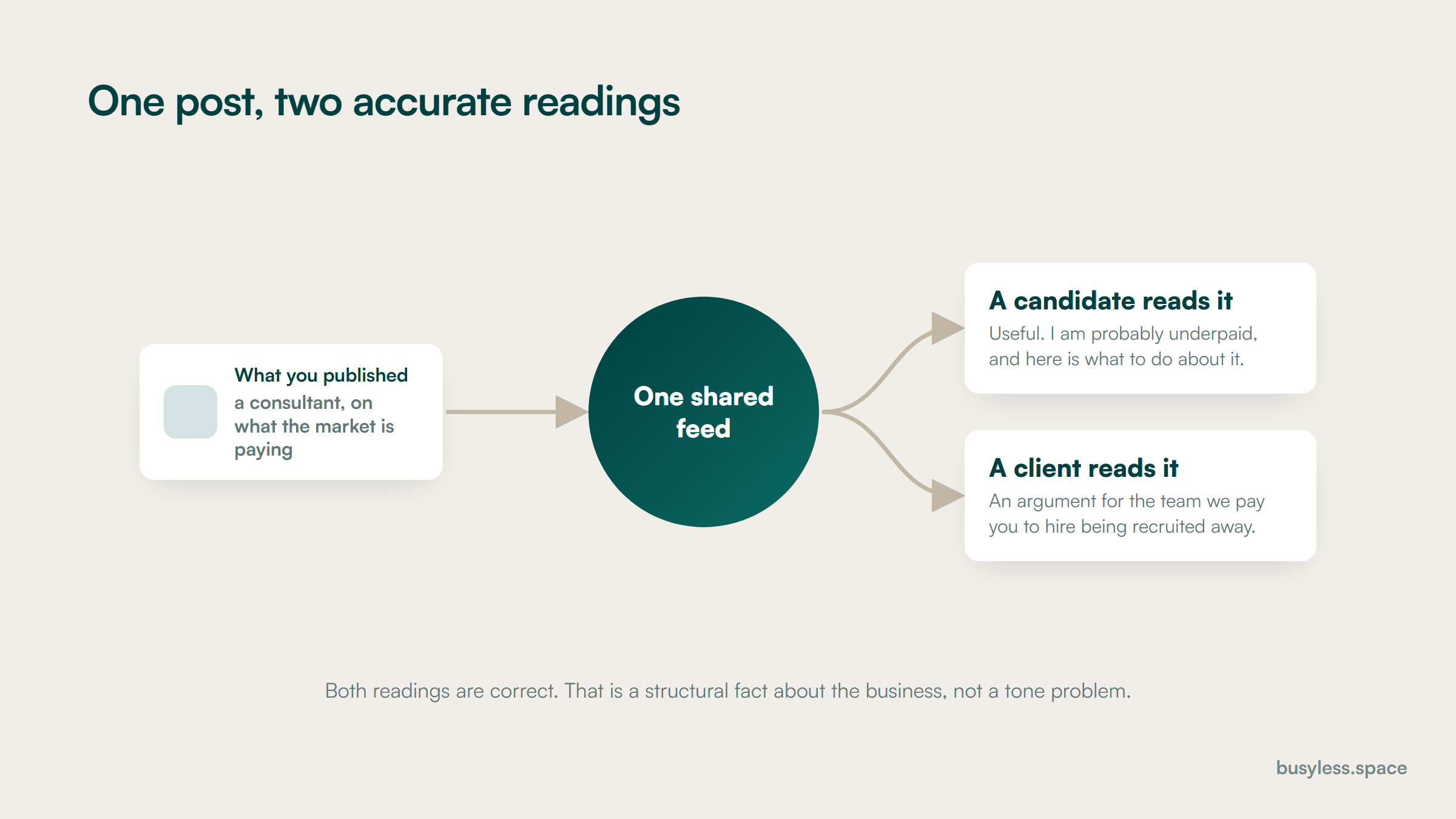
Every one of those pieces is read by hiring managers at the companies paying your invoices. They are not a separate audience who happen to see it occasionally. They follow you, because you are in their market, and they are watching whether the firm they retain is currently explaining to their team how to get a better offer somewhere else.
Most firms notice this and respond by publishing nothing with an opinion in it. The result is the genre everybody in this industry recognises: five tips for hiring in a competitive market, a quarterly update saying the market is challenging, and a case study with the client name removed and nothing left in it.
A recruitment content marketing strategy that works starts by admitting the two audiences exist and putting them in different rooms wherever it can. What stays in the shared room is the material that is genuinely true and useful to both, which turns out to be the market itself.
Looking for the search half
This page decides which channels to run. The one next door goes deep on just one of them.
Which channels to run, and which to skip
One test decides all eight here, and no other page in this directory has to apply it: can this channel separate two audiences who both matter and want opposite things? The channels that can are worth staffing. The channels that force one feed are where you have to be most careful about what you say.
Run these
Founder-led social
RunBoth audiences are here, which is the whole difficulty and also the reason it cannot be skipped. A consultant with a real specialism and a real opinion is the most effective marketing this industry has, and it is the one shared room, so it carries the material that is true for both sides rather than the material aimed at either.
First moveHave one consultant post what they actually saw in the market this month, including the thing clients will not enjoy. Anonymous, specific, and their name on it.
Newsletter
RunThe channel that solves the constraint outright, because a list can be segmented and a feed cannot. Candidates get the market read and the salary picture; clients get what is happening to their offers and their timelines. Both are honest, neither is written to be overheard by the other, and you own the list.
First moveSplit your list into candidate and client before writing anything. Running one newsletter to both is the decision that forces every later piece to be bland.
Events and talks
RunSeparate rooms, literally. A hiring manager roundtable and a candidate meetup are two different events with two different conversations, and the value in both is that people say things there that nobody would post. It is also the fastest route to the material everything else is written from.
First moveRun one small roundtable for hiring managers on a question they cannot ask a competitor. Eight people in a room beats a webinar for two hundred.
Worth a test, with a kill date
Search
TestWorth a real test on the employer side and mostly a losing bet on the candidate side, where boards and aggregators own the query. Salary and role guides are the exception, since they attract both audiences and are the one asset here with durable demand. How the boards dominate that search landscape is the sibling playbook's subject.
First movePublish one role guide properly, with your own placement data in it, and see whether it earns anything before building thirty.
Original research
TestYou hold genuinely original data and publishing it is the strongest possible position in this market, because it is true for both audiences at once. It is also the channel with a real rule attached, which the rules section covers, so the test is as much about what may be published as about whether anybody reads it.
First moveStart with data from your own placements rather than a survey of your clients. The first is yours; the second is other people's compensation information.
Video
TestA consultant on camera is more convincing than the same consultant in text, and it is time taken from a person paid on billings, which is the most expensive hour in the building. Worth testing where a specialism justifies it and worth dropping quickly where the same person could have posted instead.
First moveFilm one consultant answering the question candidates ask them constantly. If it takes more than an hour of their time, the format is wrong.
Skip these
Community
SkipThe places candidates actually gather to talk about work are hostile to recruiters, frequently by rule, and a firm posting there is removed or ratioed. That hostility is earned by the industry rather than unfair, and joining anyway converts a reputational cost into a public one. Be worth mentioning in those rooms rather than present in them.
Trade press
SkipRecruitment publications reach other recruitment firms, which is to say your competitors, plus the suppliers selling to all of you. Useful for hiring consultants and for industry standing, and not one reader of it is a client or a candidate. Different budget, different objective.
The mix is unusual for this directory in that it is chosen by audience separation rather than by reach. Newsletter and events are here because they can hold two conversations; social is here despite forcing one, because that is where the market is. The two skips are both rooms full of people who are not your customers.
What you already own that nobody can copy
This industry sits on the best raw material in professional services and publishes almost none of it, because the useful version requires saying something a client might dislike. Four of the five below already exist in a system somebody logs into daily.
Why offers actually get declined
Held by The consultants who made the calls
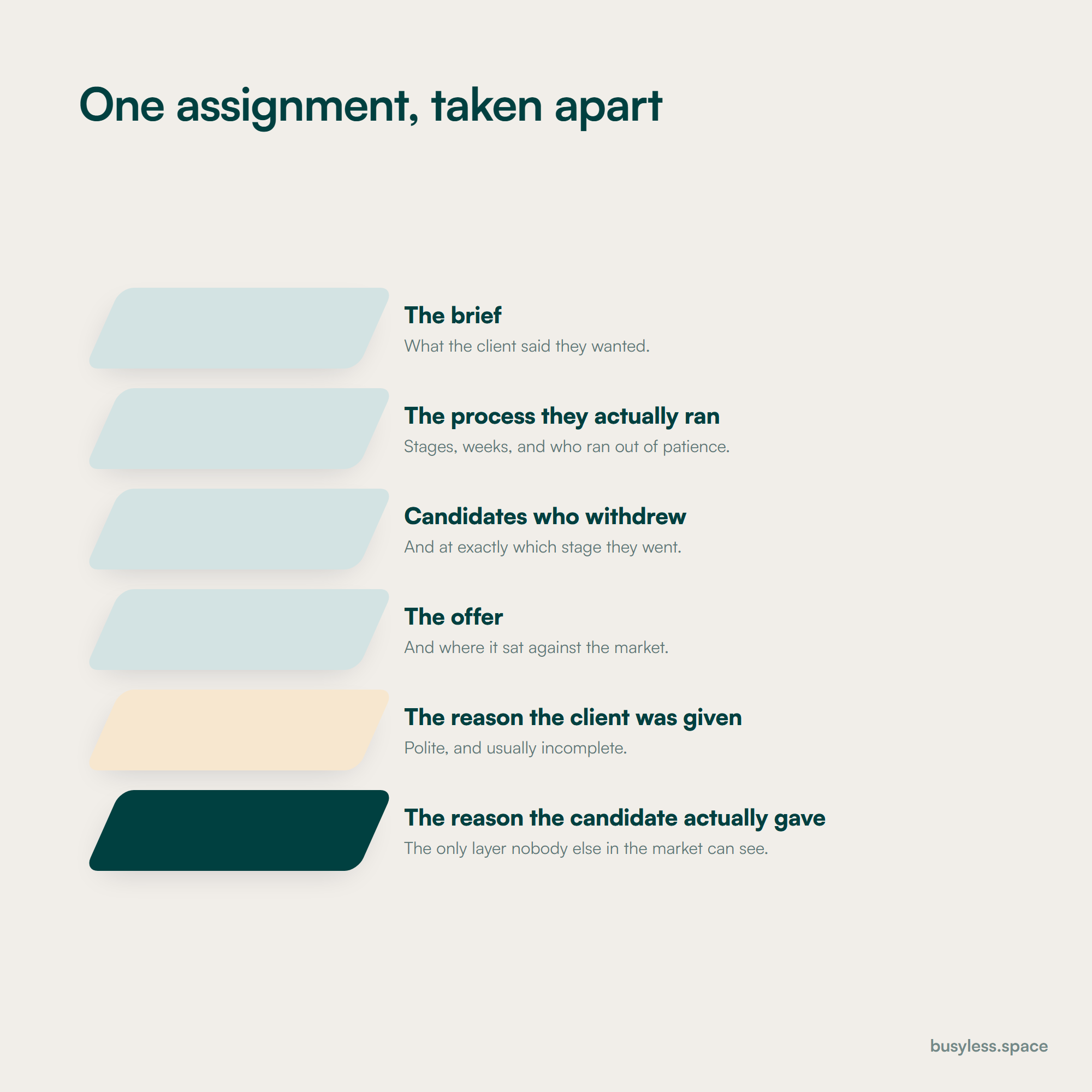
You are the only party in the transaction who hears both sides. The employer is told one reason, usually a polite one, and the candidate tells you the real one. No job board, salary survey or consultancy has access to that gap, and it is the most commercially useful thing anybody in hiring could read.
How to capture it
Add one field to the record: the reason given to the client, and the reason actually given to you. Aggregate it quarterly and never publish a single case.
What your own placements did, measured
Held by Operations, in the system already
Time from brief to offer, how many stages a process actually ran, counter-offer rates, how often a rushed process produced a decline. It is your record of your own work, which is what makes it publishable in a way a survey of your clients is not.
How to capture it
Pull two years and look at the distribution rather than the average. The tail is the interesting part and it is where the advice lives.
What a hiring process looks like from inside forty companies
Held by Every consultant, in their head
Almost nobody sees more than their own employer's process. You see dozens, across a specialism, over years, including which ones lose people and why. A candidate cannot obtain this and a hiring manager cannot benchmark against it.
How to capture it
Interview three consultants about what a good process and a slow one look like in their patch. Describe patterns, never a named company.
What candidates say when nobody is assessing them
Held by Consultants, in registration calls
People tell a recruiter what they will not tell an employer, an exit interview or a survey, because you are the one person in the conversation who benefits from them being honest. It is the closest thing this market has to what people actually want.
How to capture it
Note the reason for looking, in their words, on every registration. A year of that is a genuine picture and it takes a field, not a project.
The roles you could not fill, and what they had in common
Held by Whoever runs the desk
Failures are the half of the market nobody publishes, and the pattern in them is the most actionable advice a hiring manager will get all year. It is also the piece that proves you are not simply selling optimism.
How to capture it
List every assignment that did not close and mark why. Publish the pattern, with no client identifiable in it.
Who actually makes it
The production problem here is unusually sharp, because the only credible voice belongs to somebody paid on billings. An hour a consultant spends writing has a visible price attached and a colleague who will point it out, so every process below is designed to take as little of their time as possible.
The consultant
The opinion, the market read and their own name
Interviewed and recorded, never asked to write. Their credibility is the whole product and their time is billable, so treat two hours as a hard ceiling and design everything else around it.
2 hours, and not one more
Whoever owns marketing
Everything that is not the opinion
Their real job is extracting material from people who are on the phone all day and protecting the interview slot from being cancelled for a client call, which it will be.
Most of a role
Operations or whoever owns the system
The placement data and its definitions
The definitions matter more than the query. Time to hire measured from three different start dates produces three different stories and only one of them is defensible.
3 hours, quarterly in practice
A director
Saying the thing clients will not enjoy
Somebody senior has to own the pieces that carry a real opinion about the market, because a consultant asked to publish that alone will soften it until it says nothing. This is the role that decides whether the programme is worth running.
2 hours
An editor
Keeping two audiences apart
The specific job is checking which list a piece is going to and whether it survives being read by the other side. That check is the difference between a candid newsletter and an awkward client meeting.
6 to 8 hours
The honest cadenceOne recorded consultant conversation a month, two segmented newsletters a month, one roundtable a quarter and one data release a quarter. That is about twenty hours across the team, of which only two belong to somebody who bills, and the plan fails on that number rather than on the others.
One project, 8 surfaces
The unit here is a single recorded conversation with a consultant about what they saw in their market this month. It is the only expensive input, and it is worth building the whole calendar around protecting it.
- 1
The consultant's own post
20 minutesFrom: The one thing they said that surprised you
Drafted for them from the recording, edited by them, published under their name. Ghost-writing a consultant's post is fine; inventing their opinion is not, and readers in this market can tell the difference.
- 2
The candidate newsletter
1 hourFrom: What the market means for somebody looking
Written as though no client will read it, which is the point of having segmented the list. If you find yourself hedging here, the segmentation is not real.
- 3
The client newsletter
1 hourFrom: The same market, from the hiring side
Not a softer version of the candidate one. It answers a different question, which is what is happening to their offers, their timelines and their competitors.
- 4
The role guide update
45 minutesFrom: Anything that changed in what the role pays or does
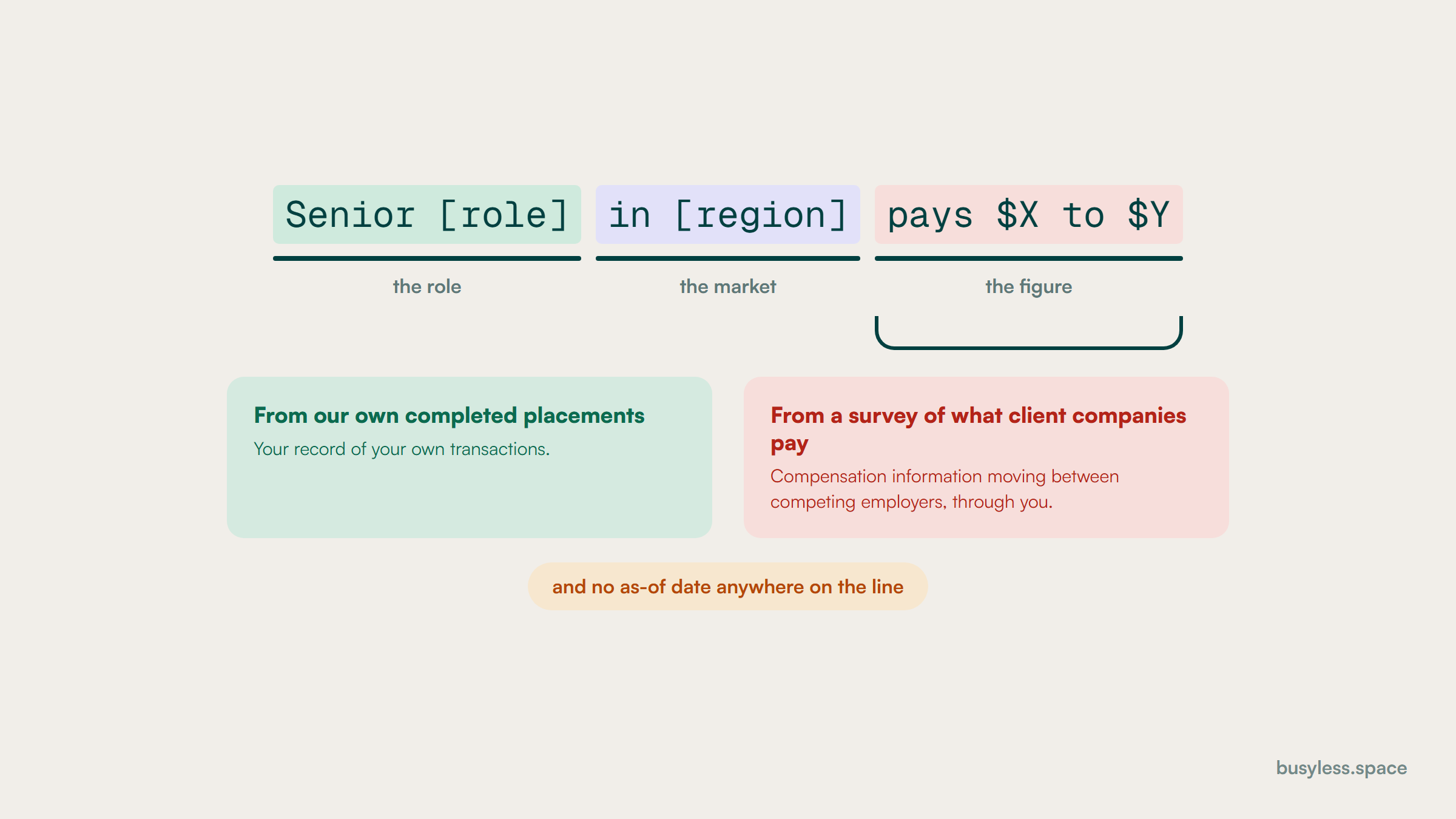
The durable search asset, and the one that needs a date on it. A salary figure with no as-of date is worse than no figure, because somebody will quote it in a negotiation next year.
- 5
The roundtable agenda
30 minutesFrom: The question consultants keep being asked
The material you already have tells you what eight hiring managers want to spend an hour on. Building an agenda from anything else is how these end up half full.
- 6
The podcast episode
90 minutesFrom: The whole conversation, barely edited
The lowest-effort output on this list, because the recording already exists. It also gives the consultant something to send a candidate, which is what actually gets it listened to.
- 7
The quarterly market note
4 hoursFrom: Three months of conversations, plus the data
Where the anecdote and the placement data meet. The anecdote makes it readable and the data is what makes it quotable by somebody else.
- 8
The pitch and proposal library
30 minutesFrom: Everything above, reused verbatim
The output nobody counts and consultants use most. A market read that already exists turns a proposal from a credentials deck into something a client did not have.
The buying cycle, and what content does at each stage
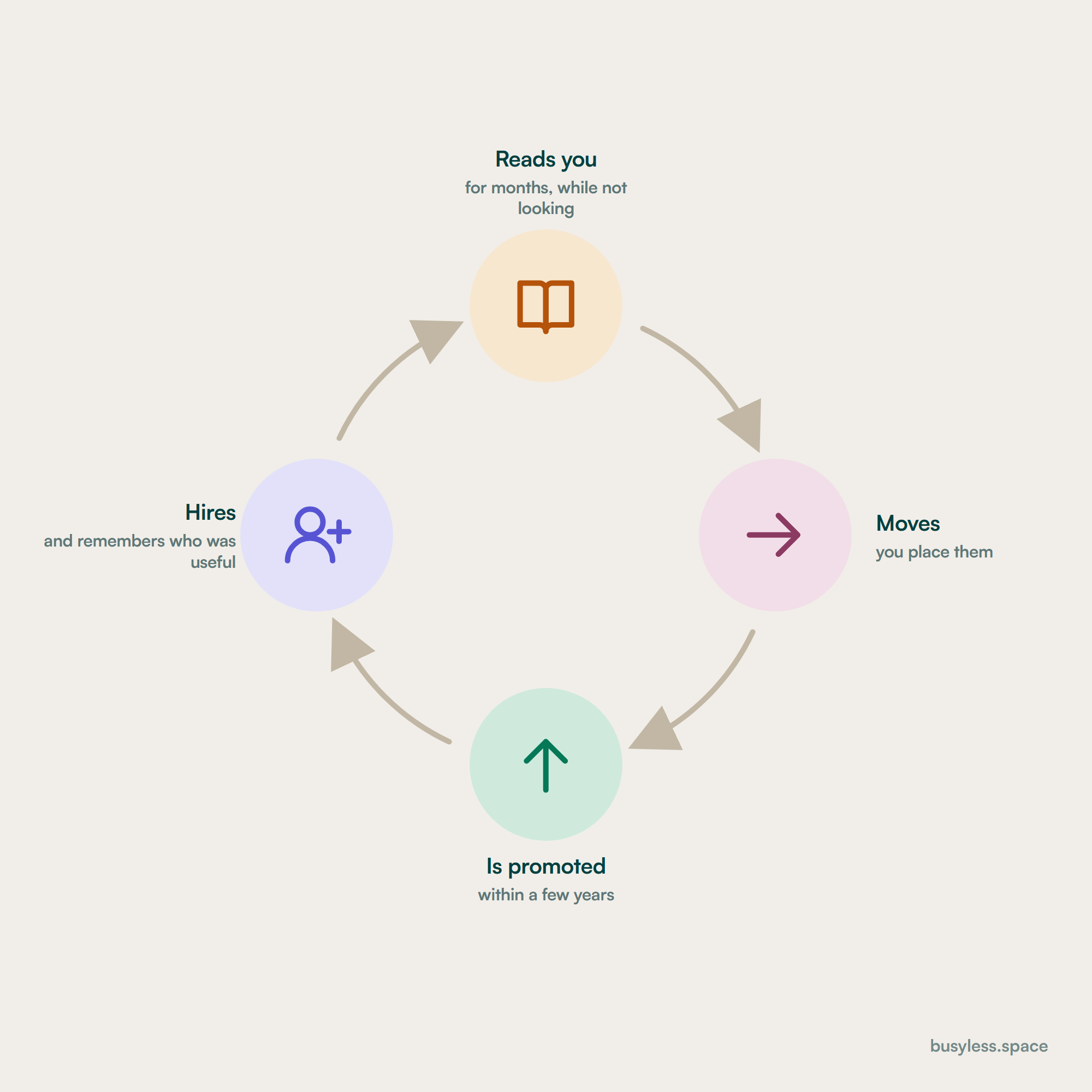
The shape here is a loop rather than a funnel, and it is the reason this industry rewards patience oddly well. The candidate you place becomes the hiring manager who briefs you, sometimes within two years, and the content they remember is the content they read while they were the other party.
Watching the market
One to three years"Am I paid properly, and is this normal?"
- What moves them
- Salary and role guides, the consultant's market read
- How you know
- Repeat reading and list subscriptions from people who are not looking
Deciding to move
Weeks"Is now the moment, and who do I talk to?"
- What moves them
- The honest piece about when to leave, and who wrote it
- How you know
- New registrations from people who name a piece they read
Choosing who to work with
Days"Does this firm know my actual job?"
- What moves them
- A named consultant with a visible specialism
- How you know
- Candidates asking for a consultant by name
Becoming a client
1 to 5 years"Who do I call now that I am hiring?"
- What moves them
- Everything they read on the other side of the desk
- How you know
- Briefs from people in your own placement history
Staying a client
Years"Do they tell me things I did not know?"
- What moves them
- The client newsletter, the roundtable, the data release
- How you know
- Repeat briefs, and clients forwarding your material internally
What you are allowed to publish
Four rules about what you may publish and about whose information it is. The sibling playbook covers everything to do with the wording of a job advertisement, including pay transparency statutes and automated hiring tool audits, so none of that appears here. None of this is legal advice and the first one in particular is worth a real conversation with counsel.
A salary guide built from client pay data is an information exchange
DOJ and FTC Antitrust Guidelines for Business Activities Affecting Workers, issued January 2025, which withdrew the 2016 HR guidance, read 2026-08-30
Competing employers sharing competitively sensitive compensation information can raise antitrust concerns, and routing it through a third party rather than directly does not remove the problem. A staffing firm collecting current pay from the companies it serves and circulating a guide back to those same companies is exactly the intermediary shape the agencies describe. Aggregation, age and independent administration are treated as considerations rather than as a safe harbour.
So do thisBuild the guide from your own placement outcomes, which are your record of your own transactions, rather than from a survey of what your clients currently pay. Where you do collect from clients, take advice first and record what you did and why.
Your candidate database is personal data before it is content
California Consumer Privacy Act as amended, whose employment and applicant exemption expired on 1 January 2023, plus comparable state statutes, read 2026-08-30
Candidate records are personal information about identifiable people who gave it to you for one purpose, which was finding them a job. Publishing analysis built from it is a different purpose, and where a state privacy statute applies you generally owe notice about that. Aggregation helps without settling the question, especially in a narrow specialism where a small cell identifies somebody.
So do thisSet a minimum cell size below which you do not publish a cut at all, say so in your privacy notice at registration rather than afterwards, and keep the published series separate from anything client-facing that names people.
The placement story you want to tell is usually contractually barred
Standard confidentiality and publicity clauses in staffing master service agreements, reviewed 2026-08-30
Most agreements in this industry prevent naming the client, describing the assignment in identifying detail, or using the client's marks, and many prohibit disclosing the existence of the relationship at all. The detail that would make a placement story worth reading is usually the detail the clause exists to prevent, which is why this genre is so consistently empty.
So do thisAsk for written permission at the point the placement succeeds, when goodwill is highest, and keep the permission with the asset. Where it is refused, publish the pattern across several assignments instead, which is more useful anyway.
A placement claim is an advertising claim
FTC Act section 5 advertising substantiation principles, reviewed 2026-08-30
Statements such as filling roles in a stated number of days, a stated fill rate, or a retention figure are objective performance claims about your service and need reasonable support before they are made. The support has to match the claim as a reader would understand it, which usually means all assignments in a period rather than the ones that went well.
So do thisDefine the population and the period beside every number, publish the definition rather than only the figure, and re-derive it rather than carrying a claim forward from an old deck. Our b2b playbook covers the same substantiation problem where the claim is about a product's performance.
None of this is legal advice. Rules vary by state and by contract, and the dates above are when each source was read. Check your own before you rely on any of it.
How to build content marketing for recruiters
The first month contains two decisions and no publishing, and they are what make everything afterwards possible: splitting the list, and adding two fields to a system somebody already uses every day.
Separate the audiences and start collecting
- Split the list into candidate and client, properly
- Add the declined-offer reason field, both versions of it
- Add the reason-for-looking field at registration
- Agree with a director which market opinions the firm is willing to hold
Output Two lists, two new fields and a stated editorial position
Get one consultant on the record
- Record one consultant a month on what they saw in their patch
- Publish their post, their newsletter section and the podcast from it
- Write one role guide using your own placement data, dated
- Send the two newsletters separately for eight weeks and compare
Output A repeatable monthly session and two lists that behave differently
Put people in rooms
- Run one hiring manager roundtable, eight people, one real question
- Pull two years of placement data and look at the distribution
- Take advice on what your salary guide may be built from
- Ask three recent clients for written permission to describe the work
Output A roundtable habit, a defensible data source and some permissions
Publish the thing only you can publish
- Publish the declined-offer pattern, aggregated, with a cell-size floor
- Publish the assignments that failed and what they had in common
- Set the minimum cell size and put it in the privacy notice
- Report list growth and brief sources side by side
Output One release nobody else in your market could have produced
Structured data for what you publish
Your firm, your offices and your live vacancies are marked up on the sibling playbook, and vacancies in particular belong there rather than here. These six describe the things you publish about the market, and two of them are types this industry never uses.
Occupation for a role guide
The page describing one role, what it pays and what it actually involvesThe right type for a role guide and almost unused anywhere, because most firms reach for the vacancy markup instead. This describes the OCCUPATION rather than an opening, which is the difference between an asset that lasts and one that expires. Date the salary figure, always.
{
  "@context": "https://schema.org",
  "@type": "Occupation",
  "name": "[ROLE NAME AS THE MARKET SAYS IT]",
  "description": "[WHAT THE JOB ACTUALLY INVOLVES, NOT THE ADVERT VERSION]",
  "url": "https://[YOUR-DOMAIN]/roles/[SLUG]",
  "occupationLocation": {
    "@type": "City",
    "name": "[CITY OR REGION]"
  },
  "estimatedSalary": {
    "@type": "MonetaryAmountDistribution",
    "name": "base",
    "currency": "USD",
    "duration": "P1Y",
    "percentile25": "[N]",
    "median": "[N]",
    "percentile75": "[N]"
  },
  "skills": "[WHAT ACTUALLY GETS SOMEBODY HIRED]",
  "responsibilities": "[WHAT THEY DO ON A TUESDAY]",
  "dateModified": "[YYYY-MM-DD]"
}
DataDownload for the published series
Beside a salary or market release, where the file itself is offeredThe file rather than the abstract dataset, which matters here because what you can honestly publish is a derived series with a cell-size floor rather than a raw record set. State the licence and how you want it cited, since being quoted is the entire point of publishing it.
{
  "@context": "https://schema.org",
  "@type": "DataDownload",
  "name": "[SERIES NAME], [PERIOD]",
  "description": "[WHAT IT MEASURES, OVER WHAT POPULATION, WITH WHAT MINIMUM CELL SIZE]",
  "contentUrl": "https://[YOUR-DOMAIN]/data/[FILE].csv",
  "encodingFormat": "text/csv",
  "datePublished": "[YYYY-MM-DD]",
  "temporalCoverage": "[YYYY-MM]/[YYYY-MM]",
  "measurementTechnique": "[DERIVED FROM OUR OWN PLACEMENT RECORDS, AGGREGATED]",
  "license": "https://[YOUR-DOMAIN]/data-terms",
  "creditText": "[HOW YOU WANT IT CITED]",
  "creator": {
    "@type": "Organization",
    "name": "[FIRM NAME]"
  }
}
BusinessEvent for a hiring roundtable
The page for an invitation-only session with hiring managersA subtype nobody in this industry uses, and it carries the thing that makes these work, which is that the audience is bounded. Say who it is for in the markup as well as on the page, because half the value of a roundtable is who else is in the room.
{
  "@context": "https://schema.org",
  "@type": "BusinessEvent",
  "name": "[SESSION NAME, PHRASED AS THE QUESTION]",
  "description": "[THE ONE QUESTION THE ROOM IS THERE TO ANSWER]",
  "url": "https://[YOUR-DOMAIN]/events/[SLUG]",
  "startDate": "[YYYY-MM-DDTHH:MM:SS-05:00]",
  "endDate": "[YYYY-MM-DDTHH:MM:SS-05:00]",
  "eventAttendanceMode": "https://schema.org/OfflineEventAttendanceMode",
  "eventStatus": "https://schema.org/EventScheduled",
  "maximumAttendeeCapacity": "[N, AND KEEP IT SMALL]",
  "location": {
    "@type": "Place",
    "name": "[VENUE]",
    "address": "[FULL ADDRESS]"
  },
  "audience": {
    "@type": "BusinessAudience",
    "audienceType": "[e.g. Engineering hiring managers in [REGION]]"
  },
  "organizer": {
    "@type": "Organization",
    "name": "[FIRM NAME]",
    "url": "https://[YOUR-DOMAIN]"
  }
}
NewsArticle for the quarterly market note
The page carrying your read on the last three monthsA market note is genuinely time-bound, which is what separates it from the role guides and is why it takes this type rather than an evergreen one. Put the period in the headline, because a note without one gets quoted two years later as though it were current.
{
  "@context": "https://schema.org",
  "@type": "NewsArticle",
  "headline": "[SPECIALISM] hiring, [QUARTER] [YEAR]",
  "description": "[THE ONE THING THAT CHANGED THIS QUARTER]",
  "url": "https://[YOUR-DOMAIN]/market/[SLUG]",
  "datePublished": "[YYYY-MM-DD]",
  "dateModified": "[YYYY-MM-DD]",
  "author": {
    "@type": "Person",
    "name": "[CONSULTANT OR DIRECTOR NAME]",
    "jobTitle": "[THEIR ACTUAL DESK]"
  },
  "publisher": {
    "@type": "Organization",
    "name": "[FIRM NAME]",
    "url": "https://[YOUR-DOMAIN]"
  },
  "temporalCoverage": "[YYYY-MM]/[YYYY-MM]",
  "about": "[SPECIALISM AND REGION]"
}
PodcastEpisode for the recorded conversation
The episode page, not only the podcast platformAlmost free to produce, since the recording exists for other reasons. Name the consultant and the desk, since somebody choosing whether to listen is deciding whether this person knows their particular corner of the market.
{
  "@context": "https://schema.org",
  "@type": "PodcastEpisode",
  "name": "[EPISODE TITLE, WHICH IS THE QUESTION]",
  "description": "[WHO IS TALKING, ABOUT WHICH MARKET, AND WHAT THEY SAY]",
  "url": "https://[YOUR-DOMAIN]/podcast/[SLUG]",
  "datePublished": "[YYYY-MM-DD]",
  "duration": "PT[M]M",
  "associatedMedia": {
    "@type": "MediaObject",
    "contentUrl": "https://[YOUR-DOMAIN]/audio/[FILE].mp3"
  },
  "partOfSeries": {
    "@type": "PodcastSeries",
    "name": "[SERIES NAME]",
    "url": "https://[YOUR-DOMAIN]/podcast"
  },
  "actor": {
    "@type": "Person",
    "name": "[CONSULTANT NAME]",
    "jobTitle": "[THEIR DESK]"
  }
}
Clip for the moment worth sending
The segment of an episode a consultant actually forwards to a candidateWorth marking up because the sharing behaviour in this industry is one person sending one moment to one other person. Point at the start and end offsets of the part that answers a specific question rather than the whole episode.
{
  "@context": "https://schema.org",
  "@type": "Clip",
  "name": "[THE QUESTION THIS BIT ANSWERS]",
  "description": "[WHY SOMEBODY WOULD FORWARD THIS]",
  "url": "https://[YOUR-DOMAIN]/podcast/[SLUG]#t=[START]",
  "startOffset": "[SECONDS]",
  "endOffset": "[SECONDS]",
  "partOfEpisode": {
    "@type": "PodcastEpisode",
    "name": "[EPISODE TITLE]",
    "url": "https://[YOUR-DOMAIN]/podcast/[SLUG]"
  }
}
What to automate, and where the line is
The genuinely useful automation here is in the data work and in the routine drafting, and it saves the only hours that matter, which are the consultant's. The line sits at anything that puts a named consultant's opinion into the world without them having given it.
- automate
Aggregating declined-offer reasons into themes
A year of free-text reasons is a few hundred rows and the clustering is mechanical. It turns a field somebody fills in after a difficult phone call into the most original thing the firm publishes.
- automate
Transcribing consultant conversations
The consultant's two hours are the constraint on this whole page, and transcription removes every downstream demand on them. Correct role titles and company names by hand, because those are exactly what a transcriber gets wrong.
- automate
Checking role guides against current placement data
A salary figure with a stale date is worse than none, because somebody will quote it in a negotiation. A scheduled comparison against your own recent placements flags which guides have drifted.
- assist
Drafting a consultant's post from the recording
Fine to draft, and the consultant edits and publishes it under their name. Readers in this market can tell when a post contains no opinion, which is what happens when the drafting step is allowed to be the last one.
- assist
Producing the two newsletter versions from one market read
Good at the mechanical half, which is reframing the same facts for the other side of the desk. A human has to check that the candidate version has not been quietly softened into the client version, which is the failure this whole page is about.
- assist
Summarising a roundtable into a client note
Useful and it will attribute something to somebody who did not say it. The room was candid because it was private, so a human confirms nothing identifiable survives before anything goes out.
- never
Publishing a market opinion under a consultant's name
Their name is the asset and an opinion they did not give is a claim about a person rather than a piece of content. It is also the single fastest way to lose a consultant, who will find out when a client quotes it back to them.
- never
Generating salary figures where the data is thin
A plausible number in a salary guide gets used in real negotiations by people who cannot check it. If the cell is too small to publish, publish the range you can defend or nothing at all.
What it costs
Bands to sanity-check a proposal against, not a price list. What moves the number here is not production volume but how many consultants you can genuinely get into a recording room each month, and whether the data work needs somebody to define the metrics first.
Do it yourself
$0 to $600- The list split into candidate and client
- Two new fields and the habit of filling them
- One consultant post a week, drafted from a recorded call
- One role guide, dated, using your own placements
- Suits
- A boutique firm of under ten people with one desk that matters
- Ceiling
- It runs on one person's enthusiasm and stops when they get busy, which in this industry is every quarter. The role guides keep working, which is the argument for writing them first.
Lean
$2,000 to $5,000- A monthly recording session that actually happens
- Two segmented newsletters, written properly
- A quarterly roundtable for hiring managers
- The declined-offer data aggregated and published once a year
- Suits
- A firm of ten to forty with two or three defined specialisms
- Ceiling
- One specialism gets covered well. A second desk needs its own consultant, its own guides and its own market note, which is a staffing question rather than a budget one.
Funded
$5,000 to $10,000- Several desks producing at once under one editorial standard
- A quarterly data release built from placement records
- Podcast and video production that does not eat consultant time
- A role guide library maintained rather than published and forgotten
- Suits
- A firm where more than one specialism carries real revenue
- Ceiling
- Consultant availability becomes the limit rather than money, and buying more production capacity does nothing about it. The fix is protecting the sessions, not adding a writer.
Above this
$10,000 and up- Data published often enough to be cited by other people
- Events as a programme rather than as occasional sessions
- Coverage of several regions with genuinely local reads
- Someone whose whole job is the data and its definitions
- Suits
- Firms where being the market's reference point is the commercial strategy
- Ceiling
- The risk stops being reach and becomes credibility. A firm publishing widely is quoted widely, and one badly defined figure in a salary guide travels further than anything you meant to say.
How to do it with no budget
The first two of these seven are field changes rather than projects, and together they produce the material nobody else in your market can publish. Neither takes an afternoon.
- 1
Split the list into candidate and client
Your existing email platform · 2 hours
The decision that makes everything else honest. One list to both audiences forces every piece to be written for whoever would be most offended.
- 2
Add the declined-offer reason field, both versions
Your CRM · 1 hour
The reason given to the client, and the reason the candidate actually gave you. The gap between them is the most original thing this industry could publish.
- 3
Ask why they are looking, at registration
One field, filled in during a call you already make · 30 minutes to add
In their words. A year of these is a genuine picture of what people want, obtained from the only conversation where they have a reason to be candid.
- 4
Record one consultant for forty-five minutes
A phone and a quiet room · 2 hours including the write-up
Ask what surprised them this month. Never ask them to write anything, because the writing is what does not happen.
- 5
List the assignments that did not close
Your own system · 2 hours
Mark why, then look for the pattern. Publishing what fails is the fastest way to stop sounding like every other firm in the market.
- 6
Date every salary figure you have ever published
A crawl of your own site · 2 hours
An undated figure is quoted in real negotiations years later. Nothing else on this list repairs so much credibility for so little work, and almost nobody has done it.
- 7
Ask three recent clients for permission to describe the work
An email, sent at the moment of success · 1 hour
Goodwill is highest the week a placement lands and lowest six months later. Ask then, get it in writing, and keep it with the asset.
The tool stack
Almost nothing is bought here. The two things that matter are the system you already have and a place to publish that is not the vacancy template. The rows linking into our other directories go to the researched review rather than to a vendor page.
Hold the placement data and its definitions
Time to hire measured from three different start points gives three different answers. Write down which one you use before publishing anything derived from it.
Free option: Free, and the definitions note is the part that matters
Segment and send two genuinely different newsletters
The requirement is not features, it is that sending to the wrong segment should be hard. That is the only failure mode that matters on this page.
Free option: Most platforms handle two segments on a free tier
Publish role guides outside the vacancy template
A role guide, a market note and a data release are three shapes, and most recruitment websites are built to hold a fourth thing, which is a vacancy that expires.
Free option: Your existing site, if it can hold a page that is not a job
See what the market searches about roles and pay
Use it beside the registration notes rather than instead of them. How the boards dominate the candidate-side landscape is the sibling playbook's subject.
Free option: Your own registration notes, which have the phrasing
Model what the programme should cost against billings
Price the consultant hours at their billing rate rather than at their salary. Costed the other way, the plan looks cheap and then gets cancelled by whoever runs the desk.
Free option: Free
Work out how much desk capacity a campaign actually needs
Content that works produces briefs and registrations, and a firm with no consultant capacity to service them has bought itself a reputation problem rather than a pipeline.
Free option: Free
Record and transcribe consultant conversations
The whole production model rests on this being frictionless. If setting up the recording takes ten minutes, the session gets cancelled for a client call.
Free option: A phone and the transcription built into most meeting tools
Find out what assistants tell candidates about pay
Candidates increasingly arrive at a number this way before speaking to anybody. Knowing which sources those answers lean on tells you what your guide is actually competing with.
Free option: Ask each assistant what your roles pay, monthly
Take it from here
Everything below is meant to be copied and filled in. Bodies are plain text, so what you see is exactly what lands on your clipboard.
Two hours that decides whether anything you publish afterwards can be candid. Split the list, then agree what stays in the shared room.
AUDIENCE SEPARATION WORKSHEET
Firm: [NAME]
Owner: [NAME, ROLE]
Date: [YYYY-MM-DD]

WHY THIS COMES FIRST
One list to both audiences forces every piece to be
written for whoever would be most offended by it.

     [THAT IS NOT CAUTION. IT IS HOW A FIRM ENDS UP
      PUBLISHING FIVE TIPS FOR HIRING IN A COMPETITIVE
      MARKET.]

THE SPLIT
Total contacts:                        [N]
  Candidates only:                     [N]
  Clients only:                        [N]
  Both (placed with a client, now hiring): [N]
     [THIS THIRD GROUP IS THE INTERESTING ONE. DECIDE
      WHICH LIST THEY SIT ON AND WRITE DOWN WHY.]
  Unclassifiable:                      [N]

HOW WE CLASSIFY GOING FORWARD
At registration:      [ ]
At brief:             [ ]
When somebody moves from one to the other:
  [ ]

WHAT GOES WHERE
For each, mark CANDIDATE / CLIENT / BOTH.

Salary and pay bands                       [ ]
When to leave a job                        [ ]
How to negotiate an offer                  [ ]
     [IF THIS IS "BOTH", THE SEGMENTATION IS NOT REAL
      YET.]
What the market is doing                   [ ]
Why offers are being declined              [ ]
How long processes are taking              [ ]
What good interviewing looks like          [ ]
Our own placement data                     [ ]
Role guides                                [ ]

THE SHARED FEED TEST
For anything marked BOTH, answer:
  Is this true and useful to a candidate?     [Y/N]
  Is this true and useful to a hiring manager? [Y/N]
  Would either be surprised we said it?        [Y/N]
     [TWO YESES AND A NO MEANS IT BELONGS IN THE SHARED
      ROOM. ANYTHING ELSE BELONGS ON A SEGMENTED LIST.]

SENDING SAFEGUARDS
[ ] Sending to the wrong segment is hard, not merely
    discouraged
[ ] Someone other than the writer checks the segment
[ ] The two newsletters are drafted in separate files
     [DRAFTING THEM IN ONE DOCUMENT IS HOW THE CANDIDATE
      VERSION QUIETLY BECOMES THE CLIENT VERSION.]

AGREED
Editorial owner: [ ]      Date: [ ]
Director sign-off: [ ] Date: [ ]The expensive mistakes
Running one newsletter to candidates and clients
What it costs: Every piece written for whoever would be most offended, which is nobody's newsletter
Split the list first. It is two hours of work and it is the decision that determines whether anything you publish afterwards can be candid.
Building the salary guide from what clients tell you they pay
What it costs: An information exchange between competitors, mediated by you
Build it from your own placement outcomes, which are your record of your own transactions, and take advice before collecting anything from clients.
Asking consultants to write
What it costs: A content plan that quietly stops in month three
Record them for forty-five minutes and do the writing elsewhere. Their two hours are the only truly scarce input on this page.
Publishing salary figures with no date on them
What it costs: Your numbers quoted back at you in negotiations two years later
Date every figure and set a review cadence. It takes an afternoon, it removes a recurring argument with clients, and almost nobody has done it.
Only publishing the placements that worked
What it costs: Content indistinguishable from every competitor's, because they do it too
Publish the pattern in what failed. It is the most actionable thing a hiring manager reads all year and no client is named in it.
Posting into candidate communities
What it costs: Removal, a public reaction, and a reputational cost you did not have to pay
Be the firm those rooms mention rather than the one posting in them. The hostility is earned by the industry and arguing with it never works.
What to measure
Measuring recruitment content marketing against placements made proves very little, because a placement needs a live brief and an available candidate to coincide. What follows separates the two audiences, since a programme can be working beautifully on one side while doing nothing on the other, and one number will hide that completely.
Leading indicators
Candidate list growth from people not currently looking
Your list tool, against the registration record
The genuinely valuable subscribers are the ones with no immediate need, because they are the ones who will be available when a brief lands. Counting total subscribers hides this entirely.
Client list engagement, tracked separately
Your list tool, by segment
Read the two lists against each other rather than as one number. A programme working on candidates and failing on clients looks healthy in aggregate and is about to have an awkward renewal conversation.
Registrations that mention something you published
One field, filled in by whoever takes the call
Crude, self-reported and by far the most useful attribution available in this industry. Ask the question rather than inferring it from a last-click report that will credit a job board.
Consultants who published something this month
Your own publishing record
A capacity metric that predicts everything downstream, because the constraint on this page is consultant time rather than production. When it falls, the sessions are being cancelled for client calls.
Business indicators
Briefs from people you previously placed
Your CRM, matched against placement history
The loop closing, and the number that justifies patience in this industry. Nobody counts it and it is frequently a large share of the best work.
Inbound briefs with no consultant approach behind them
Your CRM, filled in honestly rather than automatically
The cleanest evidence the client-side material is doing anything. It moves slowly and it is worth reading as a rolling year rather than month to month.
Candidates who came to you first, rather than to a board
Ask at registration, and write the answer down
This is the thing the whole candidate-side programme is for, since your product is access to people a client cannot reach through an advertisement.
Citations of your data by somebody who is not you
Mention monitoring on a distinctive phrase from the release
The point of publishing your own placement data is being quoted, and a firm that gets quoted is described as the market's reference point without ever having to claim it.
The verdict
Content marketing for recruiters is difficult for a reason that has nothing to do with writing. You sell access to people, so you have to attract people, and the material that attracts them is read by the companies paying your invoices. No amount of editing removes that.
What removes most of it is structure. A segmented list and a private room let you hold two honest conversations, and the shared feed then only has to carry what is true for both sides, which is the market itself and your own record of working in it.
Be wary of recruitment content marketing services that propose one newsletter, or that build a salary guide from a survey of your clients. The first guarantees blandness; the second is a compensation exchange between competitors with your firm in the middle of it.
Everything reduces to two preconditions. Content marketing services for recruiters are worth buying when the list is already split and a consultant is booked for two hours a month. Miss either and you are paying somebody to write five tips for hiring in a competitive market.
FAQ
Recruitment content marketing questions
Will our clients be annoyed by our candidate content?
Some will, if they read it as recruitment of their staff. That is why the list is split and why the shared feed carries market observation rather than career advice. What clients genuinely dislike is being surprised, so the client newsletter has to be as candid as the candidate one.Is our salary guide really an antitrust question?
It can be, where it is built from what competing employers currently pay and circulated back to them. The agencies' January 2025 guidelines treat sharing through an intermediary as raising the same concerns as sharing directly. Building it from your own placement outcomes instead avoids most of it. Take advice.How do we get consultants to write anything?
You do not. Record them for forty-five minutes and write elsewhere. They are paid on billings, so every hour spent writing has a visible price and a colleague who will mention it. Two hours a month is the realistic ceiling and the whole plan should assume it.Why not just publish case studies of placements?
Because most staffing agreements forbid naming the client or describing the assignment identifiably, and the detail that would make it readable is exactly what the clause exists to prevent. Ask for written permission when the placement lands, and otherwise publish the pattern across several.Should we be in candidate communities and subreddits?
No. Those rooms are hostile to recruiters, often by rule, and a firm posting there gets removed or publicly criticised. The hostility is earned by the industry rather than unfair. Aim to be the firm mentioned in those threads instead of the one posting in them.Can we publish data from our own candidate database?
With care. It is personal information given to you for finding somebody a job, so published analysis is a different purpose, and in a narrow specialism a small cell identifies a person. Set a minimum cell size, say so in your privacy notice at registration, and aggregate properly.Which of the two audiences should we start with?
Clients, if you need revenue this year, because the client newsletter and a roundtable move faster. Candidates, if you need supply, because that compounds more slowly and matters more. Most firms already know which of the two is their actual constraint and market to the other one anyway.What should a recruitment firm expect to spend?
Splitting the list, adding two fields and recording one consultant cost hours rather than money. Where a budget exists, an engagement starts with a Discovery and then a monthly retainer. The realistic range for running this properly, in-house or with help, is $2,000 to $10,000 a month.
Run it yourself, or have someone own it
Everything above is written to be run without us, and the free path is genuinely most of the value for a small practice. Where these plans stall is almost never the plan. It is that the person holding the material has a day job and nobody owns the programme after the first month. That is the job we do.