
Skip to content

MSP SEO strategy

Regulated marketing

The buyer is replacing an incumbent, not making a first purchase

Written by Eugene SuslovLast reviewed 29 August 2026No affiliate links
Sector
Software and tech
Model
Local service, National service
Competition
High
Time to results
6 to 12 months
Typical monthly
$2,000 to $8,000

Key takeaways

  1. 1Nobody in this market is buying IT support for the first time. Your page is not introducing a category, it is asking someone to end a relationship, which is a completely different piece of writing.
  2. 2"CMMC certified MSP" is usually a description of nothing. The programme rule does not certify service providers; it pulls yours into your client's assessment scope instead, and their award can turn on which of those you claimed.
  3. 3The article on your blog is probably on several hundred other MSP websites. Syndicated channel content is sold openly in this vertical, and it is most of the reason so few providers rank for anything but their own name.
  4. 4Co-managed IT is the least written page in the industry and the easiest sale on it, because it is the only offer that does not require the buyer to fire anybody.
  5. 5You already write the best content available about your own business, forty times a year, and then attach it to an email. The security questionnaire is the answer key to the searches your buyers actually run.

SEO for IT companies is unusual in one specific way, and almost every mistake in this market comes from ignoring it. There are no first-time buyers. Every organisation that could hire you already has somebody doing the job.

That somebody is an incumbent provider, an internal person, or the operations manager who was good with computers in 2019. Whoever it is, they are known, they are paid, and somebody inside the business defended the decision to use them.

Content written for a first purchase therefore lands on nobody. A page explaining what managed services are, or why proactive beats break-fix, is answering a question your visitor settled years ago.

So an MSP SEO strategy is built on triggers rather than on education. Something has to have gone wrong, or something has to have changed, before a buyer is in the market at all, and the searches that follow those events are specific and few.

The second unusual thing is that a large part of this market outsources its marketing to the same handful of channel agencies, which sell syndicated blog content by subscription. The result is a vertical where the same article sits on hundreds of domains.

That is a gift, if you write anything genuine. It is also the reason a decent provider can look identical to a bad one on a results page, and why proof has to be the point of almost every asset here.

Who already ranks in it services and msps

Search your main service term with your city attached and count how many results are somebody's site rather than somebody's list. Most MSP SEO audits find the same picture: directories and best-of pages at the top, a paid block above those, and the providers themselves further down than they expect.

What is on the results page

  • Local pack on IT support and computer repair queries with a city attached
  • Directory and best-of listings occupying most of the first page
  • A heavy paid block, because this is an expensive keyword set
  • A People Also Ask block asking what an MSP is and what it costs per user
  • Reddit threads ranking on named-provider and alternative queries
  • Vendor partner locators ranking on stack-specific searches
  • Almost no competition on framework, questionnaire and offboarding queries
  • Clutch

    clutch.coClaim it

    Ranks for a large share of the city-plus-service queries and is built on verified interviews rather than on written reviews, which makes it slow to game and worth the effort. The profile converts when it names the stack, the verticals and the contract shape. Sponsorship moves position, so read the placement labels before drawing conclusions from the order.

  • G2

    g2.comClaim it

    Built for software and increasingly used for services, so category fit is awkward and the reviews skew towards larger providers. Worth claiming because it ranks, worth watching because a category with three reviews in it says more about the category than about you.

  • Cloudtango

    cloudtango.netClaim it

    A directory specific to this industry rather than to services in general, which is unusual and useful. Free listings, country and city pages, and enough structure that a complete profile is a genuine citation. Low effort, and one of the few listings a buyer in this market has actually heard of.

  • Channel Futures MSP 501 and the CRN lists

    channelfutures.com

    Annual ranked lists you apply to rather than claim, judged largely on financial and operational metrics you submit. Inclusion is a real credential in the channel and a mediocre one with buyers, who have mostly never heard of either publication. Apply, then put the badge where a peer will see it rather than where a prospect will.

  • Vendor partner locators

    partner.microsoft.comClaim it

    The gatekeeper nobody counts as one. Microsoft, and the same pattern at the security and backup vendors, publishes a searchable directory of partners, filtered by designation and specialisation. Entry is bought with certifications and measured customer usage rather than with content, and a buyer who has standardised on a vendor often starts here rather than at Google.

  • Reddit, r/msp and r/sysadmin

    reddit.com

    Where your named-brand queries get answered, by people who are not you. Threads asking whether a provider is any good rank well and are read carefully. You cannot post your way out of a bad reputation there and attempting it is noticed within an hour, so the only strategy is to be worth the answer somebody else gives.

  • Google Business Profile

    google.comClaim it

    Underused here because most providers think of themselves as a national business with an office. The local pack still fires on support and repair queries, and a profile with the services listed explicitly, real photographs of the team and a handful of client reviews will out-convert a directory listing every time.

  • Expertise and the best-of listicles

    expertise.comClaim it

    Pages titled best IT companies in a city, produced at scale, sometimes with a fee attached to the badge. Worth a claim where free and worth nothing you would pay for. Their real value is as a competitor list: whoever is on all of them in your city is the firm your prospects are comparing you against.

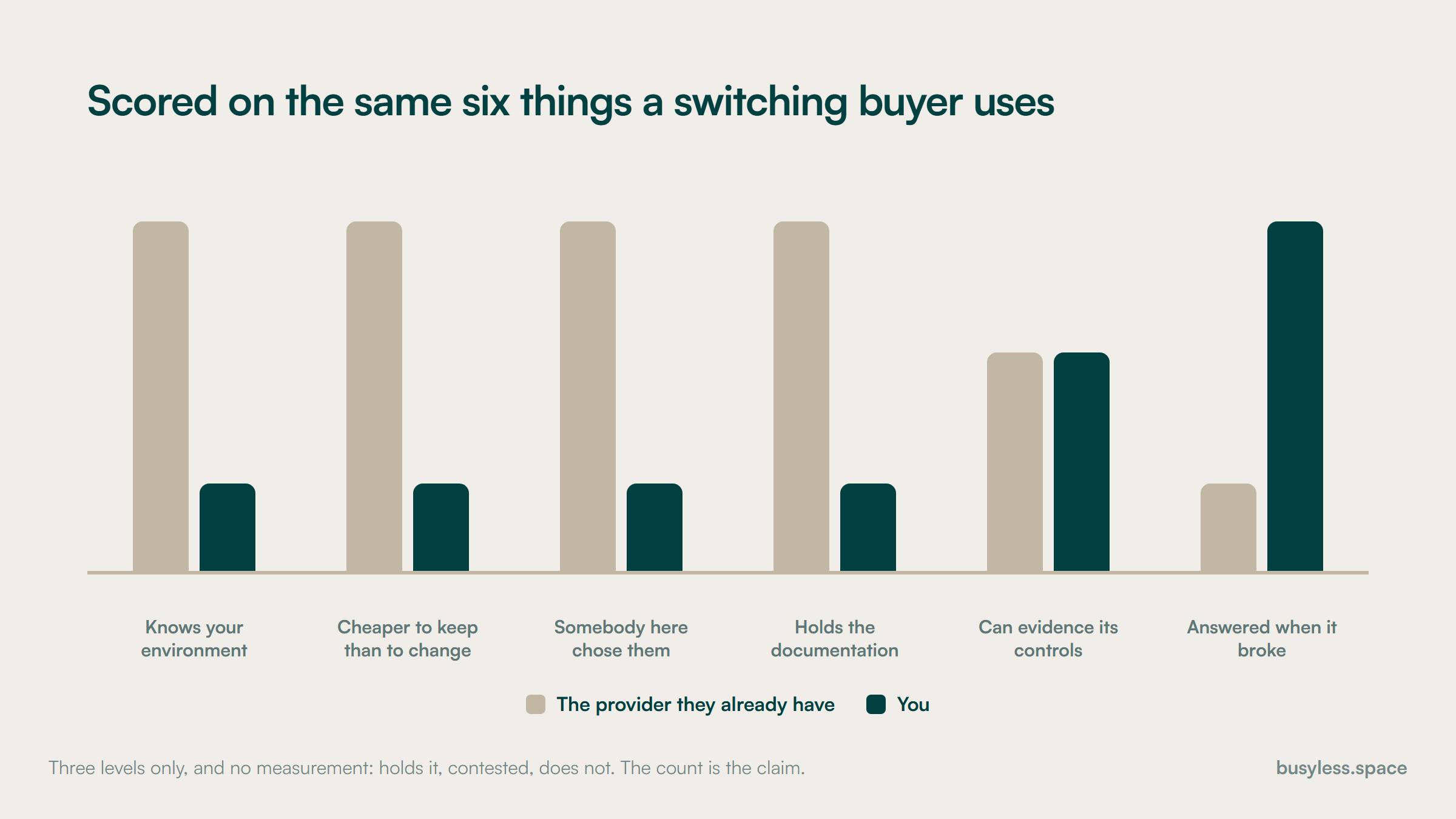
Two columns scored across the six categories a switching buyer uses. The incumbent's bar is taller on five of them, including knowing the environment and being cheaper to keep, and shorter on only one.
The single row you win on is the reason the search happened. Everything else on the page has to make the other five survivable.

What people actually search

Almost nothing in this market is a research query. The valuable searches are events, and each one has a deadline behind it. Sorting your keyword list by which event produced it is more useful than sorting it by volume.

The incumbent has failed

Transactional, with a grievance behind it

how to switch IT providers

The page that wins it: A switching page that covers offboarding, data, licences and notice

The single most valuable cluster and the one almost nobody writes. The searcher is not asking whether to switch. They are looking for evidence that switching is survivable, which is an entirely different page.

A framework has arrived

Commercial investigation

CMMC level 2 IT provider

The page that wins it: A page per framework, scoped to what you genuinely do

A deadline sits behind every one of these, usually a contract the buyer wants to keep. They are also the queries where an overstated claim does the most damage, because the reader will verify it.

The cyber insurance renewal

Informational, converting fast

MFA requirement for cyber insurance

The page that wins it: A page mapping the application questions to the controls that answer them

An annual, dated, unavoidable event that reliably ends in a purchase, and it is answered almost entirely by insurers and brokers rather than by the people who implement the controls.

Co-managed

Commercial

co-managed IT services

The page that wins it: A page written to the internal IT manager, not over their head

The only offer in this market that does not ask anybody to be fired, which is why it closes faster. It is also the one page most providers do not have, because it is uncomfortable to write.

Vertical and line-of-business

Commercial

IT support for dental practices

The page that wins it: A page naming the practice software you actually administer

The proof here is a product name. A page that mentions the industry converts nothing; a page that names the practice management system, its hosting model and its update cadence converts immediately.

Named competitor

Navigational, with doubt attached

[provider] reviews

The page that wins it: Nothing you publish, and that is the point

These get answered in forums. The useful response is operational rather than editorial: fix the thing being complained about, then be the provider whose name comes up in the reply.

Price

Commercial investigation

managed IT services cost per user

The page that wins it: A pricing page with real per-user bands and what changes them

Enormous, and answered across this industry with a contact form. Publishing bands filters out the buyers you would have wasted a quarter on and shortens every conversation that remains.

Product and licensing

Informational

Business Premium vs E3

The page that wins it: A comparison written from live tenants rather than from the vendor's page

The one cluster where you can genuinely out-write the vendor, because you administer hundreds of tenants and they are describing a product. Licensing changes often enough that a maintained page keeps earning.

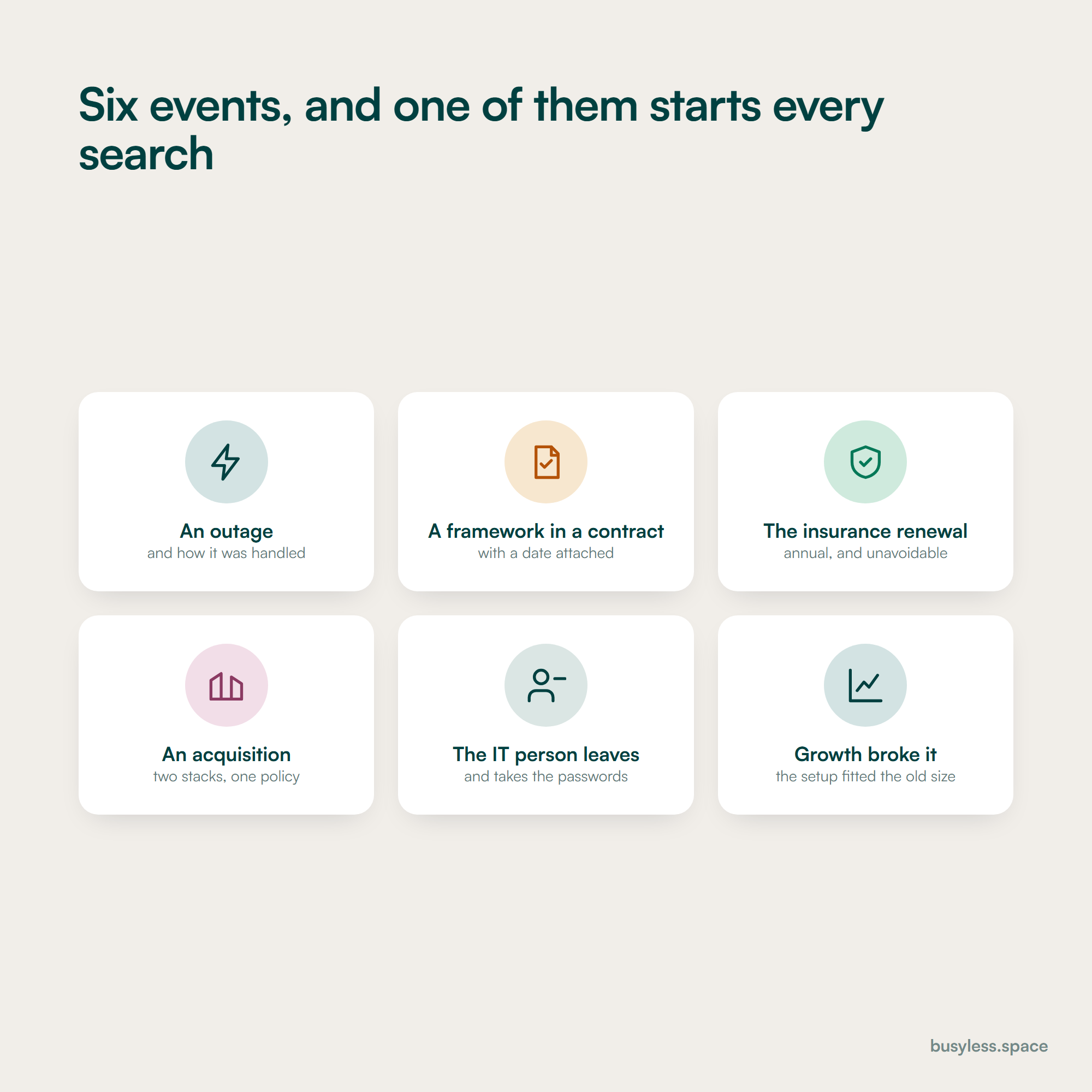
Six events shown as a set with no order: an outage, a framework arriving in a contract, a cyber insurance renewal, an acquisition, the departure of the internal IT person, and growth outgrowing the setup.
None of these is a keyword. Each of them produces several, and they are the ones worth counting.

What the rules change

The regulator does not license you, and that makes this section easier to get wrong rather than easier to ignore. Everything below constrains what your website may claim, and two of the four reach your client's contract rather than your own. Take advice on your specific position; none of this is legal advice.

1

There is almost certainly no such thing as a CMMC certified MSP

The CMMC programme rule at 32 CFR part 170, in effect since 16 December 2024, and the acquisition rule at 48 CFR carrying DFARS 252.204-7021, in effect since 10 November 2025

What it means

The final programme rule dropped the proposed requirement for external service providers to hold their own certification. Where controlled unclassified information flows to you, your services fall inside your client's assessment scope instead. Since November 2025 a contracting officer may put the requirement into a solicitation, so the claim now sits underneath a live award.

So do this

Write what is true and make it more useful than the badge was. Say which of your environments are in scope, whether you hold a CMMC assessment of your own, what your shared responsibility matrix covers, and what a client's assessor will ask you for. That page will outrank the badge and it will survive a phone call.

2

Nobody issues a HIPAA certificate

The Department of Health and Human Services, which states that it does not certify any person or product as HIPAA compliant

What it means

HIPAA certified and HIPAA compliant provider are claims about a status no regulator confers. An MSP with access to protected health information is a business associate and is directly liable under the rules, which is a real and stateable position. A certificate from a training vendor is not the same thing and a covered entity's counsel will know that.

So do this

Replace the badge with the facts a healthcare buyer is checking anyway: that you sign a business associate agreement, what it covers, how access is logged, how long you retain it, and what your breach notification obligation to them is. Name the vendor if you carry third-party training, and call it training.

3

A security claim on your website is a representation, and it travels

Section 5 of the FTC Act, together with the Department of Justice Civil Cyber-Fraud Initiative, which recovered more than $52m across nine cybersecurity settlements in the 2025 financial year

What it means

Statements about encryption, monitoring, backup testing and framework alignment are advertising claims and have to be substantiated. Where your client sells to the federal government, your representation can end up inside their certification, which is how a marketing sentence becomes somebody else's False Claims Act problem.

So do this

Keep a substantiation file for every security claim on the site, with the artefact that supports it and the date it was checked. Where a control is conditional, say what it is conditional on. Review the claims page every time the stack changes, because the copy outlives the tooling by about two years.

4

You are the service provider in somebody else's rule

The FTC Safeguards Rule at 16 CFR part 314, with the security requirements in force since 9 June 2023 and the breach notification section since 13 May 2024

What it means

Accountants, mortgage brokers, auto dealers, tax preparers and a long list of others are financial institutions under this rule, and it requires them to select service providers capable of maintaining safeguards and to bind them contractually. Since May 2024 they also have to notify the FTC within thirty days when 500 or more consumers are affected.

So do this

Build one page per covered profession that answers their obligation rather than describing your service. What the contract clause needs to say, which controls you can evidence, and how quickly you can produce the facts that a thirty-day notification needs. This is the best-converting content in the vertical and almost nobody writes it.

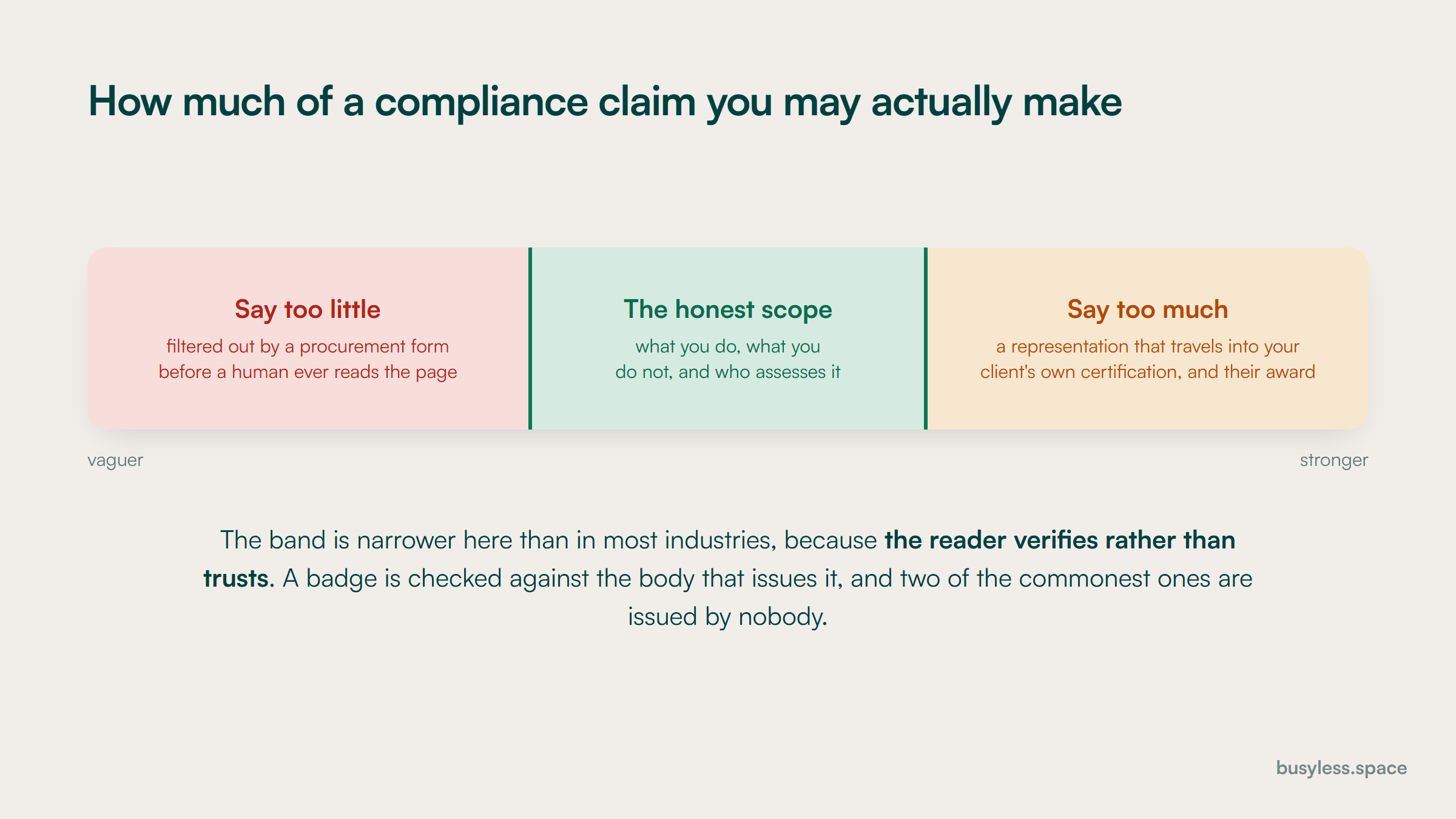
A narrow band between two failure zones. Under-claiming drops you off the shortlist before a human reads the page; over-claiming creates a representation that travels into the client's own certification.
The band is narrower in this industry than in most, because the reader verifies rather than trusts.

Proving expertise

The buyer is handing over the keys to everything, having already been disappointed once. Proof here is specific, verifiable and mostly consists of things you already have on a shared drive.

  • The named engineers who would actually work on the account, with their certifications
  • Vendor designations with the partner ID, linked to the vendor's own locator
  • The frameworks you work to, with what you do and do not cover under each
  • A real service level agreement, published rather than attached
  • Response and resolution figures you are willing to be held to
  • Your shared responsibility matrix, as a page rather than a spreadsheet
  • Named references by industry and size, with permission and a contact route
  • Whether the helpdesk is your staff, in which country, and on whose hours
  • How offboarding works if a client leaves, written before anybody asks

How to build a MSP SEO strategy

Nine months, ordered so the pages tied to a deadline exist before the pages tied to a category. An MSP SEO strategy tends to look flat for a quarter and then move quickly, because the queries that convert here are low volume and almost unopposed.

  1. 1

    Weeks 1 to 4

    Find out what you are already claiming

    • List every compliance and security claim on the site and find the artefact behind each
    • Remove or rewrite any certification badge that describes a status that does not exist
    • Identify which pages of your blog are syndicated and how many other domains carry them
    • Publish per-user price bands with the variables that move them
    • Set up the profile properly, with services listed and the real team photographed
    • Pull the last twenty security questionnaires into one document

    You end up with
    A defensible claims page, a published price, and the raw material for a quarter of writing

  2. 2

    Weeks 4 to 12

    Write the pages a deadline sends people to

    • Build the switching page, covering notice, data, licences and the first thirty days
    • Build one page per framework you genuinely work to, scoped honestly
    • Build the cyber insurance page that maps application questions to controls
    • Build the co-managed page, addressed to the internal IT manager
    • Publish the service level agreement and the shared responsibility matrix as pages
    • Claim and complete the industry directory profiles

    You end up with
    Coverage of every event that starts a search, with proof attached to each

  3. 3

    Weeks 10 to 24

    Prove you know one industry better than the rest

    • Pick the two verticals where you already have density and name their software
    • Turn the questionnaire answers into a page each for the professions the Safeguards Rule covers
    • Publish runbooks and licensing comparisons from your own tenants
    • Replace the syndicated posts with fewer, longer pieces you actually wrote
    • Add the schema for the organisation, the services and the technical articles
    • Ask three clients for a reference page you can link to by industry

    You end up with
    A site that reads as a specialist rather than as a category, and a blog that is yours

  4. 4

    Weeks 20 to 36

    Measure contracts, not enquiries

    • Tag enquiries by the trigger that produced them, not by the page they landed on
    • Track proposals sent and proposals won, split by trigger
    • Report seats added and contracted monthly recurring revenue beside the traffic
    • Watch the branded and alternative queries for reputation movement
    • Review the directory listings on cost per proposal rather than on referrals
    • Re-verify every claim on the claims page and date it

    You end up with
    A report that connects a search to a signed contract, and a claims file that is current

Technical fixes with the best payoff

One habit does most of the damage here, and it is not a crawl error. Everything that would prove this business is competent lives in a PDF, a gated form or a slide, so the only thing left on an indexable page is adjectives.

  • The proof is all in documents nobody can reach

    A sprint

    Service level agreements, security overviews, shared responsibility matrices, questionnaire responses and onboarding plans are the most persuasive material an MSP owns. In this vertical they are almost always a PDF behind a form, which means neither a search engine nor an answer engine has ever read a word of what makes you good.

    Publish each one as a real page with a heading structure, and keep the PDF as the download. Nothing in a service level agreement is a secret from a prospect who is about to be shown it anyway, and it is the single highest-conversion page most providers have never built.

  • The blog belongs to your marketing vendor

    An afternoon to check, a quarter to replace

    Channel marketing agencies sell subscription blog content to this industry openly, and one of them publishes an article defending the practice against the duplicate content objection. When the same post sits on several hundred provider domains, none of those domains is the answer to anything.

    Find out how many other sites carry your last five posts by quoting a distinctive sentence into a search. Then stop the subscription, delete or rewrite what it produced, and publish one genuine piece a month from work you did this quarter. Fewer pages, all of them yours.

  • There is no price anywhere on the site

    An afternoon

    Cost per user is one of the largest search clusters in this market and the standard answer is a form. The buyer already has an incumbent invoice in front of them, so they are not asking what it costs in general. They are checking whether you are in the same universe before they spend an hour on a call.

    Publish bands per user per month, with what moves them: seat count, coverage hours, whether hardware is included, whether the security stack is bundled, and where onboarding sits. You will lose enquiries you were never going to close and shorten every one you keep.

  • One page called industries, listing nine of them

    A day per vertical

    A single page naming healthcare, legal, finance, manufacturing and five more ranks for none of them and proves nothing about any. The vertical queries in this market are specific and the winning page names the software, not the sector.

    Pick the two verticals where you have real density and give each a page that names the line-of-business application, its hosting model, the update cadence, the integrations and the compliance regime attached to it. Delete the list page or turn it into a hub with two real children.

  • The team page is stock photography

    A day

    The purchase is a decision to trust named individuals with everything. Half the sites in this market show a smiling office nobody in the company has ever sat in, and the other half show a founder and a blank grid. Neither survives comparison with an incumbent the buyer knows by first name.

    Photograph the actual engineers, name them, list their certifications, and say who would be assigned. If the helpdesk is offshore, say so plainly and explain how it is supervised, because a buyer who finds out later treats it as the first thing you concealed.

  • The knowledge base is behind the client portal

    A sprint, then an hour a week

    Most providers have written hundreds of genuinely useful runbooks and locked all of them behind a login. Those articles answer exact-match queries that engineers and IT managers search constantly, and they are the most credible thing on the domain.

    Publish the generic half. Anything that would help any competent administrator can be public; anything naming a client's environment cannot. Mark the public ones up as technical articles and put the author's name and credentials on them.

  • Every conversion goes to one contact form

    An afternoon

    A buyer researching a framework deadline, a buyer whose server is down, and a buyer who wants a second opinion on their internal team are three different people, and this industry routes all three to a form asking for company size. The urgent one leaves.

    Different routes for different triggers: a phone number that is answered for outage traffic, a booked assessment for compliance traffic, and a written second-opinion offer for co-managed traffic. Then measure them separately, because they close at wildly different rates.

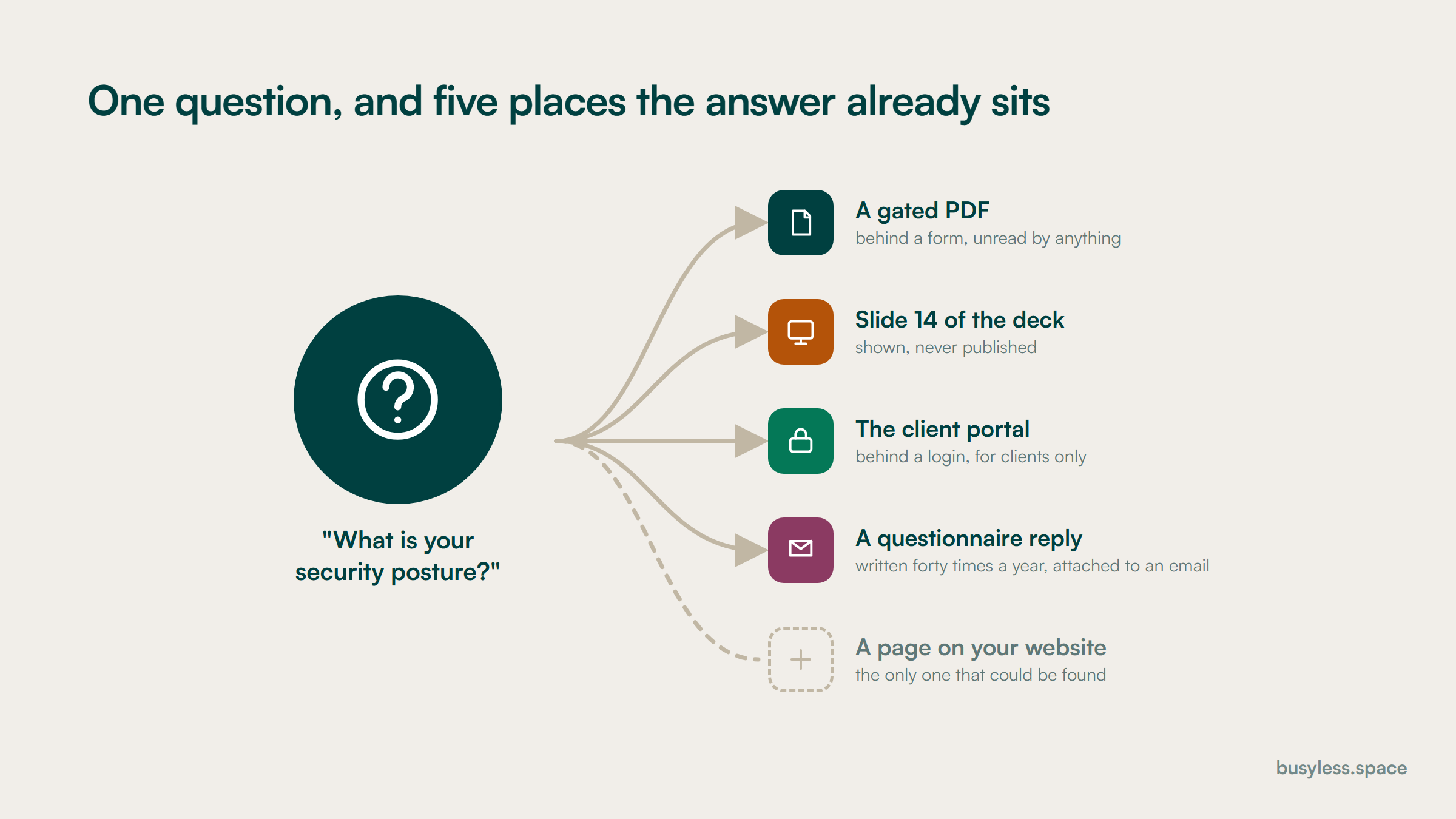
One buyer question about security posture branching to five destinations: a gated PDF, a slide in a deck, a portal login, a questionnaire reply, and a dashed empty card where a page on the website would be.
Four of these already exist and are already written. The fifth, the dashed one, is the only branch anything could ever find.

Structured data that applies here

The types below fit this industry specifically. Most of them earn no rich result on their own, which is worth knowing before anyone sells the work on that basis. What they do is describe the entity precisely, which matters for how search engines and answer engines resolve who you are.

  • ProfessionalService bounded by the stack you support

    Home page and the main service page

    The useful fields are the ones most providers leave out. areaServed describes where you will physically attend, knowsAbout describes what you administer, and the two together are what distinguishes you from a national brand with a phone number.

    ProfessionalService bounded by the stack you support.jsonld
    {
      "@context": "https://schema.org",
      "@type": "ProfessionalService",
      "@id": "https://[YOUR-DOMAIN]/#organization",
      "name": "[COMPANY NAME]",
      "url": "https://[YOUR-DOMAIN]/",
      "telephone": "[+1-555-000-0000]",
      "priceRange": "[$$$]",
      "address": {
        "@type": "PostalAddress",
        "streetAddress": "[STREET]",
        "addressLocality": "[CITY]",
        "addressRegion": "[ST]",
        "postalCode": "[00000]",
        "addressCountry": "US"
      },
      "areaServed": [
        { "@type": "City", "name": "[CITY]" },
        { "@type": "AdministrativeArea", "name": "[METRO OR COUNTY]" }
      ],
      "knowsAbout": [
        "[Microsoft 365 tenant administration]",
        "[Endpoint detection and response]",
        "[Backup and disaster recovery]",
        "[LINE-OF-BUSINESS APPLICATION YOU ADMINISTER]"
      ],
      "numberOfEmployees": {
        "@type": "QuantitativeValue",
        "value": "[00]"
      },
      "hasOfferCatalog": { "@id": "https://[YOUR-DOMAIN]/services#catalog" }
    }
  • Service with a real per-user band

    The pricing page and each service page

    Only worth publishing once the same band is in the visible copy. The unitCode below is the annotation that makes a per-seat price readable rather than ambiguous, and getting it right forces you to decide what a seat actually includes.

    Service with a real per-user band.jsonld
    {
      "@context": "https://schema.org",
      "@type": "Service",
      "@id": "https://[YOUR-DOMAIN]/services/[SLUG]#service",
      "name": "[Co-managed IT / Fully managed IT / vCIO]",
      "serviceType": "[Plain description of what is covered]",
      "provider": { "@id": "https://[YOUR-DOMAIN]/#organization" },
      "areaServed": { "@type": "AdministrativeArea", "name": "[METRO]" },
      "termsOfService": "https://[YOUR-DOMAIN]/service-level-agreement",
      "offers": {
        "@type": "Offer",
        "priceSpecification": {
          "@type": "UnitPriceSpecification",
          "minPrice": "[000]",
          "maxPrice": "[000]",
          "priceCurrency": "USD",
          "unitCode": "ANN",
          "referenceQuantity": {
            "@type": "QuantitativeValue",
            "value": 1,
            "unitText": "user per month"
          }
        },
        "eligibleCustomerType": "[Business]"
      },
      "description": "[What moves the price: seat count, coverage hours, whether the security stack and hardware are included.]"
    }
  • TechArticle for a published runbook

    Every knowledge base article you make public

    This is the node that pays for itself here, because the knowledge base already exists. The proficiencyLevel field is the one that matters: it tells an answer engine whether the piece is for an end user or for an administrator, which is exactly the distinction these queries turn on.

    TechArticle for a published runbook.jsonld
    {
      "@context": "https://schema.org",
      "@type": "TechArticle",
      "headline": "[Exact title of the runbook]",
      "description": "[One sentence naming the symptom and the environment.]",
      "proficiencyLevel": "[Expert]",
      "dependencies": "[Product and version this applies to]",
      "author": {
        "@type": "Person",
        "name": "[ENGINEER NAME]",
        "jobTitle": "[Systems Engineer]",
        "hasCredential": {
          "@type": "EducationalOccupationalCredential",
          "credentialCategory": "[CERTIFICATION NAME]",
          "recognizedBy": { "@type": "Organization", "name": "[VENDOR]" }
        }
      },
      "publisher": { "@id": "https://[YOUR-DOMAIN]/#organization" },
      "datePublished": "[YYYY-MM-DD]",
      "dateModified": "[YYYY-MM-DD]"
    }
  • Organization with credentials you can point at

    The about page and the claims page

    The rule for this block is the rule for the whole page: mark up only what a reader can verify independently. A vendor designation has a partner identifier and a locator entry, an audit report has a period and a firm. Framework alignment has neither and does not belong here.

    Organization with credentials you can point at.jsonld
    {
      "@context": "https://schema.org",
      "@type": "Organization",
      "@id": "https://[YOUR-DOMAIN]/#organization",
      "name": "[COMPANY NAME]",
      "identifier": [
        {
          "@type": "PropertyValue",
          "name": "[VENDOR] partner ID",
          "value": "[PARTNER ID]"
        }
      ],
      "hasCredential": [
        {
          "@type": "EducationalOccupationalCredential",
          "credentialCategory": "[DESIGNATION OR SPECIALISATION]",
          "recognizedBy": { "@type": "Organization", "name": "[VENDOR]" },
          "url": "[LINK TO THE VENDOR'S OWN LOCATOR ENTRY]"
        }
      ],
      "subjectOf": {
        "@type": "CreativeWork",
        "name": "[SOC 2 Type II report]",
        "creator": { "@type": "Organization", "name": "[AUDIT FIRM]" },
        "temporalCoverage": "[YYYY-MM-DD/YYYY-MM-DD]"
      }
    }
  • FAQPage

    The pricing, switching and framework pages

    The three questions worth covering are the ones a buyer will not ask on a call: what it costs, what happens if we leave, and what exactly you are certified to do. Match the visible text word for word and keep every compliance answer inside what your substantiation file supports.

    FAQPage.jsonld
    {
      "@context": "https://schema.org",
      "@type": "FAQPage",
      "mainEntity": [
        {
          "@type": "Question",
          "name": "[Question exactly as it appears on the page]",
          "acceptedAnswer": {
            "@type": "Answer",
            "text": "[Answer exactly as it appears. Give the real band, the real notice period and the real scope of any certification.]"
          }
        }
      ]
    }
  • BreadcrumbList

    Service, vertical, framework and knowledge base pages

    Worth building once there is a genuine hierarchy under services and industries. Assembling it is also the fastest way to discover that the vertical pages have no parent, which is usually why they rank for nothing.

    BreadcrumbList.jsonld
    {
      "@context": "https://schema.org",
      "@type": "BreadcrumbList",
      "itemListElement": [
        { "@type": "ListItem", "position": 1, "name": "Home",
          "item": "https://[YOUR-DOMAIN]/" },
        { "@type": "ListItem", "position": 2, "name": "[Industries]",
          "item": "https://[YOUR-DOMAIN]/industries" },
        { "@type": "ListItem", "position": 3, "name": "[VERTICAL]",
          "item": "https://[YOUR-DOMAIN]/industries/[SLUG]" }
      ]
    }

What it costs

Editorial estimates rather than quotes. They sit mid-range for this directory, because the pages are few but each one needs a technical person's time, and the cost of writing a framework page badly is not measured in traffic.

Lean

$2,000 to $4,000
  • The claims audit and a defensible claims page
  • Published per-user price bands
  • The switching page and one framework page
  • Directory profiles claimed and completed
  • The service level agreement published as a page

Who it suits

A provider under about twenty staff with one clear geography

Where it stops

It covers the events that already send people looking. It will not build the vertical depth that lets you charge more than the firm down the road.

Funded

$4,000 to $6,000
  • Two vertical pages that name the line-of-business software
  • A page per covered profession under the Safeguards Rule
  • The knowledge base opened up and marked up
  • The syndicated blog replaced with original monthly work
  • Reporting split by trigger rather than by channel

Who it suits

A provider with a growth target and at least one vertical it already wins in

Where it stops

It will not win a national compliance-led deal on its own. Those are decided in an assessment, and the site's job there is to get you into the room.

Enterprise

$6,000 to $8,000
  • Framework content maintained as the rules move
  • Original research from your own fleet, published properly
  • Comparison and licensing content kept current across the stack
  • Content built for the acquisition thesis where you are buying or being bought
  • Attribution stitched from first touch to signed contract

Who it suits

Multi-office providers, or anyone whose growth plan involves acquisition

Where it stops

Delivery becomes the limit before the budget does. If onboarding is already the bottleneck, more demand makes the service worse, and the churn line will say so before the pipeline does.

How to do it with no budget

More of this playbook is free than in almost any other industry here, because the assets already exist. Four of the seven steps below are publishing something you have already written for somebody else.

  1. 1

    Find out how many sites carry your blog

    20 minutes

    A search engine and a pair of quotation marks

    Take a distinctive sentence from your last five posts and search it in quotes. The result count is the honest answer to why the blog has never ranked, and it usually ends the subscription conversation in one meeting.

  2. 2

    Publish the service level agreement as a page

    2 hours

    Your website editor

    Not a PDF and not behind a form. It is the document a serious buyer wants most, it is not confidential, and it is the only page on your site your incumbent competitor probably cannot match.

  3. 3

    Turn the last twenty security questionnaires into pages

    4 hours

    Your shared drive

    You have already written the best answers available about your own controls. Strip the client names, group the answers by theme, and publish. This is the highest ratio of value to effort in the whole playbook.

  4. 4

    Write the switching page

    3 hours

    Your own onboarding checklist

    Notice periods, who owns the documentation, what happens to licences and tenancies, what the first thirty days look like. The buyer is not asking whether to leave. They are asking whether leaving will hurt.

  5. 5

    Publish per-user price bands

    2 hours

    Your website editor

    With the variables named. Every hour saved on a call with a buyer who was never in your range pays for this several times over in the first month.

  6. 6

    Complete the vendor partner locator entry

    1 hour

    Your vendor partner portal

    Free, ranked by designation, and read by buyers who have already standardised on that vendor. Most providers fill in the company name and stop, which leaves the specialisations and the customer evidence blank.

  7. 7

    Audit every claim on the site against an artefact

    3 hours

    A spreadsheet

    One row per claim, one column for what proves it and one for the date it was checked. The rows with an empty middle column are the ones to rewrite before anything else on this list.

The tool stack

Short, because the writing is the work. Two of these are systems you already own and have never pointed at a marketing question, and one is a search engine you use for free.

  • Track the queries that only fire during a switching event

    seoClaritySEO APIRead the review

    These clusters are small, so an average position across the whole site tells you nothing. Group them by trigger and watch the groups separately, because one framework deadline can move a page from nowhere to first in a fortnight.

    Free routeSearch Console filtered to the switching and framework pages

  • Find out which of your pages a crawler can actually read

    JetOctopusSEO APIRead the review

    The specific thing to look for here is how much of the site is a link to a document. A crawl that reports a hundred pages and forty PDFs on an MSP site is describing the problem in this playbook's technical section exactly.

    Free routeSearch Console's page indexing report

  • Work out what a contract is worth before you spend on winning one

    ROI Calculator for Workflow AutomationFree toolOpen the tool

    Seats multiplied by rate is not the number. Onboarding cost, the first-year support load and the projects that follow the contract are what decide whether a segment is worth writing for at all.

    Free routeFree

  • See what the answer engines say when somebody asks about you

    Your own browser, in a clean session

    Ask an assistant for the best providers in your city and for a comparison between you and your nearest competitor. The answers are assembled from directories and forums, which tells you where the reputation work has to happen.

    Free routeFree, and the only honest version

  • Publish runbooks, service pages and vertical content as related records

    KeystoneHeadless CMSRead the review

    Services, verticals, frameworks, engineers and runbooks are related entities and the relationships are the internal linking. Modelling them once means the framework page automatically lists the engineers certified against it, which is the link nobody maintains by hand.

    Free routeOpen source

  • Know which industries you already win in

    Your professional services automation platform

    Filter contracts by industry, then by gross margin rather than by revenue. The vertical worth writing two pages about is usually not the one with the most logos, and this report takes about ten minutes.

    Free routeAlready paid for

  • Track proposals rather than enquiries

    Your CRM, with one extra field

    Add a trigger field to every opportunity: outage, framework, insurance renewal, acquisition, internal departure, or none. Six months of that field is the most useful marketing data an MSP can own, and nothing else can produce it.

    Free routeFree

  • Check where your best pages are being copied

    Search, with a quoted sentence

    Works in both directions. It finds the syndicated content on your own site and it finds competitors who have taken yours, which happens more in this vertical than most people expect.

    Free routeFree

Take it from here

Everything below is yours to take. Fill the [BRACKETS] and it is ready to use. Start with the claims audit, because it decides what the rest of the site is allowed to say.

Checklist

One row per assertion on the site, with the artefact behind it and the date it was last checked. The rows with an empty middle column are the ones to fix first.

CLAIMS AND SUBSTANTIATION AUDIT - [COMPANY] - [DATE]

WHY THIS IS FIRST
A security or compliance claim on your website is a
representation. Where your client sells to the federal
government, it can end up inside their certification. Before you
publish anything new, find out what you are already saying.

1. INVENTORY
   Walk the home page, every service page, the footer, the
   about page and every badge image. One row each.

   CLAIM (exact words on the page)  |  PAGE  |  ARTEFACT  |  CHECKED
   [___________________________]    |  [___] |  [_______] |  [______]
   [___________________________]    |  [___] |  [_______] |  [______]
   [___________________________]    |  [___] |  [_______] |  [______]
   [___________________________]    |  [___] |  [_______] |  [______]
   [___________________________]    |  [___] |  [_______] |  [______]

2. THE FOUR CLAIMS TO CHECK FIRST
   [ ] Anything using the word certified
   [ ] Anything naming a framework (CMMC, HIPAA, SOC 2, PCI,
       NIST, ISO 27001, CIS)
   [ ] Anything stating a percentage, an uptime or a response time
   [ ] Any vendor logo or designation badge

3. THE TEST FOR EACH ROW
   [ ] Is there a document, report, certificate or contract that
       says this?
   [ ] Does the issuing body actually confer this status?
       (Two that do not: nobody issues a HIPAA certificate, and
       the CMMC programme rule does not certify service
       providers.)
   [ ] Is the artefact current, and when does it expire?
       Expires: [__________]
   [ ] Would this claim survive being read aloud to the auditor
       of the client it most matters to?

4. THE REWRITE
   For every row that fails, replace the claim with the fact
   underneath it. Facts are longer, more specific and convert
   better.

   Instead of: [_________________________________________]
   Write:      [_________________________________________]
               [_________________________________________]

5. OWNERSHIP
   Owner of this file:            [_______________]
   Reviewed every:                [ quarterly / at each stack change ]
   Next review:                   [__________]

What to publish

Write from the work. Everything that converts in this market is something you did for a client last month, described accurately, with the client's name removed and nothing else softened.

  • The switching page

    Once, reviewed annually

    Every buyer in this market has an incumbent, so the leaving is the hard part rather than the joining. Notice, data, licences, documentation and the first thirty days, written plainly.

  • One page per framework, scoped honestly

    One per framework, revisited when the rule moves

    A deadline sits behind each of these searches. The page that says what you do not cover is the one that gets believed about what you do.

  • Questionnaire answers, published by theme

    A batch a quarter, from work already done

    You write these forty times a year for an audience of one. They are precise, technical and already approved internally, which is a combination almost no marketing content has.

  • Vertical pages that name the software

    Two, done properly, rather than nine

    The proof a dental practice or a law firm wants is that you have administered their line-of-business application. Naming it does more than a page of sector language.

  • Runbooks from the knowledge base

    Weekly, from tickets already resolved

    Exact-match technical queries with almost no competition, written by people with credentials, and they establish the expertise the sales pages assert.

  • Licensing and product comparisons from live tenants

    Monthly, and updated when licensing changes

    The vendor describes the product; you administer hundreds of instances of it. That gap is where the only genuinely defensible informational content in this market lives.

And what not to

  • Subscription blog posts that sit on several hundred other provider domains
  • Any certification badge describing a status the issuing body does not confer
  • Explaining what managed services are to a reader who already buys them
  • A single industries page listing nine sectors and proving none
  • Security claims with no artefact behind them and no date on the check
  • Stock photography of an office your team has never worked in
  • Ransomware statistics borrowed from a vendor's report and restated as your own
  • Case studies with the numbers removed and the client anonymised into nothing

The expensive mistakes

Writing for a first-time buyer who does not exist

Costs you A site full of category education that ranks for informational queries and converts nobody, because every visitor settled those questions years ago

Write to the five events that put somebody in the market, and put the proof they need next to each

Buying the channel blog subscription

Costs you Several hundred domains carrying your content, a blog that has never ranked, and the appearance of a provider with nothing of its own to say

One genuine piece a month from work you did, plus the runbooks you have already written

Putting a compliance badge on the site that describes nothing

Costs you A claim a buyer's auditor will check, on a page underneath a contract award, in a market where the regulator's own rule says the status does not exist

State your actual scope, publish the shared responsibility matrix, and let the specificity do the persuading

Keeping every proof document behind a form

Costs you The most convincing material you own is invisible to search, to answer engines and to anybody not yet willing to give you an email address

Publish the page, keep the PDF as the download, and gate nothing that a prospect would see in week one anyway

Refusing to publish a price

Costs you Hours a week on discovery calls with buyers who were never in your range, and a lost visitor who wanted a number and found one elsewhere

Per-user bands with the variables named, and a shorter, better-qualified pipeline

Treating the peer forums as a channel

Costs you A reputation problem that gets worse the moment somebody notices the account is yours, in the one place your named-brand queries are answered

Fix what is being complained about, and be the provider a member recommends without being asked

What to measure

Two changes make this report honest. Attribute by the event that started the search rather than by the page that received the click, and report contracted recurring revenue rather than enquiries, because a single win here can be worth a year of them.

Leading indicators

Move first. They predict, they do not prove.

  • Impressions on switching and framework clusters

    Search Console, grouped by trigger

    Low volume by design, so a whole-site average hides it entirely. Grouped by trigger it is the earliest signal that a page has landed, usually a fortnight before anything else moves.

  • Ranking on named-competitor and alternative queries

    Rank tracking on brand-adjacent terms

    Mostly a reputation measure rather than a traffic one. It tells you which forum threads and which directory pages are answering for you, which is where the work has to happen.

  • Directory profile views and referrals

    The directories' own dashboards

    Worth watching per directory rather than in total, because two of them will produce almost everything and the rest are a citation. Review the paid ones on cost per proposal.

  • Assessment and second-opinion requests

    Your booking system, split by route

    The intermediate conversion that actually predicts revenue here. A buyer who books an assessment has decided to consider leaving, which is the hardest step in the whole funnel.

Business indicators

The ones a manager acts on.

  • Proposals sent, by trigger

    CRM, using the trigger field

    The number that reorders the plan. Six months of it usually shows one trigger producing most of the pipeline and getting a fraction of the content budget.

  • Win rate by trigger

    CRM

    Triggers close at very different rates. Insurance renewals and framework deadlines convert quickly because a date is fixed; general dissatisfaction converts slowly and sometimes never leaves.

  • Contracted monthly recurring revenue added

    Your professional services automation platform

    The outcome, and the reason enquiry counts mislead in this market. One win can be worth more than a quarter of them, so a channel that produces few and large beats one that produces many and small.

  • Onboarding capacity against signed work

    Project scheduling

    An operations number in a marketing report, deliberately. If onboarding is already late, more demand degrades the service you are selling, and the honest recommendation that month is to slow the acquisition down.

The verdict

This is the only market in this directory where the competitor is a company your prospect already trusts enough to have hired. The website's job is not to explain managed services. It is to make leaving look survivable.

Almost everything that does that is already written. The service level agreement, the questionnaire answers, the onboarding plan and the knowledge base are the most persuasive material in the business, and in this vertical they are all locked in documents.

Which is why a proposal for MSP SEO services should be judged on what it plans to publish rather than on what it plans to write. A quarter spent unlocking existing material beats a year of new articles, and it is cheaper.

One question separates a real plan from a subscription. Ask anybody offering SEO services for IT companies how many other providers will receive the same article, and whether they will show you the claims audit before they write anything at all.

FAQ

IT services and MSPs SEO questions

  • Can we say we are a CMMC certified MSP?
    Almost certainly not, because the status usually does not exist. The CMMC programme rule at 32 CFR part 170, in effect since December 2024, dropped the proposed requirement for external service providers to certify. What replaces it is scope: your services get assessed as part of your client's assessment. Describe that arrangement instead, and publish the responsibility split it depends on.
  • Why does our blog never rank?
    Take a distinctive sentence from your last post, put it in quotation marks and search it. If it comes back on dozens of other provider websites, you have your answer. Subscription blog content is sold openly in this industry, and a page that exists on hundreds of domains cannot be the answer to anything. One genuine piece a month will do more than a year of it.
  • Should we publish a per-user price?
    Yes, as bands per user per month with the variables named. Cost per user is one of the largest clusters in this market and it is answered almost everywhere with a contact form. Your buyer already has an incumbent invoice in front of them and is checking whether you are in the same range. Publishing it loses you calls you would not have won and shortens the rest.
  • What is the single most valuable page we could build?
    The switching page. Every prospect in this market already has a provider, so the thing stopping them is not doubt about you but fear of the change. A page covering notice periods, who owns the licences and documentation, what tends to go wrong and what the first thirty days look like answers the question they are actually searching.
  • Is co-managed IT worth a separate page?
    It is the most under-written page in the vertical. Every other offer asks the buyer to end a relationship, often with a person they hired. Co-managed does not, which is why it closes faster and meets less internal resistance. Write it to the internal IT manager rather than over their head, and say plainly which parts of the job stay theirs.
  • How do we handle bad Reddit threads about us?
    Operationally, not editorially. Those threads rank for your brand and are read carefully, and any attempt to manage them with an account is noticed quickly and makes it worse. Fix whatever is being described, ask the clients who are happy to answer honestly if they are asked, and accept that the reputation is earned in delivery rather than in marketing.
  • Do the paid directory listings pay for themselves?
    Some do, and the only way to know is to measure them on cost per proposal rather than on referrals or profile views. Two of them usually produce nearly everything and the rest are worth having as citations if they are free. Read the placement labels before you draw conclusions from the ordering, because sponsorship moves position on most of them.
  • What does MSP SEO cost?
    The tiers above are editorial estimates rather than quotes. A provider running a real programme is realistically at $2,000 to $8,000 a month. The range is wide because the work is uneven. The first quarter is mostly publishing material you already own; the expensive part is the framework and vertical content, which needs a senior engineer's time to be worth anything.

Run it yourself, or have someone own it

Everything above is written to be run without us, and the free path is genuinely most of the value for a single-location business. Where these plans stall is almost never the plan. It is that nobody owns it after the first month. That is the job we do, with search as one distribution layer inside a wider system rather than the whole engagement.