
Content marketing for MSPs
Your whole industry publishes the same vendor-supplied content
- Sector
- Software and tech
- Channels
- Search, Newsletter, Community
- Buying cycle
- Long cycle
- Time to compound
- 9 to 18 months
- Typical monthly
- $1,500 to $8,000
Key takeaways
- 1Your vendors supply finished marketing and so do the white-label shops, so the same article about phishing awareness sits on several hundred provider websites, occasionally with the same stock photograph. That is the category you are publishing into.
- 2This is the best news in this playbook. A market where almost everybody publishes the same thing is a market where one specific, first-hand piece stands out immediately, and it costs an engineer forty minutes rather than a retainer.
- 3The material is in the ticket queue and in the onboarding audit. Every provider finds the same catalogue of problems when it takes over an environment, and not one of them has ever written the catalogue down.
- 4You cannot name the client, and that is not only a contract clause. Publishing who you look after tells an attacker exactly who runs their IT, which makes your customer list part of their attack surface and yours.
- 5So the discipline is specific about the incident and silent about the organisation. That is genuinely hard to write and it is the only version of this that is both useful and safe, which is why so few providers manage it.
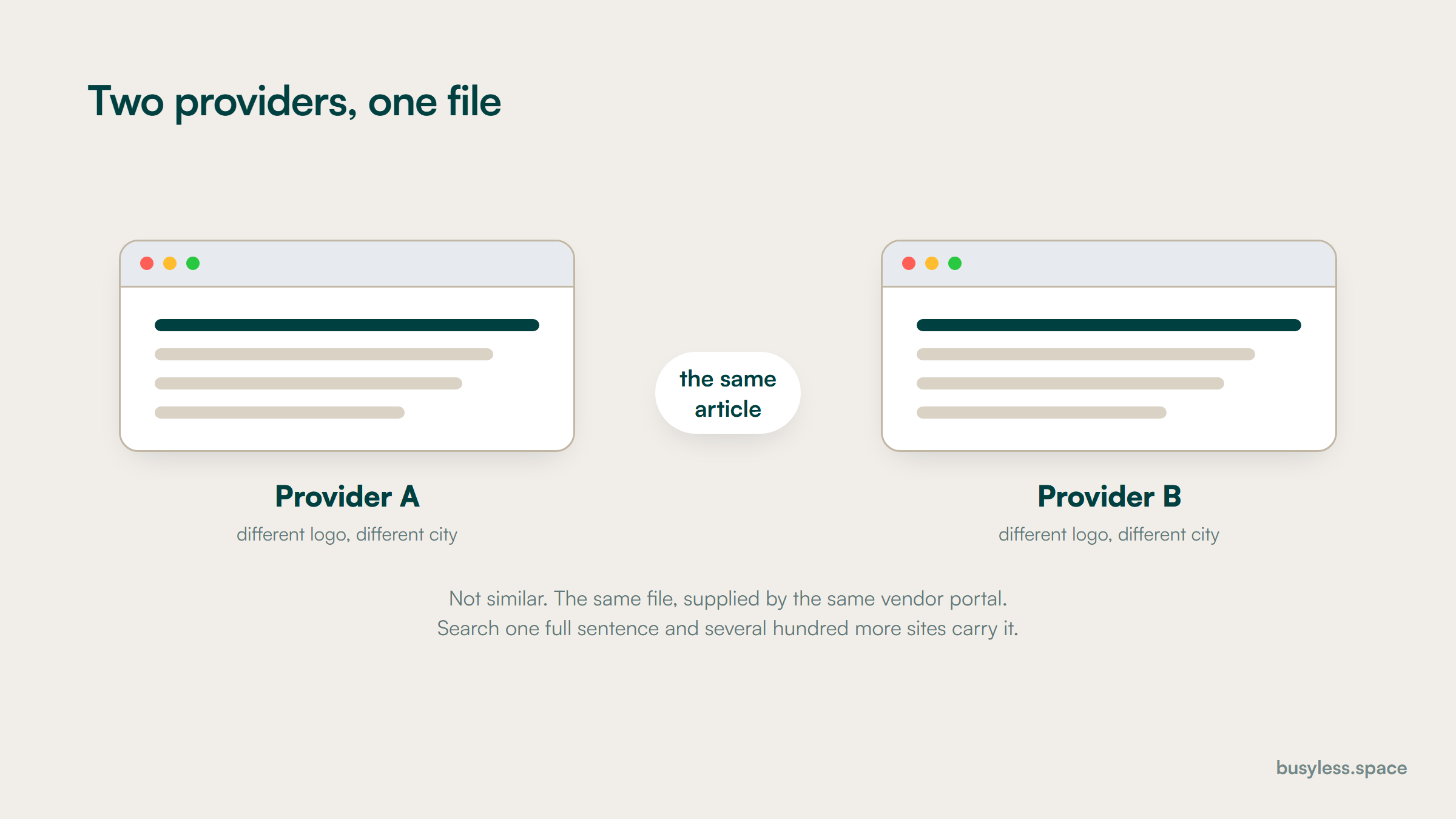
Content marketing for MSPs starts from an unusual position. Almost nobody in this industry writes their own material. Vendors run partner marketing portals that hand out finished blog posts, email sequences and social copy, and white-label agencies sell the same library to hundreds of providers at once.
The result is a category where several hundred websites carry the same article about password hygiene, published in the same month, sometimes down to the image. A buyer comparing three providers is reading one writer three times, which is a strange thing to have happened to an entire market.
It also means the bar is on the floor. One piece written from something that actually happened in your own service desk beats everything else in the category, not because it is better written but because it is the only one that is true of anybody in particular.
So an MSP content marketing strategy is mostly a decision to stop publishing what was given to you, plus an editorial discipline for describing real incidents without identifying the organisation they happened to. The second half is the difficult one and it gets a section of its own.
Looking for the search half
This page decides which channels to run. The one next door goes deep on just one of them.
Which channels to run, and which to skip
The sorting principle here is whether a channel rewards being specific, because that is the only advantage available. Anything that rewards volume is a channel where the syndicated libraries have already won on cost, and there is no point competing with a free article on those terms.
Run these
Search
RunThe syndicated article cannot win here, because four hundred sites carry it and search has to choose one, which will not be you. Your own incident write-ups have no competition at all, since nobody else saw the incident. The switching-buyer landscape and the security-claim question are the sibling playbook's subject.
First movePublish one write-up of something your service desk actually resolved last month, anonymised properly. It is the only page on your site nobody else has.
Newsletter
RunThe one place you can reach somebody who is under contract with a competitor and cannot act for two years, which is most of your market at any moment. A monthly note about what you genuinely saw keeps you present through a renewal cycle, and it costs almost nothing once the write-ups exist.
First moveSend one monthly note that is three real things you saw and nothing else. No offers, no vendor content, no seasonal greeting.
Community
RunNot peer groups, which are full of other providers, but the places your actual buyers gather: a trade association, a professional body, a chamber. This is also where vertical specialisation pays, because a provider who genuinely understands one sector's software is unusual and immediately recognisable in that room.
First movePick the one vertical where you already have several clients and turn up to its association meeting rather than a channel event.
Worth a test, with a kill date
Events and talks
TestA breakfast briefing for a dozen business owners in one sector works well in this industry and a general lunch-and-learn does not, because the second one is a vendor deck with your logo on it. Worth testing once the vertical is chosen and worth skipping until it is.
First moveRun one session on what you actually find when you take over an environment. Nobody has to be sold anything for that to be worth an hour.
Video
TestAn engineer explaining what went wrong is convincing in a way a page is not, and video is also where the syndicated libraries are weakest, because a generated explainer is obvious. The cost is service desk time, which is the scarcest thing you have, so keep the test small.
First moveRecord one engineer walking through one resolved incident, screen and voice, under ten minutes. No script and no branding at the front.
Founder-led social
TestAlmost all MSP social is the syndicated library on a schedule, which is why none of it works. The version worth testing is a named engineer or a technical director posting something they actually think, and the reason it is a test rather than a run is that it depends entirely on having such a person willing.
First moveFind out whether anybody technical in your business wants to post. If nobody does, do not buy a scheduling tool and fill it with vendor material.
Skip these
Original research
SkipA single provider does not have the volume to publish incident data as research without either overstating a small sample or narrowing a cut until somebody is identifiable. The impulse is right and the arithmetic is not, and a made-up denominator in this category is easy to spot.
Trade press
SkipChannel publications reach other providers, distributors and vendors, which is to say your competitors and your suppliers. It is also, pointedly, where the partner marketing programmes that created this problem are advertised, so it is the least likely place to find a customer.
Three to run, three to test, and both skips are places full of people who sell to you or compete with you. The organising idea is the same each time: pick the channels where one first-hand detail beats a hundred polished generic ones, and leave the volume game to the people giving the volume away free.
What you already own that nobody can copy
This is a service business that generates a written record of everything it does, which puts it in an unusually strong position and makes the silence odder. Four of the five below are already in a system, and the fifth happens every time a new client signs.
The onboarding audit, across every client you have taken on
Held by Whoever runs onboarding
Every provider does a discovery audit and finds roughly the same catalogue: the unmanaged switch, the shared administrator account, the backup that has not completed since a date nobody noticed. Nobody has ever aggregated it, and it is the single most persuasive thing a prospective client could read, because they suspect it is true of them.
How to capture it
Go back through the last twenty onboardings and count what you found. The pattern is the piece, no client is named in it, and the work is an afternoon.
The ticket queue
Held by The service desk
Hundreds of real incidents a month, with what was actually wrong and what actually fixed it. No vendor can supply this and no competitor saw it. It is also, unlike almost everything else in marketing, generated whether or not anybody is planning content that week.
How to capture it
Once a month, pick the three tickets an engineer found most interesting rather than the three most common. Interesting beats representative for this purpose.
What actually breaks in the software your vertical runs
Held by The engineers who support it
Practice management systems, dental imaging, case management, manufacturing line software. Generic providers know none of this and the vendors will not publish their own product's failure modes. It is the fastest route to being obviously different in one sector.
How to capture it
Ask your engineers which three applications generate the most tickets in your biggest vertical, and what the fix usually is.
What things actually cost, from your own quoting history
Held by Whoever prices work
Buyers in this market cannot get a straight answer about price anywhere, which is why the question dominates every first conversation. Your own history of what a migration or a rebuild really came to is honest, specific and nobody else's to give.
How to capture it
Pull ranges rather than figures from the last two years of quotes, and publish the range with what drives it up and down.
What you find wrong with the previous provider's work
Held by Onboarding engineers
You inherit other people's decisions constantly and you can see which ones aged badly. It is genuinely valuable and it is the asset that needs the most care, because it is one careless sentence away from being about an identifiable competitor.
How to capture it
Record the pattern, never the provider and never the client. Written as what to check rather than as who got it wrong, it becomes useful rather than petty.
Who actually makes it
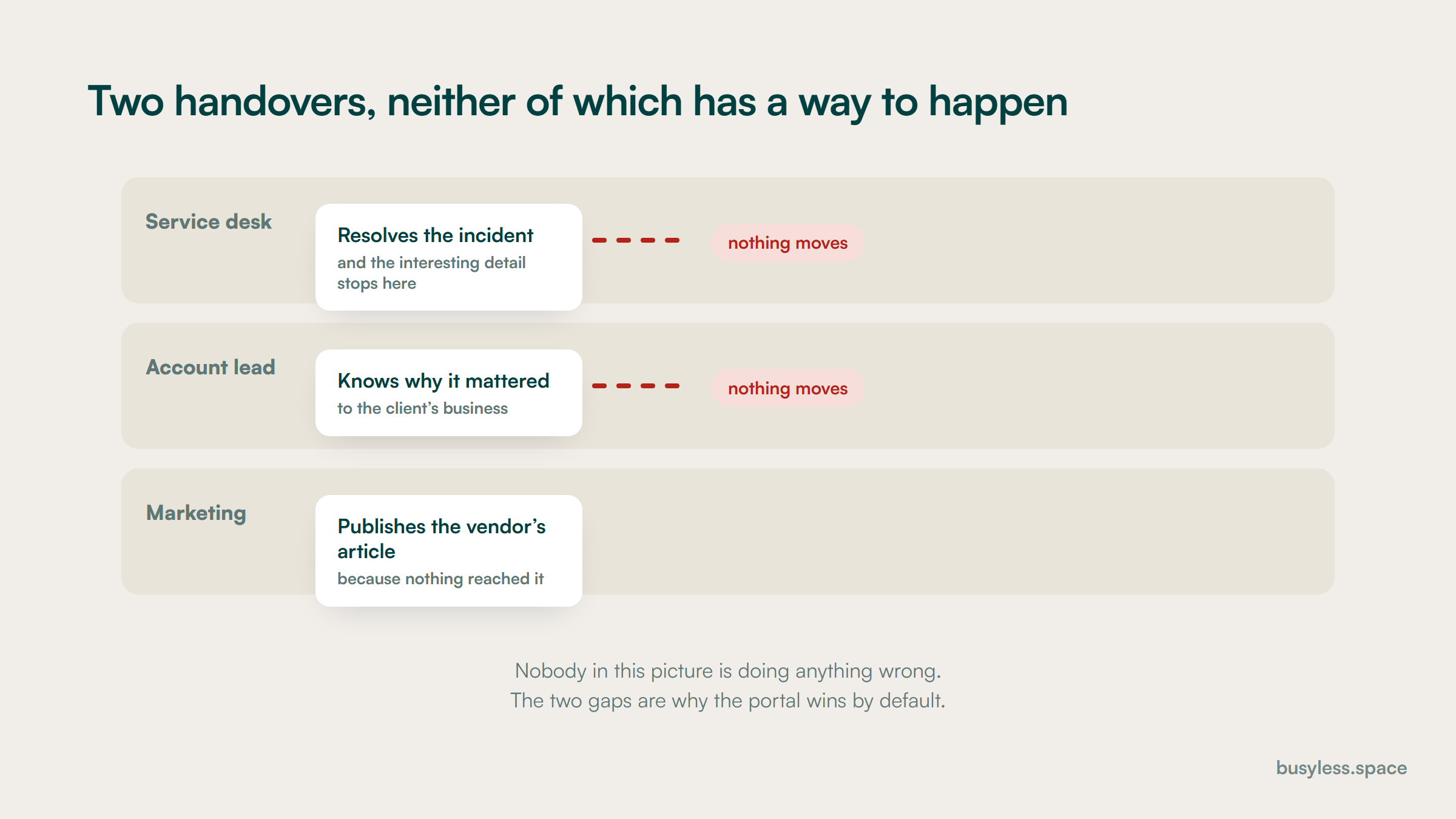
The problem here is not willingness, it is that the only person who can write the interesting version is on a ticket with a service level attached. Any plan that assumes an engineer has a spare hour on a Tuesday afternoon will produce nothing, so the whole model below is built around taking twenty minutes at a time.
The engineer who resolved it
What actually happened
Interviewed at the point of resolution, when the detail is still fresh, and never asked to write. Twenty minutes on the day beats an hour a fortnight later, when it has become a summary of a summary.
40 minutes, in two sittings
The service desk manager
Choosing which tickets are worth writing about
They already read everything and they know which one made the team stop and look. That judgement is the editorial function here and it cannot be replaced by a report of the most common categories.
1 hour
Whoever owns marketing
Everything after the twenty minutes
Their job is capturing rather than commissioning, and defending the calendar against the pull of the vendor portal, which is always easier and always produces the article everybody else has.
Most of a role
The vCIO or account lead
What the client's business actually needed
The technical fix is half the story and the reason it mattered is the other half. They are also the person who knows whether a client would be recognisable from a description.
2 hours
One person who checks anonymisation
Whether anybody is identifiable
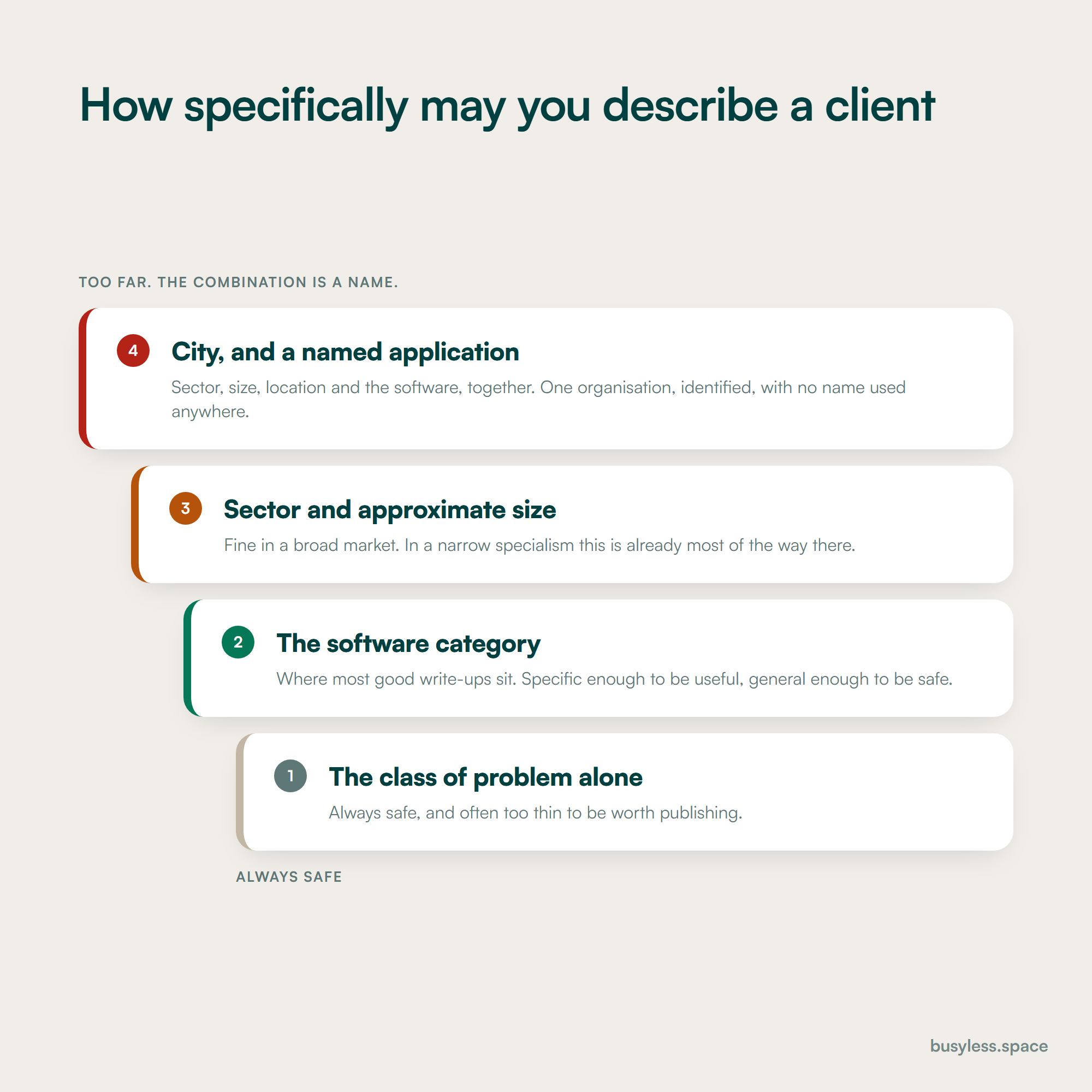
A named role rather than a step in a checklist, because this is the failure that matters most on this page. They read for the combination of details, since sector plus size plus city plus software is a name.
2 hours
The honest cadenceThree incident write-ups a month, one monthly note built from them, and one bigger piece a quarter from the onboarding data. That is roughly twelve hours across the team and only two of them belong to engineers, which is the number the plan actually lives or dies on.
One project, 8 surfaces
The unit is a single resolved incident, captured in twenty minutes while it is fresh. It is worth noting how far one of these goes, because the perceived cost of original material is what sends providers back to the vendor portal.
- 1
The incident write-up
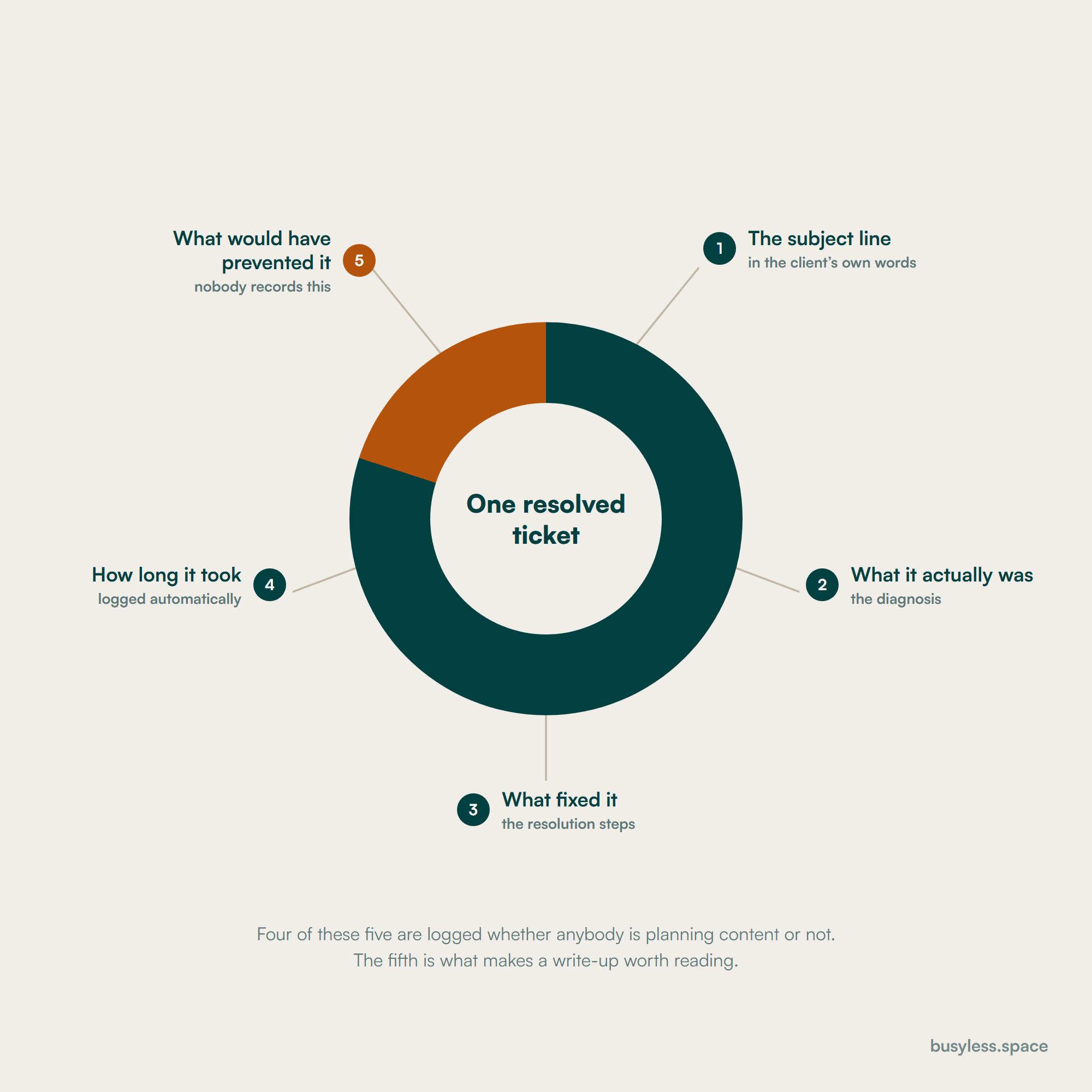
90 minutesFrom: The twenty-minute conversation
What was wrong, what it looked like from the client's side, what fixed it, and what would have prevented it. The last of those four is the one that makes it marketing rather than a blog post.
- 2
The monthly note
45 minutesFrom: Three write-ups, compressed
Three real things and nothing else. The restraint is the format: the moment it acquires an offer and a seasonal greeting, it becomes the newsletter everybody deletes.
- 3
The what-to-check list
30 minutesFrom: The prevention half
The most forwarded thing you will publish, because somebody sends it to their own IT person. It is also the asset that works hardest inside an account you do not yet have.
- 4
An engineer's post
20 minutesFrom: The detail that surprised them
Only where somebody technical actually wants to post. Drafted from the recording and edited by them, never published on their behalf without them reading it.
- 5
The short video
1 hourFrom: The same incident, on screen
Screen recording and voice, no branded opening. This is the format the syndicated libraries handle worst, which makes it disproportionately worth the time.
- 6
The vertical briefing slide
30 minutesFrom: Anything specific to your sector's software
Accumulates into the deck for the association meeting, which is the community channel above. A deck built from twelve real incidents is unarguable in a way a vendor deck is not.
- 7
The sales answer
0 minutesFrom: The write-up, sent as-is
The output nobody counts. A prospect asking whether you have dealt with something specific gets a link rather than an assurance, which is a different conversation entirely.
- 8
The quarterly onboarding piece
5 hoursFrom: Twenty write-ups plus the audit data
The one thing here that reads as research without pretending to be a study. It is a count of what you found, honestly described as that.
The buying cycle, and what content does at each stage
The cycle is long for a mechanical reason rather than a psychological one: your buyer is under a contract that has to expire. Whether they are considering a change at all is the sibling playbook's subject, so what follows is about what content has to do during the wait.
Under contract and mildly unhappy
One to three years"Is this just what IT support is like?"
- What moves them
- The monthly note and the what-to-check lists
- How you know
- Quiet subscribers who never reply and never unsubscribe
Something happens
Days"Should this have been prevented?"
- What moves them
- An incident write-up describing the same thing
- How you know
- A spike on one old page, from one company
Looking without committing
Weeks to months"Does anybody understand our particular setup?"
- What moves them
- The vertical material and the software-specific pieces
- How you know
- Deep reading across several pages in one session
A real conversation
Weeks"What will this cost and what will change?"
- What moves them
- The pricing ranges and the onboarding findings
- How you know
- Enquiries that open with a question about scope rather than price
Onboarding, and afterwards
Months"Was any of that true?"
- What moves them
- The audit itself, delivered as promised
- How you know
- Referrals into the same vertical, which is how this compounds
What you are allowed to publish
None of these four comes from a regulator, which is why this playbook is classified differently from its search sibling. They are contracts, licences and one security question, and the sibling covers everything about certification claims and security representations, so none of that appears here. None of this is legal advice.
The vendor's material comes with terms about how you use it
Standard partner programme brand, marketing and co-branding terms, reviewed 2026-08-30
Partner portals and distributor programmes license content and marks for specific uses, and the terms usually govern how the vendor's name and logo may appear, what may be modified, and whether the licence ends when the partnership does. Publishing supplied material under your own byline is a claim about authorship as well as a licensing question, and the download button addresses neither.
So do thisRead the terms before the first campaign, keep a record of which pieces came from a portal and under which programme, and remove or re-license them when a partnership ends. Where you publish supplied material at all, attribute it rather than passing it off.
Your client list is part of somebody's attack surface
Standard master service agreement confidentiality and publicity clauses, reviewed 2026-08-30
Most agreements in this industry prohibit naming the client, using their marks or disclosing the relationship, and the reason is sharper than ordinary commercial confidentiality. Publishing who you support tells anybody who is interested exactly which organisation to approach, whose credentials to target and which provider to impersonate in a phishing message. It is a disclosure about them and about you at once.
So do thisTreat the client list as confidential by default rather than seeking permission case by case, and where a client does agree to be named, check whether they understood that specific risk rather than only the marketing one.
A retired designation is a false claim
Vendor partner programme designations, including the Microsoft transition to Solutions Partner designations from October 2022, reviewed 2026-08-30
Partner programmes are restructured and old tiers stop existing, but the badges stay on websites, email signatures and proposals for years. A designation you no longer hold, or that no longer exists, is a straightforward misstatement about your business, and in this market it is one a competitor will notice before a customer does. The same applies to a competency retired under a programme change and to any accreditation whose renewal lapsed.
So do thisAudit every badge on every page, footer, deck and signature against what you currently hold, and put the check on a calendar rather than doing it once. The sibling playbook covers claims about certification and frameworks in detail.
What an engineer may say about an environment is already agreed
Client master service agreements and typical cyber insurance policy conditions, reviewed 2026-08-30
The confidentiality obligations in your client agreements bind your staff, and a technical post describing a real environment can breach them even with no name attached, because sector plus size plus location plus a named application often identifies one organisation. Insurance conditions may separately require care over disclosures relating to incidents.
So do thisGive one named person the job of reading for the combination rather than for the name, brief engineers that the interesting technical detail is usually the identifying one, and where an incident is live, publish nothing until it is closed.
None of this is legal advice. Rules vary by state and by contract, and the dates above are when each source was read. Check your own before you rely on any of it.
How to build content marketing for MSPs
Six months, and the first thing on the list is not writing. It is finding out how much of what you currently publish somebody else wrote, which is usually an uncomfortable afternoon and always the right place to start.
Find out what is actually yours
- Audit your last two years of published material for syndicated pieces
- Search a distinctive sentence from three of them and count who else has it
- Audit every partner badge against what you currently hold
- Read your partner programme terms and record which pieces came from where
Output An honest inventory, and a badge list that is true
Start capturing incidents
- Have the service desk manager flag three interesting tickets a month
- Record the resolving engineer for twenty minutes at resolution
- Publish three write-ups with the prevention half included
- Name the person who checks that nobody is identifiable
Output Three pieces nobody else in the market could publish
Aggregate the onboarding audits
- Count the findings across the last twenty environments you took over
- Publish the catalogue, with no client identifiable in it
- Pull pricing ranges from two years of quotes and publish them
- Pick the vertical where you already have several clients
Output The piece prospective clients suspect is true of them
Go where your buyers already are
- Turn up to the chosen vertical's association rather than a channel event
- Build the briefing deck from real incidents in that sector
- Start the monthly note, three real things and nothing else
- Report subscriber quality rather than list size
Output One room full of buyers, and a note worth staying subscribed to
Structured data for what you publish
Your business, your service tiers and your credentials are marked up on the sibling playbook, which also takes the technical article type. These six describe what you publish, and the first is one almost nothing in this industry uses despite being written for exactly this situation.
SpecialAnnouncement for a live advisory
A page put up while something is actively happeningWritten for time-bounded public notices and almost never used by providers, who post the same information as an ordinary article. It expires by design, which is the honest shape for an advisory, and it separates the urgent notice from your durable library.
{
  "@context": "https://schema.org",
  "@type": "SpecialAnnouncement",
  "name": "[WHAT IS HAPPENING, IN PLAIN WORDS]",
  "text": "[WHO IS AFFECTED, WHAT TO DO NOW, WHAT WE ARE DOING]",
  "url": "https://[YOUR-DOMAIN]/advisories/[SLUG]",
  "datePosted": "[YYYY-MM-DDTHH:MM:SS-05:00]",
  "expires": "[YYYY-MM-DD, WHEN THIS STOPS BEING TRUE]",
  "category": "[e.g. Vulnerability affecting [SOFTWARE CATEGORY]]",
  "audience": {
    "@type": "Audience",
    "audienceType": "[WHO SHOULD ACT, NOT EVERYONE]"
  },
  "publisher": {
    "@type": "Organization",
    "name": "[PROVIDER NAME]",
    "url": "https://[YOUR-DOMAIN]"
  }
}
Article for an incident write-up
The page describing one resolved incident, anonymisedDeliberately the general article type rather than the technical one, which the sibling takes. The audience for a write-up is a business owner deciding whether their provider would have caught it, not an engineer looking for a runbook, and the markup should say so.
{
  "@context": "https://schema.org",
  "@type": "Article",
  "headline": "[WHAT WENT WRONG, FROM THE CLIENT'S SIDE]",
  "description": "[WHAT IT LOOKED LIKE, WHAT IT WAS, AND WHAT WOULD HAVE PREVENTED IT]",
  "url": "https://[YOUR-DOMAIN]/what-we-see/[SLUG]",
  "datePublished": "[YYYY-MM-DD]",
  "dateModified": "[YYYY-MM-DD]",
  "author": {
    "@type": "Person",
    "name": "[ENGINEER NAME]",
    "jobTitle": "[ACTUAL ROLE]"
  },
  "publisher": {
    "@type": "Organization",
    "name": "[PROVIDER NAME]",
    "url": "https://[YOUR-DOMAIN]"
  },
  "audience": {
    "@type": "Audience",
    "audienceType": "[e.g. Owners of [SIZE] businesses running [CATEGORY]]"
  },
  "about": "[THE CLASS OF PROBLEM, NEVER THE ORGANISATION]"
}
DefinedTermSet for the words your category has ruined
A glossary page saying what you mean by terms vendors use differentlyThis industry is full of phrases that mean four things depending on who is selling. A glossary written from your own definitions is unusually useful to a buyer comparing providers, and it is the rare page where being blunt is the whole value.
{
  "@context": "https://schema.org",
  "@type": "DefinedTermSet",
  "name": "What we mean by these words",
  "url": "https://[YOUR-DOMAIN]/glossary",
  "description": "[WHY THIS EXISTS, WHICH IS THAT THE CATEGORY USES THESE INCONSISTENTLY]",
  "hasDefinedTerm": [
    {
      "@type": "DefinedTerm",
      "name": "[TERM]",
      "description": "[WHAT WE MEAN, AND WHAT IT DOES NOT INCLUDE]",
      "inDefinedTermSet": "https://[YOUR-DOMAIN]/glossary",
      "url": "https://[YOUR-DOMAIN]/glossary#[ANCHOR]"
    }
  ]
}
LearningResource for the what-to-check list
The checklist somebody forwards to their own IT personThe most forwarded asset on this page and worth marking up as something to be used rather than read. Say honestly what somebody needs in order to follow it, because a checklist that quietly assumes administrative access is not a checklist for the person receiving it.
{
  "@context": "https://schema.org",
  "@type": "LearningResource",
  "name": "[WHAT TO CHECK, PHRASED AS THE TASK]",
  "description": "[WHAT SOMEBODY WILL KNOW AFTERWARDS]",
  "url": "https://[YOUR-DOMAIN]/checklists/[SLUG]",
  "learningResourceType": "Checklist",
  "educationalLevel": "[WHO THIS IS PITCHED AT]",
  "competencyRequired": "[WHAT ACCESS OR KNOWLEDGE IT ASSUMES]",
  "isAccessibleForFree": true,
  "dateModified": "[YYYY-MM-DD]",
  "author": {
    "@type": "Person",
    "name": "[ENGINEER NAME]"
  }
}
CollectionPage for the write-up library
The index that gathers every incident write-upWorth marking up because the library as a whole is the argument, more than any single piece is. Thirty first-hand write-ups in one place is a claim about a provider that no individual post makes, and this is the page a prospect actually reads.
{
  "@context": "https://schema.org",
  "@type": "CollectionPage",
  "name": "What we actually see",
  "url": "https://[YOUR-DOMAIN]/what-we-see",
  "description": "[HOW MANY WRITE-UPS, OVER WHAT PERIOD, AND THE ANONYMISATION RULE]",
  "dateModified": "[YYYY-MM-DD]",
  "mainEntity": {
    "@type": "ItemList",
    "numberOfItems": "[N, MATCHING WHAT THE PAGE ACTUALLY SHOWS]",
    "itemListElement": [
      {
        "@type": "ListItem",
        "position": 1,
        "url": "https://[YOUR-DOMAIN]/what-we-see/[SLUG]",
        "name": "[WRITE-UP TITLE]"
      }
    ]
  }
}
VideoObject for an engineer walking through a fix
The page the recording sits on, as well as anywhere it is hostedThe format the supplied libraries handle worst, because a generated explainer is recognisable within seconds. Name the engineer and their real role, and keep the description about the problem rather than about your service tiers.
{
  "@context": "https://schema.org",
  "@type": "VideoObject",
  "name": "[THE PROBLEM, AS SOMEBODY WOULD DESCRIBE IT]",
  "description": "[WHAT IS SHOWN AND WHAT IT TURNED OUT TO BE]",
  "thumbnailUrl": "https://[YOUR-DOMAIN]/images/[FILE].jpg",
  "uploadDate": "[YYYY-MM-DD]",
  "duration": "PT[M]M[S]S",
  "contentUrl": "https://[YOUR-DOMAIN]/video/[FILE].mp4",
  "embedUrl": "https://[YOUR-DOMAIN]/[PAGE-SLUG]",
  "creator": {
    "@type": "Person",
    "name": "[ENGINEER NAME]",
    "jobTitle": "[ACTUAL ROLE]"
  },
  "transcript": "[FULL TEXT, WHICH IS ALSO WHERE YOU CHECK ANONYMISATION]"
}
What to automate, and where the line is
Capture and checking are where automation earns its place, and writing is not, which is a sharper distinction on this page than on any other in the directory. An industry whose whole problem is generic supplied material should be careful about generating more of it.
- automate
Flagging tickets worth writing about
Surfacing unusual resolution paths, long-running tickets and repeat categories is mechanical and it gives the service desk manager a shortlist rather than a queue. They still choose, because interesting is a judgement.
- automate
Transcribing the twenty-minute engineer conversation
The entire production model depends on that twenty minutes being frictionless. Correct product and error-code names by hand, because those are precisely what a transcriber mangles and precisely what makes the piece credible.
- automate
Scanning drafts for identifying combinations
A first pass looking for company names, city names, employee counts, unusual software combinations and dates is genuinely useful. It is a first pass, not the check, and the named human still reads it.
- automate
Checking your site for badges you no longer hold
Crawling your own pages, footers and PDFs for programme names and comparing against what you currently hold takes minutes and finds something on most providers' sites. Put it on a schedule.
- assist
Drafting the write-up from the transcript
Structure is the part it handles well; the specific detail is the part it flattens into the generic version, which is the exact failure this whole page exists to avoid. Keep the engineer's odd particulars and delete the confident sentences nobody said.
- assist
Turning three write-ups into the monthly note
Compression is mechanical and restraint is not. Left alone it adds an introduction, a call to action and a closing paragraph, which is how a note worth reading becomes the newsletter people delete.
- never
Publishing anything about a live incident
An open incident is somebody's ongoing problem and possibly an active adversary reading along. Wait until it is closed, then write it properly. There is no version of speed here that is worth what it risks.
- never
Generating articles about topics you have no experience of
That is what the vendor portal already gives you for free, and doing it yourself produces the same undifferentiated result at a cost. The only asset you have in this category is having actually been there.
What it costs
Use these to sanity-check a proposal rather than as a price list. What moves the number is not volume but whether anybody is genuinely capturing engineers at the point of resolution, and every tier assumes the syndicated material has been switched off first.
Do it yourself
$0 to $500- One incident write-up a month, from a twenty-minute conversation
- The onboarding catalogue, counted from your own history
- A badge audit that makes every claim on the site true
- The monthly note, three real things and nothing else
- Suits
- A provider of under fifteen people with an owner who will do the interviews
- Ceiling
- It depends on one person remembering to ask, and the asking stops during a busy month. The write-ups already published keep working, which is the argument for banking a few while things are calm.
Lean
$1,500 to $4,000- Three write-ups a month, captured properly at resolution
- The quarterly onboarding piece and the pricing ranges
- A vertical chosen, with a briefing deck built from real incidents
- Somebody named as responsible for anonymisation
- Suits
- A provider of fifteen to sixty with a defined sector or two
- Ceiling
- One vertical gets covered convincingly. A second needs its own incidents, its own software knowledge and its own room to stand up in, which is a specialisation decision rather than a spending one.
Funded
$4,000 to $8,000- Video production that does not consume service desk time
- Association and event presence in the chosen verticals
- A write-up library large enough to be the argument by itself
- The glossary and the what-to-check series maintained
- Suits
- A provider where two or three verticals carry the growth
- Ceiling
- Engineer availability becomes the limit rather than money, and buying more production capacity does not create more incidents worth writing about. The fix is a better capture habit, not a bigger retainer.
Above this
$8,000 and up- Several verticals covered with genuinely different material
- Events run as a programme rather than as occasional briefings
- A structured onboarding dataset maintained across years
- Someone whose job is the library and its anonymisation standard
- Suits
- Providers where being the recognised specialist in a sector is the growth strategy
- Ceiling
- The risk shifts from being ignored to being identifiable. A large and detailed library across one sector makes the combination problem harder every year, which is why the anonymisation role gets more important as the budget grows rather than less.
How to do it with no budget
The first of these seven costs an afternoon and is the most uncomfortable thing on the page, which is why it is first. Most providers have never checked how much of their own website somebody else wrote.
- 1
Search a distinctive sentence from your own blog
Any search engine, in quotation marks · 30 minutes
Take three articles and search a full sentence from each. The number of other providers carrying it is the honest measure of where you are starting from.
- 2
Audit every partner badge against what you hold
Your own site, footers and proposal decks · 2 hours
Programmes get restructured and badges do not come down. Check signatures and PDFs too, since those are where the retired ones survive longest.
- 3
Count what the last twenty onboardings found
Your own audit records · 3 hours
The pattern is the piece. No client is named, the work is already done, and prospective clients read it suspecting it is true of them.
- 4
Record one engineer at the point of resolution
A phone, twenty minutes · 1 hour including the write-up
On the day, while the detail is fresh. A fortnight later you get a summary of a summary and the specific thing that made it interesting has gone.
- 5
Ask which three applications generate the most tickets
A conversation with your engineers · 45 minutes
In your biggest vertical, with the usual fix. Nobody else will publish the failure modes of that software, least of all the company that sells it.
- 6
Pull pricing ranges from two years of quotes
Your own quoting history · 2 hours
Ranges, with what drives them up and down. Buyers cannot get a straight answer about price anywhere in this market, which is why it dominates every first call.
- 7
Find the association your best vertical actually attends
Ask three clients where they go · 1 hour
Not a channel event. The rooms full of providers are the ones easiest to find and the least useful, and your clients already know where the other room is.
The tool stack
Very little to buy, and the most valuable item is a shared document where the service desk flags a ticket. The rows linking into our other directories go to the researched review rather than to a vendor page.
Flag tickets worth writing about
One message with a ticket reference and a sentence about why it was interesting. Anything requiring a form gets used twice and then abandoned.
Free option: Free, and it beats a process
Record and transcribe the engineer conversation
Setup has to take under a minute. If capturing twenty minutes requires arranging anything, it will not happen during a week when it matters.
Free option: A phone and the transcription in most meeting tools
Publish a library that is not a blog template
An incident write-up, an advisory that expires and a checklist are three different shapes, and most provider sites are built to hold a fourth thing, which is a pricing tier.
Free option: The current site, if it can hold a page type that is not a service
See what your buyers search when something breaks
Ticket subjects are written by the person with the problem, in their words, which makes them the best free keyword source in this industry. How the switching buyer searches is the sibling playbook's subject.
Free option: Your own ticket subject lines, which are the same phrases
Model the programme before committing engineer time
Cost engineer hours at their loaded rate including the service level impact, not at their salary. Costed the other way, the plan looks free and gets cancelled by whoever owns the queue.
Free option: Free
Understand what a monthly note is worth against churn
In a business built on multi-year contracts, retention is where most of the value of this programme actually lands, and it is almost never where anybody measures it.
Free option: Free
Hold the anonymisation standard
Written down rather than understood. The combination of sector, size, city and software is what identifies somebody, and a rule that only says do not name the client will not catch it.
Free option: Free
Check what assistants recommend when asked about providers
Worth knowing which sources those answers lean on, and worth noting that a site made of syndicated material gives a model nothing distinctive to cite you for.
Free option: Ask each assistant for providers in your area and vertical, monthly
Take it from here
Everything below is meant to be copied and filled in. Bodies are plain text, so what you see is exactly what lands on your clipboard.
An uncomfortable afternoon establishing how much of your own website somebody else wrote. Start here, before writing anything new.
SYNDICATION AUDIT
Provider: [NAME]
Audited by: [NAME]
Date: [YYYY-MM-DD]
Period covered: [YYYY-MM] to [YYYY-MM]

HOW TO RUN IT
Take a full sentence from an article. Put it in
quotation marks. Search it.

     [THE NUMBER OF OTHER PROVIDERS CARRYING THAT EXACT
      SENTENCE IS YOUR STARTING POSITION. IT IS USUALLY
      NOT ZERO.]

ONE ROW PER PUBLISHED PIECE
Title | Published | Source (ours / vendor portal /
white-label / unknown) | Other sites with the same
sentence | Keep, attribute or remove

[ ] | [ ] | [ ] | [N] | [ ]

TOTALS
Pieces published in the period:            [N]
Written by somebody here:                  [N]
Supplied by a vendor portal:               [N]
Supplied by a white-label provider:        [N]
Origin unknown:                            [N]
     [UNKNOWN COUNTS AS SUPPLIED UNTIL PROVEN
      OTHERWISE. THAT IS THE HONEST DEFAULT.]

THE WORST RESULT
Piece:                     [ ]
Other sites carrying it:   [N]

LICENCE POSITION
For each supplied piece:
[ ] Which partner programme it came from
[ ] Whether the terms allow publishing as our own
[ ] Whether attribution is required
[ ] What happens to the licence if we leave the
    programme
     [MOST PROVIDERS HAVE NEVER READ THIS. IT DECIDES
      WHETHER THE MATERIAL COMES DOWN WHEN A
      PARTNERSHIP ENDS.]

DECISIONS
Removing:                  [N]
Attributing properly:      [N]
Keeping as-is, and why:    [ ]

WHAT REPLACES THEM
First three write-ups from real tickets:
 1. [ ]   engineer [ ]
 2. [ ]   engineer [ ]
 3. [ ]   engineer [ ]

     [DO NOT DELETE EVERYTHING BEFORE YOU HAVE WRITTEN
      ANYTHING. AN EMPTY SITE IS WORSE THAN A GENERIC
ONE.]The expensive mistakes
Publishing the vendor portal's article under your own name
What it costs: A website indistinguishable from four hundred competitors, at the moment somebody is comparing you
Publish one thing your service desk actually saw. It takes an engineer twenty minutes and nobody else on earth can publish it.
Treating the ticket queue as operations rather than material
What it costs: Hundreds of original stories a month, generated and then discarded
Ask the service desk manager for the three tickets that made the team stop and look. It is a judgement they are already making silently.
Never aggregating the onboarding audits
What it costs: The most persuasive asset in the business, sitting in twenty separate documents
Count what you found across the last twenty and publish the catalogue. Prospective clients read it suspecting it describes them, which it usually does.
Anonymising by removing the name only
What it costs: A client identified from sector, size, city and software by anybody who cared
Give one person the job of reading for the combination. The identifying detail is almost never the name.
Leaving retired partner badges on the site
What it costs: A false claim about your business, spotted by a competitor before a customer
Audit every badge against what you hold, including in signatures and proposal decks, and put the check on a calendar.
Spending the marketing budget on channel events
What it costs: A year of networking with your competitors and the vendors selling to all of you
Go to the association your clients attend. Ask three of them where they go, which is a shorter conversation than choosing a conference.
What to measure
Measuring MSP content marketing against new contracts signed is unhelpful for a mechanical reason: your buyer is usually locked into an agreement that has months or years left. What follows is built to show whether the programme is working during a wait it cannot shorten.
Leading indicators
Write-ups published that came from a real ticket
Your own publishing record
The number that separates this programme from the one you had before, and the one to report first. If it falls to zero the vendor portal has quietly won again, which is how it usually happens.
Engineer minutes consumed per published piece
The capture log
The constraint on this whole page. Over about forty minutes a month per engineer and the process is wrong rather than the engineers, and it will stop during the first busy quarter.
Forwards and shares of the what-to-check lists
Your own server logs or CMS
These get sent by one person to their own IT contact, which is content working inside an account you do not have. Direct traffic to a checklist is worth more here than a general session count.
Quiet subscribers who never reply and never leave
Subscriber records, read quarterly
Most of your market is under contract and can do nothing for two years, so a subscriber who simply keeps reading is the correct behaviour rather than a disengaged one. Do not prune them.
Business indicators
Enquiries that arrive already knowing your prices
Ask in the first reply, and write it down
The clearest evidence the pricing ranges are doing their job, and it changes the first conversation completely. It is also the cheapest thing on this list to measure.
Enquiries mentioning something specific you published
A single question on the enquiry form
Self-reported and imperfect and still better than any attribution model available here, given the buying window can be two years wide. Ask rather than infer.
New clients within your chosen vertical
Your own record
The whole community and events argument rests on concentration, so track the share arriving from the sector you chose rather than the total. A rising total with a flat share means the specialisation is not working.
Renewals and referrals within that vertical
Your own record, read annually
The slowest number here and the truest, because in a business of multi-year contracts most of the value of being trusted shows up as somebody not leaving and telling a peer.
The verdict
Content marketing for MSPs is unusual in that the competition has largely opted out. When several hundred providers publish the same supplied article, the bar for standing out is not excellence, it is having been there. That is a rare position and it does not require a large budget.
What it requires is a habit. Twenty minutes with the engineer who fixed something, on the day, three times a month. Everything else on this page is downstream of whether that conversation actually happens during a week when the queue is bad.
Be wary of MSP content marketing services that arrive with a content library, or that price on articles per month. Both are the syndication problem with an invoice attached, and volume is the one axis where free supplied material will always beat you.
It comes down to a habit and a person. Content marketing services for MSPs are worth buying when somebody is capturing engineers at the point of resolution and one named person owns anonymisation. Neither in place, and you have paid for a slightly better version of what the vendor gives away.
FAQ
MSP content marketing questions
What is actually wrong with using our vendor's content?
Several hundred other providers are publishing it too, often in the same month. It makes you indistinguishable at precisely the moment a buyer is comparing providers, and it cannot rank in search because a search engine has to choose one site carrying it and will not choose yours.How do we write about incidents without naming clients?
Be specific about the incident and silent about the organisation, and remember that the name is rarely the identifying part. Sector plus size plus city plus a named application usually identifies one company, so give somebody the job of reading for the combination.Why is naming a client worse here than in other industries?
Because it tells anybody interested exactly which organisation to target, whose credentials matter and which provider to impersonate in a phishing message. It is a disclosure about your client's security posture as much as a marketing decision, which is why most agreements forbid it outright.Our engineers have no time. Is this realistic?
Only if you ask for twenty minutes at the point of resolution rather than an hour later. Capture the conversation, do the writing elsewhere, and treat about forty minutes a month per engineer as the ceiling. Any plan needing more will stop in a busy quarter.Should we go to channel conferences?
Not with this budget. Those rooms are other providers, distributors and the vendors selling to all of you, which is a real audience for partnerships and not one for finding clients. Ask three customers which association they attend and go there instead.Can we publish incident data as research?
A single provider rarely has the volume. You either overstate a small sample or narrow the cut until an individual client is identifiable, and a shaky denominator is easy to spot in this category. Publish the pattern from your onboarding audits instead, described honestly as a count.How do we stop the badges on our site becoming untrue?
Audit every page, footer, email signature and proposal deck against what you currently hold, then put the check on a calendar. Programmes get restructured and old designations survive for years, and a competitor will notice before a customer does.What should a managed provider expect to spend?
The badge audit, the onboarding count and the first write-up cost hours rather than money. Where a budget exists, an engagement starts with a Discovery and then a monthly retainer. The realistic range for running this properly, in-house or with help, is $1,500 to $8,000 a month.
Run it yourself, or have someone own it
Everything above is written to be run without us, and the free path is genuinely most of the value for a small practice. Where these plans stall is almost never the plan. It is that the person holding the material has a day job and nobody owns the programme after the first month. That is the job we do.