
Content marketing for nonprofits
Regulated marketingDonors count what you spend reaching them as overhead
- Sector
- Lifestyle and leisure
- Channels
- Newsletter, Community, Events and talks
- Buying cycle
- Medium cycle
- Time to compound
- 6 to 12 months
- Typical monthly
- $800 to $5,000
Key takeaways
- 1Spending money to reach donors is visible in a way it is not anywhere else. A donor who sees a polished campaign is entitled to wonder what it cost, and that suspicion is a real constraint on channel choice rather than an unfair perception to be argued away.
- 2So the channels that survive are the ones where the labour is donated, the reach is earned or the list is already yours. That is not a smaller version of a commercial plan, it is a different plan, and it is the reason this page rates paid social as a test rather than a run.
- 3If somebody gets something in return for a payment over $75, the invitation copy has to carry a specific disclosure. That reaches the gala, the webinar registration and the members' newsletter, which are three of the surfaces this page recommends most.
- 4Your best material is not a beneficiary story. It is the data you collect to run the programme, the expertise your staff hold about the problem, and the thing you tried that did not work, none of which needs anybody's permission.
- 5Content produced under a federal award is not exclusively yours. The awarding agency reserves a licence to reproduce and authorise others to use it, which is worth knowing before a grant-funded video becomes the centre of a campaign.
Content marketing for nonprofits runs into a constraint that exists nowhere else in this directory: the money you spend reaching people is itself part of what you are judged on. A donor who encounters an expensively produced campaign is entitled to wonder how much of their last gift paid for it, and that thought is not unreasonable.
The sector has spent years arguing that this instinct is wrong, that overhead is a bad proxy for effectiveness and that underinvestment in capacity is the real problem. All of that is true, and it does not change the behaviour. The perception is a fact about your audience, and a channel plan that ignores it is a channel plan that will eventually have to be defended in public.
Working with the constraint rather than against it produces a better plan anyway. It pushes you towards the list you already own, the people who already turn up, and the material your programme staff generate as a by-product of doing the work. All three are cheap, all three are durable, and all three are what actually raises money.
So a nonprofit content marketing strategy is largely a question of which channels are defensible as well as effective. Not because appearance is more important than results, but because in this sector the two are connected: the cheapest channels are also the ones a supporter reads as evidence that you are careful with money.
Looking for the search half
This page decides which channels to run. The one next door goes deep on just one of them.
Which channels to run, and which to skip
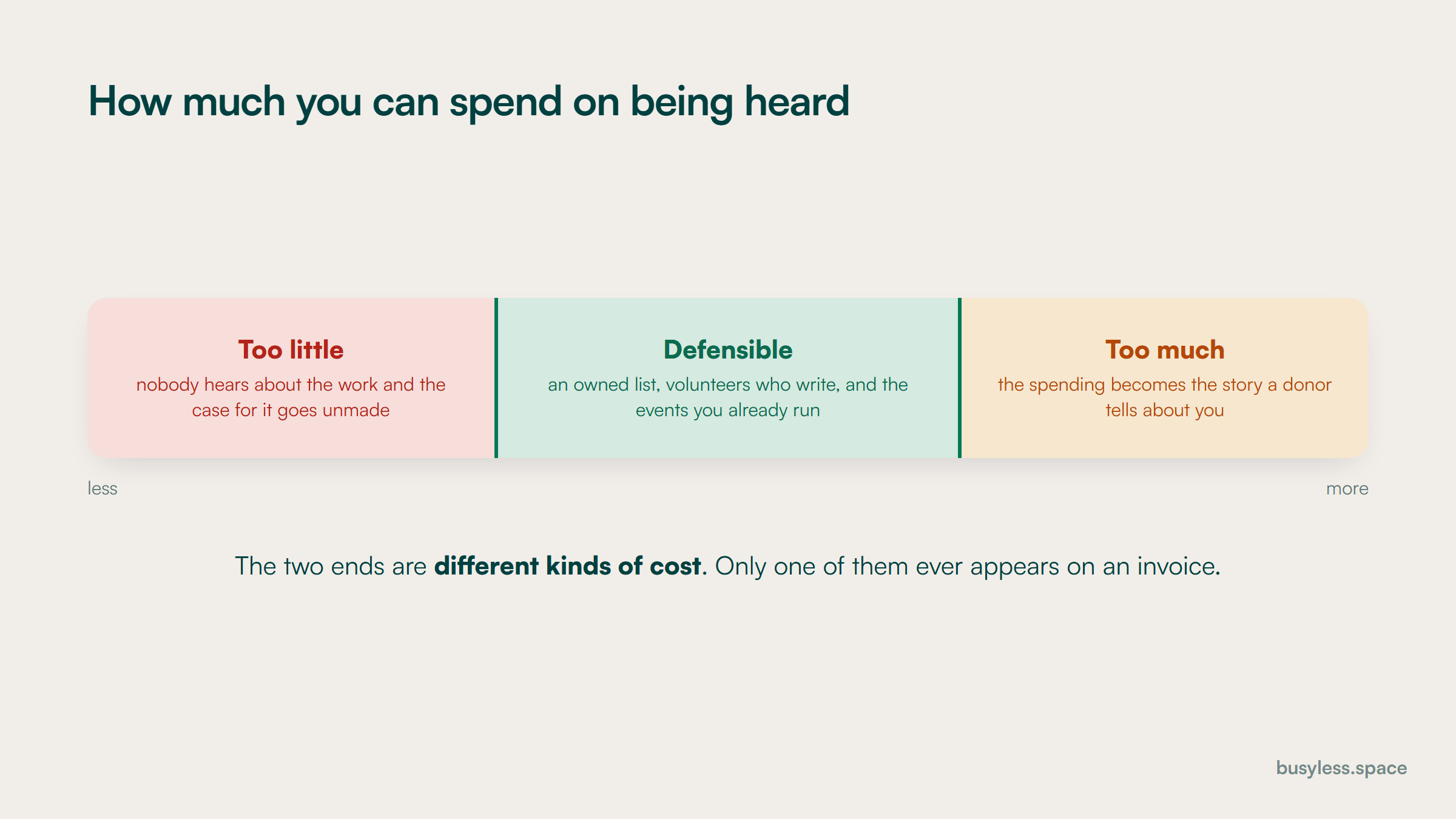
Judged on two questions instead of one. Does it work, and could you explain the invoice to a donor without flinching. A channel that fails the second is not forbidden, it is just carrying a cost that never appears on the invoice.
Run these
Newsletter
RunThe cheapest channel per person reached and the only one nobody can reprice or take away. It is also the one a supporter reads as thrift rather than as spending, which matters here in a way it does not elsewhere. Everything else on this page is largely a way of adding names to it.
First moveSend something in a month with no ask in it. Most organisations only appear in an inbox when they want money, which is why the December email performs worse every year.
Community
RunVolunteers, members, congregations and local groups are an audience you already have and a production capacity you are not paying for. This is the closest thing in the directory to a channel that costs nothing but attention, and it is chronically treated as a logistics problem rather than a communications one.
First moveAsk three volunteers what they tell people about you at a dinner party. That sentence is usually better than anything in your annual report and it is free.
Events and talks
RunThe thing this sector already does, and the point at which content and fundraising stop being separate activities. An event is also where most of the year's raw material is produced, and where the disclosure rule further down actually bites, because attendance is usually a payment in return for something.
First moveFilm and photograph the next event properly and treat it as a year of raw material rather than as a record of a night.
Worth a test, with a kill date
Founder-led social
TestOrganic reach is genuinely useful for volunteers and local supporters and genuinely poor for reaching new donors at scale. Paid amplification works and it is the single most visible way to spend money on communications, so treat any spend as a decision you will one day be asked about.
First moveSet a small paid budget with a written reason attached, and report it as a line rather than folding it into a general communications figure.
Video
TestIt moves people more than any other format and it is the format where cost and perceived cost diverge most violently. Something filmed on a phone by a programme worker often outperforms a commissioned film, and it never has to be defended.
First moveFilm one thing on a phone before commissioning anything. If the unpolished version does not move people, a more expensive version will not fix it.
Search
TestWorth funding for the questions people ask about the problem rather than for the cause name itself, which is occupied by news coverage, encyclopaedias and national organisations with decades of authority. The search side of this, including the grant programme for eligible organisations, is on the sibling playbook.
First moveAnswer the five questions somebody asks the week they encounter this problem, rather than writing about your organisation.
Skip these
Trade press
SkipSector publications reach other nonprofits, consultants and a narrow slice of institutional funders. That is a real audience for recruitment and for peer credibility, and it is not the audience that gives, so it should be funded from whichever budget is trying to reach funders rather than from this one.
Original research
SkipThe channel every organisation wants and the one where this page's constraint bites hardest. A research programme is unambiguously spend on communications rather than on the cause, unless the research IS a programme with its own funding, in which case it stops being a marketing decision entirely.
One channel you own outright, one where the labour is donated, and one you were running anyway. The two skips are both channels that work in other industries, and both fail the second question rather than the first, which is the distinction this whole page turns on.
What you already own that nobody can copy
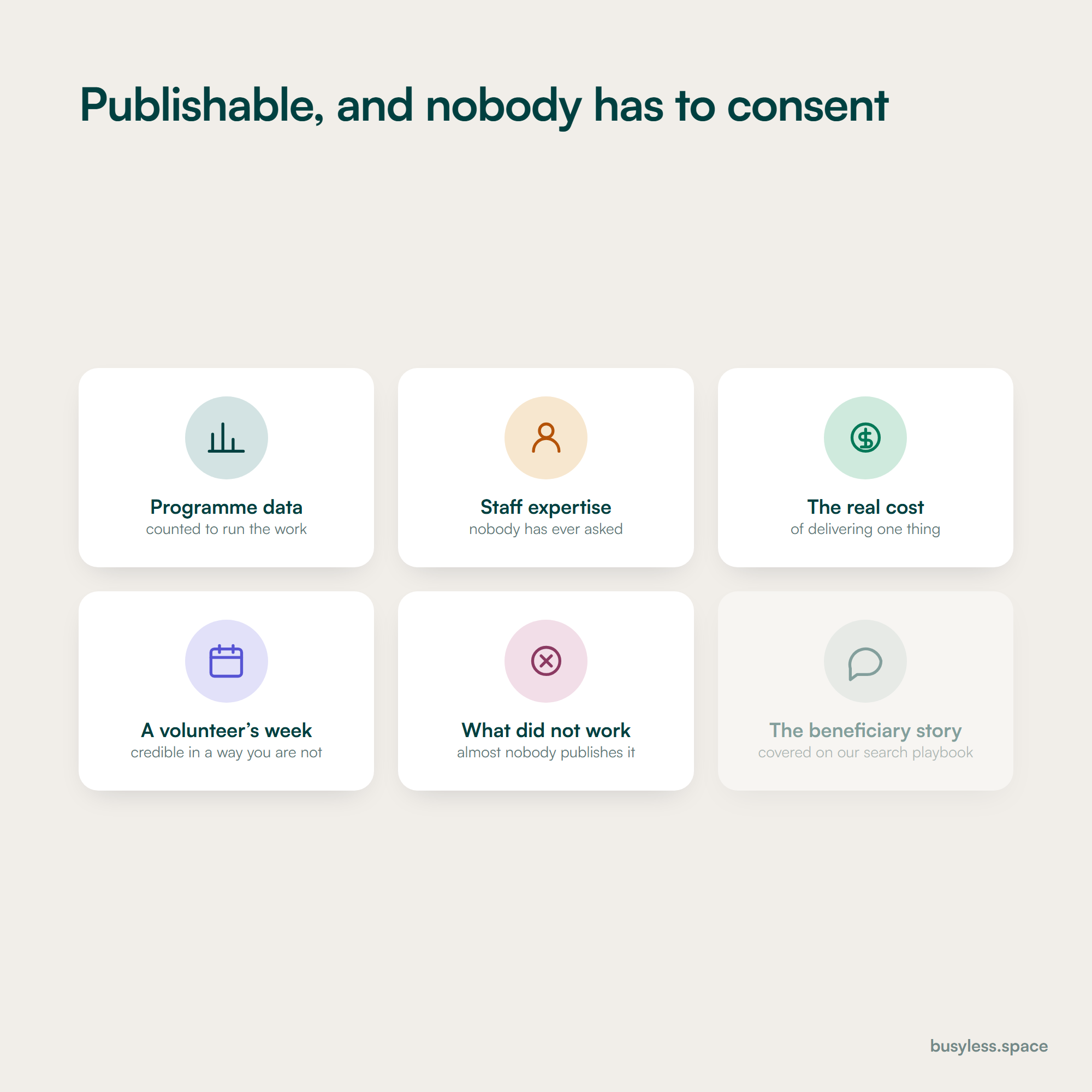
Start by noting what is not here. The beneficiary story, and the consent question that governs it, sit on our search playbook for this sector and are deliberately not repeated. This section is about the other material, which is larger, easier to publish and almost entirely ignored.
The data you collect to run the programme
Held by Programme staff, in whatever they report to funders
You are counting things about a problem because you have to, and almost nobody else is counting them at all. A local organisation frequently holds the only systematic record of a need in its area, and it is filed in a grant report nobody outside reads.
How to capture it
Take the numbers already in your last funder report and ask what a stranger would find surprising. Aggregate, never individual, and check what the funder agreement allows you to publish.
What your staff know about the problem
Held by Caseworkers, coordinators and programme leads
People who spend every day inside a specific problem understand it better than anybody writing about it. That expertise is invisible outside the organisation because nobody has ever asked them to explain it to a general audience.
How to capture it
Record a caseworker explaining what most people get wrong about the problem. Forty minutes of that produces more usable material than a quarter of planned content.
The thing you tried that did not work
Held by Whoever ran it, and the board minutes
Almost nothing in this sector is published honestly about failure, because funders are being asked for more money at the same time. An organisation that does it becomes the one people trust, and there is no way to copy that position.
How to capture it
Pick one closed or changed programme and write down what you expected, what happened and what you do differently now. Have the board read it before it goes out.
What a volunteer actually experiences
Held by Volunteers, immediately after a shift
A volunteer's account is credible in a way an organisation's never is, and it is a description of your work by somebody with nothing to gain. It also recruits other volunteers, which is the second scarcest resource here after money.
How to capture it
Ask one question at the end of a shift and record the answer. Written consent for how you will use it, in the same conversation, keeps this simple later.
The honest arithmetic of what things cost
Held by Finance, and the programme budget
Supporters have almost no idea what anything costs to deliver, and the sector's own reticence about overhead has made that worse. Publishing the real breakdown, including the parts that are not direct service, is unusual enough to be memorable.
How to capture it
Break one programme down into its real cost lines, including staff and administration. Check it against your published return before it goes anywhere.
Who actually makes it
The production model here does not look like a marketing team at all, because most of the labour is donated, seconded or squeezed into a role that was never meant to include it. A plan that assumes a dedicated writer is a plan for a different sector.
Communications lead, usually part of a role
Everything, in whatever time is left
Frequently one person also running events, the website, the annual report and the social accounts. Any plan that does not start from this number is fiction, and most sector advice does not.
Half a role at most, often much less
Programme staff, as sources
What is actually happening
Interviewed, never asked to write. Asking a caseworker for a blog post is asking them to do a second job badly; asking them twenty minutes of questions produces something better and costs almost nothing.
1 hour
A volunteer who can write
Drafting and editing
The most underused resource in the sector. Retired journalists, communications professionals and students all volunteer, and almost nobody asks them to do the thing they are best at.
4 hours
Executive director
The letter that has their name on it
A named person writing plainly outperforms an organisational voice by a wide margin here. This is the one contribution that cannot be delegated without losing most of its value.
2 hours
Finance or compliance check
Anything that asks for money in return for something
A narrow review of invitations, registrations and any campaign involving a company. Short, specific, and the section below explains why skipping it produces a penalty per contribution rather than a warning.
1 hour
The honest cadenceA monthly piece and a letter that goes out whether or not there is an ask, which is roughly eight hours of internal time. Weekly publishing is a promise this staffing cannot keep, and breaking it in public is worse than never having made it.
One project, 8 surfaces
One recorded conversation with a programme worker becomes eight things, and none of them requires a beneficiary to appear. That is deliberate: it demonstrates that a year of publishing is available from material that raises no consent question at all.
- 1
The letter from a named person
45 minutesFrom: The one thing that surprised them
Signed by somebody real and written like a letter. This is the highest-performing asset most organisations have and it is usually replaced by an organisational update.
- 2
A short film for supporters
2 hoursFrom: The recording itself
Filmed on a phone in the place the work happens. Polish is worth less than location here, and it is the version nobody has to justify the cost of.
- 3
The explainer about the problem
3 hoursFrom: What people get wrong
The durable search asset, and the one that keeps working between campaigns. Write it about the problem rather than about the organisation.
- 4
A volunteer recruitment piece
1 hourFrom: What the work actually involves
Honest about the difficult parts, which recruits better than an appeal. Volunteers who arrive with an accurate picture stay considerably longer.
- 5
The funder update section
1 hourFrom: The programme detail
Written once and reused across reports. Most organisations rewrite this from scratch for each funder, which is several days a year spent restating the same facts.
- 6
A board briefing note
30 minutesFrom: The operational reality
Trustees are consistently under-informed about what delivery looks like. A note built from a programme interview is better governance and it costs nothing extra.
- 7
The event opening remarks
1 hourFrom: The one specific story that is not a case
Concrete beats abstract in a room. Anything from a programme interview will outperform a summary of the mission statement, which is what usually gets read out.
- 8
A social post from the recording
15 minutesFrom: One sentence worth quoting
Organic and unpaid, which keeps it inside the constraint this page is written around. Attribute it to the person who said it, with their agreement.
The buying cycle, and what content does at each stage
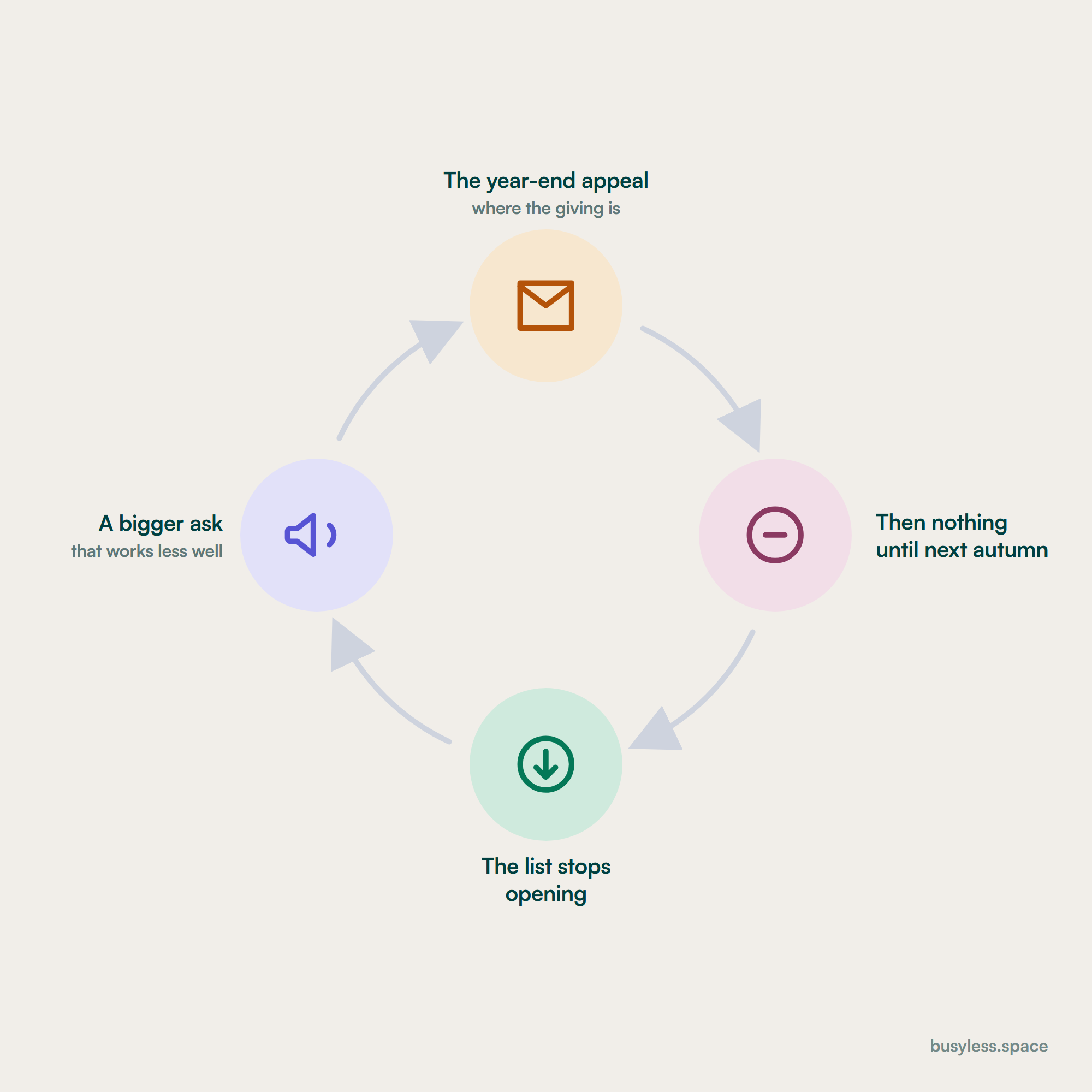
The cycle here is a year with one month in it. Giving concentrates heavily at year end, and the eleven quiet months decide how that month goes rather than being a gap before it. Almost every organisation plans the reverse.
They notice the problem
Any time, often prompted by news"Is this real, and is it near me?"
- What moves them
- The explainer about the problem, not about you
- How you know
- New subscribers in a month with no campaign in it
They look at you specifically
Days"Are these people serious and careful?"
- What moves them
- Honest arithmetic, plain writing, a named human being
- How you know
- Time on the pages about how the work is done
The first gift
Weeks, or one evening in December"Will this actually be used well?"
- What moves them
- Specific cost breakdowns rather than a general appeal
- How you know
- First-time donors, and the share arriving outside December
The eleven quiet months
Most of the year"Did anything happen after I gave?"
- What moves them
- Communication with no ask attached to it
- How you know
- Open rates in months with no campaign, which is the real health check
The second gift and beyond
12 months, then years"Am I part of this, or on a list?"
- What moves them
- Being told the difficult parts as well as the wins
- How you know
- Donor retention rate, which is the number this whole page exists to move
What you are allowed to publish
Four rules about what you publish and how it is worded. The sibling playbook covers solicitation registration, political campaign intervention, lobbying limits, beneficiary story consent and the grant programme's own rules, and none of those five are repeated here.
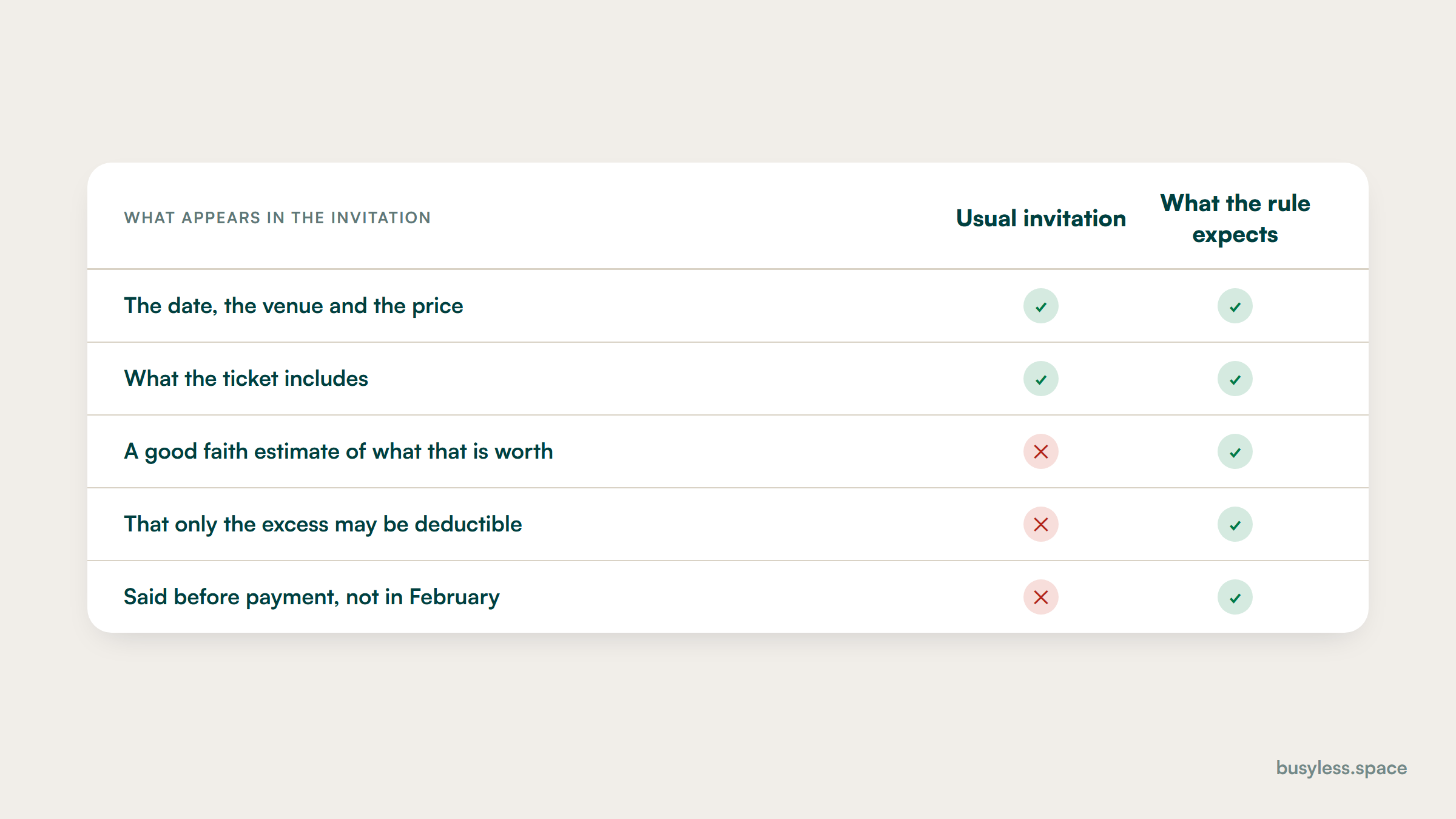
If they get something back, the invitation has to say so
IRC 6115, with the penalty at IRC 6714, read 2026-08-30
Where somebody pays more than $75 and receives goods or services in return, the organisation must provide a written statement saying the deductible amount is limited to the excess of the payment over the value of what was received, together with a good faith estimate of that value. The penalty is $10 per contribution, capped at $5,000 per fundraising event or mailing.
So do thisPut the estimate and the sentence into the invitation, the registration page and the confirmation, not only into the receipt somebody gets in February. A gala ticket, a paid webinar, a members' benefit and an auction lot all sit inside this.
A company saying it gives to you is regulated in several states
State charitable sales promotion and commercial co-venture statutes, including California, New York and Massachusetts, read 2026-08-30
When a business advertises that some portion of a purchase benefits a named charity, a number of states treat it as a charitable sales promotion with its own requirements: a written agreement before the campaign runs, disclosure of what will actually be given, and in several states registration or a filed account. The obligations reach the charity as well as the company.
So do thisGet the written agreement in place before the campaign is announced and check where the promotion will run, since obligations follow the states it reaches. Agree the exact wording of the claim rather than approving a concept.
Your public filing is read against your marketing
Form 990 and its public disclosure requirement, read 2026-08-30
The annual information return is a public document, and Part III describes programme service accomplishments in the organisation's own words. Anybody comparing a fundraising claim against the filing can do so in a minute, and journalists and large donors routinely do. A campaign describing a programme the filing barely mentions is a reconcilable difference, and having to reconcile it in public is the problem.
So do thisHave whoever writes the campaign read the filing first, and make sure the story it tells about where money goes is the same story. Where they differ, fix the filing narrative next year rather than softening the campaign.
Grant-funded content is not exclusively yours
2 CFR 200.315(b), read 2026-08-30
For work produced under a federal award, the awarding agency reserves a royalty-free, non-exclusive and irrevocable right to reproduce, publish or otherwise use the work for federal purposes and to authorise others to do so. Many private funders include similar terms, and some also restrict acknowledgement wording or require a specific statement of funding.
So do thisCheck the award terms before a funded asset becomes the centre of a campaign, and record which of your content was produced under which award. Also check the acknowledgement wording, because that is usually specified and rarely followed exactly.
None of this is legal advice. Rules vary by state and by contract, and the dates above are when each source was read. Check your own before you rely on any of it.
How to build content marketing for nonprofits
Half a year, built for somebody who has half a role and no budget. The order is deliberate: the two things that cost nothing come first, because a plan whose first month requires money is a plan that never starts here.
Find the material that needs nobody's permission
- List the numbers in your last three funder reports
- Record one programme worker explaining what people get wrong
- Ask three volunteers what they say about you at a dinner party
- Read your own public filing and note what it says about programmes
Output A source list and one recording, at no cost
Send something with no ask in it
- Write the letter from a named person and send it
- Publish the explainer about the problem rather than the organisation
- Film one thing on a phone in the place the work happens
- Set the rule that the list hears from you in quiet months
Output A list that has heard from you without being asked for money
Fix the invitation copy before the season
- Add the disclosure sentence and estimate to every paid registration
- Check any corporate partnership has a written agreement first
- Reconcile campaign claims against the public filing
- Record which assets were produced under which grant
Output Invitation copy that is correct before the busiest quarter
Publish the thing nobody publishes
- Write up one programme that did not work as expected
- Publish the honest cost breakdown for one programme
- Report retention and quiet-month engagement to the board
- Retire anything that only exists because it always has
Output A credibility asset and a report the board has not seen before
Structured data for what you publish
The organisation itself, its programmes and its donate flow are marked up on the sibling playbook. These six describe the things you publish, and two of them exist mainly to make provenance and funding legible rather than to win a rich result.
Report for the annual or impact report
The page hosting an annual report, impact report or evaluationThe right type for the document this sector produces most and publishes worst, usually as an unlabelled download. Naming the period and the funder in the markup makes it findable and makes the funding relationship legible at the same time.
{
  "@context": "https://schema.org",
  "@type": "Report",
  "name": "[REPORT TITLE], [YEAR OR PERIOD]",
  "url": "https://[YOUR-DOMAIN]/reports/[SLUG]",
  "description": "[WHAT IT COVERS AND WHO IT IS FOR]",
  "datePublished": "[YYYY-MM-DD]",
  "temporalCoverage": "[YYYY-MM/YYYY-MM]",
  "author": {
    "@type": "Organization",
    "name": "[ORGANISATION NAME]"
  },
  "funder": {
    "@type": "Organization",
    "name": "[FUNDER, IF THE WORK WAS FUNDED]"
  },
  "about": "[THE PROBLEM, NOT THE ORGANISATION]",
  "encodingFormat": "application/pdf"
}
Dataset for programme data you publish
A page describing figures you are making availableThe most under-used type in the sector. A local organisation often holds the only systematic count of a need in its area, and publishing it as data rather than as a statistic in a paragraph is what lets other people cite it.
{
  "@context": "https://schema.org",
  "@type": "Dataset",
  "name": "[WHAT IS COUNTED, WHERE, WHEN]",
  "description": "[METHOD, POPULATION AND LIMITATIONS IN ONE PARAGRAPH]",
  "url": "https://[YOUR-DOMAIN]/data/[SLUG]",
  "creator": {
    "@type": "Organization",
    "name": "[ORGANISATION NAME]"
  },
  "datePublished": "[YYYY-MM-DD]",
  "temporalCoverage": "[YYYY-MM/YYYY-MM]",
  "spatialCoverage": "[AREA COVERED]",
  "license": "[URL OF YOUR REUSE TERMS]",
  "isAccessibleForFree": true,
  "variableMeasured": "[WHAT EACH FIGURE COUNTS]"
}
VideoObject for a film about the work
Any page carrying a film, including a phone recordingDescribe what a viewer will understand rather than how it was made. Where a film was produced under a grant, record the funder, because the award terms may give somebody else the right to use it and the markup is a good place to keep that visible.
{
  "@context": "https://schema.org",
  "@type": "VideoObject",
  "name": "[WHAT IT SHOWS]",
  "description": "[WHAT A VIEWER UNDERSTANDS AFTERWARDS]",
  "thumbnailUrl": "https://[YOUR-DOMAIN]/images/[FILE].jpg",
  "uploadDate": "[YYYY-MM-DD]",
  "duration": "PT[M]M[S]S",
  "contentUrl": "https://[YOUR-DOMAIN]/video/[FILE].mp4",
  "embedUrl": "https://[YOUR-DOMAIN]/[PAGE-SLUG]",
  "transcript": "[FULL TRANSCRIPT OR URL]",
  "publisher": {
    "@type": "Organization",
    "name": "[ORGANISATION NAME]",
    "url": "https://[YOUR-DOMAIN]"
  },
  "funder": {
    "@type": "Organization",
    "name": "[FUNDER, IF PRODUCED UNDER AN AWARD]"
  }
}
PodcastEpisode for a recorded conversation
A single episode of a series about the problem you work onA format that suits this sector unusually well, because the raw material is people who know a problem deeply and the production cost is close to nothing. Publish it as episodes you own rather than as appearances you make.
{
  "@context": "https://schema.org",
  "@type": "PodcastEpisode",
  "name": "[EPISODE TITLE]",
  "description": "[WHO IS SPEAKING AND WHAT THEY EXPLAIN]",
  "url": "https://[YOUR-DOMAIN]/podcast/[SLUG]",
  "datePublished": "[YYYY-MM-DD]",
  "duration": "PT[M]M[S]S",
  "partOfSeries": {
    "@type": "PodcastSeries",
    "name": "[SERIES NAME]",
    "url": "https://[YOUR-DOMAIN]/podcast"
  },
  "associatedMedia": {
    "@type": "MediaObject",
    "contentUrl": "https://[YOUR-DOMAIN]/audio/[FILE].mp3"
  }
}
NewsArticle for a finding about the problem
The page carrying something you counted or learnedUse this for the thing a local reporter might pick up, which for most organisations is a number about the area rather than an announcement about the organisation. A named author matters, because a claim about a community with nobody's name on it is easy to ignore.
{
  "@context": "https://schema.org",
  "@type": "NewsArticle",
  "headline": "[THE FINDING, STATED PLAINLY]",
  "url": "https://[YOUR-DOMAIN]/news/[SLUG]",
  "description": "[WHAT WAS COUNTED AND OVER WHAT PERIOD]",
  "datePublished": "[YYYY-MM-DD]",
  "dateModified": "[YYYY-MM-DD]",
  "author": {
    "@type": "Person",
    "name": "[WHO IS ACCOUNTABLE FOR IT]",
    "jobTitle": "[ROLE]"
  },
  "publisher": {
    "@type": "Organization",
    "name": "[ORGANISATION NAME]",
    "url": "https://[YOUR-DOMAIN]"
  },
  "contentLocation": {
    "@type": "Place",
    "name": "[AREA]"
  }
}
Course for training you publish
A page describing training offered to volunteers or the sectorMany organisations hold real teaching material for volunteers and never publish it, and it is often the most useful thing on the site for somebody outside. State plainly whether it is free and who it is for, because a training page that hides its audience gets the wrong people.
{
  "@context": "https://schema.org",
  "@type": "Course",
  "name": "[TRAINING TITLE]",
  "description": "[WHAT SOMEBODY CAN DO AFTERWARDS]",
  "url": "https://[YOUR-DOMAIN]/training/[SLUG]",
  "provider": {
    "@type": "Organization",
    "name": "[ORGANISATION NAME]",
    "url": "https://[YOUR-DOMAIN]"
  },
  "isAccessibleForFree": "[true|false]",
  "audience": {
    "@type": "EducationalAudience",
    "educationalRole": "[e.g. Volunteer, frontline worker]"
  },
  "hasCourseInstance": {
    "@type": "CourseInstance",
    "courseMode": "[Online|Onsite]",
    "startDate": "[YYYY-MM-DDTHH:MM+00:00]"
  }
}
What to automate, and where the line is
Automation matters more here than almost anywhere else in the directory, and for an unusual reason: it does not read as spending. A subscription that saves a half-time communications lead six hours a month is defensible in a way a campaign budget is not.
- automate
Turning a recorded interview into a transcript and a first draft
The single highest-value automation on this page. It converts a forty-minute conversation with a programme worker into workable text without anybody being asked to write, which is the whole production model here.
- automate
Reformatting one programme update for several funder reports
Most organisations rewrite the same facts into four different funder templates every quarter. The facts are identical and the formatting is mechanical, so this recovers several days a year of programme staff time.
- automate
Producing captions, transcripts and alternative text
Accessibility work that would otherwise be skipped for lack of hours, and it reaches an audience this sector has a particular obligation to. Check names and place names, which is where these consistently fail.
- assist
Drafting the explainer about the problem
Good structure from a briefing, and it will produce the sector's generic framing rather than what your staff actually see. The programme worker's correction is the part worth publishing.
- assist
Drafting the letter from a named person
Useful as a shape and then rewritten by the person signing it. A supporter can tell the difference immediately, and here that difference is the entire value of the format.
- assist
Summarising the year's data for the annual report
Fast and mostly right, and it will smooth away the caveats that make the figures honest. Somebody who knows how the numbers were collected has to put those back.
- never
Writing anything in a beneficiary's voice
A generated account of somebody's experience presented as theirs is a fabrication, whatever the intent. Our search playbook for this sector covers the consent framework that governs the real version.
- never
Generating a figure about need, reach or outcomes
Every number here is checkable against a public filing and a funder report. A plausible figure that nobody counted is the fastest way for an organisation to lose the credibility this entire page is built on.
What it costs
Every figure below is an editorial estimate, and the tiers matter more here than most because the lowest one is genuinely where a large share of organisations sit. Every tier assumes the internal hours in the engine section exist, which for a half-time role is the binding assumption.
Do it yourself
$0 to $300- A monthly letter from a named person
- One recorded programme interview a month
- Phone video from the place the work happens
- The explainer about the problem
- Suits
- An organisation with a half-time communications role and no budget
- Ceiling
- It depends entirely on one person's time surviving the year, and it usually does not. When a campaign or a crisis lands, publishing stops for a quarter and the list notices.
Lean
$800 to $2,500- A few hours a month of somebody who writes for a living
- Transcription and editing tools that recover staff hours
- The annual report and impact report done properly
- Invitation copy reviewed before the season rather than after
- Suits
- An organisation with a full communications role and a fundraising target
- Ceiling
- It cannot carry a campaign and a steady programme at once. Something has to give in the run-up to year end, and the honest answer is to plan for that rather than to discover it in November.
Funded
$2,500 to $5,000- Content separated from the fundraising calendar
- Film made regularly rather than once a year
- Programme data published as data, not as a statistic in a paragraph
- Volunteer and supporter communications treated as their own stream
- Suits
- An organisation where donor retention is a board-level number
- Ceiling
- This is where the constraint on this page reasserts itself. Beyond it, the spend becomes visible enough that it needs explaining in the annual report, and that explanation had better be good.
Above this
$5,000 and up- Several programmes and regions under one editorial standard
- Research that is a programme with its own funding
- Sustained paid amplification, reported as its own line
- In-house production capacity rather than commissioned work
- Suits
- National organisations where communications is an accountable function
- Ceiling
- The question stops being what it buys and becomes whether you would publish the figure. An organisation at this level should be able to say what it spends on communications and why, in public, without preparation.
How to do it with no budget
These seven matter more here than on any other playbook we publish, because for a large share of organisations this list is not a starting point before the budget arrives. It is the plan.
- 1
Send something with no ask in it
Your existing list · 1 hour
Most organisations appear in an inbox only when they want money. Breaking that pattern once is the cheapest improvement available to a supporter relationship.
- 2
Record a programme worker for forty minutes
A phone · 90 minutes
Ask what people get wrong about the problem. Do not send questions in advance, because a prepared answer is the organisational line rather than what they actually think.
- 3
Ask three volunteers what they tell people about you
A conversation at the end of a shift · 30 minutes
Their sentence is almost always better than yours. Ask permission to use it in the same conversation and write down that you did.
- 4
List the numbers already in your funder reports
Your last three reports · 2 hours
You are already counting things nobody else counts. Check the funder agreement before publishing any of it, and aggregate everything.
- 5
Read your own public filing
Your most recent Form 990 · 1 hour
Specifically the programme accomplishments section. Anybody comparing your campaign against it can do so in a minute, and large donors do.
- 6
Put the disclosure sentence into every paid registration
Your event and registration pages · 2 hours
Where somebody pays over $75 and gets something back, the statement and the good faith estimate belong in the invitation, not only in the February receipt.
- 7
Write up one thing that did not work
Board minutes and whoever ran it · 3 hours
Expected, happened, changed. Have the board read it first, and publish it anyway if they hesitate for reasons of appearance rather than accuracy.
The tool stack
The shortest stack in the directory, on purpose. Every row is either free or cheap enough that it does not need defending, and the rows linking into our other directories go to the researched review rather than to a vendor page.
Own the list that nobody can take away
Choose on the export and the consent record rather than on the templates. The list is the asset and the ability to leave with it intact is the only feature that matters long term.
Free option: Free below a few thousand subscribers on most platforms
Turn recorded conversations into usable text
This is the tool that makes the production model on this page work. It converts a conversation into a draft without asking a caseworker to write anything.
Free option: Free tiers cover a few hours a month, which is enough for one interview
Publish reports and data as pages rather than as downloads
An annual report published as a downloadable file is invisible to everything. The same content as pages is findable, citable and readable on a phone.
Free option: Your existing site, if it can hold a page rather than only a PDF link
Price the programme honestly before proposing it to a board
Useful mainly for showing what the half-time role is already absorbing. The internal hours are the real cost here and they never appear in a communications budget.
Free option: Free
Work out what one point of donor retention is worth
Built for a commercial audience and the arithmetic transfers directly. Run it before deciding the quiet-month communication is not worth the hours.
Free option: Free
See what people ask about the problem you work on
Use it beside your own inbox rather than instead of it. The inbox tells you what people need and this tells you how many others are asking without contacting anybody.
Free option: The questions your own helpline or inbox receives, which are better and free
Check what assistants say about the problem and who they name
Increasingly the first place somebody in difficulty asks. Worth knowing whether the organisations named are the ones that can actually help in your area.
Free option: Ask each assistant where to get help with this problem, monthly, and note who appears
Know which asset came from which grant
One row per asset: which award funded it, what the terms say about reuse, and the acknowledgement wording required. Nobody keeps this and everybody needs it eventually.
Free option: No cost, and a spreadsheet is genuinely the right tool here
Take it from here
Everything below is meant to be copied and filled in. Bodies are plain text, so what you see is exactly what lands on your clipboard.
One page per channel, answering both questions: does it work, and could you explain the invoice.
DEFENSIBLE CHANNEL DECISION
Organisation: [NAME]
Channel under consideration: [ ]
Decided by: [NAME]     Date: [YYYY-MM-DD]
Reviewed by: [BOARD / FINANCE / NEITHER]

WHY THIS FORM EXISTS
In this sector a channel has to pass two tests. Most
plans only apply the first one, and the second one is the
one that gets asked about at an annual meeting.

TEST ONE: DOES IT WORK
[ ] Who exactly does this reach?         [ ]
[ ] Are they donors, volunteers, beneficiaries,
    funders or peers?                    [ ]
    [BE HONEST. SECTOR PRESS REACHES PEERS.]
[ ] What is the realistic result in 12 months? [ ]
[ ] What would tell us it failed?        [ ]
[ ] Kill date if it does:                [YYYY-MM-DD]

TEST TWO: COULD YOU EXPLAIN THE INVOICE
[ ] Annual cost, all in:                 [ ]
[ ] As a share of total expenditure:     [N]%
[ ] Would we publish this figure without being asked?
                                          [Y/N]
[ ] If a donor asked what this cost and what it
    achieved, what is the one-sentence answer?
    [ ]
[ ] Does it appear in the annual report? [Y/N]
    If no, why not: [ ]
    [IF THE ANSWER IS "IT WOULD LOOK BAD", THAT IS THE
     TEST FAILING, NOT A REPORTING PROBLEM.]

THE LABOUR QUESTION
Who does the work?
[ ] Paid staff, existing hours
[ ] Paid staff, additional hours
[ ] Volunteer
[ ] Contracted out
Hours per month: [N]
     [A CHANNEL RUN BY DONATED LABOUR PASSES TEST TWO
      ALMOST AUTOMATICALLY. THIS IS THE MAIN REASON
      VOLUNTEERS APPEAR SO OFTEN IN THIS PLAYBOOK.]

THE DECISION
[ ] RUN     [ ] TEST until [YYYY-MM-DD]     [ ] SKIP
Reason, one sentence: [ ]

Recorded in the communications plan: [Y/N]
Reported to the board: [Y/N]The expensive mistakes
Only appearing when you want money
What it costs: A list that opens less every year, and a December campaign that works less well each time
Send something in a quiet month with no ask in it. It costs an hour and it has the clearest effect on the number that matters.
Commissioning a film before filming anything on a phone
What it costs: A production cost that has to be justified, for something that may not have worked anyway
Film the unpolished version first. If it does not move people, the expensive version will not fix it, and if it does, you have saved the argument entirely.
Asking programme staff to write
What it costs: A second job done badly, resentment, and worse writing than an interview would have produced
Interview them for forty minutes and let somebody else draft it. The material is better and the cost to them is a fraction of what writing would be.
Leaving the disclosure to the receipt
What it costs: A penalty per contribution rather than a warning, capped per event or mailing
Put the statement and the good faith estimate into the invitation and the registration page. It takes an afternoon once and then it is part of the template.
Announcing a corporate partnership before the agreement exists
What it costs: A charitable sales promotion running in states with requirements nobody checked
Sign the written agreement and confirm the exact wording of the claim before anything is announced. Where the promotion runs decides which obligations apply.
Publishing only what went well
What it costs: A body of communications that reads exactly like everybody else's and is discounted accordingly
Write up one thing that did not work as expected. It is the fastest route to being the organisation in your field that people believe.
What to measure
Measuring nonprofit content marketing on reach is particularly unhelpful, because reach is the thing this page argues you cannot always afford to buy. What follows leads with retention and with what happens in the quiet months, and it is honest that year-end revenue is a poor test of anything published in March.
Leading indicators
Open and click rates in months with no campaign
Your email tool, filtered to non-campaign sends
The single most diagnostic number on this page. A list that engages when nothing is being asked for is a list that will respond when something is.
New subscribers outside a campaign period
Your email tool, by month
Growth during a campaign tells you the campaign worked. Growth in a quiet month tells you the content is doing something on its own.
Volunteer enquiries attributable to something published
Your volunteer intake form
Volunteers are the second scarcest resource here and the easiest content result to see. Add one question to the intake form and this becomes measurable immediately.
Local coverage earned rather than paid for
A folder, honestly
Judge it by the outlet rather than by an audience figure. One local paper covering a number you published is worth more here than a large aggregator pickup.
Business indicators
Donor retention rate
Your donor database
The number this whole page exists to move, and the one most reports replace with total raised. Retention improves quietly and total raised hides it completely.
Share of gifts arriving outside the final quarter
Your donor database, by month
A direct read on whether the eleven quiet months are doing anything. It moves slowly and it is the clearest evidence that a year-round programme is working.
Second gifts within twelve months of a first
Your donor database
Where the economics of this sector actually sit. A first gift costs the most to acquire and a second one costs almost nothing, which is the same arithmetic every commercial page here describes.
Communications spend, stated plainly
Finance, and your public filing
Reported as a number you would be willing to publish. On this page that is a measurement rather than a disclosure, because the willingness is itself the test.
The verdict
Content marketing for nonprofits is constrained by something no commercial page has to think about: the spending is part of what you are judged on. That is often described as an unfair perception, and it is also a fact about the audience, which makes it a design input rather than an argument to win.
Designed around it, the plan gets better rather than smaller. An owned list, volunteers who can write, staff who know the problem, and material that needs nobody's permission, all of which are cheap and durable and none of which anybody has to defend at an annual meeting. A content marketing strategy for nonprofits should be built from those.
Two signals should make you cautious about a proposal for nonprofit content marketing services: it leads with paid social, and it never asks how much time your communications person actually has. The first ignores the constraint and the second plans for a team that does not exist. Both are the commonest content marketing strategies for nonprofits on offer.
Stated simply, content marketing services for nonprofits are worth buying once the free steps on this page are running and the limit is genuinely hours rather than ideas. Bought before that, you are paying for output that your own list and volunteers would have produced.
FAQ
Nonprofit content marketing questions
Is it wrong to spend money on communications at all?
No, and pretending otherwise has done the sector real harm. The point is narrower: spending is visible here in a way it is not elsewhere, so choose channels you would be comfortable naming in an annual meeting, and be able to say what each one bought. Defensible is not the same as minimal.What do we publish if we cannot tell people's stories?
A great deal. The data you collect to run the programme, what your staff know about the problem, what a volunteer experiences, the honest cost of delivery, and the thing you tried that did not work. None of it needs anybody's permission and it is more distinctive than a story anyway.Does the disclosure rule really apply to a webinar?
If somebody pays more than $75 and receives goods or services in return, yes. A ticket, a members' benefit, a paid session and an auction lot all qualify. The statement and a good faith estimate of what they received belong in the invitation and the registration page, not only in the receipt.A company wants to donate a percentage of sales. What now?
Get the written agreement in place before anything is announced, and agree the exact wording of the claim rather than the concept. Several states treat this as a charitable sales promotion with requirements that reach the charity as well as the business, and obligations follow wherever the promotion runs.Can we reuse a video a grant paid for?
Usually yes, and it may not be exclusively yours. For work produced under a federal award the agency reserves a licence to reproduce and authorise others to use it, and many private funders include similar terms. Check the award before a funded asset becomes the centre of a campaign.How do we publish anything with half a communications role?
Stop asking anybody to write. Record a forty-minute conversation with a programme worker, transcribe it, and have a volunteer who writes turn it into two things. That is roughly eight hours a month across four people and it produces more than a full-time role usually does alone.Should we really publish something that failed?
It is the fastest route to being believed in a sector where everybody publishes successes. Write what you expected, what happened and what you do differently, have the board read it, and publish it unless the objection is about accuracy rather than appearance.What should an organisation our size expect to spend?
The free steps on this page cost nothing but hours and are genuinely the plan for many organisations. Where a budget exists, an engagement begins with a Discovery and then a monthly retainer, and the realistic range for running it properly is $800 to $5,000 a month.Is an agency worth it on a charity budget?
Only for the part your volunteers cannot do. A content marketing agency for nonprofits proposing a content calendar is proposing output your own list and supporters would have produced free. Buy the structural work instead: separating the two audiences and getting the grant used.
Run it yourself, or have someone own it
Everything above is written to be run without us, and the free path is genuinely most of the value for a small practice. Where these plans stall is almost never the plan. It is that the person holding the material has a day job and nobody owns the programme after the first month. That is the job we do.