
Skip to content

Higher education SEO strategy

YMYL and regulated

The search starts two years before anyone can apply

Written by Eugene SuslovLast reviewed 28 August 2026No affiliate links
Sector
Business services
Model
Multi-location, National service
Competition
Brutal
Time to results
9 to 18 months, against an annual admissions cycle
Typical monthly
$3,000 to $25,000

Key takeaways

  1. 1The searching begins around year nine and the application goes in during year twelve. Almost everything an institution publishes is written for the last six months of that, which is why the exploration queries sit uncontested.
  2. 2Concede the ranking queries. US News, Niche and College Board have owned "best colleges for [subject]" for years and no amount of work takes it from them. The programme, cost and outcome questions underneath are winnable and worth more.
  3. 3Two pages compete for the same programme because two departments published them. That is an org chart problem wearing a technical costume, and no crawl report will resolve it.
  4. 4The professional licensure disclosure the Department of Education already requires is also the best converting paragraph on a programme page. Publish it as text, state by state, rather than as a linked PDF.
  5. 5April 2027 is a content deadline rather than an IT one. The accessibility standard applies to the pages, the documents and the video, and most of a university's failures are in things marketing published.

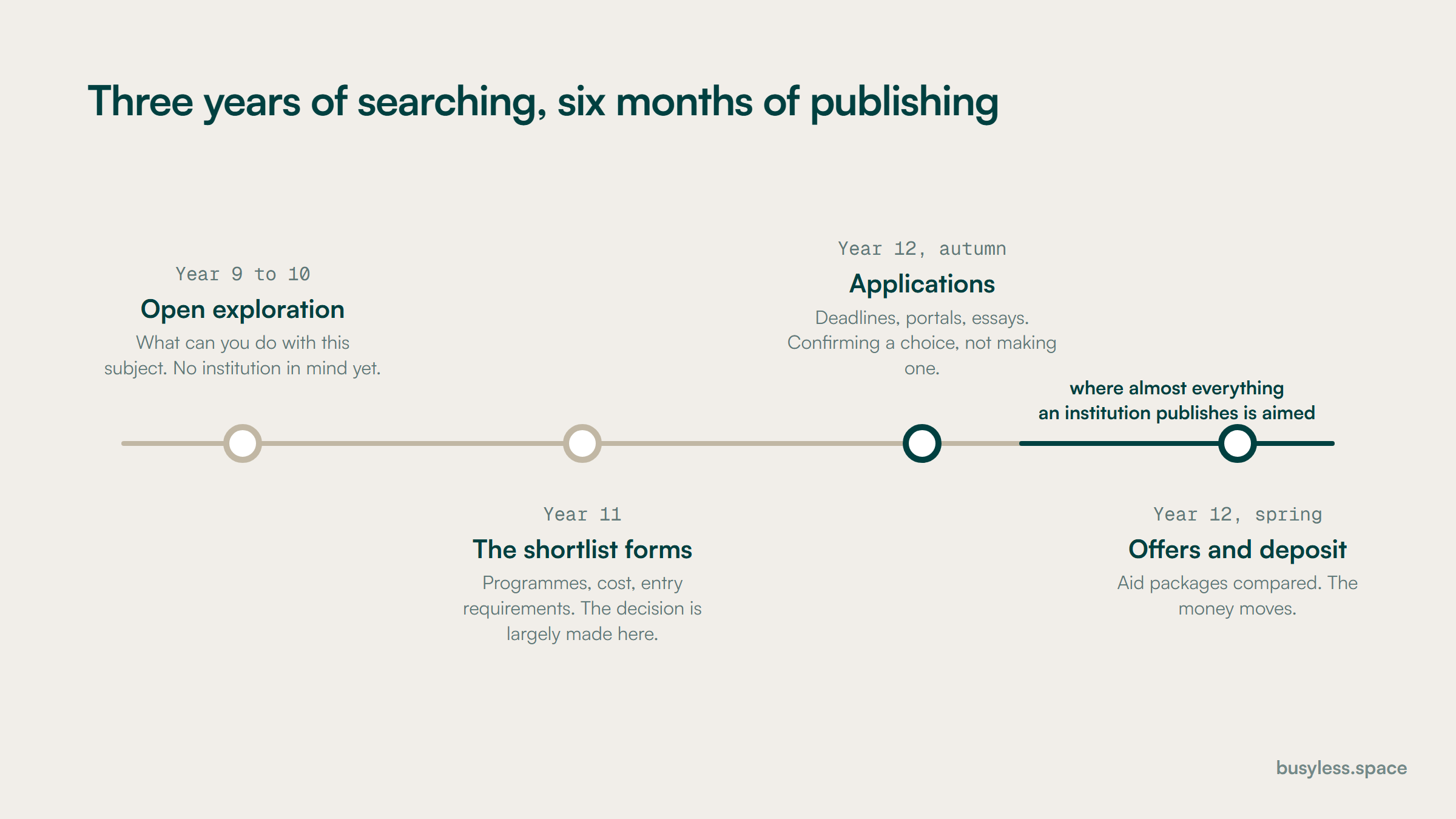
SEO for universities is unlike the rest of this directory in one respect that decides everything else: the timing. A family starts looking somewhere around year nine or ten. The application goes in during year twelve. Most of what an institution publishes is written for the last six months of that window, and most of the searching happens before it opens.

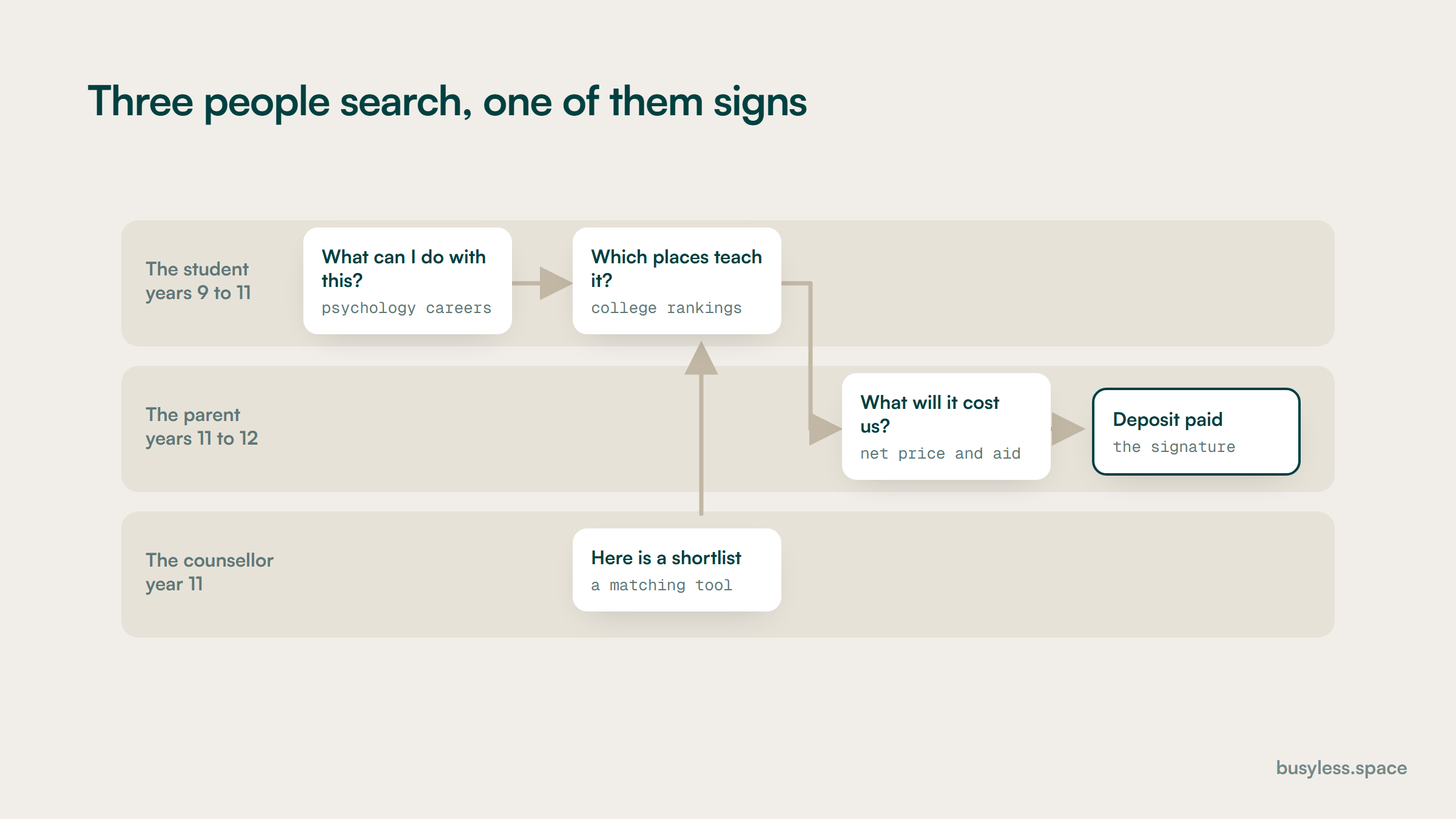
The second difference is that no one person is searching. A student, a parent and a school counsellor look for different things, in different words, months apart. Only one of them signs anything, and it is rarely the one who did the early reading.

Put those two facts together and a higher education SEO strategy turns out to be mostly about the years before an enquiry exists. That is exactly the part of the funnel nobody inside an institution is measured on, which is why it is available.

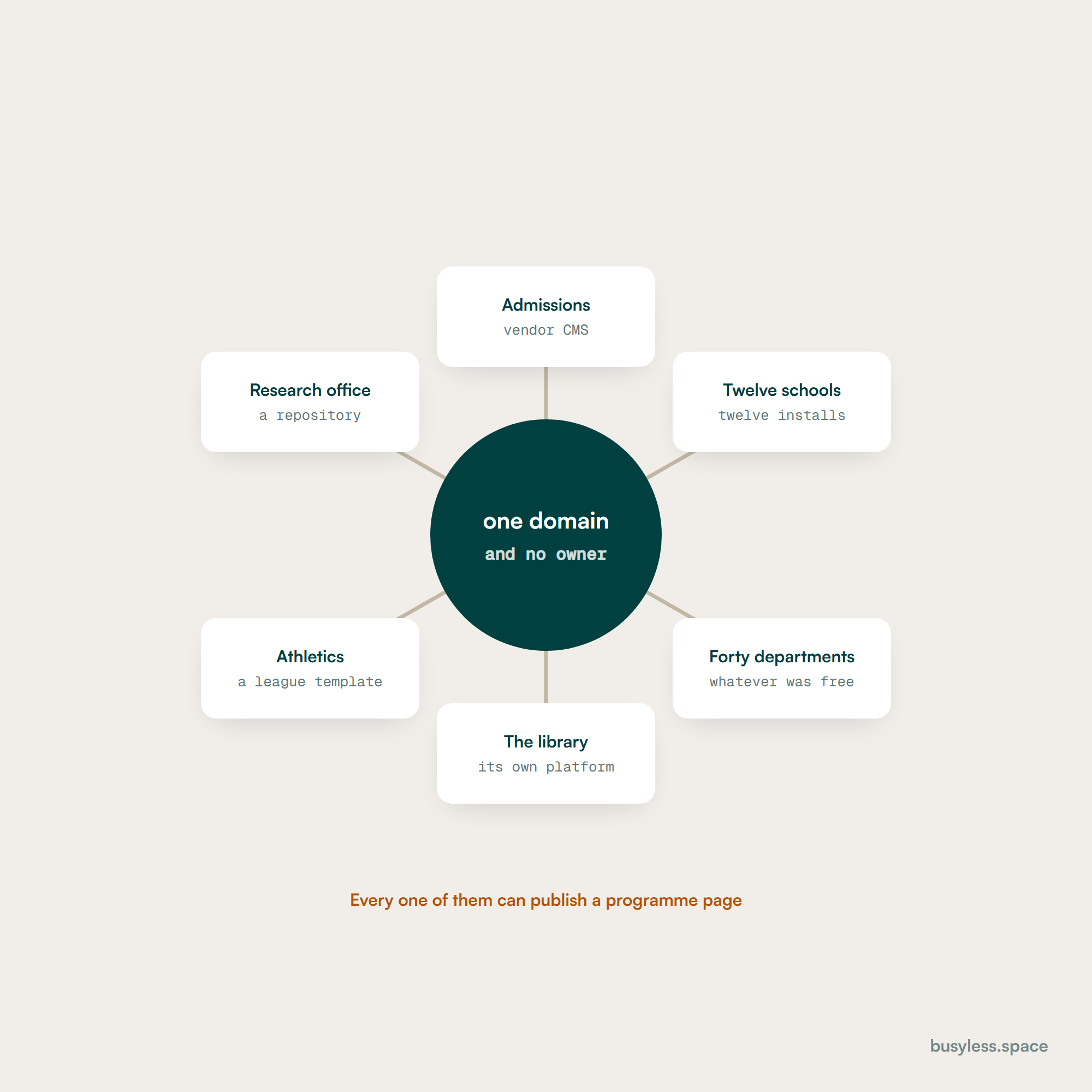
There is a third difference and it is structural. A university domain is not published by one team. Admissions, a dozen schools, forty departments, the library, athletics and a research office all write to it, usually on different systems, frequently without knowing what the others have already said.

That is why two pages for the same programme exist. It is an organisational fact rather than a technical one, and the highest-return work here is often governance: deciding who owns a programme URL before anybody argues about title tags.

Who this covers, and who it does not. Degree-granting institutions are the audience, community colleges and independent schools included. A provider selling short courses competes against free material teaching the same thing, which is a genuinely different problem and does not belong here.

Who already ranks in higher education

Honest higher education SEO begins with an uncomfortable inventory, because a large share of what a prospective student asks is already answered by four organisations, and not one of them is a university. Two of them rank you. One of them is the government publishing your own numbers.

What is on the results page

  • Ranking-site listicles on every "best colleges for [subject]" query, usually three or four of them above the first institution.
  • The federal College Scorecard surfacing on cost, debt and earnings queries about specific programmes at specific institutions.
  • Reddit threads on comparison and chance-me queries, where the discussion format genuinely answers the question better than a brochure page.
  • A knowledge panel for the institution itself, assembled largely from Wikipedia and federal reporting rather than from anything you publish.
  • Video results on campus, accommodation and student-life queries, where a current student's phone footage outperforms the commissioned film.
  • People Also Ask stacked heavily on entry requirements, deadlines and cost, which are the three things buried deepest on most institutional sites.
  • U.S. News & World Report

    usnews.com

    Owns the ranking head terms and has for a generation. There is no content answer to this. The only real lever is the data an institution submits and how it is presented, and that decision belongs to the provost's office rather than to marketing. Plan around it rather than at it.

  • Niche

    niche.comClaim it

    Ranks for both "best colleges for [subject]" and "[institution] reviews", which means it sits in front of you on discovery queries and on your own brand. The profile is claimable and most institutions have never looked at theirs. Start there.

  • College Board BigFuture

    bigfuture.collegeboard.orgClaim it

    The search tool counsellors point students at, and the profile is fed by the Annual Survey of Colleges rather than by anything you can edit ad hoc. Late or incomplete survey responses show up as a thin profile a year later.

  • College Scorecard

    collegescorecard.ed.gov

    The Department of Education publishing programme-level cost, debt and earnings for your institution. It will outrank you on your own numbers, and it is what a journalist quotes. The strategic point is not to fight it: it is to make sure your own pages do not contradict it.

  • Reddit

    reddit.com

    Where the comparison actually happens, in the applicant subreddits and in the one named after your institution. Not a channel to optimise. Worth reading weekly, because the objections raised there are the pages you have not written.

  • Appily

    appily.comClaim it

    The matching and profile network formerly known as Cappex, now run by EAB. It ranks on long-tail programme and scholarship queries and it is one of the places a student builds a shortlist without ever visiting an institutional site.

  • Times Higher Education and QS

    timeshighereducation.com

    For international recruitment these matter more than the domestic rankings do, and they answer the queries an overseas applicant types first. If international students are a real part of the intake, this is the gatekeeper to study rather than US News.

  • Wikipedia

    wikipedia.org

    Feeds the knowledge panel, the AI answers and a good deal of what an engine believes about the institution. Nobody at a university owns it, editing it yourself is against the rules, and the article is frequently years out of date on enrolment and programmes.

Three lanes running across the four years of a college search: the student, the parent and the school counsellor. Each starts at a different point, carries different queries, and the handoffs between them are marked. Only one lane reaches the cost question.
A page written for the applicant answers roughly a third of the demand. The other two columns are searching in different words and different months.

What people actually search

The clusters below are ordered by how early they happen rather than by volume, because early is where the gap is. Everything an institution publishes clusters around the last two, and the first three are where a shortlist actually forms.

Exploration, before any institution is in mind

Informational

what can you do with a psychology degree

The page that wins it: A career-outcome page owned by the academic department

The largest and least contested cluster in the industry, and it belongs to no office. Admissions will not write it because it names no institution. The department will not write it because nobody asked. So it is answered by a careers site, two years before the student has heard of you.

Programme and subject

Commercial investigation

msc data science entry requirements

The page that wins it: One canonical programme page, per programme, with a named owner

The revenue cluster and the one where the estate problem bites hardest. Where a school site and the central admissions site both publish the programme, they compete, split their links, and the older one usually wins.

Cost, aid and value

Commercial investigation

how much does [institution] cost per year

The page that wins it: A net price and aid page that reconciles with the federal figures

Behaves like a financial query rather than an educational one, which is why the quality bar here is higher than elsewhere on the site. Answering with a sticker price and a link to a calculator loses to the Scorecard, which answers with a number.

Licensure and state eligibility

Transactional

is [programme] approved for licensure in texas

The page that wins it: The per-state licensure determination, published as text

Has no analogue in any other industry here. The determination is already required, already made and usually buried in a PDF. Published properly it answers a question that decides enrolment, and it is the rare case where compliance and conversion want the same artefact.

Admissions mechanics

Transactional

[institution] transfer credit policy

The page that wins it: One page per pathway: first year, transfer, international, returning

Four genuinely different audiences repeatedly served by one "How to apply" page. The transfer pathway is the most commercially valuable and the most neglected, because those applicants are older, decide faster and arrive with credit.

Faculty, research and expertise

Informational

[narrow research topic]

The page that wins it: Faculty profiles and research pages, treated as content rather than as a directory

The only pages on the domain with genuine topical authority, and they are usually auto-generated stubs. A department with six publishing academics has six authors nobody at the institution thinks of as authors.

Adult, transfer and online learners

Commercial investigation

finish my bachelors degree online

The page that wins it: A separate section written for somebody with a job and prior credit

A different buyer entirely: older, paying themselves, deciding in weeks rather than years, and sensitive to schedule before they are sensitive to prestige. State authorisation constrains where you may market this, which is covered below.

Campus, accommodation and student life

Informational

[institution] dorms review

The page that wins it: Honest, specific pages, and a decision about who owns the video

Answered on Reddit, YouTube and TikTok by people who live there. Institutional versions of this content lose reliably. The useful move is the factual half: floor plans, meal plans, costs, distances, which nobody else has.

A four-stage timeline running from year nine to year twelve: open exploration, shortlist forming, applications, decision. A marker under the final stage shows where most institutional content is aimed, leaving the first two stages unmarked.
The two unmarked stages are the ones that decide which institutions get considered at all. Nobody inside a university is measured on them.

What the rules change

This is the most regulated section in the directory, and unusually the rules reach page copy directly rather than only the analytics. None of it is legal advice, every item names its source, and the dated ones are the ones to re-check before you act on them.

1

Licensure eligibility has to be disclosed state by state

Department of Education, 34 CFR 668.43(a)(5)(v) and 668.43(c)

What it means

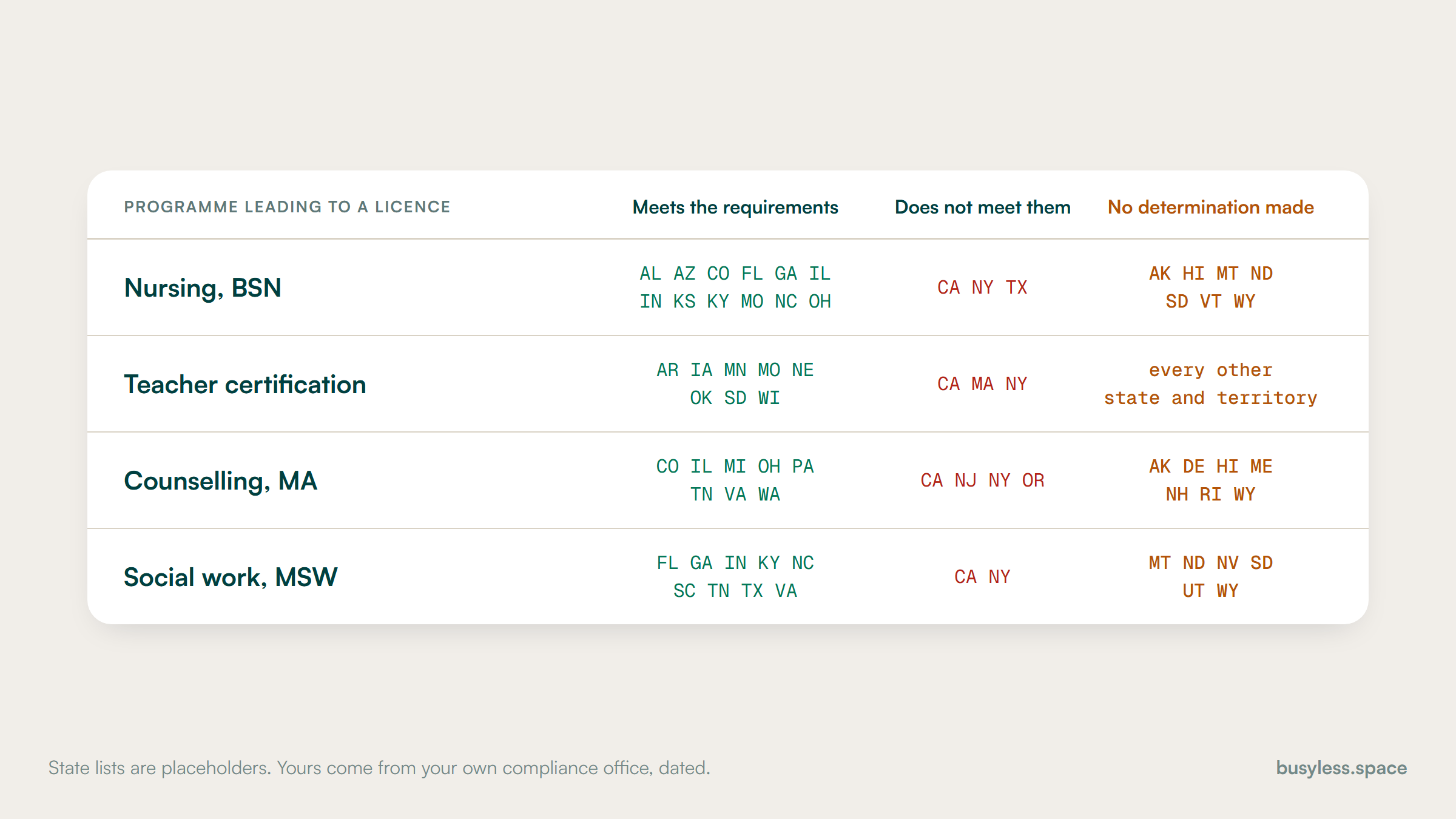
Where a programme is designed or advertised as meeting the educational requirements for a professional licence, the institution has to make available a list of every state where it has determined the programme does and does not meet those requirements. Where it does not meet them in the state a prospective student is located, or where no determination has been made, that has to be disclosed to the student directly before enrolment.

So do this

Publish the determination as text on the programme page, as a three-state list: meets, does not meet, not yet determined. It is already written and it is usually in a PDF. It also answers a query with real intent behind it.

2

Marketing claims are governed by the misrepresentation rules

Department of Education, 34 CFR 668.71 to 668.75

What it means

A substantial misrepresentation about the nature of an educational programme, the financial charges attached to it, or the employability of its graduates can put Title IV participation at risk. It covers statements made by anyone acting on the institution's behalf, which includes an agency writing landing pages and a lead vendor writing ad copy.

So do this

Route employment and salary claims through the same review as a catalogue entry, and cite the source for every outcome number on the page. Then audit what any external partner has published in your name, because that is where the exposure sits.

3

The accessibility standard now has a date attached

Department of Justice Title II rule of April 2024, and the interim final rule effective 20 April 2026 that extended the compliance dates

What it means

Public entities have to meet WCAG 2.1 Level AA for web content and mobile apps. The extension moved the date for entities with a population of 50,000 or more to 26 April 2027, and for those under 50,000 to 26 April 2028. Department guidance uses the population of the state rather than student headcount for a state university.

So do this

Treat it as a content programme, not an IT ticket. The failures are mostly in things marketing published: untagged PDFs, uncaptioned video, image-only infographics and link text reading "click here". Confirm the current dates before planning against them.

4

You may only market a distance programme where you are authorised

Department of Education state authorisation rules at 34 CFR 600.9(c), and the NC-SARA reciprocity agreement

What it means

An institution has to be authorised in the state where a distance-education student is located, either directly or through reciprocity. Reciprocity does not cover everything: professional licensure requirements and some state consumer protection provisions sit outside it, and a few states and territories are not participants.

So do this

Get the authorised list from your compliance office before building state or city pages for an online programme, and check it again before a paid campaign. Publishing a page targeting a state you cannot enrol in is a compliance problem, not a wasted page.

5

A student story is an education record

Family Educational Rights and Privacy Act, 20 U.S.C. 1232g and 34 CFR Part 99

What it means

Personally identifiable information from education records may not be disclosed without written consent. That reaches a testimonial naming a student's programme and graduation year, a photograph identifying a student in a class, and an outcome story quoting a grade or an award. Directory information is narrower than most marketing teams assume and institutions define it differently.

So do this

Use a written consent form for every student featured, keep it, and check your own institution's directory information notice rather than a general summary. Build the consent step into the content workflow so it is not a phone call three days before publication.

6

Programme cost and outcome figures are published federally

Department of Education financial value transparency rules at 34 CFR Part 668, published in the final rule of 10 October 2023

What it means

Programme-level debt and earnings information is reported and published federally, and certificate and graduate programme applicants have to acknowledge debt information before enrolling. The framework has been amended and renamed since the original rule, so the current position is worth confirming rather than assuming.

So do this

Reconcile every cost and outcome figure on your own pages against what is published federally, and explain any difference on the page rather than leaving a prospective student to find it. A contradiction between your page and a government dataset is the worst possible version of this.

A row per programme with three marked columns: the states where the programme meets licensure requirements, the states where it does not, and the states where no determination has been made. Every row carries an entry in the third column.
The third value is the honest one and the one institutions hide. Published as text it answers a question that settles an enrolment.

Proving expertise

A decision to take on years of tuition is a financial decision as much as an educational one, and search engines treat pages about it accordingly. The good news is that a university holds more genuine expertise signals than almost any other organisation and publishes almost none of them.

  • Accreditation stated plainly, with the accreditor named and linked, on the pages where somebody is deciding rather than only in the footer.
  • Named academic authors on programme and subject pages, with their credentials and publications, instead of "Office of Admissions".
  • Faculty profiles that read as expert pages: research interests, publications, an ORCID identifier, teaching, and press appearances.
  • Outcome figures with the methodology and the cohort stated, so a reader can see what the number counts and what it excludes.
  • The Common Data Set published as an HTML page rather than a spreadsheet, which most peers do not do and which answers dozens of factual queries.
  • Licensure determinations published per state, dated, with the person or office that made the determination named.
  • Historic pages kept and dated rather than silently overwritten every academic year, so the record is legible.

How to build a higher education SEO strategy

Ninety days is not enough to change an admissions cycle, so the ordering below is built to land the governance decisions early and the writing behind them. A higher education SEO strategy that starts with content and leaves ownership until later produces two competing pages and an unhappy dean.

  1. 1

    Weeks 1 to 4

    Find out what you actually publish

    • Enumerate every subdomain and every content management system publishing to the domain, and put a named owner against each
    • Export the programme list from the catalogue and check how many URLs exist per programme
    • Set up a Search Console property for each subdomain, because a single property hides where the traffic really lands
    • Claim and correct the Niche, BigFuture and Appily profiles
    • Get the state authorisation list and the licensure determinations out of the compliance office

    You end up with
    A map of the estate with owners on it, a duplicate-programme count, and the two compliance artefacts that most of the content work depends on

  2. 2

    Weeks 3 to 12

    Fix the programme page and settle who owns it

    • Agree one canonical URL per programme, in writing, with the schools that publish the duplicates
    • Build a single programme page template carrying requirements, cost, outcomes, licensure by state and a named academic contact
    • Publish the licensure determination as text rather than as a linked document
    • Redirect or consolidate the duplicates, keeping the older URL where it holds the links
    • Reconcile every cost and outcome figure against the federal dataset and explain any difference on the page

    You end up with
    One page per programme, owned by somebody, saying the things a prospective student and a regulator both need it to say

  3. 3

    Weeks 8 to 24

    Write the years nobody covers

    • Commission career-outcome pages from academic departments, one per subject, answering what the degree leads to
    • Build the four admissions pathways as four pages rather than one, starting with transfer
    • Turn faculty stubs into real expert profiles for the academics who publish
    • Publish the factual half of student life: floor plans, meal plans, costs, distances, transport
    • Start the accessibility remediation on the pages marketing owns, before the estate-wide project starts

    You end up with
    Coverage of the exploration cluster, which sits two years upstream of an enquiry and is where a shortlist is formed

  4. 4

    Weeks 20 to 40

    Measure against the cycle, not the month

    • Report enquiries and applications by source alongside impressions, with the lag between them stated
    • Track the exploration cluster separately from brand queries, because brand demand is created by things other than search
    • Compare against the same month last year rather than last month, since the cycle is annual
    • Run a repeat estate crawl and report on duplicate programme URLs as a governance metric

    You end up with
    A report an admissions director can act on, showing what search contributed and being explicit about what it cannot prove

Technical fixes with the best payoff

Higher education runs on a small number of student information and catalogue systems, so the same defects recur across almost every institution. None of the items below is exotic and all of them are expensive to leave.

  • The same programme has three URLs

    A sprint, plus a term of diplomacy

    The school publishes it, the central admissions site publishes it and the graduate college publishes it. All three rank for something, none ranks well, and the links divide three ways. This is the single most common defect in the sector.

    Agree the canonical owner programme by programme, then consolidate with redirects rather than by deleting. Do the negotiation before the technical work, because the technical work takes an afternoon and the negotiation takes a term.

  • The course catalogue is a PDF

    A project, and worth it

    Catalogues are produced annually as print artefacts and published as documents. Every course description, prerequisite and requirement then lives in a file that ranks poorly, cannot be updated in place and is invisible to an answer engine.

    Publish the catalogue as HTML, one page per programme and per course, generated from the same source. Keep the PDF for people who want it. This is usually the largest single content gain available to an institution.

  • The programme finder produces no URL

    A sprint

    A faceted JavaScript widget filters an internal list and never changes the address bar. There is no page for "online masters programmes" or "part-time business degrees", so the institution ranks for none of them despite offering all of them.

    Give every meaningful filter combination a real URL with its own title and copy, and link them from the finder. Not every combination, only the ones somebody searches for.

  • Last year's tuition page still outranks this year's

    A day, then a policy

    Academic-year content gets published to a new URL each year and the old one is never retired, so a page for a cycle that closed two years ago holds the links and the rankings while the current page is invisible.

    Use one stable URL per recurring page and update it in place, keeping an archive elsewhere if the record matters. Where separate year URLs already exist, redirect the old ones to the current page.

  • Faculty profiles are generated stubs

    A sprint, then ongoing

    The directory system produces a page per person with a name, a title and a phone number. These are the pages with the most genuine authority on the domain and they carry almost no text, so a researcher with forty publications ranks for nothing.

    Extend the profile template to carry research interests, publications, an ORCID link and press appearances, then populate it for the academics who publish rather than for everybody at once.

  • The event calendar generates a URL per day

    An afternoon

    Calendar systems commonly expose every day, week and month as its own address, in both directions, indefinitely. A crawler finds thousands of near-empty pages and spends its budget there instead of on programmes.

    Block the navigational views, keep the individual event pages, and give recurring events a single page rather than one per occurrence.

  • Redirects were lost in the last two migrations

    A day

    Universities re-platform on a long cycle, department by department, and each migration drops the map. A decade-old department page still holds inbound links from journals, government and news, and it now returns a 404.

    Pull the historic URL list from the archive and from the backlink data, and restore redirects for anything with links pointing at it. This recovers authority nobody knew had been thrown away.

  • An accessibility overlay was bought instead of a fix

    A programme, not a purchase

    Overlays are sold hard into this sector because the deadline is real and the estate is large. They do not make content conform, they are widely criticised by disability organisations, and they leave the underlying documents and video untouched.

    Remediate the content: tag the PDFs, caption the video, write real link text and real alt text. Start with the pages marketing owns, since those are the ones a prospective student sees.

A single domain at the centre with spokes out to admissions, twelve schools, forty departments, the library, athletics and a research office, each labelled with a different publishing system and none labelled with an owner.
Every spoke can publish a programme page. That is the mechanism behind the duplicates, and it is why the fix starts with a conversation.

Structured data that applies here

The types below fit this industry specifically. Most of them earn no rich result on their own, which is worth knowing before anyone sells the work on that basis. What they do is describe the entity precisely, which matters for how search engines and answer engines resolve who you are.

  • CollegeOrUniversity

    The institution's home page, referenced by everything else

    One node for the institution with a stable identifier, so programme and course pages can point at it rather than restating it. Carry the accreditation, the founding date and the identifiers a knowledge panel is assembled from, because most of that is currently being taken from Wikipedia instead.

    CollegeOrUniversity.jsonld
    {
      "@context": "https://schema.org",
      "@type": "CollegeOrUniversity",
      "@id": "https://[YOUR-DOMAIN]/#institution",
      "name": "[INSTITUTION NAME]",
      "alternateName": "[COMMON ABBREVIATION]",
      "url": "https://[YOUR-DOMAIN]",
      "logo": "https://[YOUR-DOMAIN]/[LOGO.PNG]",
      "foundingDate": "[YYYY]",
      "identifier": {
        "@type": "PropertyValue",
        "propertyID": "IPEDS UnitID",
        "value": "[UNITID]"
      },
      "address": {
        "@type": "PostalAddress",
        "streetAddress": "[STREET]",
        "addressLocality": "[CITY]",
        "addressRegion": "[STATE]",
        "postalCode": "[ZIP]",
        "addressCountry": "US"
      },
      "telephone": "[MAIN NUMBER]",
      "sameAs": [
        "[WIKIPEDIA URL]",
        "[LINKEDIN SCHOOL URL]",
        "[YOUTUBE CHANNEL URL]"
      ],
      "department": {
        "@type": "CollegeOrUniversity",
        "name": "[SCHOOL OR COLLEGE NAME]",
        "url": "https://[YOUR-DOMAIN]/[SCHOOL-SLUG]"
      }
    }
  • EducationalOccupationalProgram

    Every programme page

    The most useful type in this industry and one almost nobody uses. It describes the things a prospective student actually filters on: delivery mode, length, credential awarded, start dates, cost and the occupation it leads to. Fill only the properties you can state accurately.

    EducationalOccupationalProgram.jsonld
    {
      "@context": "https://schema.org",
      "@type": "EducationalOccupationalProgram",
      "name": "[PROGRAMME NAME, E.G. MSc Data Science]",
      "url": "https://[YOUR-DOMAIN]/programmes/[PROGRAMME-SLUG]",
      "description": "[TWO SENTENCES ON WHAT THE PROGRAMME IS AND WHO IT IS FOR]",
      "provider": { "@id": "https://[YOUR-DOMAIN]/#institution" },
      "educationalCredentialAwarded": "[E.G. Master of Science]",
      "programType": "[E.G. Master's degree]",
      "educationalProgramMode": "[full-time | part-time | online | blended]",
      "timeToComplete": "P[N]Y",
      "occupationalCategory": {
        "@type": "CategoryCode",
        "codeValue": "[SOC CODE]",
        "name": "[OCCUPATION NAME]"
      },
      "applicationDeadline": "[YYYY-MM-DD]",
      "startDate": "[YYYY-MM-DD]",
      "financialAidEligible": "[E.G. Title IV federal financial aid]",
      "offers": {
        "@type": "Offer",
        "category": "Tuition",
        "priceCurrency": "USD",
        "price": "[TUITION PER YEAR OR PER CREDIT]",
        "description": "[WHAT THE FIGURE COVERS AND WHAT IT EXCLUDES]"
      }
    }
  • Course

    Individual course pages generated from the catalogue

    Pairs with CourseInstance where a course actually runs on dated terms. Worth doing only once the catalogue is HTML: marking up a PDF link achieves nothing. The hasCourseInstance property is what makes term dates and delivery mode legible.

    Course.jsonld
    {
      "@context": "https://schema.org",
      "@type": "Course",
      "name": "[COURSE CODE] [COURSE TITLE]",
      "url": "https://[YOUR-DOMAIN]/courses/[COURSE-SLUG]",
      "description": "[THE CATALOGUE DESCRIPTION]",
      "provider": { "@id": "https://[YOUR-DOMAIN]/#institution" },
      "courseCode": "[COURSE CODE]",
      "coursePrerequisites": "[PREREQUISITE COURSES OR REQUIREMENTS]",
      "educationalCredentialAwarded": "[CREDITS]",
      "hasCourseInstance": {
        "@type": "CourseInstance",
        "courseMode": "[online | onsite | blended]",
        "startDate": "[YYYY-MM-DD]",
        "endDate": "[YYYY-MM-DD]",
        "instructor": {
          "@type": "Person",
          "name": "[INSTRUCTOR NAME]"
        }
      }
    }
  • Person

    Faculty profiles

    The pages with the most genuine expertise on the domain, and usually the thinnest. Marking them up properly connects an academic to their affiliation, their identifiers and their published work, which is what makes them legible as an authority rather than as a directory entry.

    Person.jsonld
    {
      "@context": "https://schema.org",
      "@type": "Person",
      "@id": "https://[YOUR-DOMAIN]/people/[PERSON-SLUG]#person",
      "name": "[FULL NAME]",
      "honorificSuffix": "[E.G. PhD]",
      "jobTitle": "[E.G. Associate Professor of Economics]",
      "url": "https://[YOUR-DOMAIN]/people/[PERSON-SLUG]",
      "image": "https://[YOUR-DOMAIN]/[PHOTO.JPG]",
      "worksFor": { "@id": "https://[YOUR-DOMAIN]/#institution" },
      "affiliation": {
        "@type": "CollegeOrUniversity",
        "name": "[DEPARTMENT NAME]"
      },
      "knowsAbout": ["[RESEARCH AREA]", "[RESEARCH AREA]"],
      "alumniOf": {
        "@type": "CollegeOrUniversity",
        "name": "[DOCTORAL INSTITUTION]"
      },
      "sameAs": [
        "https://orcid.org/[ORCID ID]",
        "[GOOGLE SCHOLAR PROFILE URL]"
      ]
    }
  • Event

    Open days, campus visits and application webinars

    Genuinely time-bound, so it needs retiring when it passes and it should not be applied to a permanently open enquiry form. Use one node per occurrence where the dates differ, and give a recurring open day one page rather than one per date.

    Event.jsonld
    {
      "@context": "https://schema.org",
      "@type": "Event",
      "name": "[INSTITUTION] Open Day - [TERM YEAR]",
      "startDate": "[YYYY-MM-DDT09:00:00-05:00]",
      "endDate": "[YYYY-MM-DDT16:00:00-05:00]",
      "eventAttendanceMode": "https://schema.org/OfflineEventAttendanceMode",
      "eventStatus": "https://schema.org/EventScheduled",
      "location": {
        "@type": "Place",
        "name": "[CAMPUS OR BUILDING NAME]",
        "address": {
          "@type": "PostalAddress",
          "streetAddress": "[STREET]",
          "addressLocality": "[CITY]",
          "addressRegion": "[STATE]",
          "postalCode": "[ZIP]",
          "addressCountry": "US"
        }
      },
      "description": "[WHO IT IS FOR AND WHAT HAPPENS ON THE DAY]",
      "organizer": { "@id": "https://[YOUR-DOMAIN]/#institution" },
      "isAccessibleForFree": true
    }
  • BreadcrumbList

    Programme, course and department pages

    A university site has a genuinely deep hierarchy that the engines will otherwise infer from the URL. Marking it up also makes the school or college visible in the result, which is useful when three institutions in a state have similar names.

    BreadcrumbList.jsonld
    {
      "@context": "https://schema.org",
      "@type": "BreadcrumbList",
      "itemListElement": [
        {
          "@type": "ListItem",
          "position": 1,
          "name": "Home",
          "item": "https://[YOUR-DOMAIN]/"
        },
        {
          "@type": "ListItem",
          "position": 2,
          "name": "[SCHOOL OR COLLEGE NAME]",
          "item": "https://[YOUR-DOMAIN]/[SCHOOL-SLUG]"
        },
        {
          "@type": "ListItem",
          "position": 3,
          "name": "[PROGRAMME NAME]",
          "item": "https://[YOUR-DOMAIN]/programmes/[PROGRAMME-SLUG]"
        }
      ]
    }

What it costs

These bands are editorial estimates rather than quotes, and they are wide because a community college and a research university are both described by the word here. What changes between them is not the work but how much of it is negotiation.

One department, or a small institution

$1,500 to $4,000
  • The programme page template, built once and used everywhere the department controls
  • Licensure determinations and cost figures published as text rather than as documents
  • Career-outcome pages for the subjects that department teaches
  • Profile claims on the ranking and matching sites

Who it suits

A single school, a community college, or an independent school with one marketing person

Where it stops

It cannot settle a duplicate programme page that another school publishes, because that is a decision above the budget rather than a task inside it.

Central marketing team

$4,000 to $12,000
  • The estate map, the duplicate consolidation and the governance conversations that go with it
  • Career-outcome content commissioned across departments on a real cadence
  • Faculty profiles rebuilt for the academics who publish
  • Reporting that ties enquiries and applications to source, against the previous cycle

Who it suits

A regional university with several schools and a central web team

Where it stops

It does not fund the catalogue moving out of PDF, which is usually the largest single gain available and belongs to the registrar rather than to marketing.

Institution-wide programme

$12,000 to $25,000
  • The catalogue rebuilt as HTML, with programme and course pages generated from one source
  • Accessibility remediation run as a content programme with the deadline planned against
  • International recruitment treated as its own market with its own gatekeepers
  • A published governance model saying who owns which URL, which is the thing that keeps the rest from unravelling

Who it suits

A large public institution, or one with meaningful international and online enrolment

Where it stops

None of it moves a ranking position in US News. That is decided by data an institution submits, and no amount of content spending touches it.

How to do it with no budget

An unusual amount of this is free, because the highest-value material has already been written by somebody at the institution and is sitting in a document. Most of the zero-budget work here is publishing rather than creating.

  1. 1

    Get the licensure determinations out of the PDF and onto the programme pages

    A day, once the list arrives

    Your own compliance office

    Already required, already written, already made. Publishing it as text answers a query with genuine intent behind it.

  2. 2

    Count how many URLs exist for each programme

    3 hours

    A site: search per programme name, or a free crawl

    The number is usually two or three. Having it in writing is what starts the ownership conversation.

  3. 3

    Claim the Niche, BigFuture and Appily profiles

    2 hours each

    The platforms themselves

    Free, and most institutions have never looked. These sit in front of you on your own brand queries.

  4. 4

    Set up a Search Console property per subdomain

    2 hours

    Google Search Console

    A single domain property hides which department is actually earning the traffic, which is the number that changes the conversation.

  5. 5

    Ask three department heads what their graduates do

    An afternoon each

    Email, then a shared document

    The answer is the career-outcome page. The department has it and has never been asked to write it down for the public.

  6. 6

    Publish the Common Data Set as HTML

    A day

    Whatever the site already runs on

    It is compiled every year and usually posted as a spreadsheet. As a page it answers dozens of factual queries nobody else answers well.

  7. 7

    Read the accessibility rule rather than a vendor summary

    2 hours

    The Federal Register text

    Cheaper than the overlay that will be sold to you on the strength of a summary, and it tells you which of your content types are actually in scope.

The tool stack

The tooling that matters here is unusual: a large estate needs a crawler that can hold it, and the most valuable dataset is federal and free. Rank tracking matters less than in most industries because the head terms are conceded.

  • Crawl an estate of tens of thousands of URLs across subdomains

    LumarSEO APIRead the review

    The estate is the problem in this industry, so the crawler is the tool that earns its keep. What you want from it is duplicate programme detection and a per-subdomain view, not a score out of a hundred.

    Free routeA desktop crawler will manage a single department but not a whole institution

  • See which subdomain and which department earns what

    Search ConsoleSEO APIRead the review

    Set up a property per subdomain rather than one for the domain. The aggregate view hides the fact that the library is outperforming admissions, which is the finding that changes how the work gets funded.

    Free routeFree, and the only place this data exists

  • Publish the catalogue as pages instead of documents

    PayloadHeadless CMSRead the review

    The requirement is a content model with programme, course and person as first-class types, generated from the registrar's source of truth. The failure mode is a second hand-maintained copy that drifts from the catalogue within a term.

    Free routeWhatever the institution already licenses, if it can model a programme and a course

  • Generate the programme and course markup

    Schema Markup GeneratorFree toolOpen the tool

    Use it to get the shape right once, then bake the block into the programme template so it fills from the same fields the page renders. The blocks above are already filled in for this industry.

    Free routeIt is free

  • Compare your own cost and outcome figures against the federal ones

    College Scorecard dataExternalVisit site

    Download it rather than reading the site. Reconciling your programme pages against it is a morning's work and it removes the worst version of a misrepresentation problem.

    Free routeFree, and it is the source everybody else quotes

  • Work out what a cycle of content has to return

    Content Marketing Cost CalculatorFree toolOpen the tool

    Useful here mainly to make the enrolment assumption explicit. Put your own enquiry-to-application rate in it, and where you do not have one, say so on the page rather than borrowing a sector benchmark.

    Free routeIt is free

Take it from here

Everything below is yours to take. Fill the [BRACKETS] and it is ready to use. Start with the estate inventory, because almost every other item on this page depends on knowing who publishes what.

Checklist

The audit that finds every system publishing to your domain and puts a named owner against each, before any content work starts.

ESTATE AND OWNERSHIP INVENTORY
Institution: [INSTITUTION NAME]
Run by: [NAME]        Date: [YYYY-MM-DD]        Next run: [YYYY-MM-DD]

WHY THIS COMES FIRST
Two pages compete for the same programme because two departments published
them. That is an organisational fact, and no crawl fixes it. This document
turns it into a list somebody can be accountable for.

1. EVERY HOST THAT SERVES YOUR BRAND
List every subdomain and every separate site. Include the ones marketing
does not control, especially those.

  HOST                          SYSTEM         OWNER          LAST TOUCHED
  [www.example.edu]             [CMS]          [NAME]         [YYYY-MM]
  [admissions.example.edu]      [CMS]          [NAME]         [YYYY-MM]
  [business.example.edu]        [CMS]          [NAME]         [YYYY-MM]
  [library.example.edu]         [CMS]          [NAME]         [YYYY-MM]
  [research.example.edu]        [CMS]          [NAME]         [YYYY-MM]
  [add rows until you stop finding them]

  Hosts found: [N]      Hosts with a named owner: [N]
  Hosts nobody could name an owner for: [N]   <- this is the finding

2. DUPLICATE PROGRAMME COUNT
For your ten largest programmes by enrolment, count the live URLs.

  PROGRAMME              URLS   WHICH ONE RANKS   WHICH ONE IS CURRENT
  [PROGRAMME]            [N]    [URL]             [URL]
  [PROGRAMME]            [N]    [URL]             [URL]
  [repeat for ten]

  Programmes with more than one URL: [N] of 10
  Programmes where the ranking URL is NOT the current one: [N]

3. THE OWNERSHIP DECISION
For each duplicated programme, one line, agreed and signed off.

  PROGRAMME: [NAME]
  Canonical URL will be: [URL]
  Owner of that URL: [NAME], [DEPARTMENT]
  Other URLs redirect to it: [LIST]
  Agreed by: [NAME] on [YYYY-MM-DD]
  Objections raised: [NOTE, OR "none"]

4. THINGS THAT ARE NOT PAGES
[ ] Course catalogue: is it HTML or PDF?  [HTML / PDF]
[ ] Programme finder: does filtering change the URL?  [YES / NO]
[ ] Event calendar: are day and month views crawlable?  [YES / NO]
[ ] Faculty profiles: generated stubs or real pages?  [STUB / REAL]
[ ] Common Data Set: HTML or spreadsheet?  [HTML / FILE]

5. WHAT WE LOST IN THE LAST MIGRATION
[ ] Historic URL list pulled from the archive: [YES / NO]
[ ] URLs with external links that now 404: [N]
[ ] Redirects restored: [N]
Sources worth checking specifically: journals, government, local news,
partner institutions, Wikipedia.

SIGN OFF
Prepared by: [NAME]      Reviewed by: [NAME]      Date: [YYYY-MM-DD]

What to publish

Everything below is written for somebody who has not decided anything yet, and in several cases has not heard of the institution. That rules out most of what universities publish, which assumes the reader is already interested.

  • The career-outcome page, per subject

    One per subject, then reviewed annually

    It answers the exploration query that starts the whole process, it is written by the department rather than by marketing, and almost no institution has one. It is also the page a school counsellor forwards.

  • The programme page, rebuilt to one template

    One per programme, revised each cycle

    Requirements, cost, outcomes, licensure by state and a named academic contact in one place. It carries the revenue and it is currently three competing pages in most institutions.

  • The transfer pathway

    One page, plus an equivalency table maintained per partner institution

    Transfer applicants decide faster, arrive with credit and are chronically served by a page written for eighteen-year-olds. Credit equivalency, deadlines and a real answer on what transfers.

  • Faculty expert profiles

    Start with the academics who publish, then extend

    The only genuinely authoritative pages on the domain. They earn citations, press enquiries and links from outside education, which nothing else on a university site does.

  • The factual half of student life

    Once, then updated whenever a price or a building changes

    Floor plans, meal plan costs, distances, transport, what a week costs. Students on Reddit and YouTube own the impressions; you own the facts and rarely publish them.

  • The licensure and state eligibility page

    Per programme, reviewed when a state determination changes

    Required, already determined, and it answers a question that decides an enrolment for the applicants it affects. The rare artefact where compliance and conversion want the same thing.

And what not to

  • President's-message-shaped pages. They are written for trustees and alumni and are read by nobody who is deciding where to apply.
  • Rankings-chasing content. "Why we are ranked in the top 50" competes with the ranking site itself, which will win, and it dates within a year.
  • Student-life video attempting to look like student-made video. The audience can tell, and the genuine version already exists on their phones.
  • News releases as a content strategy. A research announcement written for a press office reaches nobody who is searching for anything.
  • A single "How to apply" page serving first-year, transfer, international and returning applicants. Four audiences with four sets of deadlines and one page between them.

The expensive mistakes

Aiming everything at the last six months of a three-year decision

Costs you The shortlist is formed before your content is read

Fund the exploration cluster: career outcomes, subject explainers, what a degree actually leads to.

Fighting the ranking sites on their own terms

Costs you A year of work against publishers who have owned those queries for a generation

Concede the ranking queries. Win the programme, cost, licensure and outcome questions underneath them.

Treating duplicate programme pages as a technical problem

Costs you A consolidation that gets reversed the following term

Settle ownership in writing with the schools first, then do the redirects, which are the easy half.

Publishing the catalogue as a PDF because it always was

Costs you Every course description invisible to search and to answer engines

Generate HTML pages from the same source and keep the PDF for people who want to print it.

Buying an accessibility overlay to meet the deadline

Costs you Money spent, obligation not met, and the documents and video still unremediated

Remediate content, starting with the pages marketing owns, and plan against the current compliance date.

Marketing an online programme into states you are not authorised in

Costs you A compliance problem rather than a wasted page

Get the authorised list from compliance before building state pages, and check it again before a campaign.

Publishing a student story without written consent

Costs you An education record disclosed, which is a different category of problem from a bad testimonial

Build a consent step into the content workflow and keep the form. Check your own directory information notice.

What to measure

The reporting problem here is the cycle. Applications arrive in a season, the decision was formed years earlier, and a monthly report compares two points on a curve that only makes sense annually. Everything below is reported against the same period last year.

Leading indicators

Move first. They predict, they do not prove.

  • Impressions on the exploration cluster

    Search Console, filtered to queries naming no institution

    The slowest indicator on the page and the one that compounds. It is also the only segment that is genuinely a result of writing rather than of reputation.

  • Programme page entrances, by programme

    Analytics, segmented by the canonical programme URL

    Only meaningful once the duplicates are consolidated. Before that the number is split across three URLs and every comparison is wrong.

  • Duplicate programme URLs remaining

    A repeat crawl of the estate

    A governance metric rather than a search one, and the best single indicator of whether the ownership conversation actually stuck.

  • Enquiries by source and by pathway

    The CRM, with the pathway recorded at the point of enquiry

    Split first-year, transfer, international and returning. They convert at different rates over different periods and averaging them hides both.

Business indicators

The ones a manager acts on.

  • Applications attributable to organic entry

    The CRM, joined to first-touch source where it exists

    Report it with the gap stated. A student who read a career page in year ten and applied in year twelve will not carry that source, and pretending otherwise is how a report stops being believed.

  • Enrolments, against the same cycle last year

    The student information system

    Never against last month. The cycle is annual and a month-on-month enrolment chart is noise presented as a trend.

  • Net tuition revenue by programme

    Finance, at census

    The number that decides whether a programme keeps its marketing budget. Worth reporting even where search cannot claim it, because it is the frame everybody else is working in.

  • Accessibility conformance on marketing-owned pages

    An audit against WCAG 2.1 Level AA

    A compliance metric that belongs in the same report, because the deadline is real and the failures are concentrated in things marketing published.

The verdict

The advantage in this industry is timing and nobody is using it. Two years of searching happen before an institution starts talking, and the questions asked in that period are answered by careers sites and forums because no department owns them.

The obstacle is not the writing either. It is that a university domain has forty publishers and no owner, so the fastest route to a better result is frequently a decision about who controls a URL rather than anything a writer does.

Three questions sort the field when you are assessing higher education SEO services. Will they start with the estate rather than with content? Do they know what a licensure determination is? And will they say out loud that the ranking queries are lost?

Very few providers of SEO services for universities answer the third one honestly, because conceding a query makes the engagement look smaller. I would rather concede it in the first meeting than spend a cycle proving it.

FAQ

Higher education SEO questions

  • Can we ever outrank US News for our own subject areas?
    For "best colleges for [subject]", realistically no. Those queries have belonged to a small group of publishers for a generation. The programme, cost, licensure and outcome queries underneath them are winnable and carry more intent.
  • Where does the work actually start?
    With an inventory of what your institution publishes and who publishes it. Until you know how many URLs exist per programme and who owns each one, content work adds pages to a problem rather than fixing it.
  • How long before this shows up in applications?
    Nine to eighteen months, and it lands on an annual cycle rather than a monthly one. The programme and licensure pages pay back faster because those queries already exist and are poorly answered.
  • Is the accessibility deadline really a marketing problem?
    Largely, yes. The standard covers documents and video as well as pages, and most institutional failures are in PDFs, uncaptioned video and image-only graphics that marketing published. Confirm the current compliance date before planning against it.
  • Should each school have its own website?
    It usually already does, and that is the problem rather than the plan. Separate sites are workable if one canonical page exists per programme and somebody owns that rule. Without it, the schools compete with each other.
  • What about international recruitment?
    Different gatekeepers and a different search entirely. QS and Times Higher Education matter more than the domestic rankings, and visa, English requirement and cost-of-living queries dominate. Treat it as its own market rather than a translation.
  • Are the budget figures on this page quotes?
    No. They are editorial estimates, and the bands are wide because a community college and a research university are both described by the word here. Treat them as a shape rather than a price.
  • What is the one thing to do first?
    Count the URLs for your ten largest programmes. The number is usually two or three each, and having it written down is what starts the ownership conversation that everything else depends on.

Run it yourself, or have someone own it

Everything above is written to be run without us, and the free path is genuinely most of the value for a single-location business. Where these plans stall is almost never the plan. It is that nobody owns it after the first month. That is the job we do, with search as one distribution layer inside a wider system rather than the whole engagement.