
Content marketing for universities
YMYL and regulatedYour audience ages out before it can compound
- Sector
- Business services
- Channels
- Founder-led social, Video, Search
- Buying cycle
- Long cycle
- Time to compound
- 12 to 24 months
- Typical monthly
- $5,000 to $30,000
Key takeaways
- 1Your recruitment audience is fully replaced every cycle, so nothing you build on that side compounds. A newsletter list of prospective students is worth less each year it exists, which inverts the advice that works everywhere else.
- 2What compounds is the asset, not the audience. A page that answers a question every incoming cohort asks is worth more each year; a follower who has now graduated is worth nothing, and the difference should decide where the money goes.
- 3Paying anybody per enrolment is unlawful. The incentive compensation ban reaches third parties exactly as it reaches employees, which makes a per-enrolled-student agency contract a regulatory problem rather than a commercial preference.
- 4You do not own most of your best material. Lectures, research, student work and student media belong to the people who made them, so a permission is a production step here rather than a formality.
- 5The people publishing under your brand mostly do not work for the people accountable for it. Departments, faculties, labs and student groups all publish, and an editorial standard nobody can enforce is a document rather than a system.
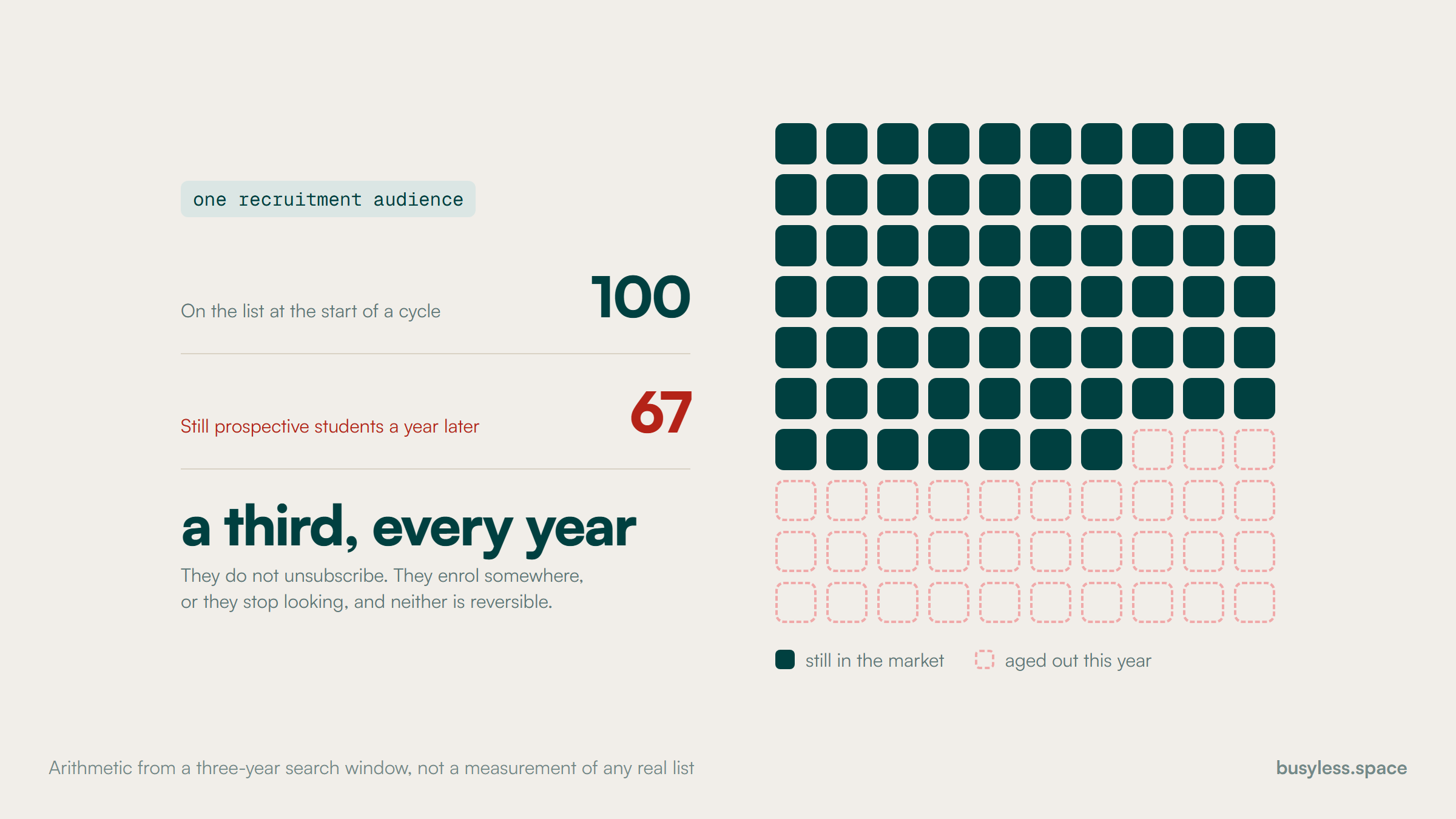
Content marketing for universities is built on an assumption that quietly fails here. Everywhere else, the point of publishing is to accumulate an audience: a list, a following, a readership that grows and is worth more each year. In recruitment, your audience is gone in three years and replaced by people who have never heard of you.
A seventeen-year-old who follows you now applies once and then either arrives or does not. Either way they stop being a prospective student. The list you spent a year building is decaying from the day you built it, and no amount of nurture stops it, because the churn is not disengagement, it is the passage of time.
So the compounding has to come from somewhere else, and it comes from the assets rather than the audience. A page that properly answers a question every cohort asks gets more valuable every year, because the question keeps arriving even though the people asking it do not.
That is the whole reframe. A higher education content marketing strategy should be judged on what it leaves behind after the cohort has moved on, and most institutional plans are judged on reach within a cycle, which measures exactly the thing that will not accumulate.
Looking for the search half
This page decides which channels to run. The one next door goes deep on just one of them.
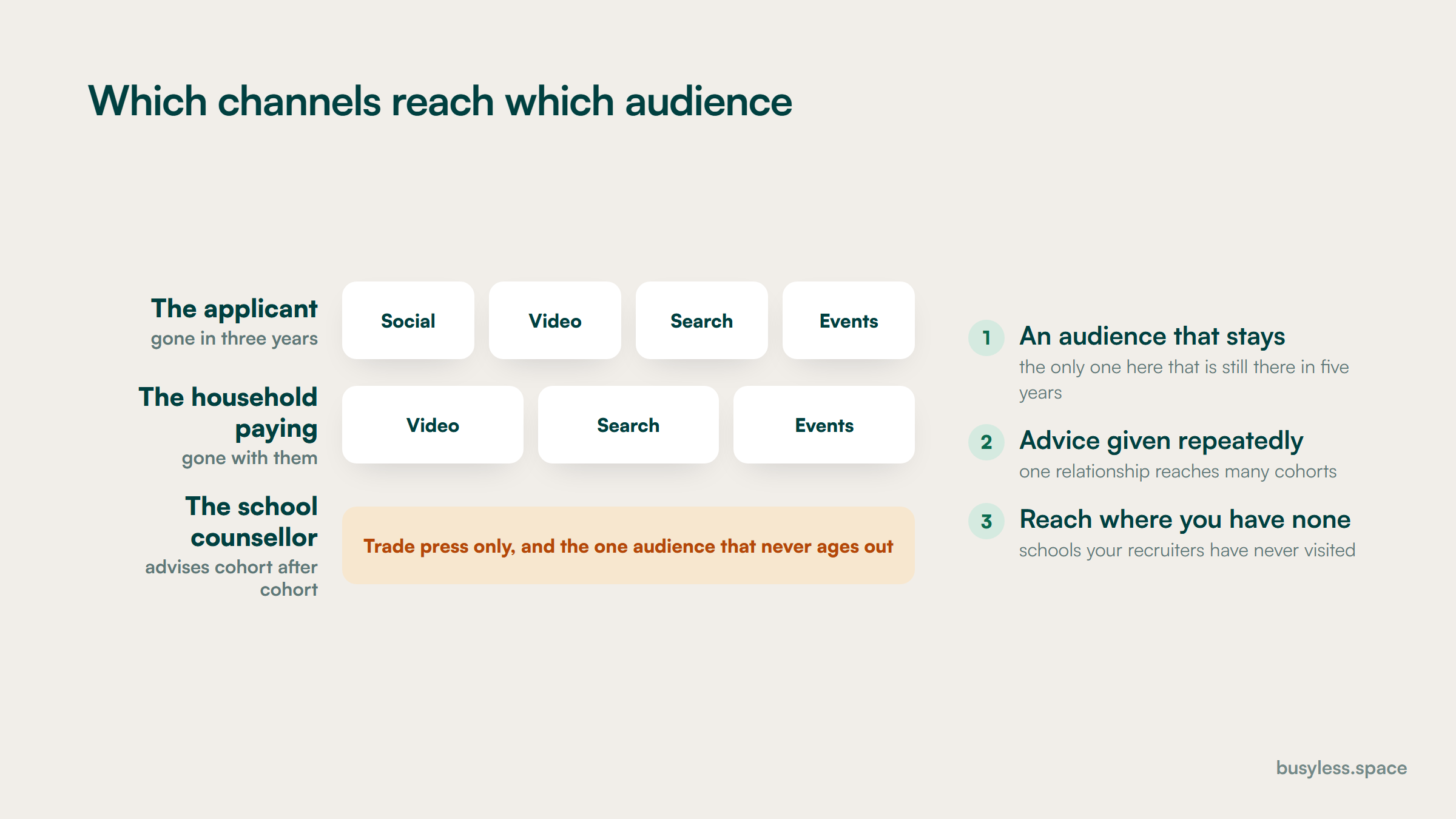
Which channels to run, and which to skip
Judged on one question that barely matters elsewhere: does this channel leave anything behind once this cohort has gone. It moves the owned channels down and the durable ones up, which is close to the opposite of what an agency proposal usually recommends.
Run these
Search
RunThe only channel whose output keeps working after the cohort turns over. A page answering what a course actually involves is found by a new seventeen-year-old every autumn, indefinitely, and it costs nothing more. This is the compounding this page argues for, and the technical half is on the sibling playbook.
First moveTake the twenty questions your admissions team answers most and give each one a real page, written for the person asking rather than for the department.
Video
RunThe format that carries what a place feels like, which is most of what an applicant is actually deciding. It also survives turnover better than social does, because a walk-through of a laboratory is as useful to next year's cohort as this year's, provided nothing in shot dates it.
First moveFilm one honest walk-through of the building a course is taught in, led by a current student rather than a presenter.
Founder-led social
RunUnavoidable, and worth being honest about what it is. It reaches this cohort now and leaves nothing behind, so treat it as distribution rather than as an asset. The accounts worth running are the ones where current students speak, because a seventeen-year-old can tell the difference immediately.
First moveHand one account to current students with a written brief and a real budget, and stop reposting the institutional press release to it.
Worth a test, with a kill date
Events and talks
TestOpen days do the work no content does, and the content question is what surrounds them. An open day that generates a filmed session, an answered-questions page and a recording is worth several times one that generates a photo album, and the marginal cost is close to zero.
First moveRecord the questions asked at the next open day, verbatim, and publish the answers as pages before the following one.
Newsletter
TestGenuinely useful for the deadline sequence and genuinely not a compounding asset, so fund it as an operational tool rather than as an audience. The version that does compound is the alumni and staff list, which is a different job with a different owner and usually a different budget.
First moveBuild the applicant sequence around the deadline dates rather than around a publishing calendar, and measure it on completed applications.
Trade press
TestReaches counsellors, teachers and the sector rather than applicants, and those people do compound: a school counsellor advises cohort after cohort. It is slow, it is earned, and it is the closest thing here to an audience that does not age out.
First moveWrite one genuinely useful piece for the publications school counsellors read, on something other than your own institution.
Skip these
Original research
SkipNot because the institution lacks research, but because publishing it is somebody else's job and it is already resourced. The marketing version, an original survey of applicants, competes for attention with actual scholarship produced by your own academics and usually loses that comparison in public.
Community
SkipApplicants already have communities and none of them are yours. They gather on student forums, on subject-specific servers and in group chats, and an institutional presence in those is read as surveillance rather than as help. Read them, brief from them, and do not build one.
One channel that compounds, one that carries the thing being bought, and one that reaches this cohort and no other. The mix is unusual because the durability test matters more here than the reach test, and almost no institutional plan applies it.
What you already own that nobody can copy
An institution generates publishable material continuously and owns a surprisingly small share of it. Everything below exists in abundance, and for most of it the first question is whose permission you need rather than how to capture it.
What is actually taught, week by week
Held by Course leaders and module convenors
Prospectus copy describes a course in the language of the validating document. What a student actually does in week four of the second year is different, more interesting and completely absent from every competitor's site, because nobody has asked the person who teaches it.
How to capture it
Interview one module convenor for thirty minutes about what students do rather than what they cover. Ask what surprises people in the first term.
Student work, and the story of making it
Held by Students, who own the copyright
The single most persuasive evidence a course produces, and the one thing a competitor cannot fabricate. It is also somebody else's intellectual property, so the licence is the work rather than the shoot.
How to capture it
Ask at the point the work is submitted rather than at the point you want to publish it, with a written licence naming the surfaces and the duration.
The questions asked at open days
Held by Whoever staffs the desks, and nobody afterwards
Hundreds of real questions from real applicants, asked out loud, in their own words, once a year. Almost every institution collects none of it, and it is a better content brief than any survey.
How to capture it
Give every staff member a card and ask them to write down each question verbatim. Type it up the same week or it is lost.
Where graduates of this specific course actually went
Held by Careers, alumni relations and the department, separately
The question every parent asks and almost no institution answers at course level. The data exists, split across three systems that do not talk, which is why the honest answer is rare enough to be a differentiator.
How to capture it
Pick one course, join the three sources by hand once, and publish the real answer including the parts that are unremarkable.
Research your own academics have just published
Held by Academics, and the research office
Genuinely new knowledge, arriving continuously, mostly translated into a press release nobody reads. The value is not the announcement, it is the academic explaining why it matters to somebody who is seventeen.
How to capture it
Record the academic for twenty minutes with one instruction: explain it to a sixth-former, not to a journalist.
Who actually makes it
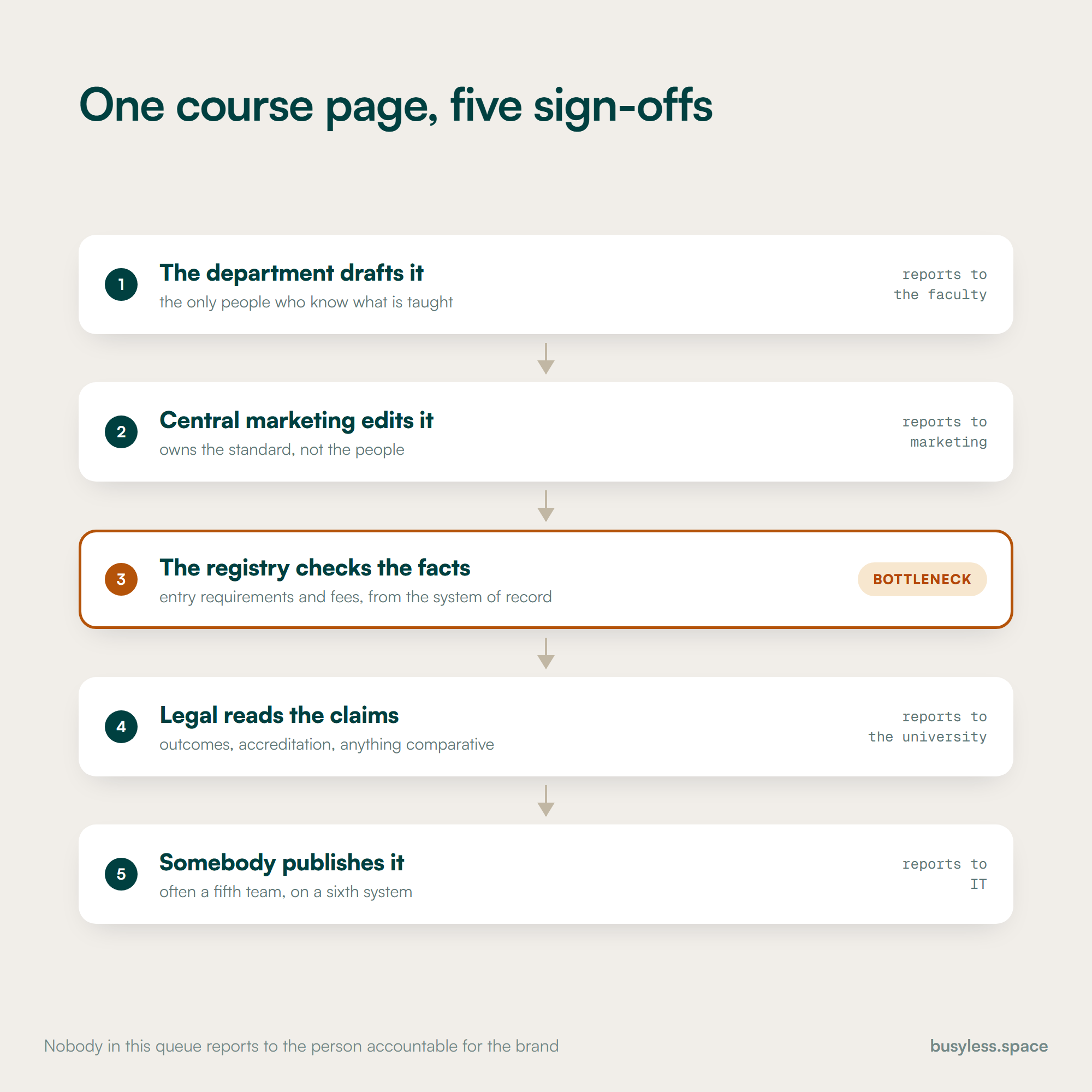
This is the hardest production problem in the directory and it is not about capacity. Hundreds of people publish under one brand, almost none of them report to the person accountable for it, and an editorial standard that cannot be enforced is a document rather than a system.
Central content lead
The standard, and the small number of things published centrally
Their real job is making the standard easy to follow rather than mandatory, because they have influence over most publishers here and authority over very few.
Full time
Faculty or departmental marketer
Course-level content, and the relationship with academics
The person who can actually get a module convenor to sit down. Central teams consistently underestimate how much depends on this relationship existing.
Varies, usually part of a wider role
Academic as source
The subject, and the right to be quoted accurately
Recorded, never asked to write. An academic will write, at length, in the wrong register, and will resent it being edited.
1 hour
Student contributors
The voice an applicant will actually believe
Pay them, brief them, and do not script them. Also note the endorsement rule below: a paid ambassador has a material connection to disclose.
Paid hours, not favours
Rights and permissions owner
Licences for student work, imagery and recordings
Usually nobody, which is why institutions routinely publish things they do not have the right to publish. Naming one person is most of the fix.
4 to 8 hours
The honest cadenceCentrally, one substantial durable asset a fortnight and nothing else. Locally, whatever each faculty can sustain against the standard. Trying to run a single institutional calendar across forty publishing units is the plan that fails every year and gets rewritten every summer.
One project, 8 surfaces
One recorded conversation with a module convenor becomes eight things, and the test applied to each is whether it is still useful to a cohort that has not started secondary school yet.
- 1
The what-this-course-is-really-like page
4 hoursFrom: The conversation, turned into plain prose
The durable asset and the reason to do any of this. Written for a seventeen-year-old, describing what students do rather than what the course covers.
- 2
A short video with the convenor
3 hoursFrom: The same conversation, filmed
Film it at the same sitting as the audio. Keep visible dates, cohorts and building signage out of shot so it survives more than one cycle.
- 3
An open-day session
2 hours, reusable annuallyFrom: The same material, delivered live
The convenor is already being asked to do this. Building it from the recording means they prepare once rather than every year.
- 4
Answers to the questions the session produced
2 hoursFrom: What people asked afterwards
This is where the compounding actually happens, and it is the step almost every institution skips.
- 5
Student-led social posts
45 minutesFrom: The one thing in the conversation students found surprising
Handed to students to make in their own voice. An institutional edit of this removes the only thing that made it work.
- 6
A page for the applicant sequence
1 hourFrom: The practical half, tied to a deadline
Operational rather than durable, and it should be written as such: dated, specific, and retired when the cycle closes.
- 7
A counsellor-facing briefing
90 minutesFrom: The same content at adviser register
Aimed at the audience that does not age out, which makes it the highest-leverage repurposing on this list and the least common.
- 8
Internal course-team reference
Nothing extraFrom: The full recording as captured
Useful at validation and revalidation, and it is often what persuades an academic that thirty minutes was worth spending.
The buying cycle, and what content does at each stage
Two clocks run at once. A long, unstructured exploration that begins years before anybody can apply, and a hard annual deadline that does not move for anyone. Content that works on one usually fails on the other, and the failure is invisible until the deadline passes.
Working out what they want to do at all
1 to 3 years before applying"What is this subject actually like, and would I be any good at it?"
- What moves them
- Subject-level content that does not mention your institution much
- How you know
- Unbranded subject queries, and long dwell on course reality pages
Building a list of places
6 to 12 months before the deadline"Would I want to be there for three years?"
- What moves them
- Honest video of the place, and student voices
- How you know
- Open day registrations, and branded search starting from nothing
Applying
Weeks, against a fixed date"What exactly do I have to do, and by when?"
- What moves them
- Clear, dated, operational content and a working form
- How you know
- Application completion rate, not application starts
Holding an offer and deciding
1 to 5 months"Should I actually go here rather than the other one?"
- What moves them
- Contact from a real person, and content that answers doubts
- How you know
- Offer acceptance, and questions arriving from the household
Between accepting and arriving
2 to 4 months"Am I going to be alright when I get there?"
- What moves them
- Practical arrival content and current-student contact
- How you know
- Enrolment against acceptances, which is where quiet attrition sits
What you are allowed to publish
What follows limits what you may publish and, in the first case, how you may pay anybody to distribute it. The sibling playbook covers student records, misrepresentation, state authorisation for distance programmes and the accessibility deadline, and none of those four appear here. The first rule below is the one that most often makes an existing marketing contract unlawful.
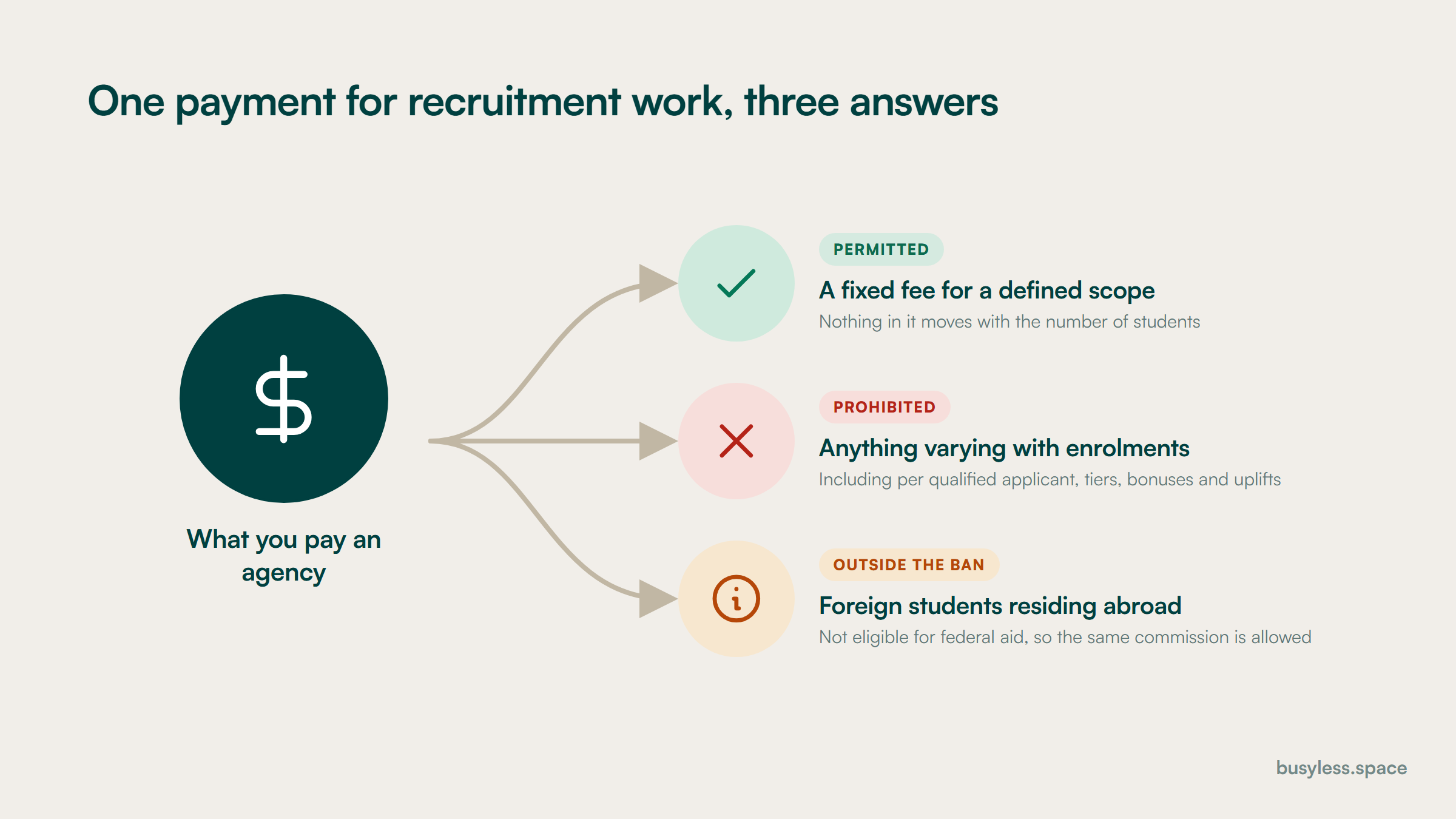
You may not pay anybody per enrolment
34 CFR 668.14(b)(22), verified 2026-08-30
An institution in the Title IV programmes may not provide any commission, bonus or other incentive payment based in any part, directly or indirectly, on success in securing enrolments or the award of aid, to any person or entity engaged in recruitment or admission activity. It reaches third parties exactly as it reaches employees, so a per-enrolled-student or per-qualified-applicant agency fee is caught, not merely discouraged.
So do thisRead your existing agency and lead-generation contracts for anything that varies with enrolment outcomes, and move to a fixed fee for a defined scope of work. The exception is narrow: it does not apply to recruiting foreign students residing abroad who are not eligible for federal aid.
A paid student ambassador is an endorser
FTC Endorsement Guides, 16 CFR Part 255, revised June 2023
Where a student is paid, given a fee waiver, or receives anything of value in return for posting about the institution, that is a material connection which has to be disclosed clearly and conspicuously where the audience would not otherwise know about it. The disclosure obligation sits with the institution as well as the student.
So do thisWrite the disclosure into the brief and the contract rather than hoping, give students the exact wording, and check the posts. Combine this with the rule above: you may pay an ambassador for their time, and you may not pay them by the applicant. Our startups and hotels playbooks apply the same guides to employees and to hosted stays.
The lecture and the essay belong to the people who made them
Copyright principles and typical institutional IP policies, reviewed 2026-08-30
Teaching materials, recorded lectures and student coursework are copyright works owned by the academic or the student, subject to whatever your own IP policy actually says, which is often less than marketing assumes. Publishing student work as marketing without a licence is an infringement regardless of it having been submitted for assessment.
So do thisGet a written licence naming the surfaces and the duration, and ask at submission rather than at publication. Read your own IP policy once and write down in plain language what it does and does not give you.
Some of the people on your campus are children
Model release practice and COPPA principles, reviewed 2026-08-30
Summer schools, outreach programmes, dual enrolment and open days all put under-18s and sometimes under-13s on campus and in shot. Photographing them for marketing needs consent from a parent or guardian, and collecting their details online engages a separate set of obligations that most institutional forms were not designed for.
So do thisRun a different consent process for any activity involving minors, hold the releases with the images, and check whether any sign-up form on an outreach page could be completed by a child.
Accreditation is a claim about somebody else's decision
Accreditor advertising and disclosure requirements, reviewed 2026-08-30
Institutional and programmatic accreditation are separate, and accreditors set rules on how their status may be described. The common failure is not fabrication, it is a page implying that programmatic accreditation held by one course extends to a related one, or that a candidacy status is a full one.
So do thisState the accreditor, the scope and the status in full on the programme page, and check the wording against the accreditor's own requirements each time the status changes.
None of this is legal advice. Rules vary by state and by contract, and the dates above are when each source was read. Check your own before you rely on any of it.
How to build content marketing for universities
Twelve months, because a recruitment cycle is twelve months and a six-month plan lands you halfway through one. The first phase deliberately produces no campaign at all, and the audit it runs instead is what makes the rest legal and possible.
Audit the contracts and the permissions
- Read every agency, lead-generation and affiliate contract for payment that varies with enrolment
- Find out who, if anyone, owns rights and permissions, and name them if nobody does
- Map who publishes under the brand: faculties, departments, labs, student groups
- Write down what your IP policy actually gives you over teaching and student work
Output A contract finding, a named rights owner and an honest map of who publishes
Build the assets that outlive the cohort
- Record six module convenors on what students actually do
- Publish the first four course reality pages, written for a seventeen-year-old
- Film one honest walk-through per faculty, led by current students
- Start collecting open day questions verbatim, and type them up the same week
Output Four durable pages, several videos and a real question log
Make the standard followable rather than mandatory
- Publish a one-page standard with examples, not a brand manual
- Give faculties templates they would use anyway, including the licence forms
- Hand one social account to paid students with a brief and a disclosure rule
- Answer the open day questions as pages before the next open day
Output A standard departments adopt because it saves them work
Measure the thing that compounds
- Separate reporting into durable assets and cycle activity, and report them apart
- Track application completion rather than application starts
- Ask at enrolment what they had read or watched, and record it
- Retire the dated cycle content rather than leaving it up
Output Evidence of what survived the cohort, and what did not
Structured data for what you publish
The institution, the programmes and the courses are marked up on the sibling playbook, which is where the entity belongs. That leaves the two most obvious types here already spoken for, so these six describe the media you publish instead, which is the more useful half for this audience anyway.
VideoObject for a course or campus walk-through
The page the video sits on, not just the platformThe most important block here, because video carries what an applicant is actually deciding. Keep the description free of a cohort year so the markup does not date faster than the film does.
{
  "@context": "https://schema.org",
  "@type": "VideoObject",
  "name": "[WHAT THE FILM SHOWS]",
  "description": "[WHAT A PROSPECTIVE STUDENT LEARNS]",
  "thumbnailUrl": "https://[YOUR-DOMAIN]/images/[FILE].jpg",
  "uploadDate": "[YYYY-MM-DD]",
  "duration": "PT[M]M[S]S",
  "contentUrl": "https://[YOUR-DOMAIN]/video/[FILE].mp4",
  "embedUrl": "https://[YOUR-DOMAIN]/[PAGE-SLUG]",
  "publisher": {
    "@type": "Organization",
    "name": "[INSTITUTION NAME]",
    "url": "https://[YOUR-DOMAIN]"
  }
}
ImageGallery for campus and student work
Any gallery page: facilities, degree shows, student projectsWorth emitting because a gallery of student work is often the strongest page on a course site and is usually marked up as nothing at all. Every item in it should also carry its own licence record, per the copyright rule above.
{
  "@context": "https://schema.org",
  "@type": "ImageGallery",
  "name": "[GALLERY TITLE]",
  "url": "https://[YOUR-DOMAIN]/[GALLERY-SLUG]",
  "description": "[WHAT IT SHOWS AND WHOSE WORK IT IS]",
  "about": "[COURSE OR FACILITY]",
  "image": [
    {
      "@type": "ImageObject",
      "contentUrl": "https://[YOUR-DOMAIN]/images/[FILE].jpg",
      "caption": "[WORK TITLE, STUDENT NAME, YEAR]",
      "creditText": "[STUDENT NAME]",
      "copyrightNotice": "(c) [YEAR] [STUDENT NAME]",
      "license": "[URL OF YOUR LICENCE TERMS]"
    }
  ]
}
LearningResource for something you give away
Open materials, revision guides, subject taster resourcesThe type that carries this page's argument, because a genuinely useful subject resource is found by a new cohort every year and never ages out. It is also the one type here that reaches the exploration stage rather than the application one.
{
  "@context": "https://schema.org",
  "@type": "LearningResource",
  "name": "[RESOURCE TITLE]",
  "url": "https://[YOUR-DOMAIN]/[SLUG]",
  "description": "[WHAT A LEARNER CAN DO AFTERWARDS]",
  "learningResourceType": "[e.g. Guide, Worksheet, Reading list]",
  "educationalLevel": "[e.g. Pre-university]",
  "teaches": "[THE SPECIFIC CAPABILITY]",
  "audience": {
    "@type": "EducationalAudience",
    "educationalRole": "student"
  },
  "isAccessibleForFree": true,
  "provider": {
    "@type": "Organization",
    "name": "[INSTITUTION NAME]",
    "url": "https://[YOUR-DOMAIN]"
  }
}
QAPage for real admissions questions
A page built from questions actually asked, one question per pageUse it only where the page really is one question and its answers, which is exactly what an open day question log produces. Do not use it for a marketing FAQ that answers questions nobody asked, because that is the pattern the type gets abused for.
{
  "@context": "https://schema.org",
  "@type": "QAPage",
  "mainEntity": {
    "@type": "Question",
    "name": "[THE QUESTION, AS SOMEBODY ACTUALLY ASKED IT]",
    "text": "[THE FULL QUESTION]",
    "answerCount": 1,
    "acceptedAnswer": {
      "@type": "Answer",
      "text": "[THE ANSWER, PLAINLY]",
      "url": "https://[YOUR-DOMAIN]/[SLUG]#answer",
      "author": {
        "@type": "Organization",
        "name": "[INSTITUTION NAME]"
      }
    }
  }
}
PodcastEpisode for an academic or student series
One episode of a series you publishAudio suits the exploration stage, where somebody is deciding whether a subject is for them rather than whether you are. Series presented by current students date faster than ones presented by academics, which is worth knowing before you commit to a format.
{
  "@context": "https://schema.org",
  "@type": "PodcastEpisode",
  "name": "[EPISODE TITLE]",
  "description": "[ONE OR TWO SENTENCES]",
  "url": "https://[YOUR-DOMAIN]/podcast/[SLUG]",
  "datePublished": "[YYYY-MM-DD]",
  "duration": "PT[M]M[S]S",
  "partOfSeries": {
    "@type": "PodcastSeries",
    "name": "[SERIES NAME]",
    "url": "https://[YOUR-DOMAIN]/podcast"
  },
  "associatedMedia": {
    "@type": "MediaObject",
    "contentUrl": "https://[YOUR-DOMAIN]/audio/[FILE].mp3"
  }
}
NewsArticle for research and institutional news
The news pages the research office and press team publishGenuinely dated content, correctly marked as such, which matters here because it is the one part of an institutional site that SHOULD expire. Keep evergreen course content off this type, or the durable half of your site inherits a shelf life it does not have.
{
  "@context": "https://schema.org",
  "@type": "NewsArticle",
  "headline": "[HEADLINE]",
  "url": "https://[YOUR-DOMAIN]/news/[SLUG]",
  "datePublished": "[YYYY-MM-DD]",
  "dateModified": "[YYYY-MM-DD]",
  "author": {
    "@type": "Organization",
    "name": "[INSTITUTION NAME]"
  },
  "publisher": {
    "@type": "Organization",
    "name": "[INSTITUTION NAME]",
    "url": "https://[YOUR-DOMAIN]"
  },
  "about": "[SUBJECT AREA]"
}
What to automate, and where the line is
Automation matters here for an unusual reason: the volume problem is not producing content, it is coordinating dozens of publishers and keeping thousands of existing pages honest. That is a maintenance job, and it is where the time actually goes.
- automate
Finding pages that reference a closed cycle or a passed deadline
A large institutional site is full of them, and they do more damage than a missing page because an applicant reads a stale date as a current one.
- automate
Transcribing academic and convenor recordings
Pure throughput, and it is what lets a central team work with material captured by a faculty they have no authority over.
- automate
Clustering open day questions into topics
Several hundred verbatim questions collapse into perhaps forty real topics, and doing that by hand is the step that stops the log being used at all.
- assist
Checking published pages against the standard
Flagging a missing accreditation statement or an undisclosed ambassador post is useful and mechanical. Deciding what to do about a faculty that ignores it is a relationship, not a rule.
- assist
Drafting course reality pages from a convenor recording
The structure is fine and the register is wrong. It produces prospectus language from a conversation that was interesting precisely because it was not prospectus language.
- assist
Translating and localising for international recruitment
Fast and mostly good, and a mistranslated entry requirement or fee is a misrepresentation risk, so a human who knows the market signs each one.
- never
Publishing anything in a student's voice
The entire value of a student voice is that it is a real student. A generated version fails with exactly the audience it is aimed at, and they are unusually good at spotting it.
- never
Stating an entry requirement, a fee or an accreditation status
These are regulated statements about somebody's eligibility and money. They come from the system of record, checked by a person, or they are a misrepresentation risk.
What it costs
Judgements rather than quotes, and they describe what a central team spends to run this properly rather than a whole institutional marketing budget. What moves the number most is the number of faculties in scope, because coordination cost rises faster than content cost does.
Do it yourself
$0 to $1,000- The contract audit and the permissions fix
- The open day question log, kept properly
- Six recorded convenors a year, written up in-house
- One social account handed to paid students
- Suits
- A single-faculty college or a small institution with one marketing person
- Ceiling
- Video is the first thing that breaks. An honest walk-through needs somebody who can film and edit, and phone footage of a building reads as evasive rather than authentic.
Lean
$5,000 to $12,000- An editor turning convenor recordings into course reality pages
- Proper video for the courses that recruit hardest
- The applicant sequence built around real deadline dates
- A standard, with templates faculties will actually use
- Suits
- A single-campus institution, or one faculty inside a larger university
- Ceiling
- It covers the courses you choose and leaves the rest publishing whatever they were publishing before, which is usually the majority of the site.
Funded
$12,000 to $30,000- Course reality content across every recruiting faculty
- A continuous video programme rather than an annual shoot
- Counsellor-facing content run as its own stream
- Rights and permissions properly owned and resourced
- Suits
- A multi-faculty university competing outside its own region
- Ceiling
- Coordination rather than money. Beyond a certain number of publishing units the constraint is how many faculties one standard can actually reach, and adding budget does not move it.
Enterprise
$30,000 and up- Several faculties and international markets under one standard
- In-house production rather than commissioned shoots
- Localised content maintained rather than translated once
- Capture built into open days, validation and degree shows
- Suits
- Large universities where faculties compete with each other for the same applicants
- Ceiling
- The failure mode is a central standard so heavy that faculties route around it, which puts you back where you started with a larger budget and a longer document.
How to do it with no budget
Seven steps, and the first is a contract review rather than a content task, because it is the one that can find something unlawful sitting in an existing agreement.
- 1
Read your agency contracts for enrolment-linked payment
The contracts you already have · 3 hours
Anything varying with enrolments is caught by the incentive compensation ban. This is the highest-value three hours on the list.
- 2
Name somebody as the owner of rights and permissions
One decision · 30 minutes
In most institutions this is currently nobody, which is why things get published without a licence.
- 3
Start the open day question log
Cards on the desks and a spreadsheet · One open day, plus 2 hours
Hundreds of real questions in their own words, collected once a year and almost always discarded.
- 4
Record one module convenor
A phone · 30 minutes
Ask what students actually do in week four, not what the course covers. The gap between the two answers is the content.
- 5
Find every page referencing a closed cycle
A site search for last year's dates · 2 hours
A stale deadline is read as a current one, and this is the cheapest credibility fix available on a large site.
- 6
Write the licence form for student work
A one-page document · 2 hours
Ask at submission rather than at publication. Asking later is how good work stays unpublished.
- 7
Ask at enrolment what they had read or watched
One field on the enrolment form · 20 minutes to set up
For a decision made over years by three people, this outperforms any attribution model you could buy.
The tool stack
Several of these already exist somewhere in the institution and nobody has told marketing. Rows linking into our other directories go to the researched review rather than to the vendor.
Publish course content without waiting for central IT
Chosen here for governed multi-team editing. The real requirement is that forty publishing units can work without either blocking each other or escaping the standard.
Free option: Whatever the institution already runs, used properly
Find pages referencing a closed cycle
On a site of this size the stale pages outnumber the current ones, and applicants cannot tell which is which.
Free option: Free, and the crawl matters more than the search data here
See what subject questions people ask before they know your name
Useful specifically for the exploration stage, which is invisible to your own analytics because it happens years before anybody visits.
Free option: Search Console, once you already rank for something
Check what an assistant says about your courses
This audience uses assistants heavily and the answers routinely quote league tables and forums rather than institutions.
Free option: Query each assistant about your subject area monthly and record what it names
Hold licences and releases so you can find them again
One row per asset: who made it, what was licensed, which surfaces, until when. Without it a revoked permission cannot be honoured.
Free option: Free, and the spreadsheet beats an unused DAM
Model what one additional enrolled student is worth
Run it on lifetime tuition rather than first-year fees, since a three or four year commitment changes the answer substantially.
Free option: Free
Understand where applicants drop between stages
Worth running on completion rather than starts, because the largest losses here sit between application start and submission, and between acceptance and enrolment.
Free option: Free
Show every faculty what the others published
A central team with no authority gets further with a published register than with a policy, because nobody wants to be the empty row.
Free option: Free, and visibility is most of the point
Take it from here
Everything below is meant to be copied and filled in. Bodies are plain text, so what you see is exactly what lands on your clipboard.
The three hours most likely to find something unlawful in a contract you already signed.
ENROLMENT-LINKED PAYMENT AUDIT
Institution: [NAME]
Audited by: [NAME, ROLE]     Date: [YYYY-MM-DD]
Reviewed with: [GENERAL COUNSEL / COMPLIANCE]

THE RULE
34 CFR 668.14(b)(22): no commission, bonus or other incentive
payment based IN ANY PART, directly or indirectly, on success
in securing enrolments or the award of Title IV aid, to any
person or entity engaged in recruitment or admission activity.
It reaches THIRD PARTIES exactly as it reaches employees.

Working tool, not legal advice. Confirm with counsel.

CONTRACTS TO PULL
[ ] Recruitment and admissions agencies
[ ] Lead generation and enquiry suppliers
[ ] Online programme management (OPM) agreements
[ ] Affiliate and referral arrangements
[ ] Performance clauses inside general marketing retainers
[ ] Anything with the word "conversion" in a payment schedule

FOR EACH CONTRACT
Supplier: [NAME]
Contract ref: [ ]        Renewal date: [YYYY-MM-DD]
Scope of work: [ ]

Payment structure, described in plain words:
  [ ]

[ ] Does ANY element vary with the number of enrolments?
[ ] Does ANY element vary with applications, deposits or
    "qualified" applicants?
[ ] Are there bonuses, uplifts, tiers or accelerators tied to
    volume of students?
[ ] Is the supplier engaged in recruitment or admission
    activity, on any reading?
[ ] Does a bundled fee CONTAIN a per-student component even
    if the headline is fixed?

    ANY TICK  ->  ESCALATE. Do not renew. Do not renegotiate
    the rate. The structure is the problem.

THE NARROW EXCEPTION
[ ] Does this contract relate SOLELY to recruiting foreign
    students residing in foreign countries who are not
    eligible for federal student assistance?
    If yes, record the basis: [ ]
    If it is mixed domestic and international, treat it as
    domestic.

REMEDIATION
Supplier | Issue found | Action | Owner | Deadline
[ ] | [ ] | [FIXED FEE / TERMINATE / LEGAL REVIEW] | [ ] | [ ]

SUMMARY
Contracts reviewed:                   [N]
Containing enrolment-linked payment:  [N]
Escalated:                            [N]
Remediated by:                        [YYYY-MM-DD]

NEXT AUDIT: [YYYY-MM-DD] Owner: [NAME]The expensive mistakes
Building a prospective-student list as though it compounds
What it costs: A year of nurture into an audience that ages out, reported as growth
Fund the list as an operational tool for the deadline sequence, and put the compounding budget into assets and into counsellors, who do not age out.
Paying an agency by the enrolment
What it costs: A regulatory problem rather than a marketing one, sitting inside a signed contract
Move to a fixed fee for a defined scope. Audit the existing contracts now rather than at the next renewal, because the exposure is live.
Writing course pages from the validating document
What it costs: Pages identical to every competitor's, describing what is covered rather than what happens
Interview the module convenor about what students actually do in week four, and publish that. It is unrepeatable and nobody else has asked.
Publishing student work without a licence
What it costs: An infringement, and a policy that quietly stops departments publishing anything
Ask at submission with a written licence naming the surfaces and the duration. Asking later is why the best work never appears.
Issuing a brand manual to units you do not control
What it costs: Forty faculties routing around the standard, and a central team enforcing nothing
Publish a one-page standard with examples and give people templates they would use anyway. Adoption here is earned rather than mandated.
Leaving last cycle's dates up
What it costs: Applicants reading a passed deadline as the current one and applying elsewhere
Retire dated content on a schedule and separate it from the durable pages, so the two kinds of content can be maintained differently.
What to measure
Reporting higher education content marketing on within-cycle reach measures the half that was never going to accumulate. What follows splits the durable assets from the cycle activity and reports them separately, because averaging the two hides both, and it is honest about a gap that here is measured in years.
Leading indicators
Entries to course reality pages from unbranded subject search
Search Console, filtered to subject queries
The clearest signal that the durable half is working, because these arrivals are from people who did not know your name.
Video watch time by course, on your own pages
Your player and your analytics
Split it by course rather than reporting a total. One course carrying the whole number is a common and useful finding.
Open day questions logged, and topics answered against them
The question log
This one predicts everything else, and it is the most likely to have stopped being kept by November.
Pages referencing a closed cycle, still live
Your crawl
A maintenance metric that belongs in the report, because on a large site this number is usually large and nobody owns it.
Business indicators
Application completion rate
Your admissions system
Completion, not starts. The gap between the two is where operational content earns its money and where a broken form hides.
Offer acceptance, by course
Admissions
The stage where content about the place rather than the course does its work, and the one most sensitive to whether the video was honest.
Enrolment against acceptances
Registry
The quiet attrition between accepting and arriving. Almost no content plan addresses this window, and it is cheap to move.
What they say they read, asked at enrolment
One field on the enrolment form
For a decision made over two or three years, by a household rather than a person, one question at enrolment outperforms the entire analytics stack.
The verdict
Content marketing for universities is usually planned as an audience-building exercise and should be planned as an asset-building one. The people you reach this year leave the market within three, and the only things that carry forward are the pages, the films and the relationships with people who advise cohort after cohort.
That single distinction reorganises the budget. Money spent on a page answering what a course is really like is spent once and works every autumn. Money spent accumulating followers who are about to graduate is spent every year and accumulates nothing. Content marketing strategies for schools have the same problem on a shorter clock.
Decline any higher education content marketing services priced on enrolments, and check an existing contract for that structure today rather than at renewal. It is prohibited by the incentive compensation ban whether or not the supplier knows that.
The short version is that content marketing services for universities are worth buying when they produce things that survive the cohort and when the standard they bring is one faculties will adopt voluntarily. The binding constraint is not budget, it is that most of the people publishing under your brand do not work for you.
FAQ
Higher education content marketing questions
Why does our prospective student mailing list keep underperforming?
Because it decays structurally. Everybody on it stops being a prospective student within about three years, so the list loses value from the day it is built and no amount of nurture prevents it. Use it as an operational tool for the deadline sequence, and put the compounding effort into assets and into school counsellors instead.Can we pay an agency per enrolled student?
No. The incentive compensation ban prohibits any commission, bonus or incentive payment based in any part on success in securing enrolments, and it reaches third parties as well as employees. Move to a fixed fee for a defined scope. It does not apply to recruiting foreign students residing abroad who are not eligible for federal aid.Do we need permission to publish student work?
Yes. Coursework is the student's copyright, and submitting it for assessment does not transfer that. Get a written licence naming the surfaces and the duration, and ask at the point of submission rather than when you want to publish, which is usually months later and much harder.What makes forty departments follow one standard?
Mostly by making it easier to follow than to ignore. A one-page standard with worked examples and templates people would use anyway gets adopted; a brand manual issued to units that do not report to you does not. Publishing a register of what each unit produced does more than a policy will.Do student ambassadors need to disclose that they are paid?
Yes, where they receive payment, a fee waiver or anything else of value in return for posting, and the audience would not otherwise know. Put the exact wording in the brief and the contract, and check the posts. The obligation sits with the institution as well as with the student.Is a campus video worth the cost when it dates so quickly?
Yes, if you film it so it does not date. Keep cohort years, dated signage and seasonal events out of shot and a walk-through of a laboratory stays useful for several cycles. What dates fastest is a presenter-led film about this year, which is the format most institutions commission.What does a central team need to budget for this?
By scope rather than by output, and the number moves with the count of faculties rather than the count of articles, because coordination costs more than production. An engagement starts with a Discovery and then a monthly retainer. The realistic range for a central team doing this properly is $5,000 to $30,000 a month.What should we measure across a cycle this long?
Split durable assets from cycle activity and report them separately. Unbranded subject search entries and video watch time by course as leading signals; application completion, offer acceptance and enrolment against acceptances as the business ones. Then ask at enrolment what they had read, because nothing else reaches a decision made over three years.Should we hire in, or buy this?
Buy the production and keep the relationships. Content marketing for education has one asset that compounds and it is the counsellor who advises cohort after cohort. Content marketing experts for universities can film and write; they cannot hold a relationship your admissions team should own.Does this work the same way for a school?
The cycle is shorter and the parent is the reader. Content marketing for schools reaches an adult deciding on behalf of a child, which changes both the format and the channel. A content marketing agency for schools proposing student-led social has misread who signs the form.How do we brief an agency?
With the calendar, not the brand guidelines. Content marketing agencies for education that have never worked to an admissions cycle will schedule the best work for the month nobody is deciding. Give them the deadline dates first and let everything else follow.
Run it yourself, or have someone own it
Everything above is written to be run without us, and the free path is genuinely most of the value for a small practice. Where these plans stall is almost never the plan. It is that the person holding the material has a day job and nobody owns the programme after the first month. That is the job we do.