
Content marketing for construction
Regulated marketingYour entire market is a list you could write down
- Sector
- Property and construction
- Channels
- Newsletter, Events and talks, Trade press
- Buying cycle
- Long cycle
- Time to compound
- 9 to 18 months
- Typical monthly
- $2,000 to $10,000
Key takeaways
- 1Write the list before you write anything else. A regional contractor's realistic market is a few hundred named organisations, and until that list exists on a page you are guessing about who you are publishing for.
- 2Reach is the wrong measurement here and it flatters everybody. Ten thousand impressions from people who will never procure a building is worth less than one estimator at a named developer reading two pages.
- 3The material only you have is your cost history, your RFI log and the schedule you actually achieved. It answers the two questions every owner asks first, and almost nobody in the industry publishes any of it.
- 4Your marketing team already exists and is entirely consumed by proposals. The content library is sitting inside the proposal library, written, approved and never published, which makes the first month here cheaper than the writing itself would suggest.
- 5Your progress photograph is a dated published record of a site you can be cited for. Under the multi-employer citation policy a general contractor can be the controlling employer, and the photograph is available to anybody who looks.
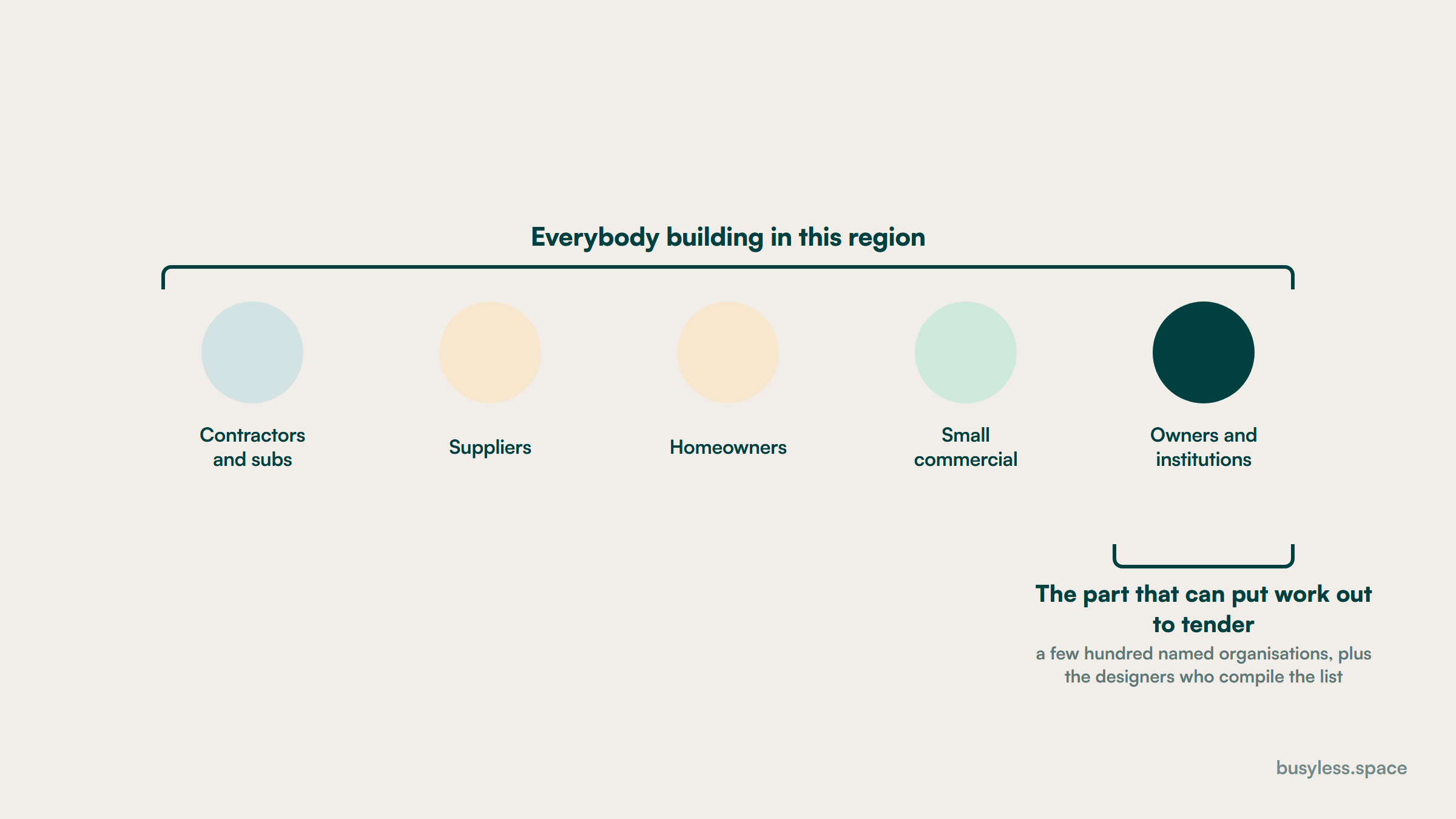
Content marketing for construction is usually planned as though the audience were a market, and it is not. A regional commercial contractor has an addressable universe of a few hundred organisations: the developers, institutions, public bodies and corporate owners who procure the kind of building it can actually build, plus the architects and engineers who influence which firms get invited.
That number is small enough to write down. Not a segment, not a persona, an actual list of names on an actual page, and most contractors have never made one. Once it exists, every channel decision on this page follows from it, and several of the decisions invert.
Reach stops being a good thing. A post seen by ten thousand people in your region is mostly seen by subcontractors, suppliers, jobseekers and competitors, none of whom will ever hire you. The same effort spent making sure eleven named people have read something useful is a different and better activity, and it is measured differently.
So a construction content marketing strategy is a penetration problem rather than an audience problem. The question is not how many people saw it. It is what proportion of a list you could recite from memory has read anything you published in the last year, and for most firms the honest answer is close to none.
Looking for the search half
This page decides which channels to run. The one next door goes deep on just one of them.
Which channels to run, and which to skip
Judged against one test rather than the usual several: can you point at the named organisations this channel reached. A channel that cannot answer that is not necessarily useless, but it is being bought on faith, and faith is expensive when the whole market fits on one page.
Run these
Newsletter
RunThe only channel where the recipient list is the market list. You are not building an audience, you are corresponding with people you have already named, which means a list of four hundred is a complete list rather than a small one. Nothing else on this page can make that claim.
First moveWrite the list first, then send to it. Four hundred correct names beats four thousand collected ones, and the first send is where you find out how wrong the list is.
Events and talks
RunOwners, developers and institutional buyers gather in places you can name: association chapters, economic development councils, facilities conferences and the continuing education sessions architects have to attend anyway. Attendance is a coverage decision here, not a brand exercise, and it can be checked against the list.
First moveTake the list and mark which three rooms those organisations are actually in this year. Present in one of them rather than exhibiting at all three.
Trade press
RunRegional business journals and sector titles are read by the small number of people who decide what gets built, and being in them is one of the few things that reaches an owner who has never heard of you. It is earned rather than bought, and the currency is a fact nobody else will give a reporter.
First moveOffer one number from your own cost history to the reporter who covers development in your region. A real figure gets returned calls that a project announcement does not.
Worth a test, with a kill date
Original research
TestYou hold real data on what things cost here and how long approvals actually take, and a regional index published annually is the most defensible asset available to a contractor. The cost is that it has to be maintained and it exposes numbers some of your people would rather not publish.
First movePublish one honest figure with its method before committing to an annual index. If nobody in the region reacts to it, an index will not save it.
Video
TestA project film is genuine proof and it travels into a proposal, an interview and a recruitment campaign. The trap is that filming a site is the part everybody enjoys and the part that produces the compliance problem described further down, so it needs a review step before it needs a budget.
First moveFilm one project as it is built rather than after it opens. Retrospective footage of a finished building is architectural photography, not evidence you can deliver.
Search
TestIt will not find you a project, and it will regularly lose you one, which is the argument the sibling playbook makes at length. Fund it for the diligence moment after somebody has already heard your name, and do not expect it to generate demand in a market this size.
First moveSearch your own firm the way a project executive would and read what comes back. The technical half of this is on the search playbook rather than here.
Skip these
Founder-led social
SkipThe audience a regional contractor can build on a social platform is almost entirely subcontractors, suppliers, recruiters and other contractors. All of them are worth talking to for other reasons, none of them procures a building, and the follower count is the most misleading number available to this industry.
Community
SkipThere is no online community where building owners discuss who to hire, because they procure so rarely that no shared practice forms around it. The nearest real thing is the association chapter, which is already covered as an event and works because people are in a room rather than in a feed.
One channel that is the list, one that puts you in a room with it, and one that reaches the part of it you have not met. Everything else on this page is either a supporting asset or an honest skip, and the skips are the reason the first three get funded properly.
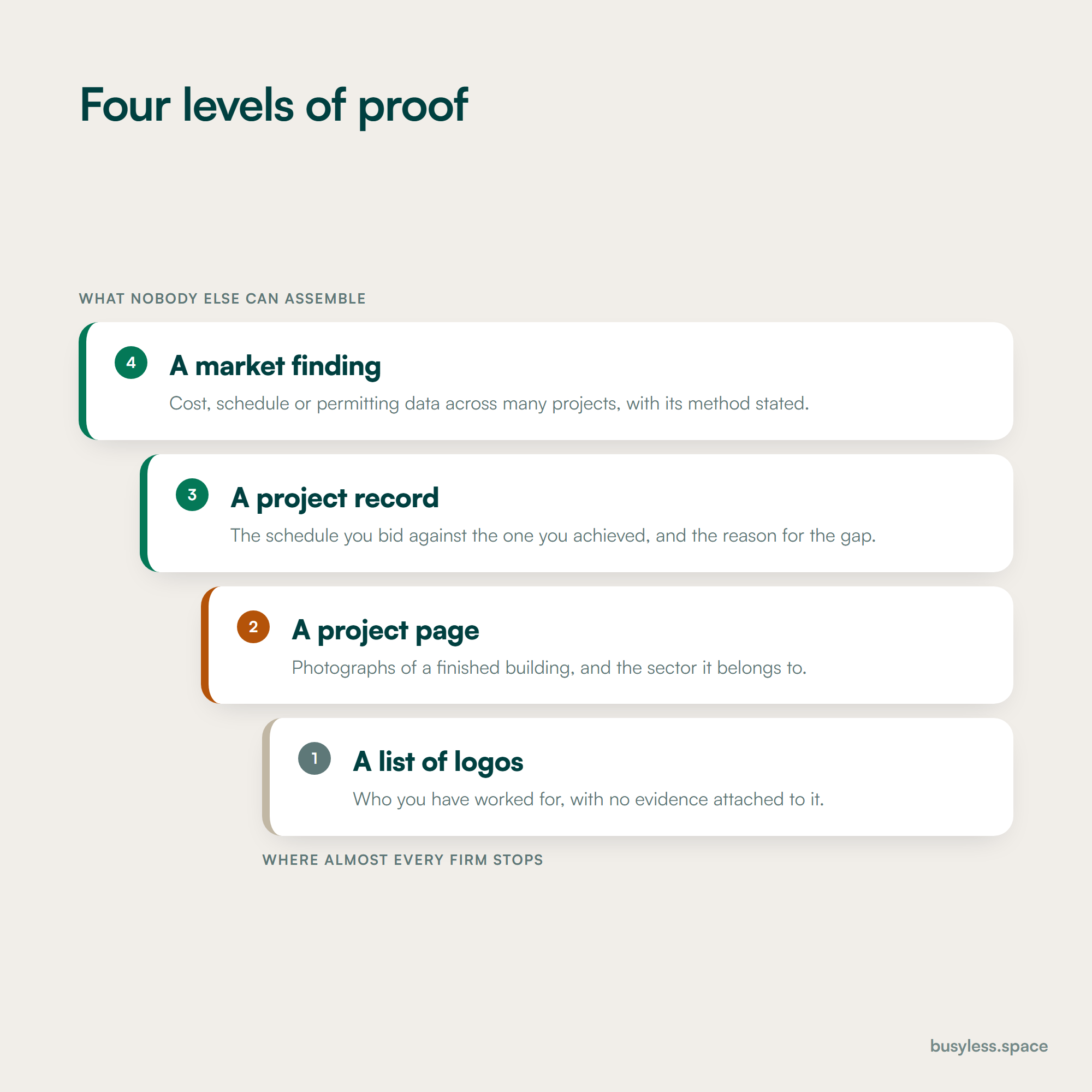
What you already own that nobody can copy
Every owner asks two questions before anything else: what will it cost and how long will it take. The industry answers both with a shrug and a range, while holding better data on both than anybody outside it. That gap is the whole opportunity here.
What things actually cost, in this market, over years
Held by Preconstruction and estimating
A published national average is wrong in both directions for any specific region and everybody knows it. You hold real bid history for a particular market, a particular building type and a particular labour pool, and nobody outside the firm can assemble it.
How to capture it
Ask estimating for the range rather than the average, and for the two things that moved it most. The range is the honest answer and the average is the one that gets you challenged.
The RFI and change order log
Held by Project managers, in the project system
It is a record of what went wrong on a real drawing set, question by question. Designers cannot publish it because it is their errors, owners never see the pattern, and it is the single most useful thing an architect could read before finishing a set.
How to capture it
Pull the twenty most common RFIs across your last five projects of one building type. The pattern is a piece of writing for architects, and it earns lunch-and-learn invitations.
The schedule you achieved against the one you bid
Held by Scheduling, and the project executives
Almost nobody publishes this because it is a confession as often as it is a boast. Published honestly, with the reasons, it is more persuasive than any claim about delivering on time and it cannot be copied by a firm that has not done the work.
How to capture it
Take five completed projects and record the bid duration, the achieved duration and the single largest cause of the difference. Do not clean it up.
How long approvals really take in each jurisdiction
Held by The permit expediter and the superintendents
Every owner budgets an optimistic number for permitting and every contractor knows the real one. It varies by jurisdiction, by reviewer and by season, and it is knowledge that only accumulates by filing repeatedly in the same places.
How to capture it
Log submission and approval dates for the last two years by jurisdiction and permit type. It is a spreadsheet you can start this week and it becomes a table nobody else has.
What the superintendent knows about this ground
Held by Field leadership
Soil, weather windows, the inspector who reads plans carefully, the utility that takes four months. It is the most valuable knowledge in the firm, it is held by people who will never write it down, and it is the reason an owner picks a local builder.
How to capture it
Record a superintendent walking one finished job and talking about what surprised them. Forty-five minutes of that is more material than a quarter of planned content.
Who actually makes it
This industry is unusual in the directory because the marketing function already exists, is properly staffed and is completely full. Proposals, prequalification packages and interview preparation have hard deadlines attached to millions of dollars, and content has a deadline attached to nothing.
Proposal or marketing coordinator
Everything already written and approved
The person who has already written most of this. The job is not to add work but to publish work that exists, and the four hours have to be booked away from a pursuit or they will not happen.
4 hours, ring-fenced
Preconstruction lead
Cost, schedule and constructability
The source of the material owners actually want. Interviewed rather than writing, because a preconstruction lead who is asked to write a blog post will produce a paragraph about commitment to excellence.
3 hours
Project executive
The named relationships on the list
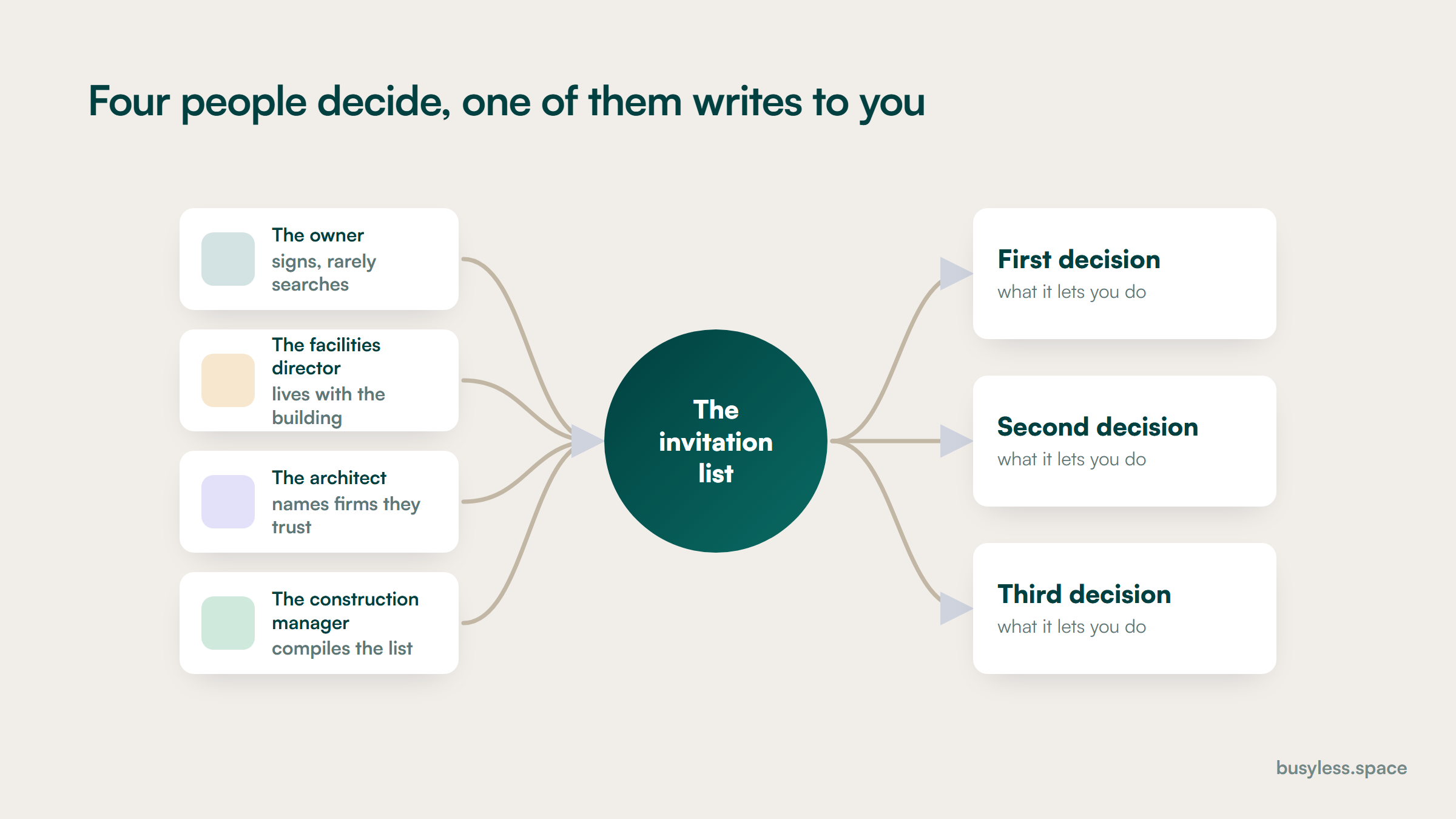
The person who knows which eleven names matter this year. Their contribution is correcting the list and forwarding the letter, which is a smaller ask than anybody expects and the one that decides whether the channel works.
2 hours
Superintendent or field leader
What actually happens on site
Recorded on site, never asked for a written contribution. Also the person who spots the safety problem in a photograph before it is published, which the rules section explains is not a small favour.
1 hour
Safety director, as a reviewer
Whether an image may go out
A narrow, fast review of images and footage only. This is the shortest review step in the directory and the one with the most direct consequences for skipping it.
1 hour
The honest cadenceA monthly piece and a monthly letter to the named list, which is a rhythm eleven hours of internal time can genuinely hold. Two pieces a month is where this breaks, because the eleven hours are borrowed from people whose real job is winning work.
One project, 8 surfaces
One project produces eight things, and the order below matters more here than anywhere else in this directory. The first item is the one that pays for the rest, because a proposal is worth a building and a blog post is worth a visit.
- 1
The proposal library entry
Nothing extraFrom: The whole project record
Written anyway for the next pursuit. Doing it while the job is fresh rather than under a submission deadline is the entire trick, and it costs nothing because the work is already scheduled.
- 2
A letter to the named list
40 minutesFrom: The one surprising thing that happened
Not an announcement. A named person telling a named person something they did not know about building this type of thing here, which is why it gets read and forwarded.
- 3
A trade-press pitch
1 hourFrom: The number nobody else would give
A reporter needs a fact, not a milestone. The cost or schedule figure from the source section is the thing that turns a press release into a phone call.
- 4
A continuing education session
6 hours, onceFrom: The RFI pattern
Architects have hours to earn and you have the errors their drawings produce. This is the only format in the industry where the buyer sits still for an hour, and it is reusable for years.
- 5
The interview story
1 hourFrom: The recovery, not the delivery
Every shortlist interview asks what went wrong and what you did. Writing it down once while the job is live means the answer is specific rather than reconstructed under pressure.
- 6
A cost or schedule data point
30 minutesFrom: The closeout numbers
One row in the table that becomes the regional index. Thirty minutes a project is what makes an annual publication possible without anybody being assigned to build one.
- 7
The recruitment piece
45 minutesFrom: The field footage
Labour is the binding constraint on growth in most markets, and the same footage recruits and reassures. It is the one output here aimed at an audience that is not on the list.
- 8
The owner debrief note
1 hourFrom: The schedule variance and its cause
Sent to the client rather than published. It is the cheapest repeat-business asset in the industry and it is skipped almost universally because the job is finished and everybody has moved on.
The buying cycle, and what content does at each stage
This cycle also runs in years, and the decisive moment is not a form submission. It is an invitation to bid, issued by somebody who compiled a shortlist before you knew the project existed. Everything content does here is aimed at being on that list.
Long before there is a project
1 to 3 years"Who builds this kind of thing around here?"
- What moves them
- Trade press, the continuing education session, and being a name in the room
- How you know
- Unprompted contact from an organisation already on your list
The project gets funded
3 to 9 months before an RFQ"Who should we ask?"
- What moves them
- The letter to the named list, and whoever they call to check
- How you know
- Invitations to bid received, which is the number this page exists to move
Qualification
2 to 6 weeks"Have they done this, here, recently?"
- What moves them
- The proposal library and everything findable about you
- How you know
- Shortlist rate from invitations, tracked by building type
The interview
One afternoon"Do we want these people on our site for two years?"
- What moves them
- The people in the room, supported by the story you wrote down
- How you know
- Win rate from shortlist, which content supports rather than decides
Delivery and afterwards
12 to 36 months, then years"Would we use them again, and who would we tell?"
- What moves them
- The debrief note and the record you built while the job ran
- How you know
- Work that comes back without a competitive process, counted yearly
What you are allowed to publish
The first of these four surprises contractors more than the rest, because it treats a marketing asset as evidence. The sibling playbook covers advertising in states where you hold no licence, the lead-safe certification logo, substantiating a licensed and bonded claim, and third-party safety grades, and none of those four are repeated here.
Your progress photograph is a published record of your site
OSHA multi-employer citation policy, CPL 02-00-124; 29 CFR 1926 Subparts E and M, read 2026-08-30
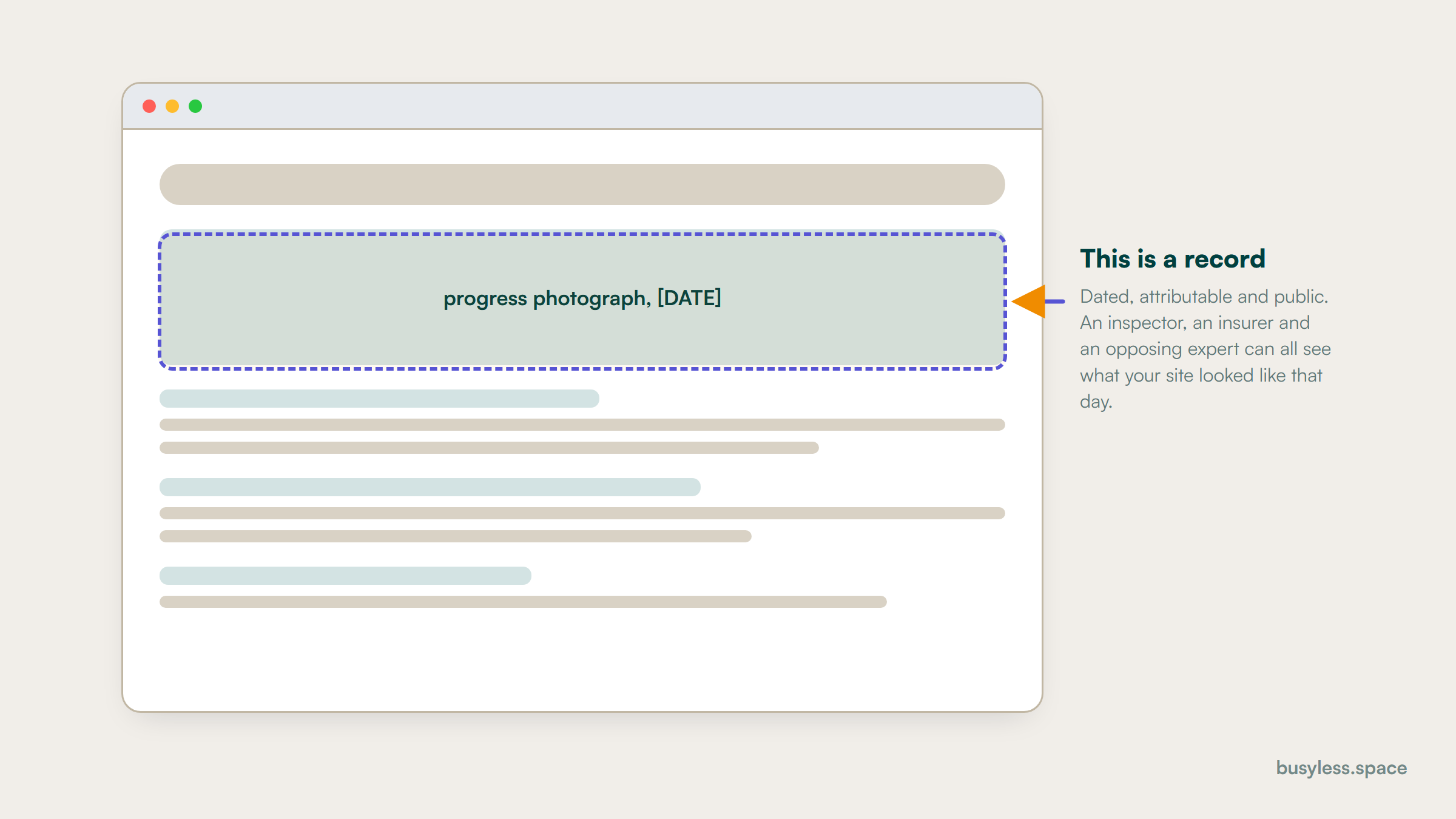
A general contractor can be cited as the controlling employer for a hazard it had the authority to correct, even where the exposed workers belong to a subcontractor. A photograph you publish is dated, attributable and available to anybody who looks, including an inspector, an insurer and an opposing expert, and it records what your site looked like on a particular day.
So do thisPut a named person on image review before publication, looking for fall protection, head protection, unguarded edges and ladders. It takes a minute per image and no other control here costs so little.
Flying over people on an active site is its own permission
14 CFR Part 107 Subpart D, operations over human beings; 14 CFR Part 89, Remote ID, compliance from 16 March 2024, read 2026-08-30
Routine commercial drone work needs a remote pilot certificate, and operating over people who are not participants falls into a set of categories with their own conditions rather than being generally permitted. Remote ID applies to the aircraft. An active construction site is the exact case the categories were written about, because the people below are working rather than watching.
So do thisConfirm the operator holds the certificate and that the flight plan accounts for who is on the ground, before the shoot rather than after. If the answer needs the site to stand down, that is a scheduling conversation and not a marketing one.
A safety record you publish has to match the one you submitted
29 CFR 1904.41, electronic submission of injury and illness records; experience modification rates set by the rating bureau, read 2026-08-30
Injury and illness data is submitted to a regulator and an experience modification rate is calculated by a rating bureau from claims history rather than chosen by you. A favourable figure on a capability statement that does not match either source is a misrepresentation, and on publicly funded work a false statement carries consequences beyond the marketing department.
So do thisTake every safety figure that appears in marketing from the submitted record, date it, and name the period it covers. If the number moved this year, say which year the published one is from.
The owner decides whether the project may be named
Publicity and confidentiality clauses in owner-contractor agreements, read 2026-08-30
Many owner agreements require written approval before a project is used in publicity, and some sectors treat it as absolute: defence, secure facilities, pharmaceutical process work and anything where a competitor could infer capacity or timing. The clause usually sits in general conditions rather than anywhere marketing reads, and it survives completion.
So do thisRead the publicity clause at award and record the answer in the project record on day one. Our architects playbook covers the separate question of who owns the photograph itself, which is a licence rather than a permission.
None of this is legal advice. Rules vary by state and by contract, and the dates above are when each source was read. Check your own before you rely on any of it.
How to build content marketing for construction
Half a year, and the first four weeks produce no content at all. That is deliberate: the list is the asset everything else on this page depends on, and a firm that starts publishing before it exists spends a year making things for an audience it never defined.
Write the list
- Name every organisation in your region that could procure the work you do
- Add the architects and engineers who influence who gets invited
- Mark which ones you have built for, bid to, or never spoken to
- Have each project executive correct their part of it
Output A named market list, on one page, with owners against each name
Mine what is already written
- Read the last ten proposals for material that was never published
- Pull the twenty most common RFIs across one building type
- Collect closeout schedule variance for five completed projects
- Agree the image review step and who performs it
Output A publishing queue built entirely from approved existing work
Publish the things only you have
- Publish one honest cost or schedule finding with its method
- Send the first letter to the named list
- Build the continuing education session from the RFI pattern
- Offer one figure to the reporter who covers development locally
Output Three assets a competitor cannot copy and one earned placement
Measure penetration, not reach
- Report the share of the named list that has read something
- Count invitations to bid and where each one came from
- Record which named organisations opened the letter twice
- Retire anything that cannot be traced to a name on the list
Output A report a project executive believes, in list terms
Structured data for what you publish
The firm itself, its services and its project pages are marked up on the sibling playbook, which is where the business entity belongs. These six describe the things you publish, and the first two carry a rights question rather than only a formatting one.
ImageObject for site and project photography
Every published photograph, and the project pages that hold themThe rights fields are the point here rather than the search benefit. Recording the photographer, the licence and where a licence can be acquired is what turns a folder of images into an asset you can prove you may use, which matters in an industry where the photographer is usually a subcontractor.
{
  "@context": "https://schema.org",
  "@type": "ImageObject",
  "contentUrl": "https://[YOUR-DOMAIN]/images/[FILE].jpg",
  "caption": "[WHAT IS HAPPENING, NOT THE PROJECT NAME]",
  "description": "[BUILDING TYPE, STAGE, AND WHAT IT SHOWS]",
  "creditText": "[PHOTOGRAPHER OR FIRM]",
  "copyrightNotice": "(c) [YEAR] [RIGHTS HOLDER]",
  "license": "https://[YOUR-DOMAIN]/image-licence",
  "acquireLicensePage": "https://[YOUR-DOMAIN]/image-requests",
  "dateCreated": "[YYYY-MM-DD]",
  "contentLocation": {
    "@type": "Place",
    "name": "[CITY, STATE]"
  }
}
ImageGallery for a project record
A page collecting one project's photography in sequenceA construction gallery is a chronology rather than a portfolio, which is the thing that makes it worth publishing. Order the images by date and say so, because the argument is that you built it rather than that it looks good finished.
{
  "@context": "https://schema.org",
  "@type": "ImageGallery",
  "name": "[PROJECT NAME], as built",
  "url": "https://[YOUR-DOMAIN]/projects/[SLUG]",
  "description": "[BUILDING TYPE], [SIZE], [CITY]. Photographed from [MONTH YYYY] to [MONTH YYYY].",
  "image": [
    {
      "@type": "ImageObject",
      "contentUrl": "https://[YOUR-DOMAIN]/images/[FILE].jpg",
      "caption": "[STAGE AND DATE]",
      "creditText": "[PHOTOGRAPHER]",
      "dateCreated": "[YYYY-MM-DD]"
    }
  ]
}
DigitalDocument for the capability statement
The download page for a capability statement or prequalification packThe version and the date are the useful fields. A capability statement circulates by email for years after it is superseded, and marking the current one with a version means the copy somebody forwards can at least be checked against a live page.
{
  "@context": "https://schema.org",
  "@type": "DigitalDocument",
  "name": "[FIRM NAME] capability statement, [SECTOR]",
  "url": "https://[YOUR-DOMAIN]/capability/[SLUG]",
  "description": "[BUILDING TYPES, MARKETS AND DELIVERY METHODS COVERED]",
  "version": "[e.g. 2026.1]",
  "dateModified": "[YYYY-MM-DD]",
  "encodingFormat": "application/pdf",
  "author": {
    "@type": "Organization",
    "name": "[FIRM NAME]"
  },
  "about": "[BUILDING TYPE OR SECTOR]"
}
Course for a continuing education session
The page describing a session you deliver to designersThis is the format that gets a contractor an hour of an architect's attention, so it deserves a real page rather than an email attachment. State the provider and the credit honestly, because a session that claims accreditation it does not hold is a problem with a professional body rather than with a search engine.
{
  "@context": "https://schema.org",
  "@type": "Course",
  "name": "[SESSION TITLE]",
  "description": "[WHAT A DESIGNER CAN DO DIFFERENTLY AFTERWARDS]",
  "url": "https://[YOUR-DOMAIN]/education/[SLUG]",
  "provider": {
    "@type": "Organization",
    "name": "[FIRM NAME]",
    "url": "https://[YOUR-DOMAIN]"
  },
  "educationalCredentialAwarded": "[CREDIT TYPE AND HOURS, OR OMIT THIS LINE]",
  "hasCourseInstance": {
    "@type": "CourseInstance",
    "courseMode": "[Onsite|Online]",
    "startDate": "[YYYY-MM-DDTHH:MM+00:00]",
    "location": {
      "@type": "Place",
      "name": "[VENUE OR PRACTICE OFFICE]"
    }
  }
}
Event for a site tour or briefing
Any page announcing a dated thing: a tour, a topping out, a briefingA site tour is the strongest asset this industry has and almost nobody gives it a page. Set an end date and describe access honestly, because a tour of an active site has conditions attached and a page that hides them creates a problem on the day.
{
  "@context": "https://schema.org",
  "@type": "Event",
  "name": "[TOUR OR BRIEFING NAME]",
  "description": "[WHAT ATTENDEES WILL SEE AND WHO IT IS FOR]",
  "startDate": "[YYYY-MM-DDTHH:MM+00:00]",
  "endDate": "[YYYY-MM-DDTHH:MM+00:00]",
  "eventAttendanceMode": "https://schema.org/OfflineEventAttendanceMode",
  "eventStatus": "https://schema.org/EventScheduled",
  "location": {
    "@type": "Place",
    "name": "[SITE OR OFFICE]",
    "address": "[FULL ADDRESS]"
  },
  "organizer": {
    "@type": "Organization",
    "name": "[FIRM NAME]",
    "url": "https://[YOUR-DOMAIN]"
  }
}
NewsArticle for a market finding
The page carrying a cost, schedule or permitting findingUse this for the thing a reporter might pick up, not for a project announcement. The dateline and the author matter because the claim is a market claim, and a market claim published without a name attached to it is worth less to the person deciding whether to quote you.
{
  "@context": "https://schema.org",
  "@type": "NewsArticle",
  "headline": "[THE FINDING, STATED PLAINLY]",
  "url": "https://[YOUR-DOMAIN]/insights/[SLUG]",
  "description": "[WHAT THE NUMBER IS AND WHERE IT CAME FROM]",
  "datePublished": "[YYYY-MM-DD]",
  "dateModified": "[YYYY-MM-DD]",
  "author": {
    "@type": "Person",
    "name": "[WHO IS ACCOUNTABLE FOR THE NUMBER]",
    "jobTitle": "[e.g. Director of Preconstruction]"
  },
  "publisher": {
    "@type": "Organization",
    "name": "[FIRM NAME]",
    "url": "https://[YOUR-DOMAIN]"
  },
  "about": "[MARKET AND BUILDING TYPE]"
}
What to automate, and where the line is
The useful automation here is all in the back office rather than in the writing, because the raw material is already structured: bid records, RFI logs, permit dates and closeout numbers all live in systems. The line sits at the photograph and at any published number.
- automate
Assembling the market list from public permit and planning data
Permit filings, planning applications and public procurement notices are published and machine readable in most jurisdictions, and this is the fastest way to find the organisations you have never spoken to.
- automate
Extracting schedule and cost variance from closeout records
The data is in the project system and nobody has time to pull it by hand. Producing the table is mechanical, and it is the table this whole page depends on.
- automate
Clustering RFIs into themes across projects
Thousands of RFIs across a portfolio is more than any person will read, and the recurring pattern is exactly what a continuing education session is made of.
- assist
Drafting a proposal library entry from the project record
A good first draft from structured data, and it will miss the recovery story, which is the only part a shortlist interview asks about.
- assist
Writing the letter to the named list
Drafted from an interview and then rewritten by the person whose name is on it, because a letter that reads as generated defeats the entire point of writing to people you know.
- assist
Captioning and tagging site photography
Fast and useful for finding an image two years later. It cannot judge whether the image should be published at all, which is a different task on the list below.
- never
Deciding whether a site photograph may be published
A person who knows what fall protection looks like on your projects has to look at it. This is a judgement about a regulated worksite and a published record, not an image classification problem.
- never
Producing a cost, schedule or safety figure for publication
Every published number here is a claim somebody can check against a submitted record or a bid. A figure that is plausible rather than sourced is the one failure mode this industry cannot absorb.
What it costs
Estimates, not a quote, and every tier assumes the internal hours in the engine section are actually protected. What moves the number most is the number of building types you pursue, because each one has its own list, its own RFI pattern and its own cost history.
Do it yourself
$0 to $600- The named market list, maintained by the project executives
- A monthly letter written by somebody whose name is on it
- One cost or schedule finding published a quarter
- The image review step
- Suits
- A firm under about fifty people with one or two building types
- Ceiling
- Nothing survives a busy bid period. The letter is the first thing dropped when three pursuits land in the same month, and a channel that stops for a quarter in a three-year cycle has effectively stopped.
Lean
$2,000 to $5,000- Somebody outside the proposal queue who writes
- The RFI pattern turned into a continuing education session
- Site photography with a review step that actually runs
- A quarterly market finding with a method behind it
- Suits
- A regional contractor pursuing two or three sectors
- Ceiling
- It covers one sector properly. A second building type brings a different list, different designers and a different cost history, so it roughly doubles the work rather than adding a slice to it.
Funded
$5,000 to $10,000- Content separated from the pursuit calendar rather than competing with it
- An annual regional cost or schedule index, maintained
- Filmed project records across live jobs
- Trade-press relationships worked rather than emailed
- Suits
- A firm where preconstruction capacity, not demand, is the limit
- Ceiling
- The constraint stops being money and becomes the willingness to publish real numbers. A firm that will only release figures that flatter it has bought the machine and withheld the fuel.
Enterprise
$10,000 and up- Several markets and sectors under one editorial and safety standard
- A research programme with named authors and a publication schedule
- Education delivered as a continuing programme rather than a session
- Owner debrief content treated as a repeat-business function
- Suits
- Multi-market contractors where repeat clients are the growth story
- Ceiling
- Coordination across regions becomes the cost, and the failure mode is a national standard so cautious that no region publishes a number specific enough to be useful.
How to do it with no budget
The first two of these seven produce the assets everything else on this page depends on. Neither costs anything except attention, and the first one is the reason a firm can start this month rather than next year.
- 1
Write down every organisation that could hire you
A spreadsheet · 4 hours
Owners, developers, institutions and public bodies, plus the designers who influence invitations. Stop when you run out of real names rather than when you hit a target.
- 2
Read your last ten proposals for unpublished material
The proposal folder · 3 hours
It is written, reviewed and approved already. Most firms find a quarter of publishable content sitting in there.
- 3
Pull the twenty most common RFIs from one building type
Your project management system · 2 hours
Export, sort, count. The pattern is what designers want and it is the cheapest way into a room with them.
- 4
Record the schedule you bid against the one you achieved
Closeout records for five projects · 2 hours
Including the cause of the difference. Resist tidying the numbers, because the untidy version is the one that persuades.
- 5
Log permit submission and approval dates by jurisdiction
Your permit records · 2 hours to start
Two years back is enough to be useful. Add each new one as it happens and it becomes a table nobody else in the region has.
- 6
Walk a finished job with a superintendent and record it
A phone · 90 minutes
Ask what surprised them. Do not send questions in advance, because a prepared superintendent gives you a safety briefing instead of a story.
- 7
Put one person in front of every image before it is published
A ten-line checklist · 1 minute per image
Fall protection, head protection, edges, ladders, and anything legible that identifies somebody else's plant. A minute of attention against a published record of a regulated worksite.
The tool stack
Barely any software, because the raw material already sits in systems this industry has run for years. The rows linking into our other directories go to the researched review rather than to a vendor page.
Hold the named market list and who owns each name
The list is a document rather than a piece of software. Buying a system before the list exists is the common way to spend a year not writing it down.
Free option: A shared spreadsheet, which is genuinely enough below about four hundred names
Send a letter people will actually open
For a list of four hundred, personal sending beats software until the reporting matters. Move when you want to know who read it twice.
Free option: Sent by a project executive from their own address, which outperforms a template
Publish education and project records outside the site template
A continuing education page and a chronological project record are different shapes from a services page, and most contractor sites make both harder than they need to be.
Free option: Your existing site, which copes to about thirty pages
Work out what one additional invitation to bid is worth
Run it before deciding this is expensive. In a market where one invitation is a multi-million dollar pursuit, the arithmetic tends to end the budget conversation quickly.
Free option: Free
Price the programme honestly before committing to it
Useful mainly for showing that the internal hours are the real cost. The external spend on this page is small next to eleven hours of preconstruction time.
Free option: Free
See what people ask before they call anybody
Worth pairing with your own clarification log rather than using alone. Search tells you volume and the log tells you what a buyer would not put in writing.
Free option: The questions in your own RFQ clarifications, which are better and free
Check whether assistants name you for your building type
Answers here lean on directories and news coverage, which is worth knowing before assuming your own project pages are what gets read.
Free option: Ask each assistant who builds your building type in your city, monthly
Keep the image review record
One line per published image: who reviewed it, when, and what was flagged. It takes seconds and it is the record that matters if anybody ever asks.
Free option: Free, and a folder convention beats software here
Take it from here
Everything below is meant to be copied and filled in. Bodies are plain text, so what you see is exactly what lands on your clipboard.
The document this whole page depends on. Four hours, a spreadsheet, and no software required.
NAMED MARKET LIST
Firm: [FIRM NAME]
Built by: [NAME]      Date: [YYYY-MM-DD]
Region covered: [MARKETS]
Building types pursued: [LIST THEM]

WHY THIS IS A LIST AND NOT A SEGMENT
Your addressable market is a countable number of
organisations. Until they are written down, every channel
decision is a guess and every report is about strangers.

Stop when you run out of real names, not at a target.

SECTION A: ORGANISATIONS THAT PROCURE
Name | Type | Building types | Last contact | Relationship
     |      |                |              | owner

[ ] | [DEVELOPER / INSTITUTION / PUBLIC / CORPORATE] |
    [ ] | [YYYY-MM-DD or NEVER] | [NAME]

  Types to work through so you do not stop early:
  [ ] Developers active in your region
  [ ] Institutions with a capital programme
      (health systems, universities, school districts)
  [ ] Public bodies that tender
  [ ] Corporate owners with owned real estate
  [ ] REITs and asset managers holding local stock
  [ ] Non-profits with facilities

SECTION B: WHO INFLUENCES THE INVITATION
Practice | Discipline | Building types | Have they
         |            |                | invited us?

[ ] | [ARCHITECT / MEP / STRUCTURAL / OWNER'S REP] |
    [ ] | [Y/N]

  [OWNER'S REPRESENTATIVES AND PROGRAMME MANAGERS BELONG
   HERE AND ARE THE MOST COMMONLY MISSED CATEGORY.]

SECTION C: SCORE EACH NAME
For every row in A, mark one:
  BUILT FOR      we have delivered for them
  BID TO         we have been invited and not won
  KNOWN          we know somebody there, never bid
  UNKNOWN        no relationship at all

     Total names:        [N]
     Of those, UNKNOWN:  [N]
     [THE UNKNOWN COUNT IS THE SIZE OF THE OPPORTUNITY
      AND USUALLY THE MAJORITY.]

SECTION D: OWNERSHIP
Every name needs a person inside the firm.
Project executive | Names owned | Reviewed on
[ ] | [N] | [YYYY-MM-DD]

MAINTENANCE
[ ] Reviewed quarterly by each project executive
[ ] New permit and planning filings checked monthly
[ ] Departures and role changes updated on sight

Next review: [YYYY-MM-DD]The expensive mistakes
Publishing for a market instead of a list
What it costs: A year of content aimed at subcontractors, suppliers and competitors
Write the list first and check every asset against it. If you cannot name three organisations on the list who would read the thing, it is being made for the wrong audience.
Reporting reach to a project executive
What it costs: The programme loses its budget at the first slow quarter, correctly
Report the share of the named list that has read something, and invitations to bid. Those are the two numbers somebody who wins work for a living recognises.
Leaving the content function inside the proposal queue
What it costs: Nothing gets published in any month with a live pursuit, which is most months
Ring-fence four hours that cannot be borrowed by a submission. It is a scheduling decision rather than a hiring one and it is the difference between a programme and an intention.
Publishing site photography without a review step
What it costs: A dated public record of a hazard on a site you may be the controlling employer for
One named person, one short checklist, one minute per image. The people who can do this already work for you and it never needs to slow anything down.
Announcing projects instead of publishing findings
What it costs: A press release nobody covers and a page nobody outside the firm reads
Give a reporter a number from your own records instead. A cost or approval figure gets calls returned in a way a groundbreaking photograph does not.
Waiting for closeout to write anything down
What it costs: The recovery story is reconstructed a year later, badly, under interview pressure
Capture the surprising thing while the job is running. Thirty minutes a month during delivery is worth more than a day of archaeology afterwards.
What to measure
Measuring construction content marketing on traffic is the fastest way to have it cancelled, because the traffic is genuinely low and always will be. What follows reports penetration of a named list and invitations to bid, and it is honest that the interval between an asset and a contract is measured in years.
Leading indicators
Share of the named list that has read something this year
Send records, matched against the list
The headline number on this page. It is knowable, it is unflattering at the start, and it moves in a way a project executive believes.
Named organisations that opened more than once
Your sending tool
Repeat opening from an organisation you have never worked for is the earliest real signal available in a cycle this long.
Continuing education sessions delivered, and to whom
Your own booking record
Count the practices rather than the attendees. Two sessions at firms that specify your building type beats ten at practices that do not.
Earned coverage in titles the list actually reads
Media monitoring, or a folder
Judge it by the publication rather than by the reach figure. One regional business journal item is worth more here than a national aggregator pickup.
Business indicators
Invitations to bid received, by source
Your pursuit log
The number this page exists to move. Record how each invitation arrived, even when the honest answer is that nobody knows, because the unknown share is itself a finding.
Shortlist rate from invitations, by building type
Preconstruction records
Content supports this stage rather than deciding it, so read it as a check that you are being invited to the right things rather than as a content result.
New organisations in the pipeline that were never clients
The pipeline, filtered against the list
Repeat clients would have come back anyway. This counts the part of the pipeline the programme can plausibly claim to have opened.
Repeat and referred work as a share of revenue
Finance, not marketing
The slowest number here and the one that says whether the debrief and delivery content is doing anything. Expect to wait two cycles before it means much.
The verdict
Content marketing for construction is unusual because the hard part is not production. The material is better than in most industries, the marketing function already exists, and the audience is small enough to name. The hard part is admitting that the audience is small enough to name, because everything follows from it and most of what follows is uncomfortable.
It means reach is not a goal, follower counts are noise, and the reporting has to change to something a project executive recognises. It also means a firm can start this month with a spreadsheet and a folder of old proposals, which is not true anywhere else in this directory.
Two things should make you cautious about a proposal for construction content marketing services: a follower target, and no request to see your last five proposals. The first suggests they think this is a reach problem, and the second means they intend to write from scratch what your firm has already written.
Put plainly, content marketing services for construction are worth buying once the named list exists and somebody senior will release real numbers. Without those two, you are paying for output rather than for penetration, and in a three-year cycle that is an expensive way to find out.
FAQ
Construction content marketing questions
How big should the market list actually be?
As big as the number of real names, which for most regional contractors is somewhere between two hundred and a thousand once designers and influencers are included. Stop when you run out of organisations that could genuinely procure your work rather than when you reach a round number. A short honest list beats a padded one.Is any of this worth it when we win work by relationship?
You win work by relationship and you get invited by reputation, which are different things. Content does not replace the relationship, it makes sure the eleven people who compile a shortlist have encountered you when the person who knows you is not in the room. That is the whole job.Should we really publish our own cost data?
One honest figure with its method, before you commit to anything more. It is the most persuasive thing available to a contractor and the least published, precisely because it feels exposing. Publish the range and the two things that moved it, not a single average that invites an argument.Can we post site photos without a review step?
You can, and the photograph becomes a dated public record of your site. A general contractor can be cited as the controlling employer for a hazard it had authority to correct, and published images are available to inspectors, insurers and opposing experts. One person, one minute, one checklist.What about drone footage of a live job?
Routine commercial flying needs a certificated remote pilot, the aircraft is subject to Remote ID, and operating over people who are not participating in the flight sits inside a set of categories with conditions. An active site is the case those categories were written for. Settle it before the shoot.Who writes it, when everyone is on a bid?
The proposal coordinator publishes and the preconstruction lead is interviewed, for about eleven hours a month between five people. The critical part is that four of those hours are ring-fenced from pursuits. Content that competes with a submission deadline loses every time, deservedly.How is this priced for a contractor?
Priced on scope rather than on output, and the number moves with how many building types you pursue, because each one carries its own list and its own history. An engagement begins with a Discovery and then a monthly retainer, and the realistic range for doing it properly is $2,000 to $10,000 a month.How long before any of it shows up?
Nine to eighteen months before the pattern is readable, because the cycle is measured in years. What moves within a quarter is the share of your named list that has read something, which is why that is the number the reporting leads with rather than revenue.Should a contractor hire an agency for this?
Probably not a large one. Content marketing for contractors is a list problem before it is a writing problem, and the list has to come from your own bid history. Rankings of the top content marketing agencies for contractors will not tell you which of them will sit through a project debrief.
Run it yourself, or have someone own it
Everything above is written to be run without us, and the free path is genuinely most of the value for a small practice. Where these plans stall is almost never the plan. It is that the person holding the material has a day job and nobody owns the programme after the first month. That is the job we do.