
Content marketing for architects
FeaturedRegulated marketingThe trade press and Instagram set the shortlist, not search
- Sector
- Property and construction
- Channels
- Trade press, Founder-led social, Search
- Buying cycle
- Long cycle
- Time to compound
- 9 to 18 months
- Typical monthly
- $1,500 to $7,000
Key takeaways
- 1Publish the drawings. Plans, sections and option studies are the one asset a competitor cannot manufacture, and most practices publish the same exterior photograph as everybody else instead.
- 2Do not post it first. Dezeen and its peers strongly prefer projects they can publish before anyone else, so a launch-day Instagram carousel can cost you the placement that would have carried the project for a year.
- 3You almost certainly do not own your project photography. The client buys a licence, not the copyright, and that licence usually does not let a contractor or a product supplier repost the image.
- 4Search is your third channel, not your first, and it is doing a different job. It captures the enquiry that publications and referrals already warmed up.
- 5A practice wins a handful of commissions a year, so reach is close to worthless. Ten of the right readers beats ten thousand of the wrong ones, and the measurement section is built around that.
Content marketing for architects runs backwards compared to most industries. In a normal funnel somebody has a problem, searches, finds you, and decides. Here a developer or a private client builds a mental shortlist over months or years from things they saw in a publication, on a feed, or at a talk, and only then searches for the practice by name.
That inversion changes what the work is for. Your content is not mainly trying to be found. It is trying to be seen by a very small number of people, remembered, and then confirmed when they eventually look you up.
It also changes what counts as an asset. Most practices already hold the strongest content in their market and never publish it. The drawings, the option studies that were rejected, the constraint that forced the plan into its shape: none of it can be manufactured by a competitor, and almost all of it stays on a server.
So an architecture content marketing strategy is mostly a sequencing problem rather than a production problem. What gets made, in what order, and which surface gets it first. Get the order wrong and you spend the same money for a fraction of the result.
Looking for the search half
This page decides which channels to run. The one next door goes deep on just one of them.
Which channels to run, and which to skip
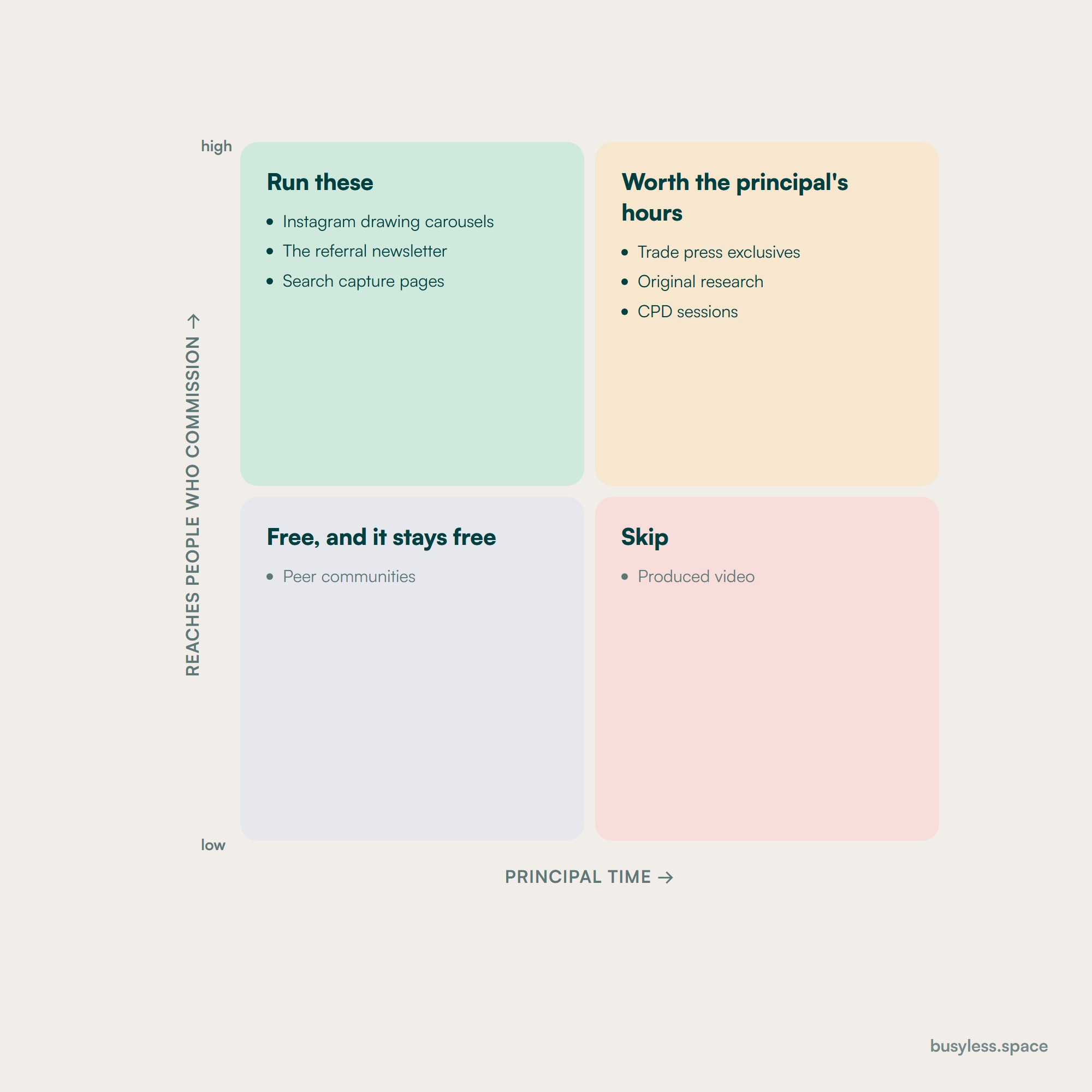
Eight channels, judged for this field specifically. Three to staff, three worth a real test with a kill date, and two that look obvious here and do not work. The losing verdicts matter as much as the winning ones: a list that recommended all eight would be a menu, not a strategy.
Run these
Trade press
RunThis is the channel that sets the shortlist. A project in Dezeen, ArchDaily or Architizer reaches the developers, planners and private clients who commission work, and it carries a third-party endorsement no owned channel can imitate. It also compounds: a published project is the thing an awards jury, a podcast booker and a journalist all find later.
First movePick the next project reaching completion and freeze all public posting on it. Book the photographer, commission the drawing exports, and pitch it as an exclusive before a single image goes anywhere else.
Founder-led social
RunInstagram and LinkedIn do different jobs and both are real here. Instagram is where private clients and younger developers browse, and where a drawing carousel consistently outperforms the hero photograph because it shows thinking rather than result. LinkedIn reaches the commercial side: developers, contractors, planning consultants and the people who refer you.
First movePost one carousel a week built from a single drawing set: plan, section, an option that was rejected, and two sentences on why. Nothing else changes.
Search
RunThird, and doing a different job from the other two. Search rarely creates the shortlist for a design-led commission, but it captures the person who already heard your name, and it genuinely originates residential enquiries and the whole do-I-even-need-an-architect cluster. Treat it as capture and qualification rather than discovery.
First moveAnswer the questions a first-time client is embarrassed to ask, starting with what an architect actually costs and when you need one at all. The full search playbook is on the sibling page.
Worth a test, with a kill date
Newsletter
TestNot an audience channel here, a referral channel. The list that matters is small and specific: past clients, contractors, planning consultants, engineers, developers you have worked with. Fifty of those people are worth more than five thousand subscribers, and the content that works is a project walkthrough rather than industry commentary.
First moveExport every past client, consultant and contractor into one list. Send a single project, with the drawings, four times a year. Judge it on replies and referrals, not opens.
Original research
TestA practice holds real numbers nobody publishes: cost per square metre by typology, planning determination times by authority, how often a pre-application meeting changed the outcome. Any of it, published honestly with its sample size stated, is the kind of thing the trade press covers and consultants cite. The test is whether your sample is large enough to say anything true.
First moveCount your own planning applications by authority and outcome. If you have thirty or more, you have a publishable piece. If you have nine, you have an anecdote and should say so.
Events and talks
TestA CPD-accredited session delivered to a developer, contractor or estate-agent audience puts you in a room with people who commission buildings, which no post does. It is expensive in principal time and slow, so it earns a test rather than a commitment, and it only works if the session teaches something rather than presenting the practice.
First moveTurn your single most-asked client question into a 40-minute session and offer it to one developer and one contractor. Measure meetings, not attendance.
Skip these
Video
SkipA produced film costs roughly what a photography shoot costs and loses to a still image plus a plan on every surface that matters in this field. Walkthrough completion rates are poor, and the practices that appear to win with video are almost always winning with the photography that funded it. The exception is a short reel cut from footage the photographer already captured, which is repurposing rather than a channel.
Community
SkipThe active architecture communities are peer communities. Archinect, the subreddits and the local institute chapters are full of other architects, who are excellent for hiring and terrible for commissions. There is no forum where developers and private clients gather to discuss appointing a practice, and building one is a five-year project that nobody has finished.
Three channels, one source asset feeding all of them, and an order of operations that is the whole trick. Press first because it is the only one with an exclusivity condition, social second because it is where the drawings live afterwards, search third because it catches everyone the first two reached.
What you already own that nobody can copy
Every channel above runs on the same raw material, and a practice already owns all of it. The question is never what to make. It is what to release, and how to get it out of the person who holds it.
The drawing set
Held by The project architect, in the model and the issued sheets
A plan, a section and an axonometric of a building you designed cannot be sourced, licensed or generated by anybody else. A competitor can hire the same photographer and shoot a similar house. They cannot produce your drawings, and Dezeen says outright that articles carrying plans and sections are among its most popular.
How to capture it
Export at completion as part of project close-out, not as a marketing favour later. Six sheets: site plan, ground floor, a long section, one detail, one axonometric, one option study that was rejected.
The option studies that lost
Held by The design lead, usually in an abandoned folder
The rejected schemes are the only honest record of why the building is the shape it is. Nobody publishes them, because they look like failure. They are the single most engaging thing a practice can post, because they show judgement rather than output, and judgement is what a client is actually buying.
How to capture it
Screenshot three option studies at the end of concept design, before they get deleted. Ask the design lead one question: what would have gone wrong with each of these.
The planning or permitting fight
Held by The principal, entirely in their head
The objection you overcame, the condition you negotiated, the pre-application meeting that changed the scheme. It is specific to a site and an authority, which is exactly why it is useful to the next client in that authority and impossible for anyone else to write.
How to capture it
A 45-minute recorded interview within a fortnight of determination, while the detail is still sharp. One question: what did we think would happen, and what actually happened.
Cost and programme reality
Held by The practice manager, in old fee proposals and cost plans
Real ranges by typology, from projects that completed. Every prospective client wants this and almost nobody publishes it, because publishing a number feels like a commitment. Published with its conditions and its date attached, it is the most-read page most practices ever put up.
How to capture it
Pull the last twenty completed projects into a spreadsheet. State the range, the year, the region and what is excluded. Never publish a single figure.
The site analysis
Held by Whoever ran the feasibility stage
Sun paths, overlooking studies, level changes, tree constraints, the massing tests that came before the design. It reads as generous rather than promotional, and it is the clearest possible demonstration that you think before you draw.
How to capture it
Keep the feasibility deck. Redact the address, keep the reasoning, and publish it as the first half of the project story.
Who actually makes it
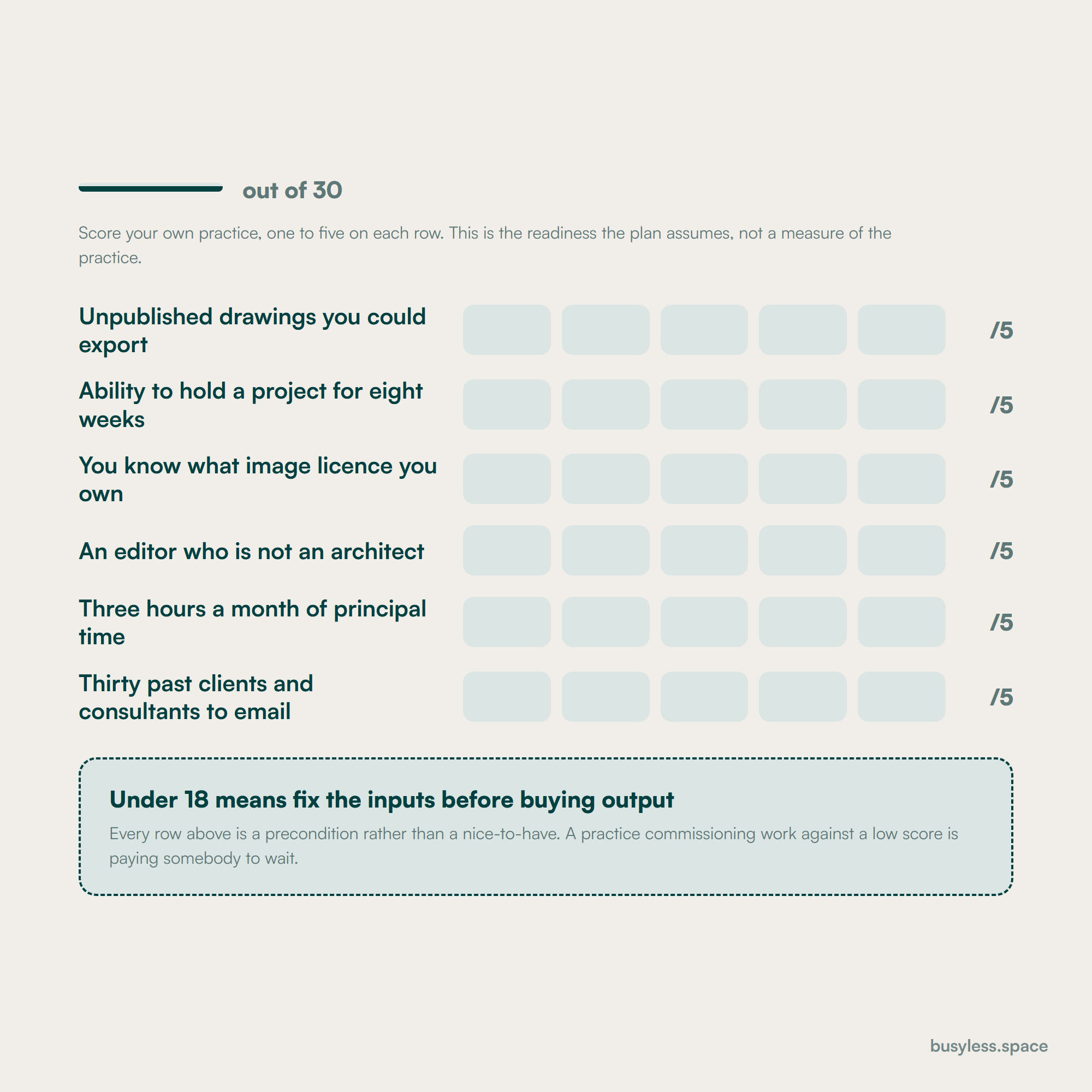
This is where practice content programmes actually die, and it is almost never a strategy problem. The people who hold the material bill their time by the hour, and nothing has been scheduled. Four roles, and honest monthly time against each.
Principal or design lead
Judgement, the argument, and anything that states a position
Interviewed, not writing. Three hours is two recorded conversations and one review pass. A principal asked to write drafts will produce nothing for four months and then cancel the programme.
3 hours
Project architect
Drawing exports, technical accuracy, project facts
Cheapest hour in the whole system and the one that unlocks everything else. Put the export in the project close-out checklist and it stops being a favour somebody asks for.
2 hours
Editor
Turning a recording into a publishable piece, and the calendar
External, almost always. This is the role a practice tries to give to an overloaded marketing coordinator or a junior architect, and it is the one that genuinely needs doing every week.
20 to 40 hours
Photographer
The images, and legally the copyright in them
Brief them for social and press crops at the same shoot, and buy the licence you actually need. Going back later for wider usage costs more than asking at the outset.
Per project, not per month
The honest cadenceOne project properly, per quarter, plus one carousel a week from the same material. A practice that promises a blog a week will stop in month three; a practice that promises four projects a year will still be running in year three.
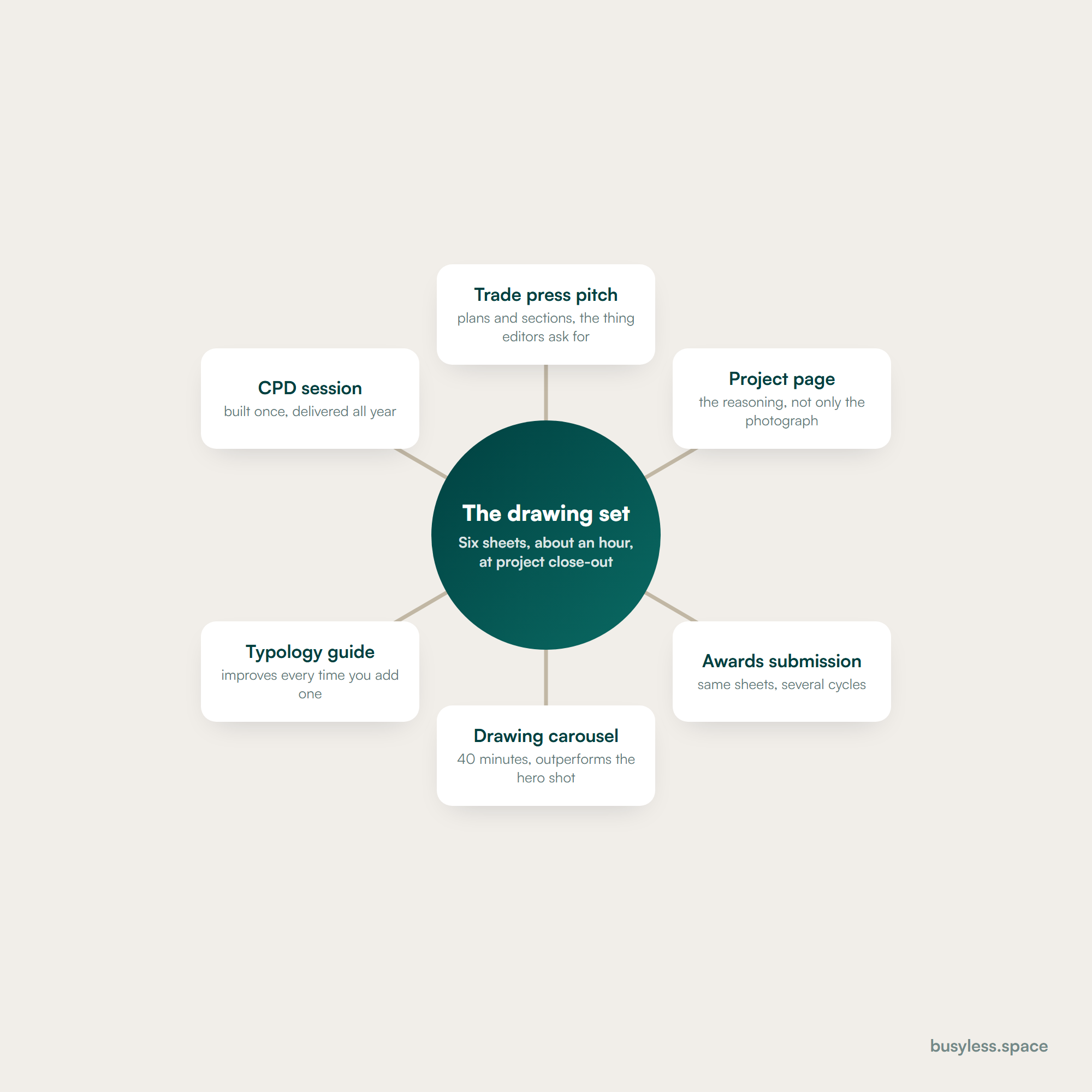
One project, 9 surfaces
One completed project, captured once, becomes nine things. The order matters more than the count, because the first item on this list has an exclusivity condition attached and every other item breaks it.
- 1
Trade press exclusive
3 hoursFrom: Photography, drawings, and 400 words of argument
FIRST, always. Dezeen and its peers strongly prefer to publish a project before anybody else, and a launch-day social post is the most common way a practice disqualifies itself without knowing.
- 2
Project page on your own site
2 hoursFrom: The full set, plus the site analysis
Goes live when the press piece does, not before. This is also the page search eventually sends people to, which is where the sibling playbook picks the story up.
- 3
Awards submission
4 hoursFrom: The same drawings, plus a written scheme rationale
Most categories accept projects completed in the last two or three years, so one capture serves several cycles. Check the rights warranty before you enter.
- 4
Instagram drawing carousel
40 minutesFrom: Plan, section, one rejected option
The highest-performing format available to a practice, and the one that uses the asset nobody else has.
- 5
LinkedIn process post
30 minutesFrom: The planning interview
Written for developers and consultants rather than peers. The constraint and the negotiation, not the aesthetics.
- 6
Newsletter issue
1 hourFrom: The whole story, told once, at length
Goes to past clients and consultants. The referral channel, so write it as though you are speaking to somebody who might recommend you rather than hire you.
- 7
A typology guide
6 hours, once per typologyFrom: This project plus the last four of its kind
The piece that ranks, months later. It is also the only item here that improves every time you add a project to it.
- 8
CPD session
5 hours to build, reusableFrom: The constraint, generalised
Once built, delivered repeatedly for a year. The slowest to make and the only one that puts you in a room.
- 9
Short reel
45 minutesFrom: Footage the photographer already shot
Repurposing, not a video channel. If it requires its own shoot it has stopped being this and started being the thing the channel section says to skip.
The buying cycle, and what content does at each stage
Six months to two years between first contact and appointment, and a practice that only needs a handful of commissions a year. Every stage below is a different question in the client's head, and the asset that answers it is different too.
Ambient awareness
6 months to several years"Who does this kind of building well?"
- What moves them
- Published projects, awards, a feed that is worth following
- How you know
- Direct and branded search for the practice name, rising slowly
Do I even need one
2 to 8 weeks"Is this a job for an architect, a technician or a builder?"
- What moves them
- An honest explainer that sometimes says no
- How you know
- Enquiries that arrive already knowing what they are asking for
What will it cost and how long
2 to 12 weeks"Can I afford this, and am I about to be embarrassed?"
- What moves them
- Published ranges by typology, with conditions and a date
- How you know
- Fee conversations that start at a realistic number
Shortlist and comparison
1 to 3 months"Which three am I meeting, and why these three?"
- What moves them
- Project pages with the reasoning, not just the photography
- How you know
- Being named alongside practices you consider peers
Appointment
2 to 8 weeks"Do I trust these people with two years of my life?"
- What moves them
- The process content and the planning stories
- How you know
- Fee proposals won without a competitive fee reduction
What you are allowed to publish
Two of the five rules below come from a contract rather than a regulator, and those two cost practices more money than the regulated ones do. Licensure itself is a different question: the protected title, firm registration, seal use and the ethics of showing prior-employer work all sit on the search playbook, because they constrain what you may call yourself rather than what you may publish.
You do not own your project photography
Standard architectural photography licensing practice, reviewed 2026-08-30. Copyright vests in the photographer unless expressly assigned.
Commissioning a shoot buys a licence with a defined scope, not the copyright. That licence usually does not permit you to pass the images to a third party, so a contractor, a product supplier or a magazine reusing your image may be infringing, and the exposure can land on you for supplying it.
So do thisBrief the licence you actually need at the point of booking: your own site and social, press submission, and awards entry, for a stated term. Keep a one-line rights record per project. Never send images onward without checking what you bought. Our construction playbook covers the separate question of whether the owner will let the project be named at all.
Publishing the project first can disqualify it
Dezeen submission guidance, read 2026-08-30
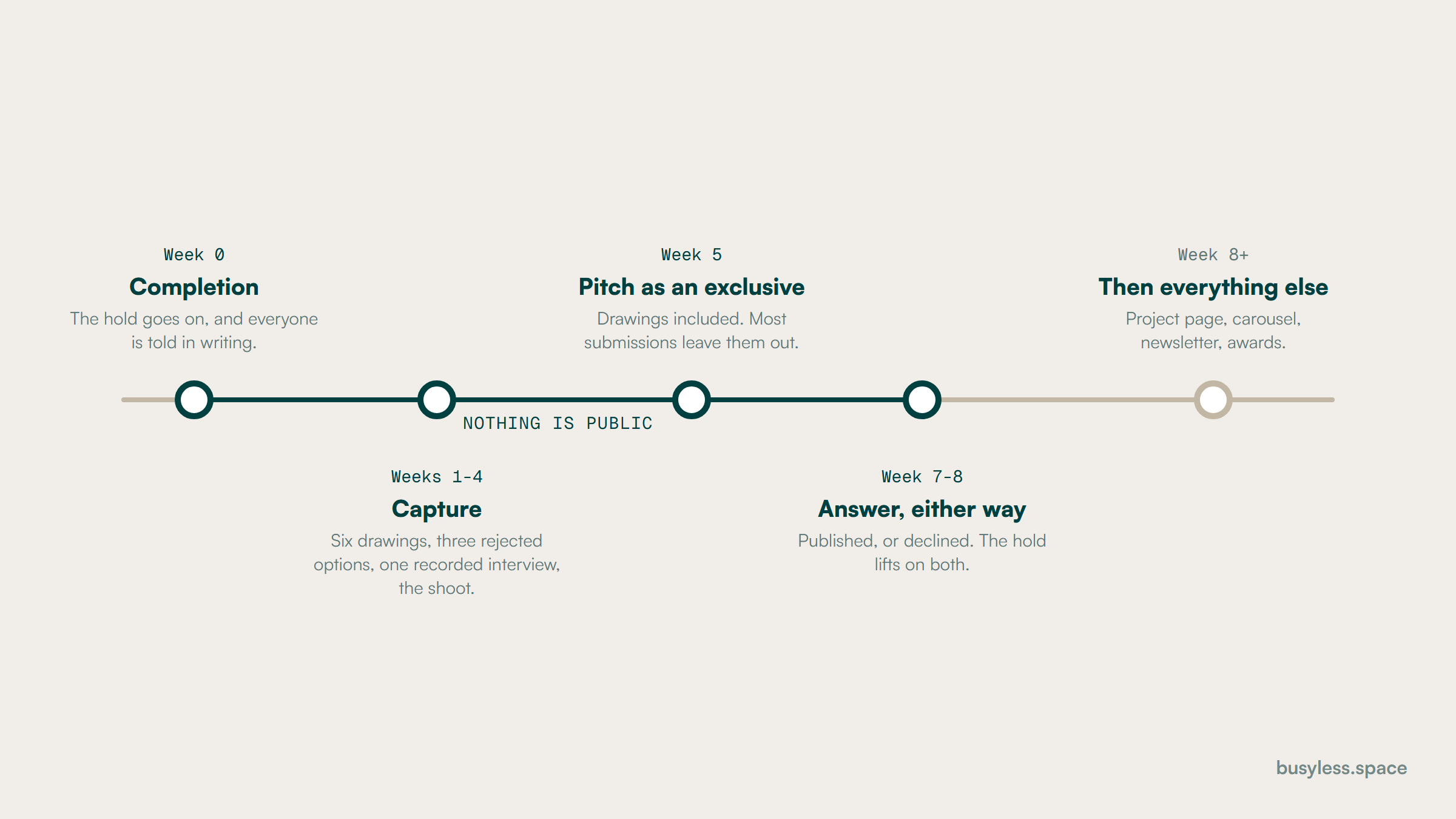
The major titles strongly prefer projects they can publish before anybody else, and Dezeen runs a dedicated exclusives section for work that has not appeared online. A project already posted to your own feed is a materially weaker pitch, and in practice often an unpublishable one.
So do thisAdd a publication hold to your project close-out process. Nothing goes public until the press outcome is known, one way or the other. Set a deadline on the hold so a slow response does not freeze the asset indefinitely.
Client consent is a publishing question, not a courtesy
Standard appointment agreements, reviewed 2026-08-30
Most appointments contain a confidentiality clause, and many corporate, healthcare and government clients prohibit publication outright or require sign-off. Residential clients frequently object to their home being identifiable even when the contract is silent.
So do thisAgree publication rights in the appointment, not after completion. Ask for the right to publish drawings and photography, name the project, and enter awards. Where consent is withheld, publish the drawings and the reasoning without the address.
An awards entry is a warranty
Major awards programme terms, reviewed 2026-08-30
Entering an awards programme generally warrants that you hold the rights to every image submitted and that the credits are complete and accurate. An entry using photography outside your licence, or omitting a collaborating practice, is a breach of the entry terms as well as an ethics problem.
So do thisRun the same rights record you keep for press against every entry. List collaborators, the architect of record and the photographer explicitly rather than assuming the form will ask.
You cannot control a supplier's caption
Product manufacturer co-marketing terms, reviewed 2026-08-30
When a manufacturer features your project in their own marketing, two things go wrong at once. Their use may fall outside the photography licence you hold, and their caption may credit the practice incorrectly or overstate their own role in a way that reads as your claim.
So do thisAnswer supplier requests with a short written permission that names the licence limits and the exact credit line. It takes ten minutes and it is the only version of this you will ever control.
None of this is legal advice. Rules vary by state and by contract, and the dates above are when each source was read. Check your own before you rely on any of it.
How to build content marketing for architects
Four phases over six months, built so the first publishable asset exists in week five rather than week twenty. The order is set by the exclusivity rule: capture before you publish anything, or the first project is spent.
Freeze, audit and choose
- Put a publication hold on every project reaching completion in the next six months
- Build the rights record: for each project, what photography licence do you actually hold and what does it permit
- Pick the one project that will be pitched as an exclusive, and the typology it belongs to
- Agree the three channels and write down what you are not doing, so it stays decided
Output A rights record, a held project, and a one-page channel decision
Capture the source material
- Export six sheets from the chosen project and three rejected option studies
- Record the 45-minute principal interview on the planning story
- Brief the photographer for press, social and awards crops in one shoot
- Pull twenty completed projects into a cost and programme range with conditions stated
Output One project captured completely, plus a publishable cost range
Publish in the right order
- Pitch the exclusive, with drawings, and wait for the answer before anything else ships
- Publish the project page and the cost range on your own site once the press outcome is known
- Start the weekly drawing carousel from material already captured
- Send the first newsletter to past clients and consultants
Output A press placement or a clear no, and a running weekly cadence
Compound it
- Build the first typology guide from this project and the four before it
- Enter the awards cycle using the same captured material
- Run one CPD session with a developer or contractor audience
- Review what actually produced enquiries and cut one channel if the answer is none
Output A guide that improves with every project, and a first read on what works
Structured data for what you publish
Structured data for the surfaces you publish on, which is a different job from marking up the practice itself. The entity markup, the professional service and the project as a creative work all sit on the search playbook. What follows describes the images, the talks and the press coverage, and the first block is the one almost nobody uses correctly.
ImageObject with rights metadata
Every project image on a project pageThe one block on this page that does a legal job as well as a marketing one. creditText, copyrightNotice and license make the photographer's rights machine-readable and travel with the image into Google Images, which is exactly where uncredited reuse starts.
{
  "@context": "https://schema.org",
  "@type": "ImageObject",
  "contentUrl": "https://[YOUR-DOMAIN]/projects/[PROJECT-SLUG]/[IMAGE].jpg",
  "name": "[PROJECT NAME], [VIEW DESCRIBED]",
  "description": "[WHAT THE IMAGE SHOWS, ONE SENTENCE]",
  "creditText": "[PHOTOGRAPHER NAME]",
  "copyrightNotice": "(c) [YEAR] [PHOTOGRAPHER NAME]",
  "creator": {
    "@type": "Person",
    "name": "[PHOTOGRAPHER NAME]",
    "url": "[PHOTOGRAPHER WEBSITE]"
  },
  "license": "[URL OF YOUR LICENCE TERMS PAGE]",
  "acquireLicensePage": "https://[YOUR-DOMAIN]/image-licensing",
  "width": 2400,
  "height": 1600
}
ImageGallery for a drawing set
The plans and sections page of a projectA page of drawings genuinely is a gallery, and marking it as one separates it from the photography in the way that matters here. The drawings are the asset a competitor cannot copy, so give them their own URL rather than burying them at the foot of a project page.
{
  "@context": "https://schema.org",
  "@type": "ImageGallery",
  "name": "[PROJECT NAME]: plans, sections and studies",
  "url": "https://[YOUR-DOMAIN]/projects/[PROJECT-SLUG]/drawings",
  "description": "[WHAT THE SET SHOWS AND WHY IT IS WORTH READING]",
  "about": {
    "@type": "CreativeWork",
    "name": "[PROJECT NAME]"
  },
  "hasPart": [
    {
      "@type": "ImageObject",
      "contentUrl": "https://[YOUR-DOMAIN]/projects/[PROJECT-SLUG]/[PLAN].jpg",
      "name": "[DRAWING TITLE, e.g. Ground floor plan]",
      "creditText": "[PRACTICE NAME]",
      "copyrightNotice": "(c) [YEAR] [PRACTICE NAME]"
    }
  ]
}
VideoObject
A reel or walkthrough embedded on a project pageOnly worth emitting for video you actually host or embed on your own page. A clip that lives only on a social platform is marked up by the platform, not by you, and duplicating it here claims a surface you do not own.
{
  "@context": "https://schema.org",
  "@type": "VideoObject",
  "name": "[PROJECT NAME]: [WHAT THE VIDEO SHOWS]",
  "description": "[ONE OR TWO SENTENCES]",
  "thumbnailUrl": "https://[YOUR-DOMAIN]/projects/[PROJECT-SLUG]/thumb.jpg",
  "uploadDate": "[YYYY-MM-DD]",
  "duration": "PT[M]M[S]S",
  "contentUrl": "https://[YOUR-DOMAIN]/video/[FILE].mp4",
  "embedUrl": "[EMBED URL IF USING A PLAYER]",
  "creator": {
    "@type": "Organization",
    "name": "[PRACTICE NAME]"
  }
}
NewsArticle for your own press page
A press or journal index listing coverage you receivedMarks up YOUR page about the coverage, never the publication's article. Claiming the publisher's own piece as yours is the mistake here, and it is the reason this block names the practice as subject rather than as publisher of the original.
{
  "@context": "https://schema.org",
  "@type": "NewsArticle",
  "headline": "[YOUR HEADLINE ABOUT THE COVERAGE]",
  "url": "https://[YOUR-DOMAIN]/journal/[SLUG]",
  "datePublished": "[YYYY-MM-DD]",
  "author": {
    "@type": "Organization",
    "name": "[PRACTICE NAME]"
  },
  "about": {
    "@type": "CreativeWork",
    "name": "[PROJECT NAME]"
  },
  "citation": {
    "@type": "CreativeWork",
    "name": "[PUBLICATION NAME]",
    "url": "[URL OF THE ORIGINAL ARTICLE]"
  }
}
Event for a talk or CPD session
The listing page for a session you are deliveringWorth emitting even for a session delivered inside one contractor's office, because it is the only structured record that a practice teaches as well as practises. Set eventAttendanceMode from what actually happens rather than defaulting to offline.
{
  "@context": "https://schema.org",
  "@type": "Event",
  "name": "[SESSION TITLE]",
  "description": "[WHAT THE AUDIENCE LEARNS, ONE SENTENCE]",
  "startDate": "[YYYY-MM-DDTHH:MM+00:00]",
  "endDate": "[YYYY-MM-DDTHH:MM+00:00]",
  "eventAttendanceMode": "https://schema.org/[Offline|Online|Mixed]EventAttendanceMode",
  "eventStatus": "https://schema.org/EventScheduled",
  "location": {
    "@type": "Place",
    "name": "[VENUE]",
    "address": "[FULL ADDRESS]"
  },
  "organizer": {
    "@type": "Organization",
    "name": "[PRACTICE NAME]"
  },
  "performer": {
    "@type": "Person",
    "name": "[WHO IS DELIVERING IT]"
  }
}
Course for an accredited CPD programme
A page describing a repeatable accredited sessionOnly when the session is genuinely accredited and repeatable. A one-off talk is an Event and nothing more, and dressing it as a Course to claim the markup is the kind of overreach that gets structured data ignored rather than rewarded.
{
  "@context": "https://schema.org",
  "@type": "Course",
  "name": "[COURSE TITLE]",
  "description": "[WHAT IT COVERS]",
  "provider": {
    "@type": "Organization",
    "name": "[PRACTICE NAME]",
    "url": "https://[YOUR-DOMAIN]"
  },
  "educationalCredentialAwarded": "[e.g. 1 CPD hour]",
  "hasCourseInstance": {
    "@type": "CourseInstance",
    "courseMode": "[Onsite|Online]",
    "courseWorkload": "PT1H"
  }
}
What to automate, and where the line is
Automation is what makes this affordable at a practice's scale, and it is backstage rather than a selling point. The honest split is that an agent is good at moving material between formats and useless at holding a position. Eight tasks, and the ones marked never are the useful part of the table.
- automate
Transcribing the principal interview
Unattended, every time. The recording is the bottleneck asset and the transcript is what makes it usable by anybody else in the practice.
- automate
Cutting a drawing set into social crops
Deterministic image work at fixed ratios. No judgement involved, and it removes the most common reason a carousel does not get posted.
- automate
Tracking which publications covered which project
A monitoring job. It also feeds the rights record, which is the thing nobody maintains by hand past month four.
- assist
Drafting a typology guide from five project files
The structure and the first pass are genuinely fast to generate from material you already hold. The claims about what works and why still need the design lead, because that is the part a reader is paying attention to.
- assist
Writing the project page from the interview transcript
Good at the sequence and the technical description. Consistently wrong about which constraint mattered most, which is precisely the sentence the page exists for.
- assist
Preparing an awards entry
Formatting, word counts and completeness checks are mechanical. The rights warranty and the credit list are a human sign-off, because a mistake there is a breach rather than a typo.
- never
Posting under a named architect's account
The account belongs to a person whose professional title is regulated and whose opinions are attributable to the practice. Nothing goes out under a real name without that person reading it.
- never
Stating a position on a live planning dispute
A view on a contested application is a professional judgement with consequences for a client, a relationship with an authority, and sometimes a hearing. It is not a content task and no agent should be near it.
What it costs
Editorial estimates rather than quoted prices, and they assume the practice supplies the five hours a month of principal and project-architect time the engine section describes. Photography is the line that moves most, because it is a per-project cost that does not scale down.
Do it yourself
$0 to $400- Drawing exports at project close-out, done by the team
- A weekly carousel from material you already own
- One press pitch per completed project
- A free newsletter tool and a list of past clients
- Suits
- A practice of two to six people with one person who genuinely enjoys writing
- Ceiling
- The press pitch is the part that suffers. Placements come from a relationship and a consistent standard of submission, and both take more sustained attention than a busy principal has.
Lean
$1,500 to $3,000- An external editor turning interviews into publishable pieces
- Four properly captured projects a year
- A managed press and awards calendar
- The weekly social cadence run for you
- Suits
- A practice of six to twenty people that wants to stop starting over every quarter
- Ceiling
- Photography and original research sit outside this. So does the CPD programme, which needs principal time that a budget cannot buy back.
Funded
$3,000 to $7,000- Everything above, plus commissioned photography on a project cycle
- One original research piece a year with a real sample
- A built and repeatedly delivered CPD session
- Search treated properly rather than as an afterthought
- Suits
- A practice of twenty or more, or a smaller one deliberately repositioning into a new typology
- Ceiling
- Above this the constraint stops being budget and becomes principal availability. Buying more output than the practice can review produces content nobody in the building stands behind.
Enterprise
$7,000 and up- Multi-studio coordination with a single editorial standard
- Sector-specific programmes running in parallel
- Original research as a repeatable annual publication
- In-house capture built into project delivery across the practice
- Suits
- Multi-office practices where several studios compete for the same commissions
- Ceiling
- Coordination overhead becomes the real cost. The failure mode is a house style so uniform that individual studios stop recognising their own work in it.
How to do it with no budget
Seven steps, all of which use material the practice already owns and none of which need a budget. Done properly this takes a couple of days spread over a month and produces more than most practices publish in a year.
- 1
Write down what photography licence you hold for each recent project
A spreadsheet and your old invoices · 2 hours
Unglamorous and the highest-value hour on this list. Most practices discover they have been outside their licence for years.
- 2
Put a publication hold on the next project to complete
Your project close-out checklist · 15 minutes
Costs nothing and protects the only asset with an exclusivity condition attached to it.
- 3
Export six drawings from one completed project
The software you already draw in · 1 hour
Site plan, ground floor, long section, one detail, one axonometric, one rejected option.
- 4
Record a 45-minute interview with the principal about one project
A phone voice memo · 45 minutes
One question to start: what did we think would happen, and what actually happened.
- 5
Publish a cost range by typology from your own completed work
Old fee proposals and cost plans · 3 hours
State the year, the region and the exclusions. A range with conditions is honest; a single number is a hostage.
- 6
Pitch one project to one publication as an exclusive
The submission form and your drawings · 3 hours
Include the plans and sections. It is the thing the editors say they want and the thing most submissions omit.
- 7
Email your last thirty clients and consultants one project
Any free newsletter tool · 1 hour
This is the referral channel, and thirty of the right people is a real list.
The tool stack
Eight jobs, and the tool for each. Most of these a practice already pays for. The rows that link into our other directories go to the researched review rather than the vendor, because the review is the thing that helps you choose.
Store and version the drawing exports so marketing can reach them
The failure mode is drawings living in project folders that only the project architect can navigate.
Free option: A shared drive with a naming convention, which works until the third person joins
Track which queries actually reach the practice
Read it for the do-I-need-an-architect cluster and for branded search, which is the ambient-awareness signal.
Free option: Free, and the only first-party source for this
Monitor where the practice is mentioned across publications
Feeds the rights record as well as the reporting, which is what makes it worth automating.
Free option: A saved search and a fortnightly manual check
Check whether AI answer engines name the practice
Increasingly where the do-I-need-an-architect question gets answered, and the answer rarely names a practice.
Free option: Ask the four main assistants the same question monthly and log it
Model what a change in enquiry quality is worth
Useful here because the commission count is small, so a single won project changes the whole picture.
Free option: Free
Sanity-check a budget before committing to a cadence
Run it against the engine section's hours rather than against a wish list.
Free option: Free
Send the referral newsletter
Deliverability matters more than features, because the list is small and every address is a person you know.
Free option: Free below a few hundred subscribers, which is where this list will sit
Keep the rights record
One row per project: photographer, licence scope, term, what it permits. Nothing on this list saves more money.
Free option: Free, and better than any product for this
Take it from here
Everything below is meant to be copied and filled in. Bodies are plain text, so what you see is exactly what lands on your clipboard.
One row per project recording what licence you actually hold. The highest-value hour on this page.
PHOTOGRAPHY RIGHTS RECORD
Practice: [PRACTICE NAME]
Last reviewed: [YYYY-MM-DD]
Reviewed by: [NAME]

Working tool, not legal advice.

For every project with commissioned photography, record:

PROJECT: [PROJECT NAME]
  Photographer: [NAME]
  Contact: [EMAIL]
  Shoot date: [YYYY-MM-DD]
  Invoice / contract ref: [REF]
  Licence term: [e.g. 5 years from shoot date / perpetual]
  Territory: [e.g. worldwide]

  PERMITTED USES (tick only what the contract actually says)
  [ ] Practice website
  [ ] Practice social accounts
  [ ] Press submission to third-party publications
  [ ] Awards entries
  [ ] Print marketing and brochures
  [ ] Client use
  [ ] Contractor / consultant use
  [ ] Product manufacturer / supplier use
  [ ] Sub-licensing to third parties

  NOT PERMITTED / UNCLEAR:
  [LIST ANYTHING THE CONTRACT DOES NOT COVER]

  Credit line required: [EXACT WORDING]
  Copyright notice: (c) [YEAR] [PHOTOGRAPHER]

  Requests received and answered:
  [DATE] [WHO ASKED] [WHAT WAS GRANTED] [WHO APPROVED]

RULE OF THUMB
If a use is not ticked above, you do not have it. Ask the
photographer in writing before supplying the image. A ten-minute
email is cheaper than every alternative.
The expensive mistakes
Posting the finished project the day it completes
What it costs: The press placement, and with it the awards shortlist and the coverage that would have followed
Hold it. Pitch first, publish second, post third. The delay is three weeks and the difference is a year of compounding.
Publishing only the exterior photograph
What it costs: You look identical to every other practice, using the one asset that is genuinely interchangeable
Lead with the drawing. The photograph proves it got built; the plan proves you thought about it.
Asking the principal to write
What it costs: Four months of nothing, then a cancelled programme and a conclusion that content does not work here
Interview them for 45 minutes and let somebody else write. Their scarce input is judgement, not prose.
Sending images to a supplier because they asked nicely
What it costs: A licence breach you supplied the evidence for, and sometimes a credit line naming the wrong practice
Reply with a short written permission naming the licence limits and the exact credit. Ten minutes, every time.
Chasing follower count
What it costs: A feed optimised for other architects, who are excellent colleagues and will never commission you
Track who follows and who enquires. Fifty developers beats fifty thousand students, and the second number is easier to get.
Treating search as the strategy
What it costs: Months spent competing with directories for terms that do not produce design-led commissions
Run search as the third channel doing the capture job, and follow the sibling playbook for the parts of it that genuinely pay.
What to measure
An ecosystem has no single channel to credit, and pretending otherwise is where reporting in this field goes wrong. What follows separates the things that move early from the things the practice actually cares about, and it is worth saying plainly that the join between them is never perfectly clean. A commission that took two years and touched a publication, a talk and a referral cannot be attributed to one of them honestly.
Leading indicators
Publications secured per year
Your own press record
The clearest single indicator in this field, and one most practices do not formally count.
Branded search volume
Google Search Console
The best available proxy for ambient awareness. It moves slowly and it moves before enquiries do.
Drawing carousel saves and shares
Platform analytics
Saves, not likes. A saved drawing is somebody filing it to show a partner or a client later.
Newsletter replies and forwards
Your list tool
On a referral list, a reply is the metric and the open rate is noise.
Business indicators
Enquiry quality, scored on arrival
Your enquiry log, scored by whoever triages
Budget realism, typology fit and whether they already know what they are asking for. Cheap to record and the fastest thing on this list to move.
Shortlist rate
Your own pipeline
How often an enquiry becomes a meeting. Content that is doing its job raises this before it raises anything else.
Fee win rate without a fee reduction
Fee proposals against appointments
The number that proves positioning rather than volume. Winning at your fee is the whole point.
Commissions won, and what the client says they saw
Ask at appointment, and write the answer down
One question at kick-off outperforms every analytics tool available for a purchase of this shape and this length.
The verdict
Content marketing for architects rewards patience and punishes volume. A practice needs a handful of the right commissions a year, so the goal is to be known and remembered by a small number of specific people rather than found by many.
The three things that matter most cost nothing. Hold the project until the press decision is made, publish the drawings instead of only the photograph, and write down what image licence you actually own.
What makes architecture content marketing unusual is that the raw material is already paid for. The drawings exist, the option studies exist, the planning story is in somebody's head. Almost all of the work is retrieval and sequencing.
I would be cautious about buying architecture content marketing services from anybody who leads with volume, or who asks the principal to write. The constraint in this field is five hours of the right person's attention a month, and a proposal that does not name that constraint has not understood the practice.
FAQ
Architecture content marketing questions
Should we post a completed project on Instagram straight away?
No. The major publications strongly prefer projects they can publish first, and Dezeen runs a dedicated section for work that has not appeared online. Hold the project until the press outcome is known, then publish your page and post the carousel. The delay is usually about three weeks.Do we own the photographs we paid for?
Almost certainly not. Commissioning a shoot buys a licence with a defined scope, and the copyright stays with the photographer unless it was expressly assigned. That licence usually does not let you pass images to a contractor or a supplier, so check what you bought before sending anything onward.Is search worth doing at all for an architecture practice?
Yes, as the third channel doing a specific job. It rarely creates the shortlist for a design-led commission, but it captures people who already know your name and it genuinely originates residential enquiries. The deep version of that work is on our search playbook for the same industry.How much principal time does this actually take?
About three hours a month, spent being interviewed and reviewing, not writing. Any plan that needs more than that from a principal will stop by month four. The project architect adds roughly two hours for drawing exports and technical accuracy.What do you charge for content marketing services for architects?
I do not sell a fixed per-industry package. An engagement starts with a Discovery, then a monthly retainer sized to the practice, and the budget section on this page gives honest bands for running it yourself or with help. The realistic range for a practice doing this properly is $1,500 to $7,000 a month.We are a small practice. Is any of this realistic?
The free path on this page is designed for exactly that case, and the highest-value step on it costs nothing: writing down what photography licence you hold for each project. A two-person practice publishing one project properly per quarter will out-perform a larger one publishing weekly.Why publish drawings rather than finished photography?
Because the photograph is the one asset a competitor can replicate and the drawing is not. Dezeen has said articles carrying plans and sections are among its most popular, and a drawing carousel consistently outperforms a hero shot because it shows judgement rather than result.Can we show work we did at a previous practice?
Sometimes, and carefully. The AIA rules require you to state your actual role accurately, acknowledge the architect of record, and make that designation plainly visible. That is a licensure and ethics question rather than a distribution one, so it is covered in more depth on the search playbook for this industry.
Run it yourself, or have someone own it
Everything above is written to be run without us, and the free path is genuinely most of the value for a small practice. Where these plans stall is almost never the plan. It is that the person holding the material has a day job and nobody owns the programme after the first month. That is the job we do.