
Skip to content

Real estate SEO strategy

Regulated marketing

The portals rank on inventory you gave them

Written by Eugene SuslovLast reviewed 28 August 2026No affiliate links
Sector
Property and construction
Model
Local service, Marketplace
Competition
Brutal
Time to results
6 to 15 months
Typical monthly
$1,500 to $8,000

Key takeaways

  1. 1You cannot outrank the portals on listing queries, because they rank on inventory you gave them. Concede those and spend the budget where syndication does not reach.
  2. 2Neighbourhood content is the right strategy and the most dangerous content in real estate. "Family-friendly", "safe" and "good schools" can each indicate a preference under the Fair Housing Act.
  3. 3Your IDX listing pages are identical to every other brokerage in the market. They are duplicates by construction, and left unmanaged they consume the crawling your real pages need.
  4. 4Since 17 August 2024 buyers sign a written agreement before touring and offers of compensation are off the MLS. There is a whole cluster of consumer questions about it and almost nobody has answered them.
  5. 5In most states a website that does not name your brokerage is a blind advertisement. That is a licence issue before it is a marketing one.

SEO for real estate starts with an admission most proposals avoid. The portals rank first on almost every listing query, and they do it using the inventory you syndicated to them. You are competing with a distribution of your own product.

That is not a fight worth funding. A brokerage cannot outrank a national portal on "homes for sale in [neighbourhood]", and the money spent trying would buy several years of the content that actually works.

One idea organises a real estate SEO strategy: find the ground syndication cannot reach. Knowledge of a place, honesty about a process, and a named human being with a licence and a track record.

There is more of that ground than there used to be. The practice changes that took effect on 17 August 2024 rewrote how buyer representation and compensation work, consumers have questions about it, and the industry has largely responded with silence or with copy written by a compliance department.

The complication is that the best content here sits directly on top of a federal advertising prohibition. Neighbourhood guides are the standard recommendation, and neighbourhood guides are exactly where an agent describes a place in terms that indicate a preference about who should live there.

That is not a reason to avoid the work. It is a reason to write about the place rather than about the people in it, which turns out to produce better content anyway: transit times, tax rates, flood zones, the noise from the freight line, what actually sold last quarter and for how much.

Who already ranks in real estate

Run a listing query and count how far down your own site appears. The finding that reorganises most real estate SEO work is that the entire first screen belongs to companies you send your listings to, and that your own listing page for the same property is somewhere below them.

What is on the results page

  • National portals occupying nearly every listing and neighbourhood query
  • Local pack on brokerage and agent-plus-city queries, though thinner than in the service trades
  • People Also Ask, dense on process, cost and the new commission questions
  • Image and map results on neighbourhood terms
  • Review stars from the portals rather than from brokerage sites
  • AI Overviews on process and market questions, which is where clear explainers are being drawn from
  • Video results on neighbourhood tours, where agents are unusually well placed to compete
  • Zillow

    zillow.comClaim it

    The dominant gatekeeper, and it ranks using inventory that came from your MLS. Claim your agent profile and keep it complete, because it frequently outranks your own site for your own name. Understand what the paid product is buying, though: it is placement next to listings, including on listings you took.

  • Realtor.com

    realtor.comClaim it

    Operated under licence from the National Association of Realtors and fed directly from MLS data. Your profile is largely populated whether you engage or not, so the work is correcting and completing it rather than deciding whether to be there.

  • Redfin

    redfin.comClaim it

    Brokerage and portal at once, which makes it a competitor and a listing channel simultaneously. Its neighbourhood and market data pages rank widely, and they are the direct competition for the content strategy this page recommends.

  • Homes.com

    homes.comClaim it

    Has invested heavily in agent-attributed listing display, which changes the calculus slightly: it is the portal most likely to send a lead to the listing agent rather than sell it to somebody else. Worth a complete profile for that reason alone.

  • Your own MLS and its IDX rules

    nar.realtor

    Not a search result and the most important item here. The MLS decides what you may display, how often it must refresh, what attribution is required and sometimes whether listing pages may be indexed at all. Read your own rules before building anything, because they differ market to market and a violation is a membership problem, not an SEO one.

  • Brokerage and franchise sites

    compass.comClaim it

    If you are with a national brand, its site usually outranks yours for your own name and hosts a profile you do not control. Make sure that profile is complete and points at your site, and be clear about which of the two you are actually building.

  • State licence lookups

    arello.org

    Not claimable, and it ranks for your name plus licence and is what a careful client checks. Make sure the name on your licence, your website and your listings agree, because in most states the brokerage must be identified in advertising anyway.

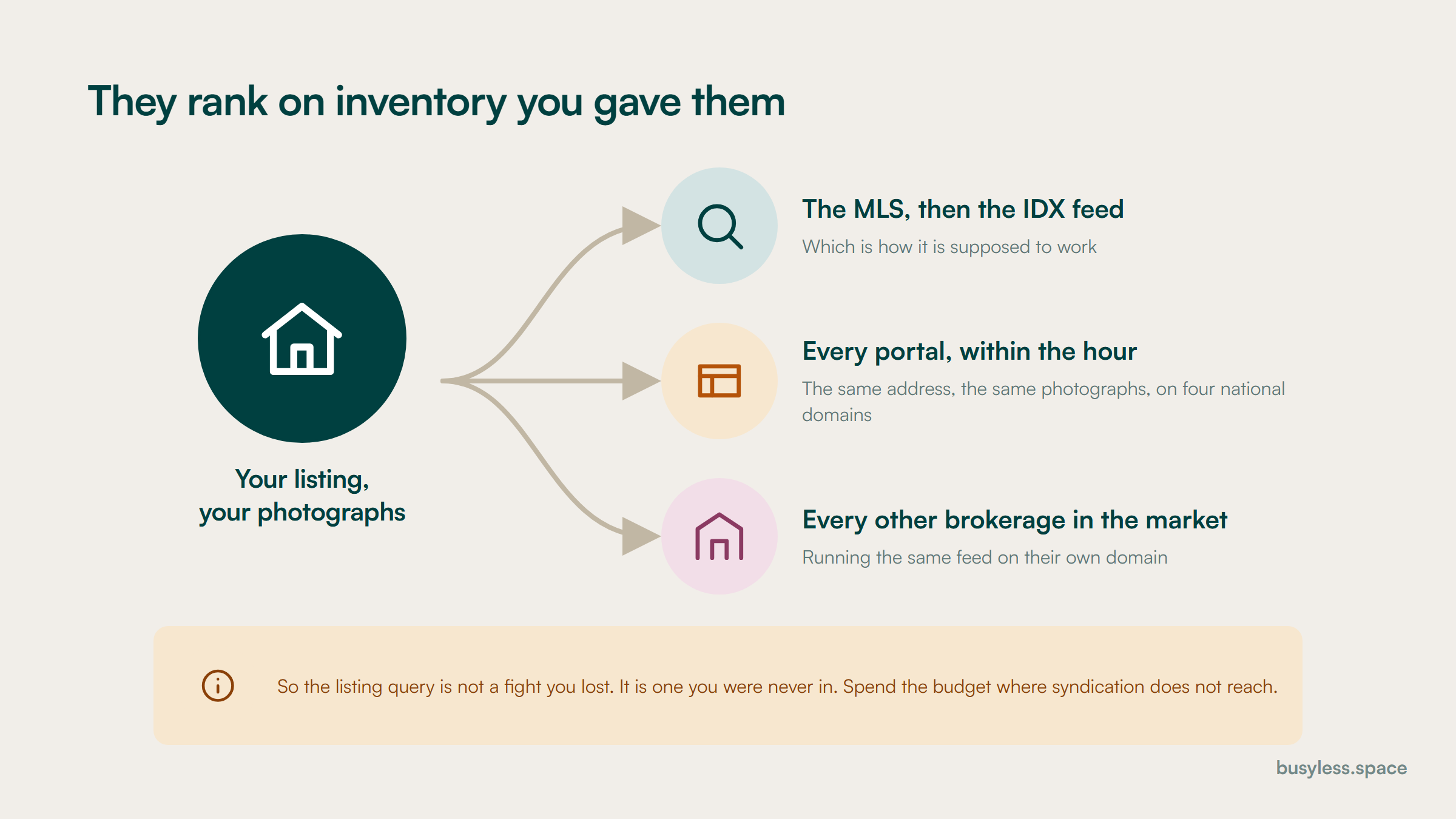
Your listing and photographs fanning out to the MLS and IDX feed, to every portal within the hour, and to every other brokerage in the market running the same feed. A note underneath says the listing query was never a fight you were in.
The portals are downstream of you, not ahead of you. That is why conceding the listing query costs nothing you had.

What people actually search

Real estate search divides into ground you have already lost, ground you can take, and a cluster that only came into existence in 2024. Being honest about which is which is the whole of the strategy.

Listing search

Transactional, local

homes for sale in [neighbourhood]

The page that wins it: An IDX search that converts the traffic you do get, not a page that competes for it

Conceded. The portals rank on your own inventory. Build the search experience for people who arrive by other routes, and stop measuring it against a portal.

Neighbourhood research

Informational

what is it like to live in [neighbourhood]

The page that wins it: A guide built from facts about the place, not adjectives about the people

The winnable ground, and the fair housing minefield. Written correctly it is the strongest asset an agent can own; written carelessly it is a federal advertising problem.

Buyer agreements and compensation

Informational, high anxiety

do i have to sign a buyer agency agreement

The page that wins it: A plain explanation of how representation and payment now work

Created by the practice changes of 17 August 2024 and still barely answered. Real volume, real confusion, and consumers are getting the answer from news coverage rather than from agents.

Process and cost

Informational

closing costs in [state]

The page that wins it: A state-specific explainer with real numbers and who pays what

Genuinely local because closing costs, transfer taxes and customs vary by state and sometimes by county. National articles get it wrong constantly.

Seller valuation and timing

Commercial investigation

should i sell my house now in [market]

The page that wins it: A dated market read with your own data and an honest answer

The highest-value cluster for a listing agent. It also demands you sometimes say no, which is the reason it converts when it is written properly.

Agent selection

Navigational

[your name] realtor reviews

The page that wins it: A bio page that answers what a client is actually checking

Low volume, extremely high intent. Every one of these searchers has your name already, and on most brokerage sites the bio is a template with a headshot.

Relocation and life event

Informational

moving to [city] what you need to know

The page that wins it: A relocation guide written for somebody who has never been

High value because relocating buyers have no local network and pick an agent from research. It is also the cluster where fair housing care matters most.

Market data

Informational

[city] housing market report

The page that wins it: A monthly market update with your own numbers and a real read

Competitive against the portals and winnable at the neighbourhood level, where their data is thin and yours is not.

What the rules change

Real estate is regulated as a licensed profession and advertised under a federal civil rights statute, which is an unusual combination. The first rule below is the one that should change how you write, and it is the one most content strategies for this industry ignore entirely. None of this is legal advice; check with your broker and your state commission.

1

Neighbourhood content can indicate a preference, which is prohibited

Fair Housing Act, 42 USC 3604(c), which prohibits advertising that indicates a preference, limitation or discrimination based on a protected characteristic; HUD administers and enforces it

What it means

The statute reaches advertising, and courts and HUD have long read it to cover descriptions that signal who a neighbourhood is for. Words like family-friendly, safe and exclusive can each indicate a preference. School quality claims are a particular trap because school quality has been used as a proxy. The problem for SEO is direct: neighbourhood guides are the standard content recommendation and they are the most likely place to write exactly this.

So do this

Write about the place, not about who belongs in it. Transit times, tax rates, flood zone, lot sizes, what sold and for how much, the noise, the commute, the parking, the assessment history. Link to the school district's own data rather than characterising it. Have your broker review the neighbourhood template once, then reuse the structure.

2

A website that does not name your brokerage is a blind advertisement

State real estate licence law and commission advertising rules, which exist in essentially every state

What it means

Licensees advertise under the supervision of a broker, and states require the brokerage to be identified in advertising. Advertising is generally read to include your website, your landing pages and your social profiles. Agent personal-brand sites break this constantly, usually because the design put the brokerage in a footer image or left it off entirely.

So do this

Put the brokerage name in text on every page, not in a logo, along with your licence number and the state. Check your own commission's rule for the required prominence and wording, since several states specify both. Do the same audit on your social profiles and any landing pages a vendor built for you.

3

The August 2024 practice changes rewrote what you may say about compensation

National Association of Realtors settlement practice changes, effective 17 August 2024: offers of compensation removed from the MLS, and written buyer agreements required before touring a home

What it means

Offers of compensation may no longer be communicated through the MLS, and agents working with a buyer must have a written agreement before the buyer tours a home, with the compensation stated objectively and a statement that fees are negotiable and not set by law. Site copy written before that date frequently still says a buyer's agent is free, or that the seller always pays. Both are now misleading.

So do this

Audit every page mentioning commission, fees or who pays. Rewrite around what is true now, say that compensation is negotiable, and publish a plain explanation of the buyer agreement, because consumers are searching for one and mostly finding news coverage.

4

Your MLS decides what you may display and how

Individual MLS rules and IDX policies, which vary by market

What it means

IDX participation comes with rules on what fields may be shown, how often data must refresh, what attribution is required, how long sold data may remain and sometimes whether listing detail pages may be indexed. These differ market to market, and an SEO plan built on displaying more data than your MLS permits is a membership problem waiting to happen.

So do this

Read your own IDX policy before designing the listing section, and build the crawl strategy around what it actually allows. Where sold listings may be retained, they are usually the most valuable pages in the whole IDX set, so find out.

5

Listing photographs are somebody else's copyright

Copyright law, and MLS rules on photograph licensing and use

What it means

Listing photographs are typically licensed by the photographer to the listing broker and then to the MLS on defined terms. Reusing another brokerage's photographs, or keeping images on a sold or expired listing page beyond what the licence allows, is a copyright exposure. Real estate photographers have been notably active in pursuing this.

So do this

Use your own photographs on any page you intend to keep, particularly sold-listing and case pages. Check your MLS's rules on how long IDX images may be retained, and put a process behind it rather than relying on nobody noticing.

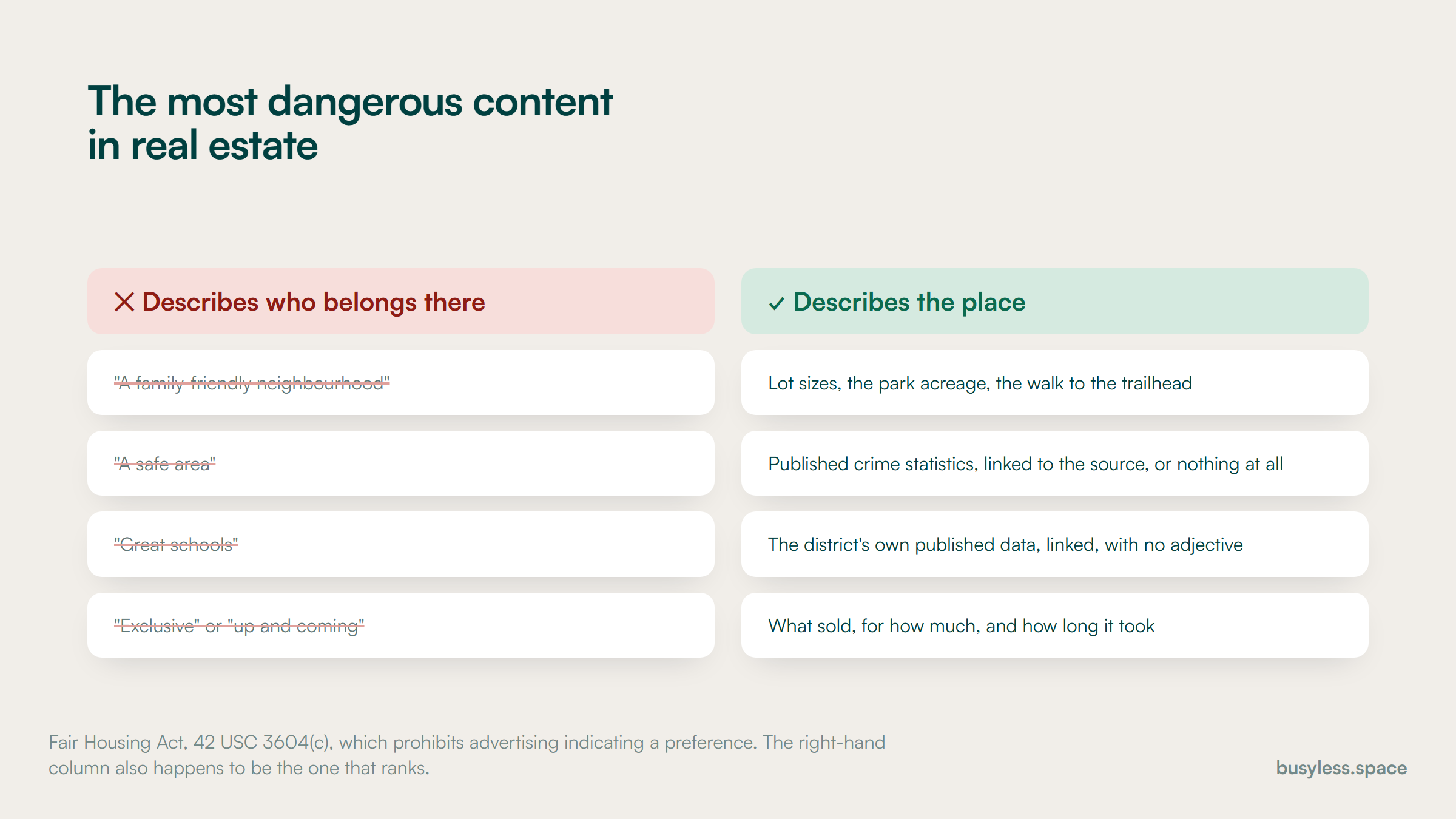
Four paired rows. On the left, struck through: a family-friendly neighbourhood, a safe area, great schools, exclusive or up and coming. On the right: lot sizes and park acreage, published crime statistics linked to the source, the district's own published data, and what sold for how much and how long it took.
The left column is the standard vocabulary of neighbourhood copy, which is exactly what makes it dangerous.

Proving expertise

Real estate is a your-money-or-your-life category and the transaction is the largest most people ever make, so the bar is high. The industry's usual signals, an award badge and a production number, are exactly the ones a reader discounts.

  • Licence number and issuing state in text, with the brokerage named on every page
  • A real bio: how long, in which markets, what you actually specialise in and what you do not
  • Transaction history described honestly, including the neighbourhoods and price bands you genuinely work in
  • Named authorship on market reports, with the data source and the date
  • Reviews and testimonials that identify the transaction type rather than floating free
  • Market data sourced to the MLS and dated, never presented as a general claim
  • Designations and certifications stated with the awarding body and the year
  • A stated position on the things clients now ask about, including how you are paid

How to build a real estate SEO strategy

A realistic first year. The sequencing here is unusual because the compliance work is genuinely first: a real estate SEO strategy that publishes forty neighbourhood guides before anybody has looked at them against the Fair Housing Act has created forty problems rather than forty assets.

  1. 1

    Weeks 1 to 4

    Fix what is wrong before publishing anything

    • Audit every page for blind advertising: brokerage named in text, licence number present
    • Audit every mention of commission or fees against the August 2024 practice changes
    • Read your MLS IDX policy and write down what you may display, retain and index
    • Review any existing neighbourhood content against fair housing, with your broker
    • Claim and complete the portal agent profiles, which rank for your own name
    • Complete the Google Business Profile for the brokerage or the team

    You end up with
    A site with no live compliance problems and a written record of what the MLS permits

  2. 2

    Weeks 4 to 12

    Take control of the IDX section

    • Decide which listing pages should be indexed at all, within MLS rules
    • Move IDX onto your own domain if it currently sits on the vendor's
    • Set a retention and redirect policy for sold and expired listings rather than 404ing them
    • Fix the performance damage from map widgets and photo carousels
    • Add RealEstateAgent and, where permitted, RealEstateListing structured data
    • Write the bio page properly, since it is the highest-intent page on the site

    You end up with
    An IDX section that stops competing with your own content for crawling and links

  3. 3

    Months 3 to 9

    Build the ground syndication cannot reach

    • Write the buyer agreement and compensation explainer, plainly
    • Build neighbourhood guides from the approved template, facts rather than adjectives
    • Write the state-specific closing cost and process pages
    • Publish a monthly market read with your own numbers and an actual opinion
    • Write the relocation guides for the places your buyers actually come from
    • Publish sold-property case pages using your own photography

    You end up with
    A body of local knowledge no portal can syndicate and no competitor can copy

  4. 4

    Months 6 to 12

    Measure appointments, not traffic

    • Track consultations and listing appointments by source, not form fills
    • Separate buyer and seller enquiries, which have completely different economics
    • Ask every new client where they first heard your name, consistently
    • Report leading and business indicators separately with the attribution gap stated
    • Review neighbourhood content annually against fair housing and against the facts
    • Re-check the commission copy whenever practice or state rules move again

    You end up with
    A picture of which content produces appointments rather than which produces sessions

Technical fixes with the best payoff

Almost every technical problem in real estate comes from the IDX feed. It is the largest section of the site, it is identical to every competitor's, it is built by a third party, and it is usually the reason the pages you actually wrote are not being crawled.

  • IDX listing pages are duplicates by construction

    A sprint, with the MLS rules open

    Every brokerage in the market publishes the same MLS feed, so thousands of near-identical pages exist across dozens of domains. This is not a mistake anyone made, it is how the system works, and it means your listing pages carry almost no independent value.

    Decide deliberately what is indexed. Within your MLS rules, index the search and neighbourhood result pages, and consider keeping individual listings out of the index while leaving them crawlable for users. The goal is that the pages you wrote get the attention.

  • The IDX sits on the vendor's domain or a subdomain

    A sprint, and possibly a vendor decision

    Some IDX products serve search from their own host. Everything a user does at the highest-intent moment happens somewhere that is not your site, and any links that section earns belong to the vendor.

    Move it to your own domain if the vendor supports it. If they do not, weigh that against what you are getting, because it is a structural limit on everything else you do.

  • Sold and expired listings return 404

    A day to set the policy, then automatic

    A property that sold accumulated links, shares and searches, and then the page vanishes. It is the most consistently wasted asset in real estate websites, repeated hundreds of times a year in an active brokerage.

    Check what your MLS allows. Where sold data may be retained, keep the page and mark it clearly as sold with the date and price. Where it may not, redirect to the neighbourhood page rather than to the home page. Never leave a 404.

  • Neighbourhood pages came from a data vendor

    A sprint, mostly deletion then writing

    Several IDX and marketing vendors ship auto-generated neighbourhood pages populated from the same demographic feed. Every brokerage using that vendor has the same pages, and they frequently contain exactly the demographic characterisations fair housing counsel would strike.

    Delete them and write your own from the approved template. This is both the compliance fix and the ranking fix, which is unusual and convenient.

  • The site is slow because of maps and carousels

    A sprint

    A map widget, a photo carousel and a lead capture script on every page is the standard real estate stack, and it is heavy. The buyer researching a neighbourhood on a phone gives up before the content renders.

    Load maps on interaction rather than on page load, compress and lazy-load listing photography, and defer the lead scripts. Measure the neighbourhood pages specifically, because they are the ones that have to perform.

  • The brokerage is not named in text

    An afternoon

    A compliance problem in most states and a trust problem everywhere. Design-led agent sites routinely put the brokerage in a footer logo, which is not text and is not prominent.

    Brokerage name, licence number and state in text on every page, in the format your commission requires. Then audit the social profiles and any vendor-built landing pages, which are usually worse.

  • The agent bio is a template

    A day

    It is the highest-intent page on the site, reached by people who already have your name from somebody they trust, and on most brokerage sites it is a headshot, a production number and three sentences of stock copy.

    Write it as an answer to what the reader is checking: how long, which markets, which price bands, what you specialise in, what you decline, how you are paid, and your licence number. Then link it from every page you write.

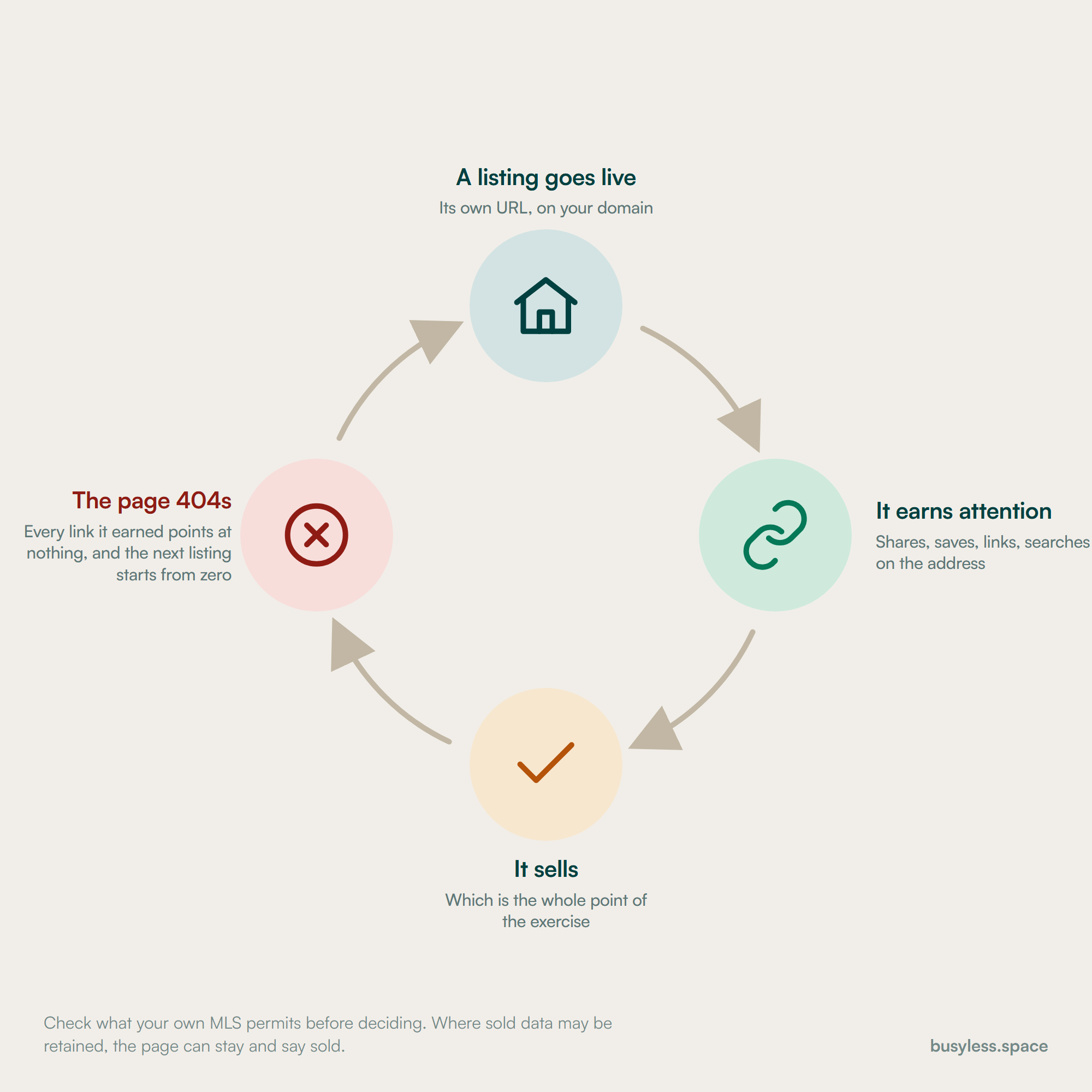
A four-step loop. A listing goes live on its own URL, it earns shares links and searches on the address, it sells, and then the page 404s so every link it earned points at nothing. The loop returns to the next listing starting from zero.
The most consistently wasted asset in real estate, and what your MLS permits decides how much of it you can keep.

Structured data that applies here

The types below fit this industry specifically. Most of them earn no rich result on their own, which is worth knowing before anyone sells the work on that basis. What they do is describe the entity precisely, which matters for how search engines and answer engines resolve who you are.

  • RealEstateAgent

    Home page and agent pages

    A real schema.org type and a subtype of LocalBusiness. Use it for the brokerage or the individual agent, and make sure the brokerage identification in the markup matches the text on the page.

    RealEstateAgent.jsonld
    {
      "@context": "https://schema.org",
      "@type": "RealEstateAgent",
      "@id": "https://[YOUR-DOMAIN]/#agent",
      "name": "[AGENT OR TEAM NAME]",
      "url": "https://[YOUR-DOMAIN]",
      "telephone": "[+1-555-000-0000]",
      "image": "https://[YOUR-DOMAIN]/headshot.jpg",
      "parentOrganization": {
        "@type": "Organization",
        "name": "[BROKERAGE NAME, exactly as required by your state]"
      },
      "address": {
        "@type": "PostalAddress",
        "streetAddress": "[BROKERAGE OFFICE ADDRESS]",
        "addressLocality": "[CITY]",
        "addressRegion": "[ST]",
        "postalCode": "[00000]",
        "addressCountry": "US"
      },
      "areaServed": [
        { "@type": "City", "name": "[CITY]" },
        { "@type": "Place", "name": "[NEIGHBOURHOOD]" }
      ],
      "hasCredential": {
        "@type": "EducationalOccupationalCredential",
        "credentialCategory": "Real estate licence",
        "identifier": "[LICENCE NUMBER]",
        "recognizedBy": {
          "@type": "GovernmentOrganization",
          "name": "[STATE REAL ESTATE COMMISSION]"
        }
      }
    }
  • RealEstateListing

    Individual listing pages, where your MLS permits it

    Check your IDX policy first. Some MLSs restrict what may be displayed or indexed, and markup is a form of display. Where it is permitted, this is the type that describes a listing properly rather than leaving it as an untyped page.

    RealEstateListing.jsonld
    {
      "@context": "https://schema.org",
      "@type": "RealEstateListing",
      "url": "https://[YOUR-DOMAIN]/listings/[SLUG]",
      "datePosted": "[YYYY-MM-DD]",
      "name": "[ADDRESS or listing headline]",
      "provider": { "@id": "https://[YOUR-DOMAIN]/#agent" },
      "about": {
        "@type": "SingleFamilyResidence",
        "name": "[ADDRESS]",
        "numberOfRooms": "[0]",
        "numberOfBathroomsTotal": "[0]",
        "floorSize": {
          "@type": "QuantitativeValue",
          "value": "[0000]",
          "unitCode": "FTK"
        },
        "address": {
          "@type": "PostalAddress",
          "streetAddress": "[ADDRESS]",
          "addressLocality": "[CITY]",
          "addressRegion": "[ST]",
          "postalCode": "[00000]"
        }
      },
      "offers": {
        "@type": "Offer",
        "price": "[000000]",
        "priceCurrency": "USD",
        "availability": "https://schema.org/InStock"
      }
    }
  • Place

    Neighbourhood guides

    The node that makes a neighbourhood guide a page about a place rather than an article. Keep the description factual for exactly the reason the fair housing section gives: this text is advertising.

    Place.jsonld
    {
      "@context": "https://schema.org",
      "@type": "Place",
      "@id": "https://[YOUR-DOMAIN]/neighbourhoods/[SLUG]#place",
      "name": "[NEIGHBOURHOOD], [CITY]",
      "description": "[Factual description: boundaries, housing stock, transit, amenities. No characterisation of residents.]",
      "url": "https://[YOUR-DOMAIN]/neighbourhoods/[SLUG]",
      "containedInPlace": {
        "@type": "City",
        "name": "[CITY]"
      },
      "geo": {
        "@type": "GeoCoordinates",
        "latitude": "[00.000000]",
        "longitude": "[-00.000000]"
      },
      "additionalProperty": [
        { "@type": "PropertyValue", "name": "Typical housing stock", "value": "[e.g. 1920s bungalows and 1960s ranches]" },
        { "@type": "PropertyValue", "name": "Nearest transit", "value": "[STATION, distance]" }
      ]
    }
  • Person with a licence credential

    Agent bio pages, referenced from anything they wrote

    Worth doing because the bio is the highest-intent page here and because the licence number is checkable. Only claim designations you actually hold, since the awarding bodies publish member lists.

    Person with a licence credential.jsonld
    {
      "@context": "https://schema.org",
      "@type": "Person",
      "@id": "https://[YOUR-DOMAIN]/team/[SLUG]#person",
      "name": "[FIRST LAST]",
      "jobTitle": "[Real estate agent / broker associate]",
      "url": "https://[YOUR-DOMAIN]/team/[SLUG]",
      "image": "https://[YOUR-DOMAIN]/team/[SLUG].jpg",
      "worksFor": {
        "@type": "Organization",
        "name": "[BROKERAGE NAME]"
      },
      "hasCredential": [{
        "@type": "EducationalOccupationalCredential",
        "credentialCategory": "Real estate licence",
        "identifier": "[LICENCE NUMBER]",
        "recognizedBy": { "@type": "GovernmentOrganization", "name": "[STATE COMMISSION]" }
      }],
      "knowsAbout": ["[NEIGHBOURHOOD]", "[NEIGHBOURHOOD]", "[Relocation]"]
    }
  • FAQPage

    Process, cost and buyer agreement pages

    Compensation and buyer agreements are what this should cover. They are what people are actually asking since the practice changes, and almost nobody has answered them on their own site.

    FAQPage.jsonld
    {
      "@context": "https://schema.org",
      "@type": "FAQPage",
      "mainEntity": [
        {
          "@type": "Question",
          "name": "[Question exactly as it appears on the page]",
          "acceptedAnswer": {
            "@type": "Answer",
            "text": "[Answer exactly as it appears. Say that compensation is negotiable and not set by law.]"
          }
        }
      ]
    }
  • BreadcrumbList

    Neighbourhood, listing and guide pages

    Worth it once neighbourhoods, cities and property types form a real hierarchy. It also surfaces IDX sections sitting entirely outside the site structure, which is worth knowing on its own.

    BreadcrumbList.jsonld
    {
      "@context": "https://schema.org",
      "@type": "BreadcrumbList",
      "itemListElement": [
        { "@type": "ListItem", "position": 1, "name": "Home",
          "item": "https://[YOUR-DOMAIN]/" },
        { "@type": "ListItem", "position": 2, "name": "[CITY]",
          "item": "https://[YOUR-DOMAIN]/[CITY]" },
        { "@type": "ListItem", "position": 3, "name": "[NEIGHBOURHOOD]",
          "item": "https://[YOUR-DOMAIN]/neighbourhoods/[SLUG]" }
      ]
    }

What it costs

Editorial estimates rather than quotes. The variable here is not company size, it is how many neighbourhoods you genuinely want to own. Each one is a real piece of research and a compliance review, and doing four properly beats doing forty from a template.

Lean

$1,200 to $2,500
  • Compliance corrections: brokerage identification, commission copy, existing content review
  • The bio page and the buyer agreement explainer written properly
  • Four to six neighbourhood guides a year, researched rather than generated
  • Portal profiles and business profile maintained
  • Quarterly reporting on appointments rather than sessions

Who it suits

An individual agent or a small team focused on a handful of neighbourhoods

Where it stops

It will not out-publish a brokerage with a content team, and it does nothing about the IDX section, which usually needs a vendor decision rather than a budget.

Funded

$3,000 to $8,000
  • The IDX section restructured, with a real indexing and retention policy
  • A neighbourhood guide programme with research and broker review built in
  • Monthly market reads with your own MLS data and a named author
  • Relocation guides for the markets your buyers actually come from
  • Sold-property case pages with your own photography
  • Attribution reconciled against what clients say when asked

Who it suits

A brokerage or a producing team with several markets and real listing volume

Where it stops

The portals still own the listing queries and always will. This tier buys the ground beside them, not the ground under them.

Enterprise

$8,000 and up
  • Neighbourhood and market content managed as structured data across dozens of areas
  • Original market research that earns coverage rather than restating the portals
  • Per-agent pages that are genuinely individual rather than templated
  • Recruitment content, which for a growing brokerage is often worth more than buyer leads
  • Per-market and per-agent reporting instead of one blended number

Who it suits

Multi-office brokerages, or teams where agent recruitment is the growth constraint

Where it stops

At this scale the risk shifts from ranking to consistency: dozens of neighbourhood pages written by different people is dozens of chances to write something that indicates a preference.

How to do it with no budget

The highest-value items in real estate cost nothing but care, and two of them are corrections rather than additions. The two corrections come first.

  1. 1

    Audit for blind advertising

    1 hour

    Your own site and social profiles

    Brokerage name in text on every page, licence number, in the format your state requires. First because in most states it is a licence issue rather than a marketing one.

  2. 2

    Audit the commission copy

    2 hours

    Your own site

    Search your site for commission, fee, free and who pays. Anything written before 17 August 2024 is likely to be inaccurate now, and inaccurate copy about how people are paid is the worst kind to leave up.

  3. 3

    Read your MLS IDX policy and write down what it allows

    2 hours

    Your MLS rulebook

    Display, refresh, attribution, retention of sold data, indexing. Everything else you might do with the listing section depends on this document, and almost nobody has read it.

  4. 4

    Write the buyer agreement explainer

    3 hours

    Your website editor

    Plain language, what the agreement is, why it exists now, that compensation is negotiable and not set by law. Real search demand, almost no supply, and it is the question every buyer now opens with.

  5. 5

    Rewrite your bio page

    2 hours

    Your website editor

    The highest-intent page you own. How long, which markets, which price bands, what you specialise in, what you decline, how you are paid, licence number, brokerage.

  6. 6

    Claim and complete the portal profiles

    3 hours

    Each portal's agent portal

    They frequently outrank your own site for your own name, so a complete profile is controlling your own brand result rather than helping a competitor.

  7. 7

    Write one neighbourhood guide properly

    6 hours

    Your website editor and public data sources

    One, done well, with your broker's review of the template. It becomes the pattern for every one after it, and getting the pattern right is worth more than a fast start.

The tool stack

Jobs first, tools second. The most important thing on this list is not a tool at all: it is your own MLS data, which is the one dataset a national portal cannot fully replicate at neighbourhood level.

  • Track visibility on neighbourhood and process queries

    DataForSEOSEO APIRead the review

    Worth it once you are tracking a dozen neighbourhoods, where the whole point is knowing which ones you are actually competitive in rather than which you would like to be.

    Free routeSearch Console covers a single-market agent adequately

  • Find the questions buyers and sellers are actually asking now

    Google Search Console plus your own consultation notes

    Since the 2024 practice changes, the questions people open with have changed. Write down what they ask in the first five minutes; that is the content plan and no tool has caught up with it.

    Free routeBoth free, and the consultation notes are better

  • Model what a transaction from search is worth

    SEO Revenue Growth CalculatorFree toolOpen the tool

    Run buyer and seller sides separately. They have different close rates, different cycle lengths and different economics, and blending them produces a number that describes neither.

    Free routeFree

  • Price the neighbourhood programme, not the whole site

    SEO Budget CalculatorFree toolOpen the tool

    Use it to price the neighbourhood programme specifically: cost per guide, including research and broker review, times the number of areas you actually want to own.

    Free routeFree

  • Generate the RealEstateAgent and Place markup

    Schema Markup GeneratorFree toolOpen the tool

    Check your IDX policy before marking up listings specifically, since markup is a form of display and some MLS rules reach it.

    Free routeFree

  • Run neighbourhood, agent and market content as related entities

    PayloadHeadless CMSRead the review

    Neighbourhoods, agents, property types and market reports intersect constantly. Modelling them as entities is what lets a market report appear on the right neighbourhood pages without being rewritten five times.

    Free routeFree and self-hosted

  • Publish market data you actually control

    Your own MLS statistics

    Not a tool purchase and the most valuable item here. Neighbourhood-level data with a real read on it is the one thing a national portal cannot do better than you, and it needs a named author and a date.

    Free routeIncluded in your membership

  • See what AI assistants say about your market and your name

    LLM visibility trackerOur toolSee the tool

    Relocating buyers increasingly ask an assistant what a neighbourhood is like before they contact anyone. Those answers are assembled from whoever wrote factually about the place, which is the strategy this page recommends anyway.

Take it from here

Everything below is yours to take. Fill the [BRACKETS] and it is ready to use. Start with the fair housing content review: it is the only item here that removes a legal exposure, and it should happen before a single new neighbourhood page is published.

Checklist

Run this over every neighbourhood page, listing description and market report before publishing. The best content strategy in real estate sits directly on top of a federal advertising prohibition.

FAIR HOUSING CONTENT REVIEW - [BROKERAGE]
Reviewer: [BROKER NAME]     Date: [DATE]

THE RULE
The Fair Housing Act, 42 USC 3604(c), prohibits advertising that
indicates a preference, limitation or discrimination based on a
protected characteristic. It reaches the words on your website.
This checklist is not legal advice. Your broker and your counsel
decide; this is a first pass so fewer problems reach them.

1. WORDS AND PHRASES TO SEARCH FOR ON EVERY PAGE
   Run a find on each. Every hit needs a decision.
   [ ] "family" / "family-friendly" / "great for families"
   [ ] "safe" / "safer" / "low crime" / "crime rate"
   [ ] "exclusive" / "prestigious" / "desirable"
   [ ] "quiet" applied to people rather than to noise
   [ ] "walkable for" / "perfect for" / "ideal for" + any group
   [ ] "young professionals" / "empty nesters" / "retirees"
   [ ] "good schools" / "best schools" / school ratings restated
   [ ] "traditional" / "established" / "up and coming"
   [ ] Any reference to the character of who lives there
   [ ] Any place of worship named as an amenity
   [ ] Any language or nationality used as a descriptor
   [ ] "integrated" / "diverse" as a selling point

2. THE REPLACEMENT TEST
   For every flagged phrase, replace a characterisation of PEOPLE
   with a fact about the PLACE.

   | Flagged phrase   | Replaced with a fact               |
   |------------------|------------------------------------|
   | [______________] | [________________________________] |
   | [______________] | [________________________________] |
   | [______________] | [________________________________] |

   Examples of the swap:
     "family-friendly"  ->  "[X] parks within a mile, sidewalks
                             on both sides of [STREET]"
     "safe"             ->  omit, or link to the police
                             department's own published data
     "good schools"     ->  "served by [DISTRICT]" with a link to
                             the district's own data, no rating
     "quiet"            ->  "no through traffic; nearest arterial
                             is [ROAD], [X] blocks east"

3. THE FACTS THAT ARE ALWAYS SAFE AND ALWAYS USEFUL
   [ ] Boundaries, and what is just outside them
   [ ] Housing stock: eras, styles, typical lot sizes
   [ ] Transit: stations, lines, real journey times
   [ ] Commute times to named employment centres
   [ ] Property tax rate and assessment practice
   [ ] Flood zone, wildfire zone, soil, other hazards
   [ ] HOA presence, fees and what they cover
   [ ] What sold in the last quarter, and for what
   [ ] Zoning, and any pending changes
   [ ] Noise sources: rail, flight paths, arterials
   [ ] Utilities, broadband availability, water source

4. IMAGES ARE ADVERTISING TOO
   [ ] Photography does not depict only one group of people
   [ ] Alt text describes the property or the place, not people

5. SIGN OFF
   Reviewed by [BROKER]: [DATE]
   Template approved for reuse: [ Y / N ]
   Re-review scheduled: [DATE + 12 months]

What to publish

Sorted by distance from what a portal can syndicate. Everything close to the listing data is a losing fight. Everything that required actually being somewhere is winnable.

  • Neighbourhood guides, factual

    One a month, properly researched, rather than forty from a template

    The only content a portal cannot generate from a feed, and the strongest local asset an agent can own. Built from facts about the place, reviewed against fair housing.

  • The buyer agreement and compensation explainer

    Once, then updated whenever practice or state rules move

    Created by the August 2024 changes, searched constantly, and answered almost nowhere by the people who actually do the work.

  • State and county process pages

    One per state or county you work in, reviewed yearly

    Closing costs, transfer taxes and customs vary by state and sometimes by county, and national articles get them wrong. Genuinely local and genuinely useful.

  • Monthly market reads with your own data

    Monthly, with a named author and a date

    Neighbourhood-level MLS data with an opinion attached is the one dataset you have and the portals do not. It also gives you a reason to publish every month.

  • Relocation guides

    One per feeder market, updated yearly

    Relocating buyers have no local network and choose an agent from research, which makes them the highest-value readers on the site.

  • Sold-property case pages

    One or two a month, from transactions you closed anyway

    Proof, using your own photography, showing what you actually achieved. It also puts the sold data to work instead of letting the page 404.

And what not to

  • Vendor-generated neighbourhood pages, which are identical across brokerages and frequently carry demographic characterisations
  • Any description of who a neighbourhood is suited to, which is where fair housing problems start
  • School quality claims, as opposed to a link to the district's own published data
  • Copy saying a buyer's agent costs the buyer nothing, which has not been reliably true since August 2024
  • A page per zip code with the name swapped, which is the doorway pattern with a fair housing risk attached
  • Market commentary restating national portal data, which the portal already ranks for
  • Any page that does not name your brokerage, which in most states is a blind advertisement
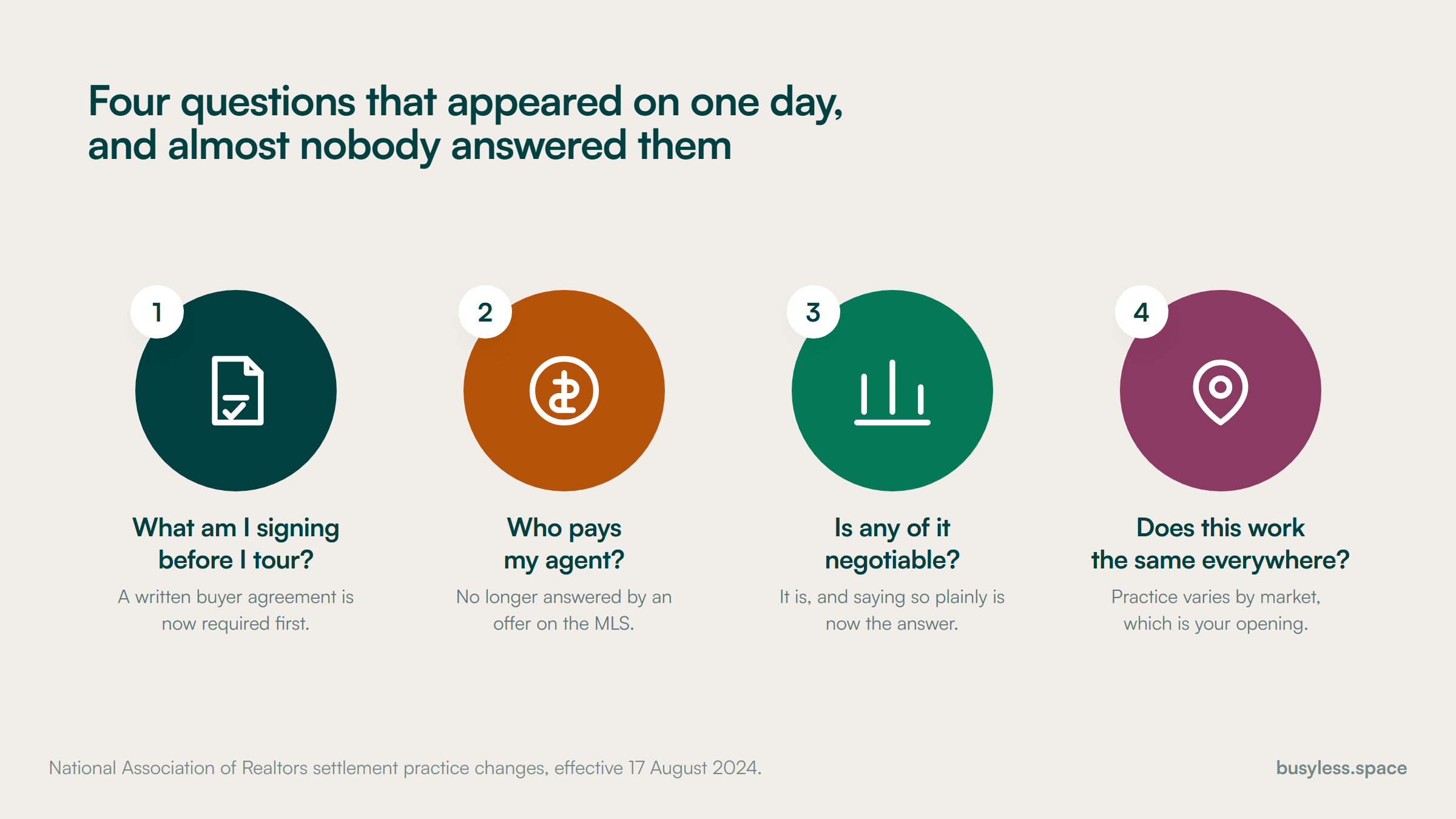
Four consumer questions numbered in the order a buyer meets them: what am I signing before I tour, who pays my agent, is any of it negotiable, and does this work the same everywhere.
All four became live questions on the same date. There is a cluster here and almost nobody has written it.

The expensive mistakes

Competing with the portals on listing queries

Costs you A year of budget spent on the one fight that cannot be won, since they rank using inventory you supplied

Concede those queries, and put the money into the local knowledge that cannot be syndicated

Publishing neighbourhood guides without a fair housing review

Costs you Federal advertising exposure, multiplied by the number of pages, in the exact content strategy everyone recommends

Write about the place rather than the people, get the template reviewed once by your broker, then reuse the structure

Leaving the commission copy as it was

Costs you Inaccurate statements about how people are paid, on a site whose entire job is trust, since the August 2024 changes

Audit every mention, rewrite around what is true now, and say plainly that compensation is negotiable

Letting sold listings 404

Costs you Hundreds of pages a year that had accumulated links and searches, thrown away automatically

Retain them where the MLS allows, marked sold with the date, and redirect to the neighbourhood page where it does not

Treating the bio as an afterthought

Costs you The highest-intent page on the site left as a headshot and a production number, in front of people who already have your name

Write it as an answer to what the reader is checking, and link it from everything you publish

Reporting website traffic to agents

Costs you A programme judged on a number with no relationship to appointments, cancelled in the first slow month

Consultations and listing appointments by source, buyer and seller reported separately

What to measure

Attribution in real estate is harder than the tooling suggests, for a structural reason: the highest-value readers are researching for months and the conversion is a conversation, not a form. Report what you can measure honestly and ask clients directly for the rest.

Leading indicators

Move first. They predict, they do not prove.

  • Impressions on neighbourhood queries

    Search Console, filtered per neighbourhood

    Report by area rather than in aggregate. The whole point of the strategy is owning specific places, and an average across twelve of them hides which ones are working.

  • Agent-name and brokerage-name searches

    Search Console, filtered to brand terms

    The clearest evidence that referrals and offline activity are happening, and a good early indicator for the bio page work.

  • Buyer agreement and process page engagement

    Analytics on those specific pages

    Unusual to report and useful right now, because it shows whether the cluster created by the 2024 changes is reaching anyone.

  • Portal profile views and their trend

    Each portal's agent dashboard

    Worth tracking because those profiles often rank for your own name. Rising views with flat site traffic usually means the portal is intercepting your brand searches.

Business indicators

The ones a manager acts on.

  • Consultations booked, by source

    Your calendar and CRM, with a consistent source field

    Not form fills. Real estate forms attract a large volume of browsing and a fair amount of solicitation, so the qualifying step has to be human and consistent.

  • Listing appointments and listings taken

    CRM and MLS

    The seller side is where the economics are, and it should be reported entirely separately from buyer enquiries. The content that drives it is also different.

  • First-touch source, asked directly

    The question every new client is asked, recorded the same way each time

    The most reliable data available in this industry. Cycles are long enough that analytics loses the thread, and one consistently asked question beats any attribution model here.

  • Transactions closed, by source, on a rolling basis

    Your own transaction records

    Report as a rolling twelve months rather than monthly. With this transaction count, a monthly figure is noise and reporting it as signal will eventually embarrass everybody.

The verdict

Real estate is the clearest example in this directory of a market where the first strategic decision is what to give up. The portals rank on your inventory, they will continue to, and every dollar spent contesting that is a dollar not spent on the ground they cannot reach.

What is left is genuinely valuable and genuinely defensible: what a place is actually like, how the process works in your state, what the new representation rules mean, and who you are. All four require having been somewhere and done something, which is why a feed cannot produce them.

Ask anybody pitching real estate SEO services these three things before you look at a price. Will they review neighbourhood content against the Fair Housing Act before publishing it? Have they read your MLS IDX policy? Will they tell you to stop competing for listing queries?

The first question is where most of it falls apart. Vendor-generated neighbourhood pages are the standard product in SEO services for real estate, and they are exactly the ones that describe who lives somewhere. I would ask to see the template before signing anything.

FAQ

Real estate SEO questions

  • Can we outrank Zillow?
    Not on listing queries, and it is worth accepting that early rather than spending a year proving it. The portals rank using inventory that came from your own MLS feed, with domain authority and link profiles a brokerage will not match. Concede those queries deliberately and spend the budget on the ground syndication cannot reach: what a neighbourhood is actually like, how the process works in your state, and who you are.
  • Is neighbourhood content really a fair housing risk?
    Yes, and it is the single most important thing on this page. The Fair Housing Act prohibits advertising that indicates a preference based on a protected characteristic, and that reaches your website copy. Family-friendly, safe, exclusive and school quality claims are all common in neighbourhood guides and all capable of indicating a preference. The fix is not to avoid the content; it is to write about the place rather than the people.
  • What should we do about our IDX listing pages?
    Read your MLS rules first, because they bound every option. Then decide indexing deliberately rather than accepting whatever the vendor shipped. Individual listing pages are duplicates of every other brokerage's version of the same listing, so in most cases they are better left crawlable but out of the index, with the search and neighbourhood result pages indexed instead. Above all, stop letting sold listings return a 404.
  • Has anything changed since the NAR settlement?
    A great deal, and most brokerage websites have not caught up. Since 17 August 2024 offers of compensation are no longer communicated through the MLS, and agents working with a buyer need a written agreement before the buyer tours a home. Audit every page mentioning fees, remove anything saying a buyer's agent is free, and publish a plain explanation of the agreement, because consumers are searching for one.
  • Do we have to put the brokerage name on every page?
    In most states, yes, and in text rather than in a logo. Licensees advertise under a broker, states require the brokerage to be identified in advertising, and advertising is generally read to include websites and social profiles. A site that does not name the brokerage is a blind advertisement, which is a licence problem before it is a marketing one. Check your own commission's rule, because several states specify wording and prominence.
  • How long does this take to work?
    Six to fifteen months, and the range is wide because it depends on how many neighbourhoods you are trying to own and how contested they are. Neighbourhood guides take months to gain traction and then hold for years. The compliance corrections and the bio page pay back immediately, in the sense that the next person to look you up finds the right answers.
  • What does real estate SEO cost?
    The tiers above are editorial estimates rather than quotes. An individual agent doing this properly is realistically at $1,200 to $2,500 a month, and a brokerage with several markets and real listing volume is at $3,000 to $8,000. The number is driven by how many neighbourhoods you genuinely want to own, because each is a real piece of research plus a compliance review.
  • Can we use AI for neighbourhood guides?
    For structure and drafting, carefully. For publishing, no, and this is the industry where I would be strictest about it. A model generating a neighbourhood description will reach for exactly the language the Fair Housing Act is concerned with. Use it for the factual scaffolding, fill the facts yourself from sources you can cite, and have a broker review the template before any of it goes live.

Run it yourself, or have someone own it

Everything above is written to be run without us, and the free path is genuinely most of the value for a single-location business. Where these plans stall is almost never the plan. It is that nobody owns it after the first month. That is the job we do, with search as one distribution layer inside a wider system rather than the whole engagement.