
Content marketing for manufacturers
Regulated marketingYour content has a service life, not a publish date
- Sector
- Industrial and manufacturing
- Channels
- Search, Trade press, Events and talks
- Buying cycle
- Long cycle
- Time to compound
- 9 to 18 months
- Typical monthly
- $2,500 to $12,000
Key takeaways
- 1Your content has a service life. A datasheet is specified into a design two years after you publish it and referenced for a decade after that, so the discipline that matters is revision control rather than a publishing calendar.
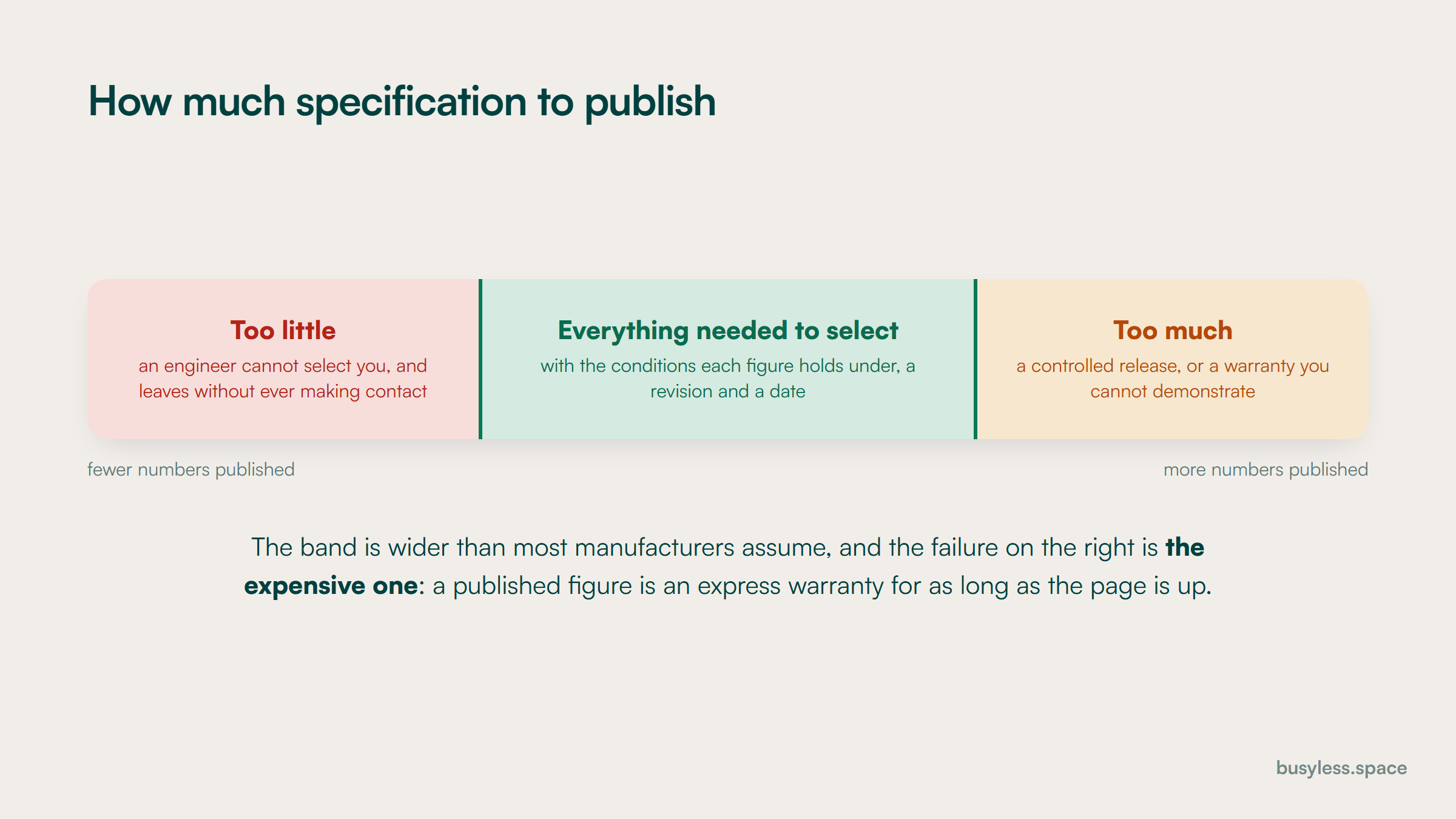
- 2The number you publish is a promise you can be held to. Under UCC 2-313 a description or affirmation of fact about the goods creates an express warranty, and the burden sits on the seller to show the bargain did not rest on it.
- 3The event worth winning is specification, not purchase. Once your part number is in a drawing you are difficult to remove, and that happens years before anybody sends you an order or fills in a form.
- 4Almost nothing here decays and almost nothing is dated. That is the single cheapest improvement available: put a revision number and a date on every published document, because your competitors have not.
- 5The people who hold the knowledge are on the shop floor and in applications engineering, and none of them will write. Recording them is the entire production problem, and it is solvable in an hour a month.
Content marketing for manufacturers is usually planned on the same annual calendar as everybody else's, and the calendar is the wrong instrument. In most industries a piece of content has a useful life measured in months. Here it has a service life measured in years, and it behaves much more like a product than a campaign.
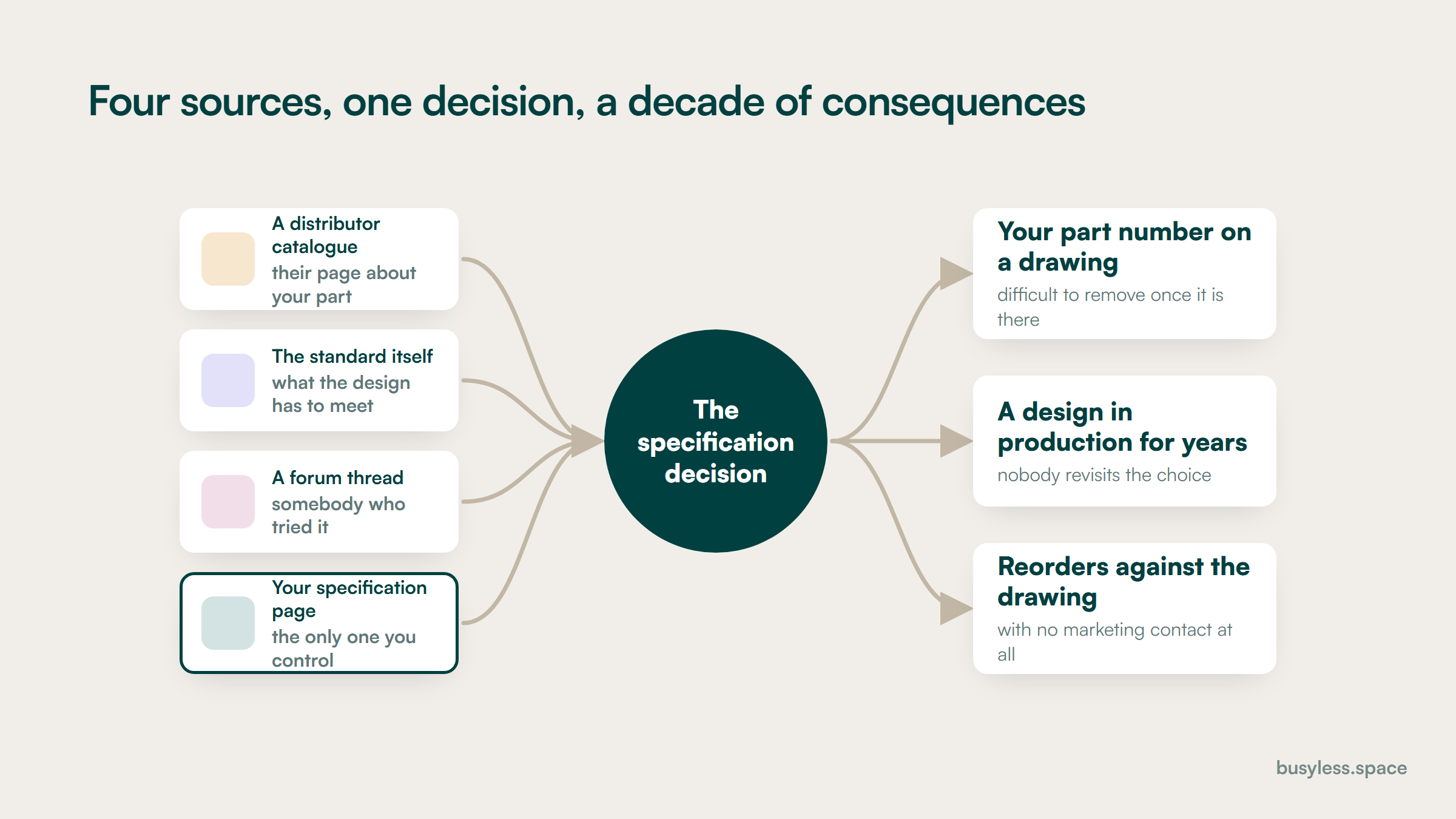
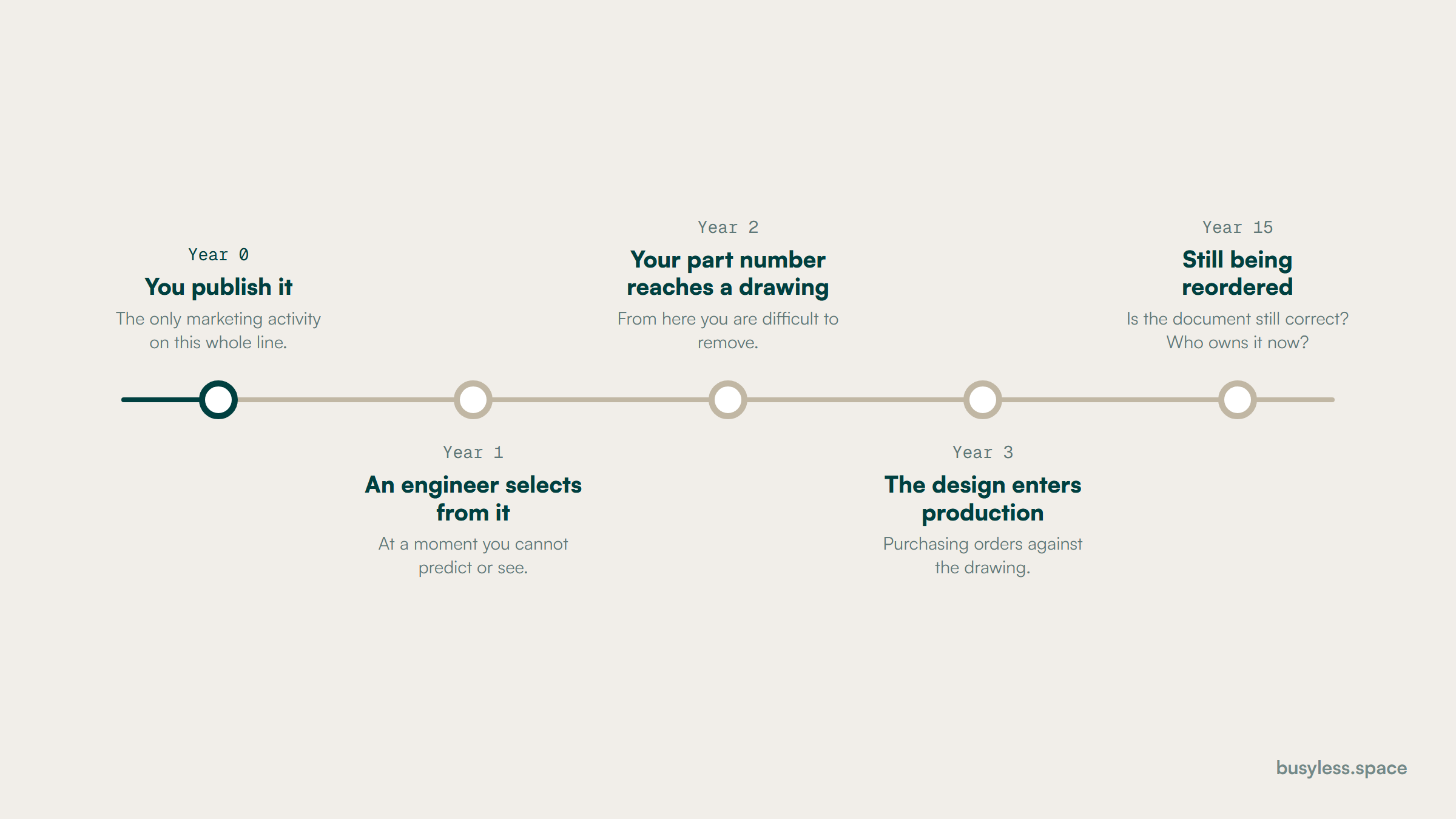
Follow one datasheet. You publish it this year. An engineer finds it while selecting a component, and eighteen months later your part number appears in a drawing. That design goes into production two years after that, and stays in production for a decade, during which purchasing reorders against the drawing without ever visiting your website again.
So the question is not how often you publish. It is whether what you published five years ago is still correct, still findable, still carries a revision number, and still says the same thing as the version your sales engineer is quoting from. Most manufacturers cannot answer any of those four, and none of them are fixed by publishing more.
A manufacturing content marketing strategy is therefore mostly an asset-management problem wearing marketing clothes. The work is capturing knowledge from people who will not write, publishing it in a form that survives, and maintaining it under version control for as long as the products it describes are in service.
Looking for the search half
This page decides which channels to run. The one next door goes deep on just one of them.
Which channels to run, and which to skip
Judged for an audience that finds you years before it buys and then does not come back. The test applied to each channel is whether it still delivers value to somebody arriving eighteen months after it was made, which moves several of them a long way from where they sit in other industries.
Run these
Search
RunThe channel an engineer uses at the moment of selection, which is the moment that decides the next decade. It is also the only channel whose output keeps working years after it was made, which matters more here than reach does. The technical half of this argument is on the sibling playbook.
First moveTake the ten most-requested specifications your applications team gets asked for and publish each one as a real page with a revision number and a date.
Trade press
RunTrade publications and their standards-body equivalents still set what a specifying engineer considers credible, and an application note or a technical article under a named engineer's byline carries weight no owned channel can buy. It is slow, it is earned, and the archive keeps working.
First moveHave your best applications engineer write one genuine technical article, not a case study, and offer it to the publication your customers actually read.
Events and talks
RunTrade shows and standards committee work are where specification decisions get influenced before any search happens. The committee half is the undervalued one: sitting on the group that writes the standard your customers must meet is a positioning asset nothing else replicates.
First movePick one show where specifying engineers attend rather than buyers, and send an engineer rather than a salesperson.
Worth a test, with a kill date
Video
TestProcess and application video is genuinely useful here, because a machine running is easier to understand than a description of it. It also ages well, which is unusual for video. The test is whether you can film without disclosing something a customer or an export control would rather you did not.
First moveFilm one process at one station, with the customer's part out of shot, and publish it beside the specification it demonstrates.
Newsletter
TestA list of specifying engineers is valuable and slow to build, and the honest use of it is notification rather than nurture: a revision to a datasheet, a new material, a standard that changed. Engineers will accept that and will unsubscribe from anything that reads like marketing.
First moveSend one email that does nothing but list what changed in your published specifications this quarter, and see how it performs against anything else you send.
Original research
TestA manufacturer holds test and failure data nobody publishes, and comparative material or process data is exactly what a specifying engineer cannot get elsewhere. The constraint is that publishing a number puts you behind it contractually, so this needs the same care as a datasheet.
First movePublish one comparison you have already run internally, with the method stated and the conditions named, and have an engineer sign it.
Skip these
Founder-led social
SkipThe feed is the exact opposite of this industry's requirement. A post is unfindable within a week, carries no revision, and cannot be cited in a specification. Engineers do use LinkedIn, and they use it to check that a company exists rather than to select a component. Maintain a presence and do not staff it.
Community
SkipEngineering forums are worth reading and are not a channel to publish in. The useful ones are vendor-neutral by norm and will punish a manufacturer that posts, and the questions asked there are a better content brief than anything a keyword tool produces. Read them, answer on your own pages.
Three channels chosen because their output survives, and two skips whose output does not. The pattern is not owned against earned, it is durable against ephemeral, which is a distinction most channel advice does not make.
What you already own that nobody can copy
The raw material is unusually rich and almost entirely undocumented, because to the people who hold it none of it seems remarkable. The constraint running through all of it is the same one the rules section describes: what you publish, you are behind.
The application knowledge in the quoting engineer's head
Held by Applications and sales engineering
Knowing which of your products suits which situation, and why the obvious choice is often wrong, is accumulated across thousands of enquiries. A competitor with an identical catalogue does not have it, and it is the single thing engineers most want and least often find.
How to capture it
Record one applications engineer for forty minutes on the question they are asked most. Instruct them to describe no customer at all, only the situation.
Test data you already generated and never published
Held by Quality and engineering, in a folder
Comparative performance, life testing, material behaviour under real conditions. Most manufacturers run far more of this than they publish, because nobody thought of it as content and because publishing it commits you to it.
How to capture it
Ask quality what has been tested in the last three years. Then decide what may be published, with the method and conditions stated, and put an engineer's name on it.
Failure modes and what caused them
Held by Field service and warranty
How things actually fail in service is the most useful information a specifying engineer can be given and the information manufacturers are most reluctant to publish. Written as a design guidance note rather than as an incident it is publishable and it is unmatched.
How to capture it
Sit with warranty for an hour and ask what keeps coming back and why. Generalise on the way out, name no customer and no batch.
The process itself
Held by The shop floor
What your machines can actually hold, in what material, at what volume. Not the marketing version, the real one that the setter knows. It is also the thing a buyer is trying to establish and cannot from any capabilities page.
How to capture it
Walk the floor with a phone and a setter. Twenty minutes of a machine running and a person explaining is worth more than a photographed factory.
The specification questions you answer by email every week
Held by Inside sales, in a mailbox
A record of exactly what your published documents fail to answer, with proven demand attached. Every one of those emails is a page that should exist and does not.
How to capture it
Have inside sales forward every specification question for one month into a single folder. Twenty of those is most of a year's publishing plan.
Who actually makes it
The production problem here is not the writing, it is that an engineer has to stand behind every number and the number outlives their tenure. That makes document control part of the content system rather than something the quality department does separately.
Applications or design engineer as source
The technical claim and the number
Recorded, never asked to draft. An engineer asked to write will produce something accurate and unreadable in six weeks, or nothing at all.
2 hours
Technical editor
Turning a recording into something a specifying engineer will use
Needs to be able to read a drawing and keep a number intact. A generalist writer will round a tolerance to make a sentence flow, which here is a contractual problem.
20 to 30 hours
Document control
Revision numbers, dates, supersession and withdrawal
Usually already exists for internal documents and has never been pointed at the website. Connecting the two is the highest-value structural change on this page.
3 to 5 hours
Marketing lead
The calendar, the questions folder and the trade-press relationships
Also owns the annual review of everything published, which is the job a publishing calendar has no slot for and the one that matters most here.
10 to 15 hours
The honest cadenceOne substantial technical piece a month, one revision pass a quarter, and a full review of everything published once a year. The review is not optional overhead. It is the work, and a programme that publishes twice as often without it is accumulating liability rather than assets.
One project, 8 surfaces
One recorded conversation with an applications engineer becomes eight things, and the unusual feature is that most of them are still in service years later, which changes what is worth spending time on.
- 1
The application note
5 hoursFrom: The transcript, worked up into technical prose
The primary asset. Written for a specifying engineer, with the conditions stated and a named author, and given a revision number from the day it is published.
- 2
The specification page
2 hoursFrom: The numbers, as real text
A page rather than a table inside a document. Every figure on it is an express warranty, which is the rules section below, so it carries a date and a revision.
- 3
A downloadable data file
90 minutesFrom: The same figures, machine readable
A CAD model or a tolerance table an engineer can pull straight into their own work. The most-used asset here and the least-discussed.
- 4
A short process video
3 hoursFrom: The operation the note describes
Ages far better than most video, because a process changes slowly. Film with customer parts out of shot.
- 5
Trade-press article
6 hoursFrom: The argument, at professional register
A genuine technical article under an engineer's byline. The version that gets accepted is the one that teaches something rather than the one that mentions you.
- 6
Conference or committee paper
8 hours, reusableFrom: The same argument plus the data
Slow and disproportionately valuable, because standards committees are where the requirements your customers must meet get written.
- 7
The quotation attachment
IncludedFrom: The published note, cited
The most undercounted return here. A published note attached to a quotation is evidence rather than assertion, and sales rarely tell marketing they used it.
- 8
Internal training material
Nothing extraFrom: The raw recording, uncut
The version that keeps the customer detail. It is often what finally persuades an engineer that being recorded is worth their time.
The buying cycle, and what content does at each stage
This cycle runs in years and the decisive event sits near the start of it. Specification, not purchase, is what you are competing for, and by the time a purchase order exists the contest was settled years earlier.
An engineer is selecting
Days to weeks, at an unpredictable moment"What will hold this tolerance, in this material, at this volume?"
- What moves them
- A specification page and a downloadable model
- How you know
- Data file downloads, which is the truest early signal available
You get designed in
3 to 18 months"Can I justify this part to my own reviewers?"
- What moves them
- Test data, an application note, a named engineer behind it
- How you know
- Sample and prototype requests, and technical questions by email
Qualification and approval
3 to 12 months"Will this pass our supplier and quality process?"
- What moves them
- Certifications, documented process capability, traceable revisions
- How you know
- Supplier questionnaires arriving, which is late-stage and reliable
Production
5 to 15 years"Nothing. They reorder against the drawing."
- What moves them
- Consistency, and a datasheet that still says what it said
- How you know
- Repeat orders with no marketing contact of any kind
Redesign or resourcing
Every few years, without warning"Is there a better option now, or a second source?"
- What moves them
- Current documents, and a published record of what changed
- How you know
- A dormant account asking a technical question again
What you are allowed to publish
Below are the rules that treat a published document as a legal object rather than as a page. The sibling playbook covers the website-side questions, including publishing controlled technical data, Made in USA claims and public certification records, and none of those are repeated here.
A published specification is an express warranty
UCC 2-313, verified 2026-08-30
Any affirmation of fact, promise or description of the goods that becomes part of the basis of the bargain creates an express warranty that the goods will conform to it. Affirmations made during bargaining are presumptively part of that basis, and the burden sits on the seller to show otherwise. A statement merely of value or of opinion does not create one.
So do thisTreat every number on a public page as contractual language, put a revision and a date on it, and route the tolerance and performance figures through the same person who signs a drawing. Never let marketing round a figure to improve a sentence.
The text of a standard is somebody else's copyright
ASTM, ISO and ANSI publication licensing terms, reviewed 2026-08-30
You may cite a standard by its designation and state that you conform to it. Reproducing its text, its tables or its figures in your own material is a licensing question, and standards bodies fund themselves from publication sales. Litigation over public access to incorporated standards has not made commercial reuse in marketing free.
So do thisCite the designation and the year, state your conformance, and link to the publisher rather than reproducing the table. Where a customer needs the values, direct them to the standard rather than republishing it.
A gated download has an audience, and the audience is the export question
US export control principles on releasing technical data, reviewed 2026-08-30
The sibling playbook covers whether a specification may be published at all. The narrower question here is who receives it. Releasing controlled technical data to a foreign national can be an export regardless of where it happens, so a webinar registration, a gated download and a conference audience are all release mechanisms rather than marketing lists.
So do thisDecide before you gate anything whether the document is controlled, and if it is, either publish nothing or screen the audience through the process your compliance function already runs. This is a starting point, not advice.
Warnings that belong on the product belong on the listing
California Proposition 65 warning requirements, reviewed 2026-08-30
Where a product requires a Proposition 65 warning, the warning generally has to reach the purchaser before purchase, which for anything sold or catalogued online means on the page rather than only in the box. Marketing pages and product catalogues are routinely built without anybody asking whether a warning is required.
So do thisAsk the question once per product family rather than per page, and build the warning into the catalogue template so a new listing cannot ship without it.
If you are certified, your published documents are documented information
ISO 9001:2015 clause 7.5.3 on control of documented information, reviewed 2026-08-30
A certified quality system requires that documented information be identified, reviewed, approved, version controlled and protected from unintended use of obsolete versions. Published datasheets are routinely excluded from that system on the basis that they are marketing, which is a distinction the standard does not make and an auditor may not accept.
So do thisBring published technical documents inside the same control as internal ones: a revision number, an approver, an issue date and a defined route for withdrawing a superseded version from the website.
None of this is legal advice. Rules vary by state and by contract, and the dates above are when each source was read. Check your own before you rely on any of it.
How to build content marketing for manufacturers
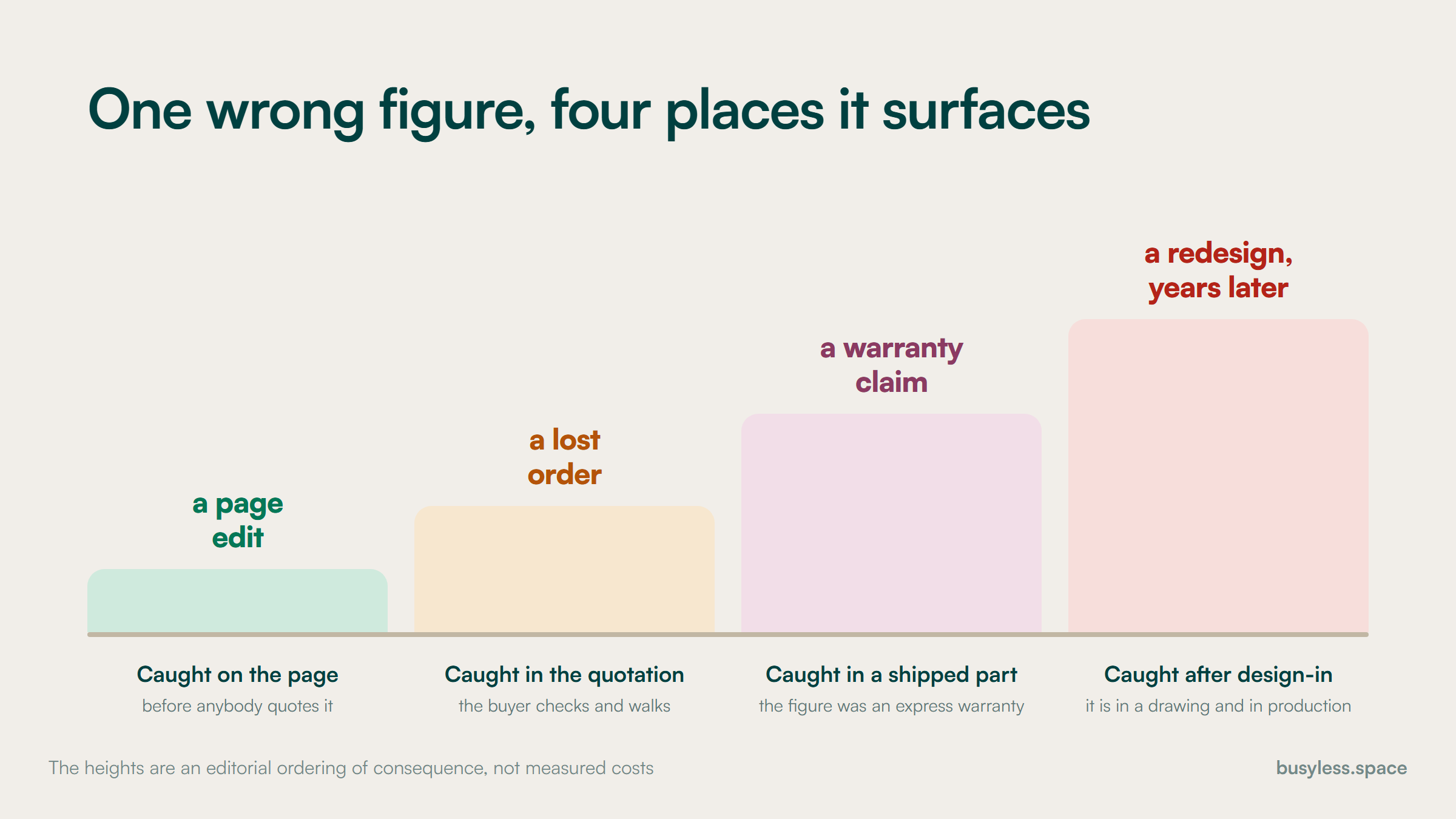
The first phase is an audit rather than a launch, and that order is deliberate: in an industry where content has a fifteen-year service life, the highest-return work available is almost always fixing what is already published rather than adding to it.
Find out what you have already published
- List every technical document on the site, with its last modified date
- Flag every one carrying a number that nobody currently owns
- Check each against the internal version, and count the disagreements
- Agree with quality that published documents come under document control
Output A register of published technical documents, and a count of what is wrong
Fix the ones people are already using
- Correct or withdraw every document that disagrees with the internal version
- Add a revision number, an issue date and a named approver to each
- Publish the ten most-requested specifications as real pages
- Start the questions folder: every specification question inside sales answers
Output A corrected, dated and owned set of the documents that matter most
Start capturing what is not written down
- Record three applications engineers for forty minutes each
- Publish the first two application notes with named authors
- Publish one downloadable data file beside each specification page
- Offer one genuine technical article to a publication your customers read
Output Two application notes, three recordings and a first trade-press submission
Make maintenance the routine
- Run the first quarterly revision pass and record what changed
- Ask incoming enquiries which document they had been reading
- Compare data file downloads against sample requests by product family
- Book the annual full review into the calendar with a named owner
Output A maintenance rhythm with an owner, which is the thing that decays first
Structured data for what you publish
The entity markup belongs on the sibling playbook, which carries products, specifications as properties, and organisational certifications. These six describe what you publish, and two of them exist specifically because a document with a service life needs a version and a date in its markup rather than only in its footer.
DigitalDocument for a datasheet or application note
The page for any versioned technical documentThe most useful block on this page, because it is the only common type that carries a version alongside a date. A datasheet marked up as an ordinary article claims to be journalism that expires; marked up this way it claims to be a controlled document, which is what it is.
{
  "@context": "https://schema.org",
  "@type": "DigitalDocument",
  "name": "[DOCUMENT TITLE]",
  "description": "[WHAT IT SPECIFIES, ONE SENTENCE]",
  "url": "https://[YOUR-DOMAIN]/documents/[SLUG]",
  "version": "[REV NUMBER, e.g. C]",
  "datePublished": "[YYYY-MM-DD]",
  "dateModified": "[YYYY-MM-DD]",
  "author": {
    "@type": "Person",
    "name": "[APPROVING ENGINEER]",
    "jobTitle": "[TITLE]"
  },
  "publisher": {
    "@type": "Organization",
    "name": "[COMPANY NAME]",
    "url": "https://[YOUR-DOMAIN]"
  },
  "about": "[PART FAMILY OR PROCESS]",
  "encodingFormat": "text/html"
}
DataDownload for a model or table
Beside any downloadable CAD model, tolerance table or datasetThe asset an engineer actually takes away, and almost nobody describes it. Include the format, because a specifier searching for a STEP file and finding a PDF has been sent to the wrong place, and include the licence terms if there are any.
{
  "@context": "https://schema.org",
  "@type": "DataDownload",
  "name": "[WHAT THE FILE CONTAINS]",
  "contentUrl": "https://[YOUR-DOMAIN]/downloads/[FILE]",
  "encodingFormat": "[e.g. model/step, text/csv, application/pdf]",
  "contentSize": "[e.g. 2.4 MB]",
  "dateModified": "[YYYY-MM-DD]",
  "license": "[URL OF YOUR TERMS OF USE]",
  "isPartOf": {
    "@type": "DigitalDocument",
    "name": "[PARENT DOCUMENT]",
    "url": "https://[YOUR-DOMAIN]/documents/[SLUG]"
  }
}
VideoObject for a process demonstration
The page a process or application video sits onProcess video ages unusually well, so treat it as a document rather than a campaign asset and give it a modified date you actually maintain. Describe what is being demonstrated rather than the company doing it.
{
  "@context": "https://schema.org",
  "@type": "VideoObject",
  "name": "[THE PROCESS OR APPLICATION SHOWN]",
  "description": "[WHAT AN ENGINEER LEARNS FROM IT]",
  "thumbnailUrl": "https://[YOUR-DOMAIN]/images/[FILE].jpg",
  "uploadDate": "[YYYY-MM-DD]",
  "duration": "PT[M]M[S]S",
  "contentUrl": "https://[YOUR-DOMAIN]/video/[FILE].mp4",
  "embedUrl": "https://[YOUR-DOMAIN]/[PAGE-SLUG]",
  "publisher": {
    "@type": "Organization",
    "name": "[COMPANY NAME]",
    "url": "https://[YOUR-DOMAIN]"
  }
}
Event for a trade show or technical webinar
Wherever a show stand, webinar or committee session is announcedWorth emitting because trade shows are a first-tier channel here and the listings are usually buried in a news post. If the event is gated and the material is controlled, read the export rule above before you publish a registration link.
{
  "@context": "https://schema.org",
  "@type": "Event",
  "name": "[EVENT OR SESSION TITLE]",
  "description": "[WHAT AN ATTENDING ENGINEER GETS]",
  "startDate": "[YYYY-MM-DDTHH:MM+00:00]",
  "endDate": "[YYYY-MM-DDTHH:MM+00:00]",
  "eventAttendanceMode": "https://schema.org/[Offline|Online|Mixed]EventAttendanceMode",
  "eventStatus": "https://schema.org/EventScheduled",
  "location": {
    "@type": "Place",
    "name": "[VENUE OR HALL AND STAND NUMBER]",
    "address": "[FULL ADDRESS]"
  },
  "organizer": {
    "@type": "Organization",
    "name": "[COMPANY OR SHOW ORGANISER]",
    "url": "https://[YOUR-DOMAIN]"
  },
  "audience": {
    "@type": "Audience",
    "audienceType": "[e.g. Design and specifying engineers]"
  }
}
Course for specifier training
A page for training you deliver to customers or distributorsManufacturers run more training than they market. Where you teach specifiers how to select or apply a product family, that is a course and describing it as one makes it findable by people looking for exactly that rather than for you.
{
  "@context": "https://schema.org",
  "@type": "Course",
  "name": "[COURSE TITLE]",
  "description": "[WHAT SOMEBODY CAN DO AFTERWARDS]",
  "provider": {
    "@type": "Organization",
    "name": "[COMPANY NAME]",
    "url": "https://[YOUR-DOMAIN]"
  },
  "teaches": "[THE SPECIFIC CAPABILITY]",
  "educationalLevel": "[e.g. Practising design engineers]",
  "hasCourseInstance": {
    "@type": "CourseInstance",
    "courseMode": "[Onsite|Online]",
    "courseWorkload": "PT[N]H"
  }
}
ImageObject for a drawing or process photograph
Technical drawings, process photography and application imagesThe field that earns its place is the licence, because these images travel: distributors, catalogues and customers all reuse them, usually without asking. Stating the terms once is what makes the reuse a benefit rather than an argument.
{
  "@context": "https://schema.org",
  "@type": "ImageObject",
  "contentUrl": "https://[YOUR-DOMAIN]/images/[FILE].jpg",
  "name": "[WHAT THE IMAGE SHOWS]",
  "caption": "[PART OR PROCESS, WITH ANY CONDITIONS]",
  "creditText": "[COMPANY NAME]",
  "copyrightNotice": "(c) [YEAR] [COMPANY NAME]",
  "license": "[URL OF YOUR IMAGE TERMS PAGE]",
  "acquireLicensePage": "https://[YOUR-DOMAIN]/media-resources",
  "representativeOfPage": true
}
What to automate, and where the line is
Maintenance is the job on this page, and automation is what makes maintenance affordable across a fifteen-year library. The line is drawn at the number: an agent may find, format, compare and flag, and may not decide what a figure should be.
- automate
Comparing published documents against the internal versions
Mechanical, tedious and the highest-value automation available here. It surfaces the disagreements the audit exists to find, and it can run continuously afterwards rather than annually.
- automate
Flagging documents that have not been reviewed in a year
A register with dates and a rule. It replaces the annual review being forgotten, which is how a fifteen-year service life turns into fifteen-year-old information.
- automate
Transcribing engineer recordings and sorting the questions folder
Both are pure throughput. Clustering a month of specification questions into topics is the step that otherwise stops the folder being used.
- assist
Drafting the application note from a transcript
It handles structure well and cuts the repetition speech contains. It will not know which caveat the engineer added almost in passing was the one that mattered.
- assist
Generating the specification page from a data table
The formatting is mechanical and worth automating. The figures still need an engineer to approve them before publication, because publication is what makes them a warranty.
- assist
Translating documents for other markets
Fast and usually good. A mistranslated tolerance or unit is a contractual claim in another language, so a technically competent reviewer signs each one.
- never
Deciding or changing a published number
It is an express warranty under UCC 2-313. A person with signing authority owns it, and no agent has the test data or the standing to be right.
- never
Deciding whether a document may be released to an audience
That is an export control judgement about who is on the other end, and it belongs with the function that already makes those calls.
What it costs
Editorial estimates rather than quotes, and each band assumes the business supplies the engineering hours the engine section describes. What moves the number most is the number of product families in scope, because each carries its own documents, its own approver and its own maintenance load.
Do it yourself
$0 to $500- The audit of what is already published, and the corrections
- Revision numbers and dates on every technical document
- The specification questions folder, kept by inside sales
- One recorded engineer conversation a month
- Suits
- A shop under fifty people with one person who can hold the register
- Ceiling
- The audit is achievable in-house and the capture is not. Recordings pile up untranscribed and unwritten, and the programme becomes a folder of audio nobody opens.
Lean
$2,500 to $6,000- A technical editor turning recordings into publishable notes
- One application note a month with a named author
- Data files published beside the specification pages
- A quarterly revision pass that actually happens
- Suits
- A manufacturer of fifty to three hundred people, or one product family in a larger group
- Ceiling
- Original test work sits outside this, and so does covering a second product family properly, because none of the approval or maintenance load transfers between them.
Funded
$6,000 to $12,000- Everything above across three or four product families
- One published comparative test a year with the method stated
- An active trade-press and conference programme
- Document control extended to everything published
- Suits
- A manufacturer competing on specification rather than on price or proximity
- Ceiling
- Engineering availability rather than money. Commissioning more than engineers can approve produces documents nobody will sign, which in this industry is a liability rather than an asset.
Enterprise
$12,000 and up- Several product families under one technical editorial standard
- Translation and regional documents maintained rather than published once
- Standards committee participation resourced as a channel
- Capture built into design review and warranty processes
- Suits
- Groups where several divisions publish under one brand and contradict each other
- Ceiling
- Coordination becomes the cost, and the failure mode is a central standard so slow that divisions go back to publishing their own documents outside it.
How to do it with no budget
Corrections rather than creation, mostly, drawing on documents the business already holds. The first three are corrections rather than creation, and in this industry corrections are usually worth more.
- 1
List every technical document on your site with its date
A crawl and a spreadsheet · 3 hours
Most manufacturers cannot say how many they have published. The list itself changes the conversation.
- 2
Check each against the current internal version
Your document control system · 1 day
Expect disagreements. Every one is a published figure you may be held to and cannot currently support.
- 3
Put a revision number and a date on everything published
Your CMS · 4 hours
The cheapest credibility improvement available here, and your competitors have not done it.
- 4
Start the specification questions folder
A mailbox rule · 20 minutes to set up
A mailbox rule turns a support inbox into next year's publishing plan.
- 5
Record one applications engineer for forty minutes
A phone · 40 minutes
On the question they are asked most. Instruct them to describe the situation, never the customer.
- 6
Publish one data file beside one specification
Your existing CAD export · 1 hour
The most-used asset in this industry and the one most often left inside a portal nobody logs into.
- 7
Ask incoming enquiries which document they read
One field on the enquiry form · 20 minutes
For a cycle this long, one question at enquiry outperforms any attribution model you could buy.
The tool stack
Several of these already exist inside the business, owned by quality or engineering rather than by marketing. Rows linking into our other directories go to the researched review rather than to the vendor.
Publish versioned technical documents without a developer
Chosen here for versioning rather than for editing comfort. A document with a service life needs a history, and most marketing content tools do not keep one.
Free option: Open source and self-hosted, with revision history built in
See which specifications engineers actually search for
The queries here are specification language rather than product language, and comparing them to your own page titles is usually uncomfortable.
Free option: Free, and the only report of what was really shown
Track how a competitor's documented specifications change
Useful here specifically because competitor datasheets change silently and a superseded figure can sit in a comparison for years.
Free option: Check the ten pages that matter by hand once a quarter
Check whether an assistant quotes your specifications correctly
Worth watching here for an unusual reason: an assistant quoting a superseded figure of yours is repeating a number you may be held to.
Free option: Put a selection question to each assistant monthly and check the figures it quotes
Keep the register of published documents and their owners
One row per document: revision, issue date, approver, last reviewed, superseded by. This register is the single most valuable artefact on this page.
Free option: Free, and the existing system is the better answer
Model what one design-in is worth over its production life
Run it over the production life rather than the first order. A ten-year design-in changes what a year of content is worth by an order of magnitude.
Free option: Free
Price the programme against the engineering hours available
The binding input is the two hours of engineering time a month. Run it against that and the honest cadence falls out.
Free option: Free
Generate the structured data for a versioned document
Useful for the DigitalDocument and DataDownload blocks above, which almost no CMS emits by default.
Free option: Free
Take it from here
Everything below is meant to be copied and filled in. Bodies are plain text, so what you see is exactly what lands on your clipboard.
The single most valuable artefact on this page. Build it before you publish anything new.
PUBLISHED TECHNICAL DOCUMENT REGISTER
Company: [COMPANY NAME]
Owner: [NAME, ROLE]      Started: [YYYY-MM-DD]
Review cycle: [QUARTERLY REVISION PASS / ANNUAL FULL REVIEW]

Working tool, not legal advice.

WHY THIS EXISTS
Most manufacturers cannot say how many technical documents
they have published, when each was last checked, or who is
responsible for the numbers in it. Every one of those numbers
is an express warranty under UCC 2-313.

ONE ROW PER PUBLISHED DOCUMENT
Doc ID | Title | URL | Rev | Issued | Approver | Last reviewed
| Internal version | Agrees? | Superseded by | Action

[DOC-001] | [TITLE] | [URL] | [REV] | [YYYY-MM-DD] | [NAME]
  | [YYYY-MM-DD] | [INTERNAL REF] | [Y/N] | [ ] | [ ]

THE AUDIT, FIRST PASS
[ ] Crawl the site for every PDF and technical page
[ ] Record the last modified date of each
[ ] Match each to its internal controlled version
[ ] Mark every disagreement
[ ] Mark every document with NO named approver
[ ] Mark every document with NO revision or date

     Documents found:                 [N]
     With a revision number:           [N]
     With a named approver:            [N]
     Disagreeing with internal:        [N]
     No internal equivalent at all:    [N]

     [THE LAST TWO ROWS ARE THE FINDING. THEY ARE USUALLY
      LARGER THAN ANYBODY EXPECTS.]

FOR EACH DISAGREEMENT, ONE OF
[ ] Correct the published version to match     Date: [ ]
[ ] Withdraw and redirect to the current one   Date: [ ]
[ ] Confirm the published one is right and fix internal
[ ] Escalate: [WHO DECIDES]

WITHDRAWAL RULE
A superseded document is removed from the site and its URL
redirected to the current version. It is NOT left up with a
note, because the note is not in the PDF somebody already
downloaded.

QUARTERLY REVISION PASS  [DATE]
[ ] Every document not reviewed in [12] months listed
[ ] Approver confirms or amends each
[ ] Register updated with the review date
[ ] Count of documents changed this quarter: [N]The expensive mistakes
Publishing more while never reviewing what is already up
What it costs: A growing library of documents you may be held to and cannot currently support
Audit first. In an industry where content has a fifteen-year service life, correcting what exists usually beats adding to it, and it takes a week.
Letting marketing round a number to improve a sentence
What it costs: An express warranty you did not intend to give, in a document that stays up for a decade
Route every published figure through whoever signs the drawing, and treat specification text as contractual language rather than as copy.
Publishing without a revision number or a date
What it costs: Nobody, inside or outside, can tell which version is current, including your own sales engineers
Put a revision and an issue date on everything, and bring published documents inside the same control as internal ones.
Asking engineers to write
What it costs: Six weeks of nothing, then a document that is correct and unusable
Record them for forty minutes and let a technical editor write. Their scarce contribution is the judgement, not the prose.
Hiding the data file behind a registration form
What it costs: The engineer downloads a competitor's model instead, and the design closes without you
Publish the model. You are competing to be specified, and a form at the moment of selection is the most expensive gate in this industry.
Measuring a ten-year cycle on quarterly leads
What it costs: Cutting the work that produces design-ins, because design-ins do not look like leads
Track data file downloads and sample requests as the leading signals, and ask at enquiry which document they had been reading.
What to measure
Measuring manufacturing content marketing means accepting that the decisive event happens years before the revenue and leaves almost no trace on your website. What follows separates the signals you can genuinely see from the numbers the business cares about, and is explicit about the gap, which here is measured in years rather than in weeks.
Leading indicators
Data file and model downloads, by product family
Your own server logs or CMS
The truest early signal available in this industry. Somebody pulling a model into their own drawing is much further along than anybody filling in a form.
Specification page entries from unbranded search
Search Console, specification pages only
Engineers arrive on a specification and not on a home page. If your entries are concentrated on brand queries, you are being found by people who already knew you.
Technical questions received by email
The questions folder
Doubles as your content brief and as evidence that people are reading closely enough to find the gaps.
Documents reviewed and revised this quarter
The document register
Watch this rather than the publishing count. A register that has stopped moving is a library going quietly out of date.
Business indicators
Sample and prototype requests
Your sales system
The first commercially real event in the cycle and the closest thing to a conversion here. Count it by product family or the picture blurs.
New part numbers appearing on drawings
Sales engineering, asked directly
The number this entire programme exists to move, and almost nobody records it as a marketing outcome.
Supplier questionnaires and qualification requests
Your quality function
A late-stage signal that is worth watching because it arrives without any marketing contact, which is exactly the pattern this page describes.
Which document they had been reading, asked at enquiry
One field on the enquiry form
For a cycle running years with no identifiable visit, this single question outperforms every attribution model available, and it is the only thing that reaches the specification stage at all.
The verdict
Content marketing for manufacturers rewards patience and punishes campaigns. The asset you publish this year is read by somebody selecting a component, appears in a drawing eighteen months later, and is still being reordered against a decade after that, which makes maintenance the discipline rather than production. A content marketing strategy for manufacturers has to budget for that.
That reframes almost every decision. The most valuable week available to most manufacturers is not a content plan, it is an audit of what is already published, because a library of undated documents disagreeing with the internal versions is a liability sitting where an asset should be. Most content marketing strategies for manufacturers never look.
Treat manufacturing content marketing services that open with a publishing calendar with suspicion, and ask who signs the numbers before anything else. Neither question gets asked by somebody who has not noticed that a datasheet is a contractual document which happens to live on a website. Content marketing strategies for distributors inherit the same problem.
In one line: content marketing services for manufacturers are worth buying when they are built around two hours of engineering time a month and a register somebody owns. The constraint is the engineer's signature, not the writing, and everything here follows from protecting it.
FAQ
Manufacturing content marketing questions
How often should we publish, and how often should we review?
Less often than you think, and review far more often than you do. One substantial technical piece a month, a revision pass each quarter and a full review annually is a realistic rhythm. In an industry where a document stays in service for a decade, publishing twice as fast without the review accumulates liability rather than assets.Is a published specification really a legal commitment?
Under UCC 2-313 a description of the goods or an affirmation of fact about them that becomes part of the basis of the bargain creates an express warranty, and the burden is on the seller to show the bargain did not rest on it. Statements of opinion or value do not. Treat published figures as contractual language and have them approved accordingly.Should we gate our CAD models behind a form?
Generally no. You are competing to be specified, and a form at the moment of selection sends the engineer to a competitor's model instead. The exception is where the file is controlled technical data, in which case the question is not lead capture but who may lawfully receive it.Engineers will not write. What then?
Stop asking them to write. Record them for forty minutes on the question they are asked most, instruct them to describe the situation rather than any customer, and have a technical editor produce the draft. Two hours a month is realistic; anything more will stop by the second quarter.Can we reproduce a table from an ISO or ASTM standard?
Cite the designation and state your conformance rather than reproducing the text or the tables. Standards bodies license their publications and fund themselves through them. Where a customer needs the values, point them to the publisher, and check the terms if a specific reuse matters to you.Why is social media a skip here?
Because a post is unfindable within a week, carries no revision number and cannot be cited in a specification, which is the opposite of what this industry needs. Engineers do use LinkedIn to confirm a supplier exists. Maintain a presence and do not staff it as a channel.What does a programme like this cost a manufacturer?
There is no standard package, and the number moves with the count of product families rather than the count of articles. An engagement starts with a Discovery and then a monthly retainer. The budget section gives honest bands for running it in-house or with help, and the realistic range for doing this properly is $2,500 to $12,000 a month.What do we measure when the cycle runs for years?
Data file downloads and specification page entries as leading signals, sample requests and new part numbers on drawings as the business ones, and one question at enquiry asking which document they had been reading. The gap between the leading and business numbers here is genuinely years, and no model closes it honestly.Does this work the same way for a distributor?
The maintenance problem is worse. Content marketing for distributors means publishing about a catalogue you did not write and cannot correct at source, so the durable assets are availability, application and cross-reference. Content marketing services for distributors that propose brand storytelling have misread who the reader is.
Run it yourself, or have someone own it
Everything above is written to be run without us, and the free path is genuinely most of the value for a small practice. Where these plans stall is almost never the plan. It is that the person holding the material has a day job and nobody owns the programme after the first month. That is the job we do.