
Skip to content

Manufacturing SEO strategy

Regulated marketing

Buyers search by spec and standard, not by product name

Written by Eugene SuslovLast reviewed 28 August 2026No affiliate links
Sector
Industrial and manufacturing
Model
National service, Ecommerce
Competition
Moderate
Time to results
6 to 12 months
Typical monthly
$2,500 to $12,000

Key takeaways

  1. 1Engineers do not search for your product name. They search a tolerance, an alloy, a standard or a competitor's part number, and almost none of that exists as text on your site.
  2. 2Your catalogue is a folder of PDFs. That is the single defining technical defect in this industry, and converting it into pages is usually the highest-value work available.
  3. 3Your distributors outrank you for your own part numbers, because they built part pages and you did not. That is fixable and most manufacturers have never tried.
  4. 4Publishing a specification can be a controlled release. Export control is the one regulator in this directory with an opinion about whether a page may exist.
  5. 5"Made in USA" is a regulated claim with a specific legal standard, and reshoring content is exactly where manufacturers make it carelessly.

SEO for manufacturers fails for a reason that has nothing to do with search engines. The people buying have a completely different vocabulary from the people writing the website, and the website is written by the company.

An engineer sourcing a part does not search for your product line. They search a tolerance, a material designation, a surface finish, a standard they have to meet, or the part number of the thing they are trying to replace.

Most of a manufacturing SEO strategy is therefore a translation problem. Everything the buyer needs already exists inside the business, in datasheets, quality manuals and quotes, and almost none of it is on a page a search engine can read.

The reason is structural. Manufacturing catalogues live in PDFs, because that is how they have been distributed for forty years, and a PDF is a poor page: no internal linking, no clean title, no way to link a spec to an application to a capability.

There is a second structural problem that most shops have simply accepted. Distributors and industrial directories outrank the manufacturer for the manufacturer's own parts, because they built a page per part number and the manufacturer published a catalogue.

And there is a constraint no other industry in this directory has. Some of what you would naturally publish is technical data under export control, so the question of whether a specification may be on a public website is a compliance question before it is a marketing one.

Who already ranks in manufacturing

Take one of your own part numbers and search it. The finding that reorders most manufacturing SEO work is that the first several results are distributors, directories and marketplaces selling your product, and your own site is somewhere below them or absent entirely.

What is on the results page

  • Industrial directories and marketplaces on capability and sourcing queries
  • Distributors on part numbers and cross-references, frequently above the manufacturer
  • Materials and standards databases on alloy, grade and property queries
  • People Also Ask on material comparison and process selection questions
  • AI Overviews on application and selection questions, drawn from whoever wrote a real explanation
  • Image results on process and part-type queries, where shop photography would rank
  • Very little local pack, since the buyer is rarely local and does not care where you are
  • Industrial directories and sourcing platforms

    thomasnet.comClaim it

    The long-standing gatekeeper for supplier discovery, and it works as a paid tier system rather than a claimable listing: a free entry exists, visibility is bought. Treat it as a costed channel with a cost per qualified RFQ, not as an SEO task, and be sceptical of any figure that counts a directory profile view as a lead.

  • Engineering data and spec databases

    globalspec.comClaim it

    Rank for component and specification queries and are where engineers do a lot of shortlisting. Listings are usually free at the base tier and the data completeness is what decides whether you appear in a filtered search, which is much more important than the profile copy.

  • Your own distributors

    grainger.com

    The gatekeeper nobody expects. Distributors build a page per part number with the spec table, the datasheet and a buy button, and manufacturers publish a catalogue PDF. So the distributor ranks for your own part. You cannot claim it and you can outrank it, by building the part pages you never built.

  • Component search engines

    octopart.comClaim it

    For electronic and electromechanical components these aggregate stock and specs across distributors and rank strongly on part numbers. Getting your data into them correctly is a data-feed job rather than a marketing one, and it is usually handled by nobody.

  • Materials databases

    matweb.com

    Own the alloy and property queries outright, and they are not competing with you: an engineer researching a material is upstream of choosing a supplier. Do not fight them. Write the application content downstream of them and link out honestly.

  • Standards and registrar databases

    iaqg.orgClaim it

    Certification registrars publish searchable databases of certified suppliers, and buyers in aerospace, medical and automotive use them as a first filter. Your entry is a function of the audit rather than of marketing, and the practical job is making sure the scope statement in the database matches what your website claims.

  • Global sourcing marketplaces

    alibaba.com

    Not a gatekeeper you engage with, and worth naming because it shapes the results page. Offshore marketplaces rank widely on generic product queries, which is one more reason for a domestic manufacturer to compete on specification, certification and lead time rather than on the product noun.

What people actually search

Industrial search is low volume and extremely high value, and the vocabulary is the whole problem. A query with forty searches a month can be a seven-figure programme, and it will be phrased in a way no marketing department would ever write.

Specification and tolerance

Commercial investigation

cnc machining to +/- 0.0005 tolerance

The page that wins it: A capability page stating real numbers rather than adjectives

The core cluster and the one manufacturers refuse to serve, because everybody writes "tight tolerances" instead of the number. The number is the query.

Standard and certification

Commercial investigation

as9100 certified machine shop

The page that wins it: A quality page listing certifications, scopes, registrars and expiry dates

A hard filter rather than a preference. A buyer who needs the certification will not consider you without it, and will check the registrar database.

Part number and cross-reference

Transactional

[competitor part number] equivalent

The page that wins it: A page per part, and a cross-reference table for competitor equivalents

A query type that exists nowhere else in this directory. It is the highest-intent industrial search there is, and distributors are currently answering it about your own parts.

Material selection

Informational

6061 vs 7075 aluminium for [application]

The page that wins it: An application-led comparison written by an engineer

Upstream of sourcing and the best top-of-funnel content available here. Materials databases own the raw property data, so compete on the application rather than the table.

Process capability

Commercial investigation

5 axis machining service for [part type]

The page that wins it: A process page with envelope, equipment list, materials and lead time

Winnable with specifics. "State of the art equipment" ranks for nothing; a machine list with work envelopes ranks for a great deal.

Application and troubleshooting

Informational

how to prevent galling in stainless fasteners

The page that wins it: An application note written by somebody who has solved it

The strongest content asset in industrial. It reaches the engineer months before the RFQ, and almost no manufacturer publishes any because the knowledge lives in people's heads.

Sourcing and supply chain

Commercial investigation

domestic supplier for [component]

The page that wins it: An industry-specific page with capacity, lead time and location stated

Growing, and it is where the Made in USA rules bite. Say where you actually manufacture and what proportion, because the claim has a legal standard behind it.

Industry served

Commercial investigation

contract manufacturer for medical devices

The page that wins it: A page per industry with the certifications, tolerances and documentation that sector requires

How buyers self-select. An aerospace buyer and a food equipment buyer need different proof, and one capabilities page cannot serve both.

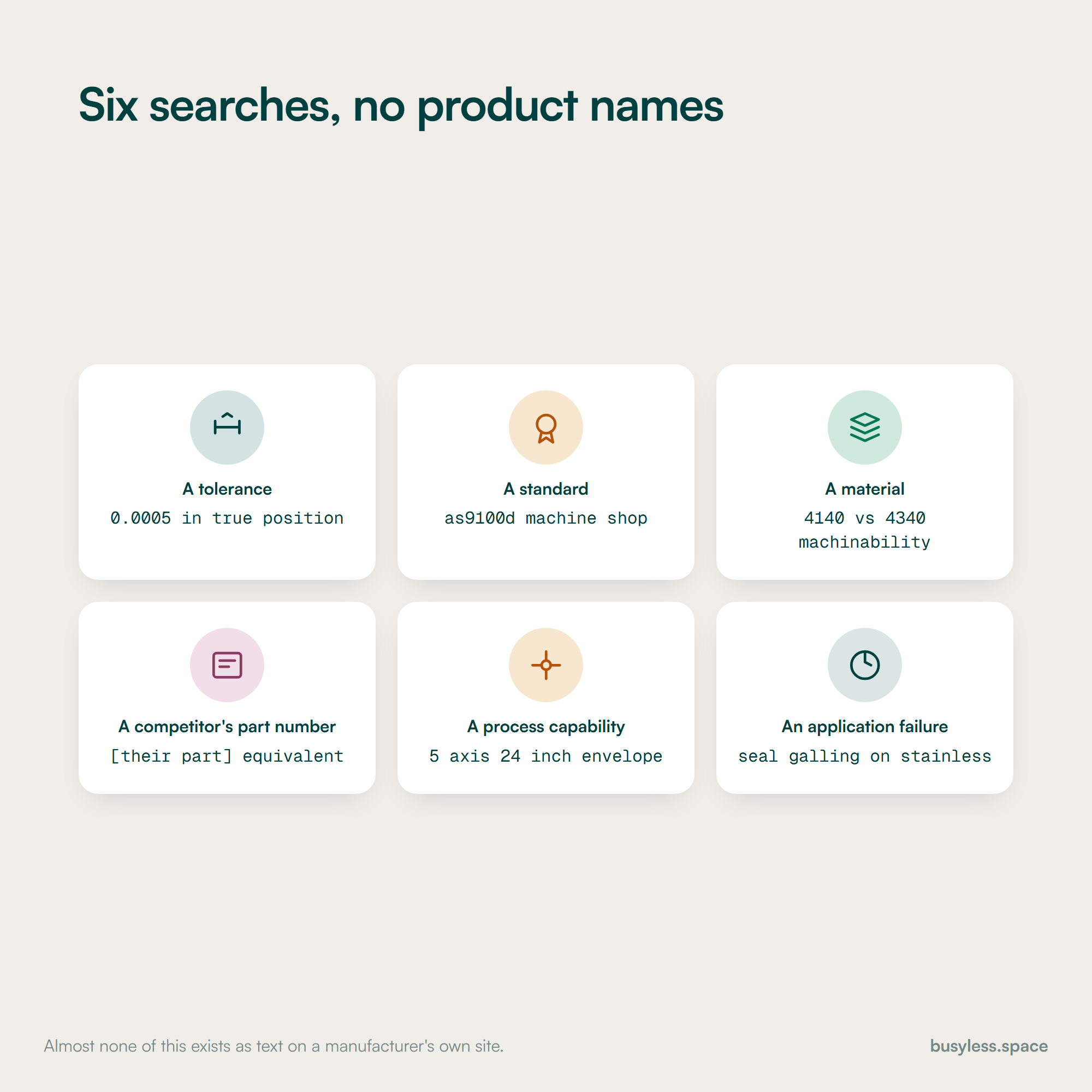
Six searches shown as a set: a tolerance, a standard, a material comparison, a competitor's part number, a process capability and an application failure. None of them contains a product name.
Six ways engineers actually search, and almost none of it exists as text on a manufacturer's own site.

What the rules change

Manufacturing is not advertised under an advertising regulator, and it has one constraint that is stricter than anything else in this directory: a regulator with an opinion about whether a specification may be published at all. Treat the first item below as a conversation with your export compliance officer rather than a marketing decision. None of this is legal advice.

1

Publishing technical data can be a controlled release

International Traffic in Arms Regulations, 22 CFR parts 120 to 130, administered by the Directorate of Defense Trade Controls; Export Administration Regulations, 15 CFR parts 730 to 774, administered by the Bureau of Industry and Security

What it means

Export control reaches information as well as goods. Technical data controlled under the ITAR may not be released to foreign persons without authorization, and making it publicly available on a website is a release to everyone. The analysis depends on the item and its classification, so drawings, tolerances, processes and material specifications for controlled items are the exact things a marketing team would naturally put on a capability page.

So do this

Before publishing any specification, drawing or process detail, route it through whoever owns export compliance, and get the answer in writing. Build a standing rule about which product lines may have public technical content and which may not. This is one place where a documented approval step is worth the friction it creates.

2

"Made in USA" is a regulated claim with a specific standard

Federal Trade Commission Made in USA Labeling Rule, 16 CFR Part 323, effective August 2021, and the FTC's long-standing all-or-virtually-all standard

What it means

An unqualified US origin claim requires that the product is all or virtually all made in the United States: final assembly or processing here, and all or virtually all ingredients or components sourced and made here. The rule reaches labels and, through the FTC Act, advertising generally. Reshoring content is the most commercially attractive cluster here, and exactly where the claim gets made without checking the bill of materials.

So do this

Either meet the standard or qualify the claim precisely: "assembled in the USA from domestic and imported components" is a different and usually accurate statement. Check the bill of materials before publishing, and keep the substantiation on file with the page, because the claim outlives whoever wrote it.

3

Certifications are checkable in public databases

Certification registrar databases, including the aerospace industry's OASIS database for AS9100 and equivalent registers for other schemes; DDTC registration for ITAR-registered entities

What it means

Quality certifications are audited, scoped and published. A buyer filtering for a certification checks the registrar rather than your website, and the scope statement in that database is what they see. A site claiming a certification the register does not show, or claiming a broader scope than the certificate covers, fails the check at the exact moment it mattered.

So do this

Publish the certificate number, the registrar, the scope as worded on the certificate, and the expiry date. Then set a reminder for the expiry, because an expired certification left on a website is the version of this that actually happens.

4

Your best proof is contractually unpublishable

Customer non-disclosure agreements and supply agreements

What it means

The most persuasive case studies in manufacturing are usually the ones you cannot tell. Programmes are covered by NDAs, customers are frequently prohibited from being named, and in defence and medical work the existence of the relationship can be sensitive. Manufacturers respond by publishing nothing, which is a real competitive loss rather than a neutral choice.

So do this

Write anonymised case studies with the customer removed and the engineering left in: the part class, the material, the tolerance, the problem, what you changed, the result as a proportion rather than a number. Get the anonymised version approved by the customer in writing. Most will agree to a version that names nothing.

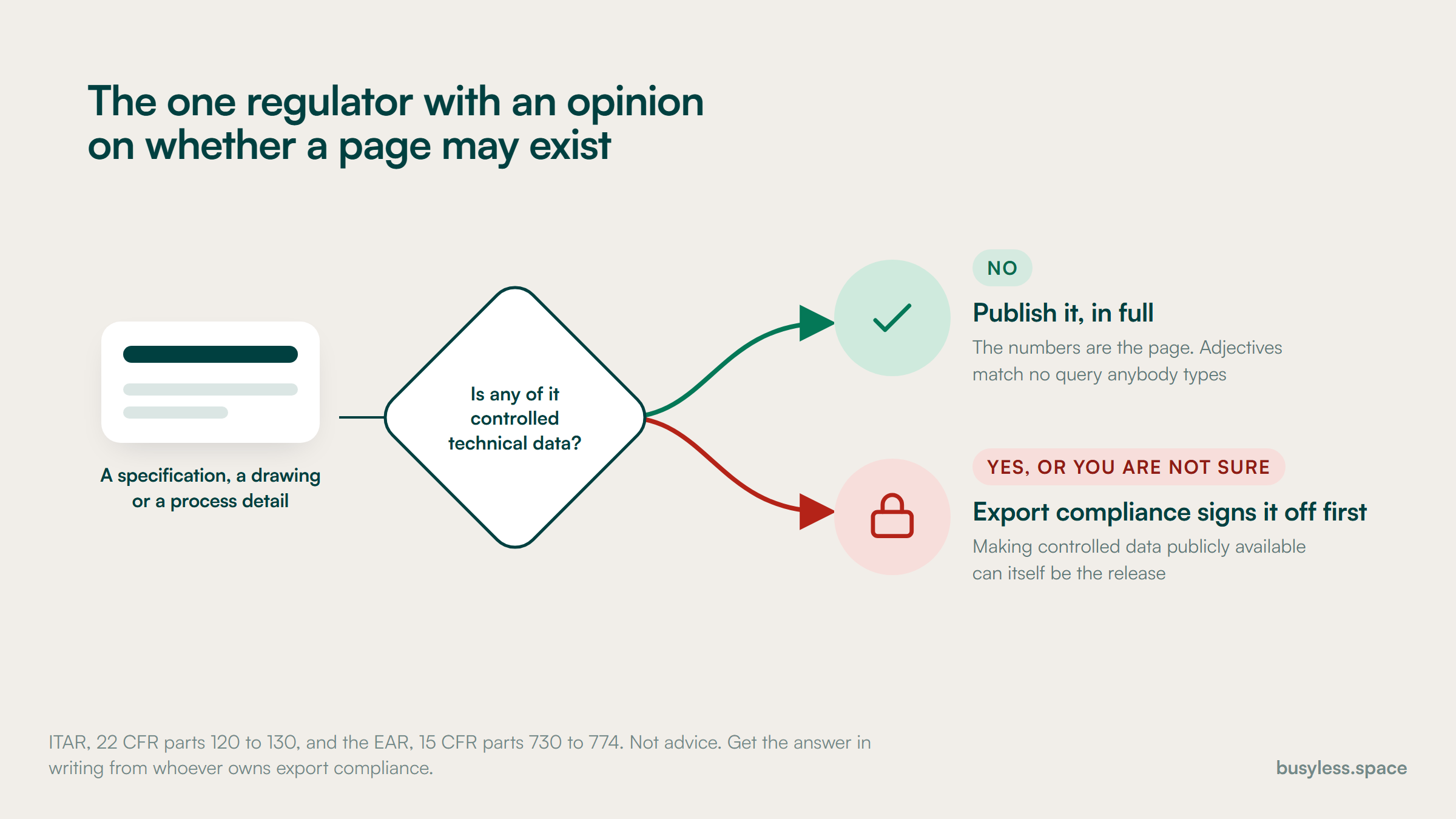
A decision gate. A specification, drawing or process detail reaches a question asking whether any of it is controlled technical data. No means publish it in full. Yes, or not sure, means export compliance signs it off first.
Export control is the one regulator in this directory with an opinion about whether a page may exist at all. Not advice: get the answer in writing.

Proving expertise

Industrial buyers evaluate suppliers the way auditors do. They want scope, evidence, numbers and names, and they are entirely unmoved by the language of marketing. More technical detail is always better here, which is true of almost nothing else written about marketing.

  • Certifications with certificate numbers, registrars, scope wording and expiry dates
  • Equipment lists with makes, models, work envelopes and axis counts
  • Tolerances, finishes and capabilities as numbers rather than adjectives
  • Materials you actually run, named by designation rather than by category
  • Named engineers and quality managers with their credentials and their years in the process
  • Inspection and metrology capability listed, including what you can certify to
  • Lead times and capacity stated honestly, with what changes them
  • Anonymised case studies with the engineering intact and customer approval on file

How to build a manufacturing SEO strategy

A realistic first year. The first phase is unusual and it is not optional: a manufacturing SEO strategy that starts publishing specifications before anybody has asked the export compliance question is creating a problem that is much more expensive than a slow start.

  1. 1

    Weeks 1 to 4

    Decide what may be published at all

    • Agree an export control review step with whoever owns compliance, in writing
    • List product lines and mark which may carry public technical detail and which may not
    • Audit every Made in USA or domestic-origin claim against the bill of materials
    • Check every certification claim against the registrar database, including scope and expiry
    • Inventory the PDF catalogue: how many documents, how many products, what is inside them
    • Search your own top part numbers and record who currently ranks for them

    You end up with
    A written rule about what can be published, and an honest map of what already ranks

  2. 2

    Weeks 4 to 12

    Get the specifications out of the PDFs

    • Build a page per product or part with the spec table as real text
    • Keep the datasheet as a download on that page rather than as the destination
    • Write process and capability pages with numbers: tolerances, envelopes, finishes, materials
    • Publish the equipment list with makes, models and capacities
    • Build the quality page with certificate numbers, scopes, registrars and dates
    • Add Product and Organization structured data with the specs as properties

    You end up with
    A site where the information buyers search for exists as pages rather than as attachments

  3. 3

    Months 3 to 9

    Take back the part numbers and write the application content

    • Build cross-reference pages for competitor and legacy part numbers you can supply
    • Write application notes from the questions your engineers answer on the phone
    • Build a page per industry served, with the certifications and documentation that sector needs
    • Publish anonymised case studies with customer approval on file
    • Write material and process selection comparisons, application-led
    • Get product data into the component search engines correctly, where relevant

    You end up with
    Coverage of the high-intent part queries and the upstream engineering questions

  4. 4

    Months 6 to 12

    Measure RFQs and quoted value, not sessions

    • Track qualified RFQs by source and by industry, with a human qualifying step
    • Track quoted value and win rate separately from enquiry count
    • Reconcile against the ERP or quoting system rather than trusting form data
    • Report leading and business indicators separately with the attribution gap stated
    • Set a review cadence on certifications, capacities and lead times, which all drift
    • Compare the directory subscriptions honestly against organic on cost per qualified RFQ

    You end up with
    A view of which content produces quotable work, and whether the directories still earn their fee

Technical fixes with the best payoff

One defect defines this industry and most of the others follow from it. The product information is in PDFs, so there are no pages, so there is nothing to link, nothing to rank and nothing for an assistant to read.

  • The catalogue is a folder of PDFs

    A sprint per product family

    PDFs can be indexed and they make terrible pages: no clean title, no meta description, poor internal linking, bad on a phone, and no way to connect a specification to an application or a capability. Meanwhile the specification inside is exactly what the buyer searched for.

    Build an HTML page per product with the spec table as real text, and keep the PDF as a download from that page. The page ranks, the PDF gets emailed to the buyer's colleague, and both jobs are done.

  • Capabilities are adjectives

    A day per capability page

    "Tight tolerances", "state of the art equipment" and "exceptional quality" appear on almost every manufacturing website and match no query anybody types. The engineer searched a number.

    Replace every adjective with a figure. The tolerance you actually hold, the work envelope, the finish, the materials by designation, the machine makes and models, the inspection equipment. It reads as confidence and it is also the keyword research.

  • Distributors own your part numbers

    A sprint, then automated from your product data

    They built a page per part with a spec table and a buy button. You published a catalogue. So when somebody searches your own part number, a distributor answers, and you have no relationship with that search at all.

    Build the part pages. Even without transacting, a page per part with full specs, the datasheet, compatible items and where to buy it beats not existing. Add cross-reference pages for the competitor part numbers you can replace.

  • The part search or configurator has no URLs

    A sprint, and a developer conversation

    Industrial part finders are frequently JavaScript applications where every result lives at the same address. Nothing inside can be linked, shared or indexed, and it is often the most useful thing on the site.

    Give every result a real URL that renders server-side, and link to them from category pages. If the configurator has to stay as it is, publish a parallel static index of the same items.

  • Certifications are logo images

    An afternoon

    The certifications are a hard filter for the buyer, and putting them in a logo strip means the certificate number, the scope and the registrar are nowhere in the text of the page. It also means nothing can quote them.

    A quality page with each certification written out: standard, certificate number, registrar, scope as worded, issue and expiry dates. Link the registrar's own database entry.

  • One capabilities page serves every industry

    A sprint

    An aerospace buyer needs first article inspection and traceability, a medical buyer needs validation documentation, and a food equipment buyer needs different finishes entirely. A single page written for all of them proves capability to none of them.

    One page per industry served, with that sector's certifications, documentation, tolerances and typical parts. This is also how buyers self-select, which shortens the qualifying call.

  • Nobody is named

    A day

    Manufacturing is bought on capability and trust, and a site with no named engineers, no quality manager and a stock photograph of a factory gives an evaluating buyer nothing to hold on to. It also means application notes have no author.

    Name the engineering and quality team with their credentials and their years in the process. Attribute application notes to the person who solved the problem. Both are cheap and neither is done.

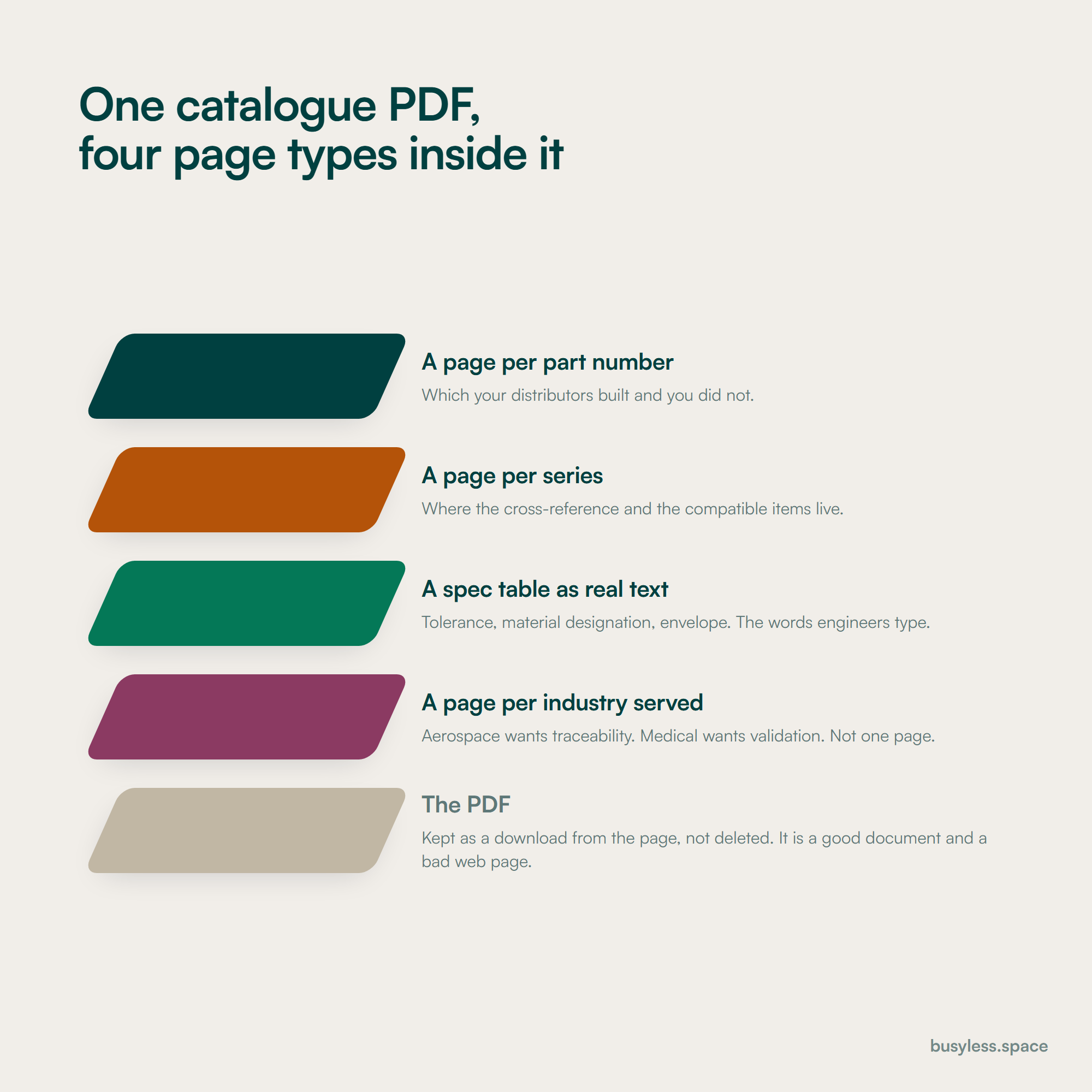
A catalogue PDF pulled apart into five skewed plates: a page per part number, a page per series, a spec table as real text, a page per industry served, and at the base the PDF itself kept as a download.
The PDF is a good document and a bad web page. Nothing here deletes it, and four page types come out of it.

Structured data that applies here

The types below fit this industry specifically. Most of them earn no rich result on their own, which is worth knowing before anyone sells the work on that basis. What they do is describe the entity precisely, which matters for how search engines and answer engines resolve who you are.

  • Product with specifications as properties

    Each product or part page

    The type that finally puts specs into structured data instead of leaving them in a PDF. Use additionalProperty for anything that is not a standard field, which in this industry is most of it.

    Product with specifications as properties.jsonld
    {
      "@context": "https://schema.org",
      "@type": "Product",
      "@id": "https://[YOUR-DOMAIN]/products/[SLUG]#product",
      "name": "[PRODUCT NAME]",
      "sku": "[YOUR PART NUMBER]",
      "mpn": "[MANUFACTURER PART NUMBER]",
      "gtin": "[IF YOU HAVE ONE]",
      "brand": { "@type": "Brand", "name": "[BRAND]" },
      "manufacturer": { "@id": "https://[YOUR-DOMAIN]/#organization" },
      "material": "[e.g. 316L stainless steel]",
      "description": "[What it is and what it is used for, in the engineer's words.]",
      "additionalProperty": [
        { "@type": "PropertyValue", "name": "Tolerance", "value": "[+/- 0.0005 in]" },
        { "@type": "PropertyValue", "name": "Surface finish", "value": "[Ra 32]" },
        { "@type": "PropertyValue", "name": "Operating temperature", "value": "[-40 to 200 C]" },
        { "@type": "PropertyValue", "name": "Standard", "value": "[ASTM A276]" }
      ],
      "isSimilarTo": [
        { "@type": "Product", "name": "[COMPETITOR PART], cross-reference" }
      ]
    }
  • Organization with certifications

    The quality page and site-wide

    Certifications are a hard filter for industrial buyers, so this node carries more weight here than almost anywhere else. Only publish what the registrar database will confirm.

    Organization with certifications.jsonld
    {
      "@context": "https://schema.org",
      "@type": "Organization",
      "@id": "https://[YOUR-DOMAIN]/#organization",
      "name": "[COMPANY NAME]",
      "url": "https://[YOUR-DOMAIN]",
      "foundingDate": "[YYYY]",
      "numberOfEmployees": { "@type": "QuantitativeValue", "value": "[000]" },
      "naics": "[NAICS CODE]",
      "hasCredential": [
        {
          "@type": "EducationalOccupationalCredential",
          "credentialCategory": "[AS9100D]",
          "identifier": "[CERTIFICATE NUMBER]",
          "recognizedBy": { "@type": "Organization", "name": "[REGISTRAR]" },
          "validIn": { "@type": "Place", "name": "[FACILITY / SCOPE]" }
        },
        {
          "@type": "EducationalOccupationalCredential",
          "credentialCategory": "[ISO 9001:2015]",
          "identifier": "[CERTIFICATE NUMBER]",
          "recognizedBy": { "@type": "Organization", "name": "[REGISTRAR]" }
        }
      ],
      "knowsAbout": ["[5 axis machining]", "[316L stainless]", "[Medical device components]"]
    }
  • TechArticle

    Application notes and engineering explainers

    The right type for content written by an engineer for an engineer, and it carries dependencies and proficiency level, which are genuinely meaningful here. It is also the content most likely to be cited by an assistant answering a technical question.

    TechArticle.jsonld
    {
      "@context": "https://schema.org",
      "@type": "TechArticle",
      "headline": "[The engineering question, as an engineer would ask it]",
      "description": "[One sentence: the problem and the conclusion.]",
      "datePublished": "[YYYY-MM-DD]",
      "dateModified": "[YYYY-MM-DD]",
      "author": {
        "@type": "Person",
        "name": "[ENGINEER NAME]",
        "jobTitle": "[Manufacturing engineer]",
        "worksFor": { "@id": "https://[YOUR-DOMAIN]/#organization" }
      },
      "publisher": { "@id": "https://[YOUR-DOMAIN]/#organization" },
      "proficiencyLevel": "Expert",
      "dependencies": "[Prior knowledge assumed, e.g. familiarity with GD&T]",
      "about": [
        { "@type": "Thing", "name": "[MATERIAL OR PROCESS]" }
      ]
    }
  • Service for contract capability

    Process and capability pages

    Use it where you sell a capability rather than a catalogue item. Keep the description in numbers, because the description is what a generative answer will quote back.

    Service for contract capability.jsonld
    {
      "@context": "https://schema.org",
      "@type": "Service",
      "name": "[PROCESS, e.g. 5 axis CNC machining]",
      "serviceType": "[Contract manufacturing]",
      "provider": { "@id": "https://[YOUR-DOMAIN]/#organization" },
      "areaServed": { "@type": "Country", "name": "US" },
      "audience": {
        "@type": "BusinessAudience",
        "audienceType": "[Aerospace / medical device / industrial OEM]"
      },
      "description": "[Envelope, tolerance, materials, typical lot sizes, lead time. Numbers, not adjectives.]",
      "additionalProperty": [
        { "@type": "PropertyValue", "name": "Work envelope", "value": "[000 x 000 x 000 mm]" },
        { "@type": "PropertyValue", "name": "Tolerance capability", "value": "[+/- 0.0005 in]" },
        { "@type": "PropertyValue", "name": "Typical lot size", "value": "[00 to 0000]" }
      ]
    }
  • FAQPage

    Capability, material and sourcing pages with visible questions

    Mark up only questions a visitor can see. Lead time, minimum order and documentation earn their place here, because those three decide whether you get the RFQ at all.

    FAQPage.jsonld
    {
      "@context": "https://schema.org",
      "@type": "FAQPage",
      "mainEntity": [
        {
          "@type": "Question",
          "name": "[Question exactly as it appears on the page]",
          "acceptedAnswer": {
            "@type": "Answer",
            "text": "[Answer exactly as it appears. Give the number: the lot size, the lead time, the tolerance.]"
          }
        }
      ]
    }
  • BreadcrumbList

    Product, category and industry pages

    Worth it as soon as the catalogue exists as pages, because a real product hierarchy is the thing the PDF catalogue never had. Expect it to turn up products that belong to no category at all.

    BreadcrumbList.jsonld
    {
      "@context": "https://schema.org",
      "@type": "BreadcrumbList",
      "itemListElement": [
        { "@type": "ListItem", "position": 1, "name": "Home",
          "item": "https://[YOUR-DOMAIN]/" },
        { "@type": "ListItem", "position": 2, "name": "[CATEGORY]",
          "item": "https://[YOUR-DOMAIN]/products/[CATEGORY]" },
        { "@type": "ListItem", "position": 3, "name": "[PRODUCT]",
          "item": "https://[YOUR-DOMAIN]/products/[CATEGORY]/[SLUG]" }
      ]
    }

What it costs

Editorial estimates rather than quotes. Manufacturing budgets look high next to the trades and buy fewer pages, because the pages take an engineer's time and often an approval step. The offsetting fact is that one won programme can pay for several years of it.

Lean

$2,500 to $4,500
  • The quality and certification page done properly and kept current
  • Capability pages rewritten with real numbers instead of adjectives
  • One product family lifted out of PDF into pages
  • One application note a month, drafted from an engineer's interview
  • Quarterly reporting on qualified RFQs rather than sessions

Who it suits

A single-facility shop that has decided to stop relying entirely on directories and referrals

Where it stops

It will not convert a large catalogue, which is a data project rather than a writing one. It also cannot move faster than your engineers can review copy.

Funded

$5,000 to $9,000
  • The catalogue converted to pages, generated from your product data
  • Part number and cross-reference pages built at scale
  • A page per industry served with that sector's proof
  • An application note programme with a real interview cadence
  • Anonymised case studies with customer approval workflow
  • RFQ attribution reconciled against the quoting system

Who it suits

Manufacturers with a real catalogue, several industries served, and a sales team that wants qualified RFQs

Where it stops

Export control and customer confidentiality still bound what can be published. That is a governance constraint and no budget removes it.

Enterprise

$10,000 and up
  • Product data as the source of truth, publishing to site, feeds and marketplaces at once
  • Multi-language coverage where you genuinely sell internationally
  • Original technical research and testing, which is what earns citations in this sector
  • Distributor and channel content coordination, so you stop competing with your own network
  • Recruitment content, which for many manufacturers is the binding constraint rather than demand

Who it suits

Multi-facility manufacturers, or anyone whose catalogue is large enough that manual page creation is not viable

Where it stops

At this scale the limit is internal: engineering review capacity and export approval throughput, not budget or ideas.

How to do it with no budget

Most of the highest-value work here costs nothing but an engineer's afternoon, because the information already exists inside the business. The first item unblocks everything under it.

  1. 1

    Agree the export control review step

    2 hours

    A conversation and a one-page written rule

    Do this first. It is the only item on this list where getting it wrong is a regulatory problem rather than a missed opportunity, and it also unblocks everything else.

  2. 2

    Search your own top ten part numbers

    1 hour

    A search engine

    Write down who ranks for each. The list of distributors and directories answering questions about your own products is the most persuasive internal argument for this work you will ever produce.

  3. 3

    Rewrite the capability page in numbers

    3 hours

    Your website editor and your process engineer

    Every adjective replaced by a figure: tolerance, envelope, finish, materials, machine list. It is the fastest ranking gain available and it reads as confidence rather than marketing.

  4. 4

    Build the quality page properly

    2 hours

    Your quality manager and the registrar database

    Certificate numbers, registrars, scope wording, expiry dates, with a link to the registrar's own entry. Buyers filter on this before they read anything else.

  5. 5

    Convert one product family out of PDF

    A day

    Your website editor

    Take the family with the most enquiries, put the spec table on a page as text, and keep the PDF as a download. Then compare the two over a quarter and you have your business case.

  6. 6

    Write three application notes

    3 hours each

    An hour with an engineer and a recorder

    Take the three questions your engineers answer most often on the phone. Interview, transcribe, edit, get it checked, publish with their name on it. This is the content nobody else in your sector has.

  7. 7

    Audit the Made in USA claims

    2 hours

    Your bill of materials

    Either the claim meets the all or virtually all standard or it needs qualifying. Fixing it costs an afternoon; leaving it is a claim you cannot substantiate on your most commercially attractive pages.

The tool stack

Jobs first, tools second. The most valuable input here is not a tool at all, it is an hour a week of an engineer's time, and every tool below is an attempt to make that hour go further.

  • Find the specification and part-number queries you are missing

    DataForSEOSEO APIRead the review

    Industrial keyword research is hard because volumes are tiny and the phrasing is technical. The API is useful mainly for checking part-number and cross-reference queries in bulk, which no manual process handles.

    Free routeSearch Console covers the queries you already appear for

  • Learn the actual vocabulary buyers use

    Your quoting inbox and your sales engineers

    Read fifty RFQ emails and write down the words. That is the keyword research for this industry, and it will not match anything the marketing team would have written.

    Free routeFree, and better than any tool

  • Model what a won programme from search is worth

    SEO Revenue Growth CalculatorFree toolOpen the tool

    Use programme lifetime value rather than first order value, because industrial relationships run for years. Also use a realistic quote-to-win rate, which in contract manufacturing is usually lower than people assume.

    Free routeFree

  • Argue the budget against what the directories already cost

    SEO Budget CalculatorFree toolOpen the tool

    Present it against cost per qualified RFQ from the directories you already pay for. That comparison is usually the argument that gets the budget approved.

    Free routeFree

  • Generate Product and Organization markup with real properties

    Schema Markup GeneratorFree toolOpen the tool

    Generate the pattern once and then produce it from your product data rather than by hand. A catalogue of any size makes manual markup unmaintainable within a month.

    Free routeFree

  • Publish a catalogue from product data rather than by hand

    PayloadHeadless CMSRead the review

    Products, materials, processes, industries and certifications are related entities, and a spec table should come from one record rather than being retyped per page. This is the single infrastructure decision that decides whether the catalogue conversion is a project or a permanent job.

    Free routeFree and self-hosted

  • Get product data into component search engines

    Your distributors and the component aggregators

    For electronic and electromechanical parts these rank strongly on part numbers. Correct, complete data is what decides whether you appear in a filtered search, and it is a data quality task rather than a marketing one.

    Free routeUsually free, and usually nobody's job

  • See what AI assistants say when an engineer describes a problem

    LLM visibility trackerOur toolSee the tool

    Engineers increasingly describe an application to an assistant before they search for a supplier. The answers come from whoever published a real explanation, which is the argument for the application note programme.

Take it from here

Everything below is yours to take. Fill the [BRACKETS] and it is ready to use. Start with the publication review: it is the only item here that closes a regulatory exposure, and it has to exist before anything technical is published.

Checklist

The approval step that has to exist before any specification goes on a public page. Export control reaches information, and a website is a release to everyone.

TECHNICAL PUBLICATION REVIEW - [COMPANY]
Owner: [EXPORT COMPLIANCE OFFICER]     Effective: [DATE]

WHY THIS EXISTS
Export control reaches technical data, not just goods. Making
controlled technical data publicly available is a release to
every person who can reach the page. The specifications, drawings
and process details a marketing team would naturally publish are
exactly the categories at issue.
This checklist does not decide anything. It routes the decision to
the person who is allowed to make it, and records the answer.

1. CLASSIFY THE PRODUCT LINE, ONCE
   | Product line    | Controlled? | Classification | Public tech OK? |
   |-----------------|-------------|----------------|-----------------|
   | [_____________] | [ Y / N ]   | [____________] | [ Y / N / SOME ]|
   | [_____________] | [ Y / N ]   | [____________] | [ Y / N / SOME ]|
   | [_____________] | [ Y / N ]   | [____________] | [ Y / N / SOME ]|

   Determined by: [NAME, ROLE]     On: [DATE]

2. FOR EVERY NEW TECHNICAL PAGE
   [ ] Product line identified: [_______________]
   [ ] Falls under a line marked "public tech OK": [ Y / N ]
   [ ] If NO or SOME, escalated to [NAME] on [DATE]
   [ ] Decision received in writing: [ Y / N ]
   [ ] Decision: [ APPROVED / APPROVED WITH REDACTIONS / REFUSED ]
   [ ] Redactions required: [_________________________]
   [ ] Approver: [NAME]  Date: [____]  Reference: [____]

3. THINGS THAT ALWAYS GO TO REVIEW
   [ ] Drawings or dimensioned images of any kind
   [ ] Process parameters (temperatures, feeds, speeds, cycles)
   [ ] Material specifications tied to a controlled item
   [ ] Test and qualification data
   [ ] Any content naming a defence or aerospace programme
   [ ] Photographs where a part or a fixture is identifiable
   [ ] Anything a customer supplied to you

4. THINGS THAT USUALLY DO NOT
   (confirm once with your compliance officer, then rely on it)
   [ ] Machine makes, models and work envelopes
   [ ] Certifications, scopes and registrar details
   [ ] Materials you run, stated as a list
   [ ] General tolerance capability for commercial work
   [ ] Lead times and lot sizes

5. THE RECORD
   Every approved page carries, in an internal field:
     Approved by [NAME] on [DATE], reference [____]
   So that in two years somebody can answer the question.

6. RE-REVIEW
   [ ] On classification change
   [ ] On new programme award
   [ ] Annually: [DATE]

What to publish

Ordered by how close each asset sits to a quotable enquiry. Manufacturing sites write about company history and equipment lists. What produces RFQs is writing about the buyer's part and the buyer's problem.

  • A page per product with the spec table as text

    By product family, until the catalogue is done

    The single highest-value conversion available. It moves the information buyers actually search for out of a PDF and onto something that can rank, link and be quoted.

  • Cross-reference and part-number pages

    Generated from product data once the pattern exists

    The highest-intent industrial query there is, currently answered by your distributors and by directories, about your own products.

  • Application notes by named engineers

    One or two a month, from a standing interview slot

    The content nobody else in your sector has, because the knowledge lives in people's heads. It reaches the engineer months before the RFQ and it is what assistants cite.

  • A page per industry served

    One per industry you genuinely serve, updated as certifications change

    How buyers self-select, and how you prove you understand a sector's documentation requirements rather than just its parts.

  • The quality and certification page

    Once, then whenever a certificate is renewed

    A hard filter rather than a nice-to-have. Buyers check it before they read anything else, and most versions of it are a strip of logos.

  • Anonymised case studies

    One a quarter, with approval built into the process

    Solves the confidentiality problem rather than surrendering to it. The engineering is the persuasive part and the customer name usually is not.

And what not to

  • Any technical detail that has not been through export control review
  • Unqualified Made in USA claims that the bill of materials will not support
  • Certifications stated without a number, a registrar, a scope or an expiry date
  • "Tight tolerances", "world class quality" and every other adjective standing where a number belongs
  • Company history and anniversary content, which no buyer has ever searched for
  • A capabilities page written to serve every industry at once
  • Republished manufacturer or association content, which every other supplier has too
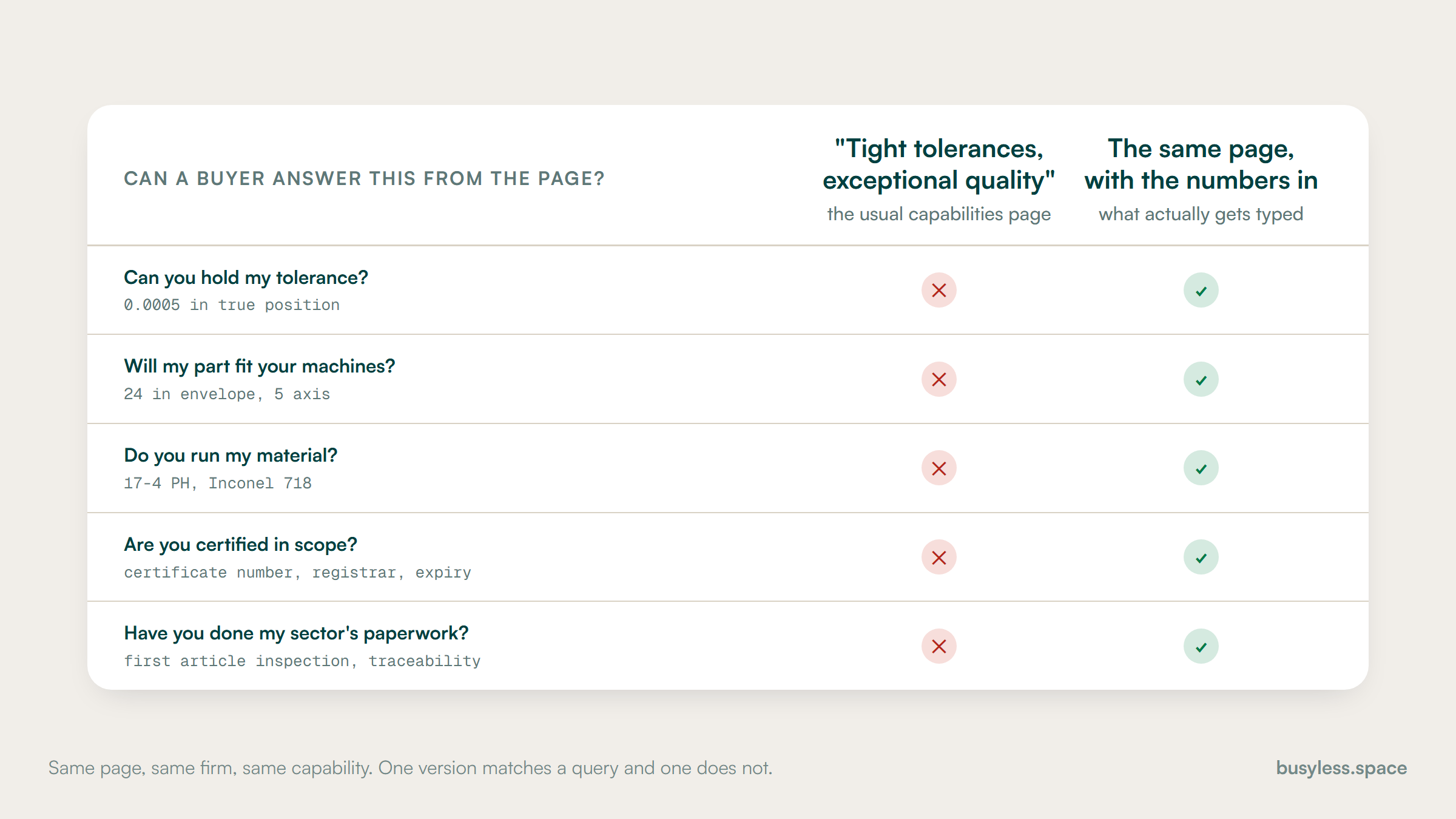
A five-row table asking whether a buyer can answer each question from the page. The usual capabilities page, promising tight tolerances and exceptional quality, answers none of them. The same page with the numbers in answers all five.
Same firm, same capability. One version matches a query and one does not.

The expensive mistakes

Leaving the catalogue in PDFs

Costs you The information buyers search for is present in the business and absent from the web, indefinitely

A page per product with the spec table as text, and the PDF as a download from it

Writing adjectives where numbers belong

Costs you Pages that match no query anybody types, on a site whose buyers search exclusively in numbers

Every capability stated as a figure, with the equipment list published in full

Conceding your own part numbers to distributors

Costs you The highest-intent search anybody performs about your company, answered by somebody else

Build the part pages and the cross-reference tables, generated from your product data

Publishing specifications without an export review

Costs you A potential controlled release, which is a regulatory matter rather than a marketing one

A written rule about which product lines may carry public technical content, agreed before anything is published

Publishing nothing because everything is under NDA

Costs you A competitive loss disguised as caution, on the proof that matters most

Anonymised case studies with the engineering intact and the customer approval on file

Reporting sessions to a plant manager

Costs you A programme judged on a number with no relationship to the order book, cancelled at the first quiet quarter

Qualified RFQs and quoted value by industry, with the attribution gap stated

What to measure

Industrial attribution has an unusual shape: very low volume, very high value, and a sales cycle measured in quarters. That combination makes conversion-rate reporting useless and makes a human qualifying step essential, because raw form fills here are mostly students and offshore suppliers.

Leading indicators

Move first. They predict, they do not prove.

  • Impressions on specification and part-number queries

    Search Console, filtered to technical query patterns

    Report by cluster rather than in total. Volumes are tiny and the totals are meaningless; what matters is whether you now appear for the tolerance and the part number at all.

  • Product pages indexed, against products in the catalogue

    Search Console coverage against your own product count

    The single clearest measure of progress during the PDF conversion, and a number a plant manager immediately understands.

  • Part-number query position against distributors

    Rank tracking on your own part numbers

    Track your position relative to the distributors specifically. Moving above them on your own parts is the concrete goal, not an abstract ranking improvement.

  • Application note engagement and citations

    Analytics, plus manual checks of assistant answers

    Slow moving and the strongest indicator of technical authority. Watch whether assistants start citing you on the questions you have answered.

Business indicators

The ones a manager acts on.

  • Qualified RFQs by source and industry

    Quoting system, with a human qualifying step

    Raw form fills are worthless here. Somebody has to decide whether an enquiry is real, and it has to be the same somebody using the same rule every month.

  • Quoted value from search

    Quoting system or ERP

    Report quoted value alongside RFQ count. Ten enquiries for prototype work and one for a production programme are not the same month, and the count alone cannot tell you which happened.

  • Win rate on search-sourced RFQs

    Quoting system

    Worth reporting separately, because search-sourced enquiries often have a different win rate from referred ones. If it is much lower, the content is attracting the wrong fit and the pages need qualifying detail.

  • Cost per qualified RFQ, organic against directories

    Quoting system plus channel spend

    The comparison that decides whether the directory subscriptions get renewed. Make it honestly, including the internal time organic content consumes.

The verdict

Manufacturing is the largest gap between what a buyer wants to know and what a supplier publishes of anything in this directory. The specifications, tolerances, certifications and application knowledge all exist inside the business, and almost none of it is on a page.

That makes the work unusually concrete. Convert the catalogue out of PDFs, replace adjectives with numbers, build the part pages your distributors built for you, and put an engineer's knowledge into application notes with their name on them.

Ask anybody pitching manufacturing SEO services these three things before you look at a price. Will they ask who owns export compliance before publishing a specification? Will they interview your engineers rather than writing around them? Will they report qualified RFQs and quoted value rather than traffic?

The second is the one that gets failed, because interviewing a process engineer is slow and writing generic industry content is fast. The generic version of SEO services for manufacturers is also the version every one of your competitors already has.

FAQ

Manufacturing SEO questions

  • Why does our website not rank for anything?
    Usually because the information buyers search for is inside PDFs rather than on pages. Engineers search tolerances, alloy designations, standards and part numbers, and on most manufacturing sites none of that exists as text. Converting one product family out of the catalogue and onto real pages, with the spec table written out and the datasheet as a download, is the fastest way to find out whether that is your problem too.
  • Can we publish our specifications?
    Ask your export compliance officer before you publish anything technical, and get the answer in writing. Export control reaches technical data, not just goods, and making controlled data publicly available is a release to everyone who can reach the page. The practical answer is usually a standing rule: some product lines may carry public technical detail and some may not. Agreeing that rule once unblocks everything else.
  • Our distributors outrank us for our own parts. Can we fix that?
    Yes, and most manufacturers have never tried. Distributors rank because they built a page per part number with the spec table, the datasheet and a buy button, while the manufacturer published a catalogue PDF. Build the part pages. Include the spec table as text, cross-references to equivalents you can supply, and a list of where to buy that names your distributors. They still get the order and you keep the relationship with the search.
  • Everything we do is under NDA. What can we publish?
    The engineering, without the customer. Write the case study as a part class, a material, a tolerance, a problem, what you changed and the result as a proportion rather than an absolute. Then get that anonymised version approved by the customer in writing; most agree to a version that names nothing. Publishing nothing at all is a competitive loss dressed up as caution.
  • Are the industrial directories worth the money?
    Judge them on cost per qualified RFQ, with a human doing the qualifying, and compare them honestly against organic including the internal engineering time organic consumes. They are a tiered advertising product rather than a listing, so what you are buying is placement. Be sceptical of any reporting that counts a profile view as a lead, and be clear that a directory relationship is rented while a product page you own is not.
  • Can we say Made in USA?
    Only if the product meets the standard, which is all or virtually all made in the United States. The FTC's Made in USA Labeling Rule took effect in August 2021 and reaches advertising as well as labels. Check the bill of materials before publishing, and where the unqualified claim does not hold, qualify it accurately: "assembled in the USA from domestic and imported components" is a different and usually true statement.
  • What does manufacturing SEO cost?
    The tiers above are editorial estimates rather than quotes. A single-facility shop doing this properly is realistically at $2,500 to $4,500 a month, and a manufacturer converting a real catalogue is at $5,000 to $9,000. The number is driven by catalogue size and by how much engineering review time each page needs, which is the constraint that actually sets the pace.
  • Can AI write our technical content?
    For structure, transcription and editing, yes, and it is genuinely useful for turning an engineer's recorded hour into a draft. For generating technical claims, no. A model will produce a confident tolerance, a plausible standard number and a material property that is wrong, and in this industry that mistake reaches somebody's design. Interview your engineer, let AI handle the transcript and the first edit, and have the engineer check every number before it is published.

Run it yourself, or have someone own it

Everything above is written to be run without us, and the free path is genuinely most of the value for a single-location business. Where these plans stall is almost never the plan. It is that nobody owns it after the first month. That is the job we do, with search as one distribution layer inside a wider system rather than the whole engagement.