
Content marketing for real estate agents
Regulated marketingYour reader moves once a decade and their friends ask them
- Sector
- Property and construction
- Channels
- Newsletter, Video, Community
- Buying cycle
- Long cycle
- Time to compound
- 12 to 24 months
- Typical monthly
- $700 to $5,000
Key takeaways
- 1Almost everybody reading you is years away from moving. Content written to convert them is written for somebody who is not there, which is why so much of this industry's marketing feels like it is shouting at an empty room.
- 2Their real job is to answer a question at a barbecue. Somebody says they are thinking of selling, and your reader either says a name or does not. Everything you publish is competing for that half second.
- 3So build for recall and forwarding rather than for conversion. A market note somebody sends to a friend has done its whole job even though the person who received it never subscribed and the person who sent it is not moving.
- 4Your best material is not the neighbourhood guide, which belongs on the search side of this and carries a serious compliance rule with it. It is what you learned inside hundreds of houses: what fails, what surveys find, and what deals actually collapse on.
- 5If a lender is paying part of your marketing bill, that arrangement has a federal statute attached, and it is the rule in this industry most likely to be misunderstood by everybody involved in it.
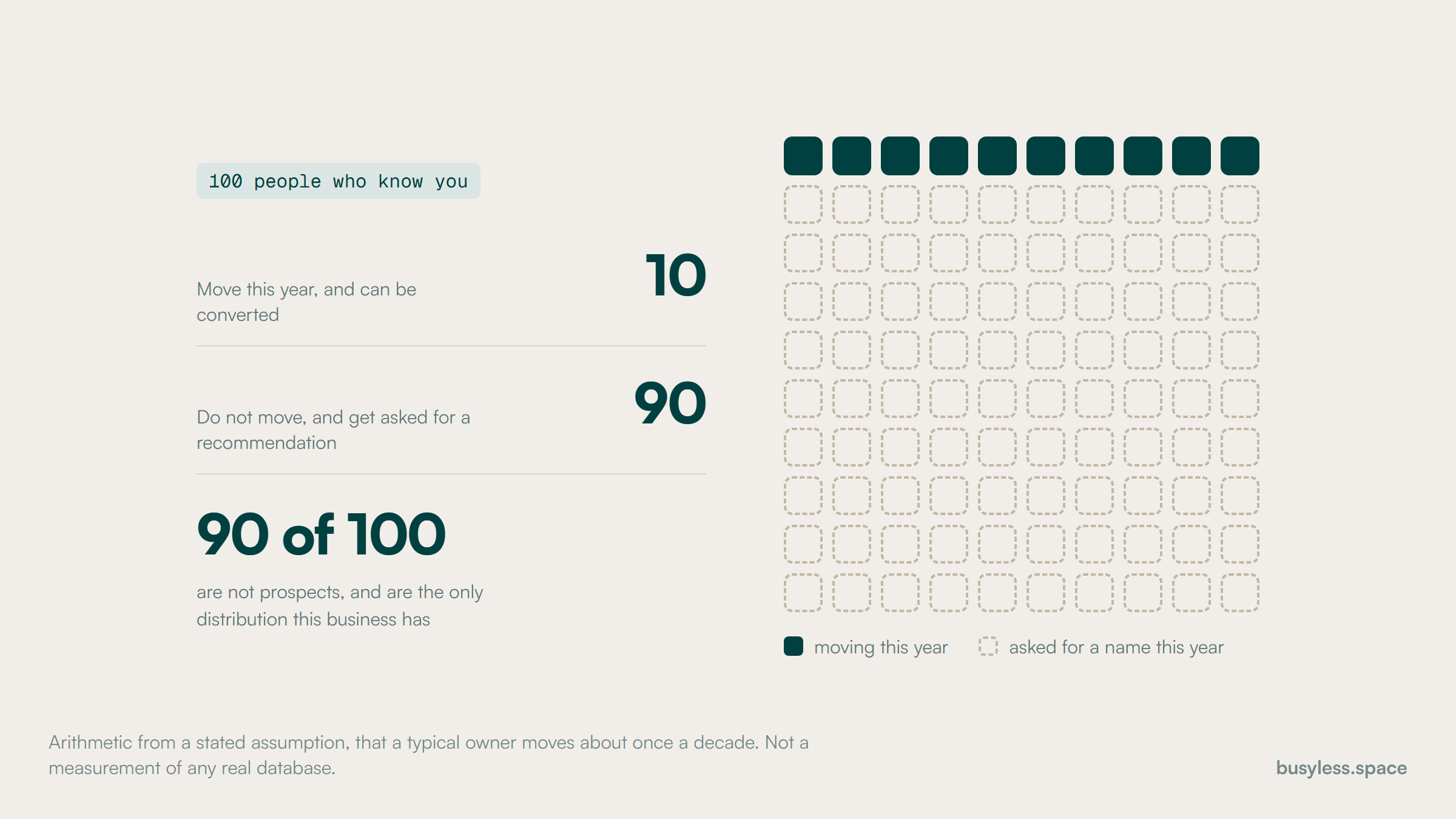
Content marketing for real estate agents is built on a fact the funnel language cannot cope with. If a typical owner moves about once a decade, then at any moment the overwhelming majority of your audience is not a prospect, is not becoming one this year, and cannot be converted by anything.
That is not a reason to publish less. It is a reason to publish differently. The reader's value is not their own transaction, which is years away, but the moment somebody they know says they are thinking of selling and asks whether they know anybody good.
Content built for that moment looks different from content built for a form fill. It has to be memorable rather than persuasive, and forwardable rather than gated, and it has to keep arriving for years without asking for anything, which is uncomfortable for an industry that measures everything in leads.
A real estate content marketing strategy is therefore mostly a sphere strategy. The audience is people who already know you, publishing is how you stay in their head between transactions, and the thing you are optimising is whether your name arrives in a conversation you will never hear.
Looking for the search half
This page decides which channels to run. The one next door goes deep on just one of them.
Which channels to run, and which to skip
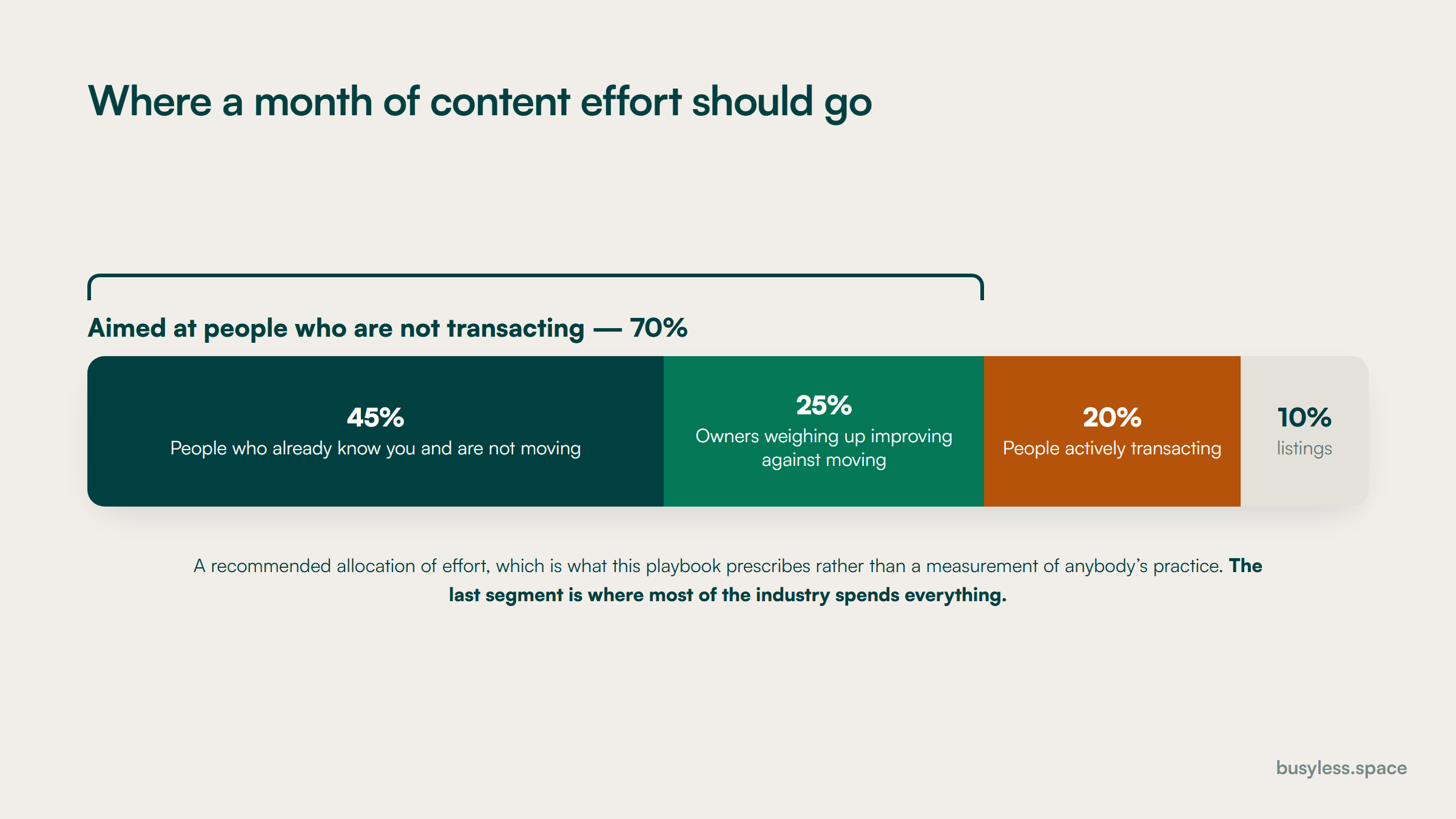
Judged on whether the channel reaches somebody who is not in the market and keeps reaching them for years. That is an unusual test and it rules out most of what this industry spends its marketing budget on.
Run these
Newsletter
RunThe only channel you own, the only one that keeps arriving without an algorithm agreeing, and the only one somebody can forward with a sentence attached. For an audience measured in years rather than weeks, that combination is decisive, and a list of four hundred people who know you beats any amount of reach.
First moveWrite to everybody who already knows you, monthly, and ask for nothing. The asking is what makes people stop opening it.
Video
RunProperty video has an enormous audience that is overwhelmingly not buying anything, which sounds like a failure and is exactly right here. People watch houses for pleasure, remember who showed them, and pass the name on. It is the cheapest recall this industry has access to.
First moveWalk one house properly, on camera, and say what is actually wrong with it. Honesty is the whole differentiator in a category built on flattering footage.
Community
RunThe sphere in physical form. School events, sports clubs, the businesses on your high street, the local association nobody else turns up to. It is slow, unmeasurable and the single most reliable source of business in this industry, which is why it survives every change in the technology.
First movePick one thing you would attend anyway and attend it for a year without mentioning property. That is the entire tactic.
Worth a test, with a kill date
Founder-led social
TestEverybody is here and most of what they post is listing announcements, which are of interest to nobody outside the industry. There is a version that works, and it is the same walkthrough and market material doing a second job. The test is whether you can resist turning it back into a listing feed.
First movePost for a month without a single listing announcement and see what happens. Most agents have never tried it.
Search
TestThe portals took the inventory queries long ago and how they did it is the sibling playbook's subject. What is left and worth testing is the question space nobody monetises: whether to sell or rent it out, what a survey will find, what a renovation actually returns. Those attract owners years before they move.
First moveAnswer one question that has nothing to do with a listing. It will reach people no portal is speaking to.
Events and talks
TestThis industry has an odd tradition of client appreciation events, and the good ones work for exactly the reason this page describes: they put you in front of people who are not moving, alongside the friends who might. Worth testing where you would genuinely enjoy hosting one and worth skipping where it is a duty.
First moveDo something small that people would attend without you, and invite the sphere. A pie collection at Thanksgiving outperforms a seminar.
Skip these
Original research
SkipEvery agent in your market publishes the same monthly figures from the same feed, so it is a commodity rather than research, and the terms attached to the underlying data are the sibling playbook's subject. Your own transactions are too few to generalise from honestly, which is the arithmetic nobody in this industry likes.
Trade press
SkipReal estate publications reach other agents, brokerage recruiters and the vendors selling to all of you. Being known among agents is genuinely useful for referrals across markets, and it is a different objective with a different budget. Nobody reading it is buying a house from you.
Three to run and all three are patient channels that reach people with no transaction in sight. The skips are the two places this industry spends most confidently: a market report identical to every competitor's, and a trade audience made entirely of competitors.
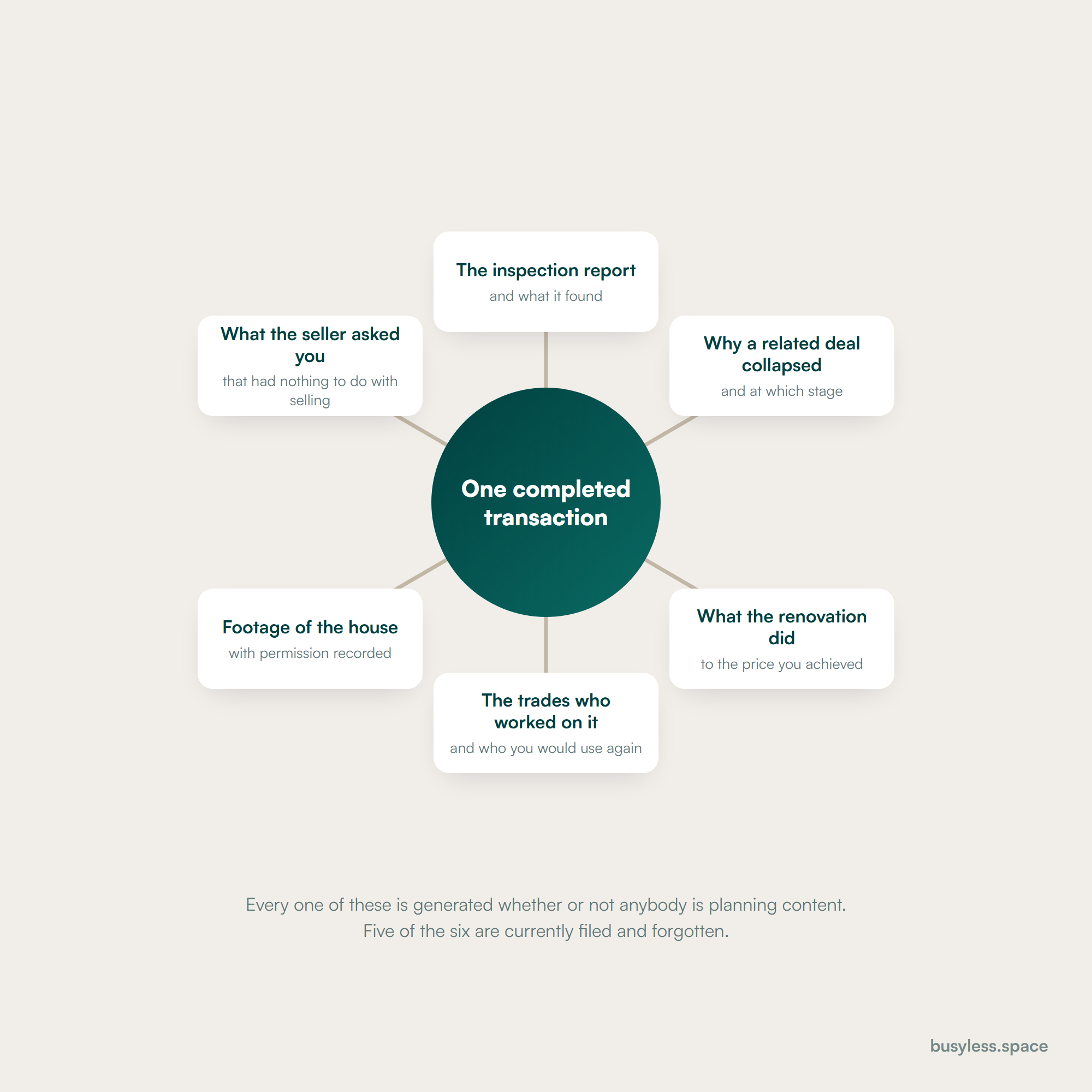
What you already own that nobody can copy
An agent accumulates an unusual amount of specific knowledge and publishes almost none of it, because the industry convention is to publish listings and market statistics instead. Four of the five below come from having been inside a lot of houses.
What inspections actually find
Held by You, from hundreds of reports
You have read more inspection reports for houses in your area than anybody except an inspector, and you know which findings kill a deal, which are routine, and which are expensive in this housing stock specifically. An owner cannot obtain that and a national publisher cannot write it.
How to capture it
Go back through a year of reports and count the findings. Publish the pattern for your area's typical age and construction, never a property.
What deals actually fall apart on
Held by You and your transaction coordinator
Finance, survey, chain, a valuation gap, somebody changing their mind in week three. You know the real distribution and the order, and everybody else has anecdotes. It is the most useful thing a person considering a move could read and it names nobody.
How to capture it
Log the reason on every collapsed transaction for a year. It is one field and the resulting list is genuinely original.
What renovations actually returned, from your own sales
Held by You, across your own transactions
National figures on renovation returns are averages across wildly different markets and everybody quotes them. What a loft conversion, a side return or a new kitchen actually did to a sale price in your streets is yours, specific, and the thing owners ask about constantly while not moving.
How to capture it
Compare properties you sold that had the work against ones that did not. Be honest about how small the sample is and say so.
The questions your sphere asks that are not about buying
Held by Your own inbox and phone
Who to call about damp, whether the extension needs permission, what the neighbour is allowed to build, whether to appeal an assessment. People ask their agent these things for years between transactions, which is exactly the relationship this page is about.
How to capture it
Write down every non-transaction question you are asked for two months. It is the content plan and it is proof the relationship already exists.
The trades and services you would actually use
Held by You, from watching them work
You have seen which builder finished on time, which solicitor answers the phone and which surveyor is thorough rather than slow. A vetted list is the most forwarded document an agent can produce and it is built entirely from having been present at other people's transactions.
How to capture it
List everyone you would use yourself, and be willing to remove people. A list nobody is ever removed from is not a recommendation.
Who actually makes it
This is usually one person whose calendar is set by other people's transactions, which makes any fixed publishing schedule fragile. The realistic model is producing in batches during quiet weeks and drawing on the stock during busy ones.
The agent
The judgement, the voice and the local knowledge
Nothing here works in somebody else's voice, because the whole asset is that a specific person is remembered. Record between showings rather than scheduling writing time that a viewing will take.
4 to 6 hours
A transaction coordinator or assistant
The logs that become the material
The collapsed-deal reason and the inspection findings are one field each, filled in by whoever is already handling the file. That is where the original material actually comes from.
2 hours
Somebody who shoots and edits
The walkthroughs
Often the agent, and worth paying for occasionally. Buy days in the quiet season and bank footage, because in a busy month nothing gets filmed and the habit breaks.
6 to 10 hours
Whoever owns the list
That the sphere is actually complete
The commonest failure here is a list containing recent clients and nobody else. Everybody who knows you belongs on it, which is a bigger and much better list than the one in most agents' systems.
1 hour
Your broker, or somebody with a compliance eye
Whether a claim or an arrangement is safe
Specifically for two things: a statistic stated as a fact, and anything a lender is helping to pay for. Both are on the rules list and both are easier to check before publication than afterwards.
1 hour
The honest cadenceOne market note a month, two walkthroughs a month, and one substantial piece a quarter from the logs. About twelve hours, and the plan is built so that a month where a transaction consumes everything costs you nothing except that month.
One project, 8 surfaces
The unit is a single house walked properly with a camera and an opinion. It is the one input that needs the agent physically present, and it goes further than most people in this industry expect. Most content marketing ideas for real estate agents stop well short of it.
- 1
The walkthrough video
2 hoursFrom: The footage, lightly cut
Say what is wrong with the house as well as what is good. In a category built on flattering footage, one honest sentence is the entire memorable differentiator.
- 2
The what-to-look-for piece
90 minutesFrom: The things you pointed at
Written about the type of property rather than that property, which makes it durable rather than expiring with the listing. This is the asset the sibling playbook's diagram about dying listing pages is a warning about.
- 3
The market note section
45 minutesFrom: What the house says about the market
One real property beats a table of figures, because a reader can picture it. The figures belong underneath, with their source and date.
- 4
Short clips
45 minutesFrom: The two moments people replay
Usually a defect or an unusual feature rather than the kitchen. What gets forwarded is what surprises somebody, which is rarely what the listing photographer was aiming at.
- 5
The answer to a sphere question
30 minutesFrom: Whatever the walk happened to settle
Written in reply to somebody real, then published. These accumulate into the most useful part of an agent's site and each one already has a proven audience of at least one.
- 6
The trades list update
15 minutesFrom: Anybody whose work you saw
The most forwarded document you will produce. Update it when somebody impresses you and, more importantly, when somebody does not.
- 7
The appraisal or valuation conversation
0 minutesFrom: The whole thing, reused verbatim
The output nobody counts. Turning up to a listing appointment with a body of published work about that street changes the conversation before it starts.
- 8
The annual piece
5 hoursFrom: Twelve months of walks and logs
What actually happened in your area this year, written by somebody who was inside the houses. It is the one thing a portal cannot publish and it is what the sphere forwards most.
The buying cycle, and what content does at each stage
The defining number here is the gap between transactions, and it reframes every stage. Most of your audience is permanently in stage one, which is not a problem to be solved but the condition the whole plan is designed for.
Living there
Years"Should we do something about the kitchen?"
- What moves them
- Maintenance, renovation returns, the trades list
- How you know
- Steady opens from people who never click anything
Wondering
Two to five years"Are we going to outgrow this house?"
- What moves them
- Whether to move or improve, and what it costs to move
- How you know
- Reading about the cost of moving rather than about listings
Somebody else is moving
Any time"Do I know anybody good?"
- What moves them
- Your name, remembered, and something worth forwarding
- How you know
- Enquiries that arrive with a name attached and no search behind them
Deciding to sell
Weeks to months"What is it worth and who do we use?"
- What moves them
- Your walkthroughs, your honesty, and what you have published about their street
- How you know
- Listing appointments where they already know how you work
In the transaction
Weeks to months"Is this normal, and will it fall through?"
- What moves them
- The collapsed-deal material and the inspection findings
- How you know
- Fewer anxious calls, and referrals during the process rather than after it
What you are allowed to publish
Four rules about who may pay for your marketing and what you may publish. The sibling playbook covers neighbourhood content and fair housing, blind advertisements, the 2024 compensation changes, listing data display and photograph copyright, so none of those five appear here. None of this is legal advice and your broker and state commission govern.
A lender helping to pay for your content has a statute attached
Real Estate Settlement Procedures Act section 8, 12 U.S.C. 2607, and Regulation X at 12 CFR 1024.14, read 2026-08-30
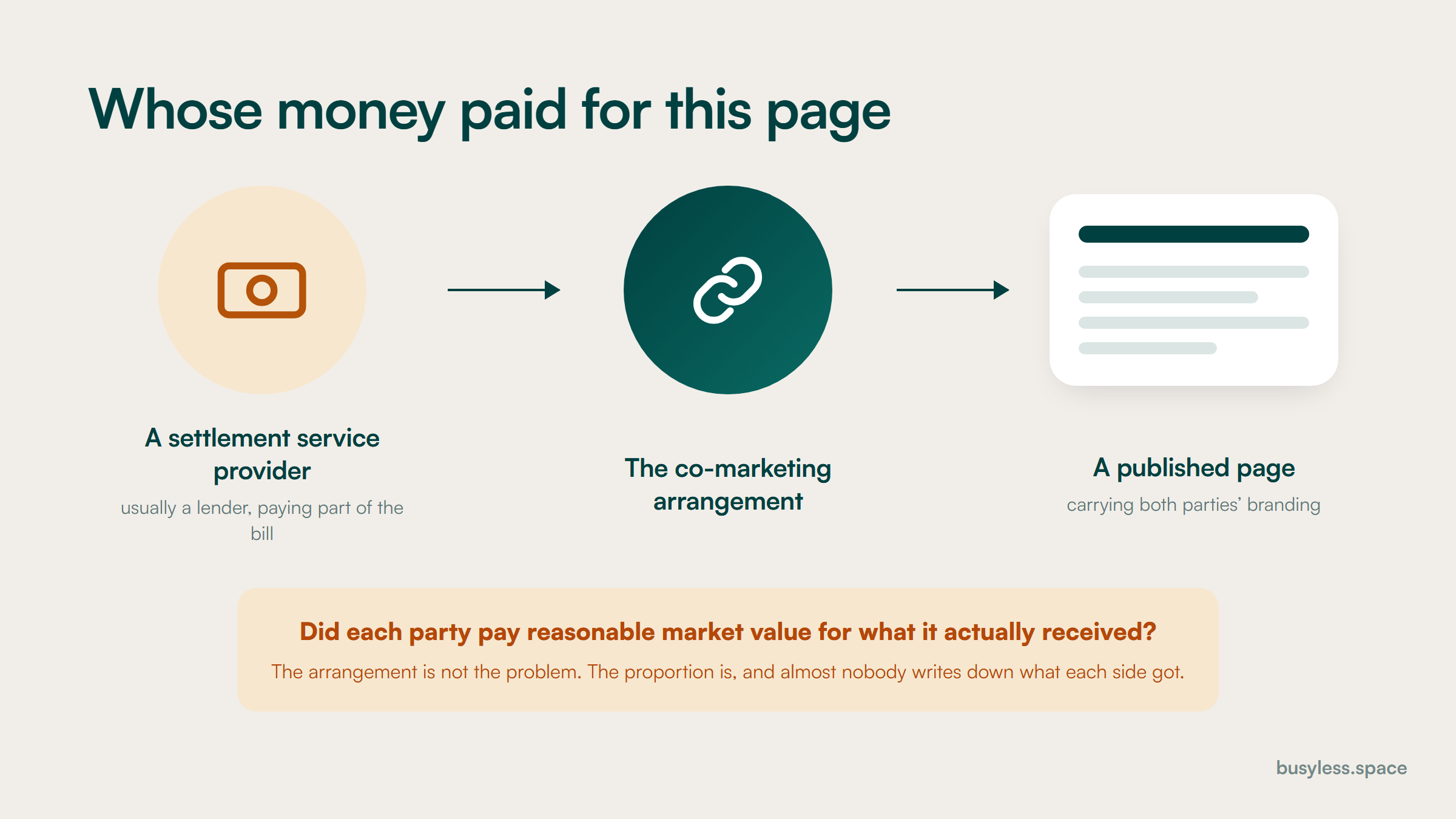
Giving or accepting anything of value pursuant to an agreement that business incident to a settlement service will be referred is prohibited. Co-marketing is not automatically unlawful, and the analysis generally turns on whether each party pays reasonable market value for what it actually receives rather than for the referral. Where a lender pays more than its share, or for placement that mostly promotes the agent, is where the risk sits.
So do thisWrite down what each party is receiving and what it is worth, keep the split proportionate to the actual prominence, and have your broker review the arrangement rather than the artwork. Our financial institutions playbook covers the same relationship from the lender's side.
A statistic you publish is a claim you are making
National Association of Realtors Code of Ethics, Article 12 on presenting a true picture in advertising, and Standard of Practice 12-1, read 2026-08-30
Members are obliged to present a true picture in advertising and marketing, and that reaches published market statistics as much as it reaches a property description. A figure chosen because it flatters the market, or a comparison period chosen for the same reason, avoids presenting a true picture while stating nothing untrue. Non-member agents face state commission rules covering similar ground.
So do thisState the source, the period and the geography beside every figure, keep the comparison period consistent from month to month, and publish the months that look bad. A market note that has never contained bad news is not being read as neutral by anybody.
Filming inside an occupied home publishes somebody's household
Seller and occupier consent practice, and ordinary privacy and security considerations, reviewed 2026-08-30
A walkthrough shows possessions, documents on a worktop, a child's bedroom with a name on the door, medication, an alarm panel, mail with a full address and which windows do not lock. The seller has consented to marketing the property, which is not the same as consenting to a permanent public video of their belongings, and the content frequently outlives the sale by years.
So do thisGet written permission for video specifically, walk the house once before filming to move or avoid the personal material, and agree in writing what happens to the footage after completion. Ask about children and about anybody living there who is not the seller.
Cold outreach to expired listings has its own rulebook
Telephone Consumer Protection Act and the FCC's telemarketing rules at 47 CFR 64.1200, including the National Do Not Call Registry, read 2026-08-30
Calling expired listings and unrepresented sellers is a long-standing practice in this industry and it is telemarketing. Registry-listed numbers generally may not be called for telemarketing without an applicable exception, an internal do-not-call list and policy is generally required, and the established business relationship exception is narrower and shorter-lived than most agents assume. State statutes frequently add requirements on top.
So do thisScrub against the registry, keep an internal list that is actually honoured, and record where each number came from. Our dtc-ecommerce playbook covers the separate consent question that governs marketing texts to people who already know you.
None of this is legal advice. Rules vary by state and by contract, and the dates above are when each source was read. Check your own before you rely on any of it.
How to build content marketing for real estate agents
Nothing gets published in the first month. It is spent rebuilding a list that almost certainly only contains recent clients, and adding two fields to files somebody is already handling.
Rebuild the sphere and start logging
- List everybody who knows you, not everybody who transacted with you
- Add the collapsed-deal reason field to every file
- Start counting inspection findings across the last year of reports
- Log the questions people ask you that have nothing to do with moving
Output A real sphere list and two logs that produce original material
Start arriving monthly and asking for nothing
- Send the first market note, with sources and dates on every figure
- Film two walkthroughs and say what is wrong with each house
- Publish the trades list you would actually use yourself
- Answer three sphere questions properly and publish the answers
Output A monthly habit and the most forwarded document you have
Publish what only you know
- Publish what inspections find in your area's housing stock
- Publish what deals actually collapse on, from the log
- Write up what renovations returned across your own sales, honestly
- Get written video permission into your listing paperwork
Output Three pieces no portal and no competitor could write
Turn up where the sphere already is
- Commit to one community thing for a year and do not mention property
- Review any lender co-marketing arrangement with your broker
- Scrub and document the cold-outreach process if you run one
- Report forwards and appointment sources rather than page views
Output A local presence and two compliance questions settled
Structured data for what you publish
You, your brokerage and your live listings are marked up on the sibling playbook, which is where the entity and the inventory belong. These six describe what you publish for people who are not moving, and one is a first use anywhere in this directory.
CreativeWorkSeries for the market note
The page that gathers every issue of your monthly noteA first use in this directory and the right shape for the argument, because the asset here is not any single issue but a thing somebody has received for nine years. Name it and date the series rather than treating each note as a standalone post.
{
  "@context": "https://schema.org",
  "@type": "CreativeWorkSeries",
  "name": "[SERIES NAME, WHICH SHOULD NOT BE 'MARKET UPDATE']",
  "description": "[WHAT IT COVERS, HOW OFTEN, AND WHAT IT NEVER CONTAINS]",
  "url": "https://[YOUR-DOMAIN]/notes",
  "startDate": "[YYYY-MM-DD, WHEN THE FIRST ISSUE WENT OUT]",
  "issn": "",
  "inLanguage": "[LANGUAGE CODE]",
  "creator": {
    "@type": "Organization",
    "name": "[TEAM OR BROKERAGE NAME]",
    "url": "https://[YOUR-DOMAIN]"
  },
  "about": "[THE AREA YOU ACTUALLY COVER, STATED HONESTLY]"
}
BlogPosting for a single issue
The archive page for one month's notePublish the archive rather than sending into a void, because a forwarded note needs somewhere to land for the person who received it and is not on the list. Keep the date visible: a market figure without one is the thing the second rule on this page is about.
{
  "@context": "https://schema.org",
  "@type": "BlogPosting",
  "headline": "[WHAT ACTUALLY HAPPENED, NOT 'MARKET UPDATE [MONTH]']",
  "description": "[THE ONE THING SOMEBODY WOULD FORWARD THIS FOR]",
  "url": "https://[YOUR-DOMAIN]/notes/[SLUG]",
  "datePublished": "[YYYY-MM-DD]",
  "dateModified": "[YYYY-MM-DD]",
  "isPartOf": {
    "@type": "CreativeWorkSeries",
    "name": "[SERIES NAME]",
    "url": "https://[YOUR-DOMAIN]/notes"
  },
  "author": {
    "@type": "Organization",
    "name": "[TEAM OR BROKERAGE NAME]"
  },
  "citation": "[SOURCE OF EVERY FIGURE, WITH THE PERIOD IT COVERS]"
}
VideoObject for a walkthrough
The page the walkthrough sits on, as well as any platformDescribe the type of property and what it teaches rather than the address, so the video keeps working after the sale. Record the permission reference somewhere retrievable, because a video of somebody's home outlives their ownership of it by years.
{
  "@context": "https://schema.org",
  "@type": "VideoObject",
  "name": "[WHAT THIS HOUSE SHOWS, e.g. What to check in a [ERA] [TYPE]]",
  "description": "[WHAT A VIEWER LEARNS, INCLUDING WHAT IS WRONG WITH IT]",
  "thumbnailUrl": "https://[YOUR-DOMAIN]/images/[FILE].jpg",
  "uploadDate": "[YYYY-MM-DD]",
  "duration": "PT[M]M[S]S",
  "contentUrl": "https://[YOUR-DOMAIN]/video/[FILE].mp4",
  "embedUrl": "https://[YOUR-DOMAIN]/[PAGE-SLUG]",
  "creator": {
    "@type": "Organization",
    "name": "[TEAM NAME]"
  },
  "contentLocation": {
    "@type": "AdministrativeArea",
    "name": "[AREA, NOT AN ADDRESS]"
  },
  "isFamilyFriendly": true
}
ImageObject with permission recorded
Every published photograph taken inside somebody's homeThis block is where the third rule on this page becomes a habit. Record who took it, whether written permission covers video and stills, and what happens after completion, because a library without that record becomes unusable the moment a former seller asks a reasonable question.
{
  "@context": "https://schema.org",
  "@type": "ImageObject",
  "contentUrl": "https://[YOUR-DOMAIN]/images/[FILE].jpg",
  "caption": "[WHAT IT SHOWS, DESCRIBED BY TYPE NOT BY ADDRESS]",
  "creditText": "[PHOTOGRAPHER]",
  "copyrightNotice": "(c) [YEAR] [RIGHTS HOLDER]",
  "acquireLicensePage": "https://[YOUR-DOMAIN]/image-requests",
  "dateCreated": "[YYYY-MM-DD]",
  "contentLocation": {
    "@type": "AdministrativeArea",
    "name": "[AREA]"
  },
  "creativeWorkStatus": "[PERMISSION REFERENCE AND WHAT IT COVERS]"
}
ItemList for the trades you would use
The vetted list of local trades, solicitors and surveyorsThe most forwarded document an agent produces and worth structuring properly. Say in the description how somebody gets on the list and that people are removed, because a list nobody leaves is a directory rather than a recommendation.
{
  "@context": "https://schema.org",
  "@type": "ItemList",
  "name": "People I would actually use",
  "url": "https://[YOUR-DOMAIN]/who-i-use",
  "description": "[HOW SOMEBODY GETS ON THIS LIST, AND THAT PEOPLE COME OFF IT]",
  "dateModified": "[YYYY-MM-DD]",
  "numberOfItems": "[N, MATCHING THE PAGE]",
  "itemListElement": [
    {
      "@type": "ListItem",
      "position": 1,
      "name": "[TRADE OR SERVICE]",
      "description": "[WHY THEM, FROM HAVING WATCHED THEM WORK]"
    }
  ]
}
Event for something the sphere would attend anyway
The page for a community event you host or supportMark up the thing people would come to without you rather than a seminar about buying. The whole argument of the events channel here is that the good ones put you beside people who are not moving, so the description should sound like an event rather than a lead capture.
{
  "@context": "https://schema.org",
  "@type": "Event",
  "name": "[WHAT IT ACTUALLY IS]",
  "description": "[WHY SOMEBODY WOULD COME IF THEY HAD NEVER MET YOU]",
  "url": "https://[YOUR-DOMAIN]/events/[SLUG]",
  "startDate": "[YYYY-MM-DDTHH:MM:SS-05:00]",
  "endDate": "[YYYY-MM-DDTHH:MM:SS-05:00]",
  "eventAttendanceMode": "https://schema.org/OfflineEventAttendanceMode",
  "eventStatus": "https://schema.org/EventScheduled",
  "isAccessibleForFree": true,
  "location": {
    "@type": "Place",
    "name": "[VENUE]",
    "address": "[FULL ADDRESS]"
  },
  "organizer": {
    "@type": "Organization",
    "name": "[TEAM OR BROKERAGE NAME]",
    "url": "https://[YOUR-DOMAIN]"
  }
}
What to automate, and where the line is
The useful automation here is in the logging and the production, both of which currently fail because a transaction interrupts them. The line sits at anything that would put your judgement into somebody's hands without you having formed it.
- automate
Extracting findings from inspection reports
A year of reports is a large pile of similar documents and counting what recurs is exactly the work nobody will do by hand. The pattern across your area's housing stock is the piece, and no property needs to be named.
- automate
Cutting short clips from walkthrough footage
High volume, low value per clip, and mechanical. Keep a person choosing the moment, because an automated pick reliably selects the kitchen when the thing people forward is the odd defect you pointed at.
- automate
Assembling the market figures each month
Pulling the same series over the same period every month is routine and it enforces the consistency the second rule on this page requires. Freeze the comparison period in the automation so nobody quietly changes it in a bad month.
- assist
Drafting the market note around the figures
It will produce the sentence every other agent's note contains. The value is what you saw inside houses this month, which has to be added by somebody who was there, and the figures belong underneath it rather than above.
- assist
Transcribing and writing up a walkthrough
Good at turning a recording into a durable written piece about that type of property. Check that nothing identifying survives from the footage, particularly documents, names and anything about children.
- assist
Sorting and tagging the sphere list
Useful for grouping by how somebody knows you and when you last spoke. A human decides who is genuinely in the sphere, because an automated read of a contacts database consistently mistakes a transaction for a relationship.
- never
Estimating a value or a return without saying how
A confident number about somebody's largest asset, produced without a method anybody can inspect, is the fastest way to lose the trust the rest of this page is built on. Show the comparable properties or do not publish the figure.
- never
Generating interior imagery or removing what is really there
Beyond ordinary staging disclosure, an image that shows a room that does not exist is a representation somebody will act on and then arrive at. In a category already fighting a reputation for flattering footage, it is not worth what it costs.
What it costs
Sanity-check a proposal against these rather than reading them as prices, and note that a solo agent can run the whole argument of this page for the cost of an email platform. The number moves mainly with whether video is produced by somebody else.
Do it yourself
$0 to $400- The sphere list, rebuilt to include everybody who knows you
- A monthly note that asks for nothing
- Two walkthroughs a month filmed on a phone
- The trades list, published and kept honest
- Suits
- A solo agent, which is most of this industry
- Ceiling
- It stops during a busy month, and busy months are unpredictable here. The stock already published keeps working, which is why the plan produces in batches rather than weekly.
Lean
$700 to $2,500- Video shot and edited by somebody who is not you
- The inspection and collapsed-deal analyses done properly
- A note designed well enough that people forward it
- One community commitment resourced for a full year
- Suits
- A busy solo agent or a small team
- Ceiling
- One person's voice and one person's sphere. Growing past it means other agents publishing in their own names, which is a different plan rather than a bigger one.
Funded
$2,500 to $5,000- Several agents publishing under their own names to their own spheres
- Regular video production rather than opportunistic filming
- The annual area piece researched properly
- Events run as a programme, not as an occasional gesture
- Suits
- A team where more than one agent has a real sphere
- Ceiling
- Coordination, and the honesty problem that comes with it. A team voice is less memorable than an individual's, and the whole argument of this page is that somebody remembers a person.
Above this
$5,000 and up- Coverage of several distinct areas with genuinely different material
- Video and photography as a standing capability
- Somebody whose job is the logs, the permissions and the sources
- A community programme rather than attendance
- Suits
- Larger teams and brokerages where the sphere is the growth strategy
- Ceiling
- The risk becomes sameness. A brokerage publishing centrally produces the market report everybody else has, which is the exact commodity this page recommends skipping.
How to do it with no budget
The first of these seven is the one that matters most and it is not writing anything. Most agents' lists contain people who transacted with them, which is a much smaller and worse list than the one they could have.
- 1
Rebuild the list around everybody who knows you
Your phone, your email and an hour of honesty · 3 hours
Not past clients. Everybody. The person you play football with is worth more here than a buyer from four years ago you have not spoken to since.
- 2
Add the collapsed-deal reason to every file
One field, filled in by whoever handles the file · 30 minutes to set up
A year of these is genuinely original, names nobody, and answers the question every anxious seller actually has.
- 3
Count what a year of inspection reports found
The reports you already have · 3 hours
Publish the pattern for your area's typical housing stock. You have read more of these than anybody except an inspector.
- 4
Write down every non-transaction question you are asked
A note on your phone · Two months of noticing
Damp, permissions, neighbours, assessments. That people ask you these between transactions is the proof the relationship this page describes already exists.
- 5
Film one house and say what is wrong with it
A phone and permission · 2 hours
Honesty is the whole differentiator in a category built on flattering footage, and one critical sentence is what makes somebody remember who was talking.
- 6
Publish the list of people you would actually use
Your own experience of watching them work · 2 hours
Be willing to remove somebody. A list nobody ever leaves is a directory, and everybody can tell the difference.
- 7
Pick one community thing and commit for a year
A calendar · Ongoing, and worth it
Something you would attend anyway, without mentioning property. Slow, unmeasurable and the most reliable source of business in this industry.
The tool stack
Very little to buy, and the only genuinely important purchase is an email platform that will not embarrass you. The rows linking into our other directories go to the researched review rather than to a vendor page.
Hold the sphere and how each person knows you
One field matters more than the rest: how this person knows you. It decides what the note says to them and whether they would ever forward it.
Free option: A spreadsheet, which is better than a CRM nobody updates
Send something monthly for years without it looking automated
A note that looks like a person wrote it gets forwarded and a template does not. Plain is a feature here rather than a limitation.
Free option: Most platforms cover a sphere-sized list free
Publish an archive worth landing on
A forwarded note needs somewhere to land for the person who is not on the list. Most agent websites are built to hold listings, which is a page type designed to stop existing.
Free option: Any simple site, provided pages do not expire with a listing
See what owners search years before they move
Search the improve-or-move question space rather than the inventory queries. How the portals took those is the sibling playbook's subject.
Free option: Your own list of non-transaction questions, which is better
Work out what a referral is actually worth over a decade
Model it on referred transactions over several years rather than on leads this quarter. Costed quarterly, everything on this page looks like a poor investment and it is not.
Free option: Free
Model what a renovation returned across your own sales
Any honest model works. What matters is publishing the method and the sample size, because a return figure with neither is the second rule on this page waiting to happen.
Free option: Free
Keep permissions with the footage
One row per property: who consented, whether it covers video and stills, and what happens after completion. Video of somebody's home outlives their ownership of it.
Free option: Free
Check what assistants say about moving in your area
The improve-or-move questions are increasingly answered here, and the answers lean on national publishers who have never been inside a house in your market.
Free option: Ask each assistant your area's common questions, monthly
Take it from here
Everything below is meant to be copied and filled in. Bodies are plain text, so what you see is exactly what lands on your clipboard.
Three hours that changes everything downstream. Most agents' lists are past clients, which is the smallest and worst possible version of this.
SPHERE REBUILD
Agent: [NAME]
Date: [YYYY-MM-DD]
Current list size: [N]
     [IF THIS NUMBER IS MOSTLY PAST CLIENTS, THE LIST IS
      PEOPLE WHO HAVE JUST MOVED AND WILL NOT MOVE AGAIN
      FOR YEARS.]

WHERE TO LOOK
[ ] Your phone contacts, all of them
[ ] Sent email, last two years
[ ] Past clients, and the people on the other side of
    those transactions
[ ] Everybody at whatever you do on weekends
[ ] Parents at your children's school
[ ] Your own trades, solicitor, accountant, dentist
[ ] Former colleagues from before this job
[ ] Neighbours
[ ] People who have referred somebody, ever
     [THIS LAST GROUP IS THE MOST VALUABLE AND THE MOST
      OFTEN MISSING.]

ONE ROW PER PERSON
Name | How they know me | Last spoke | Would they
recognise my name instantly? | On the list?

[ ] | [ ] | [ ] | [Y/N] | [Y/N]

THE ONE FIELD THAT MATTERS
"How they know me" decides what the note says to them
and whether they would ever forward it.

     [A CRM WITH FIFTY FIELDS AND NOT THIS ONE IS WORSE
      THAN A SPREADSHEET WITH ONLY THIS ONE.]

THE TWO NUMBERS
Total on the list:                 [N]
Of those, how many could I name
without looking?                   [N]
     [THE GAP BETWEEN THESE IS THE REAL HEALTH MEASURE.
      FOUR HUNDRED PEOPLE WHO KNOW YOU BEATS TWO
      THOUSAND WHO DO NOT.]

WHO I AM NOT ADDING
[ ] Purchased or scraped contacts
[ ] People who asked not to hear from me
[ ] Anybody I could not greet by name in a shop
     [IF YOU WOULD BE EMBARRASSED TO SEE THEM AFTER
      SENDING IT, THEY ARE NOT SPHERE.]

FIRST SEND
Date:                    [ ]
What it contains:        [ ]
What it asks for:        NOTHING
     [WRITE THAT WORD IN. THE ASKING IS WHAT MAKES
PEOPLE STOP OPENING IT.]The expensive mistakes
Publishing listing announcements to the sphere
What it costs: A monthly reminder that you want something, sent to people who cannot give it
Send something useful and ask for nothing. The asking is what makes people stop opening it, and they will not start again.
Building a list of past clients rather than a sphere
What it costs: A small list of people who have just moved and will not move again for years
Include everybody who knows you. The person you see at football is worth more here than a buyer from four years ago.
Publishing the same market report as everybody else
What it costs: A commodity from a shared feed, identical to your competitor's, forwarded by nobody
Lead with one house you were actually inside and put the figures underneath, with their source and period.
Filming inside a home without permission for the video specifically
What it costs: Somebody's possessions, documents and children's rooms published permanently
Get written permission for video, walk the house first to move the personal material, and agree what happens to the footage after completion.
Letting a lender pay for whatever they will pay for
What it costs: A federal statute engaged over an arrangement nobody wrote down
Document what each party receives and what it is worth, keep the split proportionate, and have your broker review the arrangement rather than the artwork.
Measuring any of this quarterly
What it costs: Cancelling the only thing that works, three quarters before it would have
Measure appointment sources and forwards over a rolling year. A decade-long cycle cannot be judged in ninety days.
What to measure
Measuring real estate content marketing on leads per month misreads the whole model, because the reader you are reaching is years from transacting and their value is a sentence they say to somebody else. What follows measures recall and forwarding, and is honest that the decisive moment is a conversation you will never observe.
Leading indicators
Forwards, and replies from people who are not moving
Your list tool, plus a folder of the replies
The clearest sign the note is doing its actual job. Somebody replying to say they enjoyed it is not a wasted send, it is the entire mechanism working exactly as designed.
Sphere list size, and how many you could name
Your CRM, checked honestly
Two numbers, and the gap between them is the real health measure. A list of two thousand strangers is worth less here than four hundred people who would recognise your name at a barbecue.
Watch-through on walkthroughs, not views
Your own player and your analytics
Somebody who watches a whole house has spent eight minutes with you, which is more attention than most brands get in a year. Views count people who scrolled past.
Non-transaction questions arriving from the sphere
A folder, honestly
People asking you about damp, permissions and neighbours is the relationship this page is about, made visible. It rises long before any transaction does.
Business indicators
Listing appointments where they already knew how you work
Ask at appointment, and write the answer down
The clearest evidence the published work reached somebody before the decision. It also changes the appointment itself, which is worth noticing separately.
Transactions traced to a name rather than a search
The intake form, one field, filled in by whoever takes the call
Ask who told them about you. Crude, self-reported, and by far the best attribution available for a mechanism that runs through conversations you never hear.
Repeat and referred business as a share of the year
Your own record, read annually
The number this whole plan is aimed at. Read it as a rolling year at minimum, because a quarterly read of a decade-long cycle will tell you to stop doing the thing that works.
How long between somebody joining the list and transacting
Your CRM, matched against the list join date
Nobody measures this and it is the most useful thing on the page, because it tells you honestly how patient the plan has to be. It is usually years, which is the argument for not cancelling it.
The verdict
Content marketing for real estate agents fails most often because it is measured against a funnel that does not apply. If your reader moves once a decade, then a page built to convert them is built for somebody who is not in the room and will not be for years.
Build for the other thing instead. Somebody at a barbecue says they are thinking of selling, and your reader either produces a name or does not. That half second is what the monthly note, the honest walkthrough and the year at the sports club are all buying.
Be wary of real estate content marketing services that lead with lead generation, or that supply a market report from the same feed as everybody else. The first misreads the cycle and the second is a commodity your competitors are sending on the same Tuesday.
Two conditions decide it. Content marketing services for real estate agents are worth buying when the sphere list contains everybody who knows you and somebody is willing to say what is wrong with a house on camera. Absent both, you are paying for a newsletter about your own listings.
FAQ
Real estate content marketing questions
Why publish for people who are not going to move?
Because they are the distribution. Somebody they know will move this year and will ask whether they know a good agent, and that half second is what everything you publish is competing for. The reader's own transaction is a bonus that arrives years later.Should I be writing neighbourhood guides?
That is the search side of this, and it carries a serious fair housing rule with it that our search playbook covers properly. It is also what every agent does. The material only you have is what you learned inside hundreds of houses.What do I put in a monthly note if not my listings?
One house you were actually inside and what it told you, then the figures underneath with their source and period. Add whatever the sphere has been asking about. A note that never mentions your listings gets opened for nine years.Is it a problem if a lender pays for my advertising?
It depends on what each party is receiving and whether the payment is reasonable market value for that rather than for referrals. Co-marketing is not automatically unlawful and the arrangement is where the risk sits. Document it and have your broker review it before it runs.Do I need permission to film inside a seller's home?
Get it in writing, specifically for video. Consenting to marketing a property is not the same as consenting to a permanent public film of your possessions, documents and children's bedrooms, and the content usually outlives the sale by years.Can I still call expired listings?
It is telemarketing, so registry rules, an internal do-not-call list and state statutes all apply, and the established business relationship exception is narrower than most agents believe. Scrub, keep records of where numbers came from, and honour your own list.How long before any of this produces a transaction?
Longer than you will be comfortable with, which is why the measurement section suggests tracking how long people are on the list before they transact. It is usually years. Judged quarterly, this plan looks like a failure right up until it does not.What should an agent expect to spend?
Rebuilding the list, the collapsed-deal log and the first walkthrough cost hours rather than money, and a solo agent can run the whole argument here for the price of an email platform. Where a budget exists, the realistic range is $700 to $5,000 a month.
Run it yourself, or have someone own it
Everything above is written to be run without us, and the free path is genuinely most of the value for a small practice. Where these plans stall is almost never the plan. It is that the person holding the material has a day job and nobody owns the programme after the first month. That is the job we do.