The product carries your brand and somebody else's charter
Written by Eugene Suslov·Last reviewed 18 September 2026·No affiliate links
Sector
Legal and financial
Model
National service, B2B SaaS
Competition
Brutal
Time to results
3 to 12 months, and the branded trust queries move first
Typical monthly
$6,000 to $25,000
Key takeaways
1The most important query on a fintech brand is whether it is a bank, and the only honest answer names another company. Give that answer its own URL on your main domain, not a help-centre subdomain or a footer.
2A federal rule writes the sentence for you. FDIC Part 328 subpart B says a non-bank mentioning deposit insurance must name the insured bank, say it is not one, and say insurance covers only that bank's failure.
3The FDIC has quoted keyword-targeted blog posts back at a company that is not a bank. A best online bank listicle published by a fintech is the page shape its letters name, so audit the blog before the home page.
4Your partner bank's contract usually gives it approval over marketing, website included, on its own SLA. Batch what you send, and store the bank's name as one field, because the bank can change.
5The "up to" amount in your H1 is measured against what applicants actually receive. Publish how the amount is set on the web, or the question goes to review sites and to the FTC's own pages.
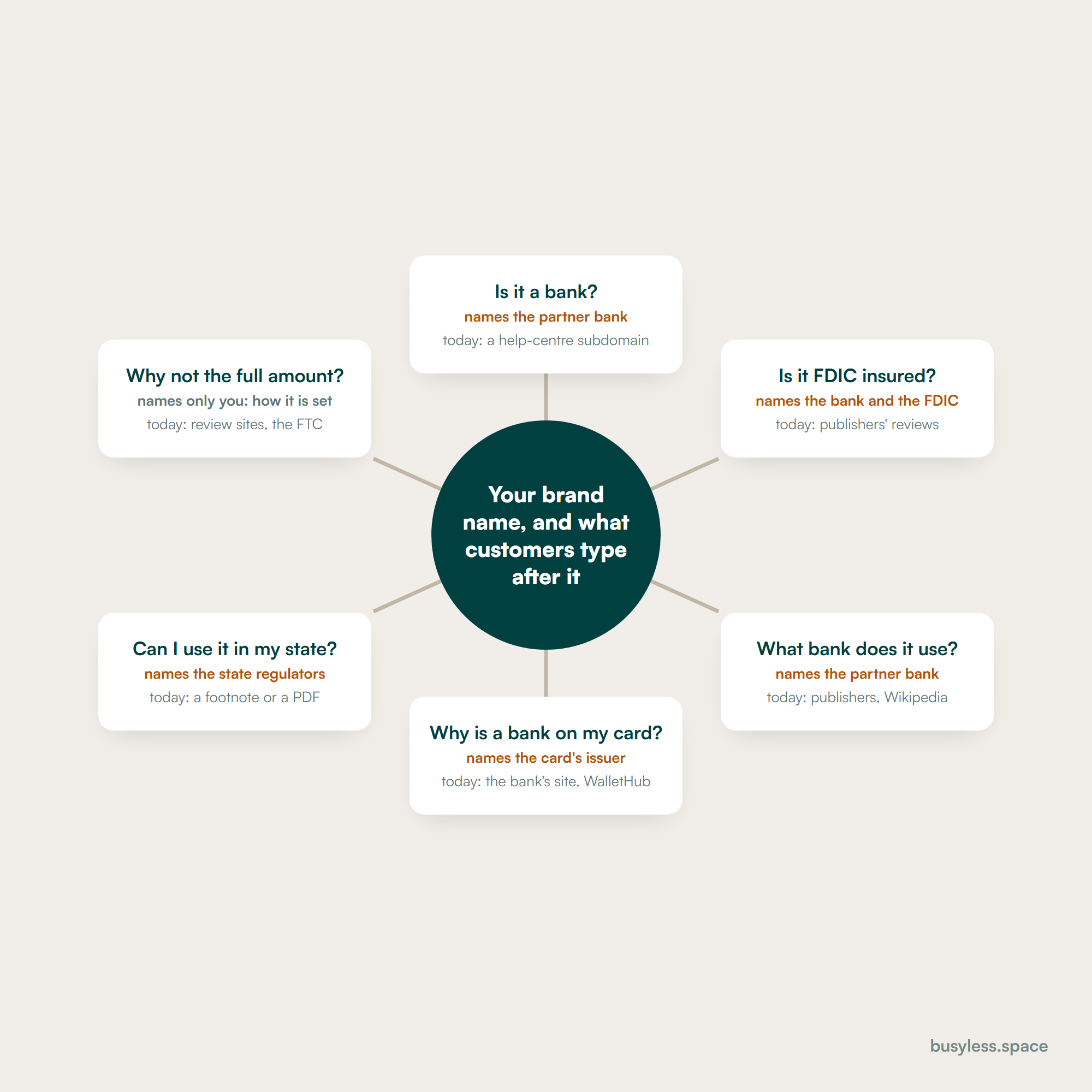
SEO for fintech starts with a query keyword plans rarely list: whether the company is a bank. It is typed after the brand name, often before anything else about the product, and the truthful answer names another company.
That follows from how the product is built. Your customers' money or credit sits at a partner bank, your brand is on the app and the card, and the charter belongs to somebody else. A federal rule, FDIC Part 328 subpart B, supplies the sentence you use when you say so.
So a fintech SEO strategy begins with the pages that answer status and safety on your own domain, in words the rule supplies, rather than with category terms the publishers hold. Those trust queries are branded and yours to win, and today they are often answered by a help-centre subdomain, a footer or somebody else's review.
Two things make it harder than it looks. The partner bank's agreement usually gives it approval over your marketing, website included, on a service-level clock, so part of the calendar runs on another company's queue. And the bank can change, which rewrites every surface that names it.
If your company holds its own charter, the banks playbook is yours; this one is for the company whose customers' money sits at somebody else's bank. Spend software that never touches a deposit is a SaaS page, and the moment a card or an account comes from a partner bank, this one applies.
Investing features answer to FINRA and the SEC, covered on the financial advisors page, and insurtech sits with insurance agencies. A new fintech has the startup problem of a category nobody searches yet as well as this one, and the partner bank's rules apply from launch day rather than at scale.
Who already ranks in fintech
Type your brand followed by "is it a bank", then type the category you sell in, and the two results pages share almost nothing. A typical fintech SEO plan starts with the second page, which personal finance publishers hold, while the first is a branded query only you can answer truthfully and somebody else usually answers.
What is on the results page
Help-centre articles on the brand's own subdomain answering whether it is a bank
Personal finance publishers holding every best-of term in the category
App store listings ranking as ordinary web results on app and lending queries
Regulator and watchdog pages ranking on brand plus complaint queries
The partner bank's own site answering why its name is on a customer's card
People Also Ask boxes on insurance, limits and state availability
AI answers summarising whether an app is a bank, often from a publisher's page
They own every best-of term in the category with review teams no fintech will match. Concede the terms and check how each describes your insurance: the FDIC's August 2022 letters included a comparison publisher, so a page about you is in scope.
They hold brand plus review and brand plus limit, and they answer why a customer cannot get the full amount. Correct their facts through editorial contacts, in writing, and publish the mechanics yourself so they have something accurate to cite.
They rank on brand plus complaint queries, through the letters and orders that name companies in the category. Nobody outranks a regulator. Answer the same underlying question plainly on your own page, with dates, so a customer has a calmer source one click away.
The partner bank and FDIC BankFind
your partner bank's domain, banks.data.fdic.gov
A customer who sees an unfamiliar bank on a card or statement searches the bank, and its site answers. BankFind lists the bank and never you. Name the bank on your own page with its certificate number, and link to its record.
App Store and Google Play
apps.apple.com, play.google.comClaim it
Both appeared in web results for the cash advance and buy now pay later queries checked for this page. A lending listing carries loan terms Apple and Google require, so treat it as a regulated page on someone else's domain rather than as store furniture.
Other fintechs' blogs
the /blog folders of your competitors
Non-banks rank on best banks and best business accounts with their own listicles. It is also the page shape the FDIC's January 2024 letter quoted, so read your own versions against the rule before copying anyone else's.
Reddit and Trustpilot
reddit.com, trustpilot.com
Threads asking whether an app is safe, and reviews about held funds, rank on brand-adjacent queries. They are not yours to optimise. Answer the underlying question on the status page, and make sure your support replies link to it.
Five of the six honest answers name somebody other than you, which is why a footer sentence cannot carry them. Where each is answered today was read off live results on 18 September 2026.
What people actually search
The first five clusters below exist because the product sits on somebody else's charter, or inside a rule that keeps moving. The last three look like any consumer finance category, and publishers, app stores or the bank's own support pages already hold them.
Status and insurance
Navigational, with doubt behind it
> is [brand] a bank
The page that wins it:A status page on the main domain, in the rule's own sentence
The truthful answer names another institution, so a line in the footer cannot win it. On the brands checked for this page, the help centre usually answered it, on a subdomain built for support tickets.
The partner bank's name
Informational, anxious
> why is [partner bank] on my card
The page that wins it:A partner bank page naming it, with its certificate number
The customer searches the bank rather than you, because the bank's name is what they can see. The bank's own site and WalletHub answered it when it was checked on 18 September 2026.
Money safety after a failure
Informational, high stakes
> what happens to my money if [brand] shuts down
The page that wins it:A failure page separating your failure from the bank's
Synapse, which filed for Chapter 11 on 22 April 2024, made this a real query. The honest answer states the pass-through conditions and promises nothing the rule does not.
Amount and eligibility
Commercial, then a complaint
> how much can I get from [brand]
The page that wins it:A how-the-amount-is-set page on the web, not only in the app
The FTC's up to cases decide what a headline may promise. Explain the mechanics, and state a typical first amount only if you hold the data and will stand behind it.
Product classification
Informational, legally contested
> is earned wage access a loan
The page that wins it:Dated explainers, one per product type
The federal position moved in 2024, in May 2025 and again in December 2025. An undated answer is wrong for somebody, whichever way it was written.
Routing and transfers
Navigational, existing customers
> [app] routing number
The page that wins it:Support pages on the main domain saying whose routing number it is
The banks playbook covers routing-number support for a bank's own customers. Here the number belongs to the partner bank, which is exactly the part customers find confusing.
State availability
Transactional, blocking
> is [app] available in [state]
The page that wins it:A state availability and notices page, as HTML
Licences decide the answer and it differs by state. One indexable page answers every state; a footnote or a disclosure PDF answers none of them.
Category best-of
Commercial investigation
> best cash advance apps
The page that wins it:Accurate listings with the publishers, not a list of your own
Publishers and the app stores hold these. A non-bank writing its own best banks post is the page shape the FDIC quoted, so concede the term and fix your listings instead.
What the rules change
Six rules follow, and each reaches the website rather than the product in the abstract: the footer sentence, the logo, the blog, the title tag and the number in the H1. Several are state rules verified for one or two states only, so check your own. Read every date, because this area has moved repeatedly since 2024. None of this is legal advice.
1
What you may say about deposit insurance, down to the sentence
FDIC Part 328 subpart B, 12 CFR 328.100 to 328.108: final rule effective 5 July 2022, amended effective 1 April 2024 with compliance from 1 January 2025
What it means
A non-bank that mentions deposit insurance must clearly name the insured bank holding the deposits, and say it is not an FDIC-insured bank and that insurance covers only that bank's failure. The rule gives a model: a statement that a person is not an FDIC-insured bank and deposit insurance covers the failure of an insured bank. The 2024 preamble adds that the Member FDIC logo misleads unless a bank's name sits beside it.
So do this
Write the footer sentence from the rule, not from a competitor, and put the bank's name beside every logo. Where deposits and other products share a page, say which are not insured and may lose value. The signs banks must display are subpart A, on the banks playbook; subpart B, which binds you, has not moved since January 2025.
2
The regulator has read the blog
FDIC letters under section 18(a)(4) of the FDI Act, including to Zil Money Corporation on 19 January 2024 and to five companies on 19 August 2022
What it means
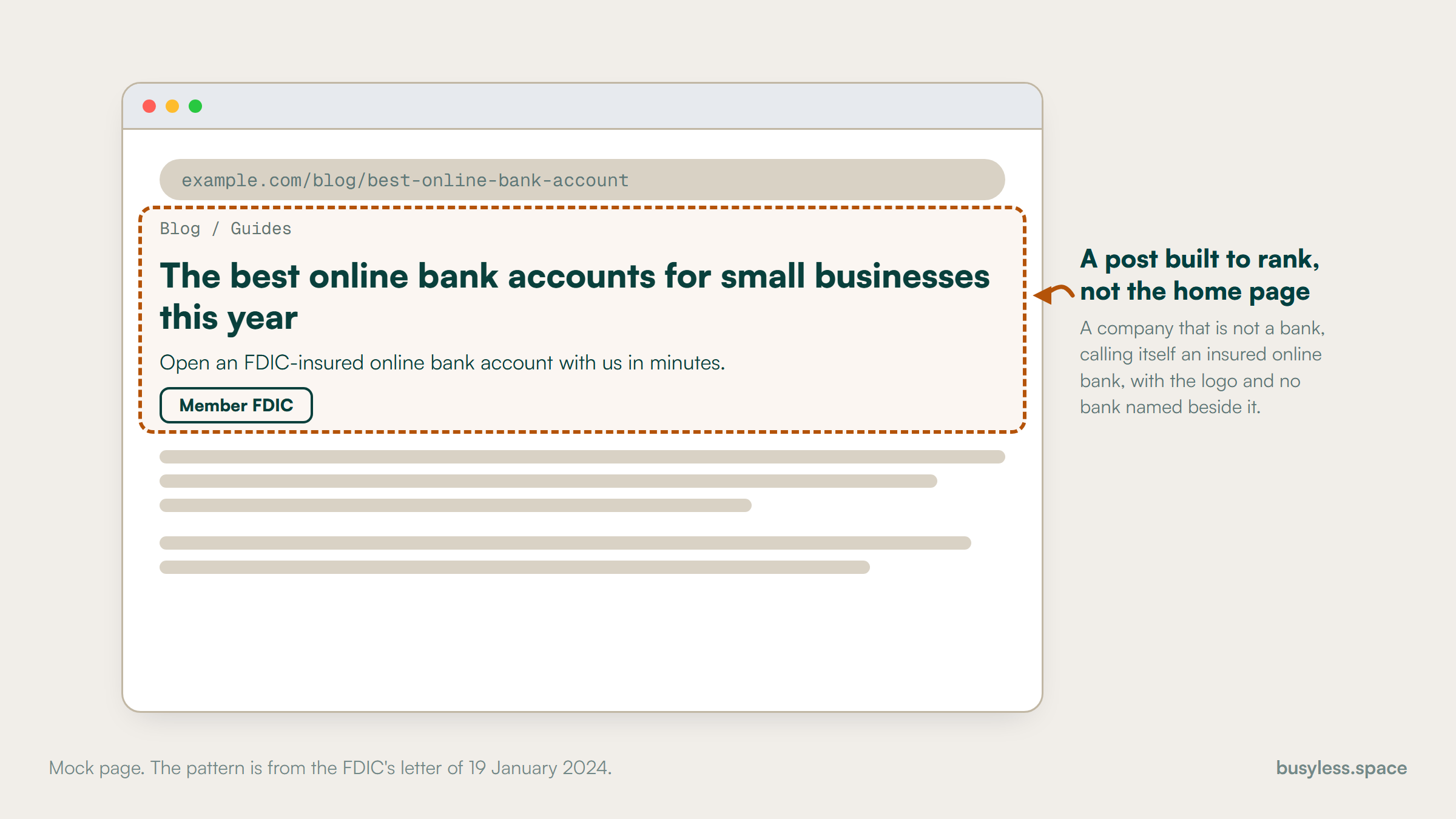
The Zil Money letter quoted five blog URLs, several built for best online bank and best business bank account terms. It asked for removal from the website, including blog posts, pop-ups, hyperlinks and chatbots, from social accounts including senior managers' personal ones, and from the app. The 2022 letters reached a comparison publisher too. These are demand letters alleging apparent violations, not rulings.
So do this
Search every post, chatbot answer and social profile for bank, FDIC and insured before you touch the home page. Then read how each comparison site describes your insurance, because a publisher's page about you is in scope, and send corrections in writing.
3
Your partner bank approves the marketing, on a clock
12 CFR 328.8(a), compliance generally from 1 May 2025; Interagency Guidance on Third-Party Relationships, 6 June 2023; joint statement of 25 July 2024; programme agreements filed with the SEC
What it means
Banks must monitor the non-banks offering their deposit products, and the 2023 guidance puts a review of the third party's websites and marketing into due diligence. Filed agreements show the mechanics: Affirm submits marketing materials to Celtic Bank for approval under an SLA, and WebBank's agreement with Prosper requires prior written approval of any reference to the bank. The bank is a counterparty, not a regulator.
So do this
Put the approval SLA into the content calendar as a real lead time, send pages in batches rather than one by one, and keep the version the bank approved. When the bank changes, every approved page goes back into a queue.
4
The word bank is reserved
California Financial Code section 561, effective 1 January 2012; the DFPI settlement agreement with Chime dated 29 March 2021, read through secondary reports
What it means
California bars an uncertificated business from using a name or words indicating it is a bank, or doing business so the public believes it is one. Chime's settlement had it stop using a bank domain and review its web pages wherever banking appeared. Banking as a description of a service survives; bank as a noun for yourself does not. Verified for California only.
So do this
Audit the domain, the brand name, every title tag and every H1 for bank used as a noun for yourself. Describe what you do instead, such as banking services provided by a named partner, and check your own states, because other states have their own versions of this rule.
5
An up to amount is measured against what applicants get
FTC action against Brigit, announced 2 November 2023, with refunds paid from November 2024; FTC final order against Credit Karma, 23 January 2023
What it means
The FTC alleged that Brigit's instant advances of up to $250 were rarely available at that amount, and that free instant transfers came with a fee. Credit Karma's order concerned pre-approved offers and approval odds for cards consumers were then denied. The number in a title tag, an H1 or an app store subtitle is the claim these cases turn on.
So do this
Keep the ceiling out of the title tag unless the page explains, in the same view, how the amount is set. Publish a typical first amount only if you hold the data and will stand behind it. Superiority claims such as first or only are covered on the startups playbook; this rule is about amounts and eligibility.
6
State notices come with a fixed sentence and a link depth
Texas 7 TAC 33.51(e)(2), amended effective 5 September 2024; California 10 CCR 1550
What it means
Texas requires money transmission licensees to show the complaint notice on the page a customer uses to start a remittance, or no more than one link away. The link must say what it opens, and the rule gives example anchor text. California lets a licensee refer to its licence only with the sentence "Loans made or arranged pursuant to a California Financing Law license."
So do this
Build one state notices page on the main domain, link it from the transfer and loan flows at the depth Texas sets, and paste the California sentence exactly. Only these two states were verified for this page, so check the rest of your licence map with counsel.
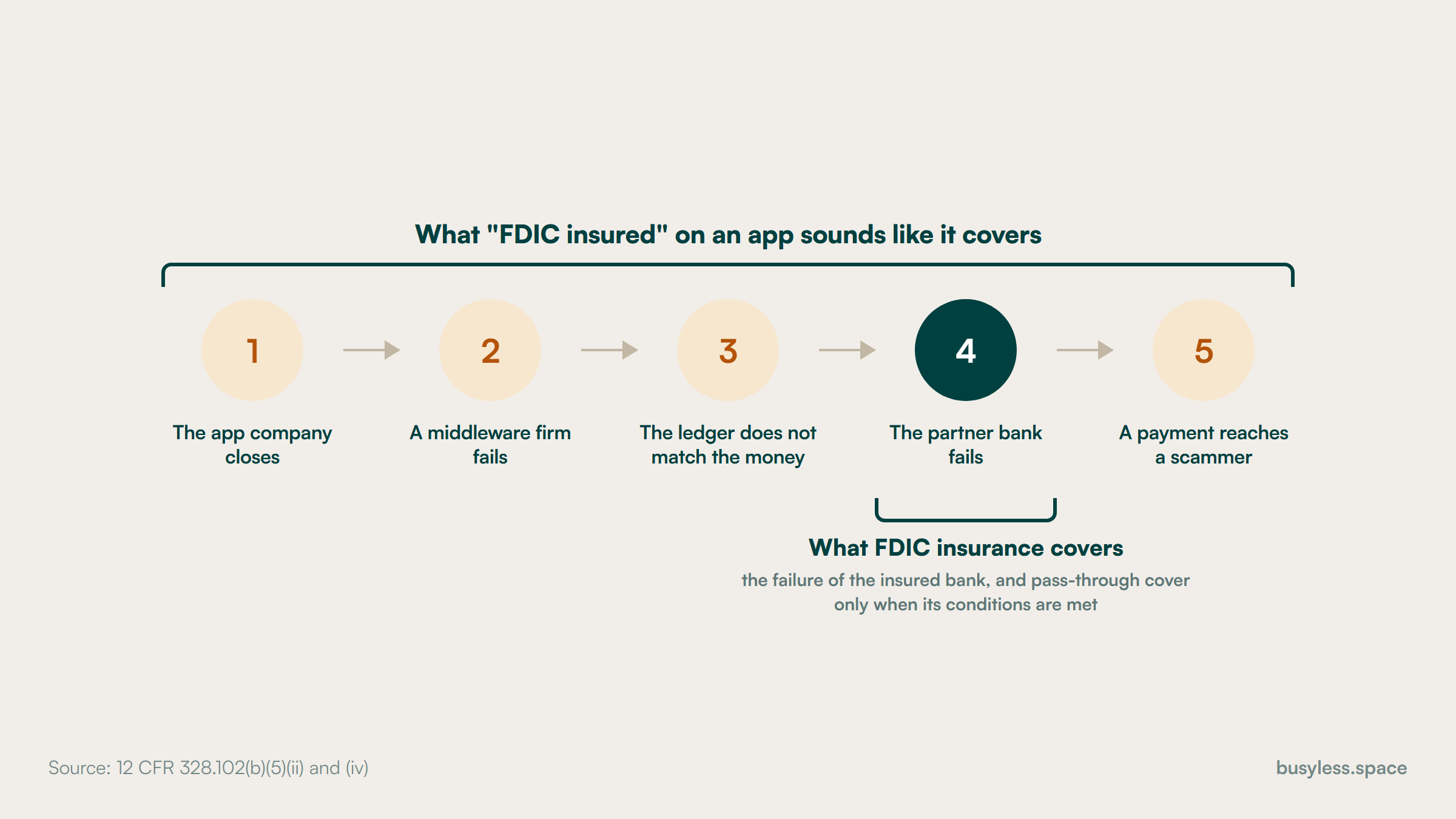
The rule's own sentence says the insurance covers the failure of an insured bank. Four of these five events are something else, and a status page should say which is which.
Proving expertise
Trust here is about structure before it is about people: who holds the money, who issued the card and which licences cover which states. Almost all of it is public record, and most of it is missing from the main domain.
The partner bank named on every trust page, with its FDIC certificate number and a link to its BankFind record
The NMLS ID and the state licence list, each with the date it was last checked
A plain account of who holds the money, who issued the card and who makes the lending decision
The deposit network list linked wherever insurance is mentioned, generated from the same source as the footer
A dated history of partner bank changes, kept rather than deleted
Named authors with real product or compliance roles on mechanics pages
How an advance or a credit limit is set, published on the web rather than only in the app
The legal entity name on the site matching the developer name on both app listings
A wind-down page saying what happens to accounts if the company closes, written before anyone needs it
How to build a fintech SEO strategy
A fintech SEO strategy has to begin with an inventory rather than a keyword list, because the first job is finding every place your site, your app listings and other people's pages describe your status. The phases below put that inventory and the status page ahead of any category content.
1
Weeks 1-3
Find every sentence about your status
Search the brand plus bank, FDIC, insured and safe, and record who answers each
List every surface that names the partner bank, with an owner for each
Search the blog, the chatbot and social bios for insurance claims
Read the programme agreement for the approval clause, its scope and the SLA
Save a Search Console filter for the branded trust queries
You end up with A status inventory with owners, and a known approval lead time
2
Weeks 4-7
Put the answer on your own domain
Rewrite the footer against 328.102(b)(5), with the bank named
Put the bank's name beside the Member FDIC logo, or remove the logo
Publish the status page on the main domain after the bank approves it
Point the help-centre status articles at the status page
Request corrections from publishers in writing
You end up with One URL that answers whether you are a bank, in approved words
3
Weeks 8-12
Make the bank's name one field
Move the bank's name, certificate number and sentence into one record
Have the footer, help centre and markup read from that record
Publish the partner bank page
Check both store listings against the platforms' lending rules
Write the bank-change runbook and assign every surface
You end up with A partner bank change that is an edit and a crawl, not a hunt
4
Months 4-6
Publish the mechanics
Publish how the amount is set, with product and legal sign-off
Publish the state availability and notices page
Publish the failure page, separating your failure from the bank's
Date every product classification explainer
Replace the mobile app-install interstitial with a banner
You end up with Answers on your own domain for the questions review sites answer today
Technical fixes with the best payoff
Of the consumer fintech sites checked for this page on 18 September 2026, most ran Next.js or Gatsby over Contentful, while the help centres checked sat on Zendesk subdomains or Salesforce Experience Cloud. That split decides where the most important answer on the brand ends up living.
The status answer lives on a help-centre subdomain
A week, most of it approval
The help centres checked for this page sat under /hc/en-us on Zendesk subdomains or under /s/ on Salesforce Experience Cloud. So the brand's highest-intent trust query is answered by an article built for support tickets. This is the legal answer, not a documentation problem.
Publish the status answer as its own page on the main domain, linked from the footer and the app listings, and turn the help-centre article into a short pointer to it.
One footer carries every disclosure for every product
A template sprint
Cards, deposits, advances and investing features each carry their own disclosure, and all of them get stacked into a sitewide footer in small type. The partner bank's name appears on every page and is the subject of none.
Keep a short footer pointing to product-specific disclosure blocks that sit beside the claims they qualify. Give deposit and non-deposit products separate blocks, since the rule requires the separation anyway.
The old partner bank's name survives the change
A sprint, then an hour per change
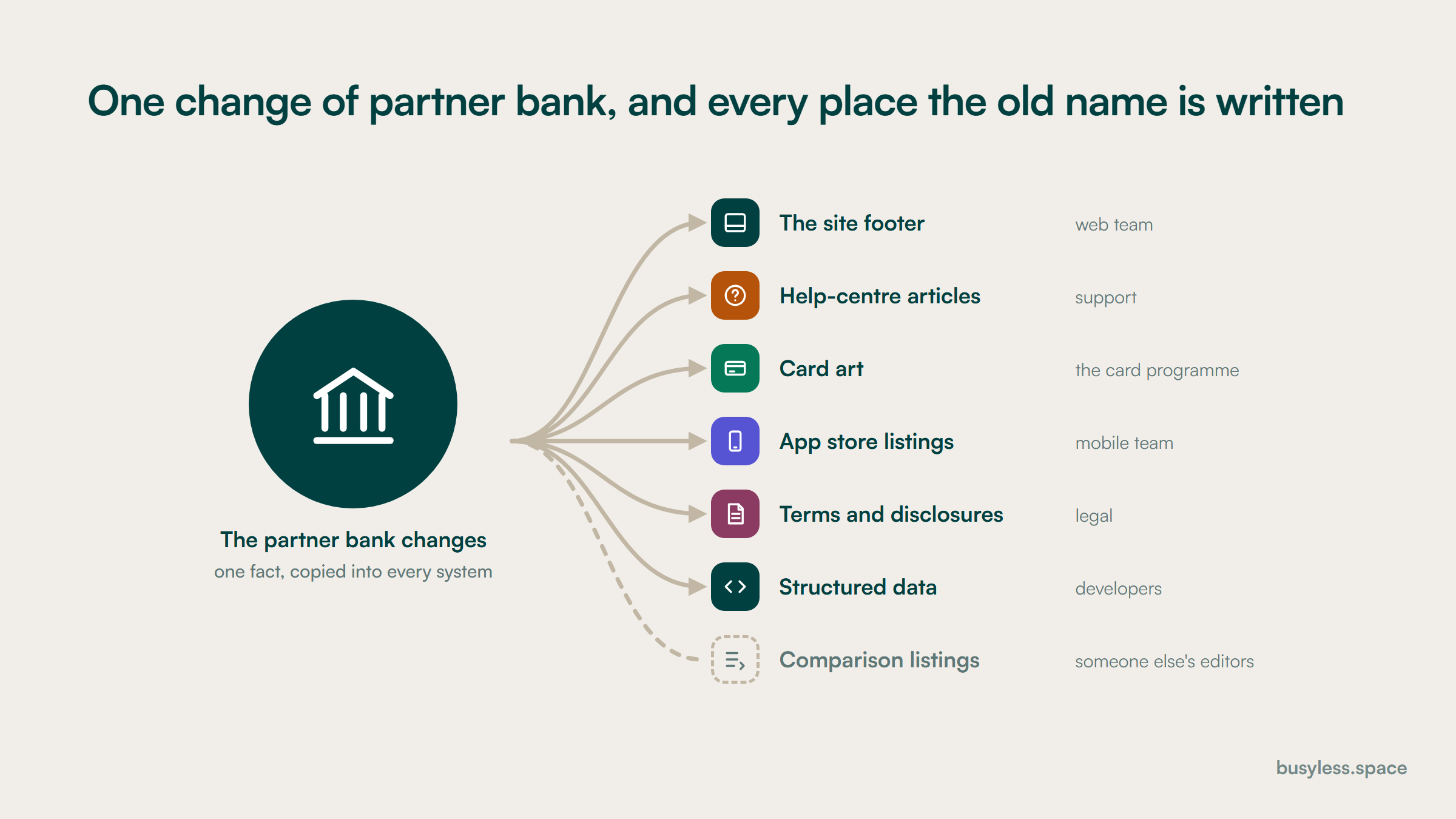
When the bank changes, the footer is fixed first and everything else lags: help articles, card art, app store text, terms PDFs, structured data and comparison listings. The name was stored as copy in several systems rather than as one field.
Store the bank's name, certificate number and disclosure sentence as one record the site, the help centre and the markup all read. Then crawl for the old name after every change, including PDFs and image alt text.
The qualifier on the amount sits in a footnote
A day per template
An amount in the H1 carries a superscript, and the explanation sits in a footer note far below it. That distance between the headline figure and its conditions is exactly what the FTC's up to cases turned on.
Move the conditions into the same view as the number, as text a crawler reads, and keep the title tag free of any figure the page does not explain.
Eligibility can only be checked inside the app
A page, plus product and legal time
The real answer to how much can I get arrives after bank linking in the app, so the web page carries only the ceiling. People asking why they cannot get the full amount end up on finder.com, NerdWallet, a watchdog or the FTC.
Publish how the amount is set on the web: the factors, the order they are checked in, and what raises a limit over time. It needs no personal data.
State availability is a footnote or a PDF
Two days
Licences decide where each product is offered, yet the list lives in a disclosure PDF or a one-line footnote, and state-specific sentences are scattered across the site. Is it available in my state has no page to land on.
One state availability and notices page on the main domain, in HTML, with each state's required lines and the date checked. Link it from every flow the notices apply to.
A full-screen get-the-app interstitial on mobile
An afternoon
Consumer fintech sites push mobile visitors toward the store, often with a prompt that covers the page. Google's guidance on intrusive interstitials, updated 10 December 2025, names app install prompts and recommends banners instead.
Replace the interstitial with a banner, and keep the status, pricing and eligibility pages free of any overlay, since those are the pages a sceptical visitor reaches from search.
The deposit network list lives on someone else's domain
A day, then a monthly check
Where deposits are swept across several banks, the list sits on the sweep provider's site or in a PDF and goes stale separately from the footer that points to it. The FDIC's 2024 preamble accepts a clear hyperlink to a current list, so the link has to stay current too.
Generate the network list from the same record as the footer, or link a provider page you check monthly. Acorns links to its provider's bank list, observed on 18 September 2026, which is the pattern the preamble describes.
Seven owners holding one fact. The last branch is dashed because nobody on your payroll can edit it, only ask.
Structured data that applies here
The types below fit this industry specifically. Most of them earn no rich result on their own, which is worth knowing before anyone sells the work on that basis. What they do is describe the entity precisely, which matters for how search engines and answer engines resolve who you are.
DepositAccount with provider and broker
Each deposit product page
The honest markup of the model: the partner bank as provider and your company as broker. Schema.org allows broker on financial products because the property sits on Service. It earns no rich result; it states in data what the footer states in words.
DepositAccount with provider and broker.jsonld
{
  "@context": "https://schema.org",
  "@type": "DepositAccount",
  "@id": "https://[YOUR-DOMAIN]/accounts/[SLUG]#account",
  "name": "[ACCOUNT NAME]",
  "url": "https://[YOUR-DOMAIN]/accounts/[SLUG]",
  "description": "[ONE SENTENCE ON WHAT THE ACCOUNT IS, NAMING THE PARTNER BANK]",
  "provider": { "@id": "https://[YOUR-DOMAIN]/banking-partner#bank" },
  "broker": { "@id": "https://[YOUR-DOMAIN]/#organization" },
  "annualPercentageRate": "[APY, ONLY IF THE PAGE ADVERTISES IT]",
  "feesAndCommissionsSpecification": "https://[YOUR-DOMAIN]/fees",
  "areaServed": { "@type": "Country", "name": "US" },
  "termsOfService": "https://[YOUR-DOMAIN]/legal/[ACCOUNT-AGREEMENT]"
}
BankOrCreditUnion for the partner bank
The status page and the partner bank page
Describes the partner bank, with its FDIC certificate number as the identifier so the node can be checked against BankFind. Never type your own company this way: that would make in markup the claim the FDIC rule forbids in words.
Your company as what it is: the legal name, the NMLS ID as identifier, and each state licence as a credential naming the regulator that issued it. No rich result, but the licence facts become readable by machines in the same words the licence page uses.
Organization with licences as credentials.jsonld
{
  "@context": "https://schema.org",
  "@type": "Organization",
  "@id": "https://[YOUR-DOMAIN]/#organization",
  "name": "[BRAND]",
  "legalName": "[LEGAL ENTITY NAME, AS ON THE APP LISTINGS]",
  "url": "https://[YOUR-DOMAIN]/",
  "description": "[BRAND] is a financial technology company, not a bank. [PRODUCT] accounts are provided by [PARTNER BANK].",
  "identifier": {
    "@type": "PropertyValue",
    "propertyID": "NMLS",
    "value": "[NMLS ID]"
  },
  "hasCredential": [
    {
      "@type": "EducationalOccupationalCredential",
      "credentialCategory": "[Money transmitter licence]",
      "name": "[LICENCE NAME AND NUMBER]",
      "recognizedBy": { "@type": "GovernmentOrganization", "name": "[STATE REGULATOR]" },
      "validIn": { "@type": "State", "name": "[STATE]" }
    }
  ],
  "sameAs": [
    "[APP STORE LISTING URL]",
    "[GOOGLE PLAY LISTING URL]",
    "[NMLS CONSUMER ACCESS RECORD URL]"
  ]
}
MobileApplication, without ratings
The app landing page
FinanceApplication as the category, the operating systems, and any membership fee as a unit price. Google's software result needs ratings, so it is not eligible unless you have real ones to mark up. What this buys is the site, the store and the markup agreeing on one name and one price.
The issuing bank is the provider and your company the broker, which is what the small print on the card already says. Every rate or fee field is an advertising statement, so fill only what the visible page states beside its conditions. No rich result.
PaymentCard or CreditCard, issued by the bank.jsonld
The questions the status page exists for, word for word as shown. Google stopped showing the FAQ rich result on 7 May 2026, so this is for answer engines and nothing else. One node per page, and the insurance answer carries the rule's sentence.
FAQPage on the status page.jsonld
{
  "@context": "https://schema.org",
  "@type": "FAQPage",
  "mainEntity": [
    {
      "@type": "Question",
      "name": "[Is BRAND a bank?]",
      "acceptedAnswer": {
        "@type": "Answer",
        "text": "[No. BRAND is a financial technology company, not an FDIC-insured bank. Banking services are provided by PARTNER BANK, Member FDIC.]"
      }
    },
    {
      "@type": "Question",
      "name": "[Is my money FDIC insured?]",
      "acceptedAnswer": {
        "@type": "Answer",
        "text": "[Deposits are held at PARTNER BANK, Member FDIC. BRAND is not an FDIC-insured bank, and FDIC insurance covers only the failure of an insured bank. Pass-through coverage applies only if certain conditions are met.]"
      }
    },
    {
      "@type": "Question",
      "name": "[What happens to my money if BRAND closes?]",
      "acceptedAnswer": {
        "@type": "Answer",
        "text": "[What the account agreement says, in plain words, and how to reach PARTNER BANK directly.]"
      }
    }
  ]
}
What it costs
These bands are editorial estimates for the work this page describes, not quotes. Two things push the category up. Every page passes your own compliance review and, if it names the partner bank, the bank's review on its own SLA. And moving a help centre's trust answers onto the main domain is engineering rather than writing.
Run it in-house
$0 to $2,000
The status inventory and the footer rewrite
A status page on the main domain
The partner bank's name moved into one record
Search Console filtered for the trust queries
Who it suits
A seed-stage fintech with one partner bank, a product lead who owns the site, and a compliance contact who already reads public pages.
Where it stops
It fixes what you say about yourself and stops there. Mechanics pages need product, legal and the bank's approval, which is more time than a side project has.
Funded
$6,000 to $12,000
Status, partner bank and failure pages written and approved
Help-centre trust articles consolidated onto the main domain
A monthly approval pack run against the bank's SLA
A dated mechanics page for each product
Who it suits
A consumer app or business account provider with a live product, one or two partner banks and a compliance team, where branded trust queries are already leaking to publishers.
Where it stops
Two reviews gate every page, so output is set by approval capacity rather than by writing. Adding writers without adding review slots only lengthens the queue.
Enterprise
$12,000 to $25,000
Several products and several banks, each with its own disclosure record
State availability and notices maintained across the licence map
Answer engine monitoring for status and insurance questions
A bank-change runbook rehearsed before it is needed
Who it suits
A multi-product fintech with lending, cards and deposits across several partner banks, or a middleware provider whose clients' pages name it.
Where it stops
Category terms stay with the publishers at any budget. Spend at this level buys accuracy across more surfaces and faster bank changes, not a best-of ranking.
How to do it with no budget
The cheapest work here is also the most important: finding and fixing what you already say about your status. None of it needs a tool beyond a search box and the admin panels you already have.
1
Search your own brand the way a worried customer does
An hour
A private browser window and Search Console
Type the brand followed by is it a bank, FDIC insured, safe and which bank. Record who answers each and what they say about your insurance, because whatever sits on page one is what customers believe.
2
List every place the partner bank's name appears
Half a day
Site search, a help-centre export and both app store consoles
Footer, help articles, card art, terms, store text, structured data and comparison listings. Put an owner beside each, because this list becomes the bank-change runbook.
3
Rewrite the footer from the rule's own sentence
Two hours, then approval
Your CMS and 12 CFR 328.102(b)(5)
Name the bank, say you are not an FDIC-insured bank, and say insurance covers only the bank's failure. Put the bank's name beside any Member FDIC logo, or remove the logo.
4
Search the blog, chatbot and social bios for insurance claims
Half a day
Your CMS search and the chatbot's answer logs
Look for bank, FDIC, insured and online bank. The FDIC's January 2024 letter reached posts, pop-ups, hyperlinks and chatbots, so the home page is the last place to look, not the first.
5
Publish the status page on your main domain
A day, plus the bank's review
Your CMS
One URL that answers whether you are a bank, who holds the money, what insurance covers and what happens if you close. Point the help-centre article at it.
6
Correct what publishers say about you
Two hours
Email to each publisher's editorial contact
Check NerdWallet, Bankrate, finder.com and any comparison page ranking on your brand. Ask in writing for the partner bank to be named wherever your insurance is mentioned, and keep the replies.
7
Swap the app-install interstitial for a banner
An afternoon
Your developer, or the marketing site settings
Google names app install prompts in its interstitial guidance. The status and pricing pages are where sceptics land, and nobody should have to dismiss anything to read them.
The tool stack
Lists of SEO tools for fintech companies are usually the list any software company would get. Two jobs differ here: seeing what machines tell customers about your status, and keeping one bank name in one place so that a change of partner is an edit rather than a search.
See what AI answers say when someone asks whether you are a bank
Answer engines summarise status and insurance from whichever page they trust, often a publisher's. If an assistant calls your app a bank or leaves out the partner bank, correct the page it cites first.
Free routeAsk the major assistants monthly and save the answers with dates
Run content on infrastructure the partner bank's vendor review can inspect
Webiny deploys into your own AWS account, which answers the hosting and access questions a bank's third-party review asks about the systems publishing its name.
Free routeYour current CMS, with access logs and a named owner
Store the partner bank's name, certificate number and sentence once
A single disclosure record in your CMS
The footer, the help centre and the markup all read the same record, so a bank change is one edit and a crawl rather than a search through five systems.
Free routeA shared content block that every template reads
Find every surviving mention of an old bank name
Screaming Frog, with custom search
Search rendered HTML, PDFs and image alt text for the old name after every change. The help centre and the store listings need a manual pass, because a crawl of your own domain will not reach them.
Free routeThe free version, on a smaller site
Measure the branded trust queries on their own
Search Console, with a regex query filter
Filter for queries containing your brand plus bank, FDIC, insured, safe or legit. These move first and they are yours to win, so they deserve their own line in the report.
Free routeFree
Check store listing copy against the platforms' lending rules
App Store Connect and Google Play Console
Apple's guideline 3.2.2(ix), updated 8 June 2026, and Google Play's financial services policy both require loan terms in the listing. The listing ranks in web results, so it is a page with rules attached.
Free routeFree with your developer accounts
Take it from here
Everything below is meant to be filled in and used rather than read. Bodies are plain text, so what lands on your clipboard is exactly what you see, brackets and all.
Checklist
Finds every sentence that mentions FDIC insurance and checks it against the rule, starting where the FDIC's letters looked.
DEPOSIT INSURANCE STATEMENT AUDIT
Company: [NAME]     Partner bank(s): [NAMES]
Audited by: [NAME]     Date: [DATE]

Working tool, not legal advice. Take anything uncertain to counsel.

THE TEST: 12 CFR 328.102(b)(5)
Every statement about deposit insurance should:
  (i)   clearly name the insured bank(s) holding the deposits
  (ii)  say you are not an FDIC-insured bank, and that FDIC
        insurance covers only the failure of the insured bank
  (iii) where deposits and non-deposit products share a page,
        say the non-deposit products are not insured, are not
        deposits, and may lose value
  (iv)  mention pass-through insurance only with the note that
        certain conditions must be satisfied
And: the Member FDIC logo only beside a bank's name.

WHERE TO LOOK
The FDIC's January 2024 letter reached every one of these.
Surface                        Searched   Hits    Fixed   Owner
Home page and footer           [ ]        [...]   [ ]     [NAME]
Product pages                  [ ]        [...]   [ ]     [NAME]
Blog posts                     [ ]        [...]   [ ]     [NAME]
Pop-ups and banners            [ ]        [...]   [ ]     [NAME]
Chatbot answers                [ ]        [...]   [ ]     [NAME]
Help-centre articles           [ ]        [...]   [ ]     [NAME]
App Store and Google Play text [ ]        [...]   [ ]     [NAME]
In-app screens                 [ ]        [...]   [ ]     [NAME]
Company social accounts        [ ]        [...]   [ ]     [NAME]
Executives' own profiles       [ ]        [...]   [ ]     [NAME]
Comparison listings about us   [ ]        [...]   [ ]     [NAME]

SEARCH TERMS
  [ ] FDIC   [ ] insured   [ ] Member FDIC   [ ] online bank
  [ ] bank account   [ ] safe   [ ] protected   [ ] pass-through

FOR EACH HIT
Location: [ ...................................................... ]
Statement as written: [ .......................................... ]
  (i)   bank named?               [ ] Y  [ ] N
  (ii)  not-a-bank line present?  [ ] Y  [ ] N
  (iii) separation needed?        [ ] Y  [ ] N  [ ] n/a
  (iv)  pass-through note?        [ ] Y  [ ] N  [ ] n/a
  Logo beside the bank's name?    [ ] Y  [ ] N  [ ] no logo
Rewrite: [ ....................................................... ]
Sent to partner bank: [DATE]     Approved: [DATE]

A SENTENCE TO START FROM
"[BRAND] is not an FDIC-insured bank. Deposit insurance covers
the failure of an insured bank. Deposits are held at [BANK],
Member FDIC."
Adapt it to your programme. Do not shorten it below the rule.

NEXT AUDIT
[DATE, SIX MONTHS ON, OR ON ANY PARTNER BANK CHANGE]
What to publish
Each asset below answers a question the brand gets asked because of how the product is built. None of them is a best-of list, and the FDIC's letters are the reason why.
The status page
Once, reviewed at every bank or product change
Answers whether you are a bank, who holds the money and what insurance covers, on the main domain in the rule's own sentence. Every other trust page should link to it.
The partner bank page
One per partner bank
Explains why another bank's name is on the card and the statement, with its certificate number and a link to its BankFind record. It takes back a query the bank's site and WalletHub answer today.
What happens to my money if you close
Once, reviewed yearly
Separates your failure from the bank's failure and states the pass-through conditions plainly. Since Synapse this is a query people type, and a calm, dated answer is worth more than reassurance.
How the amount is set
One per product
Publishes the factors behind an advance or a limit on the web, so the people asking why they cannot get the full amount find your explanation rather than a watchdog's.
State availability and notices
Updated at every licence change
Carries the state lines, the licence list and the Texas complaint link on one HTML page with a date, instead of in a footnote and a PDF.
Dated mechanics explainers
Two a month, each dated
How a transfer settles, whose routing number it is, whether a tip counts as a fee. The federal answer to some of these moved three times in two years, so each explainer carries its date.
And what not to
Best online bank listicles published by a company that is not a bank, the page shape the FDIC's letters quoted
Comparison tables calling your product FDIC-insured without naming the bank that holds the deposits
Glossary definitions of earned wage access or buy now pay later with no date on them
Budgeting and saving tips aimed at category terms the personal finance publishers hold
An up to figure in a title tag for a page that does not explain how it is set
Guest posts and partner pages that describe you as a bank
A mock, not any real company's post. The FDIC's January 2024 letter to Zil Money quoted posts of this shape and asked for fixes to posts, pop-ups, hyperlinks and chatbots.
The expensive mistakes
Publishing a best online banks post as a company that is not a bank
Costs you The page shape the FDIC quoted in its January 2024 letter, built to rank and read by a regulator.
Concede the best-of terms, make sure the publishers' listings of you name the partner bank, and write about how your product works instead.
A Member FDIC logo in the footer with no bank name beside it
Costs you The FDIC's 2024 preamble treats the logo on a non-bank's site as a misrepresentation unless a bank's name sits next to it, and a footer puts it on every page.
Put the bank's name beside the logo in the same element, or remove the logo and keep the sentence.
Leaving the old bank's name live after a change
Costs you Help articles, card images and store text tell customers their money is somewhere it is not, at the moment they are checking.
Run the change from a runbook with an owner per surface, and crawl for the old name on days one, seven and thirty.
An up to amount in the H1, with the conditions in a footnote
Costs you The gap between headline and qualifier is what the FTC's cases turned on, and the title tag repeats the headline in every result.
Conditions in the same view as the number, and no figure in the title tag the page does not explain.
Answering is it a bank only on the help-centre subdomain
Costs you The highest-intent query on your brand is served by a support article with no links in, so publishers and forums outrank it.
A status page on the main domain, linked sitewide, with the help-centre article pointing to it.
Planning a content calendar without the bank's SLA in it
Costs you Pages stall in approval one at a time, launches slip, and somebody publishes without sign-off to hit a date.
Batch submissions on a fixed day and schedule publish dates from submission plus the SLA plus a buffer.
What to measure
Report the trust queries apart from the category terms and read them as a leading signal. The path from a status page to a funded account runs through an app store and a bank link, so the business indicators below are directional rather than exact.
Leading indicators
Move first. They predict, they do not prove.
Impressions and clicks on branded trust queries
Search Console, regex filter on brand plus status terms
The queries that move first. Watch which URL earns them: your status page, or a help-centre article, a publisher and the bank.
The URL ranking first for each status question
A monthly manual check of a fixed set of queries
Is it a bank, is it insured, what bank does it use, why is this bank on my card. The goal is your own main domain on each, and the check takes ten minutes.
Surviving mentions of an old bank name
A crawl with custom search, plus a manual pass on the stores and the help centre
Should fall to zero soon after a change. A count that stops falling means a system nobody owns.
Days from submission to bank approval
Your approval log
The real constraint on output in this category. If it rises, shrink the calendar rather than letting the queue grow.
AI answers that name the partner bank correctly
Monthly prompts to the major assistants, or Profound
A sampled read, not a statistic. Record the wording, because an assistant calling you a bank is a correction to make at the source it cites.
Business indicators
The ones a manager acts on.
Support contacts asking whether you are a bank or where the money is
Help desk tags
The clearest business sign that the status page works, because every one of these is a customer who could not find the answer.
Accounts funded from organic sessions
Product analytics joined to the landing page
Report funded, not opened. The link from a trust page to a funded account is real but indirect, so read it as a trend.
App installs attributed to the web
Store console referrer data and your attribution tool
Partial by design, because store attribution is incomplete. Report the direction rather than the figure.
The verdict
Many fintech SEO services pitch the category terms first: best budgeting apps, best business accounts, best cash advance apps. Those belong to publishers with review teams, and a best banks post written by a company that is not a bank is what the FDIC quoted back at one in 2024.
Start on your own name. Put the status answer on its own URL on the main domain, in the sentence the rule supplies, name the partner bank wherever insurance is mentioned, and publish how the amount is set.
Good SEO strategies for fintech companies also plan for the bank to change. Store its name once, give every surface that repeats it an owner, and batch what goes to the bank for approval so the calendar does not stall on somebody else's SLA.
So SEO services for fintech worth paying for open with an inventory of what the site already says about its status rather than a keyword list. Whoever runs it, the first deliverable is a page telling a customer whose charter their money sits under.
FAQ
Fintech SEO questions
Can a fintech call itself a bank?+
Not as a noun for itself, in California at least. Financial Code section 561 bars an uncertificated business from using words indicating it is a bank, and Chime's 2021 settlement with the DFPI had it stop using a bank domain. Describing a service as banking provided by a named partner has survived. Other states have their own rules, so check yours.
What must a fintech's footer say about FDIC insurance?+
If it mentions deposit insurance, it must name the insured bank, say you are not an FDIC-insured bank, and say the insurance covers only the failure of an insured bank. 12 CFR 328.102(b)(5) gives the model sentence. Put the bank's name beside any Member FDIC logo, and mention pass-through cover only with its conditions.
Does the FDIC rule reach our fintech blog?+
It has in practice. The FDIC's January 2024 letter to Zil Money quoted blog posts built to rank for best online bank terms rather than the home page. It was a demand letter alleging apparent violations, not a ruling, and it remains the clearest map of where to look.
Does our partner bank have to approve the fintech website?+
Usually, by contract. Programme agreements filed with the SEC show banks reviewing marketing materials under an SLA, and one names the programme website expressly. Banks also have their own monitoring duty under 12 CFR 328.8. Read your agreement for the scope and the turnaround, and plan the calendar from it.
What changes on the site when a fintech switches partner bank?+
Everything that names the bank: the footer, help articles, card art, store listings, terms, structured data and other people's comparison listings. Mercury moved customers off Evolve after the Federal Reserve's June 2024 order against that bank, which is the scenario to plan for. Keep the old name in a dated history on the status page rather than deleting it.
Can a fintech put an up to amount in its title tag?+
Only if the page behind it explains, in the same view, how the amount is set. The FTC alleged that Brigit's advances of up to $250 were rarely available at that amount, and Credit Karma's 2023 order concerned pre-approved claims for cards people were then denied. The title tag repeats the headline in every result, without the footnote.
Which fintech rules have moved since 2024?+
Several. The CFPB's buy now pay later interpretive rule of May 2024 and its Circular 2022-02 were both withdrawn on 12 May 2025, though the FDIC rule that circular pointed to still stands. Supervision of large payment apps was nullified on 9 May 2025. An advisory opinion effective 23 December 2025 holds that covered earned wage access is not credit. Date every answer.
What does fintech SEO cost?+
The tiers above are editorial estimates rather than quotes. A fintech running this properly is realistically looking at $6,000 to $25,000 a month. The driver is review capacity more than writing, because every page passes your compliance function and anything naming the partner bank also passes the bank's review.
Can a fintech run this in-house?+
Most of the first quarter, yes, because it is an inventory and a rewrite rather than a campaign. Your compliance function probably reviews public pages already. The missing piece is usually an owner who connects what compliance approved to what search shows, and if nobody holds that, it is the part worth buying.
What should a fintech check before hiring an SEO provider?+
Lists of the best SEO agencies for fintech companies rank firms on logos and case studies, which tells you little here. Ask three things: what 12 CFR 328.102(b)(5) requires in a footer, how they would batch work for a partner bank's approval SLA, and what happens on the day the bank changes. Answers about keywords alone mean not yet.
When should a fintech not hire anyone for search yet?+
Before the partner bank agreement is signed, and before anyone owns the approval queue. Pages written before you know which bank holds the money, or before anyone can send them for review, get rewritten. Do the free steps first; they cost hours, not a retainer.
Rate tables change daily and every one is an advertised claim
The most valuable content on the site is a rate table that changes daily, is fed by a system nobody in marketing controls, and is a regulated advertisement every time it renders.
Where it comes from
Branch and product pages plus local explanatory content
Review platforms own the commercial terms you most want
Review platforms hold the commercial head terms, every competitor publishes comparison pages about every other competitor, and the bottom of the funnel is a finite set of queries that forty companies are already fighting over.
Where it comes from
Comparison and alternatives pages, integrations, product-led content
The category you are inventing has no search volume yet
The only entry here where the product has no search demand, because the category has not been named yet. The work is to rank for the thing your buyer does today, on a domain with no history, against a runway that may be shorter than the payback.
Where it comes from
The problem being replaced, the incumbent's name, founder-led content
Time to results
6 to 18 months, against a runway that may be shorter
Everything above is written to be run without us, and the free path is genuinely most of the value for a single-location business. Where these plans stall is almost never the plan. It is that nobody owns it after the first month. That is the job we do, with search as one distribution layer inside a wider system rather than the whole engagement.