
Skip to content

Insurance agency SEO strategy

YMYL and regulated

Comparison marketplaces own every head term you would want

Written by Eugene SuslovLast reviewed 29 August 2026No affiliate links
Sector
Legal and financial
Model
Local service, National service
Competition
Brutal
Time to results
6 to 12 months
Typical monthly
$1,500 to $6,000

Key takeaways

  1. 1Give up on the rate terms. A comparison marketplace is not an agency competing with you, it is a business whose entire product is that results page, funded by the carriers you represent.
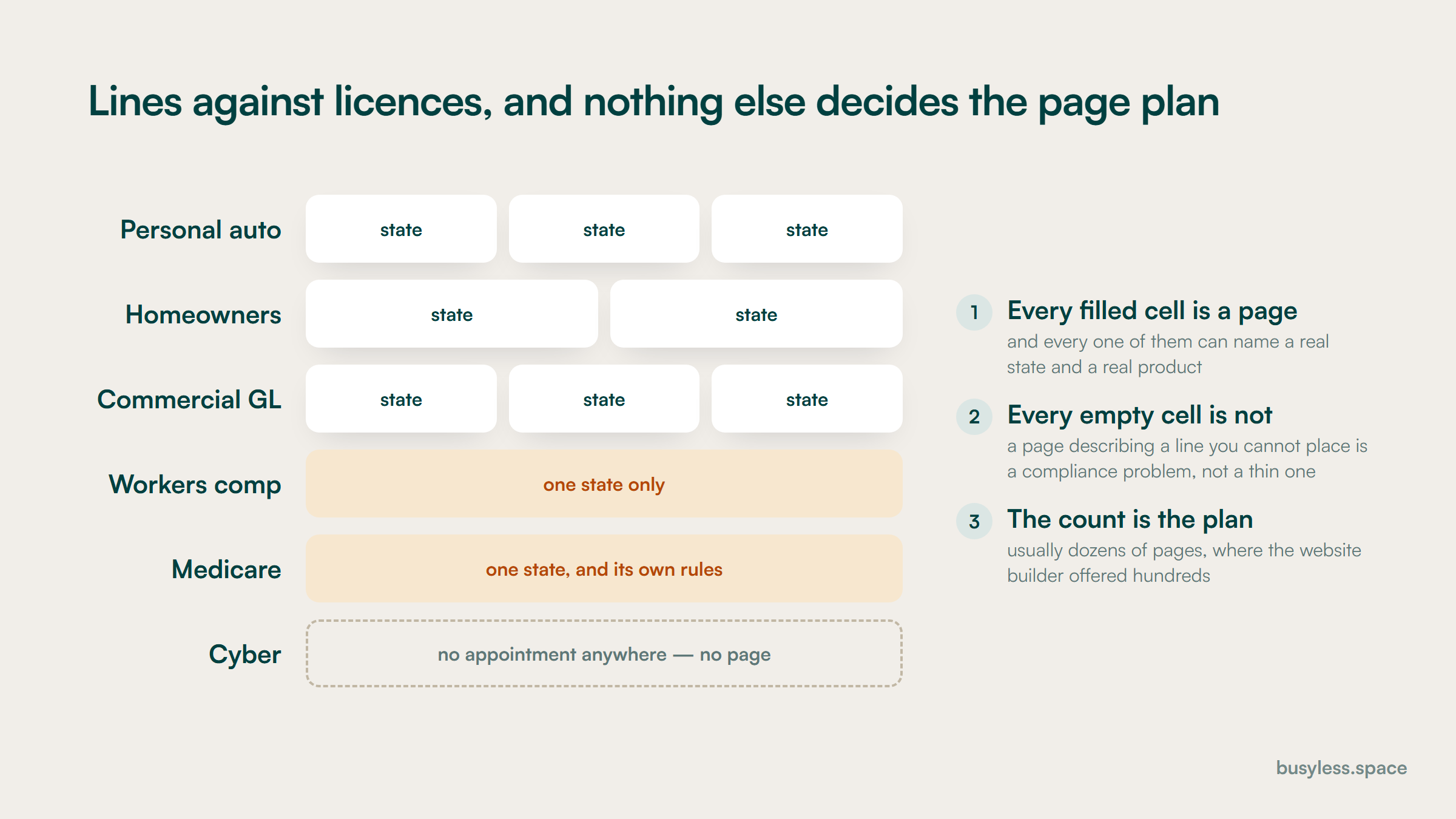
  2. 2Your licence map is your page map. Lines of business multiplied by the states you are appointed in is the complete set of pages that may legally exist, and it is much smaller than your website builder will offer.
  3. 3If you touch Medicare, a federal rule supplies the words on your website. The CMS disclaimer for third-party marketing organisations has to appear prominently, and for anonymous visitors it has a specific generic form.
  4. 4The unglamorous commercial lines are where the money and the silence are. Nobody has written a good page about liability cover for a specialist trade, and those buyers convert at multiples of a personal auto lead.
  5. 5A free gift for a quote is an inducement, not a lead magnet. Anti-rebating rules sit on the offer, and states are inconsistent enough that the landing page needs checking before it goes live.

SEO for insurance agencies begins with a concession that most proposals in this market refuse to make. The highest-volume searches are not winnable, and the reason is structural rather than competitive.

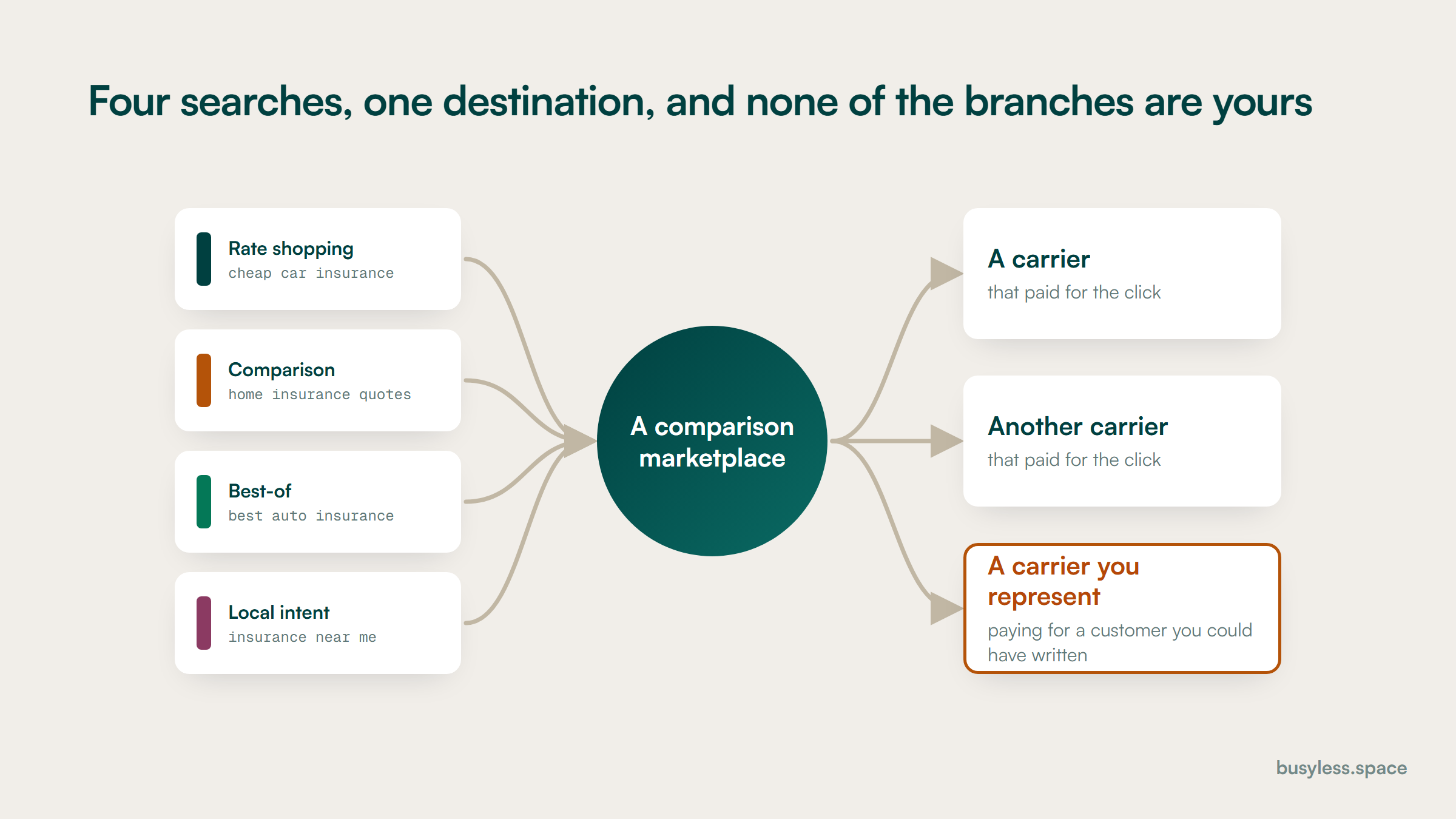
Search a rate term and count what comes back. Comparison marketplaces, personal finance publishers and a government tool, all of them businesses whose product is the results page itself, funded by carrier advertising rather than by policies sold.

An agency is not competing with them for the same customer. It is competing with an entire industry built to intercept that customer and sell them to a carrier, which is often the same carrier the agency represents.

So an insurance agency SEO strategy that starts from keyword volume produces a plan aimed squarely at the one part of the market that cannot be taken. The volume is real and the ground underneath it belongs to somebody else.

What remains is genuinely good, and it is quiet. Specific lines, specific trades, specific situations and specific counties, where the searcher has a problem rather than a price in mind and where nobody has bothered to write anything useful.

Two constraints shape all of it. Your licence and appointments decide which pages may exist at all, and if any part of the business touches Medicare, a federal rule decides some of the words on them.

Who already ranks in insurance agencies

Run the head term and then run a specific one, and the difference is the entire plan. Almost every insurance agency SEO audit finds the same shape: nine results owned by publishers on the first search, and on the second, a carrier's brochure page and nothing else at all.

What is on the results page

  • Comparison marketplaces occupying most of the first page on any rate query
  • Personal finance publishers holding the explanatory and best-of results
  • A heavy paid block, because these are among the most expensive keywords anywhere
  • Carrier brand pages and agent locators on named-carrier queries
  • Local pack on agency and agent queries with a place attached
  • People Also Ask, almost entirely about what a policy does not cover
  • A government comparison tool ranking on Medicare and health queries
  • Almost nothing on specialist commercial lines and hard-to-place risks
  • Comparison marketplaces

    thezebra.com

    The Zebra, Insurify, Compare.com and their peers exist to occupy the rate queries and monetise them through carrier advertising. They are not competing agencies and they cannot be outranked by one. Read them as market intelligence instead: whatever they are not covering is what remains for you.

  • Personal finance publishers

    nerdwallet.com

    NerdWallet, Bankrate, ValuePenguin and the news brands hold most of the explanatory and best-of results, with editorial teams and authority no agency will match. The gap they leave is state-level and situation-level detail, because a national publisher cannot economically write the version of a coverage question that only matters in your state.

  • Your carriers' own agent locators

    carrier agent locator pagesClaim it

    The one gatekeeper you are inside rather than outside. A named-carrier search plus a location often ends at the carrier's own find-an-agent tool, and your entry there is free, ranked by fields most agencies leave blank, and read by somebody who has already chosen the product. Complete it properly before writing anything.

  • Medicare Plan Finder

    medicare.gov

    A government comparison tool that ranks on Medicare queries and that a federal rule requires you to point your own visitors towards in the required disclaimer. That is unusual enough to be worth noticing: the regulator has made the competing destination part of your mandated copy.

  • Google Business Profile

    google.comClaim it

    The local pack fires on agency and agent queries and most agencies treat the profile as a formality. List the lines you actually write as services, name the producers, and keep the hours honest. For a multi-producer agency, decide deliberately whether each producer gets a profile, because inconsistent practice here fragments the signal.

  • Better Business Bureau

    bbb.orgClaim it

    Still consulted in this category more than in most, partly because the purchase is a promise about a future event. The profile ranks on agency name queries and the complaint history is what a cautious buyer reads. Worth claiming, worth keeping accurate, and worth answering properly.

  • State licensee lookup and the national producer database

    nipr.com

    Every department of insurance publishes a licensee search, and producer numbers are public. Buyers and competitors both use them. Publishing your own licence details rather than leaving them to be looked up is a trust signal that costs nothing and that almost no agency website carries.

  • Reddit and the consumer forums

    reddit.com

    Threads asking whether a carrier or an agency is any good rank on brand-adjacent queries and are read closely, because this is a category where people feel they have been misled before. You cannot manage them and you can be worth the answer somebody gives.

Four rate-shopping searches converging on a single comparison marketplace, then diverging to four carriers who paid for the click. The local agency sits outside every branch.
The carrier at the end of one of those branches is often the same carrier the agency represents.

What people actually search

One cluster below is unwinnable, one is unavoidable, and the rest are open. Sorting a keyword list by which of those three it belongs to is more useful than sorting it by volume, because the volume is concentrated in the unwinnable one.

Rate shopping

Commercial investigation

cheap car insurance

The page that wins it: Nothing, and being clear about that saves a budget

Conceded, and the concession is the point. The businesses holding these results sell clicks to carriers rather than policies to people, which is a different economic model and not one an agency can enter.

Named carrier plus a place

Navigational, high intent

[carrier] agent [city]

The page that wins it: A page per carrier you represent, plus a complete locator entry

The searcher has already chosen the product and is looking for a human. This is the one place where being an appointed agent is a genuine ranking advantage rather than a disadvantage.

Coverage questions

Informational

does homeowners insurance cover [event]

The page that wins it: A state-specific answer with the policy language quoted

The publishers own the generic version. What they cannot economically write is the version that turns on your state's rules, which is usually the version that actually decides the answer.

Specialist and hard-to-place lines

Commercial

insurance for [unusual trade or risk]

The page that wins it: A page per line with the underwriting realities named

Low volume, high premium, almost no competition and buyers who have already been declined somewhere. The best cluster in this industry and the one nobody writes for, because it takes real knowledge.

Life events and adverse history

Transactional, urgent

car insurance after a [specific event]

The page that wins it: A page per situation, written without judgement

Somebody with an urgent problem and a narrowed set of options. High intent and high loyalty afterwards, because being helped at that point is remembered longer than a saving is.

Commercial lines by trade

Commercial

general liability for [trade] in [state]

The page that wins it: A page per trade with the limits and the certificate needs named

The single most under-served cluster here. Contractors and small operators are searching for the certificate their own client demanded, which makes it a compliance purchase rather than a price one.

Medicare

Commercial, seasonal

medicare advantage plans [county]

The page that wins it: A page carrying the required disclaimer and real plan counts

The only cluster in this directory where a regulator writes the sentence itself rather than telling you what to disclose. It is also seasonal, concentrated and competitive enough that the compliance work is the price of entry rather than an afterthought.

Claims and service

Informational, existing customers

how to file a claim with [carrier]

The page that wins it: A claims page per carrier with the real steps and numbers

Retention rather than acquisition, and worth building anyway. It is the moment an agency proves it does something a marketplace does not, and it is what people describe when they recommend you.

What the rules change

Heavier than most of this directory, and unusually concrete: two of the four rules below decide the actual words on a page rather than the general tone. Everything varies by state, so check with your own compliance counsel; none of this is legal advice.

1

A federal rule supplies the sentence on your website

The CMS Medicare marketing requirements at 42 CFR 422.2267 and 423.2267, which govern third-party marketing organisations

What it means

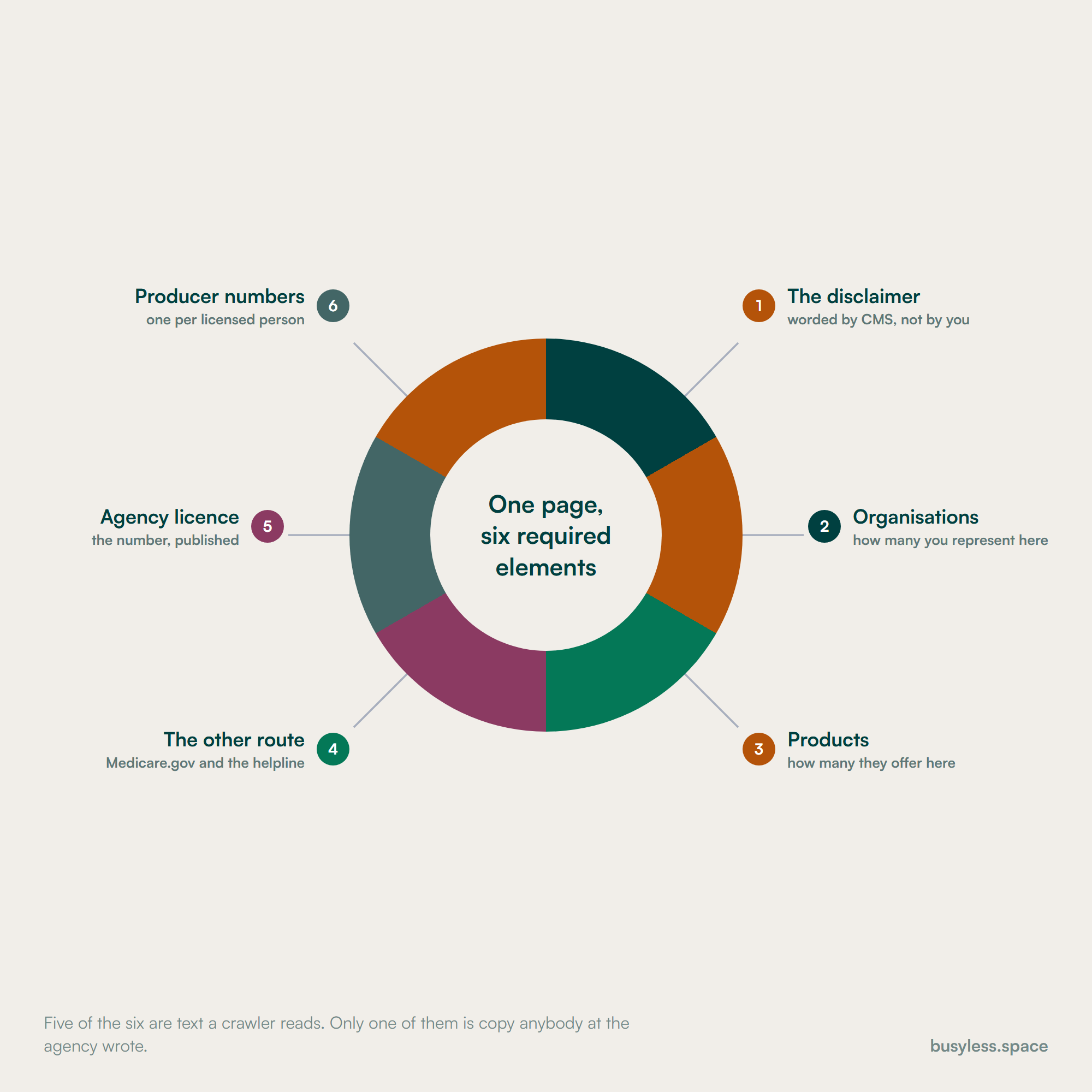
Where an agency markets Medicare Advantage or Part D plans, it must display the required disclaimer prominently on its website. Where the visitor is anonymous, CMS confirmed a generic form: that you do not offer every plan available in the area, that any information is limited to the plans you do offer, and that the reader should contact Medicare.gov or the Medicare helpline for all their options.

So do this

Put the disclaimer in the page's own HTML rather than in a script that loads afterwards, because prominence is judged on what a person sees. Where the version naming counts applies, keep the number of organisations and products accurate as appointments change, and review every Medicare page before the annual enrolment period rather than during it.

2

You may only advertise what you are licensed to sell, where you are licensed to sell it

State insurance codes and departmental advertising rules, built in most states on the NAIC advertising model regulations for accident and sickness insurance and for life insurance and annuities

What it means

Advertising has to be under the licensed name, trade names generally have to be registered with the department, and an agency cannot solicit a line or a state it is not appointed and licensed for. The rules also govern how a product may be described, which reaches ordinary marketing words like guaranteed, free and instant.

So do this

Build the page set from the licence map rather than from the keyword list. One page per line multiplied by the states you are appointed in, with the licence numbers published, and a hard rule that no page describes a product the agency cannot actually place. Re-run the map whenever an appointment changes.

3

A free gift for a quote is an inducement

State anti-rebating provisions, most of them built on the NAIC Unfair Trade Practices Act, Model 880, which the NAIC amended on 9 December 2020 to permit certain value-added products and services

What it means

Offering anything of value as an inducement to buy insurance is prohibited in most states. The 2020 amendments created an exception for value-added products and services that relate to the coverage and meet stated criteria, with drafting notes suggesting a threshold, but adoption is uneven and the states remain inconsistent.

So do this

Check any offer on a landing page against your own state before it goes live: gift cards for quotes, prize draws, referral rewards and free services bundled with a policy all sit inside this rule. Where a genuine value-added service qualifies, describe how it relates to the coverage, because that connection is what the exception turns on.

4

Shared consent survived the challenge this industry brought

Insurance Marketing Coalition Ltd v FCC, decided by the Eleventh Circuit on 24 January 2025, which vacated the FCC's one-to-one consent rule three days before it was due to take effect

What it means

The court held that the FCC had exceeded its statutory authority, so bundled consent remains permissible under federal law and a shared lead may still be called. The case is named after this industry's own trade body, which is a reasonable indication of how much of this market runs on purchased leads. Several states operate their own stricter statutes regardless.

So do this

Treat the federal position as the floor rather than the ceiling. Keep your consent language specific and your records complete, check the states you operate in for their own rules, and be careful about buying leads whose consent you cannot see, because the liability follows the call rather than the purchase.

One web page annotated with six elements a regulator or a buyer expects: the required Medicare disclaimer, the organisation count, the product count, the Medicare.gov reference, the agency licence number and the producer numbers.
Five of the six are text. Only one of them is copy anybody at the agency actually wrote.

Proving expertise

The purchase is a promise about a future event, so the proof that matters is about who is accountable when that event happens. Almost all of it is public information the agency simply has not published.

  • The agency licence number and the states it covers
  • Each producer's national producer number and the lines they hold
  • Which carriers you are appointed with, listed rather than shown as logos
  • How many organisations and how many products that actually amounts to
  • Designations written out in full, with the awarding body
  • Years in the market and whether the agency is independent or captive
  • Named claims contacts and what the agency does when a claim is disputed
  • Errors and omissions cover, stated plainly
  • Physical office, hours and whether anybody is actually there

How to build a insurance agency SEO strategy

Nine months, and the first month is spent working out what may legally be published. An insurance agency SEO strategy that skips the licence map produces pages that have to be taken down later, which is more expensive than not writing them.

  1. 1

    Weeks 1 to 4

    Draw the licence map

    • List every line you are appointed for and every state you are licensed in
    • Cross the two into the complete set of pages that may exist
    • Publish the agency licence number and every producer number
    • Complete every carrier agent locator entry properly
    • Audit any existing page against the map and remove what fails
    • Check every offer or incentive on the site against your state's rebating rules

    You end up with
    A page plan bounded by what you may lawfully sell, and a site with nothing on it that you cannot

  2. 2

    Weeks 4 to 12

    Take the quiet, valuable ground

    • Write a page per specialist and hard-to-place line you genuinely place
    • Write a page per trade for commercial lines, naming the certificate requirements
    • Write a page per life event and adverse history situation
    • Write a page per carrier you represent, with the claims process on it
    • Answer the state-specific coverage questions the publishers cannot economically write
    • Set up the local profile with lines listed as services

    You end up with
    Coverage of every search where the buyer has a problem rather than a price in mind

  3. 3

    Weeks 10 to 24

    Handle Medicare properly or not at all

    • Decide whether Medicare is genuinely part of the business
    • If it is, build the pages with the required disclaimer in the server-rendered HTML
    • Keep the organisation and product counts accurate as appointments change
    • Build a county-level page set rather than a single state page
    • Schedule the compliance review before the enrolment period, not during it
    • If it is not, remove the half-built Medicare content entirely

    You end up with
    Either a compliant Medicare presence or an honest absence, rather than the usual middle

  4. 4

    Weeks 20 to 36

    Measure policies, not quotes

    • Track quote requests by line and by source
    • Track bound policies rather than quotes, by line
    • Report written premium and commission, not lead volume
    • Report retention by line and by acquisition source
    • Review purchased lead spend against organic cost per bound policy
    • Re-run the licence map and re-audit the site against it

    You end up with
    A report in premium and retention, which is the only version an agency principal can act on

Technical fixes with the best payoff

The characteristic failure here is generated geography, and it comes from a tool the agency already pays for. Agency management platforms offer to build a page per line per town, and the licence map is the only thing that should decide how many of them exist.

  • Location pages generated beyond the licence

    A sprint

    Twelve lines across sixty towns is over seven hundred URLs, and the website module will generate all of them on request. Some describe products the agency cannot place and some describe states it is not licensed in, which turns a thin-content problem into a regulatory one.

    Build the grid from lines multiplied by appointed states, then keep only the cells where you have real business and real knowledge. That is usually a page set in the dozens rather than the hundreds. Delete the rest rather than noindexing them.

  • The carrier logos are the only proof on the site

    A day

    A wall of carrier logos is the standard trust device in this industry and it is unreadable. It says nothing about which lines each carrier is used for, whether the appointment is current, or how many organisations and products the agency actually represents, which is the number a Medicare disclaimer requires anyway.

    Replace the wall with a list: carrier, the lines you place with them, and how long you have been appointed. Then give the carriers you write most with a page each. This also produces the count the disclaimer needs and the entity data the markup wants.

  • The quote form is on the rater's domain

    An afternoon of configuration

    The comparative rater or the carrier's quoting engine usually lives somewhere else, so the moment of conversion, the drop-off point and the reason people abandon are all invisible. Most agencies therefore report form starts and call it a funnel.

    Measure the click out as a conversion at minimum, and where the platform allows it, host the flow on your own subdomain. Then find out which field loses people, because in this category it is almost always the one asking for a date of birth or a licence number before showing anything useful.

  • The required disclaimer is injected by a script

    An hour

    Medicare disclaimers are frequently added through a tag manager or a chat widget, so they appear after the page loads. Prominence is judged on what a person sees and a script that fails, or is blocked, removes the mandated copy from a page that has to carry it.

    Put it in the server-rendered HTML of every page it applies to, above the fold on landing pages, in the page's own markup rather than in an overlay. Then check it renders with scripts disabled, which takes two minutes and is the only reliable test.

  • Every producer is a paragraph on one page

    A day

    In an agency the relationship is with a person, and the licence, the lines and the designations belong to that person rather than to the business. A single team page cannot carry a producer number, a line authority list and a set of designations for six people without becoming unreadable.

    A page per producer, with their number, their licensed states, the lines they write, their designations and the kind of client they handle. It is also the honest way to answer a search for a named individual, which happens more in this category than in most.

  • There is no claims content at all

    A day per carrier

    Agencies compete with marketplaces on exactly one axis, which is what happens after something goes wrong, and almost none of them write about it. Meanwhile the claims searches are high volume, entirely commercial in effect, and answered by the carriers in their own interest.

    A claims page per carrier with the real steps, the real numbers, what to photograph, what not to say, and what the agency will do on your behalf. It retains customers, it earns recommendations, and it is the most concrete demonstration available of why an agency exists.

  • The site never says which states you are licensed in

    An hour

    Buyers, competitors and regulators can all look it up, and the agency is usually the only party that has not published it. It also creates the practical problem that a visitor two states away spends ten minutes on a quote form before discovering the answer.

    A licensing page listing the agency number, every producer number and every state, with a plain statement of which lines are available where. Link it from the footer. Nothing about this is confidential and it removes a whole category of wasted enquiry.

Six lines of business against the states each is appointed in. Three lines carry several states, two carry one, and one carries none at all, which is a line that may have no page anywhere.
An empty cell here is not an opportunity. It is a page your website builder will offer to generate anyway.

Structured data that applies here

The types below fit this industry specifically. Most of them earn no rich result on their own, which is worth knowing before anyone sells the work on that basis. What they do is describe the entity precisely, which matters for how search engines and answer engines resolve who you are.

  • InsuranceAgency

    Home page and every office

    A dedicated local business type, which is worth using rather than the generic one. The knowsAbout field is where the lines of business go, and it is the closest thing the vocabulary has to expressing what an agency is actually appointed to sell.

    InsuranceAgency.jsonld
    {
      "@context": "https://schema.org",
      "@type": "InsuranceAgency",
      "@id": "https://[YOUR-DOMAIN]/#agency",
      "name": "[AGENCY NAME]",
      "legalName": "[NAME EXACTLY AS LICENSED]",
      "url": "https://[YOUR-DOMAIN]/",
      "telephone": "[+1-555-000-0000]",
      "address": {
        "@type": "PostalAddress",
        "streetAddress": "[STREET]",
        "addressLocality": "[CITY]",
        "addressRegion": "[ST]",
        "postalCode": "[00000]",
        "addressCountry": "US"
      },
      "areaServed": [
        { "@type": "State", "name": "[STATE WHERE LICENSED]" },
        { "@type": "State", "name": "[STATE WHERE LICENSED]" }
      ],
      "knowsAbout": [
        "[Commercial general liability]",
        "[Workers compensation]",
        "[Personal auto]",
        "[SPECIALIST LINE YOU ACTUALLY PLACE]"
      ],
      "identifier": {
        "@type": "PropertyValue",
        "name": "Agency licence number",
        "value": "[LICENCE NUMBER]"
      },
      "foundingDate": "[YYYY]",
      "openingHoursSpecification": [{
        "@type": "OpeningHoursSpecification",
        "dayOfWeek": ["Monday","Tuesday","Wednesday","Thursday","Friday"],
        "opens": "[09:00]",
        "closes": "[17:00]"
      }]
    }
  • Person with a national producer number

    Every producer's page

    The producer number is a public identifier a buyer can verify against the national database, which makes this one of the few credential blocks in this directory that is genuinely checkable. List only the states where that individual holds a licence, not the agency's full footprint.

    Person with a national producer number.jsonld
    {
      "@context": "https://schema.org",
      "@type": "Person",
      "@id": "https://[YOUR-DOMAIN]/team/[SLUG]#person",
      "name": "[FIRST LAST]",
      "jobTitle": "[Licensed insurance producer]",
      "worksFor": { "@id": "https://[YOUR-DOMAIN]/#agency" },
      "identifier": {
        "@type": "PropertyValue",
        "name": "National Producer Number",
        "value": "[NPN]"
      },
      "hasCredential": [
        {
          "@type": "EducationalOccupationalCredential",
          "credentialCategory": "[Property and casualty licence]",
          "recognizedBy": { "@type": "GovernmentOrganization", "name": "[STATE] Department of Insurance" },
          "identifier": "[STATE LICENCE NUMBER]"
        },
        {
          "@type": "EducationalOccupationalCredential",
          "credentialCategory": "[DESIGNATION, WRITTEN OUT IN FULL]",
          "recognizedBy": { "@type": "Organization", "name": "[AWARDING BODY]" }
        }
      ],
      "knowsLanguage": ["[en]"],
      "knowsAbout": ["[LINES THIS PERSON ACTUALLY WRITES]"]
    }
  • Service bounded by licence and line

    Every line-of-business page

    areaServed is doing compliance work here rather than marketing work. It should list exactly the states where the agency is appointed for that line, which is usually a shorter list than the agency's overall footprint and is the boundary the page set is built from.

    Service bounded by licence and line.jsonld
    {
      "@context": "https://schema.org",
      "@type": "Service",
      "@id": "https://[YOUR-DOMAIN]/[LINE-SLUG]#service",
      "name": "[LINE OF BUSINESS] for [WHO IT IS FOR]",
      "serviceType": "[Plain description of the coverage]",
      "provider": { "@id": "https://[YOUR-DOMAIN]/#agency" },
      "areaServed": [
        { "@type": "State", "name": "[STATE APPOINTED FOR THIS LINE]" }
      ],
      "audience": {
        "@type": "Audience",
        "audienceType": "[TRADE OR SITUATION THIS PAGE IS FOR]"
      },
      "serviceOutput": "[Certificate of insurance / policy / binder]",
      "description": "[What is typically covered, what is typically excluded, and the limits this kind of buyer is usually asked for.]"
    }
  • ItemList of the carriers you represent

    The carriers page

    The machine-readable version of the count the Medicare disclaimer already requires you to state. Building it also forces the useful exercise of confirming which appointments are actually current, which is not always what the logo wall on the home page implies.

    ItemList of the carriers you represent.jsonld
    {
      "@context": "https://schema.org",
      "@type": "ItemList",
      "@id": "https://[YOUR-DOMAIN]/carriers#list",
      "name": "Carriers represented by [AGENCY NAME]",
      "numberOfItems": "[00]",
      "itemListElement": [
        {
          "@type": "ListItem",
          "position": 1,
          "item": {
            "@type": "Organization",
            "name": "[CARRIER NAME]",
            "url": "[CARRIER SITE]",
            "description": "[Lines we place with them, and since when.]"
          }
        }
      ]
    }
  • FAQPage

    Line, trade and situation pages

    The questions that stop a purchase here are about exclusions rather than about price. What is not covered, what the limit needs to be, and how a claim is actually handled. Match the visible wording exactly, and never let an answer describe a product you are not appointed to place.

    FAQPage.jsonld
    {
      "@context": "https://schema.org",
      "@type": "FAQPage",
      "mainEntity": [
        {
          "@type": "Question",
          "name": "[Question exactly as it appears on the page]",
          "acceptedAnswer": {
            "@type": "Answer",
            "text": "[Answer exactly as it appears. Name the real exclusions and the limits this kind of buyer is usually asked for, and say where the answer differs by state.]"
          }
        }
      ]
    }
  • BreadcrumbList

    Line, trade, situation and carrier pages

    Only meaningful once the site has a hierarchy built from the licence map. Assembling it is the fastest way to notice that half the generated town pages have no parent, which is usually the same half that should not exist.

    BreadcrumbList.jsonld
    {
      "@context": "https://schema.org",
      "@type": "BreadcrumbList",
      "itemListElement": [
        { "@type": "ListItem", "position": 1, "name": "Home",
          "item": "https://[YOUR-DOMAIN]/" },
        { "@type": "ListItem", "position": 2, "name": "[Business insurance]",
          "item": "https://[YOUR-DOMAIN]/business" },
        { "@type": "ListItem", "position": 3, "name": "[TRADE OR LINE]",
          "item": "https://[YOUR-DOMAIN]/business/[SLUG]" }
      ]
    }

What it costs

Editorial estimates rather than quotes. They sit above the middle of this directory because the writing needs somebody who understands underwriting, and because anything touching Medicare carries a compliance review that is not optional.

Lean

$1,500 to $3,000
  • The licence map and a site audited against it
  • Licence and producer numbers published
  • Carrier locator entries completed
  • Five to eight pages on the lines you place most profitably
  • The local profile set up with lines listed as services

Who it suits

A single-office agency in one or two states

Where it stops

It takes the quiet ground in your strongest lines. It will not build a commercial trade page set or support a Medicare operation.

Funded

$3,000 to $4,500
  • A page per trade for commercial lines with certificate requirements named
  • Situation and adverse history pages written properly
  • A page per producer with numbers, states and designations
  • Claims content per carrier
  • Reporting in bound policies and written premium

Who it suits

A multi-producer independent agency with a commercial book worth growing

Where it stops

It will not compete on the rate terms, and no tier here will. That ground belongs to businesses funded by carrier advertising rather than by commission.

Enterprise

$4,500 to $6,000
  • A county-level Medicare page set with compliance review built in
  • State-specific coverage content maintained as rules change
  • Multi-state structure bounded by the licence map
  • Original analysis of your own book, published where it is defensible
  • Attribution stitched from first touch to bound policy and renewal

Who it suits

Multi-state agencies, and anybody with a real Medicare or specialist commercial operation

Where it stops

Service capacity is what runs out first. An agency that cannot look after the book it already has does not need more quote requests, and retention shows that long before the pipeline does.

How to do it with no budget

A surprising amount of the highest-value work here is publishing public information about yourself. Three of the steps below are facts a regulator already holds, and the agency is usually the only party that has not written them down.

  1. 1

    Draw the licence map

    3 hours

    Your appointment records and the national producer database

    Lines down one axis, appointed states across the other. It is the page plan, the compliance boundary and the honest scope of the business in a single grid, and almost nobody has one.

  2. 2

    Publish your licence and producer numbers

    1 hour

    Your website editor

    Public information that buyers and competitors already look up. Publishing it is a trust signal that costs nothing and that virtually no agency website carries.

  3. 3

    Complete every carrier agent locator entry

    3 hours

    Your carrier portals

    Free, ranked, and read by somebody who has already chosen the product. Most agencies fill in the name and address and leave the lines, the languages and the specialisms blank.

  4. 4

    Replace the carrier logo wall with a list

    2 hours

    Your website editor

    Carrier, lines placed, years appointed. It is more persuasive, it is readable by a machine, and it produces the organisation and product count that a Medicare disclaimer requires anyway.

  5. 5

    Check every offer against your state's rebating rules

    2 hours

    Your state department's bulletins and your compliance contact

    Gift cards for quotes, prize draws and referral rewards all sit inside anti-rebating law. The 2020 model amendments created a value-added exception, but adoption is uneven, so this is a state-by-state check.

  6. 6

    Write one specialist line page properly

    4 hours

    Your own declined-and-placed history

    Pick the hardest risk you routinely place. Name the underwriting realities, the typical limits and why other agencies decline it. One page like this outperforms twenty town pages.

  7. 7

    Test the required disclaimer with scripts disabled

    20 minutes

    Your browser's developer tools

    If the Medicare disclaimer disappears, it was never in the page. Two minutes of checking, and the only reliable test of whether mandated copy is actually being served.

The tool stack

Short, because the difficult part is knowing what may be published. Two of the entries below are systems the agency already pays for and has never pointed at a marketing question.

  • See who actually ranks for a line in a given state

    SerpApiSEO APIRead the review

    Run the same line across the states you are appointed in and the results differ far more than they do in most industries, because carrier availability and state rules differ. That variation is the argument for state-specific pages rather than national ones.

    Free routeManual checks from a private window, state by state

  • Judge whether a competitor is beatable before writing against them

    Open PageRankSEO APIRead the review

    Useful mainly as a reality check on the head terms. When the results are held by publishers with authority an order of magnitude above yours, the correct decision is to stop, and a number makes that conversation shorter.

    Free routeAn honest look at who they are

  • Work out what a bound policy is worth before spending to win one

    Inbound Marketing CalculatorFree toolOpen the tool

    First-year commission is not the number. Retention, cross-sold lines and the renewal tail decide whether a line is worth writing pages for, and a personal auto policy and a commercial package are not remotely the same acquisition.

    Free routeFree

  • Publish lines, trades, states and producers as related records

    Agility CMSHeadless CMSRead the review

    Lines, appointed states, carriers and producers are related entities, and modelling them once is what keeps the site inside the licence map automatically. Remove an appointment and every page that depended on it can be found in seconds.

    Free routeFree tier for a small site

  • Find out which lines actually make money

    Your agency management system

    Written premium and retention by line, not policy count. The line worth three pages is usually not the one with the most policies, and this report takes about twenty minutes to produce.

    Free routeAlready paid for

  • Compare purchased leads against organic on the same measure

    Your CRM, with one extra field

    Cost per bound policy, by source, not cost per lead. Purchased leads and organic enquiries usually quote at similar rates and bind at completely different ones, and only this comparison shows it.

    Free routeFree

  • Watch the required disclaimer for drift

    A scheduled check before every enrolment period

    Appointments change, and the counts in the disclaimer change with them. Put the review in the calendar ahead of the season rather than inside it, when nobody has time to do it properly.

    Free routeFree

  • Track retention as a marketing number

    Your agency management system, again

    Retention by acquisition source is the line that reorders the whole plan. A channel producing policies that lapse at renewal is a cost, not a channel, and the annual view is the only one that reveals it.

    Free routeFree

Take it from here

Everything below is yours to take. Fill the [BRACKETS] and it is ready to use. Start with the licence map, because it decides which of the other templates you are allowed to use at all.

Brief

Lines of business against appointed states. It is simultaneously the page plan, the compliance boundary and the honest scope of the agency, and almost nobody has drawn one.

LICENCE MAP - [AGENCY] - [DATE]

WHY THIS IS FIRST
A page describing a product you cannot place, or aimed at a state
you are not licensed in, is not a thin-content problem. It is a
regulatory one. This grid is the only correct input to a page
plan in this industry.

1. THE AGENCY
   Licensed name (exactly):     [_______________]
   Trade names in use:          [_______________]
   Registered with the department?  [ Yes / No / N/A ]
   Agency licence number:       [_______________]
   States licensed:             [_______________]

2. THE PRODUCERS
   Name              NPN         States          Lines
   [____________]    [_______]   [___________]   [__________]
   [____________]    [_______]   [___________]   [__________]
   [____________]    [_______]   [___________]   [__________]

3. THE GRID
   Put a mark only where you hold a current appointment AND
   have placed business in the last 12 months.

   LINE \ STATE        [ST]  [ST]  [ST]  [ST]  [ST]
   Personal auto        [ ]   [ ]   [ ]   [ ]   [ ]
   Homeowners           [ ]   [ ]   [ ]   [ ]   [ ]
   Commercial GL        [ ]   [ ]   [ ]   [ ]   [ ]
   Workers comp         [ ]   [ ]   [ ]   [ ]   [ ]
   Commercial auto      [ ]   [ ]   [ ]   [ ]   [ ]
   Professional         [ ]   [ ]   [ ]   [ ]   [ ]
   Cyber                [ ]   [ ]   [ ]   [ ]   [ ]
   [SPECIALIST LINE]    [ ]   [ ]   [ ]   [ ]   [ ]
   Medicare             [ ]   [ ]   [ ]   [ ]   [ ]
   Life                 [ ]   [ ]   [ ]   [ ]   [ ]

4. THE PAGE PLAN
   Cells marked:                    [____]
   Of those, where we have real
   underwriting knowledge:          [____]
   PAGES THAT MAY EXIST:            [____]
   Pages currently on the site:     [____]
   Pages to remove:                 [____]

5. THE AUDIT
   [ ] Every existing page checked against this grid
   [ ] Pages outside the grid removed, not noindexed
   [ ] Licence page published with all numbers
   [ ] Footer links to the licence page
   [ ] Structured data areaServed matches the grid, per line

6. REVIEW
   Re-run whenever an appointment is added or lost.
   Owner: [____________]   Next review: [__________]

What to publish

Write where the buyer has a problem rather than a price. Everything worth publishing here comes from the placements other agencies decline and the questions a national publisher cannot afford to answer state by state.

  • Specialist and hard-to-place line pages

    One per line you genuinely place, written properly

    Low volume, high premium, and a buyer who has already been declined elsewhere. The underwriting knowledge that makes these pages good is the same knowledge that makes the placement possible.

  • Commercial pages by trade

    One per trade you write regularly

    A contractor searching for the certificate their client demanded is making a compliance purchase, not a price comparison. Naming the limits and the certificate requirements is what wins it.

  • State-specific coverage answers

    Monthly, from the questions your service team fields

    The publishers own the generic version and cannot economically write fifty state variants. The state rule is usually what decides the answer, which makes the local version the useful one.

  • Situation pages for adverse history

    One per situation, reviewed annually

    Urgent, narrowed options and no judgement available anywhere else. Being useful at that moment produces loyalty that survives a cheaper renewal offer.

  • Claims pages per carrier

    One per carrier, updated when a process changes

    The one axis on which an agency beats a marketplace, and almost nobody writes about it. Real steps, real numbers and what the agency will do on the customer's behalf.

  • Producer pages

    One per producer, refreshed when authorities change

    The relationship is with a person and the licence belongs to that person. A page each carries the number, the states, the lines and the kind of client they handle.

And what not to

  • Any page describing a product you are not appointed to place
  • Any page targeting a state you are not licensed in
  • Generated town pages built from a keyword list rather than from the licence map
  • A gift card, prize draw or reward offer that has not been checked against your state's rebating rules
  • A Medicare page whose required disclaimer is injected by a script
  • A carrier logo wall standing in for evidence of what you can actually place
  • Best-of and cheapest-rate content aimed at results owned by publishers
  • Claims of guaranteed savings, which the advertising rules reach directly
The expensive mistakes

Building the plan around the rate terms

Costs you A budget aimed at results owned by businesses funded by carrier advertising, where an agency has no economic route in at all

Concede them explicitly, then spend the whole budget on lines, trades and situations nobody has written about

Letting the website module generate the geography

Costs you Hundreds of near-identical pages, some of them describing products or states the agency is not licensed for

Lines multiplied by appointed states, filtered to where you have real business, which is usually dozens of pages

Treating the Medicare disclaimer as a footer item

Costs you Mandated copy injected by a script on a page that has to display it prominently, in the most closely supervised corner of this market

Server-rendered, above the fold on landing pages, with the counts kept current as appointments change

Running a quote-for-a-gift-card campaign

Costs you An inducement under most states' anti-rebating provisions, on a landing page built to attract exactly the wrong kind of attention

Check the offer against your state first, and use a genuine value-added service that relates to the coverage where one qualifies

Showing carrier logos instead of saying what you place

Costs you The single least informative trust device in this industry, occupying the space where the actual appointments could be listed

Carrier, lines placed, years appointed, with a page each for the ones you write most

Reporting quotes as the outcome

Costs you A number that flatters purchased leads, hides a retention problem and tells an agency principal nothing they can act on

Bound policies, written premium and retention by source, reported annually as well as monthly

What to measure

Two corrections make this honest. Count bound policies rather than quote requests, because the two diverge wildly by source, and report retention alongside acquisition, because a policy that lapses at renewal cost more than it earned.

Leading indicators

Move first. They predict, they do not prove.

  • Impressions on line, trade and situation clusters

    Search Console, grouped by cluster

    Deliberately excludes the rate terms, which are conceded. Grouped this way it shows movement on the winnable ground within about eight weeks of the pages existing.

  • Local pack position on agency and producer queries

    Geo-specific rank tracking

    Checked across the catchment rather than at the office. For a multi-producer agency, track the named-producer searches separately, because they behave differently from the brand ones.

  • Carrier locator referrals

    The carrier portals, plus referral traffic

    The gatekeeper you are inside, so it is worth measuring on its own. Movement here usually follows within days of completing an entry properly, which makes it a useful early proof point.

  • Quote requests by line

    Your CRM

    A leading indicator rather than an outcome, and reported as one. On its own it flatters whichever channel produces the most unqualified enquiries, which is normally the purchased one.

Business indicators

The ones a manager acts on.

  • Bound policies by line and by source

    The agency management system

    The conversion that matters. Purchased leads and organic enquiries frequently quote at similar rates and bind at completely different ones, and this is the only place that shows.

  • Written premium by source

    The agency management system

    Policy counts hide the difference between a personal auto policy and a commercial package. Premium is the version an agency principal can actually make decisions with.

  • Retention at first renewal, by source

    The agency management system, twelve months on

    The line that reorders the plan and the one nobody reports. A source producing policies that lapse at renewal is a cost centre wearing the clothes of a channel.

  • Cross-sold lines per household or account

    The agency management system

    Where the economics of an agency actually live. Content that brings in a single-line customer who never adds a second is worth far less than the enquiry count suggests.

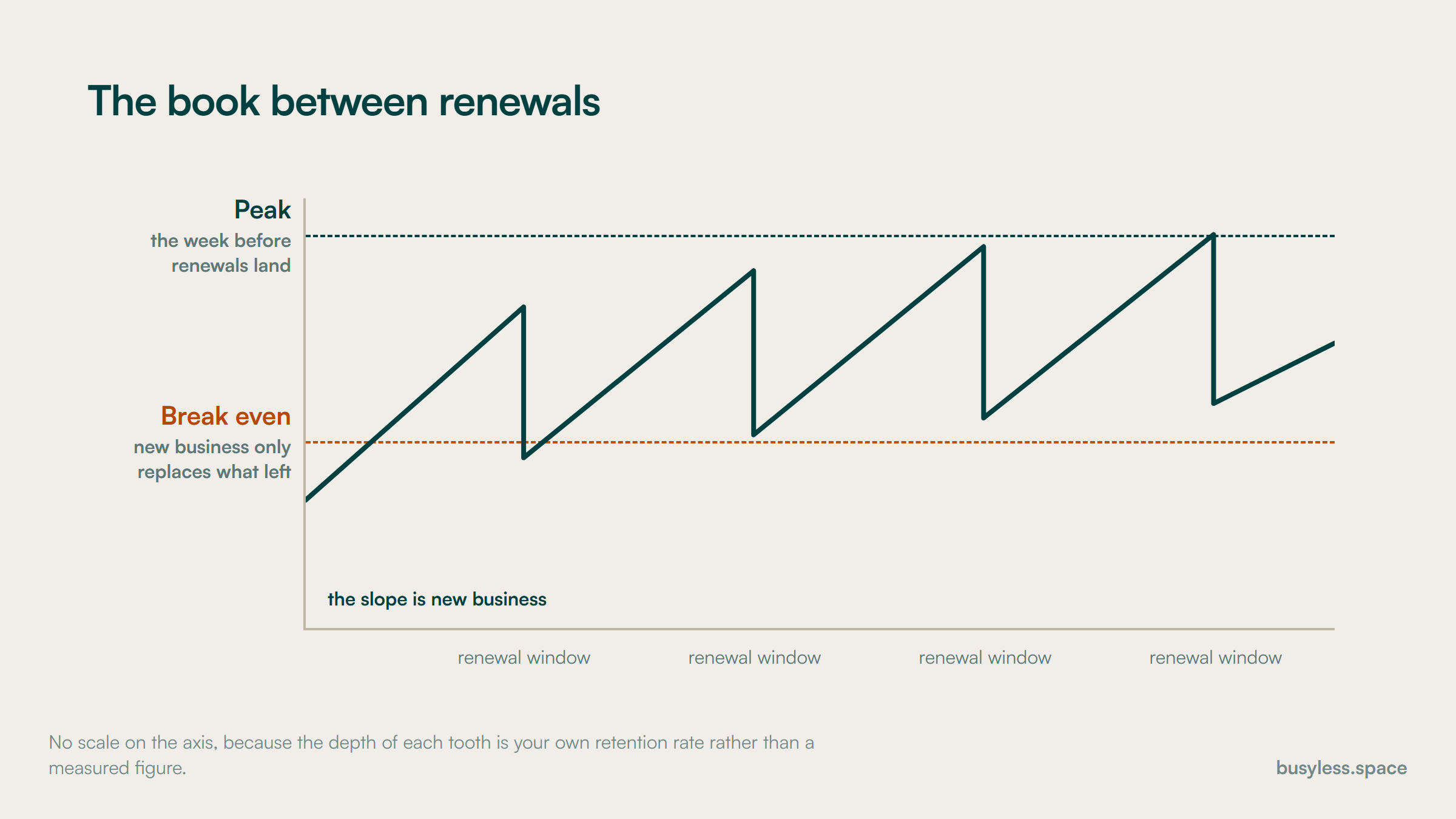
A sawtooth of policies in force, dropping at each renewal window and rising with new business, with a reference line marking the level at which the book stops growing.
The teeth are set by retention, which no acquisition channel can fix and every report leaves out.

The verdict

Insurance is the clearest case in this directory of a market where the biggest keywords are not competitive so much as owned. The businesses holding them sell clicks to carriers, which is a different trade from selling policies.

Accepting that frees up the whole budget for ground nobody is standing on. Specialist lines, trades, adverse histories and state-level coverage questions all have buyers with a problem, and almost no useful pages behind them.

The discipline that makes it work is the licence map. Lines multiplied by appointed states is the complete set of pages that may exist, and building from it removes both the thin-content risk and the regulatory one in the same decision.

Judge any insurance agency SEO services proposal on what it refuses. A plan that still promises the rate terms has not read the market it is selling into, and anybody selling SEO services for insurance agencies should be showing you a licence map before a keyword list.

FAQ

Insurance agencies SEO questions

  • Can we ever rank for cheap car insurance?
    Realistically no, and the reason is structural rather than competitive. Those results are held by comparison marketplaces and personal finance publishers whose product is the results page itself, funded by carrier advertising rather than by commission on policies. An agency has no economic route into that model. Concede the rate terms explicitly and put the whole budget on ground nobody is standing on.
  • How big should our page set actually be?
    Far fewer than your website module will offer, and the number comes from your licence map rather than from a keyword tool. Lines of business multiplied by the states you are appointed in gives the pages that may lawfully exist, and filtering that to where you have real business usually leaves dozens rather than hundreds. Anything outside the map is a compliance problem, not a thin-content one.
  • What does the Medicare disclaimer actually require?
    That the required wording appears prominently on your website. CMS confirmed a generic form for pages with anonymous traffic: that you do not offer every plan available in the area, that your information is limited to the plans you do offer, and that the reader should contact Medicare.gov or the Medicare helpline. Serve it in the page's own HTML and check it renders with scripts disabled.
  • Can we offer a gift card for completing a quote?
    Check your own state before you run it. Offering something of value as an inducement to buy insurance is prohibited in most states under anti-rebating provisions. The NAIC amended its model law in December 2020 to permit certain value-added products and services that relate to the coverage, but adoption is uneven, so a campaign that is fine in one state may not be in the next.
  • Which pages are actually worth building?
    The quiet ones. Specialist and hard-to-place lines, commercial cover by trade, adverse history situations, and state-specific coverage questions. Each has a buyer with a problem rather than a price in mind, low volume, high premium and almost no competition, because writing them well requires underwriting knowledge that a national publisher cannot buy cheaply.
  • Are purchased leads worth it compared with organic?
    Compare them on cost per bound policy and on retention at first renewal, not on cost per lead. In most agency books the two sources quote at broadly similar rates and bind and retain at very different ones. Run the comparison over twelve months rather than a quarter, because the renewal is where the difference shows and a monthly report cannot see it.
  • Should our producers have their own pages?
    Yes, because the licence belongs to the individual and so does the relationship. A page each can carry the national producer number, the states and lines they actually hold, the designations written out in full, and the kind of client they handle. It also answers searches for a named person, which happen more in this category than most agencies realise.
  • What does insurance agency SEO cost?
    The tiers above are editorial estimates rather than quotes. An agency running a real programme is realistically at $1,500 to $6,000 a month, above the middle of this directory. Two reasons. The pages need somebody who understands underwriting to be worth reading, and anything touching Medicare carries a compliance review that is not optional.

Run it yourself, or have someone own it

Everything above is written to be run without us, and the free path is genuinely most of the value for a single-location business. Where these plans stall is almost never the plan. It is that nobody owns it after the first month. That is the job we do, with search as one distribution layer inside a wider system rather than the whole engagement.