
Skip to content

Financial advisor SEO strategy

YMYL and regulated

A securities regulator reviews the marketing, and archives it

Written by Eugene SuslovLast reviewed 28 August 2026No affiliate links
Sector
Legal and financial
Model
Local service, National service
Competition
High
Time to results
9 to 15 months
Typical monthly
$3,000 to $12,000

Key takeaways

  1. 1Testimonials became permissible in 2022 under the SEC Marketing Rule, with conditions. Most firms either still avoid them entirely or use them without the required disclosures, and both are leaving something on the table.
  2. 2Your website is a record. The books and records rule means pages have to be retained, which turns an ordinary CMS decision into a compliance one.
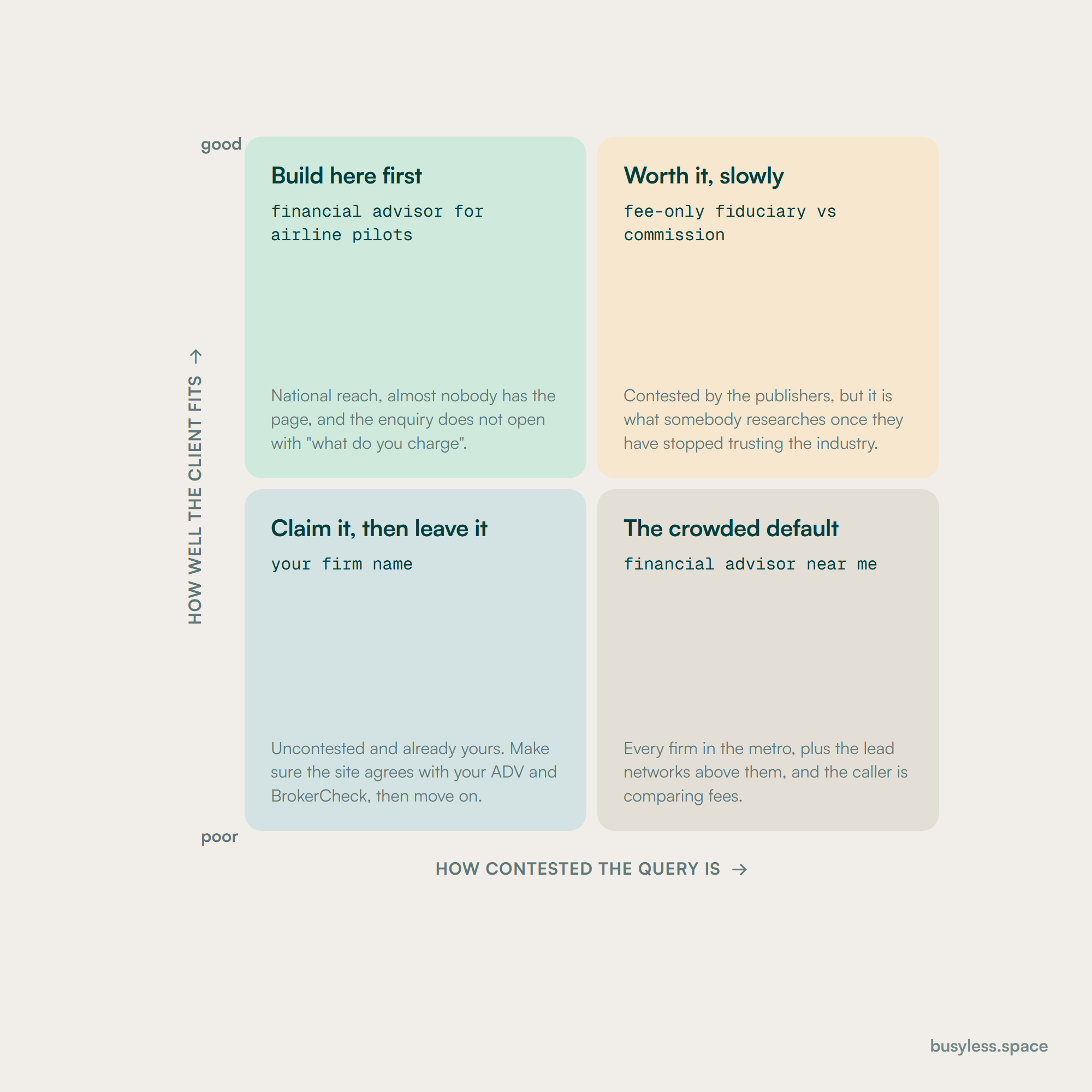
  3. 3Niche beats local, and by more than in accounting. "Financial advisor for [profession]" ranks nationally, escapes the proximity fight, and attracts clients who do not open by asking your fee.
  4. 4The fiduciary and fee cluster is the highest-intent content you can write, because it is what prospects research when they have stopped trusting the industry generally.
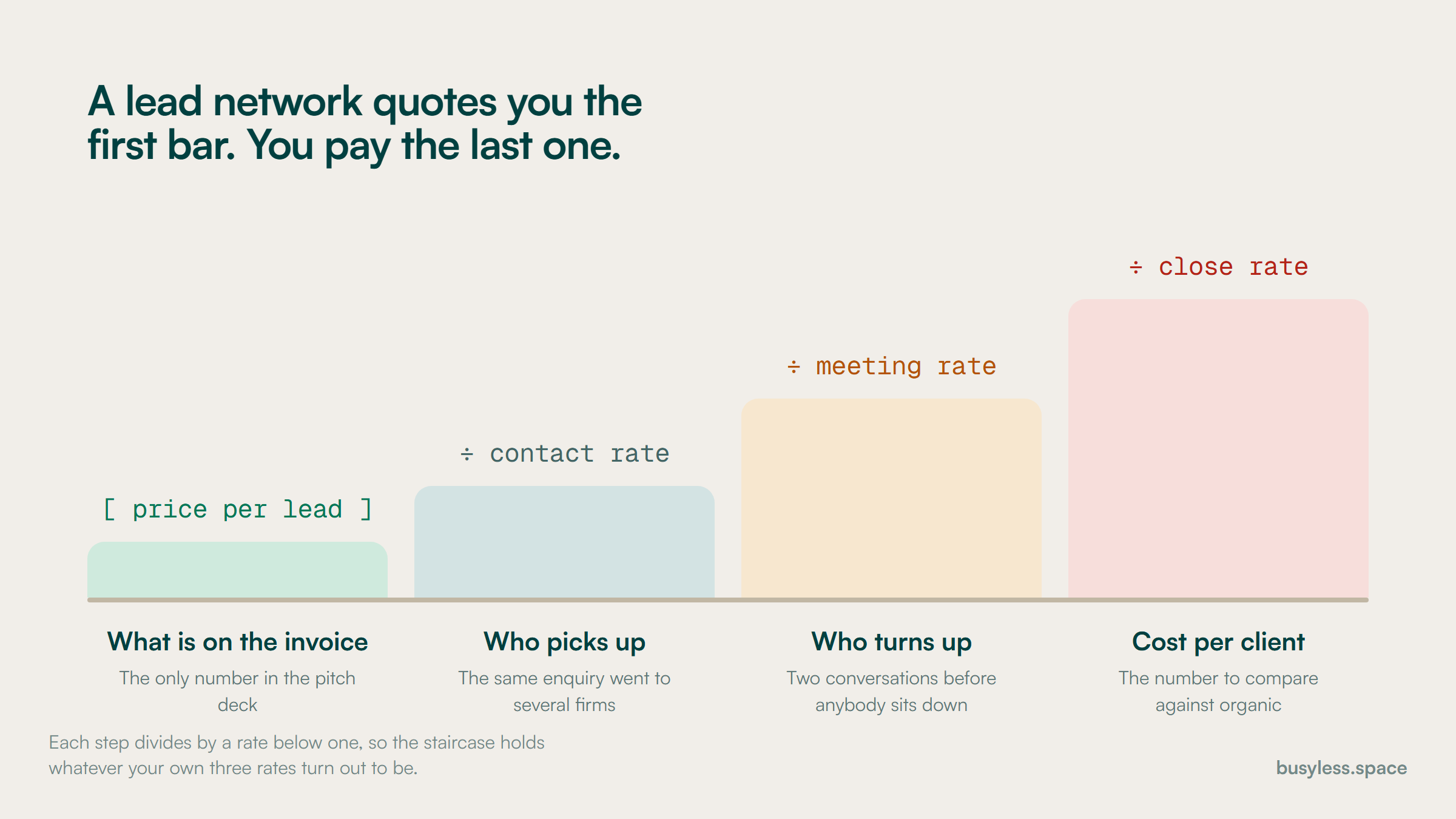
  5. 5SmartAsset and the fee-only networks are lead-generation businesses, not directories. Price them per closed client, not per lead, or the arithmetic will flatter them.

SEO for financial advisors runs into a constraint that almost no other industry has: the marketing is regulated as a category of conduct, and the material is a record that has to be kept.

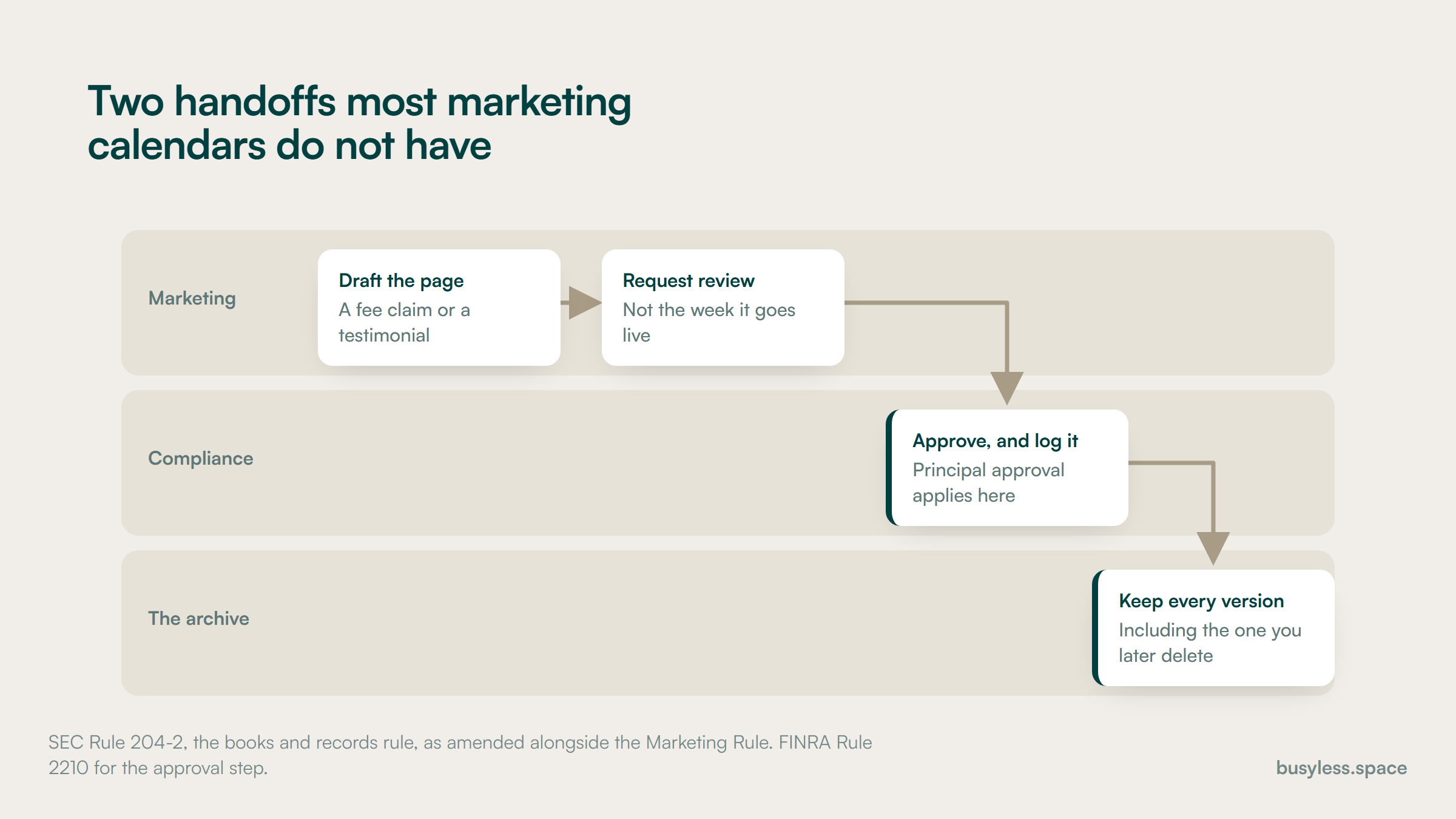
That second part is the one firms underestimate. The books and records rule means pages you publish, and pages you later change, form part of what the firm has to retain. A content programme is therefore also a records programme, and treating it otherwise creates an examination problem rather than a marketing one.

So a financial advisor SEO strategy has to be built with compliance inside it rather than bolted on afterwards.

The strategic picture is otherwise familiar. General retirement and investing questions are owned permanently by NerdWallet, Investopedia, Bankrate and the fund companies, and no advisory firm is going to outrank them on those. The winnable ground is a niche served properly and the questions prospects ask when they are specifically evaluating advisors.

That second cluster is unusual and valuable. People searching whether an advisor is a fiduciary, what fee-only actually means, or how advisors get paid are researching the industry's conflicts. A firm that answers those questions plainly is doing the most persuasive marketing available to it, and doing it in a way a competitor with something to hide structurally cannot copy.

The 2022 rule change also left an opening. Client testimonials went from effectively prohibited to permitted with disclosures, and a large part of the industry has not adjusted. Doing it properly is a differentiator that expires as competitors catch up.

Who already ranks in financial advisors

Look at what ranks before writing anything. The uncomfortable lesson of financial advisor SEO is that two of the strongest results are government databases that exist to let people check up on you, and several of the rest are lead-generation businesses that will sell you the traffic you were trying to earn.

What is on the results page

  • adviserinfo.sec.gov and brokercheck.finra.org ranking on firm and advisor name queries
  • Local pack on advisor-plus-city queries
  • People Also Ask, dense on fee, fiduciary and cost questions
  • AI Overviews on general planning questions, drawing on the large personal finance publishers
  • Lead-generation matching services occupying the top of commercial queries
  • Featured snippets on definitional questions, which is where the fiduciary cluster can take ground
  • SEC Investment Adviser Public Disclosure

    adviserinfo.sec.govClaim it

    Government-run, ranks on firm and advisor names, and shows your Form ADV including any disclosures. You cannot outrank it and should not want to. Make sure what it says matches what your site says, because prospects check.

  • FINRA BrokerCheck

    brokercheck.finra.orgClaim it

    The same job for registered representatives. Any discrepancy between BrokerCheck and your bio is a trust problem you have created yourself. Check both against your site annually.

  • SmartAsset

    smartasset.com

    Ranks widely on advisor-matching queries and is a lead-generation business rather than a directory. Price it per client actually onboarded, not per lead, because the conversion rate through a matching service is not the conversion rate through your own site.

  • NerdWallet, Investopedia and Bankrate

    nerdwallet.com

    Own the general planning and definitional queries. Do not write the generic version of what a Roth conversion is. Write the version for the profession you serve, at the life stage they are in.

  • NAPFA and the fee-only networks

    napfa.orgClaim it

    NAPFA, XY Planning Network, Wealthramp and similar run adviser directories tied to membership or fee model. Free with a membership you may already hold, they carry genuine trust with the audience that seeks them out, and most members complete the profile badly.

  • The custodians' advisor locators

    schwab.comClaim it

    Several custodians run find-an-advisor tools for firms on their platform. High authority, free, and routinely overlooked. Check whether yours has one and whether your listing is complete.

What people actually search

The volume in this industry sits on general personal finance questions, and almost none of it is worth pursuing. The clusters below are ordered by how close they sit to somebody actually looking for an advisor, which is a very different ranking from what a keyword tool returns.

Fiduciary and fee structure

Commercial investigation

fee only vs fee based financial advisor

The page that wins it: A plain explanation of how advisors get paid, including how you do

The highest-intent content in this industry. Somebody researching how advisors are compensated has already decided they need one and is now deciding whom to trust. A firm with a clean answer wins on the page.

Niche specialisation

Commercial investigation

financial advisor for physicians

The page that wins it: A real practice page for one profession or situation

Ranks nationally, escapes proximity entirely, and attracts clients who lead with their situation rather than with your fee. The strongest defensible position available.

Life event

Commercial investigation

what to do with a 401k after leaving a job

The page that wins it: Decision guide for the event, with the options and their trade-offs

Money in motion. These events are when accounts actually move, which makes this the cluster with the shortest distance to an onboarded client.

Cost

Commercial investigation

how much does a financial advisor cost

The page that wins it: Fee page explaining models, ranges and what you charge

The industry answers this evasively, which is exactly why answering it directly works. It also qualifies hard: anyone still reading after your fee is a real prospect.

Do I need one

Informational

do i need a financial advisor or can i do it myself

The page that wins it: Honest guide including when the answer is no

Saying that somebody with a simple situation and a low balance is better off in an index fund costs you nothing and earns the reader who returns in five years with a complicated situation.

Firm and advisor name

Navigational

[firm name] reviews

The page that wins it: A real team page, plus consistency with the public registers

Prospects check adviserinfo and BrokerCheck. What they find there and what your site says must match, and the gap between them is entirely within your control.

Comparison

Commercial investigation

[robo-advisor] vs a human advisor

The page that wins it: Honest comparison including who should use the alternative

Uncomfortable and effective. Naming the situations where a low-cost platform is genuinely the right answer establishes the judgement you are actually selling.

Local

Local transactional

financial advisor [city]

The page that wins it: A local page plus a complete profile

Worth winning if the practice is genuinely local. Increasingly less important as advice has gone remote, and it is the cluster where the niche play does not help.

What the rules change

This is the section that decides how the rest of the programme is run. Registered investment advisers answer to the SEC Marketing Rule and the books and records rule; broker-dealer representatives answer to FINRA Rule 2210 and to their firm's principal; many people are subject to both. Nothing here is legal or compliance advice, and your own compliance officer is the authority.

1

Testimonials are permitted now, with conditions, and that is a change most firms have not absorbed

SEC Rule 206(4)-1, the Marketing Rule, amended 2020 with a compliance date of 4 November 2022

What it means

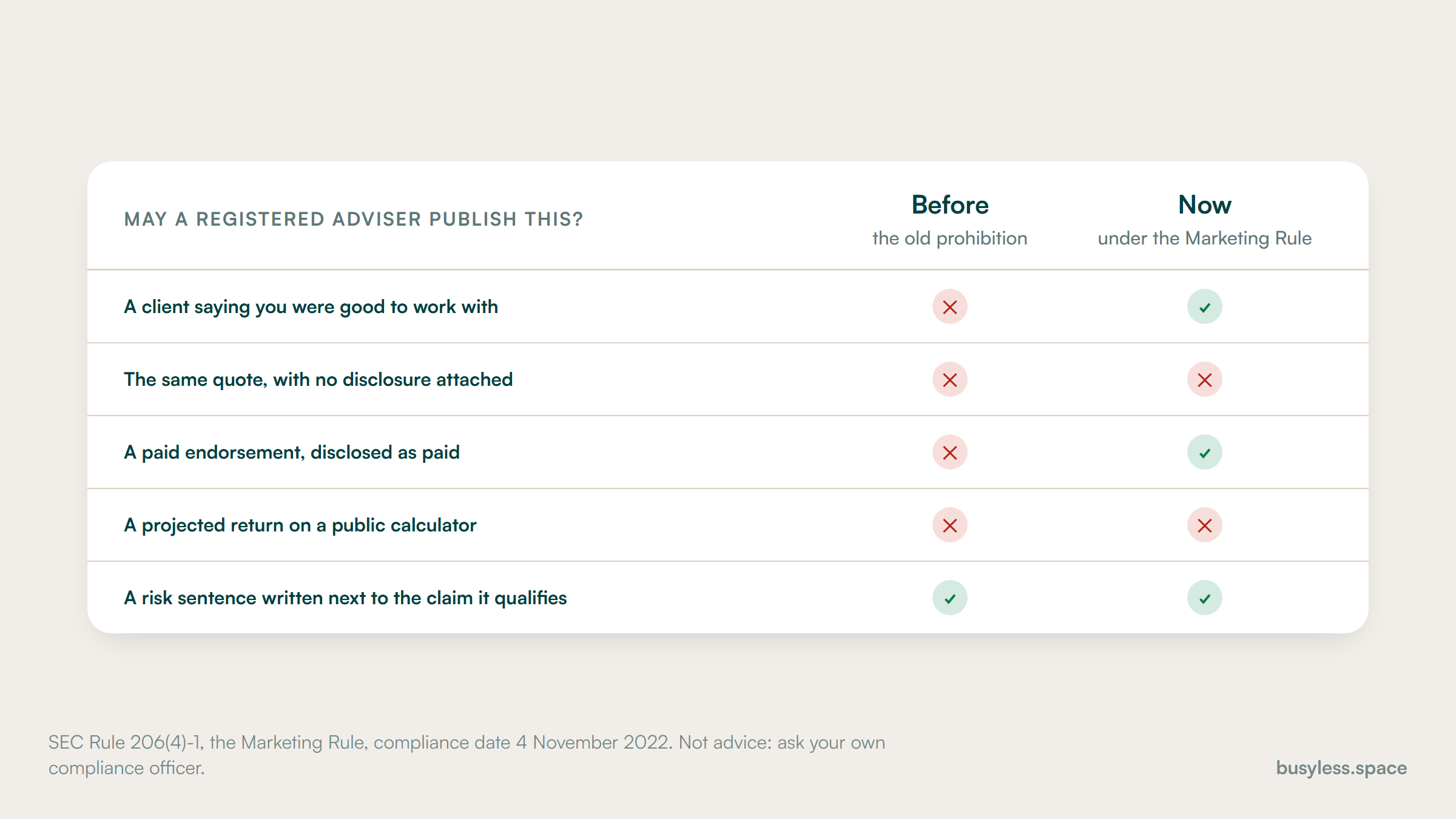
The Marketing Rule replaced a decades-old prohibition on testimonials and endorsements with a conditional permission. Advisers may now use them, subject to disclosure of whether the person is a client, whether they were compensated, and any material conflicts of interest, along with oversight and, in some cases, written agreements.

So do this

If you are not using client testimonials, ask your compliance officer whether you could be, because a large part of the industry is still operating on the pre-2022 assumption. If you are, check the disclosures are present, prominent and on the same page rather than buried in a footer.

2

The website is a record you have to keep

SEC Rule 204-2, the books and records rule, as amended alongside the Marketing Rule

What it means

Advertisements must be retained, and that includes website content. A page edited or removed does not stop being a record. In practice this means the firm needs a versioned archive of what was published and when, not just the current state of the site.

So do this

Archive on publish and on every change, with dates. This is a real input into the CMS decision: a platform with document versioning and a publish log makes the obligation cheap, and a page builder with no history makes it expensive.

3

Hypothetical performance is heavily constrained

SEC Rule 206(4)-1(d)(6)

What it means

The Marketing Rule restricts hypothetical performance, including model, backtested and projected returns, in advertisements. Presenting it to a general audience such as a public website is difficult to square with the requirement to adopt policies ensuring relevance to the intended recipient's financial situation.

So do this

Keep hypothetical and projected returns off public pages. Calculators that project outcomes need compliance review before publication, because the illustration is the part the rule reaches.

4

Broker-dealer communications need principal approval and sometimes a filing

FINRA Rule 2210

What it means

FINRA classifies communications as correspondence, retail communication or institutional communication, with different approval, recordkeeping and filing requirements. Certain retail communications must be filed with FINRA's Advertising Regulation Department, and website content generally falls into the retail category.

So do this

If any registered representative is involved, route content through principal approval before publication and build the review time into the content calendar. A programme that assumes same-day publishing will not survive contact with this.

5

Everything must be fair and balanced, which reaches ordinary marketing copy

SEC Rule 206(4)-1(a); FINRA Rule 2210(d)

What it means

Both regimes prohibit untrue statements, omissions of material fact, and presentations that are not fair and balanced. Marketing habits that are unremarkable elsewhere, such as leading with a benefit and omitting the risk, are the specific thing being prohibited here.

So do this

Write risk into the copy rather than into a footer. It also happens to be better marketing to this audience, because prospects who are researching fiduciary duty are alert to exactly the imbalance the rule addresses.

Proving expertise

The credentials in this industry are publicly checkable and the disclosures are public too, which cuts both ways. A prospect can verify a CFP mark, read your Form ADV and see any disciplinary history in about two minutes, so the only viable strategy is to be the source of that information rather than to let them discover it elsewhere.

  • Registration status stated plainly: RIA, IAR, registered representative, and with which regulator
  • CRD or SEC file number published, so the reader can verify rather than take your word
  • Credentials named precisely, with the awarding body: CFP, CFA, CPA/PFS, ChFC
  • Fee model stated in the first screen, not on a separate page a click away
  • Form ADV Part 2 linked directly rather than buried in a compliance footer
  • Named authors on planning content, with their credential and registration
  • Custodian named, because where the assets are held is a trust question prospects ask
  • Any disciplinary disclosure addressed on your own site rather than left to be discovered on BrokerCheck

How to build a financial advisor SEO strategy

A realistic sequence for the first six months. Compliance comes first for a structural reason rather than a cautious one: a financial advisor SEO strategy that publishes before the review and archiving process exists creates a records problem that has to be unpicked later.

  1. 1

    Weeks 1 to 4

    Build the compliance and records plumbing

    • Agree the review workflow with the compliance officer, including who approves and how long it takes
    • Set up the advertising archive: versioned, dated, covering publish and every subsequent change
    • Audit existing pages for hypothetical or projected performance and remove or review them
    • Reconcile the site against Form ADV, adviserinfo and BrokerCheck, and fix every discrepancy
    • Decide, with compliance, whether testimonials will be used and under what disclosure
    • Claim the fee-only network, custodian and Google Business Profile listings

    You end up with
    A review and archiving process that exists before anything is published, and a site consistent with the public registers

  2. 2

    Weeks 4 to 12

    Own the fiduciary and fee questions

    • Write the fee page: models explained, your own model stated, real ranges
    • Write the fiduciary and compensation explainer, including how you are paid
    • Write the do-I-need-an-advisor guide, including when the answer is no
    • Write the comparison against the low-cost alternative, honestly
    • Publish a proper team page with credentials, registrations and CRD numbers
    • Route every one through the agreed review, and archive on publish

    You end up with
    Coverage of the cluster prospects actually research when they are evaluating advisors rather than investments

  3. 3

    Weeks 10 to 22

    Build the niche

    • Choose the niche from the existing client book: which profession or life situation is over-represented and profitable
    • Write the niche practice page with that group's actual planning problems
    • Write the life-event guides that group hits: equity compensation, practice sale, partnership buy-in, retirement timing
    • Write the threshold and decision content specific to their circumstances
    • Add FinancialService, Person and Service structured data
    • Build the review request process, within whatever the Marketing Rule permits for your firm

    You end up with
    A national position in one niche, which is the only ground here that a local competitor cannot take back

  4. 4

    Weeks 16 to 26

    Measure onboarded assets, not enquiries

    • Attribute enquiries through to discovery meetings, then to onboarded clients and assets
    • Track average account size by source, because a niche client and a general enquiry differ enormously
    • Report leading and business indicators separately, and never present one as the other
    • Reconcile referral-sourced clients honestly, since search often assists a referral rather than originating it
    • Review the niche content on clients onboarded rather than on sessions
    • Run a quarterly check that the archive is current and the registers still match the site

    You end up with
    A report a principal can act on, showing onboarded clients and assets alongside the indicators that predict them

Technical fixes with the best payoff

One of these is genuinely specific to this industry and it changes a platform decision. The rest are ordinary, but the archiving requirement is the reason an advisory firm cannot treat its website as casually as most businesses do.

  • The CMS has no version history, and the website is a record

    A platform decision, then a day to wire the archive

    The books and records rule reaches advertising, and website content is advertising. A platform where an edit silently overwrites the previous version leaves the firm unable to show what was published and when.

    Choose or configure a platform with document versioning and a publish log, and archive externally on every change as well. This is a compliance input into a technical decision, which is unusual and is the reason it leads this list.

  • Projection calculators published without review

    A day per calculator, plus review time

    Retirement and growth calculators are the most linked-to asset an advisory site can have, and they output exactly the hypothetical performance the Marketing Rule constrains. Firms build them as marketing and never route them through compliance.

    Treat any calculator that projects an outcome as advertising requiring review. Where it survives review, state the assumptions on the page and keep the archived version alongside every change to the model.

  • The site disagrees with Form ADV or BrokerCheck

    Half a day, annually

    Both are public, both rank on your own name, and a prospect comparing them takes about two minutes. Discrepancies in fee model, services, AUM or personnel are the ones that surface, and they read as carelessness at best.

    Reconcile annually and after every ADV amendment. Make one person responsible for both, because the failure is almost always that marketing and compliance updated different documents.

  • Disclosures rendered as an unreadable footer

    An afternoon

    Both regimes require disclosures to be clear and prominent, and a grey four-point block at the bottom of the page fails that on its face while also being a poor experience for a reader genuinely trying to understand your fee.

    Put the disclosure with the claim it qualifies, at the same size as the surrounding text. It is both the compliant answer and the more persuasive one for an audience researching whether to trust you.

  • Team pages without credentials or registration

    A day

    The single most-checked page on an advisory site, routinely published as a photograph and two sentences. It is also where the verifiable trust signals belong and are almost always missing.

    Credentials with awarding bodies, registrations, CRD number, custodian, and a direct link to the public record. Give the reader the verification rather than making them go looking.

  • The publishing calendar assumes no review step

    A planning decision

    Broker-dealer content needs principal approval and some retail communications require a FINRA filing. A calendar built on same-week publishing collapses the first time review takes ten days, and the programme stalls rather than adapting.

    Build the review window into the calendar as a fixed stage with an owner and an SLA. Publish less, further ahead, rather than planning around a step that will not compress.

Structured data that applies here

The types below fit this industry specifically. Most of them earn no rich result on their own, which is worth knowing before anyone sells the work on that basis. What they do is describe the entity precisely, which matters for how search engines and answer engines resolve who you are.

  • FinancialService

    Home page and firm pages

    A subtype of LocalBusiness, so it carries address and hours while stating what the business is. For a firm serving a niche nationally, be honest in areaServed rather than describing yourself as a neighbourhood business.

    FinancialService.jsonld
    {
      "@context": "https://schema.org",
      "@type": "FinancialService",
      "@id": "https://[YOUR-DOMAIN]/#firm",
      "name": "[FIRM NAME]",
      "url": "https://[YOUR-DOMAIN]",
      "telephone": "[+1-555-000-0000]",
      "address": {
        "@type": "PostalAddress",
        "streetAddress": "[123 Example St]",
        "addressLocality": "[CITY]",
        "addressRegion": "[ST]",
        "postalCode": "[00000]",
        "addressCountry": "US"
      },
      "areaServed": { "@type": "Country", "name": "United States" },
      "knowsAbout": [
        "[NICHE] financial planning",
        "[SERVICE]",
        "[SERVICE]"
      ],
      "identifier": {
        "@type": "PropertyValue",
        "propertyID": "SEC file number",
        "value": "[801-00000]"
      },
      "feesAndCommissionsSpecification": "https://[YOUR-DOMAIN]/fees"
    }
  • Person

    Advisor bio pages

    The most-checked page on the site. The CRD number is the field worth including: it is the identifier a prospect uses to look you up, and publishing it says you expect them to.

    Person.jsonld
    {
      "@context": "https://schema.org",
      "@type": "Person",
      "@id": "https://[YOUR-DOMAIN]/team/[SLUG]#person",
      "name": "[FIRST LAST]",
      "honorificSuffix": "[CFP]",
      "jobTitle": "[Principal]",
      "url": "https://[YOUR-DOMAIN]/team/[SLUG]",
      "worksFor": { "@id": "https://[YOUR-DOMAIN]/#firm" },
      "hasCredential": [
        {
          "@type": "EducationalOccupationalCredential",
          "credentialCategory": "CERTIFIED FINANCIAL PLANNER",
          "recognizedBy": {
            "@type": "Organization",
            "name": "Certified Financial Planner Board of Standards"
          }
        }
      ],
      "identifier": {
        "@type": "PropertyValue",
        "propertyID": "CRD",
        "value": "[0000000]"
      },
      "knowsAbout": ["[NICHE]", "[SPECIALISM]"]
    }
  • Service

    Each service and niche page

    Where the niche gets stated in machine-readable form. Keep the description free of any performance implication, because the Marketing Rule reaches the description as much as the page.

    Service.jsonld
    {
      "@context": "https://schema.org",
      "@type": "Service",
      "name": "[SERVICE] for [NICHE]",
      "serviceType": "[SERVICE]",
      "provider": { "@id": "https://[YOUR-DOMAIN]/#firm" },
      "areaServed": { "@type": "Country", "name": "United States" },
      "audience": {
        "@type": "Audience",
        "audienceType": "[NICHE, e.g. physicians in their first decade of practice]"
      },
      "description": "[One plain sentence describing the service. No projected or hypothetical returns.]"
    }
  • FAQPage

    Pages with genuinely visible questions

    Strong here because fee and fiduciary questions are exactly what prospects type. The answers are advertising: they need the same review and the same archiving as the page they sit on.

    FAQPage.jsonld
    {
      "@context": "https://schema.org",
      "@type": "FAQPage",
      "mainEntity": [
        {
          "@type": "Question",
          "name": "[Question exactly as it appears on the page]",
          "acceptedAnswer": {
            "@type": "Answer",
            "text": "[Answer exactly as on the page. Fair and balanced. No performance claims.]"
          }
        }
      ]
    }
  • WebPage

    Anything reviewed by compliance

    Worth typing explicitly here for a reason that has nothing to do with rankings: a machine-readable published and modified date on every reviewed page gives you a second, independent record of when the version changed.

    WebPage.jsonld
    {
      "@context": "https://schema.org",
      "@type": "WebPage",
      "@id": "https://[YOUR-DOMAIN]/[SLUG]#webpage",
      "url": "https://[YOUR-DOMAIN]/[SLUG]",
      "name": "[PAGE TITLE]",
      "datePublished": "[YYYY-MM-DD]",
      "dateModified": "[YYYY-MM-DD]",
      "publisher": { "@id": "https://[YOUR-DOMAIN]/#firm" },
      "isPartOf": { "@id": "https://[YOUR-DOMAIN]/#website" }
    }
  • Review

    Only if compliance has approved a testimonial programme

    Included as a caution. Testimonials became permissible in 2022 under conditions including disclosure of client status, compensation and material conflicts. Marking one up does not satisfy those conditions, and the disclosure has to be as prominent as the testimonial itself.

    Review.jsonld
    {
      "@context": "https://schema.org",
      "@type": "Review",
      "itemReviewed": { "@id": "https://[YOUR-DOMAIN]/#firm" },
      "author": { "@type": "Person", "name": "[NAME OR INITIALS]" },
      "datePublished": "[YYYY-MM-DD]",
      "reviewBody": "[The testimonial exactly as it appears on the page]",
      "disclaimer": "[Client / non-client. Compensated / not compensated. Material conflicts. Same prominence as the testimonial on the page itself.]"
    }

What it costs

Editorial estimates, not quotes, and they carry a cost most industries do not: review time. A programme here runs slower per dollar than an unregulated one, and a budget that does not account for the approval stage will simply under-deliver rather than fail visibly.

Lean

$3,000 to $5,000
  • The compliance and archiving process set up properly
  • Site reconciled against Form ADV, adviserinfo and BrokerCheck
  • The fee and fiduciary cluster written and reviewed
  • A proper team page with credentials and registrations
  • Fee-only network, custodian and profile listings claimed

Who it suits

A small RIA that wants a credible site and the highest-intent content, without a full content programme

Where it stops

The fee and fiduciary cluster is finite. Once it is written, growth needs the niche, and that is a bigger commitment than this tier funds.

Funded

$6,000 to $12,000
  • A niche built out properly: practice page, life events, decision content
  • Life-event guides for the situations that actually move money
  • Calculators built and reviewed, where compliance permits them
  • Attribution through to onboarded clients and assets
  • A publishing cadence that survives the review step rather than stalling on it

Who it suits

An established firm ready to be known for one thing nationally rather than for being nearby

Where it stops

It does not compress the review cycle. If compliance turnaround is measured in weeks, more budget buys a longer queue rather than faster output.

How to do it with no budget

Everything below costs nothing but time, and the first two are the ones that most often surprise firms during an examination or a prospect conversation.

  1. 1

    Reconcile the site against the public registers

    Half a day

    adviserinfo.sec.gov, brokercheck.finra.org, your own Form ADV

    Fee model, services, personnel and AUM. Prospects check these in two minutes and any discrepancy is entirely self-inflicted. Do this before writing anything new.

  2. 2

    Start the advertising archive

    3 hours to set up

    A dated folder and a snapshot tool

    Versioned captures on publish and on every change. The website is a record under the books and records rule, and a CMS that silently overwrites is not a records system.

  3. 3

    Ask compliance the testimonial question

    An hour

    A conversation

    Testimonials have been permissible under conditions since November 2022 and a large part of the industry still behaves as though they are banned. It costs nothing to find out where your firm actually stands.

  4. 4

    Write the fee page

    A day, plus review

    Your website

    Your model, real ranges, what moves them. The industry answers this evasively, which is precisely why answering it plainly converts.

  5. 5

    Rebuild the team page

    2 hours per advisor

    Your website

    Credentials with awarding bodies, registrations, CRD number, custodian and a link to the public record. The most-checked page on the site and usually the thinnest.

  6. 6

    Claim the network and custodian listings

    3 hours once

    NAPFA, XYPN, Wealthramp, your custodian's advisor locator

    Free with memberships and platform relationships you already have. The custodian locators in particular are high authority and routinely overlooked.

  7. 7

    Audit for hypothetical performance

    2 hours

    Site search

    Search for projected, expected return, average return, backtested and any calculator output. The Marketing Rule constrains this material specifically, and it tends to live in pages written before anyone thought about it.

The tool stack

Jobs first, tools second. The unusual requirement here is that the content platform is part of the compliance stack, which changes how that choice should be made.

  • Publish with versioning and an auditable history

    SanityHeadless CMSRead the review

    The most important tool decision on this page. Document versioning, a publish log and a real review workflow turn the books and records obligation into a by-product of publishing rather than a separate manual chore.

  • Keep client-adjacent content on infrastructure you control

    PayloadHeadless CMSRead the review

    Where the firm would rather own the data and the hosting outright, which is a common position in this industry. Also models niches, services and advisors as related entities.

    Free routeFree and self-hosted

  • Track niche rankings nationally

    DataForSEOSEO APIRead the review

    The niche play is national, so proximity tracking matters only for the genuinely local half of the practice. Track the profession-plus-service queries.

    Free routeSearch Console, which shows what you already earn impressions for

  • Model what an onboarded client is worth

    SEO Revenue Growth CalculatorFree toolOpen the tool

    Use lifetime value on recurring fees, not a first-year figure. Advisory relationships run for years, so first-year revenue understates a client badly and makes the programme look weaker than it is.

    Free routeFree

  • Set a budget that accounts for review time

    SEO Budget CalculatorFree toolOpen the tool

    Sanity-check against the tiers above, then assume a lower output per dollar than an unregulated industry. Budget for the approval stage or the plan will quietly miss every deadline.

    Free routeFree

  • Generate the FinancialService and credential markup

    Schema Markup GeneratorFree toolOpen the tool

    The credential and identifier nesting is fiddly. Get it right once in the template, particularly the CRD identifier on advisor pages.

    Free routeFree

  • See what assistants tell prospects about advisor fees

    LLM visibility trackerOur toolSee the tool

    Prospects increasingly ask an assistant how advisors are paid before they ever search for one. Those answers draw on the large publishers, which is the argument for owning the honest version on your own site.

Take it from here

Everything below is yours to take. Fill the [BRACKETS] and it is ready to use. Start with the register reconciliation: it costs half a day, it is the thing prospects check first, and every discrepancy on it is self-inflicted.

Checklist

Your Form ADV, adviserinfo and BrokerCheck are public, rank for your own name, and take a prospect two minutes to read. This finds every place your website disagrees with them.

PUBLIC REGISTER RECONCILIATION - [FIRM] - [DATE]

WHY THIS IS FIRST
adviserinfo.sec.gov and brokercheck.finra.org rank on your own firm
and advisor names. A prospect compares them to your site in about two
minutes. Every discrepancy is self-inflicted.

SOURCES OF TRUTH
[ ] Form ADV Part 1, last filed:        [DATE]
[ ] Form ADV Part 2A brochure:          [DATE]
[ ] IAPD record:                        adviserinfo.sec.gov/[___]
[ ] BrokerCheck (if applicable):        [CRD ___]

FIRM-LEVEL CHECKS
| Item | Form ADV says | Website says | Match |
|------|---------------|--------------|-------|
| Legal firm name            | [__] | [__] | [ ] |
| DBA / marketing name       | [__] | [__] | [ ] |
| Registration type          | [__] | [__] | [ ] |
| SEC file / CRD number      | [__] | [__] | [ ] |
| Fee model                  | [__] | [__] | [ ] |
| Fee schedule / ranges      | [__] | [__] | [ ] |
| Services offered           | [__] | [__] | [ ] |
| AUM                        | [__] | [__] | [ ] |
| Custodian(s)               | [__] | [__] | [ ] |
| Office locations           | [__] | [__] | [ ] |

PER-ADVISOR CHECKS
| Advisor | Registration | CRD | Credentials | Site matches |
|---------|--------------|-----|-------------|--------------|
| [_____] | [__________] | [_] | [_________] | [ ] |
| [_____] | [__________] | [_] | [_________] | [ ] |

CREDENTIAL VERIFICATION
[ ] Every CFP mark verified at the CFP Board's own directory
[ ] Every credential claimed on site is current, not lapsed
[ ] Awarding body named for each, not just the acronym

DISCLOSURES
[ ] Any disciplinary disclosure on IAPD or BrokerCheck?   [Y/N]
[ ] If yes, is it addressed on our own site?             [Y/N]
    Leaving a prospect to discover it on a government site is worse
    than addressing it plainly yourself.

ADV BROCHURE
[ ] Part 2A linked from the site, directly, not buried
[ ] Link works and points at the CURRENT version
[ ] Link checked after every amendment

FINDINGS
[_____________________________________________________________]

OWNER: [ONE NAME for both marketing and compliance]
RE-RUN: [ANNUALLY, and after every ADV amendment]

What to publish

What to publish, ranked by how close it sits to an onboarded client. The instinct here is market commentary. It is the lowest-value thing on this list, it ages badly, and every firm in the country publishes it.

  • The fee and fiduciary cluster

    Built once, reviewed annually

    The highest-intent content available. Prospects researching how advisors get paid have already decided they want one and are deciding whom to trust.

  • A niche practice page and its supporting content

    Built over a quarter, then extended

    Ranks nationally, escapes the proximity fight, and attracts clients who lead with their situation rather than with your fee.

  • Life-event decision guides

    One or two a month

    Money in motion. Job changes, practice sales, inheritances and retirement decisions are when accounts actually move, which makes this the shortest path to an onboarded client.

  • A real team page with verifiable credentials

    Once, then on each hire

    The most-checked page on the site, and the one where publishing the CRD number quietly signals that you expect to be looked up.

  • The honest comparison against the cheap alternative

    One, reviewed annually

    Naming the situations where an index fund or a low-cost platform is the right answer establishes the judgement you are actually selling.

  • Reviewed calculators, where compliance permits

    One, done properly

    The most linked-to asset an advisory site can have. Also the one most likely to breach the hypothetical performance rule, so it goes last rather than first.

And what not to

  • Market commentary, which ages in days, is published by every firm in the country, and converts nobody
  • Projected or hypothetical returns on any public page, which the Marketing Rule constrains specifically
  • Anything implying past performance predicts future results, in any phrasing
  • General investing explainers, which the large publishers own permanently
  • Testimonials without the disclosures the Marketing Rule requires, at the same prominence as the testimonial
  • Anything published before the agreed review step, because the record of it exists whether it was approved or not
The expensive mistakes

Publishing before the review process exists

Costs you A records problem rather than a marketing one, since the archive has to reflect what was published whether it was approved or not

Agree the workflow, the owner and the turnaround time with compliance before writing a single page

Still treating testimonials as prohibited

Costs you Leaving the most persuasive asset in professional services on the table, four years after the rule changed

Ask compliance where the firm actually stands under the Marketing Rule, then build it properly with the disclosures at full prominence

Publishing projection calculators without review

Costs you Hypothetical performance on a public page, which is the specific thing Rule 206(4)-1(d)(6) constrains

Route every calculator that projects an outcome through compliance, and archive the model alongside the page

Letting the site drift from Form ADV

Costs you A discrepancy any prospect can find in two minutes on a government website that ranks for your own name

Reconcile annually and after every ADV amendment, with one named owner for both documents

Competing on general investing content

Costs you A year of production aimed at publishers who will not be outranked, producing readers who were never going to hire anyone

The fee and fiduciary cluster first, then a niche. Both are winnable and both attract people already looking for an advisor

Reporting website traffic to the principals

Costs you The budget goes at the first quiet quarter, because nothing in the report connects to assets onboarded

Report discovery meetings, onboarded clients and average account size by source, with the referral overlap stated honestly

What to measure

Two things complicate measurement here. The cycle is long, often a year or more between first contact and an onboarded account. And search frequently assists a referral rather than originating a client, because the first thing somebody does with a referred name is look it up. Report both effects rather than claiming the credit or ignoring it.

Leading indicators

Move first. They predict, they do not prove.

  • Impressions on the fee and fiduciary cluster

    Search Console, filtered to those queries

    The earliest signal that the highest-intent content is landing. It also tends to move faster than the niche cluster because the pages are fewer and more focused.

  • Niche query rankings, nationally

    Rank tracking, not geo-specific

    The niche play is a national game. Tracking it locally understates it badly and will make a working programme look like a failing one.

  • Branded search volume

    Search Console

    Unusually meaningful in this industry, because it largely measures referred prospects checking you out. Rising branded search alongside flat referrals usually means the referrals are being researched more thoroughly.

  • Discovery meetings booked

    Booking system or CRM

    Segment by niche versus general. The two convert at very different rates and carry very different account sizes.

  • Compliance throughput

    Your own content workflow

    Not a marketing metric anywhere else, and the real capacity constraint here. If pages are sitting in review for three weeks, that is the number limiting the programme, not the budget.

Business indicators

The ones a manager acts on.

  • Clients onboarded

    CRM

    Attribute to first source rather than last, because the gap between discovery and onboarding is measured in months and the last click is almost always branded.

  • Assets onboarded, and average account size by source

    Custodian or portfolio system

    The number that justifies the niche. If niche clients are not materially larger or stickier, the specialisation is not real enough yet.

  • Referral-assisted share

    Ask at onboarding: how did you first hear of us, and what did you do next

    The honest version of attribution here. A referred prospect who read four pages before calling is a search win, and no analytics package will ever tell you that. The question at onboarding will.

The verdict

This is the industry where compliance is not a constraint on the strategy, it is the strategy. The firms that win are the ones that answer the questions the industry usually dodges, and the rules push you toward exactly that.

Concede general investing content permanently. The large publishers own it, it converts nobody, and every hour spent there is an hour not spent on the fee, fiduciary and niche clusters that reach people already looking for an advisor.

If you are evaluating financial advisor SEO services, three questions sort the field. Do they know what changed in the Marketing Rule in 2022? Do they have a plan for archiving the website as a record? Will they build the review step into the calendar rather than treating it as a delay?

Most firms selling SEO services for financial advisors answer none of the three, and the third is where engagements actually die. A content plan that assumes same-week publishing meets principal review once and never recovers.

FAQ

Financial advisors SEO questions

  • How long before an advisory firm sees results from SEO?
    Nine to fifteen months to a measurable effect on onboarded clients, which is longer than most industries for two reasons. Content moves through a review step that does not compress, and the client cycle itself often runs a year from first contact to funded account. The fee and fiduciary cluster tends to show earliest because it is a small number of high-intent pages.
  • Can we use client testimonials now?
    Under the SEC Marketing Rule, which took effect in November 2022, testimonials and endorsements are permitted subject to conditions including disclosure of client status, any compensation, and material conflicts of interest, at the same prominence as the testimonial itself. Whether your firm uses them is a decision for your CCO. A large part of the industry is still operating on the pre-2022 assumption that they are banned.
  • Does our website really count as a record?
    Advertisements have to be retained under the books and records rule, and website content is advertising. A page you later edit or delete does not stop having been published. In practice this means archiving on publish and on every change, and it is a genuine input into which content platform you choose, because a CMS that silently overwrites is not a records system.
  • Can we publish a retirement calculator?
    Only with compliance review, and be prepared for the answer to be no in its current form. A calculator that outputs a projected future value is producing hypothetical performance, which the Marketing Rule constrains, and the relevance conditions are hard to satisfy for a general public audience. Where one is approved, state the assumptions on the page and archive the model with every change.
  • Should we go after local queries or a niche?
    A niche, more decisively than in most industries, because advice has largely gone remote and the proximity constraint has weakened. "Financial advisor for [profession]" ranks nationally, attracts prospects who lead with their situation rather than your fee, and cannot be copied by the firm down the road. Serve local queries too if the practice is genuinely local, but build the niche first.
  • Is SmartAsset worth it?
    It is a lead-generation business, not a directory, so evaluate it as one. Price it per client actually onboarded rather than per lead, because conversion through a matching service is materially different from conversion through your own site, and include the time your advisors spend on unqualified meetings in the cost.
  • What does financial advisor SEO cost?
    The tiers above are editorial estimates rather than quotes, and the honest range for a firm building a real programme is roughly $3,000 to $12,000 a month. Expect lower output per dollar than an unregulated industry, because review time is real. A budget that does not account for the approval stage will under-deliver rather than fail visibly.
  • Can AI write our content?
    For drafting and structure, yes. For publishing, no, and less so here than almost anywhere. Every page is a regulated communication that has to be fair and balanced, free of performance implications, and retained as a record. Draft with AI, have a named advisor check the substance, route it through compliance, and archive the approved version.

Run it yourself, or have someone own it

Everything above is written to be run without us, and the free path is genuinely most of the value for a single-location business. Where these plans stall is almost never the plan. It is that nobody owns it after the first month. That is the job we do, with search as one distribution layer inside a wider system rather than the whole engagement.