
Content marketing for financial institutions
YMYL and regulatedEvery employee who could build an audience is supervised
- Sector
- Legal and financial
- Channels
- Search, Video, Events and talks
- Buying cycle
- Long cycle
- Time to compound
- 12 to 24 months
- Typical monthly
- $6,000 to $30,000
Key takeaways
- 1The play that works in every other industry is closed to you. A named person with a real job posting a real opinion is how content travels now, and in a supervised firm that person's account is a business record their employer must capture, review and retain.
- 2So stop trying to run it and build the controlled surfaces instead. A recorded seminar, a filmed answer and a published explainer put the same credible human on the record in a place where supervision is a scheduled step rather than a daily risk.
- 3Your underwriting file is the best content asset in the building and nobody has ever published from it. You know precisely why applications fail, and nobody outside the industry will tell an applicant that plainly.
- 4The people who actually shape money decisions are creators, forums and a friend who works in finance. You cannot join those rooms, which is an argument for being the thing they cite rather than the thing they compete with.
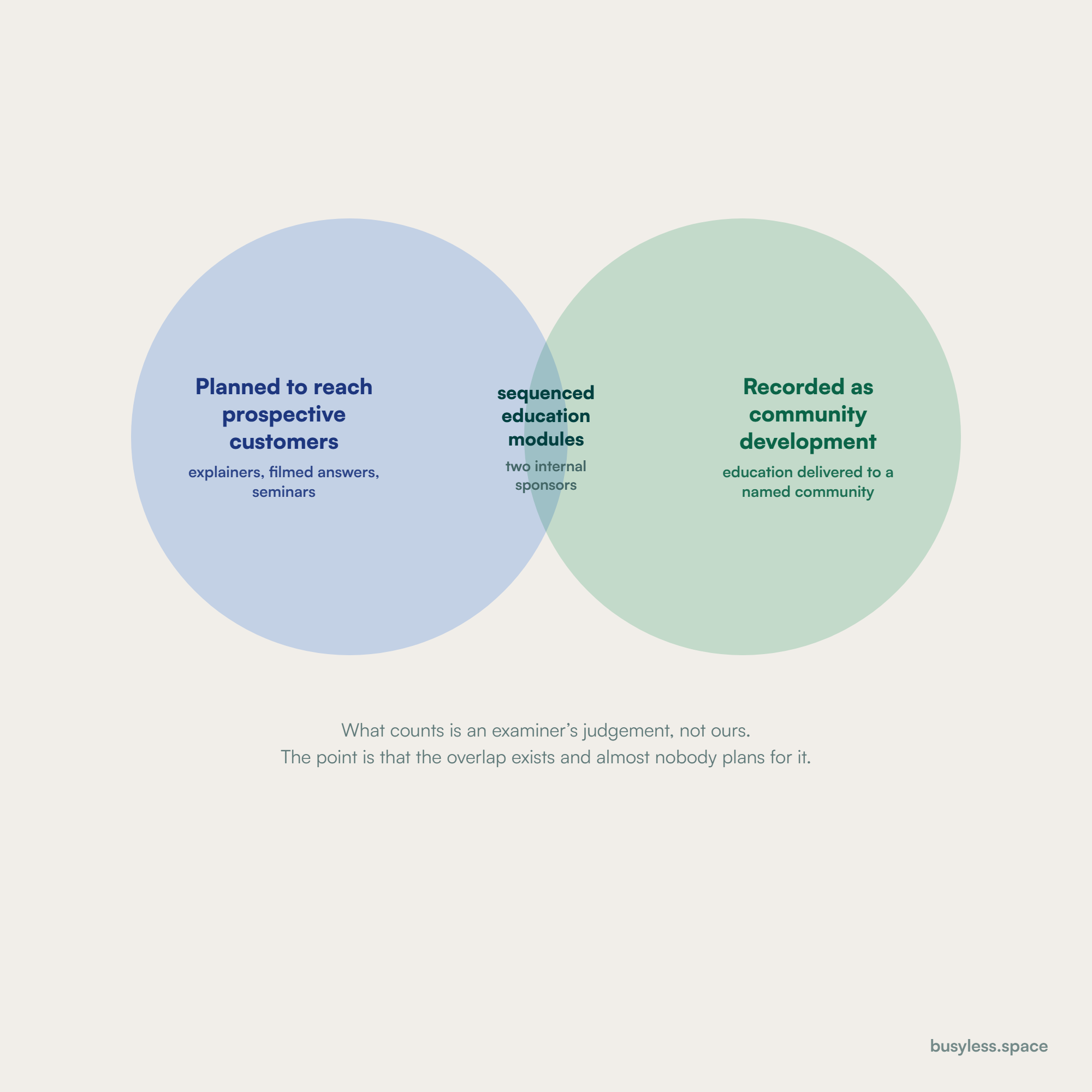
- 5Financial education is the rare programme with a second internal customer. Community development work is examined, and a genuine education programme can serve the marketing plan and that record at once, which is how these budgets survive a bad quarter.
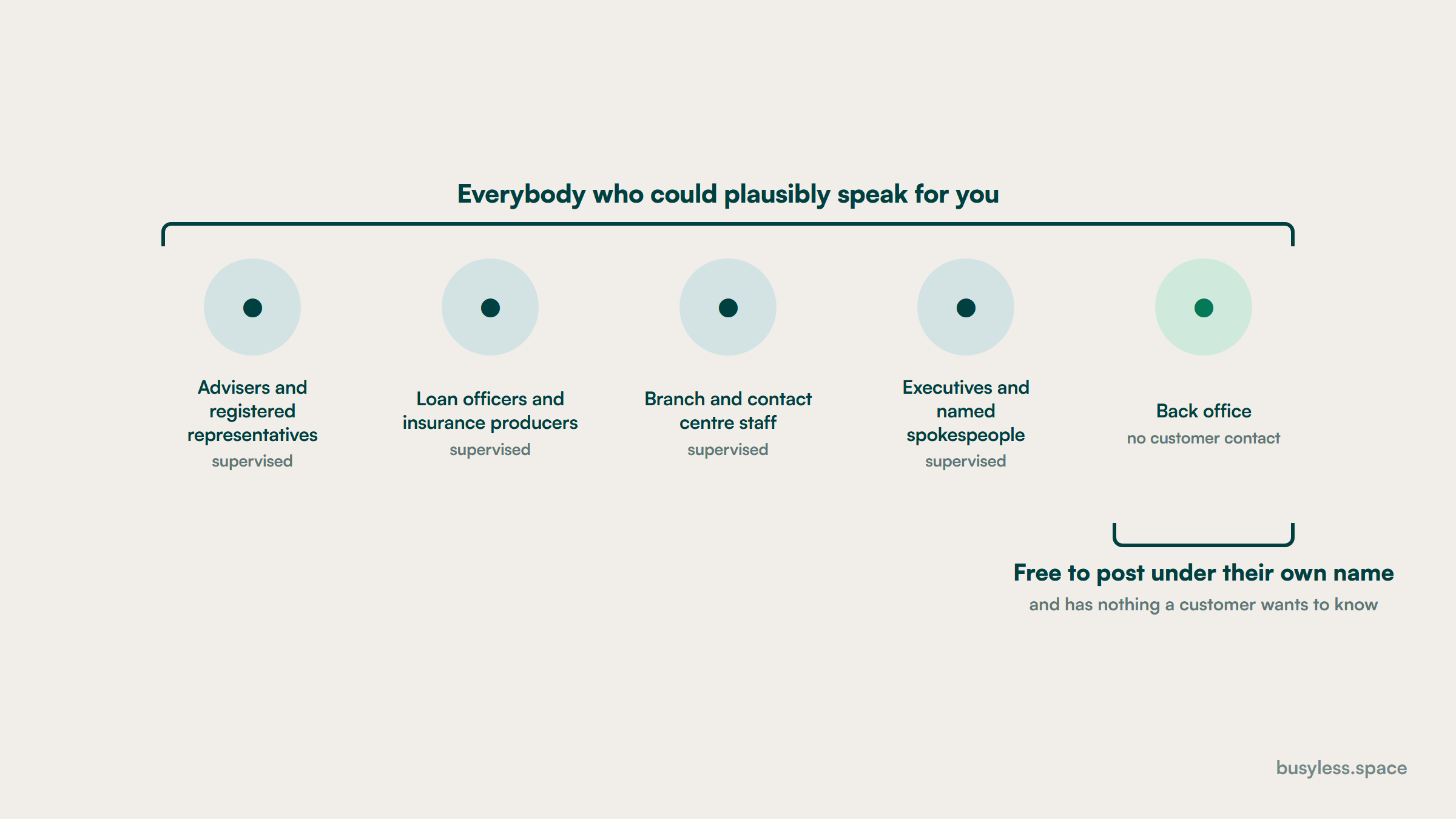
Content marketing for financial institutions runs into a wall that almost no other industry hits. The default way content travels today is a named person with a real job saying something true in their own voice, in their own feed. In a supervised firm that person is a registered or licensed individual, and what they post is not personal.
It is a business communication their employer is expected to supervise, capture and retain. That is not a policy somebody could relax if they were braver about marketing. It sits in rules written by people who have watched what happens when an individual with a licence gives money advice to strangers at scale.
The usual response is to give up on people entirely and publish as an institution, in the voice of a committee, about nothing. That produces the pages everybody recognises: a mortgage explainer with no opinion in it, a small business hub with no small businesses in it, a blog that has said nothing since a rebrand.
There is a better answer, and a financial institution content marketing strategy is mostly the work of finding it. The constraint is not on the human, it is on the surface. Put the same credible person on a surface where review is a scheduled step, and almost all of the difficulty goes away.
Looking for the search half
This page decides which channels to run. The one next door goes deep on just one of them.
Which channels to run, and which to skip
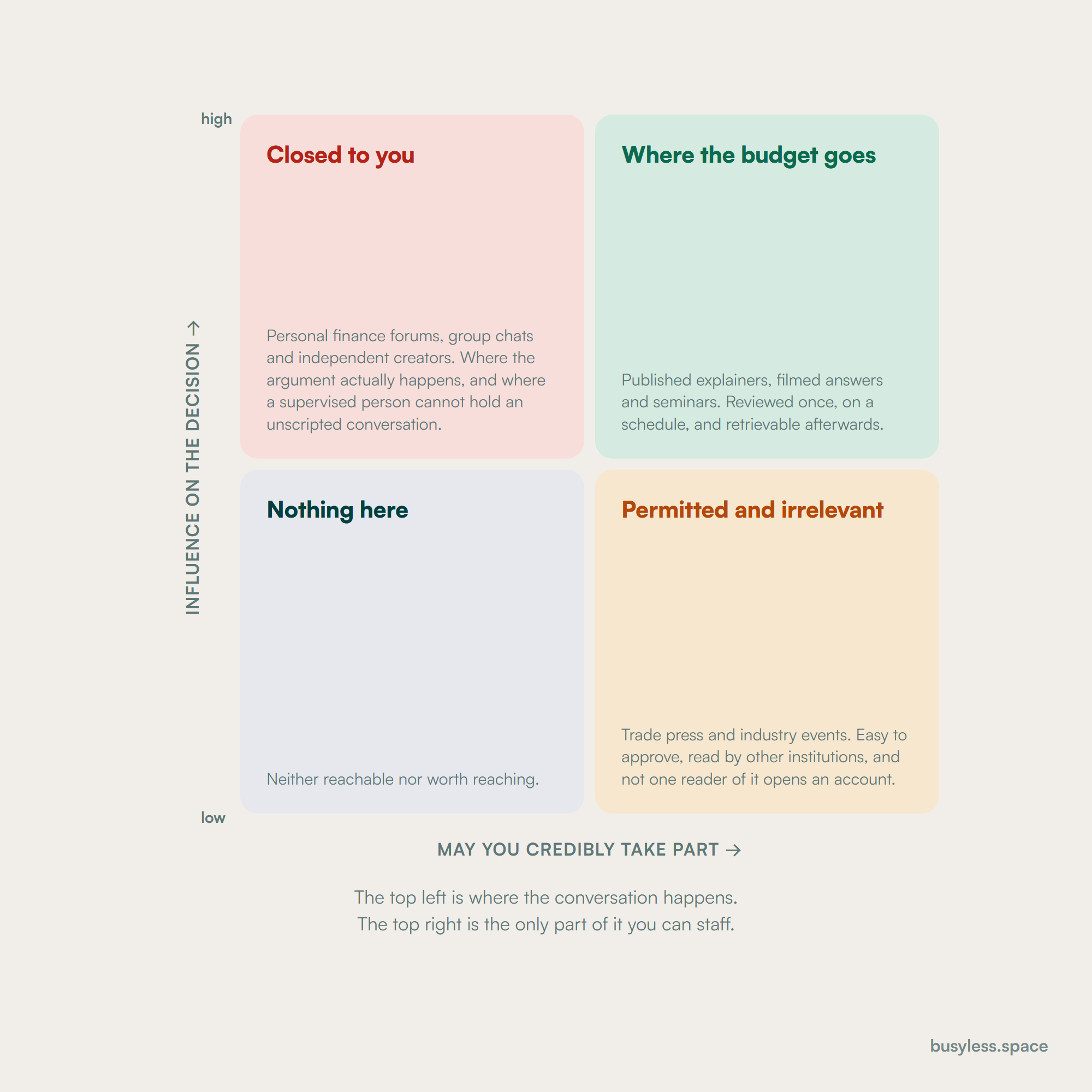
Everything below sorts on one thing: whether the channel can carry a named, credible person without handing them an unsupervised feed. That is the whole problem here, and it separates the eight more cleanly than anything else would.
Run these
Search
RunA page changes rarely, is reviewed once, and is retained by existing. That makes it the lowest-friction surface in a supervised firm, and the demand is enormous because people ask money questions in private long before they ask a person. The rate and product economics of those pages sit on the sibling playbook.
First movePublish the ten questions your call centre answers most, with an opinion in each. The reviewed version of a real answer still beats an unreviewed generic one.
Video
RunThe most underused format in this industry and the one that solves the constraint outright. A filmed answer from a named specialist is recorded, reviewable before it goes anywhere, and retrievable afterwards, which is exactly the shape supervision wants. It also carries the thing a page cannot, which is whether this person seems trustworthy.
First moveFilm one specialist answering one question in three minutes, unscripted, then review the recording rather than a script. Scripting first is what makes these unwatchable.
Events and talks
RunOld-fashioned and it works, because a room is a surface a supervised person can speak in with a prepared deck and a colleague present. First-time buyer evenings, business banking breakfasts and retirement sessions still fill, and unlike a feed the material can be approved once and used repeatedly.
First moveRun one session on the question your specialists are asked most, and record it. The recording is the next quarter's video and search material.
Worth a test, with a kill date
Founder-led social
TestOnly one version of this is worth testing, and it is not the one being sold to you. A named specialist appearing on the institution's own account, in reviewed material, is workable. A named specialist building a personal following in their own feed is a supervision and retention obligation their firm has to run every day.
First moveDecide which of the two you are actually proposing before budgeting for it. Most social proposals in this sector quietly assume the second and are priced as the first.
Newsletter
TestYou already have the list, which is unusual, and that is also the difficulty: a marketing message to an existing customer carries consent, preference and disclosure questions a stranger's subscription does not. Worth running where somebody owns those properly, and worth not starting where nobody does.
First moveSeparate the servicing list from the marketing list before writing anything. Conflating them is the mistake that makes this channel expensive later.
Original research
TestYou are sitting on genuine data about how money moves in your region, and an index published quarterly is one of the few things an institution can say that a creator cannot. It is also a data governance project before it is a content one, so the honest verdict is a test with a real budget rather than an easy yes.
First moveAsk whether one aggregate series could be published quarterly without a new approval each time. If not, this is a two-year project, not a channel.
Skip these
Community
SkipThe forums where money decisions are actually argued out are the rooms you cannot enter. A supervised person cannot hold an unscripted conversation about somebody's finances, a brand account posting there is unwelcome and frequently against the rules, and pretending otherwise ends in a moderator removing you. Be the thing those rooms cite instead.
Trade press
SkipBanking and insurance publications reach other institutions, vendors, analysts and recruiters. That is a real audience for reputation and hiring, and not one of them opens an account. It belongs to whichever budget is trying to reach the industry rather than to this one.
Three run, three test, two skip, and the sorting principle is the same every time. Search, video and events all let a credible human speak on a surface where review happens once and on a schedule. The two skips are the two rooms where the conversation is genuinely happening and where you are structurally unwelcome.
What you already own that nobody can copy
An institution holds more usable raw material than almost any business in this directory and publishes less of it than almost any. Three of the five below are sitting in systems that already exist, and the reason they are not published is that nobody has ever been asked to.
Why applications actually get declined
Held by Underwriting and credit risk
You know the real reasons, in order, with the near-misses attached. Nobody outside the industry can tell an applicant plainly what would have made the difference, and almost nobody inside it is willing to. It is the most useful thing a lender could publish and the least published.
How to capture it
Ask credit risk for the top reasons across a year, aggregated, with no case detail. It is a routine report internally and it becomes several pages that answer the question people are too embarrassed to ask.
The fifty questions the counter and the call centre answer
Held by Branch staff and the contact centre
Real questions in real phrasing from people who bank with you, including the ones they only ask a human because the website made them feel stupid. A content agency guessing at query shapes cannot produce this list and it takes a fortnight to collect.
How to capture it
Log the question rather than the resolution for two weeks, in the customer's words. Call centre quality teams are usually already sampling calls, so this is a change to what is noted rather than new work.
Aggregate patterns in how your customers use money
Held by Data and analytics
How saving behaves in your region after a rate move, when small business balances tighten, what happens to a household in the month a first child arrives. Genuinely yours, genuinely interesting, and it is the one thing a creator with a large audience cannot obtain at any price.
How to capture it
Start with one series you could publish quarterly for two years without a new approval every time. Governance is the whole cost here and choosing a repeatable series is how you avoid paying it repeatedly.
The named specialists and what they know
Held by Mortgage officers, business bankers, claims and underwriting staff
Twenty years of watching the same mistakes, held by somebody with a licence and a name. The knowledge is ordinary inside the building and rare outside it, and the constraint on this page is entirely about the surface it reaches rather than about the person.
How to capture it
Book forty-five minutes and record it. Never ask them to write anything, because the writing is what does not happen and the interview is what does.
Your community development and financial education record
Held by The community reinvestment or community affairs officer
Real work with real institutions, already documented to a standard almost nothing else in marketing is documented to. It is the one asset here that a competitor genuinely cannot claim, because they were not in the room, and it is usually invisible to the people planning content.
How to capture it
Ask for the list of what was actually delivered last year and to whom. Most marketing teams have never seen it, and it frequently contains a better story than anything the campaign calendar holds.
Who actually makes it
The unusual thing here is not the number of people, it is when the supervisory principal arrives. In most industries compliance reviews a draft. In this one they should be deciding the FORMAT before anything is made, because the difference between a workable programme and an unworkable one is which surface the material lands on.
Whoever owns content
The publishing plan and the interview schedule
Their real job here is booking specialists and protecting the recording sessions from being cancelled, which they will be. Everything else on this page follows from those sessions happening.
Most of a role
The supervisory principal
Which surfaces are permitted, and the sign-off
Bring them in at the format decision rather than at the draft. A programme designed around recorded, reviewable surfaces gives them a scheduled queue instead of a daily exposure, which is the whole argument of this page.
6 to 10 hours
The named specialist
The answer, and their own name on it
Interviewed and filmed, never asked to write. Their licence is what makes them worth listening to and it is also why the material has to land somewhere reviewable, so protect their time and never their opinion.
2 to 3 hours
Data and analytics
Anything aggregate that leaves the building
Involved only if the research channel is a real bet. A quarterly series they own is sustainable; a bespoke pull every time somebody wants a statistic is not, and it is how these programmes quietly die.
4 hours, in bursts
The community reinvestment officer
What was actually delivered, and to whom
The most useful person nobody in marketing has met. They hold the record of real work and they have a budget line that a genuine education programme can legitimately serve alongside the marketing plan.
2 hours
The honest cadenceOne recorded session a month producing a filmed answer, an explainer and a set of clips, plus one seminar a quarter and one aggregate release a quarter if the research bet is on. That is roughly twenty hours across the team, and the binding constraint is specialist availability rather than production capacity.
One project, 8 surfaces
One filmed session with one specialist is the unit here, and it is worth building the whole calendar around it, because it is the only step that needs a person who is hard to book. Everything below happens after they have left the room.
- 1
The filmed answer
2 hoursFrom: The recording, lightly cut
Publish it on your own site as well as anywhere else, because that copy is the one you control, can date and can retire. Keep the reviewed version and the approval reference together.
- 2
The explainer page
3 hoursFrom: What they actually said, written up
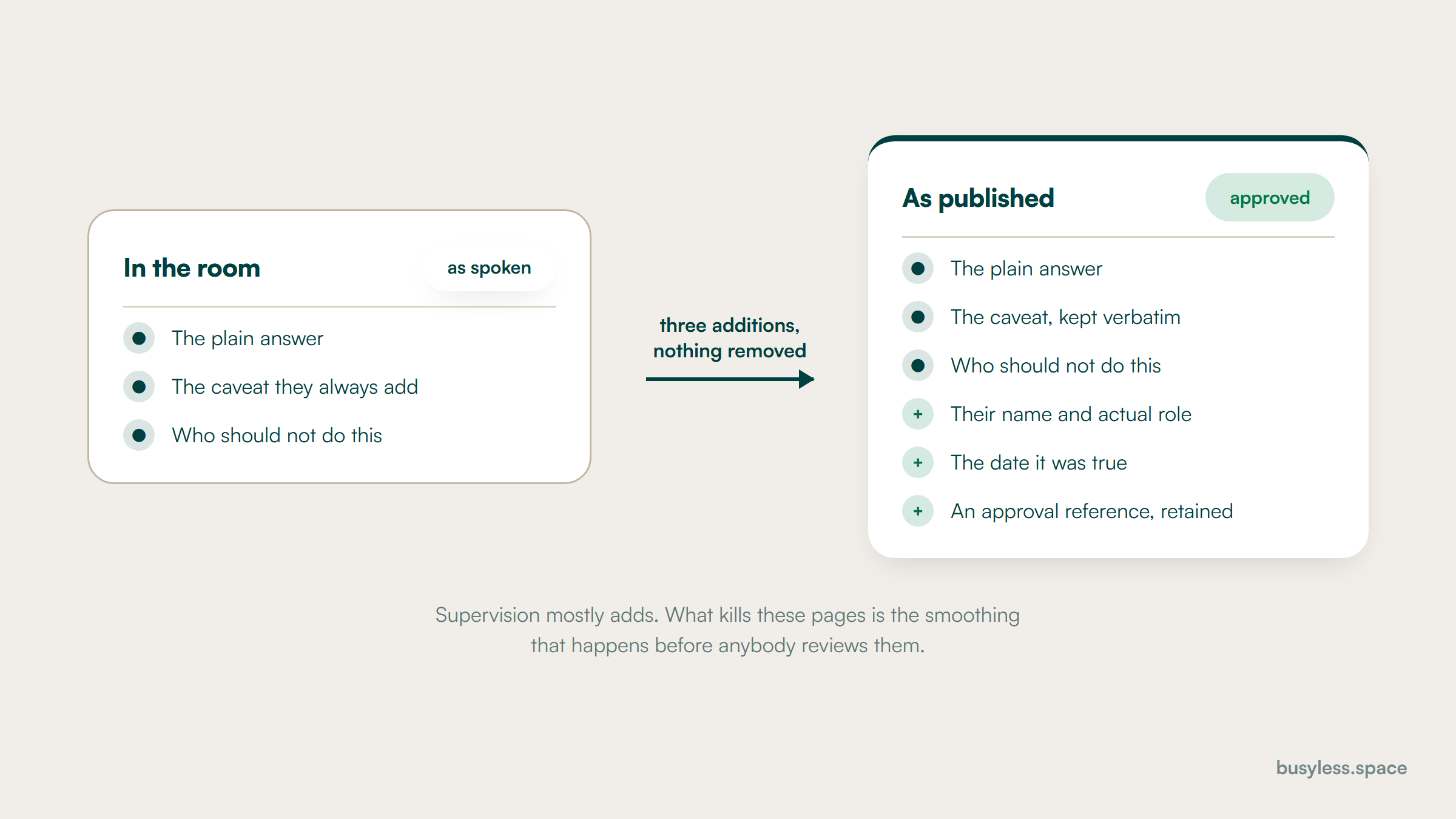
The durable asset and the one search reaches. Write from the transcript rather than from a brief, because the transcript contains the caveats a writer would smooth away and the caveats are what makes it reviewable.
- 3
Short clips for the institution's own account
90 minutesFrom: The two sharpest ninety seconds
On the institution's account under its supervision, not on the specialist's own. That distinction is the difference between a scheduled review and a daily obligation.
- 4
The seminar segment
1 hour to adaptFrom: The same answer, live
A deck approved once can be presented many times, which is the cheapest compliance arithmetic available to you. Record the room and the loop starts again.
- 5
The branch handout
45 minutesFrom: The three things people get wrong
Printed, dated and version-numbered. Branch staff hand out whatever is nearest, so an undated leaflet stays in circulation for years after the product changed.
- 6
The email to the right segment
45 minutesFrom: One question, one answer
Sent to the marketing list rather than to everybody who holds a product. Which list it goes to is a consent question before it is a performance one.
- 7
The retained record
20 minutesFrom: Everything above, archived on publication
Not a chore bolted on afterwards. If archiving happens at publication it costs twenty minutes; if it happens when somebody asks for it, it costs a week and it is never complete.
- 8
The education module
4 hoursFrom: Several sessions, sequenced
Where the community development conversation starts. A sequence somebody completes is a different thing from a page they read, and it is the version that can serve two internal customers.
The buying cycle, and what content does at each stage
The cycle here is long because trust accrues rather than because a committee is slow. Somebody notices a money problem years before they act on it, and the conversation that decides it happens with a person who does not work for you.
Noticing
A year or more"Is this going to become a problem?"
- What moves them
- Plain explainers that do not sell anything
- How you know
- Non-branded reading on question pages, from people who hold nothing with you
Asking somebody they trust
Weeks"What did you do, and would you do it again?"
- What moves them
- Nothing you publish, which is the uncomfortable part
- How you know
- Direct and branded search arriving without a campaign behind it
Working out what is possible
Weeks to months"Would I even qualify, and what would they ask me?"
- What moves them
- The declines material, and a named specialist on camera
- How you know
- Depth of reading on eligibility pages, and calls that open with a better question
Comparing
Days to weeks"Is this the same everywhere, and is anything hidden?"
- What moves them
- Honest comparison, and the product pages the sibling playbook covers
- How you know
- Return visits, and applications that reach the end
Afterwards
Years"Do I move everything else here, and who do I tell?"
- What moves them
- Servicing content, and the education programme
- How you know
- Products per relationship, and referrals nobody paid for
What you are allowed to publish
Four rules about who may publish and where, which is a different subject from the sibling playbook's. That one covers deposit insurance signage, Regulation DD linking and the credit terms that trigger further disclosure, so none of those appear here. None of the four below is legal advice and all of them vary by charter, licence and state.
A registered person's own account is a firm communication
FINRA Rule 2210 and Regulatory Notice 17-18 on digital communications, April 2017, read 2026-08-30
Where a firm is a broker-dealer, business communications made by its registered people are subject to the firm's supervision, review and retention obligations regardless of the device or account they were made on. A personal profile does not become personal because it is personal. Whether a specific post is a retail communication depends on its content and its audience, which is precisely why an unsupervised feed is difficult rather than merely risky.
So do thisDesign the programme so the credible people appear on surfaces you can review on a schedule, and write down which accounts are in scope before anybody posts. Our law-firms playbook covers the equivalent problem where the constraint is a professional conduct rule rather than a securities one.
A regulator expects social media to have a governance structure
FFIEC Social Media: Consumer Compliance Risk Management Guidance, December 2013, read 2026-08-30
The interagency guidance expects a financial institution using social media to have a risk management programme proportionate to that use, covering governance, policies, employee training, monitoring of what is said, and oversight of third parties acting for it. It is guidance rather than a rule, and examiners read it. Notably, the expectation attaches to monitoring and responding as well as to publishing.
So do thisWrite the programme before the first post rather than after the first complaint, and include the response path. A channel nobody is monitoring is the version this guidance is least comfortable with.
Talking about loan terms can require a registration
SAFE Act registration for mortgage loan originators, 12 CFR Part 1007, read 2026-08-30
An employee of a covered institution who takes a residential mortgage loan application or offers or negotiates terms generally has to be registered and to have a unique identifier, which must be provided in certain communications. General educational material about how mortgages work is a different thing from discussing terms, and the boundary is easier to cross in a comment thread than on a page.
So do thisKeep unregistered contributors on general education and route anything that becomes a specific conversation to a registered person. Say so in the material rather than relying on people to notice the line.
Insurance advertising is regulated separately, and by your state
NAIC Advertisements of Life Insurance and Annuities Model Regulation 570, as adopted by individual states, read 2026-08-30
Where an insurer or producer is in scope, advertising is governed by state-adopted rules reaching the content and the form of the material, including what may be implied about cost, benefits and the identity of the insurer. The model regulation is a template that states adopt with variations, so the operative text is your state's. An agent's own post is advertising when it is used to induce a purchase.
So do thisHave the state list before writing, because a piece cleared in one is not thereby cleared in another. Our insurance-adjacent search sibling covers how the licence bounds the lines and territories you may market at all.
None of this is legal advice. Rules vary by state and by contract, and the dates above are when each source was read. Check your own before you rely on any of it.
How to build content marketing for financial institutions
The sequencing below is deliberate and slightly counter-intuitive. The format conversation with the supervisory principal happens in week one, before anything is written, because every failed programme in this industry ran that conversation last.
Agree the surfaces before agreeing the calendar
- Sit down with the supervisory principal and settle which surfaces are permitted
- Write down which accounts and which people are in scope
- Log the questions the call centre answers, in the customer's words
- Ask credit risk for the aggregate decline reasons across a year
Output A permitted-surface list, a scope note and two research inputs
Get a named human on the record
- Record three specialists answering the three most-asked questions
- Publish the filmed answers and the explainers written from the transcripts
- Publish the declines material, plainly and without hedging it into uselessness
- Archive each piece at publication with its approval reference
Output Three filmed answers, three explainers and a working archive habit
Put a room around it
- Run one seminar built from the material already approved
- Record the room and cut the next quarter's clips from it
- Meet the community reinvestment officer and read the delivery record
- Split servicing contacts away from the marketing list
Output An approved deck that can be presented repeatedly, and a clean list
Decide the two tests
- Choose one aggregate series that could be published quarterly without re-approval
- Decide whether social means the institution's account or somebody's own
- Sequence the strongest explainers into one education module
- Report non-branded reading and application completion side by side
Output A research decision, a social decision and one completable module
Structured data for what you publish
The institution, its branches, its accounts and its rates are marked up on the sibling playbook, which is where the entity belongs. These six describe what you publish, and the fourth exists because retention is a publishing habit here rather than an afterthought.
EducationEvent for a seminar
The page for a first-time buyer evening, a business banking breakfast or a retirement sessionThe right type for a session whose purpose is teaching rather than selling, and almost nothing in this sector uses it. Name what somebody will be able to do afterwards rather than listing the agenda, because that is the thing a person decides to attend on.
{
  "@context": "https://schema.org",
  "@type": "EducationEvent",
  "name": "[SESSION NAME, e.g. What lenders actually look at]",
  "description": "[WHAT SOMEBODY WILL BE ABLE TO DO AFTERWARDS]",
  "url": "https://[YOUR-DOMAIN]/events/[SLUG]",
  "startDate": "[YYYY-MM-DDTHH:MM:SS-05:00]",
  "endDate": "[YYYY-MM-DDTHH:MM:SS-05:00]",
  "eventAttendanceMode": "https://schema.org/OfflineEventAttendanceMode",
  "eventStatus": "https://schema.org/EventScheduled",
  "location": {
    "@type": "Place",
    "name": "[BRANCH OR VENUE]",
    "address": "[FULL ADDRESS]"
  },
  "isAccessibleForFree": true,
  "teaches": "[THE SPECIFIC THING TAUGHT]",
  "audience": {
    "@type": "Audience",
    "audienceType": "[e.g. First-time buyers in [REGION]]"
  }
}
Course for a financial education programme
A sequence somebody completes, not a page they readA module with an order and an end is a different asset from a hub of articles, and it is the version that can serve an education objective as well as a marketing one. Keep the provider and the delivery mode honest, because a course that is really four blog posts reads as one.
{
  "@context": "https://schema.org",
  "@type": "Course",
  "name": "[PROGRAMME NAME]",
  "description": "[WHO IT IS FOR AND WHAT IT COVERS]",
  "url": "https://[YOUR-DOMAIN]/learn/[SLUG]",
  "provider": {
    "@type": "Organization",
    "name": "[INSTITUTION NAME]",
    "url": "https://[YOUR-DOMAIN]"
  },
  "educationalLevel": "[e.g. Introductory]",
  "isAccessibleForFree": true,
  "teaches": [
    "[OUTCOME ONE]",
    "[OUTCOME TWO]"
  ],
  "hasCourseInstance": {
    "@type": "CourseInstance",
    "courseMode": "[Online or Onsite]",
    "courseWorkload": "PT[N]H"
  }
}
VideoObject for a filmed answer
The page the recording belongs on, as well as the platformName the person and their actual role, because their name on the answer is the whole point of filming it. Keep the approval reference beside the file so a reupload after any change is not a fresh decision.
{
  "@context": "https://schema.org",
  "@type": "VideoObject",
  "name": "[THE QUESTION, ASKED PLAINLY]",
  "description": "[WHO ANSWERS IT AND WHAT THEY COVER]",
  "thumbnailUrl": "https://[YOUR-DOMAIN]/images/[FILE].jpg",
  "uploadDate": "[YYYY-MM-DD]",
  "duration": "PT[M]M[S]S",
  "contentUrl": "https://[YOUR-DOMAIN]/video/[FILE].mp4",
  "embedUrl": "https://[YOUR-DOMAIN]/[PAGE-SLUG]",
  "transcript": "[FULL TEXT, WHICH IS ALSO YOUR REVIEW ARTEFACT]",
  "creator": {
    "@type": "Person",
    "name": "[SPECIALIST NAME]",
    "jobTitle": "[ACTUAL ROLE, NOT A MARKETING TITLE]"
  }
}
DigitalDocument for the retained version
Your internal record of anything published, not a public pageThe one block here that is not for a search engine. Retention is a publishing habit in this industry and twenty minutes at publication is the difference between a record you can produce and a week of archaeology. Keep the approver and the date the version was live.
{
  "@context": "https://schema.org",
  "@type": "DigitalDocument",
  "name": "[PIECE NAME] retained version [N]",
  "description": "[WHAT THIS VERSION SAID AND WHY IT CHANGED]",
  "url": "https://[YOUR-DOMAIN]/[PATH]",
  "dateCreated": "[YYYY-MM-DD]",
  "datePublished": "[YYYY-MM-DD]",
  "expires": "[YYYY-MM-DD, WHEN IT WAS REPLACED OR RETIRED]",
  "creator": {
    "@type": "Person",
    "name": "[WHO WROTE IT]"
  },
  "editor": {
    "@type": "Person",
    "name": "[WHO APPROVED IT]"
  },
  "identifier": "[YOUR APPROVAL REFERENCE]"
}
QAPage for the questions people actually ask
A page carrying one real question and one real answerBuilt from the call centre log rather than from a keyword list, so the phrasing is the customer's. One question per page, answered by somebody named, is more useful and easier to review than a hub of twenty.
{
  "@context": "https://schema.org",
  "@type": "QAPage",
  "mainEntity": {
    "@type": "Question",
    "name": "[THE QUESTION IN THE CUSTOMER'S OWN WORDS]",
    "text": "[THE LONGER VERSION, AS IT IS ACTUALLY ASKED]",
    "answerCount": 1,
    "acceptedAnswer": {
      "@type": "Answer",
      "text": "[THE PLAIN ANSWER, INCLUDING THE CAVEAT]",
      "url": "https://[YOUR-DOMAIN]/answers/[SLUG]",
      "author": {
        "@type": "Person",
        "name": "[SPECIALIST NAME]",
        "jobTitle": "[ACTUAL ROLE]"
      }
    }
  }
}
Report for an aggregate release
The page carrying a quarterly index or seriesOnly worth adding once the series is genuinely repeatable, because a report published once and abandoned is worse than none. State the period covered and the method in the markup as well as on the page, since the method is what makes the number quotable.
{
  "@context": "https://schema.org",
  "@type": "Report",
  "name": "[SERIES NAME], [PERIOD]",
  "description": "[WHAT IT MEASURES AND OVER WHAT POPULATION]",
  "url": "https://[YOUR-DOMAIN]/research/[SLUG]",
  "datePublished": "[YYYY-MM-DD]",
  "temporalCoverage": "[YYYY-MM]/[YYYY-MM]",
  "spatialCoverage": {
    "@type": "Place",
    "name": "[REGION COVERED]"
  },
  "author": {
    "@type": "Organization",
    "name": "[INSTITUTION NAME]"
  },
  "creditText": "[HOW YOU WANT IT CITED]",
  "usageInfo": "https://[YOUR-DOMAIN]/research/terms"
}
What to automate, and where the line is
Everything worth automating here sits upstream of publication, in the research and the routing. The line sits at anything a reader could reasonably take as advice about their own money, and it sits there whether or not the output is reviewed afterwards.
- automate
Clustering call centre questions into topics
A fortnight of logged questions is a few thousand rows and the pattern is the publishing plan. Grouping them is mechanical, and it turns a quality-sampling exercise the contact centre already runs into a content calendar.
- automate
Transcribing recorded sessions and seminars
Fast, cheap and it produces the review artefact and the draft explainer at once. Correct the specialist's terminology by hand, because a mistranscribed product name propagates into everything written from it.
- automate
Checking published pages against the current product terms
A crawl comparing what pages say against the current terms catches the leaflet nobody retired. This is the least glamorous automation on the page and the one most likely to prevent an actual problem.
- assist
Drafting the explainer from a transcript
It structures a transcript well and then smooths away exactly the caveats that made the answer reviewable. Put them back before it goes anywhere, and treat any confident sentence it added as a claim somebody now has to substantiate.
- assist
Preparing the first pass of a compliance review
Useful for catching the obvious, which is unsupported comparatives, missing disclosure and a claim about cost. It is not a substitute for the supervisory principal and nothing should reach them presented as pre-cleared.
- assist
Producing regional cuts of an aggregate series
The arithmetic is routine and the disclosure question is not. Small cells stop being aggregate, and a human has to decide the threshold below which a region is not published at all.
- never
Answering an individual's question about their own money
The moment a general explanation becomes specific to one person's circumstances, you are somewhere that requires a licensed human and, in some conversations, a registration. This is the line, and it is crossed most often in a comment reply rather than on a page.
- never
Publishing anything without the supervisory principal
Speed is not the constraint in this industry and treating it as one is how firms end up with a retention gap. An unreviewed communication is not a fast publish, it is an unrecorded one.
What it costs
These are bands to sanity-check a proposal against rather than prices. What moves the number most is not production volume but how many licensed specialists you can actually get in front of a camera, and whether a data series has to be governed from scratch.
Do it yourself
$0 to $1,500- The call centre question log and ten answers from it
- One recorded specialist interview a month, on existing kit
- The aggregate decline reasons, published plainly
- An archive habit that runs at publication
- Suits
- A single-branch institution or a small agency with one marketing person
- Ceiling
- It cannot survive the specialist becoming unavailable, which they will. The recorded material keeps working, which is the argument for banking several sessions while you have the access.
Lean
$3,000 to $8,000- Filmed answers produced properly rather than opportunistically
- The explainer library written from transcripts
- One seminar a quarter, recorded and reused
- A written social and monitoring programme that an examiner could read
- Suits
- A community bank, a credit union or a regional agency
- Ceiling
- One region and one product family covered well. Adding a second means a second set of specialists and a second review queue, which is a staffing question rather than a budget one.
Funded
$8,000 to $18,000- Continuous filming rather than a burst when somebody is free
- A quarterly aggregate series with governance settled once
- The education programme sequenced into completable modules
- Separate servicing and marketing lists, properly maintained
- Suits
- A multi-region institution where the education work has an internal sponsor
- Ceiling
- The queue in front of the supervisory principal becomes the limit rather than money. Buying more production without buying more review capacity just lengthens it.
Above this
$18,000 and up- Several lines of business under one editorial and review standard
- Research published often enough to be cited rather than noticed
- Material in the languages your customers actually bank in
- A retention and version record maintained rather than reconstructed
- Suits
- Institutions where the education programme is a stated obligation as well as a marketing one
- Ceiling
- Consistency across lines becomes the cost, and the failure mode is a central voice so cautious that nothing it publishes is worth reading, which removes the only advantage the material had.
How to do it with no budget
The first three of these seven cost nothing but attention, and the third is the one almost nobody does. A lender already knows why applications fail and has never once said so publicly.
- 1
Agree the permitted surfaces with your supervisory principal
One meeting · 90 minutes
Before any calendar exists. Ask which surfaces they can review on a schedule rather than which topics are allowed, because the surface is the real constraint.
- 2
Log the questions the contact centre answers
A change to what quality sampling notes · Two weeks of noticing
The question in the customer's words, not the resolution. The list is always surprising and it is the entire publishing plan.
- 3
Ask credit risk for aggregate decline reasons
An existing internal report · 1 hour
In order, across a year, with no case detail. Publishing it plainly is the single most useful thing on this page and it costs a conversation.
- 4
Record one specialist answering one question
A phone and a quiet room · 2 hours
Unscripted, then reviewed as a recording. Scripting first is what makes these unwatchable and it does not make them easier to approve.
- 5
Meet your community reinvestment officer
A conversation · 1 hour
Ask what was actually delivered last year and to whom. Most marketing teams have never had this conversation and it frequently contains the best story in the building.
- 6
Check every published page against current terms
A crawl and an afternoon · 3 hours
Rates and terms move and pages do not. This is unglamorous and it is the check most likely to find something that matters.
- 7
Separate the servicing list from the marketing list
Your existing email platform · 2 hours
Do it before the first campaign rather than after the first complaint. Conflating them is what makes this channel expensive later.
The tool stack
Less software than this sector usually buys, and the two rows that matter most are a recording setup and a place to keep the retained versions. The rows linking into our other directories go to the researched review rather than to a vendor page.
Hold the question log and the publishing plan
One row per question: what was asked, in whose words, whether it is answered, and who the named answerer would be. It becomes the calendar without anybody writing one.
Free option: No cost, and it genuinely beats a platform for this
Publish explainers and modules outside the product templates
An explainer, a filmed answer and a sequenced module are three different shapes, and most institutional websites are built to hold a fourth thing, which is a product page.
Free option: Whatever you have now, if it can hold a page that is not a product
Keep the retained version and its approval reference
One row per published version: what it said, who approved it, when it was live and when it was replaced. Done at publication it is a small habit; reconstructed later it is a week of archaeology and still incomplete.
Free option: A folder structure plus a spreadsheet, which works further than people expect
See what people search before they ask a human
Run it beside the log rather than instead of it. The log tells you what people are too embarrassed to type and this tells you how many are typing it anyway.
Free option: The contact centre log, which has the phrasing and the urgency
Model the programme before committing to a cadence
Model it against specialist availability rather than against production capacity, because that is the binding constraint here and a plan priced the other way will stall in month four.
Free option: Free
Price the education programme honestly
Include review time as a real line. A programme costed without the supervisory principal's hours is not costed, and it is the line that gets cut and then reappears as a delay.
Free option: Free
Know what assistants are telling people about your category
Increasingly where the noticing stage happens, and the answers lean on large publishers and comparison sites. Worth knowing before assuming your explainer is what is being read.
Free option: Ask each assistant the ten questions your call centre gets, monthly
Track completion of the education modules
Completion is the number that matters here and page views are not, because a module somebody finished is the thing that can serve two internal customers at once.
Free option: Free
Take it from here
Everything below is meant to be copied and filled in. Bodies are plain text, so what you see is exactly what lands on your clipboard.
The week-one conversation with your supervisory principal, written down. Decide surfaces before topics and most of the review load disappears.
PERMITTED-SURFACE AGREEMENT
Institution: [NAME]
Date agreed: [YYYY-MM-DD]
Supervisory principal: [NAME, ROLE]
Content owner: [NAME, ROLE]

WHY THIS DOCUMENT EXISTS
Every failed programme in this sector agreed the calendar
first and the surfaces last.

     [THE CONSTRAINT IS NOT THE TOPIC. IT IS WHERE THE
      MATERIAL LANDS AND HOW OFTEN IT CAN BE REVIEWED.]

SURFACE BY SURFACE
For each, mark PERMITTED / PERMITTED WITH CONDITIONS /
NOT PERMITTED, and name the review cadence.

Published page on our own site
  [ ]  Review: [ ]        Retained by: [ ]
Filmed answer, our channel
  [ ]  Review: [ ]        Retained by: [ ]
Recorded seminar
  [ ]  Review: [ ]        Retained by: [ ]
Clips on the institution's own account
  [ ]  Review: [ ]        Retained by: [ ]
An employee's own account
  [ ]  Review: [ ]        Retained by: [ ]
     [IF THIS ONE IS PERMITTED, WRITE DOWN WHO RUNS THE
      DAILY OBLIGATION. SOMEBODY HAS TO.]
Email to the marketing list
  [ ]  Review: [ ]        Retained by: [ ]
Comment replies on any of the above
  [ ]  Review: [ ]        Retained by: [ ]
     [THIS IS WHERE THE LINE GETS CROSSED. IT IS ALMOST
      NEVER ON THE PAGE ITSELF.]

WHO IS IN SCOPE
People whose public communications are supervised:
  [ROLE]                         [HOW MANY]
  [ROLE]                         [HOW MANY]
People who may publish without scheduled review:
  [ROLE]                         [HOW MANY]

REGISTRATION BOUNDARY
General education anyone may contribute to:
  [ ]
The point at which it must go to a registered person:
  [ ]
How we say so in the material itself:
  [ ]

STATE AND CHARTER VARIATIONS
States we market into:               [LIST]
Anything cleared in one but not all:
  [ ]

REVIEW SERVICE LEVEL
Working days from submission to decision:  [N]
What happens when it is missed:
  [ ]
     [A REVIEW QUEUE WITH NO AGREED TURNAROUND IS THE
      REASON THESE PROGRAMMES STOP IN MONTH FOUR.]

SIGNED
Supervisory principal:  [ ]      Date: [ ]
Content owner:          [ ]      Date: [ ]
Review this agreement on: [YYYY-MM-DD]The expensive mistakes
Buying a personal-branding programme for licensed staff
What it costs: A daily supervision and retention obligation somebody has to run for ever
Buy the recorded surfaces instead. The same person, the same credibility, on something reviewable once rather than continuously.
Bringing compliance in at the draft
What it costs: A review queue full of things that were never going to be publishable
Agree the permitted surfaces in week one. The format decision removes most of the review load before anything is written.
Publishing in the voice of a committee
What it costs: Pages nobody reads and nobody can disagree with, which is the same thing
Put a named person's answer on the page, including the caveat they actually gave. The caveat is what makes it both credible and reviewable.
Never publishing why applications are declined
What it costs: The most useful thing you know, withheld from the people it would help most
Publish the aggregate reasons in order. It is already an internal report and it answers the question people are too embarrassed to ask a human.
Treating archiving as a chore for later
What it costs: A retention gap discovered at the worst possible moment
Archive at publication, with the approval reference attached. It takes twenty minutes then and a week afterwards, and afterwards it is never complete.
Marketing to the servicing list
What it costs: A consent problem wearing the costume of a performance problem
Separate the lists before the first campaign. Whether somebody may receive this is a different question from whether they will open it.
What to measure
Measuring financial institution content marketing against deposit or premium growth proves nothing, because those move with rates, competitors and the economy. What follows separates what the content can be shown to have done from what the business did, and it is honest that the most important stage of the cycle is a conversation you will never see.
Leading indicators
Non-branded reading by people who hold nothing with you
Analytics, segmented by customer state
The clearest sign the explainers are reaching the noticing stage rather than being read by existing customers looking for the servicing page. Almost nobody segments this and it changes the picture completely.
Questions answered on the site that still reach the call centre
The question log, re-run quarterly
Runs the other way from most metrics, since a falling share means the content is working. Ask why when it does not fall: usually the answer is there and unfindable, or there and hedged into uselessness.
Completion of an education module, not views of it
Whatever hosts the modules
The number that separates a real programme from a hub of articles with a badge on it, and the only one worth showing to a sponsor outside marketing.
Filmed answers published per quarter, and by how many named people
Your own publishing record
A capacity metric rather than an outcome, and it is the one that predicts everything else here, because specialist availability is the binding constraint on this whole plan.
Business indicators
Applications that reach the end, by entry route
Your origination system
Somebody who read the eligibility material before applying should abandon less often. It is the cleanest bridge available between the content and something the business counts.
Branded and direct arrivals with no campaign behind them
Search console and analytics
The residue of the stage you cannot observe, which is somebody asking a person they trust. It moves slowly and it is the closest thing to evidence that the trust half is working.
Products per relationship over time
Your core system
Slow, noisy and worth watching annually rather than monthly. Read it beside the education completion figure rather than in a different report, since that is the pairing the programme is actually claiming.
What the community development record shows was delivered
The community reinvestment officer
Not a marketing metric and it belongs in the same report anyway, because it is the half of this programme that has a sponsor who is not you. Report what was delivered, never what you assume it counts for.
The verdict
Content marketing for financial institutions is usually sold as a supervision problem to be endured. It is better understood as a question about surfaces. The people worth listening to already work for you, and the only real decision is where they are allowed to speak.
Pick surfaces that are recorded, reviewable on a schedule and retrievable afterwards, and most of the difficulty disappears. Pick a feed, and you have bought your firm a daily obligation in exchange for a channel that was never going to be yours anyway.
Be wary of financial institution content marketing services that open with personal branding for your licensed staff, or that treat compliance as an approval gate at the end. The first misunderstands what the account is; the second guarantees a review queue full of things that were never publishable.
The test is a short one. Content marketing services for financial institutions are worth buying when the supervisory principal helped choose the formats and a named specialist is booked into a room with a camera. Without those two, you are paying for a blog written in the voice of nobody.
FAQ
Financial institution content marketing questions
Can our loan officers just post on LinkedIn like everyone else?
Where your firm is a broker-dealer, business communications by registered people are subject to supervision and retention wherever they are made, so a personal profile is not personal for this purpose. The workable version is the same person appearing in reviewed material on the institution's own surfaces.Why film a specialist rather than have them write?
Because the writing does not happen. Forty-five minutes of recorded conversation produces the video, the transcript, the explainer and the clips, and it asks the specialist for the one thing they are good at. Review the recording rather than a script.Should we really publish why we decline applications?
Yes, in aggregate and in order, with no case detail. It is already an internal report, it answers the question people are too embarrassed to ask a human, and no competitor and no creator can produce it. It is the most useful thing on this page.Does a financial education programme count towards anything?
It can matter to community development activity as well as to marketing, which is why the community reinvestment officer is worth meeting early. What counts is an examiner's judgement rather than ours, so record what was delivered and to whom and never assert the conclusion.Is there any version of social media that works here?
One. A named specialist appearing in reviewed material on the institution's own account is workable. A named specialist building a personal following in their own feed creates a daily supervision obligation, and most proposals quietly assume the second while pricing the first.Why is community listed as a channel to skip?
Because the rooms where money decisions are argued out are rooms you cannot enter. A supervised person cannot hold an unscripted conversation about somebody's finances and a brand account is usually unwelcome there. The realistic goal is to be what those rooms cite.When does an employee need to be registered to talk about loans?
General education about how a product works is different from offering or negotiating terms, and the boundary is crossed most easily in a comment reply. Keep unregistered contributors on general material and route specific conversations to a registered person, saying so in the piece.What should an institution expect to spend?
The question log, the decline reasons and the first recorded interview cost hours rather than money. Where a budget exists, an engagement starts with a Discovery and then a monthly retainer, and the realistic range for running this properly is $6,000 to $30,000 a month.
Run it yourself, or have someone own it
Everything above is written to be run without us, and the free path is genuinely most of the value for a small practice. Where these plans stall is almost never the plan. It is that the person holding the material has a day job and nobody owns the programme after the first month. That is the job we do.