
Content marketing for life sciences
YMYL and regulatedYou publish for years before you may name the product
- Sector
- Health and medical
- Channels
- Original research, Events and talks, Newsletter
- Buying cycle
- Long cycle
- Time to compound
- 18 to 36 months
- Typical monthly
- $8,000 to $40,000
Key takeaways
- 1You cannot promote an investigational product, so the content programme has to be about something else for several years. That something else is the disease, the mechanism and the size of the unmet need, and it is a better programme than the one most companies eventually run.
- 2The people who hold the material are the people who slow it down. Medical, legal and regulatory review is the bottleneck and medical affairs is the source, which means the fix is a sequencing change rather than a hiring one.
- 3The clinician is not the only reader and is often not the decisive one. A payer, a hospital value analysis committee and a guideline group all read differently, and only one of the four will ever be reached by a sales call.
- 4Your spend on your own experts is published by the government. Payments to covered recipients are reported and searchable, so the speaker programme and the advisory board are part of the public record whether or not you plan for that.
- 5The most valuable asset in the company is usually the arm that failed or the sub-population that did not respond. It is genuine science, it builds more credibility than any launch asset, and it is almost never published because nobody is rewarded for it.
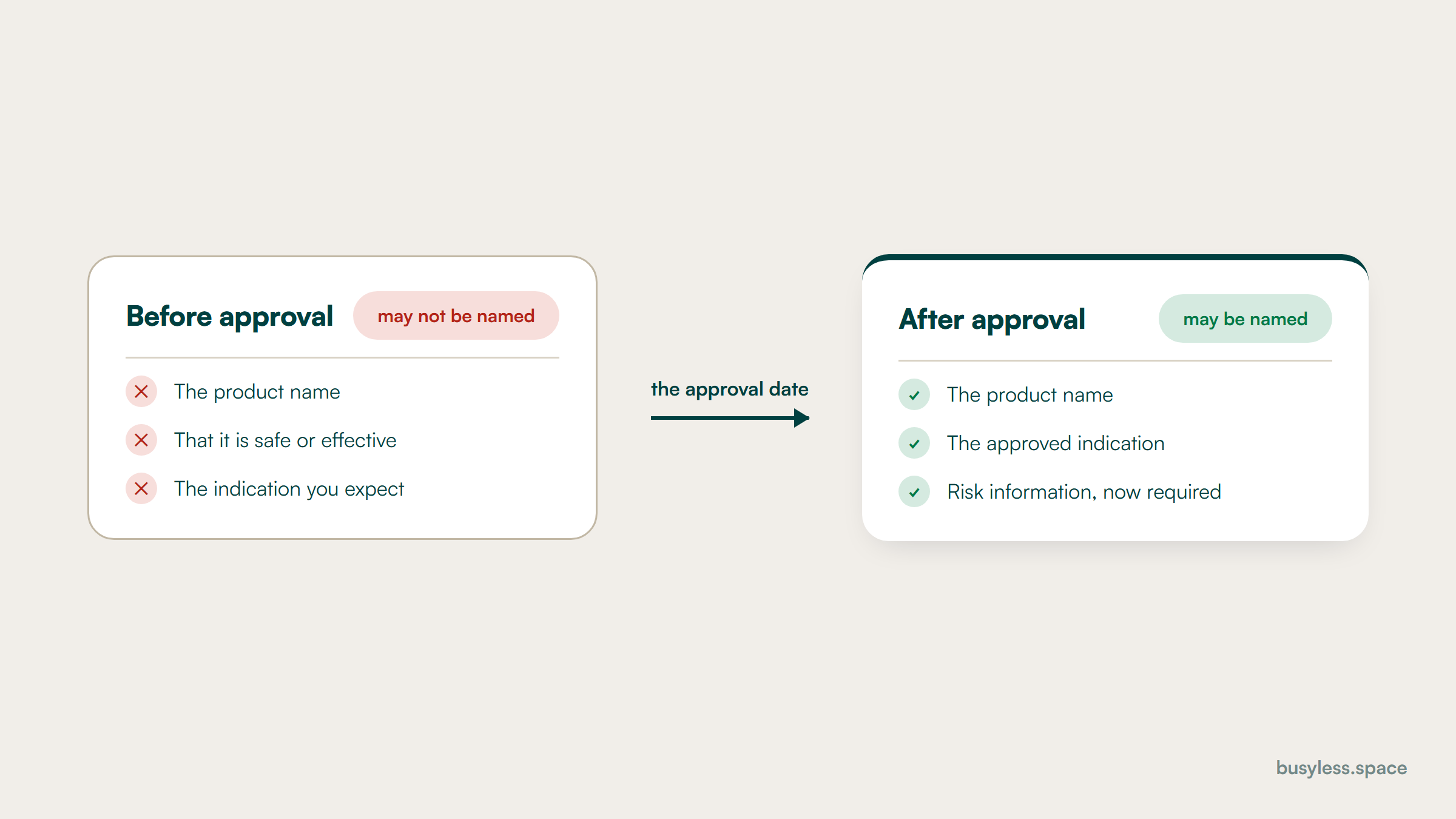
Content marketing for life sciences has to solve a problem no other industry in this directory has. For a period measured in years rather than months, the thing you are building a company around may not be promoted at all. A sponsor may not represent that an investigational product is safe or effective for the use under study, and may not otherwise commercialise it.
The reflex is to wait. Companies build a website that says very little, publish a pipeline table, and plan the real programme for the six months before approval. Then approval arrives, the commercial team switches on, and it turns out there is no audience, no relationships with the people who write guidelines, and no evidence in the literature that anybody outside the company was ever paying attention.
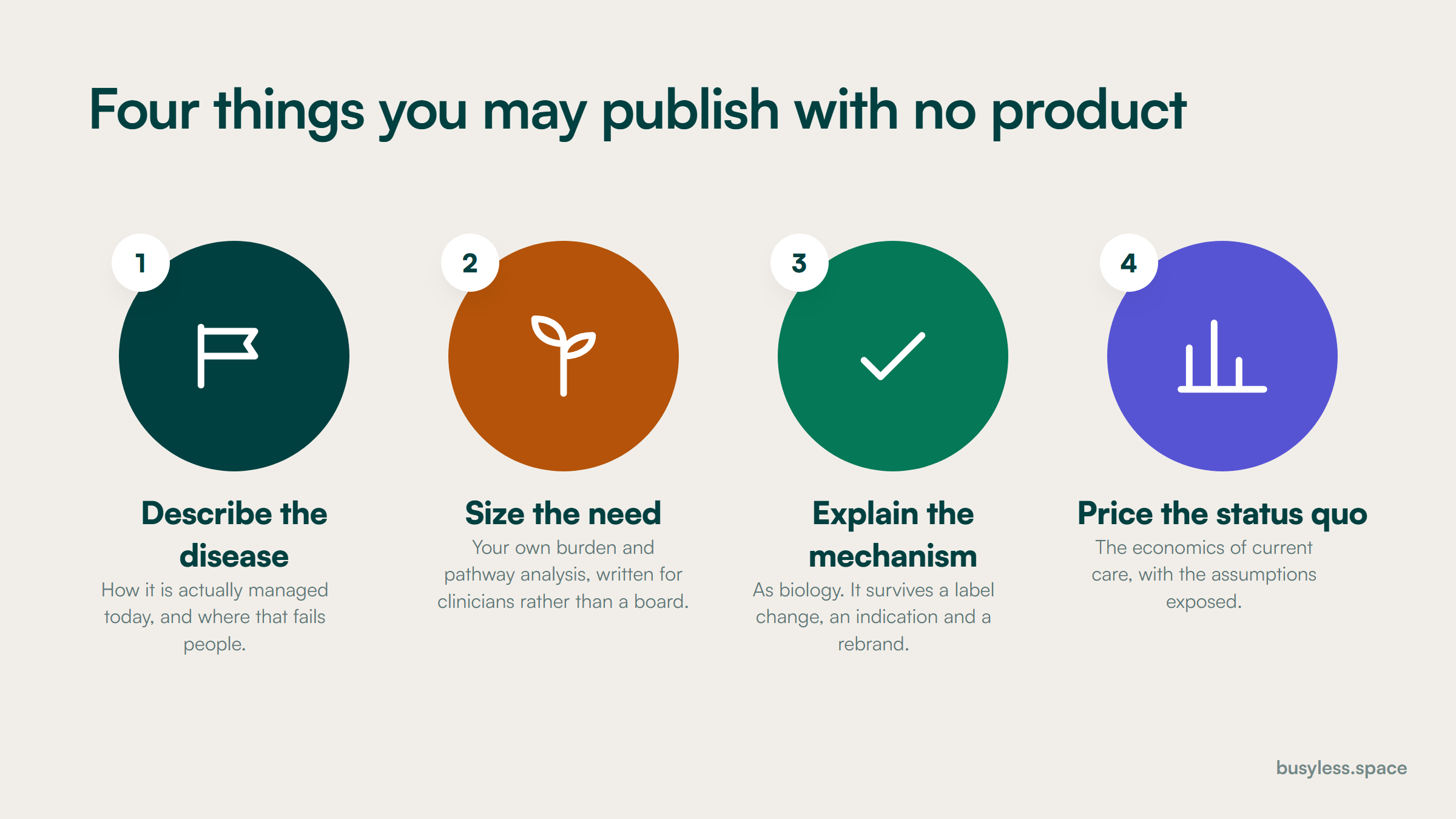
The alternative is to publish for years about everything except the product. The disease and how it is currently managed, the size and shape of the unmet need, the mechanism, the diagnostic pathway that misses people, the economics of the current standard of care. All of that is publishable, all of it is genuinely useful, and none of it is promotion.
So a life sciences content marketing strategy is really a sequencing decision. You are choosing whether the audience, the relationships and the published evidence base exist on the day of approval, or whether you start assembling them afterwards, at the exact moment the commercial pressure makes careful work hardest.
Which channels to run, and which to skip
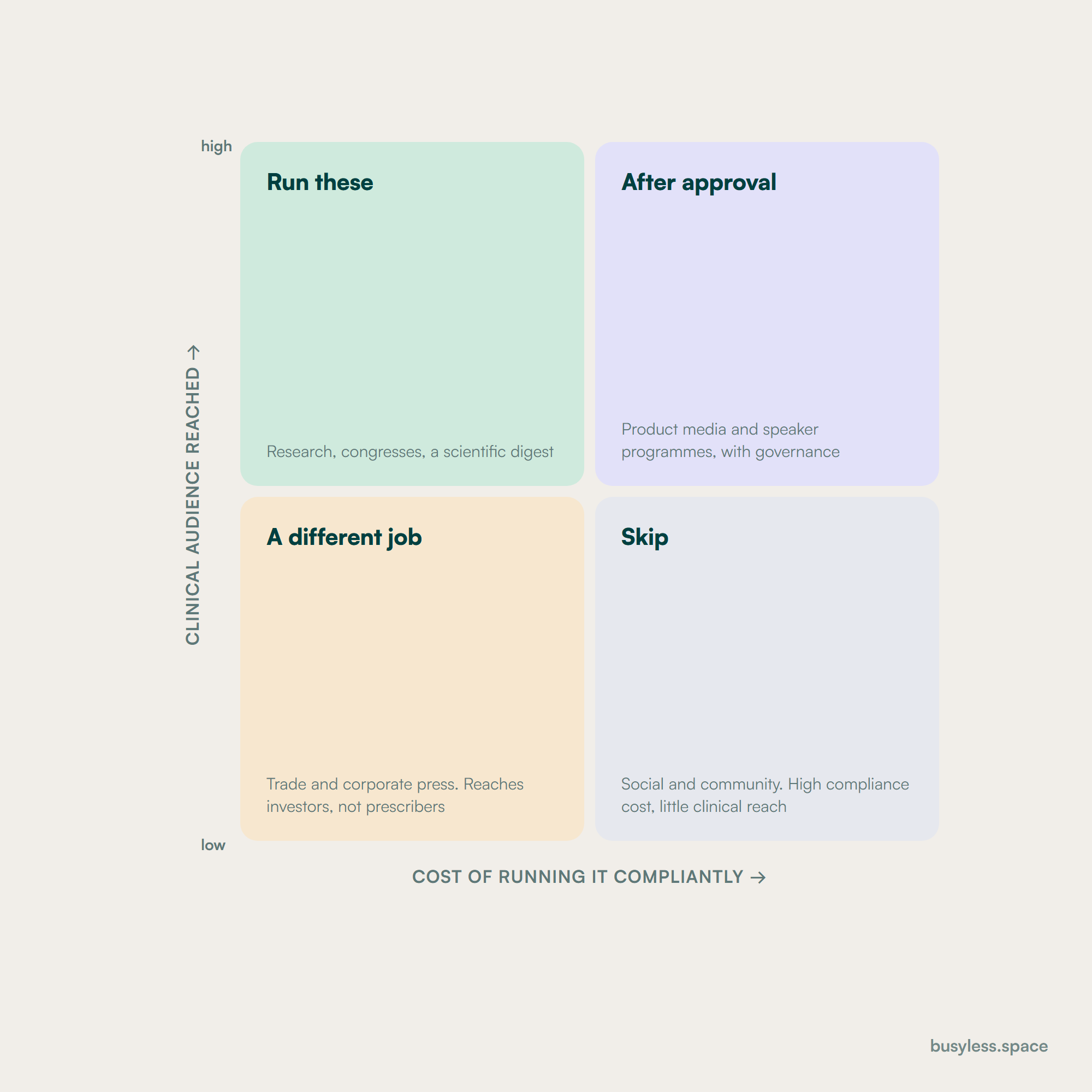
Judged on two questions rather than one: does the channel reach a clinician, a payer or a guideline writer, and can it carry a message that names no product. A channel that fails the second test is not available to you for several years, however good it looks on a plan.
Run these
Original research
RunThe currency of the entire field, and the only channel where being right is worth more than being loud. Peer-reviewed publication, registry work, real-world evidence and health-economic modelling all reach the readers who matter, and none of it requires a product to exist yet.
First movePublish something about the disease rather than about the candidate. A burden-of-illness or diagnostic-pathway paper is available years before anything else and it is what gets cited later.
Events and talks
RunCongresses are where this field actually meets, and an abstract accepted at the right one reaches more of the relevant audience than a year of everything else. It is expensive, it is slow, and it remains the most efficient thing on this list for reaching people who will never open a marketing email.
First movePick two congresses your audience genuinely attends and submit to both, rather than exhibiting at six. Presence in the programme outperforms presence in the hall.
Newsletter
RunA list of clinicians and researchers who asked to hear from you is durable in a way nothing else here is, and it survives every reorganisation and rebrand. The constraint is that it has to be worth opening on scientific merit, because this audience recognises marketing instantly and unsubscribes silently.
First moveSend a monthly digest of the literature in your disease area, including papers that are not yours. Usefulness is what earns the list, and the list is what you actually own.
Worth a test, with a kill date
Trade press
TestSector titles reach investors, partners and the commercial side of other companies rather than prescribers, which is genuinely useful for a different objective. Treat it as corporate communications with its own budget, and be honest that a clinician is unlikely to change practice because of it.
First moveDecide which audience a placement is for before pitching. If the answer is investors, fund it from that budget rather than from this one.
Video
TestA mechanism animation or a procedure film explains in ninety seconds what a slide deck fails to explain in twenty minutes, and for devices the procedural film is often the single most requested asset. It is expensive to make well and it dates the moment the labelling changes.
First moveFilm the unmet need or the mechanism first, not the product. Those assets survive a label change and a rebrand, and the product film does not.
Search
TestClinicians search, but they search the literature and the specialty societies rather than the open web, and the open web for any disease is already occupied by patient organisations and health publishers. Worth funding for the diagnostic and pathway questions rather than for the disease name itself.
First moveTake the five questions a specialist asks a colleague rather than the five a patient types, and see whether anything credible answers them.
Skip these
Founder-led social
SkipThe compliance cost per post is out of all proportion to what it returns, an unlabelled mention of an investigational product is a real exposure, and the clinicians who do post are mostly talking to each other rather than to companies. Corporate and recruitment use is a separate matter and belongs to another team.
Community
SkipClinician communities exist and are valuable, and a company sponsoring or joining one raises questions about influence and payment that are disproportionate to what is gained. Support the specialty society instead, which is a known and disclosable relationship rather than an ambiguous one.
One channel that is the field's own currency, one that puts you in the room with it, and one you own outright. The two skips are unusual for this directory because both channels genuinely work elsewhere, and here the cost of running them correctly exceeds what they return.
What you already own that nobody can copy
The raw material here is unusually good and unusually locked up. It sits with medical affairs, clinical development and health economics, all of whom generate it for regulators and journals rather than for readers, and none of whom think of it as content.
Why the trial was designed the way it was
Held by Clinical development and the medical lead
Every choice in a protocol is an argument about the disease: which endpoint matters, which population, why that comparator. The reasoning is genuinely interesting to anybody treating the condition, and it is invisible in the published protocol.
How to capture it
Interview the medical lead about the three hardest design decisions and what was rejected. Publish the reasoning about the disease, never the expected result.
The size and shape of the unmet need
Held by Market access, epidemiology and medical affairs
Companies commission burden-of-illness and pathway analyses to build an internal case and then never publish them. It is real research about how patients actually move through a system, and it is one of the few things you can publish freely from the earliest stage.
How to capture it
Take the analysis that was written for the investment case and rewrite it for a clinical audience. The method usually survives the change of purpose intact.
The health-economic model
Held by Health economics and outcomes research
Payers, value analysis committees and health systems all reason in these terms and almost nothing published speaks to them. A model of the current standard of care, with its assumptions exposed, is useful long before there is anything to compare against it.
How to capture it
Publish the model of current care with its assumptions listed. Exposing the assumptions is what makes it credible rather than what makes it vulnerable.
The arm that did not work
Held by Clinical development, and the archive
A negative result, a sub-population that did not respond, a dose that was abandoned. It is science nobody else can report, it builds more credibility with a sceptical audience than any positive result, and internal incentives point directly against publishing it.
How to capture it
Ask what was learned that is not in the primary publication. Then find out whether anybody is accountable for publishing it, because usually nobody is.
What clinicians actually ask your field team
Held by Medical science liaisons
Unsolicited questions from practising specialists, logged and categorised because they have to be. It is the most accurate map available of what the field does not understand, and it is filed for compliance rather than read for insight.
How to capture it
Review the categorised question log quarterly with medical affairs. The top ten questions are a publication plan that already has demand behind it.
Who actually makes it
Neither capacity nor talent is what limits production here. It is that the people who hold the material are the people who review it, and both jobs sit inside the same small function under an unmovable regulatory obligation.
Medical affairs lead
Whether a claim is supported by evidence
The source and the reviewer at once, which is the structural problem in this industry. The fix is to involve them at outline stage rather than at draft stage, because a rewrite after review costs four times a conversation before it.
8 hours
Regulatory reviewer
Whether it is promotional
Asks one question: does this represent an investigational product as safe or effective. A piece written about the disease rather than the candidate makes their job short, which is the reason this page recommends writing that way.
4 hours
Legal reviewer
Claims, comparisons and third-party content
Predictable and fast when the material is scientific and slow when it is aspirational. The queue length is mostly a function of what is submitted rather than of how the reviewer works.
3 hours
Publication planner
What is submitted where, and in what order
The role that already exists in larger companies and is missing entirely in smaller ones. Without it, congress abstracts, manuscripts and content all get made independently and contradict each other in public.
Half a role
Writer with a scientific background
Turning approved material into something readable
Not interchangeable with a general content writer. Somebody who cannot read a forest plot will produce copy that fails review repeatedly, and the review time is more expensive than the writing.
Full time, or agency
The honest cadenceA monthly piece plus a monthly literature digest, which is what a review cycle of two to four weeks can genuinely support. Weekly publishing is possible only where a standing set of pre-approved modular claims exists, and building that is a project of its own.
One project, 8 surfaces
One accepted congress abstract becomes eight things, and the sequencing is the discipline. Anything that goes out before the embargo lifts can disqualify the presentation, so the surfaces below are ordered by when they are permitted rather than by how much work they take.
- 1
The congress presentation
Already scheduledFrom: The abstract itself
The anchor everything else hangs off. Confirm the embargo terms before anything downstream is scheduled, because congress rules vary and breaking one costs the presentation.
- 2
The plain-language summary
3 hoursFrom: The findings, restated
For patients, advocacy groups and non-specialists. Increasingly expected by journals and funders, and it is the version most likely to be read by somebody outside the field.
- 3
The manuscript
Weeks, planned separatelyFrom: The full dataset
The abstract is not a shortcut to this. It is listed here because the publication plan and the content plan have to be the same document, not because it is a repurposing task.
- 4
A figure explained properly
2 hoursFrom: The one chart that carries the finding
A single figure with three paragraphs about what it means and what it does not. This is the most shared asset in the field and the easiest one to make.
- 5
The literature digest entry
45 minutesFrom: The finding in context
Your own work placed beside other people's, honestly. A digest that only carries your papers stops being read within about three issues.
- 6
The mechanism animation
Weeks, onceFrom: The biology behind the finding
Expensive and reusable for years, because the mechanism does not change when the labelling does. Make it about the biology and it survives every subsequent change.
- 7
The field team briefing
2 hoursFrom: What the finding does and does not support
Internal, and the highest-leverage output here. It sets what the field team may say in response to an unsolicited question, which is where most compliance incidents begin.
- 8
The advocacy group briefing
1 hourFrom: The plain-language summary
Sent rather than published, and disclosed. Patient organisations are frequently the first to hear about a finding from a journalist, which is avoidable and damaging.
The buying cycle, and what content does at each stage
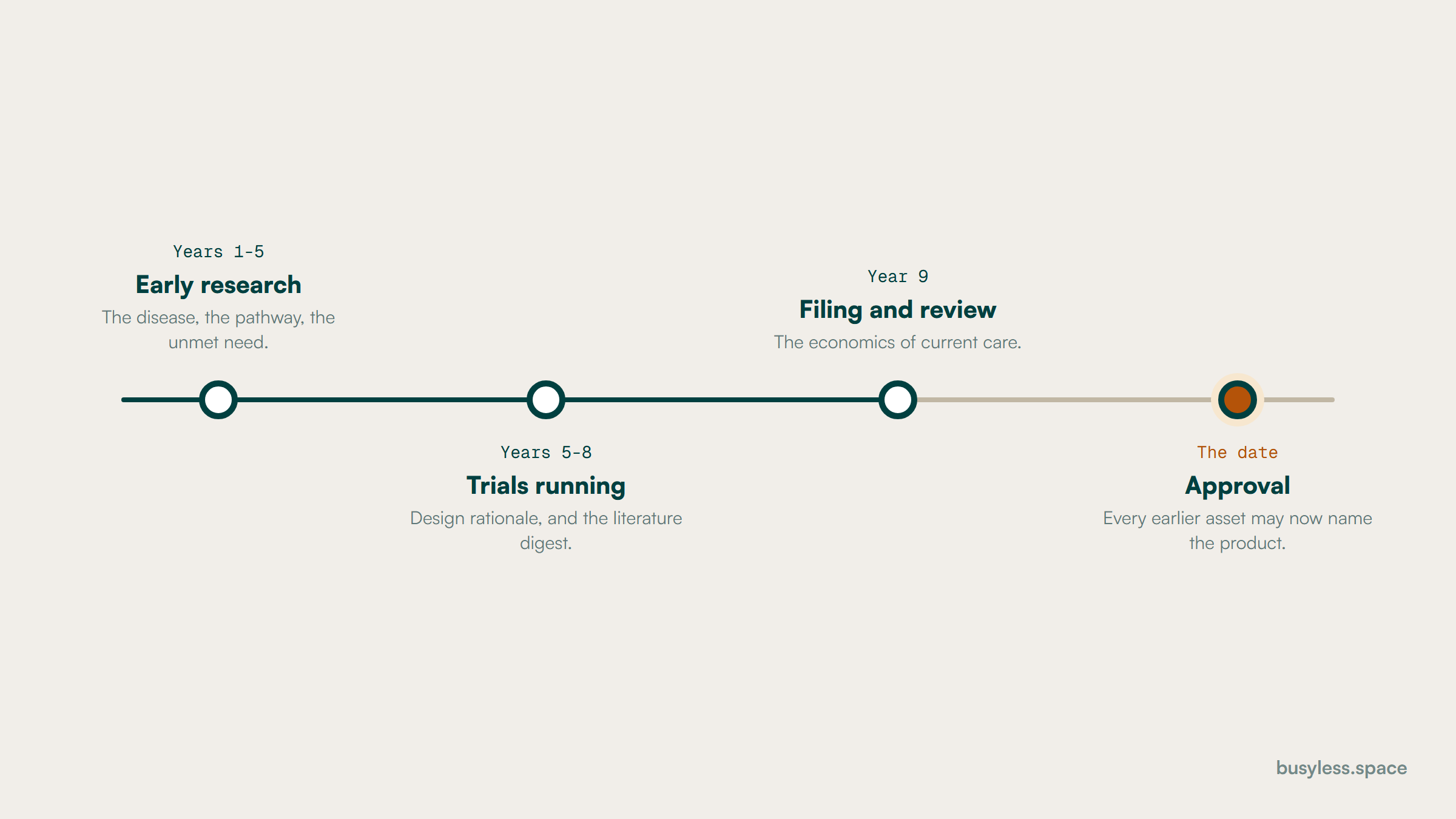
Long, like many playbooks in this directory. What is not shared is the single date in the middle of it that changes what every asset you have already published is permitted to say. Everything before it is about the disease, and everything after it is about a product.
Before there is anything to say
2 to 6 years"Is this disease understood, and by whom?"
- What moves them
- Burden of illness, pathway analysis, the mechanism
- How you know
- Citations, and being invited to contribute rather than to sponsor
The trial is running
1 to 4 years"Is anybody serious working on this?"
- What moves them
- Design rationale, disease education, the literature digest
- How you know
- Investigator interest, and unsolicited questions from non-investigators
Filing and review
6 to 18 months"What would change if this worked?"
- What moves them
- Health economics of current care, and the diagnostic gap
- How you know
- Payer and value-committee engagement before you have anything to sell
Approval and launch
The date, then 12 months"Where does this fit in what I already do?"
- What moves them
- Everything you built, now permitted to name the product
- How you know
- Guideline inclusion discussions, and formulary review scheduling
In practice
Years"Is it working outside a trial?"
- What moves them
- Real-world evidence, registries and the honest limitations
- How you know
- Real-world publications by people who do not work for you
What you are allowed to publish
The first of these four is the constraint on this page written as law. This is the only playbook in the directory with no search sibling, so nothing here has been struck to avoid a duplicate, and the set is the four that most directly change what may be published.
You may not promote an investigational product
21 CFR 312.7 for drugs and 21 CFR 812.7 for devices, read 2026-08-30
A sponsor or investigator may not represent in a promotional context that an investigational product is safe or effective for the purposes for which it is under investigation, nor otherwise promote or commercialise it. This reaches a website, a conference booth, a social post and a founder's interview equally, and the prohibition applies for the whole period before approval or clearance.
So do thisWrite about the disease, the mechanism, the pathway and the unmet need instead, and keep the candidate out of anything that reads as a claim. Scientific exchange and clinical trial recruitment are separate categories with their own rules, so route those through the people who own them.
A speaker programme is watched more closely than you think
OIG Special Fraud Alert on speaker programmes, 16 November 2020; Anti-Kickback Statute, 42 U.S.C. 1320a-7b(b), read 2026-08-30
The alert set out concerns about company-sponsored speaker programmes, including repeat attendance by the same people, attendance by those with no legitimate educational need, modest educational content alongside meals and entertainment, and selecting speakers on the basis of prescribing volume. Remuneration intended to induce referrals is the underlying prohibition.
So do thisTreat a speaker programme as a content decision as well as a spending one: real educational content, a defensible reason each attendee is there, and no selection criteria that would look like a sales target if written down. Where the goal is reach, a recording is cheaper and carries none of this.
What you paid your experts is published
Open Payments, 42 U.S.C. 1320a-7h, read 2026-08-30
Payments and transfers of value to covered recipients are reported and published in a searchable public database, and the covered-recipient definition reaches beyond physicians to several other clinician groups. Consulting fees, advisory boards, speaking, meals and travel connected with your content programme are all in scope.
So do thisAssume every advisory board and every paid contribution is public before you plan it, and make sure the work is defensible on its own terms. It is also worth telling contributors what will be published about them, because being surprised by their own entry is how relationships end.
A product communication carries its own risk information
21 CFR 202.1 and the FDA standard requiring presentation in a clear, conspicuous and neutral manner in consumer advertising, read 2026-08-30
Once a product may be named, promotional communications carry obligations about balance: material facts, side effects and contraindications presented rather than buried, and consumer-directed advertising held to a standard about how that information is presented. The obligation attaches to the communication rather than to the format, so a short video and a printed page are both covered.
So do thisDesign the format around the obligation rather than fitting the obligation into a format afterwards. A fifteen-second clip that cannot carry balance is not a shorter asset, it is an asset you cannot make. Our healthcare playbook covers the provider side of the same audience, where the binding constraint is what a patient will be seen doing rather than what you may say.
None of this is legal advice. Rules vary by state and by contract, and the dates above are when each source was read. Check your own before you rely on any of it.
How to build content marketing for life sciences
Nine months, and the first eight weeks produce nothing publishable. That is not caution, it is arithmetic: in a field where review takes weeks, the fastest route to a steady output is to fix the review path before there is a queue in it.
Find the material and fix the review path
- Inventory what medical affairs and health economics already hold
- Sit down with the medical information log
- Agree what review looks like for non-promotional disease content
- Set the rule that reviewers see an outline before a draft
Output A source inventory and a review path with an agreed turnaround
Publish about the disease
- Publish the pathway or burden analysis written for the investment case
- Start the monthly literature digest, including other people's work
- Commission the mechanism explanation as biology rather than product
- Submit one abstract to a congress your audience actually attends
Output Three assets and a list that did not exist before
Reach the readers who are not clinicians
- Publish the model of current standard of care with its assumptions
- Brief patient organisations rather than letting them read it in the press
- Build the field team briefing for the questions being asked most
- Decide who is accountable for publishing the negative results
Output A payer-facing asset and a named owner for unpublished findings
Prepare for the date
- Map every existing asset against what it may say after approval
- Draft the modular claim set so review is reuse rather than rework
- Plan the format changes that balance obligations will force
- Report on citations, invitations and unsolicited questions
Output An asset register marked for what changes on approval day
Structured data for what you publish
There is no sibling playbook here, so nothing has been given away, but the same narrowing applies: these six describe what you publish rather than the company that publishes it. Two of them exist mainly to be honest about provenance.
ScholarlyArticle for a publication or preprint
The page hosting or summarising a peer-reviewed publicationUse the identifiers rather than a title match, because this is the one field where a persistent identifier is expected and its absence is noticed. Link the version of record rather than only your own summary, even when the summary is better written.
{
  "@context": "https://schema.org",
  "@type": "ScholarlyArticle",
  "headline": "[FULL PAPER TITLE]",
  "url": "https://[YOUR-DOMAIN]/publications/[SLUG]",
  "sameAs": "https://doi.org/[DOI]",
  "identifier": [
    { "@type": "PropertyValue", "propertyID": "DOI", "value": "[DOI]" },
    { "@type": "PropertyValue", "propertyID": "PMID", "value": "[PMID]" }
  ],
  "datePublished": "[YYYY-MM-DD]",
  "author": [
    { "@type": "Person", "name": "[AUTHOR, IN PUBLICATION ORDER]" }
  ],
  "publisher": {
    "@type": "Organization",
    "name": "[JOURNAL PUBLISHER]"
  },
  "isPartOf": {
    "@type": "Periodical",
    "name": "[JOURNAL NAME]",
    "issn": "[ISSN]"
  },
  "funder": {
    "@type": "Organization",
    "name": "[YOUR COMPANY, IF IT FUNDED THE WORK]"
  },
  "about": "[DISEASE OR CONDITION]"
}
Dataset for a registry or an analysis you publish
A page describing data you are making availableThe licence and the access conditions are the fields that matter, because most data in this field is available on request rather than openly. Saying so in the markup is more honest than omitting it and letting a reader assume a download exists.
{
  "@context": "https://schema.org",
  "@type": "Dataset",
  "name": "[DATASET NAME]",
  "description": "[WHAT IT CONTAINS, POPULATION, PERIOD]",
  "url": "https://[YOUR-DOMAIN]/data/[SLUG]",
  "creator": {
    "@type": "Organization",
    "name": "[YOUR COMPANY]"
  },
  "datePublished": "[YYYY-MM-DD]",
  "temporalCoverage": "[YYYY-MM/YYYY-MM]",
  "license": "[URL OF THE LICENCE, OR YOUR ACCESS POLICY]",
  "isAccessibleForFree": "[true|false]",
  "conditionsOfAccess": "[e.g. Available on request under a data sharing agreement]",
  "variableMeasured": "[KEY VARIABLES]",
  "citation": "https://doi.org/[DOI OF THE PAPER IT SUPPORTS]"
}
DefinedTermSet for a disease-area glossary
A glossary page for the condition, the pathway or the endpointsAn unglamorous asset that gets used constantly, by journalists, by advocacy groups and by your own new starters. Defining the endpoints and the staging honestly, including where the field disagrees, is a credibility asset rather than a search one.
{
  "@context": "https://schema.org",
  "@type": "DefinedTermSet",
  "name": "[DISEASE AREA] terms and endpoints",
  "url": "https://[YOUR-DOMAIN]/glossary/[SLUG]",
  "description": "[WHAT THIS GLOSSARY COVERS AND WHO IT IS FOR]",
  "hasDefinedTerm": [
    {
      "@type": "DefinedTerm",
      "name": "[TERM]",
      "description": "[PLAIN DEFINITION, AND WHERE THE FIELD DISAGREES]",
      "inDefinedTermSet": "https://[YOUR-DOMAIN]/glossary/[SLUG]"
    }
  ]
}
VideoObject for a mechanism or procedure film
The page carrying the animation or the procedural filmDescribe the biology or the procedure rather than the product, which is both the compliant framing before approval and the framing that survives a label change afterwards. Transcripts matter here because this audience often watches with sound off in a clinical setting.
{
  "@context": "https://schema.org",
  "@type": "VideoObject",
  "name": "[THE MECHANISM OR PROCEDURE, NOT THE BRAND]",
  "description": "[WHAT A VIEWER UNDERSTANDS AFTERWARDS]",
  "thumbnailUrl": "https://[YOUR-DOMAIN]/images/[FILE].jpg",
  "uploadDate": "[YYYY-MM-DD]",
  "duration": "PT[M]M[S]S",
  "contentUrl": "https://[YOUR-DOMAIN]/video/[FILE].mp4",
  "embedUrl": "https://[YOUR-DOMAIN]/[PAGE-SLUG]",
  "transcript": "[FULL TRANSCRIPT TEXT OR URL]",
  "publisher": {
    "@type": "Organization",
    "name": "[YOUR COMPANY]",
    "url": "https://[YOUR-DOMAIN]"
  }
}
Course for accredited or non-accredited education
A page describing education you provide or fundThe provider field is where the honesty sits. If the education is independently accredited, the accredited provider is the provider and you are the funder, and conflating the two in markup is a version of the same conflation regulators care about in the programme itself.
{
  "@context": "https://schema.org",
  "@type": "Course",
  "name": "[SESSION OR MODULE TITLE]",
  "description": "[WHAT A CLINICIAN CAN DO DIFFERENTLY AFTERWARDS]",
  "url": "https://[YOUR-DOMAIN]/education/[SLUG]",
  "provider": {
    "@type": "Organization",
    "name": "[THE ACCREDITED PROVIDER, IF THERE IS ONE]"
  },
  "funder": {
    "@type": "Organization",
    "name": "[YOUR COMPANY, IF YOU FUNDED IT]"
  },
  "educationalCredentialAwarded": "[CREDIT TYPE AND HOURS, OR OMIT]",
  "audience": {
    "@type": "EducationalAudience",
    "educationalRole": "[e.g. Practising specialist]"
  },
  "hasCourseInstance": {
    "@type": "CourseInstance",
    "courseMode": "[Online|Onsite]",
    "startDate": "[YYYY-MM-DDTHH:MM+00:00]"
  }
}
Event for a symposium or investigator meeting
Any page announcing a dated scientific sessionSay who may attend and who is funding it, in the page as well as the markup. A session that looks open and is not wastes people's time, and one that looks independent and is funded by you is the thing the speaker programme alert is about.
{
  "@context": "https://schema.org",
  "@type": "Event",
  "name": "[SESSION TITLE]",
  "description": "[TOPIC, WHO IT IS FOR, AND WHO FUNDS IT]",
  "startDate": "[YYYY-MM-DDTHH:MM+00:00]",
  "endDate": "[YYYY-MM-DDTHH:MM+00:00]",
  "eventAttendanceMode": "https://schema.org/[Offline|Online|Mixed]EventAttendanceMode",
  "eventStatus": "https://schema.org/EventScheduled",
  "location": {
    "@type": "[Place|VirtualLocation]",
    "name": "[VENUE OR PLATFORM]"
  },
  "organizer": {
    "@type": "Organization",
    "name": "[ORGANISER]"
  },
  "funder": {
    "@type": "Organization",
    "name": "[YOUR COMPANY, IF YOU FUND IT]"
  },
  "audience": {
    "@type": "Audience",
    "audienceType": "[WHO MAY ATTEND]"
  }
}
What to automate, and where the line is
What justifies automation here is the review burden rather than the writing, because the writing is the small part. The line sits wherever a claim about a product, a patient or a dataset would be generated rather than checked.
- automate
Monitoring and summarising the literature in your disease area
Hundreds of papers a month across a field, and the digest that makes your list worth subscribing to depends on somebody reading all of them. The summarising is mechanical and a person still chooses what matters.
- automate
Categorising unsolicited questions from the field team
The log has to be kept anyway for compliance and nobody has time to read it for patterns. Clustering it turns a filing obligation into a publication plan with demand already proven.
- automate
Checking a draft against the approved claim library
Matching statements against a controlled set of approved claims and references is exactly the kind of comparison a machine does reliably, and it removes the most common cause of a returned draft before a reviewer sees it.
- assist
Drafting a plain-language summary from a publication
A competent first pass that consistently overstates certainty, because the hedging in a paper is the part most likely to be smoothed away. A medical reviewer restores it.
- assist
Producing the first draft of a glossary or pathway explainer
Well-established material with a clear structure, and the value of a person is in knowing where the field genuinely disagrees rather than in writing the definitions.
- assist
Translating approved material for other markets
Fast and mostly accurate, and a claim that is permitted in one jurisdiction may not be in another. Local regulatory sign-off is not optional and is not a translation task.
- never
Writing anything that characterises efficacy or safety
Every such statement has to trace to a specific dataset and a specific reviewer. A model will produce a fluent, plausible, unreferenced version of a claim, which is the exact failure mode this industry cannot absorb.
- never
Answering an unsolicited medical question
Medical information responses are a defined, regulated activity performed by qualified people using approved documents. Automating the response is not a shortcut to the same thing, it is a different and prohibited thing.
What it costs
Broad ranges, deliberately, and every tier assumes the internal medical, regulatory and legal hours in the engine section are genuinely available. What moves the number most is the number of indications, because each one carries its own literature, its own audience and its own review queue.
Preclinical or seed
$2,000 to $8,000- A monthly literature digest that builds the list
- One disease-area asset a quarter
- A glossary and a pathway explainer
- A review path agreed rather than improvised
- Suits
- A company years from filing, with a scientific founder who will write
- Ceiling
- It cannot carry a congress programme, and congresses are where this field meets. A company at this tier should choose one submission a year and fund it properly rather than spreading the same money across content.
Lean
$8,000 to $18,000- A writer who can read a paper without help
- Congress abstracts prepared properly rather than at the deadline
- The health-economic model published with its assumptions
- Field team briefings kept current
- Suits
- A single-indication company in or approaching pivotal trials
- Ceiling
- One indication and one geography. A second indication does not share a literature, an audience or a review queue, so it roughly doubles the work rather than adding to it.
Funded
$18,000 to $40,000- A publication plan and a content plan that are the same document
- Mechanism and procedural film made once and maintained
- Payer-facing evidence developed alongside clinical evidence
- A modular claim library that makes review reuse rather than rework
- Suits
- A company preparing for approval in one or two indications
- Ceiling
- Review capacity becomes the binding constraint rather than money, and buying more agency output against a fixed medical affairs team simply lengthens the queue.
Enterprise
$40,000 and up- Several indications and markets under one evidence standard
- Real-world evidence programmes with their own publication schedule
- Independent education funded and disclosed properly
- Localised material maintained rather than translated once
- Suits
- Multi-product companies with an established medical affairs function
- Ceiling
- Governance across markets becomes the cost, and the failure mode is a global standard so cautious that nothing specific enough to be useful survives review in any market.
How to do it with no budget
Seven steps, all of which use material the company already paid to produce for another purpose. The first two cost nothing but attention and between them usually produce a year of publishing.
- 1
Read the categorised question log from the field team
Your medical information system · 3 hours
The top ten recurring questions are a publication plan with demand already proven. It is kept for compliance and almost never read for insight.
- 2
Find the burden-of-illness analysis in the investment case
The internal deck archive · 2 hours
It was written to persuade a board and the method usually survives being rewritten for a clinical audience. Check the data licences before publishing.
- 3
List every asset against what it may say after approval
A spreadsheet · 3 hours
Mark each one with what happens to it when approval lands. Most companies discover they have less to change and more to add than they assumed.
- 4
Write down the three hardest trial design decisions
Forty-five minutes with the medical lead · 2 hours
Ask what was rejected and why. Publish the reasoning about the disease and keep any expectation about the result out of it entirely.
- 5
Ask who is accountable for publishing negative findings
One meeting · 1 hour
Usually nobody, which is the answer worth having. Naming somebody is free and it is the highest-credibility decision on this list.
- 6
Start the monthly digest with other people's papers
A literature alert and an email tool · 3 hours a month
Include work that is not yours from the first issue. A digest that only carries your own output is recognised as marketing immediately.
- 7
Agree that reviewers see an outline before a draft
A conversation and a template · 1 hour
The change with the best return of anything here. A rewrite after review costs several times a five-minute conversation before it.
The tool stack
Almost nothing to buy, because the systems that matter here are the ones medical affairs and regulatory already run. The rows linking into our other directories go to the researched review rather than to a vendor page.
Watch the literature without reading everything
Build the query with a librarian or a medical writer rather than guessing at terms. A bad query quietly omits the papers you most needed to see.
Free option: Free, and a saved query with an email alert is genuinely enough to start
Publish scientific and education pages outside the corporate template
Reference lists, figures and versioned documents are a different shape from a corporate site, and most pharma websites make all three harder than they need to be.
Free option: Your existing site, which copes until the reference handling gets painful
Send a digest to a list that will not tolerate marketing
Choose on what it stores about how somebody joined. Clinician lists are scrutinised and an unclear provenance is worse than a smaller list.
Free option: Free at early volumes, and the consent record matters more than the design
Cost the review burden before committing to a cadence
Model the review hours rather than the writing hours. The queue is the constraint in this industry and it is the number most plans leave out entirely.
Free option: Free
Work out what a month of earlier engagement is worth
Crude for this field, and still useful for showing that the pre-approval years are not free time. The arithmetic tends to settle the argument about starting early.
Free option: Free
See what specialists search that patients do not
Use it beside the question log rather than instead of it. The log tells you what clinicians ask and this tells you whether anybody has answered it publicly.
Free option: The field team's question log, which is better and already yours
Check what assistants say about the condition you work on
Worth doing even where you never intend to be named, because what these systems tell patients about the pathway is now part of the environment your field team works in.
Free option: Ask each assistant about the standard of care monthly and record what it names
Hold the approved claim library and its references
One row per approved claim, its reference, its approval date and its expiry. This is what turns review from rework into reuse.
Free option: A spreadsheet with one row per claim and its reference, which works surprisingly far
Take it from here
Everything below is meant to be copied and filled in. Bodies are plain text, so what you see is exactly what lands on your clipboard.
What may be said now, what may not, and what changes on the date. Agreed once, referenced constantly.
PRE-APPROVAL PUBLISHING SCOPE
Company: [COMPANY NAME]
Programme: [INDICATION OR DEVICE]
Stage: [PRECLINICAL / PHASE N / FILED]
Agreed by: [MEDICAL], [REGULATORY], [LEGAL]
Date: [YYYY-MM-DD]      Review on: [YYYY-MM-DD]

Working tool, not legal advice. Your regulatory function
owns the final answer on every line below.

THE PRINCIPLE
A sponsor may not represent that an investigational
product is safe or effective for the purposes under
investigation, nor otherwise promote it. Everything below
is sorted against that line.

A. PUBLISHABLE NOW, NO PRODUCT MENTION
[ ] The condition, its epidemiology and its burden
[ ] How it is currently diagnosed, and where that fails
[ ] The current standard of care and its limitations
[ ] The mechanism or biology, as science
[ ] Health economics of current care
[ ] Glossary, endpoints and staging
[ ] Other people's published literature
[ ] Company, people, facilities, partnerships

B. PUBLISHABLE WITH CARE, NAMED OWNER REQUIRED
[ ] Trial design rationale
    Owner: [NAME]
    [DESCRIBE THE QUESTION, NEVER THE EXPECTED ANSWER.]
[ ] Clinical trial recruitment material
    Owner: [NAME]
    [SEPARATE CATEGORY WITH ITS OWN RULES AND ITS OWN
     APPROVALS. DO NOT ROUTE IT THROUGH MARKETING.]
[ ] Scientific exchange at congresses
    Owner: [NAME]
[ ] Investor and corporate communications
    Owner: [NAME]
    [A STATEMENT MADE TO INVESTORS IS STILL PUBLIC.]

C. NOT UNTIL APPROVAL
[ ] Any statement that the candidate is safe
[ ] Any statement that it is effective
[ ] Comparison against an approved product
[ ] Anticipated indication, positioning or availability
[ ] Pricing or access commentary
[ ] Testimonials about the candidate

THE THREE QUESTIONS FOR ANY DRAFT
1. Does it name or identify the candidate?      [Y/N]
2. Does it imply a benefit, even indirectly?    [Y/N]
3. Would a reader finish it believing the candidate
   works?                                        [Y/N]
   [THE THIRD IS THE ONE THAT CATCHES THE CAREFULLY
    WORDED VERSIONS.]

WHAT CHANGES ON APPROVAL DAY
[ ] Asset register exists and is marked up
    (see the asset register template)
[ ] Balancing risk information drafted for each format
[ ] Formats that cannot carry balance identified and
    retired BEFORE the date
[ ] Field team briefing rewritten

Signed off: [MEDICAL] [REGULATORY] [LEGAL] [YYYY-MM-DD]The expensive mistakes
Waiting until six months before approval to start
What it costs: No audience, no relationships and no published evidence on the day it matters most
Publish about the disease from years out. It is permitted, it is useful, and it is the only way the assets exist before the commercial pressure arrives.
Treating medical and regulatory review as the obstacle
What it costs: An adversarial queue, long turnarounds and content nobody wants to submit
Involve reviewers at outline stage and write about the disease rather than the candidate. Most of the review pain is created by what is submitted rather than by who reviews it.
Hiring a general content writer
What it costs: Repeated rejected drafts, and review time that costs more than the writing did
Hire somebody who can read a paper. The salary difference is smaller than the review hours a writer who cannot will consume every month.
Publishing only what worked
What it costs: A body of work a sceptical clinician recognises as promotional and discounts entirely
Name somebody accountable for publishing the arm that failed. It is the highest-credibility asset in the company and nobody currently owns it.
Building the launch site around the product
What it costs: Every asset becomes unusable when the labelling changes, which it will
Build it around the disease and the mechanism, and attach the product to it. The disease assets survive a label change, an indication expansion and a rebrand.
Running a speaker programme as a reach channel
What it costs: Repeat attendance, thin educational content and a pattern that is hard to defend
Record the session and distribute the recording where the goal is reach. It costs less, reaches more people and carries none of the same scrutiny.
What to measure
Measuring life sciences content marketing on leads is meaningless, because there is nothing to buy for several years and the people you most want to reach will never fill in a form. What follows reports the things that genuinely indicate whether a field has noticed you, and it is blunt that the business indicators arrive after the date.
Leading indicators
Citations of work you funded or authored
The citation index
Slow, real, and the only measure this audience treats as evidence of anything. Count citations by people with no connection to the company separately.
Unsolicited questions from non-investigators
The medical information log
A clinician who has never been visited asking a specific question is the earliest honest sign that the disease-area publishing is reaching anybody.
Congress abstracts accepted, and where
Your publication plan
Judge by the meeting rather than by the count. One acceptance at the meeting your audience attends outweighs four at meetings they do not.
Digest subscribers who are practising clinicians
Your list, segmented by role
The total is noise because competitors, recruiters and investors all subscribe. Segment it or the number flatters you for years.
Invitations to contribute rather than to sponsor
A log kept by medical affairs
Being asked to speak, review or join a working group is what the whole programme is aiming at, and it is almost never tracked because nobody owns the record.
Business indicators
Guideline and pathway mentions of the problem you named
Guideline and society publications
The disease-level version of success, and it can happen years before you have anything approved. Track the framing you introduced, not only your product.
Payer and value-committee engagement before launch
Market access records
Whether the people who decide access have engaged with your evidence before you needed them to. This is the clearest pre-approval business indicator available.
Time from approval to first formulary and guideline review
Market access and medical affairs
The number the pre-approval years exist to shorten. Compare it against the last product in your therapeutic area rather than against a target somebody set.
The verdict
Content marketing for life sciences is a sequencing problem wearing the costume of a compliance problem. The rules are strict and they are also clear: you may not promote an investigational product, and almost everything else worth publishing is available to you the whole time.
What companies actually do is wait, because waiting feels safe and because nobody is accountable for the years when there is nothing to sell. Then approval arrives and the same companies discover that an audience, a set of relationships and a published evidence base cannot be assembled in a quarter.
Two questions separate a serious proposal for life sciences content marketing services from a poor one: what stage are you at, and how long does review take. Anybody who asks neither intends to write about the product and to promise a cadence that is fiction.
The short version is that content marketing services for life sciences are worth buying when somebody will release the material medical affairs is sitting on and somebody will own publishing what did not work. Without those two you are funding a slower, more expensive version of a pipeline page.
FAQ
Life sciences content marketing questions
What can we publish before approval?
Almost everything except the product. The disease and how it is currently managed, the diagnostic pathway, the mechanism, the size of the unmet need and the economics of current care are all publishable. What you may not do is represent an investigational product as safe or effective for the use under study, or otherwise promote it.Is it really worth publishing during the trial years?
That is the only period when you can build an audience without commercial pressure distorting it. Companies that wait arrive at approval with no list, no relationships with guideline writers and no evidence anybody outside the company was paying attention. None of those can be assembled in a quarter.How do we stop review from killing the cadence?
Two changes. Send reviewers an outline before a draft, which turns a rewrite into a five-minute conversation, and write about the disease rather than the candidate so the regulatory question is short. A modular library of approved claims turns later review into reuse rather than rework.Should we publish results that were not positive?
Yes, and almost nobody does because nobody is accountable for it. A negative arm or a sub-population that did not respond is real science only you can report, and it builds more credibility with a sceptical clinical audience than any positive finding you publish alongside it.Are our advisory boards and speaker fees public?
Payments and transfers of value to covered recipients are reported and published in a searchable database, and the definition reaches beyond physicians. Assume anything you pay a contributor is public before you plan the programme, and tell contributors what will appear so they are not surprised by their own entry.Does any of this work for a medical device company?
The whole page does, and the prohibition on promoting an investigational device mirrors the drug rule closely. Devices differ in two ways worth planning for: the procedural film is usually the most requested asset, and the hospital value analysis committee is a reader the drug side rarely thinks about.Who should write this, in practice?
Somebody who can read a paper without help, supported by medical affairs as the source rather than only as the reviewer. A general content writer produces drafts that fail review repeatedly, and the reviewer hours consumed cost far more than the difference in salary.What does a programme like this cost?
Priced on scope rather than on output, and the number moves with the number of indications because each carries its own literature, audience and review queue. An engagement begins with a Discovery and then a monthly retainer, and the realistic range for running it properly is $8,000 to $40,000 a month.How do we publish for years without naming the product?
By writing about the disease rather than the drug. Content marketing for the life sciences is a long unbranded programme, and the assets that matter are the ones a clinician cites before an approval exists. Content marketing for medical device companies has the same shape on a shorter clock.
Run it yourself, or have someone own it
Everything above is written to be run without us, and the free path is genuinely most of the value for a small practice. Where these plans stall is almost never the plan. It is that the person holding the material has a day job and nobody owns the programme after the first month. That is the job we do.