
Content marketing for home services
Regulated marketingNobody is in the market until something stops working
- Sector
- Home and trades
- Channels
- Search, Community, Video
- Buying cycle
- Short cycle
- Time to compound
- 4 to 10 months
- Typical monthly
- $1,200 to $7,000
Key takeaways
- 1Demand here is an event, not a state. Nobody is thinking about their water heater today, which means there is no audience to nurture and nothing to warm up, and most advice written for other industries fails on that single fact.
- 2So content has two jobs and only two. Be there in the ninety seconds after something breaks, and be the name a neighbour says when asked. Anything that does not do one of those is being made for an audience that does not exist yet.
- 3Your best material is produced daily and thrown away. A photograph of the failure, the plain-English diagnosis and the real price are generated on every job, and the whole industry publishes stock photography and a service list instead.
- 4The in-home free estimate is the industry's standard funnel and it is a regulated transaction. A sale of $25 or more made at the buyer's home carries a three-day right to cancel, plus a written notice and an oral one, triggered by where it happens rather than by what was sold.
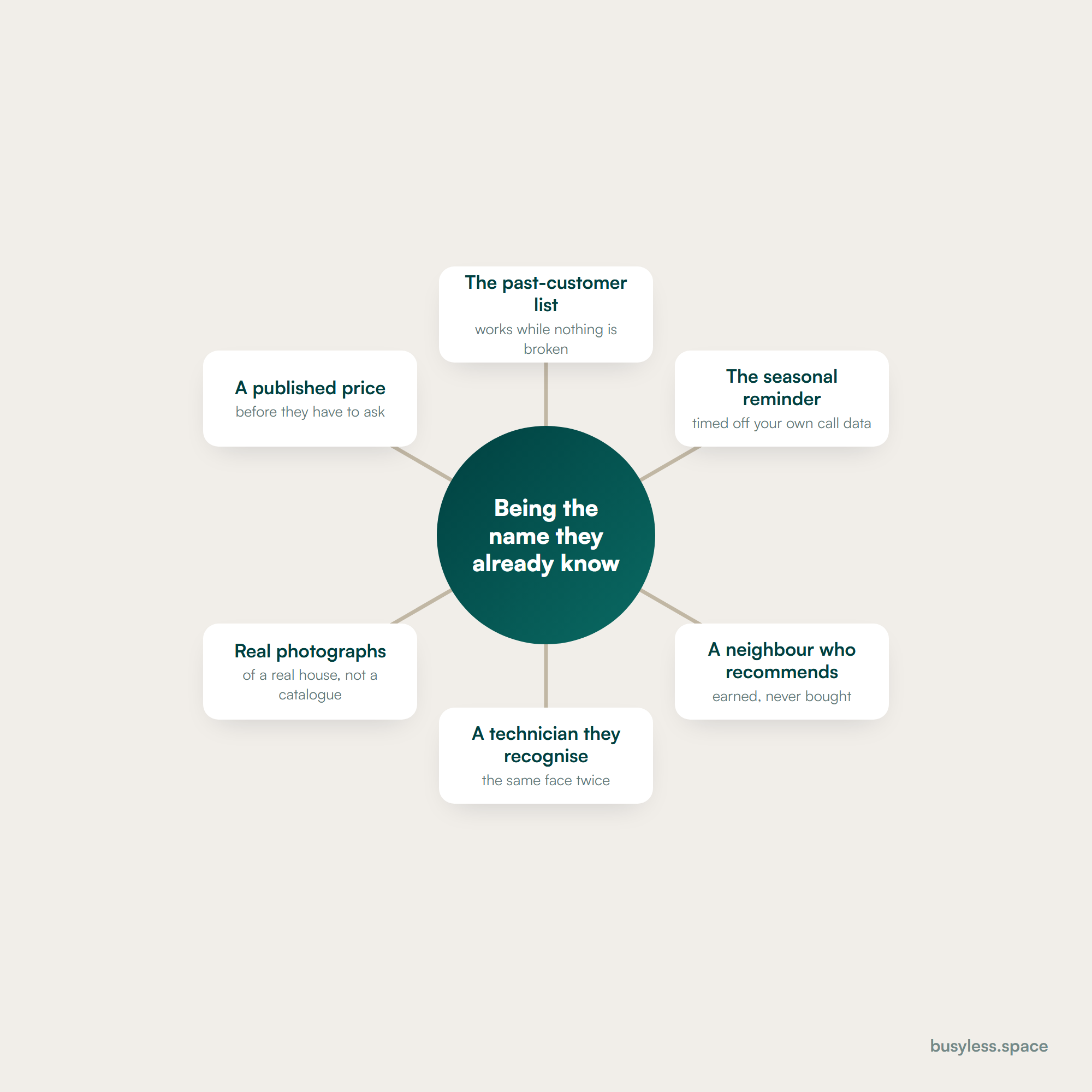
- 5The only thing that compounds in this business is being remembered. A past-customer list, a maintenance reminder and a technician a household recognises are the three assets that survive between events, and all three are cheap.
Content marketing for home services runs into a problem that most marketing advice quietly assumes away. There is no audience. Nobody wakes up interested in drains, nobody follows a heating company for the content, and nobody is somewhere in a consideration phase working towards a decision about electrical panels.
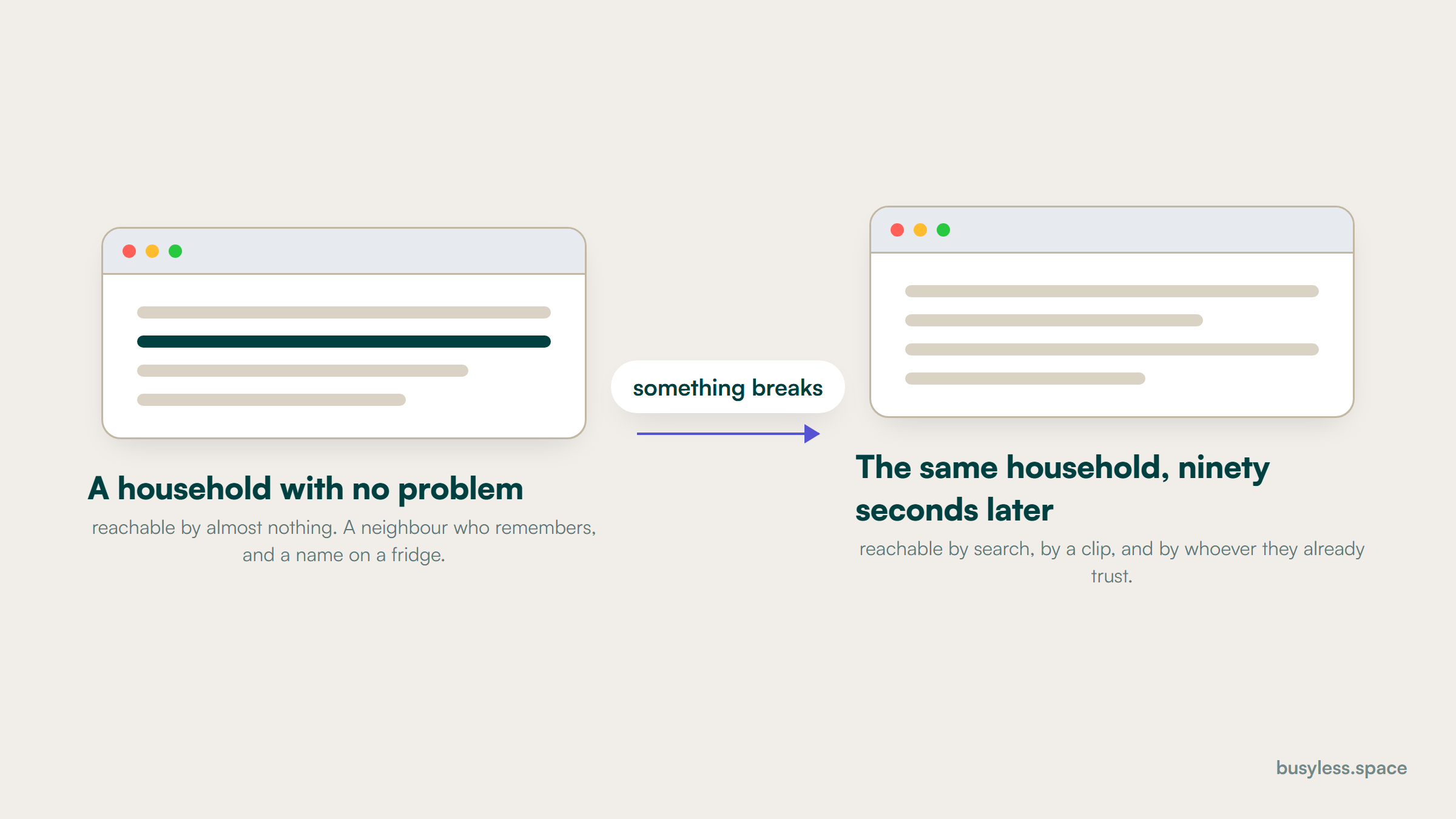
Demand appears the moment something fails, and it is close to total when it does. A household that had no interest in you at nine o'clock is calling three companies at ten, choosing on whoever answers, whoever can come today, and whoever seems least likely to take advantage of them.
That inverts the normal shape of a content plan. There is nothing to nurture, so the effort that other industries spend moving people through a funnel has to go somewhere else. Two places, in fact: being findable and convincing in the ninety seconds after the failure, and being the name a neighbour offers when asked.
So a home services content marketing strategy is really about placement and memory rather than persuasion. The asset has to already exist when the event happens, because there is no time to make one, and the relationship has to survive years of nothing happening, because that is what the gaps between events look like.
Looking for the search half
This page decides which channels to run. The one next door goes deep on just one of them.
Which channels to run, and which to skip
Judged on one question that does not apply anywhere else in this directory: does this channel work on somebody who is not currently in the market. Most channels answer no, and the honest response is to stop funding them rather than to try harder.
Run these
Search
RunThe only channel that reaches somebody in the ninety seconds after a failure, and the moment of demand and the moment of searching are the same moment here. That is unusual, and it is why search leads here as a capture channel rather than as the slow compounding bet it is on most of these playbooks.
First moveWrite the page for the symptom rather than the service. People search what they can see, hear or smell, not the name of the repair they need.
Community
RunThe neighbourhood group is where a household asks for a recommendation, and it is one of the few places a business can be present before anybody needs it. Being the company other people name is worth more here than any amount of your own posting, and it cannot be bought directly.
First moveFind the local groups your customers already use and read them for a month before joining. What people complain about is your content plan.
Video
RunA thirty-second clip of what a failing part looks like does two things at once: it answers the question somebody just typed, and it makes a technician recognisable. Both matter, and no video in any industry we cover is cheaper to make, because the raw material is a phone and a job.
First moveFilm the next unusual failure on a phone, with the technician explaining what they are looking at. Do not script it and do not reshoot it.
Worth a test, with a kill date
Newsletter
TestIt cannot build an audience here because there is no audience to build, and it is genuinely powerful in one narrow use: past customers, reminded seasonally, by a company they already trust. Treat it as a retention tool rather than an acquisition one and it earns its place.
First moveSend a seasonal reminder to past customers only, with something useful rather than an offer. A prospect list you bought or gathered will not respond to this.
Founder-led social
TestShort vertical video does travel locally and a business page mostly does not, which means the useful part is the format rather than the channel. Judge it as distribution for the video you are making anyway rather than as something with its own strategy and its own budget.
First movePost the clips you are already filming and watch whether anything reaches people outside your following. If nothing does, it is a distribution experiment that failed cheaply.
Skip these
Events and talks
SkipHome shows, county fairs and sponsorships reach people who are not in the market, which is the definition of the wrong audience here. They can work as a sales and brand activity for a large local business, and that budget belongs to sales rather than to this plan.
Trade press
SkipIndustry publications reach other contractors, suppliers and manufacturers. That is genuinely useful for recruitment, buying and reputation among peers, and none of those people will ever call you about a leak, so it should not be funded from a customer acquisition budget.
Original research
SkipA household makes a decision like this once a decade and will not read a study to do it. Published research works where a buyer is trying to become better informed over time, and here they are trying to stop water coming through a ceiling.
One channel that catches the event, one that carries the memory between events, and one format that serves both. Three skips rather than the usual two, and all three fail the same test: they reach people who are not currently in the market, which here is nearly everybody.
What you already own that nobody can copy
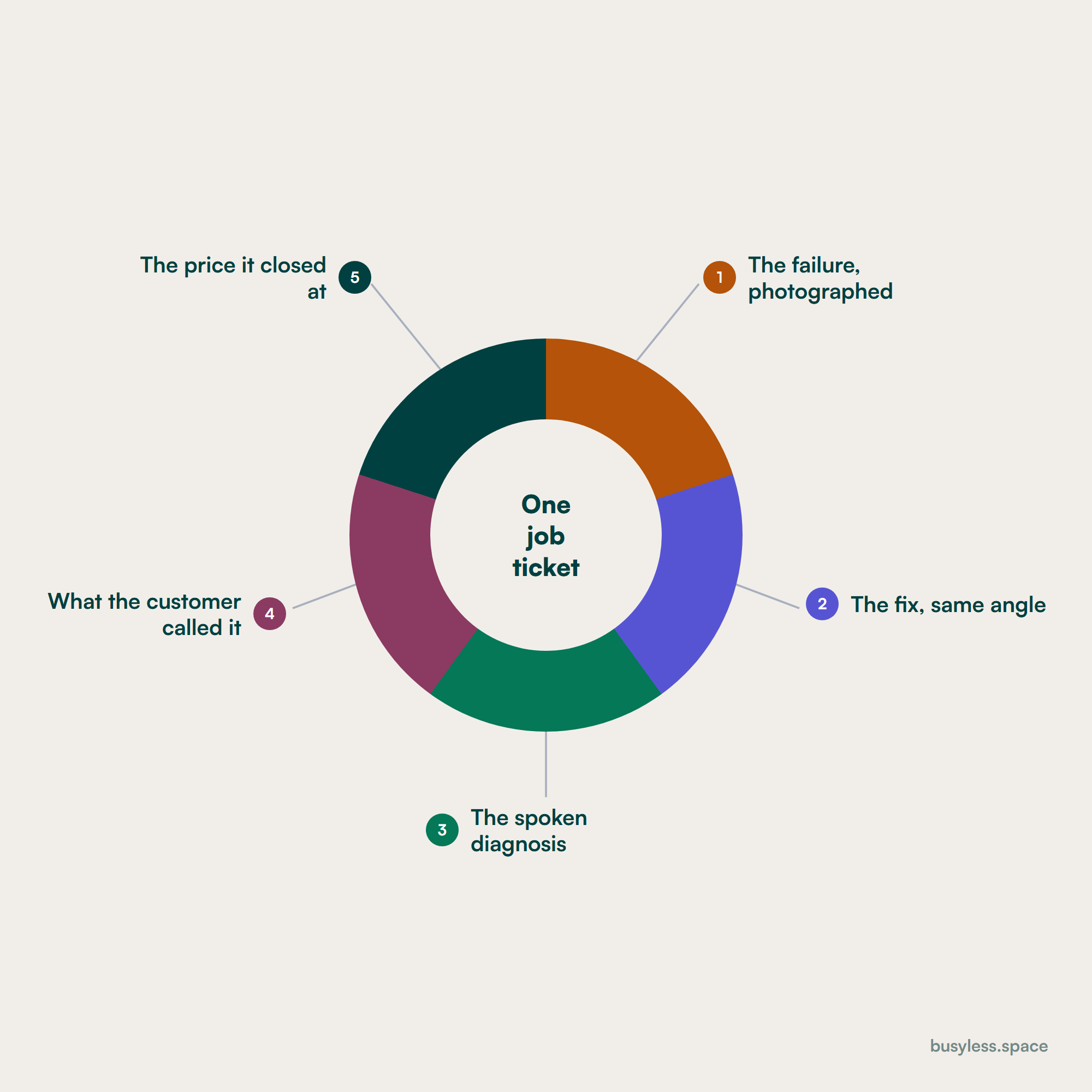
This industry generates better raw material than almost anything else in the directory and throws all of it away every day. Every job produces a photograph, a diagnosis and a price, and the sector's websites are built from stock imagery and a list of services.
The photograph of what actually failed
Held by Technicians, on their phones, already
A real corroded fitting, a scorched connection, a cracked heat exchanger. Nobody can buy these, everybody uses stock photography instead, and a homeowner recognises the difference between a real photograph of the thing in their own house and a catalogue image immediately.
How to capture it
Two photographs on every job, before and after, sent to one place. Most teams already take the first one for the invoice.
The plain-English diagnosis
Held by The technician, at the moment of explaining it
How somebody explains a fault to a worried homeowner standing next to them is genuinely different from how it is written up anywhere. It is the exact register the same person will search in, and it is delivered a hundred times a week and recorded never.
How to capture it
Record the explanation on the doorstep with the homeowner's agreement, or have the technician say it once into a phone afterwards. Do not let anybody rewrite it into trade language.
What jobs actually cost, in this area
Held by The office, in every closed invoice
Price is the first thing a household wants and the last thing the industry publishes, and national averages are wrong everywhere. Your own closed jobs are the honest local answer and the reason people distrust the trade is precisely that nobody gives it.
How to capture it
Pull the range for your ten most common jobs from closed invoices. Publish the range and what moves it, not a single figure.
Which parts and brands actually fail, and when
Held by Service history, and the senior technicians
Years of repeat visits across a specific housing stock in a specific climate. A manufacturer will not publish it, a national brand cannot know it locally, and it answers the question a household asks when deciding whether to repair or replace.
How to capture it
Ask the two longest-serving technicians which failures they see most and at what age. Check it against the service history before publishing anything.
What breaks when, across the year
Held by The dispatch log
Your own call volumes by week, by trade and by fault type, in your own climate and housing stock. It is the basis of every seasonal reminder that is genuinely useful rather than an excuse to make contact, and it is sitting in the scheduling system.
How to capture it
Export a year of calls by week and fault type. The peaks tell you what to publish and, more usefully, exactly when to publish it.
Who actually makes it
What stops production here is physical rather than editorial. The people with the material are in vans all day, they are paid for billable hours, and any process that asks them to write anything will be quietly abandoned in the first busy week.
Office manager or dispatcher
Collecting what comes in from the field
The only person who can make this work, because they are the one point every job already passes through. If the capture process does not run through this desk it does not run.
4 hours
Technicians, as sources
The photograph and the explanation
Two photographs and one voice note. Anything longer competes with billable time and will stop within a fortnight, whatever anybody agreed in the meeting.
2 minutes per job
Owner
The price question and the tone
The only person who can authorise publishing real prices, which is the highest-value and most resisted decision on this page. Also the person customers are actually choosing when the business is small.
2 hours
Somebody who writes
Turning field material into pages
The one role that usually has to be bought. Their job is to preserve how the technician said it rather than to improve it, which is a harder brief than it sounds.
8 hours, in-house or contracted
Whoever signs off advertised prices
Offers, response-time claims and dealer marks
Usually the owner. The rules section below explains why the advertised price and the availability claim are the two lines that need a second reading before they go up.
1 hour
The honest cadenceTwo pages a month built from real jobs, one clip a week from what the vans send in, and a seasonal reminder to past customers timed off the dispatch log. That is roughly fifteen hours a month and it is achievable in a busy season, which is the only test that matters.
One project, 8 surfaces
One job ticket becomes eight things, and the whole list costs about two minutes of a technician's time plus an hour at the office. That ratio is the reason this industry can publish more than it thinks it can.
- 1
The symptom page
90 minutesFrom: The fault, in the words a homeowner would use
Titled for what somebody notices rather than what the repair is called. This is the asset that is waiting when the event happens and it is the most durable thing on the list.
- 2
A short clip of the failure
20 minutesFrom: The before photograph and the explanation
Thirty seconds, filmed on a phone, technician talking. Unpolished performs better here because polish reads as advertising and a scorched connection does not.
- 3
The before and after pair
10 minutesFrom: The two photographs
Real photographs of a real house, with permission. It is the single clearest signal that you have done this before and that the pictures are not from a catalogue.
- 4
The price range entry
5 minutesFrom: The closed invoice
One row added to the published range for that job type. Five minutes a job builds the pricing page nobody in the industry has, over about a quarter.
- 5
An answer for the question page
20 minutesFrom: What the homeowner asked on the doorstep
Their question, in their words, answered plainly. These accumulate into the most useful page on a home services site and they cost almost nothing.
- 6
The seasonal reminder line
10 minutesFrom: The failure and the time of year
Feeds the past-customer email that goes out before the season this fault peaks. The dispatch log decides the date rather than a content calendar.
- 7
A recruitment post
20 minutesFrom: The job that was interesting to solve
Technicians are harder to find than customers in most markets, and the work itself is the recruitment message. The same clip serves both audiences.
- 8
The training note
Nothing extraFrom: What the technician did that was not obvious
Internal, and the thing that persuades the field team the capture process is worth doing. A process that only feeds marketing gets abandoned in a busy week.
The buying cycle, and what content does at each stage
Short once it starts, like several cycles in this directory, and almost all of it is spent outside the market entirely. Two of the five stages below happen in a single morning, and the longest one is the years in which nothing happens at all.
Nothing is happening
Years"None. They are not thinking about you at all"
- What moves them
- A past-customer list, a magnet on a fridge, a neighbour who remembers
- How you know
- Repeat calls from past customers, which is the only readable signal here
Something breaks
Minutes"What is this, and is it serious?"
- What moves them
- The symptom page and the clip, already published
- How you know
- Traffic to symptom pages, which spikes with weather rather than with marketing
Who do I call
Ten minutes"Who will actually turn up and not rip me off?"
- What moves them
- Real photographs, a published price range, a recognisable face
- How you know
- Calls per session on symptom pages, and how many mention the site
The visit
Same day, sometimes an hour"Is this person telling me the truth?"
- What moves them
- The technician, and whatever the household has already read
- How you know
- Quote acceptance rate, split by whether they found you or were referred
Afterwards
Months to years"Who did we use last time?"
- What moves them
- The seasonal reminder, and being easy to find again
- How you know
- Share of revenue from past customers, which is what compounding looks like here
What you are allowed to publish
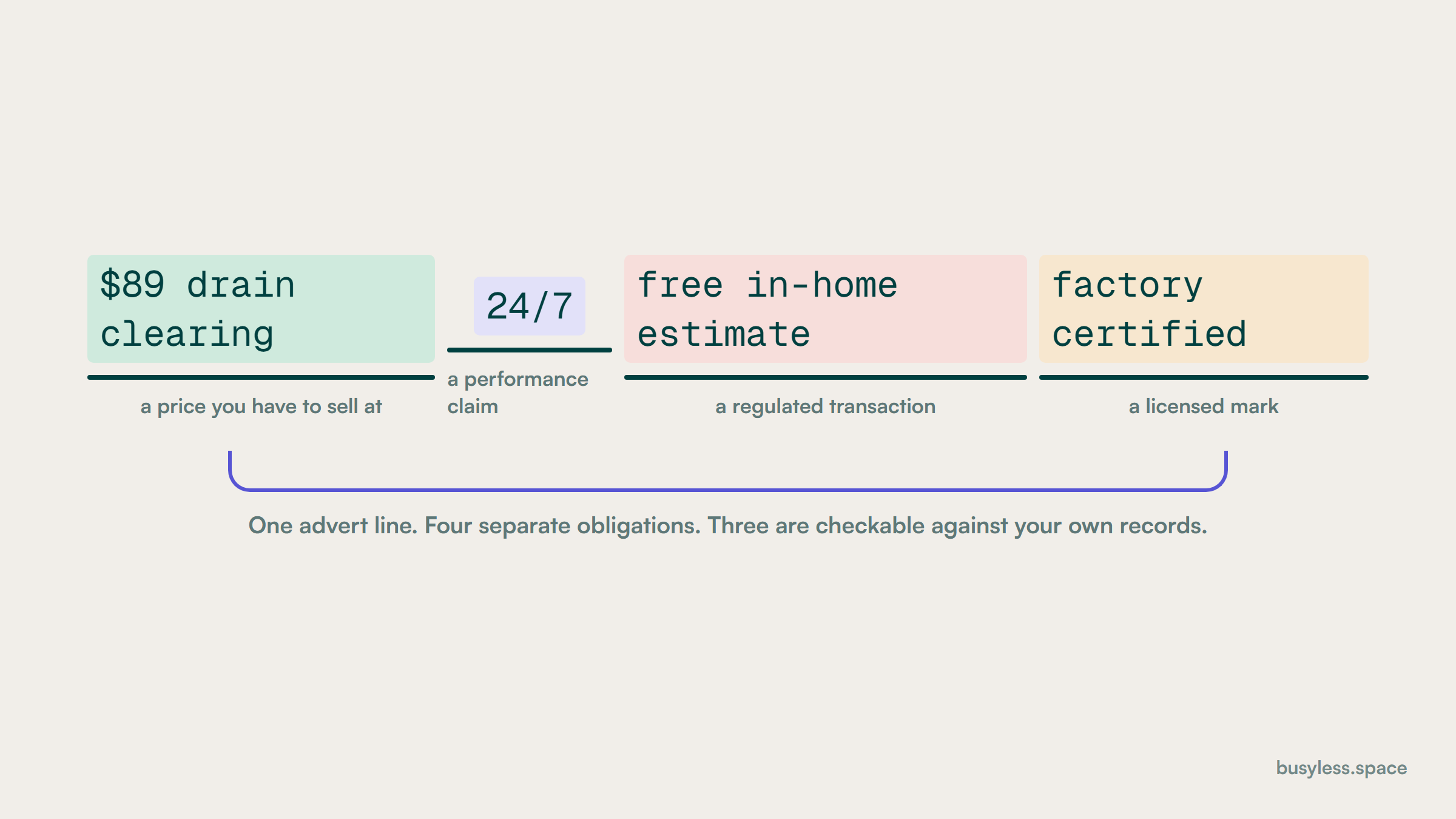
The first of these four catches the funnel almost every business in this industry runs. The sibling playbook covers which entity holds the licence, which trades a page may advertise, the membership plan as an automatically renewing subscription, and one profile per licensed entity, so none of those four are repeated here.
The in-home estimate is a regulated transaction
FTC Cooling-Off Rule, 16 CFR Part 429, read 2026-08-30
A sale of $25 or more made at the buyer's home carries a right to cancel until midnight of the third business day. The seller must give two copies of a cancellation form, say so orally, and provide the notice in the language of the sales presentation. It is triggered by where the sale happens rather than by what was sold.
So do thisTreat every page that pushes an in-home visit as advertising a transaction with this attached, and make sure the crews carry the notice rather than the office believing they do. Where an emergency repair is genuinely different, know why, in writing, before it matters.
An advertised price has to be a price you will sell at
FTC guides against bait advertising, 16 CFR Part 238, read 2026-08-30
Advertising an offer that is not a genuine offer to sell, or that exists mainly to produce a visit at which something else is sold, is the practice these guides describe. It reaches the conditions as well as the number: an $89 headline with limits that make it inapplicable to most jobs is the shape the guides were written about.
So do thisPut the conditions next to the number rather than behind an asterisk, say what is excluded in the same sentence, and track how often the advertised job is actually sold at the advertised price. If the answer is almost never, that is your finding.
A manufacturer's badge is licensed, not earned
Authorised dealer and certified installer programme terms, read 2026-08-30
Brand marks, certified installer badges and dealer logos come with usage terms about size, placement, wording and which entity may display them, and they end when the agreement does. Using a mark you no longer hold, or in a market or trade the agreement does not cover, is a trademark question rather than a marketing preference.
So do thisKeep one list of every mark you display, the entity it belongs to, the agreement date and its expiry, and check the site against it when an agreement changes. Removing a lapsed badge is a five-minute job that nobody owns.
A response-time claim is a claim
FTC advertising substantiation policy, applied to availability and response claims, read 2026-08-30
Twenty-four hour availability, same-day service and a stated arrival window are objective performance claims, and an advertiser is expected to have a reasonable basis for an objective claim before it is made. In this industry those claims are usually written by somebody who has never looked at the dispatch data.
So do thisCheck every availability claim against the last twelve months of dispatch records before it goes on a page, and write the claim you can actually meet in your worst week rather than your best. A narrower true claim outperforms a broad one nobody believes.
None of this is legal advice. Rules vary by state and by contract, and the dates above are when each source was read. Check your own before you rely on any of it.
How to build content marketing for home services
Half a year, and the first four weeks are about capture rather than publishing. A process the vans will actually follow in a busy week is worth more than a content calendar, because everything downstream is made of what the vans send in.
Make capture take two minutes
- Agree two photographs and one voice note per job, sent to one place
- Put the office manager in charge of collecting it
- Read a year of dispatch history for its seasonal shape
- Pull the price range for your ten most common jobs
Output A capture habit that survives a busy week, and two data exports
Publish what is waiting when it breaks
- Write ten symptom pages using the words homeowners actually use
- Publish the price ranges with what moves them
- Post one clip a week from what the vans sent in
- Answer the ten questions technicians are asked on doorsteps
Output Twenty pages built entirely from real jobs
Fix what the advertising promises
- Check every advertised price against what it actually sells at
- Check availability claims against twelve months of dispatch data
- Confirm crews carry the cancellation notice, rather than assuming
- List every manufacturer mark on the site against its agreement
Output Advertising claims that match the operation
Build the thing that compounds
- Send the first seasonal reminder to past customers only
- Join the neighbourhood groups you have been reading
- Report calls per session on symptom pages, not total traffic
- Report the share of revenue coming from past customers
Output A retention loop and a report about calls rather than visits
Structured data for what you publish
The business itself, its trades and its locations are marked up on the sibling playbook, which is where the licensed entity belongs. These six describe what you publish, and one of them exists for a situation this industry meets several times a year.
VideoObject for a failure explainer
The symptom page the clip belongs toName the symptom rather than the repair, because that is what somebody typed thirty seconds before landing here. Keep the clip on its symptom page rather than only on a social platform, since the page is the asset and the platform is the distribution.
{
  "@context": "https://schema.org",
  "@type": "VideoObject",
  "name": "[WHAT THE HOMEOWNER NOTICED, e.g. Why a radiator is cold at the top]",
  "description": "[WHAT THEY WILL UNDERSTAND AND WHAT TO DO NEXT]",
  "thumbnailUrl": "https://[YOUR-DOMAIN]/images/[FILE].jpg",
  "uploadDate": "[YYYY-MM-DD]",
  "duration": "PT[M]M[S]S",
  "contentUrl": "https://[YOUR-DOMAIN]/video/[FILE].mp4",
  "embedUrl": "https://[YOUR-DOMAIN]/[SYMPTOM-PAGE-SLUG]",
  "publisher": {
    "@type": "Organization",
    "name": "[BUSINESS NAME]",
    "url": "https://[YOUR-DOMAIN]"
  }
}
SpecialAnnouncement for a weather or service event
A page published during a freeze, storm or area-wide outageBuilt for exactly this situation and almost unused in this industry. During a hard freeze or a storm, the useful page is the one telling people what to do now and what your actual availability is, and this type exists to mark that as time-bound rather than permanent.
{
  "@context": "https://schema.org",
  "@type": "SpecialAnnouncement",
  "name": "[EVENT, e.g. Hard freeze advice for [AREA]]",
  "text": "[WHAT TO DO NOW, AND WHAT OUR ACTUAL AVAILABILITY IS]",
  "url": "https://[YOUR-DOMAIN]/alerts/[SLUG]",
  "datePosted": "[YYYY-MM-DDTHH:MM+00:00]",
  "expires": "[YYYY-MM-DDTHH:MM+00:00]",
  "category": "[BRIEF CATEGORY, e.g. severe weather service update]",
  "announcementLocation": {
    "@type": "Place",
    "name": "[SERVICE AREA]"
  },
  "publisher": {
    "@type": "Organization",
    "name": "[BUSINESS NAME]",
    "url": "https://[YOUR-DOMAIN]"
  }
}
QAPage for a doorstep question
A page built around one real question and its answerUse it only where the page genuinely is one question and one answer, which in this industry is often. Do not retrofit it onto a services page with a question in the heading, because the markup is describing the page shape rather than decorating it.
{
  "@context": "https://schema.org",
  "@type": "QAPage",
  "mainEntity": {
    "@type": "Question",
    "name": "[THE QUESTION, IN THE WORDS A HOMEOWNER USED]",
    "text": "[THE FULLER VERSION OF WHAT THEY ASKED]",
    "answerCount": 1,
    "acceptedAnswer": {
      "@type": "Answer",
      "text": "[THE ANSWER, IN THE WORDS THE TECHNICIAN USED]",
      "author": {
        "@type": "Person",
        "name": "[TECHNICIAN NAME]",
        "jobTitle": "[TRADE AND YEARS OF EXPERIENCE]"
      }
    }
  }
}
ImageObject for a before and after pair
Any page carrying real photographs of a real jobThe permission field is the one that matters. A photograph inside somebody's house needs their agreement, and recording that agreement with the file is what keeps a growing library usable rather than becoming a folder nobody dares publish from.
{
  "@context": "https://schema.org",
  "@type": "ImageObject",
  "contentUrl": "https://[YOUR-DOMAIN]/images/[FILE].jpg",
  "caption": "[WHAT FAILED AND WHY, NOT THE ADDRESS]",
  "description": "[BEFORE OR AFTER, AND WHAT CHANGED]",
  "creditText": "[BUSINESS NAME]",
  "copyrightNotice": "(c) [YEAR] [BUSINESS NAME]",
  "dateCreated": "[YYYY-MM-DD]",
  "contentLocation": {
    "@type": "Place",
    "name": "[TOWN OR AREA ONLY, NEVER THE ADDRESS]"
  }
}
Clip for the useful thirty seconds
Inside a longer video where one segment is the answerWhere a ten-minute job film contains ninety seconds that answer the actual question, marking the segment is more useful than cutting a second file. It also stops the useful part being buried, which is the usual fate of a long job video.
{
  "@context": "https://schema.org",
  "@type": "Clip",
  "name": "[WHAT THIS SEGMENT SHOWS]",
  "startOffset": "[SECONDS]",
  "endOffset": "[SECONDS]",
  "url": "https://[YOUR-DOMAIN]/[PAGE-SLUG]?t=[SECONDS]",
  "partOfEpisode": {
    "@type": "VideoObject",
    "name": "[FULL VIDEO NAME]",
    "url": "https://[YOUR-DOMAIN]/[PAGE-SLUG]"
  }
}
NewsArticle for a local cost or failure finding
The page carrying something you counted across your own jobsUse it for the thing a local paper might pick up, which here is usually a price range or a pattern of failures in a particular kind of housing. Put a real name on it, because a claim about local costs from an anonymous business is easy to ignore.
{
  "@context": "https://schema.org",
  "@type": "NewsArticle",
  "headline": "[THE FINDING, e.g. What a [JOB] actually costs in [AREA]]",
  "url": "https://[YOUR-DOMAIN]/insights/[SLUG]",
  "description": "[WHAT WAS COUNTED, OVER WHAT PERIOD, AND THE RANGE]",
  "datePublished": "[YYYY-MM-DD]",
  "dateModified": "[YYYY-MM-DD]",
  "author": {
    "@type": "Person",
    "name": "[OWNER OR SENIOR TECHNICIAN]",
    "jobTitle": "[ROLE]"
  },
  "publisher": {
    "@type": "Organization",
    "name": "[BUSINESS NAME]",
    "url": "https://[YOUR-DOMAIN]"
  },
  "contentLocation": {
    "@type": "Place",
    "name": "[SERVICE AREA]"
  }
}
What to automate, and where the line is
The automation that matters here happens between the van and the website, because the material arrives constantly in an unusable form and the office has four hours a month. The line sits at the price and at the availability claim.
- automate
Transcribing and sorting voice notes from the field
The highest-value automation on this page. Two minutes of a technician talking becomes text the office can use without anybody typing, which is what makes a two-minute capture habit produce a publishable page.
- automate
Grouping job records by fault type and season
The dispatch log holds the whole publishing calendar and nobody has time to read it. Grouping calls by week and fault type tells you what to publish and, more usefully, exactly when.
- automate
Calculating price ranges from closed invoices
Mechanical arithmetic over data you already have, refreshed monthly. It keeps the pricing page current, which is what stops it becoming a claim that no longer matches what you charge.
- assist
Drafting a symptom page from a transcript and photographs
A decent structure that consistently smooths away how the technician actually said it. Preserving that register is the entire value of the page, so a person puts it back.
- assist
Producing captions and cutting clips from job footage
Fast, and it will pick the visually interesting moment rather than the useful one. Somebody who understands the fault chooses which thirty seconds matter.
- assist
Scheduling the seasonal reminder off the dispatch data
The timing can be derived automatically and the message should not be. A reminder that reads as generated is worse than none from a company somebody let into their house.
- never
Publishing a price or an availability claim
Both are objective claims that need a reasonable basis before they are made, and both are checked against your own records rather than against a plausible number. This is the line on this page.
- never
Writing a review or a customer quote
A generated testimonial is a fabricated one, and in a trade where the whole purchase decision is about trusting a stranger in your home it is the worst possible thing to be caught doing.
What it costs
What follows is a range rather than a price, and every tier assumes the two-minute capture habit is actually running. What moves the number most is the number of trades and the size of the service area, because each trade brings its own symptoms, its own prices and its own season.
Do it yourself
$0 to $400- Two photographs and a voice note from every job
- Ten symptom pages written by the owner
- Published price ranges from your own closed invoices
- A seasonal reminder to past customers
- Suits
- An owner-operator or a two-van business
- Ceiling
- It stops in the first busy season, every time. The pages that exist keep working, and nothing new gets made between May and September, which is when the material is best.
Lean
$1,200 to $3,000- Somebody who writes, turning field material into pages
- A clip a week edited from what the vans send
- Advertising claims checked against dispatch data
- The past-customer reminder running on schedule
- Suits
- A single-trade business with a handful of vans
- Ceiling
- One trade and one service area. A second trade does not share symptoms, prices or seasons, so it roughly doubles the work rather than adding to it.
Funded
$3,000 to $7,000- Several trades covered properly rather than listed
- Video produced continuously from live jobs
- A published local cost picture, maintained
- Community presence that is somebody's actual job
- Suits
- A multi-trade or multi-location business
- Ceiling
- The constraint becomes capture rather than production. Beyond a certain size the field team stops sending material unless somebody is accountable for it in every branch.
Above this
$7,000 and up- Multiple markets under one editorial and claims standard
- A recruitment content stream, which is often the real constraint
- Seasonal campaigns timed off real call data per market
- Full coverage of symptoms across every trade you sell
- Suits
- Regional groups and consolidators running several brands
- Ceiling
- Claims governance across markets becomes the cost, and the failure mode is a central standard that publishes an availability promise no individual branch can meet.
How to do it with no budget
Only the first of these seven really matters. Everything else on this page is made from what it collects, and it costs two minutes a job.
- 1
Get two photographs and a voice note from every job
The phones your technicians already carry · 2 minutes per job
Before, after, and thirty seconds of explanation. Send it to one place. Anything more elaborate stops in the first busy week.
- 2
Find out what breaks in your area and when
Your scheduling system · 1 hour
The peaks are your publishing calendar. Publishing about frozen pipes in January is late, and this tells you exactly how late.
- 3
Pull the real price range for your ten commonest jobs
Closed invoices · 2 hours
Publish the range and what moves it. A single figure invites an argument and a range invites a phone call.
- 4
Write down the ten questions asked on doorsteps
One conversation with the technicians · 1 hour
In the homeowner's words, not the trade's. These are ten pages that already have demand behind them.
- 5
Read your local neighbourhood groups for a month
The groups your customers already use · 20 minutes a week
Read before joining. What people complain about, and who gets recommended, is more useful than anything you would have posted.
- 6
Check what your advertised price actually sells at
Your job records · 1 hour
Count how often the advertised job is sold at the advertised number. If the answer is almost never, that is the finding and it needs fixing.
- 7
Send one seasonal reminder to past customers
Your customer list and any email tool · 2 hours
Useful information timed off the dispatch data, not an offer. Past customers only, because nobody else has a reason to open it.
The tool stack
Very little software, because most of what matters here is a habit rather than a tool. The rows linking into our other directories go to the researched review rather than to a vendor page.
Collect photographs and voice notes from the field
The best tool here is the one the vans already use. A separate app for marketing capture is abandoned within a month, whatever it does.
Free option: A shared album and a group chat, which genuinely works below about six vans
Turn voice notes into usable text
This is what makes the two-minute capture habit produce pages. Without it somebody has to listen to everything, and nobody does.
Free option: Free tiers cover a few hours a month, which is enough at this volume
Publish symptom pages that are not stuck in a services template
A symptom page with a clip, two photographs and a price range is a different shape from a services page, and most home services sites make it harder than it needs to be.
Free option: Your existing site, which copes until about thirty symptom pages
Work out what the capture and reminder habit is worth
Run it on the seasonal reminder rather than on acquisition. The repeat-customer arithmetic is where this business actually compounds and it is rarely modelled.
Free option: Free
See whether the pages turn visits into calls
Calls per session is the number on this page, not sessions. A symptom page with high traffic and no calls is answering the question too well and stopping there.
Free option: Free
Find the words homeowners use for a symptom
Use it beside the call log rather than instead of it. The log has the phrasing and this tells you how many other households are typing it.
Free option: Your own call notes, which are better and already yours
Check what assistants tell people to do when it breaks
Increasingly the first thing somebody does at eleven at night. Worth knowing whether the advice given is safe and whether any local business is named at all.
Free option: Ask each assistant about a common fault in your area monthly and see who gets named
Know which badges you are still entitled to display
One row per badge: the entity, the agreement date, the expiry and where it appears on the site. A lapsed badge is a five-minute fix that nobody currently owns.
Free option: No cost, and a spreadsheet is genuinely the right tool for this one
Take it from here
Everything below is meant to be copied and filled in. Bodies are plain text, so what you see is exactly what lands on your clipboard.
What every technician sends from every job. Printed, laminated, in the van. Nothing longer survives.
TWO-MINUTE CAPTURE
Business: [BUSINESS NAME]
Send everything to: [ONE PLACE. ONE. NOT TWO.]

WHY THIS IS SHORT
Anything longer than two minutes competes with billable
time and stops in the first busy week. This card is the
whole process.

ON EVERY JOB

1. PHOTOGRAPH THE PROBLEM        [30 seconds]
   [ ] The failed part, close enough to see the failure
   [ ] Wide enough to show where it sits
   [ ] Nothing identifying the address or the household

2. PHOTOGRAPH THE FIX            [20 seconds]
   [ ] Same angle as the first one
       [SAME ANGLE. THAT IS WHAT MAKES THE PAIR WORK.]

3. THIRTY SECONDS OF VOICE       [30 seconds]
   Say, out loud, as if to the homeowner:
   - What was wrong
   - Why it happened
   - What you did
   - What would have prevented it
   [SAY IT THE WAY YOU SAID IT ON THE DOORSTEP. DO NOT
    USE TRADE LANGUAGE. THE WAY YOU EXPLAINED IT IS
    THE THING WE WANT.]

4. ONE LINE OF TEXT              [20 seconds]
   Trade: [ ]
   Fault: [ ]
   What the customer said was wrong: "[THEIR WORDS]"
   [THEIR WORDS ARE THE PAGE TITLE. THIS IS THE MOST
    VALUABLE LINE ON THE CARD.]

PERMISSION, IF THE PHOTOGRAPH IS INSIDE A HOME
Ask, on the day:
  "Do you mind if we use a photo of this on our website?
   No address, nothing that identifies the house."
[ ] Yes / No recorded in the job notes
[ ] If unsure, do not send it

WHAT COMES BACK TO YOU
Every month you get:
[ ] The training note from the interesting jobs
[ ] The clips that got used
[ ] Which of your explanations became a page
     [THIS SECTION IS WHY THE PROCESS SURVIVES. A
      CAPTURE HABIT THAT ONLY FEEDS MARKETING GETS
      ABANDONED.]

QUESTIONS: [NAME, EXTENSION]The expensive mistakes
Building a content plan around nurturing an audience
What it costs: A year of effort aimed at people who will not need you for another eight years
Put the effort into being findable at the moment of failure and memorable in the gaps. There is no middle stage here to move anybody through.
Using stock photography
What it costs: A site indistinguishable from every competitor, in a purchase decided entirely on trust
Publish the real photograph of the real failure, with permission. Homeowners recognise a catalogue image instantly and it is the cheapest differentiator available.
Refusing to publish prices
What it costs: The single biggest reason households distrust this trade, reinforced on your own website
Publish the range from your own closed invoices and say what moves it. It is the most commercially useful page you can build and the most resisted.
Advertising a price the business rarely sells at
What it costs: The exact pattern the bait advertising guides describe, and a crew that dreads the calls
Put the conditions in the same sentence as the number, and check how often the advertised job actually sells at it. If it almost never does, change the advert.
Promising a response time nobody checked
What it costs: An objective claim with no basis, and a reputation set by your worst week rather than your best
Read twelve months of dispatch data and write the claim you can meet in the worst week. A narrower true claim converts better than a broad one people have learned to discount.
Letting the past-customer list go cold
What it costs: Losing the only asset in this business that compounds, to a competitor with a fridge magnet
Send one genuinely useful seasonal reminder timed off your own call data. It is a couple of hours a season and it is the closest thing here to free revenue.
What to measure
Measuring home services content marketing on traffic is misleading in a specific way: symptom-page visits spike with the weather rather than with anything you did. What follows leads with calls per session and with repeat revenue, and it is honest that the biggest month is usually explained by a cold snap.
Leading indicators
Calls per session on symptom pages
Call tracking, matched to the landing page
The number that matters on this page. A page with heavy traffic and no calls has answered the question completely and given nobody a reason to pick up the phone.
Symptom pages published from real jobs
Your own publishing record
Count the ones built from a genuine job rather than the total. A page written from a keyword list rather than from a van reads differently and performs differently.
Capture rate: jobs that sent photographs and a note
Wherever the field team sends material
The health check for the entire engine. When this falls below about half, everything downstream stops within a month and nobody notices until the queue is empty.
Mentions and recommendations in local groups
The groups themselves, read weekly
Being named by somebody else is the strongest signal available here and there is no dashboard for it. Somebody has to read, and the reading is worth the twenty minutes.
Business indicators
Quote acceptance rate by source
Your job records
Split by whether they found you or were referred. A household that arrived having read your pages usually accepts at a noticeably different rate, and that gap is the clearest result content produces here.
Share of revenue from past customers
Your job records
The only thing in this business that compounds. It moves slowly, it is unaffected by the weather, and it is the honest measure of whether the retention half is working.
Average job value, first-time against repeat
Finance
Repeat customers usually accept larger recommended work because the trust question is already settled. Put both numbers in one table rather than reporting an overall average.
Advertised jobs sold at the advertised price
Your job records
A commercial number and a compliance one at the same time. A very low figure means the advert is producing visits rather than sales, which is exactly what the guides describe.
The verdict
Content marketing for home services is simpler than most of this directory and harder to accept. There is no audience, so the two jobs are being there when something breaks and being remembered in the years when nothing does. Almost every plan sold to this industry is built for a middle stage that does not exist.
The material is already being produced. Photographs, diagnoses and prices come off every job and go straight in the bin, while the website carries stock imagery and a list of services. Two minutes a job changes that, and the change is a habit rather than a budget.
Be careful with any proposal for home services content marketing services that arrives without a request for your dispatch data, or that leads with a blog calendar. The first decides when everything should publish, and the second is a plan written for an industry with a nurture phase.
Stated plainly, content marketing services for home services are worth buying when the vans are already sending material and the owner will publish real prices. Without those two, you are paying somebody to write from a keyword list, which is what everybody else in your market already has.
FAQ
Home services content marketing questions
Why would anybody read content about plumbing?
They would not, until something breaks, and then they will read everything they can in the next ten minutes. That is the whole point of this page: the asset has to already be published because there is no time to make one, and nobody is warming up in the meantime.Should we publish a range from our own closed jobs?
Publish the range from your own closed jobs and say what moves it. Refusing is the single biggest reason households approach this trade expecting to be taken advantage of, and a range with reasons attached generates calls rather than arguments about a number.Do we need a right-to-cancel notice for a free estimate?
If a sale of $25 or more is made at the buyer's home, the three-day right applies, with two copies of a cancellation form and an oral notice in the language of the presentation. It is triggered by where the sale happens rather than by what it was. Check the exceptions rather than assuming one applies.Is our $89 offer a problem?
It depends whether it is a genuine offer you sell at. An advertised price that exists mainly to produce a visit at which something else is sold is the pattern the bait advertising guides describe. Count how often that job actually sells at that number, then decide.How do we get technicians to send anything?
Keep it to two photographs and one voice note, send it to a place they already open, and make sure something comes back to them. A capture process that only feeds marketing is abandoned in the first busy week; one that also produces training notes survives.Is a newsletter worth it for a trade business?
For past customers, yes, and for prospects, no. Nobody subscribes to a plumber before they need one. A seasonal reminder to people you have already worked for, timed off your own call data and carrying something useful, is the version that works.Can we claim twenty-four hour service?
Only if you can meet it in your worst week. An availability claim is an objective performance claim and needs a reasonable basis before it is made. Read twelve months of dispatch records first, and write the narrower claim that is actually true.What should we expect to spend for a business our size?
The capture habit and the first ten symptom pages cost hours rather than money. Where a budget exists, an engagement starts with a Discovery and then a monthly retainer. The realistic range for running it properly, in-house or with help, is $1,200 to $7,000 a month depending on trades and area.Should a trades business hire an agency?
Only one that will get into a van. Content marketing agencies for home services usually propose a blog, because that is what can be produced without leaving the office, and the material that works is a technician's photograph with a two-line explanation. Content marketing for in-home services lives or dies on that access.
Run it yourself, or have someone own it
Everything above is written to be run without us, and the free path is genuinely most of the value for a small practice. Where these plans stall is almost never the plan. It is that the person holding the material has a day job and nobody owns the programme after the first month. That is the job we do.