
Content marketing for ecommerce
Regulated marketingThe channel that acquires is not the one that retains
- Sector
- Retail and ecommerce
- Channels
- Founder-led social, Newsletter, Video
- Buying cycle
- Short cycle
- Time to compound
- 3 to 9 months
- Typical monthly
- $3,000 to $20,000
Key takeaways
- 1You rent acquisition and own retention, and the two are different channels with different content. Almost every DTC brand knows this and almost none of them splits the budget accordingly.
- 2The margin is in the second order, and the content that produces it is barely funded. A brand spending nine tenths of its content effort before the first purchase is spending it on the half where the economics are worst.
- 3Your best research is your returns and cancellations. The reasons people give for sending something back are the most honest data in the business, they are free, and they are read by operations rather than by marketing.
- 4If you talk about sustainability you are making a regulated claim. The Green Guides expect general environmental benefit claims to be qualified to a specific attribute, which is exactly the opposite of how brand stories are usually written.
- 5You may not show only the good reviews. Suppressing negative reviews and carrying reviews across products are separate prohibited practices, and the second one catches brands that merge listings or reformulate without meaning anything by it.
Content marketing for ecommerce is usually planned as an acquisition problem, and acquisition is the half where a DTC brand has the least control and the worst economics. The channels that bring a first-time buyer are rented: the platform sets the price, changes the rules, and can raise the cost of your customers overnight without telling you.
The channels that keep a customer are owned. An email list, an SMS list and a community are yours, they cost almost nothing to reach, and the person on the other end has already paid you once. Every serious analysis of DTC economics arrives at the same conclusion, which is that the second and third orders are where the business is.
Then the budget gets allocated, and something strange happens: the great majority of content effort goes to the rented half. Blog posts written to be found, videos made to be scrolled past, and a post-purchase sequence consisting of a shipping notification and a discount code in week six.
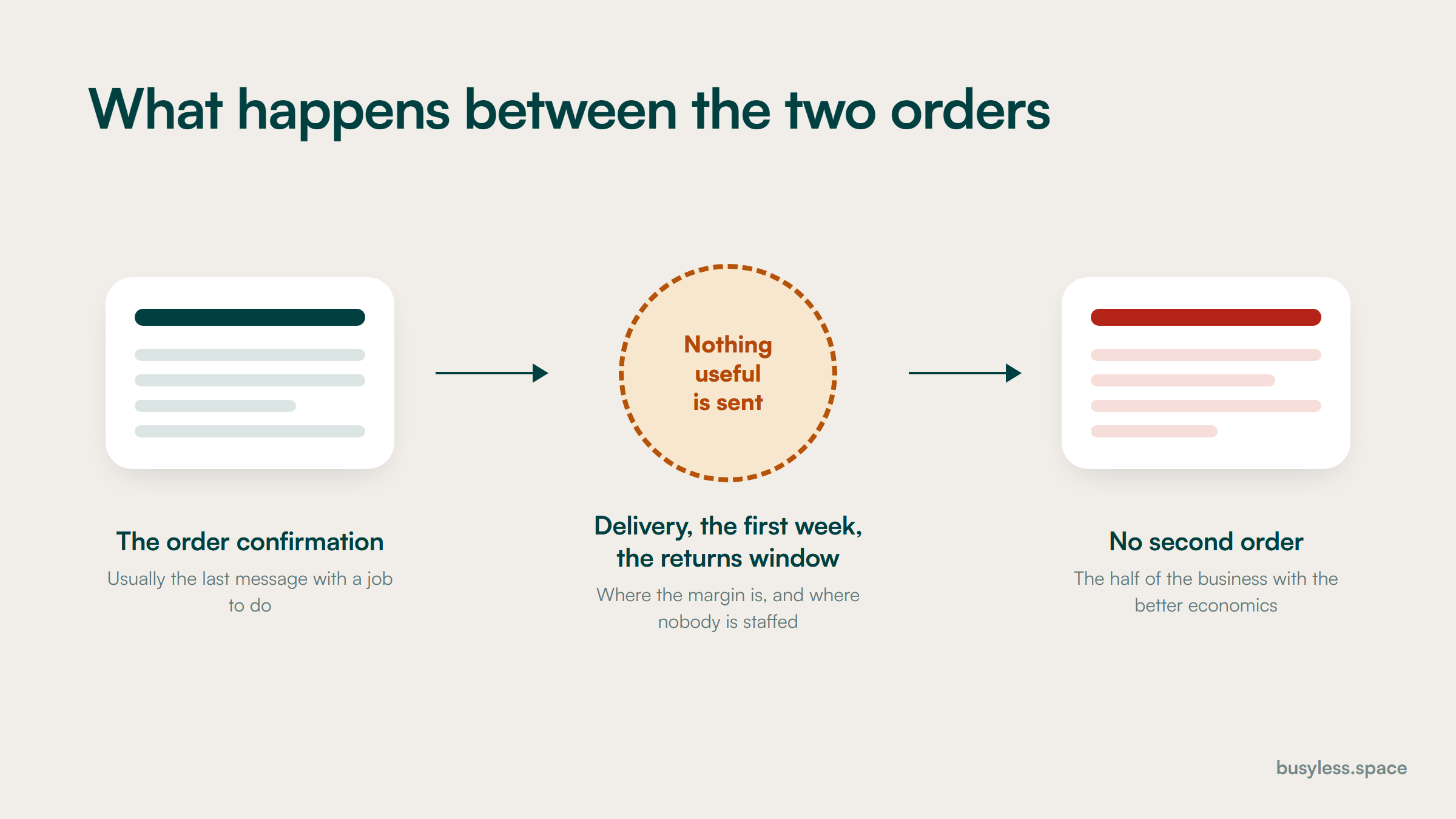
So an ecommerce content marketing strategy that is worth running usually starts by moving effort backwards rather than by producing more of it. The question is not what else to publish before the sale. It is what exists between the confirmation email and the second order, and for most brands the honest answer is nothing.
Looking for the search half
This page decides which channels to run. The one next door goes deep on just one of them.
Which channels to run, and which to skip
Judged on a split that runs through the whole page: whether the channel is rented or owned, and whether its job is a first order or a second one. A channel that does both is rare, and treating one as if it did both is the common expensive error.
Run these
Newsletter
RunThe owned channel that carries retention, and the one asset a platform cannot take away or reprice. In this industry it is also where the margin actually is, because the cost of reaching somebody who has already bought from you is close to zero and their propensity to buy again is not.
First moveBuild the post-purchase sequence before you touch the acquisition one. Most brands have five emails before the first order and one after it.
Founder-led social
RunThe rented channel that acquires, and it is not optional at this stage of the market. What matters is being honest that you are renting. The reach is lent to you and the cost of a customer is set by an auction you do not control, so everything you build there should point at getting an address you do own.
First moveAudit what proportion of social output asks for an email or an SMS opt-in. For most brands it is almost none, which is the whole problem in one number.
Video
RunThe format that does the two jobs this industry most needs: showing scale and texture before the purchase, and showing how to actually use the thing afterwards. The second is chronically underfunded and it reduces returns, which is a margin improvement rather than a marketing one.
First moveFilm one how-to-use video for your highest-return product and put it in the post-purchase sequence rather than on the product page only.
Worth a test, with a kill date
Community
TestGenuinely powerful in categories where the product is part of a practice rather than a purchase: cooking, fitness, hobbies, anything people already talk about. Genuinely a waste in categories where nobody wants to discuss the product with strangers, which is most of them, and the honest test is whether a community already exists without you.
First moveLook for whether your customers already talk to each other somewhere. If they do not, that is your answer and it saves you a year.
Search
TestCompounding and slow, and it competes with retailers and marketplaces who have more of everything. Worth funding on the questions surrounding your product rather than on the category term, and worth being honest that it will not carry acquisition in year one. The technical half is on the sibling playbook.
First moveWrite the five pages answering what people ask before buying in your category, not the pages targeting the category name itself.
Original research
TestYou have real data nobody else has, in your returns and your reorder patterns, and published carefully it gets covered. The constraint is that it must be about the category rather than about your customers, and anything derived from individual purchases needs a hard look before it goes anywhere.
First movePublish one thing your returns data tells you about the category, aggregated, with the method stated and no individual identifiable.
Skip these
Trade press
SkipCoverage in retail and industry press reaches buyers, investors and competitors, and almost never reaches a consumer who will order. It has a real use if you are pursuing wholesale or retail distribution, which is a different business objective, and it should be funded from that budget rather than from this one.
Events and talks
SkipMarkets, pop-ups and sampling do work and they are a retail and sales activity rather than a content one. Where a brand runs them, the content job is filming what happens and using it afterwards, which is repurposing rather than a channel that needs staffing.
One owned channel that keeps customers, one rented channel that finds them, and one format that serves both halves. The order is the argument: the owned channel is listed first because it is the one that gets built last, if at all.

What you already own that nobody can copy
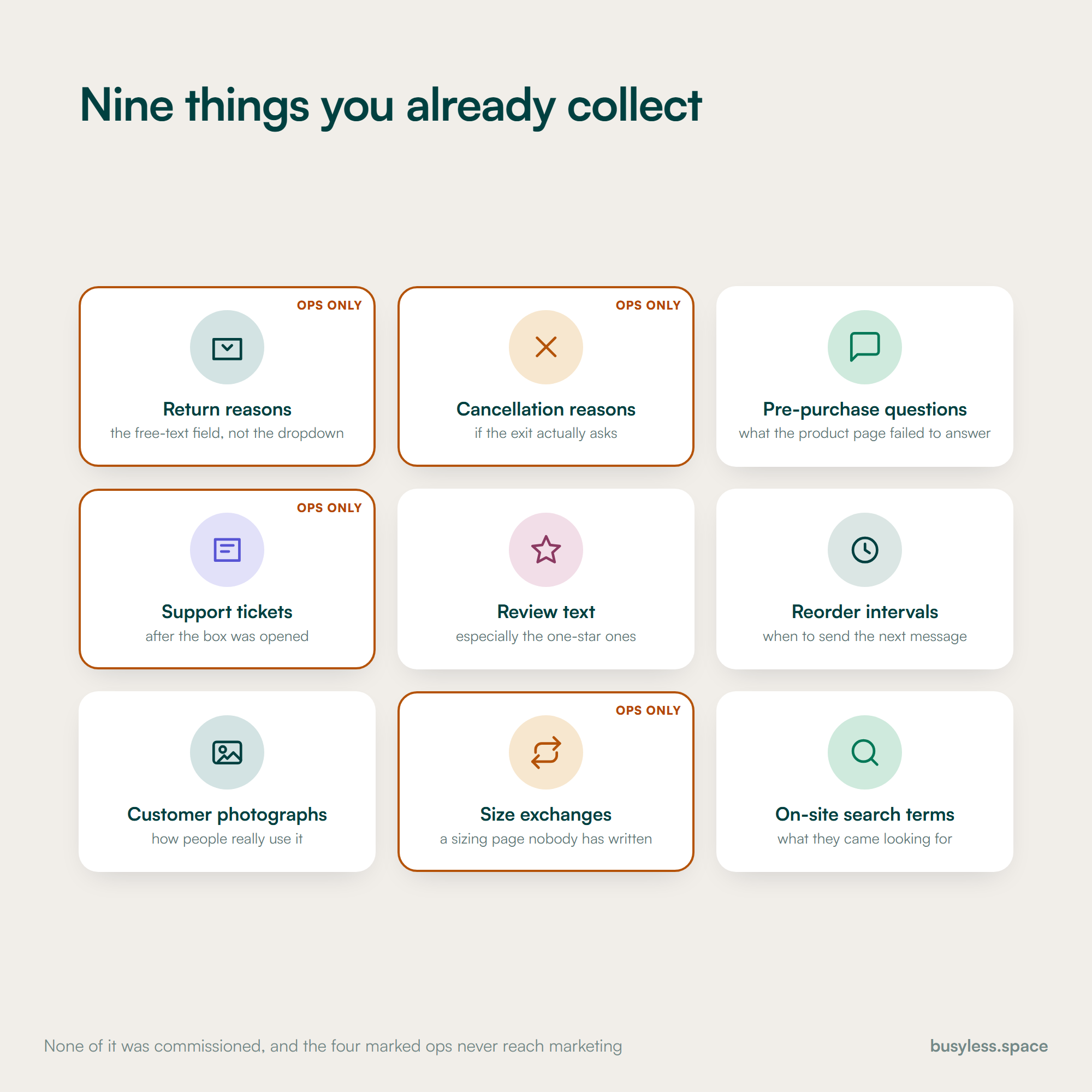
A DTC brand generates more honest research in a month than most companies commission in a year, and almost all of it goes to operations rather than to marketing. Everything below already exists in a system somebody is already reading for a different reason.
The reasons people give for returning things
Held by Operations and customer service
The most honest data in the business. Somebody has paid, waited, opened the box and decided against it, and then written down why. No survey gets close to that, and a competitor cannot buy it at any price.
How to capture it
Read a hundred consecutive return reasons rather than the summary chart. The free-text field is where the content is, and the dropdown category is where it hides.
The questions asked before buying
Held by Customer service, live chat and the comments
Every question asked before a purchase is a thing your product page failed to answer, with the person's own words attached. It is a content brief with demand already proven, arriving continuously and for free.
How to capture it
Export a month of pre-purchase messages, strip the customer, and count the topics. Ten questions is a quarter of pages.
Why subscribers cancel
Held by The cancellation flow, if it asks
The reasons are specific, unflattering and predictive, and most brands either do not ask or ask in a way designed to prevent the answer rather than record it. Where it is recorded honestly it is the best retention brief available.
How to capture it
Ask one open question at cancellation and do not gate the exit behind it. The answers are worth more than the saves.
How people actually use the product
Held by Customers, in photographs and messages
Nobody uses a product the way the brand imagined, and the gap between the two is where the useful content is. It also shows up in returns, because a return is often a misuse rather than a defect.
How to capture it
Collect what customers send you in one place, with a written permission trail, and read it as research rather than only as content to repost.
The sourcing and making of the thing
Held by The founder, and whoever manages supply
The trip, the factory, the material choice, the version that did not work. It is the only story a competitor selling a similar product genuinely cannot tell, and it is usually compressed into one paragraph on an about page.
How to capture it
Record it while it is happening rather than reconstructing it later, and note that anything about materials or environmental impact becomes a regulated claim the moment it is published.
Who actually makes it
The production problem here is not skill and it is not access. It is that the same two people make the paid ad, the email, the product page and the article, and only one of those four has a deadline attached. Content loses that fight every week unless it is separated.
Brand or content lead
Everything that is not a scheduled campaign
The role that gets absorbed into campaign work first. Protecting it is a scheduling decision rather than a hiring one, and it is the most consequential one on this page.
Full time, or it does not happen
Retention or lifecycle owner
Everything after the first order
Frequently nobody, which is why the post-purchase sequence is a shipping notification and a discount code. Naming somebody is most of the fix.
Half a role at minimum
Customer service, as a source
The questions, the returns and the cancellations
Not writing, just forwarding what they already see. The most underused people in a DTC business and the only ones talking to customers daily.
2 hours
Founder or maker
The sourcing story and the product decisions
Recorded rather than writing. Also the person whose environmental and material claims need checking before publication, which is the rules section below.
2 hours
Compliance check
Claims about materials, health and the environment
Usually the founder or an external adviser. The check is narrow and answerable, and skipping it is how a brand story becomes an enforcement matter.
1 hour
The honest cadenceOne substantial piece a fortnight, a post-purchase sequence that is finished rather than continuously tinkered with, and a weekly email that is worth opening. The post-purchase sequence is built once and reviewed quarterly, which is why it should be first rather than last.
One project, 8 surfaces
One filmed session about one product becomes eight things, and the split that matters is which of them run before the first order and which run after it. Most brands make all eight for the first half. Most content marketing ideas for ecommerce website work die in the second half.
- 1
The how-to-use video
3 hoursFrom: The session itself
Goes in the post-purchase sequence first and on the product page second. It reduces returns, which shows up in margin rather than in a content report.
- 2
Short cuts for the rented channels
90 minutesFrom: The three most surprising moments
Acquisition-side, and disposable by design. Do not spend the effort here that the durable assets need.
- 3
The product page answer block
1 hourFrom: The questions the session answers
Written from real pre-purchase questions rather than invented ones. This is the highest-converting repurposing on the list and the least visible.
- 4
A post-purchase email
45 minutesFrom: The one thing people get wrong in the first week
Sent before the point where returns cluster rather than after it. Check when that actually is rather than assuming.
- 5
The buying guide
3 hoursFrom: The comparison the session makes
The durable search asset, and the one place where being genuinely useful about alternatives outperforms being promotional.
- 6
A customer gallery entry
30 minutesFrom: What customers sent, with permission
Keep the permission trail with the image. This is a licence question and it is the reason a proper register exists.
- 7
The care and repair page
2 hoursFrom: The longevity part of the session
Retention content that also supports any durability claim you make, which the rules section says has to be qualified rather than general.
- 8
Customer service macros
Nothing extraFrom: The clearest explanations in the session
Internal, immediately useful, and the thing that persuades customer service to keep sending you material.
The buying cycle, and what content does at each stage
The cycle before the first order is short and heavily contested. The cycle after it is long, quiet, worth more, and almost unstaffed. Splitting them is the single most useful thing this page asks anybody to do.
They encounter you
Seconds"Is this for me, and is it real?"
- What moves them
- Rented reach, and something worth stopping for
- How you know
- Cost of a first order, which is set by an auction you do not run
They decide
Minutes to weeks, depending on price"Will this be right, and what if it is not?"
- What moves them
- Answers to the questions people actually ask, and honest returns terms
- How you know
- Add to basket against purchase, and pre-purchase questions received
Waiting for it
2 to 10 days"Where is it, and did I choose well?"
- What moves them
- Shipping updates that carry something other than a tracking link
- How you know
- Open rates that are far higher than anything else you send
The first week with it
7 to 30 days"Am I using this right, and is it what I expected?"
- What moves them
- How-to-use content, sent before the returns window closes
- How you know
- Return rate, which is a content metric here as much as an operations one
The second order
1 to 12 months"Do I need more, or something else from these people?"
- What moves them
- An owned channel worth staying subscribed to
- How you know
- Repeat purchase rate, which is the number this whole page exists to move
What you are allowed to publish
Four rules, and the first catches almost every DTC brand story written in the last decade. The sibling playbook covers subscription cancellation, shipping representations, country-of-origin claims and advertised pricing, and none of those four are repeated here.
Your sustainability story is a regulated claim
FTC Green Guides, 16 CFR Part 260, reviewed 2026-08-30
General environmental benefit claims such as sustainable, eco-friendly and green are treated as difficult to substantiate and should be qualified to the specific attribute being claimed. Recyclable is deceptive where a substantial majority of consumers lack access to a facility that will accept the item. Degradable claims require complete decomposition within a reasonably short time in a customary disposal setting.
So do thisReplace every general claim with the specific one behind it, name the part of the product it applies to, and keep the substantiation with the copy rather than in somebody's inbox. Precision reads better than vagueness anyway.
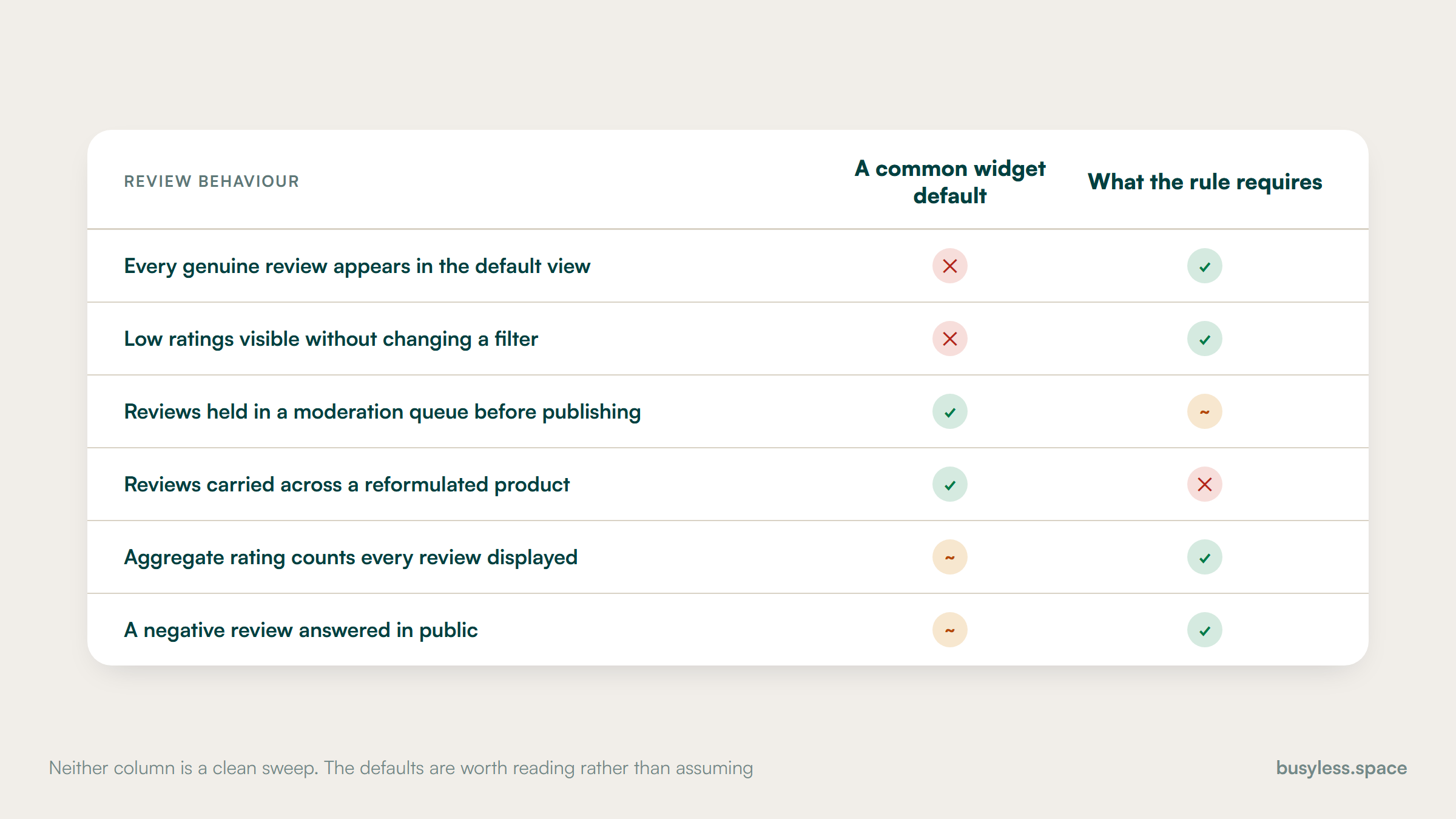
You may not show only the good reviews, or move them between products
FTC Rule on the Use of Consumer Reviews and Testimonials, 16 CFR Part 465, sections 465.7 and 465.9, effective 21 October 2024
Suppressing or selectively displaying reviews so the overall sentiment looks better than it is, including through unfounded legal threats or intimidation to get one removed, is prohibited. So is review hijacking, which is repurposing reviews from one product to make a different one look better. The insider-review provision at 465.5 is covered on the small-businesses playbook.
So do thisTurn off any filter that hides low ratings by default, and check what your review platform does out of the box. Before merging listings or carrying reviews across a reformulation, confirm the reviews describe the item a shopper is being shown.
A marketing text needs written consent, and the rules moved
TCPA prior express written consent; Insurance Marketing Coalition v. FCC, 11th Cir., 24 January 2025
Marketing text messages require prior express written consent from the recipient. The FCC's one-to-one consent rule, which would have required seller-by-seller consent and a topical relationship to the interaction that prompted it, was vacated by the Eleventh Circuit before it took effect and the FCC has since removed the language. The underlying written-consent requirement is unchanged and bundled consent remains permissible.
So do thisKeep the consent record, the timestamp and the exact wording shown at sign-up, because the record is what defends you rather than the intent. Do not rebuild your flows around a rule that no longer exists, and do not assume the area has stopped moving. Our real estate playbook covers the separate Do Not Call side of the same statute, which governs cold outreach rather than consent.
An article can turn your product into a drug
FDA structure-function and disease claim principles, reviewed 2026-08-30
For supplements, cosmetics and food, a claim that a product treats, prevents or cures a condition is a disease claim, and making one for a product not approved as a drug puts it outside its regulatory category. This is regularly triggered by editorial content rather than by the label: a blog post, a founder's caption or a customer story quoted approvingly can each do it.
So do thisApply the same claim review to editorial and social copy that you apply to packaging, and be specific about what a customer testimonial is allowed to say when you republish it. The claim is yours once you publish it.
None of this is legal advice. Rules vary by state and by contract, and the dates above are when each source was read. Check your own before you rely on any of it.
How to build content marketing for ecommerce
The post-purchase half is built first, across six months, and that inversion is the whole plan: everybody already knows how to make acquisition content, and almost nobody has anything running between the confirmation email and the second order.
Find out what happens after the first order
- Map every message a customer receives after buying, and count them
- Read a hundred consecutive return reasons in the free-text field
- Find out when returns actually cluster, in days after delivery
- Audit the review widget settings
Output An honest map of the post-purchase gap and a returns finding
Build the half that was missing
- Film the how-to-use video for your highest-return product
- Build a post-purchase sequence that lands before the returns cluster
- Write the care and repair page for your two main products
- Name somebody as the owner of everything after the first order
Output A finished post-purchase sequence and a named owner for it
Fix the claims before you scale them
- Replace every general environmental claim with the specific one behind it
- Collect the substantiation for each and store it with the copy
- Review editorial and social copy for disease claims, not just packaging
- Audit the review display and switch off any default filtering
Output A claim register, and a review display that is not quietly suppressing
Point acquisition at the owned channel
- Add an owned-channel ask to the acquisition content that has none
- Publish the five pages answering pre-purchase questions
- Publish one aggregated finding from your returns data
- Report repeat purchase rate alongside cost of acquisition, in the same table
Output Enough evidence to say whether the owned half moved
Structured data for what you publish
Products, offers, collections and the store itself are marked up on the sibling playbook, which is where the commerce entities belong. These six describe the media and the editorial you publish around them, and one of them carries a compliance point rather than only a formatting one.
VideoObject for a how-to-use film
The page it sits on, and the post-purchase email that links to itThe asset this page argues is most underfunded. Describe what somebody can do afterwards rather than what the product is, because the search demand and the retention value both attach to the task rather than to the item.
{
  "@context": "https://schema.org",
  "@type": "VideoObject",
  "name": "[THE TASK, e.g. How to season a new pan]",
  "description": "[WHAT SOMEBODY CAN DO AFTERWARDS]",
  "thumbnailUrl": "https://[YOUR-DOMAIN]/images/[FILE].jpg",
  "uploadDate": "[YYYY-MM-DD]",
  "duration": "PT[M]M[S]S",
  "contentUrl": "https://[YOUR-DOMAIN]/video/[FILE].mp4",
  "embedUrl": "https://[YOUR-DOMAIN]/[PAGE-SLUG]",
  "publisher": {
    "@type": "Organization",
    "name": "[BRAND NAME]",
    "url": "https://[YOUR-DOMAIN]"
  }
}
ImageGallery for customer photography
A gallery page collecting what customers sent youEvery item needs a permission trail, and the licence field is where you record that you have one. Customer photography is the most commonly republished thing in this industry and the most commonly republished without asking. Our hotels playbook covers the other half of this, which is the right held by an identifiable person in the frame.
{
  "@context": "https://schema.org",
  "@type": "ImageGallery",
  "name": "[GALLERY TITLE]",
  "url": "https://[YOUR-DOMAIN]/[GALLERY-SLUG]",
  "description": "[WHOSE PHOTOGRAPHS AND WHAT THEY SHOW]",
  "image": [
    {
      "@type": "ImageObject",
      "contentUrl": "https://[YOUR-DOMAIN]/images/[FILE].jpg",
      "caption": "[WHAT IT SHOWS]",
      "creditText": "[CUSTOMER NAME OR HANDLE, AS AGREED]",
      "copyrightNotice": "(c) [YEAR] [PHOTOGRAPHER]",
      "license": "[URL OF YOUR UGC PERMISSION TERMS]",
      "acquireLicensePage": "https://[YOUR-DOMAIN]/photo-permissions"
    }
  ]
}
Article for a buying or care guide
Editorial pages that are not product pagesKeep it clearly separate from the commerce markup, because a guide marked up as a product page is a mismatch and a product page marked up as an article loses its offer data. The two should not be blended even when they sit on the same template.
{
  "@context": "https://schema.org",
  "@type": "Article",
  "headline": "[GUIDE TITLE]",
  "url": "https://[YOUR-DOMAIN]/guides/[SLUG]",
  "description": "[WHAT A READER CAN DECIDE AFTERWARDS]",
  "datePublished": "[YYYY-MM-DD]",
  "dateModified": "[YYYY-MM-DD]",
  "author": {
    "@type": "Person",
    "name": "[WHO WROTE IT]"
  },
  "publisher": {
    "@type": "Organization",
    "name": "[BRAND NAME]",
    "url": "https://[YOUR-DOMAIN]"
  },
  "about": "[THE CATEGORY, NOT THE BRAND]"
}
Review, and the rule attached to it
Product pages displaying genuine customer reviewsThis block carries a compliance point rather than a formatting one. If you emit an aggregate rating it has to reflect every review you display, so a widget filtering out the low ratings breaks the markup and the rule at the same time. Fix the display before you fix the schema.
{
  "@context": "https://schema.org",
  "@type": "Review",
  "itemReviewed": {
    "@type": "Product",
    "name": "[PRODUCT NAME]",
    "sku": "[SKU]"
  },
  "author": {
    "@type": "Person",
    "name": "[REVIEWER NAME AS DISPLAYED]"
  },
  "datePublished": "[YYYY-MM-DD]",
  "reviewRating": {
    "@type": "Rating",
    "ratingValue": "[THE ACTUAL RATING GIVEN]",
    "bestRating": "5",
    "worstRating": "1"
  },
  "reviewBody": "[THE REVIEW, UNEDITED]"
}
Event for a drop, pop-up or live session
Any page announcing something time-bound: a drop, a pop-up, a live sessionUseful for drops and pop-ups, which are among the few genuinely dated things a DTC brand publishes. Set the end date honestly, because an event that never ends reads as a permanent sale and is treated as one.
{
  "@context": "https://schema.org",
  "@type": "Event",
  "name": "[DROP, POP-UP OR SESSION NAME]",
  "description": "[WHAT HAPPENS AND WHO IT IS FOR]",
  "startDate": "[YYYY-MM-DDTHH:MM+00:00]",
  "endDate": "[YYYY-MM-DDTHH:MM+00:00]",
  "eventAttendanceMode": "https://schema.org/[Offline|Online]EventAttendanceMode",
  "eventStatus": "https://schema.org/EventScheduled",
  "location": {
    "@type": "[Place|VirtualLocation]",
    "name": "[VENUE OR URL]",
    "address": "[FULL ADDRESS IF PHYSICAL]"
  },
  "organizer": {
    "@type": "Organization",
    "name": "[BRAND NAME]",
    "url": "https://[YOUR-DOMAIN]"
  }
}
PodcastEpisode for a brand or category series
A single episode of a brand or category seriesWorks in categories where the product sits inside a practice people care about and badly everywhere else. Mark up episodes you publish rather than appearances you make, and be honest about whether anybody is listening before committing to a format this expensive.
{
  "@context": "https://schema.org",
  "@type": "PodcastEpisode",
  "name": "[EPISODE TITLE]",
  "description": "[ONE OR TWO SENTENCES]",
  "url": "https://[YOUR-DOMAIN]/podcast/[SLUG]",
  "datePublished": "[YYYY-MM-DD]",
  "duration": "PT[M]M[S]S",
  "partOfSeries": {
    "@type": "PodcastSeries",
    "name": "[SERIES NAME]",
    "url": "https://[YOUR-DOMAIN]/podcast"
  },
  "associatedMedia": {
    "@type": "MediaObject",
    "contentUrl": "https://[YOUR-DOMAIN]/audio/[FILE].mp3"
  }
}
What to automate, and where the line is
Automation earns its place here on volume: thousands of returns, questions and reviews arriving continuously, none of which a small team can read. The line sits at the claim and at the review, both of which are regulated surfaces.
- automate
Clustering return and cancellation reasons into themes
The highest-value automation on this page. A hundred free-text reasons a week is more than anybody reads, and the themes are the content plan.
- automate
Sorting pre-purchase questions by topic and product
Mechanical, and it turns a support inbox into a ranked list of things the product pages fail to answer.
- automate
Generating product feed and variant copy from structured attributes
Formulaic by nature and enormous by volume. Keep any environmental or health claim out of the template, because a claim replicated across ten thousand variants is ten thousand claims.
- assist
Drafting the how-to-use script from a maker interview
Good structure, and it misses the detail that stops the return. That detail is usually a physical thing the maker demonstrated rather than said.
- assist
Producing short cuts for the rented channels
The acquisition side is high-volume and disposable, which is exactly where assistance pays. A person still picks which moments were interesting.
- assist
Translating and localising product and editorial copy
Fast and mostly reliable, and a claim that is legal in one market may not be in another, so a person who knows the market signs it off.
- never
Writing or editing anything that is a customer review
Generating a review that misrepresents a real experience is prohibited outright, and so is a review from someone who does not exist. This is not a grey area and the penalties are per violation.
- never
Making an environmental, material or health claim
These are regulated statements that need substantiation held by a person. A model will produce a confident general claim, which is precisely the form the Green Guides say to avoid.
What it costs
Ranges rather than quotes, and each one assumes the brand supplies the customer service and founder time the engine section describes. What moves the number most is the number of products in range, because each one carries its own questions, its own returns pattern and its own claims.
Do it yourself
$0 to $500- Reading the returns and cancellation reasons properly
- A post-purchase sequence written once and left alone
- One how-to-use video filmed on a phone
- A weekly email that is worth opening
- Suits
- A founder-run brand with one product line and no team
- Ceiling
- The claims work is where this breaks. Substantiating an environmental claim properly takes time that a founder running operations does not have, and the honest alternative is making fewer claims.
Lean
$3,000 to $7,000- Someone who owns everything after the first order
- Proper video for the products that drive returns
- The pre-purchase question pages written from real questions
- A claim register with the substantiation attached
- Suits
- A brand past product-market fit with a small in-house team
- Ceiling
- It covers one range properly. A second range does not share its questions, its returns pattern or its claims, so it roughly doubles the work rather than adding to it.
Funded
$7,000 to $20,000- Content separated from campaign work rather than competing with it
- A continuous video programme across the range
- One published finding a year from your own aggregated data
- Search worked properly on the surrounding questions
- Suits
- A multi-product brand where repeat purchase is the growth story
- Ceiling
- The constraint becomes the range itself. Beyond a certain number of products, per-product content stops being possible and the honest move is to prioritise by returns rather than by revenue.
Enterprise
$20,000 and up- Several ranges and markets under one editorial and claims standard
- Localised content maintained rather than translated once
- Community resourced properly where the category supports it
- Retention content treated as a margin programme with its own targets
- Suits
- Brands where retention economics are already the board conversation
- Ceiling
- Claims governance across markets becomes the real cost, and the failure mode is a central standard so cautious that the brand stops saying anything specific at all.
How to do it with no budget
All seven run on data the business already collects and mostly ignores. The first three cost nothing and produce more than a quarter of new content usually does. The content marketing tips for ecommerce below need no budget approval.
- 1
Read a hundred consecutive return reasons
Your returns system, free-text field · 2 hours
The free-text field, not the dropdown summary. The dropdown hides the finding and the free text is the finding.
- 2
Count how many messages a customer gets after buying
Your own inbox, by ordering from yourself · 1 hour, plus the delivery time
Order your own product and count. Most brands are surprised, and the number is usually two.
- 3
Find out when returns actually cluster
Your returns data · 1 hour
Days after delivery, not after purchase. Any content meant to prevent returns has to land before that point.
- 4
Check what your review widget hides by default
The widget settings · 30 minutes
Several popular tools filter or reorder out of the box. Suppression is prohibited whether or not you chose the setting.
- 5
Replace one general environmental claim with a specific one
Your product copy · 1 hour
Name the attribute and the part of the product it applies to. It is better writing as well as a safer claim.
- 6
Film one how-to-use video on a phone
A phone and daylight · 2 hours
For the product with the highest return rate. Production value matters far less here than the detail that prevents the return.
- 7
Ask one open question at cancellation
Your subscription flow · 30 minutes
Do not gate the exit behind it. An honest answer is worth more than a save you extracted.
The tool stack
Split between the rented half and the owned half, the way the rest of this page is. Rows linking into our other directories go to the researched review rather than to the vendor.
Run the owned channel that carries retention
Choose on what it stores about consent and when, because that record is what defends a marketing text rather than your intent at sign-up.
Free option: Free at early volumes, and the consent record matters more than the features
Publish editorial that is not fighting the product template
Guides and care pages need a different template from product pages, and most storefronts make that harder than it should be.
Free option: Your storefront's own blog, which works to about thirty pages
See what people ask before buying in your category
Worth pairing with the support export rather than using alone. The inbox has the questions; this tells you how many other people have them.
Free option: Your own support inbox, which is better and free
Check whether assistants recommend your category honestly
Answers here lean heavily on review aggregators and marketplaces, which is worth knowing before assuming your own pages are the thing being read.
Free option: Try one buying question on each assistant monthly and note who gets named
Model what one point of repeat purchase rate is worth
Run it before deciding the post-purchase sequence is not worth building. The number is usually larger than a comparable improvement in acquisition cost.
Free option: Free
Compare the owned channel against the rented one honestly
Put the two in the same table. Most brands have never seen the cost of an owned-channel order next to the cost of a rented-channel one.
Free option: Free
Sanity-check what the rented half is actually returning
Useful mainly to establish that the acquisition half is being measured on a different basis from the retention half, which it usually is.
Free option: Free
Keep the claim register with its substantiation
One row per claim: the wording, where it appears, the evidence, who approved it, when it was last checked. This is the artefact that makes a claim defensible.
Free option: Free, and a spreadsheet genuinely beats software here
Take it from here
Everything below is meant to be copied and filled in. Bodies are plain text, so what you see is exactly what lands on your clipboard.
Order from yourself, count what arrives, and find out where the margin is leaking.
POST-PURCHASE GAP AUDIT
Brand: [BRAND NAME]
Run by: [NAME]      Date ordered: [YYYY-MM-DD]
Product ordered: [THE ONE WITH THE HIGHEST RETURN RATE]

HOW TO RUN THIS
Order your own product, as a customer, on a personal email
address. Do not use a test account. Log everything that
arrives until 30 days after delivery.

WHAT ARRIVED, IN ORDER
Day | What arrived | Channel | Was it useful to a customer?
[0] | Order confirmation | [EMAIL] | [Y/N]
[ ] | [ ] | [ ] | [ ]
[ ] | [ ] | [ ] | [ ]

     Total messages before delivery:   [N]
     Total messages after delivery:    [N]
     Of those, purely transactional:   [N]
     Of those, actually useful:        [N]

     [THE LAST NUMBER IS USUALLY 0 OR 1. THAT IS THE FINDING.]

COMPARE AGAINST ACQUISITION
Messages a NON-customer receives after signing up: [N]
Messages a CUSTOMER receives after paying:         [N]

     [IF THE FIRST IS LARGER THAN THE SECOND, THE BUDGET IS
      ALLOCATED BACKWARDS. IT USUALLY IS.]

THE THREE MOMENTS NOBODY COVERS
[ ] Delivery day. What do they need to know in the first
    hour? Currently sent: [ ]
[ ] The first week of use. What goes wrong?
    Currently sent: [ ]
[ ] Just before the returns window closes.
    Currently sent: [ ]

WHEN DO RETURNS ACTUALLY CLUSTER
Days after DELIVERY (not purchase): [N]
Source: [RETURNS DATA]
[ ] Is anything sent before day [N]?    [Y/N]

     Content meant to prevent a return has to arrive before
     this point. Most brands send their first useful message
     after it.

THE FIX, IN ORDER
1. [ ] Name an owner for everything after the first order
2. [ ] Build a message for delivery day
3. [ ] Build a message for day [N MINUS 3]
4. [ ] Put the how-to-use video in both

Owner named: [NAME] Date: [YYYY-MM-DD]The expensive mistakes
Spending the content budget entirely before the first order
What it costs: The half with the worst economics gets all the effort, and the margin never arrives
Build the post-purchase sequence first and name somebody who owns everything after the first order. It is usually the cheapest available improvement to contribution margin.
Treating a rented channel as though you own it
What it costs: A cost of acquisition set by somebody else's auction, with no list to fall back on
Point acquisition content at an owned-channel opt-in, and measure what proportion of it asks for one. For most brands the honest answer is almost none.
Writing sustainability copy as a story rather than as a claim
What it costs: General environmental claims that cannot be substantiated, replicated across a whole catalogue
Name the specific attribute and the part of the product it applies to, and keep the evidence with the copy. Naming the thing is stronger copy than gesturing at it.
Letting the review widget filter by default
What it costs: Suppression, which is prohibited whether or not the setting was chosen deliberately
Check what it hides, switch it off, and answer the low ratings publicly instead. The negative review text is also your best content brief.
Carrying reviews across a reformulation or a merged listing
What it costs: Review hijacking, which is a separate prohibited practice and easy to do by accident
Test each review against the item a shopper is being shown. Where it does not describe that item, it does not travel with the listing.
Reading the returns dropdown instead of the free text
What it costs: A chart saying wrong size, and no idea why, on the best data in the business
Read a hundred consecutive free-text reasons. It takes two hours and it will change what you film next.
What to measure
Measuring ecommerce content marketing usually means measuring the acquisition half accurately and the retention half not at all, which is the wrong way round given where the margin sits. What follows reports the two separately and puts them in one table, and it is honest that the second is harder to attribute and worth more.
Leading indicators
Owned-channel opt-in rate from content
Your email and SMS platform, by source
The bridge between the rented half and the owned half, and the number that says whether acquisition content is building anything durable.
Post-purchase sequence engagement
Your lifecycle tool
Open and click rates here are far higher than anything else you send, which is worth knowing before deciding this sequence is not worth building well.
How-to-use video completion, by product
Your player
Watch it against the products with the highest return rates rather than the highest revenue, because that is where the content is meant to be working.
Pre-purchase questions received, by topic
Support and live chat
A falling count on a topic you covered is the cleanest content-attributable result available in this industry.
Business indicators
Return rate on products with how-to content
Your returns data
A margin number that content genuinely moves, and one that almost never appears in a content report. Compare against products without it.
Repeat purchase rate
Your commerce platform
The number this whole page exists to move. Report it in the same table as cost of acquisition rather than in a different deck.
Revenue from the owned channel, against its cost
Your platform and your tooling costs
Put the cost of an owned-channel order beside the cost of a rented-channel one. Most brands have never seen the two side by side.
Contribution margin per customer over twelve months
Finance, not marketing
The honest destination for all of this, and the number where retention content and returns reduction both show up. It is also the slowest to move.
The verdict
Content marketing for ecommerce is usually a well-executed answer to the wrong half of the question. Acquisition is contested, rented and expensive, and it receives almost all of the effort. Retention is owned, cheap to reach and worth more, and for most brands it consists of a shipping notification and a discount code. A content marketing strategy for ecommerce starts there.
The reallocation is not difficult and it is unpopular, because the acquisition half is where the visible activity is. Building the sequence that runs between the confirmation email and the second order is usually the cheapest available improvement to contribution margin, and it takes about six weeks. Most content marketing strategies for brands never get to it.
I would be wary of buying ecommerce content marketing services from anybody whose proposal is entirely pre-purchase, or who has not asked what your return rate is. Both suggest they are planning to be measured on traffic rather than on the numbers that decide whether the business works. That is what content marketing strategies for ecommerce usually miss.
The honest summary is that content marketing services for ecommerce are worth buying when somebody owns everything after the first order and when the claims in your brand story have evidence behind them. Those two are unglamorous, and they are where the money and the exposure both sit.
FAQ
Ecommerce content marketing questions
Where should we actually spend the content budget?
More of it after the first order than you currently do. Acquisition happens on rented channels whose price you do not set, and retention happens on owned ones that cost almost nothing to reach. Building the post-purchase sequence is usually the cheapest available improvement to contribution margin, and most brands have nothing there at all.Can we say our products are sustainable?
Not as a general claim. The Green Guides treat broad environmental benefit claims as very difficult to substantiate and expect them to be qualified to the specific attribute. Name the specific thing, say which part of the product it applies to, and keep the evidence with the copy. The specific version is also better writing.Are we allowed to hide our one-star reviews?
No. Suppressing or selectively displaying reviews so the overall sentiment looks better than it is is prohibited, including through legal threats to have one removed. Check what your review widget does by default, because several filter out of the box, and the prohibition does not depend on you having chosen the setting.Can we keep reviews when we reformulate a product?
Usually not. Review hijacking, which is repurposing reviews from one product to make a different one look better, is a separate prohibited practice, and merging listings or carrying reviews across a reformulation is the common accidental route into it. Ask whether each review was about the product a shopper is now looking at.What is the best research we can do?
Read a hundred consecutive return reasons in the free-text field, not the dropdown summary. Somebody paid, waited, opened the box and wrote down why they changed their mind. It is the most honest data in the business, it is free, and it usually goes only to operations.Should we build a community?
Only if your customers already talk to each other about the category without you. Where the product is part of a practice, communities work extremely well. Where it is a purchase people do not want to discuss, an empty community costs a year and signals the opposite of what you intended.How are content marketing services for DTC brands priced?
By scope rather than by article count, and the number moves with the size of the range because each product carries its own questions, returns pattern and claims. An engagement starts with a Discovery and then a monthly retainer, and the realistic range for doing this properly is $3,000 to $20,000 a month.What proves the retention content is working?
Return rate on products with how-to content against those without, repeat purchase rate, and revenue from the owned channel against its cost. Put those in the same table as cost of acquisition rather than in a separate report, because the comparison is the finding and separating them is how the retention half stays underfunded.Should this sit with the acquisition team?
No, and that is the whole argument. Content marketing for brands is usually staffed out of paid social, which is why it produces campaign assets and no retention. Content marketing for retailers with a physical estate has the same split, with the shop floor holding material nobody has written down.
Run it yourself, or have someone own it
Everything above is written to be run without us, and the free path is genuinely most of the value for a small practice. Where these plans stall is almost never the plan. It is that the person holding the material has a day job and nobody owns the programme after the first month. That is the job we do.