
Skip to content

Home services SEO strategy

Regulated marketing

One brand, several trades, and each trade ranks on its own

Written by Eugene SuslovLast reviewed 29 August 2026No affiliate links
Sector
Home and trades
Model
Local service, Multi-location
Competition
Brutal
Time to results
6 to 12 months
Typical monthly
$3,000 to $12,000

Key takeaways

  1. 1You are not in one market. You are in four, they share a domain, and each is already held by somebody whose entire name says they do that one thing.
  2. 2Your licences do not belong to the brand. They belong to entities, through qualifying individuals, and the page almost nobody writes is the one saying which entity performs which work in which state.
  3. 3The membership plan is the real product of a consolidated home services business, and it is an automatically renewing subscription. Since July 2025 there is no federal rule governing it, only fifty state ones.
  4. 4The brand you acquired is still being searched by its old name, and will be for years. Redirecting it to your home page throws away the only asset the acquisition actually bought you.
  5. 5One brand cannot be the best plumber and the best electrician on the same domain by asserting it. It can be both by having a genuinely separate page set, team and proof for each.

SEO for home service businesses is a different problem from SEO for any one of the trades inside them, and the difference is not scale. A multi-trade operator is competing in several separate results pages at once, under a single name.

Each of those results pages is already held by a company whose entire identity is that one trade. Their domain says it, their reviews say it, their photographs say it, and a homeowner searching for an emergency plumber reads all three in about a second.

So a home services SEO strategy is mostly an argument about structure. One domain has to carry four credible specialists, and the way it fails is by carrying one generic company that lists four things it can do.

Underneath that sits a licensing structure most marketing plans never look at. A trade licence attaches to a legal entity through a qualifying individual, so a brand offering four trades is frequently several entities, and the website is one voice.

There is a commercial fact behind all of this too. The consolidated home services business is not really selling jobs, it is selling a membership plan, and that plan is an automatically renewing subscription with its own rules.

And there is usually history. If the group grew by acquisition, several older brands are still being searched by name, and what happened to those domains is one of the largest recoverable assets available here.

Who already ranks in home services (multi-trade)

Run the emergency query for each of your trades and look at who holds the top three, then notice what all of them have in common. Almost every home services SEO plan underestimates this: the winners are named after the one thing they do, and your brand deliberately is not.

What is on the results page

  • A local pack per trade, with a different set of three in each one
  • Single-trade specialists holding the emergency and near-me results
  • Lead marketplaces above every operator on the generic terms
  • A heavy paid block on emergency queries in every trade
  • A People Also Ask block asking what it costs and whether it can wait until Monday
  • Manufacturer and dealer locators on equipment-specific searches
  • Review aggregators on best-in-town queries, per trade
  • Almost nothing on the questions that cross two trades at once
  • The single-trade specialist

    the company named after one thing

    Listed first because it is the gatekeeper this page exists to argue with. A homeowner with a burst pipe reads a name, and a company called after plumbing wins that read before anybody clicks. You will not beat that with a brand name; you beat it with a page set, a team and a body of proof that is genuinely only about plumbing.

  • Google Business Profile

    google.comClaim it

    The hardest configuration decision in this playbook lives here. One profile per legal entity per staffed location, and categories that actually reflect what that entity does. Multiple profiles at one address for different trades is a common growth hack and a common suspension, and it is worth taking advice before doing it rather than after.

  • Lead marketplaces

    angi.comClaim it

    They rank above every operator on the generic terms in every trade you offer, so a multi-trade business is exposed to them four times over. Measure on cost per won job per trade rather than in total, because the economics differ enormously between an emergency call-out and a replacement quote.

  • Manufacturer and dealer locators

    the equipment brands you installClaim it

    Ranked by designation, free, and reached by a homeowner who has already settled on the equipment and now wants somebody approved to fit it. Multi-trade operators hold designations across several manufacturers and complete almost none of the listings, which is an hour per brand and among the best-converting citations available.

  • Review aggregators

    yelp.comClaim it

    They rank per trade, and a multi-trade business usually has one profile carrying reviews about four different things. Worth thinking about deliberately: a homeowner reading about your electrical work while deciding on a boiler is a weaker signal than a specialist's page of reviews about boilers.

  • The brands you acquired

    the old company namesClaim it

    A gatekeeper in reverse. Customers keep searching the old name for years, and the standard post-acquisition move, redirecting the whole domain to a new home page, throws away the reviews, the citations and the local recognition that were most of what was bought.

  • Nextdoor and neighbourhood groups

    nextdoor.comClaim it

    Where a homeowner asks who to use, and a consolidated brand does worse here than a local one because the answers are personal. The counter is to be present as named people rather than as a company, which is a hiring and culture decision as much as a marketing one.

  • Utility and programme contractor lists

    the utility and state programme registriesClaim it

    Rebate programmes, weatherisation schemes and utility approved-contractor lists rank and convert, because a homeowner sent there by a rebate has already decided to spend. Multi-trade operators usually qualify for more of these than single-trade rivals and register for fewer.

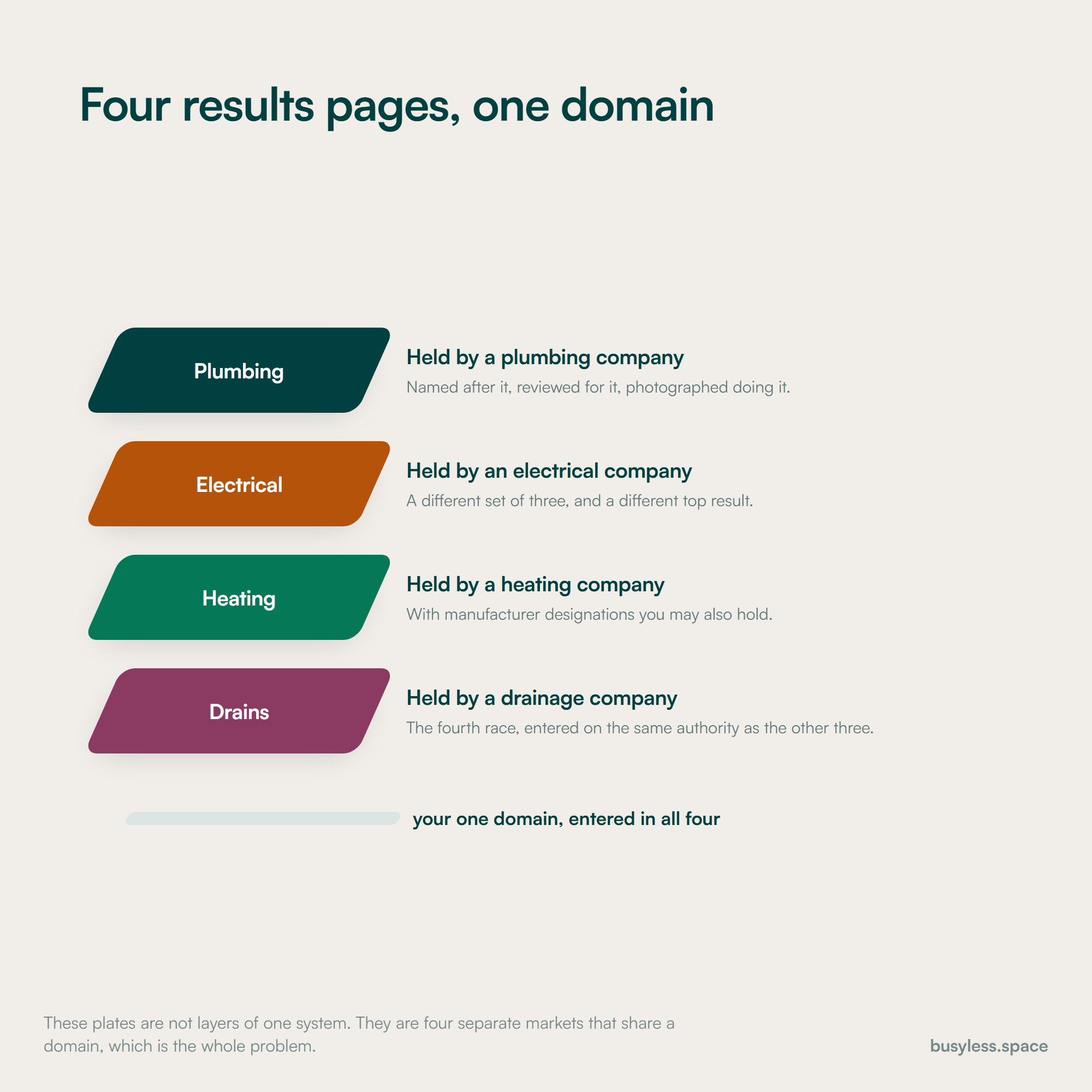
Four plates stacked like layers of one system, labelled plumbing, electrical, heating and drains, each held by a company named after that single trade, above a thin bar marked as the one domain entered in all four races.
The same domain is competing in all four, and a different specialist is already at the top of each.

What people actually search

Sort these by trade first and by intent second, because the same intent behaves differently in each of your trades. The only cluster that genuinely belongs to the group rather than to a trade is the last one.

Emergency, per trade

Local, immediate

emergency [trade] near me

The page that wins it: A page per trade with hours, response time and a real number

Four separate races, each against a specialist. The searcher reads a name before anything else, which is why the trade page has to look like a trade rather than like a division.

Replacement and quote

Commercial investigation

cost to replace [system]

The page that wins it: A page per system with real bands and what moves them

Higher value, slower, and the cluster where a multi-trade operator can genuinely out-answer a specialist, because you have seen how the systems interact in the same house.

The cross-trade question

Informational, close to booking

do I need an electrician or a plumber for [thing]

The page that wins it: A page that answers it honestly and books whichever is right

The only cluster that is genuinely yours. A single-trade company cannot write it without arguing against its own interest, and a homeowner who cannot tell which trade they need is a homeowner nobody is serving.

Membership and maintenance plan

Commercial, recurring

[trade] maintenance plan cost

The page that wins it: A plan page with the renewal and cancellation terms visible

The actual product of a consolidated operator, and the one page that has to work across every trade at once. It is also the most regulated page on the site.

The old brand name

Navigational

[acquired company name]

The page that wins it: A page that acknowledges the change and keeps the history

Free, high intent, and usually thrown away in the first week after an acquisition. People search the name on the van they remember, for years.

Equipment and manufacturer

Commercial, decided

[brand] [system] installer near me

The page that wins it: A page per designation, plus the locator listing completed

The homeowner has chosen the equipment and is looking for somebody approved to fit it. Multi-trade operators hold more of these designations than they use.

Rebates and programmes

Commercial, deadline-driven

[state] rebate for [system]

The page that wins it: A page per programme, dated, with the eligibility written out

Deadline attached, and it goes stale, which is why almost nobody maintains it. A dated page that is actually current is a strong signal in a category full of expired offers.

Hiring

Navigational and transactional

[trade] jobs [town]

The page that wins it: A real job page per trade, with pay and progression

In a multi-trade group the constraint is nearly always licensed technicians rather than demand, which makes this the cluster with the highest claim on the budget and the lowest share of it.

What the rules change

Different from the single-trade playbooks in this directory on purpose. Everything below is a consequence of running several trades under one name; the licence-number-in-advertising rule is covered on the plumbing, roofing and electricians pages and is not restated here. Take advice on your own structure; none of this is legal advice.

1

The licence belongs to an entity, through a person, not to your brand

State contractor licensing statutes, which license a legal entity through a qualifying individual and generally limit how many entities one person may qualify

What it means

A brand offering four trades is frequently several licensed entities, each qualified by a different individual, trading under one customer-facing name. The website presents one company. A homeowner, a licensing board or a competitor checking the register finds several, and cannot tell which of them is doing their work.

So do this

Publish the structure. A short page naming each licensed entity, its number, the trades it covers, the states it covers and the fact that they trade together under one brand. It is the least glamorous page on the site and it is the one that survives a check.

2

You may only advertise the trades the entity behind that page is licensed for

The same statutes, which prohibit soliciting work requiring a licence the advertiser does not hold

What it means

The failure here is by TRADE rather than by geography, which is what makes it different from advertising in a state you are not licensed in. A single services page listing everything you can arrange, published by one entity, is advertising work that entity may not perform even though the group can.

So do this

Build the page set from the licence map: trades down one axis, entities and states across the other. Only publish a trade page where the entity behind it holds that licence, and where a trade is delivered by a subcontractor or a sister entity, say so on the page rather than leaving it to be assumed.

3

The membership plan is an automatically renewing subscription

State automatic renewal statutes, which are now the whole of the regime: the Eighth Circuit vacated the FTC negative option rule on 8 July 2025, and California's amendments under AB 2863 took effect on 1 July 2025

What it means

A maintenance plan billed monthly or annually is a negative option. The state statutes require three things: the renewal terms disclosed clearly before consent, the consent taken as a separate affirmative step, and cancellation available in the medium the customer signed up in. There is no longer a federal floor to build to.

So do this

Put the renewal frequency, the renewal price and the cancellation route on the plan page in the page's own HTML, make the consent its own step rather than part of the service agreement, and build to the strictest state you operate in. Then have somebody sign up and cancel on a phone and time both.

4

One profile per licensed entity per staffed location

The Google Business Profile representation guidelines, which require a permanent location with staff present during stated hours

What it means

A multi-trade group at one address is a hard case. Separate profiles per trade at a single site are a common growth tactic and a common suspension, and separate profiles per entity are legitimate only where each is genuinely a distinct business with staff. Competitors report this, and reinstatement takes weeks.

So do this

Decide it deliberately and write down the reasoning. Where the trades genuinely run as separate businesses with their own staff and phone numbers, separate profiles are defensible. Where they do not, one profile with several categories is the honest answer and the categories do more work than most people expect.

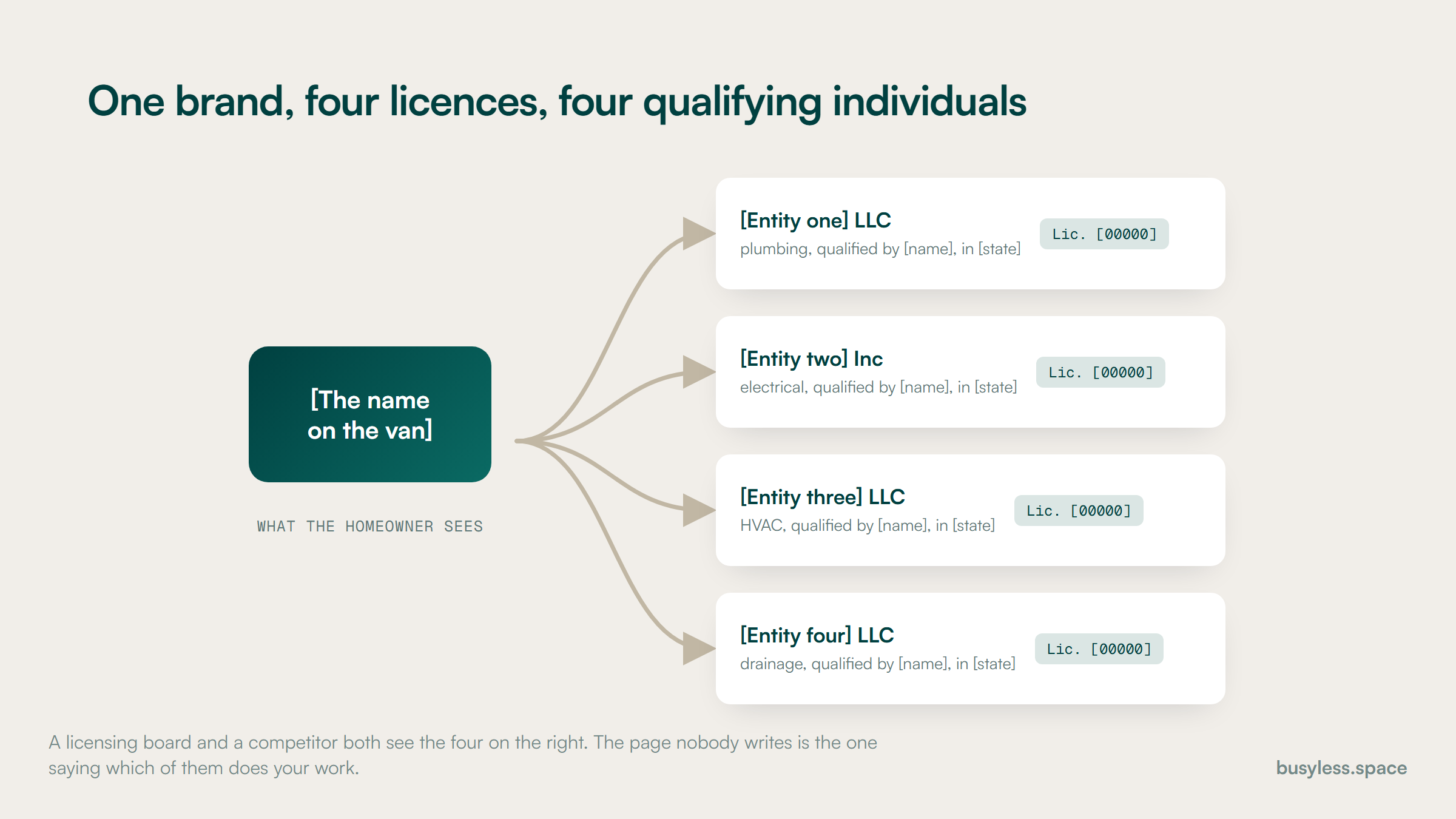
One customer-facing brand branching to four licensed entities, each with its own number, its own qualifying individual and its own set of trades and states.
The homeowner sees the box on the left. A licensing board and a competitor both see the four on the right.

Proving expertise

The homeowner is deciding whether a generalist can be trusted with a specialist job, in their house, today. Every signal that works here is per trade rather than per brand.

  • Each licensed entity named, with its number and the trades it covers
  • Which entity performs which work, stated plainly
  • Technicians named per trade, with their own certifications
  • How many technicians you actually have in each trade
  • Reviews shown per trade rather than pooled across all of them
  • Photographs of work in that trade, on the trade's own pages
  • Manufacturer designations, with the partner identifier
  • Response times per trade, and what happens out of hours
  • The membership plan terms, including how to leave it

How to build a home services SEO strategy

Nine months, and the first month is structure rather than content. A home services SEO strategy that starts by writing service pages, before anybody has established which entity may advertise which trade, produces pages that have to come down.

  1. 1

    Weeks 1 to 4

    Map the structure you actually have

    • List every licensed entity, its number, its qualifier, its trades and its states
    • Cross trades against entities into the set of pages that may exist
    • Audit the current site against that map and remove what fails it
    • Publish the structure page naming the entities and what each covers
    • Decide the profile question deliberately and write down the reasoning
    • Find every acquired brand name and check what its domain does today

    You end up with
    A page plan bounded by what each entity may lawfully advertise

  2. 2

    Weeks 4 to 14

    Build four specialists, not one generalist

    • Give each trade its own section, not a page in a list
    • Name the technicians who work in each trade, on that trade's pages
    • Publish reviews per trade rather than pooled
    • Publish real price bands per trade with what moves them
    • Write the emergency page per trade with a real response time
    • Complete every manufacturer locator listing you qualify for

    You end up with
    Four page sets that each read as a specialist rather than a division

  3. 3

    Weeks 12 to 26

    Take the ground only a multi-trade operator has

    • Write the cross-trade pages that a specialist cannot write honestly
    • Build the membership plan page with the terms and consent handled properly
    • Recover the acquired brands: pages that acknowledge the change and keep the history
    • Write a page per rebate or utility programme, dated and current
    • Build recruitment pages per trade, with pay and progression
    • Add the structured data for the group, the entities and the plan

    You end up with
    The pages a single-trade competitor structurally cannot publish

  4. 4

    Weeks 22 to 36

    Measure per trade, and measure the plan

    • Report every leading and business indicator split by trade
    • Track plan members added, and plan members lost, separately
    • Track revenue per member against revenue per one-off job
    • Track technicians available per trade beside demand per trade
    • Review marketplace spend per trade rather than in total
    • Re-run the licence map after any acquisition or qualifier change

    You end up with
    Four reports rather than one average, and a plan number the board can use

Technical fixes with the best payoff

The characteristic failure is architectural. A multi-trade business builds one website about a company, when what it needs is four page sets that each behave like a specialist and share a domain.

  • The trades are a list on a services page

    A quarter

    Plumbing, electrical, heating and drains as four cards on one page, each linking to four hundred words. Each of those is competing against a company whose entire site is about that one trade, with a domain, a name and a hundred reviews that all say so.

    A section per trade with its own hub, its own service pages, its own team, its own reviews and its own photographs. The test is whether the plumbing section would look like a plumbing company if you removed the navigation.

  • Reviews are pooled across every trade

    A sprint

    A homeowner deciding on an electrical rewire is reading about your drain cleaning, because the review widget shows everything. It dilutes the specific proof exactly where the specialist competitor is strongest.

    Tag reviews by trade at the point of collection and show each trade its own. Where the platform will not allow it, at least quote the relevant ones on the relevant pages, which is a manual job and worth it.

  • The acquired brand redirects to the home page

    A day per brand

    The standard post-acquisition move throws away the reviews, the citations and the local recognition that were most of what the acquisition bought. Meanwhile customers keep searching the old name for years and land on a page that does not mention it.

    Keep a real page for each acquired brand: what it was, when it joined, that the same technicians are still there, and what to do now. Map the old URLs to their nearest equivalent rather than to the root, and keep the old profile alive as a location if the site is still staffed.

  • One phone number for four trades

    A day

    A single number routed to one dispatcher makes it impossible to say what each trade produced, and it also means an emergency plumbing call queues behind an electrical quote. The measurement problem and the service problem have the same cause.

    A number per trade, published on that trade's pages, routed appropriately, and reported separately. Where call tracking is used, make sure the primary number stays intact for crawlers rather than being replaced after load.

  • The membership plan is a paragraph on the pricing page

    A sprint

    It is the actual product of the business and it is an automatically renewing subscription with disclosure requirements, and it is usually three sentences and a sign-up button. The terms first appear in the service agreement, which is after consent.

    A proper plan page: what is included per trade, the price, the renewal frequency, the renewal price, how to cancel and in what medium. Consent as its own step. Then test it by joining and leaving on a phone.

  • Location pages exist for the group but not per trade

    A sprint, then an afternoon per real page

    A group serving twelve towns across four trades has a real page problem, and the two wrong answers are equally common: one page per town covering everything, or forty-eight generated pages. The first ranks for nothing specific, the second is scaled thin content.

    Build from where you have genuine route density and real jobs, per trade. That is usually a much smaller grid than either wrong answer, and each cell that survives gets a page with the technicians, the jobs and the response time for that trade in that place.

  • The team page is one grid of everybody

    A day

    Twenty faces on one page tells a homeowner nothing about whether you have three licensed electricians or one. In a multi-trade group the specific question is depth in the trade they need, and a single grid hides it.

    Team members listed on their own trade's pages, with their certifications, and a count. Saying you have four licensed electricians is a stronger claim than any adjective, and a single-trade competitor with two cannot match it.

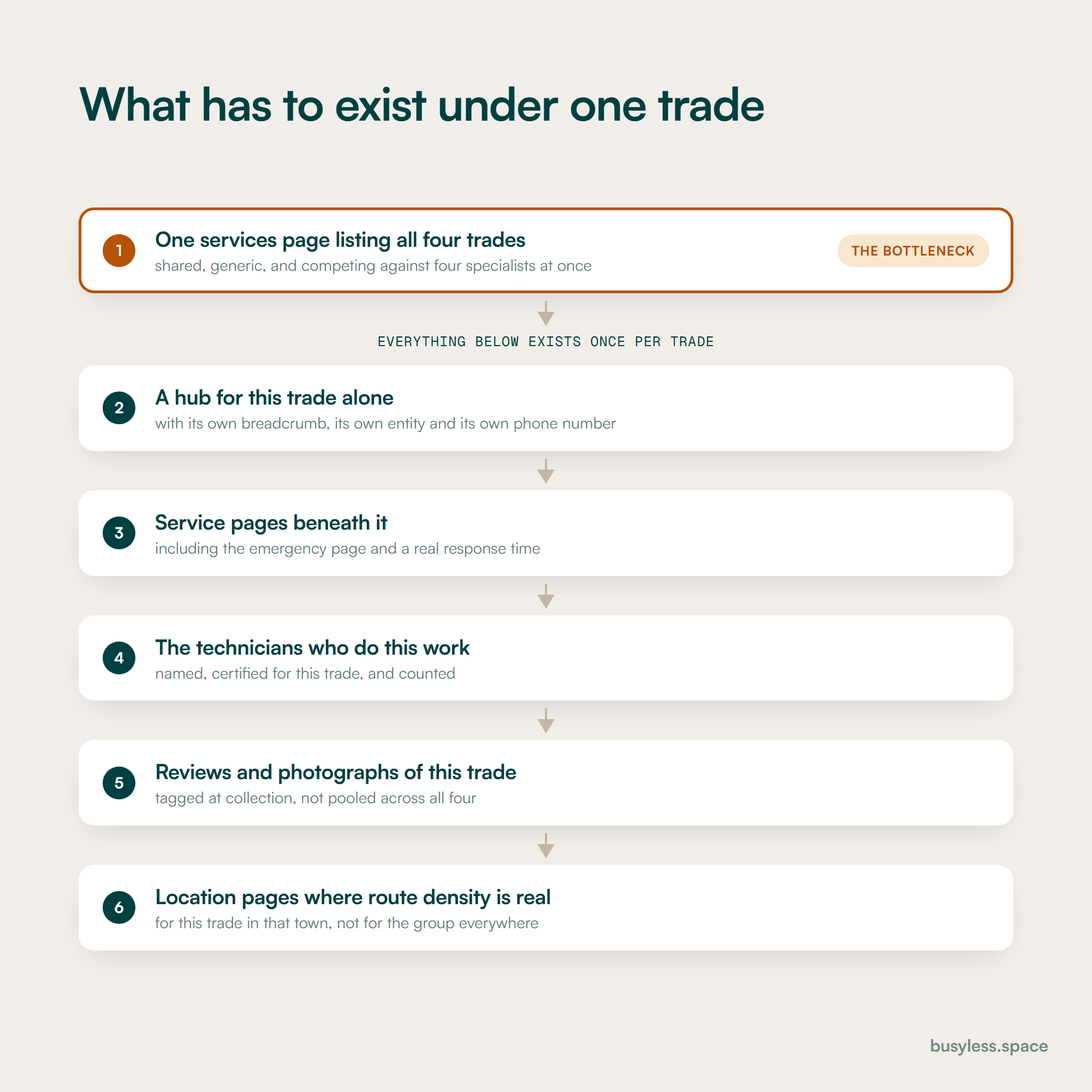
A vertical pipeline from the trade hub through service pages, technicians, reviews and photographs to a location page, with the shared services page at the top marked as the bottleneck.
Everything below the flagged stage is per trade. The stage that fails is the one page shared by all four.

Structured data that applies here

The types below fit this industry specifically. Most of them earn no rich result on their own, which is worth knowing before anyone sells the work on that basis. What they do is describe the entity precisely, which matters for how search engines and answer engines resolve who you are.

  • Organization with a subOrganization per licensed entity

    The structure page, referenced sitewide

    The block that makes the multi-trade structure machine-readable, and the reason it exists is the compliance rule above. Each subOrganization carries its own licence identifier, so the markup says what the website should also say in words: which entity performs which work.

    Organization with a subOrganization per licensed entity.jsonld
    {
      "@context": "https://schema.org",
      "@type": "Organization",
      "@id": "https://[YOUR-DOMAIN]/#group",
      "name": "[CUSTOMER-FACING BRAND]",
      "url": "https://[YOUR-DOMAIN]/",
      "subOrganization": [
        {
          "@type": "LocalBusiness",
          "@id": "https://[YOUR-DOMAIN]/#entity-[SLUG]",
          "name": "[LEGAL ENTITY NAME]",
          "alternateName": "[TRADING AS BRAND]",
          "identifier": {
            "@type": "PropertyValue",
            "name": "[STATE] contractor licence",
            "value": "[LICENCE NUMBER]"
          },
          "knowsAbout": ["[TRADE THIS ENTITY IS LICENSED FOR]"],
          "areaServed": { "@type": "State", "name": "[ST]" }
        }
      ],
      "brand": { "@type": "Brand", "name": "[CUSTOMER-FACING BRAND]" }
    }
  • Service, bounded by the entity that may perform it

    Each trade's hub page

    provider points at the licensed entity rather than at the group, which is the whole point. If the entity behind a page does not hold that licence in that state, the block cannot be written honestly, and that is the signal that the page should not exist either.

    Service, bounded by the entity that may perform it.jsonld
    {
      "@context": "https://schema.org",
      "@type": "Service",
      "@id": "https://[YOUR-DOMAIN]/[TRADE]#service",
      "name": "[TRADE] services in [AREA]",
      "serviceType": "[Plain description of the trade]",
      "provider": { "@id": "https://[YOUR-DOMAIN]/#entity-[SLUG]" },
      "areaServed": [
        { "@type": "City", "name": "[TOWN]" },
        { "@type": "City", "name": "[TOWN]" }
      ],
      "hoursAvailable": {
        "@type": "OpeningHoursSpecification",
        "dayOfWeek": ["Monday","Tuesday","Wednesday","Thursday","Friday","Saturday","Sunday"],
        "opens": "[00:00]",
        "closes": "[23:59]"
      },
      "offers": {
        "@type": "Offer",
        "priceSpecification": {
          "@type": "PriceSpecification",
          "minPrice": "[000]",
          "maxPrice": "[000]",
          "priceCurrency": "USD"
        }
      },
      "description": "[What this trade covers, how many licensed technicians work in it, and the realistic response time.]"
    }
  • The membership plan, with its renewal terms

    The plan page

    The only subscription block in this directory that belongs to a trades business. Fill the billing duration and the price honestly, and remember the markup is not the disclosure: the renewal terms and the cancellation route have to be in the visible copy before the consent step, because that is what the state statutes reach.

    The membership plan, with its renewal terms.jsonld
    {
      "@context": "https://schema.org",
      "@type": "Service",
      "@id": "https://[YOUR-DOMAIN]/plan#membership",
      "name": "[PLAN NAME]",
      "serviceType": "Maintenance membership",
      "provider": { "@id": "https://[YOUR-DOMAIN]/#group" },
      "offers": {
        "@type": "Offer",
        "price": "[00.00]",
        "priceCurrency": "USD",
        "priceSpecification": {
          "@type": "UnitPriceSpecification",
          "price": "[00.00]",
          "priceCurrency": "USD",
          "billingDuration": "[1]",
          "billingIncrement": "[1]",
          "unitCode": "MON"
        },
        "eligibleDuration": {
          "@type": "QuantitativeValue",
          "value": "[12]",
          "unitCode": "MON"
        }
      },
      "termsOfService": "https://[YOUR-DOMAIN]/plan#terms",
      "description": "[What is included per trade, how often it renews, what it renews at, and how to cancel. Say the cancellation medium.]"
    }
  • The brand you acquired, kept as an entity

    The page for each former brand

    The block that stops an acquisition throwing away its own recognition. alternateName keeps the old name attached to something real, and the page it sits on can carry the history, the same technicians and the reviews that came with it.

    The brand you acquired, kept as an entity.jsonld
    {
      "@context": "https://schema.org",
      "@type": "LocalBusiness",
      "@id": "https://[YOUR-DOMAIN]/[OLD-BRAND-SLUG]#former",
      "name": "[CURRENT BRAND]",
      "alternateName": ["[OLD BRAND NAME]", "[OLD BRAND, OTHER SPELLING]"],
      "url": "https://[YOUR-DOMAIN]/[OLD-BRAND-SLUG]",
      "parentOrganization": { "@id": "https://[YOUR-DOMAIN]/#group" },
      "foundingDate": "[YYYY, THE ORIGINAL FOUNDING]",
      "address": {
        "@type": "PostalAddress",
        "streetAddress": "[STREET]",
        "addressLocality": "[TOWN]",
        "addressRegion": "[ST]",
        "postalCode": "[00000]",
        "addressCountry": "US"
      },
      "description": "[What the business was, when it joined the group, and that the same technicians are still doing the work.]"
    }
  • FAQPage

    Trade hubs, the plan page and the cross-trade pages

    The questions that decide a booking here are about which trade you need, how fast somebody arrives and what the plan actually commits you to. Match the visible wording exactly, and keep every plan answer aligned with the strictest state you operate in rather than with a federal position that no longer exists.

    FAQPage.jsonld
    {
      "@context": "https://schema.org",
      "@type": "FAQPage",
      "mainEntity": [
        {
          "@type": "Question",
          "name": "[Question exactly as it appears on the page]",
          "acceptedAnswer": {
            "@type": "Answer",
            "text": "[Answer exactly as it appears. Give the real response time, the real price band and the real cancellation route.]"
          }
        }
      ]
    }
  • BreadcrumbList

    Trade, service, location and former-brand pages

    Load-bearing here because the hierarchy is the argument: a service page belongs to a trade, and the trade belongs to the group. Building it usually reveals that half the location pages sit under nothing, which is the same half that should not exist.

    BreadcrumbList.jsonld
    {
      "@context": "https://schema.org",
      "@type": "BreadcrumbList",
      "itemListElement": [
        { "@type": "ListItem", "position": 1, "name": "Home",
          "item": "https://[YOUR-DOMAIN]/" },
        { "@type": "ListItem", "position": 2, "name": "[TRADE]",
          "item": "https://[YOUR-DOMAIN]/[trade]" },
        { "@type": "ListItem", "position": 3, "name": "[SERVICE]",
          "item": "https://[YOUR-DOMAIN]/[trade]/[slug]" }
      ]
    }

What it costs

Editorial estimates rather than quotes, and higher than any single trade in this directory for a structural reason: you are funding several page sets at once, and each one is competing against a company that funds only its own.

Lean

$3,000 to $5,000
  • The licence map and the site audited against it
  • The structure page naming entities, licences and trades
  • One trade built properly as a specialist section
  • Acquired brand pages recovered rather than redirected
  • Manufacturer locator listings completed

Who it suits

A two or three trade operator in one market

Where it stops

It funds one trade properly. Attempting all of them at this level produces four thin sections rather than one credible one.

Funded

$5,000 to $9,000
  • A real page set for each trade, with its own team and reviews
  • Cross-trade content a specialist cannot write
  • The membership plan page built and legally reviewed
  • Location pages only where route density is real, per trade
  • Reporting split by trade rather than averaged

Who it suits

A multi-trade group across several towns

Where it stops

It will not out-authority a specialist on their own emergency term everywhere. The win is depth in the trades you choose plus the ground only you can hold.

Enterprise

$9,000 to $12,000
  • Several markets and several acquired brands maintained properly
  • Rebate and programme content kept current rather than going stale
  • Recruitment content per trade, treated as a growth channel
  • Content built for the acquisition thesis where you are buying
  • Attribution from first touch to job, and to plan membership

Who it suits

Consolidators, and groups whose growth plan involves acquisition

Where it stops

Licensed technicians are the ceiling here, in every trade separately. More demand into one you cannot staff lengthens the response time, which is the argument the specialist already wins on.

How to do it with no budget

Less free work here than in the single-trade playbooks, because the valuable moves are structural. The exceptions are worth doing this week, and the first one costs nothing but an uncomfortable hour with the licence register.

  1. 1

    Write down your actual licensing structure

    3 hours

    Your licence certificates and the state register

    Every entity, its number, its qualifier, its trades, its states. Most multi-trade groups have never had this on one page, and everything else in this playbook is bounded by it.

  2. 2

    Publish the structure page

    2 hours

    Your website editor

    Which entity performs which work, with the numbers. It is the least glamorous page you will build and the one that survives a homeowner, a board or a competitor checking the register.

  3. 3

    Find out what happened to the brands you acquired

    2 hours

    A search for each old name, and a check of the old domains

    Search each name, see what ranks, and check whether the old domain redirects to your home page. If it does, you are throwing away recognition that people are still actively searching for.

  4. 4

    Complete every manufacturer locator listing

    1 hour per brand

    Your manufacturer partner portals

    Free, ranked by designation, and read by a homeowner who has already chosen the equipment. Multi-trade operators hold more designations than single-trade rivals and complete fewer of the listings.

  5. 5

    Register for every utility and programme contractor list

    3 hours

    The utility and state programme sites

    A homeowner sent to a rebate list has already decided to spend. You probably qualify for more of these than a single-trade competitor and are on fewer of them.

  6. 6

    Join and cancel your own membership plan

    1 hour

    A real card and a phone

    Time both, count the steps, and note where the renewal terms first appear. This finds more compliance exposure in an hour than reading the service agreement finds in a week.

  7. 7

    Count your licensed technicians per trade

    30 minutes

    Your own records

    Then publish the numbers. Four licensed electricians is a stronger claim than any adjective, and it is the specific thing a homeowner is trying to work out about a generalist.

The tool stack

Weighted towards separating things that are usually pooled. Two of the entries below are systems you already own and are currently reporting an average across four different businesses.

  • See what competitors are paying for, per trade

    SpyFuSEO APIRead the review

    Useful here specifically because the paid landscape differs by trade, and a group budgeting in total will overspend on the trade with the cheapest clicks and underspend on the one that actually pays. Split the view before splitting the budget.

    Free routeSearch each emergency term and note who is buying it

  • Work out how many technicians each trade needs

    Sales Capacity Planning CalculatorFree toolOpen the tool

    The constraint in a multi-trade group is licensed technicians per trade rather than demand in total. Running this per trade usually shows one of them is the reason the group is not growing, and it is rarely the one getting the marketing.

    Free routeFree

  • Publish trades, entities, technicians and plans as related records

    DirectusHeadless CMSRead the review

    Trades, licensed entities, technicians, certifications, service areas and plan tiers are related entities, and the relationships are what keeps a trade page inside its own licence. Model them once and a page cannot advertise a trade the entity behind it does not hold.

    Free routeOpen source

  • Report calls by trade rather than in total

    Your phone system, with a number per trade

    One number for four trades makes it impossible to say what each produced, and it queues an emergency behind a quote. Splitting the number fixes the measurement problem and a service problem at the same time.

    Free routeAlready paid for

  • Tag reviews by trade at the point of collection

    Your review request tooling

    A homeowner deciding on a rewire should be reading about electrical work. Pooled reviews dilute exactly the proof a specialist competitor is strongest on.

    Free routeAsk which trade in the request

  • Know what a plan member is worth against a one-off customer

    Your field service management reports

    Revenue per member per year, retention, and the rate at which members convert to replacements. This is the number that justifies the plan page being the best page on the site, and most groups have never produced it.

    Free routeAlready paid for

  • Watch the old brand names

    Search Console, filtered to the acquired names

    Brand queries for a company you bought three years ago are usually still substantial and usually landing somewhere useless. Set the filter once and check it quarterly.

    Free routeFree

  • Track response time per trade

    Your dispatch system

    The single-trade specialist's strongest argument is that they will get there faster. If yours is competitive, publish it per trade; if it is not, that is an operations finding rather than a marketing one.

    Free routeAlready paid for

Take it from here

Everything below is yours to take. Fill the [BRACKETS] and it is ready to use. Start with the licence and entity map, because it decides which trade pages may exist at all.

Brief

Trades against licensed entities and states. Most multi-trade groups have never had this on one page, and every other template here is bounded by it.

LICENCE AND ENTITY MAP - [GROUP] - [DATE]

WHY THIS IS FIRST
A trade licence attaches to a legal entity through a qualifying
individual. A brand offering four trades is usually several
entities. Your website presents one company. A homeowner, a
board or a competitor checking the register finds several, and
cannot tell which one is doing their work.

1. THE ENTITIES
   ENTITY (legal name)     LICENCE #    QUALIFIER    STATE
   [__________________]    [________]   [_________]  [____]
   [__________________]    [________]   [_________]  [____]
   [__________________]    [________]   [_________]  [____]
   [__________________]    [________]   [_________]  [____]
   [ ] Every licence status checked as current
   [ ] Every qualifier confirmed still employed
   [ ] Expiry dates recorded: [__________]

2. THE GRID
   Mark a cell only where THAT entity holds THAT licence in
   THAT state.

   TRADE \ ENTITY        [E1]   [E2]   [E3]   [E4]
   Plumbing               [ ]    [ ]    [ ]    [ ]
   Electrical             [ ]    [ ]    [ ]    [ ]
   HVAC                   [ ]    [ ]    [ ]    [ ]
   Roofing                [ ]    [ ]    [ ]    [ ]
   Drains                 [ ]    [ ]    [ ]    [ ]
   [_______________]      [ ]    [ ]    [ ]    [ ]

3. WHAT IS SUBCONTRACTED
   Trades we advertise but do not perform in-house:
   [_________________________________________]
   Who performs them:  [_______________]
   [ ] The website says so on those pages

4. THE PAGE PLAN THAT FOLLOWS
   Trade pages that may exist:      [____]
   Trade pages currently live:      [____]
   Pages advertising a trade the publishing entity does not
   hold:                            [____]
   [ ] Those pages corrected or removed
   [ ] Each trade page names the entity performing the work

5. THE STRUCTURE PAGE
   [ ] Published at /about/our-companies or similar
   [ ] Lists every entity, number, trade and state
   [ ] Says plainly that they trade together as [BRAND]
   [ ] Linked from the footer
   [ ] Organization markup with a subOrganization per entity

6. REVIEW
   Re-run after: [ any acquisition / any qualifier change /
   any new state / annually ]
   Owner: [__________]   Next: [__________]

What to publish

Write per trade, then write the two things no single-trade company can. Almost everything that works here either makes one trade look like a specialist or exploits the fact that you are not one.

  • A full page set per trade

    One trade at a time, properly, not four at once

    Each trade competes in its own results page against a company named after it. A section with its own team, reviews, prices and photographs is the only structure that reads as a specialist.

  • The cross-trade pages

    One a month, from jobs that crossed

    Which trade do I need for this, and what happens when a job turns out to involve two. A single-trade company cannot write it without arguing against itself, which is why nobody has.

  • The membership plan page

    Once, reviewed at every price change

    The actual product of a consolidated operator, usually three sentences and a button. What is included per trade, the price, the renewal, and how to leave.

  • Former brand pages

    One per acquired brand

    People search the name on the van they remember for years after it changed. A page that keeps the history and the technicians is free traffic with real intent behind it.

  • Rebate and programme pages

    One per programme, re-dated each cycle

    Deadline-driven, high intent, and almost nobody maintains them, so a dated page that is genuinely current stands out in a category full of expired offers.

  • Recruitment pages per trade

    Continuously, per trade

    The constraint in a multi-trade group is licensed technicians, not demand. These searches are local, specific and uncontested by employers who post to a job board.

And what not to

  • A single services page listing every trade the group can arrange
  • A trade page published by an entity that does not hold that licence
  • Reviews pooled across four trades on every page
  • Redirecting an acquired brand's whole domain to your home page
  • One location page per town covering all four trades
  • A generated grid of trades multiplied by towns
  • Membership terms that first appear in the service agreement
  • One phone number for four trades, and one report for all of them
The expensive mistakes

Building one website about the company

Costs you Four trades each competing against a specialist, from a page that says you also do three other things

Four page sets that each read as a specialist, sharing a domain and nothing else

Publishing trade pages before mapping the licences

Costs you Pages advertising work the entity behind them may not perform, which is a licensing problem rather than a content one

Trades against entities and states first, and only then a page plan

Redirecting an acquired brand to the home page

Costs you Throwing away the reviews, citations and local recognition that were most of what the acquisition bought, while customers keep searching the name

A real page per former brand, with the history, the same technicians and the old URLs mapped properly

Treating the membership plan as a pricing paragraph

Costs you The actual product of the business handled as an afterthought, with renewal terms appearing after consent in a category state regulators are watching

A plan page with the terms visible, consent as its own step, and cancellation in the medium they joined in

Pooling reviews across trades

Costs you A homeowner deciding on a rewire reading about drain cleaning, exactly where the specialist competitor is strongest

Reviews tagged by trade at collection and shown on that trade's pages

Reporting the group rather than the trades

Costs you An average that hides one trade carrying the growth and another consuming the budget, which is the normal state of a multi-trade group

Every number split by trade, including cost per won job and technicians available

What to measure

One change makes this report usable and it doubles its length: split everything by trade. A group-level average hides the trade carrying the business and the trade consuming the budget, which are rarely the same one.

Leading indicators

Move first. They predict, they do not prove.

  • Local pack position, per trade

    Geo-specific rank tracking, run separately per trade

    Four different races with four different sets of competitors. A single average across them is close to meaningless and is what most reports in this category give you.

  • Impressions by trade and cluster

    Search Console, grouped by trade first

    Group by trade, then by intent within it. The same cluster behaves differently in each trade, and the emergency term in one may be uncontested while another is brutal.

  • Calls per trade

    A phone number per trade

    Requires the technical fix above. Until each trade has its own number, nothing in this report can honestly be attributed and the dispatch queue is mixing emergencies with quotes.

  • Former brand query volume

    Search Console, filtered to the acquired names

    Usually larger than expected and usually landing somewhere useless. It is also the clearest measure of whether the acquisition's local recognition is being kept or spent.

Business indicators

The ones a manager acts on.

  • Jobs won and revenue, per trade

    Field service management

    Split by trade, because an emergency call-out and a system replacement are different businesses with different margins. The trade with the most jobs is rarely the trade with the most profit.

  • Plan members added and lost

    Your billing system

    Reported as two numbers rather than a net figure, because a plan that adds and loses the same number every month looks stable and is not. Losses also tell you where the cancellation experience is doing damage.

  • Revenue per member against revenue per one-off customer

    Field service management joined to billing

    The number that justifies the plan page being the best page on the site. Most groups assert the plan matters and have never produced the comparison.

  • Licensed technicians available, per trade

    Your rota and licence records

    An operations number that belongs in the marketing report, because in this category it is the actual constraint. Marketing a trade you cannot staff lengthens the response time, which is the specialist's strongest argument against you.

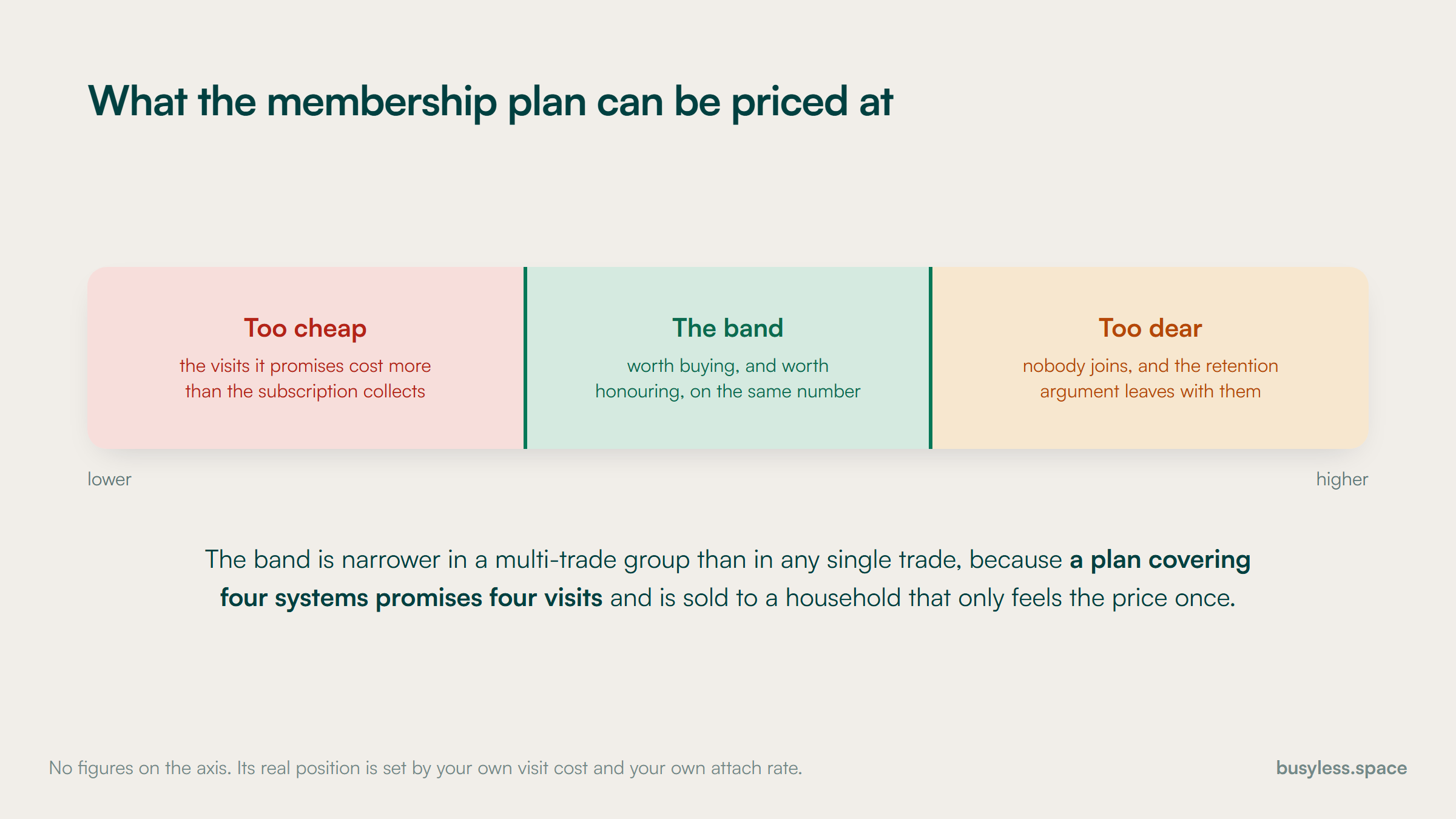
A narrow band between two failure zones. Priced too low, a membership costs more in visits than it collects; priced too high, nobody joins and the retention argument disappears with them.
The band is narrow because the plan has to be worth buying and worth honouring on the same number.

The verdict

A multi-trade home services business is not one company with four services. It is four businesses that share a domain, a phone number and a brand, and every problem in this playbook comes from treating the first sentence as though it were true.

The competitor in each of those four races is named after the one thing they do. You will not beat that with a brand, and you can beat it with depth: a page set, a team, a body of reviews and a response time that are genuinely about that trade alone.

There are two pieces of ground only you can hold, and both are usually empty. The homeowner who cannot tell which trade they need, and the membership plan that no single-trade operator can make as valuable as you can.

Most of what is sold as home services SEO services is a single-trade playbook with the noun pluralised. Ask anybody offering SEO services for home service businesses to show you their licence map before their keyword list, and see whether the plan reports four sets of numbers or one.

FAQ

Home services (multi-trade) SEO questions

  • Should each trade have its own website?
    Usually not, and the instinct behind the question is right even if the answer is no. Separate domains split your authority, your reviews and your maintenance across four sites you then have to fund individually. What you need instead is four page sets on one domain, each with its own hub, team, reviews, photographs and phone number, so that each reads as a specialist without paying for four brands.
  • Can we run a separate profile for each trade at one address?
    Take advice, because it is the hardest configuration question here. The guidelines require a permanent location with staff present, and separate profiles per trade at one site are both a common growth tactic and a common suspension, usually after a competitor reports it. Where the trades genuinely run as separate businesses with their own staff and numbers it is defensible. Where they do not, one profile with several categories is the honest answer.
  • What happened to the company we acquired, in search terms?
    Probably a redirect to your home page, which throws away the reviews, citations and local recognition that were most of what you bought. People keep searching the old name for years. Build a real page for each former brand saying when it joined, that the same technicians are still there, and what to do now, and map the old URLs to their nearest equivalents rather than to the root.
  • Do we need to worry about our maintenance plan legally?
    Yes, and more than you did last year. The plan is an automatically renewing subscription, the Eighth Circuit vacated the federal negative option rule on 8 July 2025, and what governs it now is state law. Put the renewal frequency and price and the cancellation route on the plan page before the consent step, make that consent its own affirmative action, and build to the strictest state you operate in.
  • Which trade should we build first?
    The one where you have the most licensed technicians and the least competition, not the one with the most search volume. One credible trade section beats four thin ones, and the audit in the templates above gives you a score out of five: do not start the second trade until the first is at four. A generalist section in every trade is the outcome this page exists to prevent.
  • How do we compete with a company named after the one trade?
    Not on the name, which you cannot change, and not by asserting expertise, which they assert too. Compete on depth that can be counted: the number of licensed technicians in that trade, their certifications, reviews about that trade specifically, a published response time and photographs of that work. Four licensed electricians is a claim a two-person specialist cannot match.
  • Is there anything a single-trade competitor cannot do?
    Two things, and both are usually empty ground. They cannot honestly answer the homeowner who does not know which trade they need, because every answer is in their own interest. And they cannot make a maintenance membership as valuable as you can, because a plan covering four systems in one house is worth more to a customer than a plan covering one.
  • What does home services SEO cost?
    The tiers above are editorial estimates rather than quotes. At $3,000 to $12,000 a month this is higher than any single trade in this directory, for a structural reason: you are funding several page sets at once, each competing against a company that funds only its own. Building one trade properly at the lower end beats spreading the same budget across four.

Run it yourself, or have someone own it

Everything above is written to be run without us, and the free path is genuinely most of the value for a single-location business. Where these plans stall is almost never the plan. It is that nobody owns it after the first month. That is the job we do, with search as one distribution layer inside a wider system rather than the whole engagement.