
Skip to content

Tour operator SEO strategy

Regulated marketing

The query is the destination, and the buyer is abroad

Written by Eugene SuslovLast reviewed 29 August 2026No affiliate links
Sector
Lifestyle and leisure
Model
Local service, Ecommerce
Competition
High
Time to results
6 to 12 months
Typical monthly
$2,000 to $9,000

Key takeaways

  1. 1Nobody searches for your company. They search for a place, and the place is the subject of the query rather than you. Everything else in this playbook follows from accepting that.
  2. 2The local pack will not save you. Proximity is the strongest signal in local search and your buyer is three thousand miles away, so the tactics that carry a plumber are largely unavailable here.
  3. 3Your own tour, listed on an activity platform, will often outrank your page for its own name. Fixing that is a specific and winnable job, and it is worth more than any new keyword.
  4. 4Four US states enforce their seller of travel laws on whoever sells to their residents, wherever that seller sits. The rule is triggered by who reads the page, not by where the business is.
  5. 5The trade page nobody writes is the highest-value page on the site. Agents, DMCs and corporate buyers search for operators, and they arrive with a book of clients rather than one booking.

SEO for tour operators breaks the first assumption most local advice is built on. The business is a local service, run by people who live at the destination, and almost none of its customers are anywhere near it when they decide to buy.

That single fact removes most of the toolkit. Proximity, the strongest signal in the local pack, is working for somebody standing in the street outside rather than for the person in another country who will actually book.

So a tour operator SEO strategy has to be built around the destination instead of around the operator. The queries with real volume are about a city, a landmark, a season or a route, and your company name appears in almost none of them.

The competition follows from that. The pages already answering those queries belong to tourism boards, travel publishers and the activity platforms, and the platforms are also your distribution partners, which makes the relationship genuinely awkward rather than simply adversarial.

There is a second buyer nobody writes for. Travel agents, destination management companies and corporate organisers search for operators to resell, and a page aimed at them costs one afternoon and competes with almost nothing.

The work is therefore split. Earn the destination queries with content that is genuinely about the place, win your own product name back from the platforms, and publish the trade page that the rest of the market has not bothered with.

Who already ranks in tour operators

Search the thing you actually sell, from the country your customers live in, using a VPN or a search tool that lets you set the location. Most tour operator SEO work begins with that shock, because the results a founder sees at the destination and the results a buyer sees at home are not the same page.

What is on the results page

  • Things to do carousels sitting above every organic result on a destination query
  • Activity platform product pages ranking for the operator's own tour name
  • Travel publisher listicles occupying the top of the informational queries
  • Tourism board pages ranking with no commercial intent behind them
  • Star ratings and review counts shown for platform listings rather than for your site
  • A local pack anchored to the destination, invisible to the person planning from home
  • AI answers assembling a day-by-day itinerary and naming no operator at all
  • Results that differ by country, language and currency for the same query
  • Viator

    viator.comClaim it

    Tripadvisor's supply platform and, for most operators, both the largest single source of bookings and the page that outranks their own. List on it, and treat the ranking problem as separate from the distribution decision: you can be on the platform and still own your product name.

  • GetYourGuide

    getyourguide.comClaim it

    The strongest competitor to Viator in Europe and increasingly elsewhere. Same shape of relationship, same commission mechanics, and the same habit of ranking a copy of your listing above your own tour page.

  • Tripadvisor

    tripadvisor.comClaim it

    Where the reviews live and where a large share of research happens before anybody reaches a booking page. Claiming and maintaining the listing is not optional; expecting to outrank it for your own name usually is.

  • Klook

    klook.comClaim it

    Dominant across Asia-Pacific and largely invisible from a European or North American desk. Worth checking specifically if your guests fly in from that half of the world, because the SERP you see at home does not show you this.

  • The destination marketing organisation

    Varies by destinationClaim it

    The tourism board for your city, region or country. It usually ranks for the destination query, its listing is free, and it is the one gatekeeper here that actively wants you to succeed. Most operators fill in the form once and never update it.

  • Travel publishers

    lonelyplanet.com, timeout.com, cntraveller.com

    Not claimable and not beatable on the head terms. They are a placement target instead: being named in the piece that ranks is achievable, and it is a relationship job rather than a writing job.

  • Google Things to do

    google.comClaim it

    A booking module that appears above the organic results on many destination and attraction queries. Eligibility runs through the platforms and through Google's own feeds, so being absent from it is usually a distribution decision somebody made without realising.

  • Reddit and traveller forums

    reddit.com, tripadvisor.com forums

    Where the honest recommendations happen, and increasingly where AI answers source them. You cannot optimise it and should not astroturf it. Being genuinely good and genuinely named is the whole mechanism.

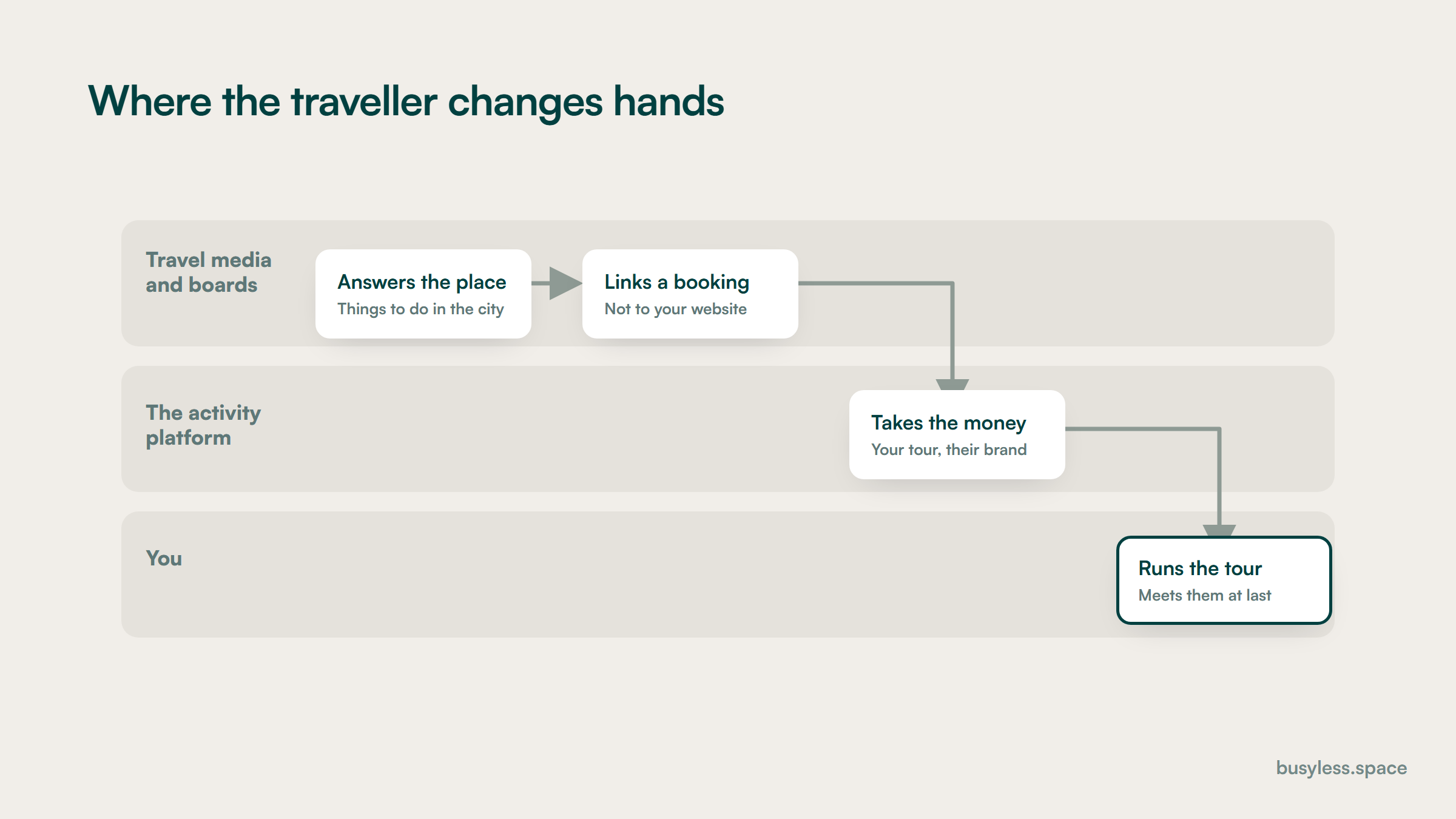
Three lanes showing a traveller passing from destination media to an activity platform and only then to the operator, with the two handover points marked
The operator appears in the third lane, after two other parties have already been paid or credited. Most of the work in this playbook is about moving that first handover.

What people actually search

The clusters below are sorted by how far the searcher is from a booking rather than by volume, because in this market those two things run in opposite directions. The biggest queries are furthest from a sale and the smallest ones convert immediately.

Destination planning

Informational, months ahead

things to do in [city]

The page that wins it: A genuinely useful guide to the place, not a list of your tours

The largest volume in the category and the hardest to convert directly. The subject is the destination, so a page that is secretly a brochure loses to a page that actually helps somebody plan four days.

Activity and experience

Commercial, comparing options

[city] food tour

The page that wins it: One page per activity type per place, with real departures on it

Where your page and the platform's copy of your page meet. This is the cluster worth fighting for directly, because the searcher has chosen the activity and is now choosing the supplier.

Landmark and access

Transactional, entity-led

[landmark] skip the line tickets

The page that wins it: A page about the landmark and how access actually works

The entity in the query is the landmark, which you do not own and cannot become. What you can be is the clearest explanation of how to get in, which is a page the official site rarely writes well.

Seasonality and timing

Informational, very long lead

best time to see [natural phenomenon]

The page that wins it: A month by month guide with the honest bad months included

Converts six to nine months later, which is why it looks like a failure in a quarterly report. Attribution here is worse than anywhere else on the site and the reporting should say so up front.

Practical logistics

Informational, trust building

do i need a visa for [country]

The page that wins it: A practical page maintained honestly and dated

Nobody sells anything on these and they are how an operator becomes the source a traveller returns to. They are also the pages most often cited by AI answers, because they answer a question precisely.

Operator comparison

Commercial, verification led

[operator] vs [operator] reviews

The page that wins it: Honest review presence, plus a page explaining how your tours differ

This search resolves on Tripadvisor and Reddit rather than on your site, so the goal is to be findable and accurately described rather than to control the answer. Trying to control it is how operators end up with fake reviews.

Private, group and custom

Commercial, high value

private [city] tour for a family of six

The page that wins it: A request page with a real person answering it

The highest margin work in the business and the lowest volume in the keyword tool. The platforms handle it badly because it needs a conversation, which is exactly why it converts on your own site.

Trade and reseller

Commercial, business to business

[city] tours for travel agents

The page that wins it: A trade page with commission terms, capacity and a contact

The reader has a budget and a book of clients, and one relationship is worth more than a hundred consumer bookings. Almost no operator publishes for them, so the page ranks on the day it goes live.

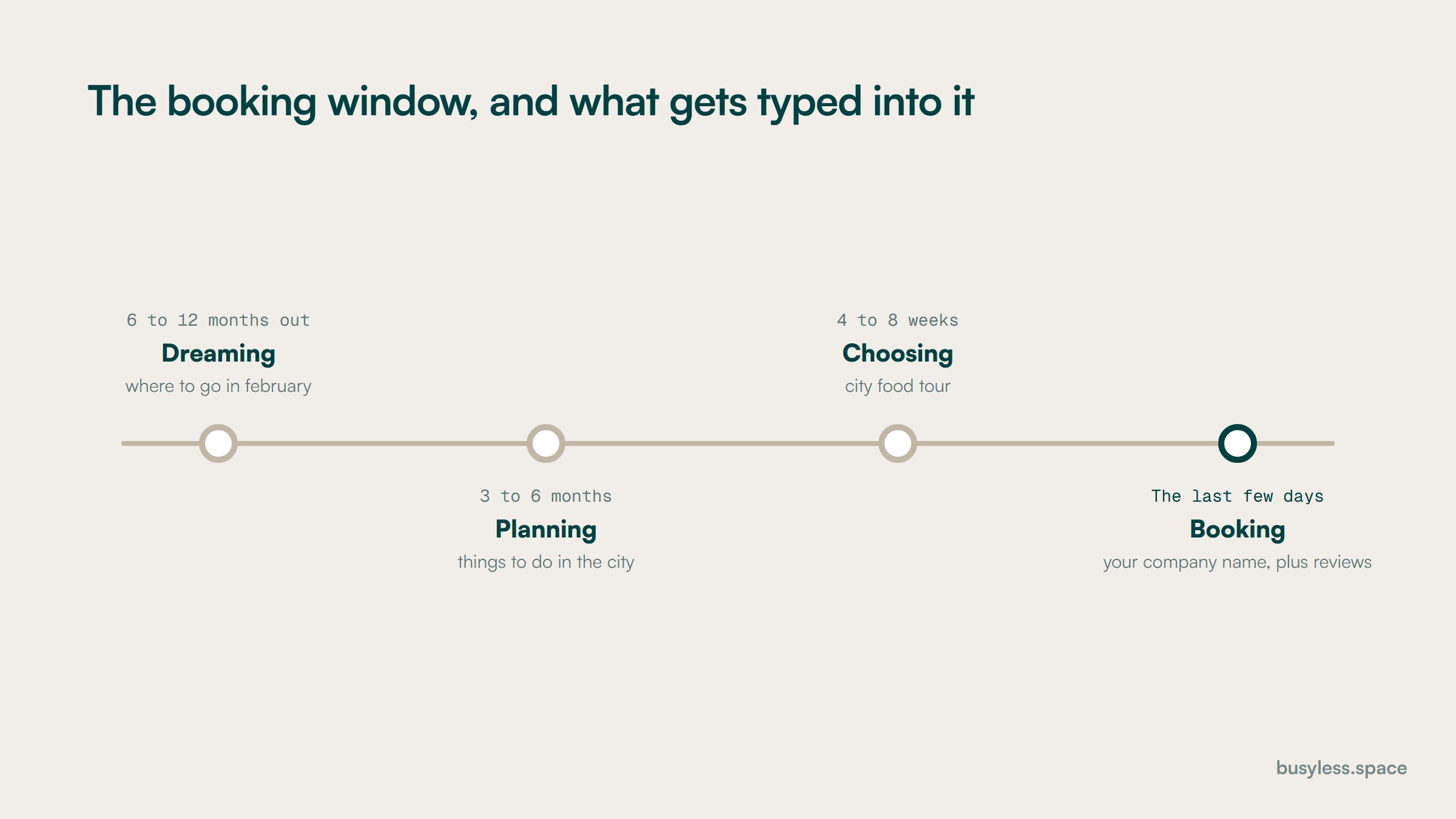
A booking window timeline from dreaming to arrival, with the query typed at each stage and the point where a company name first appears
The company name enters the search at the very last stage. Everything before it is a question about a place, which is why the content has to be about the place.

What the rules change

The rules below have an unusual property for this directory: most of them are triggered by where your customer is rather than by where you are. That makes compliance a function of your traffic, which is a strange thing to discover halfway through a marketing plan. This is my reading rather than legal advice.

1

The registration number belongs on the advertising, and the law reaches you wherever you sit

California Business and Professions Code 17550.24, and the equivalent statutes in Florida, Hawaii and Washington

What it means

California requires a registered seller of travel to display its registration number clearly and conspicuously on all advertising materials offering or soliciting the purchase of travel services, including any writings or promotional materials. The four states with active seller of travel regimes apply them to any seller doing business with their residents, whoever and wherever that seller is. Iowa repealed its equivalent in 2020.

So do this

If a Californian can buy from your site, work out whether you are a seller of travel before you spend anything on traffic from the United States. Then put the number in the footer template rather than on one page, because every page is advertising.

2

Combining two services can turn a tour into a regulated package

EU Package Travel Directive (EU) 2015/2302, applied since 1 July 2018

What it means

Selling two or more travel services for the same trip from one point of sale, or through linked online booking processes inside a twenty-four hour window, creates a package or a linked travel arrangement. The organiser then owes insolvency protection and has to tell travellers who is providing it.

So do this

Read your checkout as a lawyer would rather than as a marketer would. An airport transfer upsell added to improve average order value can convert a single service into a package, and the disclosure that follows belongs on the page, not in a terms document.

3

Air makes it a second regulator's problem

US Department of Transportation full fare advertising rule, 14 CFR 399.84

What it means

Anyone advertising air transportation, including a tour operator selling an air-inclusive package, must state the total price the consumer will pay, and that figure has to be the most prominent price in the advertisement. Taxes and mandatory charges cannot be broken out more prominently than the total.

So do this

Never let a from-price on an air-inclusive itinerary exclude the taxes. If your pricing module strips them out to make the headline number smaller, that is a template change rather than a copy change.

4

Mandatory fees have to be in the price you advertise

FTC Rule on Unfair or Deceptive Fees, 16 CFR Part 464, effective 12 May 2025, plus ordinary deception law

What it means

The rule itself covers live-event tickets and short-term lodging, so it reaches a tour only when the tour bundles one of them. The wider principle is older and applies everywhere: a mandatory charge disclosed at the last step of a checkout is a misrepresented price, whichever rule you are read under.

So do this

Put park entry, permits and compulsory tips in the displayed price rather than in a fine-print line. This is also a conversion argument, since a price that grows during checkout is the most common reason a booking is abandoned.

5

Reviews you paid for, incentivised or wrote are a separate offence

FTC Guides Concerning the Use of Endorsements and Testimonials, effective 26 July 2023

What it means

Incentivised reviews need disclosure, and reviews written by anyone connected to the business, or bought, are deceptive whether or not the sentiment is genuine. This category has an unusually strong temptation because the platforms rank on review volume.

So do this

Ask every guest, at the end of the tour, on the day. That is legitimate, it is what the well-reviewed operators actually do, and it produces more reviews than any of the alternatives that would get you delisted.

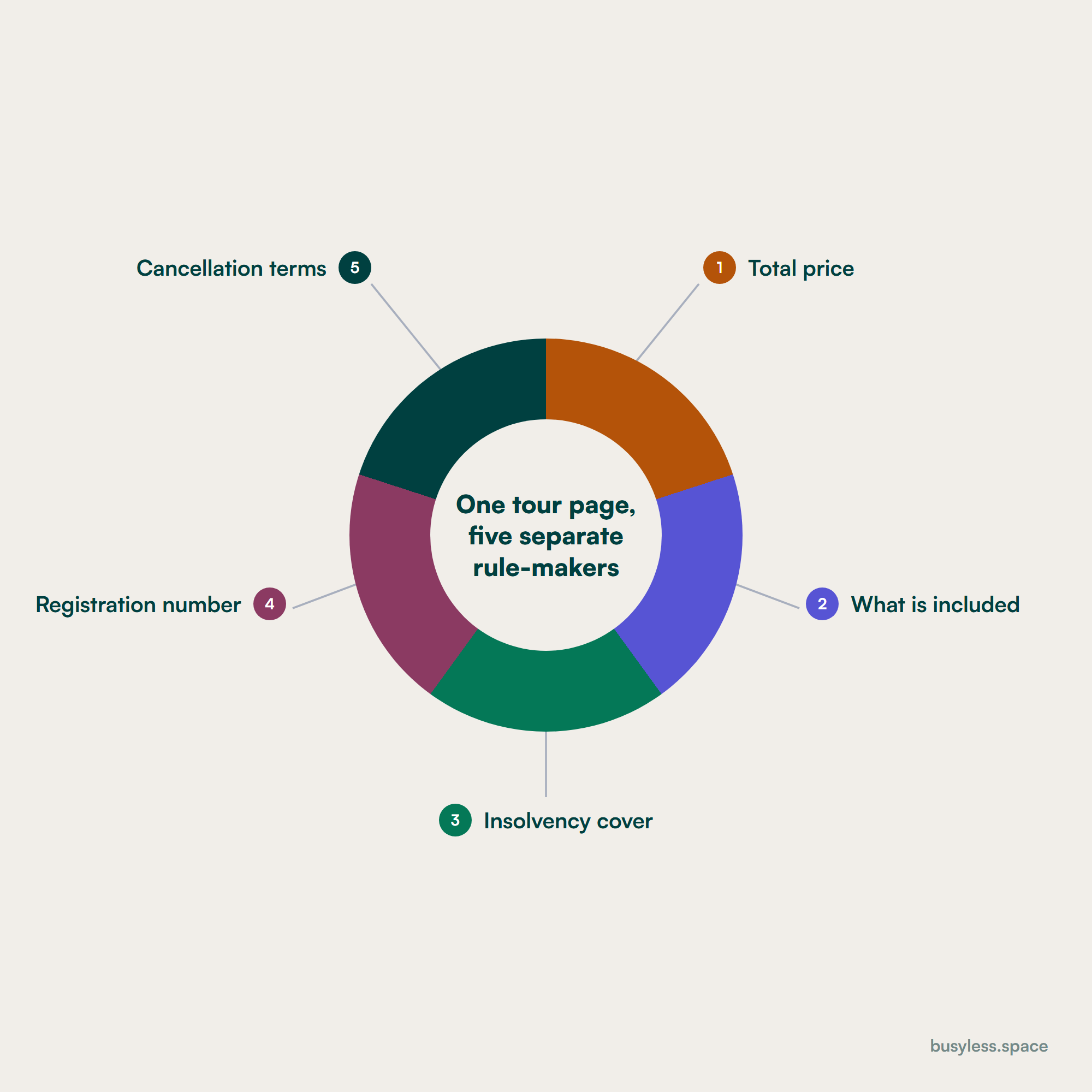
One tour page with five callouts naming the total price, the inclusions, the insolvency protection body, the registration number and the cancellation terms
None of these belong in a terms document. Each one has to be visible on the page a stranger is deciding to buy from.

Proving expertise

Trust in travel is carried by specifics. A traveller committing money in a country they have never visited is looking for evidence that you are a real operation with real people, and almost all of that evidence exists offline and never reaches the website.

  • Named guides with photographs, biographies and the languages they speak
  • The licences and permits you hold, named, with the issuing body
  • Insurance and financial protection stated plainly, with the protecting body named
  • Group sizes, meeting points and cancellation terms shown before the checkout
  • Photographs taken on your own tours rather than bought from a stock library
  • Accessibility, fitness level and weather contingency described honestly
  • Reviews shown with their source, including the ones that are not five stars
  • A physical address at the destination and a phone number somebody answers

How to build a tour operator SEO strategy

The first phase below is deliberately about seeing the market rather than changing it, because almost every tour operator SEO strategy that fails does so by optimising for a search result the founder can see and the customer cannot. Set your search location to the country your guests fly in from before you decide anything.

  1. 1

    Weeks 1-3

    Look at the market your buyers actually see

    • Run your top twenty queries from each of your three biggest source markets
    • Record who ranks in each, and whether it is the same set in all three
    • Find every page that outranks you for your own tour names
    • Check whether your booking pages are indexable and on your own domain
    • Establish which seller of travel and package rules your traffic triggers

    You end up with
    A market by market picture of the SERP, and a list of your own products you do not own

  2. 2

    Weeks 4-8

    Own the products before chasing the destination

    • Build one strong page per activity type, with real departures and prices
    • Move or fix any booking flow that leaves your domain mid-purchase
    • Add TouristTrip and Offer markup to every tour page
    • Write the trade page, with commission terms and capacity
    • Fix the currency and language handling for your top source markets

    You end up with
    Tour pages that can hold their own product names, and a page for the trade buyer

  3. 3

    Weeks 9-16

    Earn the destination

    • Publish the practical guides nobody at the destination has written well
    • Build the timing and seasonality pages, at least six months before the season
    • Create landmark access pages for the entities you sell around
    • Approach the tourism board and the publishers who own the listicles
    • Interlink guides to tours in a way that reads as help rather than as a funnel

    You end up with
    A body of destination content that answers questions rather than selling around them

  4. 4

    Weeks 17-24

    Make the seasons stop resetting you

    • Keep seasonal tour URLs live year round rather than unpublishing them
    • Add next season availability to pages the moment the current one closes
    • Set up rank tracking by source market rather than as one global number
    • Report direct bookings separately from platform bookings
    • Review which guides produced enquiries, months after they were published

    You end up with
    A site that keeps its rankings through the off season and reports its two channels apart

Technical fixes with the best payoff

Most of what breaks here is caused by the reservation system rather than by the website. Booking engines are built to take payments reliably and are indifferent to whether the pages around them can be found.

  • Seasonal tours are unpublished at the end of the season

    A template change, once

    The reservation system hides a product when it has no departures, and the website follows, so a page that spent a year earning rankings returns a 404 for five months and starts again from nothing every year.

    Keep the URL live all year with next season's dates, a waiting list form and last season's photographs. Never delete a page that ranks; change what it says.

  • The booking flow leaves your domain

    A project with your booking vendor

    Most operators embed a third-party engine, and the checkout lives on that vendor's domain. The conversion page is therefore not yours, cannot be indexed as yours, and its trust signals belong to somebody else.

    Use the vendor's white-label or subdomain option where one exists, and keep the tour page itself on your domain with the widget inside it rather than the other way round.

  • Availability is rendered by script, so the page has no dates

    A sprint

    The calendar arrives from an API after the page loads, which means the HTML a crawler reads has no departures, no prices and nothing to put in structured data.

    Render at least the next departures and the from-price server side, and keep the interactive calendar as an enhancement on top.

  • One page serves every market, in one currency

    A sprint per market

    The site was built for a buyer standing at the destination, so it shows one language and one currency, and a booker in another country reads a price they have to convert themselves.

    Add hreflang for the markets you actually sell to, and detect currency without hiding the original. Half-built localisation is worse than none, so start with two markets, not eight.

  • The photographs weigh more than the page

    Two days

    Images are genuinely the product here, so nobody wants to compress them, and a gallery of full-resolution hero shots ships several megabytes to somebody on hotel wifi in another country.

    Modern formats, real sizes, lazy loading below the fold. Keep the hero sharp and let everything else load as it is reached.

  • Every page title starts with the company name

    An afternoon

    The reservation system generates titles from a template, and the template puts the brand first because that is what a booking confirmation wants. Nobody searches the brand, so the useful words are pushed past the cut.

    Rewrite the title template so the tour and the destination come first. This is a fifteen minute change that moves more pages than most content projects.

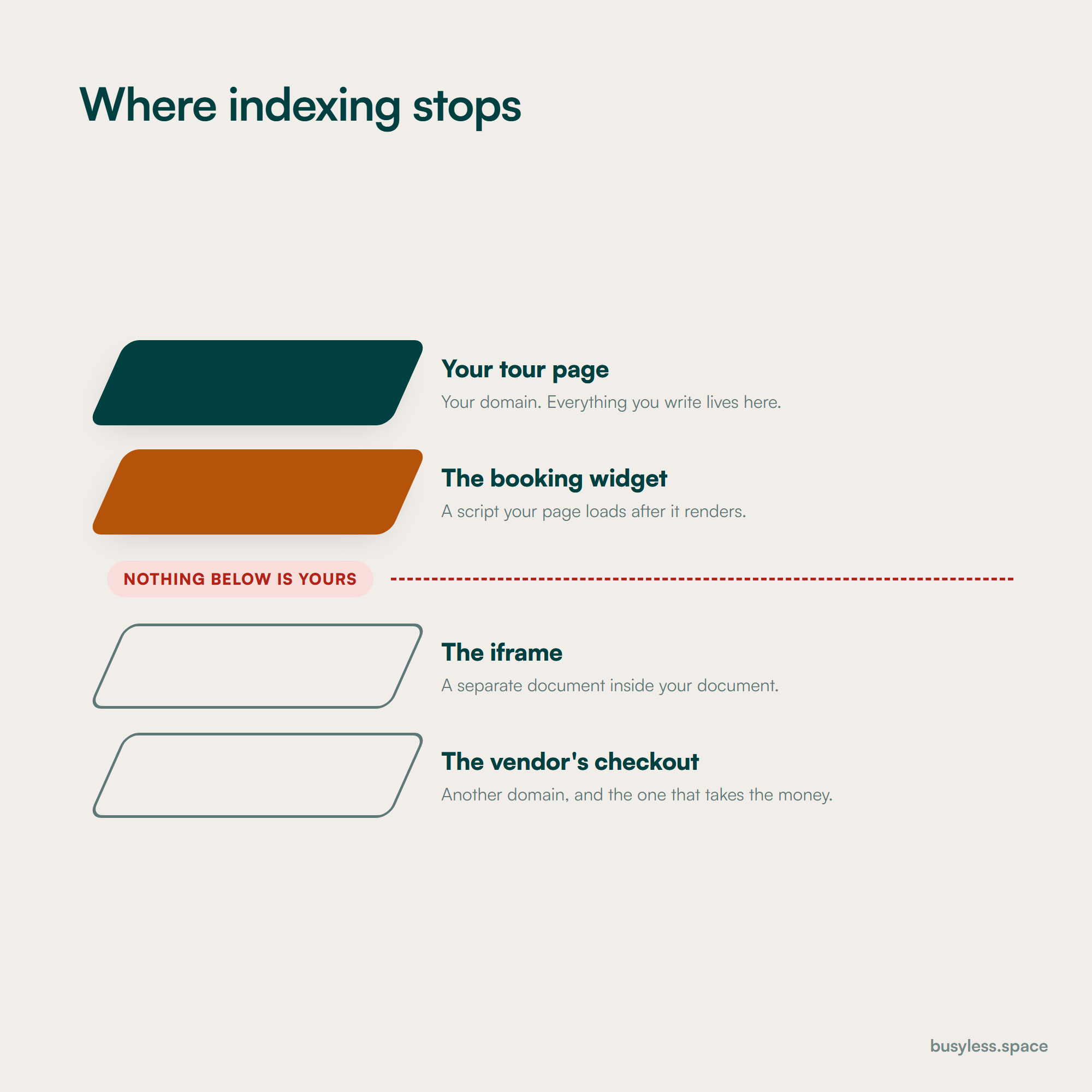
A stack of layers from your tour page down through an embedded widget to an iframe on the booking vendor domain, with the point below which nothing is indexed
The layer that takes the money usually belongs to somebody else. That is a commercial choice worth making deliberately rather than one your booking vendor makes for you.

Structured data that applies here

The types below fit this industry specifically. Most of them earn no rich result on their own, which is worth knowing before anyone sells the work on that basis. What they do is describe the entity precisely, which matters for how search engines and answer engines resolve who you are.

  • TouristTrip

    Every tour and experience page

    The type built for exactly this product, and almost nobody in the category uses it. It carries the itinerary, the duration and the audience, which are the three things a traveller is comparing when they land on the page.

    TouristTrip.jsonld
    {
      "@context": "https://schema.org",
      "@type": "TouristTrip",
      "name": "[TOUR NAME]",
      "url": "https://[YOUR-DOMAIN]/tours/[SLUG]",
      "description": "[WHAT THE TOUR ACTUALLY DOES, IN YOUR WORDS]",
      "touristType": ["[Families]", "[Small groups]"],
      "itinerary": {
        "@type": "ItemList",
        "itemListElement": [
          {
            "@type": "ListItem",
            "position": 1,
            "item": {
              "@type": "TouristAttraction",
              "name": "[FIRST STOP]",
              "address": {
                "@type": "PostalAddress",
                "addressLocality": "[CITY]",
                "addressCountry": "[ISO COUNTRY CODE]"
              }
            }
          }
        ]
      },
      "provider": {
        "@type": "TravelAgency",
        "name": "[YOUR COMPANY]",
        "url": "https://[YOUR-DOMAIN]/"
      },
      "offers": {
        "@type": "Offer",
        "price": "[PRICE]",
        "priceCurrency": "[CURRENCY CODE]",
        "url": "https://[YOUR-DOMAIN]/tours/[SLUG]#book",
        "availability": "https://schema.org/InStock"
      }
    }
  • TouristAttraction

    Landmark and access pages

    Used for the place rather than for your tour of it. This is how a page about how to get into a monument joins up with the entity a search engine already knows, instead of floating as an unattached article.

    TouristAttraction.jsonld
    {
      "@context": "https://schema.org",
      "@type": "TouristAttraction",
      "name": "[LANDMARK NAME]",
      "url": "https://[YOUR-DOMAIN]/guides/[LANDMARK-SLUG]",
      "description": "[HOW ACCESS ACTUALLY WORKS, PLAINLY]",
      "address": {
        "@type": "PostalAddress",
        "streetAddress": "[STREET]",
        "addressLocality": "[CITY]",
        "addressCountry": "[ISO COUNTRY CODE]"
      },
      "geo": {
        "@type": "GeoCoordinates",
        "latitude": "[LAT]",
        "longitude": "[LON]"
      },
      "isAccessibleForFree": false,
      "publicAccess": true,
      "availableLanguage": ["[en]", "[es]"],
      "sameAs": "https://en.wikipedia.org/wiki/[LANDMARK]"
    }
  • TouristDestination

    The destination guide hub

    Ties every guide, landmark page and tour about one place into a single thing. Useful precisely because the destination is the subject of the query, and this is the only markup that says a page is about a place as a place.

    TouristDestination.jsonld
    {
      "@context": "https://schema.org",
      "@type": "TouristDestination",
      "name": "[DESTINATION]",
      "url": "https://[YOUR-DOMAIN]/guides/[DESTINATION-SLUG]",
      "description": "[WHAT A VISITOR ACTUALLY NEEDS TO KNOW]",
      "geo": {
        "@type": "GeoCoordinates",
        "latitude": "[LAT]",
        "longitude": "[LON]"
      },
      "includesAttraction": [
        {
          "@type": "TouristAttraction",
          "name": "[LANDMARK]",
          "url": "https://[YOUR-DOMAIN]/guides/[LANDMARK-SLUG]"
        }
      ],
      "touristType": ["[First-time visitors]", "[Families]"]
    }
  • TravelAgency

    The home page and the about page

    The organisation node for the operator itself, and the right place to put the registration numbers, the licences and the financial protection body. Those are trust signals in the markup as well as on the page.

    TravelAgency.jsonld
    {
      "@context": "https://schema.org",
      "@type": "TravelAgency",
      "name": "[YOUR COMPANY]",
      "url": "https://[YOUR-DOMAIN]/",
      "logo": "https://[YOUR-DOMAIN]/[LOGO].png",
      "address": {
        "@type": "PostalAddress",
        "streetAddress": "[STREET]",
        "addressLocality": "[CITY]",
        "addressCountry": "[ISO COUNTRY CODE]"
      },
      "telephone": "[+00 000 000 000]",
      "areaServed": ["[COUNTRY]", "[REGION]"],
      "availableLanguage": ["[en]", "[de]"],
      "identifier": [
        {
          "@type": "PropertyValue",
          "name": "[California Seller of Travel registration]",
          "value": "[NUMBER]"
        }
      ],
      "sameAs": [
        "https://www.tripadvisor.com/[YOUR-LISTING]",
        "https://www.instagram.com/[HANDLE]"
      ]
    }
  • Offer with dated departures

    Tour pages that sell specific dates

    A dated departure is a different product from an open ticket, and the markup can say so. It is also the honest place for the total price, which is where the fee rules and the conversion argument happen to agree.

    Offer with dated departures.jsonld
    {
      "@context": "https://schema.org",
      "@type": "Offer",
      "name": "[TOUR NAME], [DATE]",
      "url": "https://[YOUR-DOMAIN]/tours/[SLUG]?date=[YYYY-MM-DD]",
      "price": "[TOTAL PRICE INCLUDING MANDATORY CHARGES]",
      "priceCurrency": "[CURRENCY CODE]",
      "availability": "https://schema.org/LimitedAvailability",
      "validFrom": "[YYYY-MM-DD]",
      "availabilityStarts": "[YYYY-MM-DDTHH:MM:SS]",
      "inventoryLevel": {
        "@type": "QuantitativeValue",
        "value": "[SEATS LEFT]"
      },
      "itemOffered": {
        "@type": "TouristTrip",
        "name": "[TOUR NAME]",
        "url": "https://[YOUR-DOMAIN]/tours/[SLUG]"
      }
    }
  • FAQPage

    Practical logistics guides and tour pages

    Only for questions actually shown on the page. The logistics questions in this category are unusually well suited to it, because they have short factual answers and they are exactly what an answer engine resolves.

    FAQPage.jsonld
    {
      "@context": "https://schema.org",
      "@type": "FAQPage",
      "mainEntity": [
        {
          "@type": "Question",
          "name": "[Do I need a visa for COUNTRY?]",
          "acceptedAnswer": {
            "@type": "Answer",
            "text": "[The plain answer, dated, with the official source named.]"
          }
        },
        {
          "@type": "Question",
          "name": "[What happens if it rains?]",
          "acceptedAnswer": {
            "@type": "Answer",
            "text": "[Exactly what you do, including whether a refund applies.]"
          }
        }
      ]
    }

What it costs

These bands are editorial estimates from the work this playbook describes, not quoted prices. What moves an operator up a tier is usually the number of source markets rather than the number of tours, because each market is a separate SERP with a separate set of competitors.

Do it yourself

$0 to $500
  • Every platform and tourism board listing claimed and accurate
  • Title templates rewritten so the tour comes before the brand
  • The trade page written and published
  • TouristTrip markup on the main tour pages
  • Seasonal URLs kept live through the off season

Who it suits

A single-destination operator running a handful of tours, where the founder knows the place better than any writer could and has an evening a week.

Where it stops

One person cannot see eight source markets at once. The moment your guests come from more than two countries, this tier stops showing you the real picture.

Lean

$1,500 to $4,000
  • Destination and logistics guides produced steadily
  • Rank tracking split by source market rather than pooled
  • Localisation for the two markets that actually book
  • Booking flow and availability rendering fixed properly

Who it suits

An established operator with a real season, a booking engine already in place, and enough margin that a point of direct booking share is worth chasing.

Where it stops

Content alone will not fix a distribution problem. If the platforms carry nine bookings in ten, the commercial work is in the trade and direct channels rather than in more guides.

Funded

$4,000 to $9,000
  • A destination content programme across several places or routes
  • Full localisation and market-specific landing pages
  • Trade and corporate acquisition treated as its own funnel
  • Reporting that separates direct, platform and trade revenue

Who it suits

A multi-destination operator or a DMC, where the website is genuinely a sales channel and somebody is accountable for direct booking share.

Where it stops

Search cannot lengthen a season or add capacity. Once the peak weeks are full, more traffic moves the shoulder months and nothing else.

How to do it with no budget

An unusual amount of this is free, because the decisive advantages here are knowledge of the destination and willingness to answer practical questions honestly. Neither of those is something a budget buys.

  1. 1

    Search your own tours from your customers' countries

    An hour

    A search location setting or a VPN

    The results you see at the destination are not the results your buyer sees. Do this before anything else, because it will change which problems you think you have.

  2. 2

    Rewrite your page titles so the tour comes first

    An hour

    Your website editor

    Most booking systems put the company name at the front of every title, which spends the most valuable characters on a word nobody searches. Put the experience and the place there instead.

  3. 3

    Claim and complete the tourism board listing

    An hour

    Your destination marketing organisation

    It is free, it usually ranks for the destination query, and it is the only gatekeeper in this market that wants you to do well. Most operators fill it in once and never revisit it.

  4. 4

    Write the trade page

    An afternoon

    Your website editor

    Commission terms, group capacity, lead times and a named contact. Agents and DMCs search for exactly this and almost nobody publishes it, so it competes with very little.

  5. 5

    Publish one honest logistics guide

    Half a day

    Your website editor

    Pick the question your guests ask by email most often and answer it properly, with dates and official sources. These are the pages that get cited rather than merely visited.

  6. 6

    Ask every guest for a review on the day

    A minute per guest

    Your phone, at the end of the tour

    Asking in person at the end of a good experience is the whole mechanism behind every operator with hundreds of reviews. Anything cleverer than this tends to breach the endorsement rules.

  7. 7

    Stop unpublishing tours at the end of the season

    An hour

    Your booking system settings

    Find the setting that hides a product with no departures and turn it off, then put next season's dates on the page. This one change stops the rankings resetting every single year.

The tool stack

The list is short and two entries on it exist for a reason peculiar to this market: you need to see search results from countries you are not in, and you need to know whether an AI itinerary names you.

  • Check whether AI answers name you in an itinerary

    OtterlySEO APIRead the review

    Travellers increasingly ask an assistant to plan three days somewhere, and the answer names operators or does not. This is a real acquisition surface now and almost nobody in the category is watching it.

    Free routeAsk the assistants your customers use, by hand, monthly

  • Run a site in several languages without three sites

    Kontent.aiHeadless CMSRead the review

    A tour, a departure, a guide and a landmark are structured records that need to exist in several languages at once. Modelling that properly is what stops the German site quietly falling two years behind the English one.

    Free routeA single language plus a translation workflow in your existing CMS

  • Estimate what a season of content could return

    SEO Forecast ToolFree toolOpen the tool

    Useful here mainly to make the lead time visible. Content published in February for an August season looks like a failure in April, and a forecast is the honest way to say so before anybody panics.

    Free routeFree

  • See the SERP from your source markets

    A rank tracker with per-country location settings

    Search Console tells you where impressions already come from, which is the cheapest possible market research. Use it to choose which two markets to localise for rather than guessing.

    Free routeSearch Console filtered by country

  • Keep the platform listings and your own site in step

    Your reservation system's channel manager

    Prices and inclusions drift between your site and the platforms, and a customer who spots the difference does not book on the cheaper one, they stop trusting both.

    Free routeA spreadsheet and a monthly check

  • Track direct bookings against platform bookings

    Your booking system reporting plus analytics

    The number the whole strategy is judged on. Set it up in month one, because a share is only meaningful against a baseline you recorded before you started.

    Free routeFree with most reservation systems

Take it from here

Everything below is meant to be filled in and used rather than read. Bodies are plain text, so what lands on your clipboard is exactly what you see, brackets and all.

Checklist

Records what your buyers see in their own countries, which is usually not what you see in yours.

SOURCE MARKET SERP AUDIT
Operator: [NAME]     Destination: [PLACE]
Run by: [NAME]     Date: [DATE]

BEFORE YOU START
Set your search location to the source market, not your own.
Use a rank tracker's location setting, or a VPN plus a private window.
Record the country and language for each run.

MARKET 1: [COUNTRY]   Language: [LANG]   Currency: [CUR]

Query                                  Who ranks 1-3            Are you present?
[things to do in CITY]                 [ ................. ]    [ ] Y  [ ] N
[CITY food tour]                       [ ................. ]    [ ] Y  [ ] N
[LANDMARK tickets]                     [ ................. ]    [ ] Y  [ ] N
[best time to visit CITY]              [ ................. ]    [ ] Y  [ ] N
[YOUR TOUR NAME]                       [ ................. ]    [ ] Y  [ ] N
[private CITY tour]                    [ ................. ]    [ ] Y  [ ] N
[CITY tours for travel agents]         [ ................. ]    [ ] Y  [ ] N

MARKET 2: [COUNTRY]   Language: [LANG]   Currency: [CUR]
[ REPEAT THE TABLE ]

MARKET 3: [COUNTRY]   Language: [LANG]   Currency: [CUR]
[ REPEAT THE TABLE ]

THE THREE QUESTIONS THIS ANSWERS

1. Is the competitive set the same in all three markets?
   [ ] Yes, one plan works
   [ ] No, and the differences are: [ .......................... ]

2. Which of your OWN tour names are you not ranking first for?
   [ .......................................................... ]
   Each one of these is a page to rebuild, not a keyword to chase.

3. Which market shows the most impressions in Search Console
   relative to how little you have built for it?
   [ .......................................................... ]
   That is the market to localise first.

SIGN OFF
Audited by: [NAME]     Next review: [DATE, 6 MONTHS]

What to publish

The rule for this category is that the page has to be genuinely about the destination. A guide written as a wrapper for your tours reads as one, ranks badly, and does not get cited by the publishers and assistants that matter.

  • Practical logistics guides

    One a fortnight until the obvious questions are covered

    Visas, transport from the airport, tipping, what the weather actually does. Nobody sells anything on these and they are the pages travellers bookmark and answer engines quote.

  • Landmark access pages

    One per landmark you sell around

    How to get in, when to go, what the official site does not explain well. The entity is the landmark, so the page joins a query with real volume that your tour page never could.

  • Month by month timing guides

    One per destination, revised each year

    The single most useful thing an operator knows and the thing a publisher gets wrong. Include the months that are genuinely bad; that is what makes the rest believable.

  • The trade page

    Once, reviewed each season

    Commission, capacity, lead times and a named person. It is the only page on the site written for somebody who books in volume, and it competes with almost nothing.

  • Guide profiles

    One per guide, updated as the team changes

    The guides are the product. Named people with photographs, languages and what they know turns an anonymous booking into a decision about a person.

  • Itineraries built around the destination

    One a month per destination

    Three days in a city, with your tour as one afternoon of it. It is the shape a traveller is actually planning in, and it is what an assistant asked for an itinerary will reproduce.

And what not to

  • Destination guides that are secretly tour brochures, which lose to guides that actually help
  • Top ten lists about your own category, competing with publishers who own those queries
  • Pages that exist only to say you are the best operator in the city
  • Half-built localisation, where two languages exist and only one is maintained
  • Blog posts about your company news, which no traveller has ever searched for

The expensive mistakes

Judging the SERP from the destination

Costs you You optimise against a results page your customers never see, and the competitors you worry about are not the ones taking the booking.

Set your search location to each source market and look again. It takes an hour and it usually reorders the entire plan.

Unpublishing tours in the off season

Costs you A page that spent a year earning rankings 404s for five months, and the following season starts from nothing. This happens every year and nobody connects it to the traffic.

Keep the URL, change the content. Next season's dates, a waiting list and last season's photographs.

Treating the platforms as the enemy

Costs you Operators pull their listings, lose the volume, and discover the direct channel was not ready to replace it. The distribution decision and the ranking problem get confused with each other.

Stay on the platforms and separately win back your own product names. Those are two different projects with two different timelines.

Ignoring the seller of travel question until a lawyer asks

Costs you A rule triggered by your traffic rather than by your address, discovered after you have spent a year buying that traffic.

Work out which regimes your source markets trigger before you scale acquisition, and put the disclosure in the template.

Adding a transfer upsell without reading the package rules

Costs you Two travel services sold together can create a regulated package, with insolvency protection obligations nobody budgeted for.

Check what your checkout combines before you optimise average order value. The conversion win and the regulatory exposure arrive in the same release.

Reporting one global ranking number

Costs you Three markets averaged into one figure that describes none of them, so a collapse in your second-biggest source country is invisible for a season.

Track by market and report by market. The averages are the thing hiding the problem.

What to measure

Two things make measurement unusually hard here and both should be said out loud in the first report rather than explained away in the fourth. The lead time between a guide being read and a tour being taken can be most of a year, and a booking that happens on a platform after research on your site is invisible to your analytics.

Leading indicators

Move first. They predict, they do not prove.

  • Impressions by source market

    Search Console, country dimension

    The cheapest market research available and the number that tells you where to localise next. Read it as a distribution rather than a total.

  • Rankings for your own tour names

    A rank tracker, per market

    The specific measure of whether you have won your product names back from the platforms. It moves faster than destination rankings and it is the first evidence the work is landing.

  • Guide pages entering search results

    Search Console

    Practical guides index quickly and rank slowly. Watch impressions rather than clicks for the first few months, because the clicks arrive with the booking season.

  • Booking widget starts

    Analytics, with the booking flow instrumented

    The step before revenue and the one your own site can genuinely take credit for. If the checkout is on a vendor domain this needs deliberate setup or it reports nothing.

  • Trade enquiries

    The trade page form

    Low volume and high value, so a monthly count is meaningless and a quarterly one is not. Read the enquiries rather than counting them.

Business indicators

The ones a manager acts on.

  • Direct bookings as a share of total

    Your reservation system

    The number the strategy exists to move. Record the baseline before you start, because the share is the only version of this that survives a good or a bad season.

  • Revenue per booking, direct against platform

    Reservation system, split by channel

    Direct bookings should be worth more per head once commission is accounted for. If they are not, the pricing on your own site is the problem rather than the traffic.

  • Bookings from the trade channel

    Your reservation system, by source

    Slow to start and durable once it does. A single agent relationship can outlast several years of consumer marketing, which is why the page that costs an afternoon is worth writing.

The verdict

Most tour operator SEO services arrive with a keyword list for the destination and a plan to outrank a national tourism board. That plan does not survive contact with the results page, and it spends a season proving it.

The work that pays starts closer to home. Your own tour names are being outranked by copies of your own listings, your seasonal pages 404 for five months a year, and your titles begin with a word nobody has ever typed.

Fix those and the destination content has somewhere to send people. Guides that genuinely help somebody plan a trip are also the pages publishers cite and assistants quote, which is the compounding half of this.

So the honest scope for SEO services for tour operators is two projects running in parallel: repair what the booking system broke, and become the most useful source about the place you happen to live in. The second one only works if you actually are.

FAQ

Tour operators SEO questions

  • Why does Viator outrank my own page for my own tour?
    Because it is a much larger domain running a copy of your listing, and your page usually gives it less to work with. Winning the name back is realistic: a strong page with real departures, prices, dates and TouristTrip markup competes for it far better than a thin one.
  • Should I leave the activity platforms and go direct?
    Not as a first move. The distribution decision and the ranking problem are separate, and operators who pull listings before the direct channel is ready lose the volume and keep the problem. Build direct first, then decide.
  • Do the seller of travel laws apply to me if I am not in the US?
    Possibly. California, Florida, Hawaii and Washington apply their seller of travel statutes to anyone doing business with their residents, wherever that seller is based. If you sell to Americans, take advice before you scale US traffic.
  • What counts as a package under the EU rules?
    Broadly, two or more travel services for the same trip sold from one point of sale, or through linked booking processes within twenty-four hours. An accommodation or transfer upsell in your checkout can create one, which brings insolvency protection duties with it.
  • Should I write destination guides or just tour pages?
    Both, in that order of importance and the opposite order of urgency. Fix the tour pages first because they convert, then build guides, because the destination queries are where the volume actually is.
  • How do I stop losing rankings every off season?
    Stop unpublishing the tours. Find the setting in your reservation system that hides a product with no departures, turn it off, and put next season's dates and a waiting list on the page instead.
  • Is it worth translating the site?
    For the two markets that already send you bookings, yes. For eight markets, almost never, because half-maintained translations age badly and a stale price in German is worse than an accurate one in English.
  • When will a season's work actually show up in bookings?
    Six to twelve months, and the shape matters more than the number. Product page work shows up within a quarter. Destination content published in winter usually produces its bookings the following summer, which is why a quarterly review of it reads as failure.

Run it yourself, or have someone own it

Everything above is written to be run without us, and the free path is genuinely most of the value for a single-location business. Where these plans stall is almost never the plan. It is that nobody owns it after the first month. That is the job we do, with search as one distribution layer inside a wider system rather than the whole engagement.