
Kontent.ai review
Best for governed, multi-brand content operations
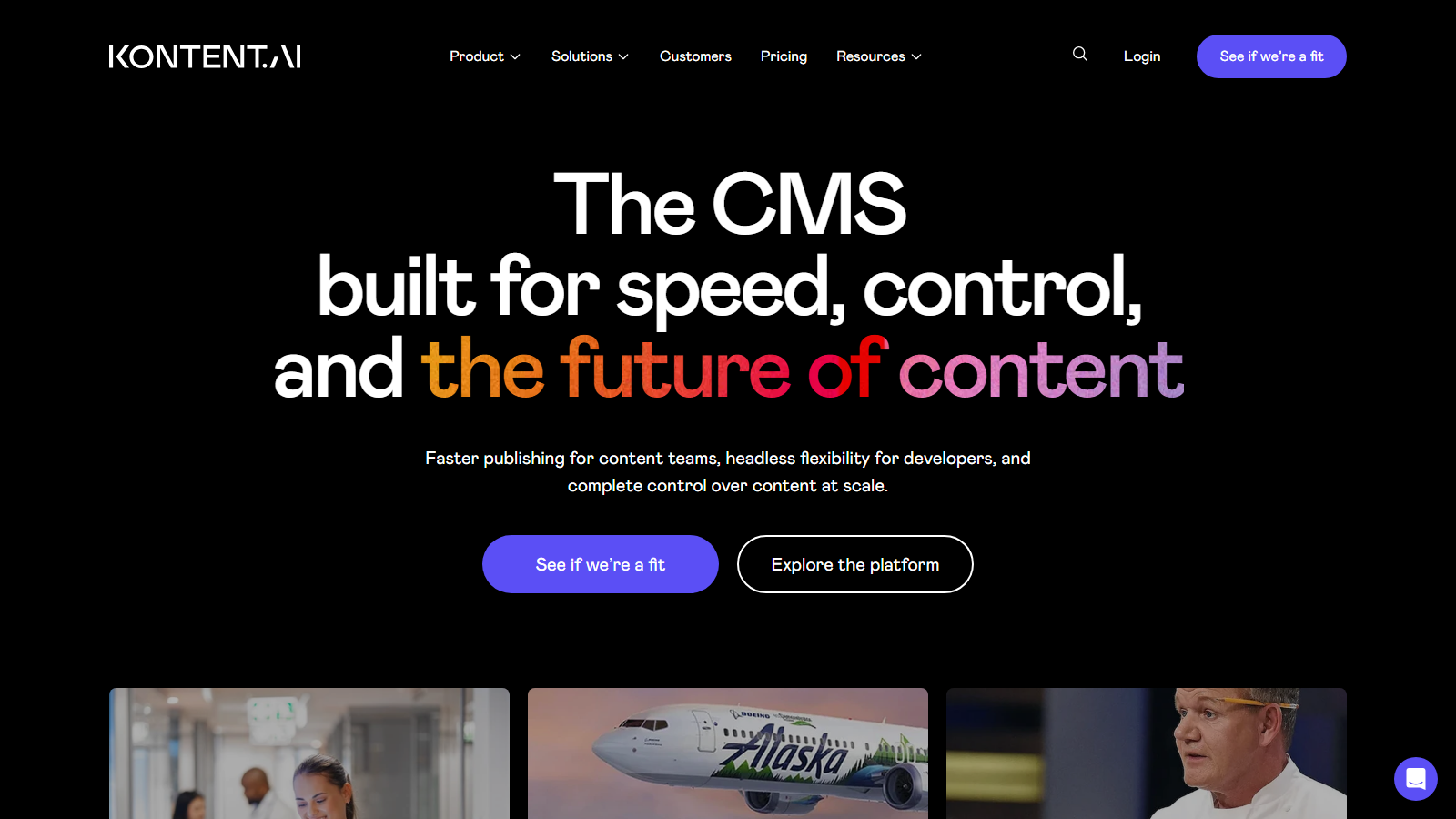
Kontent.ai is a hosted headless CMS for large content teams, and its deepest investment is in workflow, governance and compliance paperwork. It began in 2015 as a start-up inside Kentico, shipped as Kentico Cloud and then Kentico Kontent, and became a standalone company in July 2022 with $40 million from Expedition Growth Capital. It now markets itself as an agentic CMS built around an AI agent called Aiko.
Understand the pricing page first, because it looks more transparent than it is. Three sliders set user seats, content types and content items, and a box returns an additional volume discount. It never returns a price. The code behind it averages three fixed discount tables, so the answer ranges from 0% to 40% of a figure only the sales team can give you.
Two other documents fill part of the gap. The Fair Use Policy still sets monthly API call, storage and bandwidth limits for Developer and Scale plans that the pricing page no longer names. The technical limits page publishes rate limits scoped per environment, with a GraphQL allowance that the GraphQL reference itself states at double the figure.
Our scorecard
Our editorial read across six dimensions, scored 1 to 5. This is our own assessment, not an aggregate of user reviews, and it is deliberately kept out of the page's structured data.
- Content modelling4/5
Content types, snippets, components in rich text, taxonomies, spaces and collections. A language variant tops out at 450kB.
- Developer experience4/5
REST, GraphQL, Sync and Management APIs with per-environment limits and an active MCP server, held back by three SDKs and GraphQL figures that disagree.
- Editor experience4/5
Workflows, live preview with inline editing, and Mission Control for seeing who holds what. Aiko sits behind Innovation Lab.
- Pricing2/5
The dimensions and the discount curve are public. The price those discounts apply to is not, anywhere.
- Governance5/5
Fifty workflows per environment, a public Trust Center with ISO and SOC 2 entries, and four storage regions to choose from.
- Ecosystem3/5
Around two dozen vendor-vetted integrations and official sample apps, but very little public practitioner discussion.
An editorial read, not an aggregate of user reviews, and deliberately kept out of this page's structured data.
Kontent.ai in their own words
From Kontent.ai's own YouTube channel. Vendor marketing rather than an independent review, included because it is the quickest way to see the product before you sign up.
What you can query
Delivery REST API
Uncached: 100/s and 2,000/min per environment
Published items, content types, taxonomies and languages from deliver.kontent.ai, public by default or behind a Delivery API key. Previews use preview-deliver.kontent.ai.
Delivery GraphQL API
1,000 or 2,000 units a second, docs disagree
The same published content through graphql.kontent.ai, metered in resource units per request and rejected above a query complexity limit.
Sync API v2
Shares the Delivery API limits
A read-only change feed telling your app which items changed in the Delivery or Preview API, so a build can refresh only those.
Management API v2
10 req/s and 400/min per environment
Reads and writes at manage.kontent.ai/v2 across items, variants, types, snippets, taxonomies, assets, workflows, webhooks, spaces and roles.
Subscription API
10 req/s and 400/min per subscription
Lists and manages users across every project in a subscription, which is how offboarding gets scripted.
MCP server
MIT, stdio or Streamable HTTP, 0.39.0
Open-source Model Context Protocol server letting AI clients create, update and publish items and variants, and manage types, taxonomies, workflows and spaces.
Who Kontent.ai is for
Content operations teams in regulated or multi-market organisations. Kontent.ai names healthcare and insurance as its focus, and its customer stories add universities and brands running dozens of regional sites. The draw is process and paperwork together, with up to 50 workflows per environment, spaces and collections for separating brands, a Trust Center listing ISO and SOC 2 entries, and four storage regions.
A five-person team shipping one marketing site would pay for governance it will not use, and cannot learn what that governance costs without a sales call.
Strengths and limits
What it does well
- The pricing dimensions are stated openly, seats, content types and content items, and the discount curve can be read straight off the calculator.
- Rate limits, response caps and element sizes are published per API and scoped per environment, so one busy environment cannot starve another.
- Projects can be stored in East US, the Netherlands, Australia or Canada, chosen per project on creation.
- A public Trust Center lists ISO/IEC 27001, 27017, 27018 and 42001, SOC 2 Type 2, CSA STAR, HIPAA, GLBA and DORA among its compliance entries.
- Editorial governance runs deep: up to 50 workflows of 50 steps each, spaces, collections and a Mission Control dashboard for workload.
- A self-serve 30-day trial with no credit card that includes API access and AI credits.
- An official open-source MCP server under MIT, at version 0.39.0 by the end of August 2026, with stdio and Streamable HTTP transports.
- 24/7 in-app chat support on every plan, not only on Enterprise.
Where it falls short
- THE CALCULATOR RETURNS A DISCOUNT, NOT A PRICE: between 0% and 40% off a base figure that is never shown.
- The calculator's code defines a larger top band on every slider, worth up to 77%, that the sliders stop one step short of reaching.
- The Fair Use Policy still limits usage by Developer and Scale plans the pricing page no longer names, so the figures binding a Flex contract are unclear.
- The documentation contradicts itself on GraphQL, giving 1,000 resource units a second on one page and 2,000 on another.
- Official SDKs cover only JavaScript and TypeScript, .NET and Java.
- Aiko, the agent the marketing leads with, is enabled through Innovation Lab, whose features the docs say may change and carry more bugs.
- Content changes are processed one after another, so editing a type with 100,000 items can hold up later publishes for hours.
- User metadata always stays in West Europe whichever region a project uses, and moving a project between regions means cloning it.
Kontent.ai pricing
Kontent.ai calls its pricing page Flex Pricing, and no price appears anywhere on it. The page promises "No unexpected price jumps", "No complicated tiers" and "No excessive add-ons", then offers three sliders and a form. The sliders set user seats, content types and content items. The result box is labelled "Additional volume discount", and a "Get a price calculation" button opens a lead form.
The code behind the sliders is short enough to read. Every band carries a fixed discount: seats climb from 0% to 28% across the reachable bands, content types to 44% and content items to 47%. The box shows the rounded average of the three, so the default position reads 10% and the top of every slider reads 40%.
Each table also holds a sixth band, up to 5,000 seats, 5,000 content types or five million items, worth 57% to 77%. The sliders stop one step short, so those figures never appear on screen. Read the percentages as the shape of a volume curve, not the cost of any point on it.
Usage numbers appear only in the Fair Use Policy, which still names Developer and Scale plans: 200,000 API calls, 2GB of storage and 10GB of bandwidth a month on Developer, and 1,000,000 calls, 100GB and 1TB on Scale. Usage above them for several months can bring throttling or suspension, and Enterprise limits are set per customer.
Evaluation is easier than pricing. The self-serve 30-day trial needs no credit card and includes API access and AI credits. A separate Enterprise trial is arranged after a call, has no fixed length and does not convert to a paid plan automatically. Every plan includes 24/7 in-app chat, and Enterprise adds a Customer Success Manager.
30-day trial
Free
Self-serve, no credit card
- Full platform access, per the trial page
- Enterprise content modelling and workflows
- Full API access for integration testing
- Agentic features with free AI credits
Flex pricing
Quote only
Quoted on seats, content types and items
- Seat bands on the calculator run from 1-10 up to 101-200
- Content type bands from 1-25 up to 251-500
- Content item bands from 1-5k up to 201k-500k
- Output is a 0% to 40% discount, never a price
Enterprise
Quote only
Custom limits and a named CSM
- Dedicated Customer Success Manager and customised onboarding
- Usage limits set per customer rather than per plan
- Enterprise trial of no fixed length, arranged after a call
- 24/7 in-app chat, which every plan also includes
Query example
A minimal fetch against the live API, with credentials read from the environment rather than pasted inline.
curl -s -G "https://deliver.kontent.ai/$KONTENT_ENVIRONMENT_ID/items" \
  -H "Authorization: Bearer $KONTENT_DELIVERY_API_KEY" \
  --data-urlencode "system.type=article" \
  --data-urlencode "elements=title,url_slug,summary" \
  --data-urlencode "order=system.last_modified[desc]" \
  --data-urlencode "depth=0" \
  --data-urlencode "limit=10" \
  --data-urlencode "includeTotalCount=true"

# The Authorization header matters only if secure access is on;
# otherwise published content is public. depth=0 stops linked
# items piling into modular_content toward the 2,000-item cap.
#
# Uncached calls get 100 a second and 2,000 a minute PER
# ENVIRONMENT. A 429 carries Retry-After, and X-Request-Charge
# shows how close a query is to the response limit.
Limits and quotas
- Delivery REST API, uncached: 100 requests a second and 2,000 a minute per environment, Preview API included. Cached requests are unlimited.
- Delivery GraphQL API: 1,000 resource units a second and 40,000 a minute on the technical limits page; the GraphQL reference says 2,000 a second.
- Management API: 10 calls a second and 400 a minute per environment. The Subscription API has the same limits per subscription.
- CDN protection per IP: 1,000 requests a second, 5,000 per 10 seconds and 15,000 a minute for delivery; 300, 2,000 and 6,000 for management.
- Delivery responses stop at 2,000 content items including linked items; URLs at 2,000 characters; GraphQL requests at 8kB.
- Content model: 250 content types and 250 elements per type per environment, and 450kB per language variant.
- Per environment: 50 languages, 50 workflows of up to 50 steps, 100 collections, 50 spaces and 20 webhooks.
- Per project: 10 environments and 100 active API keys.
- Assets: 1,000,000 per environment, 2GB per file, and delivered images up to 8,192 pixels a side.
- Fair Use Policy, monthly: Developer 200,000 API calls, 2GB storage, 10GB bandwidth; Scale 1,000,000 calls, 100GB and 1TB.
Third-party reviews
Scores read from each source on 2026-09-13. We report them as-is and publish no rating of our own.
The listing includes reviews from before July 2022, when the product was still Kentico Kontent. Read through a page fetch rather than a search snippet.
What developers say on Reddit
Practitioner discussion of Kontent.ai on Reddit is too thin to call a sentiment. It appears mostly as a name in enterprise shortlists, next to Contentful and Storyblok, without anyone describing a build. One of the warmer recent comments came from an account that disclosed working at Kontent.ai, so it is left out.
What first-hand material exists is older than the product in its current form. Comments praising Kentico Kontent date from 2020 to 2022, before the rename and long before the agentic repositioning, and a researcher in 2021 already found its enterprise packages expensive.
The most recent substantive signals are about evaluation rather than use. A consultant who saw a demo singled out the workflow dashboards, which Kontent.ai calls Mission Control. A buyer preparing an RFP reported that Kontent.ai had been ruled out, without giving a reason. Neither is a verdict, and both are quoted as what they are.
“Things like workflow I have very rarely seen done well in CMSs, enterprise or otherwise. I saw a demo of workflow dashboards in kontent.ai which looked very good (I think they call it Mission Control).”
r/cms on Reddit“Also the 3 I have mentioned is a refined list which included Kontent.AI Contentful and Strapi but these were ruled out.”
r/cms on Reddit“From my brief research, the front-end of Kentico Kontent looks the most versatile, but its enterprise packages are expensive.”
r/cms on Reddit
Verdict
Kontent.ai earns its place on a shortlist when the bottleneck is governance rather than code: many brands or markets, formal approval chains, and a compliance team that will read the Trust Center line by line. The workflow depth, the per-environment limits and the certification list are the product's real strengths, and every one of them is documented in public.
Treat the pricing page as what it is, a lead form with a discount meter attached. Ask for the base price for your seat, content type and item bands in writing. Ask too which Fair Use figures apply to a Flex contract, since the policy still names plans the pricing page has retired.
Developers should use the 30-day trial to test two things. Run realistic GraphQL queries and watch the X-Request-Charge header, because the documents disagree about the allowance by a factor of two. Then edit a content type in an environment with real volume and time how long later publishes wait, because that queue is documented and easy to overlook.
Kontent.ai FAQ
How much does Kontent.ai cost?
No figure is published. Flex pricing is quoted on user seats, content types and content items, with volume discounts, and every plan includes 24/7 in-app chat. The calculator on the pricing page shows only a discount percentage, so the number itself arrives from the sales team after you submit a form. Trying it first costs nothing: the 30-day trial needs no card.What does the Kontent.ai pricing calculator calculate?
A discount, not a price. Each slider band carries a fixed percentage, and the box shows the rounded average of the three: 0% at the smallest bands, 10% at the default position and 40% at the largest you can select. The code also defines a bigger band on each slider, worth up to 77%, that the sliders cannot reach.Is Kontent.ai the same as Kentico Kontent?
Yes, renamed and spun out. It began in 2015 as a start-up inside Kentico, launched as Kentico Cloud in 2017, became Kentico Kontent in 2019 and a standalone company, Kontent.ai, in July 2022. Kentico Kontent pricing from before the split is no longer a guide. Mark Greenaway became chief executive on 27 April 2026.How are Kontent.ai API calls rate limited?
Kontent.ai allows 100 uncached Delivery REST calls a second and 2,000 a minute, and 10 Management API calls a second and 400 a minute. Both apply per environment, however many API keys you use. Cached delivery requests are unlimited. For GraphQL, one Kontent.ai page says 1,000 resource units a second and another says 2,000.Kontent.ai or Contentful: which costs less to own?
Public figures cannot settle it. Contentful's page in this directory lists a free tier and a $300 monthly Lite plan, while Kontent.ai publishes no figure at all. Contentful meters API calls, records and spaces; Kontent.ai quotes on seats, content types and items. Get a written Kontent.ai quote for your bands, then add implementation, translation and AI credit costs to both.How well do the Kontent.ai APIs serve developers?
Solid on the fundamentals: REST and GraphQL delivery, a Sync API for change feeds, Management and Subscription APIs, and limits documented per environment with a Retry-After header on every 429. The weak spots are three official SDKs, for JavaScript, .NET and Java, and docs that contradict themselves on GraphQL limits. The MIT-licensed MCP server is actively maintained.What compliance does Kontent.ai document?
Its public Trust Center lists ISO/IEC 27001, 27017, 27018 and 42001, SOC 2 Type 2, CSA STAR, HIPAA, GLBA, DORA and NIS 2 among its compliance entries, with detailed reports available on request. Projects can be stored in East US, the Netherlands, Australia or Canada, although user metadata always stays in the West Europe region.Is Kontent Machine part of Kontent.ai?
No. Kontent Machine is an unrelated SEO content tool that happens to share the spelling. Kontent.ai does not sell it, and nothing on this page, including the review score, refers to it. Kontent.ai's own products are the headless CMS, its APIs, the Aiko agent and the open-source MCP server.
Other platforms worth a look
This is an independent review. We have no affiliate relationship with Kontent.ai, earn nothing if you sign up, and no vendor pays for placement in the directory. Prices were read from the vendor's own pages in September 2026 and change without notice.