
Skip to content

Solar SEO strategy

YMYL and regulated

Who owns the panels decides which savings claims are true

Written by Eugene SuslovLast reviewed 18 September 2026No affiliate links
Sector
Home and trades
Model
Local service, Multi-location
Competition
Brutal
Time to results
6 to 12 months
Typical monthly
$2,500 to $10,000

Key takeaways

  1. 1The federal credit did not end so much as move. A buyer cannot claim it on a system installed after 2025, while a leasing company or PPA provider may still claim a business credit on the same panels.
  2. 2So every savings sentence on your site has to name the contract it is true for. Certificates, upkeep and what happens when the house sells split on ownership too, and they will outlast the credit.
  3. 3Build location pages around utilities, not cities. The tariff and the export rate follow the utility territory, and in the Los Angeles area LADWP and Southern California Edison run different regimes.
  4. 4In California your website calculator and the contract meet at signing. The contract's own estimate covers twelve months at current rates with no escalation, so a long-range figure online sets up a contradiction.
  5. 5Price every enquiry per signed contract, never per lead. SolarReviews' own published tiers sell one enquiry to as many as four companies.

SEO for solar companies was built for years on one sentence: a 30% federal tax credit applies. That sentence is now false for a buyer and can still describe what a leasing company claims. What decides it is not the date on the page. It is who owns the panels.

The homeowner's credit, section 25D, stopped for expenditures made after 31 December 2025, and the statute treats an expenditure as made when installation is completed. The business credit a lessor or PPA provider claims, section 48E, still covers leased solar electric systems, to a deadline of its own.

So a solar SEO strategy starts with an audit of claims rather than a keyword list. Renewable energy certificates, upkeep, warranty responsibility and what happens when the house is sold all split on ownership as well, which is why the fork will outlast the business credit too.

The second structural fact is geographic. Net metering, export rates and most rebates attach to the utility territory rather than to the city, and one metro can sit under two regimes. A location page that never names the utility is wrong for part of its own town.

Two states now have rules that reach the website itself. California prescribes how the contract estimates savings, which a long-range calculator on the site will contradict, and Texas forbids implying an affiliation with a utility or a government agency when selling or leasing.

All of it plays out on a heavily contested results page. Marketplaces rank above installers and resell the enquiry, and national leasing brands publish a city page for market after market, making the case that their lease keeps the credit.

Who already ranks in solar

Most solar SEO work is fought on a results page that sells the enquiry before an installer sees it. Marketplaces hold the city and head terms, national leasing brands hold a page per market, and the tariff queries are where local installers still rank. If you also sell roofs, the storm pages belong to the roofing playbook.

What is on the results page

  • Marketplace city pages from EnergySage and SolarReviews above installers on near-me queries
  • A local pack in which several results are roofing firms that also sell solar
  • People Also Ask boxes circling whether the federal credit still exists
  • AI Overviews answering lease versus buy with the credit question folded in
  • Programmatic city pages from national leasing brands
  • Affiliate best-company lists from national publishers on best-of queries
  • Installer blogs and the regulator's own pages on tariff queries such as NEM 3.0
  • Calculator microsites built on the same rooftop data as the installer widgets
  • EnergySage

    energysage.comClaim it

    A marketplace owned by Schneider Electric since February 2022, where installers pay to participate, and whose local pages cover utilities as well as cities. Decide on it by cost per signed contract. Then out-publish it on the one thing it cannot hold: your own installations inside a named utility territory.

  • SolarReviews

    solarreviews.comClaim it

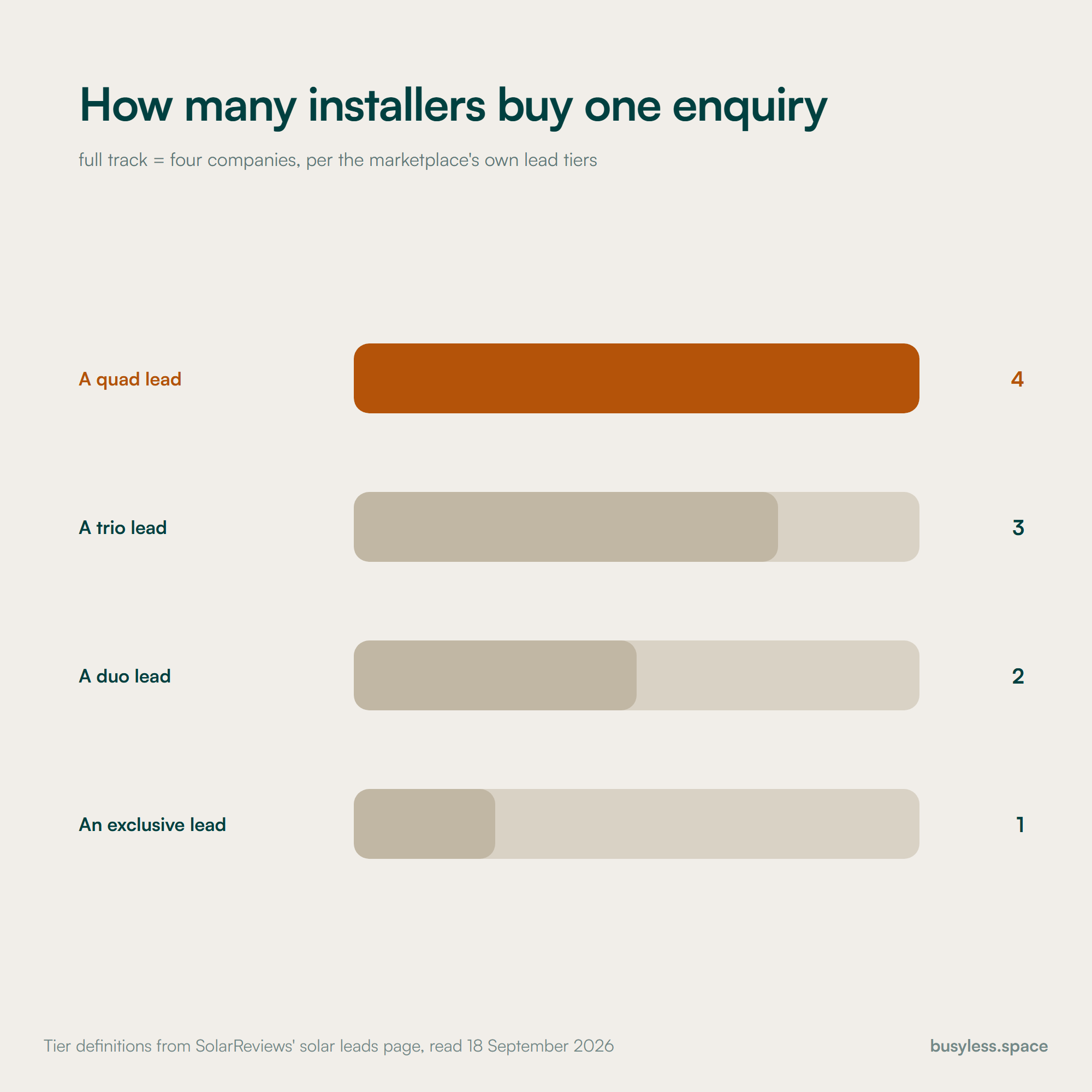
    Reviews, city rankings, incentive pages and a calculator, and it sells the enquiry. Its own lead page defines Exclusive, Duo, Trio and Quad as a lead sold to one, two, three or four companies. Claim the profile, answer the reviews, and price any paid tier per signed contract.

  • Solar.com

    solar.com

    A marketplace with some of the strongest lease-versus-buy content on the results page. It explains the choice in general. You can explain it for the contracts you actually sell, in the utility territories you actually serve, with the date you checked.

  • Forbes Home, ConsumerAffairs, NerdWallet and EcoWatch

    forbes.com, consumeraffairs.com, nerdwallet.com, ecowatch.com

    Affiliate and lead-generation lists that own the best solar companies queries and name national brands. I would concede these. A regional installer does not win a national best-of query, and the effort belongs on pages those lists cannot write.

  • National leasing brands

    palmetto.com, sunrun.com, tesla.com

    Programmatic city pages, market after market. Palmetto's Phoenix page, read on 18 September 2026, tells cash buyers the federal credit is gone and says its lease still qualifies for the commercial credit. That is the argument a local page has to answer, for the contracts you sell.

  • DSIRE

    dsireusa.org

    The Database of State Incentives for Renewables and Efficiency, operated at North Carolina State University with Department of Energy funding. It is the incentive authority, so link to it rather than competing with it, and spend your own words on what a programme means for your contracts.

  • Utilities and regulators

    cpuc.ca.gov, ladwp.com, srpnet.com

    They own the tariff queries at the source, and some publish installer lists. Link the exact tariff page from yours, use the name the bill uses, and describe any list you appear on in the utility's own words, because Texas now polices implied affiliation.

  • Google Project Sunroof and the Solar API

    sunroof.withgoogle.com

    Project Sunroof still resolves as a client-rendered app, and the same rooftop data is sold as the Google Maps Platform Solar API, which powers many installer calculator widgets. So the widget on your site may share its data with the calculator microsites ranking above you.

Four bars showing how many installers SolarReviews sells one enquiry to under its published lead tiers: four for a quad lead, three for a trio, two for a duo and one for an exclusive
The tier names are the marketplace's own. The price you are quoted is per lead; the number worth tracking is what each signed contract cost.

What people actually search

Nobody searches for solar at seven in the morning with a broken system. The clusters below belong to a decision that takes months, and most of them fork on the contract or on the utility, which is where a national page has the least to say.

After the credit

Informational, purchase on hold

is solar still worth it without the tax credit

The page that wins it: A page per contract type saying what the credit change means for that contract

Two groups search this. Prospects deciding whether to buy at all, and last year's buyers asking whether an unused credit carries into 2026, which the 2025 Form 5695 instructions say it can. Send the second group to a tax professional, not to a sales page.

Which contract

Commercial investigation, comparison led

solar lease vs buy

The page that wins it: A lease-versus-buy page naming who claims which credit, with a review date

The marketplaces explain the choice in general. An installer's version can say which contracts it sells, which party holds the certificates on each, and what happens at resale, which is the detail an abstract comparison cannot carry.

One tariff, three names

Informational, utility specific

is nem 3.0 still worth it

The page that wins it: One page per utility using the searched name, the regulator's name and the name on the bill

The head cluster where local installers still rank, because the answer changes by utility. In California homeowners search NEM 3.0, the regulator calls it the Net Billing Tariff and the CPUC's consumer guide calls it the Solar Billing Plan.

Battery attach and retrofit

Commercial, retrofit

add a battery to existing solar panels

The page that wins it: A retrofit page for existing owners, including systems another company installed

In California the scope of a solar contractor's battery work is itself disputed. CSLB says its C-46 battery amendment is stayed by court order, and a settlement the plaintiffs reported in early 2026 had not been voted on by the board as of 18 September 2026.

Orphaned systems

Transactional, urgent but no emergency

solar company went out of business who services my panels

The page that wins it: A service page for systems other installers put in, brand by brand

Owners whose installer closed are searching with nobody to call. In Texas, rules adopted in June 2026 require a retailer ceasing operations to designate someone to honour ongoing warranty obligations, which gives the page a real answer to point to.

Selling or buying a house with solar

Informational, with a closing date

selling a house with leased solar panels

The page that wins it: A home-sale page per contract type: owned, financed and leased

Ownership decides the answer again. An owned system goes with the house, a loan has to be settled or, where the lender allows it, taken on, and a lease has to be transferred to a buyer the provider accepts or bought out.

Verification

Navigational, suspicious

is the texas solar program legit

The page that wins it: A page saying which programmes exist in your state, and that you are not one of them

Programme-shaped titles taught buyers to ask whether a solar offer is real. In Texas the TDLR registration lookup exists from 1 September 2026, and a page pointing readers to it is the opposite of the pattern they are worried about.

Local shortlist

Local commercial

solar installers near me

The page that wins it: Location pages keyed to utility territory, plus the business profile

The marketplaces and leasing brands hold the city term. A local page earns the click by naming the utility, what it means for export, and the systems you have connected on that network. Phoenix, for one, is split between APS and SRP.

What the rules change

This is my reading of the rules as of 18 September 2026, not legal or tax advice, and net metering and solar contract law are moving in several states at once, so check your own. The electrician page covers deleting the dead credit; this page is about the one that moved to the leasing company, and the rules that reach a solar site directly.

1

A credit claim now has to say who claims it

IRC 48E(e)(4) and 48E(i), as amended by Public Law 119-21 section 70513 (4 July 2025); IRC 25D(h); IRS Notice 2025-42 (15 August 2025) and Notice 2026-15 (12 February 2026)

What it means

48E(i) denies the business credit on leased property only for solar water heating and small wind, so leased and PPA solar electric systems remain eligible. Its cliff excludes solar placed in service after 31 December 2027 where construction began after 4 July 2026. The homeowner's 25D credit ended for expenditures made after 31 December 2025.

So do this

Rewrite every credit sentence to name the party that claims it. A lease or PPA page may say the provider claims a business credit; a purchase page may not say the buyer does. Date every lease claim, set a review against 31 December 2027, and confirm your provider's position before publishing.

2

The tariff has three names and follows the utility

CPUC Decision D.22-12-056 (15 December 2022), Resolution E-5301 (30 November 2023) and the CPUC consumer guide addendum (2 September 2025); LADWP Net Energy Metering Guidelines (amended January 2021)

What it means

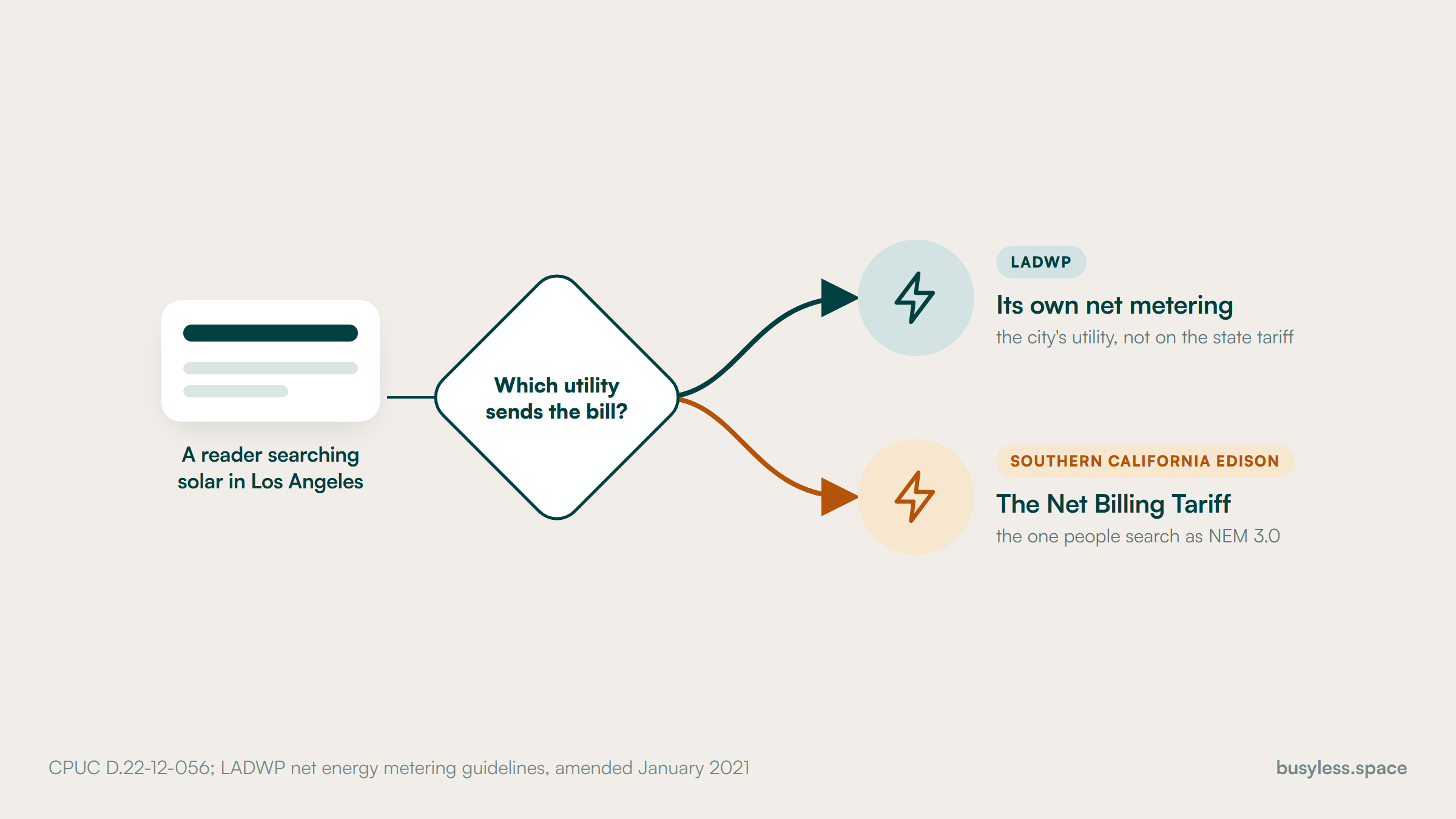
California's Net Billing Tariff covers interconnection applications from 15 April 2023 on PG&E, SCE and SDG&E. Homeowners search NEM 3.0, the regulator calls it the Net Billing Tariff and the CPUC's own guide calls it the Solar Billing Plan. LADWP runs its own net metering programme and is not on the tariff at all.

So do this

Use all three names on one page per utility, and build location pages by utility territory. A Los Angeles page explaining NEM 3.0 is wrong for LADWP customers. Other states have moved too, North Carolina's Duke Energy riders from 1 October 2023 among them, so read your own commission's orders.

3

The contract's savings estimate will contradict a long-range calculator

California Business and Professions Code 7169, as amended by SB 826 (2021); CPUC Resolution E-5364 (13 March 2025), its escalation cap applying from November 2025

What it means

The Solar Energy System Disclosure Document sits on the contract's front or cover page in boldface 16-point type. Its bill savings estimate covers the 12 months after installation, at current rates, with no rate escalation, using NREL's PVWatts. The escalator in any other calculation, alternative calculations included, is capped at the CPUC's five-year historical average.

So do this

Lead with the regulated twelve-month figure and label anything longer as an alternative calculation with its escalator stated. The contract must be in the language principally used in the sales presentation or the marketing given to the customer, so a Spanish landing page can commit you to a Spanish contract. California only; check your own state.

4

Texas forbids implying a utility or government connection

Texas Occupations Code chapter 1806 (SB 1036, in force 1 September 2025, registration and enforcement from 1 September 2026); TDLR rules at 16 TAC chapter 71, adopted in the Texas Register of 26 June 2026

What it means

Residential solar retail includes an offer to sell or lease. Nobody engaged in it may knowingly or recklessly make a false, misleading or deceptive statement, or falsely state or imply an affiliation with a public utility or a government agency. Leases and PPAs are covered, and the rules make a retailer that stops trading designate someone to honour ongoing warranty obligations.

So do this

Retire programme-shaped page titles and any utility logo strip that implies a relationship you do not have. Show your TDLR registration once you hold it, and if you serve Texas, write the page for owners whose installer has closed. Read the current TDLR rules yourself; this is not legal advice.

5

Free panels and programme language fail the federal floor

FTC Impersonation Rule, 16 CFR Part 461 (in force 1 April 2024); FTC solar guidance published with Treasury and the CFPB on 7 August 2024

What it means

The rule forbids posing as, or misrepresenting an affiliation with, a government entity, directly or by implication. The FTC's solar guidance says offers of 'free' or 'no cost' solar panels are scams, and tells sellers not to overpromise savings that might come through tax credits, rebates or incentives.

So do this

Search your titles, headings and ads for free, programme, enrolment and government, in either spelling. A page ranking for a Texas incentives query in September 2026 carried free, programme and enrolment in its title tag, beside a credit schedule that no longer applies to a buyer. Describe what you sell instead.

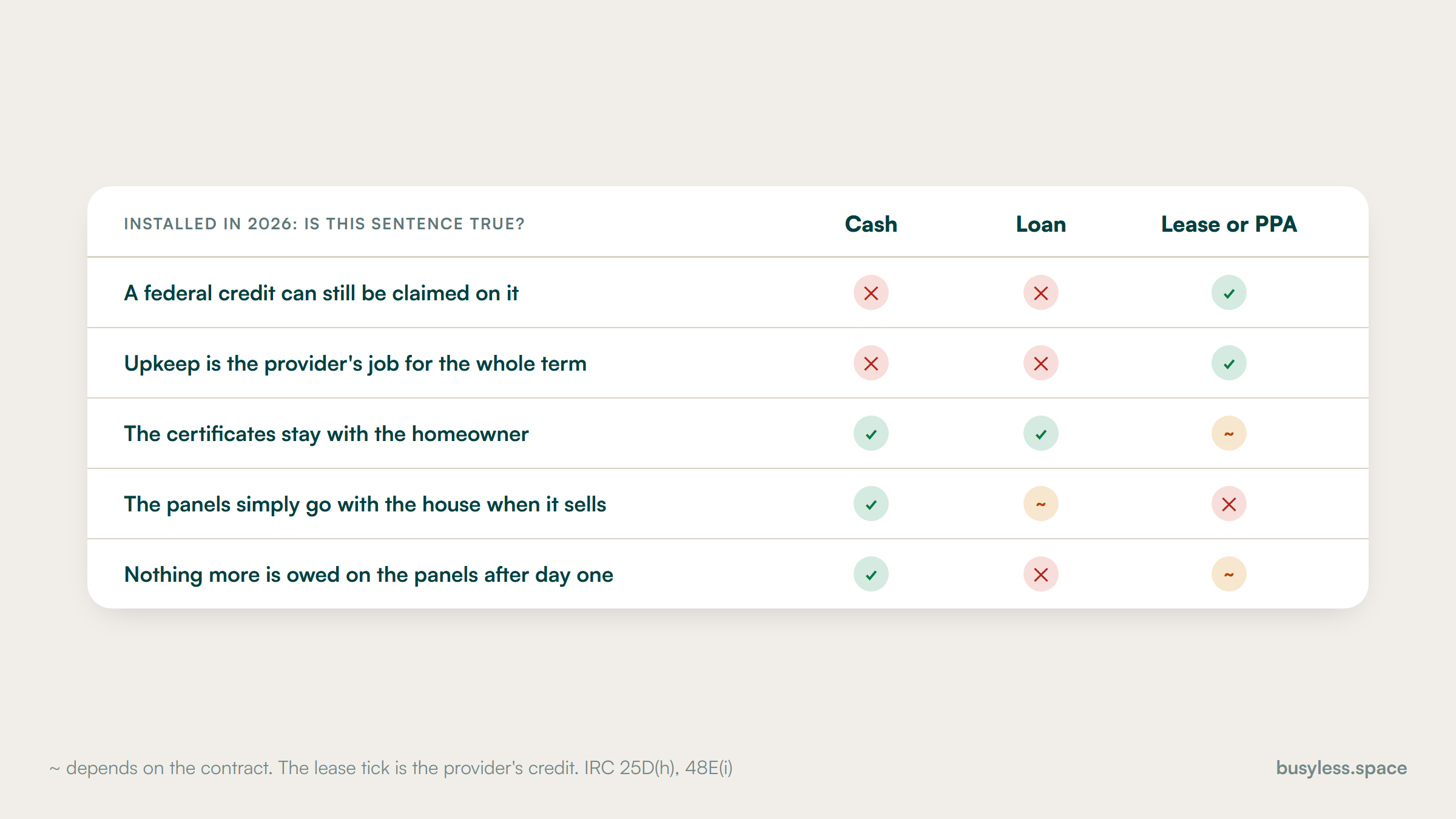
A checklist comparing a cash purchase, a solar loan and a lease or PPA for a system installed in 2026, marking which of five common website claims is true on each contract
No column wins every row, which is the point. The lease column's credit tick belongs to the provider rather than the homeowner, and it carries its own deadline.

Proving expertise

A solar contract can run twenty years or more and is sold with money attached, so the reader is checking whether the numbers were set by somebody accountable. Every signal below is something a homeowner, a lender or a quality rater can verify.

  • NABCEP certification named per installer, with the credential's name rather than a logo
  • The contractor licence class in text, such as C-46 or C-10 in California, with the issuing board
  • The Texas solar retailer registration number, once issued, from 1 September 2026
  • Every savings figure labelled with its contract type, its assumptions and the date it was checked
  • The utility named on every location page, with the tariff in force and the date it was read
  • Warranty responsibility split by issuer: panel maker, inverter maker, your workmanship, monitoring
  • Monitored production from your own installations, published by utility territory
  • What happens to service if you stop trading, stated plainly

How to build a solar SEO strategy

The order below starts with what the site already claims, not with keywords. A solar SEO strategy that builds city pages before the savings claims are audited publishes the same error once per city, and the error now depends on the contract rather than on the date.

  1. 1

    Weeks 1-3

    Sort every claim by contract

    • List every savings, credit, certificate, upkeep and home-sale claim across pages, titles and calculator defaults
    • Mark each one true for cash, loan, lease or PPA, and rewrite any that names no contract
    • Check the FAQ markup and the calculator configuration for the credit, not only the copy
    • Retire programme-shaped titles and any utility logo strip
    • Put a review date on every lease credit claim

    You end up with
    A claims register by contract type, and no page implying a credit or an affiliation that does not exist

  2. 2

    Weeks 4-6

    Map the utilities you serve

    • Map the service area to utility territories rather than to a city list
    • Find every city page that spans two utilities and plan the split
    • Collapse cloned state incentive pages for states you do not serve
    • Claim and correct the EnergySage and SolarReviews profiles
    • Set the business profile's service area to where you can actually connect

    You end up with
    A utility map, and a page plan built from it rather than from a list of towns

  3. 3

    Weeks 7-10

    Build the utility pages and fix the calculator

    • Publish one page per utility, with the tariff under every name it goes by
    • Publish the calculator's assumptions as text beside the widget
    • In California, lead with the twelve-month, no-escalation estimate
    • Publish the lease-versus-buy page, naming who claims which credit
    • Link each incentive claim to DSIRE or to the regulator's own page

    You end up with
    Location pages that are right for every address on them, and savings figures a homeowner will recognise at signing

  4. 4

    Weeks 11-13

    Serve the people who already own panels

    • Publish the orphaned-system page and one page per brand you service
    • Publish the battery retrofit page
    • Publish the home-sale pages for owned, financed and leased systems
    • Start publishing monitored production by utility
    • Report cost per signed contract by source, not cost per lead

    You end up with
    An owner audience the marketplaces do not serve, and a report measured in contracts

Technical fixes with the best payoff

The defects here are mostly about where a number lives. Calculators run inside vendor iframes, the dead credit survives in markup and defaults nobody re-reads, and location pages are built from a city list rather than from a utility map.

  • The calculator runs in a vendor iframe

    An afternoon, then one per utility

    Installer calculators are sold as embeds. Solar Estimator's is an iframe, OpenSolar's lead tool is a snippet or a popup, and several vendors sell calculators built on Google's Solar API. None of the result is in your HTML, and the vendor sets the rate, the escalator and the credit treatment.

    Publish the assumptions as text beside the widget, with a worked example for a typical roof in each utility territory. In California, lead that text with the twelve-month, no-escalation estimate.

  • The dead credit survives in markup and defaults

    A day

    Copy reviews read the body. The credit also lives in title tags, hero banners, calculator defaults that still subtract it, and FAQPage JSON-LD answering yes. Google stopped showing FAQ rich results on 7 May 2026, but answer engines still read the markup.

    Crawl titles, meta descriptions, alt text, structured data and calculator settings as well as copy. Then rewrite by contract: remove the claim from purchase pages and keep a named, dated version on lease pages.

  • City pages never name the utility

    A sprint

    The export tariff, the rate plan and most rebates attach to the utility territory. Phoenix addresses split between APS and SRP. In the Los Angeles area an address may be served by LADWP or by Southern California Edison, under different regimes, so a cloned city page is wrong for part of its own city.

    Name the utility in the title and the first paragraph, and split any page whose area spans two. Where one utility serves the whole town, say so and link its tariff page.

  • Cloned state pages share one false sentence

    A week, then quarterly

    State incentive pages were often built from one template with the state name swapped and an identical federal paragraph, so every one of them became wrong in the same sentence on the same day.

    Consolidate the states you do not serve. Rewrite the ones you do around state and utility programmes, link each to DSIRE, and date every figure.

  • Your trust content lives on a vendor's domain

    An hour to check

    OpenSolar's PROfile gives an installer a public URL with an editable slug carrying reviews, licences and team photos, and online proposals live on design-software URLs. Whether those profile pages are indexed is unconfirmed, and where they are, they duplicate your own.

    Keep the canonical version of every credential and review on your own domain. Search the vendor's domain for your company name, and if a profile is indexed, make sure it links back.

  • The old dealer page is still live

    An afternoon per brand

    SunPower filed for Chapter 11 on 5 August 2024 and the brand has changed hands since. Former dealer sites still carry authorised-dealer pages, promising a relationship that no longer exists to owners who need service.

    Rewrite each one as a service page for existing owners of that brand: what you can service, what you cannot, and who now holds each warranty where you know.

A decision fork for a reader searching solar in Los Angeles: where LADWP sends the bill its own net metering applies, and where Southern California Edison does, the state's Net Billing Tariff applies
The city is the keyword and the utility is the answer. A location page that names neither is wrong for somebody, whichever tariff it explains.

Structured data that applies here

The types below fit this industry specifically. Most of them earn no rich result on their own, which is worth knowing before anyone sells the work on that basis. What they do is describe the entity precisely, which matters for how search engines and answer engines resolve who you are.

  • HomeAndConstructionBusiness

    The home page and each utility territory page

    Schema.org has no solar subtype, so this is the closest honest fit. The new part is areaServed: name the utility territories you connect in, not only towns. It earns no rich result. What it buys is an entity that says where your work is valid.

    HomeAndConstructionBusiness.jsonld
    {
      "@context": "https://schema.org",
      "@type": "HomeAndConstructionBusiness",
      "@id": "https://[YOUR-DOMAIN]/#business",
      "name": "[COMPANY NAME]",
      "url": "https://[YOUR-DOMAIN]/",
      "logo": "https://[YOUR-DOMAIN]/[LOGO].png",
      "telephone": "[+1 000 000 0000]",
      "address": {
        "@type": "PostalAddress",
        "streetAddress": "[STREET]",
        "addressLocality": "[CITY]",
        "addressRegion": "[STATE]",
        "postalCode": "[ZIP]",
        "addressCountry": "US"
      },
      "areaServed": [
        {
          "@type": "Place",
          "name": "[UTILITY NAME] service territory, [STATE]"
        },
        {
          "@type": "Place",
          "name": "[SECOND UTILITY NAME] service territory, [STATE]"
        }
      ],
      "knowsAbout": [
        "[Solar installation]",
        "[Battery retrofits for existing systems]",
        "[Service for systems installed by other companies]"
      ],
      "sameAs": [
        "[BUSINESS PROFILE URL]",
        "[STATE LICENCE LOOKUP URL]"
      ]
    }
  • Legislation

    Incentive and tariff pages, once per rule the page relies on

    A core schema.org type with a date and an in-force status, which is exactly what an incentive claim needs. No rich result. It tells an answer engine which rule the page relies on, and when a rule ends you change legislationLegalForce to NotInForce rather than deleting the claim silently.

    Legislation.jsonld
    {
      "@context": "https://schema.org",
      "@type": "Legislation",
      "name": "[NAME OF THE RULE OR TARIFF]",
      "legislationIdentifier": "[OFFICIAL IDENTIFIER, e.g. A DECISION OR SECTION NUMBER]",
      "legislationDate": "[YYYY-MM-DD]",
      "legislationJurisdiction": "[STATE OR UTILITY TERRITORY]",
      "legislationLegalForce": "https://schema.org/InForce",
      "legislationPassedBy": {
        "@type": "Organization",
        "name": "[LEGISLATURE OR REGULATOR]"
      },
      "url": "[OFFICIAL SOURCE URL]"
    }
  • Dataset

    A production data page for your own installations

    Monitored generation from systems you installed, by utility territory and month. Eligible for Google Dataset Search, not for a web rich result. It is the honest counterweight to a vendor calculator, because it is measured rather than modelled and nobody else holds it.

    Dataset.jsonld
    {
      "@context": "https://schema.org",
      "@type": "Dataset",
      "name": "[COMPANY] monitored solar production by utility territory",
      "description": "[What was measured, how many systems, how they were chosen, and what is excluded]",
      "url": "https://[YOUR-DOMAIN]/production-data",
      "creator": {
        "@type": "Organization",
        "name": "[COMPANY NAME]",
        "url": "https://[YOUR-DOMAIN]/"
      },
      "license": "[LICENCE URL]",
      "dateModified": "[YYYY-MM-DD]",
      "temporalCoverage": "[YYYY-MM]/[YYYY-MM]",
      "spatialCoverage": {
        "@type": "Place",
        "name": "[UTILITY NAME] service territory, [STATE]"
      },
      "variableMeasured": [
        "[Monthly generation per kW installed]",
        "[Generation exported to the grid]"
      ],
      "distribution": {
        "@type": "DataDownload",
        "encodingFormat": "text/csv",
        "contentUrl": "https://[YOUR-DOMAIN]/production-data.csv"
      }
    }
  • EducationalOccupationalCredential

    Team and about pages, through hasCredential on each Person

    NABCEP certification, the state licence class and, in Texas from 1 September 2026, the solar retailer registration. No rich result, but these are the checkable credentials in this trade, and markup keeps their names exact rather than paraphrased.

    EducationalOccupationalCredential.jsonld
    {
      "@context": "https://schema.org",
      "@type": "Person",
      "name": "[INSTALLER NAME]",
      "jobTitle": "[ROLE]",
      "worksFor": {
        "@type": "Organization",
        "name": "[COMPANY NAME]",
        "url": "https://[YOUR-DOMAIN]/"
      },
      "hasCredential": [
        {
          "@type": "EducationalOccupationalCredential",
          "credentialCategory": "certification",
          "name": "[NABCEP CREDENTIAL NAME]",
          "recognizedBy": {
            "@type": "Organization",
            "name": "North American Board of Certified Energy Practitioners",
            "url": "https://www.nabcep.org/"
          }
        },
        {
          "@type": "EducationalOccupationalCredential",
          "credentialCategory": "license",
          "name": "[LICENCE CLASS, e.g. C-46 Solar Contractor]",
          "identifier": "[LICENCE NUMBER]",
          "recognizedBy": {
            "@type": "Organization",
            "name": "[ISSUING BOARD]"
          }
        }
      ]
    }
  • Article with dateModified and citation

    Tariff, lease-versus-buy and incentive explainers

    For pages where the date is part of the claim. No special rich result. The citation list says which rules the page relies on, and dateModified is only honest if somebody re-read those rules on that day.

    Article with dateModified and citation.jsonld
    {
      "@context": "https://schema.org",
      "@type": "Article",
      "headline": "[e.g. Leasing or buying solar in UTILITY territory]",
      "url": "https://[YOUR-DOMAIN]/[SLUG]",
      "datePublished": "[YYYY-MM-DD]",
      "dateModified": "[YYYY-MM-DD, THE DAY THE RULES WERE RE-READ]",
      "author": {
        "@type": "Person",
        "name": "[NAME]",
        "jobTitle": "[ROLE]"
      },
      "publisher": {
        "@type": "Organization",
        "name": "[COMPANY NAME]",
        "url": "https://[YOUR-DOMAIN]/"
      },
      "about": "[THE CONTRACT TYPE OR TARIFF THE PAGE COVERS]",
      "citation": [
        {
          "@type": "Legislation",
          "name": "[RULE THE PAGE RELIES ON]",
          "legislationIdentifier": "[IDENTIFIER]",
          "url": "[OFFICIAL SOURCE URL]"
        }
      ]
    }
  • FAQPage

    Every page that answers a credit question, as the audit target

    Google has not shown FAQ rich results since 7 May 2026, so this earns nothing in its results. It is here because the old credit answer hides in it: a page corrected in the copy can still say yes in its markup to every answer engine that reads it.

    FAQPage.jsonld
    {
      "@context": "https://schema.org",
      "@type": "FAQPage",
      "mainEntity": [
        {
          "@type": "Question",
          "name": "[If I buy the system, do I get a federal tax credit?]",
          "acceptedAnswer": {
            "@type": "Answer",
            "text": "[For a system installed after 31 December 2025, no. Say what applies instead, and the date you checked.]"
          }
        },
        {
          "@type": "Question",
          "name": "[If I lease, who claims the credit?]",
          "acceptedAnswer": {
            "@type": "Answer",
            "text": "[The provider, where it qualifies. Name it, say what that means for the price, and give the review date.]"
          }
        },
        {
          "@type": "Question",
          "name": "[Which tariff applies at my address?]",
          "acceptedAnswer": {
            "@type": "Answer",
            "text": "[Name the utility, the tariff under every name it goes by, and link the utility's own page.]"
          }
        }
      ]
    }

What it costs

These bands are editorial estimates for the work on this page, not quoted prices. What moves a solar installer up a tier is the number of utility territories served. Each one is a page set with its own tariff, and every savings figure on it needs a claims review before it ships.

Do it yourself

$0 to $500
  • A claims audit sorting every savings sentence by contract
  • One page per utility territory you serve
  • Marketplace and business profiles claimed and corrected
  • Programme-shaped titles and utility logo strips removed
  • A review date on every lease credit claim

Who it suits

A single-territory installer where the owner or the sales lead knows every contract type sold and can give the site a few hours a month.

Where it stops

Nobody auditing their own savings claims is independent of the sales target, and a second utility territory doubles the page set.

Lean

$2,500 to $5,000
  • A utility-territory page set, each tariff under every name
  • Calculator assumptions published, and California disclosures aligned
  • Lease-versus-buy and home-sale pages by contract type
  • Orphaned-system and battery retrofit pages

Who it suits

A regional installer in two or three utility territories, selling at least two contract types, with someone who can sign off a claim.

Where it stops

The head terms stay with the marketplaces and the leasing brands at this spend. The wins are utility, tariff and owner queries, where a local installer knows something a national page does not.

Funded

$5,000 to $10,000
  • Multi-state page sets with a claims review per state
  • Monitored production published as a dataset
  • Marketplace spend priced per signed contract against organic
  • The incentive and tariff calendar run as a standing programme

Who it suits

A multi-location installer, or a company selling its own lease or PPA, where each state is a different set of true sentences.

Where it stops

Money does not shorten a decision that takes months, and it does not move a marketplace off the head terms it already holds.

How to do it with no budget

Most of the first month costs nothing but a spreadsheet and a morning with whoever writes the contracts, because the problem is what the site already says rather than what it lacks.

  1. 1

    Sort every savings sentence by the contract it is true for

    A morning

    A spreadsheet and a site: search

    One row per claim, one column each for cash, loan, lease and PPA. The first thing to look for is a credit claim true for one column and printed on every page.

  2. 2

    Look for the credit where copy reviews never look

    Two hours

    View source on your top pages, plus Search Console's page report

    Titles, hero banners, calculator settings and FAQ markup. The copy may already be right while the structured data still answers yes to every assistant that reads it.

  3. 3

    Write down which utility serves each town you cover

    Two hours

    Your utilities' published service territory maps

    The list decides your location pages. Expect a town that sits in two territories, and a page that currently explains the wrong tariff to some of its readers.

  4. 4

    Claim and correct the marketplace profiles

    An hour each

    EnergySage and SolarReviews installer profiles

    They rank above you on your own city whether you engage or not. A claimed, accurate profile with answered reviews costs nothing; any paid tier gets judged later, per signed contract.

  5. 5

    Point every incentive sentence at its source and date it

    An hour

    DSIRE and your state regulator's site

    Link the programme, write the date you checked beside it, and delete anything you cannot source. It is the cheapest credibility on the page.

  6. 6

    Match the business profile to where you can connect

    Half an hour

    Google Business Profile

    Set the service area to the towns inside territories you actually work in, and describe each contract type you offer in the services list rather than just the word solar.

  7. 7

    Write the page for owners whose installer has gone

    Half a day

    Your website editor

    Which brands you service, which warranties usually survive and who holds them, and what a diagnostic visit involves. Few installers answer this search at all.

The tool stack

Six jobs, two of them specific to selling one product under several contracts: keeping claims in step across a page set per utility, and watching results city by city, because a marketplace ranks differently in each.

  • Keep one page per utility territory editable without a developer

    CloudCannonHeadless CMSRead the review

    Git-based editing suits a page set that changes together. When a tariff or a credit rule moves, the change is one reviewed edit across every page it touches rather than a morning of copying.

    Free routeYour existing CMS, with one strict template per utility

  • Watch city-level results where marketplaces and leasing brands rank

    ValueSERPSEO APIRead the review

    The local results for the same query differ town by town inside one territory. Pulling them monthly for the towns you serve shows which marketplace or leasing brand you are actually up against in each.

    Free routeSearch Console, filtered by page and by query

  • Check which incentives exist in each state you serve

    DSIREExternalVisit site

    The incentive authority. Link to it from every incentive claim rather than rewriting its tables, and spend your own words on what a programme means for your contracts.

    Free routeFree

  • Model production the same way the California disclosure does

    NREL PVWattsExternalVisit site

    Resolution E-5364 names PVWatts for the solar-only generation estimate. Using it for the worked examples on your pages means the website and the contract start from the same model.

    Free routeFree

  • Keep the local profile accurate by territory

    Google Business Profile

    Service area, contract types in the services list, and photographs of your own installations. It is the local half of the results page and it takes an hour a quarter.

    Free routeFree

  • Tie every enquiry to a signed contract

    Your CRM, with the lead source kept through to signature

    The only way to compare a marketplace lead with an organic one. Without it, a report counts enquiries, and a lead sold to four installers looks as good as one sold to you alone.

    Free routeA spreadsheet, updated weekly

Take it from here

Everything below is meant to be filled in and used rather than read. Bodies are plain text, so what lands on your clipboard is exactly what you see, brackets and all.

Checklist

Sorts every claim on the site by the contract it is true for, which has to exist before a single location page is written.

SAVINGS CLAIMS AUDIT, BY CONTRACT
Company: [NAME]     Audited by: [NAME]     Date: [DATE]

Working tool, not legal or tax advice.

WHY THIS COMES FIRST
The same sentence can be true on a lease page and false on a
purchase page. Nothing else on the site can be planned until
every claim is sorted by the contract it is true for.

WHICH CONTRACTS YOU SELL
  [ ] Cash purchase
  [ ] Loan     Lender(s): [ ................................ ]
  [ ] Lease    Provider:  [ ................................ ]
  [ ] PPA      Provider:  [ ................................ ]

WHERE TO LOOK (not just the body copy)
  [ ] Page titles and meta descriptions
  [ ] Hero banners and image alt text
  [ ] Calculator defaults and settings
  [ ] FAQ markup (FAQPage JSON-LD)
  [ ] Ads, landing pages and email templates
  [ ] Marketplace and business profile descriptions

THE CLAIMS, ONE ROW EACH
Tick only the contracts the claim is TRUE for.

Claim                            Found on      Cash Loan Lease PPA
A federal tax credit applies     [ ......... ] [ ]  [ ]  [ ]   [ ]
You own the certificates         [ ......... ] [ ]  [ ]  [ ]   [ ]
Maintenance is included          [ ......... ] [ ]  [ ]  [ ]   [ ]
Adds value when you sell         [ ......... ] [ ]  [ ]  [ ]   [ ]
No upfront cost                  [ ......... ] [ ]  [ ]  [ ]   [ ]
Save $[X] over [N] years         [ ......... ] [ ]  [ ]  [ ]   [ ]
[ OTHER CLAIM ]                  [ ......... ] [ ]  [ ]  [ ]   [ ]

A row with any box empty must name its contract on the page.

THE FEDERAL CREDIT ROW, IN DETAIL
  Buyer (cash or loan), system installed after 31 December 2025:
    the 25D credit does not apply. Remove the claim.
  Lease or PPA: the provider may claim 48E on the system.
    [ ] Provider has confirmed its position in writing
    [ ] Page says the PROVIDER claims it, not the customer
    [ ] Review date set, no later than 31 December 2027
  Source: IRC 25D(h), 48E(e)(4) and 48E(i). Read on: [DATE]

LOAN PAGES
  [ ] Any dealer fee is included in the financed price, and the
      page does not suggest otherwise
  [ ] Down payment and monthly figures checked against
      Regulation Z advertising rules
  Minnesota's Attorney General sued four solar lenders on
  8 March 2024 alleging fees hidden in the financed price; the
  lenders deny it. Worth knowing before quoting a monthly figure.

AFFILIATION AND PROGRAMME LANGUAGE
  [ ] No title or heading uses free, programme, enrolment or
      government to describe what you sell
  [ ] No utility logo implies a relationship you do not have
  [ ] Texas pages checked against Occupations Code 1806.201
  Sources: 16 CFR 461; FTC solar guidance, 7 August 2024

CERTIFICATES
  [ ] No case study claims a client "runs on solar" where the
      certificates were sold (16 CFR 260.15(d))

RESULT
Claims found:                         [ ..... ]
True on every contract we sell:       [ ..... ]
Rewritten to name the contract:       [ ..... ]
Removed:                              [ ..... ]

SIGN OFF
Checked against the contracts by: [NAME, WHO WRITES THEM]
Date: [DATE]     Next review: [DATE, 3 MONTHS]

What to publish

Everything below either answers a question that forks on the contract or on the utility, or serves somebody who already owns panels. The general solar explainers are written better by the marketplaces, and conceding them costs you nothing.

  • A page per utility territory

    One per utility, re-read quarterly

    The unit a solar decision actually runs on. It carries the tariff under all its names, the towns inside the territory, and the systems you have connected on that network, which a national city page cannot.

  • Lease versus buy, for the contracts you sell

    Once, reviewed each quarter

    The marketplaces answer it in general. Yours names the providers, who claims which credit, who holds the certificates and what happens at resale, with the date you checked.

  • Selling a house with solar, by contract

    Three pages, once

    A searcher with a closing date and a question only ownership answers. Three short pages, for owned, financed and leased, beat one long page that hedges every sentence.

  • Service for systems other companies installed

    One page, plus one per brand you service

    Owners whose installer has gone are searching with a problem and nobody to call. It is also the honest replacement for an old dealer page.

  • Monitored production from your own installations

    Monthly, by utility

    Measured rather than modelled, and held by nobody else. Published by utility and month, it is the counterweight to every vendor calculator on the results page.

  • The calculator's assumptions, written out

    Once per calculator, dated

    Rate, escalator, contract type, credit treatment and production model as text on the page. In California it is also where the twelve-month estimate goes first.

And what not to

  • One federal credit paragraph cloned across every state page
  • Free, programme, enrolment or government wording in titles and headings
  • Utility logos on the home page that imply a relationship you do not have
  • Long-range savings totals with no escalator and no contract type beside them
  • Case studies saying a business now runs on solar where the certificates were sold, which 16 CFR 260.15(d) of the Green Guides treats as deceptive
  • Generic how-panels-work explainers the marketplaces and publishers already own
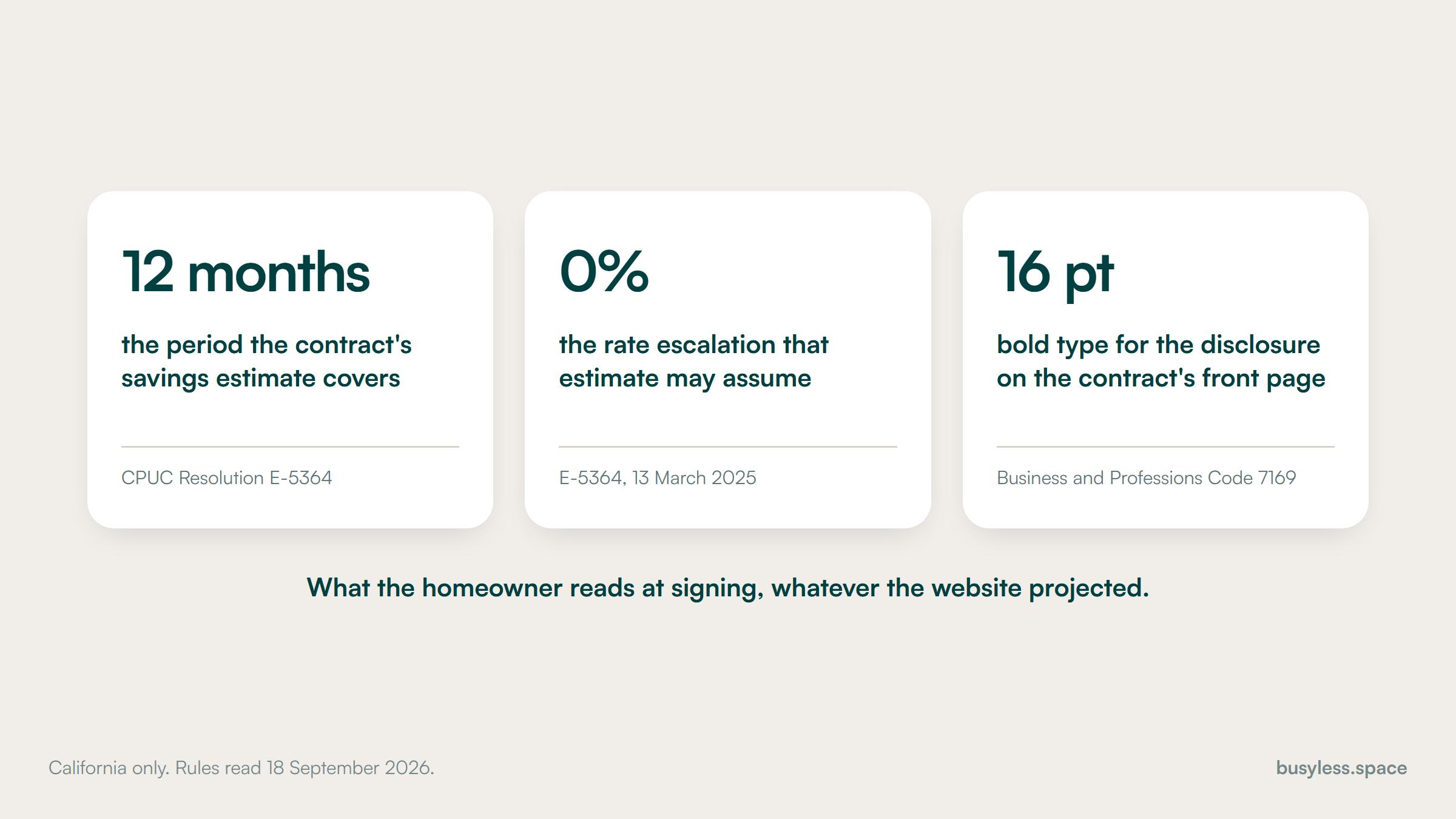
Three tiles showing what California puts on a solar contract: a bill savings estimate covering 12 months, with 0% rate escalation, disclosed on the front page in 16-point bold type
Publish these beside any calculator, first. Whatever the website projected, these are the numbers the homeowner reads at signing.

The expensive mistakes

Writing one credit sentence for every contract

Costs you A sentence that is false on the purchase pages and true, for the provider, only on the lease page, so a buyer reads a saving that does not exist.

Name the party in every credit sentence, and keep a dated version only on the pages where it is true.

Building location pages from a list of cities

Costs you Pages that explain the wrong tariff to part of their own city, read by somebody in the other territory who notices.

Map the utility territories first, then decide which towns get a page and which page each town belongs on.

Letting the calculator vendor set the assumptions

Costs you In California, a long-range figure that the contract's twelve-month, no-escalation estimate contradicts at signing. Everywhere else, the overpromise the FTC's solar guidance names.

Set the assumptions yourself, starting from the contract you actually sell, and publish them as text.

Paying for enquiries by the lead

Costs you By SolarReviews' own definitions a quad lead goes to four companies, so a cheap lead can be an expensive contract.

Price every source as spend divided by signed contracts, and cut the ones that do not close.

Leaving a dealer page up after the brand has gone

Costs you A promise of a relationship that has ended, read by owners who need service and cannot get it through you.

Rewrite it as a service page for existing owners, saying what you can and cannot do.

Treating the lease credit claim as permanent

Costs you The provider's credit has its own deadline: solar placed in service after 31 December 2027 is excluded where construction began after 4 July 2026. An undated claim will quietly become false.

Put a review date on every lease credit claim and diarise it in the incentive calendar.

What to measure

Measure per signed contract and split everything by contract type and by utility territory. A decision that takes months will never attribute cleanly, so say so in the report and let the business indicators, not the lead count, decide the budget.

Leading indicators

Move first. They predict, they do not prove.

  • Impressions on tariff and utility queries

    Search Console, filtered by utility and tariff names

    The cluster where installers can win, and the first to move once utility pages exist. Track each utility separately, because one territory can move while another stalls.

  • Utility pages indexed against territories served

    Search Console and your utility map

    A coverage number rather than a traffic one. A territory with no page is a town where the answer on your site is somebody else's tariff.

  • Calculator completions with the assumptions opened

    Analytics, with the calculator instrumented

    Close to impossible while the calculator lives in an iframe, which is itself a finding. Readers who open the assumptions are the ones who will compare you against a contract.

  • Marketplace profile views and enquiries

    EnergySage and SolarReviews dashboards

    A volume signal and a misleading outcome. Read it only beside the contracts those enquiries became.

Business indicators

The ones a manager acts on.

  • Signed contracts by type and by source

    Your CRM, contracts tagged by type and first source

    The number everything else predicts. Split cash, loan and lease, because they are different revenue and the pages that win each are different pages.

  • Cost per signed contract, by source

    CRM plus marketplace invoices

    Spend divided by contracts, never by leads. It is the one fair comparison between organic work and an enquiry that was sold to several installers.

  • Cancellations inside the cancellation window

    Your CRM

    A rise here often means a page promised something the contract did not. It catches an overpromise before a complaint does.

  • Service and retrofit jobs from owner pages

    Your job management system

    Revenue from people who already have panels, much of it from systems you did not install. A report counting only new installations never sees it.

The verdict

Plenty of solar SEO services still build on the credit, because for years it was the sentence that sold everything. It now depends on the contract, and a page that does not say which contract it means is wrong for somebody who reads it.

You will not take the head terms from EnergySage, and nothing here pretends otherwise. The benefits of SEO for solar companies sit one layer down: your utility territories, the lease-versus-buy question for the contracts you sell, and the owners nobody else will service.

That makes the order of work unusual. Most SEO strategies for solar companies begin with city pages; this one begins with a claims register, then builds locations around utilities, then makes the calculator agree with the contract.

So judge SEO services for solar companies on one test: can they tell you which of your current sentences are false on a lease and which on a loan? If nobody on your team has time to keep those sentences true, that is the job worth handing over.

FAQ

Solar SEO questions

  • Can a solar company still advertise the 30% federal tax credit?
    Only where it is true, and only if the page says for whom. A buyer's 25D credit ended for expenditures made after 31 December 2025, treated as made when installation is completed. A lease or PPA provider may still claim 48E on the panels, to its own deadline. Name the party, date the claim, and check with a tax adviser.
  • Why build solar location pages by utility rather than by city?
    Because the tariff, the export rate and most rebates follow the utility. Phoenix splits between APS and SRP, and a Los Angeles-area address may be on LADWP or on Southern California Edison, under different regimes. A city page that names neither utility is wrong for somebody who reads it.
  • Should our solar pages say NEM 3.0, Net Billing Tariff or Solar Billing Plan?
    All three, on one page per utility. Homeowners search NEM 3.0, CPUC Decision D.22-12-056 created the Net Billing Tariff, and the CPUC's 2025 guide addendum calls it the Solar Billing Plan. Using one name misses two sets of searches, and none of the three applies to LADWP customers.
  • Can a solar savings calculator show 25 years of savings in California?
    It can, but the contract will not. Resolution E-5364 makes the contract's estimate twelve months at current rates with no escalation, and caps the escalator in alternative calculations at the CPUC's five-year historical average. Showing the twelve-month figure first means the two numbers agree when they meet. This is not legal advice.
  • Can a solar company call its offer a programme or show utility logos?
    Not if it implies a connection you do not have. Texas Occupations Code 1806.201 forbids falsely stating or implying an affiliation with a utility or a government agency, enforceable from 1 September 2026, and the FTC's Impersonation Rule sets the national floor on implied government affiliation. Describe the offer as what it is: a contract with you.
  • Are solar lead marketplaces worth paying for?
    Sometimes, if you measure them per signed contract. SolarReviews publishes its own tiers, from an exclusive lead sold to one company up to a quad lead sold to four, and EnergySage charges installers to participate. Compare each source's spend per signed contract with organic, and keep only the ones that close.
  • Should a solar installer build pages for systems it did not install?
    Yes. Owners whose installer has closed are searching with nobody to call, and a page saying which brands you service, which warranties usually survive and who holds them answers a question few installers do. In Texas, rules adopted in June 2026 require a closing retailer to name a warranty contact.
  • What does solar SEO cost?
    The tiers above are editorial estimates rather than quotes. Running this properly, yourself or with help, is realistically $2,500 to $10,000 a month. What moves it most is how many utility territories you serve, since every territory needs its own pages and its own review of the savings figures on them.
  • Can a solar installer do the local work in-house?
    Mostly, yes. Local SEO for solar companies is the business profile, a service area matching the utility territories you connect in, and a steady flow of genuine reviews. Bring in help when the page set spans several utilities and every figure needs a claims review, not before.
  • How should a solar company judge an SEO provider?
    Hand them three sentences from your site and ask which are true on a lease and which on a loan. A provider who cannot answer has not worked in this industry since the credit changed. Then ask how they would report, and walk away from anyone counting leads rather than signed contracts.
  • When should a solar installer hold off hiring anyone?
    While the claims register does not exist, and while you sell in one utility territory with one contract type. The first month is sorting sentences by contract, which the person who writes your contracts does better than any outside hire. Hire once there are more pages than that person can keep true.

Run it yourself, or have someone own it

Everything above is written to be run without us, and the free path is genuinely most of the value for a single-location business. Where these plans stall is almost never the plan. It is that nobody owns it after the first month. That is the job we do, with search as one distribution layer inside a wider system rather than the whole engagement.