
Skip to content

Electrician SEO strategy

Regulated marketing

The profitable work is permitted, inspected and planned months ahead

Written by Eugene SuslovLast reviewed 28 August 2026No affiliate links
Sector
Home and trades
Model
Local service, National service
Competition
Brutal
Time to results
4 to 9 months
Typical monthly
$1,200 to $6,000

Key takeaways

  1. 1Your emergency calls are not the business. Panel upgrades, generators, EV charging and rewires are, and every one of them is researched for weeks before anybody rings.
  2. 2Home inspection reports generate the highest-intent queries in this trade. Somebody searching "Federal Pacific panel replacement" has a closing date and a lender behind them.
  3. 3If your incentive pages still promise a 30% federal credit, they are wrong. The 25C and 25D credits ended for property placed in service after 31 December 2025.
  4. 4Your utility's trade ally or participating contractor list is free, it ranks, and it sends work directly. Most electrical contractors have never checked whether they are on it.
  5. 5Publishing code requirements without naming the code cycle and the jurisdiction is wrong advice somewhere, and it is why most electrician code content cannot rank.

SEO for electricians looks like the plumbing playbook from a distance and behaves nothing like it up close. Both trades have emergencies, both live in the local pack, and there the similarity ends.

A plumbing emergency is the plumbing business. An electrical emergency is a tripping breaker or a dead outlet, and the ticket is small. The money is in service upgrades, standby generators, EV charging, rewires and commercial maintenance contracts, and none of those is decided in an afternoon.

That inverts the usual trade advice. An electrician SEO strategy that only optimises for "electrician near me" is competing hardest for the least profitable work you do.

The planned jobs are permitted and inspected, which means the customer is anxious about something a website can genuinely fix. What the permit process involves, how long the inspection takes, whether the power goes off, what the utility has to do and when. Nobody in the trade writes any of it.

There is also a cluster no other trade has. A home inspection report names specific defects, buyers search those exact terms, and they are on a closing timetable. Panel brands, wiring types, grounding faults. High intent, high ticket, and almost entirely uncontested by electrical contractors.

The last piece is the incentive landscape, and it moved recently enough that a lot of live pages are now inaccurate. That is a content liability and an opportunity in the same paragraph, because whoever updates first owns a set of queries everyone else answers wrongly.

Who already ranks in electricians

A capacity query and an emergency query return two results pages with almost nothing in common. That split is the awkward finding in most electrician SEO audits: one is a paid block over a map pack, the other is manufacturer sites, utility pages and national publishers, with local contractors nowhere.

What is on the results page

  • Local Services Ads above the map pack on emergency and near-me queries
  • Local pack on anything carrying a place name or an urgent fault
  • Manufacturer and utility pages dominating generator, EV charging and rebate queries
  • People Also Ask, unusually dense on cost, capacity and code questions
  • AI Overviews on diagnostic and code questions, which is where the explainer content pays
  • Image results on panel and installation queries, where finished-work photography would rank if it were indexable
  • Review stars from the lead marketplaces rather than from contractor websites
  • Utility trade ally and participating contractor lists

    energy.govClaim it

    The most overlooked asset in this trade. Utilities that run rebate programmes publish a list of approved contractors, the list ranks for programme-name queries, and being on it sends work directly rather than just linking to you. It is free, it requires paperwork rather than marketing, and most contractors have never checked whether their listing exists or is correct. Start at your own utility's business or efficiency programme pages.

  • Manufacturer installer and dealer locators

    generac.comClaim it

    Standby generator, EV charger and energy storage manufacturers all run find-an-installer tools, and those tools rank for their own trademarks, which you will never outrank directly. If you are certified, the listing is free and usually half filled in. Check every brand you are authorised on, and read the trademark guidelines before putting the brand in a page title.

  • Google Local Services Ads

    google.comClaim it

    Paid, sits above the map pack, and gated behind licence, insurance and background checks. Budget for it as a channel with its own cost per job rather than folding it into the SEO line. On emergency queries it is effectively the ceiling on what organic can reach, which is another argument for putting the content budget on the planned work instead.

  • Angi and Thumbtack

    angi.comClaim it

    Lead marketplaces that rank on service-plus-city queries almost everywhere. Claim the free profiles for consistency. Price any paid tier as lead buying, and price it properly: the same enquiry usually goes to several contractors, so your real cost is the lead price divided by your win rate.

  • State licensing board lookups

    dol.gov

    Not claimable and not a lead source, but the board's licence lookup frequently ranks for your company name plus "license", and it is the first thing a cautious commercial buyer checks. Make sure the trading name on the licence matches the name on your website, because a mismatch reads as a red flag even when it is just an old DBA.

  • NECA and trade association directories

    necanet.orgClaim it

    Modest traffic and genuine authority. Worth the listing for the credential rather than the clicks, and worth naming the membership on the site as a membership rather than implying it is a certification.

  • Nextdoor

    nextdoor.comClaim it

    Not a search channel, and in many neighbourhoods it is the strongest referral source in the residential trades. A claimed business page and a handful of genuine recommendations outperform a lot of paid effort, particularly for panel and generator work where neighbours compare notes.

What people actually search

Electrical search separates cleanly into work that pays the bills and work that pays for the business. The first is urgent, low ticket and decided on proximity. The second is researched, permitted and worth several thousand dollars, and it is where a website changes the outcome.

Capacity and service upgrade

Commercial investigation

200 amp panel upgrade cost

The page that wins it: A cost page with the real drivers: service size, meter position, utility work, permit

The core high-ticket cluster. People research it for weeks and almost every contractor page says call for a quote, which is why the national cost aggregators win it.

Inspection remediation

Commercial investigation, deadline driven

federal pacific panel replacement

The page that wins it: A page per named defect, explaining the finding and what replacement involves

The cluster no other trade has. It is generated by a document the buyer is holding, it names specific brands and materials, and it comes with a closing date attached.

EV charging

Commercial investigation

level 2 charger installation cost

The page that wins it: An installation page covering load calculation, panel capacity and permitting

Growing, and the manufacturer sites own the head terms. You win on the local specifics: your utility, your permit office, whether the panel can take it.

Standby power

Informational to commercial

what size generator do i need for my house

The page that wins it: A sizing guide that ends in a load calculation, not a product list

Seasonal, spikes after outages, and the sizing question is the one people actually search. Answer it properly and the installation enquiry follows.

Code and permit

Informational

does a hot tub need a dedicated circuit

The page that wins it: A jurisdiction-specific explainer naming the code cycle in force

Genuinely useful and almost always answered wrongly online, because the answer depends on which edition your jurisdiction has adopted.

Diagnostic and safety

Informational, urgent

burning smell from outlet

The page that wins it: A short explainer with a clear stop-and-call-us threshold

The one place emergency and content overlap. Written responsibly it converts fast; written carelessly it tells somebody to open a panel.

Incentives and rebates

Commercial investigation

[utility] rebate for electrical panel upgrade

The page that wins it: A page listing the programmes actually available in your service territory, dated

High intent and high maintenance. Most pages in this cluster are out of date, which is exactly why an accurate one wins and holds.

Commercial and property maintenance

Commercial investigation

commercial electrical contractor [city]

The page that wins it: A separate section written for a facilities manager, not a homeowner

Different buyer, different cycle: contracts, response times, certificates of insurance, scheduled maintenance. Usually buried under residential copy or missing entirely.

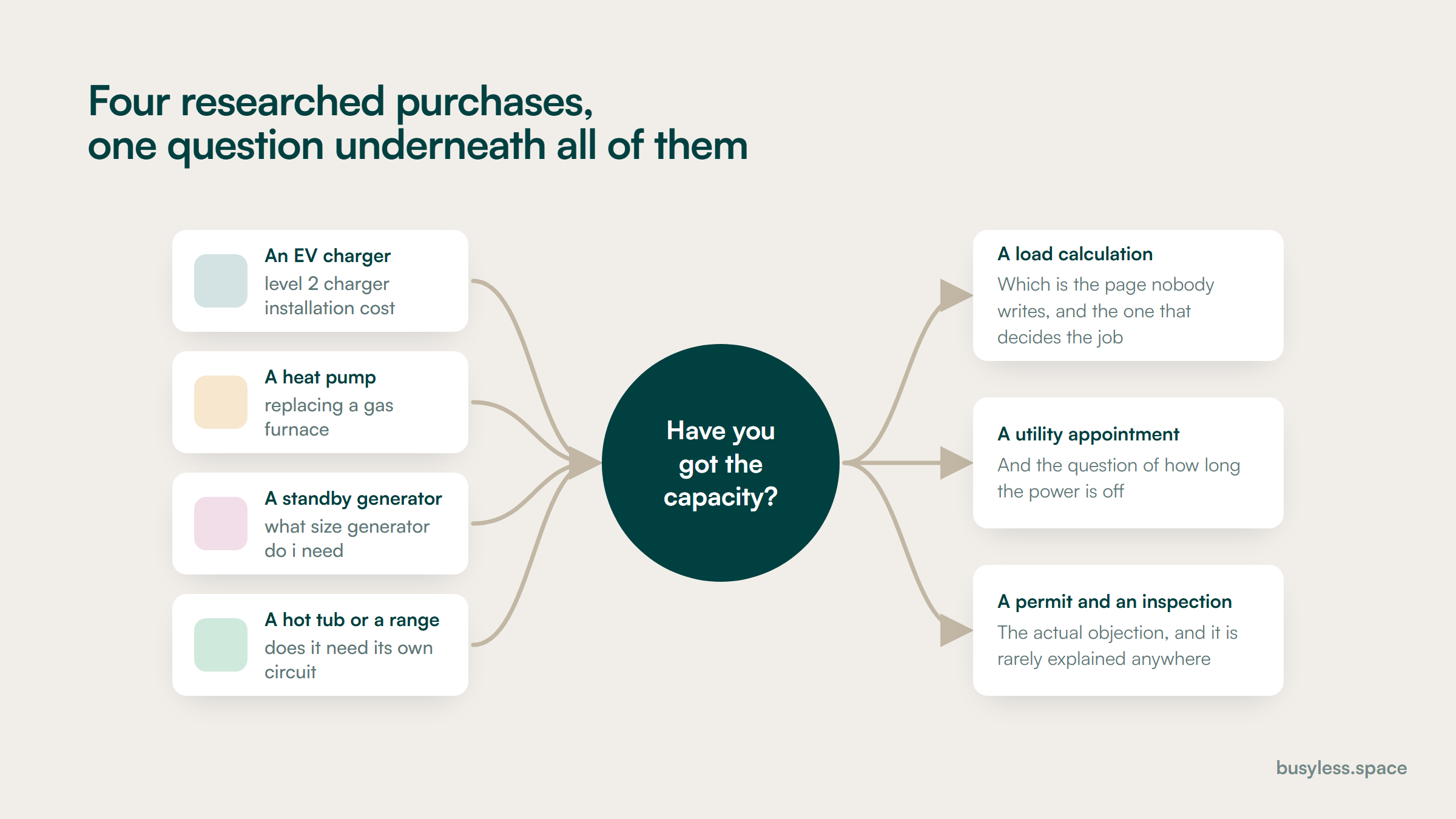
Four researched purchases, an EV charger, a heat pump, a standby generator and a hot tub or range, all converging on one question about electrical capacity, which then produces three outputs: a load calculation, a utility appointment, and a permit and inspection.
Four different searches, one question underneath them. The three things on the right are the ones a homeowner is actually anxious about, and almost nobody writes them.

What the rules change

Lighter than health or law, and two of the four below have teeth. The incentive item is the urgent one, because it makes live pages inaccurate rather than merely unhelpful. Electrical licensing sits with each state, and the categories differ, so verify against your own board. Nothing here is legal advice.

1

The federal home energy credits have ended, and your pages may still promise them

Public Law 119-21, signed 4 July 2025, terminating Internal Revenue Code sections 25C and 25D; see the IRS guidance published on the change

What it means

The 25C Energy Efficient Home Improvement Credit and the 25D Residential Clean Energy Credit were terminated for property placed in service after 31 December 2025. A large amount of contractor content was written between 2023 and 2025 promising a percentage back on panel upgrades, heat pump wiring and solar-adjacent work, and that content is now telling homeowners something untrue.

So do this

Audit every page mentioning a federal tax credit. Rewrite them around what still exists: state programmes and utility rebates, which are administered separately and vary by territory. Date every incentive claim on the page itself, and put a calendar reminder on the review.

2

Your licence number may have to appear in the advertising itself

State electrical licensing authorities; Texas Department of Licensing and Regulation rules for electrical contractors are a clear example, requiring the licence number on advertisements and vehicles

What it means

Several states require an electrical contractor's licence number to appear in advertising, and advertising is generally read to include your website. Requirements differ on the format and on whether the licensee's name has to appear too, and an electrical licence is often issued separately from a general contractor licence.

So do this

Set it in the site footer so every page carries it, repeat it in the business profile description, and confirm the exact format your state expects. It is a trust signal regardless of whether your state mandates it.

3

Code answers are jurisdiction-specific, and a wrong one is a real problem

NFPA 70, the National Electrical Code, adopted state by state and sometimes amended locally; adoption cycles differ by several editions across states

What it means

States adopt different editions of the code on different timetables, and local authorities amend it. So an article stating a requirement without naming the edition and the jurisdiction is wrong somewhere, and possibly wrong in your own market if it was written against a newer or older cycle than yours.

So do this

Name the code edition in force in your jurisdiction and the date you checked it, on every code page. Say plainly that the local authority having jurisdiction has the final word. That sentence is also the thing that makes the page more useful than the national version.

4

Manufacturer certifications come with trademark rules

Individual manufacturer dealer and installer programme agreements and brand guidelines

What it means

Being a certified installer for a generator, charger or storage brand is a real credential and a real asset. The programme agreement usually governs how you may use the mark, including whether it can appear in a page title, a domain or a business name, and whether you may claim to be an authorised dealer for products you did not buy through the channel.

So do this

Read the brand guidelines before writing a title tag with a manufacturer's name in it. "Certified installer for [brand]" is usually fine; "[brand] of [city]" usually is not. When in doubt, ask your distributor rep, who deals with this weekly.

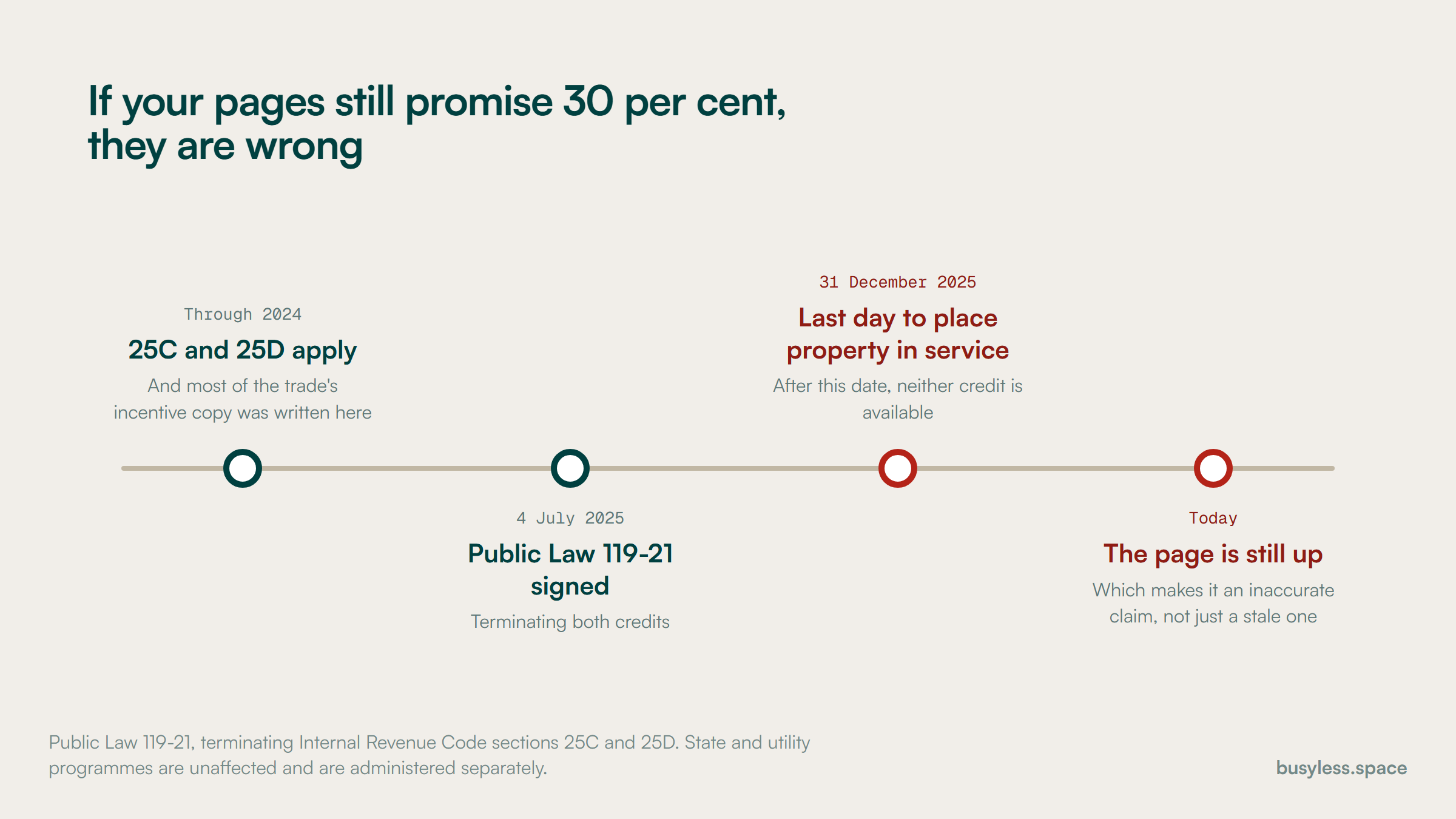
A four-point timeline. Through 2024 the 25C and 25D credits applied. On 4 July 2025 Public Law 119-21 terminated both. After 31 December 2025 neither is available for property placed in service. Today, the page promising them is often still live.
A stale page is a nuisance. A page still promising a credit that no longer exists is an inaccurate claim.

Proving expertise

The trust signals in electrical work are unusually concrete and unusually checkable, and most contractor sites publish almost none of them. The customer is deciding whether to let somebody rewire a house they live in, and a badge graphic does not answer that.

  • Licence number and class visible on every page, with the issuing authority named
  • Insurance and bonding stated with the coverage type rather than a graphic
  • Named electricians with their licence level, so a master electrician is identifiable as one
  • Manufacturer certifications named with the brand and the programme, matched to the locator listings you have claimed
  • Photographs of your own finished work, particularly panels, with the job described
  • The permit and inspection process explained in your jurisdiction, which proves you actually pull permits
  • Utility trade ally or participating contractor status named where you hold it
  • Code content dated and attributed to the edition in force locally

How to build a electrician SEO strategy

A realistic first six months. The order is deliberately different from the other trades on this site: an electrician SEO strategy that spends its first month on emergency queries is fighting a paid ad block for the least profitable work in the business, while the upgrade pages that close five-figure jobs sit unwritten.

  1. 1

    Weeks 1 to 3

    Correct what is wrong and claim what is free

    • Audit every page mentioning a federal tax credit and rewrite or remove it
    • Check whether you are on your utility's trade ally or participating contractor list
    • Claim every manufacturer installer locator you qualify for, and complete the profile
    • Complete the Google Business Profile: categories, every service, real photos, hours
    • Licence number into the footer and the profile description, in your state's required format
    • Confirm the trading name on your licence matches the name on the website

    You end up with
    No inaccurate incentive claims live, and every free high-authority listing claimed

  2. 2

    Weeks 3 to 8

    Write the money pages

    • Build the panel and service upgrade page properly, with real cost drivers
    • Write the permit and inspection explainer for your jurisdiction
    • Build the EV charger installation page around load calculation and local permitting
    • Write the generator sizing guide that ends in a load calculation
    • Add Electrician and Service structured data
    • Start publishing finished-work photography with real page copy around it

    You end up with
    The high-ticket clusters covered with pages that answer the cost and process questions

  3. 3

    Weeks 6 to 16

    Take the clusters nobody else is writing

    • One page per named inspection defect: panel brands, wiring types, grounding faults
    • Code explainers naming your jurisdiction's adopted edition and the date checked
    • The incentives page, listing only what is genuinely available in your territory
    • Diagnostic and safety explainers with an explicit stop-and-call threshold
    • A commercial section written for a facilities manager rather than a homeowner
    • Reach out to local realtors and inspectors, who are the referral source for the remediation cluster

    You end up with
    Coverage of the deadline-driven and researched queries that competitors ignore

  4. 4

    Weeks 12 to 26

    Measure booked work and average ticket

    • Attribute calls and forms, and reconcile against the job management system
    • Report leading and business indicators separately, never one as the other
    • Track average ticket by cluster, because a service call and a rewire are different businesses
    • Review the upgrade pages on quotes issued rather than on sessions
    • Set a quarterly review on every incentive and code page, which go stale on their own
    • Decide on Local Services Ads with a cost per booked job in hand

    You end up with
    A report showing booked work and average ticket by cluster, with the attribution gap stated

Technical fixes with the best payoff

The defects here are less about crawling and more about pages that exist but refuse to answer the question. In a trade where the profitable job is researched for weeks, a page that says call for a quote loses to a national aggregator that gave a number.

  • Incentive pages promise credits that no longer exist

    A day, then a recurring hour

    Not just stale, inaccurate. Federal residential energy credits ended for property placed in service after 31 December 2025, and pages written in the preceding two years are still promising a percentage back. A homeowner who finds out at invoicing has a complaint, not just a disappointment.

    Find every page and blog post mentioning a federal credit, rewrite around what still applies in your territory, and date the claim on the page. Set a quarterly reminder, because state and utility programmes change on their own schedules too.

  • The panel upgrade page answers no cost question

    A day

    "200 amp panel upgrade cost" is the highest-value researched query in the trade and most contractor pages respond with a contact form. National cost aggregators give a range, so they win the query and then sell the lead back to you.

    Publish a range with the drivers spelled out: existing service size, meter and mast condition, whether the utility has to do work, permit and inspection fees, whether the panel location moves. A range with variables beats a number and it beats silence.

  • Certifications and trade ally status are logo images

    An afternoon

    Manufacturer certifications and utility programme participation are the strongest differentiators you have, and rendering them as a strip of logos means the words are not on the page. Nobody can search a logo.

    Write the credentials in text: which brands, which programmes, which certifications, held by whom, since when. Keep the logos as decoration if you like them, but the text is the asset.

  • The finished-work photography lives on social and nowhere else

    A sprint, then ongoing

    Panel and installation queries return image results, and electrical work is unusually photogenic in a way that reads as competence. A gallery on a social platform contributes nothing to your own site.

    Publish jobs as short case pages: what was wrong, what was installed, what it cost, how long the power was off, which inspector signed it off. Compress the images and write alt text describing the work.

  • The permit and inspection process is never explained

    A day per jurisdiction

    It is the actual objection. Homeowners are worried about the power being off, the utility appointment, the inspector and the paperwork, and no contractor site addresses it. The pages that do rank for the anxious long tail nobody targets.

    One page per jurisdiction you work in: who pulls the permit, what it costs, how long the utility takes, what the inspection checks, what happens if it fails. This is genuinely local content that cannot be syndicated.

  • Commercial work is buried under residential copy

    A sprint

    A facilities manager looking for a maintenance contractor and a homeowner with a dead outlet want completely different pages. Serving both from one site section usually means neither converts and the commercial queries never rank at all.

    A separate section with its own language: response times, certificates of insurance, scheduled maintenance, after-hours cover, the sectors you hold experience in. Link it from the navigation, not from the footer.

  • Code content names no edition and no jurisdiction

    An afternoon per page

    It is simultaneously a quality problem and a ranking problem. Undated code content is wrong somewhere, and it is also indistinguishable from the thousand generic versions of the same article, so there is no reason to prefer it.

    Name the adopted edition, the jurisdiction and the date you checked, and say that the local authority has the final word. That single paragraph is what makes your version the local answer.

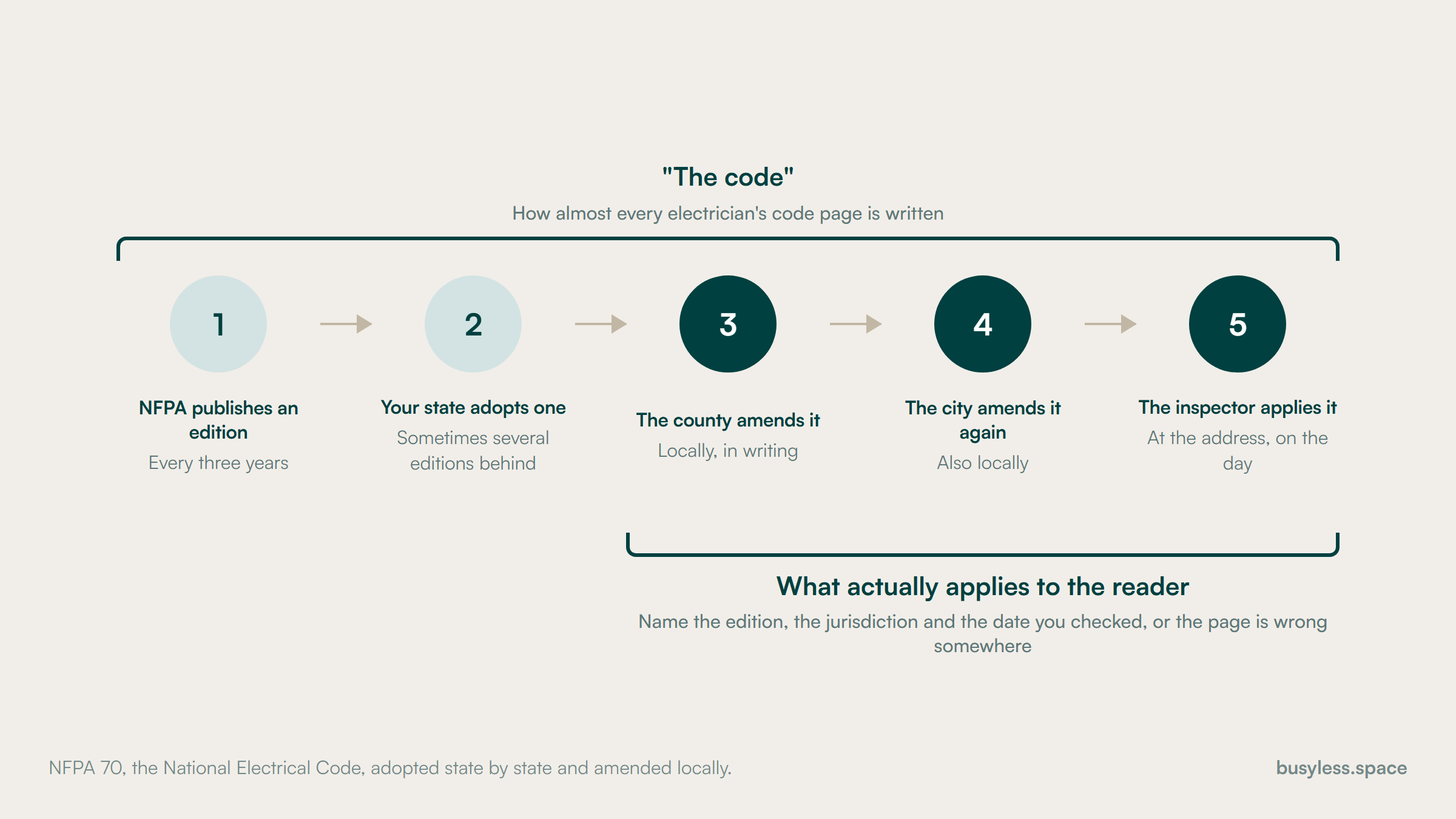
Five stages bracketed as the code: NFPA publishes an edition, the state adopts one, the county amends it, the city amends it again, and the inspector applies it at the address. A narrower bracket covers only the last three, labelled as what actually applies to the reader.
Two brackets, and most code content is written against the wider one. Name the edition, the jurisdiction and the date you checked.

Structured data that applies here

The types below fit this industry specifically. Most of them earn no rich result on their own, which is worth knowing before anyone sells the work on that basis. What they do is describe the entity precisely, which matters for how search engines and answer engines resolve who you are.

  • Electrician

    Home page and any location pages

    A real schema.org type and a subtype of HomeAndConstructionBusiness. Almost nobody in the trade uses it, so it is free precision: it says exactly what kind of business this is rather than leaving a generic node to be interpreted.

    Electrician.jsonld
    {
      "@context": "https://schema.org",
      "@type": "Electrician",
      "@id": "https://[YOUR-DOMAIN]/#business",
      "name": "[BUSINESS NAME]",
      "url": "https://[YOUR-DOMAIN]",
      "telephone": "[+1-555-000-0000]",
      "priceRange": "[$$]",
      "image": "https://[YOUR-DOMAIN]/van.jpg",
      "address": {
        "@type": "PostalAddress",
        "streetAddress": "[123 Example St]",
        "addressLocality": "[CITY]",
        "addressRegion": "[ST]",
        "postalCode": "[00000]",
        "addressCountry": "US"
      },
      "areaServed": [
        { "@type": "City", "name": "[CITY]" },
        { "@type": "AdministrativeArea", "name": "[COUNTY]" }
      ],
      "hasCredential": {
        "@type": "EducationalOccupationalCredential",
        "credentialCategory": "Electrical contractor licence",
        "identifier": "[LICENCE NUMBER]",
        "recognizedBy": {
          "@type": "GovernmentOrganization",
          "name": "[STATE LICENSING AUTHORITY]"
        }
      },
      "openingHoursSpecification": [{
        "@type": "OpeningHoursSpecification",
        "dayOfWeek": ["Monday","Tuesday","Wednesday","Thursday","Friday"],
        "opens": "[07:00]",
        "closes": "[17:00]"
      }]
    }
  • Service with a price range

    Each service page where you publish a real range

    This is the type that makes the upgrade pages work. Only publish a range you will honour, and only where the identical range is visible in the page copy.

    Service with a price range.jsonld
    {
      "@context": "https://schema.org",
      "@type": "Service",
      "name": "[Electrical panel upgrade]",
      "serviceType": "[Panel and service upgrade]",
      "provider": { "@id": "https://[YOUR-DOMAIN]/#business" },
      "areaServed": {
        "@type": "AdministrativeArea",
        "name": "[COUNTY OR METRO]"
      },
      "offers": {
        "@type": "Offer",
        "priceSpecification": {
          "@type": "PriceSpecification",
          "minPrice": "[0000]",
          "maxPrice": "[0000]",
          "priceCurrency": "USD"
        },
        "description": "[What the range includes: permit, inspection, utility coordination. And what changes it.]"
      },
      "description": "[One plain sentence describing the job in the customer's words.]"
    }
  • Person with a licence credential

    Team pages, referenced from the pages they wrote

    Worth doing here because licence level is meaningful to buyers: a master electrician is a different claim from an apprentice, and the number is checkable against the board.

    Person with a licence credential.jsonld
    {
      "@context": "https://schema.org",
      "@type": "Person",
      "@id": "https://[YOUR-DOMAIN]/team/[SLUG]#person",
      "name": "[FIRST LAST]",
      "jobTitle": "[Master electrician]",
      "url": "https://[YOUR-DOMAIN]/team/[SLUG]",
      "worksFor": { "@id": "https://[YOUR-DOMAIN]/#business" },
      "hasCredential": [{
        "@type": "EducationalOccupationalCredential",
        "credentialCategory": "[Master electrician licence]",
        "identifier": "[LICENCE NUMBER]",
        "recognizedBy": {
          "@type": "GovernmentOrganization",
          "name": "[STATE LICENSING AUTHORITY]"
        }
      }],
      "knowsAbout": ["[Service upgrades]", "[Standby generators]", "[EV charging]"]
    }
  • ImageObject

    Finished-work photography on case and service pages

    Unusual to recommend, and it earns its place here because the proof in this trade is photographic. A described image with a caption and a licence statement is eligible for image results in a way an unlabelled gallery is not.

    ImageObject.jsonld
    {
      "@context": "https://schema.org",
      "@type": "ImageObject",
      "contentUrl": "https://[YOUR-DOMAIN]/work/[SLUG]-panel.jpg",
      "url": "https://[YOUR-DOMAIN]/work/[SLUG]",
      "caption": "[What the photograph shows: the work, the equipment, the location type.]",
      "description": "[Two sentences: what was replaced, what was installed, why.]",
      "creditText": "[BUSINESS NAME]",
      "creator": { "@id": "https://[YOUR-DOMAIN]/#business" },
      "copyrightNotice": "[BUSINESS NAME]",
      "license": "https://[YOUR-DOMAIN]/image-licence"
    }
  • FAQPage

    Cost, permit and code pages with genuinely visible questions

    The strongest rich-result history and the most abused type. Mark up only questions a visitor can see, and match the answer text exactly. Prioritise the permit questions; they are what people actually type.

    FAQPage.jsonld
    {
      "@context": "https://schema.org",
      "@type": "FAQPage",
      "mainEntity": [
        {
          "@type": "Question",
          "name": "[Question exactly as it appears on the page]",
          "acceptedAnswer": {
            "@type": "Answer",
            "text": "[Answer exactly as it appears on the page. Name the jurisdiction where it matters.]"
          }
        }
      ]
    }
  • BreadcrumbList

    Service, defect and jurisdiction pages

    Modest, and worth it once services, inspection defects and jurisdictions form a real hierarchy. On most contractor sites the attempt fails immediately, because there is no hierarchy to describe.

    BreadcrumbList.jsonld
    {
      "@context": "https://schema.org",
      "@type": "BreadcrumbList",
      "itemListElement": [
        { "@type": "ListItem", "position": 1, "name": "Home",
          "item": "https://[YOUR-DOMAIN]/" },
        { "@type": "ListItem", "position": 2, "name": "[Services]",
          "item": "https://[YOUR-DOMAIN]/services" },
        { "@type": "ListItem", "position": 3, "name": "[SERVICE]",
          "item": "https://[YOUR-DOMAIN]/services/[SLUG]" }
      ]
    }

What it costs

Editorial estimates, not quotes. The variable that moves this range is not company size, it is which half of the business you are marketing. Competing for emergency calls against a paid ad block is expensive and low margin; owning the upgrade and remediation clusters is cheaper and pays more.

Do it yourself

$0 to $300
  • Google Business Profile completed and maintained
  • Utility trade ally and manufacturer locator listings claimed
  • Licence number in the footer and the profile
  • Incentive pages corrected and dated
  • A review request at the end of every job

Who it suits

An owner-operator or a two-van shop where somebody can protect two hours a week for it

Where it stops

You will hold your own brand and compete locally on emergency work. You will not build the upgrade cluster, because that takes writing time a two-van business does not have.

Lean

$1,200 to $2,800
  • Everything above, run consistently rather than in bursts
  • The panel, EV and generator pages built properly with real cost drivers
  • Permit and inspection explainers for the jurisdictions you actually work in
  • Two to four new pages a month, aimed at the researched clusters
  • Structured data and monthly reporting split into leading and business indicators

Who it suits

A three to eight van company that wants more planned work and fewer service calls

Where it stops

Progress is steady and not fast, and it will not out-publish a contractor already three years into this. It also cannot fix a quote follow-up process that loses jobs after the visit.

Funded

$3,500 to $6,000
  • The inspection remediation cluster built out defect by defect
  • A separate commercial or facilities programme with its own content
  • A photography workflow turning finished jobs into published case pages
  • Attribution reconciled against the job management system
  • Incentive and code content maintained on a real cadence rather than left to rot

Who it suits

Contractors in competitive metros, or anyone with real capacity for planned work to fill

Where it stops

At this level you are up against the firms that only do contractor marketing. What it cannot fix is a quote that takes a week to go out, and the remediation cluster still runs on relationships with realtors and inspectors.

How to do it with no budget

Everything below costs time rather than money, and for most electrical contractors it is genuinely the majority of the available value. The order matters: the first item is the only one where doing nothing means publishing something untrue.

  1. 1

    Fix the incentive pages

    3 hours

    Your website editor

    Find every mention of a federal tax credit and correct it. This is first because it is the only item on the list where doing nothing means publishing something untrue.

  2. 2

    Check your utility trade ally listing

    1 hour to check, longer if you have to apply

    Your utility's efficiency or business programme site

    Free, high authority and it sends work directly. Most contractors have never looked. If you are on it, check the listing is accurate; if you are not, find out what qualifying takes.

  3. 3

    Claim every manufacturer installer locator

    2 hours

    Each brand's installer portal

    Generator, charger and storage brands all run them, they rank for the trademark you cannot outrank, and your entry is probably half filled in.

  4. 4

    Complete the Google Business Profile

    3 hours, then 20 minutes a week

    Google Business Profile

    Primary category, every service as its own entry, photographs of your own finished work rather than stock, and hours that match reality. Most competitors stopped at the address.

  5. 5

    Publish a real panel upgrade cost range

    3 hours

    Your website editor

    A range with the drivers listed. It is the single highest-value page in the trade and it currently belongs to national cost aggregators in almost every market.

  6. 6

    Write the permit and inspection explainer

    3 hours per jurisdiction

    Your website editor and your own permit office

    Who pulls it, what it costs, how long the utility takes, what the inspector checks. Local, specific and impossible to syndicate, which is exactly what makes it rank.

  7. 7

    Write five inspection defect pages

    2 hours each

    Your website editor

    The panel brands and wiring types that appear on inspection reports in your area. Deadline-driven buyers, high tickets, and almost no competition from other contractors.

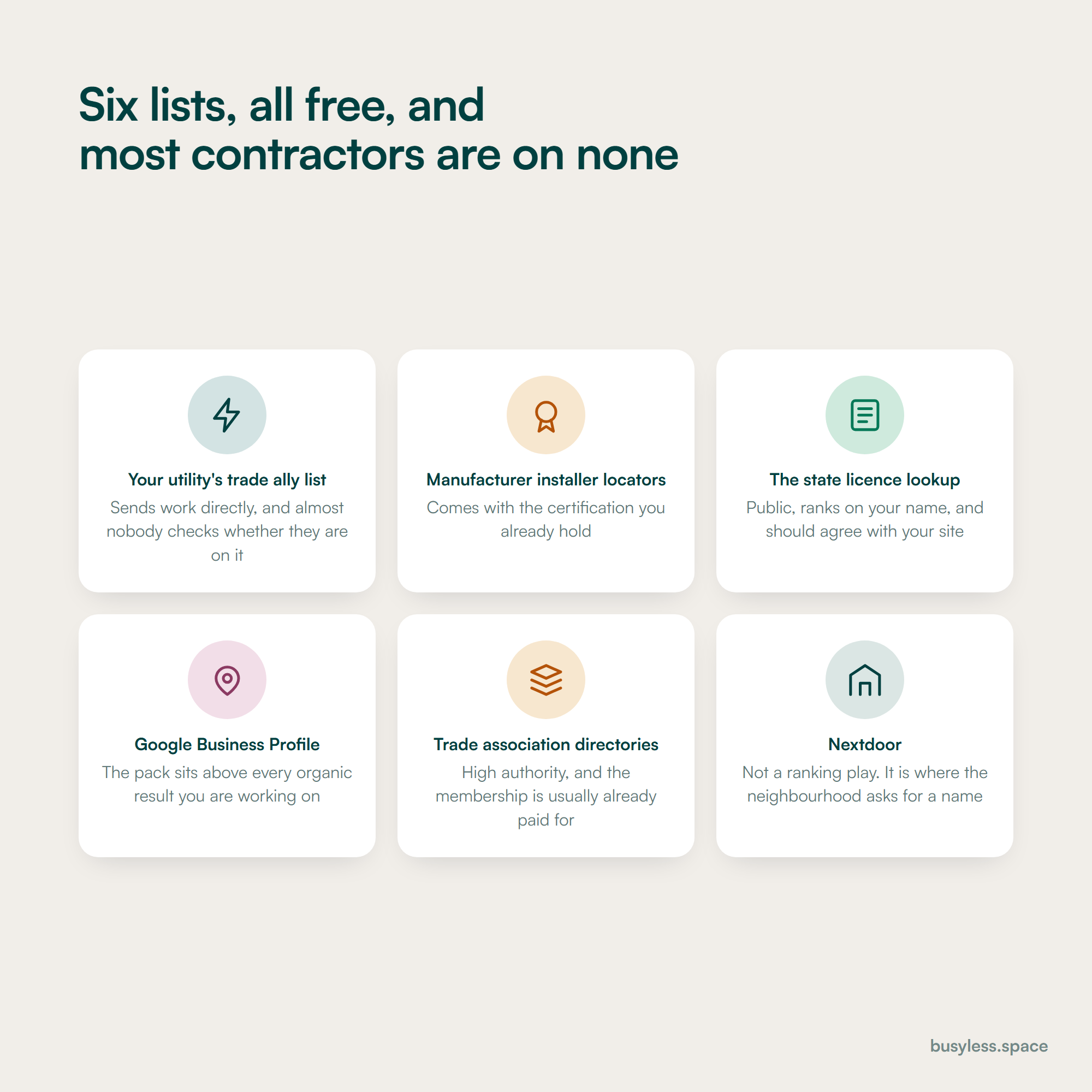
Six free listings shown as a set with no order: the utility trade ally list, manufacturer installer locators, the state licence lookup, Google Business Profile, trade association directories and Nextdoor.
All six are free, all six already outrank most contractor sites, and most electrical contractors are on none of them.

The tool stack

Jobs first, tools second. Most of this has a free option that is genuinely adequate below about five vans. The paid tools start earning their place when you are tracking several jurisdictions and several clusters at once.

  • Track local pack position across your service territory

    DataForSEOSEO APIRead the review

    Local rank tracking has to be geo-specific. A contractor can own the pack at the yard and be invisible in the suburb with all the 1960s housing stock, which is where the panel work is.

    Free routeChecking by hand from two or three postcodes; workable for one service area, not for a county

  • Find the defect and code queries worth writing for

    Google Search Console plus your own quote log

    Write down the exact wording customers use when they ring about an inspection report. Those brand and material names are the keyword research, and no tool will surface them as well.

    Free routeBoth free, and the quote log is the better source

  • Model what a planned job from search is worth

    SEO Revenue Growth CalculatorFree toolOpen the tool

    Run it separately for service calls and for upgrades. A blended average ticket hides the entire argument for putting the content budget on the planned work.

    Free routeFree

  • Give the owner a range before there is a proposal

    SEO Budget CalculatorFree toolOpen the tool

    A sanity check against the tiers above. Bring it to the conversation where somebody asks what this should cost, before there is a proposal on the table.

    Free routeFree

  • Generate the Electrician and Service markup

    Schema Markup GeneratorFree toolOpen the tool

    Generate it, validate it, and put it in the template rather than the page. The Electrician type is the part almost nobody uses.

    Free routeFree

  • Run service, defect and jurisdiction pages as related entities

    PayloadHeadless CMSRead the review

    Services, jurisdictions and inspection defects intersect. Modelling them properly is what lets you publish a real page per combination instead of a template with the town swapped.

    Free routeFree and self-hosted

  • Attribute phone calls to the cluster that produced them

    A call tracking vendor with dynamic number insertion

    Reconcile against the job management system monthly. The two rarely agree on their own, and the difference is usually jobs booked by a technician on site rather than through the office.

  • See what AI assistants recommend on capacity and code questions

    LLM visibility trackerOur toolSee the tool

    Homeowners increasingly ask an assistant whether their panel can take a charger before they search for anybody to fit it. The answers lean on clear capacity and code explainers, which is another argument for writing them.

Take it from here

Everything below is yours to take. Fill the [BRACKETS] and it is ready to use. Start with the incentive audit: it is the only item here that removes a live inaccuracy rather than adding an opportunity.

Checklist

Finds every page still promising a federal credit that ended for property placed in service after 31 December 2025, and rebuilds the page around what actually applies in your territory.

INCENTIVE PAGE AUDIT - [COMPANY] - [DATE]

WHY THIS IS FIRST
The federal 25C and 25D credits were terminated for property placed
in service after 31 December 2025 by the July 2025 reconciliation
act. Content written between 2023 and 2025 is still promising
homeowners a percentage back. That is a complaint waiting to happen
at invoicing, not just a stale page.

1. FIND EVERY MENTION
   Search your own site for each of these:
   [ ] "tax credit"
   [ ] "30%"
   [ ] "federal credit"
   [ ] "25C"  /  "25D"
   [ ] "Inflation Reduction Act"
   [ ] "rebate"
   [ ] "incentive"
   Include blog posts, service pages, PDFs and the footer.

   | URL                        | What it claims | Still true? |
   |----------------------------|----------------|-------------|
   | [________________________] | [____________] | [ Y / N ]   |
   | [________________________] | [____________] | [ Y / N ]   |
   | [________________________] | [____________] | [ Y / N ]   |
   | [________________________] | [____________] | [ Y / N ]   |

2. REBUILD AROUND WHAT REMAINS
   Federal, state and utility programmes are administered
   separately and they do not move together.
   | Programme      | Administered by | Covers | Amount | Ends |
   |----------------|-----------------|--------|--------|------|
   | [____________] | [_____________] | [____] | [____] | [__] |
   | [____________] | [_____________] | [____] | [____] | [__] |
   | [____________] | [_____________] | [____] | [____] | [__] |

3. THE SENTENCE EVERY INCENTIVE PAGE NEEDS
   "Checked against [PROGRAMME ADMINISTRATOR]'s published terms on
    [DATE]. Programmes change without notice and eligibility depends
    on your property and your utility. Confirm before you rely on
    a figure."

4. MAINTENANCE
   [ ] Owner named: [__________]
   [ ] Review date set: [__________] (quarterly)
   [ ] Every incentive claim carries a checked-on date
   [ ] Old blog posts either updated or redirected, never left live

What to publish

Ranked by how quickly it becomes a quote worth issuing. Most contractor sites describe services. The pages that earn money describe a decision with a number attached, and usually a permit behind it.

  • Cost pages with real drivers

    One per major service, reviewed when your pricing moves

    The highest-value researched queries in the trade, currently owned by national aggregators because contractors will not publish a range.

  • Inspection defect pages

    One a week until the common defects are covered

    Deadline-driven buyers holding a document that names the exact term they search. High ticket, and almost no competition from other contractors.

  • Permit and inspection explainers, per jurisdiction

    One per jurisdiction you work in

    The real objection, answered nowhere, and genuinely local. It also proves you pull permits, which is the thing a nervous homeowner is actually checking.

  • Finished-work case pages

    Two a month, from jobs you were doing anyway

    Panel and installation queries return images, and this trade photographs well in a way that reads as competence. Each case is a page nobody can copy.

  • Capacity and sizing guides

    One per equipment category

    Generator sizing and charger load calculation are the questions people search before they search for a contractor. Answer them properly and the enquiry follows.

  • A commercial section for facilities buyers

    Once, properly, then quarterly additions

    A different customer with contracts, response times and insurance requirements. Usually missing entirely, which means those queries go to whoever bothered.

And what not to

  • Any page still promising a federal tax credit for work placed in service after 2025
  • Code articles with no edition, no jurisdiction and no date
  • A page per town within driving distance, which is the doorway pattern this trade repeats more than any other
  • Do-it-yourself electrical instructions, which are a liability and attract exactly the reader who will not hire you
  • Hiring posts, anniversary notices and charity days, which reach nobody outside the business
  • Manufacturer trademarks in page titles or domains without checking the brand guidelines
  • Stock photography of a generic electrician, in a trade where your own finished panels are more persuasive

The expensive mistakes

Optimising for the emergency call

Costs you The most contested, most expensive and least profitable half of the business, fought over below a paid ad block

Put the content budget on upgrades, generators, charging and remediation, and let the profile carry the emergency work

Leaving the incentive pages up

Costs you Publishing something untrue about somebody's tax position, and a complaint at invoicing rather than a disappointed reader

Audit, rewrite around what still exists in your territory, and date every claim on the page

Refusing to publish a cost range

Costs you You concede the most valuable researched query you have, and then buy the lead back from whoever answered it

A range with the drivers spelled out, which filters the enquiries as well as winning them

Ignoring the utility trade ally list

Costs you A free, high-authority listing that sends work directly, left unclaimed for years

Check it this week, and fix the listing if you are already on it

Writing code content without a jurisdiction

Costs you Advice that is wrong somewhere, on a page indistinguishable from a thousand generic copies

Name the adopted edition, the jurisdiction and the date checked, and say the local authority decides

Reporting traffic to the owner

Costs you A report containing nothing that resembles a job, which is why the marketing line is the first one cut in a quiet month

Booked work and average ticket by cluster, with the attribution gap stated

What to measure

Attribution here is more workable than in the regulated industries and it has one specific gap: the profitable jobs have long consideration windows, so the panel upgrade booked in November was first researched in August. Report leading and business indicators separately and say which is which.

Leading indicators

Move first. They predict, they do not prove.

  • Local pack position by service area

    Geo-specific rank tracking

    Measured from the areas that actually generate upgrade work, which is usually the older housing stock rather than the neighbourhood the yard is in.

  • Profile actions: calls, direction requests, website clicks

    Google Business Profile insights

    The quickest thing on this list to respond, and free. Expect movement a few weeks after the profile work, not a few quarters.

  • Impressions on the upgrade and remediation clusters

    Search Console, filtered to cost, capacity and defect queries

    The slow one and the one that compounds. It is also the only early evidence that the expensive half of the content programme is working.

  • Quote requests by cluster

    Form and call tracking, tagged by landing page

    The bridge between the two halves of this report. A rising quote count on upgrade pages predicts revenue a quarter out.

Business indicators

The ones a manager acts on.

  • Booked jobs from search

    Job management system, reconciled with call tracking

    Needs whoever answers the phone to capture source consistently, and needs technicians to record jobs booked on site. That is a training problem rather than a tooling one.

  • Average ticket by cluster

    Invoicing

    Service calls, upgrades, generators and commercial contracts have almost nothing in common commercially. Blend them and you lose sight of which pages bring in the work worth having.

  • Planned versus emergency mix

    Job management system

    The whole argument of this page in one number. If the content programme is working, this shifts toward planned work over quarters, which is easier to schedule and better margin.

  • Cost per booked job by channel

    Invoicing plus channel spend

    This is what settles the Local Services Ads argument. Calculate it per channel and resist defending whichever one you happened to set up first.

The verdict

Electrical is the trade where content genuinely changes the outcome, and almost nobody in it writes any. The upgrade, capacity and permit questions are researched for weeks before anyone rings, and the pages that answer them are currently national aggregators with no local knowledge at all.

The two assets worth building are the inspection remediation cluster and the permit explainers for your own jurisdictions. Both are impossible to syndicate, both attract buyers with deadlines, and both take an afternoon each to write once you know the material.

Electrician SEO services are easy to buy badly. Three questions make it harder. Will they audit your incentive pages before publishing anything new? Will they publish a cost range on the panel upgrade page? Will they report average ticket by cluster rather than total traffic?

The second is where it usually falls down, because persuading a contractor to publish a price is harder work than writing another blog post, and nobody selling SEO services for electricians wants that conversation. I would not sign without the third either, since it is the only number that shows whether the planned work is growing.

FAQ

Electricians SEO questions

  • Should we optimise for emergency calls or planned work?
    Planned work, almost always. Emergency queries sit under a paid Local Services Ads block and the ticket is small. Panel upgrades, generators, EV charging and rewires are researched for weeks, are worth several thousand dollars each, and the pages that answer their cost and permit questions barely exist. Let the business profile and reviews carry the emergency work, and put the content budget on the jobs that pay.
  • Our rebate page mentions a 30% federal tax credit. Is that still right?
    No, if it refers to the residential energy credits. The 25C and 25D credits were terminated for property placed in service after 31 December 2025 by the reconciliation act signed in July 2025. State programmes and utility rebates are administered separately and many continue. Audit every page that mentions a credit, rewrite around what genuinely applies in your service territory, and put a checked-on date next to each claim.
  • What is the inspection remediation cluster?
    Home inspection reports name defects in specific language, and buyers search that language the same day with a closing date behind them. Panel brands, aluminium branch wiring, knob and tube, missing GFCI protection. It is the highest-intent set of queries in residential electrical work, the tickets are large, and almost no contractor targets it. Ask two local inspectors what they write up most often and build a page for each.
  • Do we have to publish prices?
    You have to publish a range, or a national cost aggregator will own the query and sell you the lead back. The objection is that every job is different, which is exactly why the format is a range plus the variables: existing service size, meter position, whether the utility has to attend, permit fees, whether the panel moves. It is honest, it filters enquiries, and it beats a national guess.
  • Is the utility trade ally list actually worth anything?
    It is one of the few genuinely free, high-authority listings in the trade, and unlike a directory it sends work directly rather than just linking to you. Utilities running efficiency or electrification programmes publish approved contractor lists that rank for programme-name queries, which are searched by homeowners who have already decided to spend. Check whether you are on your own utility's list this week, and if you are, check the listing is accurate.
  • Can we write code content?
    Yes, and it is one of the better clusters, provided you name the edition and the jurisdiction. States adopt different editions of NFPA 70 on different timetables and local authorities amend it, so an undated article stating a requirement is wrong somewhere. Say which edition is in force where you work, date the check, and state that the authority having jurisdiction decides. That paragraph is also what makes it the local answer.
  • What does electrician SEO cost?
    The tiers above are editorial estimates rather than quotes. A contractor running a real programme is realistically in the $1,200 to $6,000 a month range, driven mainly by how many jurisdictions you cover and whether you are competing on planned work or emergency calls. Anything under that is upkeep rather than a programme, and worth paying for only if it is sold as upkeep.
  • Can AI write these pages?
    Use it to get a first draft out of your head and onto a page, which is where most contractors stall. Do not publish anything a licensed electrician has not read. Code requirements, permit processes and safety thresholds are all jurisdiction-specific and all things AI will confidently get wrong. Draft with it, have a master electrician correct the local facts, and put their name and licence number on the page.

Run it yourself, or have someone own it

Everything above is written to be run without us, and the free path is genuinely most of the value for a single-location business. Where these plans stall is almost never the plan. It is that nobody owns it after the first month. That is the job we do, with search as one distribution layer inside a wider system rather than the whole engagement.