
CloudCannon review
Best for portfolios of static sites
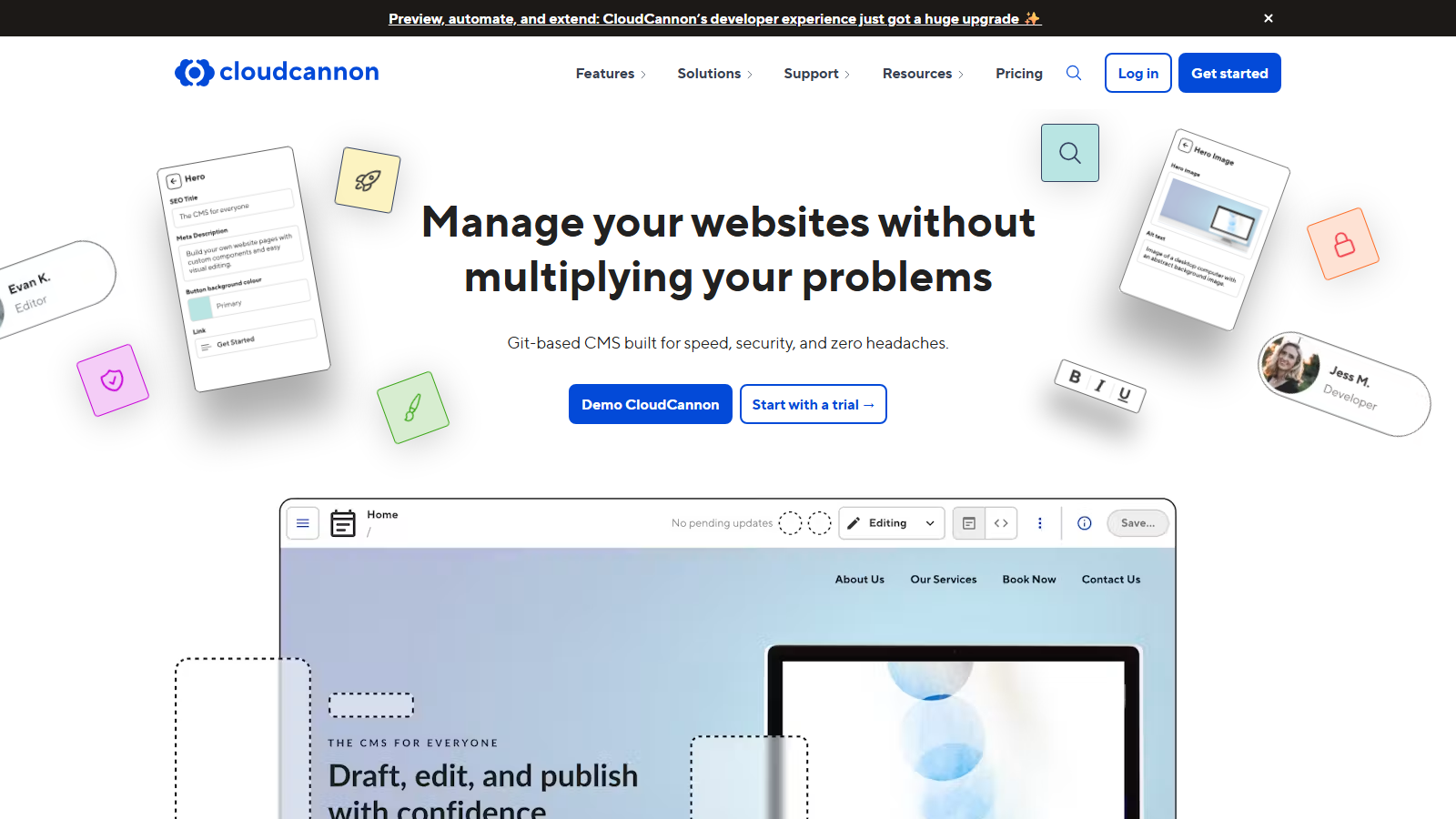
CloudCannon is two products sold as one. It is a visual editor for sites built with a static site generator, and it is the host that builds and serves those sites. Content stays as Markdown, YAML, JSON or TOML in a GitHub, GitLab or Bitbucket repository, and every edit is committed back there. The company was founded in New Zealand in 2013.
The detail that decides most evaluations is that the two halves are coupled. CloudCannon's documentation says building on CloudCannon is optional, but required for the Visual Editor, the testing domain and custom domains. You can host elsewhere, because CloudCannon will commit the built output to a branch for you. The build itself still has to run on CloudCannon if editors are to click on the page.
The bill follows the same logic. CloudCannon pricing is set per organisation, not per site: Standard is $55 a month, or $49 paid annually, for unlimited sites and three users. People are the meter, at $10 a month each, alongside bandwidth and custom domains. The CLI, REST API and TypeScript SDK added on 20 August 2026 manage that account, and none of them serves content to an app.
Our scorecard
Our editorial read across six dimensions, scored 1 to 5. This is our own assessment, not an aggregate of user reviews, and it is deliberately kept out of the page's structured data.
- Content modelling3/5
Collections, inputs, structures and snippets over files in Git. Fine for pages and posts, thin for relational data.
- Developer experience4/5
A config file with JSON Schemas and TypeScript types, and a CLI that validates it and runs the editor locally.
- Editor experience4/5
Editing on a preview of the real built page, marked up with data attributes. Review on branches needs Team.
- Pricing3/5
Sites are free to add and hosting is included, but seats, branching and SSO each push you up a tier.
- Governance3/5
SOC 2 Type 2, but default roles only on Standard, custom groups from Team, SSO and SLA on Enterprise.
- Ecosystem3/5
MIT and ISC tooling such as Bookshop and Editable Regions, a community forum, and no MCP server.
An editorial read, not an aggregate of user reviews, and deliberately kept out of this page's structured data.
CloudCannon in their own words
From CloudCannon's own YouTube channel. Vendor marketing rather than an independent review, included because it is the quickest way to see the product before you sign up.
What you can query
cloudcannon.config.yml
Published JSON Schemas and TypeScript types
Collections, inputs, structures, snippets and editor settings for the whole site, in YAML, JSON or JavaScript at the repository root
Editable Regions
Needs a build on CloudCannon
HTML attributes such as data-editable and data-prop that turn text, images, arrays and components in your built pages into in-place editors
Visual Editor API
Openly documented since 20 August 2026
Scripted access inside the editor to collections, datasets and files, for custom panels and editing interfaces beyond the built-in regions
REST API
v0, may change; per-IP rate limit, no figure published
Organisations, sites, builds, editing sessions, inboxes, DAMs and domains at app.cloudcannon.com/api/v0, with an OpenAPI specification
CLI and TypeScript SDK
CLI needs Node 24; SDK is server-side only
Config generation and validation, a local dev server, and scripted site, build and inbox management from the terminal or Node
Git sync and Build Deploys
Self-hosted GitLab and GitHub Enterprise Server on Enterprise
Two-way sync with GitHub, GitLab or Bitbucket, and optional build output committed to a branch for an external host
Who CloudCannon is for
Agencies and in-house web teams running several static sites, where the people editing them are not developers and the developers would rather not run hosting as well. One organisation holds every site, builds and hosting come with it, and editors get a page they can click on rather than a form. The Partner Program adds a $10 Lite plan for small clients.
The wrong buyer is anyone who needs content delivered to an app, a mobile client or a second front end. Asked whether it is headless, CloudCannon answers "not in the traditional sense". A team whose builds must stay on its own CI also gets less for the money, because in-place editing depends on the CloudCannon build.
Strengths and limits
What it does well
- No plan counts sites or repositories. Adding a site costs nothing in itself; users, bandwidth and custom domains are what move the bill.
- Editors work on a preview of the real built page, with regions marked by data-editable attributes in your templates rather than a separate component layer.
- Hosting is included on every plan: builds on push, automatic SSL, a global CDN, DDoS protection, password-protected pages and form inboxes without server code.
- The site settings reference names fourteen generators, from Hugo, Jekyll, Eleventy and Astro to Next.js, SvelteKit, Nuxt, Docusaurus and MkDocs, plus plain static files.
- Configuration lives in the repository with published JSON Schemas and TypeScript types, and since August 2026 the CLI validates it and runs the editor locally before you push.
- SOC 2 Type 2, with the report available on request through CloudCannon's Trust Center.
- The tooling around it is genuinely open: Bookshop is MIT and shipped 3.20.0 on 24 August 2026, and the CLI and Editable Regions packages are ISC.
- Client Sharing is ticked on every plan, so a client can update content without holding a CloudCannon account.
Where it falls short
- IN-PLACE EDITING DEPENDS ON THE CLOUDCANNON BUILD. External hosting is supported, but the build that feeds the Visual Editor has to run on CloudCannon.
- No content delivery API. The REST API from 20 August 2026 manages organisations, sites, builds and files, is versioned v0, and warns that endpoints may change.
- No free plan on the public price list: a 21-day trial, then a card. The $10 Lite plan is only available through the Partner Program.
- Branching workflows and deploy previews start on Team at $300 a month paid annually, so Standard has no in-app review of an editor's change on a branch.
- SSO/SAML, an uptime SLA, custom edge rules and syncing with self-hosted GitLab or GitHub Enterprise Server are all Enterprise only.
- Seats are the meter: three users on Standard and fifteen on Team, then $10 a month each, and the add-on list says shares include client sharing.
- With overages switched off, a site that exceeds its bandwidth goes offline until you buy more or a new billing period starts.
- No self-hosted edition and no MCP server. CloudCannon's position is that agents should edit the repository directly.
CloudCannon pricing
Standard is $55 a month, or $49 a month paid annually, in USD. It includes unlimited sites, three users, visual editing, Git syncing with GitHub, GitLab or Bitbucket, 110GB of bandwidth and five custom domains. Permissions are the default roles only, and there is no branching workflow, deploy preview or SSO.
Team is $350 a month, or $300 paid annually, for fifteen users, 700GB of bandwidth and ten custom domains. It adds branching workflows, deploy previews, advanced scheduling, up to ten custom permission groups, advanced forms and larger site mounting. Enterprise is quoted, and is where SSO/SAML, the uptime SLA, custom edge rules, a custom DAM and three hours a month of professional services sit.
Add-ons are $10 a month per extra user or site share, $15 per 100GB of bandwidth and $2 a month per extra custom domain. Overages can be switched off, in which case a site that runs out of bandwidth goes offline rather than creating a charge. Decide which failure you prefer before launch.
Agencies should read the Partner Program page as well. Partners get the Lite plan at $10 a month with one user, 20GB of bandwidth and one custom domain, discounts of 10% to 20% by tier, and trial sites that stay free until the client goes live.
The comparison worth running is against TinaCMS, using the figures on our own TinaCMS page. Ten client sites on Tina's Team plan at $24 per project is $240 a month, with three users each. One CloudCannon Standard organisation is $55 plus $10 per person beyond three: ten editors comes to $125, and thirty editors to $325.
Standard
$55 / mo
Or $49/mo paid annually; 21-day trial
- Unlimited sites, 3 users, $10/mo per extra user
- Visual editing and Git syncing with GitHub, GitLab or Bitbucket
- 110GB bandwidth and 5 custom domains included
- No branching workflows, deploy previews, SSO or uptime SLA
Team
$350 / mo
Or $300/mo paid annually; 21-day trial
- 15 users and up to 10 custom permission groups
- Branching workflows and deploy previews
- 700GB bandwidth and 10 custom domains included
- Advanced scheduling, forms and site mounting
Enterprise
Custom
Quoted after a sales call
- SSO/SAML authentication and an uptime SLA
- Syncing with self-hosted GitLab or GitHub Enterprise Server
- Custom edge rules, custom DAM and unlimited permission groups
- 3 hours a month of professional services, dedicated Slack support
Query example
A minimal fetch against the live API, with credentials read from the environment rather than pasted inline.
# cloudcannon.config.yml, at the root of the repository.
# Keys below are taken from the configuration file reference.
collections_config:
  blog:
    path: content/blog
    name: Blog
    icon: post_add
    url: /blog/[full_slug]/
    _enabled_editors:
      - visual
      - content
    create:
      extra_data:
        filename: '{date|year}-{date|month}-{date|day}-{title}'
      path: '[relative_base_path]/{filename|slugify}.[ext]'
    _inputs:
      date:
        type: datetime
        label: Publish date
        options:
          timezone: Etc/UTC
      seo_image:
        type: image
        options:
          path:
            uploads: images

# Visual editing is switched on in the templates, not here:
#   <h1 data-editable="text" data-prop="title">{title}</h1>
#
# Generate and check the file locally before pushing:
#   npm install --global @cloudcannon/cli    (Node.js 24 or later)
#   cloudcannon configure generate
#   cloudcannon validate
#   cloudcannon dev
Limits and quotas
- Standard: 3 users, 110GB bandwidth, 5 custom domains. Team: 15 users, 700GB, 10 domains. Lite (partners only): 1 user, 20GB, 1 domain.
- Extra user or site share: $10 a month. Extra bandwidth: $15 per 100GB. Extra custom domain: $2 a month.
- Bandwidth alerts are emailed at 50%, 75% and 100% of the allocation; with overages off, the site goes offline at the limit.
- Custom permission groups: none on Standard, 10 on Team, unlimited on Enterprise.
- Site mounting: 4 connections on Standard; 50 connections and 5 sites onto one site on Team; 500 connections on Enterprise.
- Advanced forms on Team: up to 5 targets per inbox and 10 form inboxes per site. Unlimited on Enterprise.
- The Visual Editor, the testing domain and custom domains all require the site to be built on CloudCannon.
- REST API: base URL app.cloudcannon.com/api/v0, X-API-KEY header, rate limited per IP address with 429 responses and no published figure.
- CLI requires Node.js 24 or later. The SDK requires Node.js 20 or later and runs server-side only.
- Legacy plans were repriced from 1 June 2024 and can no longer be bought, upgraded or downgraded; holders can only move to a current plan.
What developers say on Reddit
Practitioners who have shipped client sites on CloudCannon recommend it warmly, and the reasons are consistent. Agencies moved clients to it after Forestry shut down in 2023, and they cite the visual builder, hosting in the same bill, the partner dashboard and helpful support.
The criticism is just as consistent and comes in two forms. Some find it expensive for small or personal sites, and one commenter balked at three editors on the cheapest plan. Others warn that making an existing Hugo theme visually editable took significant conversion work with Bookshop, while a 2026 comment describes adding data attributes instead, which matches the Editable Regions approach documented now.
One limitation raised in passing is build time on a large Jekyll site. That matters more here than it would elsewhere, because the visual editor depends on CloudCannon running the build. A CloudCannon staff member answers pricing questions in several threads and is not quoted.
“I second the vote for Cloudcannon. We have moved most of our clients to it after Forestry shut down. They all love having the visual builder.”
r/webdev on Reddit“Cloudcannon has been really great for me. It includes hosting and has a great partner dashboard so billing is simple.”
r/webdev on Reddit“I would say though, to get the visual editing experience with cloudcannon it will require a significant amount of conversion work even with the help of bookshop.”
r/gohugo on Reddit“The only limitation I ran into was build time for a large jekyll site that takes a while to build but that's a fringe case”
r/JAMstack on Reddit“CloudCannon is so expensive to use”
r/eleventy on Reddit
Verdict
Pick CloudCannon when the sites are static, the editors are not technical, and you would rather not assemble hosting, builds, forms and an editor from separate vendors. The per-organisation bill suits a portfolio, the visual editor works on the real page, and SOC 2 Type 2 answers the first question an enterprise buyer will ask.
Go in knowing the dependency. In-place editing needs CloudCannon to run the build, so the product is at its best when it is also the host, and a pipeline you must keep elsewhere gets a thinner version of it. Budget for template work too: practitioners who converted existing Hugo themes describe real effort before the editor had anything to edit.
Rule it out for anything that needs content over an API. The vendor's own answer to whether it is headless is "not in the traditional sense", and the August 2026 API exists to run the account. Count editors before counting sites, because people, not sites, are what push the price from $55 towards Team at $350.
CloudCannon FAQ
How much does CloudCannon cost?
Standard is $55 a month, or $49 a month paid annually, in USD, for unlimited sites and three users. Team is $350, or $300 paid annually, for fifteen users. Enterprise is quoted. Extra users are $10 a month each, extra bandwidth $15 per 100GB and extra custom domains $2 a month. Agencies in the Partner Program can also put small clients on a $10 Lite plan.Does CloudCannon have a free plan?
No. Standard and Team both start with a 21-day trial, and before it ends CloudCannon asks for a card; without one the account is put on hold. Sales can extend a trial. The nearest thing to free is the Partner Program, where trial sites stay free until the client goes live.Does CloudCannon host websites or only edit them?
Both. Hosting is part of every plan: CloudCannon builds on each push to Git and serves the site over a global CDN with automatic SSL. You can host elsewhere instead, and CloudCannon will commit the static output to a branch for you to deploy. What you cannot do is skip the CloudCannon build and keep in-place visual editing.Is CloudCannon a headless CMS?
By its own description, not in the traditional sense. CloudCannon's AI information page says a typical headless CMS stores content in a database behind an API, whereas CloudCannon keeps it as files in your repository and builds the site from them. If a mobile app or a second front end needs the content, that architecture is the wrong one.Does CloudCannon have an API?
Yes, since 20 August 2026, but it is a platform API. The REST API at app.cloudcannon.com/api/v0 manages organisations, sites, builds, editing sessions and inboxes, authenticated with an X-API-KEY header. It is versioned v0 and endpoints may change. For content as JSON, CloudCannon's MIT-licensed Flatlake generates a static API from your files, though its last release was in May 2024.Which static site generators does CloudCannon support?
The site settings reference lists Hugo, Jekyll, Eleventy, Astro, Lume, MkDocs, Next.js, SvelteKit, Bridgetown, Docusaurus, Gatsby, Hexo, Nuxt and Sphinx, plus plain static files and an other option. CloudCannon's Next.js page describes static Next.js builds. Git syncing covers GitHub, GitLab and Bitbucket, with self-hosted GitLab and GitHub Enterprise Server on Enterprise only.How do you make a page visually editable in CloudCannon?
Add data-editable attributes to the HTML your templates output, with values such as text, image, array or component, and a data-prop naming the key to edit. Where no element fits, web components such as editable-text wrap the markup instead. Older sites often use Bookshop, the MIT component library, and converting an existing theme to it is where practitioners report the effort goes.Is CloudCannon cheaper than TinaCMS for an agency?
Often, and the deciding number is editors rather than sites. Tina bills its $24 Team plan per project, so ten client sites come to $240 a month, each with three users. One CloudCannon Standard organisation is $55 for three users in total plus $10 per extra person, so ten editors come to $125 and thirty to $325. The CloudCannon figure also includes hosting.
Other platforms worth a look
This is an independent review. We have no affiliate relationship with CloudCannon, earn nothing if you sign up, and no vendor pays for placement in the directory. Prices were read from the vendor's own pages in September 2026 and change without notice.