

Skip to content

HVAC SEO strategy

Regulated marketing

Weather sets demand and emergency queries convert within the hour

Written by Eugene SuslovLast reviewed 28 August 2026No affiliate links
Sector
Home and trades
Model
Local service, Multi-location
Competition
Brutal
Time to results
3 to 8 months
Typical monthly
$1,500 to $7,000

Key takeaways

  1. 1Demand arrives in walls. In the weeks that decide your year, the constraint is capacity rather than visibility, and every ranking gain is capped by how many trucks you can put on the road.
  2. 2The money is the replacement, and it is chosen under duress. Somebody whose system died in a heatwave has one day to decide on a five-figure purchase, and almost nobody has written the page that helps them.
  3. 3The refrigerant transition is the biggest content opening this trade has had in years, and most of the industry is answering it with a scare tactic that is both wrong and a deceptive claim.
  4. 4Your manufacturer will co-fund your marketing. Dealer programmes carry co-operative budgets and most dealers never claim theirs, which makes this the cheapest money in the trade.
  5. 5The maintenance agreement is the asset. It smooths the seasonality, it produces the replacement leads, and almost no contractor lets somebody buy one on the website.

SEO for HVAC companies has a rhythm nothing else in this directory has. Demand is not steady and it is not random. It is set by the weather, and it arrives in walls.

In the first genuinely hot week of the year, every failing system in the market fails at once. Calls triple, the phone cannot be answered, and the constraint stops being visibility and becomes how many trucks you can put on the road.

That has a specific consequence. An HVAC SEO strategy judged on peak-week leads is being judged on a number you could not have serviced anyway, so the work that matters is what happens either side of the peak.

Either side of the peak is where the money is. A replacement is an eight-thousand to twenty-thousand dollar decision, it is usually made under duress in a single day, and the homeowner has no idea how to make it. That is a content problem with an unusually large prize.

There is a second opening, and it is temporary. The refrigerant rules changed what may be built and then changed again on what may be installed, homeowners are searching for what it means, and a large part of the trade is answering with a version designed to sell a system rather than to inform.

The last piece is the maintenance agreement, which is the actual asset in this business. It flattens the seasonality, it produces the replacement conversations before the emergency, and almost no contractor lets a customer buy one from the website without ringing first.

Who already ranks in hvac

An emergency query and a replacement query return two completely different results pages, and HVAC SEO has to plan for both: the emergency one is a paid block over a map pack with no room for a website, and the replacement one is national cost aggregators and manufacturer sites, with local contractors nowhere.

What is on the results page

  • Local Services Ads above the map pack on emergency and near-me queries
  • Local pack on nearly everything carrying a place name or an urgent fault
  • National cost aggregators on replacement, sizing and price queries
  • Manufacturer sites on brand, model and refrigerant queries
  • People Also Ask, dense on repair-or-replace, sizing and standards questions
  • AI Overviews on diagnostic and standards questions, drawn from whoever explained them clearly
  • Seasonal volatility in everything above, with demand for some clusters moving by an order of magnitude
  • Manufacturer dealer programmes

    carrier.comClaim it

    The most valuable and most neglected gatekeeper in this trade. Carrier, Trane, Lennox, Daikin and the rest run tiered dealer programmes with a locator that ranks for brand-plus-city queries you cannot outrank directly. Most dealers leave the listing half filled in, and leave the programme's co-operative marketing budget unclaimed. Ask your distributor rep what your co-op accrual is, because it is usually the cheapest money in the trade.

  • Google Local Services Ads

    google.comClaim it

    Paid, sits above the map pack, and on emergency queries it caps what organic can reach at all. Entry is gated on licence, insurance and background checks. Treat it as a costed channel and watch it hard in peak weeks, when cost per lead moves and you may not have capacity for the leads anyway.

  • Utility rebate and programme contractor lists

    energystar.govClaim it

    Utilities running efficiency, electrification or demand response programmes publish approved contractor lists, and those pages rank for programme-name queries searched by homeowners who have already decided to spend. It is free, it is paperwork rather than marketing, and it also routes rebate-driven work directly.

  • Angi and Thumbtack

    angi.comClaim it

    Rank on service-plus-city queries almost everywhere and sell the same enquiry to several contractors. Claim the free profiles for consistency. If you buy the paid tier, watch it seasonally: peak-week leads are the ones you are least able to service and the ones you will pay most for.

  • Technician certification directories

    natex.orgClaim it

    Certification bodies publish searchable lists of certified technicians and contractors. Modest traffic and genuine credibility, particularly with the kind of homeowner who researches before they buy. Name the certification on the site with the awarding body rather than posting the badge alone.

  • Nextdoor

    nextdoor.comClaim it

    Not a search channel and one of the strongest referral sources in this trade, because a failed air conditioner is exactly the thing neighbours ask about. A claimed page and genuine recommendations outperform a lot of paid effort, and the effect is strongest in the weeks when everybody's system is under strain.

  • National cost aggregators

    homeguide.com

    Not claimable and they own the replacement cost queries, because contractors will not publish numbers. They are answering questions about your market with national averages. The only way past them is a local cost page with real ranges, which is the single highest-value page in this playbook.

What people actually search

HVAC search splits by urgency and by ticket size, and those two axes do not line up. The urgent queries are small money and cannot be won with content. The large money is a considered purchase compressed into a single stressful day, and that is where a website changes the outcome.

Emergency

Local transactional, urgent

ac not blowing cold [city]

The page that wins it: Local pack presence and a page that loads and dials

Converts within the hour and sits under a paid block. In peak weeks the real constraint is whether you have a truck, not whether you rank.

Repair or replace

Commercial investigation

is it worth repairing a 15 year old air conditioner

The page that wins it: An honest decision guide, including when to repair

The highest-value page in the trade. It is read at the exact moment a five-figure decision is being made, and the version that sometimes says repair it is the one that gets the replacement.

Replacement cost and sizing

Commercial investigation

how much does a new furnace cost

The page that wins it: A local cost page with real ranges and what moves them

Owned by national aggregators because contractors will not publish numbers. Sizing is a related and equally unserved query, and the honest answer involves a load calculation.

Refrigerant and standards

Informational

r-410a phase out what it means for my system

The page that wins it: A plain, accurate explainer with a clear so-what

The best content opening in this trade right now, and the one where the industry is least trustworthy. An accurate version is easy to write and immediately differentiating.

Heat pump conversion

Commercial investigation

heat pump vs furnace in a cold climate

The page that wins it: A climate-specific comparison with real running-cost arithmetic

Growing, contested by national publishers, and winnable locally because the honest answer depends on your climate, your electricity rate and your housing stock.

Maintenance and plans

Commercial investigation

is an hvac maintenance plan worth it

The page that wins it: A page stating exactly what your plan includes and costs

The asset that smooths your year, and almost no contractor lets anybody buy one online. The sceptical framing of the query is a gift: answer it honestly and you win the sceptic.

Indoor air quality

Informational to commercial

does a whole house air purifier help with allergies

The page that wins it: An evidence-led page that says where the claims are weak

High margin and the area where the trade's claims are least supported. Being the honest voice here is both safer and more persuasive than the alternative.

Commercial and property management

Commercial investigation

commercial hvac maintenance contract [city]

The page that wins it: A separate section written for a facilities buyer

Different customer, different cycle, and it is counter-seasonal in a useful way: planned commercial work fills the shoulder months residential leaves empty.

A single day drawn as a timeline. The system fails at seven in the morning during the first hot week, the homeowner searches repair or replace at nine, two quotes arrive in person, and it is signed before bed.
A five-figure purchase with no research phase. The highlighted moment is the only one a website is in.

What the rules change

Lighter than health or finance, and with one item that is being broken across the whole trade right now. Licensing and refrigerant handling are federal and state matters, so check your own board and your own certification. Nothing here is legal advice.

1

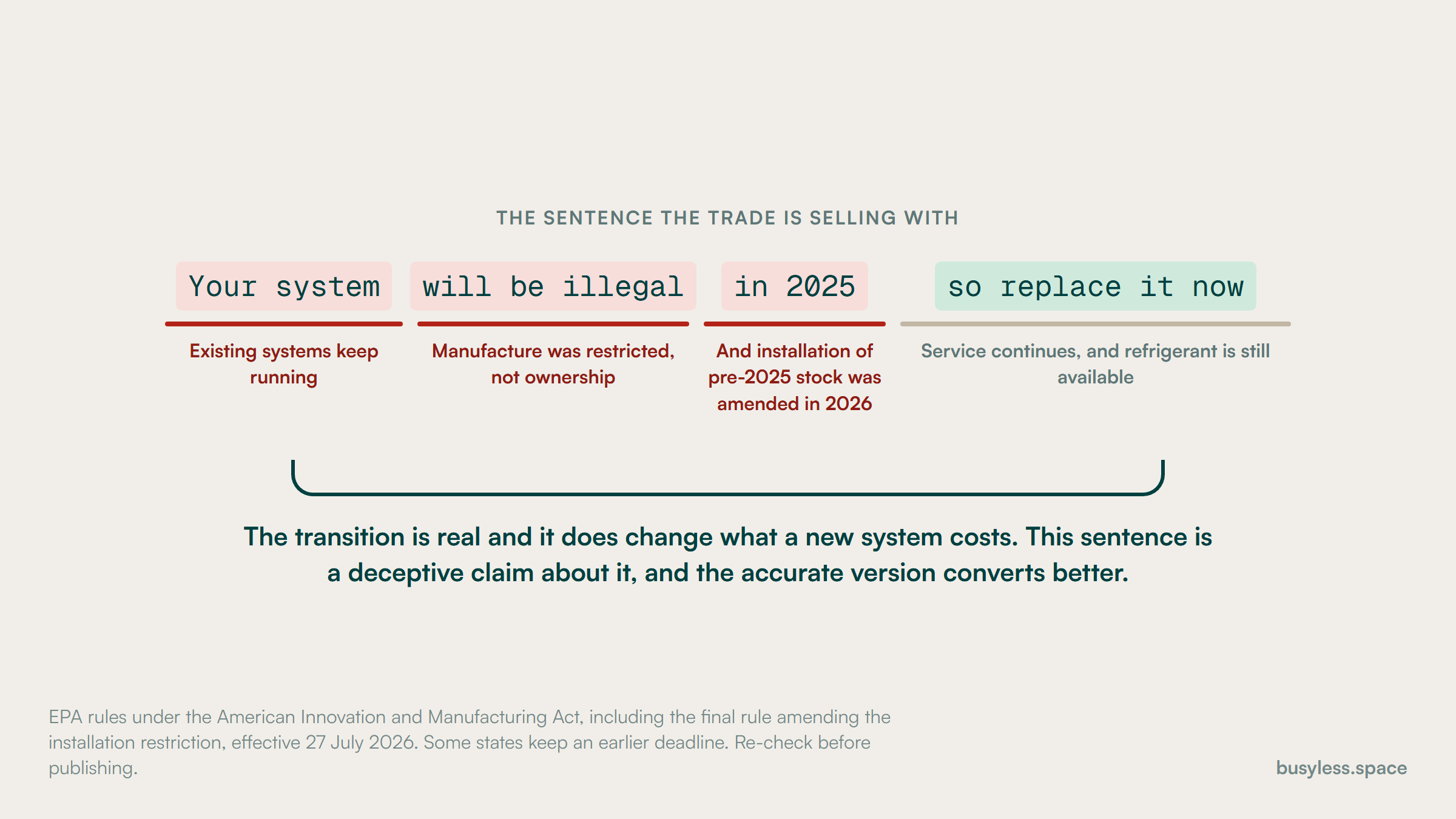
"Your system will be illegal" is a deceptive claim

Environmental Protection Agency rules under the American Innovation and Manufacturing Act of 2020, including the Technology Transitions rule and the final rule amending its installation restriction, effective 27 July 2026

What it means

Manufacture is what the rule restricts: new systems using the higher global warming potential refrigerant have not been made since 1 January 2025. The installation side has already moved once, with an EPA final rule effective 27 July 2026 letting units built before that date be installed until stocks run out. None of it makes an existing system illegal, forces a replacement, or stops servicing.

So do this

Write the accurate version: existing systems keep running, service continues, and new equipment uses a different refrigerant with real cost and handling implications. Date the page and re-check it, because this rule has already been amended once and some states kept an earlier deadline. Being the honest explanation in a market full of scare tactics is a competitive position, not just a compliance one.

2

Refrigerant handling requires certification

EPA regulations under section 608 of the Clean Air Act, 40 CFR Part 82 Subpart F

What it means

Technicians who maintain, service, repair or dispose of equipment that could release refrigerant must hold the appropriate certification, and there are recordkeeping and recovery obligations. The newer lower global warming potential refrigerants also introduce mild flammability classifications, which brings training, handling and sometimes code implications with them.

So do this

State the certifications your technicians hold, by type. Do not advertise a service your team is not certified to perform. If you have trained on the newer refrigerant classifications, say so specifically, because it is a genuine differentiator right now and a homeowner researching the transition will look for it.

3

Efficiency ratings belong to a matched system, not to a box

Department of Energy efficiency standards and test procedures using SEER2, EER2 and HSPF2; AHRI certified ratings for matched combinations; Federal Trade Commission Appliance Labeling Rule, 16 CFR Part 305

What it means

An efficiency rating applies to a tested combination of outdoor unit, indoor coil and sometimes air handler, not to the condenser alone. Advertising a headline rating that the system as actually installed will not achieve is a misrepresentation, and the labelling rule governs how efficiency information is presented to consumers.

So do this

Quote the rating for the matched combination you would actually install, and reference the certified rating rather than the brochure number. On any page comparing systems, say that the rating depends on the match, because that sentence alone is more useful than most of what is published on the subject.

4

Incentive pages go stale, and stale incentives are inaccurate claims

Federal residential energy credits under Internal Revenue Code sections 25C and 25D were terminated for property placed in service after 31 December 2025; utility and manufacturer rebate programmes are administered separately and change on their own schedules

What it means

The federal picture changed, while utility and manufacturer rebates continue and vary by territory and by season. HVAC marketing leans heavily on incentives, so a page written two years ago is likely promising something that no longer exists, and a rebate page rarely gets revisited once it is published.

So do this

Audit every incentive claim, rebuild the page around programmes that genuinely apply in your service territory, and date every figure. Never imply that a utility endorses you because you appear on its contractor list; describe it as participation, which is what it is.

The sales claim your system will be illegal in 2025, so replace it now, broken into four clauses. Each of the first three carries the accurate correction: existing systems keep running, manufacture was restricted rather than ownership, and the installation restriction was amended in 2026.
The transition is real and it does change what a new system costs. This particular sentence is a deceptive claim about it.

Proving expertise

The trust signals in this trade are concrete and mostly unpublished. The homeowner is deciding whether to spend five figures with somebody they found an hour ago, and a badge graphic answers none of the questions they actually have.

  • Licence number and class in text, with the issuing authority named
  • Refrigerant handling certifications stated by type, including any newer refrigerant training
  • Technician certifications named with the awarding body rather than shown as a logo
  • Manufacturer dealer status named with the tier and the year it was earned
  • Whether you perform a load calculation before quoting a replacement, stated plainly
  • What your warranty actually covers, including labour, and for how long
  • Real photographs of your own installations rather than manufacturer stock imagery
  • Maintenance plan terms published in full, including price, inclusions and cancellation

How to build a HVAC SEO strategy

A realistic first six months, sequenced against the season rather than against a generic calendar. An HVAC SEO strategy that starts in June is starting in the month you have least capacity to act on it, so the ordering below assumes you begin in a shoulder season and build toward the next peak.

  1. 1

    Weeks 1 to 3

    Take down the inaccurate claims, claim the free listings

    • Audit every incentive and rebate page and rewrite around what genuinely applies now
    • Review any refrigerant messaging for the your-system-will-be-illegal claim, and rewrite it
    • Claim and complete every manufacturer dealer locator listing you qualify for
    • Ask your distributor rep what your co-operative marketing accrual is
    • Complete the Google Business Profile: categories, services, real photos, hours
    • Check the utility programme contractor lists in your territory

    You end up with
    No inaccurate claims live, every free listing claimed, and a known co-op budget

  2. 2

    Weeks 3 to 8

    Write the pages that decide a five-figure purchase

    • Build the repair-or-replace guide, honestly, including when to repair
    • Publish local replacement cost ranges with the drivers spelled out
    • Write the refrigerant transition explainer accurately
    • Publish the maintenance plan with its real price, inclusions and terms
    • Add HVACBusiness and Service structured data
    • Make the maintenance plan buyable online rather than by phone only

    You end up with
    The high-value decisions answered on your site rather than on a national aggregator

  3. 3

    Weeks 6 to 16

    Build the seasonal and shoulder-season assets

    • Write the sizing and load calculation explainer for your climate
    • Build the heat pump comparison with real local running-cost arithmetic
    • Write the indoor air quality pages with an honest read on the evidence
    • Build a commercial section, which is the counter-seasonal revenue
    • Publish installation case pages with your own photography
    • Prepare the seasonal content changes before the season, not during it

    You end up with
    Coverage of the researched clusters, plus a commercial pipeline for the quiet months

  4. 4

    Weeks 12 to 26

    Measure replacements and plan enrolments

    • Attribute calls and forms, and reconcile against the dispatch system
    • Report replacements, maintenance enrolments and service calls separately
    • Track capacity honestly: leads you could not service are not a marketing win
    • Compare Local Services Ads against organic on cost per booked replacement
    • Set a quarterly review on incentive, refrigerant and standards content
    • Report plan enrolment as a first-class number, since it is the asset

    You end up with
    A report that separates the seasonal spike from the underlying business

Technical fixes with the best payoff

The technical work here is unusually shaped by the calendar. A site that performs perfectly in October can fall over in the first heatwave, and content written for one season is wrong for half the year unless somebody planned for it.

  • The site is not built for a demand spike

    A sprint, done off-peak

    Traffic in the first hot week can be several times a normal week, and it arrives on mobile, on cellular, from people who are uncomfortable and impatient. A heavy page and a slow form lose calls precisely when calls are worth most.

    Test the emergency and service pages under a throttled mobile connection, not on the office wifi. Strip the hero video, compress the images, make the number tappable and put it in a sticky header. Do this in the shoulder season, because you will not do it in July.

  • Seasonal content was written once

    A day to plan, then an hour per change

    Half the site is about cooling and it is January, or the home page still promotes a spring tune-up in November. Demand in this trade swings by an order of magnitude between clusters, and a static site is wrong for roughly half the year.

    Plan the seasonal rotation in advance: what the home page promotes, which service is featured, which content gets refreshed and when. Six calendar entries and a prepared set of blocks is the whole system.

  • There is no repair-or-replace content

    A day

    It is the highest-value decision the customer makes and the moment they are most open to being helped. Contractors avoid it because the honest answer is sometimes repair, so a national aggregator answers it instead and sells the lead onward.

    Write it honestly, with the actual decision factors: age, refrigerant type, repair cost against replacement, efficiency difference, remaining warranty, how long they intend to stay. The version that sometimes recommends repair is the one that wins the replacement.

  • The refrigerant explainer is missing or is a scare tactic

    A day

    Homeowners are searching this and the industry is answering with urgency rather than information. It is a rare case where the accurate version is also the differentiated version, and where the inaccurate version is a deceptive claim.

    Write what actually changes and what does not: existing systems keep running, service continues, new equipment uses different refrigerant, here is what that means for cost and for repairs. Date it and review it.

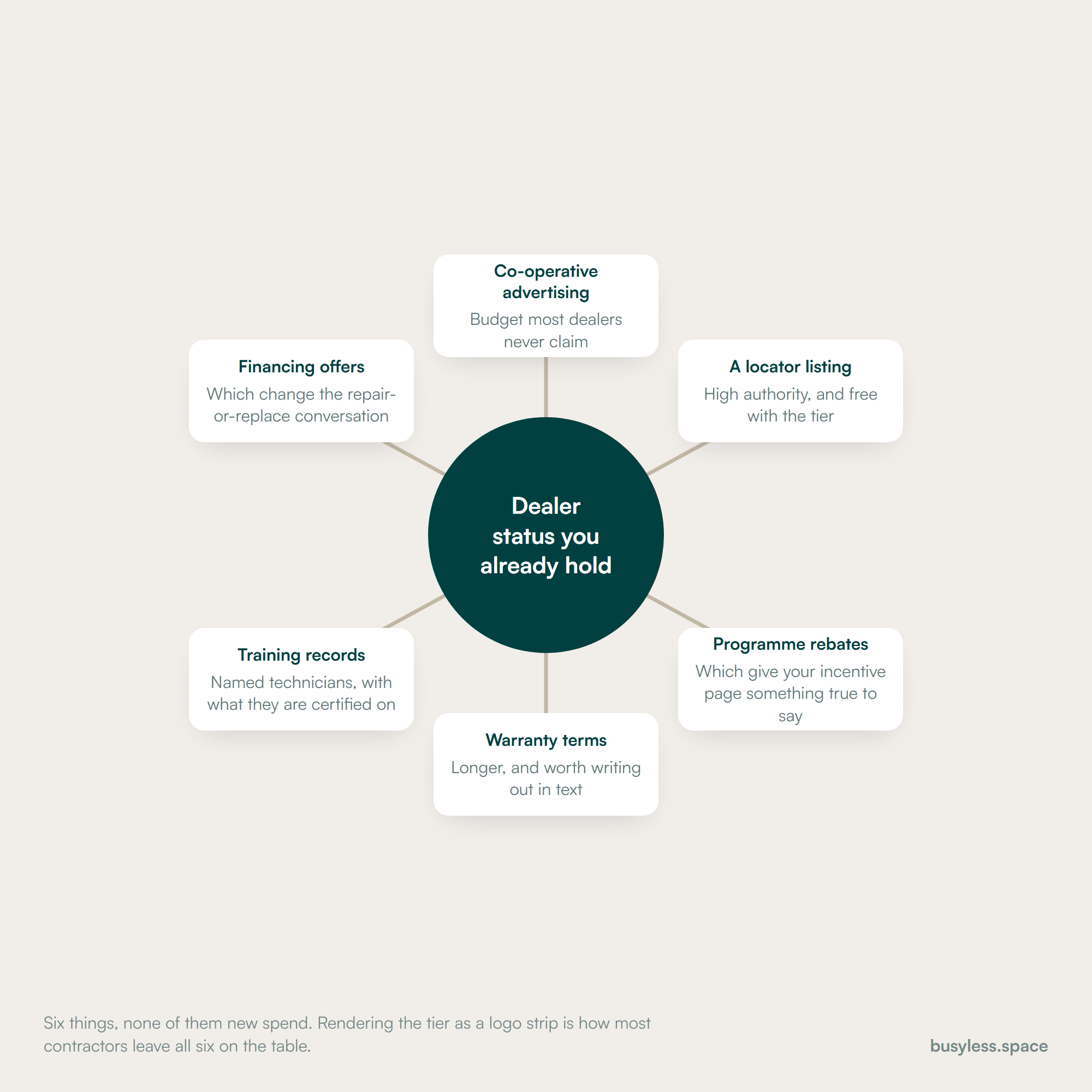
  • Dealer status is a logo

    An afternoon

    Manufacturer dealer tiers are a genuine differentiator, they carry warranty and training implications, and rendering them as a strip of badges means the words are nowhere on the page. It also means the locator listing and the site do not reinforce each other.

    Write it out: which brands, which tier, since when, what it required. Link to the manufacturer's own locator entry. Then go and complete that entry, which is almost certainly half empty.

  • The maintenance plan cannot be bought

    A sprint

    It is the asset that smooths the year and produces replacement conversations, and on almost every contractor site it is a paragraph and a phone number. The customer most likely to buy one is the one who just had a good service visit and is on their phone.

    Publish the plan properly: price, exactly what is included, how many visits, what is discounted, the term, and how to cancel. Then let somebody buy it online. Check your state's automatic renewal rules before setting it up as a subscription.

  • There are no photographs of your own installations

    Ongoing, a few minutes per job

    Equipment and installation queries return image results, and manufacturer stock photography proves nothing about your workmanship. A tidy line set and a properly sealed plenum are the things a knowledgeable buyer looks at.

    Photograph completed installations, publish them as short case pages with what was replaced and why, and write alt text describing the work. It costs nothing and it is the proof a cautious buyer wants.

Structured data that applies here

The types below fit this industry specifically. Most of them earn no rich result on their own, which is worth knowing before anyone sells the work on that basis. What they do is describe the entity precisely, which matters for how search engines and answer engines resolve who you are.

  • HVACBusiness

    Home page and any location pages

    HVACBusiness is in the vocabulary and almost nobody in the trade uses it, which makes it free precision. One node per physical location.

    HVACBusiness.jsonld
    {
      "@context": "https://schema.org",
      "@type": "HVACBusiness",
      "@id": "https://[YOUR-DOMAIN]/#business",
      "name": "[BUSINESS NAME]",
      "url": "https://[YOUR-DOMAIN]",
      "telephone": "[+1-555-000-0000]",
      "priceRange": "[$$]",
      "image": "https://[YOUR-DOMAIN]/van.jpg",
      "address": {
        "@type": "PostalAddress",
        "streetAddress": "[123 Example St]",
        "addressLocality": "[CITY]",
        "addressRegion": "[ST]",
        "postalCode": "[00000]",
        "addressCountry": "US"
      },
      "areaServed": [
        { "@type": "City", "name": "[CITY]" },
        { "@type": "AdministrativeArea", "name": "[COUNTY]" }
      ],
      "openingHoursSpecification": [{
        "@type": "OpeningHoursSpecification",
        "dayOfWeek": ["Monday","Tuesday","Wednesday","Thursday","Friday"],
        "opens": "[07:00]",
        "closes": "[17:00]"
      }],
      "specialOpeningHoursSpecification": {
        "@type": "OpeningHoursSpecification",
        "description": "[Emergency cover, or on-call. Say which, and mean it.]",
        "opens": "00:00",
        "closes": "23:59"
      },
      "hasCredential": [{
        "@type": "EducationalOccupationalCredential",
        "credentialCategory": "Contractor licence",
        "identifier": "[LICENCE NUMBER]",
        "recognizedBy": { "@type": "GovernmentOrganization", "name": "[STATE AUTHORITY]" }
      }]
    }
  • Service with a replacement price range

    Replacement and installation pages

    The node that puts a number where competitors put a contact form. Publish a range you will honour and make sure the identical range is visible in the page copy.

    Service with a replacement price range.jsonld
    {
      "@context": "https://schema.org",
      "@type": "Service",
      "name": "[Air conditioner replacement]",
      "serviceType": "[System replacement and installation]",
      "provider": { "@id": "https://[YOUR-DOMAIN]/#business" },
      "areaServed": {
        "@type": "AdministrativeArea",
        "name": "[COUNTY OR METRO]"
      },
      "offers": {
        "@type": "Offer",
        "priceSpecification": {
          "@type": "PriceSpecification",
          "minPrice": "[0000]",
          "maxPrice": "[00000]",
          "priceCurrency": "USD"
        },
        "description": "[What the range includes: equipment, labour, permit, disposal. And what moves it: capacity, efficiency tier, ductwork, electrical.]"
      },
      "description": "[One plain sentence, in the homeowner's words.]"
    }
  • Offer for a recurring maintenance plan

    The maintenance plan page

    Unusual in this directory and exactly right here, because the plan is genuinely a subscription. Model the billing period properly, and check your state's automatic renewal rules before you sell it as one.

    Offer for a recurring maintenance plan.jsonld
    {
      "@context": "https://schema.org",
      "@type": "Offer",
      "name": "[PLAN NAME]",
      "url": "https://[YOUR-DOMAIN]/maintenance-plan",
      "seller": { "@id": "https://[YOUR-DOMAIN]/#business" },
      "category": "Preventative maintenance agreement",
      "priceSpecification": {
        "@type": "UnitPriceSpecification",
        "price": "[000]",
        "priceCurrency": "USD",
        "billingDuration": 1,
        "billingIncrement": 1,
        "unitCode": "ANN"
      },
      "eligibleCustomerType": "https://schema.org/Consumer",
      "areaServed": { "@type": "AdministrativeArea", "name": "[COUNTY]" },
      "description": "[Visits per year, what each includes, what is discounted, the term, and how to cancel.]"
    }
  • Organization with dealer and technician credentials

    The about or credentials page

    Dealer tier and refrigerant certifications are the two things a researching buyer checks. Both are usually rendered as logos, which puts them nowhere a machine can read.

    Organization with dealer and technician credentials.jsonld
    {
      "@context": "https://schema.org",
      "@type": "Organization",
      "@id": "https://[YOUR-DOMAIN]/#business",
      "name": "[BUSINESS NAME]",
      "hasCredential": [
        {
          "@type": "EducationalOccupationalCredential",
          "credentialCategory": "[MANUFACTURER] dealer programme",
          "name": "[TIER NAME]",
          "recognizedBy": { "@type": "Organization", "name": "[MANUFACTURER]" },
          "dateCreated": "[YYYY]"
        },
        {
          "@type": "EducationalOccupationalCredential",
          "credentialCategory": "EPA section 608 certification",
          "name": "[Type I / II / III / Universal]",
          "recognizedBy": { "@type": "GovernmentOrganization", "name": "US Environmental Protection Agency" }
        },
        {
          "@type": "EducationalOccupationalCredential",
          "credentialCategory": "Technician certification",
          "recognizedBy": { "@type": "Organization", "name": "[CERTIFYING BODY]" }
        }
      ]
    }
  • FAQPage

    Cost, repair-or-replace and refrigerant pages

    Refrigerant is the cluster to cover right now. It is being asked constantly and answered badly. Match the visible text exactly and keep the answers accurate.

    FAQPage.jsonld
    {
      "@context": "https://schema.org",
      "@type": "FAQPage",
      "mainEntity": [
        {
          "@type": "Question",
          "name": "[Question exactly as it appears on the page]",
          "acceptedAnswer": {
            "@type": "Answer",
            "text": "[Answer exactly as it appears. Give the real range or the real rule, not the urgent version.]"
          }
        }
      ]
    }
  • BreadcrumbList

    Service, equipment and coverage pages

    Modest, and worth it once services and equipment types form a real hierarchy. It also drags the generated town pages into view, which is the bigger prize.

    BreadcrumbList.jsonld
    {
      "@context": "https://schema.org",
      "@type": "BreadcrumbList",
      "itemListElement": [
        { "@type": "ListItem", "position": 1, "name": "Home",
          "item": "https://[YOUR-DOMAIN]/" },
        { "@type": "ListItem", "position": 2, "name": "[Services]",
          "item": "https://[YOUR-DOMAIN]/services" },
        { "@type": "ListItem", "position": 3, "name": "[SERVICE]",
          "item": "https://[YOUR-DOMAIN]/services/[SLUG]" }
      ]
    }

What it costs

Editorial estimates rather than quotes. The number here is driven by market size and by whether you are contesting emergency work against a paid ad block, rather than by how many vans you run. One thing to weigh before setting it: the manufacturer co-operative budget you may already have accrued.

Lean

$1,500 to $3,000
  • Profile, dealer locators and utility programme listings kept accurate
  • The repair-or-replace guide, the cost page and the refrigerant explainer
  • The maintenance plan published properly and made buyable
  • Seasonal content rotation planned and executed
  • Structured data and reporting split into leading and business indicators

Who it suits

A three to eight van company that wants more replacements and fewer bargain service calls

Where it stops

It will not out-spend a competitor buying Local Services Ads heavily in peak season, and it cannot fix an answer rate that collapses in a heatwave.

Funded

$3,500 to $7,000
  • The full decision cluster: sizing, heat pump comparison, indoor air quality, warranty
  • A commercial section built for facilities buyers, which is counter-seasonal revenue
  • Installation case pages produced from jobs you were doing anyway
  • Call attribution reconciled against the dispatch system
  • Content maintained through the season rather than published and abandoned

Who it suits

Multi-van companies in competitive metros, or anyone with a real cost per booked replacement to beat

Where it stops

This tier competes with the trades marketing specialists. It does not create capacity in July, and in peak weeks capacity is the whole game.

Multi-location

$7,000 and up
  • Location pages and profiles managed as a system rather than individually
  • Per-location reporting, so a weak branch is visible rather than averaged away
  • Commercial and residential run as separate programmes with separate content
  • Recruitment content, which for a growing contractor is frequently the binding constraint
  • Co-operative marketing budgets actually claimed and reconciled

Who it suits

Contractors above about four locations, or anyone acquiring companies and merging their sites

Where it stops

Scale brings a duplication problem across location pages, and an integration problem every time you acquire. Both are content modelling questions rather than budget ones.

How to do it with no budget

Most of the available value here costs time rather than money, and one item may actually return money you have already earned. Make the first call before you set any budget, and do the rest in the shoulder season.

  1. 1

    Ask your distributor about co-operative marketing funds

    30 minutes

    A phone call to your rep

    First, because it may fund everything below. Dealer programmes usually accrue a co-op budget against purchases and a large share of it expires unclaimed every year.

  2. 2

    Fix the refrigerant messaging

    2 hours

    Your website editor

    Remove anything implying an existing system becomes illegal or must be replaced. It is inaccurate, it is a deceptive claim, and the honest version is a better page anyway.

  3. 3

    Audit the incentive pages

    2 hours

    Your website editor

    The federal picture changed and utility programmes move on their own schedules. Date every figure and put a quarterly reminder against the page.

  4. 4

    Complete every manufacturer dealer locator

    2 hours

    Each brand's dealer portal

    Free, high authority, ranks for brand-plus-city queries, and almost always half filled in. Photographs, services, hours and description all matter.

  5. 5

    Publish a replacement cost range

    3 hours

    Your website editor

    A range with the drivers listed. It is the single highest-value page in the trade and national cost aggregators currently own it in every market.

  6. 6

    Write the repair-or-replace guide

    3 hours

    Your website editor and your best technician

    Honest, including when to repair. Interview a technician and write down the actual factors they weigh. It is the page read at the moment the money decision is made.

  7. 7

    Publish the maintenance plan in full

    2 hours

    Your website editor

    Price, inclusions, visit count, discounts, term and cancellation. Then work out how to let somebody buy it without ringing you, because that is where the enrolments are lost.

Dealer status at the centre of six things it entitles a contractor to: co-operative advertising budget, a locator listing, programme rebates, longer warranty terms, training records and financing offers.
Six things, none of them new spend. Rendering the tier as a logo strip is how most contractors leave all six on the table.

The tool stack

Jobs first, tools second. Most of this has a free option below about five vans. The one genuinely necessary purchase in this trade is call tracking, because the phone is the conversion and the seasonal swing makes guessing useless.

  • Track local pack position across the service territory

    DataForSEOSEO APIRead the review

    Track it seasonally as well as geographically. Position in February and position in the first hot week are different numbers, and the second is the one that matters.

    Free routeManual checks from a few postcodes, workable for one area

  • Find the decision and standards queries worth writing for

    Google Search Console plus your own call log

    Write down what customers actually ask when a system fails. That phrasing is the keyword research, and it is where the refrigerant questions will show up first.

    Free routeBoth free, and the call log is the better source

  • Model what a replacement from search is worth

    SEO Revenue Growth CalculatorFree toolOpen the tool

    Model replacements, service calls and plan enrolments separately, and include the plan's renewal value. A blended ticket hides the entire argument for the decision content.

    Free routeFree

  • Set the budget against the co-op money you already have

    SEO Budget CalculatorFree toolOpen the tool

    Run it against the co-operative marketing budget you may already have. That comparison usually changes the conversation with the owner entirely.

    Free routeFree

  • Generate the HVACBusiness and Offer markup

    Schema Markup GeneratorFree toolOpen the tool

    The maintenance plan Offer is the one worth getting right, since it is the only genuinely recurring product in the trade and nothing else models it.

    Free routeFree

  • Run seasonal content changes without a developer each time

    PayloadHeadless CMSRead the review

    Services, equipment types, coverage areas and seasons intersect. Being able to swap the featured service and the home page promotion on a schedule is the difference between a plan and a good intention.

    Free routeFree and self-hosted

  • Tell a repair call and a replacement call apart at source

    A call tracking vendor with dynamic number insertion

    The one purchase I would not skip here. The phone is the conversion, volume swings by an order of magnitude across the year, and without attribution the seasonal noise makes every other number unreadable.

  • See what assistants say about the refrigerant transition

    LLM visibility trackerOur toolSee the tool

    This is the question homeowners are currently asking an assistant rather than a contractor. The answers come from whoever explained it clearly, which is an argument for writing the accurate version before your competitors do.

Take it from here

Everything below is yours to take. Fill the [BRACKETS] and it is ready to use. Start with the refrigerant messaging audit: it is the only item here that removes an inaccurate claim, and the accurate version is a better page than the one it replaces.

Checklist

Finds and fixes the your-system-will-be-illegal claim, which is currently being made across the trade, is not true, and is a deceptive claim as well as a bad page.

REFRIGERANT MESSAGING AUDIT - [COMPANY] - [DATE]

WHY THIS IS FIRST
The rule restricts what may be MANUFACTURED. Higher global warming
potential residential systems have not been built since 1 January
2025. The installation restriction has already been amended once:
an EPA final rule effective 27 July 2026 allows units built before
that date to be installed until stocks run out, and some states
kept an earlier deadline of their own. None of it makes an
existing system illegal, forces a replacement, or stops service.
A lot of contractor marketing implies otherwise, because urgency
sells.

1. SEARCH YOUR OWN SITE AND ADS FOR
   [ ] "illegal"
   [ ] "banned"
   [ ] "phased out" / "phase out"
   [ ] "must replace"
   [ ] "before it is too late"
   [ ] "R-410A"
   [ ] "R-22"
   [ ] "act now"
   Include blog posts, service pages, ads, mailers and social.

   | Where            | What it claims | Accurate? | Action |
   |------------------|----------------|-----------|--------|
   | [______________] | [____________] | [ Y / N ] | [____] |
   | [______________] | [____________] | [ Y / N ] | [____] |
   | [______________] | [____________] | [ Y / N ] | [____] |

2. THE ACCURATE VERSION, AS A PAGE
   Write these five answers and you have the best page on this
   subject in your market.

      a) What actually changed
      [Manufacture, from 1 January 2025. Then the installation
       rule was amended effective 27 July 2026. Check the
       current position and your own state before writing this,
       and put the date you checked on the page.]

   b) Does my current system become illegal
      [No. Say it plainly, in the first line of the answer.]

   c) Can it still be serviced
      [Yes. Explain refrigerant availability and what changes
       about cost over time, honestly.]

   d) What is different about a new system
      [Different refrigerant, different handling requirements,
       different equipment. What that means for price and for
       who can work on it.]

   e) Should I replace now or wait
      [The honest answer depends on the age and condition of
       the system, not on the rule. Link to the repair-or-
       replace guide.]

3. WHAT YOUR TECHNICIANS ARE CERTIFIED FOR
   [ ] EPA section 608, type: [__________]
   [ ] Training on the newer refrigerant classifications: [ Y/N ]
   [ ] Say so on the page. It is a genuine differentiator now.

4. MAINTENANCE
   Dated on the page: [DATE]
   Owner: [NAME]     Review: quarterly while the transition runs

What to publish

Ranked by how directly it touches a five-figure decision. The trade writes about services and seasonal tune-up reminders. What pays is the decision a homeowner is making under pressure with no information.

  • The repair-or-replace guide

    Once, reviewed yearly and whenever standards change

    The highest-value decision in the trade, made under duress, currently answered by aggregators with no stake in the outcome.

  • Local replacement cost ranges

    Once, reviewed when equipment pricing moves

    Every homeowner asks it, no contractor answers it, and a national average is answering it for your market right now.

  • The refrigerant and standards explainer

    Once, then reviewed quarterly while the transition continues

    The best temporary opening in this trade, and the one place where being accurate is also being differentiated.

  • The maintenance plan page

    Once, updated whenever the plan changes

    The asset that flattens your year and produces replacement conversations early. Publishing the full terms is what converts the sceptic who searched whether it is worth it.

  • Sizing and load calculation content

    Once per equipment type

    Answers a question homeowners ask constantly and demonstrates that you do the calculation, which is a genuine differentiator against contractors who guess.

  • Installation case pages

    Two a month

    Proof of workmanship, image search eligibility, and the thing a knowledgeable buyer actually looks at. Produced from jobs you were doing anyway.

And what not to

  • Any claim that an existing system will become illegal or must be replaced because of the refrigerant transition
  • Efficiency ratings quoted for an outdoor unit rather than for the matched system you would install
  • Incentive pages that still promise credits which no longer apply
  • A page for every town in the county, which is the doorway pattern the trades keep repeating
  • Seasonal content left up out of season, which is half the year on most contractor sites
  • Indoor air quality claims stronger than the evidence supports
  • Round-the-clock emergency claims the answering arrangement cannot support

A four-step loop. Somebody buys the maintenance plan on the website, two visits a year follow, the contractor sees the system failing before the heatwave, and the replacement is planned at a scheduled price which renews the plan.
The flagged first step is the one almost no contractor site allows, which breaks the loop before it starts.

The expensive mistakes

Judging the programme on peak-week leads

Costs you A number that measured the weather rather than the marketing, and a budget decision made on it

Report the shoulder seasons separately, and treat leads you could not service as a capacity fact rather than a marketing win

Selling the refrigerant transition as an emergency

Costs you A deceptive claim, and the loss of the one content position in this trade where honesty is differentiating

Write what actually changes and what does not, date it, and let the accuracy do the selling

Refusing to publish replacement costs

Costs you The highest-value researched query in the trade handed to a national aggregator who then sells the lead back

A range with the drivers listed, which filters enquiries as well as winning them

Leaving the dealer co-op budget unclaimed

Costs you Money you already earned, expiring annually, while the marketing budget is argued about

Ask the distributor rep what has accrued and what it can be spent on, before setting any budget

Making the maintenance plan a phone call

Costs you The recurring revenue asset that smooths the whole year, lost at the moment of highest intent

Publish the full terms and let somebody buy it online, having checked your state's renewal rules

Reporting traffic to the owner

Costs you The budget goes in the first mild month, because nothing in the report connects to an installation

Replacements, plan enrolments and average ticket by cluster, with seasonality stated

What to measure

Seasonality makes this the easiest industry in the directory to mislead somebody with, in either direction. A hot June looks like brilliant marketing and a mild one looks like failure, and neither is true. Every number here needs a comparison that controls for the weather.

Leading indicators

Move first. They predict, they do not prove.

  • Local pack position by area, tracked seasonally

    Geo-specific rank tracking

    Compare against the same period last year, never against last month. Month-on-month movement in this trade is mostly weather.

  • Profile actions: calls, direction requests, website clicks

    Google Business Profile insights

    The fastest-moving indicator and the most seasonally distorted. Useful for spotting profile problems, useless as a trend without a year-on-year comparison.

  • Impressions on the decision clusters

    Search Console, filtered to repair-or-replace, cost, sizing and refrigerant

    The clusters that survive the season, and the ones the content programme is actually building. These should grow through the quiet months.

  • Answer rate and missed calls in peak weeks

    Phone system reporting

    Report it in the marketing report even though it is an operations number. In the weeks that decide the year, it caps everything else, and marketing is the function that notices.

Business indicators

The ones a manager acts on.

  • Replacements booked from search

    Dispatch or job management system, reconciled with call tracking

    The number that justifies the programme. Track it separately from service calls, because the two have entirely different values and different content behind them.

  • Maintenance plan enrolments

    Your plan administration

    The asset. Report enrolments, cancellations and net movement, because a plan base that churns as fast as it grows is not smoothing anything.

  • Average ticket by cluster

    Invoicing

    Emergency service, planned replacement, commercial contract and plan enrolment are four different businesses. A blended average hides which content is producing the profitable ones.

  • Cost per booked replacement by channel

    Invoicing plus channel spend

    Compare organic against Local Services Ads seasonally rather than annually. Peak-week paid leads cost more and arrive when you can least service them, and an annual average conceals that entirely.

The verdict

HVAC is a fast industry to move in and an easy one to misread. The pack and the profile respond within weeks, and then the weather makes the numbers say whatever it likes for the rest of the year.

The durable work is the decision content: repair or replace, what a replacement actually costs here, what the refrigerant change does and does not mean, and whether the maintenance plan is worth it. All four are read at the moment money is being committed, and none of them are seasonal.

There is a fast way to test anybody selling HVAC SEO services, and it is three questions long. Will they publish a replacement cost range? Will they write the refrigerant explainer accurately rather than urgently? Will they compare this year's numbers to the same period last year rather than to last month?

A seasonal upswing makes a much better report than an honest comparison does, which is why the third is where this usually goes wrong. Before buying SEO services for HVAC companies I would ask to see how a mild summer gets presented.

FAQ

HVAC SEO questions

  • Will my customers' systems become illegal?
    No, and this is the claim to remove from your marketing first. The rules restrict what may be manufactured, and the installation restriction was itself relaxed by an EPA final rule effective 27 July 2026. Nothing in it makes an existing system illegal or stops service. The accurate version is easy to write and it distinguishes you immediately in a market where the messaging is mostly urgency dressed as information.
  • Should we optimise for emergency calls?
    Partly, and with clear eyes about the ceiling. Emergency queries sit under a paid ad block, they convert within the hour, and in the weeks when they spike your constraint is trucks rather than rankings. Let the profile and the pack carry that work, and put the content budget on the decisions that are researched: repair or replace, what a replacement costs, and whether the maintenance plan is worth it.
  • Do we really have to publish replacement prices?
    Publish a range, or a national cost aggregator will own the query and sell you the lead back. The objection is that every home is different, which is exactly why the format is a range plus the drivers: capacity, efficiency tier, ductwork, electrical, permits, disposal. Say what the number includes and, more importantly, what it excludes, because that is what most disputes are actually about.
  • What is the co-op budget everybody talks about?
    Manufacturer dealer programmes usually accrue a co-operative marketing budget against your purchases, and a large share of it expires unclaimed every year because nobody asks. Ring your distributor rep and ask what your accrual is, what the current balance is, when it expires and what it can be spent on. It is frequently the cheapest money available to a contractor, and it often covers exactly the work this playbook recommends.
  • How should we handle seasonality in reporting?
    Compare to the same month last year, never to last month, and put degree days on the report so the weather is visible rather than implied. Also report capacity alongside demand: leads you could not service are a capacity fact, not a marketing win. A programme judged on peak-week volume is being judged on the weather, which is unfair in both directions.
  • Is the maintenance plan really an SEO topic?
    It is the asset the rest of the programme feeds. It flattens a weather-driven business, and plan holders are where replacement conversations start months before the emergency. The search query is usually sceptical, which is a gift: publish the full terms, the price, the visit contents, the discounts and how to cancel, then let somebody buy it online. Check your state's automatic renewal rules before you set it up as a recurring subscription.
  • What does HVAC SEO cost?
    Editorial estimates, not quotes. A real programme lands somewhere between $1,500 and $7,000 a month, and what moves it is market size and whether you are fighting for emergency work against heavy paid spend. Before setting the number, find out what your manufacturer co-operative budget is, because it frequently covers a meaningful share of it.
  • Can AI write the technical content?
    For drafting, yes. For publishing without a certified technician reading it, no. Refrigerant rules, efficiency ratings and sizing are all areas where a model will produce something confident and subtly wrong, and in this trade that reaches a homeowner making a five-figure decision. Interview your best technician, let AI turn the recording into a draft, and have them correct every number and every rule before it goes live.

Run it yourself, or have someone own it

Everything above is written to be run without us, and the free path is genuinely most of the value for a single-location business. Where these plans stall is almost never the plan. It is that nobody owns it after the first month. That is the job we do, with search as one distribution layer inside a wider system rather than the whole engagement.