
Skip to content

Roofing SEO strategy

Regulated marketing

A single storm resets the whole market for a season

Written by Eugene SuslovLast reviewed 28 August 2026No affiliate links
Sector
Home and trades
Model
Local service
Competition
Brutal
Time to results
4 to 10 months
Typical monthly
$2,000 to $9,000

Key takeaways

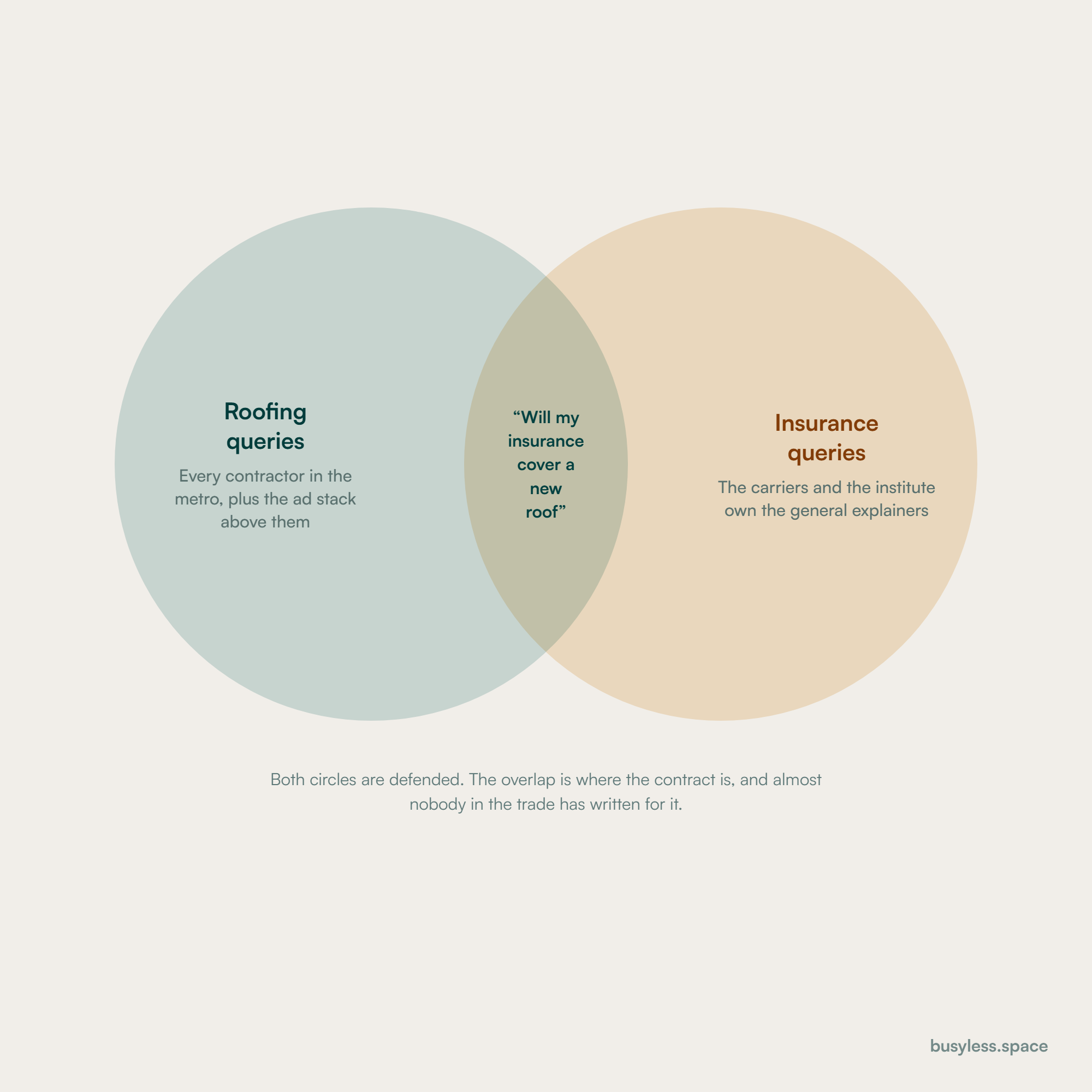
  1. 1Most of the money is in insurance queries, not roofing queries. "Will my insurance cover a new roof" is closer to a signed contract than "roofers near me" and is far less contested.
  2. 2Rebating or absorbing a customer's deductible is illegal in a number of states, and it is the single most common compliance failure in the trade's marketing.
  3. 3Negotiating a claim on a homeowner's behalf can be unlicensed public adjusting. Where you draw that line has to be visible in your copy, not just in your process.
  4. 4Manufacturer certification directories outrank most contractors and are free to claim. Almost nobody in the trade has claimed theirs.
  5. 5After a storm your competition is out-of-state crews with no local footprint. Everything that proves you were here last year and will be here next year is a conversion asset.

SEO for roofers is shaped by two things that do not apply to any other trade. The demand arrives in bursts triggered by weather rather than flowing steadily, and the person deciding is often negotiating with an insurance company rather than spending their own money.

Both change what the website is for. Steady-state demand rewards patient content; storm demand rewards being already ranked when the hail falls, because there is no time to build anything afterwards.

So a roofing SEO strategy is really an off-season project with an in-season payoff.

The insurance dimension changes the content entirely. A homeowner who has just been hailed on is not searching for a roofer. They are searching whether the damage is claimable, what their deductible means, whether filing will raise their premium, and what an adjuster is going to say. Those queries are barely contested and they sit directly upstream of the contract.

Then there is the trust problem, which is specific to this trade. After a significant storm, a metro fills with out-of-state crews who arrive with a truck and leave before the warranty matters. Homeowners know this. Everything on your site that proves you were here before the storm and will be here after it is doing conversion work.

The competition is not weak. Roofing is one of the most aggressively marketed trades there is. But most of that spend goes to paid lead generation, and the insurance content cluster sits almost empty.

Who already ranks in roofing

Look at what ranks before writing anything. The first honest lesson of roofing SEO is that the results page splits by query type more sharply than in other trades: service queries are owned by the pack, the lead marketplaces and paid placement, while the insurance and cost queries are owned by insurers, publishers and nobody in particular. The second group is where a contractor can actually win.

What is on the results page

  • Local Services Ads with the Google Guaranteed badge on service queries
  • Local pack on anything carrying a location or a roof problem
  • People Also Ask, unusually dense on insurance and cost queries
  • AI Overviews on claim and coverage questions, drawing on insurer and publisher content
  • Image packs on material and style queries, where a real project gallery earns its place
  • Review stars from the marketplaces rather than the contractor's own site
  • Manufacturer certification directories

    gaf.comClaim it

    GAF, Owens Corning, CertainTeed and the rest run find-a-contractor directories for certified installers. High authority, free with the certification you already hold, and almost nobody in the trade has completed their listing. This is the most overlooked free asset in roofing.

  • Google Local Services Ads

    google.comClaim it

    Paid, above the map pack on service queries, and requires licence, insurance and background checks. Worth pricing per booked inspection rather than per lead, because the inspection is the real conversion step in this trade.

  • Angi

    angi.comClaim it

    Ranks on roofer-plus-city queries widely and sells the same enquiry to several contractors. Claim the free profile; treat any paid tier as a lead-buying decision with a win rate attached.

  • Insurance carriers and their content

    iii.org

    The Insurance Information Institute and the carriers themselves own most general claim explainers. Do not write the generic version of how a claim works. Write the version that names your state's rules, your typical adjuster process and your local timelines.

  • Better Business Bureau

    bbb.orgClaim it

    Carries more weight in roofing than in most trades, precisely because of the storm-chaser problem. Homeowners actively check it after a storm. Claim it, keep it clean, and resolve complaints rather than ignoring them.

  • Nextdoor

    nextdoor.comClaim it

    Where neighbours compare notes after a storm, which is exactly when your market is deciding. Not a ranking play, but a genuine referral channel and a place your reputation is being discussed whether you are there or not.

What people actually search

Roofing search splits into two groups that behave nothing alike, and most contractors only compete in the smaller one. Service queries are contested by everybody. The insurance and cost queries, which sit directly upstream of the contract and carry more intent, are largely uncontested by roofers because they read as somebody else's subject.

Insurance and claim

Commercial investigation

will my insurance cover a roof replacement

The page that wins it: Claim explainer naming your state's rules and the real timeline

The most valuable cluster in the trade and the least contested by contractors. Somebody working out whether they have a claim is closer to a contract than somebody typing a service query, and almost nobody in the trade writes for them.

Storm damage

Local transactional, urgent

hail damage roof [city]

The page that wins it: Storm response page that is already ranked before the storm

You cannot build this after the event. The page has to exist and be ranked in the off season, which is the whole argument for treating roofing SEO as an off-season project.

Damage identification

Informational

what does hail damage look like on a roof

The page that wins it: Visual identification guide with real photographs

Searched from the ground with a phone, often before the homeowner is sure anything is wrong. Real photos of real local damage beat stock imagery decisively here.

Cost

Commercial investigation

roof replacement cost [state]

The page that wins it: Cost page by material and square footage, with what moves it

High volume and genuinely useful. In a claim scenario the homeowner is comparing your estimate against the adjuster's figure, so being transparent about how pricing works is a competitive advantage rather than a risk.

Material comparison

Commercial investigation

metal roof vs asphalt shingles

The page that wins it: Honest comparison including when the cheaper option is right

Long consideration window, unlike anything in plumbing. This is where a contractor demonstrates judgement, and it is the format most likely to be cited in an AI answer.

Deductible and premium

Informational

does filing a roof claim raise my premium

The page that wins it: Straight answer, with the deductible rules stated plainly

The question that stops homeowners filing, and the one where the trade's own compliance exposure lives. Answer it honestly and never hint at absorbing the deductible.

Contractor vetting

Commercial investigation

how to avoid roofing scams after a storm

The page that wins it: An honest guide to vetting a roofer, including questions you can answer well

Counter-intuitive and effective. Writing the guide that helps somebody avoid a storm chaser positions you as the local alternative without you having to claim it.

Service plus area

Local transactional

roofing contractor [suburb]

The page that wins it: One page per real coverage zone

Contested and won mostly off-site through the pack. Same doorway-page trap as every other trade: coverage belongs in words, not in a hundred URLs.

What the rules change

Roofing carries two rules that exist in no other trade in this directory, and both reach the marketing directly. They are also the two most commonly broken. Requirements are state by state, so check your own; nothing here is legal advice.

1

Rebating or absorbing the deductible is prohibited, and in several states it is a crime

State insurance statutes; Florida, Texas and a number of other states have specific prohibitions

What it means

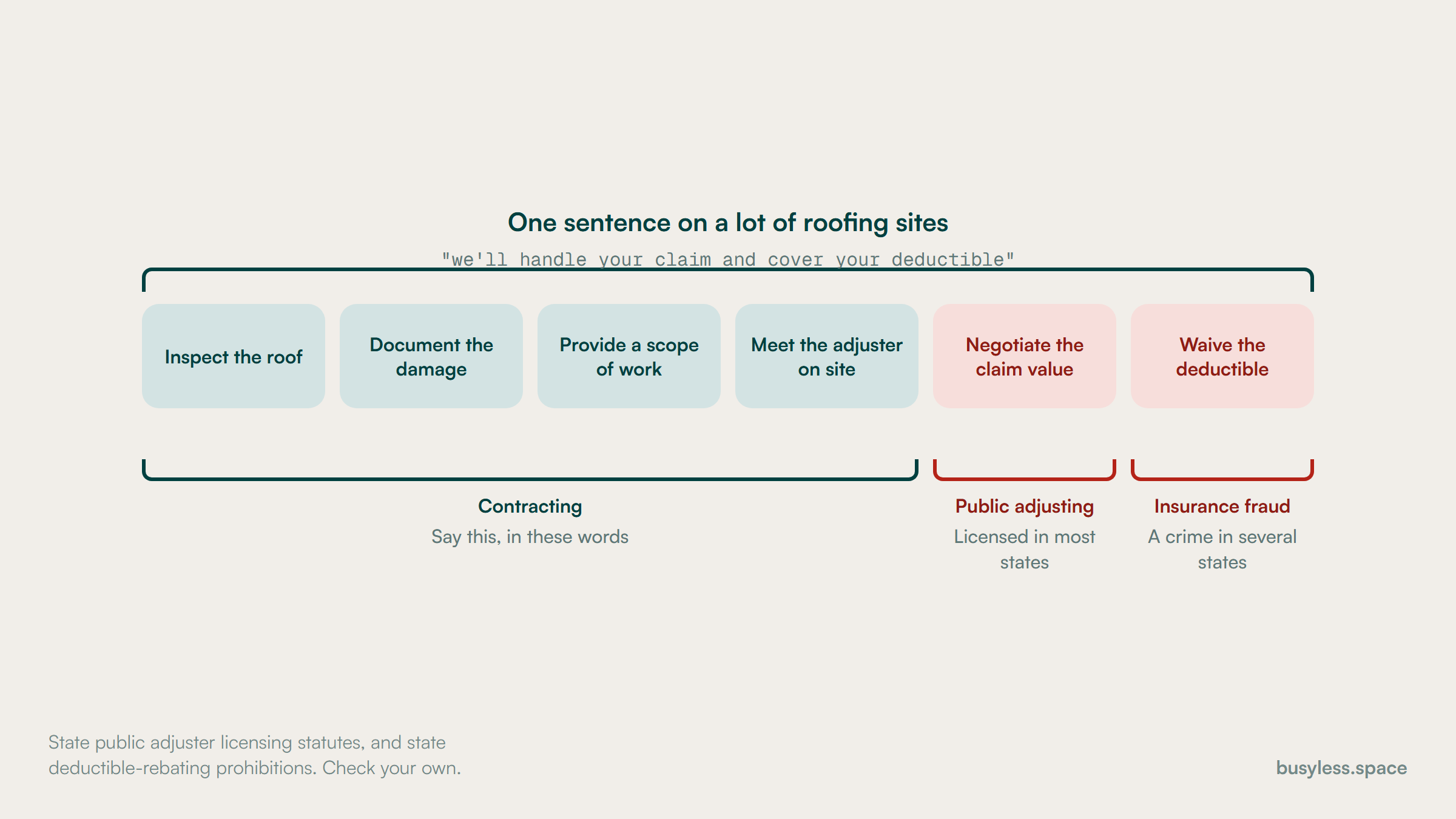
A number of states expressly prohibit a contractor from paying, waiving, rebating or absorbing an insured's deductible, or from advertising that they will. Several treat it as insurance fraud rather than a licensing matter. Softer phrasings such as "we'll work with your deductible" or "no out of pocket cost" are read as the same offer.

So do this

Remove every variant of it from the site, the profile, the ads and the door-knocking script. Then check that any "free" or "no cost" language elsewhere cannot be read as a deductible offer. This is the first thing to grep for on a roofing site.

2

Negotiating the claim can be unlicensed public adjusting

State public adjuster licensing statutes

What it means

Most states license public adjusters, and a contractor who negotiates, adjusts or advises on the value of a claim on the homeowner's behalf may be acting as one without a licence. The line between documenting damage, which is your job, and negotiating a settlement, which generally is not, differs by state and is narrower than most contractors assume.

So do this

Say what you actually do: inspect, document, provide a scope and meet the adjuster on site. Avoid copy promising to handle, fight, maximise or negotiate the claim. Check your own state's definition before writing any of it.

3

Your licence number may have to appear in the advertising

State contractor licensing boards; requirements vary and several states have none

What it means

Where contractor licensing exists, several states require the licence number in advertising, which is generally read to include the website and business profile. Roofing licensing is genuinely inconsistent: some states license it specifically, some cover it under general contracting, and a few do not license it at all.

So do this

Establish what your state actually requires rather than copying another contractor's footer. Where a number exists, put it in the footer so it is site-wide, and add it to the profile description.

4

Door-to-door work triggers a right to cancel

FTC Cooling-Off Rule; state home solicitation sales acts

What it means

The FTC's Cooling-Off Rule gives consumers three days to cancel certain sales made at their home, and many states have their own home solicitation statutes with additional notice requirements. Storm canvassing is exactly the activity these rules were written for.

So do this

If any part of the business is door-knocked, the cancellation notice has to be given properly. Where the website supports canvassing, make sure it does not contradict the notice by implying the agreement is immediate and final.

5

Review gating and incentivised reviews are prohibited

FTC Rule on the Use of Consumer Reviews and Testimonials, final rule 2024

What it means

The FTC's 2024 rule covers buying reviews, incentivising them conditioned on sentiment, and suppressing negative ones. Roofing is high ticket and storm-driven, which historically made it one of the categories where review manipulation was most common.

So do this

Ask every customer at the same point in the job, with the same message, and offer nothing in exchange. Respond to negative reviews rather than trying to have them removed.

Proving expertise

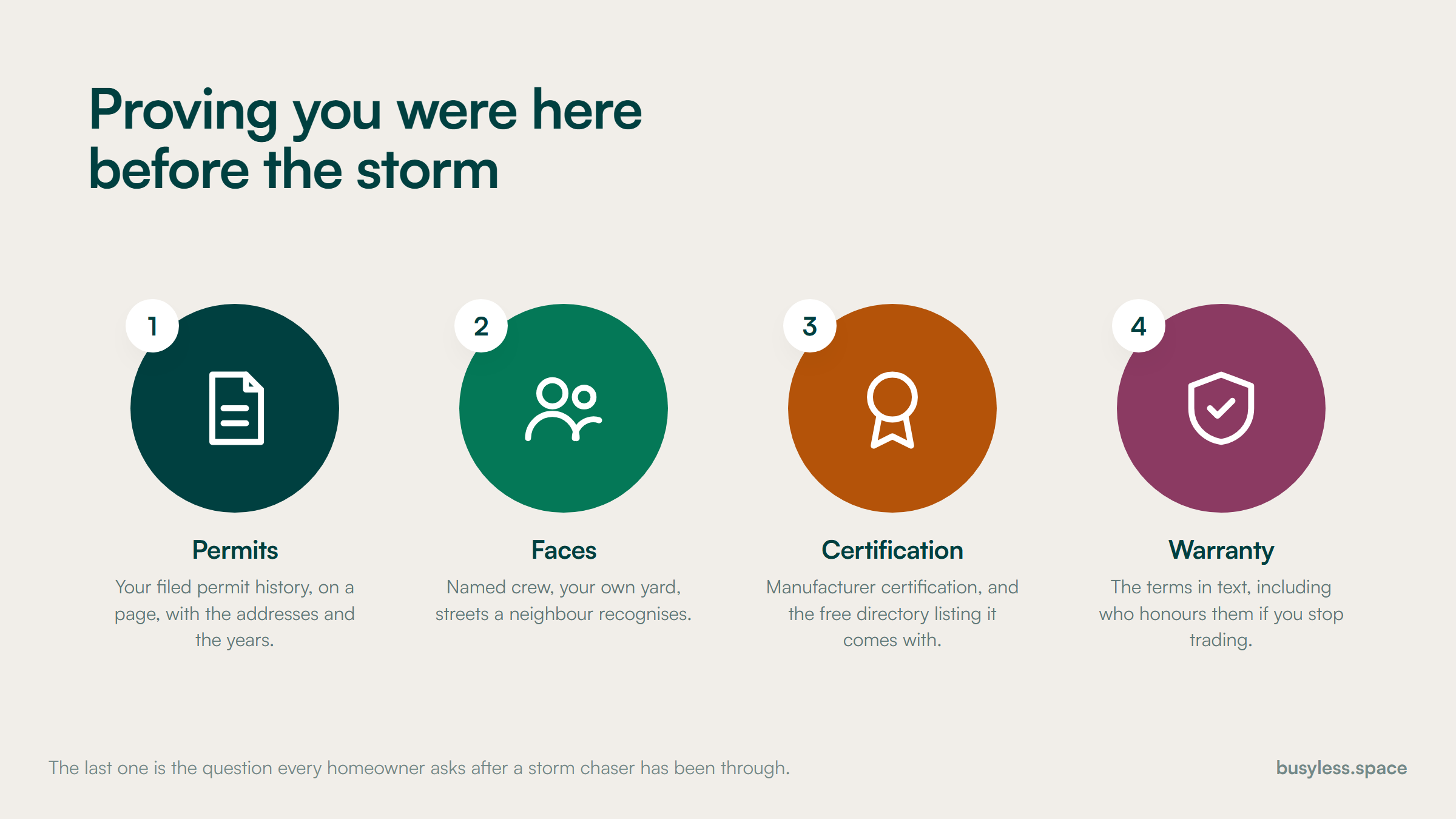
The trust bar in roofing is set by the storm chasers, and that is an advantage for anyone who is genuinely local. A homeowner deciding between you and a truck with out-of-state plates is looking for evidence of permanence, and most of that evidence is easy to publish and almost never is.

  • Years in business at a physical local address, with the address visible rather than a PO box
  • Manufacturer certifications named with the level, matched to a claimed listing in that manufacturer's directory
  • Licence and insurance details stated with numbers, not badge graphics
  • Real project galleries from streets a local reader would recognise, with dates
  • Warranty terms published in full, including what voids them and who honours them if you are gone
  • Named crew and a real yard or office in photographs, not stock imagery
  • A clear statement of what you do and do not do on insurance claims, which doubles as compliance
  • Local affiliations: chamber, BBB, local supplier relationships, sponsorships that predate the storm

How to build a roofing SEO strategy

A realistic sequence, and the timing matters more here than anywhere else in this directory. Build in the off season, because a roofing SEO strategy that starts the week after a hail event has already missed the demand it was supposed to capture.

  1. 1

    Weeks 1 to 3

    Remove the compliance exposure and claim what is free

    • Grep the entire site, profile and ad copy for deductible language in every phrasing, including "no out of pocket" and "we work with your deductible"
    • Review every claim-related sentence against your state's public adjuster definition, and rewrite anything promising to negotiate or maximise a claim
    • Establish what your state requires on licence numbers in advertising, and comply site-wide
    • Claim every manufacturer certification directory you qualify for
    • Claim or correct Google Business Profile, BBB, Angi, Nextdoor
    • Audit service-area pages: real coverage zones versus generated town names

    You end up with
    A site with the two roofing-specific compliance problems removed, and the free high-authority listings claimed

  2. 2

    Weeks 3 to 10

    Build the insurance cluster while the weather is quiet

    • Write the claim explainer for your state: process, timeline, what an adjuster does, what you do
    • Write the deductible and premium page, answering the questions honestly
    • Write the damage identification guides with real photographs of local damage
    • Write the contractor vetting guide, including the questions you answer well
    • Publish real cost ranges by material and roof size, with what moves them
    • Publish warranty terms in full, including what happens if the installer is no longer trading

    You end up with
    Coverage of the cluster that sits upstream of the contract, ranked before the next storm rather than after it

  3. 3

    Weeks 8 to 18

    Prepare the storm response before you need it

    • Build the storm response page template so a new event needs copy, not a build
    • Consolidate generated town pages into real coverage zones with local housing detail
    • Build the project gallery by neighbourhood, with dates and materials
    • Add RoofingContractor and Service structured data
    • Decide Local Services Ads as a costed channel, priced per booked inspection
    • Install a review routine that asks every customer, and a response for negative ones

    You end up with
    A site that can respond to a storm in hours instead of weeks, and that proves local permanence to a homeowner comparing you against a stranger

  4. 4

    Weeks 12 to 26

    Measure signed contracts, not inspections

    • Attribute calls and form fills through to booked inspections and then to signed contracts
    • Track the inspection to contract rate separately for insurance and retail work
    • Report leading and business indicators separately, and never present one as the other
    • Review the insurance cluster on contracts signed rather than sessions
    • Track seasonality honestly so a quiet month is not read as a failure
    • Set a maintenance cadence for storm pages, which go stale faster than anything else on the site

    You end up with
    A report an owner can act on, showing signed contracts and average job value alongside the indicators that predict them

Technical fixes with the best payoff

Some of these are the standard trades problems and some are specific to a business that sells a high-ticket job on the back of a weather event. The storm-specific ones are the ones competitors have not fixed.

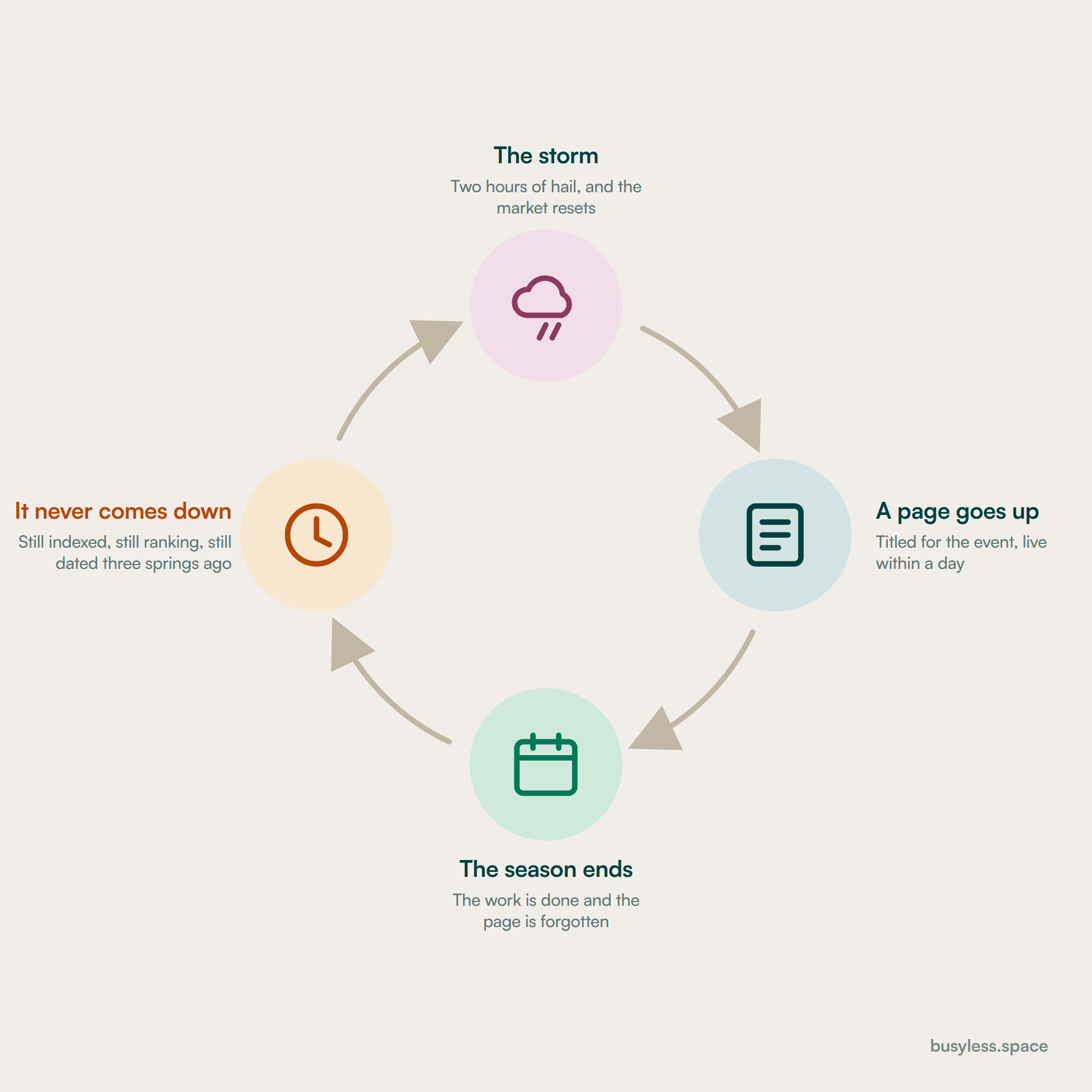
  • Storm landing pages left live for years

    A day, then a seasonal habit

    A page titled for a hail event from three seasons ago is still indexed, still ranking for the storm cluster, and telling every visitor the site is abandoned. It is the roofing-specific version of stale content and it is everywhere.

    Build one storm response template with a dated event section. Retire or redirect old event pages rather than accumulating them, and diarise a review after each season.

  • The project gallery is a JavaScript carousel

    A sprint

    Galleries are the strongest proof this trade has, and they are routinely built as a slider that ships no crawlable image, no alt text and no location. The proof exists and is invisible.

    Real image URLs with descriptive alt text, a location and a date per project, on crawlable pages rather than inside a widget. Group them by neighbourhood so they support the coverage-zone pages.

  • Photographs are stock, in a trade defined by trust

    A day, plus a camera

    A homeowner is deciding whether you are local and permanent or a truck passing through. Stock imagery answers that question the wrong way, and it is worse here than in any other trade for exactly that reason.

    Real crews, real yard, real local streets. Compress properly and serve modern formats, because these pages are read on a phone standing in a driveway.

  • A page for every town in the metro

    A sprint, mostly deletion

    Same doorway pattern as every trade. Roofing tends to have more of them than most because storm chasing normalised the practice of claiming an enormous service area.

    One page per real coverage zone with the housing stock, the typical roof age and the storms that have actually hit it. If you cannot write that, the page should not exist.

  • Warranty terms are a PDF or absent

    An afternoon

    The warranty is a primary decision factor on a high-ticket job, and it is routinely published as a download or not at all. That is a conversion problem and a search problem at once.

    Publish the terms as HTML, including what voids them and who honours them if you cease trading. That last part is the question every post-storm homeowner has and nobody answers.

  • No structured data, or a generic LocalBusiness node

    A day

    Schema.org has a RoofingContractor type and it is barely used. A generic node describes the business less precisely than the vocabulary allows.

    Mark up as RoofingContractor with services, area served and credentials, and mark service pages as Service. See the structured data section.

Structured data that applies here

The types below fit this industry specifically. Most of them earn no rich result on their own, which is worth knowing before anyone sells the work on that basis. What they do is describe the entity precisely, which matters for how search engines and answer engines resolve who you are.

  • RoofingContractor

    Home page and location pages

    A real schema.org type, a subtype of HomeAndConstructionBusiness, and barely used in a trade that would benefit from the precision. Carries hours, area served, services and credentials.

    RoofingContractor.jsonld
    {
      "@context": "https://schema.org",
      "@type": "RoofingContractor",
      "@id": "https://[YOUR-DOMAIN]/#business",
      "name": "[BUSINESS NAME]",
      "url": "https://[YOUR-DOMAIN]",
      "telephone": "[+1-555-000-0000]",
      "priceRange": "[$$$]",
      "foundingDate": "[YYYY]",
      "image": "https://[YOUR-DOMAIN]/crew.jpg",
      "address": {
        "@type": "PostalAddress",
        "streetAddress": "[123 Example St]",
        "addressLocality": "[CITY]",
        "addressRegion": "[ST]",
        "postalCode": "[00000]",
        "addressCountry": "US"
      },
      "geo": {
        "@type": "GeoCoordinates",
        "latitude": "[00.000000]",
        "longitude": "[-00.000000]"
      },
      "areaServed": [
        { "@type": "City", "name": "[CITY]" }
      ],
      "hasCredential": [
        {
          "@type": "EducationalOccupationalCredential",
          "credentialCategory": "Manufacturer certification",
          "name": "[CERTIFICATION NAME]",
          "recognizedBy": { "@type": "Organization", "name": "[MANUFACTURER]" }
        },
        {
          "@type": "EducationalOccupationalCredential",
          "credentialCategory": "Contractor licence",
          "identifier": "[LICENCE NUMBER]"
        }
      ]
    }
  • Service

    Each service page

    Describes the job rather than leaving the page untyped. Keep serviceType in the words a homeowner uses, and only publish a price range you will honour against an adjuster's estimate.

    Service.jsonld
    {
      "@context": "https://schema.org",
      "@type": "Service",
      "name": "[SERVICE, in the homeowner's words]",
      "serviceType": "[SERVICE]",
      "provider": { "@id": "https://[YOUR-DOMAIN]/#business" },
      "areaServed": {
        "@type": "AdministrativeArea",
        "name": "[COUNTY OR METRO]"
      },
      "offers": {
        "@type": "Offer",
        "priceSpecification": {
          "@type": "PriceSpecification",
          "minPrice": "[0000]",
          "maxPrice": "[00000]",
          "priceCurrency": "USD"
        }
      },
      "description": "[One plain sentence. Never imply any deductible arrangement.]"
    }
  • ImageObject

    Project gallery entries

    The one type worth the effort in this trade specifically. A gallery is the strongest proof a roofer has, and marking each project up with a real location and date is what turns a slider into evidence.

    ImageObject.jsonld
    {
      "@context": "https://schema.org",
      "@type": "ImageObject",
      "contentUrl": "https://[YOUR-DOMAIN]/projects/[SLUG].jpg",
      "name": "[MATERIAL] roof replacement in [NEIGHBOURHOOD]",
      "description": "[What was done, what the damage was, which material was used.]",
      "datePublished": "[YYYY-MM-DD]",
      "contentLocation": {
        "@type": "Place",
        "name": "[NEIGHBOURHOOD], [CITY]"
      },
      "creator": { "@id": "https://[YOUR-DOMAIN]/#business" }
    }
  • WebPage

    The storm response page

    Worth typing explicitly because this page needs a visible and machine-readable date. A storm page with no date is the single most common stale artefact on a roofing site.

    WebPage.jsonld
    {
      "@context": "https://schema.org",
      "@type": "WebPage",
      "@id": "https://[YOUR-DOMAIN]/storm/[EVENT-SLUG]#webpage",
      "url": "https://[YOUR-DOMAIN]/storm/[EVENT-SLUG]",
      "name": "[EVENT] storm damage response, [AREA]",
      "datePublished": "[YYYY-MM-DD]",
      "dateModified": "[YYYY-MM-DD]",
      "about": {
        "@type": "Event",
        "name": "[EVENT NAME OR DATE]",
        "startDate": "[YYYY-MM-DD]",
        "location": { "@type": "Place", "name": "[AREA]" }
      },
      "publisher": { "@id": "https://[YOUR-DOMAIN]/#business" }
    }
  • FAQPage

    Pages with genuinely visible questions

    The insurance pages are where this earns most, because the questions are exactly what people type. Mark up only what is visible, and keep the answers free of any deductible implication.

    FAQPage.jsonld
    {
      "@context": "https://schema.org",
      "@type": "FAQPage",
      "mainEntity": [
        {
          "@type": "Question",
          "name": "[Question exactly as it appears on the page]",
          "acceptedAnswer": {
            "@type": "Answer",
            "text": "[Answer exactly as on the page. State your jurisdiction. Never suggest any deductible arrangement.]"
          }
        }
      ]
    }
  • Review

    Only reviews genuinely published on the page

    Read the FTC note in the compliance section first. In a trade where storm chasers have damaged trust generally, a review profile that reads as curated does more harm than a mixed but obviously real one.

    Review.jsonld
    {
      "@context": "https://schema.org",
      "@type": "Review",
      "itemReviewed": { "@id": "https://[YOUR-DOMAIN]/#business" },
      "author": { "@type": "Person", "name": "[REVIEWER NAME]" },
      "datePublished": "[YYYY-MM-DD]",
      "reviewBody": "[The review exactly as published on the page]",
      "reviewRating": {
        "@type": "Rating",
        "ratingValue": "[5]",
        "bestRating": "5"
      }
    }

What it costs

Editorial estimates, not quotes, and unusually seasonal. A roofing budget that is flat across the year is being spent wrong: the building happens in the quiet months and the harvesting happens after the weather. The figures assume US rates in 2026.

Lean

$2,000 to $3,500
  • Google Business Profile and every manufacturer directory claimed and completed
  • The deductible and public-adjuster compliance sweep, done once and properly
  • The core insurance cluster: claim explainer, deductible page, damage identification
  • Real cost ranges published by material
  • A project gallery rebuilt as crawlable pages

Who it suits

A single-crew contractor in a moderate market who wants to stop renting every lead

Where it stops

You will build the asset but slowly, and a big storm will arrive before it is finished. It also does nothing about paid competition on the service queries.

Funded

$4,000 to $9,000
  • The full insurance and cost cluster, built in the off season
  • Storm response template plus the operational readiness to publish an event page in hours
  • Coverage-zone pages with genuine local content, replacing generated town pages
  • Attribution through to booked inspections and signed contracts
  • Content produced at a cadence that compounds year over year rather than in bursts

Who it suits

Multi-crew contractors in storm-exposed metros, or anyone whose lead cost has become the largest line in the business

Where it stops

This is the tier that competes with the roofing marketing specialists. It does not fix a poor inspection-to-contract rate, which is a sales problem rather than a marketing one.

Enterprise

$10,000 and up
  • Multi-market coverage where storm exposure differs by region
  • Content and landing infrastructure that can stand up a new market quickly
  • Insurance content maintained across several states with different deductible rules
  • Reporting tied to crew capacity rather than to lead volume

Who it suits

Regional contractors operating across several states, where the compliance picture differs market by market

Where it stops

At this scale the constraint is usually crew capacity and supply, not demand. Marketing that outruns the ability to install is a scheduling problem wearing a growth costume.

How to do it with no budget

Everything below costs nothing but time. The first item is not optional in several states, and the second is the most valuable free listing in the trade.

  1. 1

    Remove every deductible reference

    2 hours

    Site search, profile, ad copy, door-knock script

    Search for deductible, out of pocket, no cost to you, and we'll cover it. In several states offering to absorb a deductible is a criminal matter rather than a marketing choice. Do this before anything else on this list.

  2. 2

    Claim every manufacturer certification directory

    1 hour per manufacturer

    GAF, Owens Corning, CertainTeed and any other brand you are certified with

    Free, high authority, and it comes with a certification you already paid for. This is the single most overlooked asset in roofing and most contractors have never completed the listing.

  3. 3

    Complete the Google Business Profile

    3 hours, then 20 minutes a week

    Google Business Profile

    Correct primary category, services listed individually, real photographs of crews and completed local work, accurate hours. Add the founding year, because permanence is the thing you are selling.

  4. 4

    Publish the warranty in full

    2 hours

    Your website

    Terms, what voids them, and what happens if you are no longer trading. That last question is what every post-storm homeowner is really asking and almost nobody answers it.

  5. 5

    Photograph ten local projects properly

    An afternoon

    A phone

    Before, during and after, with the street or neighbourhood identifiable and the date recorded. This is the proof that separates you from a truck with out-of-state plates.

  6. 6

    Write the damage identification guide

    A day

    Your website

    What hail damage actually looks like, what wind damage looks like, and what is just granular loss from age. Use your own photographs. This ranks, it is genuinely useful, and it starts the conversation before a competitor knocks.

  7. 7

    Claim the BBB listing and keep it clean

    1 hour, then as needed

    BBB

    It carries more weight in roofing than in other trades because of the storm-chaser problem, and homeowners actively check it after an event. Resolve complaints rather than leaving them open.

The tool stack

Jobs first, tools second. The seasonal shape of this trade means the tooling matters most in the quiet months, when you are building the asset rather than answering the phone.

  • Track position on the insurance cluster before storm season

    DataForSEOSEO APIRead the review

    The insurance queries are the ones worth tracking off-season, because that is the ranking you cannot build after the event. Service queries move on the pack and are better watched geo-specifically.

    Free routeSearch Console, which shows what you already earn impressions for

  • Find the claim questions homeowners actually ask

    Your own inspection notes plus Search Console

    Write down what homeowners ask standing in the driveway. That phrasing is the keyword research for the insurance cluster, and it is more accurate than any tool.

    Free routeFree, and the inspection notes are the better source

  • Model what a signed contract from search is worth

    SEO Revenue Growth CalculatorFree toolOpen the tool

    Use average job value and your real inspection-to-contract rate. Roofing tickets are large enough that a small change in that rate matters more than a large change in traffic.

    Free routeFree

  • Set a seasonal budget rather than a flat one

    SEO Budget CalculatorFree toolOpen the tool

    Use it as a sanity check, then deliberately weight the spend toward the quiet months. A flat annual budget in a seasonal trade is a budget being spent at the wrong time.

    Free routeFree

  • Generate the RoofingContractor and gallery structured data

    Schema Markup GeneratorFree toolOpen the tool

    The ImageObject markup on the gallery is the piece worth doing properly here. It is what turns a slider nobody can crawl into evidence.

    Free routeFree

  • Run coverage zones, projects and storm pages as related content

    PayloadHeadless CMSRead the review

    Projects, materials, coverage zones and storm events are related entities. Modelling them properly is what lets you publish an event page in an hour instead of a week.

    Free routeFree and self-hosted

  • Attribute calls through to booked inspections

    A call tracking vendor with dynamic number insertion

    The inspection is the real conversion in roofing, not the call. Attribute to the booked inspection and then to the signed contract, or you will optimise for enquiries that never get on a roof.

  • See what AI assistants tell homeowners about claims

    LLM visibility trackerOur toolSee the tool

    Homeowners increasingly ask an assistant whether damage is claimable before they call anyone. Those answers lean on insurer and publisher content, which is the gap the insurance cluster is written to fill.

Take it from here

Everything below is yours to take. Fill the [BRACKETS] and it is ready to use. Run the compliance sweep first: it is the only item here that removes legal exposure rather than adding an opportunity, and in several states it is not optional.

Checklist

The two roofing-specific rules that reach your marketing directly, and the phrases that break them. Run this before publishing anything, because in several states deductible language is a criminal matter rather than a marketing choice.

ROOFING MARKETING COMPLIANCE SWEEP
Company: [NAME]        Date: [DATE]        State(s): [_____]

NOT LEGAL ADVICE. Deductible and public adjusting rules are set state
by state and several states treat violations as criminal. Verify with
your own counsel or state insurance department.

1. DEDUCTIBLE LANGUAGE  (search the whole site, profile, ads, scripts)
   Search for each phrase. Any hit is a finding.
   [ ] "deductible"                              hits: [__]
   [ ] "out of pocket"                           hits: [__]
   [ ] "no cost to you"                          hits: [__]
   [ ] "we'll cover"  /  "we'll take care of"    hits: [__]
   [ ] "work with your deductible"               hits: [__]
   [ ] "$0" / "free roof"                        hits: [__]
   [ ] "we'll waive"                             hits: [__]

   Check ALL of these surfaces, not just the website:
   [ ] Website (every page, including the footer)
   [ ] Google Business Profile description and posts
   [ ] Paid ad copy, all platforms
   [ ] Door-knock script
   [ ] Yard signs and vehicle livery
   [ ] Flyers and door hangers

2. CLAIM NEGOTIATION LANGUAGE
   Public adjusting is licensed in most states. Any hit needs review.
   [ ] "handle your claim"                       hits: [__]
   [ ] "fight the insurance company"             hits: [__]
   [ ] "maximise your claim"                     hits: [__]
   [ ] "negotiate with your adjuster"            hits: [__]
   [ ] "we deal with the insurance"              hits: [__]

   SAFE ALTERNATIVES (verify against your state):
   - "We inspect and document the damage"
   - "We provide a detailed scope of work"
   - "We meet your adjuster on site"
   - "We answer the adjuster's questions about our scope"

3. LICENSING
   [ ] Does our state license roofing?           [Y/N]
   [ ] Is the licence number required in ads?    [Y/N]
   [ ] Is it in the footer, site-wide?           [Y/N]
   [ ] Is it in the profile description?         [Y/N]

4. DOOR-TO-DOOR
   [ ] Do we canvass?                            [Y/N]
   If yes:
   [ ] Cooling-off notice given in writing       [Y/N]
   [ ] State home solicitation requirements met  [Y/N]
   [ ] Website does not contradict the notice    [Y/N]

5. REVIEWS
   [ ] Every customer asked, not just the pleased ones
   [ ] Nothing offered in exchange for a review
   [ ] Negative reviews responded to, not suppressed

FINDINGS AND ACTIONS
[_____________________________________________________________]

SIGNED OFF: [NAME / DATE]     RE-RUN: [QUARTERLY]

What to publish

What to publish, ranked by how directly it leads to a signed contract. The trade's instinct is to write about roofs. The content that converts is about the claim, the cost and whether you will still be here in five years.

  • The insurance claim cluster

    Built once in the off season, reviewed annually

    Sits directly upstream of the contract, is barely contested by contractors, and reaches the homeowner while they are still deciding whether to do anything at all.

  • Damage identification guides with your own photographs

    One per damage type, refreshed with new photos each season

    Searched from the ground with a phone before the homeowner is sure anything is wrong. Real local photos beat stock imagery decisively.

  • Real cost ranges by material and roof size

    Once, reviewed when material prices move

    High volume, genuinely useful, and in a claim scenario it helps the homeowner read the adjuster's estimate. Transparency is a competitive advantage here rather than a risk.

  • The contractor vetting guide

    Once, refreshed after each major storm season

    Counter-intuitive and effective. Helping somebody avoid a storm chaser positions you as the local alternative without you claiming it about yourself.

  • A project gallery organised by neighbourhood

    Ongoing, a few projects a month

    The strongest proof of local permanence you have, and it supports the coverage-zone pages at the same time.

  • A storm response template, built before the storm

    Once, then a dated event section per storm

    You cannot rank a page written after the event. The template makes an event page a copy exercise rather than a build.

And what not to

  • Any language about deductibles, out-of-pocket costs or covering the difference, which is prohibited outright in several states
  • Copy promising to handle, fight, maximise or negotiate the claim, which can be unlicensed public adjusting
  • Storm event pages from previous seasons left live, which tell every visitor the site is abandoned
  • A page for every town in the metro, which is the same doorway pattern as every other trade
  • Stock photography of roofs and crews, in the one trade where proving you are local and permanent is the whole sale
  • Generic explainers of how insurance works, which the carriers and the Insurance Information Institute already own

The expensive mistakes

Offering to cover or absorb the deductible

Costs you Prohibited outright in several states and treated as insurance fraud in some of them. It is a legal problem, not a marketing one

Remove every phrasing of it, including the soft ones, from the site, the profile, the ads and the door-knock script

Promising to fight or maximise the insurance claim

Costs you Potentially unlicensed public adjusting, depending on your state's definition, and the line is narrower than most contractors assume

Say what you actually do: inspect, document, provide a scope, meet the adjuster on site

Starting the content programme after the storm

Costs you The demand arrives and passes while the pages are still being indexed. The whole season is missed

Build in the quiet months. Roofing is the clearest case in this directory for treating SEO as an off-season capital project

Leaving old storm pages live

Costs you A site that tells every visitor it was last updated three seasons ago, in a trade where permanence is the sale

One storm template with dated event sections, and a seasonal review that retires or redirects the old ones

Hiding the gallery in a JavaScript slider

Costs you The strongest proof you own, invisible to search and often to the visitor on a slow connection

Crawlable project pages with real locations, dates and alt text, grouped by neighbourhood

Reporting leads to the owner

Costs you Lead volume looks fine while the inspection-to-contract rate collapses, and nobody notices until the quarter ends

Report booked inspections and signed contracts, split between insurance and retail work

What to measure

Roofing has a longer measurable chain than the other trades: enquiry, booked inspection, scope, adjuster, contract. That is genuinely useful, because it shows you where the drop-off is. It also means seasonality has to be stated explicitly or a quiet month reads as a failure when it is just weather.

Leading indicators

Move first. They predict, they do not prove.

  • Impressions on the insurance cluster

    Search Console, filtered to claim and deductible queries

    The off-season indicator that matters. If this is climbing in the quiet months, the storm season has something to harvest.

  • Local pack position by coverage zone

    Geo-specific rank tracking

    Measured from the zone, not the yard. Roofing service areas tend to be wide and the pack does not follow you across them.

  • Profile actions: calls, direction requests, website clicks

    Google Business Profile insights

    Moves within weeks of the profile work, and spikes visibly after weather, which makes it a useful early read on an event.

  • Booked inspections from search

    CRM, reconciled with call tracking

    The real conversion step in roofing. An enquiry that never becomes an inspection is not a lead, and counting it as one flatters the whole report.

Business indicators

The ones a manager acts on.

  • Signed contracts from search

    CRM or contract log

    The number that matters. Attribute it back through the inspection rather than to the first click, because the gap between the two is where most of the loss happens.

  • Inspection to contract rate

    CRM

    Genuinely diagnostic and usually a sales problem rather than a marketing one. If it drops while enquiries rise, the content is attracting the wrong homeowner.

  • Average job value, insurance versus retail

    Contract log

    Two very different businesses inside one company. Blending them hides which content produces the work you actually want.

  • Seasonality-adjusted comparison

    Your own prior years

    Compare this March to last March, never to February. Without this, a normal seasonal dip gets read as a failing programme and the budget goes at exactly the wrong moment.

The verdict

Roofing rewards patience in a way that feels wrong to a trade used to reacting. The demand is seasonal and unpredictable, and the only sensible response is to build the ranking in the quiet months so the storm has something to land on.

The insurance cluster is the whole opportunity. It sits upstream of the contract, it is barely contested by contractors, and it is where a homeowner is actually making the decision that ends in a signed job.

If you are evaluating roofing SEO services, three questions sort the field. Will they audit your site for deductible and claim-negotiation language before writing anything? Will they build the insurance cluster in the off season rather than storm pages after the event? Will they report signed contracts and inspection-to-contract rate rather than leads?

Most firms selling SEO services for roofers answer the third badly and have never heard of the first. It is the first that carries actual legal exposure, and I would not sign without it being checked.

FAQ

Roofing SEO questions

  • How long before a roofing company sees results from SEO?
    Profile and listing work can move the local pack within four to twelve weeks. The insurance and cost clusters realistically take four to ten months to rank. The important part is when you start: build in the quiet season so the ranking exists before the weather arrives, because a page published the week after a hail event is still being indexed while the demand passes.
  • Can we advertise that we will cover the deductible?
    In several states, no, and it is treated as insurance fraud rather than a marketing violation. The prohibition generally covers softer phrasings too, including working with your deductible and no out-of-pocket cost. Check your own state's insurance statutes, then search your website, profile, ad copy and door-knock script for every variant and remove them. This is the first thing to fix on most roofing sites.
  • Can we say we handle the insurance claim?
    Carefully, and probably not in those words. Most states license public adjusters, and negotiating or advising on the value of a claim on a homeowner's behalf may require that licence. Documenting damage and providing a scope of work is your job; negotiating a settlement generally is not. Write what you actually do, and check your own state's definition before publishing it.
  • What is the single most overlooked free asset in roofing?
    The manufacturer certification directories. GAF, Owens Corning, CertainTeed and others run find-a-contractor listings for certified installers. They carry real authority, they are free with a certification you have already paid for, and most contractors have never completed the listing. Claim every brand you are certified with before spending anything on marketing.
  • Should we build a page for every storm?
    Build one template, then a dated event section per storm. What you should not do is accumulate event pages across seasons and leave them live, which is extremely common and tells every visitor the site was abandoned three years ago. Diarise a retirement date for each event page at the moment you publish it.
  • How do we compete with out-of-state storm chasers?
    By proving permanence, which they cannot fake. A physical local address, projects photographed on recognisable local streets with dates, manufacturer certifications verifiable in the manufacturer's own directory, a published warranty that says who honours it if you stop trading, and local affiliations that predate the storm. Then write the contractor vetting guide and let the reader apply it themselves.
  • What does roofing SEO cost?
    The tiers above are editorial estimates rather than quotes. A contractor who wants a real programme is realistically looking at $2,000 to $9,000 a month, driven by market size and storm exposure more than by crew count. Weight the spend toward the quiet months rather than running it flat, because that is when the asset gets built.
  • Is it worth publishing prices when insurance is paying?
    Yes, and arguably more so. In a claim scenario the homeowner is trying to understand whether the adjuster's figure is reasonable, and a contractor who explains how roofing is priced becomes the trustworthy party in that conversation. Publish ranges by material and roof size with the factors that move them, and never connect any of it to the deductible.

Run it yourself, or have someone own it

Everything above is written to be run without us, and the free path is genuinely most of the value for a single-location business. Where these plans stall is almost never the plan. It is that nobody owns it after the first month. That is the job we do, with search as one distribution layer inside a wider system rather than the whole engagement.