
Wincher API review
Tracked-keyword reporting to position 30
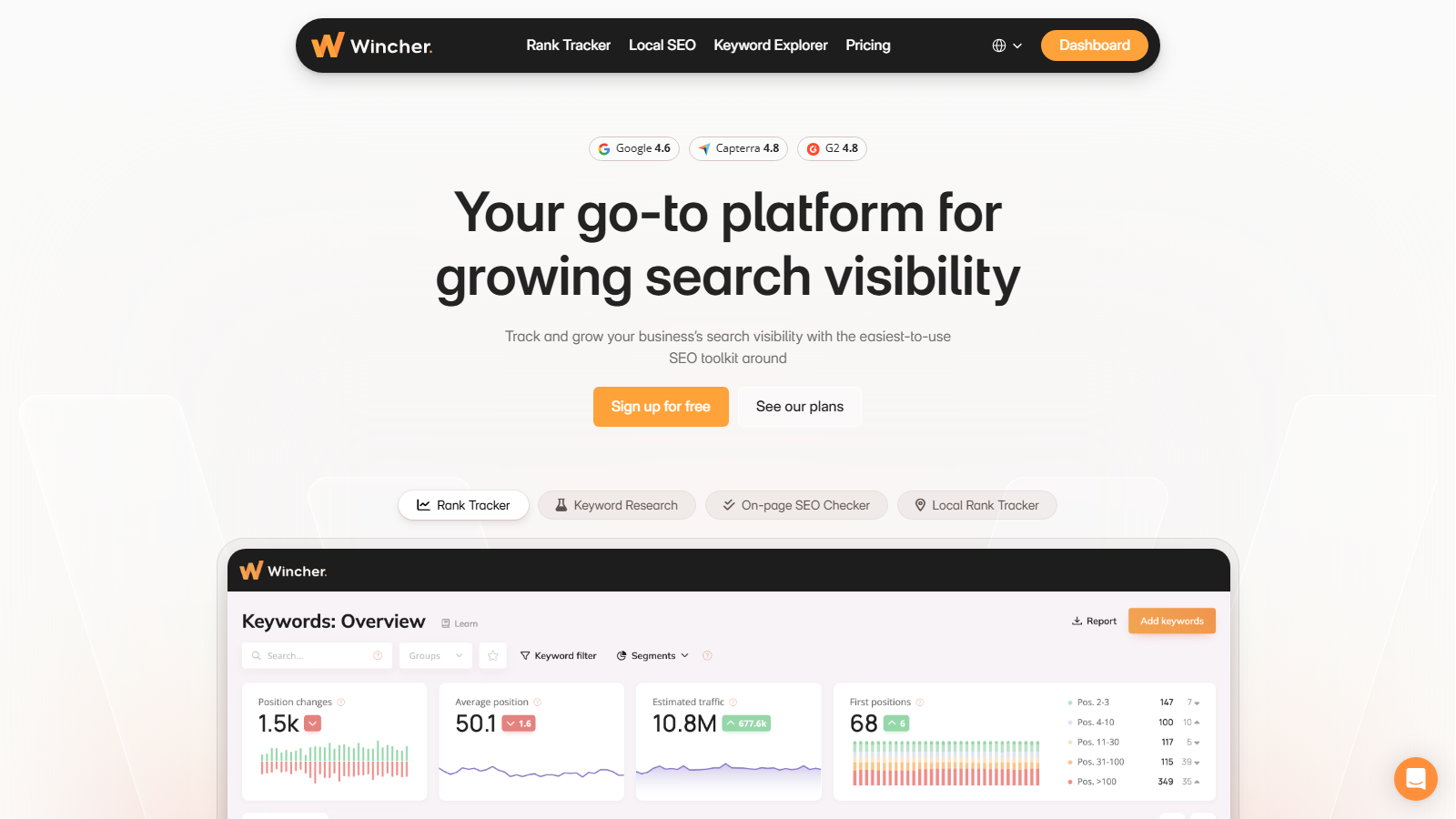
Wincher is a Stockholm rank tracker, and its API is best understood as a window onto your own account rather than a data service. You add websites and keywords, Wincher checks Google every day, and the API reads and writes that setup: keywords, groups, competitors, annotations, historical positions and parsed result pages. Calls are not metered. What you pay for is the number of keywords the plan lets you track.
Access is gated one step above the entry price. The plan comparison table marks API access with a cross on Basic, at €49 a month, and with a tick on Standard and Professional, which the help centre confirms. So the working floor is Standard at €89 a month for 1,000 keywords, or €74 a month billed yearly. Professional starts at €319 for 5,000 and reaches €2,255 at 50,000.
The fact that matters most is depth. On 18 September 2025 Wincher stopped recording positions below 30, after Google changed how search results can be fetched programmatically. The change was retroactive: stored positions deeper than 30 were replaced with 31 in graphs, exports and averages. Anyone expecting Wincher's old top 100 view, through the app or the API, will not find it.
Our scorecard
Our editorial read across six dimensions, scored 1 to 5. This is our own assessment, not an aggregate of user reviews, and it is deliberately kept out of the page's structured data.
- Data coverage2/5
Google positions to 30 for keywords you track, plus competitors and SERP features. No lookups, no Maps grid endpoint.
- Pricing3/5
Unmetered calls on a keyword allowance, but the API starts on the second plan and devices and locations multiply the count.
- Documentation4/5
A complete public reference with a changelog that dates breaking and deprecated changes back to 2021.
- Ease of integration4/5
Bearer token, JSON, limit and offset paging, bulk keyword creation. One path uses 'keyword' where the rest say 'keywords'.
- Reliability3/5
A published 5,000 an hour limit, but the 2025 depth change rewrote stored history, and no SLA is published.
- Support4/5
Chat on every plan, an onboarding call from Standard and a key account manager on Professional, per the plan table.
An editorial read, not an aggregate of user reviews, and deliberately kept out of this page's structured data.
What you can pull
Websites
Unlimited websites from Standard
Create, list, update and delete tracked website profiles, each tied to one Google market, location and device, with ranking summaries and competitors attached
Keywords
Each keyword uses plan allowance
Tracked keywords with position, change, ranking pages, owned SERP features, traffic estimate, volume, CPC, difficulty and search intent. Bulk create, update and delete
Ranking history
Included
Position or traffic series for one keyword, optionally split by page or competitor, plus a bulk call for a list of keyword ids over a date range
SERPs
Included
Stored result pages for a tracked keyword with titles, URLs, traffic and features such as AI Overviews, forums and local packs, at most 30 snapshots per call
Competitors
10 per website on Standard, 20 on Professional
Add competitors to a website and read their ranking summaries, share of voice and per-keyword positions
Groups, segments and projects
Included
Keyword groups, saved segments whose filters can be passed to other calls, and projects that bundle websites together
Account, user and annotations
Included
Plan limits and current usage for keywords, websites and users, plus dated notes on a website's ranking timeline
Who Wincher API is for
Agencies and in-house teams whose rank tracking already lives in Wincher and who want those numbers in their own dashboards or client reports. The write side is the underrated part: onboarding a new client's keyword set can be scripted at up to 1,000 keywords per call, with groups and competitors created the same way, instead of pasted in by hand.
Look elsewhere if you need positions below 30, such as watching new content climb from page five, or keyword research by the call, since Keyword Explorer has no documented endpoint. And if you want ranking data without running a tracking account at all, a pay-per-request SERP API in this directory is the closer fit.
Strengths and limits
What it does well
- Calls are not metered. The keyword allowance is the whole cost, and 5,000 requests an hour covers most reporting schedules comfortably.
- The API writes as well as reads: websites, keywords, groups, competitors and annotations can all be created in code, with bulk keyword creation up to 1,000 per request.
- A public reference with a dated changelog that labels breaking and deprecated changes, which is how the top 30 change reached developers rather than being discovered in the data.
- SERP features are recorded per keyword with whether you own them, including AI Overviews since August 2024, discussions and forums, and local packs.
- Keyword records carry volume, CPC, difficulty and search intent next to the position, so a report needs no second source for context.
- Competitor positions and share of voice come from the same account and the same token as your own rankings.
- Yearly billing takes a real amount off: the pricing page shows a saving of €178 a year on entry Standard and €638 on entry Professional.
Where it falls short
- No API on Basic. The effective entry price is €89 a month, not the €49 the pricing page leads with.
- Positions beyond 30 have not been tracked since 18 September 2025, and stored history deeper than 30 was rewritten to 31.
- Every device and every location counts as a separate website drawing on one keyword allowance, so desktop plus mobile doubles the keyword count.
- No keyword research endpoint. Keyword Explorer lookups are an app feature with no documented API operation.
- On-demand refresh is a Standard feature in the app, but the public reference lists no operation that triggers one; the API only reports when the last manual refresh happened.
- Google only, and the Local Rank Tracker for Maps positions has no documented endpoint.
- No official MCP server. The two on GitHub are community projects, one of them describing itself as unofficial.
Wincher API pricing
Three self-serve plans priced in euros by keyword allowance. Basic is €49 a month for 500 keywords and does not include the API. Standard is €89 for 1,000 keywords, €143 for 2,000, €215 for 3,000 and €287 for 4,000. Professional is €319 for 5,000, then €545, €758, €967, €1,396 and €1,815 at 10,000 to 40,000, and €2,255 at 50,000, beyond which Wincher quotes.
Billed yearly, the same ladder reads €74, €119, €179 and €239 a month on Standard and €266 to €1,879 on Professional, which the help centre describes as two months free. The plan is chosen by picking a keyword count from a dropdown on each card, so the headline prices are floors for each plan rather than fixed rates.
Size the allowance by profiles, not by keywords. A thousand keywords tracked on desktop and on mobile is 2,000; repeat that in a second country and it is 4,000, which is €287 on Standard. One more market and you cross into Professional. That multiplication, not the call volume, is what decides the bill.
On the cheapest API plan the rate is €0.089 per keyword per month, falling to about €0.045 at 50,000. Each keyword is checked daily, so the per-check cost is small. The catch is what each check can see: thirty positions, and nothing below.
Basic
€49 / mo
€41 / mo billed yearly. No API
- API access marked with a cross in the plan table
- 500 keywords, up to 10 websites, 1 user
- Daily updates, but no on-demand refresh
- Right for the app alone, not for an integration
Standard
From €89 / mo
€74 / mo yearly. 1,000 to 4,000 keywords
- The cheapest plan that includes API access
- €143, €215 and €287 at 2,000, 3,000 and 4,000 keywords
- On-demand refresh, Looker Studio and history import
- 10 competitors per website and multiple users
Professional
From €319 / mo
€266 / mo yearly. 5,000 to 50,000 keywords
- €545 at 10,000 keywords, €2,255 at 50,000
- 20 competitors per website and external users
- Custom start date and a key account manager
- More than 50,000 keywords is a tailored quote
Request example
A minimal call against the live endpoint, with credentials read from the environment rather than pasted inline.
# 1. Find the website id for the profile you track.
curl -s "https://api.wincher.com/v1/websites" \
  -H "Authorization: Bearer $WINCHER_TOKEN"

# 2. Pull its keywords with ranking data for a date window.
curl -s -G "https://api.wincher.com/v1/websites/$WINCHER_WEBSITE_ID/keywords" \
  -H "Authorization: Bearer $WINCHER_TOKEN" \
  --data-urlencode "include_ranking=true" \
  --data-urlencode "start_at=2026-09-01T00:00:00Z" \
  --data-urlencode "end_at=2026-09-13T00:00:00Z" \
  --data-urlencode "limit=100" \
  --data-urlencode "offset=0"

# The token is a personal access token created in the app under
# the account menu > API, on a Standard or Professional plan.
# include_ranking=true makes responses much slower and larger, so
# page through with limit and offset. Over 5,000 requests an hour
# returns HTTP 429. Positions are only recorded down to 30.
Rate limits and quotas
- API access is included on Standard and Professional plans only.
- Rate limit: 5,000 requests per hour, after which the API returns HTTP 429.
- Authentication is a personal access token sent as a Bearer header, with an expiry date set at creation and manual revocation.
- Base URL is https://api.wincher.com/v1 and all data is JSON.
- Bulk keyword creation accepts at most 1,000 keywords per request; invalid or existing keywords are skipped.
- The SERP listing call returns at most 30 SERPs at a time.
- Ranking positions are recorded down to 30 only, since 18 September 2025.
- Each tracked device or location is a separate website, and its keywords count toward the plan allowance.
- Competitor tracking: 5 per website on Basic, 10 on Standard, 20 on Professional.
Third-party reviews
Scores read from each source on 2026-09-13. We report them as-is and publish no rating of our own.
Capterra rates the Wincher platform as a whole, not its API, and reviewers may be on Basic, which has no API access at all. No review site scores the API on its own.
What practitioners say on Reddit
We could not find enough practitioner discussion to call a sentiment. Across r/SEO, r/localseo, r/bigseo and r/TechSEO, Wincher appears mostly as one line in lists of rank trackers, and several come from accounts recommending a competing tool in the same breath, one of them its self-declared founder. One reply is from a Wincher employee. Nobody we found discusses the API.
The September 2025 depth change barely registers either. The large r/SEO and r/bigseo threads about Google removing its 100-results parameter discuss the industry rather than Wincher. One r/SEO commenter in a thread about vanished keywords reported sudden drops in both Semrush and Wincher, without mentioning depth.
That quiet is consistent with a simple tool used by small teams. It is not evidence of quality in either direction, which is why the scorecard above leans on the documentation and the plan table instead.
Verdict
Wincher's API earns its place when Wincher already holds your tracking. It turns an account into a data source without charging per call, the reference is thorough and honestly versioned, and scripting keyword setup across client websites saves real hours for an agency that onboards often.
Budget from the right number. The API starts at €89 a month, not €49, and the allowance counts every device and every market separately, so a modest keyword list tracked properly can land on a much larger plan than the list itself suggests.
Decide on depth before anything else. If your reporting needs to show a page moving from position 60 to 35, Wincher can no longer see it, and the 2025 change rewrote stored history to match. For reporting that lives inside the top 30, it is a tidy, well-documented choice.
Wincher API FAQ
How much does Wincher cost?
Basic is €49 a month for 500 keywords, Standard starts at €89 for 1,000 and Professional at €319 for 5,000, rising to €2,255 at 50,000. Yearly billing brings those to €41, €74 and €266 a month. Above 50,000 keywords Wincher quotes a custom price. Only Standard and Professional include the API.Which Wincher plan includes API access?
Standard and Professional. The pricing table marks API access with a cross on Basic, and the help centre confirms it. That makes Standard at €89 a month, or €74 billed yearly, the lowest price at which you can call the API, whatever the pricing page headline says.Does Wincher still track the top 100?
No. Since 18 September 2025 Wincher records positions down to 30 only. Wincher says Google's change to how deeper results can be fetched made anything past the first page much more expensive. The change was retroactive: older positions below 30 now show as 31 in graphs, exports and average position.Is there a free Wincher plan?
Not among the plans on the pricing page. The help centre describes a free account for people who sign up through partner integrations such as Yoast SEO, limited to 1 website, 5 keywords and 1 competitor. It has no API access. Everyone else gets a 7-day free trial before a paid plan.Where do I create a Wincher API token?
Log in on a Standard or Professional plan, open the account menu and choose API. Name the token, set an expiry date and save; it is shown once, so copy it then. Send it as a Bearer token in the Authorization header. Tokens can be revoked from the same screen at any time.What are the Wincher API rate limits?
5,000 requests per hour, with HTTP 429 once you exceed it. Two per-call caps also matter: bulk keyword creation takes at most 1,000 keywords a request, and the SERP listing returns at most 30 SERPs at a time. Neither is metered, so the limits shape your batching rather than your bill.What happens if I cancel my Wincher subscription?
Cancel from Plan and billing at least 24 hours before renewal to avoid the next charge. You keep access until the period ends. After that daily position updates pause, but domains, keywords and ranking history are kept, and updates resume where they stopped if you subscribe again.Who owns Wincher?
Wincher's terms name Wincher International AB, and its about page lists founder and CEO Kim Ängalid, with a Stockholm address. The Yoast connection is a partnership: Yoast's feature page describes an integration built together with Wincher. Neither company's site describes Yoast owning Wincher.
Other providers worth a look
This is an independent review. We have no affiliate relationship with Wincher API, earn nothing if you sign up, and no provider pays for placement in the directory. Prices were read from the vendor's own pages in September 2026 and change without notice.