
Serper review
Cheapest credible SERP data
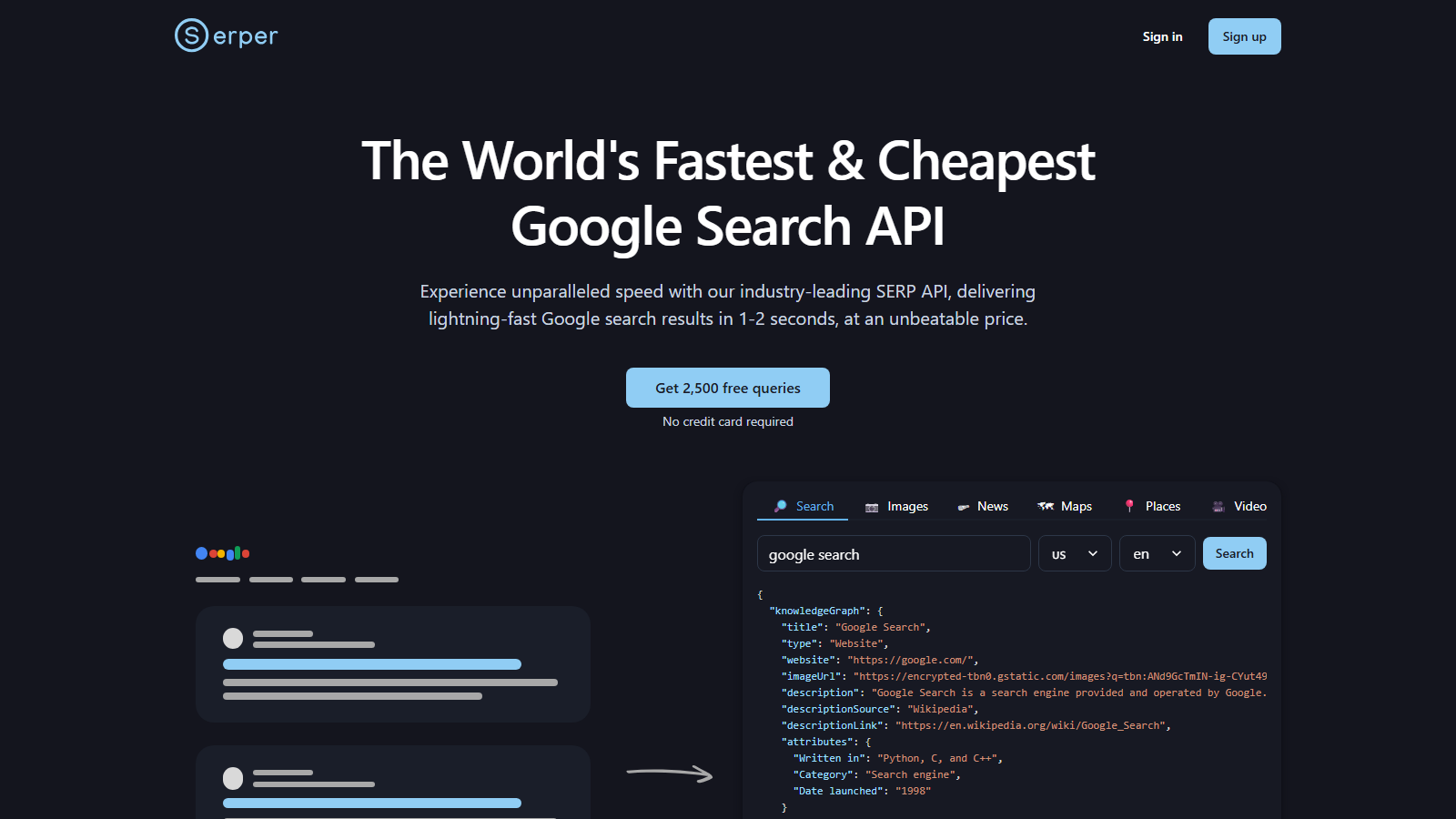
Serper does one thing and does it fast: Google search results as structured JSON, returned in one to two seconds, billed from a prepaid credit balance with no subscription underneath. The endpoint list is deliberately short, covering Search, Images, News, Maps, Places, Videos, Shopping, Scholar, Patents and Autocomplete, and there is nothing else to learn.
That simplicity is why it has become a default inside AI and agent stacks. A single API key, one credit per query, a response shape that fits straight into a prompt, and no monthly commitment to justify makes it the path of least resistance for anything that needs to look something up on the web.
The pricing needs restating carefully, because the headline rate is the volume floor rather than the entry price. Credits come in four packs, all valid for six months: 50,000 at $1.00 per thousand, 500,000 at $0.75, 2.5 million at $0.50 and 12.5 million at $0.30. Reaching that $0.30 means $3,750 up front and a commitment to burn 12.5 million queries within half a year.
Our scorecard
Our editorial read across six dimensions, scored 1 to 5. This is our own assessment, not an aggregate of user reviews, and it is deliberately kept out of the page's structured data.
- Data coverage3/5
Ten Google surfaces, well handled. No other search engines, no backlinks, no keyword metrics.
- Pricing5/5
Genuinely cheap at volume, prepaid with no subscription, and you are only charged for successful responses.
- Documentation3/5
A live playground and a simple schema. Thin compared with SerpApi, and it does not need to be thick.
- Ease of integration5/5
One key, one endpoint, JSON out. The fastest thing in this directory to get working.
- Reliability4/5
One to two second responses claimed, and query-per-second limits rise with pack size.
- Support3/5
Lean operation with a self-serve model. Refunds within seven days if under 20% used.
An editorial read, not an aggregate of user reviews, and deliberately kept out of this page's structured data.
What you can pull
Search
1 credit
Organic results, knowledge graph, people also ask, related searches and sitelinks as structured JSON
Images and Videos
1 credit each
Image and video results with source URLs, thumbnails and metadata
News
1 credit
News results with publisher, date and snippet, useful for monitoring and PR tracking
Maps and Places
1 credit each
Local pack and place data including ratings, addresses and categories, which is the local SEO surface
Shopping
1 credit
Product listings with prices, merchants and ratings for competitive pricing work
Scholar and Patents
1 credit each
Academic papers and patent records, which few SERP APIs at this price expose at all
Autocomplete
1 credit
Google's query suggestions, which is the cheapest keyword-ideas source in this directory
Who Serper is for
Anything that needs Google results cheaply and quickly, especially AI agents, research tools and internal automations. If your requirement is a search result inside a prompt or a workflow, Serper is the least friction available: one key, one endpoint, two seconds, and no subscription to justify to anyone.
It is not an SEO data platform. There are no backlinks, no keyword volumes, no rank tracking and no engines other than Google. If you need those, this is a component of your stack rather than the stack.
Strengths and limits
What it does well
- The cheapest credible SERP data in this directory at volume, reaching $0.30 per thousand at the top pack.
- Prepaid credits with no subscription, so a quiet month costs nothing and there is no plan to downgrade.
- Credits are deducted only on successful responses, which removes a whole category of billing dispute.
- One to two second responses, which is fast enough to sit inside an interactive request rather than a batch job.
- 2,500 free queries with no card is the most generous free tier among the paid SERP APIs here.
- Ten Google surfaces including Scholar, Patents and Autocomplete, which several pricier providers do not expose.
- Query-per-second limits scale with pack size, from 50 to 300, so throughput grows with commitment rather than needing a sales call.
Where it falls short
- The headline $0.30 per thousand needs a $3,750 purchase. The entry rate is $1.00, which is a much less dramatic saving.
- Credits expire after six months, so a volume discount is a consumption commitment rather than a pure discount.
- Google only. No Bing, no Baidu, no Yandex, and no marketplaces beyond Google Shopping.
- Answer-engine surfaces such as AI Overviews and AI Mode have no endpoint here, so tracking them means a second provider.
- SERP data only: no keyword volumes, no backlinks, no rank tracking, no historical series.
- Documentation is a playground rather than a reference, which is fine for ten endpoints and thin if you hit an edge case.
- Refunds are limited to seven days and only if under 20% of credits are used.
- No published legal position on scraping, which is a live consideration in this category in 2026.
Serper pricing
Prepaid credits, four pack sizes, no subscription. 50,000 credits cost $50, which is $1.00 per thousand. 500,000 cost $375, which is $0.75. 2.5 million cost $1,250, which is $0.50. And 12.5 million cost $3,750, which is the $0.30 per thousand the marketing leads with.
Quote the rate that matches your volume rather than the floor. At the pack most readers will actually buy, Serper is around $1.00 per thousand, which is cheaper than SerpApi by a wide margin and roughly comparable to Bright Data or Oxylabs on Google. The order-of-magnitude advantage only exists at the top of the range.
The six-month expiry is what turns the discount into a decision. Reaching $0.30 per thousand means committing to consume 12.5 million queries inside half a year, so the effective question is not whether you can afford $3,750 but whether you will genuinely use 2 million queries a month. If not, a smaller pack at a worse rate is the cheaper choice.
Two things in the buyer's favour. Credits are only deducted on successful responses, so failures are free, and throughput scales with pack size from 50 to 300 queries a second without a sales conversation.
Free
$0
2,500 queries, no card
- The most generous free allowance of any paid SERP API here
- Enough to build and test a real integration end to end
- No credit card required to start
- Same endpoints as the paid packs
50k / 500k packs
$50 / $375
$1.00 and $0.75 per 1,000
- 50 and 100 queries per second respectively
- The realistic entry point for most buyers
- Credits valid for six months from purchase
- At $1.00 per 1,000 the price advantage is real but modest
2.5m / 12.5m packs
$1,250 / $3,750
$0.50 and $0.30 per 1,000
- 200 and 300 queries per second respectively
- $0.30 per 1,000 is the cheapest rate in this directory
- Requires consuming 12.5m queries inside six months
- Unused credits expire, so the discount is a commitment
Request example
A minimal call against the live endpoint, with credentials read from the environment rather than pasted inline.
curl -s -X POST "https://google.serper.dev/search" \
  -H "X-API-KEY: $SERPER_API_KEY" \
  -H "Content-Type: application/json" \
  -d '{
        "q": "best crm for small business",
        "gl": "us",
        "hl": "en",
        "num": 20
      }'

# Swap the host path for /images, /news, /maps, /places, /videos,
# /shopping, /scholar, /patents or /autocomplete. Same key, same
# shape, one credit each.
#
# Credits are only deducted on a SUCCESSFUL response, so a failed
# request costs nothing. Few providers here commit to that.
Rate limits and quotas
- Credit packs: 50,000 at $1.00 per 1,000, 500,000 at $0.75, 2,500,000 at $0.50 and 12,500,000 at $0.30.
- Queries per second: 50, 100, 200 and 300 respectively across those four packs.
- All purchased credits are valid for six months.
- Free allowance is 2,500 queries with no credit card.
- One credit per query on every endpoint.
- Credits are deducted only when a query returns a successful response.
- Queries stop being accepted when the credit balance reaches zero.
- Full refund within 7 days of an initial purchase unless more than 20% of credits are used.
What practitioners say on Reddit
Serper's reputation is built inside AI and automation communities rather than SEO ones, and it shows in how it gets recommended: as the fast, cheap lookup component in a bigger workflow rather than as an SEO product. It appears constantly in r/n8n build posts, usually alongside DataForSEO and Firecrawl, as the piece that fetches results.
When SEOs compare it directly, the framing is consistent: lightweight and fast, good when you just need the results, and not a substitute for a platform that gives you volumes and backlinks.
The wider criticism in this category, that pay-as-you-go marketing usually turns out to be a subscription with caps, is one Serper largely escapes: prepaid credits with no monthly commitment is genuinely what it says. The catch is the expiry rather than the billing shape.
“If you're mainly scraping Google SERPs at scale, I'd also look at Serper.dev. It's lightweight, fast, and great when you just need”
r/SEO on Reddit“I keep seeing pay as you go serp api mentioned across various tools but when I dig into actual pricing it almost always turns out to be a subscription with usage caps. The words say pay as you go but the billing says otherwise.”
r/TechSEO on Reddit“The hidden cost with SERP APIs is often configuration. Desktop versus mobile, country, city, language, search engine and refresh frequency can all change both cost and usefulness.”
r/TechSEO on Reddit“Rank tracking has awkward volume swings because one new client can multiply the number of keywords, locations and devices overnight. A fixed subscription can be fine for stable volume but it gets wasteful when client load changes month to month.”
r/TechSEO on Reddit
Verdict
The right default for anything that just needs Google results. One key, one endpoint, two seconds, no subscription, and failures cost nothing. For an AI agent, a research tool or an internal automation, there is very little reason to reach for something more complicated.
Buy the pack that matches your real volume rather than chasing the headline rate. At $1.00 per thousand on the 50k pack Serper is cheap but not extraordinary, and the $0.30 rate requires $3,750 up front and 12.5 million queries consumed inside six months. Work out your monthly volume first, then pick the pack, and treat the expiry as the binding term.
Understand what you are not buying. No engines besides Google, no AI Overview endpoint, no keyword volumes, no backlinks and no rank tracking. Serper is a component, and a very good one. If you want a platform, DataForSEO covers the same ground plus everything else at a comparable unit price.
Serper FAQ
How much does Serper cost?
Prepaid packs with no subscription: 50,000 credits for $50, 500,000 for $375, 2.5 million for $1,250 and 12.5 million for $3,750. That works out at $1.00, $0.75, $0.50 and $0.30 per thousand queries respectively. There is also a free allowance of 2,500 queries.Is Serper really $0.30 per 1,000?
Only at the top pack, which costs $3,750 and must be consumed within six months. The entry rate is $1.00 per thousand on the $50 pack. Quoting $0.30 as the starting price makes it look roughly four times cheaper than it is at the volume most buyers actually purchase.Do Serper credits expire?
Yes, six months from purchase. That matters most at the large packs, because the cheapest rate requires committing to burn 12.5 million queries inside half a year. If your volume will not reach that, a smaller pack at a worse per-thousand rate is the cheaper option overall.Does Serper charge for failed requests?
No. Serper deducts credits only when a query returns a successful response, and stops accepting queries when the balance reaches zero. That is an unusually clean commitment in this category and removes the most common billing argument with scraping providers.What is Serper's rate limit?
It scales with pack size: 50 queries a second on the 50,000 pack, 100 on 500,000, 200 on 2.5 million and 300 on 12.5 million. Throughput therefore grows with commitment rather than requiring a sales conversation, which suits a workload that scales predictably.Which search engines does Serper cover?
Google only, across ten surfaces: Search, Images, News, Maps, Places, Videos, Shopping, Scholar, Patents and Autocomplete. There is no Bing, Baidu, Yandex or DuckDuckGo, so a multi-engine requirement needs a different provider.Can Serper return AI Overviews?
No dedicated endpoint. If measuring Google's AI answer surfaces matters to you, SerpApi documents separate AI Mode and AI Overview endpoints and DataForSEO returns AI Overviews within its SERP response. Serper is the wrong tool for answer-engine tracking specifically.Serper or DataForSEO?
Serper if all you need is fast Google results and the simplest possible integration. DataForSEO if you also want keyword volumes, backlinks, on-page data and AI Overviews from one account, at a broadly comparable per-request price. Serper is a component; DataForSEO is a platform.
Other providers worth a look
This is an independent review. We have no affiliate relationship with Serper, earn nothing if you sign up, and no provider pays for placement in the directory. Prices were read from the vendor's own pages in September 2026 and change without notice.