
Skip to content

Podcast SEO strategy

The content is audio, so the search engine cannot read it

Written by Eugene SuslovLast reviewed 29 August 2026No affiliate links
Sector
Lifestyle and leisure
Model
National service
Competition
Moderate
Time to results
4 to 9 months
Typical monthly
$500 to $3,000

Key takeaways

  1. 1Nothing you publish is readable until you make it readable. The episode is audio, so the entire strategy is manufacturing a text surface, and every other tactic depends on that existing first.
  2. 2Google left the category in 2024. Google Podcasts shut down and moved to YouTube Music, which means the one index you can influence is no longer a podcast destination. It is still where your transcripts can rank.
  3. 3Your episode pages are probably on somebody else's domain. Most hosting platforms give you a subdomain site by default, so years of work builds authority for your host rather than for you.
  4. 4The disclosure has to be spoken. The FTC's revised guides are media-neutral: an audible claim needs an audible disclosure, delivered so an ordinary listener can hear it. Show notes do not discharge it.
  5. 5There is no blanket podcast music licence to buy. A performing rights licence does not cover podcasting, so a track needs a sync licence and master use rights, cleared separately from a publisher and a label.

SEO for podcasts starts from a problem no other category in this directory has. The thing you made cannot be read. A crawler arrives at an episode, finds an audio player and forty words of description, and leaves.

Everything else follows from that. Before any of the usual work is possible, there has to be text, which means transcripts, structured show notes and a page per episode on a domain you own.

So a podcast SEO strategy is really a publishing strategy with a search engine attached. The audio stays the product; the text is the surface that lets anything find it, quote it or recommend it.

The discovery picture makes this more urgent rather than less. Listeners find shows inside Apple Podcasts, Spotify and YouTube, and none of those are places a publisher can meaningfully optimise for beyond filling in metadata correctly.

Google, meanwhile, left. Google Podcasts closed in 2024 and its listeners were migrated to YouTube Music, so the one index a publisher can genuinely influence stopped being a podcast destination while remaining the only place the text can rank.

That sounds like bad news and is mostly clarifying. It means the web half of the work is not about competing in a podcast directory at all. It is about ranking for the questions your episodes already answer.

Who already ranks in podcasts

Search a question your show has answered well and see whether anything of yours appears. Almost every podcast SEO audit finds the answer is no, not because the episode was weak, but because the answer only exists as sound and nothing has ever indexed it.

What is on the results page

  • Apple and Spotify show pages ranking above the publisher's own site
  • YouTube results dominating anything with a video version
  • Podcast directories occupying best-of and recommendation queries
  • Publisher subdomains from hosting platforms competing with their own shows
  • Featured snippets on the topic questions episodes actually answer
  • AI answer engines quoting transcripts where they exist and skipping shows where they do not
  • Guest name queries returning the guest's own properties, not the interview
  • Apple Podcasts

    podcasts.apple.comClaim it

    Still the reference directory, and its show pages routinely outrank the publisher's own site on the show name. You cannot optimise ranking inside it beyond accurate metadata and category choice, so treat it as a listing to keep correct rather than a channel to work.

  • Spotify

    open.spotify.comClaim it

    Where a large share of listening happens and where almost none of it is discoverable from outside. Its internal search rewards accurate titles and descriptions and nothing else you control. Claim the show, fill everything in, and spend your effort elsewhere.

  • YouTube

    youtube.comClaim it

    The most consequential surface in this list, because it is a search engine that will index your words if you give it a transcript and chapters. Publishing a video version, even a static one, converts an unreadable asset into a searchable one.

  • YouTube Music

    music.youtube.comClaim it

    Where Google Podcasts listeners were sent when it closed in 2024. It accepts RSS feeds, which means your existing feed can serve it. Worth setting up once and then leaving alone.

  • Listen Notes

    listennotes.comClaim it

    A podcast search engine that indexes episode-level metadata and ranks on long-tail episode and guest queries. Small traffic, and unusually useful because it is one of the few places episode-level text is searchable outside your own site.

  • Podchaser

    podchaser.comClaim it

    Credits, guests and reviews, and it ranks on guest name plus podcast. Filling in the guest credits properly is the cheapest way to be findable by somebody looking for that person rather than for your show.

  • Your hosting platform's site builder

    buzzsprout.com

    Not a gatekeeper so much as a trap. Most hosts offer a free site on their own subdomain, and publishers use it for years without realising every link and every ranking is accruing to the host. Move to your own domain before building anything.

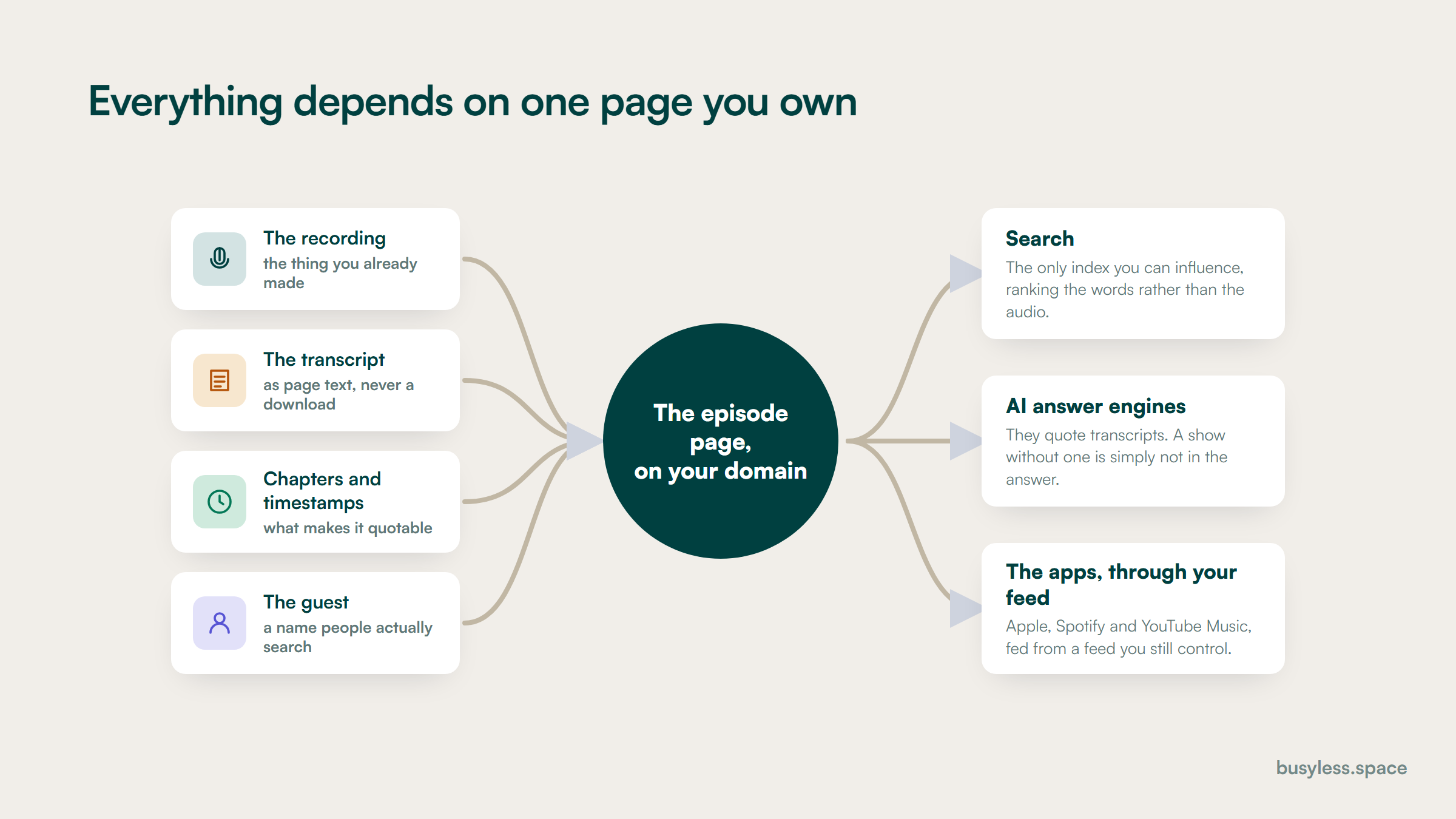
Four inputs converging on a single episode page on your own domain, which then feeds search, AI answer engines and the podcast apps
Everything upstream is work you already did. The page in the middle is the only part that is yours, and everything downstream depends on it existing.

What people actually search

Only two of the clusters below are about your show by name, and they are the smallest. The valuable ones are the questions your episodes already answer, and the one almost nobody builds for, which is the advertiser looking for a show like yours.

The question the episode answers

Informational, topic-led

how to price a seat-based product

The page that wins it: An episode page whose transcript and summary answer the question in text

The largest opportunity by far and the one the medium hides. Your show has probably answered hundreds of these well, and none of those answers exist in a form anything can index or quote.

Guest name

Navigational, person-led

[guest name] interview

The page that wins it: A page per guest, linking every episode they appear on

Reliably searched, especially after a guest publishes or launches something. The guest's own properties usually win, so the winnable version is guest plus a topic they discussed with you specifically.

Advertiser and sponsor research

Commercial, high value

podcasts about [niche] to advertise on

The page that wins it: A media kit page with audience, downloads and formats, published not gated

The money cluster, and almost no show publishes for it. The reader is a media buyer, not a listener, and the whole rest of the site is built for the wrong person. This page pays for the strategy.

Best-of and recommendation

Informational, list-led

best podcasts for [topic]

The page that wins it: Outreach to the lists rather than a list of your own

Owned by publishers and directories, and not realistically winnable with a page about yourself. It is a placement target: being included in other people's lists is the achievable version.

Quote and reference hunting

Informational, verification-led

what did [guest] say about [thing]

The page that wins it: Timestamped transcripts with quotable passages in headings

Small volume and disproportionately valuable, because it is exactly what AI answer engines resolve. A transcript with real structure is quotable; an unbroken wall of speech is not.

Show name and brand

Navigational

[show name] podcast

The page that wins it: A show home page that outranks the platform listings

Low volume relative to everything above, and usually already answered by Apple or Spotify. Worth owning so the first result is a page you control, but not worth building a strategy around.

Where and how to listen

Navigational, access-led

[show name] transcript

The page that wins it: Every episode page carrying the full transcript, not a download

A small cluster that reveals a large gap. People asking for a transcript are asking for the exact asset that would have made the show findable in the first place.

Starting a podcast

Informational, adjacent

how to start a podcast about [topic]

The page that wins it: Only worth writing if it is genuinely your subject

Tempting and usually wrong. It attracts other podcasters rather than listeners or advertisers, and the category is saturated by hosting companies with far more authority than a show.

What the rules change

Two of the rules below are unusual in this directory because neither can be satisfied by anything on the website. One has to happen in the audio, and the other has to happen before the audio is published at all. This is my reading rather than legal advice.

1

An audible claim needs an audible disclosure

FTC Guides Concerning the Use of Endorsements and Testimonials, effective 26 July 2023

What it means

The revised guides are deliberately media-neutral. Where a representation is made audibly, the disclosure must be made at least in the audible portion, delivered at a volume, speed and cadence an ordinary listener can hear and understand.

So do this

Script the disclosure into the read rather than leaving it to the host, and stop relying on show notes to carry it. A host-read advert is an endorsement, and the one place the disclosure cannot live is the only place most shows put it.

2

There is no blanket podcast music licence

US copyright law; ASCAP, BMI, SESAC and SoundExchange licence terms

What it means

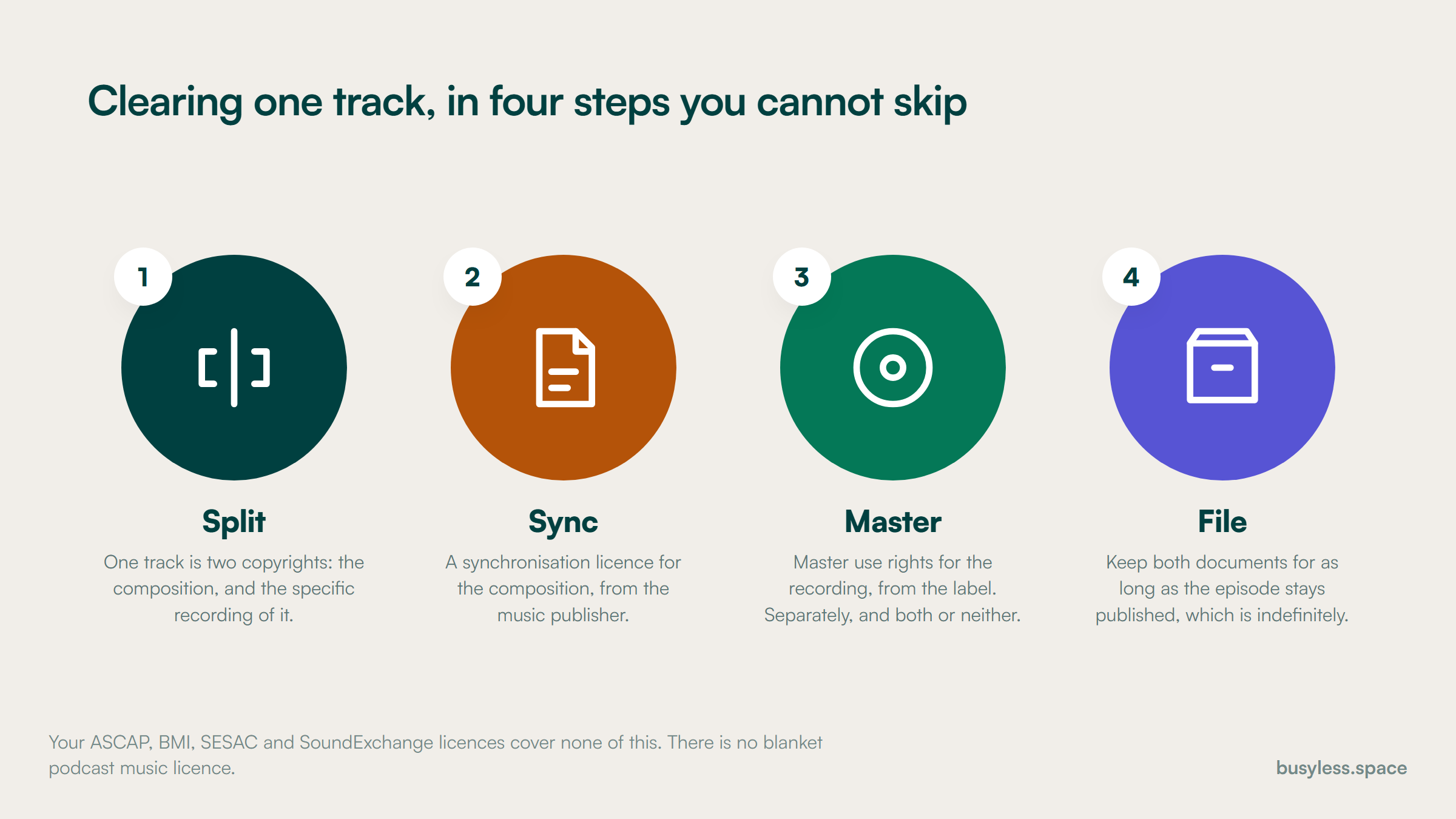
A performing rights licence covers public performance, and a downloadable on-demand episode is a reproduction and distribution instead. Clearing a track therefore needs a synchronisation licence for the composition and master use rights for the recording, from a publisher and a label separately.

So do this

Use genuinely licensed production music and keep the licence documents. This constrains what you can put in a trailer, a clip or an embedded player on the site, which is the part a content strategy actually touches.

3

Platform metadata policies govern the field that matters most

Apple Podcasts and Spotify catalogue and metadata guidelines

What it means

Directories reject or suppress shows whose titles are stuffed with keywords, whose categories are inaccurate, or whose artwork carries promotional text. The show title is the single most important discovery field and the most commonly abused.

So do this

Keep the title the name of the show. Put the topic in the description and the category, and win the topic queries on your own site instead, where nobody restricts what you may say.

4

A guest's words and likeness are not automatically yours to reuse

State right of publicity laws and ordinary contract

What it means

Publishing an interview is one thing; cutting a guest into a promotional clip, quoting them in an advertisement or using their name to sell a sponsorship is another, and the second is a use most verbal agreements never covered.

So do this

Use a short written release covering the recording, clips, transcript publication and promotional use. Ask before the recording rather than after a clip has done well.

A four step method for clearing one piece of music, splitting the track into two copyrights and licensing each from a different party
There is no single licence at the end of this. Two rights, two owners, and a performing rights licence covers neither of them.

Proving expertise

Trust in this category is carried by people rather than by the publication, which makes the signals unusually personal. Almost all of them are things the show already has and does not publish in text.

  • Named hosts with what they actually do when not recording
  • Guest credentials stated on the episode page, not just in the audio
  • Full transcripts, published as text rather than offered as a download
  • Episode publication dates and any later corrections, visible
  • Sources and links for factual claims made in the episode
  • A media kit with real audience numbers and how they are measured
  • Named sponsors and a plain statement of the disclosure policy
  • A guest release policy, so guests know what they are agreeing to

How to build a podcast SEO strategy

The first phase below is about ownership and text, in that order, because everything else is wasted until both exist. A podcast SEO strategy that starts with keyword research while the episode pages sit on a hosting platform's subdomain is optimising somebody else's website.

  1. 1

    Weeks 1-3

    Own the pages

    • Establish where your episode pages actually live and who owns that domain
    • Move episode pages onto your own domain, one page per episode
    • Redirect the old host-subdomain URLs if you controlled them
    • Claim Apple, Spotify, YouTube Music, Listen Notes and Podchaser
    • Set up analytics that separate episode pages from the rest of the site

    You end up with
    Every episode on a URL you own, with the directories claimed and accurate

  2. 2

    Weeks 4-8

    Manufacture the text

    • Transcribe the back catalogue and publish transcripts as page text
    • Add real headings and timestamps inside each transcript
    • Write a genuine summary per episode, not the same show blurb repeated
    • Add PodcastEpisode and PodcastSeries markup
    • Publish a video version to YouTube with chapters, even a static one

    You end up with
    A searchable archive where there was previously only audio

  3. 3

    Weeks 9-12

    Build the pages that are not episodes

    • Build guest pages, one per guest, linking every appearance
    • Publish the media kit as a real page rather than a gated PDF
    • Write topic hub pages grouping episodes by subject
    • Add the disclosure policy and the guest release policy
    • Fix the audio embed so it does not block page rendering

    You end up with
    A site that serves advertisers and researchers as well as listeners

  4. 4

    Weeks 13-16

    Make it repeatable

    • Fold transcription and summary writing into the publishing routine
    • Set a template so a new episode ships with its text on day one
    • Start outreach for inclusion in best-of lists
    • Report episode page traffic separately from downloads
    • Review which topics actually earn search traffic and tell the editorial side

    You end up with
    A publishing process where every new episode arrives readable

Technical fixes with the best payoff

Almost every defect here comes from the hosting platform being treated as the website. The platforms are good at distributing audio and indifferent to whether anything you publish accrues to you.

  • The episode pages are on the host's subdomain

    A project, then permanent

    Every major podcast host offers a free site, and it is the fastest way to have somewhere to point people. Years of links and rankings then belong to the host rather than to the show.

    Move to your own domain and redirect what you can. This is the largest single gain available and the one most publishers discover far too late.

  • There is no page per episode

    A template, then automatic

    The site is a single player with a scrolling list, because that is what the embed produces. Hundreds of episodes share one URL and none of them can rank for anything.

    One page per episode, with its own title, summary, transcript and markup. This is the unit of content in this medium and most shows have never created it.

  • The transcript is a download or does not exist

    A day for a template, then per episode

    Transcription is treated as an accessibility chore, so it is produced as a PDF and linked, which leaves the text unreadable to the crawler in almost the same way the audio was.

    Publish the transcript as page text, with headings and timestamps. This is the entire strategy in one change.

  • Every episode page repeats the same show description

    Ten minutes an episode

    The feed carries a show-level blurb and the template prints it on every page, so several hundred pages share most of their words.

    Write a real summary per episode. Three or four sentences that could only describe that conversation, above the transcript.

  • The player blocks rendering

    Half a day

    Third-party embeds load scripts and often the audio itself before the page is usable, on a page whose value is entirely in the text underneath.

    Load the player lazily and put the summary and transcript above it in the source. The reader who arrived from a search wants the words first.

  • No PodcastEpisode markup anywhere

    A day

    The templates predate the schema types and nobody has revisited them, so the one machine-readable description of an audio file is missing.

    Add PodcastSeries on the show page and PodcastEpisode on each episode, with the audio file, duration and publication date.

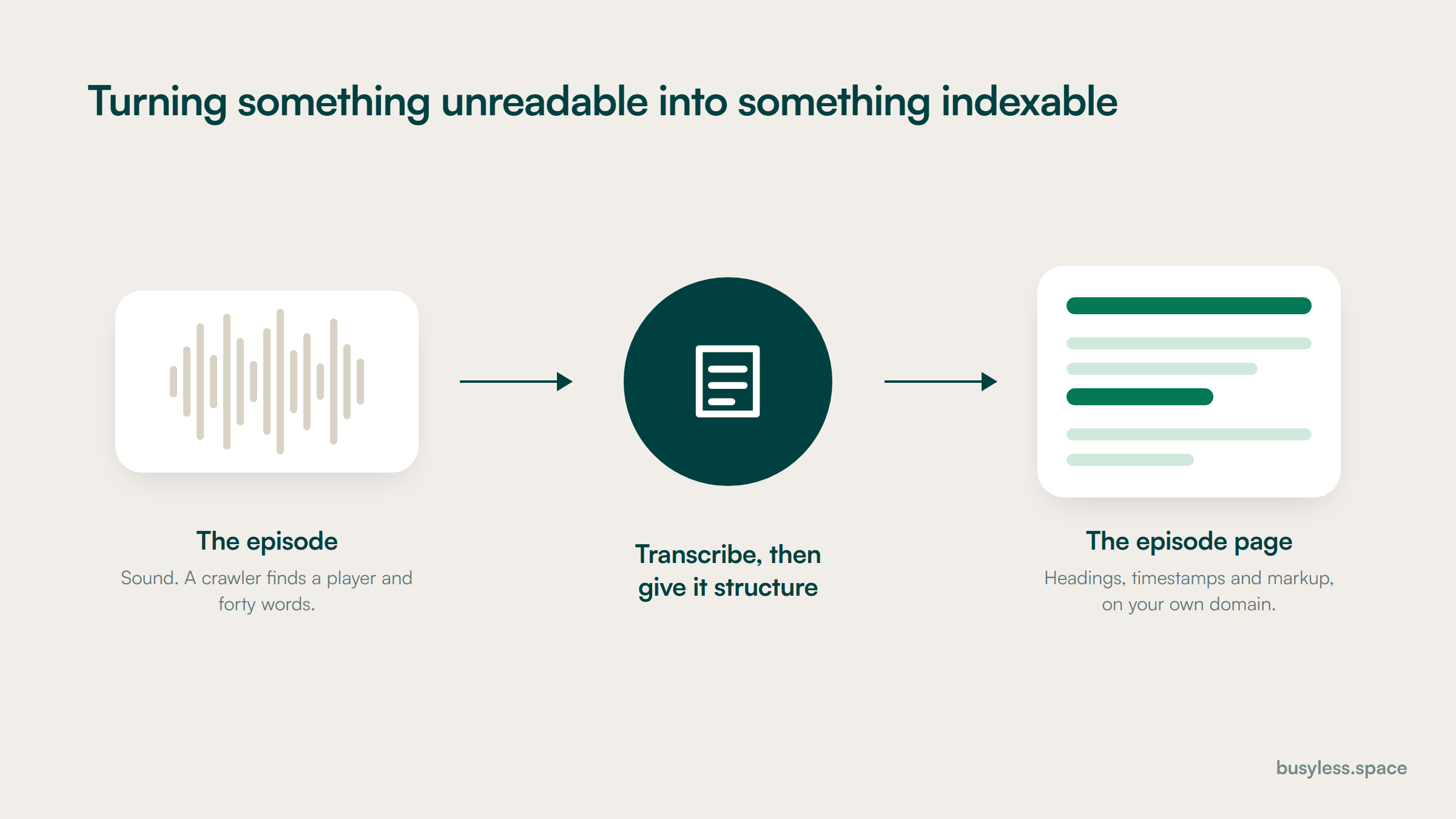
A three stage pipeline from an episode drawn as a waveform, through transcription and structuring, to a finished episode page of headings and text
Each stage makes the next one possible. Most shows never leave the first box, and then wonder why the archive earns nothing.

Structured data that applies here

The types below fit this industry specifically. Most of them earn no rich result on their own, which is worth knowing before anyone sells the work on that basis. What they do is describe the entity precisely, which matters for how search engines and answer engines resolve who you are.

  • PodcastSeries

    The show home page

    Describes the publication rather than an episode, and it is what ties several hundred episode pages together into one thing. It also carries the feed URL, which is the only machine-readable link between your site and the apps.

    PodcastSeries.jsonld
    {
      "@context": "https://schema.org",
      "@type": "PodcastSeries",
      "name": "[SHOW NAME]",
      "url": "https://[YOUR-DOMAIN]/podcast",
      "description": "[WHAT THE SHOW IS ABOUT, IN YOUR WORDS]",
      "image": "https://[YOUR-DOMAIN]/[SHOW-ARTWORK].jpg",
      "webFeed": "https://[YOUR-DOMAIN]/feed.xml",
      "author": {
        "@type": "Person",
        "name": "[HOST NAME]",
        "url": "https://[YOUR-DOMAIN]/about"
      },
      "publisher": {
        "@type": "Organization",
        "name": "[PUBLISHER OR YOUR OWN NAME]"
      },
      "inLanguage": "en-US"
    }
  • PodcastEpisode

    Every episode page

    The unit of content in this medium, and the markup that says an audio file exists, how long it is and which series it belongs to. Without it an episode page is just a page with a player on it.

    PodcastEpisode.jsonld
    {
      "@context": "https://schema.org",
      "@type": "PodcastEpisode",
      "url": "https://[YOUR-DOMAIN]/podcast/[EPISODE-SLUG]",
      "name": "[EPISODE TITLE]",
      "datePublished": "[YYYY-MM-DD]",
      "description": "[3 TO 4 SENTENCES THAT COULD ONLY DESCRIBE THIS EPISODE]",
      "episodeNumber": "[N]",
      "timeRequired": "PT[H]H[MM]M",
      "partOfSeries": {
        "@type": "PodcastSeries",
        "name": "[SHOW NAME]",
        "url": "https://[YOUR-DOMAIN]/podcast"
      },
      "associatedMedia": {
        "@type": "MediaObject",
        "contentUrl": "https://[AUDIO-FILE-URL].mp3",
        "encodingFormat": "audio/mpeg"
      },
      "actor": [
        { "@type": "Person", "name": "[GUEST NAME]", "url": "https://[GUEST-SITE]/" }
      ]
    }
  • Person for each guest

    Guest pages, and referenced from the episodes they appear on

    Guest name is a real query and the guest's own properties usually win it. A proper Person node with sameAs links is what lets your interview join up with the entity a search engine already knows about.

    Person for each guest.jsonld
    {
      "@context": "https://schema.org",
      "@type": "Person",
      "name": "[GUEST NAME]",
      "url": "https://[YOUR-DOMAIN]/guests/[SLUG]",
      "jobTitle": "[ROLE]",
      "worksFor": {
        "@type": "Organization",
        "name": "[COMPANY]"
      },
      "sameAs": [
        "https://[THEIR-OWN-SITE]/",
        "https://www.linkedin.com/in/[HANDLE]"
      ],
      "subjectOf": {
        "@type": "PodcastEpisode",
        "name": "[EPISODE TITLE]",
        "url": "https://[YOUR-DOMAIN]/podcast/[EPISODE-SLUG]"
      }
    }
  • Transcript as a text region

    Inside each episode page, around the transcript itself

    The transcript is the whole strategy, so it is worth marking as what it is rather than leaving it as an anonymous block. Keep it as page text; a downloadable file defeats the purpose entirely.

    Transcript as a text region.jsonld
    {
      "@context": "https://schema.org",
      "@type": "PodcastEpisode",
      "url": "https://[YOUR-DOMAIN]/podcast/[EPISODE-SLUG]",
      "name": "[EPISODE TITLE]",
      "transcript": "[THE FULL TRANSCRIPT TEXT, OR THE FIRST PORTION OF IT]",
      "hasPart": {
        "@type": "Clip",
        "name": "[WHAT THIS SECTION COVERS]",
        "startOffset": "[SECONDS]",
        "endOffset": "[SECONDS]",
        "url": "https://[YOUR-DOMAIN]/podcast/[EPISODE-SLUG]#t=[SECONDS]"
      }
    }
  • WebPage for the media kit

    The advertise-with-us page

    The commercial page on a podcast site, aimed at a media buyer rather than a listener. Publishing it rather than gating it is what makes it findable by the one reader whose search has money attached.

    WebPage for the media kit.jsonld
    {
      "@context": "https://schema.org",
      "@type": "WebPage",
      "url": "https://[YOUR-DOMAIN]/advertise",
      "name": "Advertise on [SHOW NAME]",
      "description": "[Audience, formats and rates for sponsoring SHOW NAME, a podcast about TOPIC.]",
      "about": {
        "@type": "PodcastSeries",
        "name": "[SHOW NAME]",
        "url": "https://[YOUR-DOMAIN]/podcast"
      },
      "mainEntity": {
        "@type": "Offer",
        "name": "[Host-read mid-roll]",
        "priceCurrency": "USD",
        "price": "[RATE]",
        "description": "[60 seconds, host-read, includes the audible disclosure.]"
      }
    }
  • FAQPage

    The media kit and the about page

    Mark up the questions an advertiser and a prospective guest actually ask: how the audience is measured, what a slot includes, and what happens to a recording afterwards. Those decide the enquiry.

    FAQPage.jsonld
    {
      "@context": "https://schema.org",
      "@type": "FAQPage",
      "mainEntity": [
        {
          "@type": "Question",
          "name": "[How is your audience measured?]",
          "acceptedAnswer": {
            "@type": "Answer",
            "text": "[Downloads over the first 30 days, measured by HOST, using the IAB v2 standard. Here is the current average and the range.]"
          }
        },
        {
          "@type": "Question",
          "name": "[What happens to the recording after we speak?]",
          "acceptedAnswer": {
            "@type": "Answer",
            "text": "[We publish the full episode, a transcript, and short clips. You sign a release covering all three, and you can review the clips before they go out.]"
          }
        }
      ]
    }

What it costs

These bands are editorial estimates of what the work takes rather than a price list or survey data. Podcasts sit at the bottom of this directory for a real reason: the highest-value action is transcription, and transcription has become genuinely cheap.

Do it yourself

$0 to $300
  • Episode pages moved onto your own domain
  • Machine transcripts, tidied and published as page text
  • A real summary per episode rather than the show blurb
  • PodcastEpisode and PodcastSeries markup
  • Every directory claimed and accurate

Who it suits

An independent show where the host has an hour a week and would rather spend it than pay for it. Most of the value in this playbook is reachable here.

Where it stops

The back catalogue is the slow part. Doing several hundred episodes by hand takes longer than most shows will sustain.

Lean

$500 to $1,500
  • The back catalogue transcribed and published in one pass
  • An editor writing episode summaries and topic hubs
  • Guest pages built properly, with markup
  • The media kit written for a media buyer

Who it suits

A show with a real archive and some commercial intent, where the back catalogue is the asset and nobody has time to unlock it.

Where it stops

Search will not fix a discovery problem caused by the show itself. If nobody finishes an episode, more text does not help.

Funded

$1,500 to $3,000
  • Clips and video versions produced per episode
  • Topic hubs built and maintained as a real content structure
  • Outreach for inclusion in the best-of lists that own that cluster
  • Reporting that connects episode pages to sponsorship enquiries

Who it suits

A show that is a business, with sponsorship revenue to protect and a reason to be found by advertisers rather than only by listeners.

Where it stops

Beyond this, growth comes from the show and its guests rather than from the website, and no amount of optimisation substitutes.

How to do it with no budget

More of this playbook is free than almost any other in this directory, because the two decisive actions are moving to your own domain and publishing text you can now generate for pennies.

  1. 1

    Find out whose domain your episodes are on

    2 minutes

    Your browser address bar

    If the episode URL contains your host's name, every link and ranking you have ever earned belongs to them. This two minute check reorders the whole plan for a lot of shows.

  2. 2

    Publish transcripts as page text

    20 minutes an episode

    Your hosting platform's transcription, or a free tool

    Machine transcription is now good enough to publish after a tidy. As page text, never as a download. This single change is most of the strategy.

  3. 3

    Write a real summary per episode

    10 minutes an episode

    Your website editor

    Three or four sentences that could only describe that conversation. It replaces the show blurb the template repeats on every page, which is why several hundred pages currently look identical.

  4. 4

    Add headings and timestamps inside the transcript

    10 minutes an episode

    Your website editor

    Turns a wall of speech into something a person can scan and a machine can quote. It is also what makes an episode usable in an AI answer rather than skipped.

  5. 5

    Claim Listen Notes and Podchaser

    An hour

    Those platforms

    Both index at episode level, which almost nothing else does, and Podchaser ranks on guest credits. Filling in guests properly makes you findable to people looking for a person rather than a show.

  6. 6

    Publish a video version with chapters

    20 minutes an episode

    YouTube

    Even a static image with the audio over it. YouTube will index the words, which converts an unreadable asset into a searchable one on the largest search surface still open to podcasts.

  7. 7

    Retitle your ten best episodes

    An hour

    Your website editor

    Replace the episode number with the question the episode answers. Nobody searches for episode 147, and a title that names the argument is the difference between a page that can rank and one that cannot, before a word of transcript is written.

The tool stack

Very short, because the expensive parts of this job became cheap. What is left is finding where the show is already mentioned, and running a site that can hold a transcript per episode without falling over.

  • Find where your show and guests are already being discussed

    ExaSEO APIRead the review

    Podcast mentions happen in newsletters, forums and other shows' notes rather than in places a backlink tool watches. Semantic search finds the discussions a keyword match misses, which is where best-of placements come from.

    Free routeSearch your show name in quotation marks, monthly

  • Run a site that is a page per episode, not a player

    TinaCMSHeadless CMSRead the review

    An episode, a transcript, timestamps and a guest list are structured records. Modelling them once means a new episode ships with its page, its markup and its guest link already correct.

    Free routeGit-based, free for a single editor

  • Work out what a sponsorship slot is worth

    Social Media ROI CalculatorFree toolOpen the tool

    Sponsorship is priced on audience and attention rather than on clicks, and most independent shows have never modelled what a slot returns to the advertiser. Doing that maths is what lets you price it without guessing.

    Free routeFree

  • Transcribe the back catalogue

    Your host's built-in transcription

    Check before paying for anything. Most podcast hosts now include transcription, and publishers routinely buy a separate tool for a job their existing plan already covers.

    Free routeIncluded with most hosting plans

  • Separate episode page traffic from everything else

    Google Analytics and Search Console

    The question is whether the transcripts are earning search traffic, and a site-wide total will never answer it. Segment episode pages from day one.

    Free routeFree

  • Watch which questions your episodes rank for

    Search Console, filtered to episode URLs

    The queries that arrive are the best editorial signal a show can get, because they are the questions people wanted answered. Feed them back to whoever plans the episodes.

    Free routeFree

Take it from here

Everything below is meant to be filled in and used rather than read. Bodies are plain text, so what lands on your clipboard is exactly what you see, brackets and all.

Checklist

Establishes whose domain your archive has been building for, which reorders everything else.

PODCAST OWNERSHIP CHECK
Show: [NAME]
Checked by: [NAME]     Date: [DATE]

STEP 1 - OPEN ONE EPISODE PAGE
Paste the URL here: [URL]

Does it contain your host's name?
  [ ] buzzsprout.com / libsyn.com / captivate.fm / transistor.fm
      / podbean.com / anchor.fm / simplecast.com / [OTHER]
  [ ] It is on my own domain

If your host's name is in the URL, everything below has been
accruing to them:
  - every link anyone has ever given an episode
  - every ranking the transcripts could have earned
  - every citation from an article or an AI answer

STEP 2 - WHAT YOU CONTROL
[ ] Do you own the domain the feed points to?         [Y/N]
[ ] Can you set redirects on the current episode URLs? [Y/N]
[ ] Can you export episode metadata and descriptions?  [Y/N]
[ ] Can you export transcripts, if any exist?          [Y/N]
[ ] Who owns the RSS feed URL people subscribed to?    [NAME]

STEP 3 - THE MOVE, IF NEEDED
[ ] Register or choose the domain
[ ] Stand up a page per episode on it
[ ] Point the feed at the new domain
[ ] Redirect old episode URLs where you can
[ ] Keep the feed URL stable, or you lose every subscriber

STEP 4 - RECORD THE ANSWER
Verdict: [OWNED / ON THE HOST / PARTLY]
If not owned, this is the first project. Nothing else in the
playbook is worth doing until it is.

What to publish

Almost everything below already exists as audio. The work is conversion rather than creation, which is why a back catalogue is worth more here than a content calendar.

  • The episode page with a full transcript

    Every episode, without exception

    The unit of the medium and the entire basis of the strategy. It converts an unreadable asset into something that can rank, be quoted and be cited by an answer engine.

  • Guest pages

    One per guest, built as they appear

    Guest name is a real query, and a page per guest linking every appearance is how your interviews join up with a person a search engine already recognises.

  • The media kit

    Once, updated quarterly with real numbers

    The only page on the site aimed at somebody with a budget. Publishing it rather than gating it is what makes an advertiser able to find you at all.

  • Topic hubs

    One a month until the main subjects are covered

    Groups episodes by subject so a reader who arrives for one question finds the other eleven times you covered it. It is also what turns an archive into a body of work.

  • A video version with chapters

    Every episode

    YouTube is the largest search surface still genuinely open to podcasts, and it indexes speech. Even a static image over the audio makes the episode findable there.

  • Clips with their own pages

    Two or three per episode

    A short, quotable passage with a timestamp and a heading is what gets shared, cited and picked up. It also serves the quote-hunting cluster, which nothing else does.

And what not to

  • How to start a podcast guides, which attract podcasters rather than listeners or advertisers
  • Transcripts published as downloadable files, which leaves them unreadable to the crawler
  • Keyword-stuffed show titles, which breach the directories' own metadata policies
  • The same show blurb repeated on every episode page
  • Best-of lists about your own category, competing with publishers who own that cluster
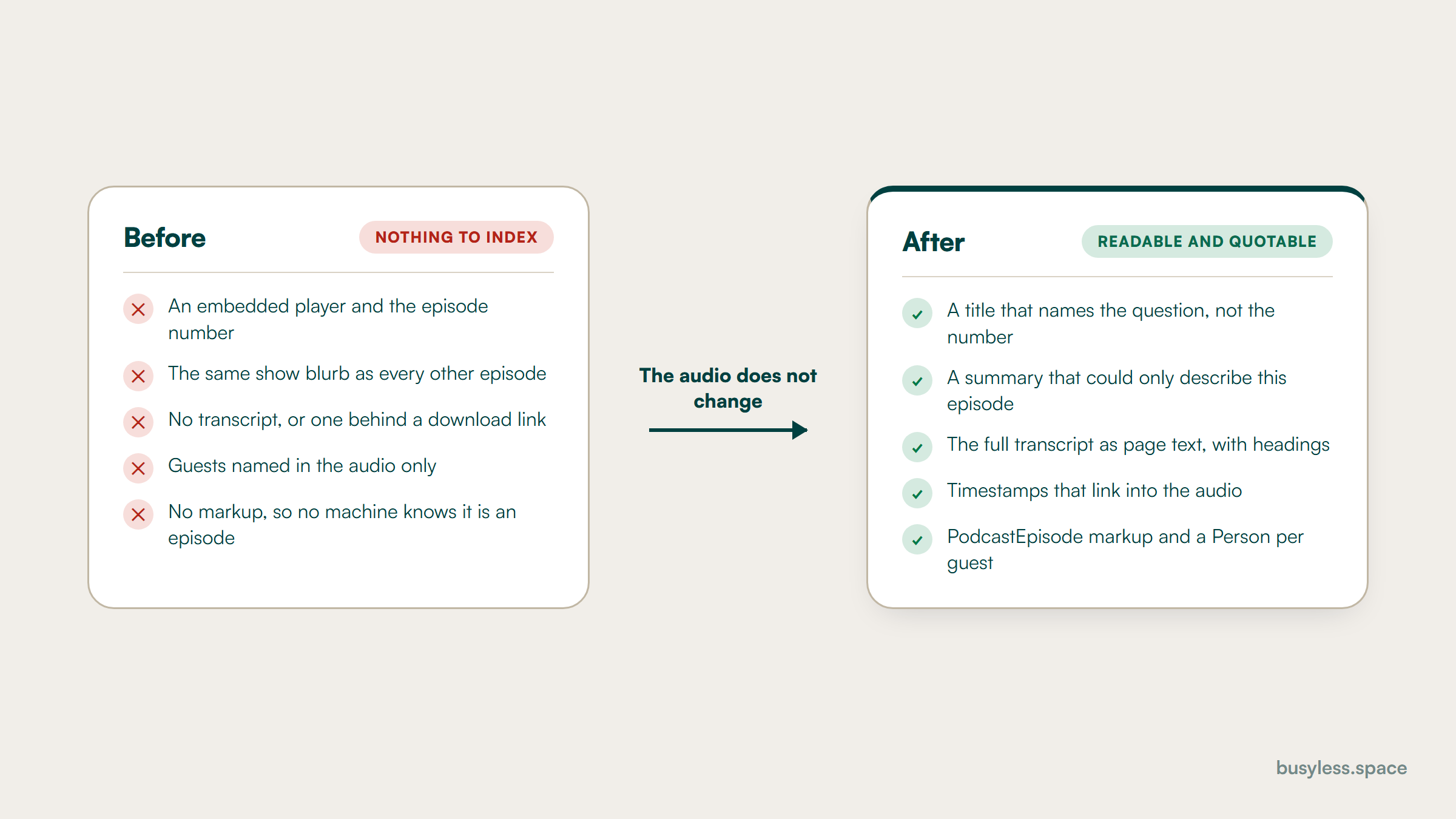
An episode page before and after, moving from a player and a repeated show blurb to a summary, transcript, timestamps and guest links
The audio is identical in both. Everything that makes the right-hand version findable was already sitting in the recording.

The expensive mistakes

Building the site on the hosting platform's subdomain

Costs you Every link, ranking and citation you earn accrues to your host, and you find out when you try to leave.

Own the domain from the start. If it is already years in, move and redirect what you can; it only gets more expensive.

Treating transcripts as an accessibility chore

Costs you A PDF gets produced, linked and ignored, and the text stays as invisible to a search engine as the audio was.

Publish transcripts as page text with headings and timestamps. This is the strategy, not a compliance task adjacent to it.

Putting the disclosure in the show notes

Costs you The one place the guides say it cannot be, on a claim made audibly. Show notes are not the audible portion of anything.

Script it into the read, spoken clearly at ordinary pace. Keep the show notes version as well, but never instead.

Using a track because it feels like fair use

Costs you Two separate copyrights infringed at once, and no performing rights licence you hold covers either of them.

Use licensed production music and keep the paperwork. There is no blanket podcast licence to buy, so the shortcut does not exist.

Chasing best-of podcast lists with your own list

Costs you A page about yourself competing with publishers who own that query, on a cluster you cannot win by writing.

Treat it as outreach. Being included in other people's lists is the achievable version, and it is a relationship job.

Reporting downloads as the only number

Costs you The website's contribution is invisible, so the work that made the archive searchable looks like it did nothing.

Report episode page sessions, search queries and sponsorship enquiries separately from downloads, and say how they relate.

What to measure

Podcast measurement is unusually broken and it is worth saying so plainly rather than working around it. Downloads are a delivery metric, not an audience metric, and nothing connects a listener to a search visit. Report the two halves separately and never add them.

Leading indicators

Move first. They predict, they do not prove.

  • Episode pages indexed

    Search Console

    The first thing to watch, and it should climb steeply once transcripts go live. A flat line here means the pages are not being found rather than not being liked.

  • Search impressions on episode pages

    Search Console, filtered to episode URLs

    Segment these from the rest of the site or the archive's contribution is invisible inside the home page's numbers. This is the direct measure of whether the transcripts worked.

  • Queries arriving on episode pages

    Search Console

    Worth reading rather than counting. These are the questions people wanted answered, which is the best editorial signal a show can get, and it belongs in front of whoever plans episodes.

  • Transcripts published as page text

    Your own count

    A production metric, reported as a fraction of the catalogue. The back catalogue is the asset and the count is the honest measure of how much of it has been unlocked.

  • Guest page and clip traffic

    Analytics

    Small numbers that indicate whether the show is becoming citable rather than merely listenable. Worth watching after the transcripts rather than before.

Business indicators

The ones a manager acts on.

  • Downloads

    Your hosting platform

    The number the industry runs on and the one least connected to anything else here. Report it, use the same window every time, and do not expect the website to move it directly.

  • Sponsorship enquiries

    The media kit page and your inbox

    The clearest commercial outcome the website can produce on its own, because an advertiser genuinely does search and genuinely does land on a page. This is what the media kit exists for.

  • Guest applications and pitch quality

    Your booking form

    A searchable archive changes who pitches you, usually before it changes who listens. It is a slow signal and a real one.

The verdict

Most podcast SEO services sell keyword-optimised titles and directory submissions, which is tinkering with metadata on platforms that do not rank on it. The medium's actual problem is upstream of all that.

The content cannot be read. Until there is a page per episode on a domain you own, carrying a real summary and a full transcript as text, nothing else in a search strategy has anything to work with.

So honest SEO services for podcasts start with two unglamorous questions: whose domain are these pages on, and where is the text. On most shows the answers are somebody else's, and nowhere.

Fix those and the archive stops being a library nobody can search. A show that has answered good questions for three years suddenly has three years of answers that can be found, quoted and cited.

FAQ

Podcasts SEO questions

  • Why can my podcast not be found on Google?
    Because there is nothing to find. An episode is audio, and a crawler arriving at a player and forty words of description has no text to index. Publishing a full transcript as page text on your own domain is what changes that.
  • What happened to Google Podcasts?
    It shut down in 2024 and its listeners were migrated to YouTube Music. Google effectively left podcast discovery while remaining the place your transcripts can rank, which is why the web half of this work is about topics rather than about being in a podcast directory.
  • Should transcripts be a download or page text?
    Page text, always. A downloadable file leaves the words nearly as invisible as the audio was. Put the transcript in the page with real headings and timestamps so both a reader and a machine can use it.
  • Is it a problem that my episodes live on my host's website?
    Yes, and it is usually the biggest one. Every link, ranking and citation accrues to their domain rather than yours. Check the URL of any episode; if it carries your host's name, moving to your own domain comes before anything else.
  • Do I need to say the sponsorship disclosure out loud?
    Yes. The FTC's guides are media-neutral, so an audible claim needs an audible disclosure, delivered so an ordinary listener can hear and understand it. Show notes do not discharge it, which is exactly where most shows put it.
  • Can I use a well-known song as my theme?
    Not on the licences most publishers hold. A performing rights licence does not cover podcasting, so you need a synchronisation licence from the publisher and master use rights from the label. There is no blanket podcast licence available.
  • Should I put the show on YouTube even without video?
    Usually yes. YouTube indexes speech and is the largest search surface still genuinely open to podcasts, so a static image over the audio with proper chapters makes the episode findable where it otherwise is not.
  • How long before this shows results?
    Four to nine months, and it depends far more on how large the back catalogue is than on how competitive the topic is. A show with three years of unindexed episodes has more to gain in month one than a new show has in a year.

Run it yourself, or have someone own it

Everything above is written to be run without us, and the free path is genuinely most of the value for a single-location business. Where these plans stall is almost never the plan. It is that nobody owns it after the first month. That is the job we do, with search as one distribution layer inside a wider system rather than the whole engagement.