
Skip to content

Musician SEO strategy

Regulated marketing

Your name is the query and a platform owns the answer

Written by Eugene SuslovLast reviewed 29 August 2026No affiliate links
Sector
Lifestyle and leisure
Model
National service, Local service
Competition
High
Time to results
3 to 9 months
Typical monthly
$0 to $2,500

Key takeaways

  1. 1Concede your own name. The correct top result for it is Spotify or YouTube, because that is where the music is. Fighting for position one on your own brand is the most common and most expensive mistake in this market.
  2. 2The knowledge panel that answers your name is assembled from databases you can edit and do not own. MusicBrainz and Wikidata are a two-hour job and they are the closest thing to controlling how you are described.
  3. 3The money is in the queries with no artist name in them at all. Hiring a band, licensing a track, booking a lesson, commissioning a piece. Those pages barely exist and they convert to invoices rather than to fractions of a cent.
  4. 4Bought streams and bought followers are metered by the platform and unlawful under a federal rule at the same time. Spotify charges per track per month for artificial streaming; the FTC rule carries civil penalties for buying indicators of social media influence.
  5. 5Your records have no pages. The site links straight out to the platforms, so the album title, the credits, the personnel and the story exist on your own domain nowhere at all, and nothing you own can rank for any of them.

SEO for musicians starts by giving something away, which is unusual enough to be worth stating first. The single highest-intent query about you is your own name, and the right result for it is not your website.

Somebody typing an artist's name usually wants to hear the music. Spotify, YouTube and Apple Music serve that intention better than any website can, and the platforms have the authority to hold those positions whatever you do.

Accepting that changes the whole plan. Your name query becomes an entity problem rather than a ranking problem: making sure the thing search engines resolve your name to is you, described correctly, with the right links attached.

The rest of a musician SEO strategy then goes somewhere most artists never look, which is the set of searches with no artist name in them. Somebody looking for a band for a wedding, a track for an advertisement, or a teacher for their child.

Those queries are commercial, local, unglamorous and almost entirely unanswered by working musicians. They also pay in invoices rather than in fractions of a cent per play, which changes what the website is even for.

There is a second reason to be careful here. This is one of very few industries where the standard growth tactic, buying attention, is both metered by the platforms and prohibited by a federal rule, and the two enforcement routes are unrelated.

Who already ranks in musicians and artists

Search your own name and look at what answers it, then search the thing you would actually like to be paid for and look at that. Almost every musician SEO conversation improves the moment those two results pages are put side by side, because they have almost nothing in common.

What is on the results page

  • A knowledge panel on the artist name, assembled from sources you do not control
  • A listen-now style module linking directly to the streaming services
  • Streaming platform pages taking the top organic positions on the name
  • Lyric sites ranking for song titles ahead of the artist's own site
  • Video results dominating anything with a song title plus the word live
  • Booking marketplaces owning every hire-a-band query in every city
  • A local pack on lessons, studio and rehearsal queries
  • Almost no competition on licensing, credits and personnel queries
  • Spotify

    spotify.comClaim it

    Ranks near the top for almost every artist name and deserves to, because it is what the searcher wanted. Claim the artist profile so you control the biography, the images, the artist pick and the links out. The profile is also the canonical entity many other services read from, so an error there propagates further than it looks.

  • YouTube

    youtube.comClaim it

    The second answer to your name and the first answer to most song titles, especially with a live or lyrics qualifier. Consolidate into an official artist channel so the topic channel, the vevo uploads and your own videos stop competing with each other. Descriptions and chapters are read as text; almost nobody writes them properly.

  • Genius

    genius.comClaim it

    Owns song and lyric queries in a way that is not realistically contestable, and lyrics are one of the largest search categories in music. Verify as an artist, annotate your own songs, and get the credits right, because those annotations are quoted back in answer engines and read as authorial.

  • MusicBrainz and Wikidata

    musicbrainz.orgClaim it

    The two open databases behind a great deal of how you are described, and the closest thing to an editable knowledge panel. An accurate MusicBrainz entry with the right identifiers, linked to a Wikidata item, is a couple of hours of work and it is the highest-leverage unglamorous job in this playbook.

  • Bandcamp

    bandcamp.comClaim it

    Ranks well on artist and release names and is the one platform where the page is a shop rather than a stream. Worth keeping current even when most listening happens elsewhere, because it is the destination that converts a fan into a transaction and it links back to you cleanly.

  • Bandsintown and Songkick

    bandsintown.comClaim it

    The tour date aggregators, which will outrank your own dates page unless you have one worth ranking. Claim both and keep them accurate. Then publish the dates on your own site as real pages too, because the aggregator page cannot sell the thing you want sold.

  • GigSalad and The Bash

    gigsalad.comClaim it

    The gatekeepers for the queries that pay. Search any hire-a-band term with a city attached and these marketplaces are the first organic results, ahead of every working act in that city. Treat them as a paid channel with a real commission, useful as a bridge and expensive as a permanent arrangement.

  • Discogs

    discogs.comClaim it

    The reference for physical releases, credits and personnel, and it ranks for catalogue numbers and pressing details that nothing else covers. If you have released anything physically, the entry exists whether or not you made it, and the credits on it are worth correcting.

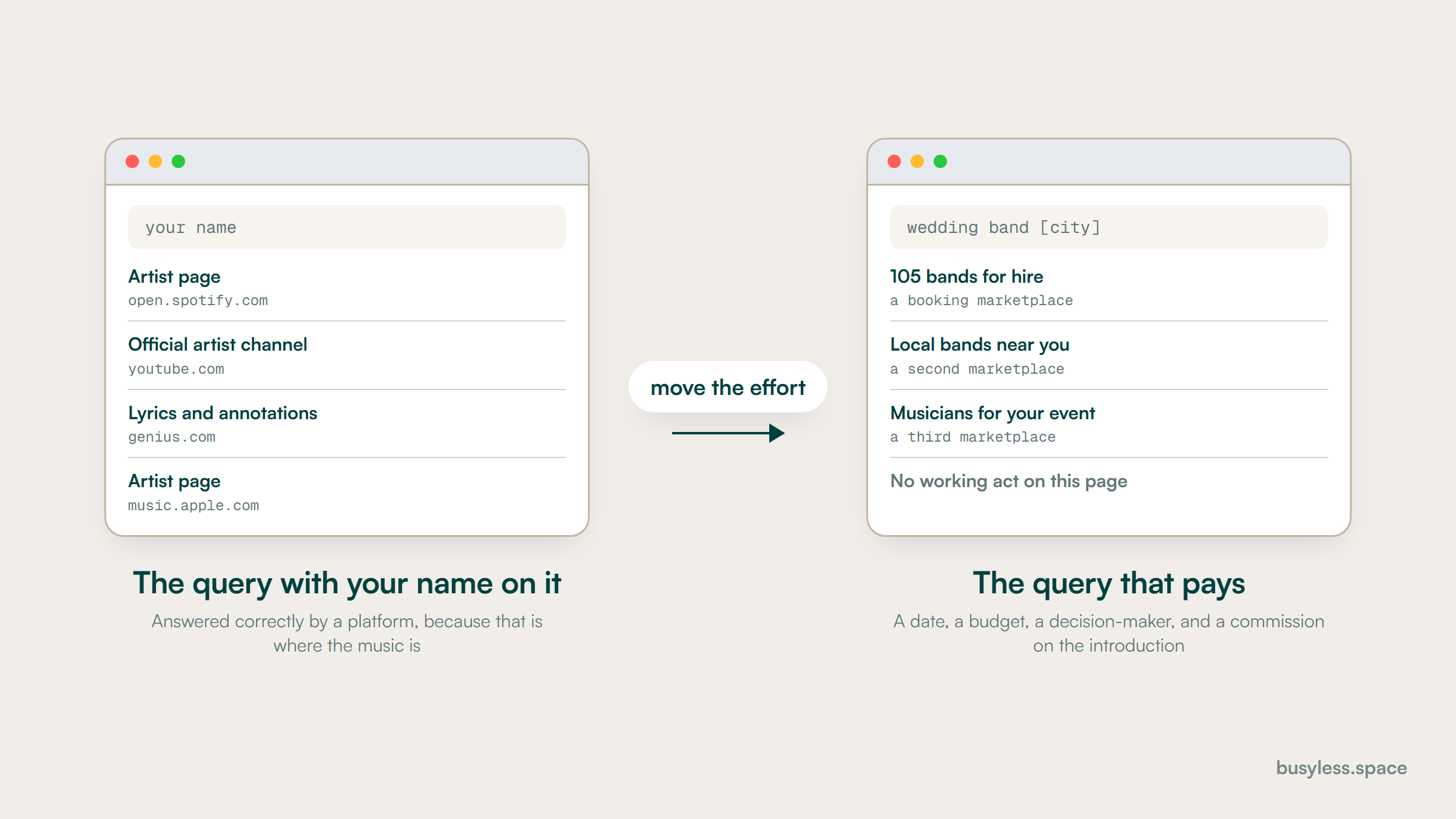
Two panels side by side. The left holds the results for an artist name: streaming services, a lyric site, a video platform. The right holds the results for hiring a band in a city: three booking marketplaces and no working musician.
Nothing appears in both panels. That is the whole argument of this page, in the order the reader will meet it.

What people actually search

Sort these by whether the searcher has a budget. Two of the eight clusters below produce invoices, one produces royalties, and the remaining five produce audience. All five matter, but only if the first two are already covered.

The artist name

Navigational

[artist name]

The page that wins it: An accurate entity across the platforms and the open databases

Conceded on purpose. The work here is making sure the entity resolved is you and not the other act with the same name, which is a data job rather than a content one.

Song titles and lyrics

Informational

[song title] lyrics

The page that wins it: A verified annotation on the lyric site, plus a song page of your own

Enormous volume that a lyric aggregator will keep. What is winnable is the story, the credits and the meaning, which is what an answer engine quotes when somebody asks what the song is about.

Discovery by similarity

Informational, high value

artists similar to [name]

The page that wins it: Editorial coverage and playlist placement, not a page on your site

Answered by playlists, editorial lists and other people's blogs. You cannot rank for it and you can appear in it, which is a public relations job wearing a search costume.

Hire an act

Transactional, with a budget

wedding band [city]

The page that wins it: A hire page per event type, with real pricing and a set list

The best query in this industry and the one almost no working musician has written a page for. There is a date, a budget and a decision-maker, and the marketplaces are taking a commission for the introduction.

Licensing and sync

Commercial investigation

license music for a documentary

The page that wins it: A licensing page naming what you own and how to clear it

The searcher is a producer or a brand with a deadline, and the thing that loses the deal is ambiguity about who controls the rights. A page that answers that clearly is rarer than it should be.

Lessons and teaching

Local commercial

[instrument] lessons [city]

The page that wins it: A lessons page with rates, levels and a local profile behind it

Recurring revenue, local competition and a proper local pack. It behaves like a service business rather than like music, which is exactly why musicians undersell it.

Tour and tickets

Transactional

[artist] tour [year]

The page that wins it: A dates page with a page per show, not an embedded widget

The one cluster with a hard deadline attached to every item. It is also where the fee disclosure rules bite, because a ticket price on your own page is an advertised total.

Merchandise and physical

Transactional

[album] vinyl

The page that wins it: A product page per item with variants and real stock status

Behaves like ecommerce and gets treated like an afterthought. Pressing details, weight, colour and edition size are what these searchers actually type, and a store platform's default page names none of them.

What the rules change

Lighter than the regulated professions in this directory, and sharper than most artists expect, because two of the four rules land on the growth tactic the industry sells hardest. Check your own position; none of this is legal advice.

1

Buying indicators of social media influence is prohibited

The Federal Trade Commission rule on the use of consumer reviews and testimonials, 16 CFR part 465, effective 21 October 2024

What it means

The rule bans creating, buying, selling or disseminating fake reviews and testimonials, and separately bans selling or purchasing fake indicators of social media influence. Bought followers, bought plays and bought engagement sit squarely inside that second prohibition, and the rule carries civil penalties.

So do this

Do not buy any of it, and be careful about promotion services that describe themselves as organic. Ask any campaign vendor in writing where the listeners come from, and treat a refusal as the answer. Put the same question to anyone offering to place you on a playlist for a fee.

2

The platform meters it separately

Spotify's artificial streaming policy, under which labels and distributors have been charged a monthly penalty per affected track since April 2024, alongside the 1,000-stream annual threshold introduced the same year

What it means

Spotify charges a monthly penalty of ten euros per track showing high levels of artificial streaming, billed to the label or distributor and passed on to the artist, and it removes the streams from reporting. Separately, a track needs at least a thousand streams in the previous twelve months before it earns recorded royalties at all.

So do this

Two consequences for the website. Never link to a promotion service from your own domain, because you are recommending it. And build the release page so it works for a catalogue where most tracks will not clear the royalty threshold, which means the value has to come from licensing, live and merchandise.

3

A ticket price on your page is an advertised total

The Federal Trade Commission rule on unfair or deceptive fees, 16 CFR part 464, in force since 12 May 2025, which covers live-event tickets as well as short-term lodging

What it means

The rule requires the total price, inclusive of mandatory fees, to be disclosed clearly and prominently wherever a price is advertised. A dates page listing a face value with the service charge appearing later in the checkout is exactly the pattern it was written about, and the same rule reaches short-term lodging, which is why the hotels playbook in this directory argues its other half.

So do this

Show the all-in figure wherever you show a price, including on the dates page, in any structured data and in anything a metasearch service might read. Where your ticketing partner controls the fees, get the total from them and publish that rather than the face value.

4

Paid coverage has to be disclosed as paid

The Federal Trade Commission Endorsement Guides, 16 CFR part 255, in their revised form issued in June 2023

What it means

Where a review, a feature or a placement was paid for or given in exchange for anything of value, the connection has to be disclosed clearly. A large part of the music press and playlist economy runs on paid submission, and the disclosure obligation reaches both the outlet and the artist who commissioned it.

So do this

Keep a record of what you paid for and what you did not, and do not quote a paid feature on your press page as though it were an unsolicited review. Where a placement was submitted through a paid pitching platform, say so in the credit line rather than leaving it to be discovered.

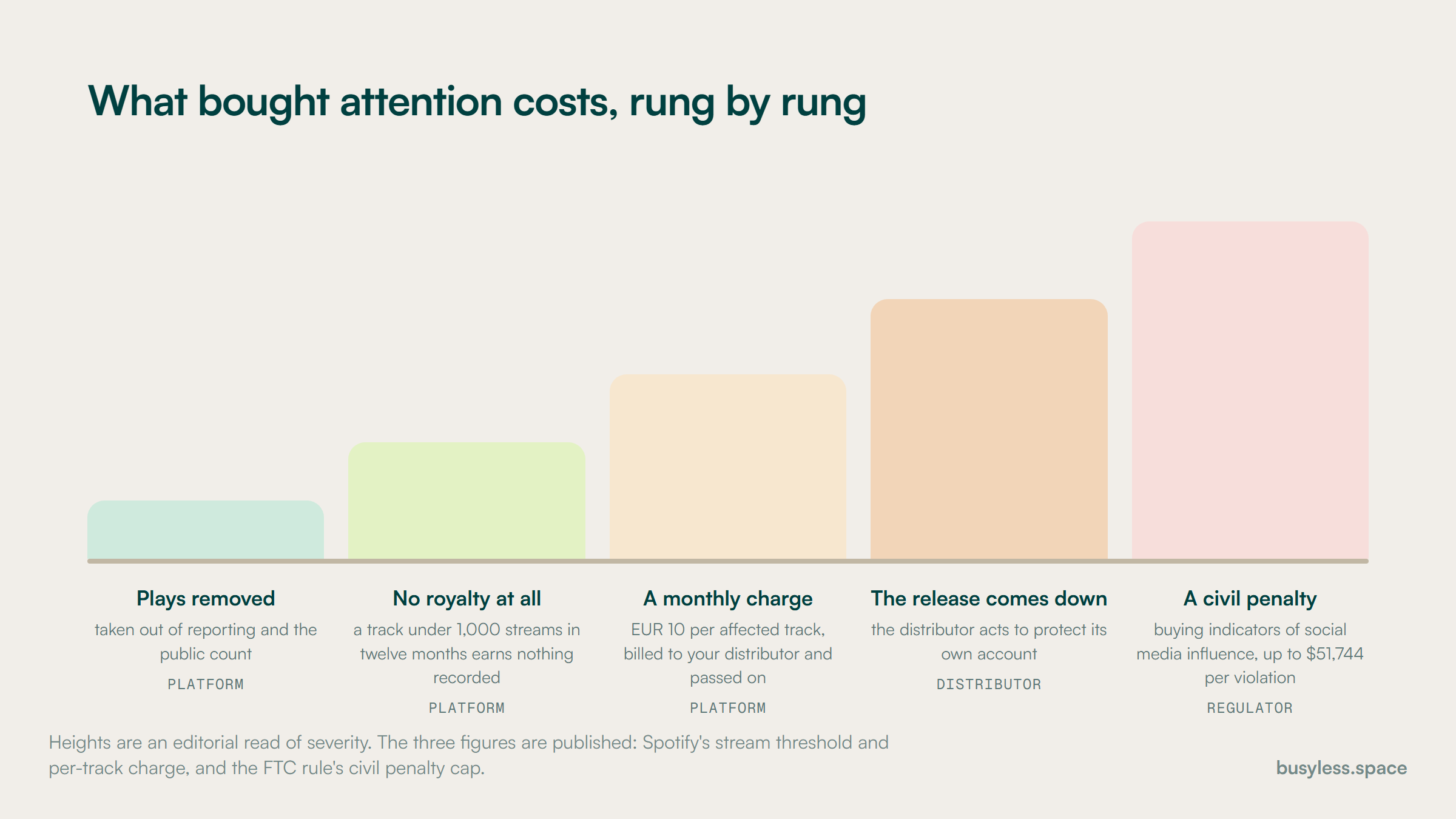
Five rungs rising from removed plays, through withheld royalties and a per-track monthly penalty, to distributor action and a federal civil penalty. Only the first and last rungs carry a figure.
Two of these are the platform's decision and one is a regulator's. They are unrelated, which is why both can happen.

Proving expertise

Expertise here is provenance. A booker, a licensing supervisor and a parent looking for a teacher all want the same underlying thing, which is evidence that you have done this before and can be found afterwards.

  • Full credits on every release, including engineers, players and studios
  • The catalogue identifiers, so a rights holder can find the recording
  • Named personnel with their own pages, not just a band name
  • Past venues, dates and support slots, as pages rather than a poster image
  • Who controls the master and who controls the publishing, stated plainly
  • Real photographs from real performances, with the photographer credited
  • Press coverage linked to the original, with paid placements labelled as such
  • For teaching, qualifications, insurance and safeguarding checks where they apply

How to build a musician SEO strategy

Six months, front-loaded with the entity work because it is free and it compounds. A musician SEO strategy usually shows its first real return from the booking pages rather than from anything to do with the music, which surprises people and should not.

  1. 1

    Weeks 1 to 3

    Fix the entity

    • Claim the artist profiles on every streaming service and complete the biographies
    • Consolidate the video channels into one official artist channel
    • Create or correct the MusicBrainz entry and link it to a Wikidata item
    • Verify on the lyric platform and correct the credits on the physical catalogue
    • Claim both tour date aggregators and make the dates match your own
    • Search your own name in an incognito window and write down what is wrong

    You end up with
    One consistent entity across the databases that assemble your knowledge panel

  2. 2

    Weeks 3 to 8

    Build the pages that produce invoices

    • Write a hire page per event type with real price bands and a set list
    • Write the licensing page naming what you own and how to clear it
    • Write the lessons page with rates, levels and location, and claim a local profile
    • Give every release its own page with credits, personnel and the story
    • Give every show its own page rather than embedding a dates widget
    • Publish all-in ticket prices wherever a price appears

    You end up with
    A site that can be paid, rather than a site that points at a streaming service

  3. 3

    Weeks 6 to 16

    Make the catalogue findable

    • Add a page per song with the story, the credits and the lyrics you control
    • Write the video descriptions and chapters properly on the back catalogue
    • Add music group, album, recording and event structured data
    • Turn the press kit into a page with downloadable assets underneath it
    • Replace the smart-link landing pages with pages on your own domain
    • Photograph and describe merchandise properly, with editions and pressings named

    You end up with
    A domain that holds the catalogue, the credits and the story rather than links to them

  4. 4

    Weeks 12 to 26

    Measure bookings, not plays

    • Track enquiries by type: hire, licence, lesson, press
    • Track the value of each booking and where it originated
    • Track lesson enquiries and retention separately from everything else
    • Watch the knowledge panel and the artist profiles for drift
    • Review the booking marketplaces on commission paid per booking won
    • Report streams as context rather than as an outcome

    You end up with
    A report where the numbers correspond to money that arrived

Technical fixes with the best payoff

One structural habit causes most of the damage, and it comes from good instincts. Artists point their website at the platforms, because that is where the music is, and end up with a domain that contains no nouns anybody searches for.

  • The records have no pages

    A day for the first, an hour each after

    The releases section is a grid of artwork linking straight out to the streaming services. So the album title, the track names, the personnel, the studio and the story exist on the artist's own domain nowhere at all, and no page you control can rank for any of them.

    One page per release and one per song. Title, date, full credits, the story of how it was made, the lyrics where you control them, and the streaming links underneath rather than instead. This is the single largest source of unclaimed material on almost every artist site.

  • Every link goes to a smart-link service

    An afternoon

    The pre-save and multi-platform link tools are genuinely useful and they take the visit somewhere else. When every social profile, every post and every advertisement points at a third-party landing page, the artist's own domain never receives the traffic and never accumulates anything.

    Host the equivalent page on your own domain and redirect from there. You keep the platform buttons, you keep the analytics, and the visit lands somewhere you own. Keep the external tool for the pre-save mechanics it does uniquely well.

  • The name is ambiguous and nothing on the site says who you are

    An hour

    Artist names collide constantly, and a search engine resolving the wrong entity will attach the wrong knowledge panel, the wrong images and the wrong discography. Most artist sites contain no identifiers at all, so there is nothing for a machine to reconcile against.

    Put the identifiers in the markup: the streaming profiles, the open database entry, the publisher and society affiliations. Then write a disambiguating sentence in the biography naming the genre, the city and the year you started, because that is what a human editor will use.

  • The dates page is a widget

    A day, then minutes per show

    The tour data lives in an aggregator and is injected into the page, so the shows are not really on your site. The aggregator's page for your tour then outranks yours, and it cannot sell merchandise, a VIP package or anything else with a margin on it.

    Publish the shows as real pages, one per date, with the venue, the support, the on-sale time and the all-in price. Keep the aggregator in sync, because fans use it, but let the page that can sell something be the one that ranks.

  • The site is a splash screen with audio

    A sprint

    An enter-site page, an autoplaying player, or a full-screen video that has to load before anything else appears. Each of these delays the point at which a page is usable and, on a phone on a venue's wifi, often prevents it entirely. It also leaves a single URL for an entire catalogue.

    One clear page with real headings, a player that starts when somebody presses play, and no interstitial. The visual identity survives this. The single-URL site does not, and it was never the reason anybody stayed.

  • The lyrics and the credits are images

    An hour per release

    Sleeve artwork scanned into a gallery, a lyric sheet as a photograph, a credits list inside a PDF booklet. All of it is text that cannot be read, in a category where lyric and credit queries are among the highest volume available.

    Type them out. Lyrics as text where you have the rights, credits as a proper list with roles, and the artwork as an image beside them rather than instead of them. Alt text describing the sleeve is not a substitute for the words.

  • The press kit is a shared folder

    A day

    A journalist, a booker or a licensing supervisor arriving with a deadline gets a link to a cloud folder, a permission prompt and a two-hundred-megabyte download. Nothing in it is indexable, nothing in it can be quoted, and half the time the link has expired.

    A press page with the biography in three lengths, the credits, high and low resolution images with photographer credits, the technical rider, and the downloads underneath. Keep the folder for the raw files and let the page be the thing that gets found.

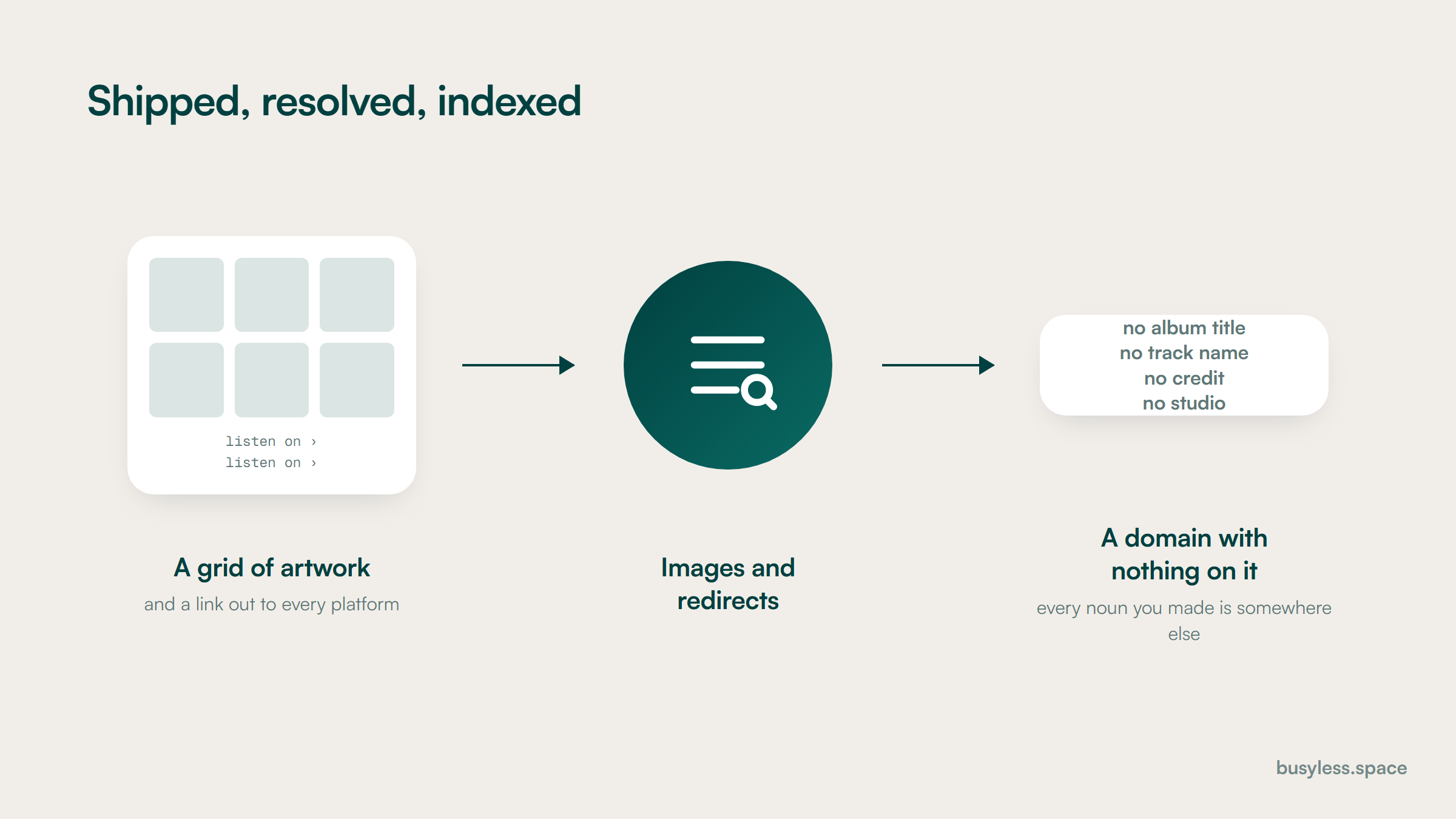
A left-to-right flow: what the page ships is a grid of artwork and outbound links, what a crawler resolves is a set of images and redirects, what reaches the index is a domain holding no album titles at all.
Every album title, every credit and every studio name is in the world. None of it is on the domain the artist owns.

Structured data that applies here

The types below fit this industry specifically. Most of them earn no rich result on their own, which is worth knowing before anyone sells the work on that basis. What they do is describe the entity precisely, which matters for how search engines and answer engines resolve who you are.

  • MusicGroup

    Home page and the about page

    The node that tells a search engine which act you are. Everything hangs off the sameAs list, so include the streaming profiles and the open database entry rather than only the social accounts. For a solo artist, use Person with the same members list omitted.

    MusicGroup.jsonld
    {
      "@context": "https://schema.org",
      "@type": "MusicGroup",
      "@id": "https://[YOUR-DOMAIN]/#artist",
      "name": "[ARTIST OR BAND NAME]",
      "alternateName": "[ANY NAME YOU HAVE ALSO RELEASED UNDER]",
      "url": "https://[YOUR-DOMAIN]/",
      "genre": ["[GENRE]", "[GENRE]"],
      "foundingLocation": {
        "@type": "Place",
        "name": "[CITY, COUNTRY]"
      },
      "foundingDate": "[YYYY]",
      "description": "[Two sentences that disambiguate you from any other act with this name.]",
      "image": "https://[YOUR-DOMAIN]/press/[PHOTO].jpg",
      "member": [
        {
          "@type": "Person",
          "name": "[MEMBER NAME]",
          "roleName": "[INSTRUMENT]"
        }
      ],
      "sameAs": [
        "https://open.spotify.com/artist/[ID]",
        "https://music.apple.com/artist/[ID]",
        "https://www.youtube.com/channel/[ID]",
        "https://musicbrainz.org/artist/[MBID]",
        "https://www.wikidata.org/wiki/[QID]",
        "https://[NAME].bandcamp.com/"
      ]
    }
  • MusicAlbum with its tracks

    Every release page

    Worth building for the whole back catalogue, not just the new record. The byArtist reference points at the artist node so the album and the act are joined up, and the track list is what lets a song title resolve to a release you own.

    MusicAlbum with its tracks.jsonld
    {
      "@context": "https://schema.org",
      "@type": "MusicAlbum",
      "@id": "https://[YOUR-DOMAIN]/music/[SLUG]#album",
      "name": "[ALBUM TITLE]",
      "byArtist": { "@id": "https://[YOUR-DOMAIN]/#artist" },
      "albumProductionType": "[StudioAlbum / LiveAlbum / DemoAlbum]",
      "albumReleaseType": "[AlbumRelease / SingleRelease / EPRelease]",
      "datePublished": "[YYYY-MM-DD]",
      "genre": "[GENRE]",
      "image": "https://[YOUR-DOMAIN]/music/[SLUG]/sleeve.jpg",
      "numTracks": "[00]",
      "recordLabel": { "@type": "Organization", "name": "[LABEL OR SELF-RELEASED]" },
      "track": {
        "@type": "ItemList",
        "numberOfItems": "[00]",
        "itemListElement": [
          {
            "@type": "ListItem",
            "position": 1,
            "item": { "@id": "https://[YOUR-DOMAIN]/music/[SLUG]/[TRACK]#recording" }
          }
        ]
      }
    }
  • MusicRecording with real credits

    Every song page

    The block that makes credits machine readable, which matters more here than in almost any other industry because a licensing search often starts from a person rather than from a title. Fill the ISRC if you have one; it is the identifier a rights researcher will actually use.

    MusicRecording with real credits.jsonld
    {
      "@context": "https://schema.org",
      "@type": "MusicRecording",
      "@id": "https://[YOUR-DOMAIN]/music/[SLUG]/[TRACK]#recording",
      "name": "[SONG TITLE]",
      "byArtist": { "@id": "https://[YOUR-DOMAIN]/#artist" },
      "inAlbum": { "@id": "https://[YOUR-DOMAIN]/music/[SLUG]#album" },
      "duration": "PT[0]M[00]S",
      "isrcCode": "[ISRC]",
      "datePublished": "[YYYY-MM-DD]",
      "recordingOf": {
        "@type": "MusicComposition",
        "name": "[SONG TITLE]",
        "composer": { "@type": "Person", "name": "[COMPOSER]" },
        "lyricist": { "@type": "Person", "name": "[LYRICIST]" },
        "iswcCode": "[ISWC]",
        "publisher": { "@type": "Organization", "name": "[PUBLISHER OR SELF]" }
      },
      "producer": { "@type": "Person", "name": "[PRODUCER]" },
      "recordingLocation": "[STUDIO, CITY]"
    }
  • MusicEvent with an all-in price

    Every show page

    The price field here is where the fee rule meets structured data. Put the total a buyer will pay in the offer, not the face value, because a metasearch service reading this block is advertising a price on your behalf.

    MusicEvent with an all-in price.jsonld
    {
      "@context": "https://schema.org",
      "@type": "MusicEvent",
      "name": "[ARTIST] at [VENUE]",
      "startDate": "[YYYY-MM-DDT20:00:00-05:00]",
      "doorTime": "[YYYY-MM-DDT19:00:00-05:00]",
      "eventStatus": "https://schema.org/EventScheduled",
      "eventAttendanceMode": "https://schema.org/OfflineEventAttendanceMode",
      "performer": { "@id": "https://[YOUR-DOMAIN]/#artist" },
      "location": {
        "@type": "MusicVenue",
        "name": "[VENUE NAME]",
        "address": {
          "@type": "PostalAddress",
          "streetAddress": "[STREET]",
          "addressLocality": "[CITY]",
          "addressRegion": "[ST]",
          "addressCountry": "US"
        }
      },
      "offers": {
        "@type": "Offer",
        "url": "[TICKET URL]",
        "price": "[TOTAL INCLUDING ALL MANDATORY FEES]",
        "priceCurrency": "USD",
        "availability": "https://schema.org/InStock",
        "validFrom": "[ON-SALE DATE AND TIME]"
      }
    }
  • FAQPage

    The hire page, the licensing page and the lessons page

    Three questions stop a booking every time: what it costs, how long you play for, and what you need from the venue. Answer all three in the visible copy and mirror the wording exactly here, including any all-in price.

    FAQPage.jsonld
    {
      "@context": "https://schema.org",
      "@type": "FAQPage",
      "mainEntity": [
        {
          "@type": "Question",
          "name": "[Question exactly as it appears on the page]",
          "acceptedAnswer": {
            "@type": "Answer",
            "text": "[Answer exactly as it appears. Give the real fee band, the real set lengths and the real technical requirements.]"
          }
        }
      ]
    }
  • BreadcrumbList

    Release, song and show pages

    Only worth adding once the catalogue is a real hierarchy rather than a gallery. Assembling it is usually the moment somebody notices that the songs have no parent release and the shows have no parent tour.

    BreadcrumbList.jsonld
    {
      "@context": "https://schema.org",
      "@type": "BreadcrumbList",
      "itemListElement": [
        { "@type": "ListItem", "position": 1, "name": "Home",
          "item": "https://[YOUR-DOMAIN]/" },
        { "@type": "ListItem", "position": 2, "name": "Music",
          "item": "https://[YOUR-DOMAIN]/music" },
        { "@type": "ListItem", "position": 3, "name": "[ALBUM TITLE]",
          "item": "https://[YOUR-DOMAIN]/music/[SLUG]" }
      ]
    }

What it costs

Editorial estimates rather than quotes, and the lowest range in this directory. Most of what works here costs time rather than money, and the first tier below is genuinely enough for a working act that will do the writing itself.

Do it yourself

$0 to $300
  • Every artist profile claimed and the biographies written
  • The open database entry created and linked
  • A page per release with credits and the story
  • The hire page and the lessons page
  • All-in ticket prices published wherever a price appears

Who it suits

A working act or a solo artist with a weekend a month

Where it stops

It covers the entity and the pages that produce invoices. It will not build a full catalogue of song pages or keep a licensing library current.

Lean

$500 to $1,200
  • A page per song across the back catalogue
  • Video descriptions and chapters written properly
  • A real press page replacing the shared folder
  • Show pages rather than an embedded widget
  • Structured data across the artist, releases and events

Who it suits

An act touring regularly, or one with a catalogue worth making findable

Where it stops

It will not buy discovery. Appearing in the artists-similar-to results is earned through editorial and playlists, and no amount of on-site work substitutes for it.

Funded

$1,200 to $2,500
  • A licensing library with clearance information per track
  • Hire pages by event type and by market
  • Merchandise treated as a real store with proper product pages
  • Ongoing entity maintenance across the platforms and databases
  • Reporting that ties enquiries to booking value

Who it suits

An act with a booking business, a teaching practice or a licensing catalogue

Where it stops

Nothing at this level touches the work itself, and search cannot make more people want the music. A plan that promises otherwise is selling something else.

How to do it with no budget

More of this playbook is free than in any other industry in this directory. The first four steps below cost nothing but an afternoon, and between them they do most of what a budget would buy.

  1. 1

    Claim every artist profile and write the biography properly

    2 hours

    The streaming platforms' own artist tools

    The biography, the images, the artist pick and the links. Several other services read from these profiles, so a mistake here is copied into places you will never find.

  2. 2

    Create or correct your open database entry

    2 hours

    MusicBrainz, then Wikidata

    Tedious, editable, and the closest thing to controlling how you are described in a knowledge panel. Add the identifiers for every platform you are on, then link the two records together.

  3. 3

    Give each release a page of its own

    1 hour per release

    Your website editor

    Title, date, credits, personnel, studio, story, lyrics where you control them. All of it currently exists on a platform rather than on your domain, which is why nothing you own ranks for the record's name.

  4. 4

    Write the hire page

    3 hours

    Your website editor

    Event types, set lengths, price bands, what you need from the venue, travel radius, and a real set list. The searches this answers have a date and a budget attached, and a marketplace is currently taking a commission on them.

  5. 5

    Consolidate the video channels

    1 hour

    The video platform's artist tools

    Topic channels, label uploads and your own channel competing for the same song titles is a common and entirely fixable problem. Then write descriptions and chapters, because they are read as text and almost nobody bothers.

  6. 6

    Verify on the lyric platform and annotate your own songs

    2 hours

    Genius

    You will not outrank it, so the useful move is to be the author of what it says. Verified annotations are quoted back by answer engines and read as coming from you.

  7. 7

    Search your own name in a clean browser session

    30 minutes

    Any browser, in a private window

    Write down everything wrong in the knowledge panel, everything attributed to a different act with your name, and every dead link. That list is the first month of work, in priority order, for nothing.

The tool stack

Short, and cheaper than any other stack in this directory. Two of the entries are free forever and one of them is the platform's own dashboard, which almost no artist reads for anything except the play count.

  • Find what people search on the platforms, not just on the web

    Keyword ToolSEO APIRead the review

    Video and app store suggestions matter more here than web volume, because a large share of music discovery starts inside a platform's own search box. The phrasing there is different, and it is what your titles and descriptions should match.

    Free routeThe platforms' own search suggestions, typed by hand

  • Find blogs, playlists and shows that cover music like yours

    ExaSEO APIRead the review

    Semantic search finds the outlets covering acts adjacent to you, which is the only realistic route into the artists-similar-to results. Build the list once and keep it; it is a public relations asset rather than a keyword one.

    Free routeThe similar-artist lists on the streaming services

  • Understand what your audience is worth against what it costs to reach

    Social Media ROI CalculatorFree toolOpen the tool

    Useful mainly as a corrective. Put the value of a booking next to the value of a thousand plays and the ordering of this whole plan becomes obvious in about four minutes.

    Free routeFree

  • Watch how you are described where you cannot edit it

    A private browser window and the platforms' own artist dashboards

    Check the knowledge panel, the artist profile biography and the similar-artist list monthly. All three drift, all three are assembled from sources you can influence, and none of them will tell you when they change.

    Free routeFree

  • Publish releases, songs, shows and credits as related records

    Decap CMSHeadless CMSRead the review

    Releases, tracks, personnel and shows are related entities, and modelling them once is what makes a credit appear on every page it belongs on. A git-based editor also suits a catalogue that changes rarely and has no editorial team.

    Free routeOpen source, and free to host

  • Know which songs actually earn

    Your distributor's reporting, exported

    Sort by revenue rather than by plays and the list usually reorders completely. That order should decide which songs get a page first, which is not how anybody does it.

    Free routeAlready paid for

  • Track enquiries by type rather than by channel

    A spreadsheet, or one field on your contact form

    Hire, licence, lesson, press. Four categories, one question on the form, and six months of it will tell you which page on the site is actually paying for the others.

    Free routeFree

  • Keep the tour data in one place

    Your own dates page, syndicated outwards

    Write the dates on your own site first and push them to the aggregators, rather than pulling theirs into a widget. The direction matters: only one of those pages can sell a VIP package or a shirt.

    Free routeFree

Take it from here

Everything below is yours to take. Fill the [BRACKETS] and it is ready to use. Start with the entity audit, because it is free, it takes an afternoon, and everything else assumes it has been done.

Checklist

The free afternoon that decides how you are described everywhere you cannot edit. Work through it in a private browser window with nothing signed in.

ENTITY AUDIT - [ARTIST NAME] - [DATE]

WHY THIS IS FIRST
You are conceding your own name to the platforms on purpose. That
only works if the thing a search engine resolves your name to is
actually you, described correctly. This is a data job and it is
free.

1. WHAT COMES BACK TODAY
   Search your name in a private window. Write down what you see.
   Knowledge panel present?          [ Yes / No ]
   Is it the right act?              [ Yes / No / Wrong [_____] ]
   Description shown:                [_____________________]
   Discography shown:                [_____________________]
   Similar artists shown:            [_____________________]
   What is wrong:                    [_____________________]

2. NAME COLLISIONS
   Other acts using this name:       [____]
   Where they appear ahead of you:   [_____________________]
   Your disambiguating facts:
     Genre:      [__________]  City: [__________]
     Active since: [______]    Label: [__________]

3. PROFILES: CLAIMED, COMPLETE, CORRECT
                          Claimed  Bio  Images  Links  Correct
   Spotify                [ ]      [ ]  [ ]     [ ]    [ ]
   Apple Music            [ ]      [ ]  [ ]     [ ]    [ ]
   YouTube artist channel [ ]      [ ]  [ ]     [ ]    [ ]
   Bandcamp               [ ]      [ ]  [ ]     [ ]    [ ]
   Genius                 [ ]      [ ]  [ ]     [ ]    [ ]
   Bandsintown            [ ]      [ ]  [ ]     [ ]    [ ]
   Songkick               [ ]      [ ]  [ ]     [ ]    [ ]
   Discogs                [ ]      [ ]  [ ]     [ ]    [ ]

4. THE OPEN DATABASES
   [ ] MusicBrainz entry exists      MBID: [____________]
   [ ] Every release listed
   [ ] Every external identifier added
   [ ] Wikidata item exists          QID:  [____________]
   [ ] The two records are linked to each other
   [ ] Members, founding date and location are correct

5. WHAT YOUR OWN SITE SAYS
   [ ] MusicGroup markup present with a full sameAs list
   [ ] The biography contains the disambiguating facts above
   [ ] Every platform profile links back to the site
   [ ] No dead links to a service you have left

NEXT CHECK: [__________]  (monthly for three months, then quarterly)

What to publish

Write the things that are already true and have never been written down. Credits, stories, rates and rider requirements are all sitting in somebody's head, and each of them answers a search somebody is running today.

  • A page per release and a page per song

    One per release, then one per song as time allows

    The titles, credits, personnel and stories exist nowhere on your own domain today. This is the largest body of unclaimed material almost every artist owns.

  • The hire page, by event type

    One per event type, reviewed when rates change

    A date, a budget and a decision-maker, and the marketplaces are currently taking a commission for the introduction. Weddings, corporate, private and function work each want different reassurances.

  • The licensing page

    Once, then updated per release

    A supervisor with a deadline needs to know who controls the master and the publishing before they will shortlist anything. Ambiguity here loses the placement silently.

  • Show pages with an all-in price

    One per date, minutes each once the template exists

    Every one has a deadline attached, and only a page you own can sell the ticket alongside the merchandise and the VIP package.

  • The press page

    Once, refreshed each campaign

    Journalists, bookers and licensing supervisors all arrive under time pressure and all currently get a cloud folder. A page with three biography lengths and credited images gets used.

  • The lessons page

    Once, reviewed each term

    Recurring local revenue that behaves like a service business and is priced like an afterthought. Rates, levels, location and availability, plus a claimed local profile.

And what not to

  • Bought plays, followers or engagement from any vendor, however it is described
  • Links from your own domain to promotion services you cannot vouch for
  • A face value ticket price with the mandatory fees revealed later
  • Quoting a paid feature on the press page as though it were unsolicited
  • Lyrics, credits and sleeve notes published only as images
  • A one-page site behind an enter screen and an autoplaying track
  • Pointing every social link at a third-party landing page you do not own
  • Chasing position one for your own name against the platform that has the music
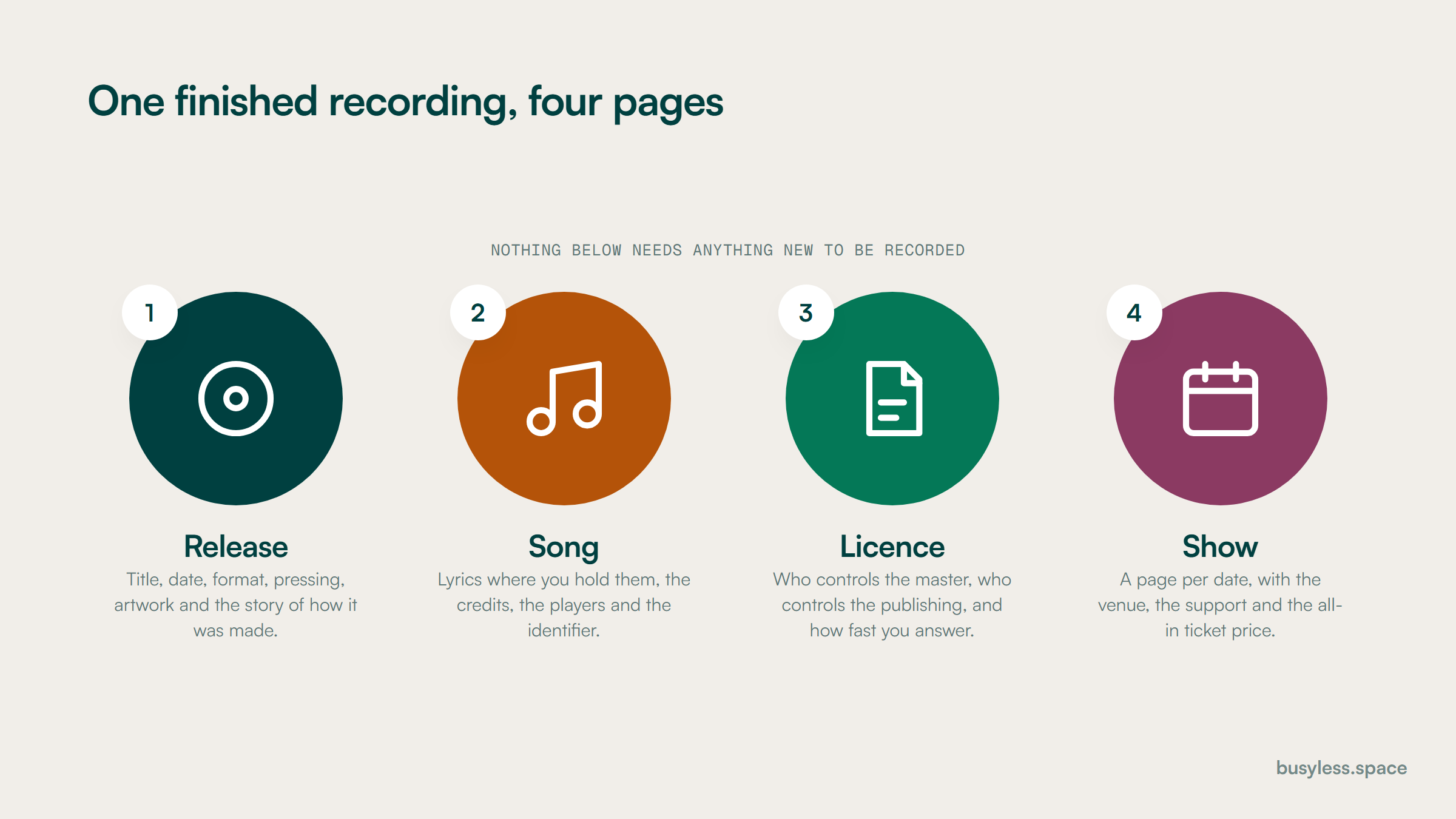
Four numbered steps turning one finished recording into a release page, a song page with credits, a licensing entry and a show page, each answering a different search.
None of these four requires anything new to be recorded. They require somebody to write down what already happened.

The expensive mistakes

Fighting the streaming platforms for your own name

Costs you Months of effort against results that are correct, while the queries with a budget attached stay unanswered

Concede the name, fix the entity behind it, and spend the time on hire, licensing and lessons

Buying streams or followers to look established

Costs you A per-track monthly penalty from the platform, removed plays, and conduct a federal rule prohibits with civil penalties attached

Spend the same money on one properly built hire page, which produces bookings rather than an appearance of them

Linking the whole catalogue out to the platforms

Costs you A domain containing no album titles, no track names and no credits, which cannot rank for a single thing you made

A page per release and per song, with the streaming buttons underneath rather than instead

Treating the tour widget as a dates page

Costs you The aggregator outranks you on your own tour, and the page that ranks cannot sell a shirt or a VIP package

Real pages per show, syndicated outwards to the aggregators rather than pulled in from them

Leaving the press kit in a cloud folder

Costs you A journalist on deadline meets a permission prompt, and nothing in the folder can be found, quoted or indexed

A press page with biographies, credited images and the rider, with the downloads underneath it

Reporting plays as the outcome

Costs you A number that rises while the bank balance does not, and a plan that keeps optimising for the least valuable thing you produce

Report bookings, licences and lessons as the outcome, and plays as context for them

What to measure

One correction fixes most reporting in this industry. Plays are an audience measure and not a revenue one, so they belong in the leading column with impressions, and the business column has to contain things that were invoiced.

Leading indicators

Move first. They predict, they do not prove.

  • Impressions on hire, licensing and lesson queries

    Search Console, filtered by cluster

    The clusters that pay. They are small enough to disappear inside a site-wide total, and they typically move within six weeks of the pages existing because so little else competes for them.

  • Knowledge panel accuracy

    A monthly check in a private browser window

    Not a number, and worth a line in the report anyway. Track whether the entity resolved is you, whether the discography is right and whether the similar-artist list has changed.

  • Artist profile followers and saves

    The streaming platforms' artist dashboards

    A better audience signal than plays because it is deliberate. It also predicts the response to a release far more reliably than the previous release's stream count did.

  • Show page views against tickets sold

    Analytics against the ticketing report

    The ratio matters more than either number. A page with traffic and no sales usually has a price problem or a fee surprise rather than an audience problem.

Business indicators

The ones a manager acts on.

  • Enquiries by type

    One question on the contact form

    Hire, licence, lesson, press. Four categories are enough, and six months of them usually shows the least glamorous page on the site paying for everything else.

  • Booking value and where it originated

    Your invoices set against the enquiry source

    The number that reorders the plan. One function booking is often worth more than a year of streaming income from the same catalogue, which is uncomfortable and useful.

  • Commission paid to booking marketplaces

    The marketplaces' own statements

    Track it as a line item rather than as a cost of sale, because it is the budget your own hire pages are competing to replace. Set a date to review whether the channel still earns it.

  • Teaching retention

    Your scheduling or invoicing

    Lessons are a subscription and behave like one. Average retained months against acquisition effort tells you whether that page deserves more of the budget, and it usually does.

The verdict

Music is the only business in this directory where the correct advice is to lose your own brand term on purpose. The platform that holds the recording is a better answer to your name than your website could ever be.

Conceding it frees up the interesting part. The searches with a budget behind them contain no artist name at all, and almost nobody working in music has written a page for any of them.

Which is the test to apply to anybody selling musician SEO services. A proposal built around ranking for your own name is describing a fight you should not be in, and one built around plays is measuring the least valuable thing you produce.

The better question for anyone offering SEO services for musicians is simpler. Ask which page they would build first, and whether the answer is one that could be invoiced.

FAQ

Musicians and artists SEO questions

  • Should we try to rank our website above Spotify for our own name?
    No, and the attempt is the most common waste of effort in this market. Somebody typing an artist name usually wants to hear the music, so a streaming service is the correct answer and has the authority to hold that position. Spend the effort on making sure the entity search engines resolve your name to is actually you, described correctly, with the right links attached.
  • What is the highest value page we could build?
    A hire page for whatever kind of work you would actually like more of. Those searches carry a date, a budget and a decision-maker, and at the moment a booking marketplace is taking a commission for making the introduction. Publish line-up options, real price bands, the set list and what you need from the venue, and the page will out-convert everything else on the site.
  • Is buying streams or followers really a problem?
    Yes, from two unrelated directions. Spotify has charged labels and distributors a monthly penalty per track for artificial streaming since April 2024, passed on to the artist, and removes the plays from reporting. Separately, the FTC rule at 16 CFR part 465, effective October 2024, prohibits buying fake indicators of social media influence and carries civil penalties.
  • How do we get into the artists similar to results?
    Not through your own website, which is worth knowing before anybody sells you the attempt. That result set is assembled from playlists, editorial coverage and listening behaviour. The realistic route is coverage by the outlets that already write about acts adjacent to you, which is a public relations job. Build the list of those outlets and treat it as an asset.
  • Do we need a page for every song?
    Eventually, and start with the ones that earn rather than the ones you like. Export your distributor's report, sort it by revenue rather than by plays, and work down that list. Each page wants the credits, the personnel, the story and the lyrics where you control them, because those are the things a licensing researcher and an answer engine both look for.
  • Can we publish our lyrics if a lyric site already has them?
    Where you control the publishing, yes, and it is worth doing even though you will not outrank the aggregator. Your page can carry the story, the credits and the meaning alongside the words, which is what gets quoted when somebody asks what a song is about. Verify on the lyric platform as well, so the annotations there are yours rather than a guess.
  • Do we have to show ticket fees on our own tour page?
    Show the all-in total wherever you show a price. The FTC rule on unfair or deceptive fees has covered live-event tickets since 12 May 2025 and requires the total, including mandatory charges, to be disclosed clearly and prominently. Where your ticketing partner sets the fees, ask them for the total and publish that rather than the face value.
  • What does musician SEO cost?
    The tiers above are editorial estimates rather than quotes, and this is the cheapest playbook in the directory. A realistic range is $0 to $2,500 a month, and the bottom of that is not a joke: the entity work, the hire page and the release pages are all free if you write them yourself, and they are most of the value.

Run it yourself, or have someone own it

Everything above is written to be run without us, and the free path is genuinely most of the value for a single-location business. Where these plans stall is almost never the plan. It is that nobody owns it after the first month. That is the job we do, with search as one distribution layer inside a wider system rather than the whole engagement.