Written by Eugene Suslov·Last reviewed 29 August 2026·No affiliate links
Sector
Business services
Model
National service, Local service
Competition
Brutal
Time to results
6 to 15 months
Typical monthly
$1,000 to $8,000
Key takeaways
1Everyone you are competing against does this for a living, which means the execution floor is higher here than in any other market and a merely competent page ranks nowhere.
2The results page for your best commercial query is your competitors' content marketing. Getting onto it means being listed by a rival, so the realistic play is a niche narrow enough that few rivals exist.
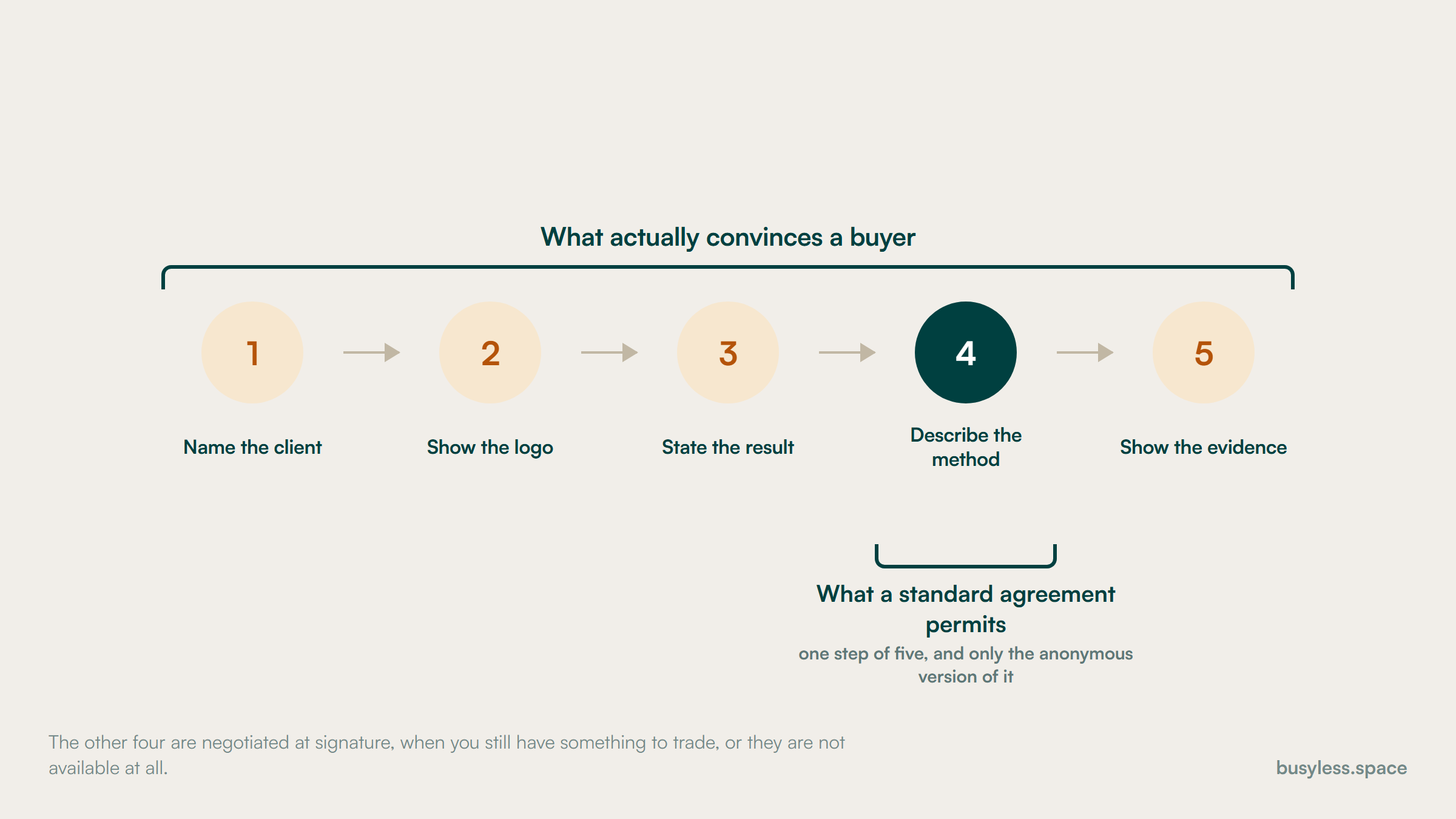
3Your strongest proof is usually the thing a client contract stops you publishing. Solve that at the point of signature, not at the point of writing the case study.
4The founder outranks the agency. Search resolves to people faster than it resolves to firms, and a named person with a body of work is a more durable asset than a brand page.
5Publish your prices, or at least your ranges. It is the largest unanswered query in the category and refusing it is the reason so many enquiries arrive from buyers you would never have taken.
SEO for marketing agencies is unlike anything else in this directory for one reason. Every competitor on the results page does this professionally, so nothing merely competent will rank and no easy technical win is sitting unclaimed.
Look at what actually returns for the phrase a buyer would use. Search for the best agency in almost any specialism and the first page is a stack of listicles, nearly all of them published by other agencies as content marketing.
Getting onto that page therefore means persuading a competitor to include you. It is not impossible, and it is a strange enough proposition that most firms never try it and quietly pretend the query does not exist.
Underneath that sits a proof problem that shapes everything. A marketing agency SEO strategy runs on evidence, and the best evidence you have is usually covered by a confidentiality clause somebody signed without reading it.
Meanwhile the directories that do rank are largely paid for by the agencies listed on them rather than by the buyers reading them, which is worth knowing before you treat a placement as third-party validation.
What is left is narrower and better than it sounds. A specific niche, publishable evidence, real prices and a named human being who is visibly good at the work is a position almost no agency occupies, because all four are uncomfortable.
Who already ranks in marketing agencies
Run the search a buyer would actually run, then read who wrote each result. Any honest marketing agency SEO review starts there, and the finding is consistent: the commercial head terms are held by competitors' listicles and by directories funded by the firms they rank.
What is on the results page
Best-of listicles on nearly every commercial query, written by other agencies
Review platforms with category leader grids and sponsored positions
Local pack on service plus city queries, which is where small agencies can win
People Also Ask, dense on cost, in-house comparison and how to choose
Personal profiles and newsletters ranking for practitioner-level questions
Job boards competing for your own brand name plus the word careers
Competitor listicles
example-agency.com
The largest and least discussed gatekeeper in this market. Most best-of results are content marketing by firms you compete with, which means placement is an outreach problem rather than an SEO one. It is worth asking. The firms that publish them need credible names on the list, and a genuinely non-overlapping specialism is the version of you they can afford to include.
Clutch
clutch.coClaim it
Ranks well and carries genuine verified reviews, which is the part worth having. It also sells sponsorship and gates parts of visibility behind paid plans, so a high position is not purely earned. Invest in the reviews, which travel, and be sceptical of paying for placement, which does not.
DesignRush, UpCity, Sortlist and the rest
designrush.comClaim it
Variations of the same model: agencies pay for verified status or featured placement, and the platform's revenue comes from the firms being ranked rather than from the buyers reading the ranking. Useful as citations and occasionally as leads. Not useful as evidence of quality, and buyers increasingly know it.
G2 and software review platforms
g2.comClaim it
Increasingly ranking for service categories as well as software, and unusually valuable because the reviews are verified and attached to real reviewers. If you sell into a category with a G2 presence, this is the review asset most worth building, and the one competitors find hardest to fake.
Platform partner directories
partners.google.comClaim it
HubSpot, Google, Shopify, Klaviyo and most large platforms publish partner directories with filters buyers actually use. Placement depends on certification and on spend or revenue thresholds rather than on content, and the listings are frequently half-completed. Cheap, credible and unglamorous.
Practitioner communities and newsletters
reddit.com
Where buyers ask for recommendations in private, and where the answer is a person rather than a firm. It is not addressable through search and it is heavily influenced by whether your founder is visible and useful. That is the honest reason founder-led content matters more here than the tactic itself suggests.
Job boards and employer review sites
glassdoor.comClaim it
They rank for your brand name, and prospective clients read them as well as prospective staff. An agency with a poor employer reputation is being read that way by buyers who are about to hand you a retainer, which makes this a commercial page whether you treat it as one or not.
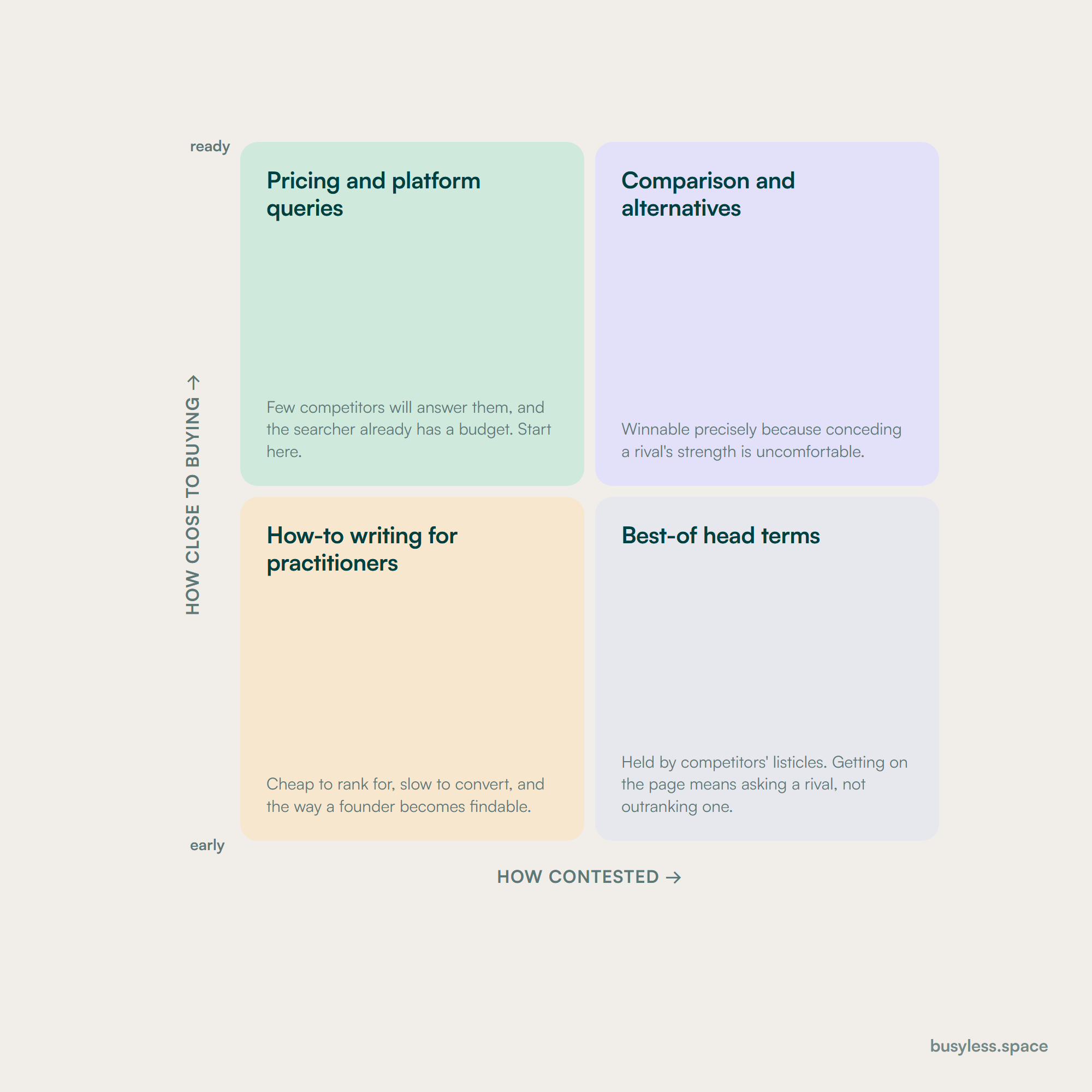
The bottom-right quadrant is where most of this industry's own budget goes, which is the whole finding.
What people actually search
Agency demand splits into a head term the listicles own, a set of comparison queries that are genuinely winnable, and one enormous cluster the entire industry has agreed not to answer.
Best-of and category head terms
Commercial investigation
> best [specialism] agency
The page that wins it:Placement on somebody else's list, plus your own honest version
Held by competitors' content. Your own list is worth publishing anyway, provided it names firms you would genuinely recommend, including for the work you do not want.
Service plus place
Local commercial
> [service] agency [city]
The page that wins it:A real page for the city you actually operate in
Lower volume and far more winnable, because the listicles are national and the local pack is available. Only worth it where you have a genuine presence, since the alternative is a hundred templated city pages.
Pricing
Commercial investigation
> how much does [service] cost
The page that wins it:A pricing page with real ranges and the reasons they vary
The largest cluster in the category and the one the whole industry refuses to answer. Publishing ranges filters the enquiries you did not want and reaches the buyer building a budget, who is the buyer worth having.
Comparison and alternatives
Commercial investigation
> [competitor] alternatives
The page that wins it:An honest comparison that concedes where the competitor is better
Genuinely winnable and uncomfortable, which is why it stays winnable. The version that says a rival is the right answer for a particular buyer is the version the reader believes about everything else on the page.
Model comparison
Commercial investigation
> agency vs in-house vs freelancer
The page that wins it:A costed comparison including the case for not hiring you
The buyer's actual first question, asked before any brand is in the frame. An answer that recommends in-house for the reader who genuinely needs it earns more trust than any case study.
Platform and certification
Commercial investigation
> certified [platform] partner [city]
The page that wins it:A page per platform you are genuinely certified in
High intent, low competition, and the buyer has already chosen the technology. Only claim what you currently hold, because badge status is checkable in the platform's own directory.
How to do the work
Informational
> how to [specific task in your specialism]
The page that wins it:Genuinely useful writing under a named author
Reaches practitioners rather than buyers, which sounds wrong and is not. Practitioners become buyers, recommend firms in private communities, and are the audience that builds a founder's entity.
Talent
Transactional
> [specialism] jobs [city]
The page that wins it:Real role pages, and an employer page worth reading
Agencies compete for people as hard as for clients, and the same buyers read your employer reviews. Treat the careers section as commercial content rather than as a form.
What the rules change
No sector regulator here, and two ordinary advertising rules land hard anyway, because the strongest proof an agency has is a performance claim about somebody else's business. Check your own contracts and your own counsel; none of this is legal advice.
1
A case study result is an advertising claim
Section 5 of the FTC Act on deceptive practices, together with the Guides Concerning the Use of Endorsements and Testimonials in Advertising, revised effective 26 July 2023
What it means
A number in a case study is a performance claim about what a prospective client can expect, and it needs substantiation like any other. Where a result is not what a typical client achieves, presenting it as representative is the problem the guides address. Client testimonials describing outcomes carry the same requirement, and a quotation does not transfer the obligation to the person quoted.
So do this
Keep the working behind every published number: the measurement window, the baseline, what else changed, and who confirmed it. Say what is typical beside what is exceptional. An honest range is more persuasive to a serious buyer than an outlier anyway, because a serious buyer has read a hundred outliers.
2
A partner badge is a claim about a status you currently hold
The terms of the platform partner programmes themselves, and section 5 of the FTC Act where a lapsed badge is still displayed
What it means
Platform partner and certification badges are granted on conditions, usually a mix of examinations, managed spend or revenue, and account health, and they are revoked when the conditions stop being met. They are also verifiable in the platform's own public directory, which is where a diligent buyer will check rather than on your website.
So do this
Keep a register of every badge with its awarding platform, the date it was granted and the date it expires, and remove anything lapsed the week it lapses. Link each one to your own entry in the platform's directory, which turns a logo into something checkable.
3
What you may publish about a client was decided at signature
Your own client agreements: confidentiality clauses, logo usage rights and case study approval terms
What it means
The evidence that would convert a prospect is usually the evidence a contract forbids: the client's name, their numbers, their screenshots. Most agencies discover this while writing the case study, long after the leverage to negotiate it has gone, and end up publishing something anonymous and unconvincing instead.
So do this
Put a marketing clause in the standard agreement: the right to name the client, use the logo, and publish agreed metrics after a stated period, with an approval process attached. Negotiate it during the sale, when you have something to trade. Then keep a record of exactly what each client approved.
4
Client data in a public case study is still client data
Your data processing agreements, and state privacy laws that treat an agency handling client customer data as a processor or service provider
What it means
Analytics screenshots, dashboards, keyword lists and customer counts frequently contain more than intended: sample paths with identifiers, account names, revenue the client would not want public, and occasionally data belonging to their customers rather than to them. A processing agreement usually limits what may be disclosed regardless of what marketing has approved.
So do this
Redact and rebuild rather than screenshot. Publish a chart you produced from an exported figure, with the axis labelled and the period stated, instead of a photograph of somebody's dashboard. Get sign-off from the person who owns the data rather than only from the marketing contact.
The narrow bracket widens during the sale or it does not widen at all.
Proving expertise
Expertise is the product here, so the usual signals are table stakes and the differentiating ones are all uncomfortable: what you charge, what you refuse, and who specifically will do the work.
The people who will actually work on the account, named, with their own histories
Prices or ranges, published, with the variables that move them
Work you turn down, and the reasoning behind it
Results with the method, the window and the baseline stated, not headline multiples
Clients named where the contract allows, and the contract negotiated so it usually does
Certifications linked to your entry in the awarding platform's directory
Writing under named authors with real profiles, not published by the agency as an entity
An honest account of an engagement that did not work, and what changed afterwards
How to build a marketing agency SEO strategy
Twelve months, because this is a slow market and anybody promising faster is selling to somebody who has not run an agency. The first phase of a marketing agency SEO strategy is mostly positioning and contract work, and neither produces a single page.
1
Weeks 1 to 6
Narrow the position and fix the contract
Decide the niche you can credibly be the obvious choice for, and write it down
Add a marketing clause to the standard client agreement
Go back to your three best past clients and ask for publication rights
Audit every badge and certification against the awarding platform's directory
Assign a named owner and a fixed weekly slot for the agency's own marketing
Decide whether you will publish prices, and what the ranges are
You end up with A position you can defend and the right to publish the proof you already have
2
Weeks 4 to 14
Publish the evidence and the prices
Rebuild case studies as public pages with method, window and baseline
Remove the gate from anything a buyer needs in order to shortlist you
Publish the pricing page with real ranges and what moves them
Write the agency versus in-house versus freelance comparison, costed
Build a page per platform you are genuinely certified in
Set up author profiles so writing is attributed to people, not to the firm
You end up with Everything a buyer needs to shortlist you, visible without a form
3
Weeks 10 to 30
Build the founder as the entity
Publish practitioner-level writing under a named author, on a schedule
Take the comparison and alternatives queries honestly
Get onto the listicles that rank, by asking the firms that publish them
Complete every platform partner directory listing properly
Build the review base on the platforms with verified reviews
Make the careers section something a client would also read
You end up with A named human with a visible body of work, which is what buyers search for
4
Months 6 to 12
Measure the pipeline, not the traffic
Track qualified enquiries rather than form fills
Track which pages appear in the path of the deals you actually won
Track close rate and average contract value by source
Track how many enquiries you declined, and why
Report the time your own team spent on your own marketing
Review whether the niche is producing better-fitting work, not just more
You end up with Evidence about fit and margin rather than about volume
Technical fixes with the best payoff
Agency websites fail in a particular and slightly embarrassing way. They contain the exact mistakes the agency is paid to fix elsewhere, for the ordinary reason that internal work is done by whoever happens to be free.
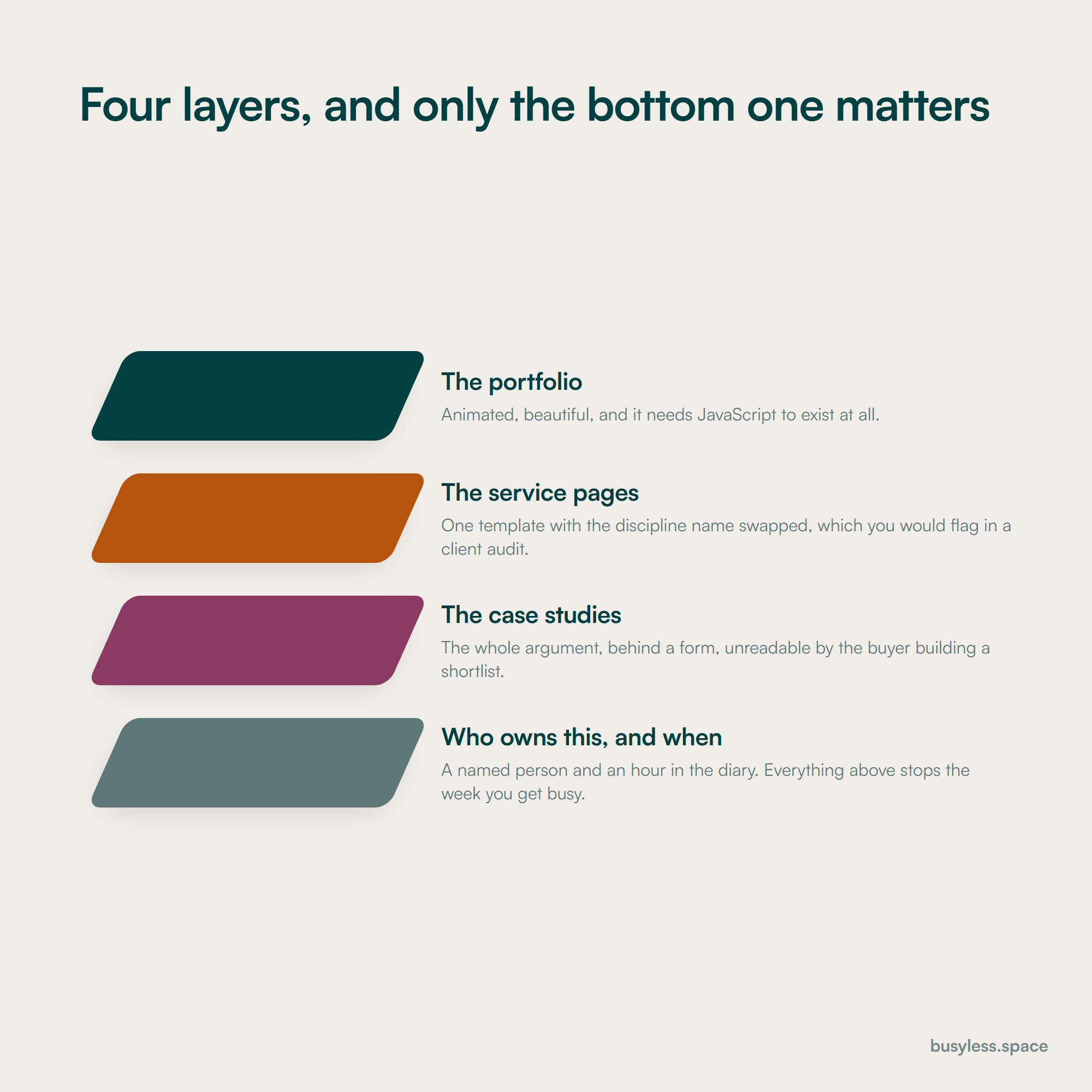
The case studies are behind a form
An afternoon per case study
The proof is the whole argument, and gating it means a buyer building a shortlist cannot read it, a search engine cannot index it, and a language model summarising the market has nothing to quote. The form was added to capture leads and it prevents the evaluation that produces them.
Publish them. Full method, timeline, what changed, what did not work. If a lead magnet is wanted, gate a template or a tool rather than the evidence somebody needs in order to consider you at all.
Every service page is the same page
A day per service
Agencies build service pages from one template with the discipline name swapped, which is precisely the practice they would flag in a client audit. It produces a set of interchangeable pages, none of which demonstrates the expertise the page is claiming.
One page per service you genuinely lead with, written by whoever runs that practice. What you actually do, what the first ninety days look like, what it costs, who does it, and which clients it is wrong for. Delete the services you would not really take.
Nobody owns the agency's own marketing
A decision, then permanently
Internal work is allocated to whoever is on the bench, so it stops the moment the team is busy and restarts when it is not. That produces a publishing pattern that stops for a quarter, resumes with an apology post, and never accumulates.
A named owner and a fixed, defended slot in the week, booked like a client's. Then track hours spent on it in the same system you track client hours, because what is not tracked is what gets given away first.
The site is redesigned every eighteen months and loses its URLs
A sprint, at every redesign
Agencies rebrand, and a rebrand usually means a new site, a new structure and a redirect map written on the last day. Whatever ranking equity had accumulated resets, which is why so many agency domains have a good age and nothing to show for it.
Treat your own migration with the discipline you would sell: a full URL inventory, a mapped redirect for everything with links or traffic, and a post-launch crawl. Keep the article URLs stable across redesigns even if everything visual changes.
Articles are published by the agency rather than by a person
A day, then per article
Writing appears under the company name or under Team, so there is no author entity, no profile, no history and nothing for a search engine or an assistant to attach expertise to. Meanwhile buyers are searching for named practitioners.
Real author profiles with a bio, a photograph, links to their own accounts and a list of what they have written, referenced from every article. If a piece was ghostwritten for a founder, that is normal, and the byline should still be a real accountable person.
The portfolio needs JavaScript to exist
A sprint
Agency sites are built as showcases, so the work is often loaded by a script into an animated grid. The pages are then slow, sometimes uncrawlable, and the case study a buyer wanted to read is three interactions deep with no URL of its own.
Give every piece of work its own URL, rendered server-side, with the text present in the source. Keep the animation on top of real pages rather than instead of them. Then check it in a text-only view, which is what most machines reading your site will see.
The blog is a decaying pile of trends posts
A sprint, then quarterly
Predictions and trends articles are easy to commission and worthless within a year, so the archive fills with dated content that ranks for nothing and, worse, makes the whole domain look abandoned in the years nobody updated it.
Delete or consolidate anything with a year in the title that has passed. Keep and update the pieces that answer a durable question. Fewer, better, maintained, with a review date on each one and somebody responsible for it.
The three upper plates are design decisions. The bottom one is an entry in somebody's diary.
Structured data that applies here
The types below fit this industry specifically. Most of them earn no rich result on their own, which is worth knowing before anyone sells the work on that basis. What they do is describe the entity precisely, which matters for how search engines and answer engines resolve who you are.
ProfessionalService
Home page and any genuine office location
The type that describes an agency without overclaiming. Fill priceRange honestly if you publish prices, and areaServed with the places you actually work rather than every city you would accept a call from.
Team pages, referenced from every article they wrote
The most valuable node on an agency site, because search resolves to people faster than to firms and buyers ask communities for a person rather than a company. Fill sameAs with the profiles they actually use.
Person for the founder and the practitioners.jsonld
{
  "@context": "https://schema.org",
  "@type": "Person",
  "@id": "https://[YOUR-DOMAIN]/team/[SLUG]#person",
  "name": "[FIRST LAST]",
  "jobTitle": "[Founder / Head of [PRACTICE]]",
  "url": "https://[YOUR-DOMAIN]/team/[SLUG]",
  "image": "https://[YOUR-DOMAIN]/team/[SLUG].jpg",
  "description": "[What they have actually done, with specifics and years.]",
  "worksFor": { "@id": "https://[YOUR-DOMAIN]/#agency" },
  "knowsAbout": ["[SPECIALISM]", "[SPECIALISM]"],
  "sameAs": [
    "https://www.linkedin.com/in/[HANDLE]",
    "https://x.com/[HANDLE]",
    "https://github.com/[HANDLE]"
  ],
  "hasCredential": [{
    "@type": "EducationalOccupationalCredential",
    "credentialCategory": "[CERTIFICATION]",
    "recognizedBy": { "@type": "Organization", "name": "[PLATFORM]" },
    "url": "[LINK TO YOUR ENTRY IN THEIR DIRECTORY]"
  }]
}
Article with a real author
Every published piece
The point is the author reference, not the Article node. An article attributed to the company builds nothing, because the entity a buyer is evaluating is a person. Reference the Person by id rather than restating a name.
Any genuine review you publish of software you use
The only honest review markup available to an agency. Marking up testimonials about yourself is self-serving, earns no rich result and is exactly the practice the review rules are aimed at. Reviewing the tools you use daily is credible, useful, and something buyers search for.
Review, of a tool rather than of yourself.jsonld
{
  "@context": "https://schema.org",
  "@type": "Review",
  "itemReviewed": {
    "@type": "SoftwareApplication",
    "name": "[TOOL NAME]",
    "applicationCategory": "[BusinessApplication]"
  },
  "author": { "@id": "https://[YOUR-DOMAIN]/team/[SLUG]#person" },
  "datePublished": "[YYYY-MM-DD]",
  "reviewBody": "[What you used it for, for how long, on what kind of account, and where it fell down.]",
  "reviewRating": {
    "@type": "Rating",
    "ratingValue": "[4]",
    "bestRating": "5",
    "worstRating": "1"
  },
  "publisher": { "@id": "https://[YOUR-DOMAIN]/#agency" }
}
FAQPage
The pricing page and the model comparison page
Cost and the in-house comparison are the two questions every buyer asks and the two the industry avoids. Answering them in markup is only worth doing because answering them on the page is worth doing.
FAQPage.jsonld
{
  "@context": "https://schema.org",
  "@type": "FAQPage",
  "mainEntity": [
    {
      "@type": "Question",
      "name": "[Question exactly as it appears on the page]",
      "acceptedAnswer": {
        "@type": "Answer",
        "text": "[Answer exactly as it appears. Give the real range, the real minimum and the real reason it varies.]"
      }
    }
  ]
}
BreadcrumbList
Service, case study and author pages
Worth adding once services, work and people are a real hierarchy. Building it is also a quick way to notice that the case studies live under a slug nobody could guess and the authors have no pages at all.
Editorial estimates rather than quotes, and unusual in this directory because most of the cost is your own team's time rather than a supplier's invoice. Price it at the rate you charge clients, or you will keep concluding it is free and keep not doing it.
Do it yourself
$0 to $500
A named owner and a defended weekly slot
Case studies unlocked and rewritten with method and window
Pricing ranges published
Author profiles created and articles reattributed
Platform partner directory listings completed
Who it suits
A small agency where the founder is willing to write and to defend the time
Where it stops
It stalls the first time the team gets busy, which is the failure mode of every internal marketing programme and the reason the named owner matters more than the budget.
Lean
$1,000 to $3,000
Regular founder-led writing, ghosted where necessary but honestly bylined
Comparison and alternatives pages built properly
The costed agency versus in-house comparison
Review base built on the platforms with verified reviews
The trends archive pruned and the survivors maintained
Who it suits
An established agency with a defined niche and a founder willing to be visible
Where it stops
It will not put you on competitors' listicles, which is relationship work, and it will not move a positioning that is still too broad to be memorable.
Funded
$3,000 to $8,000
Original research nobody else in your niche has published
A real page per service and per platform, written by practice leads
Systematic outreach for placement on the lists that rank
Reporting through to closed-won by source and by content path
The careers section built as commercial content
Who it suits
Agencies where a single new retainer justifies a year of the budget
Where it stops
Above this the constraint is delivery capacity and positioning rather than demand. If you cannot staff another account, more enquiries make the existing clients worse off.
How to do it with no budget
Everything on this list is free and most of it is uncomfortable, which is why it stays available. The first two items are decisions rather than tasks and they determine whether the rest is worth doing.
1
Narrow the position until it is almost too narrow
Half a day
An afternoon and an honest conversation
You cannot be the obvious answer to a broad query in a market where everybody is a professional marketer. You can be the obvious answer in a niche small enough that four firms compete, and that is a real position rather than a claim.
2
Add a marketing clause to the standard agreement
2 hours
Your contract template
The right to name the client, use the logo and publish agreed metrics after a stated period. Negotiated during the sale, when there is something to trade, rather than eighteen months later when there is not.
3
Unlock the case studies
1 hour
Your website editor
Remove the form. A buyer building a shortlist will not fill it in, a search engine cannot read what is behind it, and neither can the assistants increasingly doing the shortlisting.
4
Publish your prices, or your ranges
2 hours
Your website editor
The largest unanswered query in the category. It filters out the enquiries you would have declined and reaches the buyer assembling a budget, who is the one worth talking to.
5
Give every writer a real author profile
2 hours
Your website editor
Bio, photograph, links to their own accounts, and every article attributed to a person. Buyers search for practitioners, and an article published by a company builds no entity at all.
6
Audit every badge against the awarding directory
1 hour
The platform partner directories
Confirm each one is current and link to your own entry in the platform's directory. It converts a logo into something a buyer can verify, which is the only version of a badge that means anything.
7
Ask three firms to add you to their list
1 hour
Email
The listicles ranking for your money query are written by competitors who need credible names on them. A firm with a genuinely non-overlapping specialism is one they can afford to include, and almost nobody asks.
The tool stack
A short stack, because the constraints in this market are positioning, contracts and attention rather than tooling. The last two entries are the ones that decide whether anything ships. Most seo software for agencies is priced per seat and bought per client, which is the wrong shape. The best seo software for agencies is whichever one the team opens on a Monday.
Track the small number of terms that actually convert
Track pricing, comparison and platform queries rather than the head terms. The head terms belong to listicles you are not on, and reporting them monthly teaches everybody to ignore the report.
Free routeA spreadsheet and a fortnightly manual check
Find every list you could realistically be added to
Pull the ranking results for your commercial queries and note the publisher of each. The output is an outreach list, not a keyword list, which is the correct shape of answer in this market.
Free routeSearch the query and read who published each result
Work out what an ideal client is worth over the relationship
Sales Capacity Planning Calculator
Use average retained months and delivery margin, not first invoice. A badly fitting retainer at a good rate can be worth less than a smaller one that stays three years and refers.
Free routeFree
Cost your own marketing at your own rate
Content Marketing Cost Calculator
Internal work looks free and is the most expensive time in the building. Pricing it at the rate you bill clients is usually what finally gets it scheduled and defended.
Authors are first-class objects rather than a text field, which makes the author entity easy to keep consistent across the site and the markup. It also makes a newsletter the same asset as the blog.
Free routeSelf-host it
Verify every badge in the place a buyer would
The platform partner directories
Check your own entry exists, is complete and shows the status you claim. Half-completed partner listings are among the most common unclaimed assets in this industry.
Free routeFree
Report to closed-won rather than to form fills
Your CRM
Enquiry volume is the least useful number an agency can report about itself. Close rate and average contract value by source is the one that tells you whether the positioning is working.
Free routeAlready paid for, and usually not connected to the website
Track hours spent on your own marketing
Your time tracking system
Not a marketing tool and the reason most agency programmes fail. Internal hours are the first thing surrendered to a client emergency, and what is not recorded is not defended.
Free routeAlready paid for
Take it from here
Everything below is yours to take. Fill the [BRACKETS] and it is ready to use. Start with the positioning test, because every other item here gets easier once the niche is narrow enough to be worth defending.
Brief
You cannot be the obvious answer to a broad query in a market where everyone is a professional marketer. This finds a niche small enough to own.
POSITIONING TEST - [AGENCY] - [DATE]

THE PROBLEM
Every competitor on the results page does marketing for a
living. There is no easy technical win sitting unclaimed and no
content gap nobody noticed. The only durable position is one
where very few firms are credible, which means narrower than is
comfortable.

1. HOW WE DESCRIBE OURSELVES NOW
   "[_______________________________________________]"
   Word count: [__]
   Could a competitor use the same sentence?  [ Y / N ]
   If yes, it is not a position.

2. THE NARROWING QUESTIONS
   Answer each with something specific.
   Industry we are genuinely best at:     [_____________]
   Company stage or size:                 [_____________]
   The single problem we solve:           [_____________]
   The channel or discipline we lead with:[_____________]
   The thing we do that others do not:    [_____________]
   Who we would refuse:                   [_____________]

3. THE FOUR-FIRM TEST
   Write the search a buyer in that niche would use:
   "[_______________________________________________]"
   Run it. How many genuine specialist competitors?  [__]
   0-2   : too narrow, there may be no demand
   3-6   : the target
   7-15  : narrow further
   16+   : this is a head term, not a position

4. THE EVIDENCE TEST
   [ ] We have at least [3] engagements in this niche
   [ ] We can name the specific outcomes
   [ ] We have publication rights for at least one
   [ ] Someone here can write about it credibly
   [ ] We would decline work outside it

   If any of those is no, the position is aspiration.

5. WHAT WE GIVE UP
   Revenue currently from outside the niche:  [___]%
   Are we willing to let that decline?        [ Y / N ]
   Over what period:                          [_______]
   A position nobody is willing to lose money for is a slogan.

6. THE SENTENCE
   "[AGENCY] is the [SPECIALISM] partner for [WHO],
    who need [PROBLEM]. We do not do [WHAT WE REFUSE]."
   [ ] It appears on the home page, in those words
   [ ] Everyone here can say it from memory
What to publish
The only durable advantage available here is being specific about things other firms keep vague. Everybody can write well, so writing well is not the differentiator; disclosure is.
Public case studies with the method shown
One per engagement worth writing up, published within the quarter
The evidence a buyer needs to shortlist you, and the thing most agencies hide behind a form. Method, window and baseline matter more than the headline number.
The pricing page
Once, reviewed when rates change
The largest unanswered query in the category. Ranges with the variables named filter the enquiries you would have declined anyway.
The agency versus in-house versus freelance comparison
Once, refreshed yearly with current salary data
The buyer's real first question. Recommending in-house to the reader who genuinely needs it is what makes the rest of the page credible.
Honest competitor comparisons
One per genuine competitor, reviewed yearly
Winnable because they are uncomfortable. Conceding where a rival is better is the reason a reader believes the rest.
Practitioner-level writing under a named author
Weekly or fortnightly, sustained, by a named person
Reaches the people who recommend firms in private, and builds the entity buyers are actually searching for.
Original research in your niche
Once or twice a year, properly
The one asset competitors cannot replicate by writing better. It also earns the links that everything else on this list does not.
And what not to
Case studies gated behind a form
Service pages built from one template with the discipline name swapped
Trends and predictions posts with a year in the title
Articles published under the company name with no author entity
Headline result multiples with no method, window or baseline
Testimonial markup about your own agency, which earns nothing and invites scrutiny
A partner badge you no longer hold
Screenshots of a client dashboard, however carefully cropped
Drawn at the width the default agreement produces, which is the one most agencies signed without reading.
The expensive mistakes
Competing on the broad head term
Costs you Years spent against listicles you are not on, in a market where every rival does this professionally
Narrow the niche until four firms compete, then be the obvious answer inside it
Discovering the NDA while writing the case study
Costs you Anonymous, unconvincing proof, published eighteen months after the leverage to negotiate had gone
A marketing clause in the standard agreement, negotiated during the sale
Gating the evidence
Costs you A buyer building a shortlist moves on, and nothing that would have persuaded them is indexable
Publish the case studies and gate a template or a tool instead
Publishing under the company name
Costs you No author entity, no accumulating expertise, and none of it reaching buyers who search for people
Real author profiles, referenced from every article and from the markup
Leaving internal marketing to whoever is free
Costs you A publishing pattern that stops every time the agency is busy, which is every time it matters
A named owner, a defended weekly slot, and hours tracked like a client's
Refusing to publish a price
Costs you Enquiries from buyers who were never going to afford you, and none from the ones building a budget
Ranges with the variables named, and a stated minimum engagement
What to measure
Volume is close to useless here. An agency with ten enquiries and three good ones is in better shape than one with fifty, and the metrics below are chosen to tell those two situations apart. Seo reporting for agencies is a retention problem more than a measurement one, and most seo reporting tools for agencies are sold on that basis.
Leading indicators
Move first. They predict, they do not prove.
Position on pricing, comparison and platform queries
Rank tracking, restricted to terms that convert
Deliberately excludes the broad head terms. Those are held by listicles you are not on, and reporting them monthly trains everybody to stop reading the report.
Branded search volume for the founder's name
Search Console, filtered to the person
The clearest measure of whether founder-led work is accumulating. It usually moves before the agency's own brand volume does, which is the point.
Case studies published and ungated
A count
Trivial to measure and closely tied to close rate. It also quietly measures whether the contract change in phase one actually happened.
Placements on lists that rank
Manual tracking of the outreach list
The only realistic route onto the commercial head terms. A count of asks made and placements won is a more honest report line than a position you cannot influence.
Business indicators
The ones a manager acts on.
Qualified enquiries
CRM, with an agreed definition of qualified
Agree the definition before reporting it, in writing. Half the disagreements about agency marketing are really disagreements about what counts as a lead.
Close rate and contract value by source
CRM
The number that tells you whether the niche is working. A narrower position usually produces fewer enquiries with a much higher close rate, and only this line makes that visible.
Enquiries declined, and why
CRM, with a required reason field
Reported deliberately. If the positioning is working, the proportion of enquiries you turn down should fall, and the reasons should change from wrong fit to wrong timing.
Hours spent on your own marketing
Time tracking
An operations number in the marketing report. When it drops to zero for a quarter, that explains the results two quarters later, and no other line will.
The verdict
Agencies face the hardest version of this problem in the directory, because every rival is professionally good at it and the best commercial queries are held by their content rather than by anything you can outrank. Accepting that early saves years.
What remains is genuinely available and almost nobody takes it. A niche narrow enough to be memorable, evidence you have the contractual right to publish, prices in the open, and a named person whose work is visible.
I should say plainly where this is written from. busyless is not an agency and does not sell marketing agency SEO services, so nothing here is a pitch, and the advice is the same advice I would give about any market where the buyer knows more than average.
The uncomfortable items on this page are the whole strategy. Publishing a price, conceding that a competitor is better for a certain buyer, and negotiating publication rights before the work starts are the three things that separate an agency people can evaluate from one that merely offers SEO services for marketing agencies to somebody else.
FAQ
Marketing agencies SEO questions
Why can we not rank for best marketing agency?+
Because those results are almost entirely listicles published by other agencies as their own content marketing, and a listicle will usually beat a single firm's page for a best-of query. Getting onto that results page means being included by a competitor rather than outranking them. The practical response is to narrow the niche until only a handful of specialists are credible.
Are the agency directories worth paying for?+
The reviews are worth building; the placement usually is not. These platforms earn their revenue from the firms being ranked rather than from the buyers reading the rankings, and sophisticated buyers know it. Invest in verified reviews, which travel with you and get quoted elsewhere, and treat a paid position as advertising rather than as third-party validation.
Our clients will not let us publish results. What can we do?+
Fix it at signature rather than at publication. Put a marketing clause in the standard agreement giving you the right to name the client, use the logo and publish agreed metrics after a stated period, and negotiate it during the sale while you still have something to trade. Then go back to your three best past clients and simply ask, because most agencies never do.
Should an agency publish its fees?+
Publish ranges with the variables that move them, and a minimum engagement. It is the largest unanswered cluster in this category, and refusing it is why so many enquiries arrive from buyers with no budget in mind. The paragraph saying who you are too expensive for is the most valuable one on the page, because it earns trust from everybody it does not exclude.
Should content go under the founder or the agency?+
Under named people, always. Search resolves to individuals faster than to firms, buyers ask communities for a person rather than a company, and an article published under a company name builds no author entity at all. Ghostwriting for a founder is normal and fine; the byline should still be a real, accountable human with a profile and a history.
How long does this take?+
Six to fifteen months before it contributes meaningfully, and anybody promising faster has not run an agency. The market is slow because the decision is high-value and relationship-led, and because the first six weeks of real work produce positioning and contract changes rather than pages. What moves earlier is close rate, once the evidence is public and the prices are visible.
Can we mark up our client testimonials as reviews?+
You can, and it earns you nothing. Reviews about a business collected on that business's own site are self-serving, so they do not produce rich results, and they invite scrutiny under rules aimed at exactly that practice. The honest review markup available to an agency is a review of software you actually use, which buyers search for and competitors rarely publish.
What does marketing agency SEO cost?+
The tiers above are editorial estimates rather than quotes, and the largest cost is your own team's time rather than a supplier's invoice. Price those hours at the rate you bill clients, or you will keep concluding the work is free and keep giving it away to the first client emergency. A real programme sits at roughly $1,000 to $8,000 a month.
Should we resell rather than build the capability?+
It depends what you are selling. White label seo for agencies works when the client relationship is yours and the delivery is genuinely commodity. White label seo services for agencies stop working the moment a client asks something only the person who did the work can answer, which on this kind of account happens early.
What tooling should an agency actually pay for?+
Less than the market assumes. Seo tools for agencies multiply by client count, so an seo platform for agencies is worth it only when you can name the report it replaces. The best seo tools for agencies are the two everybody uses; the rest get bought to look thorough in a pitch.
Job boards own the candidate side, so the money is on the other one
Two-sided, with one side already lost. The job boards own candidate search, so the winnable half is the employer, who searches rarely and buys on proof rather than on ranking.
Review platforms own the commercial terms you most want
Review platforms hold the commercial head terms, every competitor publishes comparison pages about every other competitor, and the bottom of the funnel is a finite set of queries that forty companies are already fighting over.
Where it comes from
Comparison and alternatives pages, integrations, product-led content
A buying committee searches separately, months apart, for different things
The only buyer in this directory that is plural. Six to ten people search separately over months, the query that closes the deal is searched forty times, and the form fill happens after the decision rather than before it.
Where it comes from
Problem and evaluation content, comparison pages, review sites
Time to results
9 to 18 months, and the first real signal is not a lead
Everything above is written to be run without us, and the free path is genuinely most of the value for a single-location business. Where these plans stall is almost never the plan. It is that nobody owns it after the first month. That is the job we do, with search as one distribution layer inside a wider system rather than the whole engagement.