
Exa API review
Best for semantic discovery
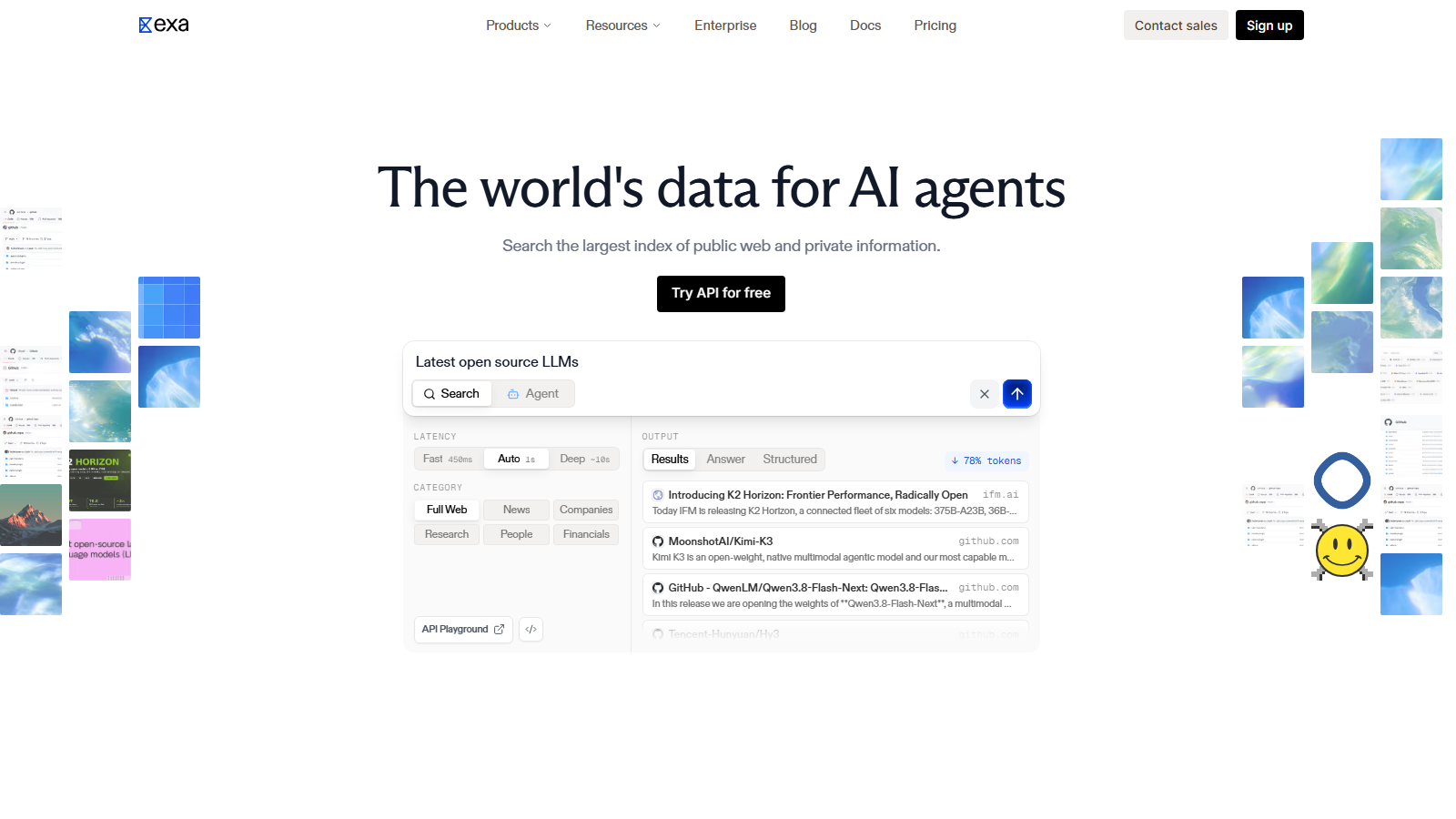
Exa states that it builds and runs its own search index instead of relaying another engine's results, and everything on this page follows from that. It dates the work to 2021, and its May 2026 funding post puts its crawlers at over 500 billion tracked URLs. Alongside the general web index, its documentation lists vertical indexes of more than 1 billion people, 50 million companies and 350 million scholarly publications.
That makes Exa a different instrument from a SERP API. Serper and SerpApi report what Google shows. Exa returns what its own retrieval models judge relevant, so the two disagree by design and position tracking is impossible here. What it offers instead is meaning-based discovery, readable content for every result in the same call, and filters for domain, published date, category and user country.
The bill is driven by results rather than searches. A request returning up to ten results with text and highlights costs $0.007, because Exa folded contents into the base price in March 2026. Ask for 50 results and that request costs $0.047; ask for 100 and it costs $0.097. Set numResults deliberately, and note that the free $10 a month covers roughly 1,400 ten-result searches.
Our scorecard
Our editorial read across six dimensions, scored 1 to 5. This is our own assessment, not an aggregate of user reviews, and it is deliberately kept out of the page's structured data.
- Data coverage4/5
A proprietary web index with people, company and publication verticals. Not Google, no positions, and freshness depends on Exa's own crawl.
- Pricing4/5
Plain dollar rates with contents bundled for ten results. Result count multiplies the cost quickly, and the monthly free credit is modest.
- Documentation4/5
An OpenAPI spec, Markdown docs and a dated changelog. The rate-limit page and the pricing page quote different search limits.
- Ease of integration5/5
Python and JavaScript SDKs, an official MCP server and a dashboard flow that generates integration code for your stack.
- Reliability3/5
SOC 2 Type II, but the surface keeps moving: /research was retired in April 2026 and /findSimilar is now flagged deprecated.
- Support3/5
Standard email support on pay as you go. A dedicated Slack channel and SLAs come with Enterprise.
An editorial read, not an aggregate of user reviews, and deliberately kept out of this page's structured data.
Exa API in their own words
From Exa API's own YouTube channel. Vendor marketing rather than an independent review, included because it is the quickest way to see the product before you sign up.
What you can pull
Search (instant, fast, auto)
$7 per 1,000 requests, plus $1 per 1,000 results above ten
Up to 100 results from Exa's index, each with text, highlights or a summary, filterable by domain, published date, category and user country
Deep search (deep-lite, deep, deep-reasoning)
$12 per 1,000 (deep-lite, deep), $15 (deep-reasoning)
Multi-step searches that synthesise across sources and return structured output with field-level citations, in roughly 4 to 40 seconds
Contents
$1 per 1,000 pages, per content type
Full text, highlights or summaries for up to 100 known URLs a request, with freshness control and crawling of linked subpages
Answer
$5 per 1,000 requests
An LLM answer or cited summary built from an Exa search, optionally as JSON matching a schema
Monitors
$15 per 1,000 requests
Scheduled searches on an interval of at least an hour, delivering only new results to a webhook
Agent
$0.012 to $1.00 per fixed-effort run, or metered
Asynchronous research, list-building and enrichment runs with structured, cited output and optional partner data through Exa Connect
Websets
Separate plans from $49 a month
Lists of companies, people or documents that match stated criteria, with enrichment columns, from the dashboard or the API
Find similar (legacy)
Not listed
Pages similar to a given URL. Flagged deprecated in the current OpenAPI spec and missing from the pricing page
Who Exa API is for
Teams whose problem is finding the right pages rather than checking a ranking. Content researchers collecting every substantive article on a topic, analysts building lists of companies or publications, and agents that need readable context for each result all fit the design. The people, company and publication indexes put prospect and literature research a single category parameter away.
SEO measurement is where it disappoints. Exa's results are its own judgement rather than Google's, so rank tracking, SERP feature monitoring and share-of-voice reporting need a SERP API. Anyone who wants many results per query should model the per-result charge first, and anyone who needs same-day freshness on fast-changing pages should test live crawling on their own targets.
Strengths and limits
What it does well
- Its own index and retrieval models, so results are not a relay of one search engine and can surface pages a keyword query misses.
- Text and highlights for the first ten results are inside the $7 base price, so discovery and retrieval happen in one call.
- Vertical indexes for people, companies and 350 million publications, each reached with a single category parameter.
- Latency is a choice, from the instant type for chat and voice through to deep-reasoning for research that can take 40 seconds.
- Pay as you go in dollars with no subscription or minimum spend, and search and answer responses carry an estimated cost.
- An official, open-source MCP server at mcp.exa.ai that can be tried unauthenticated at limited volume.
- SOC 2 Type II, with zero data retention and a HIPAA mode available to Enterprise customers.
Where it falls short
- Not Google. Positions, ads, local packs and SERP features cannot be measured, and results will differ from what a searcher sees.
- Cost scales with results: a 100-result search is $0.097, nearly fourteen times the price of a ten-result one.
- The free allowance is $10 a month, about 1,400 base searches, which is far below the 20,000 free requests some comparisons still quote.
- The rate-limit docs set search at 10 queries a second, while the pricing page quotes up to 25 on pay as you go, so confirm yours in the dashboard.
- The API surface changes: /research was removed in April 2026, several search categories are being deprecated, and /findSimilar is flagged deprecated.
- Websets is a separate subscription with its own credits, so an API balance does not pay for it.
- Practitioners report stale details on fast-changing pages such as people profiles, and live crawls that fail.
Exa API pricing
Exa pricing works in dollars per request, drawn from a prepaid balance, with no subscription or minimum spend on the API. Search costs $7 per 1,000 requests for up to ten results with text and highlights. Deep-lite and deep searches cost $12 per 1,000 and deep-reasoning $15. Answer is $5 per 1,000, Monitors $15 per 1,000, and the Contents endpoint $1 per 1,000 pages for each content type requested.
Three add-ons decide what an invoice actually says. Every result above ten costs $1 per 1,000, an AI-written page summary costs $1 per 1,000 pages, and Contents counts text and highlights on one page as two. A 30-result search with a summary on every result therefore costs $0.007 plus $0.02 plus $0.03, or $0.057, against $0.007 for the plain ten-result call.
The Agent is priced on its own scale. Fixed effort levels cost $0.012, $0.025, $0.10, $0.50 or $1.00 a run. The default auto effort meters $0.10 per Agent Compute Unit and $0.005 per search call up to a $5 cap, contact enrichment adds $0.02 per email and $0.07 per phone number found, and partner data through Exa Connect is billed on top.
Free use starts with $20 of credit at sign-up and $10 a month on the free tier, with no card. Enterprise adds volume discounts, invoicing, custom rate limits and up to 1,000 results per search. Websets is sold separately: Starter at $49 a month for 8,000 credits and Pro at $449 for 100,000, with the Websets FAQ counting 10 credits per fully matching result.
Starter (free)
$0
$20 at sign-up, then $10 a month
- No payment method needed
- Every endpoint, including Agent and Monitors
- 10 search queries a second, 50 concurrent Agent runs
- $10 covers about 1,400 ten-result searches
Developer
$7 / 1,000 searches
Prepaid balance, no subscription
- Up to 25 search queries a second, per the pricing page
- Text and highlights for ten results included
- $1 per 1,000 extra results or AI summaries
- Auto recharge from $5 to $10,000 per top-up
Websets Starter / Pro
$49 / $449 per mo
8,000 and 100,000 credits a month
- Billed apart from the API balance
- 100 and 1,000 results per Webset
- API access on both plans
- Docs count 10 credits per fully matching result
Request example
A minimal call against the live endpoint, with credentials read from the environment rather than pasted inline.
curl -s -X POST "https://api.exa.ai/search" \
  -H "x-api-key: $EXA_API_KEY" \
  -H "Content-Type: application/json" \
  -d '{
        "query": "independent reviews of crm software for small business",
        "type": "auto",
        "numResults": 10,
        "userLocation": "US",
        "contents": {
          "highlights": { "maxCharacters": 4000 }
        }
      }'

# The response includes costDollars.total, an estimate: 0.007 here,
# because contents for the first ten results are in the base price.
# Change numResults to 50 and the same call estimates 0.047, since
# every result above ten adds $0.001. Result count, not request
# count, is what moves an Exa bill.
Rate limits and quotas
- Search: 10 queries a second in the rate-limit docs; the pricing page lists 10 on Starter and up to 25 on Developer.
- Contents: 100 queries a second. Answer: 10 queries a second.
- Agent: 50 concurrent runs on Starter and Developer.
- numResults: 1 to 100 on public plans; Enterprise lists up to 1,000 results per search.
- Contents accepts up to 100 URLs per request and bills each content type per page.
- Base search price covers ten results; each additional result costs $1 per 1,000.
- Agent metered runs are capped by default at $5 on auto effort and $20 on beta max; budget.maxCostDollars accepts $1 to $100.
- When the balance reaches zero, requests are blocked until credits are added or auto recharge fires.
- A larger credit balance does not raise rate limits; higher limits need an Enterprise contract.
- Unauthenticated MCP use is limited to 3 queries a second and 150 calls a day.
What practitioners say on Reddit
Exa is discussed as infrastructure by people building agents, research tools and GTM workflows, and hardly at all by SEOs. The praise is for relevance on open-ended research, and several developers describe moving from Tavily to Exa, while others left Exa for Brave or Serper with their own filtering on cost and consistency grounds.
The criticism takes two consistent shapes. First, results that diverge from Google, including missing forum and Reddit pages a Google search would surface, which is the own-index design showing through. Second, freshness: stale details on fast-moving pages such as people profiles, and live crawls that fail. The cost complaints we found date from late 2024 and early 2025, before March 2026 pricing folded contents into the base rate.
Exa staff reply often in these threads, and one r/gtmengineering discussion was openly accused by other users of being staged. We quoted practitioners only, leaving out Exa employees and founders of competing search APIs.
“I tried using Exa.ai's search API endpoint and noticed that the results are not as accurate as I expected. They seem to miss important links such as Reddit or forum posts that I would typically find through a Google search.”
r/Rag on Reddit“To be fair, Exa works fine for the company-side historical data. But when it comes to getting accurate, current info about the candidate, Exa is not the best.”
r/AI_Agents on Reddit“For unstructured research, what are people saying about this account, articles, context, its really good and i still use it for that.”
r/gtmengineering on Reddit“We were using Exa but it got too expensive too quickly so switched to Brave and added our own filtering and it works great.”
r/Rag on Reddit
Verdict
Exa is the choice when discovery is the job. An independent index, meaning-based retrieval and vertical indexes for people, companies and publications let it find material a Google-shaped query does not, and bundling content for ten results into $7 per 1,000 keeps the common call cheap and simple to reason about.
Price the result count before the request count. The same query costs $0.007 at ten results and $0.097 at a hundred, summaries add a tenth of a cent per page, and an auto-effort Agent run can reach its $5 default cap unless you lower budget.maxCostDollars. A numResults default that nobody revisited is the easiest way to overspend here.
Keep Google-shaped questions away from it. Rankings, SERP features and anything a client will check against their own search belong with a SERP API such as Serper or SerpApi. And plan for movement: /research was retired in April 2026 and /findSimilar now carries a deprecation flag, so pin SDK versions and read the changelog before upgrading.
Exa API FAQ
How is Exa search API pricing calculated?
Per request, in dollars, drawn from a prepaid balance. A search costs $7 per 1,000 for up to ten results with text and highlights included, plus $1 per 1,000 for each extra result and $1 per 1,000 for AI summaries. Deep search is $12 or $15 per 1,000, Answer $5 and Monitors $15. The API itself has no subscription.How generous is the Exa free tier?
New accounts get $20 of credit, and free-tier accounts receive another $10 each month, with no payment method and access to every endpoint. At the base search rate, $10 buys about 1,400 ten-result searches. Figures of 20,000 free requests a month, still repeated in older comparisons, do not match the current pricing page.Why does asking Exa for more results cost more?
Because the $7 per 1,000 base price only covers ten results. Each result beyond that adds $1 per 1,000, so numResults set to 50 costs $0.047 a request and 100 costs $0.097, with summaries charged per page on top. For an agent that reads only the top few pages, lowering numResults is the biggest saving available.How much do Exa Websets cost?
Websets has plans of its own, separate from the API balance. The plan chooser lists Starter at $49 a month for 8,000 credits and 100 results per Webset, Pro at $449 for 100,000 credits and 1,000 results, and Enterprise on custom terms. The Websets FAQ counts 10 credits per fully matching result, with extras such as contact details using more.Is Exa a SERP API?
Not in the sense SEOs mean. A SERP API such as Serper or SerpApi returns Google's results page as data, positions and features included. Exa searches its own index with its own ranking, so it cannot report where a page ranks on Google and its results will differ from a Google search. It is a discovery and retrieval engine that happens to take queries.What happened to Exa's research and find similar endpoints?
Exa retired /research in April 2026 and points users to /search with the deep-reasoning type instead. /findSimilar still appears in the OpenAPI specification but is flagged deprecated and does not appear on the pricing page. Several search categories, including pdf, github and tweet, are also being deprecated, so check the changelog before copying older examples.How many requests per second does Exa allow?
The rate-limit documentation sets search at 10 queries a second, Contents at 100 and Answer at 10. The pricing page lists 10 search queries a second on the free Starter tier and up to 25 on pay as you go, plus 50 concurrent Agent runs. A bigger balance does not raise limits; Enterprise contracts set custom ones.Exa or Serper for an SEO team?
Serper when the question is what Google shows: its entry pack works out at $1.00 per 1,000 queries against Exa's $7. Exa when the question is what has been written on a topic and what those pages say, because content for ten results arrives in the same call. Plenty of teams need both answers and run both.
Other providers worth a look
This is an independent review. We have no affiliate relationship with Exa API, earn nothing if you sign up, and no provider pays for placement in the directory. Prices were read from the vendor's own pages in September 2026 and change without notice.