
Skip to content

Physical therapy SEO strategy

YMYL and regulated

Direct-access rules differ by state and decide the whole funnel

Written by Eugene SuslovLast reviewed 29 August 2026No affiliate links
Sector
Health and medical
Model
Local service, Multi-location
Competition
High
Time to results
4 to 9 months
Typical monthly
$1,200 to $5,000

Key takeaways

  1. 1Patients can come to you directly everywhere in the country now, and the conditions attached are different in every state. The page answering that question is the highest-value one on your site.
  2. 2The state gives permission and the payer takes some of it back. A Medicare beneficiary may self-refer and the plan of care still needs a physician's certification inside thirty days.
  3. 3Your list of accepted insurers is probably an image or a PDF. It is the question that stops more bookings than any other, and it is currently unreadable to everything except a human squinting.
  4. 4Referrals are made to a person, not to a clinic. If your therapists exist only as photographs in a modal, the surgeon who wants to send patients to one of them has nothing to link to.
  5. 5The exercise video cluster is enormous and mostly worthless. It belongs to video platforms, and the audience is explicitly trying to manage the problem without an appointment.

SEO for physical therapists sits on top of a legal question that changed recently and is still not the same twice. Whether a patient may walk in without a doctor's referral, and on what terms, is decided state by state, and the answer shapes the entire acquisition funnel.

The direction of travel is settled. As of the middle of 2025 every state, the District of Columbia and the US Virgin Islands allowed either provisional or unrestricted direct access, with twenty-one states placing no restriction at all and the rest attaching limits on time, visits or particular procedures.

So a physical therapy SEO strategy has to be built for a market where the front door works differently in each jurisdiction. A practice in an unrestricted state can market straight to a person with back pain; one in a provisional state has to be honest about what happens after the limit.

Then the payer adds a second dimension. Medicare permits a beneficiary to reach you without a referral, and still requires the plan of care to be certified by a physician within thirty days of the evaluation, which means the same clinic runs two different journeys depending on who is paying.

Against that sits a search landscape owned by other people. The condition queries belong to national health publishers, the exercise queries belong to video, and the local queries are contested by hospital systems and national chains with hundreds of location pages each.

What is left is genuinely winnable and mostly unwritten. Access questions by state, insurance and cost questions, sub-specialisms, and pages for individual clinicians that a referring surgeon can actually point at.

Who already ranks in physical therapy

Split the queries into three groups before deciding anything, because physical therapy SEO fails most often by treating them as one market. Condition questions are a publishing contest you will lose, exercise questions are a video contest you should not enter, and access, cost and location questions are a contest almost nobody has turned up for.

What is on the results page

  • National health publishers holding the top of every condition query
  • Video results occupying anything phrased as an exercise or a stretch
  • A local pack heavily weighted to reviews and proximity
  • Hospital system service-line pages ranking above independent clinics
  • Chain location pages templated across hundreds of towns
  • People also ask stacks expanding one condition into six related ones
  • Insurance and coverage questions answered by payers rather than providers
  • AI answers offering exercises followed by a line about seeing a professional
  • Google Business Profile

    google.comClaim it

    Where the near me decision resolves, and where a multi-site practice most often gets it wrong by pointing several profiles at one phone number. Each clinic needs its own, with its own hours and its own reviews.

  • Hospital and health system websites

    Varies by market

    Large local domains with a rehabilitation service line, ranking on institutional authority rather than on better content. They are also, frequently, your referral source, which makes competing with them a relationship question as well as a ranking one.

  • National therapy chains

    athletico.com, atipt.com, selectphysicaltherapy.com

    Hundreds of near-identical location pages backed by one strong domain. Their weakness is exactly that: the pages are templated, so a clinic that writes about its own town and its own clinicians beats them on specifics.

  • Insurer provider directories

    Each payer's find-a-provider toolClaim it

    How a large share of patients actually choose, and a listing most practices completed once and never checked. Wrong specialisms, wrong locations and lapsed entries in these directories cost more bookings than most ranking problems.

  • Health publishers

    webmd.com, healthline.com, mayoclinic.org

    They own the generic condition query and will keep owning it. The winnable version is the same condition attached to your state's access rules, your insurers and your clinicians, which a national publisher cannot write.

  • ChoosePT

    choosept.comClaim it

    The profession's own consumer directory, run by the APTA, and a free listing most clinics have never claimed. It also publishes the state-by-state access position, which is worth reading before you write your own access page.

  • YouTube

    youtube.comClaim it

    The default answer to any exercise or stretch query and not worth fighting on the page. A clinician demonstrating something well builds trust that converts elsewhere, which is a different use from chasing the query.

  • Yelp and consumer review sites

    yelp.comClaim it

    Persistent on local health queries and read carefully by people choosing a clinic for a course of treatment rather than a single visit. Claim it, keep hours accurate, and answer reviews without ever confirming somebody was a patient.

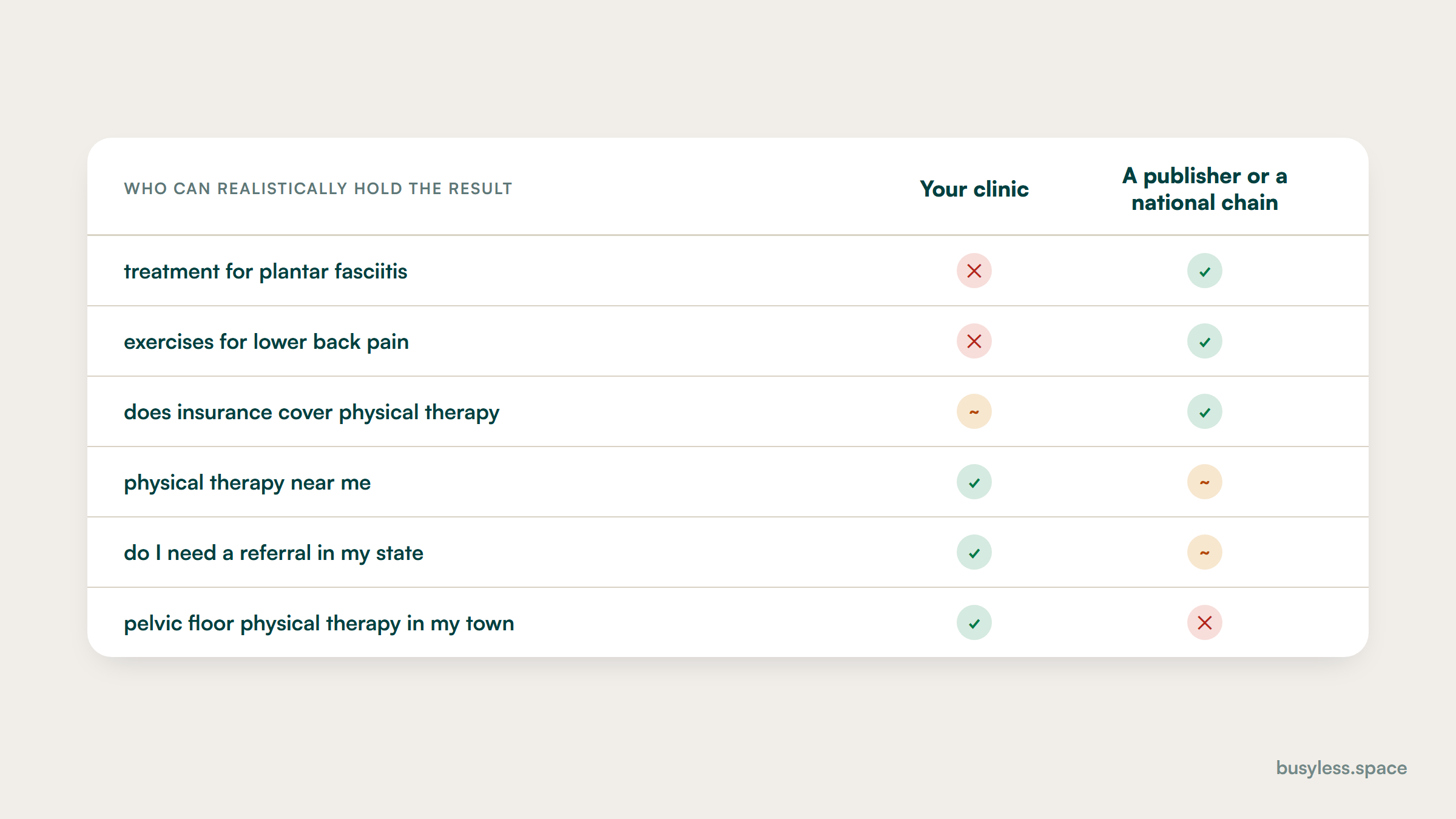
Six query types marked according to whether a clinic can realistically hold the result or a publisher, a chain or a video platform already does
Only the bottom half of this table is contested. The top half was decided years ago, by domains that are not going to get smaller.

What people actually search

These clusters are sorted by how much of the answer only you can give. The ones at the top have a different answer in every state and at every clinic; the ones at the bottom have the same answer everywhere, which is why publishers already own them.

Access and referral

Informational, decision blocking

do i need a referral for physical therapy in [state]

The page that wins it: A state-specific access page, kept dated

The constraint expressed as a keyword. The answer differs by state and again by payer, and a page that resolves both removes the reason somebody delays booking for a fortnight.

Insurance and cost

Commercial investigation

how much does physical therapy cost without insurance

The page that wins it: A coverage page and an honest self-pay price page

The pair of questions that decide whether an appointment is made this week or postponed indefinitely. Cash-pay pricing is increasingly the whole conversation, and a clinic that publishes a number gets the call that one refusing to is still waiting for.

Specialism plus location

Local commercial, qualified

pelvic floor physical therapy [town]

The page that wins it: A page per specialism per clinic, not a checkbox in a list

Where an independent beats a chain outright. Sub-specialisms carry lower volume, far higher intent and almost no competition, because the templated location page cannot say anything specific.

Post-surgical protocol

Informational, professional and patient at once

[procedure] rehabilitation protocol

The page that wins it: A protocol page written to be read by the referring surgeon

A business-to-business page wearing a patient page's clothes. Surgeons look for clinics that follow the protocol they use, and publishing yours is how that conversation starts without a lunch.

Condition and diagnosis

Informational, health sensitive

treatment for plantar fasciitis

The page that wins it: A condition page with a named clinical reviewer and a local route in

Publishers hold the generic version permanently. What they cannot write is what happens next in your state, with your insurers, at your clinic, which is the whole reason to publish one at all.

Payer-specific work

Commercial, payer driven

work injury physical therapy [town]

The page that wins it: A page per payer type, with the intake described

Workers compensation, auto injury and personal injury cases have different intake, different documentation and different referral sources. Almost no practice separates them and the queries are entirely distinct.

Clinician by name

Navigational, referral led

[therapist name] physical therapist [town]

The page that wins it: A page per clinician, with credentials and licence state

Referrals are made to a person. A practice whose therapists exist only as photographs in a modal gives a referring physician nothing to send, and gives the patient nothing to check.

Exercises and self-management

Informational, frequently do-it-yourself

exercises for [condition]

The page that wins it: Rarely a page, and usually a video if anything

The largest cluster and the least useful. It is a video contest, and the audience is explicitly trying to resolve the problem without an appointment, which is the opposite of what the practice needs.

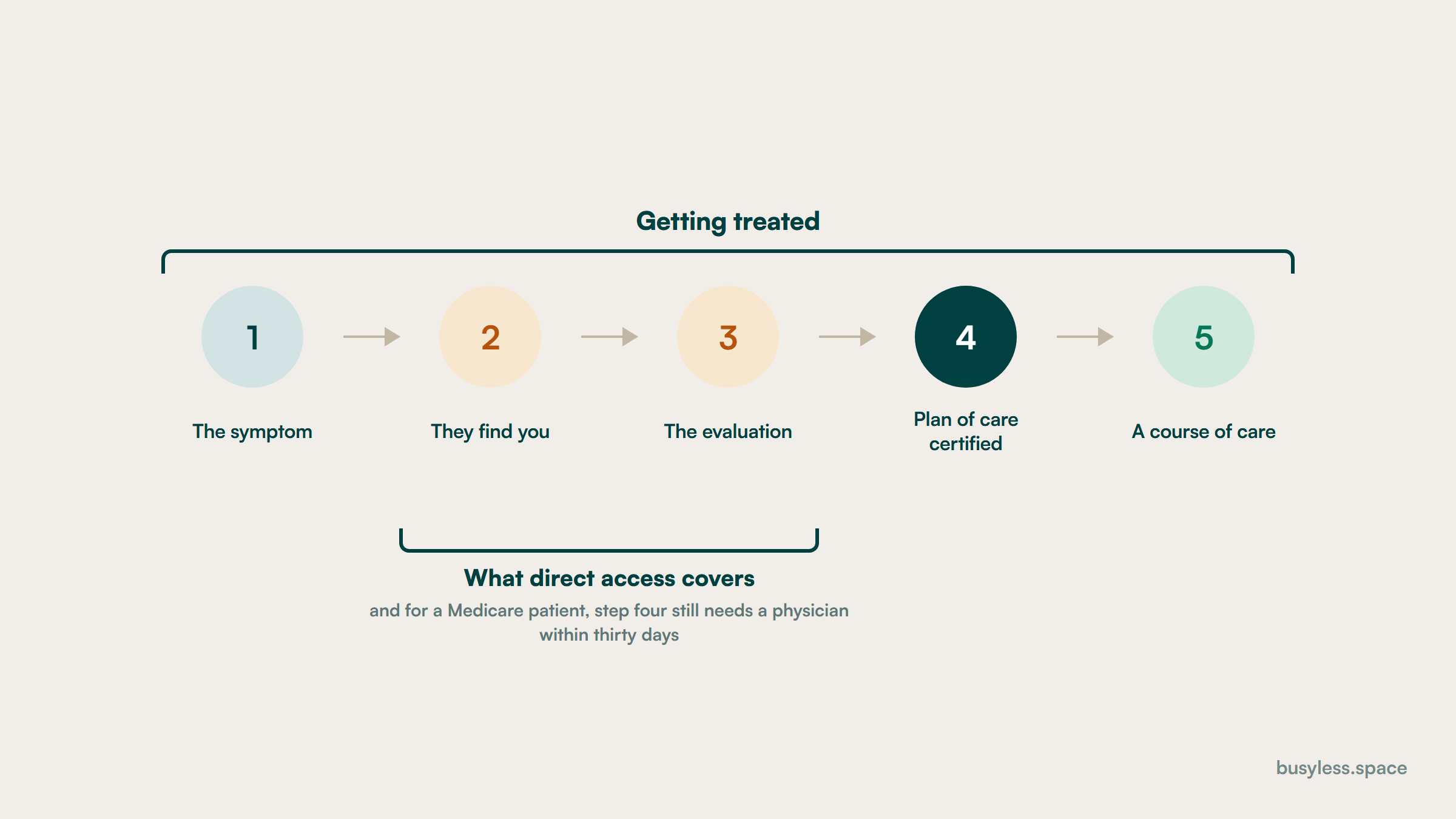
A bracket showing that the phrase direct access covers only part of the patient journey, stopping short of the payer certification step
The term describes the front door and nothing past it. What sits beyond the bracket is where a Medicare patient meets a physician anyway.

What the rules change

The rules below are the reason this page exists as something other than a local business playbook. Three of them change what a clinic may say and one changes what it may give away. Healthcare, chiropractic and mental health carry the tracking, efficacy-claim and interstate licensure rules that also touch this profession, and those pages are linked rather than repeated here. This is my reading rather than legal advice.

1

Direct access exists everywhere and means something different everywhere

APTA, State of Direct Access to Physical Therapist Services, position as of 1 July 2025

What it means

All fifty states, the District of Columbia and the US Virgin Islands allow either provisional or unrestricted direct access. Twenty-one states are unrestricted. The other thirty-one jurisdictions attach conditions, typically a limit on time or number of visits, or a referral requirement for particular procedures. The last severely restrictive state was cleared in 2024.

So do this

Write the access page for your own state, name the limit precisely, and date it. If you operate across a state line, that is two different pages rather than one page with a caveat, because it is genuinely two different offers.

2

The payer condition sits underneath the state permission

Medicare Part B plan of care certification, 42 CFR Part 424; APTA guidance on the exception effective 1 January 2025

What it means

A therapist may evaluate a Medicare beneficiary without a referral. Once therapy is medically necessary the patient must be under the active care of a physician, and the plan of care must be certified within thirty calendar days of the evaluation. From 1 January 2025 a signed order in the record can satisfy that, if the plan reached the referring provider inside the same window.

So do this

Say this on the access page rather than discovering it at intake. A Medicare patient reading that they can book directly, and then meeting a physician requirement in week three, has been told something incomplete by your own marketing.

3

How a clinician may be titled is decided by the board

State practice acts and board rules, including Florida, New York and Texas

What it means

Florida permits a physical therapist holding a Doctor of Physical Therapy to use the letters D.P.T. and P.T. but not the title doctor without also clearly informing the public of the profession. New York requires the title to indicate the profession the doctorate is in. Texas permits a form such as Dr. Name, PT, DPT in advertising, with the licensure designation ahead of the academic one.

So do this

Set one house style for clinician names and apply it in the H1, the title tag, the byline, the schema and the profile listings. This is a regulated string appearing in a hundred places, so it is a template decision rather than a copy decision.

4

A free screening offered to a federal beneficiary is not a free lunch

Civil Monetary Penalties Law beneficiary inducement provision, 42 U.S.C. 1320a-7a(a)(5), and OIG guidance

What it means

Offering something of value to a Medicare or Medicaid beneficiary that is likely to influence their choice of provider can be an inducement, and the exception for items of nominal value is narrower than most marketing plans assume. Free screening offers are among the most common promotions in this profession.

So do this

Before the offer becomes a landing page, establish who it is aimed at and take advice. A free screening advertised generally, without any carve-out, is a marketing decision with a regulatory dimension attached to it.

5

Marketing to referral sources is regulated marketing

Federal anti-kickback statute and physician self-referral rules, plus state equivalents

What it means

Relationships with the physicians and surgeons who send you patients sit inside a regulatory framework that covers remuneration in any form. Co-branded content, sponsored education, staffing arrangements and hospitality are all forms of value moving between a referral source and a provider.

So do this

Keep referral-source marketing informational. A published protocol page, outcome data and a clear description of what you do is defensible and effective. Anything that looks like payment for referrals needs advice before it needs a designer.

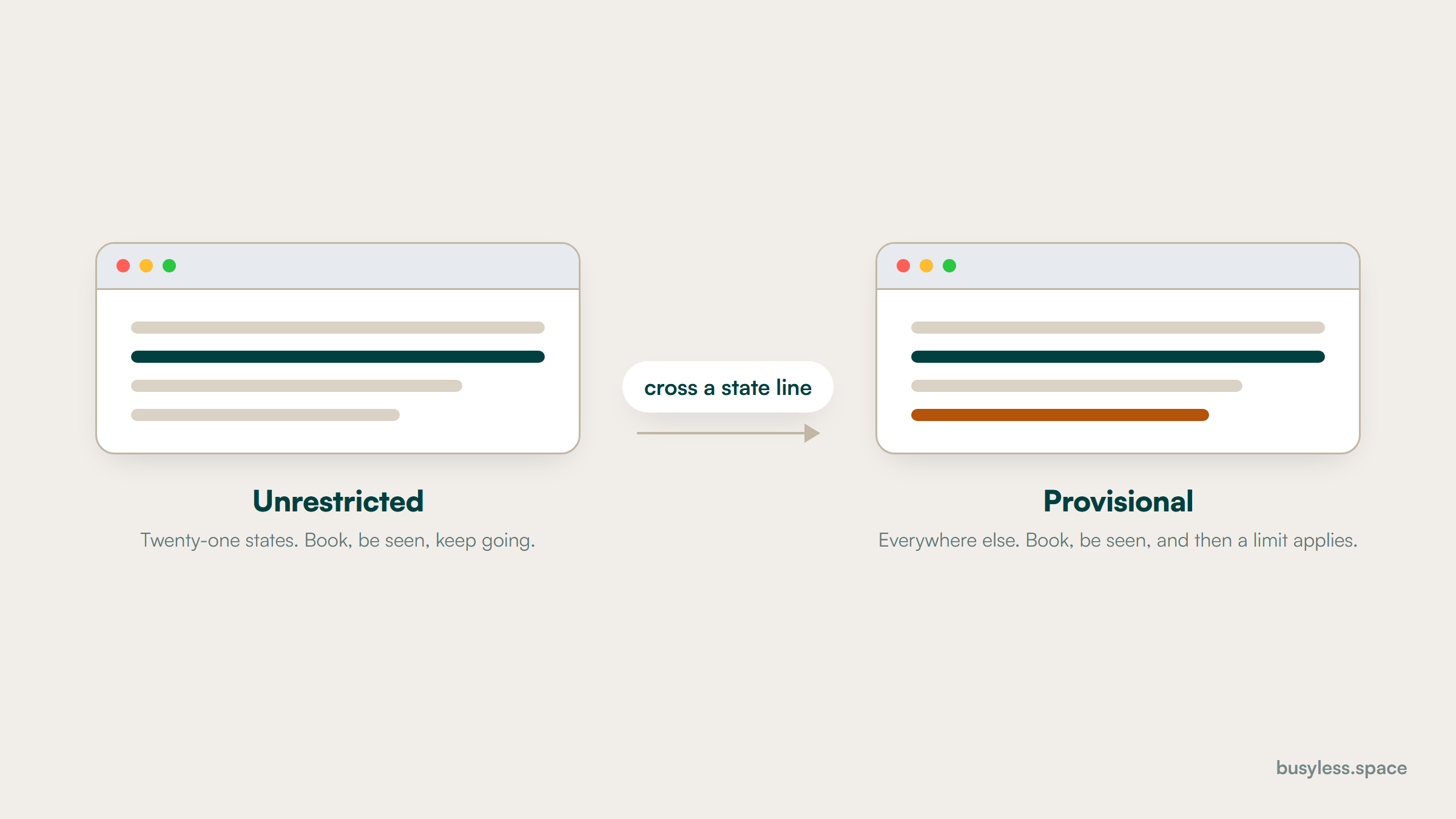
The same patient shown in an unrestricted state and a provisional one, with the referral requirement drawn as the link between the two panels
Identical symptom, identical clinic, two different funnels. A practice with sites on both sides of that line is running two businesses.

Proving expertise

This is a health category, so the quality bar is high and the signals have to be about people and evidence rather than about the premises. Nearly everything below is a fact the practice already holds in a personnel file.

  • Named therapists with credentials, licence state and year qualified
  • Board-certified specialisms named, with the certifying body
  • A named clinical reviewer and a review date on every condition page
  • Sources cited for clinical claims, with publication and year
  • The state's direct-access position stated plainly and dated
  • Insurers accepted, listed as text and kept current
  • Self-pay pricing published rather than offered on request
  • Outcome measures explained, including what they do not capture

How to build a physical therapy SEO strategy

Order matters here because a physical therapy SEO strategy that opens with condition content walks straight into a fight with national health publishers. Answer the access, insurance and clinician questions first; they are unwritten, they are yours to answer, and they block bookings today.

  1. 1

    Weeks 1-4

    Answer the blocking questions

    • Publish the direct-access page for every state you operate in
    • Put the Medicare certification requirement on it in plain words
    • List accepted insurers as text rather than as an image or a PDF
    • Publish self-pay prices for an evaluation and a follow-up
    • Set one house style for how clinicians are titled

    You end up with
    Four pages that answer what stops a booking, and a naming rule

  2. 2

    Weeks 5-12

    Give the practice a face and a shape

    • Build a page per clinician, with credentials and licence state
    • Give each clinic its own location page, profile, hours and reviews
    • Build a page per specialism per clinic rather than a checkbox list
    • Add PhysicalTherapy markup and branchOf for each site
    • Fix the scheduling widget so bookings can be counted

    You end up with
    A practice a referrer can point at and a patient can choose from

  3. 3

    Weeks 13-20

    Publish for the referrer as well as the patient

    • Write protocol pages for the procedures you rehabilitate most
    • Name the surgeons' protocols you follow, where they are published
    • Build the payer-specific pages for work injury and auto cases
    • Publish outcome measures with an honest note on their limits
    • Claim and correct every insurer directory listing

    You end up with
    Pages a referring clinician can read, and directory entries that are true

  4. 4

    Weeks 21-26

    Take on the condition queries, last

    • Write condition pages only for conditions you genuinely treat often
    • Add a named clinical reviewer and a review date to each
    • Route each condition page into your state's access answer
    • Track bookings by page and by clinic rather than as one number
    • Review which specialism pages produced first appointments

    You end up with
    Condition content that ends somewhere, and a report by clinic

Technical fixes with the best payoff

Most of the damage here comes from practice-management and clinic website vendors that model a group as one business with several addresses. That is convenient for billing and wrong for search, and it produces the same handful of defects everywhere.

  • Every clinic shares one phone number and one hours block

    A week, then per clinic

    The practice runs a central intake line, so the website and every profile carry it, and the individual clinics have no distinguishing contact detail, no separate hours and nothing to make them separate entities.

    A real number and real hours per clinic, on the page and on its own profile. Route the calls centrally if you want; publish them locally.

  • The clinicians live in a modal

    A day per clinician

    The team page is a grid of photographs that open a pop-up, because that is how the template renders staff. There is no URL for any therapist, so a referring physician has nothing to link to and neither does anybody else.

    A page per clinician with credentials, licence state, specialisms and the conditions they treat. This is also the fix for the referral cluster.

  • Insurers accepted is an image or a PDF

    Two hours

    The list comes from the billing team as a document, so it gets published as one. The most common blocking question in the category is therefore answered in a format nothing can read and nobody can search within.

    Plain text, alphabetical, with a last-checked date. Add the plan types where they differ, because a payer name alone is not the answer people need.

  • Specialisms exist only as checkboxes in the practice system

    A day per specialism

    Vestibular, pelvic health, lymphoedema and hand therapy are recorded as service codes for billing, so they appear on the website as a comma-separated list under a heading and never as pages.

    A page per specialism per location, naming the clinician who delivers it. These are the lowest-competition and highest-intent queries in the market.

  • Location pages are one template with the town swapped

    Half a day per clinic

    A group with twelve clinics generates twelve pages from one record, so the only difference between them is an address and a map, which is exactly what the national chains already do better at scale.

    Each page needs its clinicians, its specialisms, its parking, its hours and its own reviews. If the page could describe a different clinic with one find and replace, it is not finished.

  • The scheduling widget reports nothing

    A sprint with your vendor

    Booking is handled by a third-party platform in an iframe or on its own domain, so the one conversion the website exists to produce is invisible and every report undercounts the site's contribution.

    Use the vendor's inline option if there is one, and instrument the click at minimum. Ask at intake how the patient found you, and record it.

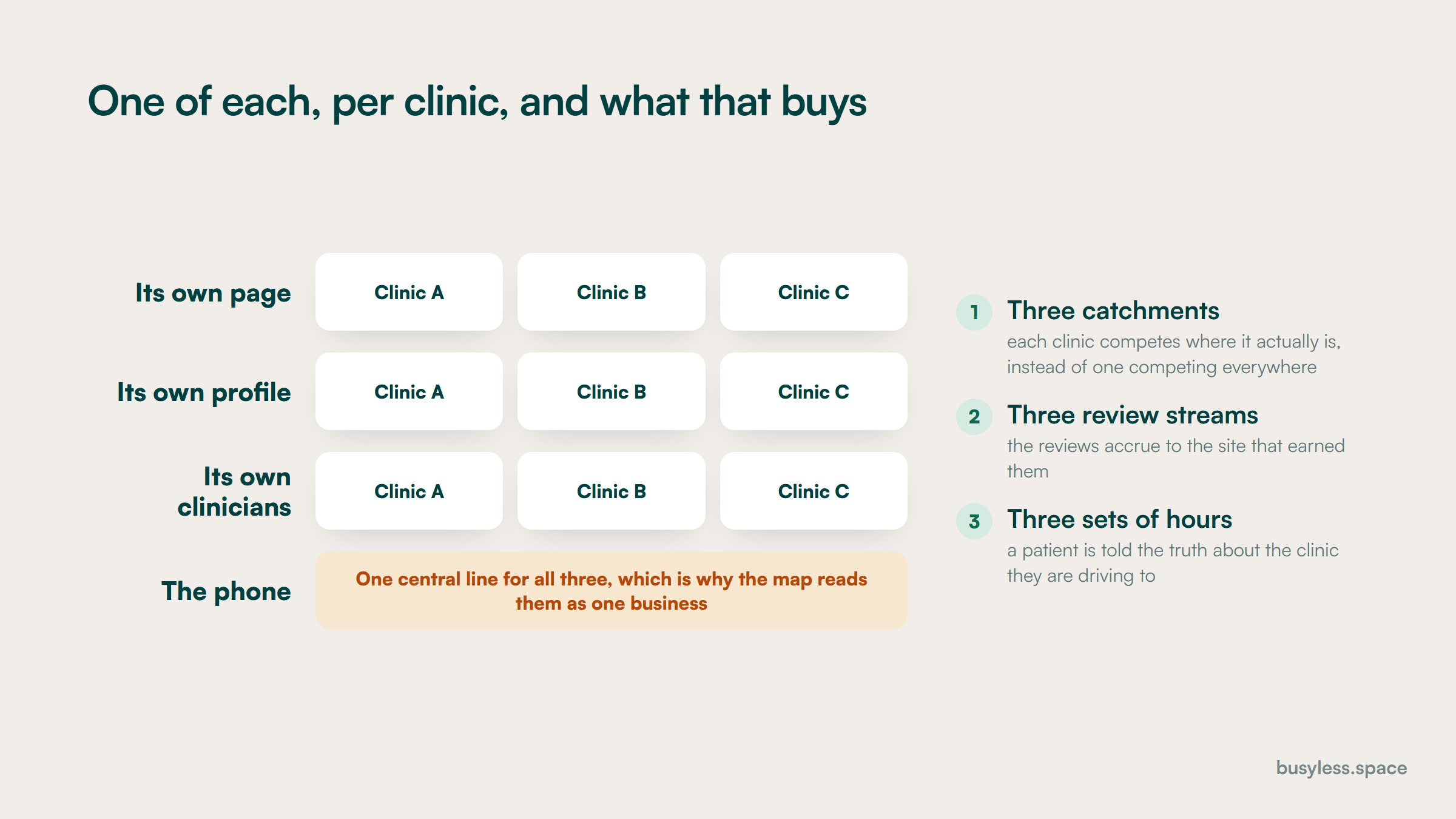
A matrix of clinic locations against the assets each one needs, showing a page, a profile, a clinician list and a review stream filled per site
Nothing in this grid can be shared between rows. That is the argument for a page per clinic in one picture.

Structured data that applies here

The types below fit this industry specifically. Most of them earn no rich result on their own, which is worth knowing before anyone sells the work on that basis. What they do is describe the entity precisely, which matters for how search engines and answer engines resolve who you are.

  • PhysicalTherapy

    Every clinic location page

    Schema.org models this profession by name, under MedicalBusiness, and almost every clinic site uses the generic local business type instead. Using the exact one is free specificity on the pages that matter most.

    PhysicalTherapy.jsonld
    {
      "@context": "https://schema.org",
      "@type": "PhysicalTherapy",
      "name": "[PRACTICE NAME], [CLINIC LOCATION]",
      "url": "https://[YOUR-DOMAIN]/clinics/[SLUG]",
      "image": "https://[YOUR-DOMAIN]/[CLINIC-PHOTO].jpg",
      "telephone": "[THIS CLINIC'S NUMBER]",
      "address": {
        "@type": "PostalAddress",
        "streetAddress": "[STREET]",
        "addressLocality": "[TOWN]",
        "addressRegion": "[STATE]",
        "postalCode": "[POSTCODE]",
        "addressCountry": "[ISO COUNTRY CODE]"
      },
      "geo": {
        "@type": "GeoCoordinates",
        "latitude": "[LAT]",
        "longitude": "[LON]"
      },
      "openingHoursSpecification": [
        {
          "@type": "OpeningHoursSpecification",
          "dayOfWeek": ["Monday", "Wednesday", "Friday"],
          "opens": "[07:00]",
          "closes": "[19:00]"
        }
      ],
      "availableService": [
        {
          "@type": "MedicalTherapy",
          "name": "[SPECIALISM]",
          "url": "https://[YOUR-DOMAIN]/services/[SLUG]"
        }
      ],
      "isAcceptingNewPatients": true
    }
  • branchOf, for a clinic inside a group

    Each location page in a multi-site practice

    The block that says twelve clinics are one practice without pretending they are one place. It is the machine-readable version of the argument that each site needs its own page, profile and reviews.

    branchOf, for a clinic inside a group.jsonld
    {
      "@context": "https://schema.org",
      "@type": "PhysicalTherapy",
      "name": "[PRACTICE NAME], [CLINIC LOCATION]",
      "url": "https://[YOUR-DOMAIN]/clinics/[SLUG]",
      "branchCode": "[INTERNAL CLINIC CODE]",
      "parentOrganization": {
        "@type": "MedicalOrganization",
        "name": "[PRACTICE NAME]",
        "url": "https://[YOUR-DOMAIN]/"
      },
      "employee": [
        {
          "@type": "Person",
          "name": "[CLINICIAN NAME], PT, DPT",
          "url": "https://[YOUR-DOMAIN]/team/[SLUG]"
        }
      ],
      "areaServed": [
        { "@type": "City", "name": "[TOWN]" },
        { "@type": "City", "name": "[NEIGHBOURING TOWN]" }
      ]
    }
  • Person, titled the way your board requires

    Every clinician page

    The one block on this page where the wording is a regulated string rather than a style choice. Decide the house form once against your own board's rules and then use it identically in the markup, the H1 and every directory listing.

    Person, titled the way your board requires.jsonld
    {
      "@context": "https://schema.org",
      "@type": "Person",
      "name": "[NAME], PT, DPT",
      "url": "https://[YOUR-DOMAIN]/team/[SLUG]",
      "jobTitle": "Physical therapist",
      "worksFor": {
        "@type": "MedicalOrganization",
        "name": "[PRACTICE NAME]",
        "url": "https://[YOUR-DOMAIN]/"
      },
      "hasCredential": [
        {
          "@type": "EducationalOccupationalCredential",
          "credentialCategory": "degree",
          "name": "Doctor of Physical Therapy",
          "recognizedBy": { "@type": "Organization", "name": "[UNIVERSITY]" },
          "dateCreated": "[YYYY]"
        },
        {
          "@type": "EducationalOccupationalCredential",
          "credentialCategory": "license",
          "name": "[STATE] physical therapist licence",
          "identifier": "[LICENCE NUMBER]",
          "validIn": { "@type": "State", "name": "[STATE]" }
        }
      ],
      "knowsAbout": ["[SPECIALISM]", "[CONDITION YOU GENUINELY TREAT]"]
    }
  • The insurers you accept, as data

    The insurance page and each clinic page

    The most common blocking question in the category, usually published as a logo wall or a PDF. Putting it in the markup does not create a rich result, and it does make the answer machine readable for the assistants people now ask first.

    The insurers you accept, as data.jsonld
    {
      "@context": "https://schema.org",
      "@type": "PhysicalTherapy",
      "name": "[PRACTICE NAME], [CLINIC LOCATION]",
      "url": "https://[YOUR-DOMAIN]/clinics/[SLUG]",
      "paymentAccepted": "[Insurance, self-pay, HSA, FSA]",
      "currenciesAccepted": "[USD]",
      "makesOffer": [
        {
          "@type": "Offer",
          "name": "Initial evaluation, self-pay",
          "price": "[PRICE]",
          "priceCurrency": "[CURRENCY CODE]",
          "description": "[Length of the appointment and what it includes.]"
        },
        {
          "@type": "Offer",
          "name": "Follow-up visit, self-pay",
          "price": "[PRICE]",
          "priceCurrency": "[CURRENCY CODE]"
        }
      ],
      "healthPlanNetworkId": "[NETWORK IDENTIFIER, WHERE YOU HAVE ONE]"
    }
  • Service written for a referring clinician

    Post-surgical protocol pages

    The only markup on this site aimed at a professional audience rather than a patient. Setting the audience explicitly is a small signal, and the page it sits on is how a surgeon decides where to send people.

    Service written for a referring clinician.jsonld
    {
      "@context": "https://schema.org",
      "@type": "Service",
      "serviceType": "[PROCEDURE] rehabilitation",
      "name": "[PROCEDURE] rehabilitation protocol at [PRACTICE NAME]",
      "url": "https://[YOUR-DOMAIN]/protocols/[SLUG]",
      "provider": {
        "@type": "MedicalOrganization",
        "name": "[PRACTICE NAME]",
        "url": "https://[YOUR-DOMAIN]/"
      },
      "audience": {
        "@type": "Audience",
        "audienceType": "Referring surgeons and physicians"
      },
      "areaServed": { "@type": "City", "name": "[TOWN]" },
      "termsOfService": "https://[YOUR-DOMAIN]/protocols/[SLUG]#phases",
      "provider_mobility": "static"
    }
  • FAQPage

    The access page, the insurance page and clinic pages

    Only for questions the page shows. The access and cost questions are the ones worth marking up here, because they are short, factual and the reason somebody has not yet booked.

    FAQPage.jsonld
    {
      "@context": "https://schema.org",
      "@type": "FAQPage",
      "mainEntity": [
        {
          "@type": "Question",
          "name": "[Do I need a referral to see a physical therapist in STATE?]",
          "acceptedAnswer": {
            "@type": "Answer",
            "text": "[The state position, any limit, and the date you checked it.]"
          }
        },
        {
          "@type": "Question",
          "name": "[What does it cost without insurance?]",
          "acceptedAnswer": {
            "@type": "Answer",
            "text": "[Evaluation price, follow-up price, and what a course typically is.]"
          }
        },
        {
          "@type": "Question",
          "name": "[Is it different if I am on Medicare?]",
          "acceptedAnswer": {
            "@type": "Answer",
            "text": "[The certification requirement, in plain words, and what you do about it.]"
          }
        }
      ]
    }

What it costs

These are editorial estimates for the work described here rather than quotes. The variable that moves a practice up a tier is the number of clinics, because every site needs its own page, its own profile and its own reviews, and none of that can be shared.

Do it yourself

$0 to $400
  • The state access page, written and dated
  • Insurers listed as text with a last-checked date
  • Self-pay prices published
  • A page per clinician with credentials and licence state
  • Profiles claimed and completed for every clinic

Who it suits

A single-site practice where an owner or office manager can give this a few hours a month. The blocking questions are all answerable from knowledge the practice already has.

Where it stops

Condition content is where this runs out. Writing it properly needs clinical review, and a reviewer's time is the thing a small practice has least of.

Lean

$1,200 to $3,000
  • A page per specialism per clinic
  • Protocol pages for the procedures you rehabilitate most
  • Condition pages with named clinical review
  • Scheduling instrumented so bookings are countable

Who it suits

An established practice with two or three sites and real sub-specialisms, competing with a chain that cannot say anything specific about any of its locations.

Where it stops

Search does not create therapists. Once the schedule is full, further demand generation lengthens the wait rather than growing the practice.

Funded

$3,000 to $5,000
  • Location and specialism coverage across a whole group
  • Referral-source content produced as a programme
  • Insurer directory listings audited and maintained
  • Reporting split by clinic, by specialism and by payer

Who it suits

A multi-site group where clinic utilisation is a managed number and somebody is accountable for new patient volume per location.

Where it stops

Hiring, always. The constraint on a growing therapy group is licensed clinicians, and no amount of search work recruits one.

How to do it with no budget

The highest-value work here costs nothing, because the questions that block a booking are answered from facts the practice already holds: what the state allows, who it bills, what it charges and who works there.

  1. 1

    Write the direct-access page for your state

    Two hours

    Your website editor

    Whether a referral is needed, what limit applies, and what changes for a Medicare patient. Date it. This is the single most valuable page you can publish and almost no competitor has one.

  2. 2

    Turn the insurer list into text

    Two hours

    Your website editor

    Alphabetical, with plan types where they matter and a last-checked date. It currently sits in an image or a PDF, which is why the question keeps arriving by phone.

  3. 3

    Publish what a visit costs without insurance

    An hour

    Your website editor

    An evaluation price and a follow-up price. Cash-pay is increasingly the conversation, and a practice that answers it gets the call from the person still ringing round for a number.

  4. 4

    Give every therapist their own page

    30 minutes each

    Your website editor

    Credentials, licence state, specialisms and the conditions they treat. Referrals are made to people, and a modal is not something a surgeon can send anybody to.

  5. 5

    Give each clinic its own profile and its own hours

    An hour per clinic

    Google Business Profile

    One central phone number across twelve profiles makes twelve clinics look like one. Separate numbers and separate hours are the difference between appearing locally and not.

  6. 6

    Claim the profession's own directory listing

    30 minutes

    ChoosePT, run by the APTA

    Free, credible and unclaimed by most practices. It also publishes the state-by-state access position, which is worth reading before you write your own page about it.

  7. 7

    Fix your insurer directory entries

    An hour per payer

    Each payer's provider portal

    Wrong specialisms, closed locations and lapsed entries in these directories cost more appointments than most ranking problems, and nobody checks them because they are not marketing.

The tool stack

The list is short, and the first entry is here because a therapy group's rankings are not one number: they are one number per clinic, and the clinic at the edge of the group is the one worth watching.

  • Track rankings per clinic rather than per practice

    SE RankingSEO APIRead the review

    A twelve-site group averaged into one position tells you nothing about any location. The sites that are losing are usually the newest ones, and the average hides them for a year.

    Free routeSearch from each clinic's postcode by hand each month

  • Run location and clinician pages as records rather than as pages

    ApostropheCMSHeadless CMSRead the review

    A clinic, a clinician, a specialism and an insurer list are structured records that combine differently at each site. Modelling them once is what stops twelve location pages becoming one template with a town swapped in.

    Free routeYour existing CMS, with a strict template per clinic

  • Work out what a new patient is actually worth

    SEO Conversion Rate CalculatorFree toolOpen the tool

    A course of treatment is many visits, so valuing a new patient at one appointment understates it by an order of magnitude. That number decides how much of this playbook is worth paying for.

    Free routeFree

  • Record how each new patient found you

    One question at intake, written into the practice system

    Bookings arrive by phone, by portal and by referral, and the website gets credit for almost none of them by default. This one habit turns the whole report from an argument into evidence.

    Free routeFree, if the front desk asks

  • Keep every clinic profile accurate

    Google Business Profile

    Hours, services, photographs and reviews, per site. For a local health business this is the highest-return asset there is, and in a group it is the one most often managed centrally and badly.

    Free routeFree

  • Audit the insurer directories you appear in

    Each payer's provider portal, on a schedule

    Not search work in the usual sense and it belongs in the same plan, because for a large share of patients the payer's directory is the search engine.

    Free routeFree

Take it from here

Everything below is meant to be filled in and used rather than read. Bodies are plain text, so what lands on your clipboard is exactly what you see, brackets and all.

Brief

Writes the answer to the question that delays a booking by a fortnight, for one state, with a date on it.

DIRECT ACCESS PAGE
State: [STATE]     Practice: [NAME]
URL: /direct-access-[STATE-SLUG]
Written by: [NAME]     Clinically checked by: [NAME]
Date: [DATE]

WHY THIS PAGE
Patients delay booking because they believe they need a doctor
first. The answer differs by state and again by payer, and almost
no clinic in your market has published either half of it.

TITLE TAG
Do you need a referral for physical therapy in [STATE]?

H1
Seeing a physical therapist in [STATE] without a referral

THE ANSWER, IN THE FIRST 40 WORDS
"In [STATE] you [can / can, with limits] see a physical therapist
without a referral from a doctor. [THE LIMIT, IN ONE SENTENCE.]"

THE STATE POSITION
Access level:        [ ] Unrestricted   [ ] Provisional
If provisional, the limit is:
  [ ] A number of visits: [ ..... ]
  [ ] A number of days:   [ ..... ]
  [ ] A referral needed for: [ ....................... ]
  [ ] Other: [ ................................. ]

Source: [ .......................................... ]
Checked on: [DATE]     Next check: [DATE, 6 MONTHS]

IF YOU ARE ON MEDICARE
"You can come to us for an evaluation without a referral. If we
find that therapy is medically necessary, Medicare requires your
plan of care to be certified by a physician or non-physician
practitioner within thirty calendar days of that first visit.
We handle that for you by [WHAT YOU ACTUALLY DO]."

  - do not leave this out. A patient told they can self-refer,
    who then meets a physician requirement in week three, was
    told something incomplete by your own marketing

IF YOU HAVE COMMERCIAL INSURANCE
"Some plans require a referral even where state law does not.
We check this before your first visit. [HOW.]"

WHAT HAPPENS AT THE FIRST APPOINTMENT
[ 80 words. What it involves, how long, what to wear, what to
  bring. The practical anxiety sitting behind the legal one. ]

WHAT WE DO IF YOU DO NEED A DOCTOR
[ Say it plainly. A practice that explains how it helps somebody
  get a referral is more trustworthy than one that implies the
  question never arises. ]

BOOKING
  [ ] Phone number as tappable text
  [ ] Online booking link
  [ ] Which clinics this applies to

MARKUP
  [ ] FAQPage for the questions above
  [ ] PhysicalTherapy for the clinic

ONE PAGE PER STATE
If you operate across a state line, this is two pages, not one
page with a caveat. It is genuinely two different offers.

What to publish

The order below is deliberate. Everything at the top has an answer only your practice can give; everything further down is contested by publishers who will keep winning it. Start where you are the only source.

  • The state access page

    One per state you operate in, reviewed twice a year

    The constraint written as a page. It answers the question that delays a booking by a fortnight, the answer differs by state, and almost no competitor has published one.

  • Insurance and self-pay pricing

    Once, verified quarterly

    The two questions that stop a booking at the last moment. Publishing a number wins the call from somebody who is still ringing round for one.

  • Clinician pages

    One per clinician, updated as credentials change

    Referrals go to people. A page per therapist gives a surgeon something to link to and a patient something to check before committing to eight weeks.

  • Specialism pages, per clinic

    One per specialism per site

    Vestibular, pelvic health and hand therapy carry low volume, high intent and almost no competition, and a templated chain location page cannot compete for them.

  • Post-surgical protocol pages

    One per procedure you rehabilitate regularly

    A page a referring surgeon reads. Publishing the protocol you follow starts the referral conversation without a meeting, and it happens to serve patients too.

  • Condition pages with named review

    Two a month once everything above exists

    Worth writing last and only for conditions you genuinely treat, because the generic version belongs to publishers. Yours wins by ending somewhere specific.

And what not to

  • Exercise and stretch libraries, which are a video contest and attract people avoiding an appointment
  • Generic condition articles competing head on with national health publishers
  • Location pages that would describe a different clinic after one find and replace
  • Free screening offers built as landing pages before anybody has checked who they reach
  • Outcome claims stated without the measure, the population and the limits

The expensive mistakes

Never publishing the state's access position

Costs you Patients who could walk in today assume they need a doctor first, and delay for a fortnight or go somewhere that told them.

Write it for each state you operate in, name the limit, and add what changes for a Medicare patient.

Publishing the insurer list as an image

Costs you The most common blocking question in the category is answered in a format nothing can read, so it keeps arriving by phone and losing the ones who did not ring.

Plain text, alphabetical, with plan types and a last-checked date.

Hiding the therapists in a modal

Costs you A referring surgeon has nothing to link to and a patient has nothing to check, in a profession where the choice is a person rather than a building.

A page per clinician with credentials, licence state and the conditions they treat.

Running twelve clinics off one phone number

Costs you Twelve profiles that look like one business to a local search, so the group ranks like a single location while paying rent on twelve.

A real number and real hours per site, routed centrally if you want but published locally.

Building the content plan around exercises

Costs you Months of production aimed at a video query, attracting an audience whose intention is to avoid the appointment you need them to book.

Start with access, cost, clinicians and specialisms. Every one of them is unwritten and every one of them blocks a booking.

Marketing a free screening without checking who it reaches

Costs you A promotion aimed at federal beneficiaries can be an inducement, and the nominal-value exception is narrower than a marketing plan assumes.

Establish the audience and take advice before it becomes a landing page. There are versions of this offer that are fine.

What to measure

Two things make measurement here misleading in opposite directions. Bookings arrive by phone, portal and referral, so the website is undercredited by default, while a new patient is worth a whole course of treatment rather than one appointment, so their value is understated as well.

Leading indicators

Move first. They predict, they do not prove.

  • Local pack position, per clinic

    A rank tracker with a location per site

    Never as a group average. The newest clinic is usually the weakest and an averaged number hides it for as long as the older sites hold up.

  • Access page impressions and queries

    Search Console

    Read the queries rather than the count. They tell you which version of the referral question people are actually asking in your state, which is not always the one you answered.

  • Profile calls and direction requests, per clinic

    Google Business Profile insights

    The earliest signal in a local health business, and the one that moves first when separate numbers and hours go live on each site.

  • Specialism page impressions

    Search Console, filtered to those URLs

    Low volume by design. Judge them on whether the right people arrive, not on how many, because a handful of pelvic health searches is a full caseload.

  • Scheduling starts, by clinic

    Analytics, with the booking widget instrumented

    Requires deliberate setup because the widget usually lives on a vendor domain. Without it the website's contribution is invisible in every report you produce.

Business indicators

The ones a manager acts on.

  • New patients with a recorded source

    Your practice management system, asked at intake

    The number that makes the rest of this defensible. It needs the front desk to ask and record, and it is the difference between a report and an argument.

  • Visits per episode of care

    Your practice management system

    Worth watching because it turns a new patient into a real value. It also moves for clinical reasons, so read it alongside the caseload rather than as a marketing metric.

  • Referrals by source, and their direction

    Your practice management system

    Protocol pages and clinician pages are aimed at referrers, and this is the only place their effect shows. A new referring surgeon is worth more than a month of consumer traffic.

The verdict

A lot of physical therapy SEO services arrive with a condition content calendar and a plan to outrank national health publishers on plantar fasciitis. That fight has been settled for a decade and it is not going to reopen.

The unwritten pages are the ones that matter. Whether somebody in your state can book without a referral, what happens when they are on Medicare, which insurers you take, what it costs without one, and who exactly would be treating them.

Each of those has an answer only your practice can give, and each of them is currently stopping somebody from booking. They are also the cheapest work in this playbook, because the facts already exist inside the business.

So useful SEO services for physical therapists start at the front desk rather than in a keyword tool: publish what the practice already knows, give the clinicians pages, and leave the exercise library to the video platforms.

FAQ

Physical therapy SEO questions

  • Can patients see a physical therapist without a referral?
    Somewhere in the country, always; on your terms, it depends. As of mid-2025 every state, DC and the US Virgin Islands allowed provisional or unrestricted direct access, with twenty-one states unrestricted and the rest attaching limits on time, visits or particular procedures. Publish your own state's position and date it.
  • Does direct access change anything for Medicare patients?
    Yes, and this is the part most marketing leaves out. A beneficiary can reach you without a referral, and the plan of care still needs certification by a physician or non-physician practitioner within thirty calendar days of the evaluation. Say so on the access page rather than at intake.
  • Should we publish our prices?
    Publish self-pay prices at minimum, for an evaluation and a follow-up. Cash-pay is an increasing share of this market and somebody ringing round for a number will book with the practice that already answered.
  • How should we write our therapists' names?
    Set one house form against your own board's rules and use it everywhere. Several states constrain how a Doctor of Physical Therapy may use the title doctor, typically requiring the profession to be made clear at the same time, and that string appears in your H1, your markup and every directory.
  • Is it worth writing condition pages at all?
    Only for conditions you genuinely treat often, only with a named clinical reviewer, and only after the access, insurance and clinician pages exist. The generic version belongs to publishers; yours wins by ending in your state's rules and your clinic's door.
  • What should a multi-clinic practice do differently?
    Stop treating twelve sites as one business. Each clinic needs its own page, its own phone number, its own hours, its own profile and its own reviews, or a local search reads the whole group as a single location.
  • Can we advertise a free screening?
    Sometimes, and it needs checking first. Offering something of value to a Medicare or Medicaid beneficiary that could influence their choice of provider raises the beneficiary inducement rules, and the nominal-value exception is narrower than most marketing plans assume.
  • Why does our website show almost no conversions?
    Because most bookings arrive by phone, by portal or by referral, and the scheduling widget usually lives on a vendor's domain. Instrument the booking step, and ask every new patient at intake how they found you.

Run it yourself, or have someone own it

Everything above is written to be run without us, and the free path is genuinely most of the value for a single-location business. Where these plans stall is almost never the plan. It is that nobody owns it after the first month. That is the job we do, with search as one distribution layer inside a wider system rather than the whole engagement.