
Skip to content

Chiropractic SEO strategy

YMYL and regulated

Efficacy claims are constrained twice, by boards and by YMYL

Written by Eugene SuslovLast reviewed 29 August 2026No affiliate links
Sector
Health and medical
Model
Local service
Competition
High
Time to results
3 to 7 months
Typical monthly
$800 to $3,500

Key takeaways

  1. 1The sentence that converts a patient is the same sentence a state board and a search quality rater both read, and they are looking for opposite things. That collision is the whole strategy.
  2. 2You are not competing with the clinic down the road for the pain queries. You are competing with a hospital system's service line and a national health publisher, and only one of those can be displaced.
  3. 3Medicare covers manual manipulation of the spine to correct a subluxation and essentially nothing else a chiropractor does, so a four-word badge on the home page implies coverage that is not there.
  4. 4Two elements decide whether a condition page survives review, and almost no clinic in this category adds either: a named clinician who reviewed it, and a date.
  5. 5This is the one playbook here where the structured data advice is to use less of the medical vocabulary, because marking a treatment up as a therapy for a condition is an efficacy claim a machine can read.

SEO for chiropractors is unusually constrained at the level of the sentence. In most industries the difficulty is finding something to say. Here the difficulty is that the most persuasive version of what you want to say is the version somebody will object to.

A patient in pain wants to know whether this will fix them. A state board constrains what you may claim treatment achieves. An advertising regulator applies a substantiation standard. A search quality rater applies a different one, to health content specifically.

So a chiropractic SEO strategy that starts by writing persuasive copy about outcomes has walked into the one problem this category actually has. The wording is not the last step here. It is the design constraint.

The second fact reframes who you are competing with. On a back pain query the results belong to national health publishers, hospital systems and large clinic groups, none of whom is a chiropractor and none of whom you will outrank on the general question.

Narrower ground remains, and it is genuinely good: the local pack, the specific presentations you see every week, and the questions patients ask before booking that nobody publishes plainly.

Underneath all of it sits a category with a contested evidence base, which is not a marketing problem to be worked around. It is the reason precision reads as credibility here in a way that enthusiasm does not.

Who already ranks in chiropractic

Search a common presentation and count how many of the first ten results are a clinic rather than a publisher or a hospital. Most chiropractic SEO plans are built as though the answer were high, and in nearly every market it is one or two.

What is on the results page

  • Local pack on chiropractor and back pain near-me queries
  • National health publishers holding the condition and symptom results
  • Hospital and health system service lines on the same terms
  • People Also Ask, returning to the same three questions: does it work, does it hurt, what does it cost
  • Review aggregators on best-in-town queries
  • Video results on technique and stretch queries
  • Insurance and cost comparison pages on coverage questions
  • Almost nothing on the specific presentations a clinic sees every week
  • Google Business Profile

    google.comClaim it

    The main asset in the category, because the pack sits above the organic results on almost every query with local intent. Services listed explicitly, real photographs of the practice and the practitioners, exact hours, and the questions section answered by you before somebody else answers it wrongly.

  • National health publishers

    healthline.com

    They hold the condition and symptom results with editorial teams, clinical review processes and authority a single clinic will not match. They also cannot say what happens in your building on Tuesday, which is the entire opening and the reason this playbook is about presentations rather than conditions.

  • Hospital and health system service lines

    the systems in your metro

    Large local organisations publishing on the same conditions with more authority than you and a physical presence in the same city. Frequently the second and third results on a local condition query, and worth reading, because what they decline to say is often where a chiropractor can be more specific.

  • Review aggregators

    yelp.comClaim it

    They rank on best-in-town queries and feed maps and assistants. Claim them, keep the details identical to your profile, and answer complaints properly. In a category where the decision is partly about trust in the profession, the reply to a bad review is read more carefully than the review.

  • Directory and booking platforms

    the health booking platforms in your marketClaim it

    They rank on clinician-name and book-an-appointment queries and they will sit above your own booking page. Claim the profile, keep it accurate, and be clear internally about whether you are paying for a patient who was already searching for you by name.

  • Insurance and cost comparison content

    the payer and comparison sites

    They own the coverage cluster, which is one of the largest in this category. Their answers are general; yours can be specific to your fee schedule and your area, which is both more useful and easier to write than anything about efficacy.

  • Video platforms

    youtube.comClaim it

    Technique, stretch and what-to-expect searches are answered visually, and the results are frequently practitioners rather than publishers. It is one of the few surfaces in this category where an individual clinician can rank on merit, and it carries the same claim constraints as the website.

  • Your state board's licensee lookup

    the board's own register

    Not a competitor, and worth naming as a gatekeeper because it is the source a patient or a complainant checks. Everything on your site about licences, credentials and titles should match it exactly, and your own listing there should be current.

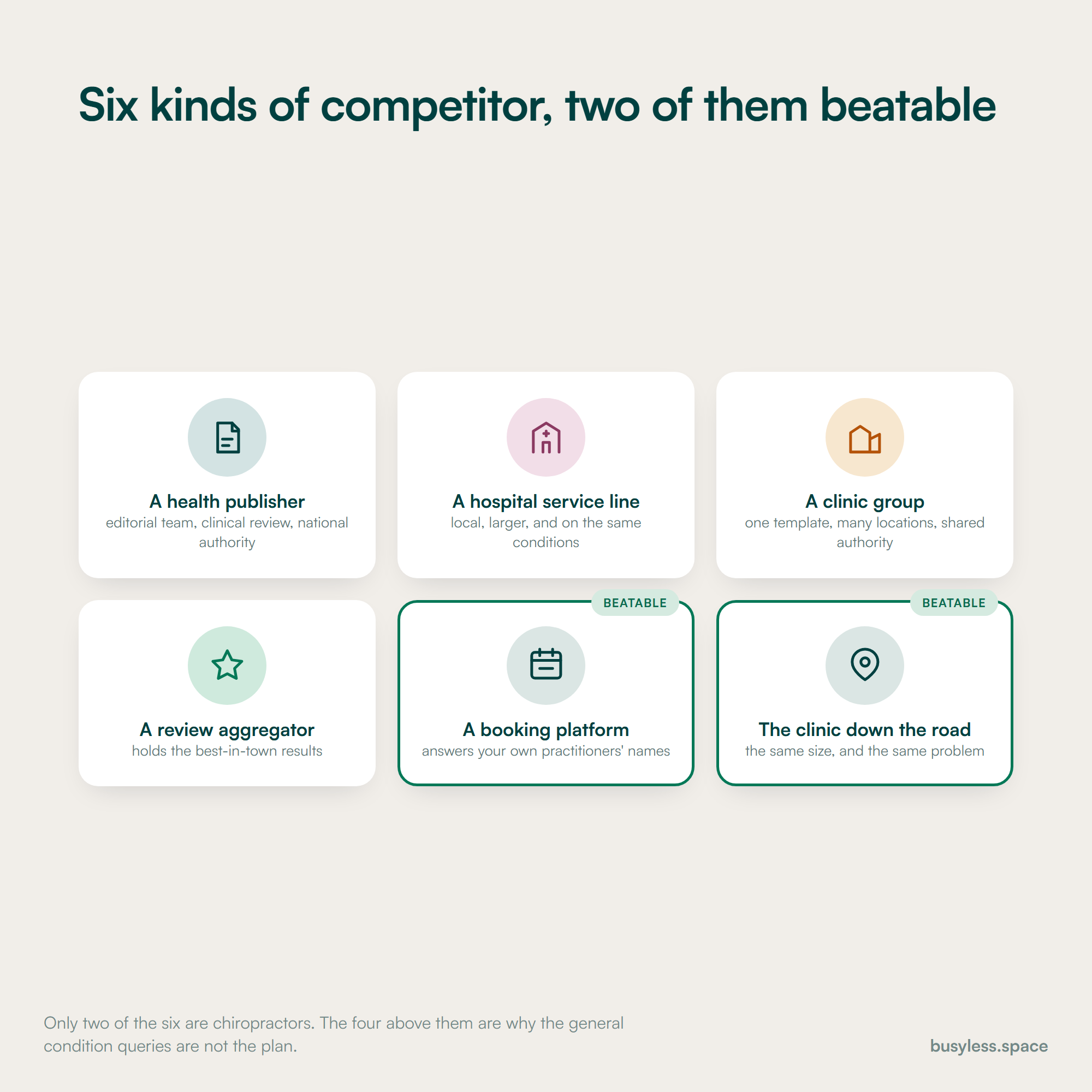
Six kinds of organisation shown as a set with no order: a national health publisher, a hospital service line, a clinic group, a review aggregator, a booking platform and the clinic next door.
Only two of the six are chiropractors, and only two of the six can realistically be displaced.

What people actually search

Two clusters below are conceded to publishers, one is regulated at the level of the sentence, and four are winnable and almost unoccupied. The order to build in follows that division rather than the volume.

Practitioner near me

Local, immediate

chiropractor near me

The page that wins it: A complete profile and an honest availability answer

The highest-volume cluster and mostly a profile job. Whether you have an appointment this week matters more here than anything you write, because the searcher is deciding today.

General condition

Informational

what causes lower back pain

The page that wins it: Nothing, in most markets

Held by national publishers and hospital systems. Writing another general explainer competes with a clinical review team on their own ground, which is the most common way a budget disappears in this category.

Specific presentation

Informational, close to booking

back pain when I stand up from sitting

The page that wins it: A page per presentation you genuinely see every week

The best cluster here. It is described in a patient's own words rather than in clinical ones, it is answered badly by generalist publishers, and it is written from your own case load rather than from research.

Does it work, and does it hurt

Informational, hesitant

is a chiropractic adjustment safe

The page that wins it: A carefully worded page that does not overclaim

The regulated cluster, and the one a hesitant patient actually reads. Precision converts better than enthusiasm here, and a page that names the limits is more persuasive than one that does not.

Cost and coverage

Commercial investigation

does insurance cover chiropractic

The page that wins it: Your own fees, plus an honest note on what Medicare covers

Large, answered by payers and comparison sites in general terms, and answerable by you specifically. It is also the cluster where an implied coverage claim does the most damage.

What happens in a visit

Informational, pre-booking

what to expect at a chiropractor first visit

The page that wins it: A plain description of your own first appointment

Nervousness is the main reason people do not book, and this question is asked constantly. It requires no claim about outcomes at all, which makes it the easiest good page in this playbook.

Technique and modality

Local commercial, specific

[named technique] chiropractor

The page that wins it: A page per technique you are genuinely trained in

Low volume, high intent, and a patient who searches a named technique has usually had it before and will travel. Only write it where the training is real and nameable.

Clinician by name

Navigational

[practitioner name] chiropractor

The page that wins it: A page per practitioner, matching the board register

Referrals and recommendations produce these constantly, and a booking platform will otherwise answer them. Every credential on the page should match the licensee lookup exactly.

What the rules change

The tightest wording constraints in this directory, and they land on ordinary marketing copy rather than on the treatment. Rules differ by state and this is not legal advice; check your own board and take advice on anything specific.

1

What you may say treatment achieves is constrained by your board

State chiropractic board advertising and unprofessional conduct rules, which differ by state and are enforceable against the licensee

What it means

Boards constrain claims about what care achieves, and several restrict guarantees, superlatives and language implying a cure. Several also constrain how titles are used where they could imply a qualification the licensee does not hold. The complaint route is open to patients and to competitors, and the file follows the individual rather than the business.

So do this

Write about what happens rather than about what results. Describing an examination, a treatment plan, a typical course of care and the point at which you would refer is both permitted and more convincing than an outcome promise. Read your own board's advertising rule once a year and date the reading.

2

A health claim needs competent and reliable scientific evidence

The FTC Health Products Compliance Guidance, issued 20 December 2022, replacing the 1998 dietary supplement guide and expressly covering all health-related products and services

What it means

The guidance restates the substantiation standard and gives worked examples of how much evidence a claim needs, including how qualified claims and disclaimers are read. It applies to services as well as products, and the standard is about the evidence you hold before publishing rather than about your sincerity afterwards.

So do this

For every claim on the site, write down what supports it and where. Where the evidence is genuinely mixed, say so, because a page that acknowledges the state of the evidence is more credible to a hesitant patient and considerably safer. Keep the file with the page rather than in somebody's memory.

3

Medicare covers manual manipulation and almost nothing else you do

Medicare Part B coverage of chiropractic services, limited to manual manipulation of the spine to correct a subluxation

What it means

The examination, X-rays a chiropractor orders, massage, electrical stimulation and maintenance care are not covered. So a badge saying you accept Medicare, on a page listing all of those services, implies coverage that does not exist, and the patient discovers it at reception rather than on the website.

So do this

Write it out. A short section saying exactly what Medicare covers, what it does not, and what the patient will pay for the rest. It removes a difficult conversation from the front desk, it is genuinely useful, and it wins a cluster the payers answer only in general terms.

4

Patient testimonials about outcomes are the highest-risk content here

State board rules on testimonials, several of which restrict or prohibit them, together with the FTC endorsement rules on typicality and disclosure

What it means

A testimonial describing a result is an outcome claim made through somebody else, and it carries the same substantiation burden as one you made yourself. Several boards restrict them outright and others require that they not imply typical results. Incentivised or gated reviews are separately prohibited.

So do this

Check your own board first, because the answer varies more here than on anything else on this page. Where testimonials are permitted, prefer ones about the experience rather than the outcome: how they were treated, what was explained, whether they felt heard. Those persuade a nervous patient more anyway.

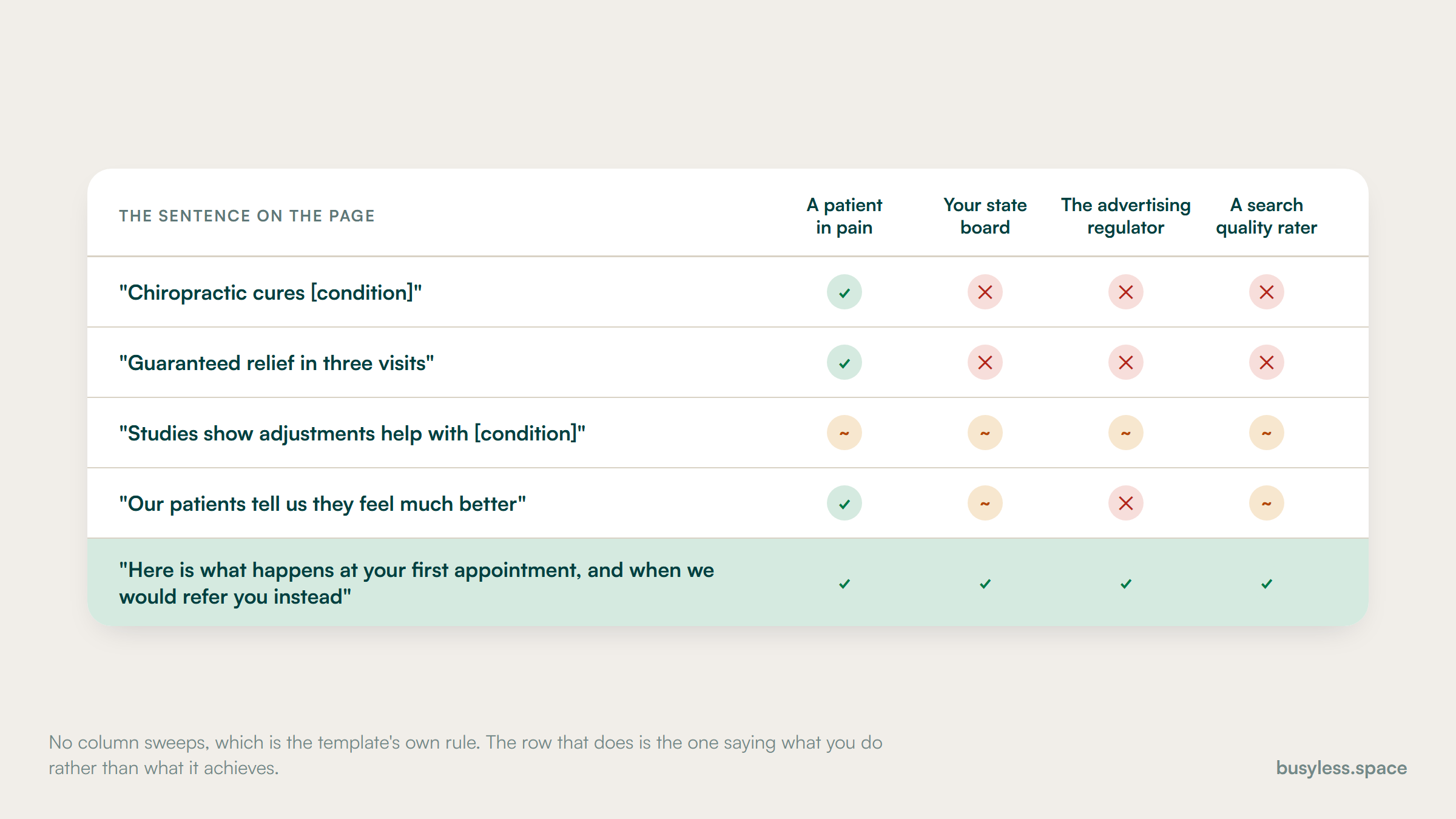
Five kinds of claim scored against four readers: a patient in pain, a state board, an advertising regulator and a search quality rater. Only the claim about what happens during a visit passes all four.
The row that passes everywhere is the one that says what you do rather than what it achieves.

Proving expertise

The reader is deciding whether to let somebody manipulate their spine, in a category they may have heard argued about. Every proof signal that works is specific, checkable and about a person.

  • Each practitioner named with their degree, school and year of qualification
  • State licence number, matching the board register exactly
  • Post-graduate training and named techniques, with the awarding body
  • How long they have practised, and where before
  • Who reviewed each clinical page, by name, and when
  • The conditions you refer out rather than treat, stated plainly
  • What a first appointment actually involves, step by step
  • Fees, and a clear statement of what insurance and Medicare cover
  • Professional association membership, with the number

How to build a chiropractic SEO strategy

Six months, and the first three weeks are wording rather than writing. A chiropractic SEO strategy that publishes before the claims have been audited is producing pages that will have to be edited under pressure later.

  1. 1

    Weeks 1 to 3

    Audit what the site already claims

    • Read your board's current advertising rule and write down the date
    • Search the site for cure, heal, guarantee, eliminate, fix and permanent
    • Check every credential and title against the board's licensee lookup
    • Check whether any testimonial describes an outcome, and what your board allows
    • Correct or remove the Medicare badge and write the coverage section
    • Complete the profile: services, photographs, exact hours, questions answered

    You end up with
    A site whose claims you could defend, and a profile that is actually finished

  2. 2

    Weeks 3 to 10

    Write the pages that need no outcome claim

    • Write what happens at a first appointment, step by step
    • Publish your fees, and what insurance and Medicare do and do not cover
    • Write the safety and what-it-feels-like page carefully
    • Write a page per practitioner, matching the register exactly
    • Say which presentations you refer out, and to whom
    • Add a named reviewer and a date to every clinical page

    You end up with
    The pages a hesitant patient reads, none of which required a claim

  3. 3

    Weeks 8 to 18

    Take the presentations only you see

    • List the ten presentations you see most, in patients' own words
    • Write a page each, describing the presentation and the assessment
    • Write a page per technique you are genuinely trained in
    • Publish what you would do before referring, and when you would refer
    • Add the structured data, deliberately without condition and therapy claims
    • Ask every patient for a review, the same way, and answer all of them

    You end up with
    A page set built from your own case load rather than from research

  4. 4

    Weeks 16 to 26

    Measure new patients, not sessions

    • Track new patient appointments, not form submissions
    • Track which page the patient landed on first
    • Track the proportion who complete an initial course of care
    • Report profile calls and direction requests separately
    • Watch the review profile weekly and answer within two days
    • Re-read the board rule and re-date the claims file

    You end up with
    A report about patients, and a claims file that is current

Technical fixes with the best payoff

The fixes with the best payoff here are unusual, because two of them exist to satisfy a reader who is not a patient. A clinical page in this category needs elements that most website builders have no field for.

  • No page says who reviewed it or when

    An hour to set up, minutes per page

    Health content is held to a quality bar that asks who produced it and whether it is current, and in this category a page also has to survive a board complaint. A page with no named author, no reviewer and no date has nothing to answer either question with.

    Every clinical page carries the practitioner who wrote or reviewed it, their credentials, and the date it was last reviewed, in the visible copy rather than only in markup. It is two lines, it is the single highest-leverage change on this list, and almost no clinic in any market has it.

  • The condition pages were bought as a library

    A sprint, then an hour per page

    Website vendors in this vertical supply pre-written condition libraries, so the same forty pages appear on hundreds of clinic sites, frequently with outcome language nobody at your practice chose and no reviewer named. They compete with national publishers and lose, and they carry claims you did not write.

    Delete them or rewrite them. Ten presentations described in your own words, from your own case load, with your name on them, will outperform forty borrowed pages and will not contain a sentence you have to defend without having written it.

  • The claims are scattered and nobody has a list

    Half a day, then quarterly

    Outcome language accumulates: a homepage banner, an old blog post, a service page written by a previous marketer, alt text on an image. When a complaint arrives, the practice discovers what its own website says at the worst possible moment.

    One spreadsheet: every claim, where it appears, what supports it, the date checked. Search the site for the specific words rather than reading it, because the risky ones cluster in headings and image captions where nobody looks.

  • Fees are not on the site at all

    An afternoon

    Cost and coverage is one of the largest clusters in the category and it is answered by payers and comparison sites in general terms. Meanwhile the practice fields the same phone call all day, and a nervous patient adds price uncertainty to their existing hesitation.

    Publish the initial consultation fee, the follow-up fee, what a typical initial course involves, and what insurance and Medicare cover. This requires no claim about outcomes and it removes two objections at once.

  • The booking flow is on somebody else's domain

    An afternoon of configuration

    Practice management and booking platforms host the appointment flow, so the moment of conversion is invisible and, in this category, a platform profile often outranks the practice's own booking page for the practitioner's name.

    Host the booking flow on your own subdomain where the platform allows it, and measure the click out as a conversion where it does not. Then make sure a practitioner page exists on your own domain for every name a patient might search.

  • The practitioner pages do not match the register

    An hour

    Titles, qualifications and technique certifications drift on a website: an abbreviation here, a slightly grander phrasing there. The board's licensee lookup is the source anybody checking will use, and a discrepancy is the easiest possible complaint to make.

    Open the register and the site side by side. Name, licence number, credentials, and the exact wording of any specialty or certification. Where a post-graduate qualification is real but not a board specialty, describe it as training rather than as a specialism.

  • The waiting room is stock photography

    A day

    The decision is whether to trust a named person with your spine. Half the sites in any market show a stock image of a smiling model being adjusted, which is both unpersuasive and, in a category people are already unsure about, faintly alarming.

    Photograph the actual practice, the actual practitioners and the actual treatment rooms. Add a short video of the first appointment if you can, because the nervousness this addresses is the main reason people do not book.

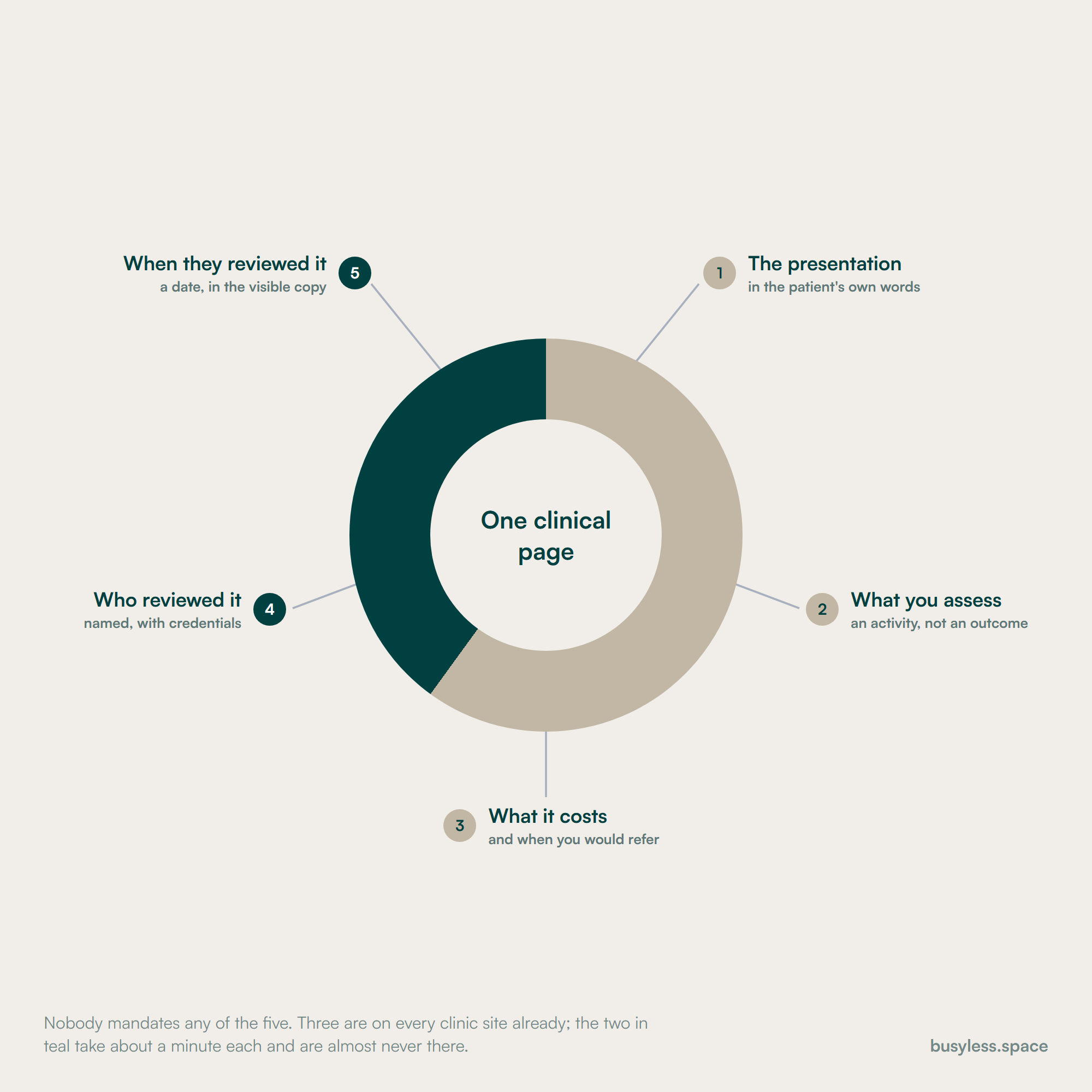
A single page broken into five parts, with two of them marked as the ones almost no clinic includes: the named clinician who reviewed it and the date it was last reviewed.
Three of the five are on every website in the category. The other two take about a minute each.

Structured data that applies here

The types below fit this industry specifically. Most of them earn no rich result on their own, which is worth knowing before anyone sells the work on that basis. What they do is describe the entity precisely, which matters for how search engines and answer engines resolve who you are.

  • MedicalBusiness, without the condition vocabulary

    Home page, referenced sitewide

    The important part of this block is what it leaves out. medicalSpecialty states what the practice is; it does not assert what any treatment achieves. Resist the temptation to add condition and therapy nodes, for the reason set out in the block below.

    MedicalBusiness, without the condition vocabulary.jsonld
    {
      "@context": "https://schema.org",
      "@type": "MedicalBusiness",
      "@id": "https://[YOUR-DOMAIN]/#practice",
      "name": "[PRACTICE NAME]",
      "medicalSpecialty": "https://schema.org/Chiropractic",
      "url": "https://[YOUR-DOMAIN]/",
      "telephone": "[+1-555-000-0000]",
      "priceRange": "[$$]",
      "image": "https://[YOUR-DOMAIN]/[PHOTOGRAPH OF THE PRACTICE].jpg",
      "address": {
        "@type": "PostalAddress",
        "streetAddress": "[STREET]",
        "addressLocality": "[TOWN]",
        "addressRegion": "[ST]",
        "postalCode": "[00000]",
        "addressCountry": "US"
      },
      "openingHoursSpecification": [{
        "@type": "OpeningHoursSpecification",
        "dayOfWeek": ["Monday","Tuesday","Wednesday","Thursday","Friday"],
        "opens": "[08:00]",
        "closes": "[18:00]"
      }],
      "isAcceptingNewPatients": true,
      "employee": [
        { "@id": "https://[YOUR-DOMAIN]/team/[SLUG]#person" }
      ]
    }
  • The blocks to leave out, and why

    Nowhere, deliberately

    The only entry of its kind in this directory. MedicalCondition and MedicalTherapy exist and are tempting, and using them means asserting in machine-readable form that a named treatment addresses a named condition. That is precisely the claim your board constrains and the substantiation standard reaches. This block is here so the decision is deliberate rather than accidental.

    The blocks to leave out, and why.jsonld
    {
      "_comment": "DO NOT PUBLISH THIS. It is here to be recognised.",
      "@context": "https://schema.org",
      "@type": "MedicalTherapy",
      "name": "[NAMED TREATMENT]",
      "indication": {
        "@type": "MedicalCondition",
        "name": "[NAMED CONDITION]"
      },
      "_whyNot": [
        "indication asserts that this treatment is indicated for this condition",
        "that is an efficacy claim, in a form a machine will read and repeat",
        "your board constrains claims about what care achieves",
        "the FTC substantiation standard reaches services, not only products",
        "publish a Service describing what you DO instead: see the next block"
      ]
    }
  • Service, describing what happens rather than what it fixes

    Each treatment or care page

    The replacement for the block above. It describes an activity, a provider and a price, and asserts nothing about outcomes. Writing the description is a useful discipline: if it cannot be written without an outcome claim, the page needs rethinking rather than rewording.

    Service, describing what happens rather than what it fixes.jsonld
    {
      "@context": "https://schema.org",
      "@type": "Service",
      "@id": "https://[YOUR-DOMAIN]/[SLUG]#service",
      "name": "[WHAT YOU CALL IT]",
      "serviceType": "[Plain description of the activity]",
      "provider": { "@id": "https://[YOUR-DOMAIN]/#practice" },
      "areaServed": { "@type": "City", "name": "[TOWN]" },
      "offers": {
        "@type": "Offer",
        "priceSpecification": {
          "@type": "PriceSpecification",
          "minPrice": "[00]",
          "maxPrice": "[00]",
          "priceCurrency": "USD"
        }
      },
      "description": "[What happens during the appointment, how long it takes, what the practitioner assesses, and what a typical course of care involves. No claim about what it achieves.]"
    }
  • Person, matching the register exactly

    Each practitioner's page

    Every field here should be checkable against your state board's licensee lookup, because that is what a patient or a complainant will use. Where a post-graduate qualification is real but is not a board-recognised specialty, describe it as training and do not call it a specialism.

    Person, matching the register exactly.jsonld
    {
      "@context": "https://schema.org",
      "@type": "Person",
      "@id": "https://[YOUR-DOMAIN]/team/[SLUG]#person",
      "name": "[Dr FIRST LAST]",
      "honorificSuffix": "[DC]",
      "jobTitle": "[Chiropractor]",
      "worksFor": { "@id": "https://[YOUR-DOMAIN]/#practice" },
      "alumniOf": {
        "@type": "CollegeOrUniversity",
        "name": "[CHIROPRACTIC COLLEGE]"
      },
      "hasCredential": [
        {
          "@type": "EducationalOccupationalCredential",
          "credentialCategory": "degree",
          "educationalLevel": "[Doctor of Chiropractic]",
          "recognizedBy": { "@type": "Organization", "name": "[COLLEGE]" },
          "dateCreated": "[YYYY]"
        },
        {
          "@type": "EducationalOccupationalCredential",
          "credentialCategory": "[State licence]",
          "recognizedBy": { "@type": "GovernmentOrganization", "name": "[STATE] Board of Chiropractic Examiners" },
          "identifier": "[LICENCE NUMBER, AS IT APPEARS ON THE REGISTER]"
        }
      ],
      "knowsAbout": ["[Named technique you are trained in]"]
    }
  • WebPage with a named reviewer and a date

    Every clinical page

    The block that answers the two questions a health page is judged on: who is behind this, and is it current. Put the same two facts in the visible copy as well, because that is where a patient and a board will look, and the markup only mirrors what is already on the page.

    WebPage with a named reviewer and a date.jsonld
    {
      "@context": "https://schema.org",
      "@type": "WebPage",
      "@id": "https://[YOUR-DOMAIN]/[SLUG]#webpage",
      "url": "https://[YOUR-DOMAIN]/[SLUG]",
      "name": "[PAGE TITLE]",
      "isPartOf": { "@id": "https://[YOUR-DOMAIN]/#practice" },
      "author": { "@id": "https://[YOUR-DOMAIN]/team/[SLUG]#person" },
      "reviewedBy": { "@id": "https://[YOUR-DOMAIN]/team/[SLUG]#person" },
      "datePublished": "[YYYY-MM-DD]",
      "dateModified": "[YYYY-MM-DD]",
      "lastReviewed": "[YYYY-MM-DD]",
      "specialty": "https://schema.org/Chiropractic"
    }
  • FAQPage

    The fees page, the safety page and the first-visit page

    The three questions that stop a booking here are whether it hurts, what it costs and whether it is covered. Answer all three in the visible copy in the words patients use, mirror them exactly, and keep every answer inside what your claims file supports.

    FAQPage.jsonld
    {
      "@context": "https://schema.org",
      "@type": "FAQPage",
      "mainEntity": [
        {
          "@type": "Question",
          "name": "[Question exactly as it appears on the page]",
          "acceptedAnswer": {
            "@type": "Answer",
            "text": "[Answer exactly as it appears. Give the real fee, the real coverage position and an honest description of what the appointment involves.]"
          }
        }
      ]
    }

What it costs

Editorial estimates rather than quotes, and among the lower ranges in this directory because the winnable pages are short and local. The cost that is easy to miss is clinician time, which is what makes the pages defensible.

Do it yourself

$0 to $300
  • The claims audit and the board rule read and dated
  • Credentials checked against the licensee lookup
  • The profile completed properly, with real photographs
  • Fees and the Medicare coverage section published
  • Reviews asked for consistently and answered

Who it suits

A single practitioner with a few hours a month

Where it stops

It removes the risk and answers the money questions. It will not build a presentation page set or replace a bought condition library.

Lean

$800 to $2,000
  • The bought condition library replaced with ten pages of your own
  • A page per practitioner, matching the register
  • The first-visit and safety pages written carefully
  • A named reviewer and a date on every clinical page
  • Structured data, deliberately without condition and therapy claims

Who it suits

A practice with two or three practitioners and local competition

Where it stops

It will not win general condition queries against national publishers and hospital systems, and it is not meant to.

Funded

$2,000 to $3,500
  • A page per presentation you genuinely see, from your own case load
  • Technique pages where the training is real and nameable
  • Video of the first appointment and what treatment involves
  • Multi-practitioner and multi-site structure done properly
  • Reporting on new patients and course completion rather than sessions

Who it suits

Multi-practitioner practices, or a clinic with a genuine specialism

Where it stops

Practitioner time is what runs out, not budget. More demand into a full diary lengthens the wait rather than growing the practice.

How to do it with no budget

Most of the highest-value work here costs nothing but attention, and two of the steps below reduce risk rather than add traffic, which is an unusual thing for the free section of a playbook to do.

  1. 1

    Read your board's advertising rule

    1 hour

    Your state board's website

    Once a year, and write down the date you did it. Rules differ by state more than practitioners expect, and this hour is what makes every other decision on this page a decision rather than a guess.

  2. 2

    Search your own site for six words

    1 hour

    Your browser's search function

    Cure, heal, guarantee, eliminate, fix, permanent. Include headings, image captions and alt text, because that is where the risky language survives longest after everybody has forgotten it is there.

  3. 3

    Check every credential against the register

    1 hour

    Your board's licensee lookup

    Name, licence number, qualification, and the exact wording of any specialty. A discrepancy between your website and the register is the easiest complaint anybody could make.

  4. 4

    Add a reviewer and a date to every clinical page

    2 hours

    Your website editor

    Two visible lines per page: who reviewed it and when. Almost no clinic in any market has this, and it answers both of the questions a health page is judged on.

  5. 5

    Publish your fees and the coverage position

    2 hours

    Your website editor

    Initial consultation, follow-up, what a typical course involves, and exactly what Medicare and insurance cover. It requires no claim about outcomes and it removes the most common phone call.

  6. 6

    Write what happens at a first appointment

    2 hours

    Your website editor

    Step by step, including how long it takes, what you will ask, what you will and will not do on the first visit. Nervousness is the main reason people do not book, and this page requires no claim at all.

  7. 7

    List the ten presentations you see most

    10 minutes a day

    A notepad, over a fortnight

    In the patient's words rather than the clinical ones. That list is your content plan, it is built from real demand, and no competitor can research their way to it.

The tool stack

Short, and weighted towards checking rather than researching. The most important item on this list is a public register and the second is your own appointment book.

  • Track the local pack across your catchment

    WincherSEO APIRead the review

    Check from the neighbourhoods patients travel from rather than from the practice, because visibility falls away within a mile or two and the view from your own car park always looks healthy.

    Free routeManual checks from four points across the area

  • Find out how patients describe what is wrong

    Your own intake forms and call log

    The gap between a patient's words and the clinical term is where the winnable queries live. Your front desk hears the real phrasing every day and nobody writes it down.

    Free routeFree, and more accurate than any tool

  • Understand whether patients complete a course of care

    Customer Churn Analysis CalculatorFree toolOpen the tool

    A practice with good acquisition and poor completion has a delivery problem rather than a marketing one, and the numbers look identical in a traffic report. Work this out before spending on more new patients.

    Free routeFree

  • Publish presentations, practitioners and reviews as related records

    Craft CMSHeadless CMSRead the review

    A clinical page needs a reviewer, a review date and a practitioner attached to it, and most website builders have no field for any of those. Modelling them once is what makes the highest-leverage change on this page maintainable rather than manual.

    Free routeFree for a single-user solo licence

  • Keep the claims file current

    A spreadsheet, reviewed quarterly

    One row per claim, one column for what supports it, one for the date checked. Unglamorous, and the only thing that turns an anxious conversation about a complaint into a five-minute one.

    Free routeFree

  • Check what your board says this year

    Your state board's own site

    Rules change and newsletters announce it to licensees who do not read them. An annual diary entry to re-read the advertising rule is the cheapest risk control available in this category.

    Free routeFree

  • Know which appointment types actually sustain the practice

    Your practice management system

    Revenue and retention by presentation type. The presentations worth writing pages about are frequently not the ones with the most appointments, and this report takes about twenty minutes.

    Free routeAlready paid for

  • Watch how far out you are booked

    Your appointment book

    A number that belongs in the marketing report. Past a couple of weeks, more new patient demand makes the service worse for the people already mid-course, and the recommendation should change accordingly.

    Free routeFree

Take it from here

Everything below is yours to take. Fill the [BRACKETS] and it is ready to use. Start with the claims audit, because it is the one item on this list that carries a regulatory consequence if it is left undone.

Checklist

Finds every outcome claim on the site, including the ones in headings and image captions where they survive longest, and gives you the replacement wording.

CLAIMS AUDIT - [PRACTICE] - [DATE]

WHY THIS IS FIRST
Outcome language accumulates. A banner from a redesign, a blog
post from 2021, a service page written by a previous marketer, a
caption nobody has read since. When a complaint arrives, most
practices discover what their own website says at the worst
possible moment.

STEP 0: READ THE RULE
   State board:                    [_______________]
   Advertising rule read on:       [__________]
   Anything changed since last year: [_____________]
   Testimonials permitted?         [ Yes / No / Restricted ]
   If restricted, how:             [_______________]

STEP 1: SEARCH FOR THE WORDS
   Use the browser find function on every page, and check
   headings, image captions and alt text separately.

   WORD           FOUND ON                   ACTION
   cure           [_________________]        [__________]
   heal           [_________________]        [__________]
   guarantee      [_________________]        [__________]
   eliminate      [_________________]        [__________]
   fix / fixes    [_________________]        [__________]
   permanent      [_________________]        [__________]
   restore        [_________________]        [__________]
   treat / treats [_________________]        [__________]
   relief from    [_________________]        [__________]
   [_____________][_________________]        [__________]

STEP 2: THE SUBSTANTIATION COLUMN
   For every remaining claim about what care achieves:
   CLAIM                      WHAT SUPPORTS IT      CHECKED
   [____________________]     [________________]    [______]
   [____________________]     [________________]    [______]
   [____________________]     [________________]    [______]
   An empty middle column means rewrite, not defend.

STEP 3: THE REWRITE PATTERN
   Instead of: what it achieves
   Write:      what happens
   Before: [_________________________________________]
   After:  [_________________________________________]
   Test: could you say this sentence to the board without
   needing a study to hand? [ Yes / No ]

STEP 4: TESTIMONIALS
   [ ] Every testimonial found and listed
   [ ] Any describing an outcome flagged
   [ ] Checked against the board position in step 0
   [ ] Kept ones are about the EXPERIENCE, not the result
   Removed: [____]   Kept: [____]

STEP 5: THE MEDICARE BADGE
   [ ] Does the site say we accept Medicare? [ Y / N ]
   [ ] Does it sit near services Medicare does not cover?
   [ ] Replaced with the coverage section (separate template)

SIGN OFF
   Audited by:      [_______________]
   Clinician read:  [_______________]
   Next review:     [__________] (annually, and at every rebuild)

What to publish

Write what happens rather than what results. Almost every good page in this category can be written without a single claim about outcomes, which is both safer and, for a hesitant reader, more convincing.

  • What happens at a first appointment

    Once, reviewed annually

    Nervousness is the main reason people do not book, and this answers it with no claim at all. It is the easiest good page in the playbook and one of the most read.

  • Fees and coverage

    Once, reviewed when fees change

    A large cluster answered generally by payers, and specifically only by you. It also removes the Medicare misunderstanding before it reaches the front desk.

  • Presentation pages in patients' words

    One a fortnight, from the list you kept

    Written from your own case load rather than from research, described the way people describe it, and answered badly by generalist publishers.

  • The safety and what-it-feels-like page

    Once, carefully, reviewed annually

    The hesitant reader's real question. Precision and honest limits persuade here where enthusiasm does not, and this is the page a board would read first.

  • Practitioner pages

    One per practitioner, updated on any new qualification

    The decision is about a person. Credentials matching the register, training described honestly, and a photograph taken this decade.

  • What you refer out

    Once, reviewed annually

    Saying what you do not treat, and to whom you send it, is the fastest credibility available in a category where people worry about overreach.

And what not to

  • Any claim that care cures, heals, eliminates or permanently fixes anything
  • A bought condition library shared with hundreds of other clinics
  • General explainers competing with national health publishers
  • An accepts Medicare badge on a page listing services Medicare does not cover
  • Testimonials describing outcomes, unless your board expressly permits them
  • Clinical pages with no named reviewer and no date
  • Titles or specialisms that do not match the board register exactly
  • Stock photography of a model being adjusted
The expensive mistakes

Writing outcome copy first and checking it later

Costs you A site full of sentences that have to be edited under pressure, in a category where the complaint route is open to competitors

Audit the claims first, then write about what happens rather than about what results

Keeping the vendor's condition library

Costs you Forty pages shared with hundreds of clinics, carrying language nobody at your practice chose, competing with publishers and losing

Ten presentations in your own words, from your own case load, with your name and a date on them

Displaying an accepts Medicare badge

Costs you An implied coverage claim for services Medicare does not cover, discovered by the patient at reception rather than on the website

A short section saying exactly what is covered, what is not, and what the patient will pay

Competing on general condition queries

Costs you Months of writing aimed directly at national publishers and hospital systems, both of which will win

The specific presentations you see every week, described the way patients describe them

Publishing outcome testimonials without checking the board

Costs you An efficacy claim made through somebody else, carrying the same burden as your own, in a state that may prohibit it outright

Check first, and prefer testimonials about the experience rather than the result

Leaving clinical pages unsigned and undated

Costs you Nothing to answer either of the two questions a health page is judged on, and nothing to show a board about when it was last reviewed

A named reviewer and a review date on every clinical page, in the visible copy

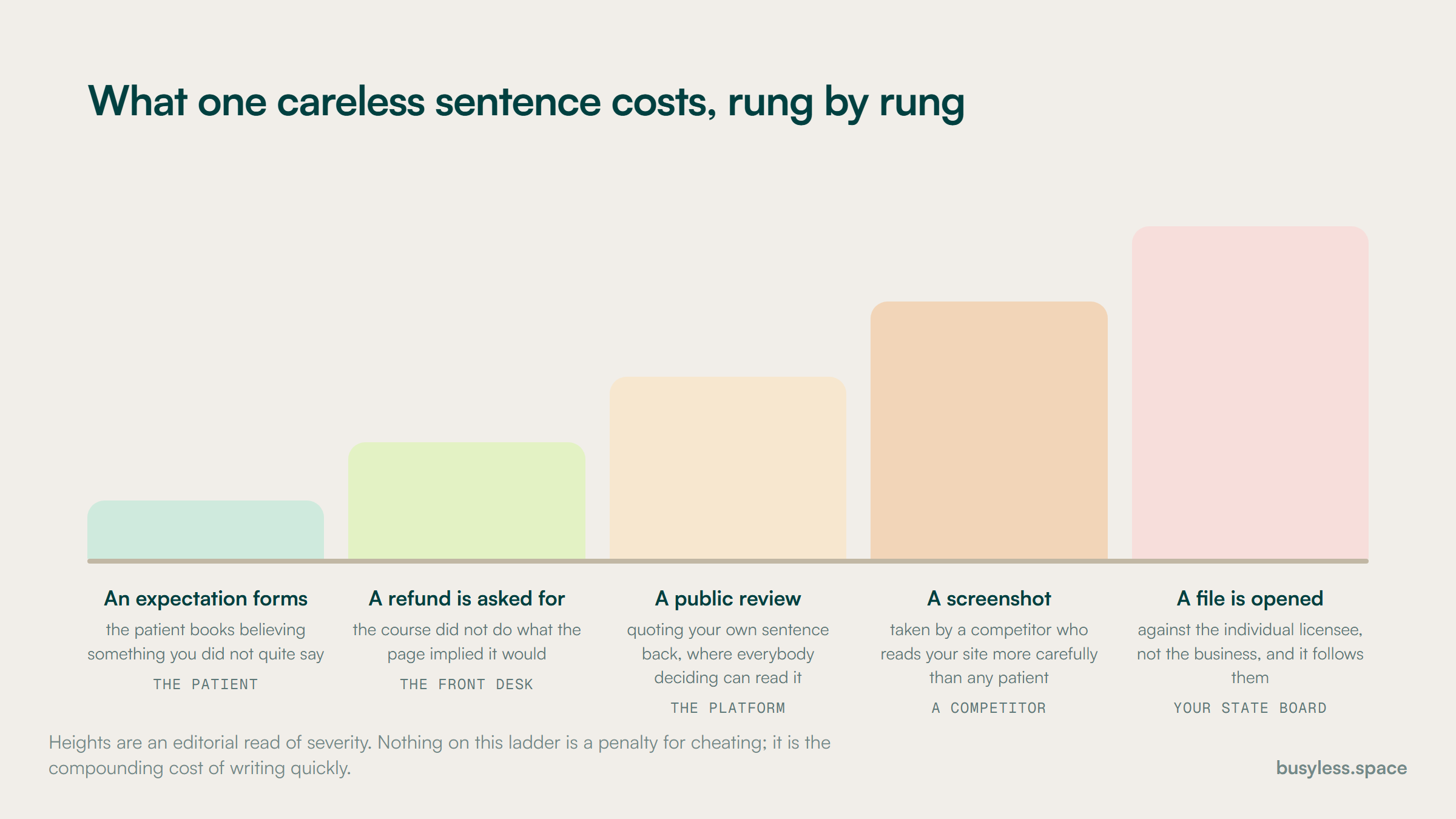
Five rising steps from a patient forming the wrong expectation, through a refund request, a public review, a competitor screenshot and a board file opened against the individual licensee.
Nothing here is a penalty for cheating. It is the compounding cost of a sentence written quickly.

What to measure

Two adjustments make this honest. Count new patient appointments rather than form submissions, and report whether patients complete an initial course of care, because acquisition and delivery look identical in a traffic report and are not.

Leading indicators

Move first. They predict, they do not prove.

  • Local pack position across the catchment

    Geo-specific checks from several points

    Measured from where patients travel from rather than from the practice. Visibility falls away within a mile or two, so a single check at your own address is close to meaningless.

  • Profile calls and direction requests

    Google Business Profile insights

    The fastest indicator available and free. In this category a large share of bookings still start with a phone call after reading the profile rather than the website.

  • Impressions on presentation and fee clusters

    Search Console, filtered by cluster

    Deliberately excludes the general condition terms, which are conceded. These move within about two months of the pages existing because so little competes with them.

  • Reviews received and answered

    The profile dashboards, checked weekly

    Track the answer rate too. In a category where the decision involves trust in the profession itself, the reply to a complaint is read more carefully than the complaint.

Business indicators

The ones a manager acts on.

  • New patient appointments

    The practice management system

    Not form submissions, which include existing patients, rescheduling and people who never arrive. The gap between the two is usually large enough to change the conclusion.

  • First page seen by new patients

    Analytics joined to the booking record

    The report that decides what to write next. It usually shows the fees page and the first-visit page doing more work than anything written about conditions.

  • Initial course completion rate

    The practice management system

    The number that separates a marketing problem from a delivery one. Strong acquisition with poor completion is not fixed by more new patients, and only this metric shows the difference.

  • How far out the diary is booked

    The appointment book

    An operations number in a marketing report. Past a couple of weeks, additional demand degrades care for patients already mid-course, and the honest recommendation that month is to hold.

The verdict

Chiropractic is the tightest wording problem in this directory. Four readers assess the same sentence, two of them can act on it, and the most persuasive phrasing is usually the one that fails at least one of them.

The way out is not careful hedging, which reads as evasion. It is writing about what happens instead of what results: the assessment, the appointment, the course of care, the fees, the point at which you would refer.

That turns out to be what a hesitant patient wanted anyway. Almost every high-value page in this playbook can be written without a single claim about outcomes, which is both safer and more convincing.

So the useful thing to ask about any chiropractic SEO services proposal is what comes before the writing. A claims audit does, and a plan that opens with content has skipped the only step that makes the content safe to publish. Anybody offering SEO services for chiropractors should also be able to say who will review each page and when.

FAQ

Chiropractic SEO questions

  • What can we actually say about what treatment achieves?
    Less than you want to, and the way out is to write about what happens instead. State boards constrain claims about results, and the FTC's Health Products Compliance Guidance from December 2022 applies a substantiation standard to services as well as products. Describing the assessment, the appointment, the likely course of care and the point at which you would refer is permitted, checkable and more convincing to a hesitant reader.
  • Should we keep the condition library our website vendor supplied?
    No. Those pages appear on hundreds of clinic sites, they frequently contain outcome language nobody at your practice chose, and they compete with national health publishers on the general question, which they will lose. Ten presentations written in your own words from your own case load, with a named reviewer and a date, will outperform forty borrowed ones.
  • Can we say we accept Medicare?
    Be careful where you say it. Medicare Part B covers manual manipulation of the spine to correct a subluxation and does not cover the examination, X-rays you order, massage, electrical stimulation or maintenance care. A badge sitting near a list of those services implies coverage that is not there. Write the coverage position out in full instead; it wins a search cluster and removes a reception conversation.
  • What is the single highest-leverage change we could make?
    Put a named clinician and a review date on every clinical page, in the visible copy. Health content is judged on who produced it and whether it is current, and a board complaint asks the same two questions. It takes about a minute per page, almost no clinic in any market does it, and it is the cheapest credibility available here.
  • Can we publish patient testimonials?
    Check your own board first, because the answer varies more on this than on anything else. Several restrict or prohibit testimonials outright, and a testimonial describing a result is an outcome claim made through somebody else carrying the same substantiation burden. Where they are permitted, prefer ones about the experience rather than the outcome, which persuade a nervous patient more anyway.
  • Should we write about back pain generally?
    Almost certainly not. Those results are held by national health publishers with clinical review teams and by hospital service lines with local authority you will not match. What they cannot write is the specific presentation you see every week, described in the words a patient actually uses, from your own case load. That cluster is winnable and nearly unoccupied.
  • Why does the structured data advice here say to use less markup?
    Because marking a treatment up as a therapy indicated for a condition is an efficacy claim in machine-readable form, and it is precisely the claim your board constrains and the substantiation standard reaches. Describe the service, the provider and the price instead. This is the only playbook in this directory where the honest recommendation is to leave a vocabulary out.
  • What does chiropractic SEO cost?
    The tiers above are editorial estimates rather than quotes. A practice running a real programme is realistically at $800 to $3,500 a month, which is low for this directory because the winnable pages are short and local. The cost people underestimate is clinician time to review the wording, which is also what makes the pages defensible.

Run it yourself, or have someone own it

Everything above is written to be run without us, and the free path is genuinely most of the value for a single-location business. Where these plans stall is almost never the plan. It is that nobody owns it after the first month. That is the job we do, with search as one distribution layer inside a wider system rather than the whole engagement.